Below is a reconstruction of the 2025 39 CQ QRS RagChew newsletter designed to support full text searching. This reconstruction was built using OCR, and will contain errors.
To view the Mailchimp original, click here. To search the entire newsletter archive, click here.
Contents
- CQ QRS RagChew
- Masthead Image
- New Team Members
- Reports
- Website
- Post Morsum-24th September 2025
- On My Workbench
- CW on the 2 Metre Band
- This Week’s Topic of Interest
- propagation.
- Three Cheers for Modern Maaic !!
- Head Copy Practice
- Other News
- Morse Training Net
- A Note from Chris’ Mother
- Best Regards
- Reverse Beacon Woes
- Readable Five
- Antenna Modelling
- Prosign/Character/Signal of the Month
- Di-dan-al-aan-ait
- Next Tuesday’s Net
- Post Morsum
- Articles
- Teamwork
- About the CQ QRS Net
CQ QRS RagChew
Yet another sensational CQQRS Slow CW Practice QSO net on Tuesday – at least 41 of our QRS family were on air, working 65 different stations!
I love to read the positive report comments (below) – so many people having so much fun, some reporting the bands on fire, some unable to find a quiet frequency to call CQ, others hearing nothing! Isn’t radio communications fun?
To a more serious matter – I hear tell that one of our most prolific family members Jordan VK3ACU came a cropper on his beloved motorbike this week and was seriously injured!
Wishing you a quick and hopefully pain-free recovery Jordan; I’m sure I reflect the thoughts of the brigade of team members who you’ve worked and helped on our net. Hope we hear you back on air and out portable again very soon mate.
This week’s RagChew newsletter is again just brimming with interesting reading – once again a huge thank you to our barrage of contributors – and again, I had to knock some back to next week – what a great team – phew!
Thanks especially to Patrick VK2I0W, with the assistance of Nigel G4RW’s software for assembling the reports that you’ll read below.
Thanks also to John VK2RU for building the head- copy exercises again this week, and to Richard VK6HRC for running and reporting on the Wednesday Post Morsum call-back.
Thad a quick skim through the YouTube video of the Yaesu FT-101 re-build from George VK2A0E (see below) this morning; George mentioned that he used a little box callled a TinySA – both a near DC-to-daylight spectrum analyser and signal generator with a four-inch touch screen.
But importantly, the signal generator had a calibrated output, so he could dial up a 50 micro-Volt signal to check the S-meter calibration etc. I ordered one on the spot! I’ll send you the bill George!
One of this week’s articles by Ross MONNK explores a possible explanation for the success of Long-Path UK to Oceania propagation – interesting new ideas that I’m hoping will stimulate some discussion.
In another article, Ross opens up an opportunity for us to re-establish CW on 2m – it used to be a thing – but there’s very little activity these days, outside of the occasional contest and field day.
But what if we had some of our SOTA (and even VKFF PARKS) team investigate these tiny transceivers, that with a firmware change could replace the usual 2m / 70CM hand- helds that many activators carry already. Thank you Ross – we might start a movement!
Oh, and speaking of portable ops, below John VK2RU reminds us about an easy-to use portable antenna modelling website – simulation adds an very interesting twist to the joy of portable HF antenna experimentation.
Masthead Image
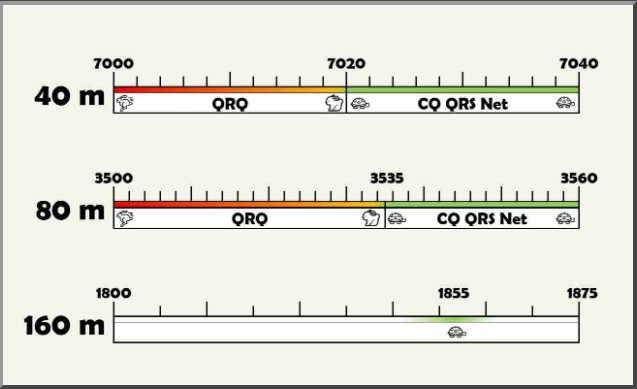
Thanks this week to Lance VK7TO for this work of art shown above! After Lance discussed non-QRS operations on Tuesday evenings with others, there appeared to be some confusion about operating QRQ in the CQ QRS Net segment.
To help, Lance has put together these nice CQQRS Net band plans to help nudge participants in the right direction. Thanks mate!
New Team Members
Welcome this week to Calvin VK3CAL who lives at Koondrook on the Murray River between Echuca and Swan Hill. Calvin has recently started his CW journey and is keen to get a bit of help from our team along the way.
Calvin’s mate George VK3ALC from Keysborough (Sounds like a great location for CW George!) has also joined the team this week. Welcome guys and great to see that you were both on the net on Tuesday; you’ve pushed our family membership to over 230 now!
Reports
After next Tuesday’s Group, please send me a list of who you worked and / or who you heard using our web form here:

Please help attract new and old team members to have a go by submitting your repo! each week. Submissions close 1300 (Eastern Australian time) on Thursday.
Website
If you’d like to find out a bit about our net, or would like to pass information to others about our Tuesday get-togethers, here’s the link to our website.
Bit.ly/CQQRSWebsite Cheers, mb Mark Bosma VK2KI / VK6QI Beautiful South Bowning NSW mark.bosma@icloud.com non impsditi ratione cogitationis
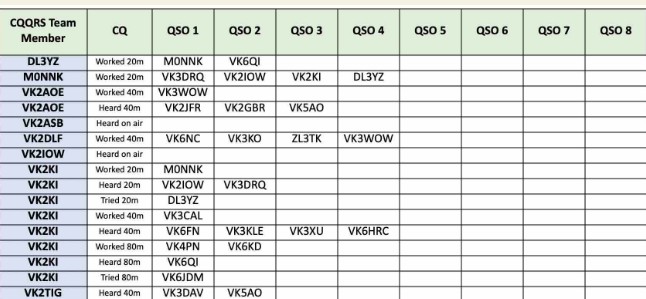
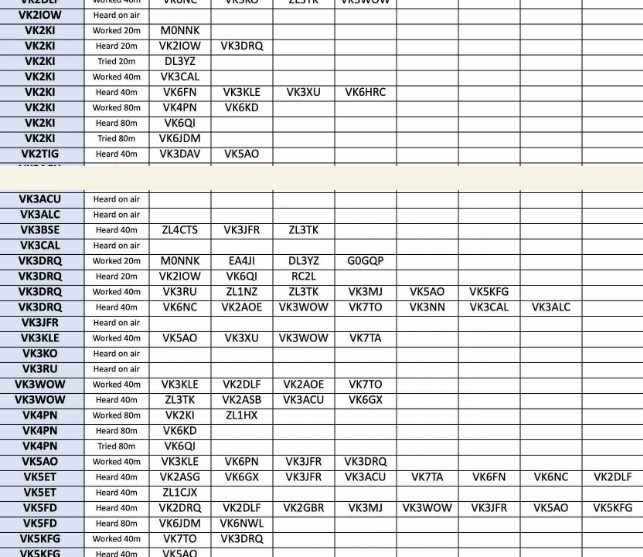
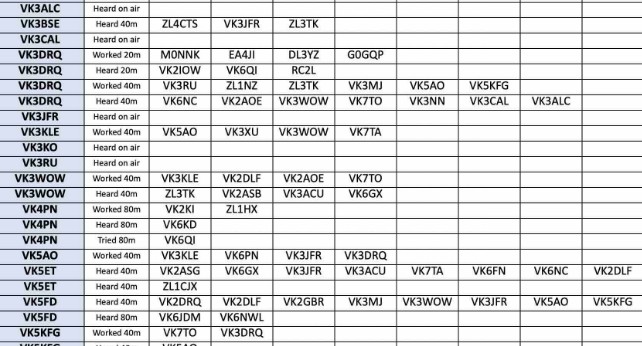
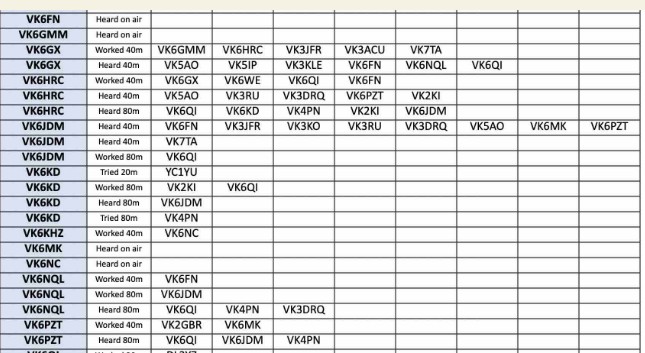
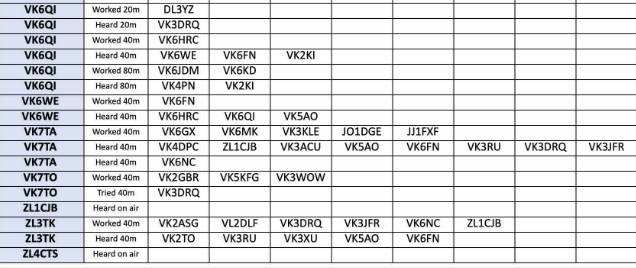
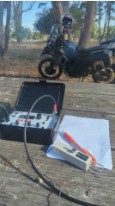
This week’s comments from our webform reports have been compiled for us by Patrick VK2IOW; thanks Patrick.
[20m] This morning I had some appointments in the office, so I wasn’t able to be on air for a proper shift. In a short break, I just turned the radio on and caught Ross on his last beeps for today. So I just send him a short greeting.
After our brief exchange, I heard Manny – VK2DRQ calling me. And after our nice little QSO I heard Mark – VK6QI’s signals and we did a quick exchange. Thanks for the fun 🙂 Hope I can be on air for a full shift next Tuesday.
Have a great week and enjoy spring time! Mike – DL3YZ
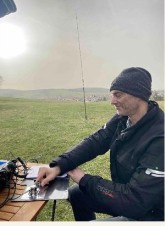
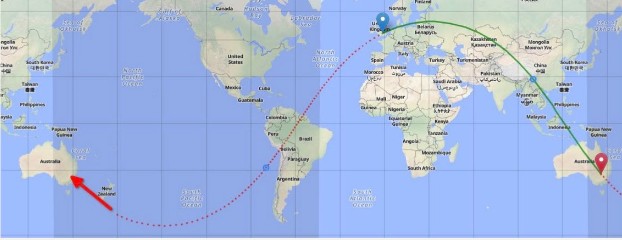
[40m] Quite few stations on 40MTS between 18:00 – 18:30 local S.A time.
[80m] Early night, only listened on 40 until 10:00 Z. 20 mts very noisy earlier on.
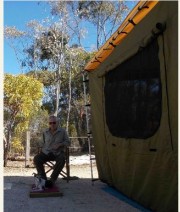

From Donald VK6JDM at 20 west of Esperance
[40m] The whole CW segment of 40 was on fire. At times with a 250 Hz wide Collins filter switched in there were three stations in the passband.
[80m] 80 was quiet as a mouse but I could hear a lot of international stations using SSB so the potential was there. Spoke to the fearless leader who took so many us down the path o CW on 80.
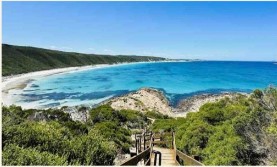
40m] Great signal to ZL from vk6 tonight
[80m] I had no luck on 20m to Europe. I’m home too late to catct the long path window. However, my signal was getting intc North America. So NSOE and NG2E answered my CQ – instead.
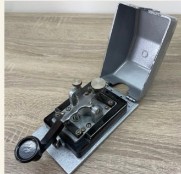
[40m] Only stations on 40m I could copy were flying along too fast for me.
[80m] Propagation appeared to be quite good but a lot of QSB from VK2 and VK4. I tried Sava VK4PN on 80m but my signal was coming into VK4 too low for a sig report.
[40m] I had a quick listen at 1730 and the only sigs heard were too weak to copy. I called CQ and got no response. When I came back later in the evening I could hear more activity.
The two Japanese stations (who were pretty weak here) may not have been official net participants, but they were sending at moderate speeds.
[40m] ” Heard Richard VK6PZT calling and was about 23 to give him a call but a message came up on x3 WhatsApp letting us know he had gone off to Cz 2@m so missed out. F:
[40m] Low QRN on 40 here tonight (but high QRN on 80 for son reason). QRP with the QMX+ (which, incidentally, pretty accurately decoded the QSO between Mait and Manny as it progressed. Splendid fists gentlemen!)
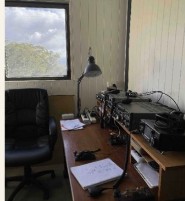
[40m] _lonly managed to get on a bit later this week, but quickly found Philip, VK2GBR. It’s always a pleasure hearing the musical rhythm of his bug. Next up was Greg, VKSKFG with his most impressive 3 W signal into Hobart.
I finished off the evening with Peter, VK3WOW. It’s been just over a year since our last QSO, so nice to catch up again. |
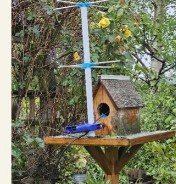
From your editor Mark VK2KI at Beautiful South Bown
[20m] Well a historical moment for me using my VK2 station – finally, finally, finally worked Ross MONNK/p! I’ve worked him many times before via the VK6SR, Summerland Radio Club and DL3YZ remote stations, but never direct from here in NSW.
Ross was clearly pleased as well that we got through at last (I could tell from the cadence of his keying – HI!),
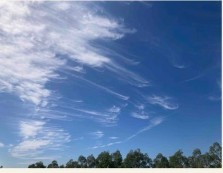
• ven though he reported RST 529 but I gave him RSN 311 in return with QSB taking his dits and dahs from nicely Q5 to down below the noise. Woo hoo! Thank you for your persistence Ross – so it can be done with simple wire antennas at both ends.
[40m] I was distracted by the VK6 Remote and dinner, so I didn’t get to chat to anyone at rush hour this week. However, late in the evening I noticed a nice QRS signal on 7020KHZ – and was pleased to work Cal VK3CAL who from the sounds of things was having a go on air early in his CW learning journey.
Cal was struggling a bit with my signal, so I tried to call in the Meredith QRS specialist Jordan VK3ACU via WhatsApp – however, being around 2230, Jordan was sensibly, horizontally polarised.
Needless to say, I flashed off an email as well, inviting Cal to join our happy team. Mike DL3YZ came up for a quick chat to Ross on his way out the door heading to work… but I tried anyway! No luck from this side of the country.
[80m] On 80m I heard Donald VK6JDM and gave him a try – no luck across the desert sands this time. I did hook up with Sava VK4PN who reported that he was worn out having spent the day helping his son in the garden; I think he needs more practice – plenty of weeds down here mate!
After Sava I worked David VK6KD – tough going though RSN 311 with QSB, so we reverted to the VK6SR remote for a more relaxed chat.
Also from your editor Mark VK6QI via the VK6SR Remote HF station at Jandakot and the VK5PH KiwiSDR network at Ironstone Range, just East of Adelaide
[20m] I noticed that Mike DL3YZ was coming through nicely into WA when he was working Manny VK3DRQ – and I was pleased to send him an RSN 311 in QSB, and received RST 529 in return. Hope you weren’t too late getting to work Mike!
[40m] Great to hook up with one of our WA Directors, Richard VK6HRC, via the VK6SR Remote.
Doctor Donald VK6JDM near Esperance was coming through nicely to the VK6SR Remote at Jandakot when we hooked up. Funny to realise that it had been seven months since we chatted last!
Donald teaches rural medicine up in Kalgoorlie, and after he asked how I was, I had this funny vision about conducting GP consultations via CW – I guess that’s what happened in the days before voice communication with outback stations via the RFDS network….
All while pedalling the generator as well! Anyway, it was nice to chat anain
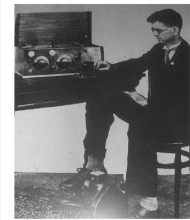
Again. I rounded out the 80m session with a nice follow-up chat to David VK6KD at Ballajura before heading to bed… via 40m… and then the kitchen – where I managed to drop a full bottle of white wine vinegar on the tiled floor in the pantry! What a mess….
And so much fun trying to clean up the glass and wine from the floor, walls, shelves, sneakers, trousers, socks and the cat around midnight! Phew!
[40m] I was only able to put in a couple of hours on 40m. It seemed like a very slow start to the net on this side of VK. Some good signals from eastern VK, but no ZL’s heard this week.
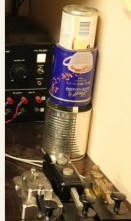
[40m] took my newly pimped, venerable Yaesu =T-101E out for its first spin. The newly itted CW crystal filter worked a treat and 10 smoke came out! I worked Peter VK2WOW and we had a fine old QSO, 2xchanging antenna info.
It was a school night, and the term has been unrelenting, 50 I only had the one QSO but it was a Sy yn a Le TIT a VW =
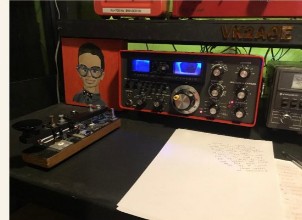
[40m] ‘Twas a night for sandbagging with enough signals above the noise, both VK and ZL. Does anyone know what the signal on 7039 is about? The transmission is continuously sends kkkk kkkk kk} etc.
[20m] OM Ross MONNK was not so strong, only 321 but when OM Mike DL3YZ came in, which surprised me, he was 441 with little QSB. Thanks to both of you and let’s keep on trying!
‘ Extremely, QRM because of so many operators, which is y unusual but nice to hear. For the first time I found it hard to find i a clear spot where to call CQ QRS. When I found the spot, it was almost non-stop.
Unfortunately, I couldn’t stay too long because this morning was a very early start for me. My apologies if anyone was waiting for me.
[80m] Again very late to join the QRS Net. Got on air at 21:50 and went straight 80 m, pretty quiet, I mean no signals but plenty of noise and QRN.
Logged on the trusty Ironside SDR to see if I could spot anything on the waterfall, there was a weak trace at 3554 kHz.
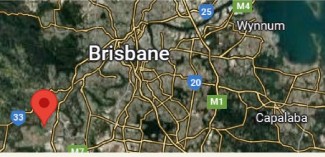
Tuned on that frequency and did not hear anything just warbling noise at S9. That particular frequency is obliterated with noise from somewhere in the neighborhood. The trace changed from pale green to solid red and I could copy VK2KI ina QSO with VK6KD.
I moved 5 kHz lower to clear the noise and started calling CQ. No takers but I could see VK2KI and VK6KD still chatting.
After about 15 min and when traces at 3554 kHz vanished I think I heard VK6KD responding but the signal was feeble and my noise was still $8 peaks. Sent QRZ and did not hear anything back. Than VK2KI called me and we had a bit of a chat.
Mark was strong at times but fading frequently into the noise, even if he faded to S7 I would lose only fragments his over and managed to make sense of what he was sending. Advantage of slow Morse you do not miss much during fades or QRN burst.
I thought this would be the only QSO for the evening but kept calling CQ as my signal was strong into Ironside SDR and I was also picked up in ZL by the Reverse Beacon Network. At about 22:4 I was stunned by a call from ZL1HX booming in at 599+.
We had a nice QSO with great signals both ways. Bow in fact was on the way to bed when he heard me calling and stopped for a quick chat so I did not hold him too long it was almost 1 an in ZL. Hope to join QRS net a bit earlier next Tuesday.
Post Morsum-24th September 2025
From Richard VK6HRC five checked in on the South West repeater and AllStar/Echolink hub.
VK6QI. = Mark VK6KD David VK6FN Max VK6HRC VK6MRB Mulligan SWL and others.
Ue el Mark managed to catch up with Ross MONNK/P on 2m but not so lucky with Mike DL3YZ. On 4m a new station was worked and Mark is hoping we will have another regular on the net.
From VK2, Donald VK6JDM was heard on 82m but a contact was not completed unfortunately. On the upside contacts with VK6KD David and Sava VKAPN were successful. On the VK6SR remote in Jan- dakot WA, Mark worked Donald and David.
David worked Mark VK6QI on 82m tried to work Sava VK4PN but was not successful due to QSB taking signals down into the noise. On 4m tried to work an Indonesian station but was not successful there either but another station called in at a rather rapid pace.
Unfortunately did not respond to David sending QRS and disappeared into the ether ! Max worked six stations on 4@m using the Flex Maestro working really well with the new battery.
He is also looking forward to getting more antennas up in the air with more conducive weather on the way. had four good contacts on 4@m tried on 8@m later to no avail. In SWL mode it was great to follow on with a lot of signals in the
Was great to follow on with a lot OF signals in the waterfall to choose from. A big thank you to all on last night and this morning. Stay safe Richard.
On My Workbench
CW on the 2 Metre Band
• S Se 2 2S Oe ee Se Se ee ee eee ee by Ross MONNK This is something that’s not strictly relevant to the QRS Net… But it was super chea to put together, very compact and portable, and might be great fun if I can find someone to QSO with.
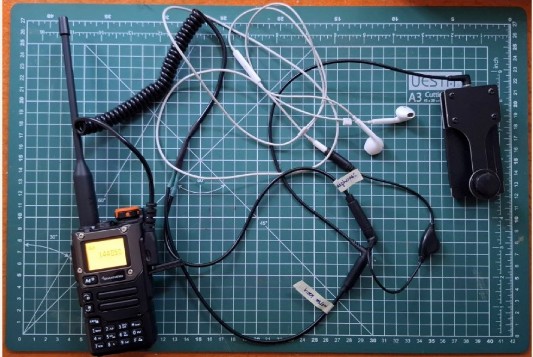
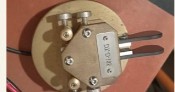
• Quansheng UV-KS radio: 144.050 MHz is the UK VHF CW Centre of Activity © Firmware: IJV version 2.9R5 (enables CW mode) @ Homebrew wiring hamess for earphones and morse key © Headphone signal is very strong (intended to drive a speaker?) so I use an in- line attenuator © Flat pack straight key (improved Mk2 version) by MOBMN The UV-KS is a VHF and UHF FM radio; it must be an SDR (that’s why I could flash new firmware to it).
The firmware enables CW – forming and transmitting the keyed cartier (it’s not MCW (keyed audio) so presumably it does the same for receive demodulation).
2m CW is a slowly growing corner of the hobby in the UK, although it does seem to have a toe-hold in California and tech spreads out across the world from there. If you want to see a young lady making a great job of it, I can recommend this video.
One thing I can say with confidence, though, is that I won’t be having any CW DX QSOs with Aussie operators on 2 metres, regardless of how good the propagation is! Thanks Ross.
This device opens up a very interesting option for SOTA and VKFF Parks CW fans who don’t have time to set up an HF station, but can use the parksnpeaks.org website to notify others nearby of their activation.
I don’t even know if there’s a CW frequency on 2m in Australia any more – HI
If you have an article or two that you think might be of interest to our readers, please let me know so we can share more thoughts and ideas; for guidance on writing for RagChew, see Articles below. Please email material to Mark VK2KI: cqqrsnet@gmail.com

This Week’s Topic of Interest
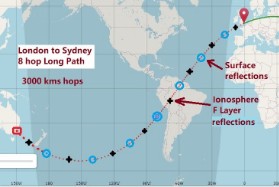
Copied shamelessly from this website. We’ve been having great success with EU-VK DX via The Long Path, and very little success when working The Short Path. So, why are Long Path signals consistently stronger than Short Path signals?
This could be because the Long Path runs mainly over salt water, reflecting off that surface with less attenuation than off a land surface.
But that whole “multiple reflections off the surface” thing has never seemed credible to me – with six or seven bounces there would be just too much aggregated
propagation.
Chordal Hop propagation is when a signal bounces along within the ionosphere, never touching the surface and thus experiencing much less attenuation. We’te all amateur radio operators so now comes the Science part.
It is significant that our Long Path signals spend most of their journey in the night time area of the earth. Chordal Hop propagation uses the night time “F-layer – when the F-layer loses its ionization density and its ability to reflect signals back to Earth.
At these times, the F-layer may be just dense enough to reflect the signal but at a less steep angle, causing the signal to hit the F-layer again as the layer dips down around the curvature of the earth. A bit like laser light in a curving fibre optic cable.
So, how does the signal mysteriously know when to drop out of the ionosphere and down onto Australia or Europe? Simple – the signal passes from night into day, where the F-layer becomes more reflective, directing it downwards rather than horizontally.
We all know that propagation is not well understood so it’s no surprise that there are alternative explanations as to how Chordal Hop works.
It could be that signals travel within the F-layer, curving in a duct rather than internally reflecting within the layer. Or that signals bounce between the F-layer and a Sporadic-E layer. Your guess is as good as theirs.
In any event, something good and magical is happening (which is a rare event these days) so I’m going to take off my Full License holder hat, throw it up in the air, and call out:
Three Cheers for Modern Maaic !!
[Really interesting postulation Ross – thank you. Couple of observations for our readers to think about and hopefully add-to svp: + The weak F-layer is an interesting thing to think about.
Probably easier if one was to think about propagation in terms of refraction (bending as the EM wave travels through the ionosphere) versus reflection. Does a weaker refractive medium produce a shallower refraction compared to a more ion-dense medium?
I can’t remember that aspect of Physics – can our readers help me here? * A life-time ago in the 70s when I lived in Perth the first time, we (my father VK6SB and I VK6QL) had a three element tri-band Yagi up 60 feet – life was good!
My memory is dim, but I recall that at that time, the Short Path to the UK usually had better signals than the Long Path. So it’s interesting that you’re finding the opposite now. What are VK6 DXers finding this season?
* if the signal was being somehow ‘ducted’, what would form the lower surface of the duct? I think the E-layer would be weaker (and likely dissipated) compared to the F-layer – and I think that sporadic-E would be very rare at night.
So Ross – you’ve posed a very interesting thing to think about and do some more research on – thank you. Readers’ thoughts svp?]
What’s going on on your workbench? If you have an article or two that you think might be of interest to our readers, please let Mark VK2KI know; email to cqqrsnet@gmail.com For guidance on writing for RagChew, see Articles below.
Head Copy Practice
For anyone who has been using these files for a while, you might be finding 12 wpm a bit too slow. This week I’ve increased the audio file speed and it is now recorded at 16 wpm.
Ifyou want a slower speed, you can find 12 wpm audio files in previous newsletters. Or you can create your own MPS files from the Chapter 4 txt file at any speed as noted below. This week we start Chapter 4 of Wind in the Willows – Mr Badger.
Because of MailChimp’s size limits, I’ve split Chapter 4 into 4 parts. Each part is over 1 hour playing time @ 16 wpm. Parts 1 and 2 are attached below.
If you’d like the full chapter in a single file, you can use the complete text of Chapter 4, and convert it yourself with the Ebook2CW app — https://fkurz.net/ham/ebook2cew.htm|. I’ve made a few small adjustments to the text to keep it “Morse friendly”.
Uncommon punctuation has been removed (the Ditto CW app doesn’t recognise some of it), and contractions have been simplified (for example, we’ll becomes we will).
This week’s attachments include: + Two MP3 files (first section of Chapter 4) * Two text files matching the MP3 segments * One text file of Chapter 4


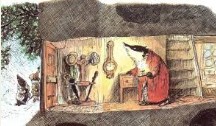
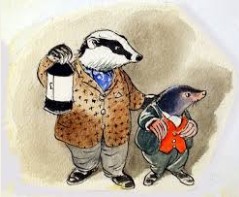

You can either play the MP3 files in any media player, or load the text files into the Ditto CW: Morse Player app — https://dittocw.andro.io/.
Both work well, but Ditto CW gives you complete control over all Morse settings, while a normal media player only allows changes to playback speed, and does that in steps (e.g. +1.25x, 1.5x, 1.75x).
Other News
Last week we looked at the new Class Licensing scheme for amateur radio in Australia. Kees, VK1KVS opened a can of worms when he sent the article to the Canberra Region Amateur Radio Club! Over to Kees:
Regarding the callsign expiry article in the last CQQRS RagChew newsletter, I contacted CRARC, the Canberra Region Amateur Radio Club, and suggested they periodically send members an email advising them to keep an eye towards any upcoming expiry of their callsigns.
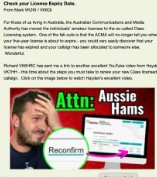
Hi Kees, You do not have to do anything. All previous licence holders are automatically recognised as being qualified to operate under the class licence. THERE IS NO LONGER a licence issued to an individual operator.
If you hold a recognized qualification, advanced certificate of proficiency or for example an “ACMA recognition certificate (Foundation)” you can be issued with a callsign (you allready have one).
Having a callsign allows you to operate under the new class licence. This class licence covers ALL Australian amateur radio operators. A call sign Is issued for life after payment of a fee (you have paid this under the old system).
You must keep your contact details updated with ACMA email etc. Every 5 years ACMA will ask you if you want to keep the callsign. IN SHORT no expiry dates, so the article is pointless.
UNQUOTE I’ll make sure my ACMA profile stays up to date, however I will wait and see if ACMA indeed asks that question when the time comes.
But thanks for raising the issue, prompting us all to familiarise us further with the portal and check our status with ACMA. 73 Kees VKIKVS, My response: Hi Kees. Interesting.
I’ve just re-listened to Hayden’s video – he says the ACMA won’t contact you to check whether you want to retain the license – but the ACMA website says it will:
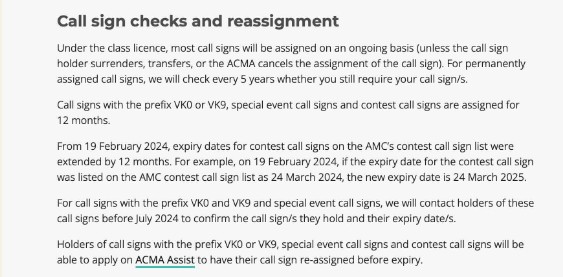
I guess the critical thing is to make sure that your email address is correct when your license approaches expiry. If not, will the ACMA write to your last known address? We don’t know of course.
There may be people who have moved locations and changed their email address who might slip through the cracks. ret sP 4
Many thanks, very much appreciated. This conforms that ACMA will indeed check after 5 years, as mentioned by my CRARC contact, but which was not stated in the video, to my knowledge (having listened to it twice).
Thanks for going back right to the authoritative source! As you say, then it becomes a matter to make sure one’s contact details with ACMA are up to date for their five-yearly check. Thanks again and all best wishes! 73 Kees VK1KVS Followed by:
I had some further communications with CRARC yesterday. They reminded me that at the beginning of last year prior to the introduction of the Radiocommunications (Amateur Stations) Class Licence 2023 ACMA sent out a letter to Australian Amateur Radio Operators.
I managed to dig up the letter I received, as attached. CRARC further advised that the proposed licence changes were also first published by ‘ACMA (2028) and the WIA news broadcast, AR Magazine, CRARC, VK1 Reflector and other sources which have published the updates to the information since then.
I indeed would have received some of the ones mentioned, but obviously as time passes one does not necessarily retain all the details.
The attached letter also addresses the call sign issue, although it is not clear if the five-year period commences from the date the call sign was first issued, or from February 19″ 2024 when the new class licence came into effect.
Short of further investigating the ACMA website as per Hayden VK7HH‘s video, I trust I will hear something in the fullness of time, whichever date applies. 73 Kees VKIKVS,
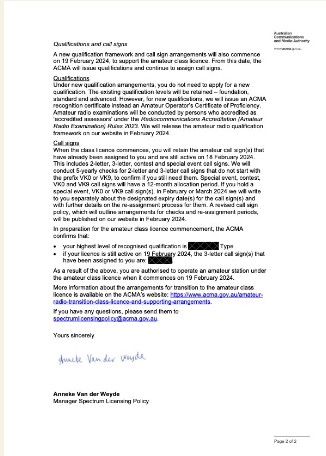
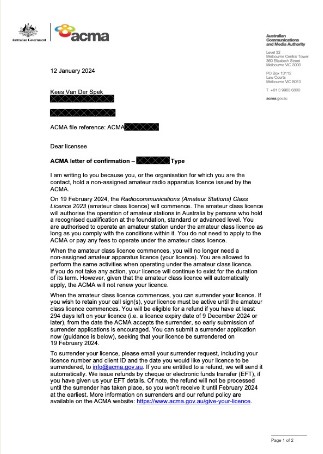
Well thank you Kees. You’re not Robinson Crusoe – I had also forgotten that the ACMA had emailed me the letter in January 2024 – it was still in my Inbox! I’ve now printed, filed, saved and who knows what else… so hopefully I can find it next time!
And yes, I’ve set myself a reminder (in my phone – what could possibly go wrong?) to check my email address just before the five year period expires.
Morse Training Net
Our team member Nic VK7WW runs an on-air Slow Morse training net every Wednesday at 7pm EDST on 3580 for 30 mins. He uses the callsign of the Northern Tasmania Amateur Radio Club VK7TAZ on that net.
Many of our team learned Morse code with the support of Nic, and the weekly training session comes highly recommended for anyone who wants to learn the Code, or simply brush up.
Everyone’s welcome – 3580KHZ at 7pm Eastern time every Wednesday; you’ll hear lots of the CQQRS team on that net. Jordan VK3ACU has recorded the complete set of lessons which you can now find here:
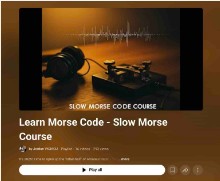
Https://www. youtube.com/playlist?list=PLHsQmZz6fBXO7swAfbTmutrbbEL17fUQL Contact Nic VK7WW for more info nicholaschantler@hotmail.com including how to join the NTARC DISCORD group to follow the action, or just come along and join in on Wednesdays.
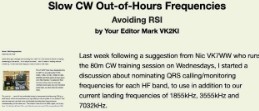
Further thoughts from Peter VK3WOW on the interesting topic discussed in RagChew editions 37/2025 and 38/2025.
| have just analysed the last 100 notifications I received from ParksNPeaks regarding POTA and/or WWFF notifications of 40 metre CW calls for these activities in our region between early August and now, in order to identify what frequencies POTA and/or WWFF operators are calling on.
As this table shows, while nearly half of all calls are being made on what appears to be at least a de facto “standard” 40 metre CW POTAWWFF frequency of 7.032, many calls are being made that do not adhere closely to such a “standard.
Indeed, a hunter who monitored ONLY 7.032 MHz would miss slightly more than half all calls being made. Despite the level of variation shown here, these data suggest that the POTAWWFF community do in practice adopt one standard calling CW frequency a lot of the time.
That being so, my own personal view is that the CW QRS community should not adopt 7.032 MHz as a standard CW QRS calling frequency, in order to minimise interference with POTA/(WWEF operators.
I concede that these data do, however, only partly support this view. With best wishes, Peter Dann VK3WOW
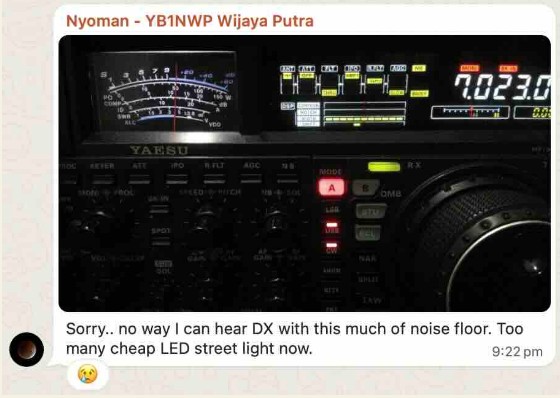
A Note from Chris’ Mother
From Chris G7BED Apologies, I couldn’t make the net Tuesday … there was another storm on Sunday whilst I was away, and this time, it damaged the fan dipole …
One of the 10m legs came off 🙂 In tilting over the mast to repair it, I knocked the brake winch off, and fell the last few feet unchecked … so the stub mast is also now broken.
I couldn’t « it back in the air for the net, but rest assured, I will send you some photos for the magazine and will try to be back on air next week. Wishing you all well, and good DX. Best Regards Chris G7BED [Bad luck mate!
Then again, perhaps good luck that no-one was hurt and there wasn’t too much collateral damage when it fell. Take care.]
Best Regards
Reverse Beacon Woes

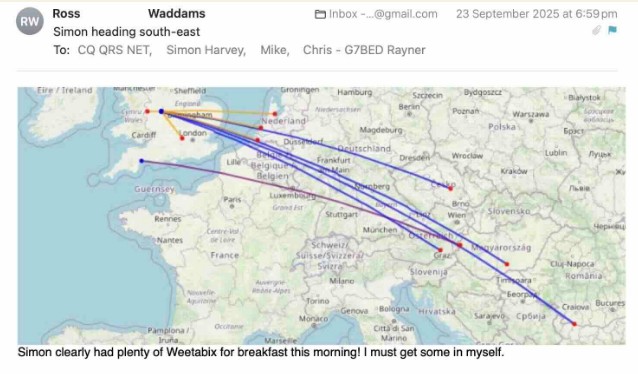
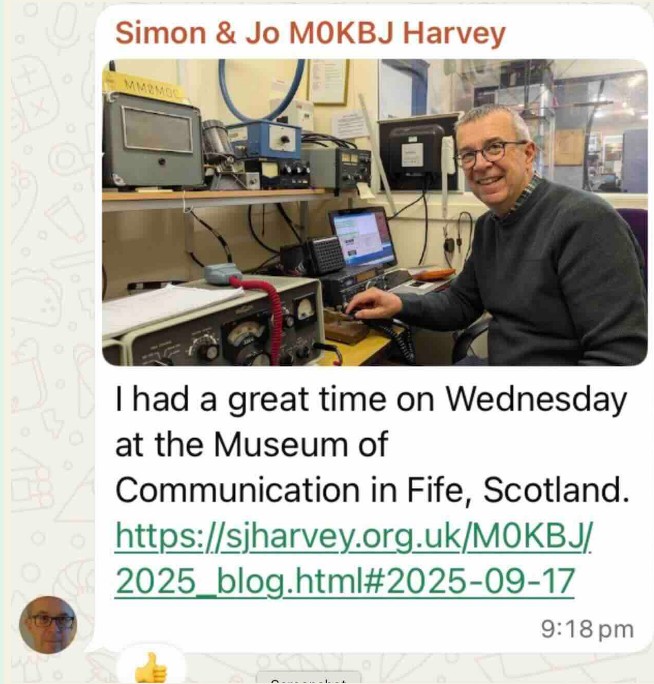
And the response from Simon MOKBJ Hi guys, Working from home I tried calling CQ on 40m, 20m and 17m and didn’t get a single response! Conditions look great but few stations were on the air.
I could hear Brian ZL3XDJ calling on 14037kHz but he couldn’t hear my replies. 73 Simon
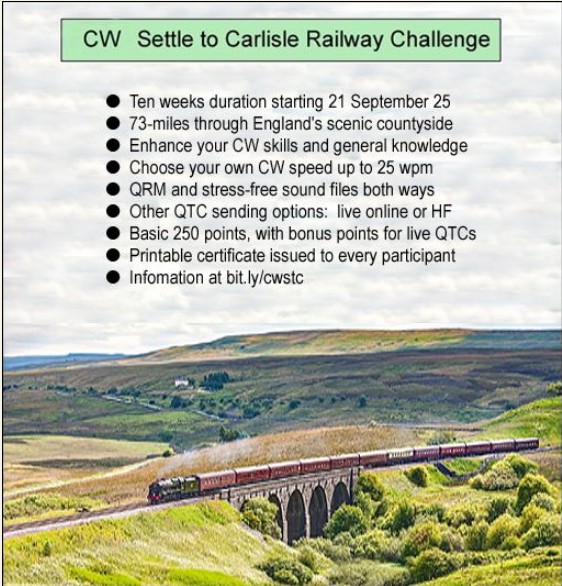
Our journey started spot on at 0800Z British railway time last Sunday. The first QTC arrived a mere 38 hours later, very well constructed and a stunning achievement. The system works!
Entrants quickly found that the journey doesn’t start from the locale one might expect, which of course was the whole idea: introduce the unexpected to establish traffic authenticity. CW traffic has always presented surprises.
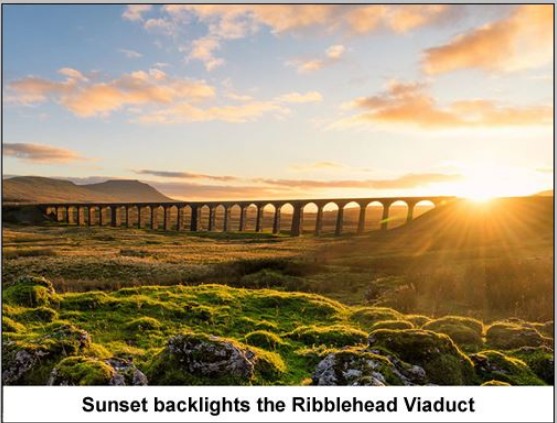
Operators were never pre-warned, its impossible to predict the content of traffic they’d be handling. Here’s a promise – next Sunday’s QNC, NRO2, we will take us on the rail journey proper, heading north to the first stop at Ribblehead to explore its surrounds and the monumental viaduct.
This is a relaxed challenge, there’s a whole two weeks in which to deal with each QNC. To reap full benefit from STC, deal with one question a day for five days simulating a daily traffic net then send all answers in one sound file or QTC – short bursts of sustained practice is the way to succeed.
Entry can start at any time during the next 10 weeks, however, the opportunity to earn the full 250 points will end when access to QNC NRO1 sound file ends on 05 October. Best not be late, ‘Morse with a Purpose’ projects are unique in what they offer.
If you have something that you think might be of interest to our readers, please let me know. For guidance on writing for RagChew, see Articles below. Please email material to Mark VK2KI: cqqrsnet@gmail.com
Readable Five
What I Have Been Looking at Lately. Compiled on the track somewhere by John VK2RU
Antenna Modelling
From John VK2RU I’ve known about MMANA-GAL for years, but this week I came across Portable- Antennas.com (see RagChew 21/2025). Here is a quick review.
Portable-antennas.com is a browser-based antenna modelling tool designed for radio amateurs focused on portable HF wire antennas.
It offers an intuitive interface for designing and simulating common antenna types like dipoles, EFHWs, verticals, Moxons, and delta loops. Users can input basic parameters and instantly view 3D radiation patterns, VSWR plots, current distribution, and more.
The use of NEC 4.2 ensures reasonably accurate simulations for typical HF applications.
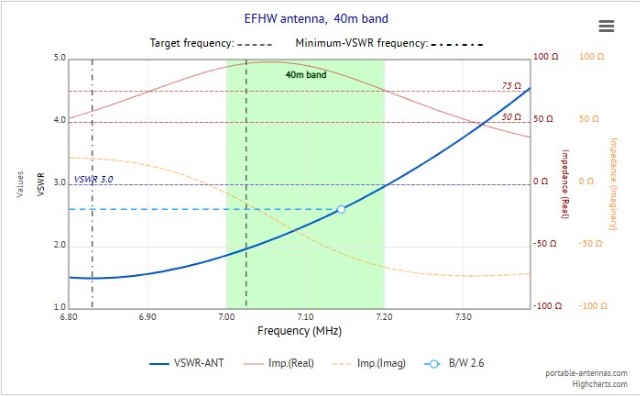
The site excels in accessibility. No software installation is needed, and it is ideal for quick prototyping or educational use. It also includes handy utilities like coax loss calculators and unit converters.
However, i’s limited to pre-defined antenna types and lacks the flexibility for modelling complex or multi-element arrays.
In contrast, MMANA-GAL http://gal-ana.de/basicmm/en/ is a powerful, Windows- based NEC modelling program offering full control over wire geometry, segmentation, and optimization.
It’s better suited for advanced users and more complex designs but comes with a steeper learning curve and outdated UI. In summary: Portable-antennas.com is an excellent quick-look tool for portable antenna design with minimal setup, while MMANA-GAL remains the go to for in- depth, custom modelling and serious optimization work.
[Thanks John. I think you’re right – the more flexible antenna modelling software packages are very hard to use. There was a good series of articles in AR Magazine in the last couple of years, but I suspect most people like me give up because of the amount of learning needed to make those programs work – portable-antennas.com looks to be a more practicable too!
If you’ve read something that you think might be of interest to our readers, please let me know so John and I can share more thoughts and ideas. For guidance on writing for RagChew, see Articles below. Please email material to Mark VK2KI: cqqrsnet@gmail.com
Prosign/Character/Signal of the Month
[Suggestion – put it on a sticky note near your key as a reminder for Tuesday. Tell us how you went!]
Di-dan-al-aan-ait
So back to the CQQRS Slow CW QSO practice net.
Next Tuesday’s Net
Our CQQRS Group will be on as always on Tuesday from around 0700Z until about 1300Z; see https://bit.ly/CQQRSWebsite and navigate to the Net Details page for details.
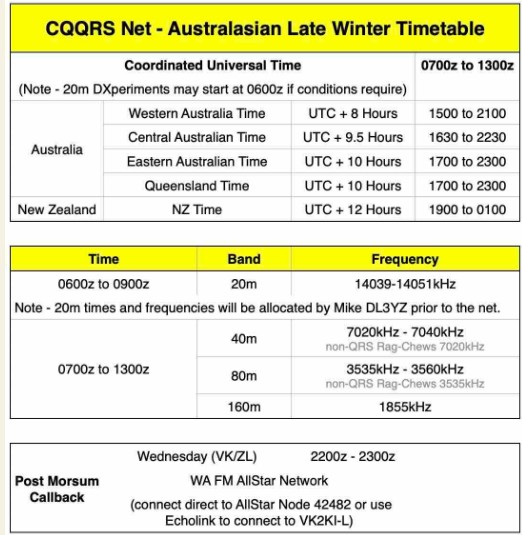
Doesn’t matter whether you’re brand new and want to try just exchanging callsigns and RST reports, or you’re ready for a good old rag chew. We’ll have fun.
There’s usually people around until after 1300Z – so keep calling in the segment of the band designated in the table below until you catch someone.
I should be on as usual from home in NSW or via the Remote at Bedfordale WA, and I’ll also be watching the proceedings using the VK6QS and Tecsun SDRs in WA and NSW respectively. Hope to hear you there.
Please let us know via our Reports form bit.ly/CQQRSNET who you work or hear on Tuesday’s Group. The report form closes at lunchtime (Eastern Australian time) on Thursday.
And by the way, a reminder; if you send me any information by email, our report form or WhatsApp – unless you specifically state that material is not to be published, I’ll assume that you’re happy to see your thoughts in the RagChew newsletter.
Post Morsum
Richard VK6HRC will run our phone Post Morsum on the South West AllStar net (via repeaters and hotspots all over WA) from 0600 WA time, then from 0700 WA time on 80m (8605 LSB).
See https://bit.ly/CQQRSWebsite and navigate to the Net Details page for details of how you can connect via Echolink or even possibly via your local FM repeater.
Articles
The newsletter is interesting to readers because of the material contributed by so many people – be it the reports each week or the various articles. Could you write a short article or articles for RagChew? You bet! Writing not your strong point?
Don’t worry, I’m very happy to help as much or as little as needed. Here’s a thought – although our readers will much prefer your own writing, perhaps have a go at using a Large Language Model Artificial Intelligence tool such as ChatGPT, Microsoft Copilot or Google Gemini to check your writing or even to actually draft the whole article in a relaxed easy-to-read manner!
You can find out more about how to do that on the Newsletter page on our website bit.ly/CQQRSWebsite. Our website also includes a suitable prompt (the command you feed to the Al to make it do what you want).
Please remember though – you must fact-check anything that an Al tool drafts for you because Als ‘hallucinate’ – ie if an Al can’t find what you’re looking for, it will make up an answer and present it as a fact!
This is one of the dangers of using Als – it’s quite probable that the tool will create a very readable and convincing draft that is 100% wrong! You as the submitter are responsible for fact-checking.
But it’s a learning experience – please let us know how you went if you had a go with this new generation of tool. And by the way – lam very concerned about our future in a world of Al – but I’m pleased to see that school and university curriculums now focus on understanding the risks – for instance, kids are now learning critical thinking something that used to be taught mostly at post-graduate level.
When the typewriter was invented, people predicted the downfall of handwriting; when the word processor was invented, the art of writing was thought to be on the way out – ditto for the spreadsheet and arithmetic, AM, SSB and FT-8 for amateur radio etc.
We can ignore Al and hope that it just goes away… or we can learn to handle it through experimentation and use. For more guidance on writing for the RagChew newsletter (including help with using an Al), head to our website bit.ly/CQQRSWebsite then click the menu on the top right and then click RagChew Newsletter.
Teamwork
Thank you so much to our team of 31 contributors: G7BED, DL3YZ, MOKBu, MONNK, VK1KVS, VK2AOE, VK2DLF, VK2IOW, VK2RU, VK2TIG, VK3BSE, VK3DRQ, VK3KLE, VK83WOW, VK4PN, VK5AO, VK5ET, VK5FD, VKSKFG, VK6GX, VK6HRC, VK6JDM, VK6KD, VK6KHZ, VK6NQL, VK6PZT, VK6WE, VK7TA, VK7TO, YB1INWP and ZL3TK.
And a special thank you to our editorial team, Nigel G4RWI (software developer), Patrick VK2IOW (reports and cattle wrangler), John VK2RU (researcher and file re-sizer extraordinaire) and Richard VK6HRC (Post Morsition). Great work all:
Thank you so much to our team of 31 contributors: G7BED, DL3YZ, MOKB4J, MONNK, VK1KVS, VK2A0E, VK2DLF, VK2IOW, VK2RU, VK2TIG, VK3BSE, VK3DRQ, VKSKLE, VK3WOW, VK4PN, VK5AO, VKSET, VK5FD, VK5KFG, VKBGX, VKEHRC, VK6JDM, VK6KD, VK6KHZ, VK6NQL, VK6PZT, VK6WE, VK7TA, VK7TO, YB1NWP and ZL3TK.
And a special thank you to our editorial team, Nigel G4RWI (software developer), Patrick VK2IOW (reports and cattle wrangler), John VK2RU (researcher and file re-sizer extraordinaire) and Richard VK6HRC (Post Morsition). Great work all! UY CW on Tuesday, mb.
Mark Bosra VK2KI/ VK6QI Beautiful South Bowning NSW mark,bosma@icloud.com non impediti ratione cogitationis


About the CQ QRS Net
For the current schedule and more information about the CQQRS net, please go the the Net Details page on our website:

The opinions expressed in the RagChew newsletter are those of the individual contributors. The opinions do not necessarily reflect that of the editor or of the CQ QRS Group members.
Any material and images received from members by the editor or published on the CQQRS WhatsApp groups may be published in this newsletter unless specifically requested otherwise.
The values, doctrine and guidelines for the Group and for the newsletter are published on the Principles page of the group’s website https://bit.ly/CQQRSWebsite