Below is a reconstruction of the 2025 38 CQ QRS RagChew newsletter designed to support full text searching. This reconstruction was built using OCR, and will contain errors.
To view the Mailchimp original, click here. To search the entire newsletter archive, click here.
Contents
- CQ QRS RagChew
- Masthead Image
- New Team Members
- Reports
- Website
- POST MORSUM 17th SEPTEMBER.
- This Week’s Topic of Interest
- Mike DL3YZ from Stuttgart
- Ross MONNK from Budleigh Salterton
- On My Workbench
- 1:1 Current BALUN
- Head Copy Practice
- Other News
- CWOps
- Morse Training Net
- CQ QRS Hand-Out Cards
- Check your License Expiry Date.
- Dubious Types
- SKCC Oceania QRS Saunter – Tomorrow!
- New Amateur Radio Regulations
- Watchable Channels
- Evil Lair Electronics
- Budget Ham Radio
- MMOOPX
- W2AEW
- Prosign/Character/Signal of the Month
- Di-dah-di-dah-ait
- Next Tuesday’s Net
- Post Morsum
- Articles
- About the CQ QRS Net
CQ QRS RagChew
Another spectacular CQQRS Slow CW Practice QSO net on Tuesday – some people had too many choices, others didn’t hear a sausage! What fun though! Thank you to everyone who contributed to this week’s newsletter.
I’ve just compiled the summary of topics above above; amazingly satisfying to receive so much input and read everyone’s comments – thank you one and all.
One of the topics of correspondence this week was the question raised last week by Nic VK7WW about landing frequencies in each band for those of us who like to keep an ear out for our team calling CQ or having a rag-chew outside the net.
In addition to what you’ll read below, I’ve also had a couple of not-for-publication responses, and I’m really pleased to see so much interest. So without further ado-ing…. here we go…. I hope you can make the time to kick back and enjoy the read this week.
Masthead Image
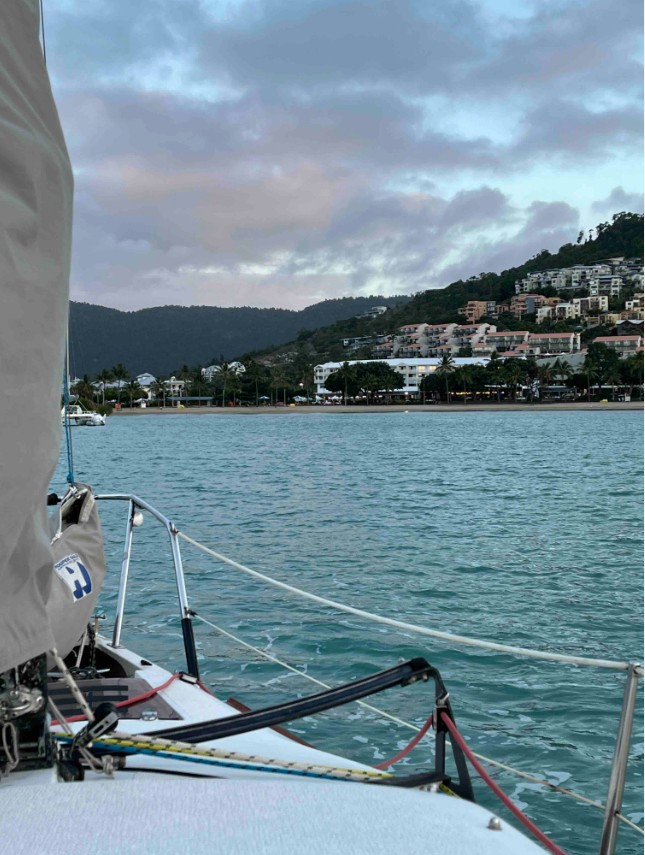
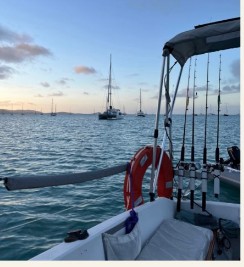
Thanks this week to Rob VK3ECH who has made his way all the way up to Airlie Beach from Echuca – towing his yacht! Listen out for Rob’s maritime mobile station for the next month or so. Send more photos mate!
New Team Members
Welcome to Ron VK7ME/VK7WRC who has joined us from Lenah Valley in Hobart. Ron tells me that he’s been licensed for about three years and heard about CQQRS from Lance VK7TO.
Ron is following in Lance’s foot-steps and is half way through the CWOps beginner course and really looking forward to getting to the part where he learns the correct protocol for QSOs etc.
Ron listened in this week on 40m; while he reported that he couldn’t follow a lot of it, he did hear a VK2 calling CQ ©.
Ron tells me that Lance has been very helpful with CW support, and looks forward to gaining more CW skills and participating in the Tuesday nights sessions. He’s even recently got the two-letter CW-friendly call sign!
Great to have you on board Ron – and yes, Lance has done very well attracting a number of new people to the beautiful art of CW. And having a go on our net is what it’s all about – mistakes, brain-fades, bloody keys that won’t send what you ask them….
It’s what we’re here for! Most of our people will slow down to match your sending speed… so when you’re ready, start at about 75% of your comfortable receiving speed – that’ll give you a safety buffer… it’s not a race or a competition…
Just a pleasant pathway to an amazingly satisfying aspect of our hobby… and a good way to meet the finest group of amateurs you’ll find anywhere!
And you’ll find more about suggested operating protocols on our website bit.ly/cqqrswebsite – then navigate to the Useful Resources and Links page from the drop menu at the top- right.
Reports
After next Tuesday’s Group, please send me a list of who you worked and / or who vo heard rieing oir wah farm hare:

Please help attract new and old team members to have a go by submitting your repo each week. Submissions close 1300 (Eastern Australian time) on Thursday.
Website
If you’d like to find out a bit about our net, or would like to pass information to others about our Tuesday get-togethers, here’s the link to our website.
Bit.ly/CQQRSWebsite Cheers, mb Mark Bosma VK2KI / VK6QI Beautiful South Bowning NSW mark.bosma@icloud.com non impsditi ratione cogitationis
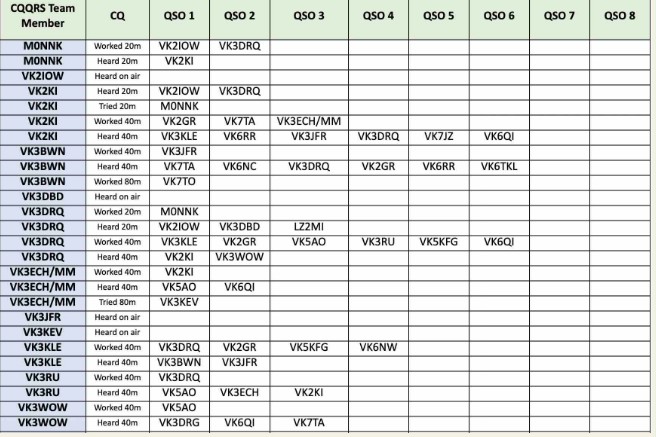
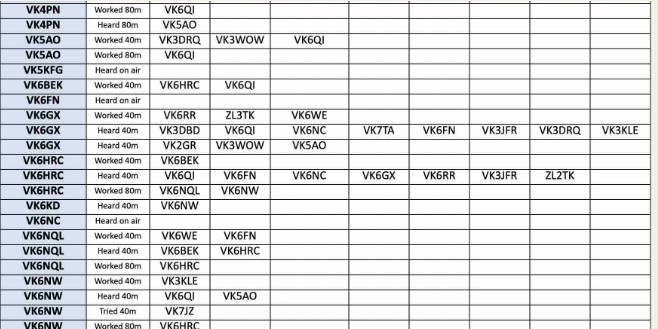
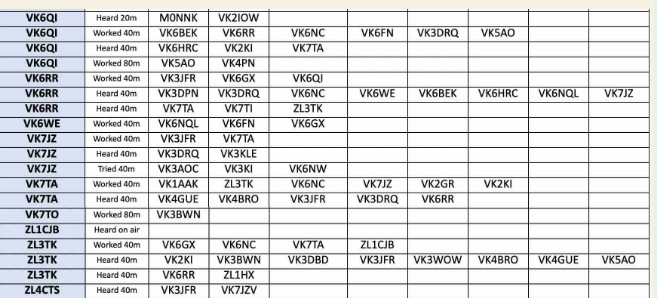
The spreadsheets above show the known stations on last Tuesday’s Group; the comments in the team members’ reports (Submitted via our webform bit.ly/CQQRSNET ) follow:
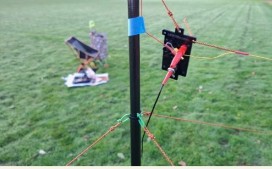
[80m] It was great to be out Portable at a local sports field, making a few contacts into VK2 on 20m. I only had 20 watts from my G90 going into a quarter wave vertical with two elevated radials.
I know I say this every time, but it really is amazing that so little can go so far.
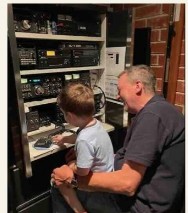
40m] ot many stations on 40 tonite and I try to at least work lanny every Tuesday night. his time I have moved some of my shack inside to the armth using an IC7000. The keyer was set up a bit fast nd I was running 100W into an unchecked antenna.
Just a it of work to do before I do that again.
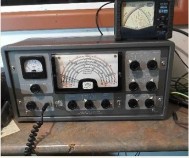
[40m] P Good conditions and enjoyable contacts, thanks so much i guys
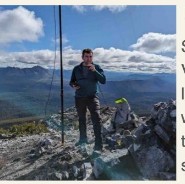
40m] ;ome more lessons learnt tonight. Blowing a gale here in /{K7, really glad that on the weekend past I ran new guy nes for my vertical antenna.
Not so glad that after last yveeks CW success (by my standards) I had tightened up he levers on my paddles to respond to a softer, more killed touch and been practicing during the week.
PSE ALLY SIE EY DEON MOE MEIN EIN AIS EMIT BE Ee ee aa started sending dit dit dit dit all on it’s own. I am trying to hold the levers apart and make the damn thing stop sending and I realised I am not the man with that more skilled touch.
I pulled the cable from the paddle and got to widening up those levers again. Poor lan VK7TA must have been scratching his head thinking the bloke on this end was an idiot. I hope to revisit that QSO with lan next week.
I could hear a few other stations but the signals were coming and going. I heard VK6NW finish up with VK3KLE and then VK6NW started calling CQ again so I responded, I heard Wayne respond to me and then I lost him in the fade and noise.
When all seemed quiet I sent QRM QRM 73 QRT. I am not sure if that was the right way to drop out early but I felt to continue on I was only wasting Wayne’s time. I heard RRR followed by more CQ CQ CQ so I think he got it. Sorry Wayne.
I was on a high after last week thinking I was coming along OK, this week I am at a lower elevation but it was nice to listen to some of the other @SOs going on and pick some bits out.
I will be back next week for sure – bring on the summer weather, I have kit ready for the non-urban places.
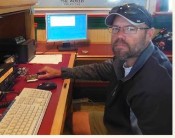
40m] elighted to work a couple of VK6S in quick uccession. VK central and east coast was unusually uiet. Plenty of Js were chattering away between .020 ~ 7.026 MHz but I’m rather too short on wabun 1ORUSU fugd expertise to get anything except call igns.
Another case of extreme asymmetry with Clive
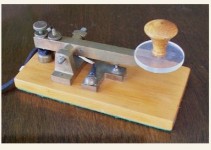
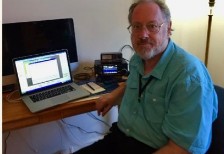
[40m] Managed only about 15 minutes on 40m. Called several CQs but no takers. I could see my trace on the Ironside SDR and on the reverse beacon net (VK2RH and VK3RASA both over 20DB SN) so I was getting out but obviously I was late.
[80m] Arrived home very late and by the time I unpacked the car it was 21:40 so I decided to go straight to 80 m. Band sounded noisy and a quick scan did not find any QRS traffic. Started Kiwi SDR (Ironside ) and reverse beacon net to see if I was getting out.
On Ironside I was the solitary trace and reverse beacon net returned report from VKSRASA. Called CQ till 22:00, no luck I was still a solitary trace at Ironside. Switched to 40m for a while but gave up after about 15 min and continued calling on 3550KHZ.
There were few faint traces a bit lower than my frequency, I tuned around all of them but couldn’t dig out anything from the noise. I was about to give up but a reasonable trace popped up at 3555.
Moved up to that frequency to check, VK5AO and VK6QI were in a QSO. I waited until they finished and called VK6QI (worked VK5AO numerous times but VK6QI would be my first QSO with Mark under that call sign).
He came back and gave me a very respectable 572 report but I was struggling to copy him at 344 plus sweeping QRM which often bothers me. The QSO was short but at least I had something for my log.
[40m] Neither 40m or 80m had much activity from my QTH. I tested both bands by logging into the Yarloop SDR but my sig was coming in very low, even at 80W TX pwr.
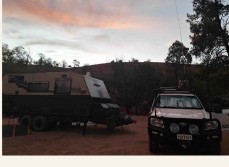
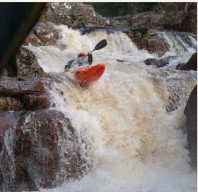
[80m] I only had a short window to get on air at 11:30Z, and with no signs of activity on 40 or 80, I dropped down to 80 and called CQ. As luck would have it, Ketut, VKS3BWN found me on my second call.
I’ve always enjoyed reading Ketut’s rag-chew reports, so was nice
To finally meet him on air. As an aside, I had a cracker of an evening last week with several new calls in my log, but the business of life meant that submitting the reports slipped my mind until it was too late. C’est la vie.
From Rob VK3ECH at Maritime Mobile. Airlie Beach Qld
[80m] A little bit of chaos onboard my yacht “By Invitation”, after catching up with our fearless leader Mark VK2KI sending CQ, then having trouble with a dodgy headphone connection, then trying to find a bearable sidetone level which was lost in the myriad of Icom IC-7100 menus.
And then after all the goings on I had inadvertently knocked the dial and wasn’t sure what frequency Mark was patiently waiting for me. I eventually found him. So thanks Mark for your patience and an enjoyable QSO. From lan VK7TA at Latrobe
Early on conditions seemed very poor, but then ZL3TK came in with a good signal. I was able to reminisce about cycling up the Lune valley and near the Ribblehead viaduct.
It was unusual for me to manage a QSO with VK7, and I had a bit of a chat Cote Pp CUP aod eer PR are ee ae vel
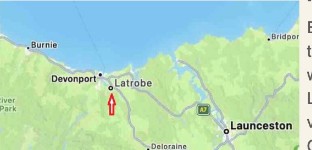
[oe es Oe) ee QSO with VK7, and I had a bit of a chat with Jim VK7JZ. I didn’t hear much from VK2, but Mark VK2KI was booming in peaking over S9. Maybe I wasn’t using a vertical last night but more of an inverted L due to the strong wind!
From Manny VK3DRQ at Blackburn (20m) MONNK OM Ross was only RSN 222 and just managed to copy him. Thanks OM Ross. G7BED, OM Chris was nowhere to be seen. Sorry OM Chris.
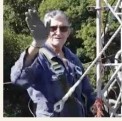
[40m] There was no sign of activity when I first tuned in but Peter, VK6NQL, answered my call and we had a nice chat. I returned about an hour later and heard several weak signals which I could not copy.
My call was quickly answered by Phil, VK6GX, but as I was responding Max, VK6FN, boomed in with a very strong signal. I was in a fix as to whom I should answer. I settled on Max who had asked me for a contact in the morning phone net.
After our QSO I saw several signals on the waterfall and I made another call. To my delight Phil answered and we had a good chat. Thanks Phil for hanging around.
By now there were more signals but other duties called and I ended one of the most satisfying sessions.
From Your editor Mark VK6QI at Beautiful South Bowning NSW via the VK6SR Remote HF station and the VK5PH Ironstone Range network of KiwiSDRs.
[20m] Ross MONNK was coming through to the VK5PH Ironstone Range KiwiSDR network better than to my home station in Southern NSW and I couldn’t hear him on the VK6SR Remote HF station South of Perth. Patrick VK2IOW had a good signal into VKS5 and VK6.
[40m] I decided to concentrate on VK6 this week, using the VK6SR Remote HF station at Jandakot, about 15KM South of Perth.
The station uses a 30m inverted-L antenna, with a 10m vertic section; the noise level on the lower bands is fairly high with the front-end preamps in the circuit, but still quite usable.
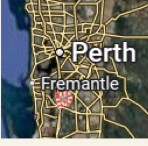
Nice to hook up with Shaun VK6BEK up at Quinns Rocks again; Shaun was one of our very early and reliable team members when we only operated on 80m, and it’s always interesting to chat to him about his endeavours to reduce the annoying switch mode power supply and solar inverter noise at his beautiful location right on the water front.
Like my QSO with Phil VK6GX last week, there was QSB on Shaun’s signal over the 50KM path at around 0800Z. I’m looking forward to some photos of the new vertical antenna set-up for the newsletter.
After Shaun I had a chat to Roy VK6RR up at Geraldton, then I was called by VK6NC; my brain didn’t register that this was the callsign of the Northern Corridor Amateur Radio Group’s club station at Whiteman Park – and I was pleased to hear that the operator was our old mate Lin VK6NT (previously VK6LIN) who like Shaun, was one of the first regulars when we were on 80m.
After Lin, I had a quick chat to Max VK6FN at Manjimup before disappearing for dinner with Ms Elizabeth. When I came back to the VK6 Remote after dinner, I had a nice chat with Manny VK3DRQ at Blackburn then Maitland VK5AO at Banksia Park (despite the gaps while my Internet Router rebooted itself several times) before we were chased down to 80m by all the QRM on 40m.
[80m] On 80m, Maitland was a solid RSN 596 into the Remote – much easier than the very busy 40m band! I then wrapped up the evening with a quick chat to Sava VK4PN who was struggling to hear the VK6 signal below his S4 noise level.
From also from your editor Mark VK2KI at Beautiful South Bowning NSW [20m}
Ross MONNK/p was in and out of the noise here – really not strong enough to exchange signal reports – he could hear me and make out my callsign, and I could hear him, but that’s about it.
I’m pleased that he got through to Manny VK3DRQ and Patrick VK2IOW though.
[40m] After dinner I had a listen on 40m – as the grey-line passed; the band Opened and closed to ENC IV IMEI it
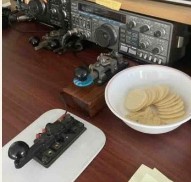
_ passed, the bana opened and closed to everywhere It seemed; one minute the VKSPH Ironstone Range KiwiSDR was full of CW signals, and the next minute they’d gone.
I had a chat to Allan VK2GR near Nowra then lan VK7TA at Latrobe – and we had a bit of fun being chased around the band by the QRM. Next I was called by Rob VKSECH/mm who sent me a quick
About 15-20 minutes later he re-appeared…. he’d gone to plug his headphones in and broke the connector! Just what you need when operating away from the workbench!
Anyway, it turned out that Rob was on his yacht way up North at Airlie Beach; pretty good to work over that distance from the maritime mobile – well done mate.
[80m] I didn’t get to 80m from home this week – having too much fun on the VK6SR Remote! But thanks to everyone who made the effort to come up again this week – well done one and all!
[40m] Thank you to the experienced operators leading the way much appreciated
[80m] Great to catch up with Peter VK6NQL and Wayne VK6NW on 8@m no others heard unfortunately.
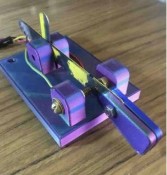
40m] Some great fun, amongst that local noise level, but the signals were in there. 80m] still need some more WAs to be on this band.
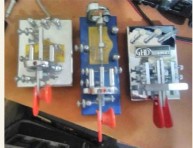
[40m] Great to have a chat with Mark again, and a 1st QSO with James, VK3JFR. Had to leave early yet again!! Getting a bad habit!!
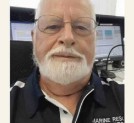
[40m] Let’s hope I get all the callsigns right. Otherwise, we may have ghost callsigns, yikes! After all the windy days of the past weeks, my guy rope system was broken.
With some helpful hints from the WhatsApp group, I found what I think will be the best solution: a washing line from Bunnings ($2.50 for 30m).
I also replaced the doublet with a large loop, as I have always been curious / fascinated with what people have said about it.
So on this Tuesday night, with the antenna half erected and a large VSWR, I went on air with it (while cranking down the output power). I was so amazed by how quiet it is, I had to ask people what they thought the noise level was that night.
Oh well, maybe it was just a great coincidence, but the noise on Tuesday night at my QTH was low! Maybe there was something going on with the aurora, but the noise sounded like a constant white noise and nothing else.
Some stations were booming into my QTH, and I thought I heard Mark VK2KI S9+60dB conversing with eat!
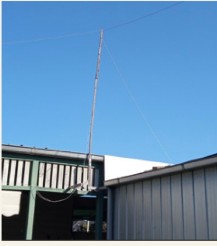
GUUS OLA, WMTIIA Wel Yb. After operating/listening with this large loop for 2 nights in a row, I conclude that it does pick up atmospheric noise, but maybe a tad lower/quieter. Hey, I will take any improvements over nothing.
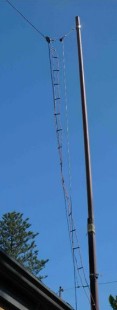
The large loop was designed for 40m, but with a very long ladder line, I think it works on 80m too. Here are the dimensions: Loop total length ~41m.
Feedline = ladder line, designed to be 450 ohms (actual maybe 250 – 300 ohms — oh well), feedline length ~ 13m into a 1:1 balun, then coax to a tuner. Thanks for reading my ramblings, and I will see you again on the air. ee Phe ee ASIF eA 2 fess) eee le
40m] 300D condx enabled a nice chat with stan ZL3TK, the best I have heard 7L over the winter period. rior to me working Stan ZL3TK, Lin /K6NT had a QSO with Stan, using he Northern Corridor Radio Group acilities as VK6NC, using a 4 hink Ctan nniild hardAh: Rolisvea hic
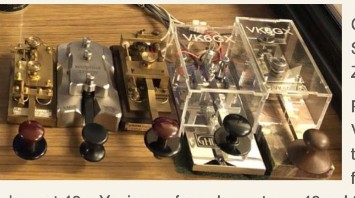
From Richard VK6HRC. Seven on the South West repeater and AllStar/Echolink hub this morning. VK6KD David VKeQl Mark VK6NW Wayne VK6FN Max VK6HRC Caught up with VK6MRB Mulligan and ZL3TK Stan before the net but they had to get on with their daily activities so monitored in the background to ensure we behaved ourselves !
David still getting to grips with new radio and computer set up had to go through the settings to get the receive levels right. Unfortunately by that time 4m and 8@m had gone quiet. Better luck next week David.
Mark tried 2@m but not enough signal for a contact. Utilising the VK6SR remote at Jandacot and from home worked six on 4@m heard three and on to 8m working two. One being Rob VK3ECH maritime mobile.
Mark was trying to get away for dinner at one stage but had a pile up to deal with first ! Wayne a bit weary after a day of firewood harvesting managed one contact on 4@ heard a VK7 and on to 89m with one contact but all quiet after that.
Still switching between the vertical and the dipole for comparison. Max won the battle with the doona and managed to catch us before we signed off.
He had fun on 42m enjoying having the Flex Maestro operational with a new battery fresh off the aircraft from Germany. [had a very enjoyable contact with Shaun VK6BEK on 4@m and went into swl mode as he continued with Mark VK6QLI.
Later on I had another enjoyable contact with Wayne VKENW on 8m hearing about his days activities also had a contact with Peter VK6NQL to round the evening off. A baie thee cine, te nll cee leceé ahekt eed thie eemening
POST MORSUM 17th SEPTEMBER.
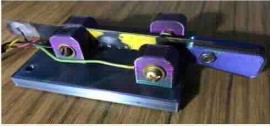
This Week’s Topic of Interest
Slow CW Out-of-Hours Frequencies Avoiding RSI by Your Editor Mark VK2KI
Last week following a suggestion from Nic VK7WW who runs the 80m CW training session on Wednesdays, I started a discussion about nominating QRS calling/monitoring frequencies for each HF band, to use in addition to our current landing frequencies of 1855KHZ, 3555KHZ and 7032KHZ.

Sev ne wt sesame dp erg win os pate new wba Td Tay caren nay wa nev nanan inceig toy ana sore i ferstie sttter atin Fonneroonanicanemaerian
Mike DL3YZ from Stuttgart
Mike DL3YZ has provided some info about what’s done in Europe, which makes interesting reading:
OE OEE NE EEE EEO Maybe this helps, but of course its only the IARU Region 1 Band Plan. But I think they are all the same, otherwise these QRGs wont make much sense. See the list below. Have made another more explicit one with SKCC / QCX..
Freqs etc , but must look for it! List of CW QRS/QRP frequencies 160M: 1838 kHz – CW QRP Centre of Activity 80m: 3.555 kHz – CW QRS Centre of Activity 3.560 kHz – CW QRP Centre of Activity 40m: 7 030 kHz- CW QRP Centre of Activity 30m: 10 116 kHz – CW QRP Centre of Activity 20m: 14 055 kHz – CW QRS Centre of Activity 14 060 kHz – CW QRP Centre of Activity 17m: 18 086 kHz – CW QRP Centre of Activity 15m: 21 055 kHz – CW QRS Centre of Activity 21 060 kHz – CW QRP Centre of Activity 10m: 28 055 kHz – CW QRS Centre of Activity 28 060 kHz – CW QRP Centre of Activity In case of 14 055 kHz (20m QRS channel ) I was happy to have it when I started being on air.
I really had a lot of QSOs on this QRG. Its very active, and there are lots of OM constantly monitoring this frequency. So calling CQ here is successful almost every time. Thats why our DXpedition frequencies end 14 052 KHz.
Above is lot of QRS traffic around these frequencies here in Europe. PS: do you know httpsi//asofinder.com ? Have a nice day 73 Mike.
Ross MONNK from Budleigh Salterton
| think that’s a good idea of Nic’s. It’s not something I personally could take part in as I’m Portable only (and I don’t have the patience) but there must be experienced guys like Nic who could maintain a listening watch.
Designated frequencies and wide time windows might be the key to drawing in the odd ditherer to the fold. My own view on QRP is that it’s best left to the experts and is bound to lead to discouragement for novices.
But personal experience with QRP has left me with a bias. I do appreciate, though, that many novices start out with low powered radios (as I did). Ross
Regarding CW listening frequencies as mentioned by Nic VK7WW. The VK QRP Frequencies are a legacy item. They were promoted when we were crystal locked, like some of my simple home brew devices today.
Most people do wander over the range now with modern radios but please use the suggested frequencies even as a starting point. At least there will be someone there! More the better. Cheers Trevor Quick VK5ATQ VK CW Ops Club.
First to calling frequencies; thanks for your observations in the last RagChew newsletter Nick. I think one of the issues facing CW ops in Australia is that there are so few of us, yet every group has its own calling frequencies.
I suspect it may be beneficial in Europe and the USA, but only serves to spread us across the bands where our calls pass one another like blinkered donkeys on a lonely road.
At a glance, we already have established calling frequencies for FISTS, SKCC, VK-QRP, SOTA/Parks, CWOps, and no doubt others of which I’m not aware.
I support using an existing set of calling frequencies rather than creating our own; whose to use becomes the question. I’ll propose the FISTS frequencies, given that their purpose is very similar to the CQQRS aims, and so anyone already monitoring those frequencies would happily participate in a QRS QSO.
I also suspect they would welcome our adopting their calling frequencies. In fact, if you read their latest newsletter, you’ll see many of the same topics discussed as in our own RagChew.
I guess in the end most of us own radios capable of scanning multiple calling frequencies; my takeaway is to create a scan group of the frequencies in which I’m interested, and try to make use of that feature more often.
Next – whilst on the topic of frequencies… 80m net sub-bands. I’ve often wondered why the 80 m segment we use is in the SSB portion of the band-plan, and not in the CW only window of 3500-3535? I eagerly await enlightenment.
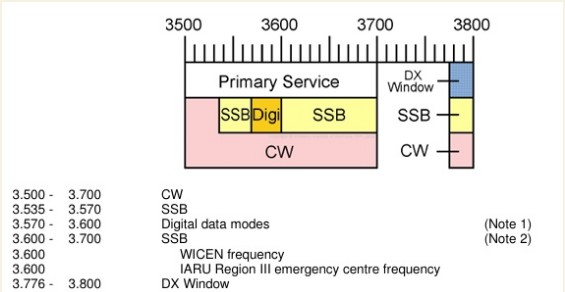
[Heh heh! Ready for another long story Lance? Here we go….. Way back in ancient history before so many people discovered the joys of our CQQRS community, someone (c’est mois!) started encouraging a group of four Peel ‘Amateur Radio Group (WA) members who were learning Morse code, to have a go on air with some slow CW.
I was using the Remote HF station belonging to our team member Rick VK6XT, which at the time was at Broomehill WA. We started on the PARG SSB net frequency (8600KHZ) and before long, more and more people started joining in….
We needed a new home – quieter, and bigger – with room to run around. The aim was to find somewhere safe, where we wouldn’t bother the DXers and other activities – where our new operators weren’t so worried about who might call them.
3540 to 3570 was tried – and seemed to work well; below the strange-sounding wobbly carriers… and no SSB nets to worry about in WA.
And 30KHZ of band seemed to be a good compromise – most people could find a quiet frequency without some odd spurious switch mode power supply (or even 15.625kHz line- output harmonic for those old enough to know what that is), and older, wider receivers weren’t assaulted by signals packed together like cotton buds.
More recently, we’ve slipped down a bit to 3535 to 3560KHZ to butt-up against the ZL net and allow for some of our crystal-locked friends to get involved. So there you go.
I could have saved you a bunch of reading by just saying we didn’t want to intimidate our new starters or offending the DXers by being in the DX portion of the band… but that wouldn’t have been anywhere as much fun to read. However comma…..
Seeing grey-line DX is relatively rare on 80m, and there’s a bunch of ZLs who would probably love to have others joining their net….
If there’s a strong public outcry about sharing with our wide-load (SSB) friends (noting that in the East, there is a Blue Mountains Tuesday evening SSB net in the lower SSB segment who we annoy), I would be happy to consider slipping down.
Standing by for public outcries…. cqarsnet@gmail.com So back to the out-of-hours QRS monitoring frequencies posed last week by Nic VK7WW.
Terrific to have so much interest in the question – including a couple of not- for-publication responses – standing by for more thoughts folks.]
If you have an article or two that you think might be of interest to our readers, please let me know so we can share more thoughts and ideas; for guidance on writing for RagChew, see Articles below. Please email material to Mark VK2KI: cqqrsnet@gmail.com

On My Workbench
1:1 Current BALUN
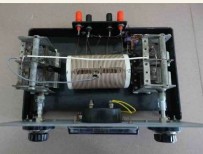
From Patrick VK2IOW The recent CQQRS Net interest in trying 160M has prompted me to find a way to feed my one-wavelength loop (horizontal – Hl!).
I considered Sava’s balanced coupler in recent RagChews, but instead decided to try building a 1:1 Guanella current BALUN. lused RG316 coax and instructions from German ham DJOIP’s website – supposed to be optimised for 160 – 80 m band.
According to DJOIP, an acceptable work- around tuner for tuning a balanced antenna fed with ladder line is to use an asymmetric tuner combined with a 1:1 tuner BALUN. So this is what I’m curious to try on the 160M band.
My balanced MFJ tuner does not tune 160M band. My old asymmetric tuner can tune 160M, but perhaps there are losses within the tuner.
Perhaps using the BALUN + asymmetric tuner would have greater efficiency than the asymmetric tuner by itsel Or perhaps it won’t be able to tune 160M – I would be substituting the inbuilt 4:1 voltage balun in the MFJ 949 E tuner, with the external 1:1 current balun – and testing to see whether or not it could still tune my loop on 160M.
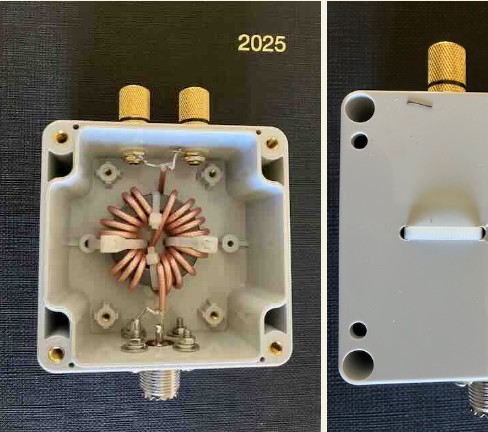
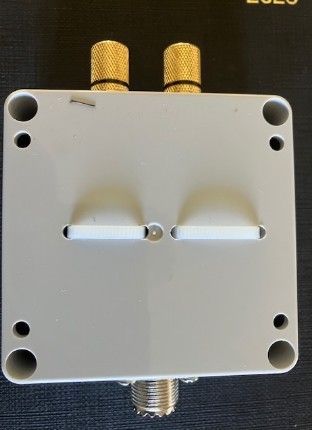
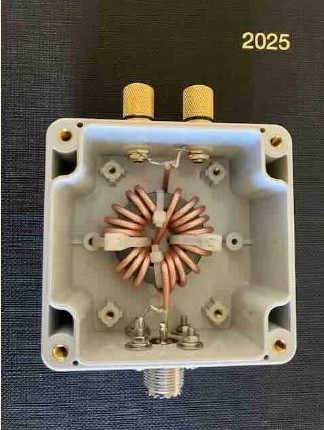
Fun and easy to build but I found the lining up and soldering of components tricky. Anyway I hope it works – I haven’t tried it out yet; I’ll post an alert on our WhatsApp group when I’m ready to test it – perhaps another 160M opportunity on Tuesday’s net?
What’s going on on your workbench? If you have an article or two that you think might be of interest to our readers, please let Mark VK2KI know; email to cqqrsnet@gmail.com For guidance on writing for RagChew, see Articles below.
Head Copy Practice
Here is the second part of Chapter 3 of Wind in the Willows — The Wild Wood. Because of MailChimp’s size limits, I’ve split the remaining Chapter 3 audio into two parts. Each part is over 1 hour playing time @ 12 wpm.
If you’d like the full chapter in a single file, you can use the complete text of Chapter 3 that was attached to last weeks Newsletter, and convert it yourself with the Ebook2CW app – https://fkurz.net/ham/ebook2ew.html.
I’ve made a few small adjustments to the text to keep it “Morse friendly”. Uncommon punctuation has been removed (the Ditto CW app doesn’t recognise some of it), and contractions have been simplified (for example, we’ll becomes we will).
This week’s attachments include: + Two MP3 files (second section of Chapter 3) * Two text files matching the MP3 segments


You can either play the MP3 files in any media player, or load the text files into the Ditto CW: Morse Player app — https://dittocw.andro.io/.
Both work well, but Ditto CW gives you complete control over all Morse settings, while a normal media player only allows changes to playback speed, and does that in steps (e.g. +1.25x, 1.5x, 1.75x).
Other News
CWOps
From Chris VK3QB, CWOps Oceania Ambassador Hello readers, The internet is very average over here. We simply weren’t able to hold Zoom open when testing so cancelled the September session last Monday. Emails are just managing to get through…
But we’re here for radio and Morse code, not the internet or Facebook! Thus far conditions have been reasonable, and we have over 1,500 CW contacts in the log. The pileups, especially overnight have been enough to keep us busy.
Watch for us on the spotting clusters (dxsummit.fi is a good one), spin the dial and give us a call. Speeds arent too hectic and we increase the spacing as required from time to time. If you’re new to chasing DXpeditions, listen for a while.
Chances are we’re working “split frequency”… meaning we ‘re transmitting on one frequency and (usually) listening up 1-2kHz. If you’d like to know more about operating “split” or arrange a sked, please send me an email.
Norfolk Island is an easy chip shot from the eastern states, and we’ve had no trouble working VK5 and VK6. In fact Graeme VK5GG worked us with 1W on 20m a couple of nights ago. Of course ZL is just over the water as well – nice clear paths.
I’ll keep it brief this week… and hope to hear you on-air from Norfolk Island 73, Chris VK3QB / VKONT Ps. I’m heading into town later – the internet is better there – I’ll try to get some photos to Mark as well
The Morse with a Purpose Society offers this new challenge … The Settle to Carlisle CW Challenge due Right on Time. http://bit.ly/ewste To become truly competent in Morse Code, numbers and punctuation need to be recognised instantly like any other character.
Those two components are included in this, the second challenge lasting 10 weeks, in a series from the ‘Morse with a Purpose Society’.
Final arrangements have been made in preparation for the release of the first QNC on Sunday 21 September at 0800Z, right on railway time!
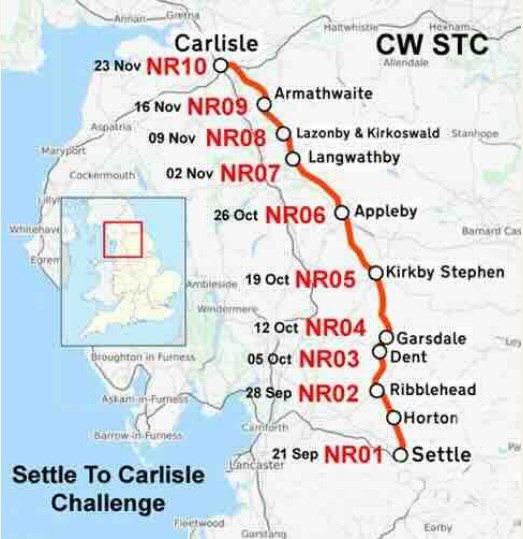
The map plots our journey on the Settle and Carlisle line, during which we make eight stops to explore both historic and contemporary features, all dealt with in Morse, of course.
You can see we don’t stop at only one active station, the beautiful little Yorkshire Dales town of Horton-in-Ribblesdale, for no reason other than that we’re in a bit of a hurry to start traversing spectacular viaducts, rumble through black tunnels along the western Pennines, then breeze along the Eden Valley.
Finally, even further north but not shown on the map, we will find an unexpected surprise.
With only a short time before kick-off on the 21ST, here’s the promo again to summarise the simplicity of the concept and how easy it is to take part using only sound files if the propagation god doesn’t want to play the game, though he was amazingly cooperative throughout the IFC, and this time offers a goodly number of STC bonus points.
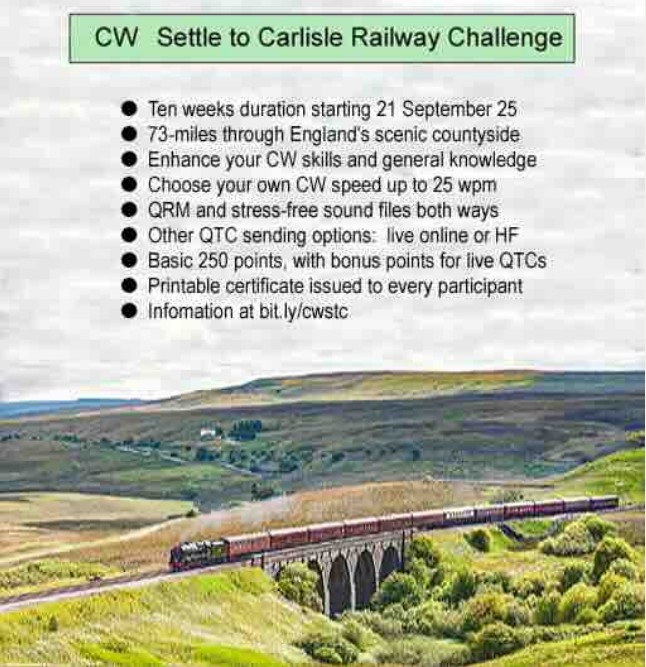
Thanks to those who were kind enough to provide feedback after the QRS IFC. Some will pick up on how their suggestions have been introduced to make this challenge more fulfilling.
Despite being the second longest tunnel on the Settle to Carlisle line at 1213 yards long (1.1 km) and at 1100 feet (840 m) ASL in the western Pennine moors, one might think the Rise Hill Tunnel deserves a mention, but alas it didn’t get one!
In the past week Google Maps has been sent more than enough information for an update, but in case that doesn’t happen before the third week into the STC Challenge, at least you now know why the tunnel has not been included.
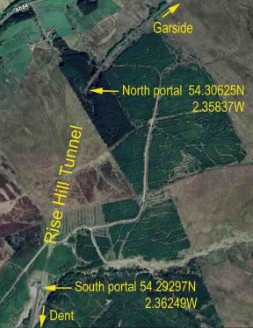
This annotated image provides some details of a most-significant feature on the Settle to Carlisle line to give STC participants an insight into what otherwise would remain invisible. 73 de Stan ZL3TK
Morse Training Net
Our team member Nic VK7WW runs an on-air Slow Morse training net every Wednesday at 7pm EDST on 3580 for 30 mins. He uses the callsign of the Northern Tasmania Amateur Radio Club VK7TAZ on that net.
Many of our team learned Morse code with the support of Nic, and the weekly training session comes highly recommended for anyone who wants to learn the Code, or simply brush up.
Everyone’s welcome – 3580KHZ at 7pm Eastern time every Wednesday; you’ll hear lots of the CQQRS team on that net. Jordan VK3ACU has recorded the complete set of lessons which you can now find here:
Https://www. youtube.com/playlist?list=PLHsQmZz6fBXO7swAfbT mutrbbEL17fUQL Contact Nic VK7WW for more info nicholaschantler@hotmail.com including how to join the NTARC DISCORD group to follow the action, or just come along and join in on Wednesdays.
CQ QRS Hand-Out Cards
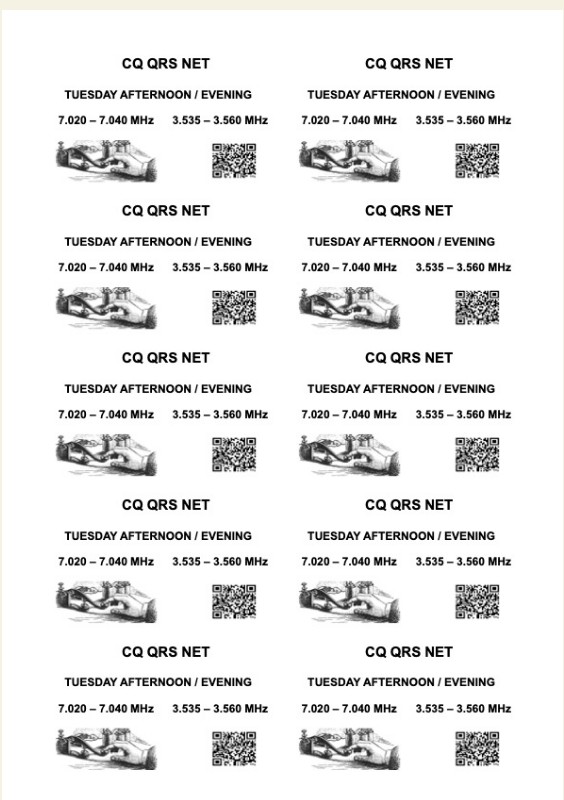
Richard VK6HRC made some hand-out cards for the recent Northern Corridor Radic Group Swap-Meet’. A .pdf version of the cards can be downloaded by clicking on the image below; an editable version was published last week if you wish to make any changes.
The cards can be cut to size once printed of course.
Check your License Expiry Date.
From Mark VK2KI / VK6QI For those of us living in Australia, the Australian Communications and Media Authority has moved the individuals’ amateur licenses to the so-called Class Licensing system.
One of the fall-outs is that the ACMA will no-longer tell you when your five-year license is about to expire – you could very easily discover that your license has expired and your callsign has been allocated to someone else. Wonderful.
Richard VK6HRC has sent me a link to another excellent YouTube video from Hayder VK7HH – this time about the steps you must take to renew your new Class licensed callsign. Click on the image below to watch Hayden’s excellent video.
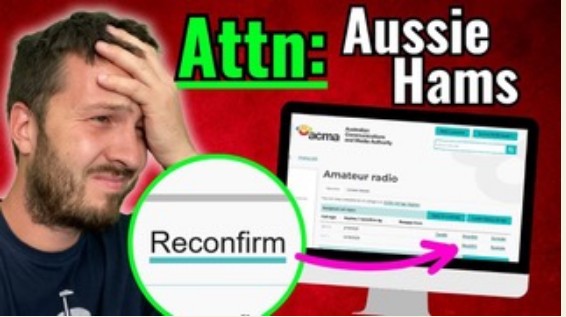
The new Class amateur radio license expires after five years – and following the modern doctrine of making the customer do the routine work, the ACMA has now left it up to licensees to renew their callsign allocation every five years – according to Hayden, we will no longer receive reminders that our licenses are about to expire!
We are somehow expected to keep track of this ourselves. Easy enough for those among us who use computer/phone reminders… as long as we are confident that the reminders will still work in four years time…
Software updates, applications no-longer available, replacement computers or phones… and how will your computer skills be by then?
But what about the significant proportion of amateurs who are no-longer able to sort through the mire of computer applications, websites etc? For instance, do you have an ‘Australia Post digital ID’ – necessary to establish a log-in on the ACMA website?
Hayden’s video will help – but I reckon a significant proportion of us will struggle, and unfortunately, give up! Amateur Radio clubs and groups like ours can help of course… but from what I’ve seen, lots of our older amateurs drift away from such clubs…
And unless they have a teenage computer supporter… who knows how they will cope? By the way, I’m always happy to help any of our team with this sort of thing (while I can anyway!) – and I reckon we have others who can also do the same.
So please don’t dispair – if you’re worried about whether or not your license is stil current, please send me an email, and I’ll see if I (or someone near you) can help: cagrsnet@gmail.com Dit-dit Mark VK2KI / VK6QI
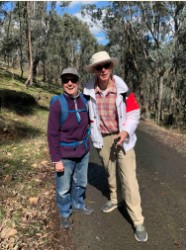
Dubious Types
From Andrew VK1DA: A picture of some dubious types I found when activating SOTA on Bowning Hill last weekend. Cheers, Andrew VK1DA
SKCC Oceania QRS Saunter – Tomorrow!
The SKCC Oceania QRS Saunter will take place this Saturday, 20TH September, 2025 from 00:00 UTC until 11:59 UTC a 12 hour event. All are welcome to join in!!
All the details for the Oceania QRS Saunter (OQS) can be viewed on the SKCC website at: https:/Awww.skccgroup.com/operating_activities/oqs/
Https://sked.skccgroup.com/ https://rbn.telegraphy.de/
| look forward to contacting you during the event. Best regards, Garry VK2GAZ/VK2ZP #5460C Manager – SKCC Oceania QRS Saunter
New Amateur Radio Regulations
From Jules VK3JFP The Radiocommunications Licence Conditions (Amateur Licence) Determination (LCD) 2025 will be reinstated with effect from 30 September 2025 and was brought into line with the class licence.
This is needed because there are still a few hams that have paid for multiyear licences and have not relinquished their old licence for a refund. This means that they remain covered by the renewed LCD.
Anyone whose old licence has run out, or who is a new candidate for a licence, is covered by the new class licence. See here for REGULATIONS CHANGES or at home.
Jules Perrin JP 0457585974 VK3JFP www. julesworkshop.net Supporting our Veterans.
If you’ve read something that you think might be of interest to our readers, please let me know. For guidance on writing for RagChew, see Articles below. Please email material to Mark VK2KI: cqqrsnet@gmail.com
Watchable Channels
For some weeks now I’ve been researching End-Fed Half Wave antennas and a transformers. Here are a few of the better YouTube sites I’ve found.
Evil Lair Electronics
This channel does a really solid job with EFHW antenna content. In “An efficient 40- 10m EFHW antenna for portable ops” it shows not just theory but practical deployment, with good visuals of the antenna in field, real measurements of SWR, and considerations like weight, feed-line.
YouTube Their video “EFHW antenna – low loss QRP core” digs into transformer core selection, losses, wire winding, etc. YouTube The style is fairly technical but accessible. The steps are clear and design decisions are explained.
For operators wanting reliable performance and low loss, their work is among the more trustworthy.
Budget Ham Radio
Budget Ham focuses on “how to build the best 49:1 UnUn / balun matching transformer…” which is exactly what many people need if building EFHWs. YouTube Their video shows construction, component choice, winding methods, and tradeoffs.
They tend to be concise and practical, often emphasizing cost, ease of build, what parts are effective vs wasteful. That makes their content particularly useful for someone who wants to build without over engineering.
MMOOPX
MMOOPX stands out for experimentation and measurement. For example, “How to wind an End Fed Half Wave Autotransformer” shows the winding method clearly and gives detail on specs and losses.
YouTube Another video “Small Transformer, BIG Performance — EFHW for Pennies” shows inexpensive but efficient builds. YouTube MMOOPX often gives strong quantitative data (efficiency, weight, loss) which helps in comparing designs.
The content is aimed maybe a bit more at people who already understand basics.
W2AEW
W2AEW is more about antenna deployments in the field, and tutorials that show both design and real-use trade-offs. The “Trapped EFHW Antenna Tutorial: Building a Smaller, More Versatile Solution for Portable Operations” post discusses how to build amore compact EFHW using traps and a 49:1 UNUN, with good commentary on band coverage, tradeoffs, and tuning.
QR Per While the core-transformer build details are not always as deep as MMOOPX or Evil Lair, W2AEW’s strength is linking design to actual operational use, which helps users understand context – when a build is ‘good enough’ vs when you need premium components.
If you’ve read something that you think might be of interest to our readers, please let me know so John and I can share more thoughts and ideas. For guidance on writing for RagChew, see Articles below. Please email material to Mark VK2KI: cqqrsnet@gmail.com
Prosign/Character/Signal of the Month
After being thrown this one on Tuesday evening – like most prosigns (most of which I’ve never bothered to learn), I needed to look it up. So why not share it and let others learn from my lack of knowledge?
[Suggestion – put it on a sticky note near your key as a reminder for Tuesday. Tell us how you went!]
Di-dah-di-dah-ait
Next Tuesday’s Net
Our CQQRS Group will be on as always on Tuesday from around 0700Z until about 1300Z; see https://bit.ly/CQQRSWebsite and navigate to the Net Details page for details.
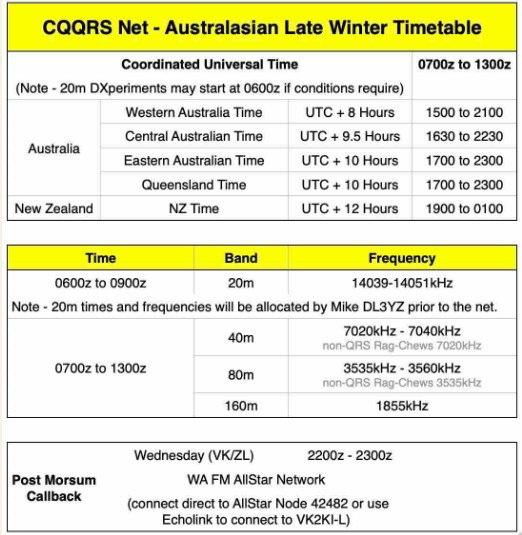
Doesn’t matter whether you’re brand new and want to try just exchanging callsigns and RST reports, or you’re ready for a good old rag chew. We’ll have fun.
There’s usually people around until after 1300Z – so keep calling in the segment of the band designated in the table below until you catch someone.
I should be on as usual from home in NSW or via the Remote at Bedfordale WA, and I’ll also be watching the proceedings using the VK6QS and Tecsun SDRs in WA and NSW respectively. Hope to hear you there.
Please let us know via our Reports form bit.ly/CQQRSNET who you work or hear on Tuesday’s Group. The report form closes at lunchtime (Eastern Australian time) on Thursday.
And by the way, a reminder; if you send me any information by email, our report form or WhatsApp – unless you specifically state that material is not to be published, I’ll assume that you’re happy to see your thoughts in the RagChew newsletter.
Post Morsum
Richard VK6HRC will run our phone Post Morsum on the South West AllStar net (via repeaters and hotspots all over WA) from 0600 WA time, then from 0700 WA time on 80m (8605 LSB).
See https://bit.ly/CQQRSWebsite and navigate to the Net Details page for details of how you can connect via Echolink or even possibly via your local FM repeater.
Articles
The newsletter is interesting to readers because of the material contributed by so many people – be it the reports each week or the various articles. Could you write a short article or articles for RagChew? You bet! Writing not your strong point?
Don’t worry, I’m very happy to help as much or as little as needed. Here’s a thought – although our readers will much prefer your own writing, perhaps have a go at using a Large Language Model Artificial Intelligence tool such as ChatGPT, Microsoft Copilot or Google Gemini to check your writing or even to actually draft the whole article in a relaxed easy-to-read manner!
You can find out more about how to do that on the Newsletter page on our website bit.ly/CQQRSWebsite. Our website also includes a suitable prompt (the command you feed to the Al to make it do what you want).
Please remember though – you must fact-check anything that an Al tool drafts for you because Als ‘hallucinate’ – ie if an Al can’t find what you’re looking for, it will make up an answer and present it as a fact!
This is one of the dangers of using Als – it’s quite probable that the tool will create a very readable and convincing draft that is 100% wrong! You as the submitter are responsible for fact-checking.
But it’s a learning experience – please let us know how you went if you had a go with this new generation of tool. And by the way – lam very concerned about our future in a world of Al – but I’m pleased to see that school and university curriculums now focus on understanding the risks – for instance, kids are now learning critical thinking something that used to be taught mostly at post-graduate level.
When the typewriter was invented, people predicted the downfall of handwriting; when the word processor was invented, the art of writing was thought to be on the way out – ditto for the spreadsheet and arithmetic, AM, SSB and FT-8 for amateur radio etc.
We can ignore Al and hope that it just goes away… or we can learn to handle it through experimentation and use. For more guidance on writing for the RagChew newsletter (including help with using an Al), head to our website bit.ly/CQQRSWebsite then click the menu on the top right and then click RagChew Newsletter.
Thank you so much to our team of 29 contributors: DL3YZ, MONNK, VK1DA, VK2GAZ, VK2IOW, VK2RU, VK3BWN, VK3DRQ, VKSECH, VK3JFP, VK3KLE, VK3QB, VK3RU, VK3WOW, VK4PN, VK5AO, VK5ATQ, VK6BEK, VK6GX, VK6GX, VK6HRC, VK6KD, VK6NQL, VK6IS, VK6NW, VK6RR, VK6WE, VK7HH, VK7JZ, VK7TA, VK7TO, ZL8TK and ZLACTS.
And a special thank you to our editorial team, Nigel G4RWI (head of software development), Patrick VK2IOW (reports coordinator), John VK2RU (researcher and WhatsApp spy) and Richard VK6HRC (Post Morsition and ear-to- the-ground spy).
Great work alll UY CW on Tuesday, mb. Mark Bosra VK2KI/ VK6QI Beautiful South Bowning NSW mark,bosma@icloud.com non impediti ratione cogitationis

About the CQ QRS Net
For the current schedule and more information about the CQQRS net, please go the the Net Details page on our website:

The opinions expressed in the RagChew newsletter are those of the individual contributors. The opinions do not necessarily reflect that of the editor or of the CQ QRS Group members.
Any material and images received from members by the editor or published on the CQQRS WhatsApp groups may be published in this newsletter unless specifically requested otherwise.
The values, doctrine and guidelines for the Group and for the newsletter are published on the Principles page of the group’s website https://bit.ly/CQQRSWebsite