Below is a reconstruction of the 2025 37 CQ QRS RagChew newsletter designed to support full text searching. This reconstruction was built using OCR, and will contain errors.
To view the Mailchimp original, click here. To search the entire newsletter archive, click here.
Contents
- CQ QRS Ragchew
- Masthead Image
- New Team Members
- Reports
- Website
- Reports & Comments
- Last Tuesday’s Group
- Post Morsum – 10th September 2025
- On My Workbench
- PC Maintenance
- QRZ?
- Amateur Radio and the Falkland Islands Invasion
- QRZ? Who’s on the other end?
- Head Copy Practice
- Compiled on the track somewhere by John VK2F
- You can either play the MP3 files in any media player, or load the text files into the Ditto CW: Morse Player app — https://dittocw.andro.io/. Both work well, but Ditto CW gives you complete control over all Morse settings, while a normal media player only allows changes to playback speed, and does that in steps (e.g. +1.25x, 1.5x, 1.75x).
- Other News
- Slow CW Frequencies
- CQ QRS Hand-Out Cards
- KPH Delivers the Goods… Again! – continued
- Another Enigmaphile
- The Importance Of S Price – Defence Of Moral tale 18th-century
- Amateur Radio CW in WWII
- Morse Training Net
- Ever thought of joining the ‘Morse with a Purpose Society’
- Portable in My Backyard
- Watchable Code Shorts
- Di-dah-di-dah-dit
- Next Tuesday’s Net
- Post Morsum
- Articles
- Teamwork
- About the CQ QRS Net
CQ QRS Ragchew
Another really fun CQQRS Slow CW Practice QSO net on Tuesday – with odd and interesting conditions all-round…. along with a smattering of Spring-time static crashes to add to the mix.
I really enjoyed reading the reports submitted by our participants again this week – and in particular, it’s really pleasing to see the number of people that took the time to report their thoughts on the night / morning’s fun and frustrations; these reports make both the newsletter and the net itself so interesting to our participants.
Thank you one and all for taking the trouble to pen your thoughts again. We also have a bunch of other interesting reading ahead submitted by so many of our team members – I hope you’ll have time to scan through and even enjoy the read if you have time.
Thanks team – please keep them coming. Got some thoughts, but think you can’t write well? Let’s put that to the test! See Rag-Chew Articles below for some options.
Masthead Image
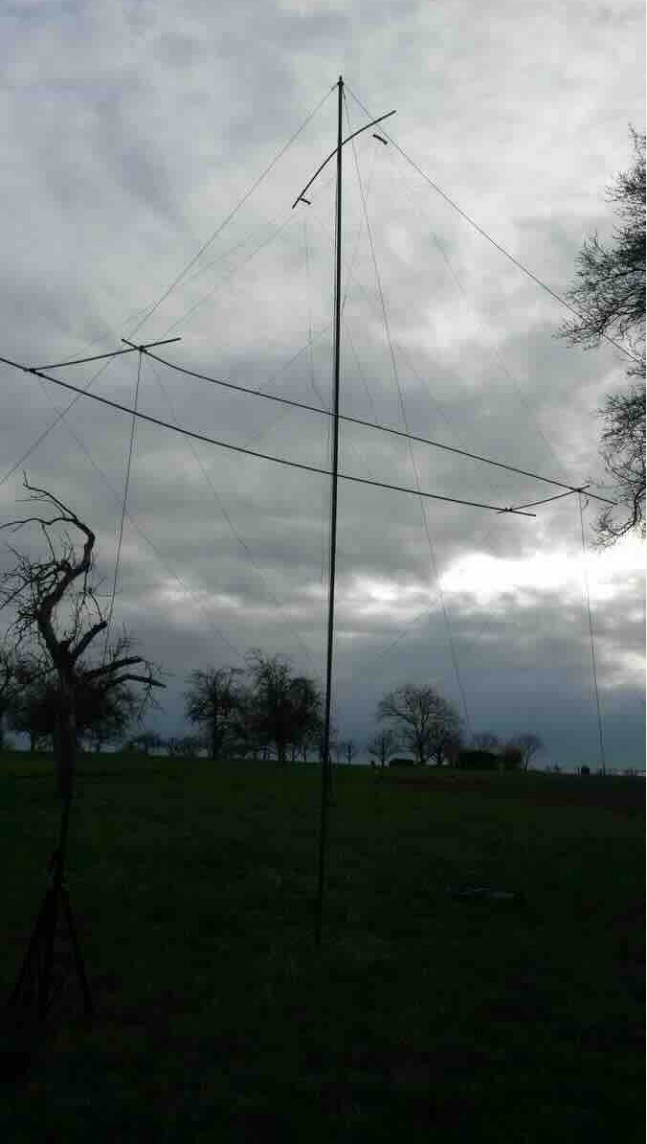
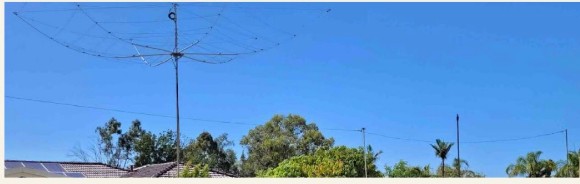
What the? You may have read about Mike DL3YZ’s challenges to put up gain antennas at home, in a way that doesn’t attract too much interest from the neighbours. Well take a look at his latest creation! What’s there to not love about that I ask myself! Heh heh!
What is it you ask? If you look closely, you’ll see it’s a two-element diamond quad – made for 15m. To quote Mike:“Dr Frankensteins rhapsody of duct tape, insulation pipes and old, left over copper wire.
I pointed it to Australia, and even hit the left part of it, Japan es New Zealand 🙂 Not too bad for a total cost of 40 euros”.
New Team Members
Welcome this week to Rodger VK3DXC who recently moved to West Melton from New Zealand; welcome Rodger and I hope you can join us soon on the Slow CW Practice QSO net.
Reports
After next Tuesday’s Group, please send me a list of who you worked and / or who you heard using our web form here:

Please help attract new and old team members to have a go by submitting your repo! each week. Submissions close 1300 (Eastern Australian time) on Thursday.
Website
If you’d like to find out a bit about our net, or would like to pass information to others about our Tuesday get-togethers, here’s the link to our website.
Bit.ly/CQQRSWebsite Cheers, mb Mark Bosma VK2KI / VK6QI Beautiful South Bowning NSW mark.bosma@icloud.com non impsditi ratione cogitationis
Reports & Comments
Last Tuesday’s Group
Here’s the 60 stations heard by 37 members of our team on Tuesday:
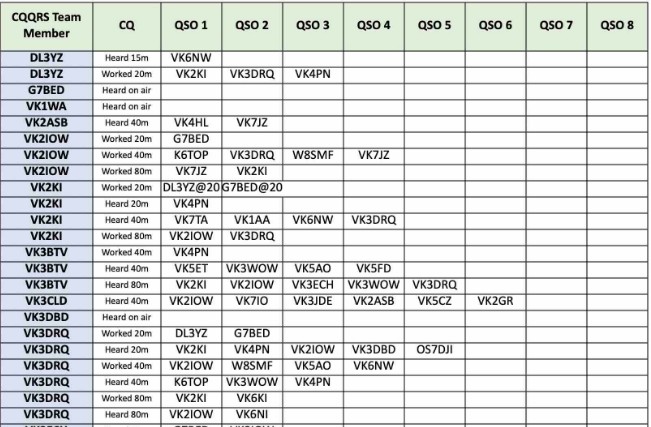
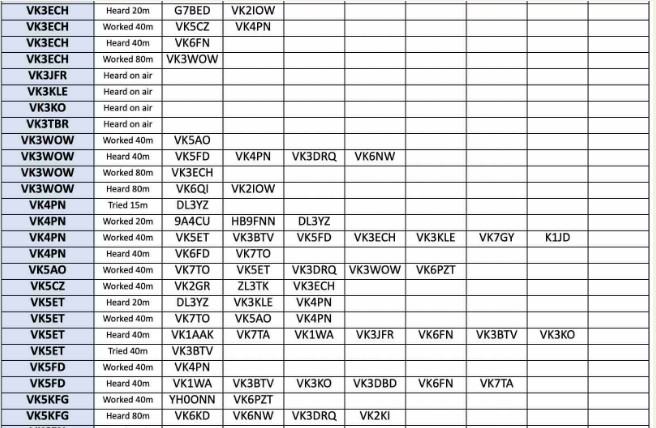
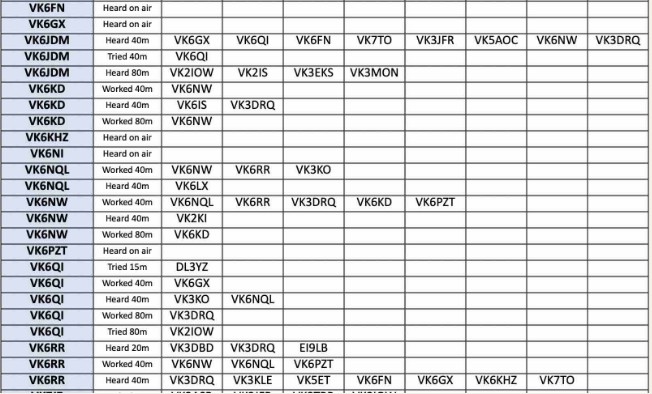

The spreadsheets above show the known stations on last Tuesday’s Group; the comments in the team members’ reports (Submitted via our webform bit.ly/CQQRSNET ) follow: Comments: This week’s comments from our webform reports have been compiled for us by Patrick VK2IOW; thanks Patrick.
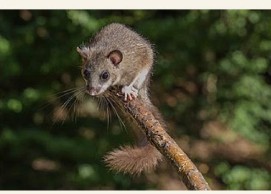
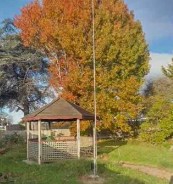
This week I was out in the meadows again, vi: there’s not too many left of the old glory. Thin most visitors of the hut these days have four little feet, sharp little teeth and a furry tail.
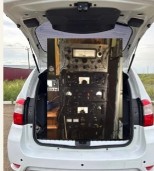
Meet the radio dormouse 😉 Think their population in the hut exceeds the number of human members in the club. I wanted to trv overatina the beam again. to si
| wanted to try operating the beam again, to see differences between antennas. I measured my signal S5 in Ironstone. Condx (SFU) were a little weaker than last week, so the beam was helping.
I had some nice QSOs on 20m, great signals of all stations here, all easy to copy. Only QRM here was the noise of the fridge. Then I switched to the 15m band, but couldn’t find my signal on the waterfall in Ironstone.
I even had problems to be heard by any RBN station at all. I checked the antenna, anc all was fine. Condx are mysterious at times. Seems they have switched that band off for maintenance today HI.
I heard Wayne – VK6NW calling me on the SDR, but no signal up here as well… sorry Wayne, let’s hope for better times next week. Greetings from Germany – Mike. [Interesting about the dormice Mike; we don’t have them up here in Australasia.
Perhaps you can tell us more about the club in a later newsletter too?]
• 5 Last Sunday for the Alpine Fault Net 40m was : unusable, nothing was heard until 50 minutes in when % discovered there were ca 35 stations on.
Well tonight was similar, nothing heard until after 0915Z then signals began to appear but were suffering from deep QSB. Hence, except for a short QSO with lan
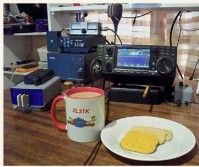
VK5CZ, decided to watch a YouTube doco. It was made by the inimitable Geoff Marshall as he rode the spectacular Settle and Carlisle line up the spine of UK ona warm summer day in June.
Https:/Awww.youtube.com/watch?v=DGbitI3i5 WBI Highly recommended to those interested in joining the ‘Morse with a Purpose Society
[40m] Much noise & QSB. Some signals way down in noise, difficult to copy.
[80m] No stations heard, only noise but not as bad as 40m a 20m. Switched off early.
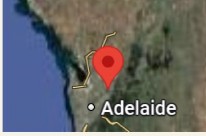
[40m] East coast stations appeared through the mist early evening. it was nice to chat with Manny VK3DR@Q for a while
[80m] I changed to the dipole for 80m and it
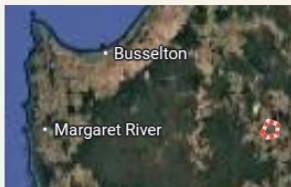
From Donald VK6JDM at 20KM west of Esperance
[40m] Lots of deep QSB on 40 and 80. Local conditions were quiet but heard some others complaining of lots of static crashes.
Heard lots of stations and was able to copy about 50% of what f was being sent. Did not manage to get heard by anyone or rather got no reply to CQs which of course may actually mean I was heard but no one wanted to play.
It was good practice and I am slowly improving in my receiving. I saw the graph of how fast servicemen learnt the code in the past – I take the graph as either proof that there is a void in my head where Morse is processed OR as proof that SA Ce ee a a ee A ere
A void in my head where Worse Is processed OH as proot that the Yanks were producing disinformation way back then. Of course the truth may be worse, it may be that I have a void in the brain where Morse is processed AND the Yanks were producing disinformation back then.
[40m] Lots of QSB on 40m. Stations heard, here one minute, gone the next. As the night went on, the band got quieter.
[80m] Nothing much on the waterfall display. Heard Wayne calling VK6NW with a very strong sig so decided to pick up our QSO where we left on 40m. Much better copy on 80m. TU Wayne.
[20] Got on 20 a bit late around 16:30 and scanned the QRS segment for our EU friends, heard nothing. Decided to call a few CQs just to see where I was picked up by the reverse beacon net. Very promising a lot of
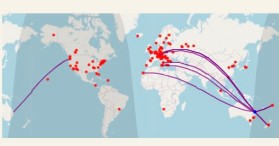
A Ae cl Pt Waa emecrials OF tocaala ct oad spots in EU, North America and West Africa. A Croatian station responded to my CQ, pretty good signal around S6. I was surprised when he told me he was using just 50W and a dipole!
His QTH was Split, an ancient port in Dalmatia of which I have very fond memories. During school summer break the family used to travel by train to Split to catch a boat (old steamers) to sail to one of Adriatic islands for summer holidays.
Split is a fascinating old city, council chambers are in a building built by Romans (Emperor Diocletian was born in Split). He built a huge palace which is still in good condition. I wonder how many of our palaces will be standing 2000 years from now.
While I was in a QSO with 9A4CU, HB9FNN kept calling me, so after finishing with the Croatian I had a QSO with the Swiss as well. I must have been close to DL3YZS frequency as I kept hearing him at a very high pitch (lucky I did not use my CW filter).
I called Mike and he came back with a good $7, QSO was brief as he needed to change to 15m at 17:00 hrs. Scanned 15m QRS segment looking for Mike but couldn’t hear anything.
Checked the FT8 segment, wall to wall JA and East Asians, only a few feeble EU stations so obviously 15m was out for our low power QRS EU friends
[40m] Very unusual conditions on 40m this evening, first a lot of noise and frequent bursts of QRN almost impossible to dig out weak signals. After moving to 40 from 20 at around 17:00 hrs I heard nothing on my RX or on Araluen SDR.
After calling few CQ just to see where I was heard on the reverse beacon net I gave up. I was definitely getting out to ZL, Fiji, WA and southern states but no takers.
On return at around 20:00hrs conditions were much better, so I managed few lengthy QSOs all affected by QRN and fading. QSO with VK7GY was particularly troublesome. We started at S9 both ways than Gerry faded slowly out to nothing.
I responded at a time I thought he would have finished his over. After I finished my over he came back at S9. While listening to Gerry’s last over I could copy K1JD a kHz or so away from our frequency.
I had QSOs with K1JD in the past (prior to FTS take over) so I called him and he came back $9 both ways! We chatted for a while reminiscing of good old CW times and he never faded once throughout a 10 min QSO.
So you have it smooth to New Mexico and trouble to good old Tassie!
[80m] Most frustrating band, no luck at all. Spent almost an hour calling CQ and not a single QSO! There were couple of traces on the Ironside SDR (I think VK2KI, VK2IOW and VK3DRQ ) but all were involved in marathon QSOs so I had no option but to call CQ and hope.
I could see my trace on the Ironside SDR but boy the waterfall was ugly noise level was off the limit. On the reverse beacon net I could see that I was being heard in ZL, Southern states, Fiji and WA so I was getting out, but QRN and noise must have scared our QRS folk off.
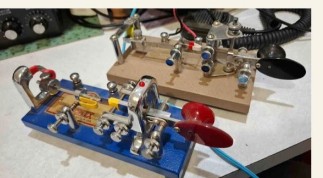
[40m] I only managed an hour between about 6 and 7 and didn’t hear many stations. Apologies to Edward for being slow in getting his call right, VK1AAK, the K at the end was confusing me.
[80m] After saying hi to Andy and the others on the Boa Anchor Net, I tuned into our QRS net but very strong static crashes at this QTH made CW a challenge.
[20m] I try calling OM Chris G7BED as soon as he started but no luck, he only copied VK3??? so waited towards the end of his time, called aga and this time I was lucky. AQSO was had. Thanks OM Chris for the effort. oy yee
[40m] ) 40 was pretty quiet here earlier in the night. Noticeable QSB.
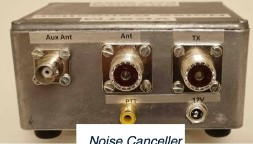
[80m] 80 was very noisy tonight – crashes well over the 9.
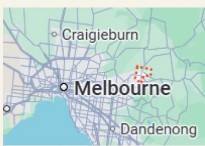
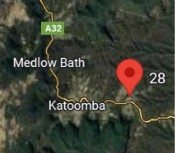
[20m] At 4:30 pm local time I listened for Mike, DL8YZ on 20m. He had 3 VK QSOs during the half hour. I was using my large loop, wire antenna rather than my Yagi (wound down because of possible thunderstorms).
Mike had a good signal, about RST 559, though it seemed to go down a little to about 539 over the 30 minutes. Then Mike switched to 4am ond hie cinnal Arnannad tn ahniit OCT 240 an 1 Aid nnt tn
Jom ana nis signal aropped to about Mol oly so! ald nor tl to QSO. I switched back to 20m to listen for Chris, G7BED. He was booming in at about RST 569. We had a QSO and I was surprised that he gave me RST 579 on my wire antenna.
We were both using 100 watts and he was on his usual fan dipole.
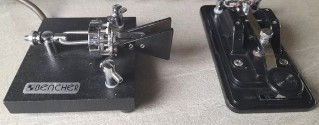
[40m] The band was very noisy with thunderstorms West of my QTH. I called CQ on 7020 kHz. I decided to use this frequency, since I wanted to do some straight key practice I’m not that good on a straight key and strangely I also find it difficult to send slower than about 15 wpm.
I had a reply from K6TOP near San Francisco. He had 500 watts and a dipole. Then Manny, VK3DRQ answered my CQ, however the ionosphere thinned abruptly in the middle of our QSO and we could no longer copy each other. Then W8SMF from Florida called.
He had 500 watts and a 2 el yagi. I heard Jim, VK7JZ and Tim, VK3TBR chatting until the ionosphere struck again and they could no longer hear each other. I called Jim and we had a QSO.
[80m] Before going QRT I tried 80m. It was as noisy or even more noisy than 40m. I sent: Whatsapp message that I would try 3535 kHz and Jim, VK7JZ came back for a short 2nd QSO.
Finally I had a QSO with Mark, VK2KI whose strong signal was mostly above the static crashes.
| returned to the Southern Electronics Group Remote a bit later, and after a few plaintive CQs, hooked up with Phil VK6GX at Gidgegannup.
There was some very interesting slow and deep QSB on Phil’s signal over the 30-40km path; we figured that perhaps it was the existing ground
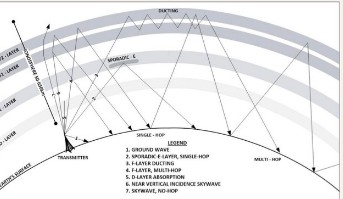
Wave signal mixing with emerging Near-Vertical Incidence Skywave as the sun set o the ionosphere in the West?
[80m] Later I heard Patrick VK2IOW signing with James VK7JZ – both Readable 5, so I popped my callsign in after the dit-dits. Silence! Boo-hoo – they don’t love me any more! Well actually, there’s more to it.
When I posted my tears on the CQQRS WhatsApp Alerts group, Patrick headed back down to the frequency, but James had pulled the pin, claiming that his brain was fried.
As it turned out, we had a return of the one-way propagation that I’ve noticed often in the past on the East-West 80m path (there’s discussion in previous years’ RagChew from various experts about possible causes of the phenomenon) – I could hear the Eastem-States’ signals (including my own home station), but the signals coming the other way were nothing short of challenging.
Patrick just couldn’t pull my signals out of the static crashes (strangely, the static crashes weren’t audible here, only 150KM South – see previous RagChews for discussion about static crash propagation as well, and how it sometimes appears to be different to normal propagation).
So I swapped keys and continued the QSO with Patrick from my home station instead. Half an hour later I repeated the test with Manny VK3DRQ; Manny was RSN 572 into WA, but struggled to report RSN 322 the other way.
The VK6SR Southern Electronics Group Remote station continues to work nicely, with no return of the previous antenna coupling gremlins.
Also trom your editor, Mark VA2KI at Beautiful Sot
[15m] The mind was willing, but the TS-120S wasn’t (another fun little fault-finding job to add to the pile fix the old Kenwood which refuses to operate above 20m! Or, plan B, replace the ALC system transistors in my beautiful little Kenwood TS-50.
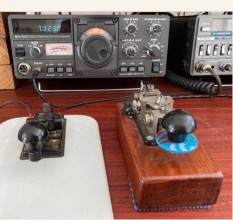
[20m] Mike DL3YZ was coming through nicely RSN 531 from his radio club’s Yagi antenna at Stuttgart, and he gave me RST 539 in return. I then slipped down to where Chris G7BED was calling from Northampton North of London.
Chris was having more trouble than Mike, and it took a number of calls before he made out my callsign; I sent RSN 411 and Chris responded with RST 339.
Perhaps my antenna had fallen down, because I saw later on our CQQRS WhatsApp groups that Chris had worked others, including Patrick VK2IOW at Millthorpe (150KM North of me) and David VK3DBD at Yakandandah (about 200KM South West) who were both booming-in to the UK, despite Patrick using a 2-wavelengths per side wire loop antenna (instead of his HF Yagi).
[40m] I didn’t get much time to listen on 40m this time – 20m DXperiment -> dinner -> 80m do not pass Go, do not collect $200.
However, in passing I heard lan VK7TA chatting to Nick VK1AA (a new callsign for me) and later as the band struggled to open to the West, Wayne VK6NW chatting to Manny VK3DRQ.
[80m] After dinner, I had nice chats to Patrick VK2IOW and Manny VK3DRQ, after giving up on trying to work them from the Remote HF station in WA. An early start on Wednesday saw me retire early to places warmer and even more friendly this week.
40m] ots of stations were around later on, but the noise level we pD by then. 30m] till need some more WA based activity on this band.
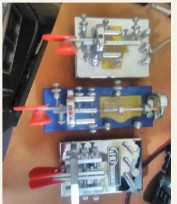
[40m] Due to other commitments only had a short time on air but enjoyed the time.
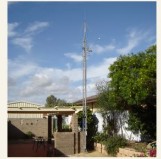
[40m] This week I had an absolute blast, participating n five QSOs with four on 40 meters and one on 30 meters. The night started out with indecision, do I go orave the cold hunting for a park with lower noise han my QTH and run around with a head torch I Nk a ee TRS a i a a Be a a Ee
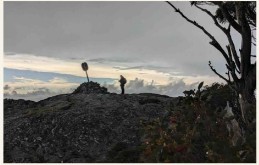
On, or do I stay home, warm, and just accept whatever the local noise in my shack is – in the end I folded and took the soft option staying at home.
My first QSO on 40 meters was with Arthur VK2ASB where I explained I was new and he later sent me some drill sheets to practice. Then a QSO with James VK3JFR who is always encouraging, then Tim VK3TBR.
My 40 meter QSO of the night was with Pat VK2IOW in rural VK2 and I was on 10w. I was thrilled to copy well enough that he was on a SMALL FARM with ALP?C?S and CATTLE.
Reviewing my notes I thought looks like ALPACAS but then doubted myself and thought my copy was off. When checking Pat’s QRZ page there they were ALPACAS keeping the grass neat and tidy around Pat’s antenna.
Was a thrill to be think I am finally starting to get it. Much appreciation to all the CW Ops out there who have been patient with me for months.
Ps This is not an invitation to QRQ, yes I understand that Mark VK2K{ will QRQ me at our next QSO just the same but it’s OK, being pushed is helpful. Final QSO for the night was Pat VK2IOW again briefly 80m and 100W.
Post Morsum – 10th September 2025
FOSt MOPSUtin a SEPleInpe:! 220 from Richard VK6HRC Seven checked in on the South West repeater and AllStar/Echolink hub.
VK6KD David VK6NW Wayne VK5ET John VK6QI = Mark VK6HRC
SWL VK6MRB Mulligan, VK6ZLZ Christine and others. David monitored 4@m where it was very quiet so he changed over to 8@m and caught up with Wayne VKENW.
Wayne monitored 2m and was not hearing anything so logged onto a local SDR which was not any better then on to the Ironstone Range SDR in VK5 with better results there hearing Mike DL3YZ and Mark VK2KI. On 8 m he worked David VK6KD and Richard VK6PZT.
He was also switching between his vertical antenna and the dipole during the evening for optimum operation. John toughed it out on noisy 49m working three stations then on to 8@m but no contacts there so pulled the big switch.
Mark caught up with Mike DL8YZ on 2m then Chris G7BED who was struggling with Mark’s measily signal; Mike was doing well at his end receiving better sig- nals this time.
Then on to the SR remote in Perth to work Phil VK6GX in Gidge- gannup on 4@m where QSB was evident over that short distance, even had time to send alerts on WhatsApp !
I was only on for a while monitoring 82m and heard Donald VK6JDM calling so I responded a couple of times but he was not hearing me. Hopefully he did better than I did! Thank you to alll on last night and this morning.
73 Richard VKeHRC ps Just caught up with young Max VK6EN he had a great session with Phil VK6GX on 48m but had to QRT and go entertain his visitors. [Thank you once again Richard. Would you like to join in on our fun callback on Wednesday morning?
Kicks off at 6am WA time, 7:30 SA time, 8am in the East, 10AM in New Zealand and tam in Europe/UK, and everyone will be made very welcome. To connect, use Echolink to
On My Workbench
PC Maintenance
From Patrick VK2IOW After having the hard drive crash this week I’m wondering whether there is anything I can do to take better care of the PC – computer care and hygiene. So I asked ChatGPT. It recommended the following:
HE Monthly PC Maintenance Checklist @ Weekly Quick Tasks (5-10 minutes) + Restart your PC (don’t just sleep it). + Check Task Manager > disable unnecessary startup apps. + un Windows Security Quick Scan.
+ Delete junk/temp files (use %otemp%, Disk Cleanup, or Storage Sense). @ Monthly Deep Maintenance (~30 minutes) + Run Windows Update. + Run Malwarebytes Free (Full Scan). + Check drive health with CrystalDiskinfo. + Check temperatures with HWMonitor or Speccy.
+ Run System File Check: sfc /scannow (and DISM if needed). + Clean browser cache and remove unused extensions. + Backup important files (external drive or cloud). @ Quarterly Tasks (Every 3 Months) + Uninstall unused software (Settings — Apps).
+ Defrag HDDs (skip if you have only SSDs). + Run Windows Troubleshooters (Settings > Troubleshoot). @ Yearly Tasks + Clean dust inside PC/laptop with compressed air. + Replace thermal paste if system is 3+ years old and overheating.
+ Check laptop battery health (powercig /batteryreport).
What’s going on on your workbench? If you have an article or two that you think might be of interest to our readers, please let Mark VK2KI know; email to cqqrsnet@gmail.com For guidance on writing for RagChew, see Articles below.
QRZ?
Who’s calling me? Who’s on the other end?
Amateur Radio and the Falkland Islands Invasion
AINGtCUr Maglio ala ihe Falnialld Islands livasion
From Chris G7BED Jam of a certain age, that I was a teenager during the Falkland Islands invasion back in 1982. I remember it vividly, rushing home from school to turn on the news to find cout what had happened that day.
Remember, this was before the age of mobile phones, and online 24 hour news. It was either radio or TV back then :-). Well, I guess most of you know the story of the war, but if you don’t, and have an hour or so to spare, have a listen to the following RSGB news cast, and the story as told by a certain Lauri Margolis, a BBC reporter (who has only just retired from the BBC) and a radio ham.
Put it this way, it sounds like if it wasn’t for amateur radio, the UK Foreign Office wouldn’t really have known what the hell was actually going on down there …
Fast forward a few years to 2022, when I started volunteering at the National Radio Centre (NRC) at Bletchley Park. A few weeks prior, I had worked my first VP contact on HF, a guy called Bob Mcleod (VP8LP).
Whilst I was chuffed to bits that I’d finally got the Falklands in my log, I thought nothing more about it. Until one day, I find myself standing in front of this display in the NRC.
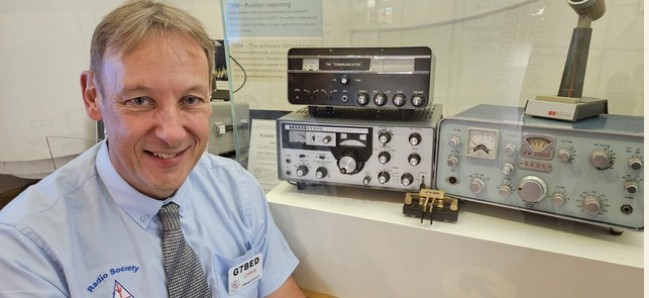
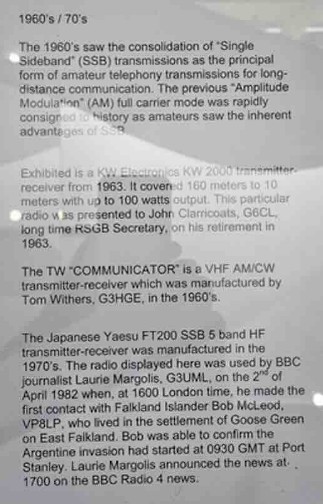
The VP8LP station I had been talking too, was the very same guy who had shared the news of an Argentine invasion with the BBC and Lauri Margolis way back in 1982. And that Laurie’s radio was now only display in Bletchley Park. What an interesting coincidence!
There you go … maybe an interesting diversion for some of you. Ifit is, can share another fascination Falkands War (radio) story next time. Thanks Chris G7BED
[Thanks Chris. The FT-200 brings back memories – that was my first HF transceiver… I even had it installed under the dashboard in my first car (don’t turn the engine off when the all-valve transceiver was on!).
And there were a few (ex-G) operators in Western Australia at the time who used the KW Electronics gear that they had brought with them to the colonies. Terrific story – more? Yes please!]
QRZ? Who’s on the other end? From your editor Mark VK2KI / VK6QI Key to the success of our net is helping to make it a get-together that people enjoy returning to each week.
But when you’re on the key, it’s really hard to find out a bit more about the person you’re chatting to. So I’m really keen to share the backgrounds of some of our team members – it’s really nice to know who’s on the other end of the QSO.
How did they come to amateur radio and when, and what on earth was the motivator that got them interested in CW? How’s the journey been so far, and what’s planned? Perhaps, what they get out of the net and the newsletter, and how it can be made better?
Or like Chris, a bit of insight into their past? So, would you be willing to share some thoughts about yourself? Please let Mark VK2KI know: cqqrsnet@gmail.com For guidance on writing for RagChew, see Articles below.
QRZ? Who’s on the other end?
Head Copy Practice
Compiled on the track somewhere by John VK2F
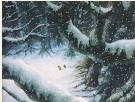
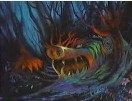
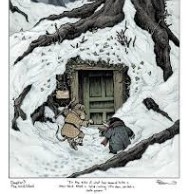
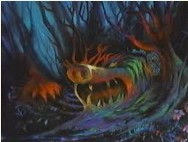
This week we start Chapter 3 of Wind in the Willows – The Wild Wood. Because of MallChimp’s size limits, I’ve had to split the remaining Chapter 3 audio into three parts. Each part is over 1 hour playing time @ 12 wpm.
If you’d like the full chapter in a single file, you can use the complete text of Chapter 3 which is attached below, and convert it yourself with the Ebook2CW app — https://fkurz.net/ham/ebook2cw.htm|.
I’ve made a few small adjustments to the text to keep it “Morse friendly”. Uncommon punctuation has been removed (the Ditto CW app doesn’t recognise some of it), and contractions have been simplified (for example, we’ll becomes we will).
This week’s attachments include: + Three MP3 files (first section of Chapter 3) + Three text files matching the MP3 segments * One text file with all of Chapter 3


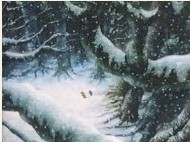
You can either play the MP3 files in any media player, or load the text files into the Ditto CW: Morse Player app — https://dittocw.andro.io/. Both work well, but Ditto CW gives you complete control over all Morse settings, while a normal media player only allows changes to playback speed, and does that in steps (e.g. +1.25x, 1.5x, 1.75x).
Other News
Slow CW Frequencies
From Nic VK7 WW Some time ago I thought about sitting on a 15m CW USA novice fx whilst I’m doing something in the shack…for a couple of hours… and if a slow or wobbly Novice comes up, I’d be more than happy to have a contact with them.
The VK-QRP Club have designated fxs for QRP on several bands (1.815; 3.530, 7.028, 10.106, 14.060, 21.060, 28.060), but there seems to have been very little interest.
I’ve called on their fxs many times, but not one club member came back; but non members came back, so other Ops do monitor them.
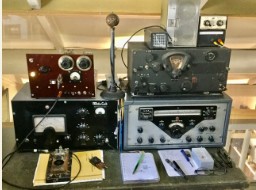
The point is …. would it be worthwhile having a designated slow/learning CW fx on each band, which we could leave our rigs sitting on as we potter in our shacks?
That way any learners may feel more comfortable knowing they have someone understanding ‘at the other end’. This doesn’t have to be on QRS nights, but at any time. P’m thinking 40 and 20m; and 15m if condx are good (15m especially for USA novice ops).
I wonder if any other countries still have CW-only Novice license ops? Does anyone know? Cheers es 73 Nic VK7WW [Thanks Nic; terrific suggestion.
We currently have 7032KHZ, 3655KHZ and 1855KHZ as designated landing frequencies during the net – and I know some people listen there by default at other times.
I specifically picked 7032KHZ because it’s a popular VKFF PARKS and SOTA CW frequency in Australasia; in the Eastern States, listening out on 7032 during the day (especially on weekends in Spring-Summer/Autumn) will usually (or at least often) provide opportunities to exchange reports with portable stations who pop up there.
That’s how I came back to CW in recent years – listening on 7032KHZ with my TS-50 muted. So perhaps by default, we might designate other listening frequencies for 30m, 20m, 17m, 15m, 12m, 10m and 6m?
Question is, should we use the SOTA frequencies like 14062kHz (again because it’s where you’re likely to hear QRS around here), or the VK-QRP Club frequencies?
I defer to those who listen around more than me (that would be just about everyonel); where are we likely to hear most QRS activity?
Cheers es 73 Nic VK7WW [Thanks Nic; terrific suggestion. We currently have 7032KHZ, 3655KHZ and 1855KHZ as designated landing frequencies during the net – and I know some people listen there by default at other times.
I specifically picked 7032KHZ because it’s a popular VKFF PARKS and SOTA CW frequency in Australasia; in the Eastern States, listening out on 7032 during the day (especially on weekends in Spring-Summer/Autumn) will usually (or at least often) provide opportunities to exchange reports with portable stations who pop up there.
That’s how I came back to CW in recent years – listening on 7032KHZ with my TS-50 muted. So perhaps by default, we might designate other listening frequencies for 30m, 20m, 17m, 15m, 12m, 10m and 6m?
Question is, should we use the SOTA frequencies like 14062kHz (again because it’s where you’re likely to hear QRS around here), or the VK-QRP Club frequencies?
I defer to those who listen around more than me (that would be just about everyonel); where are we likely to hear most QRS activity?
And by the way – some will say don’t clutter up the SOTA frequency of 7032KHZ. I picked the frequency for our net knowing that 360/365 days of the year, there’s no after-hours SOTA/Parks activity there at night. And SOTA / VKFF Parks operators are quite
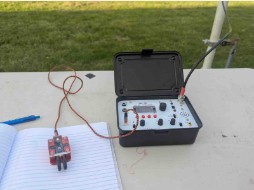
Quite used to discovering that there’s other operators on 7032 when they get on air – so sliding up or down is easy – very few use crystal-locked transmitters these days.
I suspect that most will be happy knowing that we’re promoting QRS exchanges or rag-chews – and very few will have noses out of joint to find there’s a natter going on on 7032KHZ. Suggestions from readers about listening frequencies please?
Cqqrsnet@gmail.com And does anyone know of countries that still have CW-only license classes? Wouldn’t that be great for CW in our world where our amateur bands have become a bit like an extension of our dearly loved but now lost 11m band?
I know, showing my (normally well-disguised) grumpy old man side!]
CQ QRS Hand-Out Cards
From Richard VAK6HRC Richard VK6HRC has made up a sheet of hand-out cards to be cut up and either kept in your wallet for when you’re telling someone about the CQQRS Slow CW Practice QSO net, or handed out at your local hamfest or club meeting.
They’re available here for downloading. You could if you wish also use the template for something for the back – no responsibility for getting the orientation correct in your printer though! Download the Word file here.
KPH Delivers the Goods … Again! – continued
From Stan ZL3TK Did anyone decrypt the Enigma message received from KPH, the one for 2025 shown in last week’s RagChew?
—_ Despite the seven-day interval, my invitation to decrypt it for yourselves has borne no fruit, nonetheless, as promised, my decrypt is here this week.
The same deadly-silence typical of ‘bearing no fruit’, came from the opportunity to discover why the Enigma message, even without decrypting, can be seen as. historically impossible. Did anyone spot it but not document their findings? Second things first.
The message is dated 27 May 1939, produces an interesting conflict with the historical facts. Why? Because Adolph didn’t begin, or even mention Operation Sea Lion (Untemehmen Seeléwe) until 16 July 1940.
His plan first appeared as a directive ordering preparations to begin for the invasion, with the specific code name assigned only at that time.
Prior to July 1940, he had been hoping Great Britain would negotiate peace after her defeat in France, but with Churchill’s determination to continue the war, Hitler eventually decided to proceed with his invasion plan.
Our friend at KPH, Kevin McGrath K6TOP, agrees with that interpretation. First things second. Decryption using the somewhat clunky simulator recommended by KPH went perfectly, albeit rather slowly, whereas Dirk Rijmenants’ splendid simulator downloadable from the Enigma World Code Group site delivered clear text very fast, thanks to its copy-and-paste quick- type function.
KPH Delivers the Goods… Again! – continued
On the SAS Net we use formal Enigmagrams, I saw no reason not to this time. Here is how the Enigma decrypt was submitted to KPH judges. Feedback says they liked it.
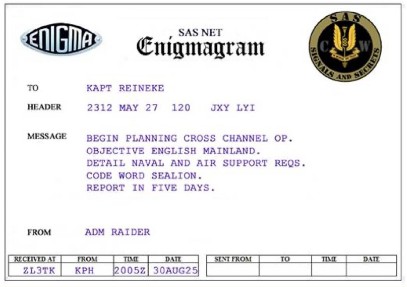
Notice my typo? Apologies to Admiral Raeder. I must have imagined two dots so mea culpa. There’s absolutely no excuse since I knew his name was spelled incorrectly but failed to address the issue. Fortunately it doesn’t affect the message text.
After academic discussions and exchanging noises of mutual-admiration by email, my certificate duly arrived. It is based on KPH’s proven boilerplate from previous years with only the date changed.
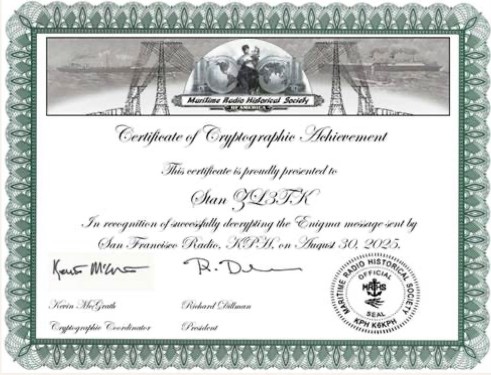
Please excuse my putting forward an antiquated notion, but this type of activity breathes life back into ‘Morse with a Purpose’, just as in the days of yore when there was only no-nonsense, functional, serious communication to be heard and vacuous chatter was still a long way off.
It is highly recommended to anyone wanting to improve their CW skills to join the select group who take part in KPH’s Enigma events.
From KPH records, 141 certificates have been issued globally for the 2025 event. Will you qualify to be on KPH’s mailing list after their next epic Enigma transmission? Sure hope so. 73 de Stan ZL3TK
Another Enigmaphile
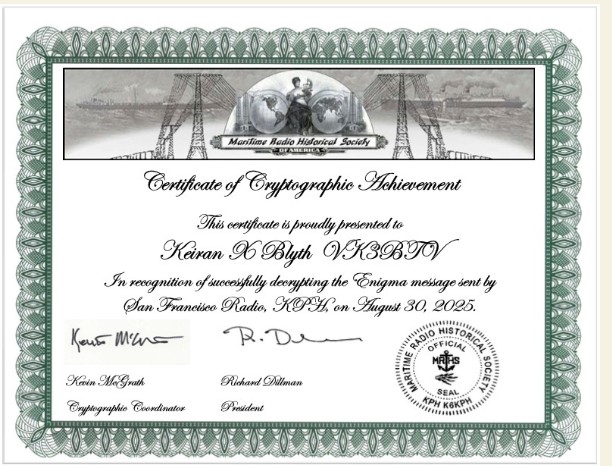
From Keiran VK3BTV Hi Bozzie Not sure if you would want to include this in the newsletter, but I received a very pleasant email on Monday. I finally got to have a crack at a KPH encryption challenge – it was worth the early Sunday start time.
AWNICE Little raravie OF NOlral tale Irom the i/thh Ventury
From Patrick VK2IOW I’m not sure whether parable is quite the right word, but it seemed to sort of fit.
The Importance Of S Price – Defence Of Moral tale 18th-century
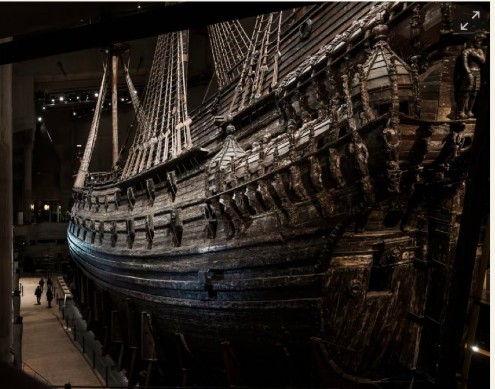
The ill-fated Swedish warship Vasa sank on its maiden voyage on 10 August 1628 when a light breeze caused it to heel and plunge into the water, only 1,300 meters from departure.
The root cause: King Gustav insisted on adding a second gun deck despite shipbuilders’ warnings that the design compromised stability. The Vasa’s preservation in cold Baltic waters allowed it to survive largely intact.
Today, it is on display ina purpose-built museum in Stockholm harbour, drawing around 45 million visitors. The wreck stands as a powertul historical lesson on the consequences of dismissing scientific advice.
One can draw a parallel between the Vasa’s fate and the modern-day erosion of scientific trust. Truth and science are under attack.
According to the authors of a 2025 study on global trust in science, the best thing scientists can do to counter this is, is to engage with the public.
“We recommend avoiding top-down communication but encouraging public participation in genuine dialogue.” One of the key lessons to disseminate to the public is that, actually, science does not ask for trust.
“Nullius in verba’ is the motto of the British Royal Society, dating back to 1662. Translated as take “no one’s word for it”, it emphasizes that scientific consensus emerges from rigorous scrutiny — not unquestioned authority.
Scientific consensus is also provisional, subject to change if new data emerges. Launching a ship – or policy – without heeding scientific evidence is a recipe for disaster.
To read the rest of the article, click the link: https:// www.theguardian.com/science/2025/sep/06/what-does-a-sunk-swedish- galleon-teach-us-about-the-perils-of-ignoring-science-take-no-ones-word- for-it Patrick
Amateur Radio CW in WWII
From Kim VK6KL The Secret Ham Radio Operators Who Helped Crack Enigma
Morse Training Net
Our team member Nic VK7WW runs an on-air Slow Morse training net every Wednesday at 7pm EDST on 3580 for 30 mins. He uses the callsign of the Northern Tasmania Amateur Radio Club VK7TAZ on that net.
Many of our team learned Morse code with the support of Nic, and the weekly training session comes highly recommended for anyone who wants to learn the Code, or simply brush up.
Everyone’s welcome – 3580KHZ at 7pm Eastern time every Wednesday; you’ll hear lots of the CQQRS team on that net. Jordan VK3ACU has recorded the complete set of lessons which you can now find here:
Https://www. youtube.com/playlist?list=PLHsQmZz6fBXO7swAfbT mutrbbEL17fUQL Contact Nic VK7WW for more info nicholaschantler@hotmail.com including how to join the NTARC DISCORD group to follow the action, or just come along and join in on Wednesdays.
Ever thought of joining the ‘Morse with a Purpose Society’?
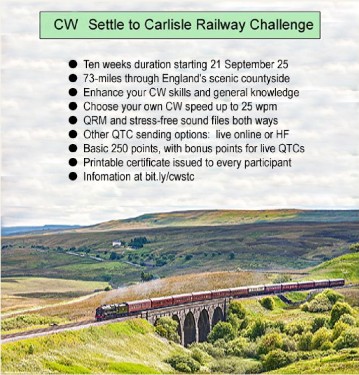
From Stan ZL38TK Here’s your opportunity. The Great British countryside has featured many times in such entertainment as ‘Last of the Summer Wine’, ‘The Camomile Lawn’, ‘All Creatures Great and Small’, ‘Doctor Finlay’s Casebook’, ‘Foyle’s War’ and of course ‘Morse’ (of the police inspector variety).
In this instance, William Blake’s ‘green and pleasant land’ gives way in part to a more mountainous, occasionally black environment where tunnels and viaducts, becks and rivers, dales and fells, completely white in season punctuate the countryside.
Believe it or not, that very countryside is able to be enjoyed any time of year on a 1 hour, 39 minute train journey. Yes, I refer to the iconic Settle to Carlisle railway which narrowly escaped closure in the 1980S, and in July 2025 celebrated its 150TH anniversary since the first freight train pounded along it.
Read about this event focused on advancing the CW skills of thousands and sponsored by the ‘Morse with a Purpose Society’, then commit to becoming a member.
Ever thought of joining the ‘Morse with a Purpose Society’
Portable in My Backyard
From Mark VK2KI Have you had any thoughts about a Portable in My Back Yard-type activity to encourage people to have a bit of fun while perhaps preparing their portable gear for the Summer ahead?
Or perhaps, just drag your transceiver and power supply out to the patio for a bit of fun in the sun? I’m thinking of a weekend day in early October. Perhaps to commiserate the start of Daylight Saving? Any thoughts or support for the idea?
Cqqrsnet@gmail.com Dit-dit Mark VK2KI / VK6QI
If you’ve read something that you think might be of interest to our readers, please let me know. For guidance on writing for RagChew, see Articles below. Please email material to Mark VK2KI: cqqrsnet@gmail.com
Watchable Code Shorts
This week I’ve found a few YouTube clips. This first one has some advice from an experienced operator – what he would do if he was starting over again. https://www. youtube.com/watch?v=7Qcvtbul pbA&t=63s Sit back, relax, and enjoy the QSO.
How easy does he make this look. https://www. youtube.com/watch?v=i8Ed0TSpOgs And finally, something from the other end of the spectrum – high speed morse using a straight key. https://www.youtube.com/watch?v=YPsgEdmIUf0
If you’ve read or watched something that you think might be of interest to our readers, please let me know so John and I can share more thoughts and ideas. For guidance on writing for RagChew, see Articles below.
Please email material to Mark VK2KI: caqgrsnet@gmail.com
Di-dah-di-dah-dit
So back to the CQQRS Slow CW QSO practice net.
Next Tuesday’s Net
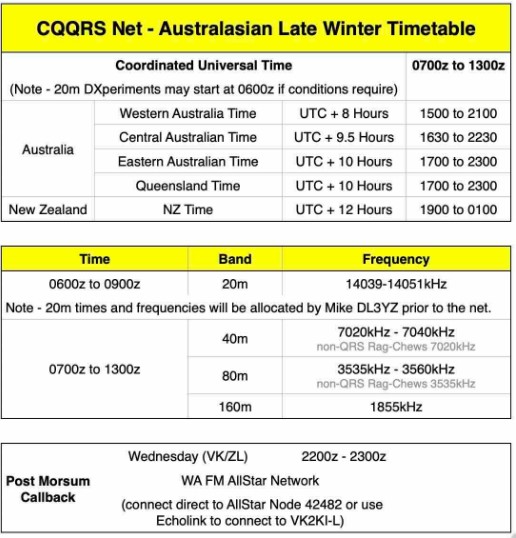
Our CQQRS Group will be on as always on Tuesday from around 0700Z until about 1300Z; see https://bit.ly/CQQRSWebsite and navigate to the Net Details page for details.
Doesn’t matter whether you’re brand new and want to try just exchanging callsigns and RST reports, or you’re ready for a good old rag chew. We’ll have fun.
There’s usually people around until after 1300Z – so keep calling in the segment of the band designated in the table below until you catch someone.
I should be on as usual from home in NSW or via the Remote at Bedfordale WA, and I’ll also be watching the proceedings using the VK6QS and Tecsun SDRs in WA and NSW respectively. Hope to hear you there.
Please let us know via our Reports form bit.ly/CQQRSNET who you work or hear on Tuesday’s Group. The report form closes at lunchtime (Eastern Australian time) on Thursday.
And by the way, a reminder; if you send me any information by email, our report form or WhatsApp – unless you specifically state that material is not to be published, I’ll assume that you’re happy to see your thoughts in the RagChew newsletter.
Post Morsum
Richard VK6HRC will run our phone Post Morsum on the South West AllStar net (via repeaters and hotspots all over WA) from 0600 WA time, then from 0700 WA time on 80m (8605 LSB).
See https://bit.ly/CQQRSWebsite and navigate to the Net Details page for details of how you can connect via Echolink or even possibly via your local FM repeater.
Articles
The newsletter is interesting to readers because of the material contributed by so many people – be it the reports each week or the various articles. Could you write a short article or articles for RagChew? You bet! Writing not your strong point?
Don’t worry, I’m very happy to help as much or as little as needed. Here’s a thought – although our readers will much prefer your own writing, perhaps have a go at using a Large Language Model Artificial Intelligence tool such as ChatGPT, Microsoft Copilot or Google Gemini to check your writing or even to actually draft the whole article in a relaxed easy-to-read manner!
You can find out more about how to do that on the Newsletter page on our website bit.ly/CQQRSWebsite. Our website also includes a suitable prompt (the command you feed to the Al to make it do what you want).
Please remember though – you must fact-check anything that an Al tool drafts for you because Als ‘hallucinate’ – ie if an Al can’t find what you’re looking for, it will make up an answer and present it as a fact!
This is one of the dangers of using Als – it’s quite probable that the tool will create a very readable and convincing draft that is 100% wrong! You as the submitter are responsible for fact-checking.
But it’s a learning experience – please let us know how you went if you had a go with this new generation of tool. And by the way – lam very concerned about our future in a world of Al – but I’m pleased to see that school and university curriculums now focus on understanding the risks – for instance, kids are now learning critical thinking something that used to be taught mostly at post-graduate level.
When the typewriter was invented, people predicted the downfall of handwriting; when the word processor was invented, the art of writing was thought to be on the way out – ditto for the spreadsheet and arithmetic, AM, SSB and FT-8 for amateur radio etc.
We can ignore Al and hope that it just goes away… or we can learn to handle it through experimentation and use. For more guidance on writing for the RagChew newsletter (including help with using an Al), head to our website bit.ly/CQQRSWebsite then click the menu on the top right and then click RagChew Newsletter.
Teamwork
Thank you so much to our team of 28 contributors: DL3YZ, G7BED, VK2ASB, VK2I0W, VK2RU, VK3BTV, VK3CLD, VK3DRQ, VK3ECH, VK3WOW, VKAPN, VK5AO, VKSCZ, VKSET, VKSED, VKSKFG, VK6HRC, VK6JDM, VK6KD, VK6KL, VK6NQL, VK6IS, VK6NW, VK6RR, VK7JZ, VK7TA, VK7WW, and ZL3TK.
And a special thank you to our editorial team, Nigel G4RWI (head of software development), Patrick VK2I0W (our chief reports coordinator), John VK2RU (Head-Copy magician and researcher) and Richard VK6HRC (Post Morsition). Great work alll UY CW on Tuesday, mb.
Mark Bosra VK2KI/ VK6QI Beautiful South Bowning NSW mark,bosma@icloud.com non impediti ratione cogitationis
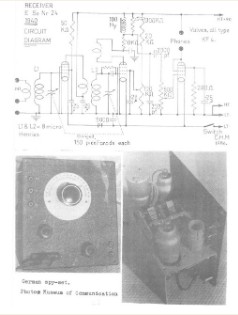
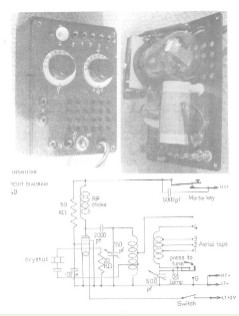
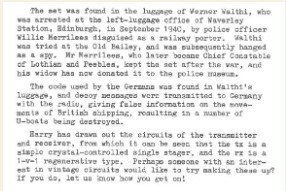

Thanks again to John VK2RU for yet another interesting tail-end snippet.
About the CQ QRS Net
For the current schedule and more information about the CQQRS net, please go the the Net Details page on our website:

The opinions expressed in the RagChew newsletter are those of the individual contributors. The opinions do not necessarily reflect that of the editor or of the CQ QRS Group members.
Any material and images received from members by the editor or published on the CQQRS WhatsApp groups may be published in this newsletter unless specifically requested otherwise.
The values, doctrine and guidelines for the Group and for the newsletter are published on the Principles page of the group’s website https://bit.ly/CQQRSWebsite