Below is a reconstruction of the 2025 36 CQ QRS RagChew newsletter designed to support full text searching. This reconstruction was built using OCR, and will contain errors.
To view the Mailchimp original, click here. To search the entire newsletter archive, click here.
Contents
- CQ QRS RagChew
- Masthead Image
- Reports
- Website
- Post Morsum — 3rd September 2025
- Made On My Workbench
- Hand Copy Practice
- Other News
- Emails during DXperiment
- KPH Delivers the Goods … Again!
- Morse Training Net
- Winding up the QRS International Flight Contest
- Say What? Choosing What to Send as Your QTH
- CW Ops
- Support
- Readable (Watchable) File
- QRQ Rag-Chew Anyone?
- Di-dan-ai-daan-ait
- Next Tuesday’s Net
- Post Morsum
- Articles
- Teamwork
- About the CQ QRS Net
CQ QRS RagChew
John VK2RU continues his series of head-copy practice material, plowing into The Wind in the Willows – thanks mate – pretty good for the couple travelling the far North in a caravan, who were connected to 240V power and water for the first time in five months this week.
John is now heading Southward and reports a relaxed state, not having to watch
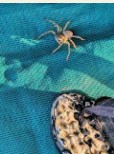
Out for crocs, snakes or giant spiders. John has also brought us another interesting Readable Five article and once again left us with a smile on our dial at the end of the newsletter.
We also learn from Stan ZL3TK about the latest Enigma challenge from the Historic US Navy station KPH – which somehow I missed. I thought I was on the email distribution list, but perhaps it’s been trimmed in the cut-backs.
So if you hear of more KPH challenges, please let me know eatly, so I can let others in on the secret too. This week Stan also winds up the QRS International Flight Contest with the results and a debrief for those who had a go at the interesting and fun learning exercise.
And we hear from our mate Simon MOKBJ who also popped up on Tuesday; and you thought spelling your QTH in CW was a challenge! Chris VK3QB has his regular CW Ops segment – this week discussing dropping your line in the DX or contesting puddles.
And Peter VK3WOW has suggested an alternative to my suggestion of a separate QRQ (je non-QRS) rag-chew net, after lan VK7TA’s comments last week. I’d also like to acknowledge the trials and tribulations of our CQQRS Reports editor Patrick VK2IOW.
As the deadline for this week’s material drew closer, Patrick’s only two-year old computer decided it didn’t like CW – and spat the dummy – black screen, 3FO hard disk error, can’t find the hard drive!
Thank you Patrick for biting the bullet and buying a new machine and sorting out the configuring to keep us on the air; to quote Patrick: “never in the history of human digital endeavour have so many decisions to be made, with so little understanding, by so few” 🙂 Well done mate.
So please read on; I hope you enjoy the newsletter and come away with a smile.
Masthead Image
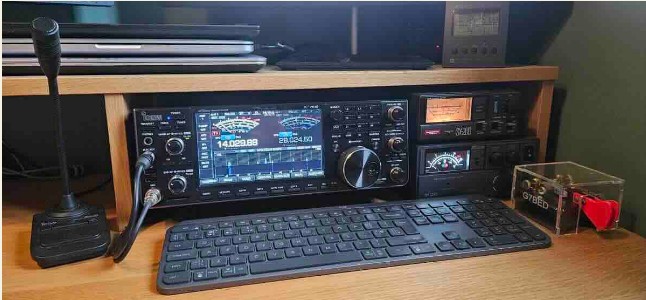
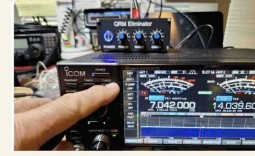
The masthead photo this week is the Icom IC-7610 belonging to Chris G7BED at Northampton, about 100KM North of London. As you know, Chris is one of the down-under DXperiment team who joins us each week early on Tuesday morning his time – to try some long-path propagation on 20m.
As mentioned above, Chris tells us about his antennas later in the newsletter.
Reports
Just an early reminder – after next Tuesday’s Group, please send me a list of who you worked and / or who you heard using our web form here:

Please help attract new and old team members to have a go by submitting your repo! each week. Submissions close 1300 (Eastern Australian time) on Thursday.
Website
If you’d like to find out a bit about our net, or would like to pass information to others about our Tuesday get-togethers, here’s the link to our website.
Bit.ly/CQQRSWebsite Cheers, mb Mark Bosma VK2KI / VK6QI Beautiful South Bowning NSW mark.bosma@icloud.com non impsditi ratione cogitationis
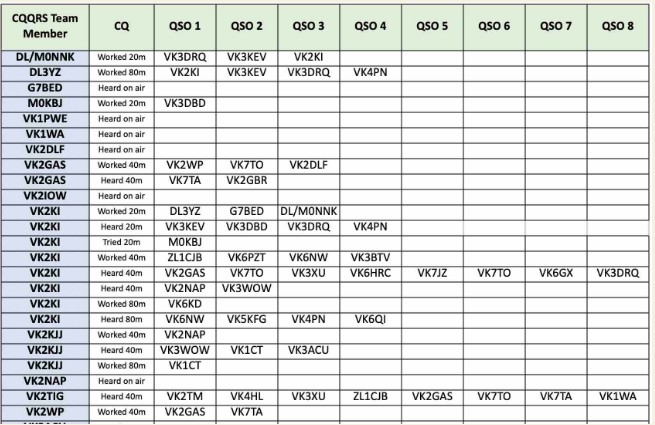
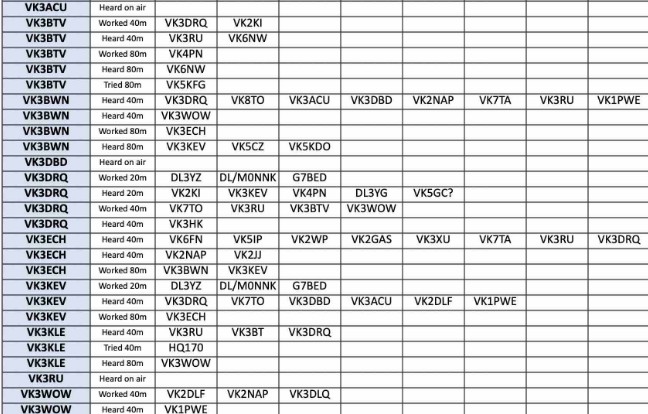
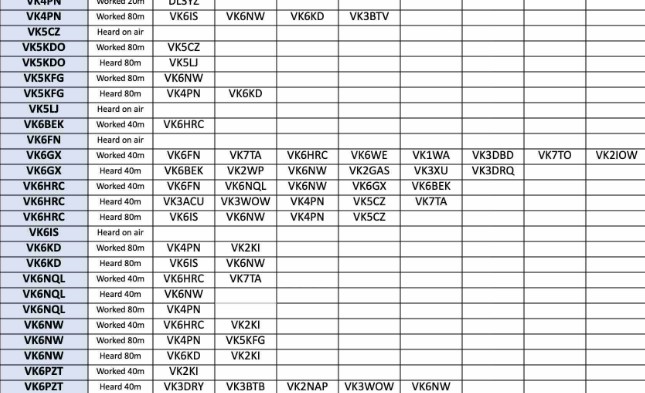
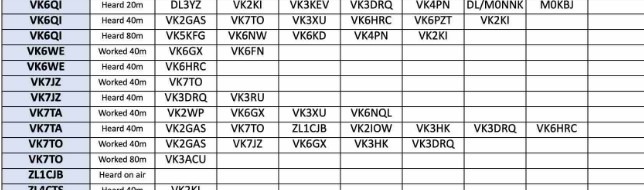
The spreadsheets above show the known stations on last Tuesday’s Group; the comments in the team members’ reports (Submitted via our webform bit.ly/CQQRSNET ) follow:
[20m] Today I finally managed to operate with my home brew 2(¢ full wave diamond loop antenna. It was great fun, as it did really well this morning. Condx were also a charm. At sor times I had S7 on the wonderful SDR at Ironstone.
A big thank you to all stations calling me around the globe. You! signals were easy copy and some were up here at S8 wit just 100 watts. Still I doubt I was able to chat to all station: that tried to call me in the pile-up at the start of my shift.
|’ sorry for that, and I hope you have reached one of my fell from sunny Germany, Mike – DL3YZ
[20m] At the end of my time slot on 20m I heard a weak station but couldn’t make out the callsign. And then it was gone. I’d love to know who it I was.
[40m] Had a quick look and listen but saw nothing on the spectrum scope waterwall. When I came back much later only fast CW stations were calling CQ. Too fast for me, hihi.
[80m] Cram miu OTL QNm IW9AC vars ninat= I wac hanr
POM Iny Girt OVI Was Very QUICL. I Weds lappy to have QSOs with Mark VK2KI and Sava VK4PN. Remote SDR Rx in Yarloop w utilised for Sava’s QSO as his sig was very low at my QTH. 73s to all. Cram Rad Tamnaran Virtnarian (Mairan) VHaRTY at lilwdoala Virinrian
[40m] Had a great chat with Manny, VK3DRQ again and brushed up on my Spanish. He signed off with “Haste La Proxima, Amigo” meaning “Until next time, friend” If he ever sends “Hasta La Vista, Baby” I’ll be diving f the floor 🙂 Manny’s QRS sending is rock solid and reliable for
[80m] I called VK5KFG after he signed with VK6NW and signals were fading. But then Sava VK4PN popped up from Queensland for a couple of quick overs, which was appreciated. Cheers Sava!
[20m] Had only 15 min before guests arrived enough for a quick QSO wit DL3YZ. He was readable at about § at best but he gave me S8! Hard to explain this difference in signal strength along presumably the sam path. I have noticed this with most c
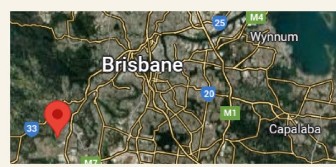
Pendle BF: NE met ech Se rt nde et Ned eam me cr emctnrnns Neweih Phenet enn om Lend river) ome ‘A” ~ Ppa wa Nrmmn oo’ Namo owe erm Sent Nr toh mtn Re mend Behe met Seth tonal a?
Ne Rom Meme em mee alah mend oe ort assumption of the same path in either direction only applies to line of sight, when ionosphere is involved who knows.
[40m] No time to work on 40 m this Tuesday, family visiting.
[80m] Managed to squeeze few contacts on 80m after family left. Lucky by this time of nig in QLD it was twilight in WA and VK6 stations were starting to come through. Local QRN was pretty bad so copying was sporadic but sufficient to carry simple conversation.
Signal strengths were OK around S6 but shredded by frequent QRN bursts. The evening finished with first QO between Keiran VK3BTV from Lilydale and myself. Being very late QSO was brief.
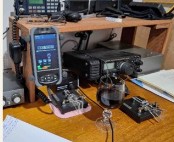
[80m] I heard VK5LJ on my WS62 but he was a fair way off my 3526 crystal freq. Still not getting into VASPH SDR with my 2W output. Using same antenna I was able to have a QSO with lan VK5CZ using Syncal at 20W.
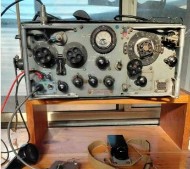
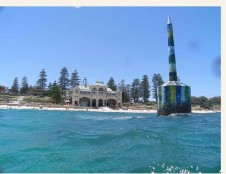
[40m] I was enjoying my birthday and dipped in twice to tes the bands. It seemed very quiet but I got an answer to my call each time for two short QSOs. It added a little more interest to the day.
[20m] When I came back from our afternoon walk just before DXperiment sked time, Mike DL3YZ was thundering through at RSN 531 as he finished a QSO with an RB station.
I jumped in and hooked him straight away – his new loop antenna was real working well, and his signal increased up to RSN 551 in the last over. Great to hear the pile-up of Aussies calling when we finished.
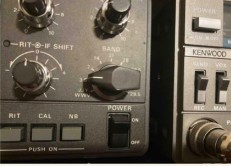
Aussies calling when we finished. I started stirring up Chris G7BED via WhatsApp to let him know the ionosphere was playing well – he advised that he was on to it – charging-up on Wheatabix in anticipation.
Mike was still going hammer-and-tong as 0630Z approached and I was wondering how the hand-over of the station to Ross MONNK as a Remote operator was going to pan out.
However, the hand-over seemed to go nicely and no friendships were lost in ‘the making of the transition. When I caught up with Ross DL/MONNK (on Mike’s station as a Remote) signals had dropped a bit – I reported RSN 421 and he sent RSN 431 back.
A while later Simon MOKBJ came up unexpectedly on 14033 and had a chat to David VK3DBD. Simon was only RSN 211 here – so I didn’t try annoying the ionosphere.
[40m] Things were very quiet when I returned to the shack after dinner; only the one QSO under-way. I could also only just make out the weak CQ signal from Richard VK6HRC – but that was mainly because I was listening to him on the VK6PH KiwiSDR at Ironstone Range as well; the band wasn’t open yet from WA to darkest NSW from the sounds of things.
So I resorted to calling CQ. I was pleased to be called by Clive ZL1CJB in Auckland. Clive’s RSN report showed that he was struggling with an S6 noise level and he also reported QSB – so we had a brief chat only.
Great to hook up with one of our founding team members, Richard VK6PZT at Dalyellup again. Then followed Wayne VK6NW in Bridgetown who was a tad stronger than Richard, then Keiran VK3BTV came up and bent my TS-120S S meter with a pretty rare $9 signal.
[80m] There was a bit of activity around with good signals when I came down late to 80m. A few CQs drew no nibbles, so I went for the fish in a barrel solution (ie teed-up a chat via WhatsApp).
Good to work David VK6KD again – we went from chatting every week when he and Pauline were on the road, to only occasionally now that they are home…. let’s blame his Birthday present from Ms Pauline – the new IC-7610, so he then sells it to me!
Also from your editor Mark VK6QI at Beautiful South Bowning NSW via the VK5PH Ironstone Range and VK6SEG Hoddys Well KiwiSDRs and the VK6SR Remote station at Jandakot.
[20m] Mike DL3YZ was rocking in to Paul VK5PH‘s Ironstone Range KiwiSDRs at RSN 561 and the VK6SEG SDR near Northam RSN 531. Chris G7BED was a nice RSN 551 into VK5 and 541 into WA.
When Ross took-over the Remote station reigns, signals into SA and WA were still good. Simon MOKBJ came up unexpectedly and was RSN 311 into VK5 but couldn’t be spotted on the WA waterfall display this time.
Aussies calling when we finished. I started stirring up Chris G7BED via WhatsApp to let him know the ionosphere was playing well – he advised that he was on to it – charging-up on Wheatabix in anticipation.
Mike was still going hammer-and-tong as 0630Z approached and I was wondering how the hand-over of the station to Ross MONNK as a Remote operator was going to pan out.
However, the hand-over seemed to go nicely and no friendships were lost ir the making of the transition. When I caught up with Ross DL/MONNK (on Mike’s station as a Remote) signals had dropped a bit – I reported RSN 421 and he sent RSN 431 back.
A while later Simon MOKBJ came up unexpectedly on 14033 and had a chat to David VK3DBD. Simon was only RSN 211 here – so I didn’t try annoying the ionosphere.
Also from your editor Mark VK6QI at Beautiful South Bowning NSW via the VK5PE Ironstone Range and VK6SEG Hoddys Well KiwiSDRs and the VK6SR Remote station at Jandakot.
[20m] Mike DL3YZ was rocking in to Paul VK5PH‘s Ironstone Range KiwiSDRs at RSN 561 and the VK6SEG SDR near Northam RSN 531. Chris G7BED was a nice RSN 551 into VK5 and 541 into WA.
When Ross took-over the Remote station reigns, signals into SA and WA were still good. Simon MOKBJ came up unexpectedly and was RSN 311 into VK5 but couldn’t be spotted on the WA waterfall display this time.
[40m] Fired up the VK6SR Remote but got too bi from over East to use it, except to listen to own signal (not very exciting really!).
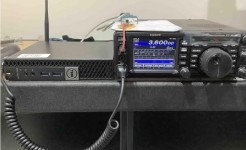
80m] The VK6SR Remote coupled to the antenna ok on 80m again this week – thanks Southern Electronics Group team. This week there was the distinct sound of an electric fence nearby – tick, tick, tick, tick.
Luckily, the noise blanker function worked at the press of the button (being a bit of a dinosaur, I haven’t worked out what the control frequency and control level controls on the Remote do – probably the dynami noise reduction – but luckily the traditional pulse noise NB button worked perfectly!).
[40m] The evening started with Armin, VK2GAS, discussing weather and weekend bushwalking. Next up, Jim, VK7JZ. Unsurprisingly good signals given it was only a 18 km hop.
Unfortunately, my cottage pie was ready to come out of the oven, so 73’d each other after only a couple of overs each.
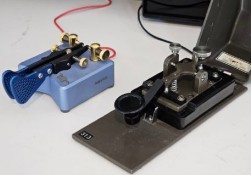
| was surprised to hear Phil, VA6GX so early in the evening. We established contact, but the QSB was very deep and wide. We ha to call it quits pretty soon, as I simply wasn’t receiving enough of his signal to facilitate a conversation.
It was good to get a new call in the log though. VK3HK, Steve, was booming in Hobart. Even at 50 W, he was still S9+10. This allowed for a very relaxing QSO. Then Manny, VK3DRQ, answered my call, leading to an enjoyable extended QSO too.
We discussed weekend visits and our DX exploits.
With the 40 m well drying up, I was about to move down to 80 m when I came across TS0TTT, operating split from Kiribati. It didn’t take long to get an unexpected new D? entry into the log, although he was operating anything but QRS.
[80m] When I first arrived on 80 there was no QSO activity. Lawrie, VK5LJ was calling QRQ however, so had a brief hello with him before moving up the band to look for any QRS contacts. I was rewarded with Jordan, VK3ACU, as my only 80 m contact.
His incredibly strong signal made me wonder why there wasn’t more 80 m activity. None the less, as always it was nice to catch up with him.
[40m] That noise level still cuts in, after 1800 local, and still makes looking for those CW sigs, more interesting.
[80m] It’s still fairly quiet, over here, in the west,
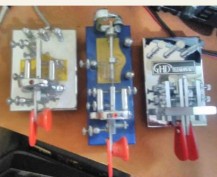
[80m] 40m was very busy band at one stage but by the time I was able to be on-air, I caught the tail end « the busy period and could not raise any station with my CQ call. So I jumped quickly to 80m banc to hear VK3ECH calling CQ and responded right
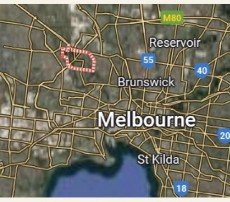
[40m] Sondx seemed pretty good to the east coast on 10m, although I didn’t hear any ZL’s or VK5’s.
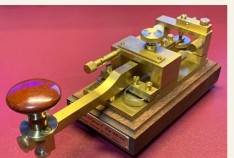
[40m] Only one QSO for me this week with Lance VK7TO and I really enjoyed it. I was listening along for a bit before-hand and pleased to get some copy practice in. Later I could also hear VK3DRQ and VK3RU.
This week I did not make the effort to go to a park (usually seekinc
Post Morsum — 3rd September 2025
A ace et a ae ct alt ro feta enen Sarma Nmvaeditar| planeta eral aarti aa from Richard VK6HRC seven checked in on the AllStar / Echolink and South West Repeater Hub.
Me Bh AI thn eh MeN he roe Bhan tA VK6KD_ David VK6FN Max VK6QI_ Mark VK6NW Wayne VK6HRC. VK6XL_ Allen
VK6MRB Mulligan sw and others. David got an unintentional early start to the day as his electronic device activated an hour earlier than normal so he decided to head off to the salt mine.
End result we caught up before net with and Mulligan checking in as well. He monitored 20m to start with then 4Gm but got busy on 82m to work Sava VKAPN, Wayne VK6NW and Peter VK6IS.
Max got a good start on 49m he enjoyed a contact with Phil VK6GX with great code at a good speed but an important phone call interrupted proceedings. Mark worked three on 20m Mike DL3YZ, Chris G7BED and Ross MONNK remote through Mikes system.
He had a good run on 4@m and then caught up with Richard VK6PZT a founding member on 89m. As usual Mark did a fine job of spotting on WhatsApp monitoring multiple SDR receivers toughing it out with an ice pack over his eye I Wayne enjoyed himself with some local and Eastern state contacts on 49m then on to 8@m to work Sava VK4PN, Greg VK5KFG and Peter VKIS.
I had a good run on 4@m working five stations one being Shaun VK6BEK which was great as I had not heard him for quite some time. Tried 82m no contacts but probably too early as quite a few turned up later when I had gone into SWL mode.
Allen VK6XL called in at the end of the net with some queries about VHF/CW and aurora scatter possibilities and was given a lot of helpful advice from Mark. Thank you to all on last night and this morning
Made On My Workbench
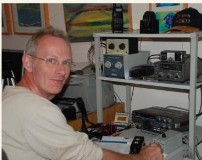
In the weekly email reminder, Mark suggested that our 20m DXperiments aren’t just for people with gain antennas on 20m. I agree! My HF antenna is only a simple wire fan dipole too. Took me a few hours to make and tune, and probably cost me about £5.
I’ve worked the world on it and with 100W, my signals seem to land quite well in VK/ZL land. Just arrived home and thought for the newsletter, I’d pop out with the camera :-).
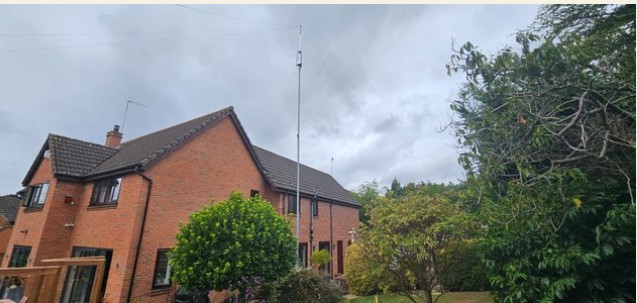
Quick description as follows … – 3 dipoles for 10m, 20m and 40m – All running from the same (common) feeder cable – Took some tweaking (mast up/down) because as you tune one, the others wander off – But eventually you get an antenna system that (using the built-in tuner in the radio) is useable on 10/20/40 AND ALL the WARC bands too.
You can see the rotator cage, it’s a mast designed to support a small-to- medium sized yagi and rotator. As I don’t have any VHF gear up
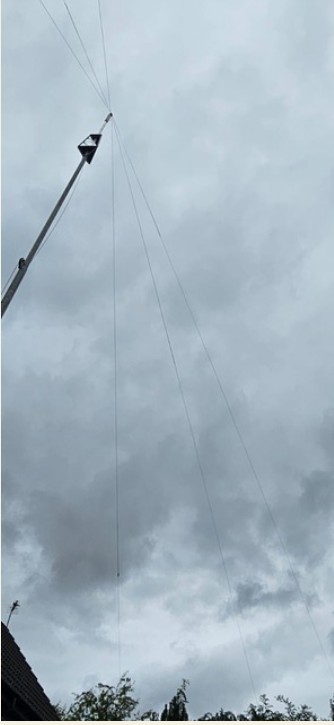
At the moment, I thought I’d use it as the centre for my dipole as I spend pretty much all my time on HF these days. There’s a short wooden stub mast to keep the radiating elements away from the main stub mast itself.
The mast winches up and down, and then tilts right over for maintenance.
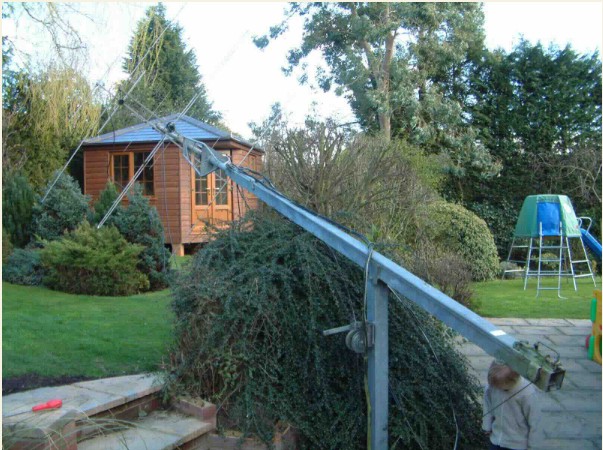
Interesting choice of support at the right hand end Chris! It sits in a huge concrete block in the ground (1.5m cubed). I have some old pictures of me and my Dad digging that out somewhere … as fast as we dug, it filled with water 🙂 …
I keep toying with the idea of moving the dipole to the gable end of the house, and getting some more 6m & VHF Yagis back up. But that’s for another day.
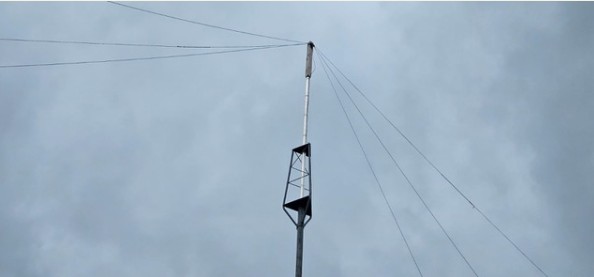
It’s all I’ve used for years and I’ve worked the world. There also a picture below showing my EFHW with the loading coil at the end to add 80m …
That’s my garden shack antenna – OK, I have space compared to most (though not by Australian standards), but I only have bits of cheap copper wire – nothing fancy
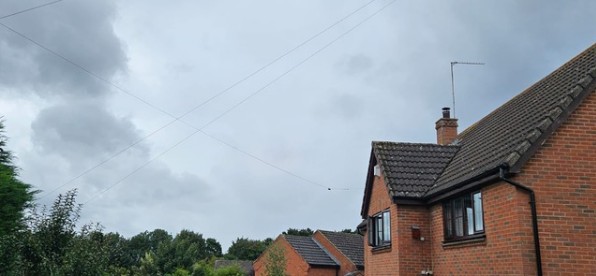
Looking forward to working some of you again next week. Thanks Chris G7BED [Thanks for the insight into what’s at the other end Chris.
I still have half of a similar antenna tangled up with the corrugated roofing iron tek-screws after a storm; with parallel elements (not fanned), I could never get the antenna to work properly so when the rope deteriorated and it blew down, it stayed where it landed!
By the way, many of us have never ventured that far down under, so it’s interesting to see the beautiful garden shots as well. Love the idea of a garden shack and an inside shack!)
What’s going on on your workbench? If you have an article or two that you think might be of interest to our readers, please let Mark VK2KI know; email to cqqrsnet@gmail.com For guidance on writing for RagChew, see Articles below.
Hand Copy Practice
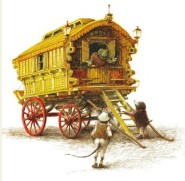
Last week we began Chapter 2 of The Wind in the Willows, The Open Road in which Rat, Mole and Toad start out on their caravan adventure. Unfortunately for them, their trip didn’t last long. This week we continue and complete Chapter 2.
Because of MallChimp’s size limits, I’ve had to split the remaining Chapter 1 audio into three parts. If you’d like the full chapter in a single file, you can use the complete text of Chapter 1 (attached to last week’s newsletter) and convert it yourself with the Ebook2CW app — https://fkurz.net/ham/ebook2cew.html.
I’ve made a few small adjustments to the text to keep it “Morse friendly”. Uncommon punctuation has been removed (the Ditto CW app doesn’t recognise some of it), and contractions have been simplified (for example, we’ll becomes we will).
This week’s attachments include: + Three MP3 files (second half of Chapter 2) + Three text files matching the MP3 segments
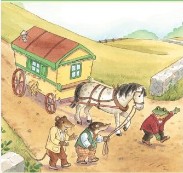

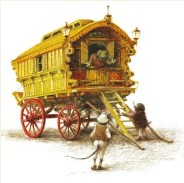

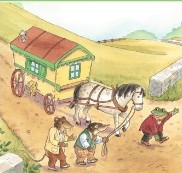
The complete text file for Chapter 2 can be found in last week’s newsletter. You can either play the MP3 files in any media player, or load the text files into the Ditto CW: Morse Player app — https://dittocw.andro.io/.
Both work well, but Ditto CW gives you complete control over all Morse settings, while a normal media player only allows changes to playback speed, and does that in steps (e.g. +1.25x, 1.5x, 1.75x).
Other News
Emails during DXperiment
Superb signals from your new loop Mike – up to RSN 551 on the last over with me and RSN 561 into Paul VK5PH’s Ironstone Range KiwiSDR receivers. Di-dit. Hello Mark, Thanks for our QSO and your kind report.
Now Ross operating on my radio by remote control and it feels somehow like it is possessed HI. What a pity I can’t have the loop permanent here, it also works great on 10 m.
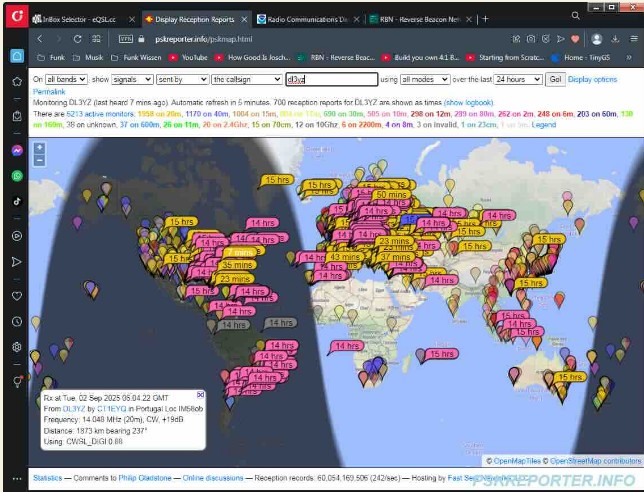
But yesterday the curious neighbours already gathered together whispering, so I will clear away all antennas for a few days. 😉 Hope I can provide a photo showing the dimensions HI. Have fun in the net Mike DL3YZ
KPH Delivers the Goods … Again!
From Stan ZL3TK It’s been a long two-year wait since the Historic Maritime Coast Station at Point Reyes, north of San Francisco, transmitted an Enigma message, but now it’s over.
On Saturday 30 August the intrepid operators at KPH delivered the goods again when they sent a war-time themed message encrypted on a Kriegsmarine 3-rotor machine.
The FCC prohibits both encoding and encryption on amateur band traffic, so the transmission took place on six (retired) maritime frequencies simultaneously, from 462 kHz to 22.4475 MHz. No one said decrypting the message was going to be easy.
The captured code book page needed for setting up the receiving-end machine is badly damaged, a situation not atypical to real life for a Wehmacht Funker on the battle fields in the 1940S. Kevin KETOP, manager at KPH, focused on this feature to good effect.
He says, “Use this captured code sheet to decode the message. It is in poor condition, but it’s the best we have. Use your knowledge of what a complete Enigma code sheet looks like – it should be enough!” Well, he’s right, it is enough!
But for those without previous Enigma experience, the damaged page introduces an exciting 50 % risk-of- failure factor. Why exactly 50 %? The answer lies in the photo which shows what could be either an ‘O’ ora ‘Q’.
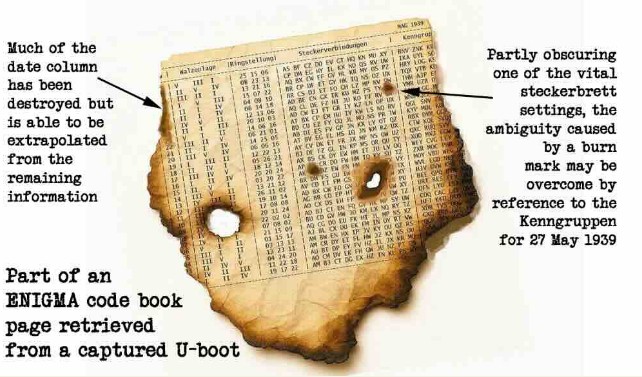
One could not be offered a more fantastic exercise. That grossly over-used word ‘fun’, doesn’t even come close. For those who would like to experience the excitement of a successful Enigma decrypt, here is the transcript of Saturday’s KPH transmission.
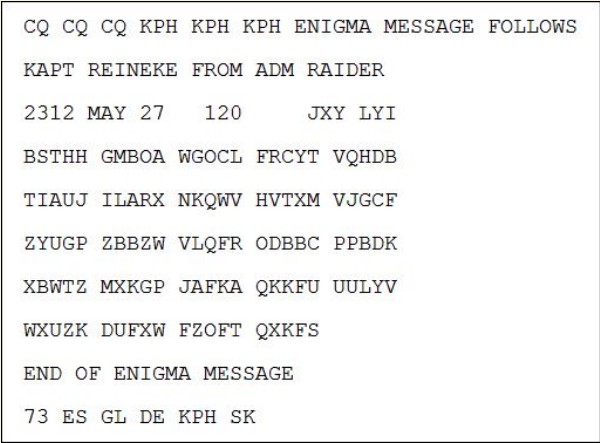
Be aware there is a one-letter error in the message which when in clear is easy to spot. Next week my decrypt will be published, which gives you seven days to do your own decrypt.
The time to enter to receive an official KPH certificate in recognition has long passed. However, as a blunt encouragement tool ‘have a go’ and a way of opening the gates to a field of purposeful CW, anyone is welcome to email their decrypted message to zl3tk@qsl.net and will receive an Oceania-grown certificate in commemoration of success.
Final challenge: even without decrypting, can anyone spot what clearly makes the message historically impossible? If so, gain some observational ‘Brownie Points’ by letting us know what it is. 73 de Stan
Morse Training Net
Our team member Nic VK7WW runs an on-air Slow Morse training net every Wednesday at 7pm EDST on 3580 for 30 mins. He uses the callsign of the Northern Tasmania Amateur Radio Club VK7TAZ on that net.
Many of our team learned Morse code with the support of Nic, and the weekly training session comes highly recommended for anyone who wants to learn the Code, or simply brush up.
Everyone’s welcome – 3580KHZ at 7pm Eastern time every Wednesday; you’ll hear lots of the CQQRS team on that net. Jordan VK3ACU has recorded the complete set of lessons which you can now find here:
Https://www. youtube.com/playlist?list=PLHsQmZz6fBXO7swAfbT mutrbbEL17fUQL Contact Nic VK7WW for more info nicholaschantler@hotmail.com including how to join the NTARC DISCORD group to follow the action, or just come along and join in on Wednesdays.
Winding up the QRS International Flight Contest
Winding up the QRo International Fiignt Contest
From Stan ZL3TK Eleven weeks and just over 130 QTCs since the launch, it’s all over! Sincere thanks goes out to all who took part in the spirit IFC was intended, for without entrants (albeit stating the obvious) there’d be no contest.
And here’s what you’ve all been waiting for: the ‘place-getters’, in reality the Winners who surpassed 100 points. To avoid embarrassment, the points gap between 116 the next lower scorers is so big those entrants won’t be listed, and neither will the even lower scorers who bailed out.
Nonetheless, all entrants will receive a suitably-annotated certificate in acknowledgement.
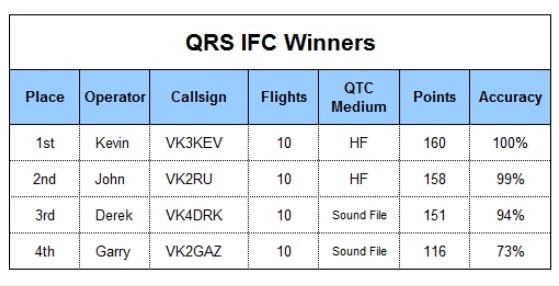
It became clear early on that the significant numbers of early entrants was deceptive, because historically we know that few can see the many advantages such opportunities as IFC offer.
Most entrants were sending in QTCs only intermittently, eliminating any possibility of their ever reaching the notional threshold of 100 points.
Then after making the same mistake over and over and despite being given wide- ranging hints how to jump-start themselves back on track, several balled out entirely.
Hints cannot be too specific without unfairly discriminating against those who achieve top scores unaided, so lateral thinking in interpreting hints would have likely prevented so many bail outs.
Out of frustration I guess, a couple of unsuccessful hintees (if that’s a real word), became less than friendly and suggested traps had been deliberately set, somehow the contest was rigged and trickery was going on to make them fail. But for what purpose?
Nothing could be further from the truth, as the Winners’ scores show. Meanwhile the points-sucking conundrum that folks were facing seemed insurmountable, yet the solution was hidden in plain sight and the tool to solve it had already been provided.
It all came down to how the tool was used, or if it was used at all. Then rising out of the depressing murk came a bright light in the form of a very determined competitor who was not going to be beaten.
He put in the hard yards to unearth what was causing him, and the others in his position, so much grief. It took a while before he tracked it down, but when he did he applied the new-found knowledge and got an immediate, gratifying elevation to 14 points for each flight.
Despite his early losses, dogged perseverance got him over the ‘place-getter’ finish line. Lesson: any of those who bailed-out could have done exactly the same thing. ‘So what was going on? Using this extract from my logs, let’s all play ‘Spot the Problem’.
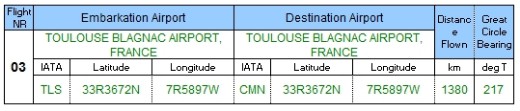
Look first at the two IATA codes, then see how the airport of embarkation and its coordinates are the same as those of the destination airport? How can that be possible? Now consider the distance travelled, it shows they’re not exactly located inthe same city.
As QTCs arrived and I filled in the log sheets pre-configured for each competitor, the problem became instantly obvious.
I’m sure competitors never intended such duplication, but repeatedly earning only 8 out of a possible 14 points was decimating the afflicted’s scores, without considering further losses from various errors.
The remedy was to compare one’s log sheet against the associated sound file to review what was actually being sent, which obviously had little resemblance to the researched data. So simple; there were no tricks!
Cynical bailers-out, your apologies, if offered, will be accepted. It might seem a bit dismal having only four competitors qualify as place- getters, however their entries demonstrate the rules were clear and able to be followed.
Those high scores resulted solely from their personal dedication to the task, especially so for our conundrum-cracking ‘Sherlock Holmes’ who successfully dragged himself back into contention after making heavy early losses – very well done that man!
Finally, not to be intimidated by the unpredictable ‘god of propagation’, Apollo, two place-getters thumbed their noses at using sound files and sent their QTCs live on 40m HF – naked CW at its best.
The few errors encountered were quickly dealt with and only a smattering of perseverance was needed to succeed. This kind of multi-tasking exercise is one way to gain experience in multiple disciplines simultaneously: comprehension; research; logical thinking; data
Handling and composition, in addition of course to CW competence – what’s not to like? I Those who adopted the aphorism ‘Who Dares Wins’, indeed won handsomely.
Congratulations to the four intrepid winners. Everyone will have learned things from IFC, including me, especially about what not to do next time.
In due course each entrant will receive a Certificate to hang on the shack wall in appreciation for either participating or achieving. What’s it called, brag-paper? 73 de Stan
Say What? Choosing What to Send as Your QTH
From Simon MOKBJ Aussie and Kiwi place names can be quite tricky to copy but it’s fun when a long one comes across the long path. I’m burdened with a long QTH myself.
“WOLVERHAMPTON” is a bit tiresome to send and not every foreign station has heard of the city, although it has many claims to fame. I could send the specific area in which I live but “WEDNESFIELD” isn’t much better.
Yesterday I worked John GW3WC, who gave his QTH as “ANGLESEY”. For those unfamiliar with the geography of the UK, it’s the beautiful island off the coast of North Wales, famous for its castles and the ferry port which takes passengers to Dublin.
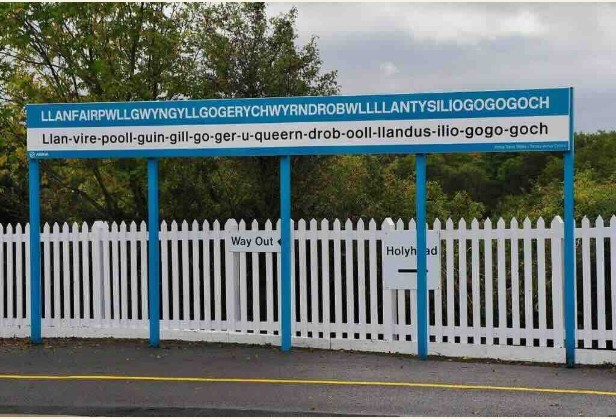
When I checked John’s QRZ page, I saw that he was being a bit unspecific by sending “ANGLESEY”. He actually lives in LLANFAIRPWLLGWYNGYLLGOGERYCHWYRNDROBWLLLLANTYSILIOGOGOG OCH.
Itis a real place and even features the full name on signs at its tiny railway station. I wonder if John has ever sent that and if so, did anyone come back with “PSE QTH AGN?” Simon MOKBJ
CW Ops News for 4 September 2025 Some more thoughts on working DX I’d like to build on the topic of working DX from last week.
As amateur radio enthusiasts we have free (more or less) access to a vast swath of the RF spectrum Those of us who spend time on the HF bands will attest to the wonder of RF and propagation. You can never be sure what the ionosphere will serve up.
We are (mostly) creatures of habit. We have our favourite bands, skeds, times of day, etc, and it can be easy to fall into the comfort of a predictable routine. HF radio offers a great opportunity to challenge those habits and really have some fun.
Call it the magic of radio. Spin the dial. Last Sunday I received a text message from a friend: “check out 17m it’s on fire”… 1 can’t remember the last time I was on 17 metres.
Well, my normal habit has me on 40 or 20 metres, but I decided to match the 40-metre doublet and spin the dial on 17 metres. I started at about 1200Z and over the next sixty minutes I was lost in the magic of radio.
It started with a few European Russians, then some Japanese and a Philippine station, then swung back to Europe with a couple of English stations, then Mark from Ange in Sweden and a couple of Germans. About 80% of the QSOs were ops responding to my CQs.
The opening was sufficiently strong that my dipole (10 metres high) and 100 Watts was more than enough, with most stations reporting readability 5, even if signal strengths weren’t $9. And pretty much every QSO followed the protocol I discussed last week.
Some were a simple “569, op is Vlad – tu 73”, but a few extended to include QTH, a weather report and a basic description of the op’s station. Here I am, 42 years since my first QSO, and I still marvel at the magic of HF radio.
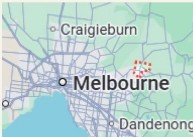
It still amazes me when I report the temp at 3c here 100KM SE of Melbourne, and Ken (250KM SW of Tokyo) reports a hot and sticky 35c.
It might seem fickle in the age of social media, “free” messaging and voice apps, and news-on-demand, but none of that offers the magic and surprise of an unknown response to a CQ on HF.
CW Ops
Support
Two weeks and Its always great to have QSOs witn our fellow VK ops just a short hop over the water. For those on the east coast, Norfolk Island is a very easy chip shot. Maybe set yourself a challenge and see how many bands you can work us on.

As always, if you have any questions or feedback, please drop me an email. 73, Chris VK3QB & VK1CWO CW Ops OC Ambassador VK3QB @hotmail.com or vk1cwo@outlook.com
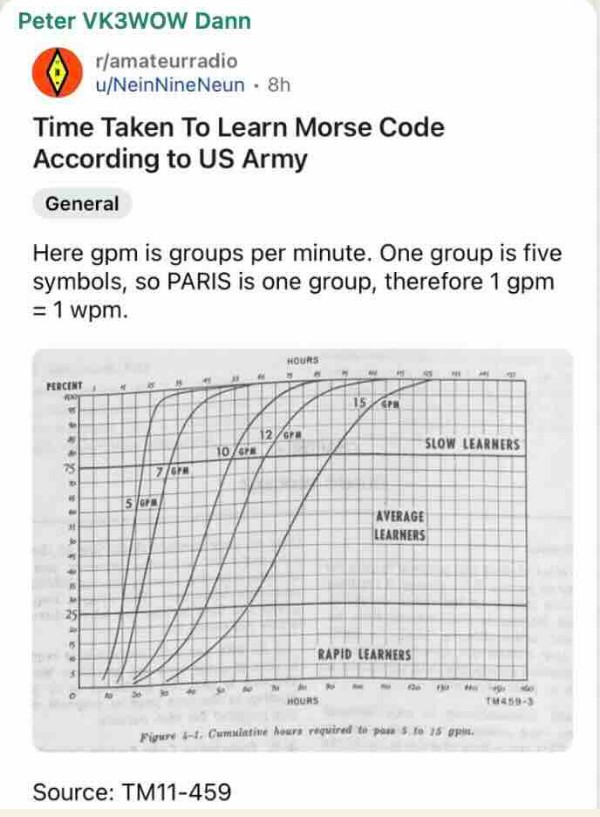
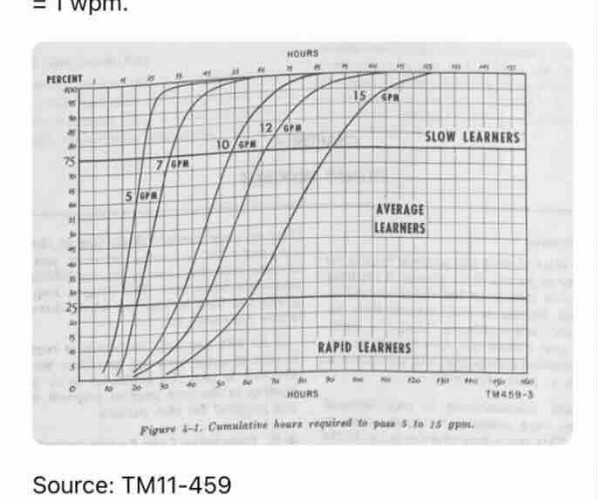
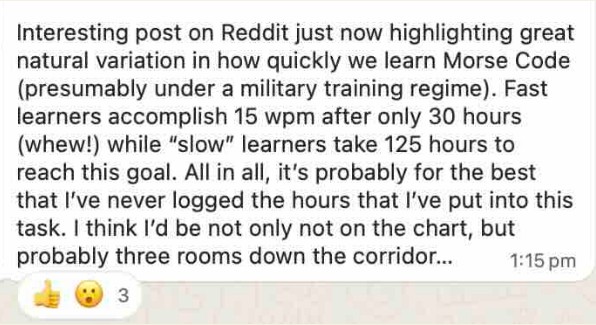
[Everyone’s different – some learn some things quickly, some not so quick. Does it matter in the scheme of things? Nope! My aim is to encourage everyone to enjoy the journey – it’s not a race, and whether you take 300 hours or 30 – who cares?
The folks who’d love to have CW contacts with you certainly don’t! The other side of the coin is if you’re struggling – that’s normal. I struggled and hated it when I had to learr the Code in the 70s for the AOCP exam….
And now look how much time I spend doing CW-related things! Keep it up.]
If you’ve read something that you think might be of interest to our readers, please let me know. For guidance on writing for RagChew, see Articles below. Please email material to Mark VK2KI: cqqrsnet@gmail.com
Readable (Watchable) File
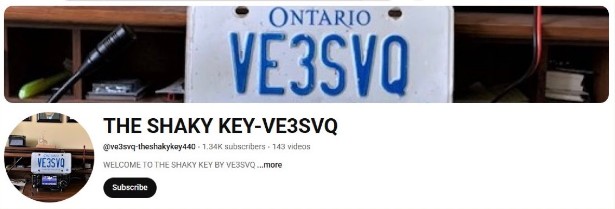
This is a YouTube channel created by Keith (VE3SVQ), aimed primarily at newcomers to Morse code and amateur radio. What sets the channel apart is its approachable teaching style and practical focus.
Keith understands the hurdles beginners face, things like timing, speed, and the anxiety of making mistakes on-air, and addresses them directly with patience and encouragement.
The channel covers a wide range of topics, from slow-speed practice sessions (ideal for those building confidence at 10-12 WPM) to discussions about whether using a CW decoder is acceptable, or how to get started with Parks On The Air (POTA) activations.
Keith also shares tips on key technique, station setup, and operating etiquette, helping operators understand both the technical and cultural aspects of cw.
For those interested in equipment, Keith occasionally delves into straight keys, paddles, and electronic keyers, explaining their pros and cons. He also demonstrates how simple rigs and portable antennas can be used effectively for QRP and field operations.
With over 130 videos and a steadily growing community, The Shaky Key provides both instruction and encouragement. It feels like sitting down with a mentor who remembers what it’s like to be new, and who genuinely wants to see others succeed on the key.
If you’ve read something that you think might be of interest to our readers, please let me know so John and I can share more thoughts and ideas. For guidance on writing for RagChew, see Articles below. Please email material to Mark VK2KI: cqqrsnet@gmail.com
QRQ Rag-Chew Anyone?
From Peter VK3WOW I personally am glad we are thinking about the desirability and practicality of adding QRQ contacts in some way to our existing QRS activities (refer RagChews 34/2025 and 35/2025).
One possible way forward would be to have Mark flag the normal frequency limits of ‘our’ activities as the desired sub-band for QRS activity as he does at the moment, but, in addition, to mention explicitly that if anyone would like to venture on some QRQ activity on Tuesday evening, they’re welcome to do that at a frequency below ‘our’ designated sub-band for QRS activity.
I see no reason why any possible QRQ activity by people receiving RagChew should not be logged on the same form as what we’re currently using for QRS activity. They’re all QSOs, after all. Peter VKSWOW
From Peter VK3WOW I personally am glad we are thinking about the desirability and practicality of adding QRQ contacts in some way to our existing QRS activities (refer RagChews 34/2025 and 35/2025).
One possible way forward would be to have Mark flag the normal frequency limits of ‘our’ activities as the desired sub-band for QRS activity as he does at the moment, but, in addition, to mention explicitly that if anyone would like to venture on some QRQ activity on Tuesday evening, they’re welcome to do that at a frequency below ‘our’ designated sub-band for QRS activity.
I see no reason why any possible QRQ activity by people receiving RagChew should not be logged on the same form as what we’re currently using for QRS activity. They’re all QSOs, after all. Peter VKSWOW [Thank you Peter.
Just as lan VK7TA pointed out the secondary effect of establishing a QRQ net on a different night last week, you have also made an excellent suggestion here.
From your suggestion, I propose that we nominate 7020KHZ and 3535KHZ as a good place to hang-out if you’re after a bit of QRQ rag-chew action. That way no-one gets upset at CW that’s too fast for them.
And what’s more, the frequencies are on the doorsteps of the DX-end of the bands – so you never know SER OTaIVonitaton ate iciitancitin 2a ve aciteclliainorelloritachachialtrthencioen
Do you have a question or two that are worth sharing? How about a discussion- starter? Please let me know cqgrsnet@gmail.com and I’ll pass them to John VK2RU for compilation into a There’s No Such Thing section.
Or if you have some intel about other team members… or even yourself… that’s worth sharing, please let me know cqqrsnet@gmail.com
Di-dan-ai-daan-ait
Next Tuesday’s Net
Our CQQRS Group will be on as always on Tuesday from around 0700Z until about 1300Z; see https://bit.ly/CQQRSWebsite and navigate to the Net Details page for details.
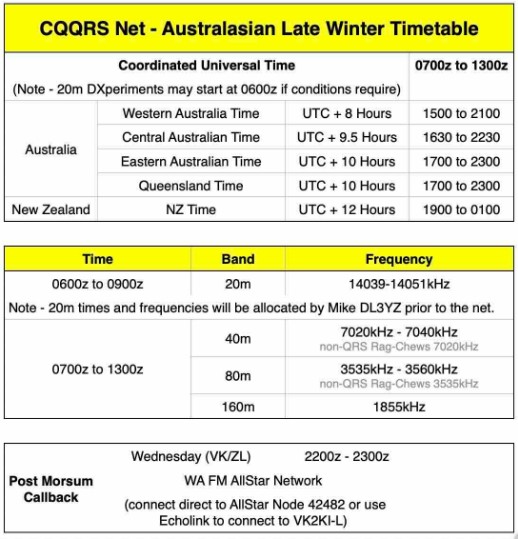
Doesn’t matter whether you’re brand new and want to try just exchanging callsigns and RST reports, or you’re ready for a good old rag chew. We’ll have fun.
There’s usually people around until after 1300Z – so keep calling in the segment of the band designated in the table below until you catch someone.
I should be on as usual from home in NSW or via the Remote at Bedfordale WA, and I’ll also be watching the proceedings using the VK6QS and Tecsun SDRs in WA and NSW respectively. Hope to hear you there.
Please let us know via our Reports form bit.ly/CQQRSNET who you work or hear on Tuesday’s Group. The report form closes at lunchtime (Eastern Australian time) on Thursday.
And by the way, a reminder; if you send me any information by email, our report form or WhatsApp – unless you specifically state that material is not to be published, I’ll assume that you’re happy to see your thoughts in the RagChew newsletter.
Post Morsum
Richard VK6HRC will run our phone Post Morsum on the South West AllStar net (via repeaters and hotspots all over WA) from 0600 WA time, then from 0700 WA time on 80m (8605 LSB).
See https://bit.ly/CQQRSWebsite and navigate to the Net Details page for details of how you can connect via Echolink or even possibly via your local FM repeater.
Articles
The newsletter is interesting to readers because of the material contributed by so many people – be it the reports each week or the various articles. Could you write a short article or articles for RagChew? You bet! Writing not your strong point?
Don’t worry, I’m very happy to help as much or as little as needed. Here’s a thought – although our readers will much prefer your own writing, perhaps have a go at using a Large Language Model Artificial Intelligence tool such as ChatGPT, Microsoft Copilot or Google Gemini to check your writing or even to actually draft the whole article in a relaxed easy-to-read manner!
You can find out more about how to do that on the Newsletter page on our website bit.ly/CQQRSWebsite. Our website also includes a suitable prompt (the command you feed to the Al to make it do what you want).
Please remember though – you must fact-check anything that an Al tool drafts for you because Als ‘hallucinate’ – ie if an Al can’t find what you’re looking for, it will make up an answer and present it as a fact!
This is one of the dangers of using Als – it’s quite probable that the tool will create a very readable and convincing draft that is 100% wrong! You as the submitter are responsible for fact-checking.
But it’s a learning experience – please let us know how you went if you had a go with this new generation of tool. And by the way – lam very concerned about our future in a world of Al – but I’m pleased to see that school and university curriculums now focus on understanding the risks – for instance, kids are now learning critical thinking something that used to be taught mostly at post-graduate level.
When the typewriter was invented, people predicted the downfall of handwriting; when the word processor was invented, the art of writing was thought to be on the way out – ditto for the spreadsheet and arithmetic, AM, SSB and FT-8 for amateur radio etc.
We can ignore Al and hope that it just goes away… or we can learn to handle it through experimentation and use. For more guidance on writing for the RagChew newsletter (including help with using an Al), head to our website bit.ly/CQQRSWebsite then click the menu on the top right and then click RagChew Newsletter.
Teamwork

About the CQ QRS Net
For the current schedule and more information about the CQQRS net, please go the the Net Details page on our website:

The opinions expressed in the RagChew newsletter are those of the individual contributors. The opinions do not necessarily reflect that of the editor or of the CQ QRS Group members.
Any material and images received from members by the editor or published on the CQQRS WhatsApp groups may be published in this newsletter unless specifically requested otherwise.
The values, doctrine and guidelines for the Group and for the newsletter are published on the Principles page of the group’s website https://bit.ly/CQQRSWebsite