Below is a reconstruction of the 2026 21 CQ QRS RagChew newsletter designed to support full text searching. This reconstruction was built using OCR, and will contain errors.
To view the Mailchimp original, click here. To search the entire newsletter archive, click here.
Contents
- CQ QRS RagChew
- Dah-di-dah-di-dah
- New Team Members
- Website
- Post Morsum 20th May 2026
- Reporting
- Proposed New CQ QRS
- Proposed New CQ QRS ANlat Eraqianciac
- Bayesian Thinking
- Random Wire Antennas
- V-Band – Part 1 Introduction
- A Variable Frequency Oscillator for my Home-Brewed Gear
- Replica Paraset (Whaddon Mk-VII) Progress
- CW Practice
- Other News
- Emails to the Editor
- Dear Editor.
- Greetings Mark
- RandomGram Event # 43
- Morse Training Net
- Snowline KiwiSDR
- Slow Morse Training
- Cheers
- Keiran (VK3BadTemperedVictorian)
- On the Bar
- There’s No Such Thing…
- Answer:
- QRZ? Who’s on the other end?
- Prosign/Character/Signal of the Month
- Di-dah-di-dah-dit
- Next Tuesday’s Net
- Reports & Photos
- Articles
- Material
- Teamwork
- About the CQ QRS Net
CQ QRS RagChew
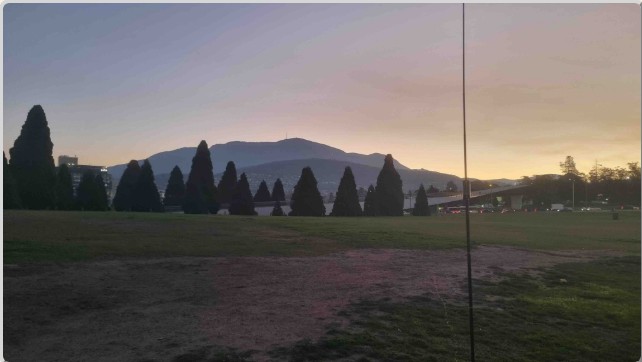
Thanks this week to James VK7JZ for this shot taken during last week’s net from the Cenotaph in Hobart with Mount Wellington in the background and the sun setting in the West. 40m vertical in the foreground of course!
Dah-di-dah-di-dah
Tuesday’s CQQRS Slow CW Practice QSO net was a bit of a mixed bag. Some of the 40 of our team members on air reported ok conditions, others struggled to hear much at all. So, let’s go with variable!
Anyway, thank you to everyone for being there, and in particular, thank you to the ones who made the time to send in reports; I know it’s not the highlight of your week (| nearly missed the Thursday deadline myself), but it’s what makes the net so interesting – seeing what others heard, and hearing their opinions about the evening’s fun.
And well, this week’s mailbag has been brimming with mail prompted by things in the previous couple of editions. I get excited if I hear that my programs on YassFM (the local Community Radio station – broadcast on 100.3MHz but also streamed live on the Internet) are actually listened-to on occasion; more-so if it’s one of our CQQRS team listening-in!
Well, I get even more excited to discover that the efforts of so many of our team to make the newsletter interesting, result in a lot of people actually reading what’s been written.
This week there’s lots of comments about Lance VK7TO’s proposal to shift the 80m and 160M segments, and there’s also lots of traffic about the use of the RSN reporting system on and beyond our Tuesday net.
Thank you to every single person who took the time to pen some thoughts. On a different subject, Ms Elizabeth and I are heading off on another public transport-only trip down through Victoria next week, and for the following three weeks.
I’ll be leaning heavily on our editorial team again, and under some ‘guidance’ from the love of my life, we will probably have some thinner-than-normal editions for awhile.
In addition, over the three weeks and when I return, I’ll be looking to find someone to take over as RagChew editor – coming up to five years of writing every week about the activity, i’s time to hand over.
And more importantly, we now have a terrific supporting team who contribute the bulk of the material with zero input from me, so unlike most other interest groups’ newsletters, this one will just hum-along without much prompting from the editor.
So please – put up your hand if you’re interested in joining the team, aiming to take over as editor after a bit of MailChimp training (which by the way is pretty easy – it’s used by thousands of organisations around the world to either generate marketing material or for newsletters like ours – so only basic computer skills and an internet connection are needed).
Cgarsnet@gmail.com Oh, and speaking of travels – our current plans are to stop for a couple of nights. each at Chiltern, Wallan (with a possible touch-and-go at Seymour on the way) and Ballarat, before landing at Lorne.
The return journey will have a couple of nights each in Melbourne (Australian Chamber Orchestra concert… the primary reason for this trip again!), Culcairn and Wagga.
Elizabeth suggested that we try to catch up with some of our CQQRS team members, so if one of those places might be reachable by you and you’d like to catch-up for a cup of coffee or similar, please let me know.
Cgarsnet@gmail.com So, yet another bumper edition of RagChew this week – please enjoy, and keep those cards and letters (well, emails to cqgrsnet@gmail.com actually) coming!
New Team Members
Welcome this week to Phil, VK4BVM who now lives at Griffith but who has had very little opportunity to put up any sort of decent antenna.
Phil passed the CW part of the AOCP back in the day, and attempted one CW contact which was such a frustrating experience that he didn’t ever try again; sounds familiar!
Hopefully Phil will discover that our net is exactly what he’s been looking for in terms of having another go – no-doubt, he will find the experience much more enjoyable this time… and you never know! Welcome Phil.
Website
If you’d like to find out a bit about our net, or would like to pass information to others about our Tuesday get-togethers, here’s the link to our website. bit.ly/CQQRSWebsite So here we go – on behalf of the CQQRS Editorial team, please enjoy the newsletter.
Niall kh DOSITa VK2KI / VK6QI Patrick John Beautiful South Bowning VK2IOW VK2RU NSW Milthorpe NSW on a track somewhere cqqrsnet@gmail.com non impsditi ratione cogitationis Nigel Richard Lance G4RWI VK6HRC VK7TO our other grey nomad Padbury WA Margate TAS Jordan VK3ACU
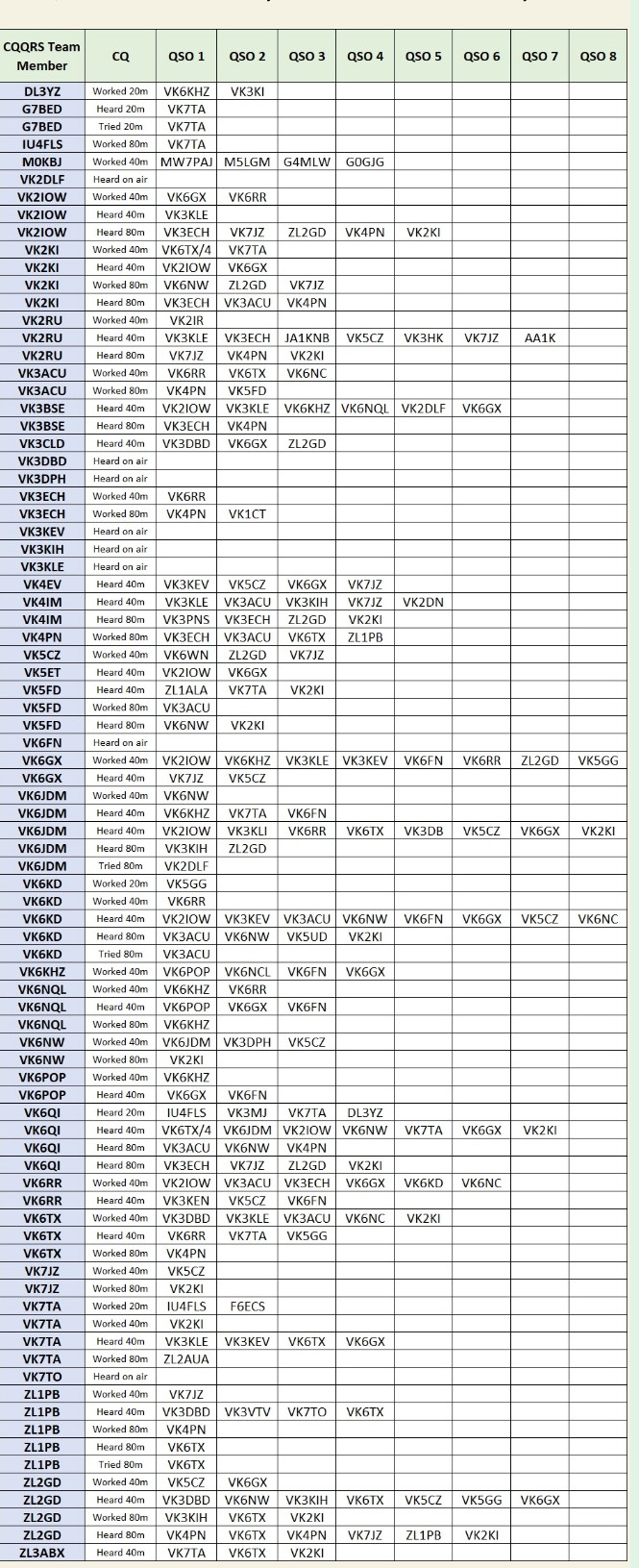
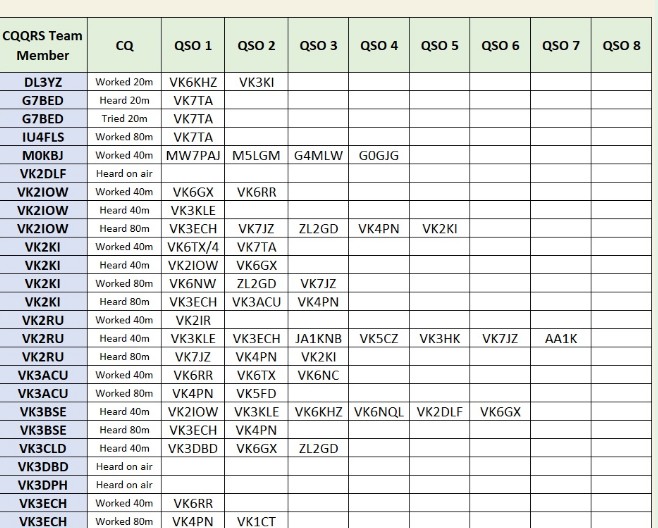
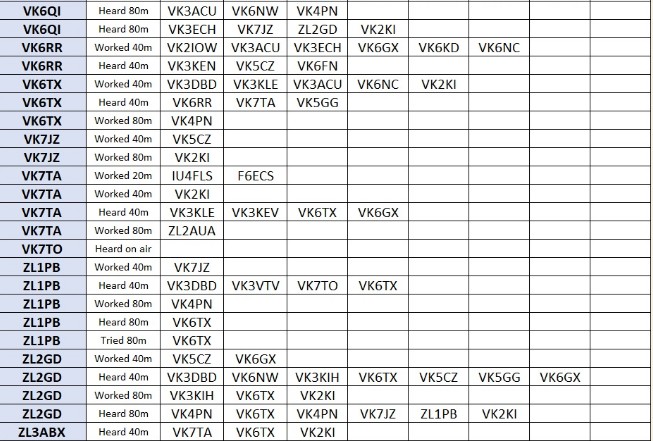
WUTC Hto, John’s spreadsheet above shows the known stations heard or worked on last Tuesday’s CQQRS Net (reported via our webform bit.ly/CQQRSNET ); the comment: in the team members’ reports follow.
The comments were compiled for us by the clever software built by Nigel G4RWI and the layout was perfected by Patrick VK2IOW. Thanks again to Nigel, Patrick and John for the work, and to every team member
[20m] Called CQ for 15 mins, finally got a call back from VK7TA – but then F6ECS barged in and made a QSO instead.
[20m] Weather conditions were good in Bologna on 19TH. Having set up the radio to14044KHz, my s-meter gave a noise level 3, the same at 14046 . At 6:34z I got a weak signal by VK7 but due to noise I was unable to copy it completely.
A few minutes later I succeeded and understood I was in contact with VK7TA, given RST 339. Hope to hear you again lan, I’ve listed you in my QRZ. 73 de IU4FLS Fausto
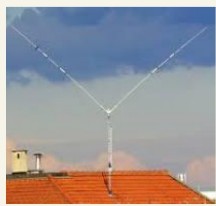
[20m] Today the ionisation was not too high, but at least the noise here was quite low again. It was nice to QSO Mark — VK2KI again, and I was also able to hear the friendly beeps of Ron – VK6KHZ around the globe.
Thanks for the contacts 🙂 Have a nice week, 73 Mike
[40m] 40m was not so good tonight, those that I did hear were weak and had quite a bit of QSB.
[80m] I really need to build an antenna for 80m. I was listening on a 1/4 wave ground-mounted vertical centred on 40m,
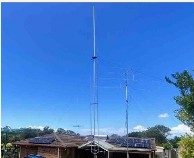
From Grant ZL2GD at Oxford, North Canterbury
[40m] Condx not the best on 40m tonight, all stations heard were well down on normal.
[80m] Signals to VK were much better on 80m tonight. Thanks for the QSOs guys.
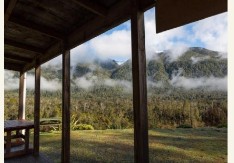
[40m & 80m] Mainly a listening session for me this week. I had a QSO with Wayne, VK6NW, however after a few overs I disappeared – flicked the wrong knob and thought I was transmitting to Wayne when I was not. Sorry OM, please accept my apologies.
It is time to use 80 again, it is now quieter as the Winter Queen approaches with her frosty
Wand, it is almost devoid of signals in the CW segment, and propagation seem great at this time. I heard ZL2GD booming and also a strong signal from VK2DLF in a pretty vacant band.
On 40 there were multiple SSB signals from the north on top of the CW traffic making it hard to find a spot to park a signal. The suggestions about moving our 80 metre activity made by Lance seem sensible to me. Now the question of RSN.
While RST has been the standard for a long time, the T bit seems pretty pointless with nearly all stations having good shaping and clean single frequency signals. That is of course unless I fire up the Paraset and supply a signal with chirp and whoop.
So since T is pretty irrelevant, I like the idea of a bit of a change to RSN. CW is of course a holdout bastion for those who resist change, but RSN strikes me as a good functional change. Finally I was surprised to find Venus and Mars is fictional.
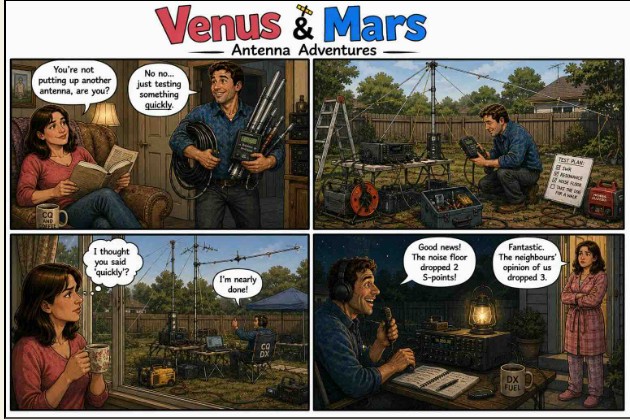
I have avoided showing Anne the cartoons for fear that she would see there are others like herself, and, being the great organising type she is, she might set about creating a group for radio widows, to petition parliament to curtail our activities.
[40m] It seemed 40m somewhat behaving itself though a eee ee
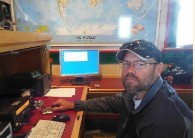
[40m] Interesting conditions some great sig reports with 40W into VK6 on 40m.
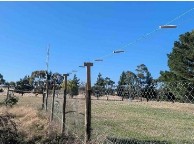
[40m] VERY QUIET as for stations heard. Only noise.
[80m] Nil stations heard, only noise as per 40m band.
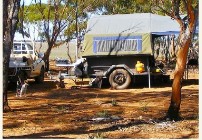
From Ballajura WA 40m was quite active earlier in the evening but by 2200HRS WST our CW QRS operators must have hit the sack or the band closed up with not much to be heard.
My closest station VK6NC should have been bending my Sig meter but only received on an S2. The Northern up must have great antennas for 40m with very little signal
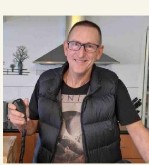
Getting past the reflector in the rear. I will have to touch bases with LIN who was in the hot seat doing all the work last night.
[80m] Conditions in Ballajura WA were quite good on 80m where VK2, 3, 5 & 6 were heard. I didn’t actually get to participate in a QSO but experimented with a number of toroid rings to stop my QRM eliminator playing up when transmitting.
Back to the work bench for me on that one as the eliminator works fine on 40m but still has issues on 80m. 73s all.
[40m] I don’t normally post my Tuesday QSOs unless I have a chat I with an Aussie or a Kiwi but I was so pleased to work two CW novices and an 86-year-old today that I wanted to share the joy.
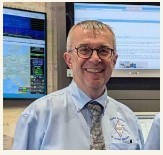
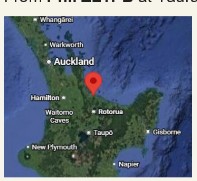
[20m] I could just hear Fausto a couple of times and sent a call but could not hear any reply. Eventually his signal just came up enough that I could manage an exchange. I listened for the others but heard nothing (except for a call from France).
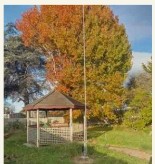
[40m] Good to hear everyone chatting away and to have QSOs with some new stations. Some deep QSB occurred at times with VK6 stations disappearing and VK2 & 3 coming in quite strong.
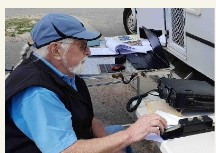
From Patrick VK2IOW between Bathurst and Orange
[40m] Reasonable condx to WA, QSOs with VK6GX and VK6RR.
[80m] Condx seemed good on 80m. Grant, ZL2GD had a great signal in his QSO with Mark, VK2KI. I would have tried to QSO with Grant, but he said it was getting late over there and signed off.
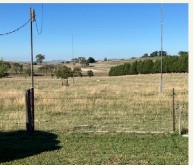
[40m] Most signals were around RSN 433 to 473 using a 40m OCFD up at ~ 7m which will be higher in a few months. There was rapid flutter ~ 8Hz on the signal from Pat VK2IOW, multi path of some sort???
Anyway, after listening only to SDRs for 6 months, it’s good to hear the tones out of a radio. 73 de John VK3BSE
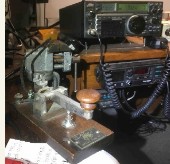
[80m] Mark VK2KI you were RST 599 plus int BLAKEVIEW (ADELAIDE) but as you were closing I did not call you.
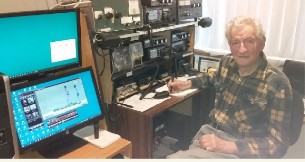
[40m] Interesting conditions tonight, only 2 QSO’s and a new shack issue to solve (now solved). I started by calling CQ, I think it was ZL1PB? answering but the signal was so weak I could not quite make it out.
Next a QSO with lan VKSCZ, I was pleased I was getting more of the CW this week, it shows if I put my head back into practice it comes back. Sorry lan I was still not 100%, but I was better than last week.
Lan was really strong at the start, then faded in/out, then faded totally by the end. times during this QSO. lan was super patient, he just waited, |
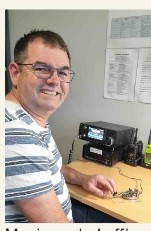
MY ig Cycie@ O/ON o mes QUurNg tls WoW. lan Was super patient, he just waited, I fluffed around trying to sort it, then would call again. lan was waiting on frequency and good to go again. Thanks lan.
The next QSO was with Mark VK2KI on 80m, I know I have had a SSB contact on 80m before, but I think this was quite possibly my first CW QSO on 80m. Mark and I discussed the possibility of an Aurora in Tasmania and how conditions could be better.
I could not see one out my window (I was looking in the right direction), probably sent ‘No Aurora’ with the wrong spelling back at Mark, then after I was QRT my wife told me there was an Aurora not far from Hobart, but just could not be seen against the city lights.
I will be back next week hunting for another operating location.
[40m] Good signals locally and from eastern VK and ZL before sunset, but generally weaker with deep and rapid QSB after.
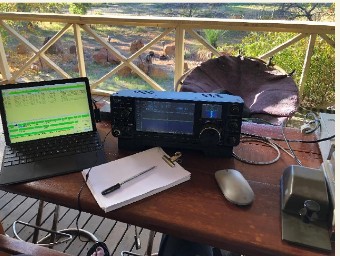
As we are experiencing a very dry and warm May in SW VK6, I took the opportunity to operate outside during the CQ QRS Net, at the VK6GXX Crystal Bar, on the deck, using my IC-7760 remote.
[80m] I For the first time since the start of this war in West Asia I made a few QRS contacts more by chance than choice.
I still cannot get over the emotional impact of the war and the atrocities happening on a daily basis which are no longer even being reported. We quickly get desensitized to any
News and MS media moves to the next catchy topic for a while. What is even more astonishing is that hams from all GCC including Lebanon and Israel have been on ait even during the most intense hostilities. Incomprehensible! Well back to 80m activity.
I check in every weekday to the ZL CW net on 3535 for a brief report and usually have Kiwi SDR at Marahau on to see traces of net members I cannot copy so when the net finished I observed a fairly strong signal a few kHz up and tuned in.
To my surprise it was VK6TX booming in. Well I was not going to let the opportunity go and Icalled Mike. He was 599 at my QTH and gave me 599 but my next surprise was the QTH – Hervey Bay! That’s QLD so no wonder Mike was booming in.
After I finished with Mike a NZ station called Mike, I guess assuming he was in WA which is a bit of a DX for NZ. Not having any luck with Mike ZL1PB called me and I responded. Phil was not particularly strong, about 465 but he gave me 599 report.
I was a bit puzzled with the imbalance in signal strength reports until Phil told me he was running QRP about SW and that this was his first QRS Net QSO. Well he made my day.
I tried to call him at SW for a two way QRP exchange but unfortunately he couldn’t copy me. The remaining two QSOs were with QRS Net regulars VK3ECH and VK3ACU. It was nice to catch up with Rob and Jordan after a long while.
Next Tuesday I will be on 80 m from 10:00 UTC for 15 min every odd quarter hour. I did check propagation this last Tuesday and although I couldn’t see my cartier at Marahau (ZL) I could see quite a good carrier at Ironstone SDR, so I will try again next week.
I did hear VKSPJ working FK8CH but was I bit late to jump in, by the time Ituned up and retumed to frequency they were gone. Such is life!
From your editor Mark VK2KI at Beautiful South Bowning
[40m] Nice to catch up with lan VK7TA at Latrobe again, and I was also pleased to catch up with Mike VK6TX/4 up at Hervey Bay. I knew that Mike had been having a go at CW on the net over the last few weeks, but I hadn’t heard him.

Interesting listening to Patrick VK2IOW chatting to Phil VK6GX; Patrick’s signal had a distinct deep warble, sounding like auroral flutter, even though there wasn’t an aurora alert.
80m] James VK7JZ struggled with the noise at his end for our WhatsApp arranged chat – but we got there. After that, Grant ZL2GD at Christchurch called me and nearly blew my socks off – S9+ signal!
Later I heard Wayne VK6NW calling CQ on 3550KHZ, and it was good to have a nice chat with him again this week. Pleased to see a few more HNeonle popping un on 80m aaain.
Post Morsum 20th May 2026
From Richard VK6HRC. Five on the VK6RLM rptr and AllStar/Echolink hub this morning.
VK6KD David VK6FN Max VK6NW Wayne VK6HRC VK6MRB Mulligan swl
David doing better with his QRM eliminator these days worked VK5GG Graeme and VK6RR Roy tried VK3ACU Jordan but conditions not quite good enough. Heard eight on 40 m and four on 80 m.
Max worked VK6KHZ Ron and VK6GX Phil on 40 m heard Wayne VK6NW and VK5GG Graeme at approx 22 wom ! Wayne worked VK6JDM Donald, VK5CZ lan on 40 m and on 80 m two good ragchew sesssions one with Mark VK2KI and then on to lan VK5CZ.
Nothing from our Northern Hemisphere friends. Wayne is going to be away for a while in Kununurra with SES duties but is hoping to join the Post Morsum using an AllStar node.
Mark was unable to supervise this morning due to an early start, thanks to Wayne for letting us know. I missed out but hope to be on next week. Thank you to all on last night and this morning
Reporting
After next Tuesday’s Group, please remember to send me a list of who you worked and / or who you heard using our web form here:

Even if you didn’t hear anyone, we’d still like to know that you had a go. And to make your report more interesting, please consider sending a photo: cqarsnet@gmail.com So, please help attract new and old team members to have a go by submitting your report each week.
Submissions close 1300 (Eastern Australian Summer time)_on Thursdays.
Proposed New CQ QRS
Proposed New CQ QRS ANlat Eraqianciac
In last week’s RagChew edition 20/2026, Lance VK7TO proposed new net
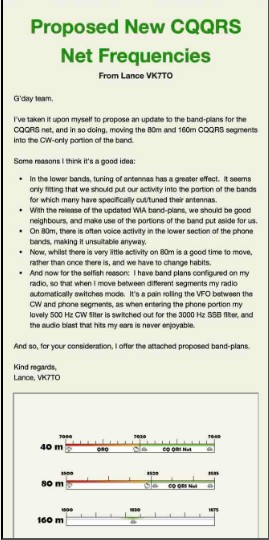
| Looks like an improvement to me, however I don’t have the insights / experience that other members in this group have. Patrick VK2IOW – G’day…. I’m happy to use any frequency that the majority prefer…..
Apart from the 160 metre band which I don’t have a working antenna for, and probably never will. Cheers…. ZL3ABX, Stephen Coote. – G’day Mark, in regards to Lance’s new proposed CW frequencies, I am all in favour to give it a try.
John VKSET Lance makes good points in his recent article. Anything we can do to promote broader awareness of operational good practice is a constructive thing.
The Australian Band Plan was updated recently, and whilst there weren’t a load of changes impacting us HF users, it’s a good time to promote the Australian Band Plan and encourage everyone to be aware of the recommended band segments https://www,wia.org.au/members/bandplans/data/ Whilst the Australian Band Plan is not enforceable (ACMA only regulates the bands, power levels and signal purity), it provides a reference for mutual respect and sharing of our spectrum resources.
Bringing the Tuesday night activity into the broadly accepted CW-only ‘segments of the band is a good move – for everyone. It engages with the broader AR community and encourages everyone to acknowledge and respect other band users.
3555 kHz and 1855 kHz, whilst not a breach of the regs, were clearly outside the traditionally accepted CW-only segments of these bands… and whilst both bands are heavily under-utilised, it’s still good practice to stick with the Band Plans.
If we don’t need to stray into SSB and AM segments we shouldn’t. It’s also good to remember that WSPR sits on 7038.6 KHz, so I make a mental note to keep my dial off 7038 – 7041 kHz… give that mode the space it needs.
Anything we can do to promote a greater awareness of life outside the QRS eco-system is both constructive and helpful to everyone.
The matter of special QRS band plans was raised a few weeks back (in response to a question from a reader in VK6) – the rest of the world wont know about these QRQ and QRS segments, nor the oft mis-understood “speed limits”, and our own observations suggest Tuesday night participants operate at their own speeds irrespective of the QRS/QRQ Band Plan.
Is it not easier to simply say that everyone gathers between 7015-7038 (for example), with a Centre of Activity (CoA) being (for example) 7.025? This also aligns with broader use of the bands.
We all have VFOs and most of us have spectrum scopes these days – which help build better skills spinning the dial, QRV-ing signals and responding to CQs at speeds we’re comfortable with.
It also removes the confusion (or someone looking silly) when an operator isn’t following the informal QRS Band Plan. And, as noted previously, other clubs have preferred calling frequencies – and those members, both at home and abroad, may not know about the QRS Tuesday night activity.
Eg Fists & CWops 7028 kHz and 3528 kHz, Bug club 7033 kHz and these will be more active with Winter approaching. Some local members may be chasing other club members and will tend to gather around those club frequencies.
They shouldn’t suffer the ire/confused messaging of QRS folks feeling they are doing the wrong thing. We don’t own the bands on Tuesday nights.
With more ops on-air these days, a better approach would be to have a centre of activity of 7023 kHz and a range of say +/- 15 KHz. So, start around 7023 kHz and move up or down to find a clear frequency or listen for someone calling CQ.
If someone is going a bit fast for you, just keep spinning the dial. And don’t forget the FDU Wednesday Wrap; an additional opportunity to get on-air and develop skills https://www.fdu.org.au/events/ Assmall but important point, it’s the Australian Band Plan, not the WIA Band Plan.
@ RASA also publishes the Australian Band Plan. 78, Chris VK8QB – Greetings Mark. TE PR por TRON STE Pee] pea RQ Py a pe ky
Bayesian Thinking
Pet A From our Special Correspondent Ross MONNK Recently, an OM remarked about my attitude to Artificial Intelligence (Al), “you’ve certainly changed your tune!” (he meant it light-heartedly)..
It was interesting that this ability to change one’s mind is often regarded as a weakness rather than a strength. If a politician does a “u-turn”, that’s regarded as a tertible wobble.
And some old-fashioned blokes cling to the notion that women are “notorious” for changing their minds, like that’s a bad thing.
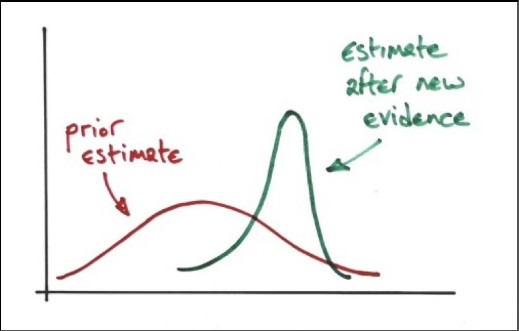
Ido not belong to that camp, so I replied: “Google Gemini Al says, “Bayesian Thinking is a method of updating the probability of a belief (hypothesis) as new evidence becomes available, rather than relying on a fixed, initial assumption.” J engaged in a bit of Baysian Thinking!”
Ne when another OM told me that: RE AD * Iwas handling my straight key in a way that was making my Morse sound staccato.
If want my Morse to sound more “musical”, I should consider a different technique; + my dits are sometimes shorter than standard, which confuses the Vband decoder; + if Iwant my Morse to be more comprehensible in challenging conditions, I should consider the judicious use of longer dahs Now I could just have dismissed those ‘observations’ as a load of old cobblers because, of course, my Morse is already music to anyone’s ears.
But I respect that OM’s opinions (he’s been in the game far longer than I have) so I’ve chosen to regard his feedback as new evidence that can be used to test the validity of my existing beliefs.
Fortunately, the comments about my key handling included advice to improve it and therefore are classified as positive feedback.
Up till now, I’ve been supporting my wrist on the desk, gripping the knob between thumb and middle finger, and tapping with my index finger.
I do this because when I started on the straight key, I had difficulty controlling my arm movernent to get sufficiently good timing, so I experimented with different ways of manipulating the key and found that this unconventional method gave the best results.
This OM suggested I use the conventional ‘floating arm’ technique (my term), and I’m now giving this a try. First impressions are that it’s rather tiring and that I’ll end up with Glass Elbow.
But I’ll persevere with it for a few weeks because I want to gather good quality evidence before I update my beliefs. His remarks about the length of my dits and dahs were a wake-up call; a caution against complacency.
Ido know that, when I get excited, I start sending faster than my optimum speed and that’s when my timing starts to drift. It can be very difficult to make adjustments at this micro-scale though. So…Bayesian Thinking.
It means that you can never rest on your laurels. It’s uncomfortable to accept that your beliefs may need correcting from time to time. And, ideally, one shouldn’t wait for outside observations before checking that your beliefs have a sound basis.
It certainly doesn’t sound much fun. But if you value the truth over comfort, you should consider adding it to your life skills. My wife tells me I over-think things. Is she correct? Do I need to ‘update my priors’?! Ross
Random Wire Antennas
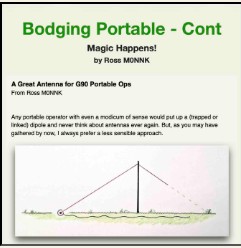
Thoughts on the Much-Maligned ‘Random Wire’ Antenna In response to intellectual curiosity expressed by Ross MONNK
Firstly, the wire is not ‘random’ at all, but a carefully measured and cut length of wire to avoid any multiple of quarter waves in any HF amateur band. If full all-band flexibility is the goal, then, that will include the WARC and 60 m bands.
Secondly, and down entirely to the laws of physics, when there is nowhere for RF current
To flow, by definition there will be only RF voltage present, ie a current node coincides with a voltage loop. Where does this occur exactly?
It is an immutable constant found at the unterminated end of any wire antenna while energised with any radio frequency. That simple fact determines where, in accordance with the frequency, one or more current loops will appear on the ‘random’ wire.
RF energy radiates only from those current loop(s), reducing to zero at the respective current nodes, and of course there’s no radiation at all from voltage loops.
Only when the wire length has been judiciously chosen to fulfil the definition of a ‘random wire’, then driven on an amateur band frequency, will it have neither a voltage nor a current loop at the driven end; instead a mid-range reactive impedance in the range 100 ~ 900 ohms.
Usually, 9:1 UNUN is fitted at this point to allow a coax connection. Arguably the UNUN will be the only major contributor to losses, yet is often needed to present a less- reactive impedance to the mandatory antenna coupler.
Although the radiation polar plot will be different for each band due to the presense of more or fewer current loops, it can be roughly guessed by taking height into consideration.
Despite what people say, there is no reason why a properly matched random wire should perform any less efficiently than a resonant antenna, with the added benefit of being truly multi-band capable.
Proof can be found for its efficacy on many smaller water-borne craft which deploy a back-stay antenna, and at my land-anchored QTH.
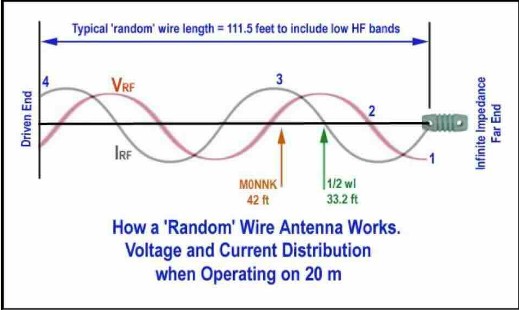
Rhe imperial length measurements for British eyes are to scale. Now we refer to the umbered points and work back from the unterminated end at the right: 1. First principles!
At the insulator end there can never be anything other than an RF voltage loop, for obviously RF current has nowhere to flow. This is always going to be our reference point and represents the highest, though not infinite, impedance encountered on any antenna.
2. A quarter wavelength back from the insulator, an RF current loop radiates EM energy and presents the convenient low impedance point with which we are all familiar.
Moving away from the insulator a further quarter wavelength, we find another voltage loop with reversed phase. 3. Ross is driving his random wire at this point and as can be seen, neither a voltage nor current feature exists, instead the point is reactive, a combination of capacitive and inductive reactances which are immaterial because these reactive components must be converted using an antenna coupler to a near 50 ohm resistive impedance to match modern transceivers.
This is achieved when equal and opposite compensatory reactances are switched-in by the coupler, yet made no change whatsoever to the physical length or tuning of the antenna.
4, Ross’s antenna is shorter than most random wires, yet as the waveform shows, it is ideal for 20 m and portability. But it will progressively become less efficient as the bands of operation go lower in frequency.
So let’s consider a home station random wire, chosen for operation on the lower bands as well. On 20 mand higher, the radiation lobes will become more scattered and unpredictable due to the presence of more current loops, while on the lower bands radiation is more predictable.
Height plays a big role, for without height a significant proportion of radiation will be in NVIS mode, do different to any other near-horizontal antenna.
The same matching technique is needed as well as either a longer counterpoise or radials, though both adjuncts are far less demanding than for a Marconi vertical.
N summary, it can be seen how a random wire does not offer the convenience of an ¢ntirely predictable feed impedance which a single band, centre-fed dipole does.
Nonetheless, it will perform in an almost identical manner to a balanced, 600 ohm »pen-wire fed dipole when it comes to its multi-band potential.
The laws of physics show that in the same circumstances, there is no difference to how one set of surrent nodes will radiate relative to any other set of current nodes, proving long-held 1egative myths surrounding random wire antennas are entirely false.
Try one for ourself as Ross has done. Stan ZL3TK
V-Band – Part 1 Introduction
• If you’re a radio operator who does Morse code, raise your left hand. ¢ If you’re a Morse lover who does radio, raise your right hand. Thank you for participating.
All those of you with just your left hand raised are strongly advised to leave the room now as you may find the following article uncomfortable reading and possibly offensive.
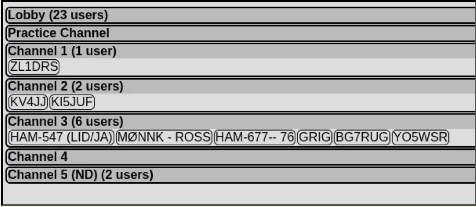
These are spontaneous and occur frequently. Being ad-hoc, they never have a ‘Net Controller’ – it’s understood that each participant will get their turn (some just want to listen), but if the conversation naturally bounces between two people for a few overs then that’s fine too.
This system works because VBand users are polite and sensitive to the needs (and weaknesses) of others. Yes, believe it or not in this day and age, it’s not like typical Social Media – almost all VBand users are polite and sensitive despite the many cultural differences on this world-spanning platform.
Ihope that’s given you a feeling for what VBand is. Why not have a look at the website? There’s no registration and no log in.
You will automatically be allocated an anonymous default callsign (for example, HAM-753 which you can change), so no-one need know who you are. There’s a lot to be said for just listening to what’s going on (like an SWL on radio).
I’ll be back soon with some practical advice on how to be active on VBand.
If you have an article or two that you think might be of interest to our readers, please let me know so we can share more thoughts and ideas; for guidance on writing for RagChew, see Articles below. Please email material to Mark VK2KI: cqqrsnet@gmail.com
A Variable Frequency Oscillator for my Home-Brewed Gear
A Variabie Frequency Usciliator tor my mome-brewed Ge
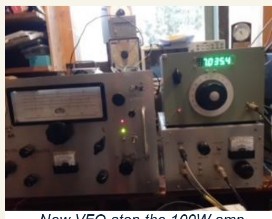
From Donald VK6JDM The new VFO for 40 and 20 metres atop the 100 Watt amp.
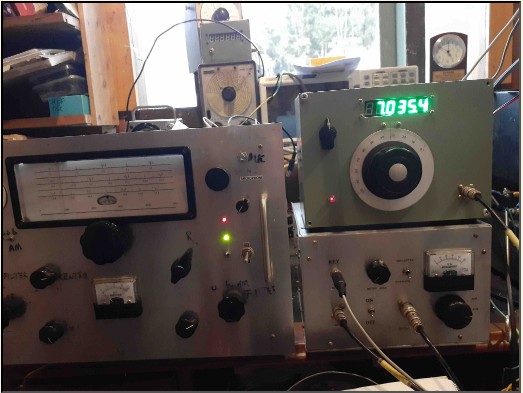
The VFO uses a very smooth Jackson’s Brothers’ dial with a concession to modernity – a digital readout. I will prepare a surprisingly neat circuit schematic when I get a chance to breathe. At present I am clearing the dining table of test instruments.
Anne has the notion that dining tables are for dining! If the table is not cleared and all sign of clandestine activity removed I will not be well enough to supply a schematic.
The receiver is on the left and has a beautiful Eddystone dial – 50 turns from one side of the dial to other. Now I need to make a balanced feeder for 20 metres; then I hope to have a QSO or three with the European wing of the net. 73 Donald
Replica Paraset (Whaddon Mk-VII) Progress
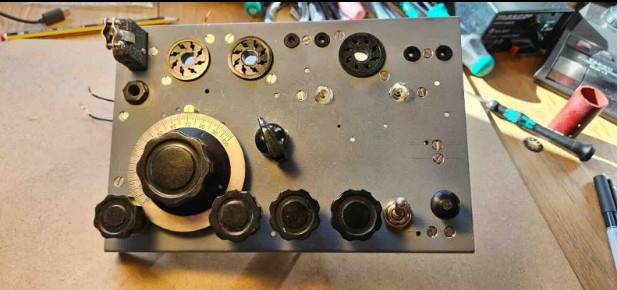
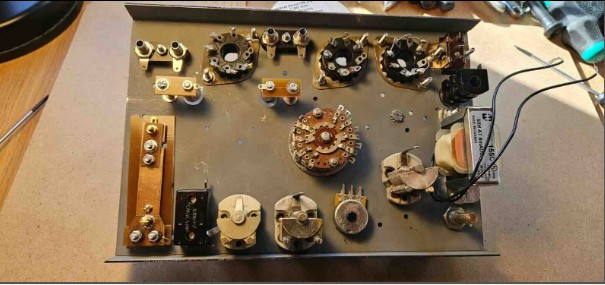
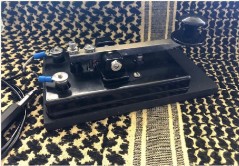
Mechanical build almost complete. Morse key in in the lower left from Henk the Paraset man https://Awww.paraset.nl/
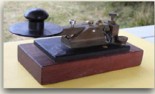
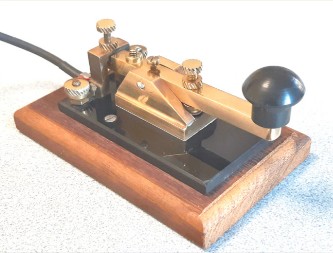
Useful hints on key maintenance, so I decided to leave most of it in. Here are David’s comments, with some minor editing by me, and, at the end, a photo of two keys he has made.
My thanks again to David, 78 John VK2RU Testablished eventually that there are at least three different threads used on the key.
The only one that was relevant to me was the one for the back adjuster and T found I had the BSW 3/16 inch (Whitworth) tap, and a matching die too, ‘among iy assorted tools which are quite comprehensive but not exhaustive.
T go back many years with BA threads which were so commonly used on instruments and radios and primarily clocks (weirdly) BA has a 47.5 degree angle to the ‘teeth unlike most others which are 55 deg or 60 deg, It was apparently invented by Swiss clock makers for threads in thin metal, it is actually metric in measurement yet known as a British Association (BA) Thread.
It is still in quite common use. But metric measurements are taking over in engineering- even in USA – but they persist in using thousandths of an inch still for small steps yet ‘their drawing and plans are in metric to confarm with “international standards” on their machines so they convert to metric in practice ..T imagine.
Timust say 1,2 or 3 thou and similar measures do seem to be easier to my brain than say 0.02 or 0.04 mm ete. Anyway, that is a discussion not required at the moment! Knurls on knobs intended to be turned by fingers are mostly, as you will have.
Noticed, usually found on smaller items made of brass etc and commonly either a diamond sort of pattern or sometimes just straight grooves longitudinal to the ‘thread.
I have tools to do some of these (there are variations of spacings) and these are usually made by actually crushing the surface of a knob not actually cutting the markings out.
On those originals on your key the “finger grip indentations” for want of better words look as if they were cut individually on a shaper – a quite old-fashioned device which did exactly what it says, by planing or scratching / cutting a groove by sheer force.
It is mostly now done by milling a rotary tool which can cut away a layer of metal with great accuracy, leaving a pretty flat surface, bordering on nearly a “polish” Now the odd way the original was made caused a bit of head scratching here as it wos neither a crushing knurl nor a straight forward cut due to the fact it is on a rounded surface.
After some experiments and measuring the approximate, angle of the cuts it was found that using a dividing head on the Mill (a device to
• nable degrees and decimal parts of) rotation very accurately and making a suitable arbour to hold the brass disc setting it at a suitable angle. The general effect could be created by sawing a .5 mm slot every 22.5 degrees created a nearly original effect.
As my father-in-law used to say quite often – “A blind man would be pleased to see that”.
Then in practical terms of using said key, I thought a little more enhancement would be rather nice. A short piece of hardwood fell to hand, so I cut it to a suitable size then added the simple moulding shape to enhance visual effects and the cable course.
Iam not fond of keys with stiff plast covered wire but I found a source of quite nice cable in UK last time I was there and bought a few meters – this is two-core, plus a screen, As when I
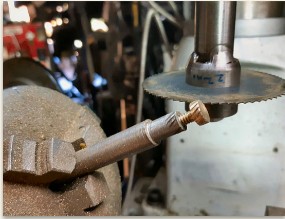
Is two-core, plus a screen, As when I make a paddle key it needs three wires of course, in your case the screen is connected along with the black inner and the red makes contact to the tip of the jack.
So, you can ignore the screen if you wish or indeed ignore the black but in just a very few circumstances a keying cable can sometimes pick up some transmitted Rf and cause peculiar effects.
That is not normal but can relate to location of the transmitting aerial and /or the quality of your Earth at the QTH, and possibly even the frequency. A good reason to not make key cables too long.
In the package you will see there are two spare “knurled” wheels, one which matches the one fitted on the new adjuster and the other was cut twice in opposite ways to see what a more normal diamond pattern would look like done in the same way when cut with the slitting saw a quite different in practice too to crush knurling or even cut knurling which is yet another way sometimes used.
(each groove which would normally be done at 90 degrees). Of course, the “crush knurl” with usual tool is done in one operation.
On yours, as well as setting up the mill and dividing head to suit the dual angles, the 16 slots around the diameter requires 16 cuts at 22.5 degrees.
It is twice as many for a diamond pattern as plus and minus 30 degrees makes the diamond pattern, Hope that all makes sense to youl!
The spare locking ring there you will see is same as the other two parts I made ‘and there is the diamond pattern (cut both ways) just as an experiment to see. what it looked like.
You can if you wish, remove the nut from the slotted adjuster and replace it with the spare one. Thave sent you a suitable size piece of anti-slip which T usually glue under a key if required, Contact adhesive is ideal – just trim off the edges to leave them Just inside so it does not hang out, if in fact you need it at all Timeant to enclose a small strip of very fine wet/dry emery paper but found it on the bench here after posting so obviously in error it had been missed when packing.
The brass-to-brass contacts do usually benefit with a clean occasionally, perhaps every couple of months. Not much, just insert a strip cut to fit in the contacts gap and lightly holding the knob to It pull thru a couple of times, then turn over the strip and repeat for the other contact.
1500 grade or 2000 grade wet/dry will suffice. Tris of course, good used with water for cleaning up seriously aged dirty brass and other metal you want to polish with the Autosol.
But I do admit I am not a great one for much polishing, Citric acid erystals, dissolved in water are very good for rust and corrosion removal. Don’t leave anything brass submerged in it for too long. Tf you have plenty lemon trees, squeeze the juice for free.
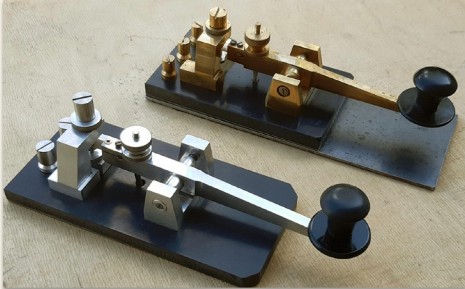
This is my version of a Marconi PS213 key, made in brass. It was so nice to use on completion, it has been plugged into my radio for the last two years.
I was curious why this key seems so nice to use, so I made one in aluminium too, just to see if that was different in feel. Amazingly very hard to tell a differencel 73 David
What’s going on on your workbench? If you have an article or two that you think might be of interest to our readers, please let Mark VK2KI know; email to cqqrsnet@gmail.com For guidance on writing for RagChew, see Articles below.
CW Practice
This year we’re using Aesop’s Fables. These are short moral stories, often using talking animals, that illustrate simple truths about human behaviour and character.
Aesop’s Fables originated in ancient Greece, traditionally attributed to the storyteller ‘Aesop who is thought to have lived around the 6th century BCE.
The fables are generally smaller files of two to three hundred words that have been recorded at 15 wpm and run for about 15 minutes.
If 15 wpm is a bit quick for you, load it onto your phone and set the playback speed at 0.75 X or even 0.5 X- whatever works for you. 0.75 X will play the MP8 at a bit under 12 wpm. Itis suggested that you read the text file before listening to the audio file.
That will make it easier to follow the audio file and prepare you for any unusual words. Any punctuation that is not usually used with CW has been removed. This week’s fable is ‘The Shepherd’s Boy and the Wolf’, and the MP3 and TXT files are attached here –


If you prefer a different speed or tone, you can create your own MP3 files by converting the text file with the Ebook2CW app — https://fkurz.net/ham/ebook2cw.html.
You can either play the MP3 files in any media player, or load the text file into the Ditto CW: Morse Player app — https://dittocw.andro.io/.
Both options work well, however Ditto CW gives you complete control over all Morse settings, while a normal media player only allows changes to playback speed, and does that in steps (e.g. +1.25x, 1.5x, 1.75x). Have fun, John VK2RU/4
Other News
Emails to the Editor
In the editorial of RagChew edition 19/2026, I discussed the use of RSN and RST reporting, and in last week’s edition, we published some feedback from a reader – even though the reader did not agree at all with my contention that we should use RSN outside the net, I was very pleased to receive the feedback.
Even more pleasing, we’ve received more feedback this week.
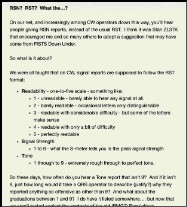

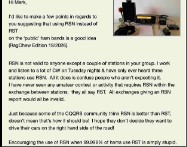
They say, BUT … NOISE is more valid than a TONE report. Who can distinguish Tone compared to Noise these days? Once the NOISE values are understood they make more sense (to me anyway) as to what we are actually hearing.
Interesting info on TONE can be found from + (A) Wikipedia: RS T system in 1936 and in 1995. Scroll down to the TONE section. * (8) The RST Standard of Reporting , L. B.
Cebik, WARNL_ Below is a short extract from the TONE description on page 5: © Does “T” need revision, omission, or mention only when the note is other than purest d.c.?
Perhaps QRP operators are in the best position to contribute to a revised standard applicable to them or to everyone since they work at power levels where the report is most.
© Until then, the de facto standard is that which appears in handbooks and which takes precedence over meters. Until we go through the process of creating a better standard, we can either report in accord with the standard to the best of our operating skill or we can be deviant (or ‘cool’.
If the latter, we owe it to other QRP operators to let them know which we are doing so that operator may discount our report.
If the former, then we are committed to applying our best efforts and skills to master the art of reporting uniformly with others who are also committed to the standard. an ae Pra pa Pr
Courtesy of KBGNU’s Ham radio blog: ¢ Tone was used as a Signal report in Morse code (specifically within the R-S-T system) to assess the quality and stability of the transmitter’s audio note, which was crucial in the early days of radio.
In the R-S-T system, the T (Tone) stands for the third digit in the report (1-9), which describes how pure, chirpy, or rough the CW (Continuous Wave) signal sounds to the receiving operator.
¢ RSN signal reports – Readability, Strength, Noise – provide a more accurate assessment of High Frequency conditions than traditional RST, by replacing the often-obsolete Tone (T) report with a 1-9 Noise (N) figure.
This system, gaining popularity in CW and Net operations, helps operators distinguish between weak signals and high noise floors. [1, 2, 3] John, VKSET
Dear Editor.
| would like to offer a response to the comments made by Mark VK3MJ on signal reporting. Specifically, the relative merits of RSN and RST. It is clearly true that the vast majority of CW operators use RST to give a signal report.
It is equally true that the vast majority of such reports end in a 9, so that one third of the report contains no useful information. Mark refers to valid reports for contests, where of course none of the three digits convey any information!
So it seems to me to be a good idea to change the reporting system. I first came across the RSN reporting on the Tuesday evening ‘net’/’gathering’.
A few minutes using Google shows that there are people around the world pointing out the redundancy of the last digit with an RST report. It also appears that Oceania is a hotbed of radical extremists using RSN reporting!
Just as languages evolve and change with time so can our use of Morse code reporting. I did enjoy the irony that Mark does appreciate the changing nature of language as he states on his QRZ page that he “never uses ‘OM’. It’s the 21S* century”.
So, we don’t need to overthrow the use of RST overnight, but we should be willing to dip our toes into the water and send the occasional RSN report and see if we find it useful.
Lan VK7TA PS As for driving: even although the majority of people in the world drive on the
Greetings Mark
Re the RSN/T complaint – I do not agree with the remarks that only a few use it – the RST has long gone past it’s use-by date as T is no longer really applicable – but the level of noise is relevant – and it is getting worse, therefore it is of importance to indicate it in a signal report.
Re: Email to the editor from Mark VK3MJ In the famous one-word retort by the venerated British comedians Armstrong and Miller, and sometimes thrown into the mix by limited-vocabulary modern youth, I say “Harsh”.
Putting RSN into context, I’m the guilty party who introduced that ‘stupid’ concept to CQQRS FFA, thinking that it would be jolly useful.
However I claim no fame, it was an older and wiser ARO, Louis VKSEEE, who invented the RSN concept – for the benefit of all CW operators. Now let’s consider each of Mark’s allegations. 1. “RSN is not valid to anyone except a couple of stations in your group”.
Wrong! Although they have not been counted, serious CW operators, ie those who strive for 100 % accuracy such as traffic handlers and RandomGram enthusiasts, appreciate the benefits from knowing the other guy’s receiving conditions, and when informed of ‘N-for-noise’ are in a position to cut their cloth to suit (yes, that old Jewish tailor pun was intended.
RSN is the only reporting protocol used on at least two international traffic nets, there may well be others. 2. “I have never seen any amateur contest or activity that requires RSN”. Quite likely, but why? Because hoi pollo’ contesters choose the easy path to.
Cram in as many contacts as possible in the shortest possible time. Most dyed-in-the-wool contestants choose to send meaningless 5NN reports in all circumstances, even when barely able to copy, grabbing points is all that matters, else it makes no sense.
Keyboard computer-to-computer contesters are unquestionably bottom-feeders, exhibiting no personal CW skill at all. On the other side of that coin, operators reporting with RSN have to think logically on-the-fly, and are therefore a higher grade of operator, who consciously or not, are helping others to succeed every time they rationally report conditions using RSN.
3. “Encouraging the use of RSN when 99.99% (!) of hams use RST is simply stupid”. Harsh, unjustified and frankly offensive. Although the author has not stated it specifically, maybe he counts RSN as our second stupid idea in less than a month.
The first was to initiate a team to compete in Randomgram, in which all Oceania participants could have their points added to the Team’s total Desnite heing invited and then aently reminded to affiliate 2 certain narty
Onefit of all CW operators. ow let’s consider each of Mark’s allegations. 1. “RSN is not valid to anyone except a couple of stations in your group”. Wrong!
Although they have not been counted, serious CW operators, ie those who strive for 100 % accuracy such as traffic handlers and RandomGram enthusiasts, appreciate the benefits from knowing the other guy’s receiving conditions, and when informed of ‘N-for-noise’ are in a position to cut their cloth to suit (yes, that old Jewish tailor pun was intended.
RSN is the only reporting protocol used on at least two international traffic nets, there may well be others. 2. “I have never seen any amateur contest or activity that requires RSN”. Quite likely, but why? Because hoi pollo’ contesters choose the easy path to.
Cram in as many contacts as possible in the shortest possible time. Most dyed-in-the-wool contestants choose to send meaningless 5NN reports in all circumstances, even when barely able to copy, grabbing points is all that matters, else it makes no sense.
Keyboard computer-to-computer contesters are unquestionably bottom-feeders, exhibiting no personal CW skill at all. On the other side of that coin, operators reporting with RSN have to think logically on-the-fly, and are therefore a higher grade of operator, who consciously or not, are helping others to succeed every time they rationally report conditions using RSN.
3. “Encouraging the use of RSN when 99.99% (!) of hams use RST is simply stupid”. Harsh, unjustified and frankly offensive. Although the author has not stated it specifically, maybe he counts RSN as our second stupid idea in less than a month.
The first was to initiate a team to compete in Randomgram, in which all Oceania participants could have their points added to the Team’s total.
Despite being invited and then gently reminded to affiliate, a certain party who came second in the Oceania region and could have easily contributed his 60 well-earned points to the total, refused to do so.
Any thoughts on why ‘Aesop’s fable ‘The Dog-in-a-Manger’ comes to mind? summary, I am bemused as to why Mark’s email was published and fail to see how s negativity could possibly have been the welcome arrival in Mr Ed’s inbox he aimed it to be.
Or am I missing a nuance; could Mr Ed’s positive response to such sject misinformation have been carefully crafted sarcasm? 3 from the resident POG.
Now the question of RSN. While RST has been the standard for a long time, the T bit seems pretty pointless with nearly all stations having good shaping and clean single frequency signals.
That is of course unless I fire up the Paraset and supply a signal with chirp and whoop. So since T is pretty irrelevant, I like the idea of a bit of a change to RSN.
CW is of course a holdout bastion for those who resist change, but RSN strikes me as a good functional change.
RandomGram Event # 43
When? Next Saturday 23 May 2026 starting at 2200Z, runs for 24 hours! Log in to https://sked.skccgroup.com/ and announce your presence, to do so helps everyone!
MWAPS, the ‘Morse with a Purpose Society’ fully endorses this month’s opportunity to undertake personal training while achieving something socially constructive when your points are aggregated with (hopefully ALL) participants down under.
This month, alphanumeric groups will be deployed. Affiliation does not roll over between events, so when requesting your list of code groups from Drew AF2Z, please confirm your affiliation with the OCEANIA TEAM.
We need a cohesive group embracing a common goal to compete successfully with those US AROs in their significantly advantaged environment.
Affiliation with the OCEANIA TEAM costs you nothing, you receive and retain your own points, meanwhile the total from your effort boosts the team’s total – it couldn’t be simpler.
RandomGram URL _ hitps://groups.io/g/RandomGram Email for your customised code group list and affiliation:
Morse Training Net
Our team member Nic VK7WW runs an on-air Slow Morse training net every Wednesday at 7pm EDST on 3580 for 30 mins. He uses the callsign of the Northern Tasmania Amateur Radio Club VK7TAZ on that net.
Many of our team learned Morse code with the support of Nic, and the weekly training session comes highly recommended for anyone who wants to learn the Code, or simply brush up.
Everyone’s welcome – 3580KHZ at 7pm Eastern time every Wednesday; you’ll hear lots of the CQQRS team on that net. Jordan VK3ACU has ralso ecorded the complete set of lessons which you can now find here:
Https://www. youtube.com/playlist?list=PLHsQmZz6fBXO7swAfbT mutrbbEL17fUQL Contact Nic VK7WW for more info nicholaschantler@hotmail.com including how to join the NTARC DISCORD group to follow the action, or just come along and join in on Wednesdays.
Snowline KiwiSDR
The bad news from lan VK1HF is that his fantastic Snowline KiwiSDR has been switched off, and is looking for a new quiet location; power and internet may not be required at the site by the way.
Would any of our rural readers like to host lan’s set- up in a quiet location perhaps? cqarsnet@gmail.com
SOomeuMng WViterent:s Forwarded by Peter VKSWOW
Let’s face it, camping out in the wilds is not for everyone. There are just so many things that can go wrong. Snakes. Spiders. A tree falling on your tent. Some disgruntled hunter mistaking you for a wild boar.
If you’re keen to explore the great outdoors, but you’d like to start off in a safe and friendly environment, why not consider joining the Very Small Campfire Society? Meetings are held every Thursday night in the Mullamulla Town Hall.
All interested are welcome to bring along their camping gear — we generally kick off about 7:00 pm — and set up camp in the main auditorium.
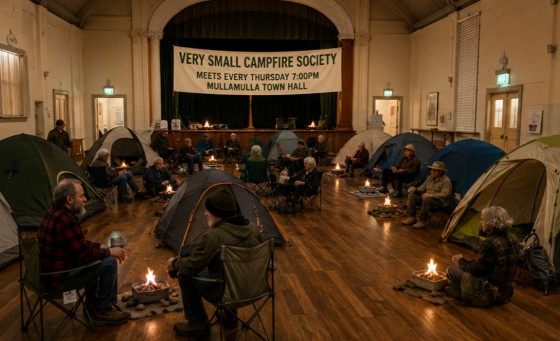
These Thursday evening gatherings have proved to be a great networking opportunity for all those keen to explore the great outdoors, but in a safe and friendly environment.
As the name of the Society implies, there is really only one special condition that participants need to abide by, and that is, of course, that every campfire lit inside the Town Hall must be a small one.
In practice, this means that no campfire may be allowed to burn more than 15 centimetres high.
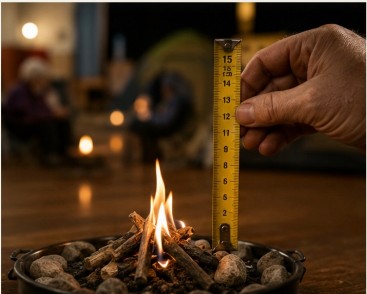
As is only fitting in a Society devoted to exploring the great outdoors, once Participants have set up their tents and lit their campfires in the Town Hall, the main activity on Thursday nights consists of visiting the campfires of other participants and sharing yarns about tent pegs, where to buy the best tent poles, and the pros and cons of various styles of sleeping bags.
The stuff of true outdoor adventure, in short! To encourage participation, and to gee up the spirits of those few timid souls who find even the thought of camping for three hours in the MullaMulla Town Hall a bit daunting, you will be pleased to learn that the Very Small Campfire Society publishes a weekly newsletter (Round The Campfire) that is positively crammed from front cover to back with fascinating accounts of the exact round-the-campfire conversations heard on the previous Thursday evening, together with most informative photos of participants’ tents, tent pegs, tent poles, sleeping bags and sometimes even faces.

Lam sure you will be just as delighted to learn as I am report that our Very Small Campfire Society is currently in a very healthy state, with numbers growing by the week.
As for whether any of our members ever do — to use a word grating to my ears — graduate from our Society and venture into the actual wilds without the protection of ‘the fine root of the MullaMulla Town Hall over their heads or the invaluable guidance of Round The Campfire in their ears — that I honestly could not say for, to tell you the truth, I am just a little afraid myself of snakes, spiders, trees falling on my tent, and a disgruntled hunter mistaking me for a wild boar.
Ithardly matters, though, really, given how much fun we all have in the Town Hall on Thursday nights, and then reading about that exact same fun afterwards in Round The Campfire. I do hope you will consider joining us.
Grant Eveready President vscs Please note: Bona fide boar hunters are, of course, free to join us in the Town Hall on Thursday evenings. We must request, however, that no campfire lit inside the Town Hall be allowed to burn more than 15 cm high. Interested?
There doesn’t seem to be any antenna restrictions (yet); contact Peter VK3VVOW via his QRZ.com page: https://www.qrz.com/db/VK3WOW.
Observations on RagChew Edition 20/2026 from the POG Headings are in order of publication for easy context reference. Editorial fairness is front of mind, those who derserve praise receive copious praise, those who clearly do not get a bollocking, all other comments are centered – neither left nor right.
Dah-di-dah-di-dah In his introduction, seems Mr Ed was feeling generous. Readers were treated to, sorry but there’s no better way to put it, an unnecessary word and two unnecessary hyphens at the end of his fourth sentence.
The fifth paragraph raises a question of hypocrisy. Why he would be, ” …pleased to see some negative feedback …” about RSN, when only a week ago he saw fit to at least explain, if not actually promote the most progressive on-air reporting innovation in many decades?
Last Tuesday’s FFA Log Table How does a call sign appear as “Heard on air” when that station did not radiate even 1 femtoWatt, therefore was definitely silent in every respect due to other commitments?
Was the listing caused by a human or a software error, and can that error be repeated rendering the table unreliable? The Report from Manny VK3DRQ in Blackburn You can’t fault OM Manny for sheer determination and stamina.
Listening, and knowing his keenness he was probably calling as well right through the night into mid-Wednesday morning VK time. That must be a new record for the CQQRS FFA. Congrats Manny, doubt that anyone else could not have stayed awake that long!
The Post Morsum, 13TH May 2026 Congratulations are also due to Richard VK6HRC for his (almost unique-in- RagChew) use of correct SI Metric nomenclature. A tiny number of us have been locking forward to seeing attention to such accuracy for years.
We’re hoping this outbreak of SI correctness is incurable, contagious and without prospect of a vaccine. One sees Lance VK7TO showing occasional symptoms of this most- welcome virus, obviously capable of travelling far and wide, what’s to stop it?
In the interest of raising standards, please refuse to don masks guys, keep right on infecting as many of those around you as possible!
Despite the modern trend to embrace mediocrity, it is still possible to do things properly -without compromising your manhood.
Headings are in order of publication for easy context reference. Editorial fairness is front of mind, those who derserve praise receive copious praise, those who clearly do not get a bollocking, all other comments are centered – neither left nor right.
Slow Morse Training
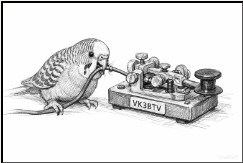
From Keiran VK3BTV Hi Mark Just another reminder that the half-hour SLOW
Morse Net is on 3580 every Wed night at 1900 EST. The net is run by Nic VK7WW, under the alias of VK7TAZ and is provided to introduce hams to CW, so it’s kept very slow for newcomers.
Nic has provided this service every Wednesday night for many years, and adapts his sessions to whoever is on air. There is a Discord channel where participants can enter their copied text in real time (and if they wish, get almost instant assessment of their progress).
Contact Phil, VK3ZPD via his email on QRZ.com to join the Discord Channel. Have a go! Cheers Keiran (VK3BadTemperedVictorian)
Cheers
Keiran (VK3BadTemperedVictorian)
On the Bar
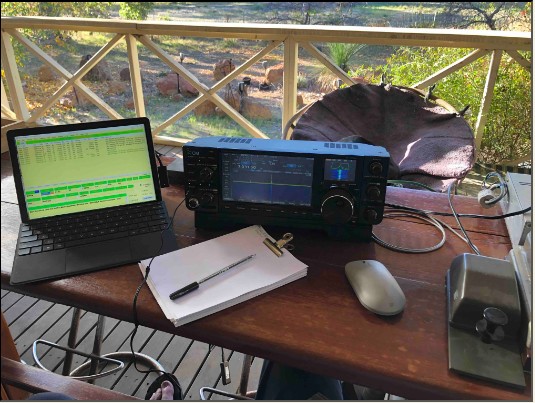
From Phil VA6GX Hi Mark, I hope all is well in beautiful South Bowning. Are your travels over during winter? Attached is a pic of my outside operating position at the VK6GX Crystal Bar, on the deck, during the latest CQ QRS Net.
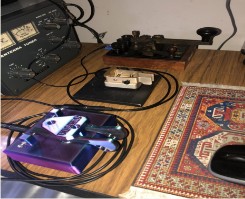
The rig was my IC-7760, operating remote with the Control/display unit. The tablet was used for logging and internet. Keys used were a Junker and a Marconi 365B. Stay well, 73, Phil VK6GX.
If you have something that you think might be of interest to our readers, please email to Mark VK2KI: cqgrsnet@gmail.com
There’s No Such Thing…
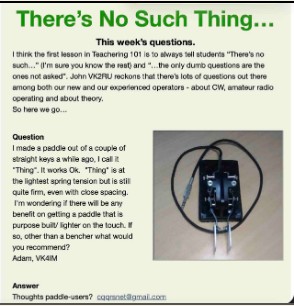
Pho WEEN 2 YMC UlIViios I think the first lesson in Teachering 101 is to always tell students “There’s no such…” (I’m sure you know the rest) and “…the only dumb questions are the ones not asked”.
John VK2RU reckons that there’s lots of questions out there among bot! our new and our experienced operators – about CW, amateur radio operating and about theory. So here we go…
Answer:
Adam VK4IM asks an interesting question. At pedestrian speeds, paddle pressure plays little part in sending quality, however, when sending speed is increased, faster and smaller finger movements become necessary.
This brings both paddle pressure and contact spacing under close scrutiny, albeit in quite subtle ways. It’s a very personal thing and
Requires experimentation to find your sweet spot. This is where the VBand decoder on the Practice Channel reveals, arguably, its only its only legitimate purpose.
One gets instant feedback and sees the error rate increase either side of one’s paddle-pressure sweet spot. However, non-optimised pressure isn’t a fatal flaw because the development of cerebral muscle memory permits adaptation to the circumstances over time, which slowly brings the error rate down.
Although I’m far from qualified to make a paddles-brand recommendation, an enquiry to Australia’s experienced, paddle-familiar CWA Ambassador, Chris VK3QB, will likely produce some very useful results. 73 Stan ZL3TK
[Do you have a question or two or a discussion starter worth sharing? cqqrsnet@gmail.com if so.]
QRZ? Who’s on the other end?
Our net is a fun get-together that people enjoy returning to each week. It’s really nice to know who’s on the other end of the QSO. So, please share some thoughts about yourself to cqqrsnet@gmail.com for a future RagChew.
Prosign/Character/Signal of the Month
Prosign.
- my eS a Meaning: Clear – going off the air.
[Put it on a sticky note near your key as a reminder for Tuesday…. and tell us how you went!]
Di-dah-di-dah-dit
So back to the CQQRS Slow CW QSO practice net.
Next Tuesday’s Net
Our CQQRS Group will be on as always on Tuesday from around 0600Z until about 12002; see https://bit.ly/CQQRSWebsite and navigate to the Net Details page for details.
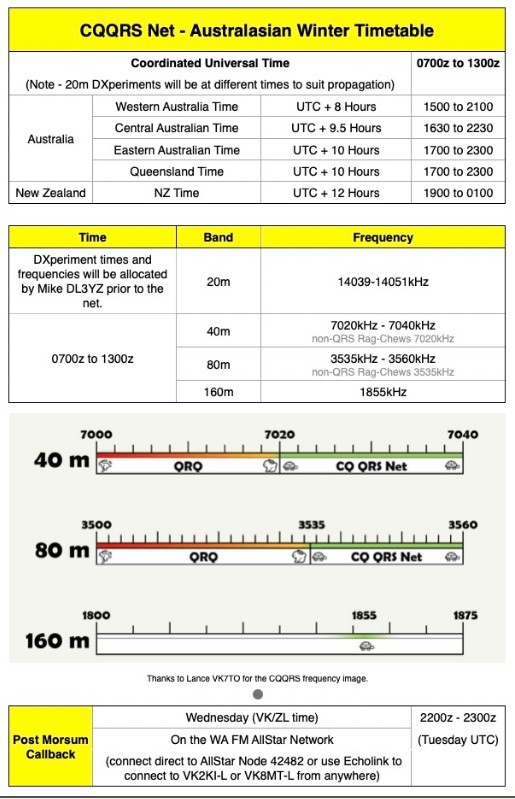
Doesn’t matter whether you’re brand new and want to try just exchanging callsigns and RST reports, or you’re ready for a good old rag chew. We’ll have fun.
There’s usually people around until after 1200Z – so keep calling in the segment of the band designated in the table below until you catch someone.
Reports & Photos
Please let us know via our Reports form bit.ly/CQQRSNET who you work or hear on Tuesday’s Group. The report form closes at 1pm (Eastern Australian time) on Thursday. And how about helping to make the reports even more interesting by sending a photo?
If you have a photo that you’d be happy to include, please email it to: cqqrsnet@gmail.com And of course, we’re always on the lookout for more photos for the newsletter, so if you have something that might be of interest aside from the reports, please send it through as well.
Email to cqgrsnet@gmail.com please. Oh and by the way, I recommend that you don’t keep the Reports Form website open between submission of reports from one week to the next.
If you’re unlucky, there’s an undocumented feature in the software that could cause your current week’s report to be combined with your previous report – it’s happened to your editor several times – much to the chagrin of our Reports editor 🙂
Richard VK6HRC will run our phone Post Morsum on Wednesday mornings on the South West AllStar net (via repeaters and hotspots all over WA) from 0600 WA time, then from 0700 WA time on 80m (3605 LSB).
See https://bit.ly/CQQRSWebsite and navigate to the Net Details page for details of how you can connect via Echolink from anywhere in the world.
Articles
Could you write a short article or articles for RagChew? You bet! Writing not your strong point? Don’t worry, I’m very happy to help as much or as little as needed.
Oh, and one more thing (actually two) – copyright material: * please use your own images – don’t use images copied from the internet unless you have the producer’s permission, or they’re marked ‘Creative Commons’ or similar; ¢ if you include other peoples’ written material, unless you have permission, you may only include small snippets (unless it’s marked ‘Creative Commons’ or similar), and you’ll need to site the source and author.
For more guidance on writing for the RagChew newsletter (including how you might even try using one of the new Artificial Intelligence tools), head to our website bit.ly/CQQRSWebsite then click the menu on the top right and then click RagChew Newsletter.
Material
Areminder; if you send me any information by email, our report form or WhatsApp I unless you specifically state that material is not to be published, I’ll assume that you’re happy to see your thoughts in the RagChew newsletter.
Teamwork
Thank you so much to our team of 41 contributors: DL3YZ, G4RWI, G7BED, IU4FLS, MOKBJ, MONNK, Resident POG, VK1HF, VK2IOW, VK2RU, VK3ACU, VK3BSE, VK3BTV, VKS3CLD, VK3DBD, VK3ECH, VK3QB, VKSWOW, VK4EV, VK4IM, VK4PN, VK5CZ, VK5ET, VK5FD, VK6GX, VK6HRC,

VK6JDM, VK6KD, VK6KHZ, VK6NQL, VK6NW, VK6POP, VK6RR, VK7TA, VK7TO, VK6TX, VK7JZ, VK7TA, ZL1PB, ZL2GD, ZL3ABX and ZL3TK.
And a special thank you to our editorial team, Nigel G4RWI (head softie), Patrick VK2IOW (Mister Reports), John VK2RU (Spreadsheeter and wordsmither), Richard VK6HRC (hearder de les chats), Lance VK7TO (old bloke in charge of the archive department) and Jordan VK3ACU (Monsieu Venus et Mars).
Great work all! GU CW on Tuesday, mb Mark Bosma VK2KI / VK6QI Beautiful South Bowning NSW cqqrsnet@gmail.com non impediti ratione cogitationis
About the CQ QRS Net
For the current schedule and more information about the CQQRS net, please go the the Net Details page on our website:

The opinions expressed in the RagChew newsletter are those of the individual contributors. The opinions do not necessarily reflect that of the editors or of the CQQRS Group members.
Any material and images received from members by the editor or published on the CQQRS WhatsApp groups may be published in this newsletter unless specifically requested otherwise.
The RagChew newsletter is considered to be exempt from the Australian Government’s ban on social media for under 16 year olds because it is a service that has the primary purpose of enabling users to share information about products or services, engage in professional networking or professional development services or of supporting the education of users per the Australian Government eSafety Commissioner FAQ webpage “Which platforms have been excluded from the age restrictions” dated 10DEC25.
The values, doctrine and guidelines for the Group and for the newsletter are published on the Principles page of the group’s website https://bit.ly/CQQRSWebsite