Below is a reconstruction of the 2026 22 CQ QRS RagChew newsletter designed to support full text searching. This reconstruction was built using OCR, and will contain errors.
To view the Mailchimp original, click here. To search the entire newsletter archive, click here.
Contents
- CQ QRS RagChew
- New Team Members
- Website
- Post Morsum 27th May 2026
- Reporting
- The Perfect Age to Learn Morse Code
- Yes, there is life in the old dog yet!
- Proposed New Net Frequencies – Continued
- Till next time
- V band Part 2: Sending Without A Key
- Computer Keyboard: Paddle Style
- Leaving a Channel!
- Next Time
- On My (Son’s) Workbench
- CW Practice
- Other News
- CW Academy – Notes from the CW Academy – 22May26
- First Ever 40m DX
- Accessing the ACMA Assist Portal
- National VKFF Parks Get-Together – Albury NSW
- Morse Training Net
- In defence of 599 contest exchanges
- QRZ? Who’s on the other end?
- Prosign/Character/Signal of the Month
- Di-dan-ai-daan-ait
- Next Tuesday’s Net
- Reports & Photos
- Post Morsum
- Articles
- Material
- About the CQ QRS Net
CQ QRS RagChew
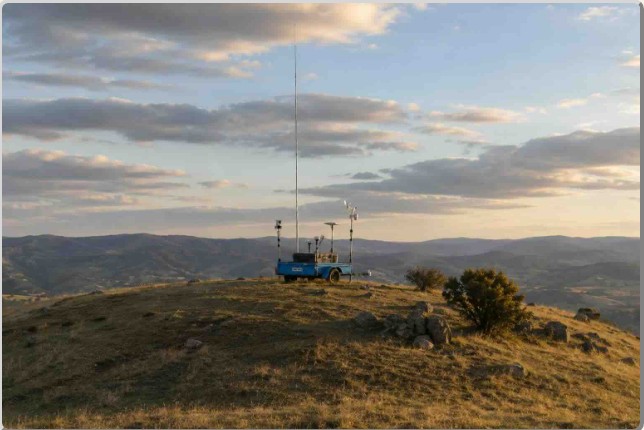
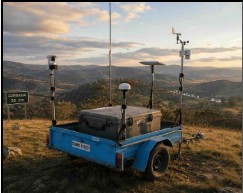
Thanks this week to lan VK1HF for this nice image of the coms trailer he’s building. Interested in hosting the KiwiSDR? See below.
I know you’ll enjoy the reports this week from 40 of our team members about Tuesday’s CQQRS Slow CW Practice QSO net. Thank you again one and alll for penning such entertaining and readable reports each week – they’re part of the glue that keeps our QRS family stuck to Tuesdays.
1’d also like to acknowledge Richard VK6HRC‘s dedication for running the weekly voice call-back on Wednesday mornings; 6am WA time week-in, week-out has got to be a challenge – not to mention the challenge of herding all the discussions into a succinct report.
Thanks mate. This week, Ross MONNK has applied some of the Bayesian thinking he discussed last week in an interesting article about the ideal age to learn Morse Code. And what’s more, he’s also written Part 2 of his series about using Vband.
Some readers may recall Ross’ series of articles about setting up your page on qrz.com; well like those articles, Ross takes the reader through the whole Vband thing, step-by-step – outstanding work Ross – thank you.
Also this week, Lance VK7TO continues the discussion about the frequencies used for our weekly CQQRS net, and down in the Emails to the Editor section, Lance also throws some more thoughts in to the discussion about the use of the RSN reporting protocol for CW.
Excellent reading, thanks Lance. On this week’s workbench, Steven the son of David VK8DBD has produced another engineering masterpiece from the Dunns’ workshop at Yackandandah. And further down the newsletter you’ll find the CW practice segment from John VK2RU.
Every week this year and last, John has compiled an audio track of practice CW that can be sped up or slowed down to match your practice needs; so even if you can’t get on air for some practice, have a listen to what John has made each week – great work mate – amazing what someone can do from a caravan on a track somewhere!
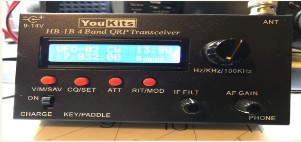
As discussed last week, I have been using the brilliant VK1HF Snowline KiwiSDR during the net – the waterfall display and low noise level sure beats tuning up and down on my old Trio TS-120S (which with it’s narrow CW filter can easily miss QRS CW if I tune too fast).
Lan is building the SDR into a mobile comms trailer as shown on our newsletter’s Masthead which can be set-up anywhere. So if you have a quiet location and would like to host the unit, please let me know; see more below.
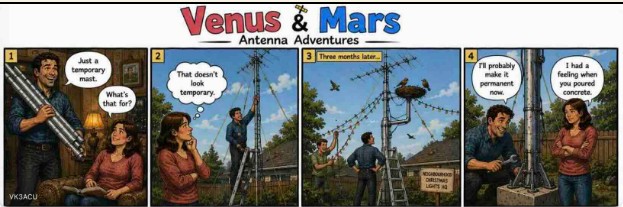
Finally, we round out this week’s offering with yet another edition of Venus and Mars in the Ham Shack; Jordan VK3ACU has done yet another outstanding job! So… on, on! I’ve got a V/Line coach to catch to start our travels tomorrow…
New Team Members
Welcome this week to Andy VK3XKA from Lysterfield East of Melbourne, and Mark VK2XMB from Blaxland in the Blue Mountains West of Sydney. Both Andy and Mark are on the current round of the CWops CW Academy being run by Chris VK3QB.
Welcome gents, and I’m sure you’ll find when you do get on air, that our group of over 240 team members will be very welcoming and will provide practice in a nice safe environment.
We have both new operators like yourselves and old-timers who were born with a Morse key in their mouths so as to speak…. so lots of folks out there ready to help.
Website
If you’d like to find out a bit about our net, or would like to pass information to others about our Tuesday get-togethers, here’s the link to our website. bit.ly/CQQRSWebsite So here we go – on behalf of the CQQRS Editorial team, please enjoy the newsletter.
WVlarK bosma VK2KI / VK6QI Patrick John Beautiful South Bowning VK2IOW VK2RU NSW Milthorpe NSW on a track somewhere cqqrsnet@gmail.com non impsditi ratione cogitationis Nigel Richard Lance G4RWI VK6HRC VK7TO our other grey nomad Padbury WA Margate TAS Jordan VK2ACII
With thanks to Nigel G4RWI’s clever software, and John VK2RU’s clever spreadsheet work, here’s the 58 stations heard by 40 members of our team on Tuesday:
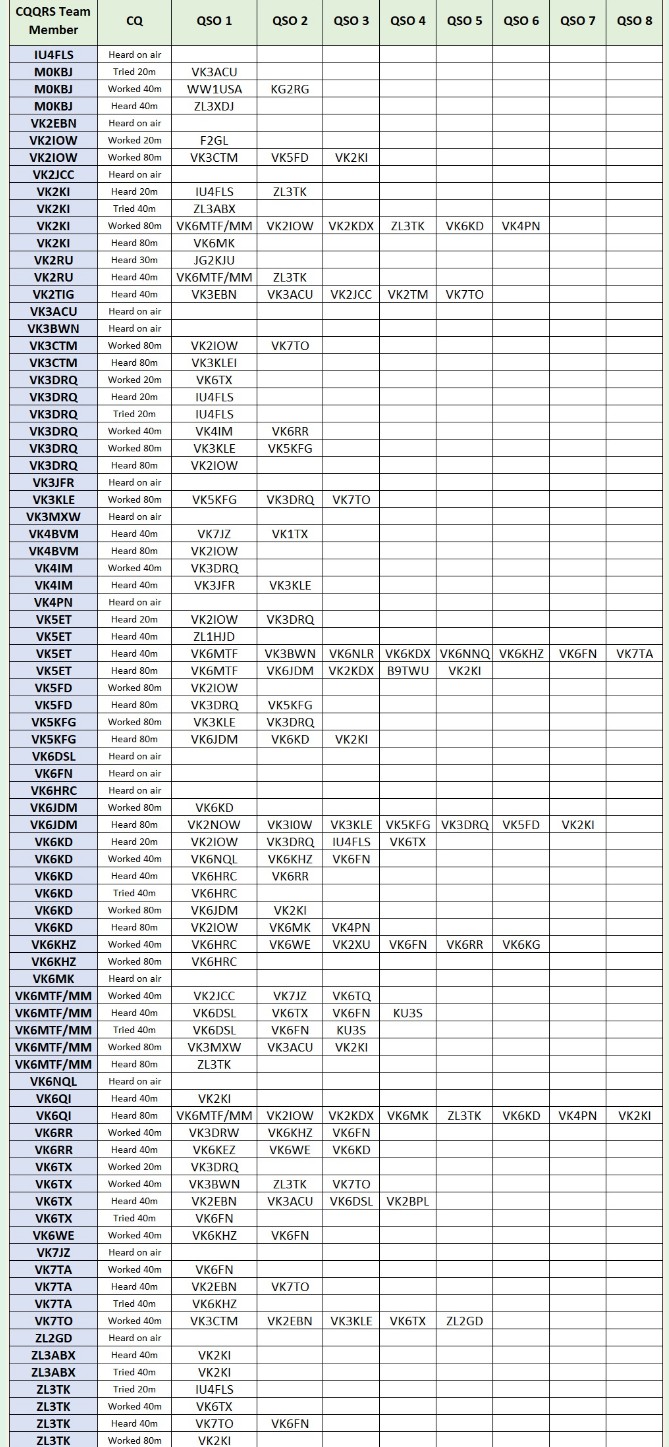
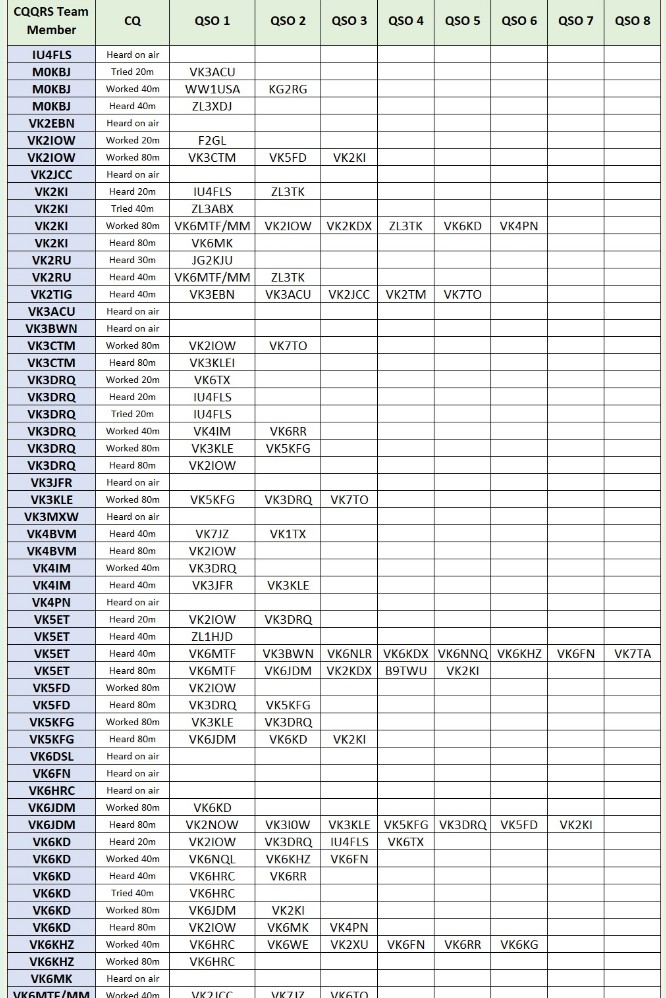
John’s spreadsheet above shows the known stations heard or worked on last Tuesday’s CQQRS Net (reported via our webform bit.ly/CQQRSNET ); the comments in the team members’ reports follow.
The comments were compiled for us by the clever software built by Nigel G4RWI and the layout was perfected by Patrick VK2IOW. Thanks again to Nigel, Patrick and John for the work, and to every team member who submitted a report –
[40m] Only heard a few this evening and the ones I did hear were right on, or just below, my S7 noise floor. I did manage to make one contact, (Finally!), with Manny in Blackburn, even with seriously deep QSB we managed to complete the contact.
[40m] Only heard a few this evening and the ones I did hear were right on, or just below, my S7 noise floor. I did manage to make one contact, (Finally!), with Manny in Blackburn, even with seriously deep QSB we managed to complete the contact.
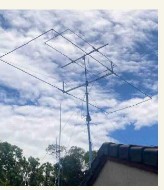
[20m] Noisy, much fading, hard to copy callsigns.
[40m] Very noisy, signals disappeared completely at tim Six VK6 stations heard with weak signals.
[80m] Much the same as 40m & 20m. Two VK6 stations
[40m] A few nice QSO’s on 40m despite plenty of QSB. Great to work my mate Kim VK6TQ who is a keen DXer and competent CW operator but takes some convincing to dust off key. Jim VK7JZ was also a good signal from the park tonight.
After spending some time finding a good frequency, Max VK3MXW and I had a gooc QSO on 80m. Great keying Max, good to get you in the log. Finished off my night with a long QSO with Mark who reminded me it gets cold in VK7!
Sounds like Sth Browning NSW gets cold and wet also. Cheers Mark.
[40m] Low noise but surprisingly poor trans-Tasman signals. Conditions had deteriorated somewhat since RandomGram on Sunday night when some fine DX, notably Alaska, was to be had.
Starting at O600Z, listened for and somewhat optimistically called DOZEMR on 15 m, but he didn’t show up on either RF or Mike’s Live Status Monitor. Moving to 20 m, could just detect a CQ from Fausto but would never have been able to copy a signal report.
Nonetheless, called him in case he might hear me. The other two guys were unavailable for various reasons, so finished on 20 m at 0800Z after a fruitless two hours listening and calling – justin case as they say.
Strange thing though, no VKs were heard, only a couple of random dashes several minutes apart which were likely from VKs, but no one identified. RBN has been proving it shouldn’t be relied on.
During RandomGram when RBN was reporting ‘no dice – best go to bed’, in fact skip into the US was remarkably good and the source of some useful points. Strongly recommend QRSers swallow their fear and take on Randomgram with gusto next month.
It is conducted at a pedestrian speed out of necessity and Team Oceania is showing goodly performance.
[40m] 40m was quite active so there was the option of waiting for the end of a QSO or move onto another frequency and hope to catch the end of aQSO. By 2130HRS WST there were still stations calling CQ QRS on 40m.
Noise levels S5 were much the same at my QTH for both 40 and 80m.
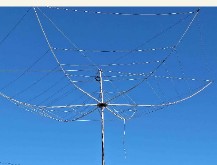
[80m] Once again 80m looked to open up and remain active for quite a while. While I could just make out stations from the S5 noise it was interesting to note I was able to decode more than what I originally thought would be possible.
Yes it was hard work but that’s the challenge, hihi. Station from Italy (IU4FLS) was coming into my QTH in Ballajura WA on 20m earlier in the evening but QSB changed conditions quickly at my end. 73s until next week.
From Simon MOKBJ at Wolverhampton, central UK
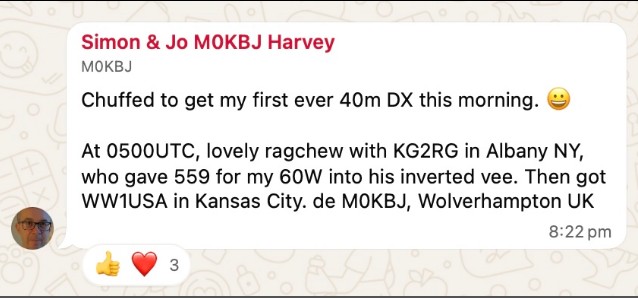
[40m] Radio propagation continues to bring surprises and today I was thrilled to make two contacts with the USA on the 40m band.
Until now, that band has been great for working around the UK and into Western Europe but early this morning (0457UTC) I was easily able to copy Justin KG2RG in Albany, New York.
Even better, Justin enjoys a proper che exchange, so he was able to tell me about his station. Today
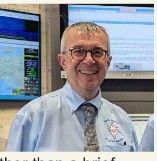
• xchange, so he was able to tell me about his station. Today he was using a TenTec Corsair with a Heathkit amplifier to drive 800W to an inverted vee antenna. He was using a bug and I had no difficulty copying him. I sent 60W back the other way.
We subsequently exchanged emails and he sent me a video of an amazing shack, full of vintage equipment, beautifully restored to working condition. We both had to adjust our VFO to cope with a little drift during the chat.
And since Justin was using a bug and I was using a straight key, every aspect of our modulations was variable! Great fun! I then briefly worked WW1USA, a special event station to commemorate the US army and navy’s involvement in World War 1.
This station was in Kansas City, Missouri, on the western edge of the state. It’s my most westerly contact in the North American continent.
[80m] Well last week 80 metres was like an empty car park. You could park your CQ there with little risk of colliding with another station. Last night the 80 metre park was chockers after the word went out that it was open.
The CW segment was silent early in the night, but a journey up to the SSB zone revealed 80 metres was working; after a quick tea I found it crowded to near capacity.
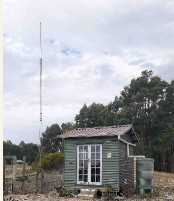
[40m] I only managed a short session on 40m around 6pm, and I didn’t hear many stations.
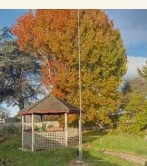
[80m] I will try to take part more frequently. Always very entertaining. I will work 30 and 160 meters if possible next Tuesday.
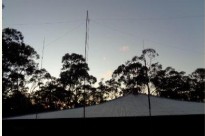
From Patrick VK2IOW between Bathurst and Oran
[20m] I almost managed a QSO with Fausto – I heard ZL3TK calling him; then I heard Fausto calling CQ. I replied, however there was no response, then realised that I had BREAK-IN off on my FTDX-10 (CW practice mode), so nothing was going out!
After that we got hit by a rainstorm, which severely detuned my 450 ohm ladderline (I wondered whether an antenna connection had broken). By the time I sorted myself out, Fausto was gone. Tho with F2GL near Paris.
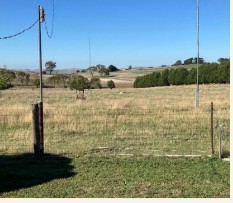
[80m] Later in the evening I skipped down to 80 metres. Conditions seemed good. Good QSOs with Victoria (VK3CTM), South Australia (VK5FD) and NSW (VK2KI).
[20m] From the Europeans, only OM Fausto was 331 QSB. I called him a few times without any luck. I gave Edi, Ross and Mike a few calls just in case, but nothing came back, not even a beep.
For those of you, if any, who are wondering about my absence last week – there is an explanation. No, I didn’t fall from the 7-metre tall trees I was pruning and cutting down.
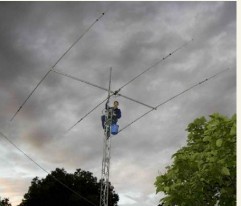
From your editor Mark VK2KI at Beautiful South I
[20m] As seems normal these days, I nearly missed the early start on the higher bands. I completely missed checking for Edi DOZEMR on 15m, but I could just hear Fausto IU4FLS on 20m – in and out of the noise.
Signals were getting weaker, and by the time his 30 minute slot had ended, he was way down in the murk. Thanks for trying mate.
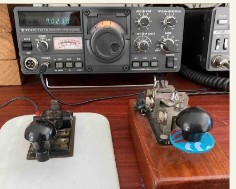
[40m] Stephen ZL3ABX was very weak when I tried calling from 0700Z; I think I heard the “3” each time he called me, but very little else. Thanks for trying, and for the email Stephen.
I then took an early break for dinner, and when I returned and had a quick listen, there didn’t seem to be much going on on 40m. I gave up on 40m and headed down to try my luck on 80m.
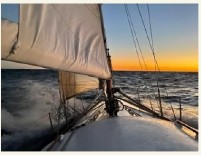
[80m] Great to have six nice back-to-back QSOs on 80m on Tuesday. Steven VK2KDX was a new callsign for me, and he had a really nice signal from Grenfell. Stan ZL3TK was rolling in nicely, as was Morgan VK6MTF/MM down South of Hobart at Kettering.
Morgan reported a daytime temperature of 12 degrees with 20MM of rain – and no heating in the cabin of the yacht! Patrick VK2IOW up at Millthorpe had a solid RSN 592 signal here and we enjoyed chatting about the weather, hay, cattle breeding, regenerative agriculture – pretty normal discussion by a pair of rural dudes!
David VK6KD called in next – great to have a full exchange with David – after what seems like a long time where he’s had to use an SDR to receive because of the noise level.
I rounded out the night with a nice chat with Sava VK4PN up at Mount Ommaney Brisbane; great to hear Sava home early from grand-kid duty, and able to get on air during the net I then heard Stuart VK6MK at Australind calling Sava; unfortunately, Stuart lost Sava in the noise – but it was really great to hear him on again – I think the last time I worked him was back in late 2024.
Stuart used to be a regular on the net in the early days, and set up our fantastic WhatsApp Alerts and Rag Chews groups. Also from your editor Mark VK6QI at Beautiful South Bowning via the VK6SEG KiwiSDR at Hoddys Well near Northam. &
[80m] Nice signals across the continent on 80m this week. For those Rather rom tivation lmredliiotarncloratanlatlenionmatcnmicionenl
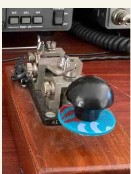
[40m] Not much happening on 40m 20:00 local time so after trying CW I QSY’d to 80m.
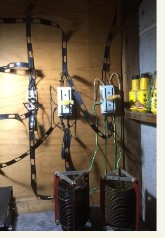
[40m] This week was a rather different in style for me; rather than two or three long ragchews, I enjoyed five shorter QSOs.
No less enjoyable, especially as I got to work some stations I’d not spoken to ina couple of years, and met some operators I’d not worked before. I was particularly surprised to work
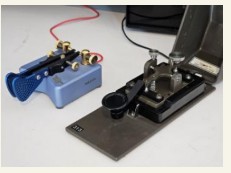
VK6TX early in the evening, but soon discovered that Mike was operating from Queensland. Unfortunately, before learning about his travels in the Eastern states our circuit faded to nothing. Hopefully I’ll catch him again before he returns west.
[20m] WX in Bologna was sunny and warm. Noise level 3 over the range 14044 – 14046 kHz. Power 90w. Having good weather conditions and low noise, I naively expected reasonably clear signals, but I was wrong. I started calling CQ at 14044.
Replies were floating in the QSB and noise. Impossible for me to understand. Later I was forced to QSY to 14045.5 kHz due to a Russian OM intrusion on 14044. Finally ignal : I gave RST 339, but I missed my RST due to t was nice to hear Stan.
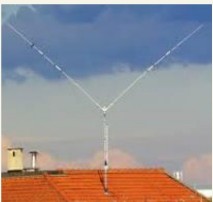
Post Morsum 27th May 2026
From Richard VK6HRC. Six on the VK6RLM rptr and AllStar/Echolink hub this morning.
VK6FN Max VKKD David ZL3TK = Stan VK6QI_—s- Mark VK6HRC VK6MRB Mulligan swl
Max had a great evening worked six on 40 m before meal time. David heard three on 20 m and another three on 40 m and went on to work three ‘on 80 m. Stan heard Fausto IU4FLS on 20 M briefly but conditions changed and his signal was lost in the noise.
On 40 m Max VK6FN and Mike VK6TX were heard then ‘Stan went on to work Mark VK2KI on 80 m. Mark was busy but got on later heard Fausto IU4FLS and Stan ZL3TK ON 20 M ‘ried working Stephan ZL3ABX but conditions not quite good enough.
Mark had better results on 80 m worked a new station VK2KDX Steven had a good ragchew with Patrick VK2IOW as well as getting Morgan, Stan and Stuart in the log.
I had a good session worked two on 40 m and one on 80 m and followed other traffic to improve my decoding. Had a bonus contact with Jordan VK3ACU this morning on 40 m just before the Post Morsum a great way to start off.
Thank you to all on last night and this morning
Reporting

Even if you didn’t hear anyone, we’d still like to know that you had a go. And to make your report more interesting, please consider sending a photo: cqarsnet@gmail.com So, please help attract new and old team members to have a go by submitting your report each week.
Submissions close 1300 (Eastern Australian Summer time)_on Thursdays.
The Perfect Age to Learn Morse Code
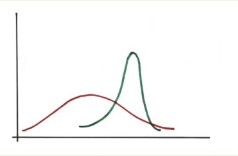
By Ross MONNK. It’s an oft-repeated adage that the best age to learn Morse code is when you’re young. But what a load of old cobblers!
(IMO) Young people certainly have flexible and agile minds that quickly acquire new skills, and I think that’s what leads to the misconception. In practice, most young people have become habituated to instant gratification.
In Voand, where I regularly come into contact with young learners, this translates into an impressively swift grasp of sending. Before long they’re rattling along at 25 wpm and sounding like a pro.
But they fall victim to decoder dependency and shy away from the long hard haul of learning to copy. The intuitiveness of modern tech means that they’re just not prepared for mental skill acquisition that requires long-term self-motivation.
Young people certainly put a tremendous amount of time and effort into learning to skateboard but that is a pursuit undertaken alongside their peers, whereas Morse is an unfashionable activity undertaken outside youth culture.
Even if they do persevere with the copying challenge, the teenage years have many distractions and are a time when one’s interests (and hormones) fluctuate wildly. The drop-out rate is, thus, likely to be extremely high.
And it’s not like learning to ride a bike – when that early skill has gone, it’s gone, and in later years you’ll be very much back at square one again, but with added frustration. No, that is definitely not the best age to learn Morse code.
Neither will it be for people in their twenties and thirties, with work, partners and children all having greater and understandable demands upon their time. The abandonment of radio as a hobby at this time of life is so common as to be a trope.
It doesn’t get any better during the ‘empty nest’ years either. The breadwinner is being ground down by the lack of satisfaction at the tail end of their career; energy and enthusiasm are fading, and what little remains are being drained to line the pockets of strangers; the light at the end of the tunnel looks increasingly inviting.
The housewife (and let’s be honest here, it is usually the female partner who’s become the homemaker by this time in their relationship) has her own social circle that does not include radio among its group norms. There are exceptions but those are rare indeed.
Which brings us neatly to the perfect age to learn Morse code – your retirement years, before you start to lose your marbles! By this time in life, you have a thorough understanding of your strengths and weaknesses, and how best to learn new skills.
Age has gained you the wisdom and resilience needed to see a difficult task through to its successful conclusion. You now have time, that most valuable of commodities, and you’ve learned how to play the fong game to your advantage.
You observe the radio hobby populated by your peers, who revere Morse code as an admirable skill. Best of all, you now have the support of a group of like-minded fellows here on the QRS Net. I’m not saying that learning at this age will be quicker or easier.
Far from it. But it will be more satisfying and enjoyable (once you can see past the frustration, that is), with arguably a greater pay-off at the end because you don’t take your achievement for granted.
Ht to put your energies into a long delayed endeavour for yourself. Welcome into the fold, OM/OL – you are among kindred spirits here.
Yes, there is life in the old dog yet!
Proposed New Net Frequencies – Continued
Chaps, thanks for a really good discussion in RagChew Edition 21/2026. I think one of the issues the group is facing is that because of the amount of CW activity now found on Tuesday evenings, like any large mass, it has an increasing gravity to the point where many find and participate in the activity, probably unaware of any structure at all.
Isn’t it amazing that Australia now has one evening a week where so many CW participants congregate!
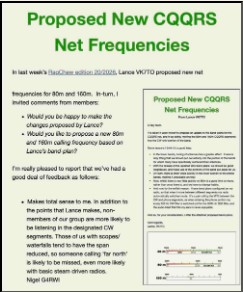
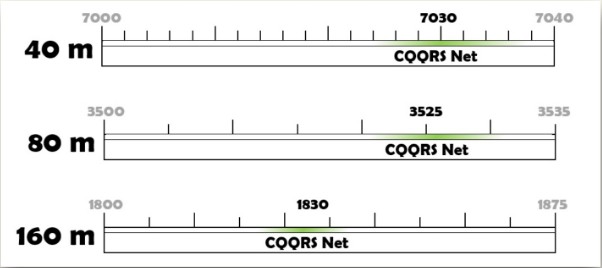
I’ve enjoyed reading all the feedback and really liked Chris’ suggestion of a Centre of Activity, but without hard edges. I think it offers the following advantages: * No defined block, which some participants erroneously perceive as frequency ownership.
I can see how some people took my previous images to mean there were set QRS/QRO sections of the bands, rather than how we operate as a group.
* Sort of sends the message that the whole band is there to play in, but if you want to find other QRS participants, stick around the CoA.
Given that many people have waterfall displays, once they get on the bands, they just operate and find other operators without worrying about edges. For those of us without, it’s not hard to tune around anyway.
Having said all that, I don’t think we can underestimate the value of the safe QRS space to beginners. I also think that whilst the net has fostered the activity we see today and may need to adjust how we communicate about the net a little because of it.
The reality still stands that the only reason there is so much activity is because of the net, and we should unapologetically continue to focus on beginners, and those for whom slow CW is what they enjoy.
Anyway, how about something along the lines of the following, which becomes nothing more than a handy reference if people want to print and stick it to their bench? If you want to forgo the images entirely and just list the frequencies, that’s fine by me too.
Till next time
Lance [Thanks Lance – nicely done. Readers’ thoughts for the next edition please. cqqrsnet@gmail.com Last week’s responses are here and there’s a link in that article to the previous week’s discussion by Lance if you want to re-cap].
V band Part 2: Sending Without A Key
Let’s Jump right In. I’m assuming you’ve found the VBand website discussed in RagChew edition 21/2026 okay. It’s definitely worth looking at all six tabs, but we’re only going to use the first three. Go to the Settings tab.
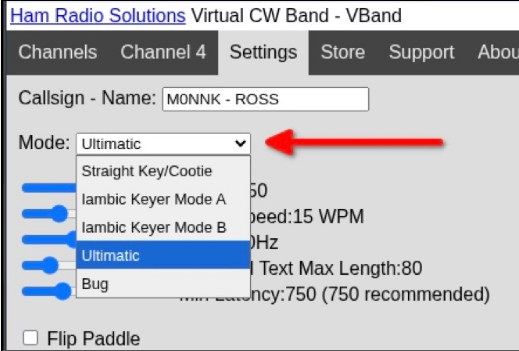
Change your callsign to something short and easy for others to send, then make your settings look like mine below:
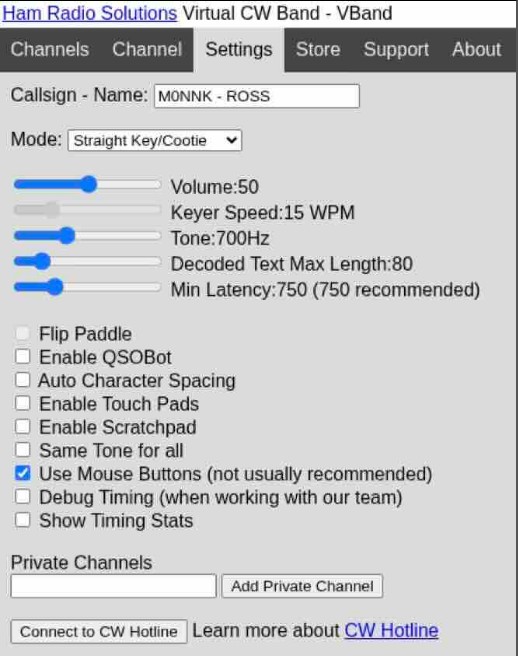
Now go to the Channels tab and select the Practice Channel. Nobody can see that you’re on the Practice Channel and nobody can join you there, so it’s a “Safe Place”.
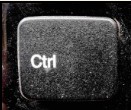
Once you are in the Practice Channel, tap the CTRL key on your keyboard. Hey! You just sent the letter E, and the decoder should show that.
You can also use the left mouse button but most people find it very awkward, hence the “not usually recommended” comment next to the Enable box. But we’ll use this functionality when the time comes to connect a proper Morse key. Okay.
You’re an intelligent operator – you can see how Straight Key Mode works. Now let’s try Paddle Mode.
Computer Keyboard: Paddle Style
Go back to the Settings tab and change the Keying Mode to the paddle mode of your choice, and adjust the Keyer Speed slider to your normal speed..
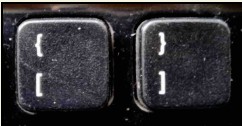
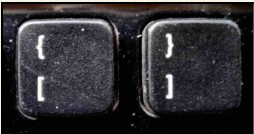
Then go back to the Practice Channel. The Square Brackets keys are now a paddle. The left is dits; the right is dahs.
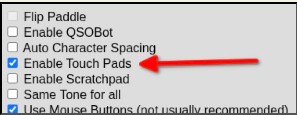
On the Settings tab, set the Mode an Keyer Speed as before and additionally tick the Enable Touch Pads box.
Now go back to the Practice Channel and you should see a Dit and a Dah pad be’ the decoder.
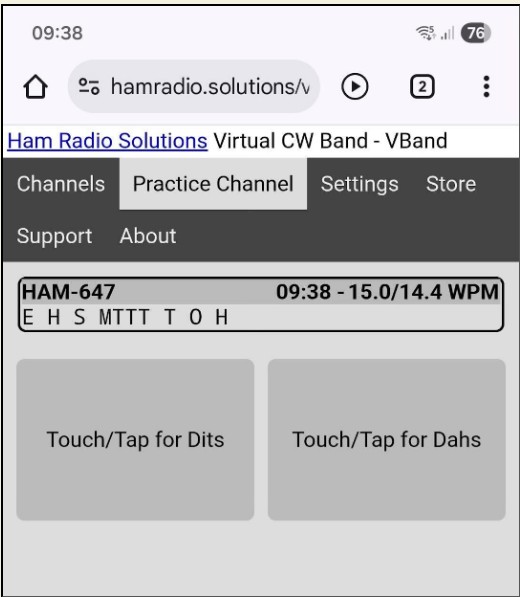
| haven’t had enough practice with this to be competent but some operators are very good with it. But you can, of course, use Straight Key Mode instead – you just get a single touch pad for that.
VBand on your mobile phone is perfect for when you’re out portable, or dare I say, waiting impatiently in the car for your partner to come back with the weekly shopping.
Leaving a Channel!
I’ll speak more about the decoder in a later episode, but for now just be aware that it takes 20 or 30 seconds for it to get the hang of your sending. So, ignore the Decoder to start with and just send your best Morse.
Once you’ve got the hang of things on the Practice Channel, you’ll no doubt want to Go Live on one of the chat channels. Warning: the “ND” on Channel 5 means “No Decoder”! When the time comes to leave the channel, please hit the Page Refresh icon.
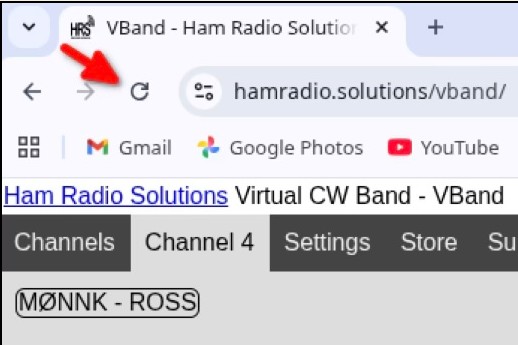
This will take you back to the Home page. If you don’t do this, your callsign may linger on that last channel, which can be mildly irritating to other users.
Next Time
Morse is always more enjoyable when you use the right tool for the job so, in the next episode, we’ll be looking at getting your favourite key connected to VBand. Ross
If you have an article or two that you think might be of interest to our readers, please let me know so we can share more thoughts and ideas; for guidance on writing for RagChew, see Articles below. Please email material to Mark VK2KI: cqqrsnet@gmail.com
On My (Son’s) Workbench
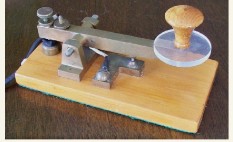
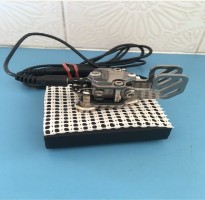
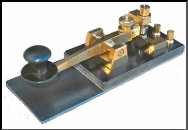
As we all seem to drool over keys I attach a photo of a quite large paddle constructed by my son Steve (who Mark has met, and who has little or no interest in radio but has had to put up with it all his life!).
He does like making and mending things (and indeed inventing when required) and has a feel for aesthetically pleasing items – it must be the artistic streak, inherited from his father!!
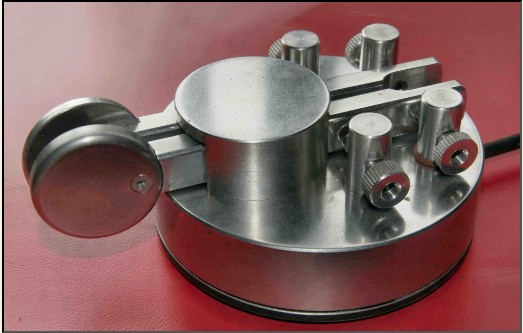
‘As Mark knows, we have a reasonably comprehensive workshop here and we both collect “might be useful items”. Ihad a thick round disk of aluminium which caught his eye and for a year or three has been awaiting a suitable use.
With that as a basis with a few hints from a likely user (me), Steve produced this quite substantial paddle key, which is about four inches diameter and about two inches high (we do use metric measurements for most of our machining, but often tend to think in Inches…).
It is of course of high precision with 4 miniature ball bearing races supporting the vertical shafts which allows the paddles themselves to swing.
After a suitable test time on the air I came to the conclusion a small modification would improve matters; I like a light touch on a paddle key, but I guess some folk have different preferences.
So I made a pair of Perspex finger pieces, a little longer than the round alloy ones he had originally made and the extra leverage does offer a lighter touch which I felt that was quite a noticeable benefit.
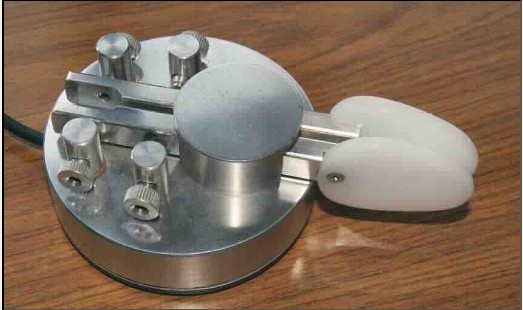
The tew screw threaded parts are of stainiess steel of course. One might question the lack of weight of an Aluminium paddle, but surprisingly it is around 1.5 kg – just a little less than my all-brass Marconi 213 straight key, which is nearly 2 kg.
That key is nearly 11 inches long and has a steel plate under the shorter composite base.
73 to all of our QRS enthusiasts and try your best to have a short, but daily practice at listening and copying, which is without a doubt, the best way of improving your speed. David VK3DBD
What’s going on on your workbench? If you have an article or two that you think might be of interest to our readers, please let Mark VK2KI know; email to cqqrsnet@gmail.com For guidance on writing for RagChew, see Articles below.
CW Practice
This year we’re using Aesop’s Fables. These are short moral stories, often using talking animals, that illustrate simple truths about human behaviour and character.
‘Aesop’s Fables originated in ancient Greece, traditionally attributed to the storyteller Aesop who is thought to have lived around the 6th century BCE.
The fables are generally smaller files of two to three hundred words that have been recorded at 15 wpm and run for about 15 minutes.
If 15 wpm is a bit quick for you, load it onto your phone and set the playback speed at 0.75 X or even 0.5 X- whatever works for you. 0.75 X will play the MP8 at a bit under 12 wpm. Itis suggested that you read the text file before listening to the audio file.
That will make it easier to follow the audio file and prepare you for any unusual words. Any punctuation that is not usually used with CW has been removed. This week’s fable is ‘The Fisherman and the Little Fish’, and the MP3 and TXT files are attached here –

If you prefer a different speed or tone, you can create your own MP3 files by converting the text file with the Ebook2CW app — https://fkurz.net/ham/ebook2cw.html.
You can either play the MP3 files in any media player, or load the text file into the Ditto CW: Morse Player app — https://dittocw.andro.io/.
Both options work well, however Ditto CW gives you complete control over all Morse settings, while a normal media player only allows changes to playback speed, and does that in steps (e.g. +1.25x, 1.5x, 1.75x).
Other News
CW Academy – Notes from the CW Academy – 22MAY26
From Chris VK3QB. CWops Oceania Ambassador Hello everyone, It’s great to see everyone progressing as we complete session 6AVEEK 3.
Most of the characters and numerals learnt in the first 3-4 sessions should be getting baked in by now and you’ll be adding the new stuff that’s introduced progressively each session.
Of critical importance is rhythm and timing, as well, of course as character formation. These skills will continue to strengthen as you practice…
And don’t forget to take advantage of those extra practice opportunities, verbalising the code as you go about your daily routines, and starting to listen to words and phrases on your phone/device when out and about.
As you go into sessions 7 and 8 (this week coming) you’ll be getting close to having all the characters, numbers and punctuation marks in your vocabulary.
Of course, some of the newer ones will still be a bit tricky to master, but the practice will yield results – as it has thus far. Now is the time (if you haven’t already) to start listening on-air.
A lot of what you hear will sound too fast, but stil take the time to relax and listen; you’ll be surprised what you can copy. ‘As we have discussed, going into your uncomfortable zone is a great learning technique.
Tuesday nights are a great opportunity to start getting familiar with basic QSOs and listening to ops in the Slow CW Activity, also known as the QRS Net.
It’s not a Net in the traditional sense of a Net, (ie no Net Controller and no fixed frequency) but its a great friendly environment to start getting experience with on-air activity.
There’s plenty of activity around the speeds your learning; ie character speeds of 17-20 wpm, Famsworthed down to 6-10 wpm. Its every Tuesday from about O800UTC with most activity on 80, 40 and 20m.
You can find out more here: https://bit.ly/CQQRSWebsite And if you want to subscribe to the weekly newsletter drop Mark an email at cqgarsnet@gmail.com . Mark VK2KI/VK6QI curates this event each week and publishes the newsletter – by
CW Academy – Notes from the CW Academy – 22May26
It’s great to see everyone progressing as we complete session 6AVEEK 3. Most of the characters and numerals learnt in the first 3-4 sessions should be getting baked in by now and you’ll be adding the new stuff that’s introduced progressively each session.
Of critical importance is rhythm and timing, as well, of course as character formation. These skills will continue to strengthen as you practice…
And don’t forget to take advantage of those extra practice opportunities, verbalising the code as you go about your daily routines, and starting to listen to words and phrases on your phone/device when out and about.
As you go into sessions 7 and 8 (this week coming) you’ll be getting close to having all the characters, numbers and punctuation marks in your vocabulary.
Of course, some of the newer ones will still be a bit tricky to master, but the practice will yield results – as it has thus far. Now is the time (if you haven’t already) to start listening on-air.
A lot of what you hear will sound too fast, but stil take the time to relax and listen; you’ll be surprised what you can copy. ‘As we have discussed, going into your uncomfortable zone is a great learning technique.
Tuesday nights are a great opportunity to start getting familiar with basic QSOs and listening to ops in the Slow CW Activity, also known as the QRS Net.
It’s not a Net in the traditional sense of a Net, (ie no Net Controller and no fixed frequency) but its a great friendly environment to start getting experience with on-air activity.
There’s plenty of activity around the speeds your learning; ie character speeds of 17-20 wpm, Famsworthed down to 6-10 wpm. Its every Tuesday from about O800UTC with most activity on 80, 40 and 20m.
You can find out more here: https://bit.ly/CQQRSWebsite And if you want to subscribe to the weekly newsletter drop Mark an email at cqgarsnet@gmail.com .
Mark VK2KI/VK6QI curates this event each week and publishes the newsletter – by copy, Mark, please welcome those on this email list, the CW Academy Beginners class for Semester 2, 2026. Lastly, if you haven’t yet started looking around my website, please do.
It’s intended as an adjunct to CW Academy and the monthly Zoom interviews I host; I hope its a resource you will find useful as you build and develop your CW skills. Feedback and questions are welcome, and will help drive additional content.
Https://masteringmorse.com/ Have a good weekend everyone, and see you on Monday.
F3, Chris VASQB CW Ops # 2949 CWP Ops OC Ambassador / CW Academy Advisor

First Ever 40m DX
Simon & Jo MOKBJ Harvey MOKBJ Chuffed to get my first ever 40m DX this morning. & At O5OOUTC, lovely ragchew with KG2RG in Albany NY, who gave 559 for my 60W into his inverted vee. Then got WW1USA in Kansas City. de MOKBJ, Wolverhampton UK 8:22pm & Os:
Accessing the ACMA Assist Portal
In Amateur Radio, Volume 94 No 2 2026, Justin VA7TW explained in detail how to access the ACMA Assist Portal for management of Australian amateur radio licenses.
With thanks to the Wireless Institute of Australia and Justin, the article has been linked into the Useful Information and Links section of the COQQRS Website. The article is also available here: Accessing the ACMA Assist Portal
National VKFF Parks Get-Together – Albury NSW
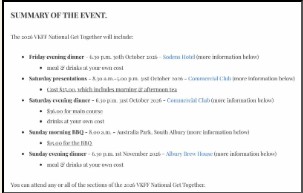
INGUOla! VINER Palko Vl IOYCIIC! – AIDULTY INOW 300CT26 to 1NOV26 The Wagga Amateur Radio Club’s QRM newsletter has advice from Paul VK5PAS the National VKFF Parks Coordinator, that the Annual Get-together will be at Albury this year from October 30TH to November 1st.
Click on either if the images below for details and registration.
Morse Training Net
Our team member Nic VK7WW runs an on-air Slow Morse training net every Wednesday at 7pm EDST on 3580 for 30 mins. He uses the callsign of the Northern Tasmania Amateur Radio Club VK7TAZ on that net.
Many of our team learned Morse code with the support of Nic, and the weekly training session comes highly recommended for anyone who wants to learn the Code, or simply brush up.
Everyone’s welcome – 3580KHZ at 7pm Eastern time every Wednesday; you’ll hear lots of the CQQRS team on that net. Jordan VK3ACU has ralso ecorded the complete set of lessons which you can now find here:
Https://www. youtube.com/playlist?list=PLHsQmZz6fBXO7swAfbT mutrbbEL17fUQL Contact Nic VK7WW for more info nicholaschantler@hotmail.com including how to join the NTARC DISCORD group to follow the action, or just come along and join in on Wednesdays.
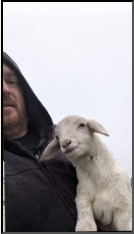
Can you guess who the one on the left is? He’s a well-known CQQRS family member. cqqrsnet@gmail.com
Hi Mark, Been a few weeks QRT but we move on Friday complete with masts and all my radio gear, hope to be back on the air in a couple of weeks. Importantly one of my mates in the US tells me it’s
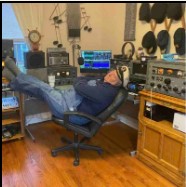
World CW day tomorrow, 27 May. You might check before you post as I am knee deep in boxes. Cheers David Williams. VK3RU [Good luck with your move to Mornington David.
Don’t know about World CW Day – but for several years we celebrated International Morse Code Day on April 27TH (Samuel Morse’s Birthday) with a Zoom Trivia Quiz hosted by our ABC TV Hard Quiz Mug winner, Richard VK6PZT_]
Im a@erence Of hol I don’t believe the RSN report offers any utility. It is pretty much unheard of outside the CQ QRS Net; I’ve never heard it used elsewhere, and expect operators will get a bunch of ??s in response to its use from the wider CW community.
From my perspective, (R)eadability is the key metric as to a QSO’s viability. The stated aim of of the RSN, being able to use the signal (S)trength and noise floor report to determine how well the other station can copy you is not only redundant, but also ignores a host of other factors affecting a QSO, such as flutter, QSB, QRM, desense etc.
The other factor I’ve found is that in very poor conditions (R=2,3) where multiple elements aren’t being received, the more markers (expected elements) in an exchange, the easier it is to piece it together across multiple repeats.
Knowing that the third digit in the signal report is a 9 can be very useful. My recommendation? If you want to be understood by the wider CW community, stick to RST.
In defence of 599 contest exchanges
In defence of 999 contest exchanges Operating in a contest at 30+ wpm is a hoot. It’s a long way from rag-chewing, but if you want to push your station, and your copying ability to the limits, it can be tremendous fun.
What about those meaningless 599 signal reports though? Talk about redundant elements… or is there more to it? You may be interested to know that the 599/IS, for many contesters, vital.
In those conditions 599 operates less as a report, and more like a sync bit used in many FSK type protocols. It serves to queue your brain to latch onto the next group of characters as the exchange number/letters which must be recorded.
The brain effectively hears 699 . It’s hard to explain, but anyone who’s done it will no doubt nod their heads with a “yep”.
In defence of the wobbly fist I’m sure we’ve all had QSOs where our partner’s fist required us to focus that little bit harder in order to decode what’s being sent.
Be it the learning curve, equipment gremlins or muscles seemingly intent on ignoring the signals sent from the brain, the choice of poor sending is often not one of choice.
I see little difference to chatting with people for whom English is not their first language, or those with a medical condition which causes them to slur their words. Yes it takes a little more effort, but I am all the richer for having engaged with them.
It’s no different with CW. If you’ve got a shaky fist, or your paddles stick now and then, I will take a QSO with you any day of the week. And thanks to the CQQRS Net, there’s one evening a week when countless others will too.
In that light, I was alarmed to read that our resident POG intends to stop participating on the airways when his fist is no longer able to emulate a clockwork automaton. Given the enjoyable QSOs we’ve shared in the past, that would be a grave loss to us all.
I’m sure I’m not the only one who would happily trade a bit of extra concentration for the continued enjoyment of his thoughts and experiences in the form of the all too familiar dits and dahs (with perhaps the occasional dahhhhh and dahit).
The bad news from lan VK1HF is that his fantastic Snowline KiwiSDR has been switched off.
The good news is that the gear is looking for a new quiet location; power and internet aren’t required at the site – it’ll be self-contained. Would any of our rural readers like to host lan’s set-up in a quiet location perhaps?
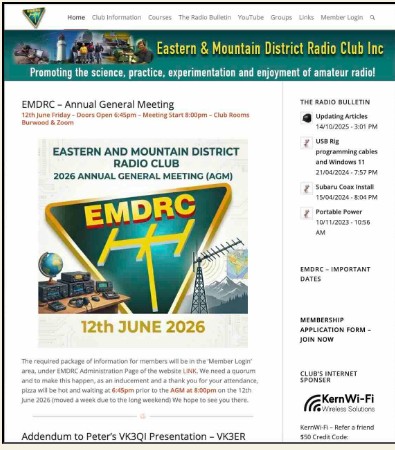
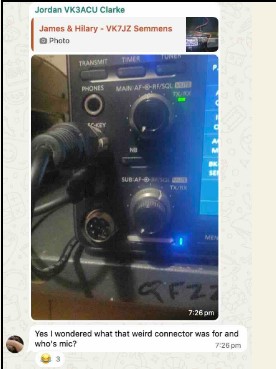
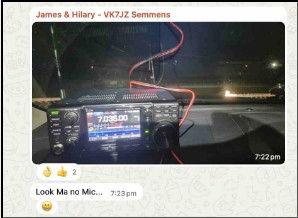
If you’ve read something that you think might be of interest to our readers, please email to Mark VK2KI: cqgrsnet@gmail.com
QRZ? Who’s on the other end?
Prosign/Character/Signal of the Month
[Put it on a sticky note near your key as a reminder for Tuesday… and tell us how you went!]
Di-dan-ai-daan-ait
Next Tuesday’s Net
Our CQQRS Group will be on as always on Tuesday from around 0600Z until about 12002; see https://bit.ly/CQQRSWebsite and navigate to the Net Details page for details.
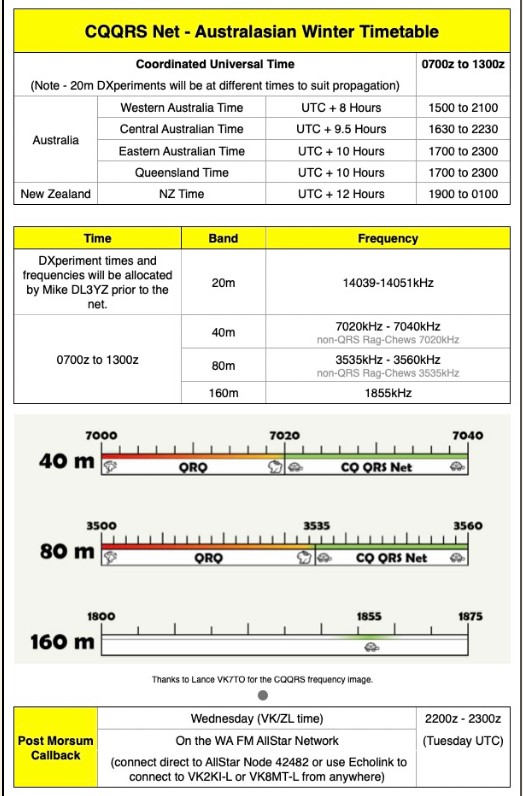
Doesn’t matter whether you’re brand new and want to try just exchanging callsigns and RST reports, or you’re ready for a good old rag chew. We’ll have fun.
There’s usually people around until after 1200Z – so keep calling in the segment of the band designated in the table below until you catch someone.
Reports & Photos
Please let us know via our Reports form bit.ly/CQQRSNET who you work or hear on Tuesday’s Group. The report form closes at 1pm (Eastern Australian time) on Thursday. And how about helping to make the reports even more interesting by sending a photo?
If you have a photo that you’d be happy to include, please email it to: cqqrsnet@gmail.com And of course, we’re always on the lookout for more photos for the newsletter, so if you have something that might be of interest aside from the reports, please send it through as well.
Email to cqgrsnet@gmail.com please. Oh and by the way, I recommend that you don’t keep the Reports Form website open between submission of reports from one week to the next.
If you’re unlucky, there’s an undocumented feature in the software that could cause your current week’s report to be combined with your previous report – it’s happened to your editor several times – much to the chagrin of our Reports editor 🙂
Post Morsum
Richard VK6HRC will run our phone Post Morsum on Wednesday mornings on the South West AllStar net (via repeaters and hotspots all over WA) from 0600 WA time, then from 0700 WA time on 80m (3605 LSB).
See https://bit.ly/CQQRSWebsite and navigate to the Net Details page for details of how you can connect via Echolink from anywhere in the world.
Articles
Could you write a short article or articles for RagChew? You bet! Writing not your strong point? Don’t worry, I’m very happy to help as much or as little as needed.
Oh, and one more thing (actually two) – copyright material: * please use your own images – don’t use images copied from the internet unless you have the producer’s permission, or they’re marked ‘Creative Commons’ or similar; ¢ if you include other peoples’ written material, unless you have permission, you may only include small snippets (unless it’s marked ‘Creative Commons’ or similar), and you’ll need to site the source and author.
For more guidance on writing for the RagChew newsletter (including how you might even try using one of the new Artificial Intelligence tools), head to our website bit.ly/CQQRSWebsite then click the menu on the top right and then click RagChew Newsletter.
Material
Areminder; if you send me any information by email, our report form or WhatsApp – unless you specifically state that material is not to be published, I’ll assume that you’re happy to see your thoughts in the RagChew newsletter.
Thank you so much to our team of 33 contributors: IU4FLS, MONNK, MOKBJ, VK1HF, VK2IOW, VK2RU, VK2TIG, VK3ACU, VK3CTM, VK3DBD, VK3DRQ, VKSKLE, VK3QB, VK4BVM, VK4IM, VK5ET, VK5FD, VK5KFG, VK5PAS, VK6HRC, VK6JDM, VK6KD, VK6KHZ, VK6MTF/MM, VK6RR, VK6TX,
VK6WE, VK7JZ, VK7TA, VK7TO, VK7TW, ZL3ABX and ZL3TK. And a special thank you to our editorial team, Nigel G4RWI (head of software development), Patrick VK2IOW (our hard-working reports coordinator), John VK2RU (the spreadsheet guru), Richard VK6HRC (post morsition), Lance VK7TO (director of the frequency management department) and Jordan VK3ACU (our resident joker).
Great work all! GU CW on Tuesday, mb Mark Bosma VK2KI / VK6QI Beautiful South Bowning NSW cqqrsnet@gmail.com non impediti ratione cogitationis
About the CQ QRS Net
For the current schedule and more information about the CQQRS net, please go the the Net Details page on our website:

The opinions expressed in the RagChew newsletter are those of the individual contributors. The opinions do not necessarily reflect that of the editors or of the CQQRS Group members.
Any material and images received from members by the editor or published on the CQQRS WhatsApp groups may be published in this newsletter unless specifically requested otherwise.
The RagChew newsletter is considered to be exempt from the Australian Government’s ban on social media for under 16 year olds because it is a service that has the primary purpose of enabling users to share information about products or services, engage in professional networking or professional development services or of supporting the education of users per the Australian Government eSafety Commissioner FAQ webpage “Which platforms have been excluded from the age restrictions” dated 10DEC25.
The values, doctrine and guidelines for the Group and for the newsletter are published on the Principles page of the group’s website https://bit.ly/CQQRSWebsite