Below is a reconstruction of the 2025 50 CQ QRS RagChew newsletter designed to support full text searching. This reconstruction was built using OCR, and will contain errors.
To view the Mailchimp original, click here. To search the entire newsletter archive, click here.
Contents
- CQ QRS RagChew
- Mean Output Power
- Back to the Net
- New Team Members
- Reports
- Website
- POST MORSUM 10th December
- This Week’s Topic of Interest
- QRZ?
- Our latest American team member, Jeff WB2GDZ from Seminole Florida.
- QRZ? Who’s on the other end?
- From your editor Mark VK2KI / VK6QI Key (ha!) to the success of our net is helping to make it a get-together that people enjoy returning to each week. So I’m really keen to share the backgrounds of some of our team members, just as Jeff has – it’s really nice to know who’s on the other end of the QSO. So, would you be willing to share some thoughts about yourself? Please let Mark VK2KI know: cqgrsnet@gmail.com For further guidance on writing for RagChew, see Articles below.
- Head Copy Practice
- You can either play the MP3 files in any media player, or load the text file in last week’s Newsletter into the Ditto CW: Morse Player app — https://dittocw.andro.io/. Both options work well, however Ditto CW gives you complete control over all Morse settings, while a normal media player only allows changes to playback speed, and does that in steps (e.g. +1.25x, 1.5x, 1.75x).
- Other News
- Jordan VK3ACU’s so-called “drifty delight” in action. Click on the image to show the short video.
- DXperiment Status Monitor
- Dit-dit
- Morse Training Net
- Settle to Carlisle Railway Challenge — Results
- Prosign/Character/Signal of the Month
- I Hear Tell…
- Di-dah-di-dah-dit
- Next Tuesday’s Net
- Reports & Photos
- Post Morsum
- Articles
- Material
- teamwork
- About the CQ QRS Net
CQ QRS RagChew
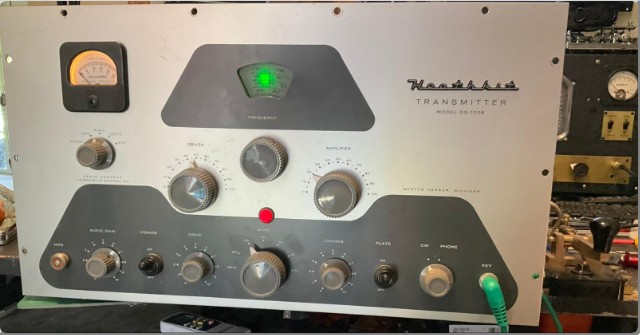
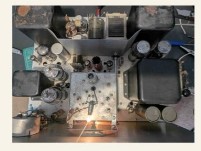
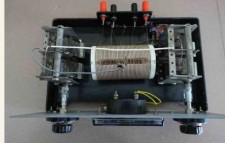
Thanks this week to Jordan VK3ACU for the image of his latest project – restoration of a Heathkit DX-100B transmitter. See Jordan’s report for more.
| really like some of the photos we get of our team’s restoration projects – Jordan’s photo of the Heathkit DX-100B transmitter shown above for instance. Unfortunately, Heathkit the company doesn’t exist any more, but in its day, it was just marvellous….
The average numpty like me could buy an affordable kit – complete right down to the solder – and assemble something that worked well; so satisfying!
One of my early transceivers was a Heathkit HW-29A; better known as a Benton Harbor Lunch Box, this 6m AM unit had an external 12V vibrator power supply and a regenerative receiver that with careful adjustment could receive SSB, CW and FM – and
Being broad, you could listen to much of the 6m band all at once. Looks like Jordan’s transmitter was from around the same era. I atar in life I farind mycalf living in Navinn
Rtn ht NIN Nat nD cet NID Prpthere DBA NADA ING we J Nt NP meh [De DF Ohio for a couple of years, and once went to the amazing Dayton Hamvention, where I bought a new Heathkit SB-1000 linear amplifier kit; a perfect project for the once-a- week enforced break from study – Sunday nights became build the amplifier night.
|’ve still got it wrapped in plastic wrap, ready to be pressed back into service one day.
Mean Output Power
Mean VUIpul Fower And speaking of amplifiers and in particular, power limits in Australia – in last week’s RagChew I reminded the team about Australia’s power output limits for CW – 120W and 30W mean for Advanced and Standard licenses, and 10W PEP for Foundation.
I pondered the question about what exactly was meant by mean; mean CW power measured over 100MS was completely different to mean power measured over 1 second, one minute or 1 hour – our regulator doesn’t specify.
Well luckily lan VK7TA has come to our rescue with ITU guidance on measuring pY for CW; lan’s article is in this week’s Topic of Interest below. Thank you lan – at last one of my many questions has been answered!
RagChew Indexing This year, there’s been several requests to find specific articles that readers recall reading in the RagChew.
I create the newsletter each week using MailChimp – an email marketing (spam) generation system, using a combination of html text and text embedded in images; the latter allows contributions from other writers without the long process of manipulating photographs – which unlike word processed document is very complicated and slow in MailChimp.
To-date, we’ve had a number of suggestions about indexing, but I haven’t had the time to think about the problem. Well, there’s movement at the station and several of our team have volunteered to help with the challenge in different ways.
There’ll be more to come on the indexing problem, but it’s outstanding that: + there’s so much interest in our little newsletter that there’s demand for a way to search for published articles, and * we have some volunteers who have agreed to help sort through the challenge of searching the newsletters produced in MailChimp.
Thank you one and all. And let me know if you’d like to join the happy band in the likely event that there’s some manual processing of past issues required.
Back to the Net
Data LO UTC INCL Well I’ve rabbited-on about who knows what, and haven’t even mentioned the reason we’re all here… the Tuesday CQQRS net! Fear not – we’ll all be back on Tuesday evening (morning in Europe, and sparrow’s in the US) having some fun.
The schedule is down the end of the newsletter – like a supermarket, you need to walk all the way past the impulse-buy things to complete your purchase.
New Team Members
Ue Do ket Welcome this week to Steve VK2EEL who lives in Plumpton, Michael VK3CMV at Chiltern, Jon VK4QJ at Murrumba Downs and Jeff WB2GDZ at Seminole Florida.
Both Steve and Michael have been subscribers to our newsletters for a while, but I only recently came across them among our 230+ subscribers. I’m pleased to welcome Jon as well who’s among the small group of Queenslanders who have joined the team.
Jeff WB2GDZ lives in Tampa on the West side of the Florida pan-handle. One of Jeff’s main radio interests is CW rag chewing which he says is becoming a dying art (ha – have we got news for you matel).
Jeff is a keen user of Remote stations in the US and has joined the Southern Electronics Group in WA, aiming to get to know some of the local CW folks here.
He’s already made himself known on the net with a nice QRQ rag-chew with Phil VK6GX which several of our team enjoyed attempting to copy on Tuesday. Jeff has written us a nice article for our QRZ? segment this week.
Welcome Jeff – and you’ll have to see if you can drag our mate Gary W4GAL out early on Tuesdays as well – after all, the sun comes up in Melbourne FL before Tampa!
Reports
After next Tuesday’s Group, please send me a list of who you worked and / or who you heard using our web form here:

To make your report more interesting, please consider sending a photo to be attached. If you have a photo that you’d be happy to include, please email it to: cqgrsnet@gmail.com To make it even easier for Patrick and Mark, see if you can compress or reduce the siz of the image (preferably to less than 100KB file size).
No problems if your computer or phone can’t do that – just send it through anyway please. So, please help attract new and old team members to have a go by submitting your report each week. Submissions close 1300 (Eastern Australian Summer time) on Thursdays.
Website
If you’d like to find out a bit about our net, or would like to pass information to others about our Tuesday get-togethers, here’s the link to our website. bit.ly/CQQRSWebsite So, on, on…. here we go with this week’s newsletter.
Cheers, mb Mark Bosma VK2KI / VK6QI Beautiful South Bowning NSW cqqrsnet@gmail.com non impsditi ratione cogitationis
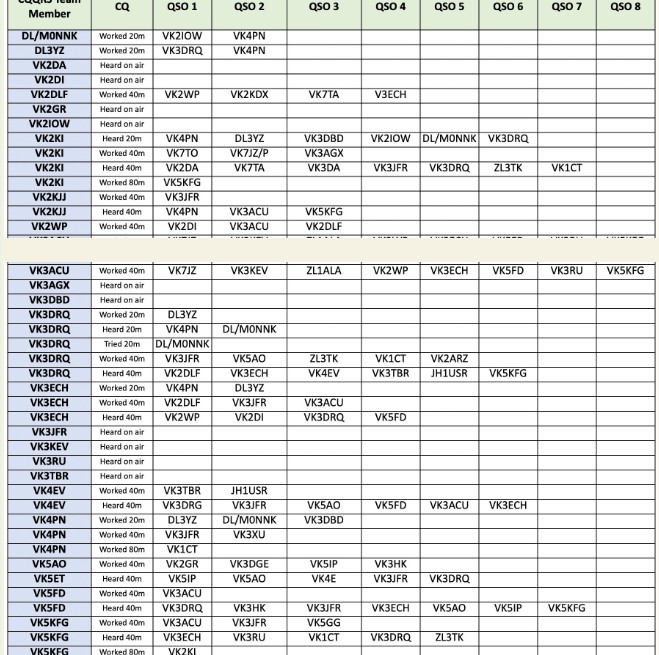
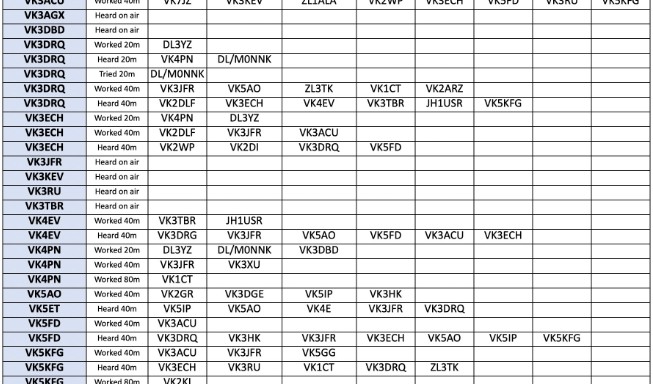
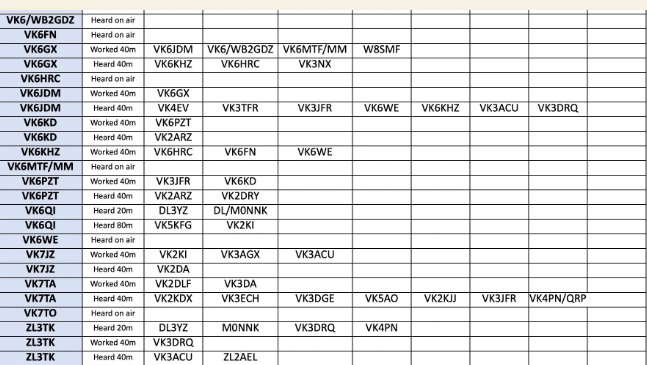
This week’s comments from our webform reports have been compiled for us once again by Patrick VK2IOW. Don’t the reports look great? Thanks mate – I really appreciate the effort you make for us all each week.
[20m] I started early in the DX window, so my signal was still weak in Ironstone. First QSO with Manny – VK3DRQ was easy to copy. Then heavy fog was coming up the Neckar Valley, vision below 30 m. So my QSO with OM Sava, VK4PN was hard to copy for both sides.
But Sava has a great fist, so we got the important parts exchanged. Our new Real Time Status Monitor worked fine, so we had a great overview of all stations. condx next time. Have a great week – 73 de DL3YZ
From Donald VK6JDM at 20KM west of Esperance
[20m] I started early in the DX window, so my signal was still weak in Ironstone. First QSO with Manny – VK3DRQ was easy to copy. Then heavy fog was coming up the Neckar Valley, vision below 30 m. So my QSO with OM Sava, VK4PN was hard to copy for both sides.
But Sava has a great fist, so we got the important parts exchanged. Our new Real Time Status Dy payee Aer be eS eer Pes eee ee meer eS es meen ee es
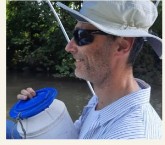
[40m] Had a QRS with Phil VK6GX who kindly went slowly enough that I could actually copy 90%. I then spent an hour mainly listening and managing to copy a lot more than I would have a few months ago.
I know I could do a lot of practice and get there a lot quicker, but there are

| fe cette ett ee tte Be eth ee Sette te tet Cote! Og Pecwettetie eet ornate ot etree nel ete tet so many things to do AND Anne has lists. Nurses have a nasty habit of making lists and it is better I find to tick a few items off Anne’s lists.
I find if I avoid doing a few of the simpler chores on the list, it leaves something simple to do at moments when one is accused of not having done enough list jobs. Unfortunately I have not seen “do more Morse practice” on any of her lists!
I will just go on slowly getting a bit faster with my hour or two of listening to you all shaking the ether on Tuesday nights.
[20m] Heard both DX stations RSN 211 while working oth no time this week to wait for a clear spot. ECram lan UV9OW LI at VAlannsy lAlanas
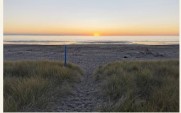
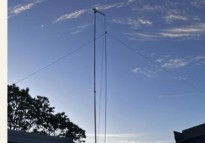
Due to foul winter weather here, I was using Mike’s radic in Germany over an internet connection from the UK (Google “RCForb Client’), hence my callsign DL/MONNk Camo WIM Wee I Wher or moo Teens
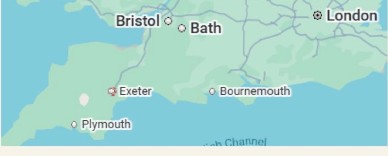
Sava VK4PN was struggling with his S4 noise – DX signals are often weak, so moderate QRM must be frustrating. Pat VK2IOW with his Yagi was a strong (for DX) signal and easy copy.
Strangely, some brief but strong QRM in Germany caused my brain to forget how to copy for an entire over! Then I heard some very faint morse. Was someone calling me?
[15m & 40m] got started too late to catch our DX team, but set up my antena for 40m and 15m anyway. Two good contacts on 40m, ut less luck on 15m within VK. I suspect my signal was skipping over the top of vk3 and vk2.
BN was picking up ny cq in Europe via short path!
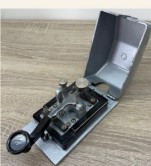
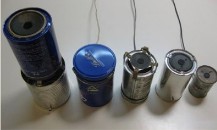
[40m] Excellent signals tonight. I decided to fire up the old Heathkit DX-100B after chasing a few gremlins earlier in the week. What I initially thought was a VFO issue turned into a bit of detective work because the 40m xtal also wouldn’t peak up. During a
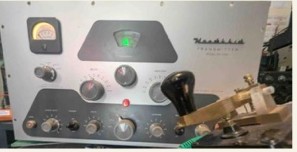
QSO, the VFO just decided to wander off and that was that. On inspection of the schematic, I discovered a previous owner had fitted a 4.7 kQ resistor instead of the correct 27 kQ on the screen of one of the valves and the crystal.
Because of this, the crystal itself also needed attention. I pulled it apart and gave it a proper clean, which brought it back to life.
In the end, the real culprit turned out to be a leaky mica capacitor in the VFO — but it did leave me stumped having a daday vital and VENI
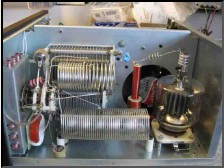
All sorted now, and the DX-100B is sounding great. Click the image to the left for a short video showing testing the leaky mica capacitor with high voltage.
After a few 100 W QSOs with the old Heathkit, I turned to the little Penntek TR-45 OQRP rig and made another five or so contacts. Something old, something new, a aia) =!
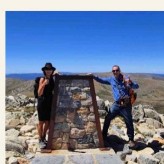
[40m] I found the 40m band the most active this Tuesday night. My noise floor was close to zero at times. Quite a bit of fading. Some stations must have been on the same frequency even though they weren’t in a QSO with each other.
I guess I was : in the middle somewhere, hihi.
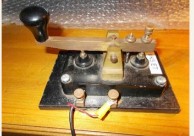
[80m] Appeared to be a big blank wall on 80m. Only a couple of local stations up on 3.645 LSB. At least there was some activity in the band even if it wasn’t CW, hihi. 73s VK6KD.
[40m] VERY NOISY, signals fading out completely then back t at S5.
So VAIVL A VIN/ FOMADIC OF MOU VWWOITIQtor
[40m] I finally found a good spot with zero or close to zero noise. Over previous weeks I have been looking for places to set up that offer less noise compared to my QTH… which is pretty much anywhere.
Been checking out places close to the water, and this time up on Mount Wellington which sits over the top of Hobart. I set myself up at ‘The Springs’ which is about 2/3 of the way to the top, I had big sky facing north, but was in the lee of the mountain facing west, sorry Morgan never even heard you.
I had the pleasure of very clear crisp QSOs with Mark VK2KI,
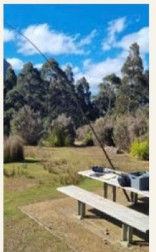
Reter VASAGA, and then vordan VASAUU. It was a short session for me, I had to pack up and make it home to then set up again for the CW Academy class, but have to say I really enjoyed CW where I could hear clear tones and was not struggling to lift it out of the noise, it was like ‘what noise’ Mark VK2KI was only competing against the chirping of the birds in the trees behind me.
The mountain is looking positive, next week I will go further up, the summit is no good with all the towers but there is another spot known as ‘Big Bend’ that might do the trick for more big sky from more of the compass points. Hear you all next week. 73 Jim.
[40m] After putting in a brief appearance on the Boat anchor Net (3.620 MHz 8.00 pm central time Tuesday), as the sun was sinking QRS on 40m wa quite busy.
Jordan was S9 on 5w with his Penntek (yes, I had to confirm that it was a Penntek and no a TenTec, not having heard of the Penntek before. Looking up the Penntek later, it looks very

Looking up the Penntek later, it looks very tempting, but do I really NEED another QRP rig?). James was S9 from Ararat and, c course, Graeme, ex-Navy signaler, was lightning fast. Mark was on 80m when I had a look, back at his home QTH.
Thank you Mark for another year’s brilliant effort.
[40m] Had a good listen around on 40M. The 40m band is always very noisy at my suburban QTH with a level of around 7 to 8 S-points. However made a couple of QSOs on 40 which was good. I like the higher bands as the noise level is much better.
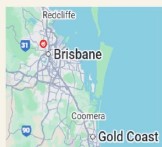
[40m] I had a long ragchew with Jeff VK6/WB2GDZ, who is very eager to work VKs. Sorry for tying up VK6SR remote for 1hr 21MINS! Then worked Morgan, VK6EMTF/mm,
Moored at Dunsborough, an excellent place to be in hot WX. Sorry for missing the deadline for reports over the last few weeks, I was here, just very QRL! 73, Phil.
[15m] Nothing heard of Edi DO2EMR on 15m via the VK1HF Snowline KiwiSDR (my ageing TS-120S won’t work above 20m – sometimes I know how it feels!).
[20m] Signals from Mike and Ross were very weak to me
This week; conditions improved as we went along, but I could only hear the occasional bits and pieces on QSB peaks – not enough to attempt a SO. Anyway, the guys seemed to have no shortage of callers – good stuff team.
[40m] I think I managed to sort out my GMT times for the second week in a row; I cranked up 40m at 0600Z and had an interesting QSO with Lance VK7TO in Hobart.
There was a predicted geomagnetic disturbance which seemed to cause Lance to struggle with my signal, yet he was Q 5 with me; we often get one-way propagation between NSW and WA on 40 and 80m around dusk (in WA) as the upper ionosphere is.
Illuminated but the lower areas aren’t – but I can’t recall such conditions on the North- South path. I also noted that my signal into lan VK1HF‘s Snowline KiwiSDR at Dry Plain (about 150KM South of here) suddenly took a dive and almost disappeared.
After Lance I listened to some rare DX – VK2DA and VK3AGX. Andrew VK2DA is better known to SOTA/PARKS chasers and to our net as VK1DA; he has recently had some success running his station at nearby Yass by remote control from Canberra using wiview and his com Remote software.
Unlike the RCForb remote software, Andrew’s keying sidetone is affected by internet latency – try sending while listening to a KiwiSDR (with your own sidetone turned down) and you’ll know how hard that is!
So Andrew who prefers the paddle, is stuck with keyboard CW for the time being. Andrew – I have your old keyer with the Galbraith paddle with a built-in speaker if you want to give that a try mate; might be the quickest solution.
Anyway, seeing he was transmitting from VK2, Andrew reverted to his VK2 callsign – rare DX indeed. And Andrew was chatting to Peter VKSAGX from Warmambool; I hadn’t heard from Peter for about a year – so it was great to hear hime and then work him as well.
I also caught our trainee Eskimo – James VK7JZ who braved the slopes of Mount Wellington before racking-off (in the colloquial, not vinification sense) for some CWops training.
After the 15 and 20m DXperiment and dinner, I returned to listen to a few rag-chews on 40m before sliding down to 80m to try my luck.
[80m] Nice to hook up again with Greg VKSKFG on 80m; despite the odd conditions on 40, 80m was doing nicely – RSN 593S both ways (and I got to try my new RSN doctrine of reporting static crash levels rather than baseband noise levels).
First time in living memory, Greg reported that things at Willunga were green (I was lamenting my broken tractor that dumped its coolant while I was doing anti-bushfire slashing last. week)! Makes a nice change eh Greg?
From Manny VAK3DRQ at Blackburn NOTE: This applies to any band. It is OK to give
Other operators waiting to find out the call sign; in order to call and have a QSO when conditions are poor. PSE don’t get me wrong. We are only humans. No other stations were heard on 20 or 15m.
[20m] Managed to work Mike and Ross again but it was a struggle. Most of signals from stations in that part of EU using standard 100 W or less are at or just under the noise level at my QTH at this time of day.
David VK3DBD who was listening to my struggling QSO with Mike called me afterwards and we had an extended and enjoyable chat. He told me he had no
• s extended and enjoyable chat. Me tola me he had no trouble copying Mike and confirmed this is always the case. David is using a 3 el beam while I use just a simple wire antenna, still I should be doing better unless there is a null in that direction as my antenna is fairly long.
Still puzzling, a few hours later when I work FT8, usually around 13:00 UTC, getting into EU is not a problem. Difference between short and long paths is not that big so distance shouldn’t be an issue.
[40m] Much better results working QRP on this occasion. Two enjoyable QSOs in a quick succession, first one with VK3JFR and second one with VK3XU. Despite the fact that I was running QRP both QSOs were extended well beyond just exchanging RSN and names.
Again I was late to get on 40m so there was hardly any activity after 11:00 UTC and the few subsequent CQs I made did not attract anyone.
[80m] The last 30 minutes of the QRS net I devoted to 80m. Ironside SDR showed just one trace at 3555 kHz and a lot of noise. I could see my trace quite well (red most of the time) so I moved to 3550 kHz and called a number of CQs but nil success.
A faint trace popped up briefly much lower in frequency; I had to readjust the tuner to reduce SWR to call QRZ. Chris VK1CT came back. We had a quick QSO but propagation was marginal, Chris gave me RSN of 555 I could return only 556.
By the time I finished with Chris the trace at 3555 kHz had disappeared so I missed the chance to work VK2KI or VK5KFG. Hopefully next Tuesday.
POST MORSUM 10th December
From Richard VK6HRC. Seven on the South West repeater and AllStar / Echolink hub this morning.
Neier tiled Nyt nd hts Ne ERE Ol nn el Nth Mn me VK6KD David VK6FN Max VK6QI Mark ZL/G4RWI Nigel VK6HRC

VK6MRB Mulligan, VK6TDU Blue and other SWLs. Achaotic start again; I had to emphasise I was calling for check in’s not chickens… can’t help it if I talk funny!
David had a contact with Richard VK6PZT on 80 m heard VK2ARZ and then tuned around only some SSB traffic in the landing zone. Max manged to take part after hard day’s work at his shed in town, nearly ready for the hand over now.
One contact with Ron VK6KHXZ on 40 m and then into listening mode and was given a master class at 18 wpm > by Phil VK6GX and Jeff VK/WB2GDZ. Max manged to decode most of what was being sent and really enjoyed following on.
Mark was multi tasking again, open heart surgery on his tractor and taking breaks to call in. On 20 m the DX signals were weak from Ross MONNK and Mike DL3YZ using Mike’s station, and another six locals were heard. Nothing heard from Edi – DO2EMR on 15 m.
On 40 m worked three heard seven and worked Greg VKSKFG on 80 m. Nigel was happy to report he was handing the barnacle encrusted Morse key back to Neptune and is heading back to Brisbane to house sit and retrieve his paddle plus other gear that was inadvertently left behind.
Listen out for VK/ G4RWI next week. I called on 40 m for a while but no takers so took a break and came back worked Ron VK6KHZ and then into SW mode to listen in on Phil and Jeff.
I was getting Phil’s call sign fine but had to cheat and make use of a Kiwi sdr and decoding function to aet Jeff’s. that dreaded VK/ was the problem.
Ponte TNE Tahal foe eet ne etal at PLT DI te re A el a I hn ES Thank you to all on last night and this morning, stay safe 73 Richard
This Week’s Topic of Interest
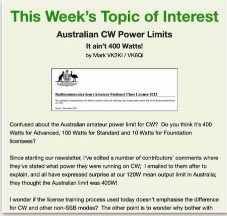
CW Power Limits in Australia – continued May the power be with you – it’s all about time. by lan VK7TA
Last week in RagChew edition 49/2025, Mark wrote about Australian permitted power levels for CW. This has never been a practical issue for me as I have never had a radio capable of more than 100W PEP, but I did once think about this. I’ve attached some notes.
Mark recently reminded us that in Australia, Advan to 120W mean power, and not 400W PEP when using Morse Code. We usually say that we are using CW, and this is what the knob on the radio says when sending Morse code, but when discussing power I think it important that we distinguish between a continuous wave and a wave with on-off modulation (the ITU differentiates between the two).
Mark ponders what interval the average is taken over. Our licence conditions (as best I recall) actually refer to pX and pY; PEP and mean power respectively.
These terms are defined by the ITU. I quote: “Mean power (of a radio transmitter); the average power supplied to the antenna transmission line by a transmitter during an interval of time sufficiently long compared with the lowest frequency encountered in the modulation taken under normal operating conditions”.
Under normal operating conditions Morse Code has a duty cycle of around
Morse Code has a duty cycle of around 50% (or more like 42% if you use the standard word ‘PARIS’). So I would say that the ITU definitions are pretty clear, and when pY = 120 then pX = 250.
So fora continuous series of dits, pX = 120/0.5 = 240 W; for ‘PARIS’ pX = 120/0.42 =286 W. One could argue that on a Tuesday night we might be using Farnsworth spacing, and so the allowed pX could be a bit higher!
So I would unashamedly use 250 W at key-down, and announce that I was doing so, if I had a radio capable of such power. Now I wonder if any of you have come across the YouTube video of a Morse Code QSO where the operator is whistling into his microphone rather than using a key?
Perhaps I usually send Morse by singing a fixed pitch into the microphone; could you tell? The knob on my radio would say LSB/USB and I am using my voice, so am I allowed 400W PEP?
| know that there are conflicting statements about the relation between pX and pY for CW/telegraphy, including some from the WIA and RSGB. So I’m keen to hear of thoughts from readers.
Maybe I should show my commitment to my interpretation and buy myself a 200W radio for Xmas? 73 de lan VK7TA. [Thanks lan. At last, I now have some guidance about how to interpret our license conditions; thank you for filling in some of the blanks.
WIA members may have seen the article in the latest AR Magazine by Dr George Galanis VK3EIP about RF exposure limits (RF Exposure Limits – Is this another Hall of Doom?
Amateur Radio Vol 93 No 6) which notes the lack of useful details in the ACMA EMR Exposure Calculator; I suspect the same applies to our power limits – from my reading, there appears to be no reference to the reason that the regulator specified the limits or how the limits were to be measured (note, practical measurement of SSB Peak Envelope Power using the two-tone method is covered in amateur radio texts such as the ARRL Handbook, but not-so mean power as far as I know).
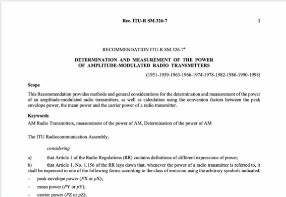
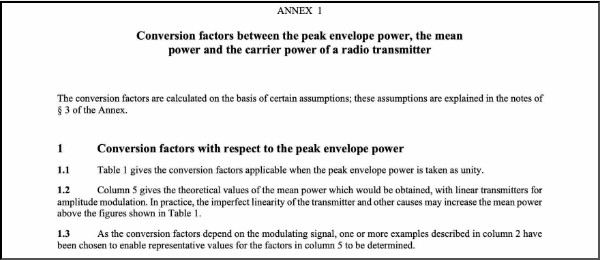
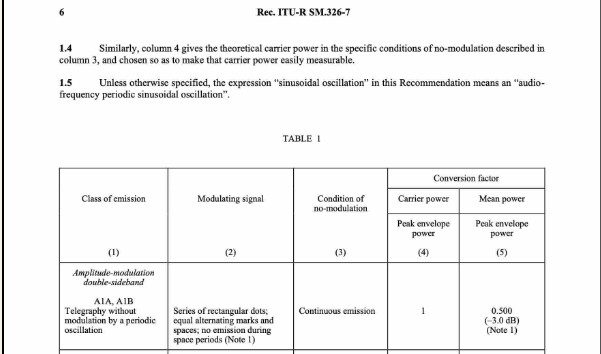
For reference, the International Telecommunication Union (now known as the United Nations specialised agency for digital technologies) document for radio frequency power measurement is RECOMMENDATION ITU-R SM.326-7 Determination and Measurement of the Power of Amplitude-Modulated Radio Transmitters (click on lan’s article above to open the document).
Lan refers to the mean power of a 50% duty cycle CW transmission, as well as the mean for the standard ‘PARIS’ transmission.
For future reference if challenged on air or when the ACMA visits (well you never know), the relevant part of the Annex to the ITU reference document is below.
And if you check the Note 1 to the Annex:

So that changes lan’s calculations slightly – the pX (PEP) to produced by a pY (mean power) of 120W would I think be 120/(0.5×0.98) = 245 Watts (rather than the ‘PARIS’ calculation of 286W).
For Standard licences, pX of 30/(0.5×0.98) = 61W is a pY of 30W, and for Foundation licenses, the limit remains 10W PEP.
Of course, as lan also points out, for Farnsworth transmissions that we commonly use on the CQQRS net, the equivalent PEP would be higher still – but I’m not sure that the legendary RI knocking on your door (or the person you’re telling about your mean power) would be convinced!
So as lan said, Australian Advanced license holders could probably use 245W PEP transmitters (Standard licensees could use 61W PEP and Foundation members use 10W PEP transmitters) and would be justified in reporting our pY or mean output power as 120W; Standard licensees could report 30W mean, and for Foundation, 10W PEP.
Higher power amplifiers could of course be used with their ALC wound back (or a simple battery and potentiometer switched-in to apply a negative voltage to the ALC input), and for Standard licensees, 100W PEP transmitters with the carrier level wound back would be fine; not sure how the correct output power setting would be determined for pY = 30W though…
Good thing I’m not a Standard licensee… too hard for me – Hil! However, the from last week, the implication from the UK OFCOM RSGB suggests that Of course, these are just my interpretation – license holders are responsible for transmitting with no more than their allowed mean power (PEP for Foundation).
Thank you lan – terrific article that will I think lead to some interesting discussions on air and at various club meetings – and hopefully some comments from the team in future RagChews. Yes please – an IC-7760 would be a nice Xmas present!
If you have an article or two that you think might be of interest to our readers, please let me know so we can share more thoughts and ideas; for guidance on writing for RagChew, see Articles below. Please email material to Mark VK2KI: cqqrsnet@gmail.com

What’s going on on your workbench? If you have an article or two that you think might be of interest to our readers, please let Mark VK2KI know; email to cqqrsnet@gmail.com For guidance on writing for RagChew, see Articles below.
QRZ?
Our latest American team member, Jeff WB2GDZ from Seminole Florida.
Thanks for letting me join the CQQRS group. I’ve been licensed since 1969 and would love to help out any newbies on CW at a slow speed. I am up each morning about 4am so would have the time to join the net each Tuesday.
Please add me to the CQQRS WhatsApp group as well. By the way, I do want to mention that there is more regular CW activity over here in the USA compared to Australia.
Yes, some of these regulars are seasoned operators but others are going at slow speeds as well. I would encourage members in your group to try out the KiwiSDRs and WebSDRs just to listen even in Europe as well.
I do it a lot and am familiar with a number of the regulars on CW.
| would also encourage your members to try out RemoteHams as well. If they can get owner permission, there are a number of them on the air here. Eric, KF4LZA is a really nice guy and has several RemoteHams stations set up on the east coast of Florida which |
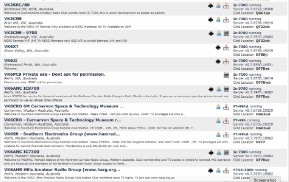
Use. I believe that he has at least one of these remotes set up to allow using a real Morse key/keyer in addition to keyboard sending.
If one of your members got on, I could chat on CW with them, say on 40 meters during the day using my own IC- 7300 while they are on the remote on the other coast (distance about 120 miles); my wife and I are both retired and have plenty of free time.
There are also some powerful RemoteHams stations on the ait. I use the W8RJ remote in Michigan; Roger has appreciated that I have pointed out some bugs in the RemoteHams software and he was able to get them corrected.
Roger has his station on the air in RemoteHams for 160 to 10 meters – it puts out a great signal. It is a K4 with KPA1500 amp putting out 900 watts all of the time (except 30 meters).
Here’s some useful SDR and RemoteHams links that the team might like to explore: http://rx.linkfanel.net/ By the way, Mark, I would keep internet CW in mind as well.
No, it is not ‘real radio’ but on the other hand I see nothing wrong with separating CW and HF radio into separate categories. I do FT8 sometimes for the HF part and see nothing wrong with that.
Anything that is fun in ham radio and can be a learning experience as well is ok in my book. Rigid thinking as to what ham radio should be will contribute to its demise.
Https://hs50.hamsphere.com/ I am glad to see that Australia has taken the lead in trying to regulate social media with the kids. I think that social media has gotten out of hand.
I am embarrassed as an American that we have our tech companies just do whatever they want to for the sake of profits even if it hurts our kids and even all of us.
I think that it has also contributed to a lot of the political/populist problems going on here and around the world. I dislike it when companies profit off of people without regard to the damage they are causing; our medical system is out of control as well.
Anyway, I will stop the rant lol. Jeff Pohl (WB2GDZ) [Thanks Jeff, and welcome. Yup – I agree with your sentiments about rigid thinking; when I passed my amateur license test in the early 70s, one of the reasons that I hated CW (and vowed to never ever use it on air!) was the attitude of many of the CW operators at the time; had they been less discouraging toward newcomers, things may have been different.
However, as I hope you’ll discover, the CQQRS net isn’t like that (see our website if you’re interested in our principles and doctrine).
Terrific to hear that you were on air early on Tuesday morning for our net last week using the VK6SR Southern Electronics Group RemoteHams station at Jandakot (I use it often myself; several WA listeners enjoyed your QRQ QSO with Phil VK6GX.
And by the way, that Remote is set up for manual or paddle keying as well; so with a simple USB to Serial adapter, you could really have some fun! I use a straight key on the Remote – hoy if you need more information.]
QRZ? Who’s on the other end?
From your editor Mark VK2KI / VK6QI Key (ha!) to the success of our net is helping to make it a get-together that people enjoy returning to each week. So I’m really keen to share the backgrounds of some of our team members, just as Jeff has – it’s really nice to know who’s on the other end of the QSO. So, would you be willing to share some thoughts about yourself? Please let Mark VK2KI know: cqgrsnet@gmail.com For further guidance on writing for RagChew, see Articles below.
Head Copy Practice
Anyone who is just starting out with head copy should look at edition 23 ~ 2025 where we first started with Winnie the Pooh recorded at 12 wpm.
In edition 23, and for a few following Newsletters, there are instructions on how to use these files, and edition 25 – 2025 has information on the Ditto CW : Morse Player app. See the website for the back-issues.
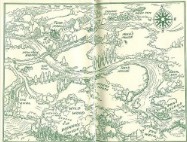
This week we have Wind in the Willows Chapter 11 – Like Summer Tempests Came His Tears. Itis suggested that you read the text file before listening to the audio file. That will make it easier to follow the audio file and prepare you for any unusual words.
The MP3 files have been recorded at 16 wpm and 650 Hz tone. If you prefer a slower speed or different tone, you can create your own MP3 files by converting the text file included in last week’s Newsletter with the Ebook2CW app — https://fkurz.net/ham/ebook2cw.htm|.
Because of MallChimp’s size limits, I’ve split Chapter 11 into five parts, and all five parts are attached below. Each part is over 1 hour playing time @ 16 wpm.
Uncommon punctuation has been removed (the Ditto CW app doesn’t recognise some of it), and contractions have been simplified (for example, we’ll becomes we will). This week’s attachments are: * Chapter 11 parts 1, 2, 3, 4 and 5 MP3 files * Chapter 11 text file


You can either play the MP3 files in any media player, or load the text file in last week’s Newsletter into the Ditto CW: Morse Player app — https://dittocw.andro.io/. Both options work well, however Ditto CW gives you complete control over all Morse settings, while a normal media player only allows changes to playback speed, and does that in steps (e.g. +1.25x, 1.5x, 1.75x).
Other News
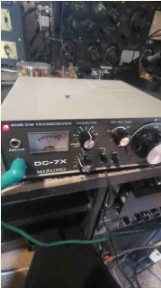
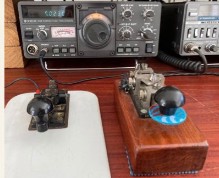
Jordan VK3ACU’s so-called “drifty delight” in action. Click on the image to show the short video.
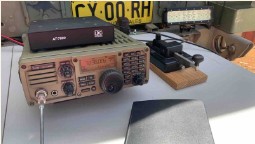
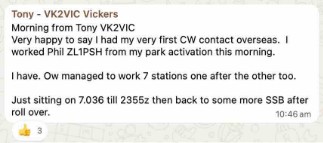
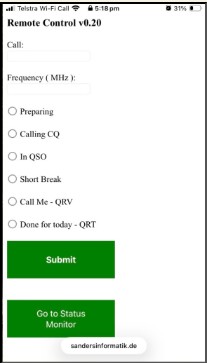
DXperiment Status Monitor
From Mike DL3YZ Hi Mark, I have revised the remote control for the status monitor, and also changed the filename logic somewhat to still save me from programming login management.
We could widen up the access for some more runners on 40 m or 80 m, so we’d have more testers to see if the idea is appreciated and get some feedback, before I put a lot of
Time and work in it…. I think up to 30 should be easily possible in the current beta version. If some members would like to test, send me their call and name and I will send personalised links (or tell them they can mail me directly).
To register, send an email to cqqrsnet@gmail.com 73 Mike.
Dit-dit
Hi Mark, I’ve been thinking about the dit dit thing which has grown
During the time I’ve been using CW. In the 60s, you never heard it, through to the 90s when it became used by a few ops, then today it is used even in text messages for some unknown reason. And some ops keep sending EE as long as you do.
You said at the end of the recent newsletter “Dit-dit (which translates roughly to ‘thank you and wishing you strong ionospheres and low noise’)”. Now this will be a shock but it never meant that when it was first used.
It was simply a final acknowledgment of the end of the contact and was sent only by the other station after you sent 73 GL DX UT, he would reply dit dit to acknowledge receipt of those last words.
In fact it was probably a bit of code borrowed from cadence of the old song; “Shave and a haircut Two bits”. Which was often the ending of a dance number by some bands, in music not words. The “two bits” correspond to the EE – obviously.
Ihave heard some operators actually send “dit didit dit dit” (op 1) to which the reply is “dit dit” (from op2). They knew the song. ‘So when I hear someone send at the end of an over “73 GL DX TU EE” ask myself why is he acknowledging himself.
He is acknowledging the acknowledgement. Or trying the end the contact more speedily. I now studiously avoid sending EE unless there is something to acknowledge. Hearing two stations ending a QSO with EE which is answered by EE, which is acknowledged with EE…
Etc. just drives me nuts. 73 Andrew VK1DA
Morse Training Net
Our team member Nic VK7WW runs an on-air Slow Morse training net every Wednesday at 7pm EDST on 3580 for 30 mins. He uses the callsign of the Northern Tasmania Amateur Radio Club VK7TAZ on that net.
Many of our team learned Morse code with the support of Nic, and the weekly training session comes highly recommended for anyone who wants to learn the Code, or simply brush up.
Everyone’s welcome – 3580KHZ at 7pm Eastern time every Wednesday; you’ll hear lots of the CQQRS team on that net. Jordan VK3ACU has recorded the complete set of lessons which you can now find here:
Https://www. youtube.com/playlist?list=PLHsQmZz6fBXO7swAfbT mutrbbEL17fUQL Contact Nic VK7WW for more info nicholaschantler@hotmail.com including how to join the NTARC DISCORD group to follow the action, or just come along and join in on Wednesdays.
Settle to Carlisle Railway Challenge — Results
From Stan ZL3TK Who had heard of Armathwaite before STC? Visiting this north-western English village attests to a fundamental difference between a standard most-contacts based contest which so many shun, and an academic challenge with far wider implications and real educational value.
And so we have the foundation premise of ‘Morse with a Purpose’.
Settle to Carlisle Railway Challenge — Results
Each week for ten weeks, one Morse sound file was released which carried five compound questions about a particular region along Britain’s most scenic railway.
Research was required to find answers about villages, features and history of the English countryside surrounding railway stations along the 73 mile route.
The consistency with which entrants tackled this Challenge was quite remarkable, considering none of them were aware they’d let themselves in for researching 119 answers to 50, mostly-compound questions.
The responses from those who chose RF to send their QTCs added a further dimension; they weren’t down-the-road QSOs, they were on average 2 600 km.
Usually taking 15 minutes to complete, one of the final QTCs took 45 minutes during lightning storms in the Tasman Sea. What a wonderful learning experience though, its not often that QSZ needs to be invoked, and still had to be followed up with repeat requests – stolid determination won the day.
We may therefore conclude that the validity of academic performance-oriented contests has been proven. After receiving unsubstantiated criticism about potential bias in my marking of IFC entries, the task for evaluating STC questions was delegated to Ruth ZL4KA.
She reported that depending on the website consulted, a range of answers to the same question was possible, so she adopted a polling system to find the highest probability for correctness, and allowed tolerance where figures were obtained from map measurements.
Arbitrary samples from her decisions were tested for accuracy, none were found wanting. A vote of thanks goes to Ruth for the sterling work she contributed.
The convenience of sound files in both directions was expected to attract both a lot of interest and an increase in first-time entrants, yet it did neither. Only two of the five options for sending answers were used.
It seems 10 bonus points per on-air QTC proved an attractive draw-card. Or could it be (said with tongue-in-cheek), that the benefits accruing from operating in a quasi-military environment requiring the discipline needed for [rudimentary] traffic handling was finally becoming understood, even appreciated?
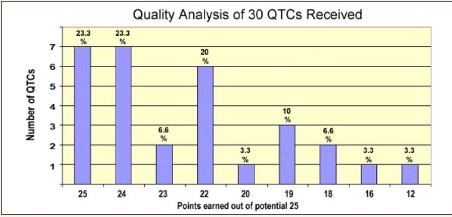
And so to the final scores. By the nature of the beast, scoring had to be somewhat analogue. Fully correct answers to every five (simple or compound) weekly questions had the potential to earn 25 points, making a total of 250 points, with further potential for a grand total of 350 points by successfully passing all ten QTCs on-air.
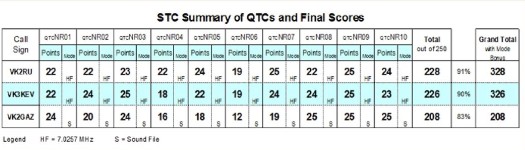
Remember that the entire STC journey was through unfamiliar territory and required careful research to find answers. To end up entirely with ‘A’ Grade marks in a small range must be very satisfying, just look at those percentage passes!
What sets these entrants apart from most other CW operators is the sheer quantity and quality of the work they put in to making STC a success.
Congratulations to all entrants for not only doing a magnificent job, but setting an enviable example of what can be achieved with the right attitude towards ‘Morse with a purpose’. Your ‘Certificates of Achievement’ are in the mail.
[Wow – congratulations Stan and Ruth for this superbly crafted and executed challenge. And well done to John, Kevin and Armin plus the six other participants (and no-doubt, those who participated but didn’t submit reports) – I’m sure that the experience would have been great.]
If you’ve read something that you think might be of interest to our readers, please let me know. For guidance on writing for RagChew, see Articles below. Please email material to Mark VK2KI: cqqrsnet@gmail.com
Or do you have a question or two that are worth sharing? How about a discussion- starter? Please let me know cqqrsnet@gmail.com.]
Prosign/Character/Signal of the Month
[Suggestion – put it on a sticky note near your key as a reminder for Tuesday. Tell us how you went!]
I Hear Tell…
You may recall that our travelling Brit, Nigel G4RWI found himself in New Zealand in November, avec radio gear, mes sans antenna and key!
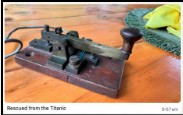
Well the Nelson Amateur Radio Club came to the rescue (thanks to our team member Nev ZL2BNE at Blenheim) with one member from Nelson providing a loan of an end-fed antenna and another finding an ancient straight key (which according to Nigel, may have been rescued from the Titanic).
Asked whether he was enjoying LWOP (life without paddle), his reply was: “That straight key was a malevolent sadist, that would drive even the most abstemious user to hard drink. Put it another way – I didn’t really take to it”.
[If you have some intel about other team members… or even yourself… that’s worth sharing, please let me know cqqrsnet@gmail.com J
Di-dah-di-dah-dit
So back to the CQQRS Slow CW QSO practice net.
Next Tuesday’s Net
Our CQQRS Group will be on as always on Tuesday from around 0600Z until about 12002; see https://bit.ly/CQQRSWebsite and navigate to the Net Details page for details.
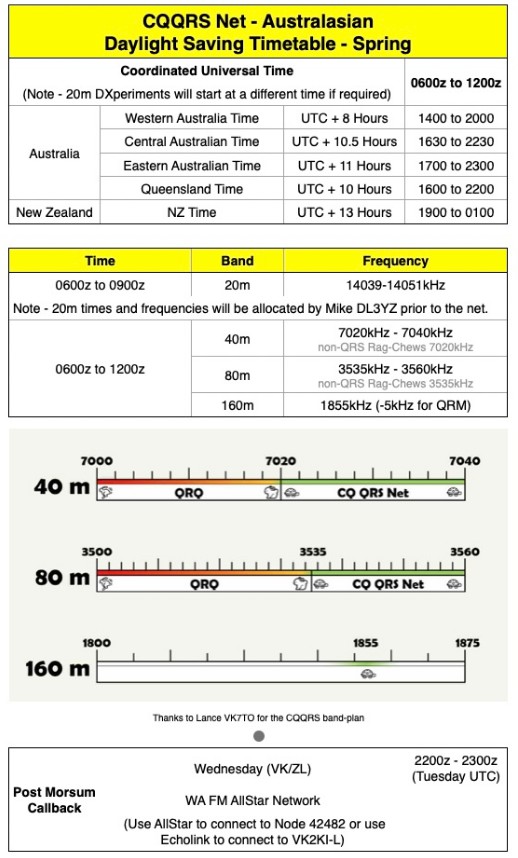
Doesn’t matter whether you’re brand new and want to try just exchanging callsigns and RST reports, or you’re ready for a good old rag chew. We’ll have fun.
There’s usually people around until after 1200Z – so keep calling in the segment of the band designated in the table below until you catch someone.
I should be on as usual from home in NSW or via the Remote at Bedfordale WA, and I’ll also be watching the proceedings using the VK6QS and Tecsun SDRs in WA and NSW respectively. Hope to hear you there.
Reports & Photos
Please let us know via our Reports form bit.ly/CQQRSNET who you work or hear on Tuesday’s Group. The report form closes at lunchtime (Eastern Australian time) on Thursday. ‘And how about helping to make the reports even more interesting by sending a photo?
If you have a photo that you’d be happy to include, please email it to: cgarsnet@gmail.com To make it even easier for our Reports editor Patrick VK2IOW, see if you can reduce the size of the image (to less than 100KB file size by preference).
No problems if your computer or phone can’t do that – just send it through anyway please. And of course, I’m always on the lookout for more photos for the newsletter, so if you have something that might be of interest aside from the reports, please send it through as well – I always enjoy the photos that our readers send – and I’m sure our readers do too.
Email them to cqqrsnet@gmail.com please (reduced size if possible – but whatever you send will be great). Oh and by the way, I recommend that you don’t keep the Reports Form website open between submission of reports from one week to the next.
If you’re unlucky, there’s an undocumented feature in the software that could cause your current week’s report to be combined with your previous report – it’s happened to your editor several times – much to the chagrin of our Reports editor 🙂
Post Morsum
Richard VK6HRC will run our phone Post Morsum on the South West AllStar net (via repeaters and hotspots all over WA) from 0600 WA time, then from 0700 WA time on 80m (8605 LSB).
See https://bit.ly/CQQRSWebsite and navigate to the Net Details page for details of how you can connect via Echolink or even possibly via your local FM repeater.
Articles
The newsletter is interesting to readers because of the material contributed by so many people – be it the reports each week or the various articles. Could you write a short article or articles for RagChew? You bet! Writing not your strong point?
Don’t worry, I’m very happy to help as much or as little as needed. Here’s a thought – although our readers will much prefer your own writing, perhaps have a go at using a Large Language Model Artificial Intelligence tool such as ChatGPT, Microsoft Copilot or Google Gemini to check your writing or even to actually draft the whole article in a relaxed easy-to-read manner!
You can find out more about how to do that on the Newsletter page on our website bit.ly/CQQRSWebsite. Our website also includes a suitable prompt (the command you feed to the Al to make it do what you want).
Please remember though – you must fact-check anything that an Al tool drafts for you because Als ‘hallucinate’ – ie if an Al can’t find what you’re looking for, it will make up an answer and present it as a fact!
This is one of the dangers of using Als ~ it’s quite probable that the tool will create a very readable and convincing draft that is 100% wrong! You as the submitter are responsible for fact-checking.
But it’s a learning experience – please let us know how you went if you had a go with this new generation of tool. And by the way – lam very concerned about our future in a world of Al – but I’m pleased to see that school and university curriculums now focus on understanding the risks – for instance, kids are now learning critical thinking something that used to be taught mostly at post-graduate level.
When the typewriter was invented, people predicted the downfall of handwriting; when the word processor was invented, the art of writing was thought to be on the way out – ditto for the spreadsheet and arithmetic, AM, SSB and FT-8 for amateur radio etc.
We can ignore Al and hope that it just goes away… or we can learn to handle it through experimentation and use. For more guidance on writing for the RagChew newsletter (including help with using an Al), head to our website bit.ly/CQQRSWebsite then click the menu on the top right and then click RagChew Newsletter.
Material
Areminder; if you send me any information by email, our report form or WhatsApp – unless you specifically state that material is not to be published, I’ll assume that you’re happy to see your thoughts in the RagChew newsletter.
teamwork
Thank you so much to our team of 29 contributors: DL3YZ, G4RWI, MONNK, VK2DLF, VK1DA, VK2DA, VK2IOW, VK2KJJ, VK2RU, VK2WP, VK3ACU, VK3DRQ, VK3ECH, VK4EV, VK4PN, VKS5AO, VKSET, VK5FD, VKSKFG, VK6GX, VK6HRC, VK6JDM, VK6KD, VK6KHZ, VK6PZT, VK7JZ, VK7TA, WB2GDZ, ZL3TK and ZL4KA.
And a special thank you to our editorial team, Nigel G4RWI (straight key fan and software untangler), Patrick VK2IOW (image consultant), John VK2RU (quiet campground searcher), Richard VK6HRC (chicken fan) and Lance VK7TO (algorithm architect).
Great work alll UY CW on Tuesday, mb Mark Bosna VK2KI/ VKEQI Beautiful South Bowning NSW ‘eqarsnet@gmail.com non impedit ratione cogitationis


About the CQ QRS Net
For the current schedule and more information about the CQQRS net, please go the the Net Details page on our website:

The opinions expressed in the RagChew newsletter are those of the individual contributors. The opinions do not necessarily reflect that of the editor or of the CQ QRS Group members.
Any material and images received from members by the editor or published on the CQQRS WhatsApp groups may be published in this newsletter unless specifically requested otherwise.
The values, doctrine and guidelines for the Group and for the newsletter are published on the Principles page of the group’s website https://bit.ly/CQQRSWebsite The RagChew newsletter is considered to be exempt from the Australian Government’s ban on social media for under 16 year olds because it is a service that has the primary purpose of enabling users to share information about products or services, engage in professional networking or professional development services or of supporting the education of users per the Australian Government eSafety Commissioner FAQ webpage “Which platforms have been excluded from the age restrictions” dated 10DEC25.