Below is a reconstruction of the 2026 32 CQ QRS RagChew newsletter designed to support full text searching. This reconstruction was built using OCR, and will contain errors.
To view the Mailchimp original, click here. To search the entire newsletter archive, click here.
Contents
- CQ QRS RagChew
- Website
- Reporting
- How it all started for me
- Scotty’s POTA Pack
- Jamie’s QMX Build
- On My Workbench
- Paul’s station on a spotless bench
- QRZ?
- CW Practice
- Other News
- radio domain names available
- CW Activities
- ZL Winter Sprints
- VK1 Winter SOTA Party
- Remembrance Day Contest
- Morse Training Net
- Readable Five
- There’s No Such Thing…
- Prosign/Character/Signal of the Month
- I Hear Tell…
- Di-dah-di-dah-dit
- Next Tuesday’s Net
- Reports & Photos
- Post Morsum
- Articles
- Material
- About the CQ QRS Net
CQ QRS RagChew
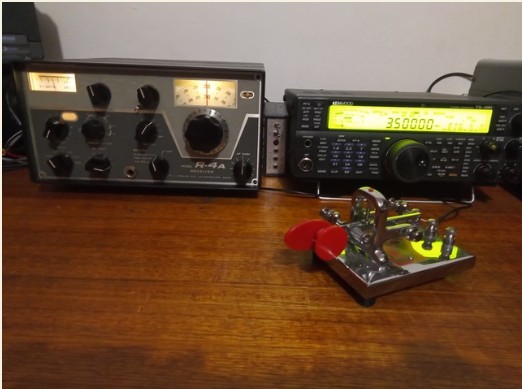
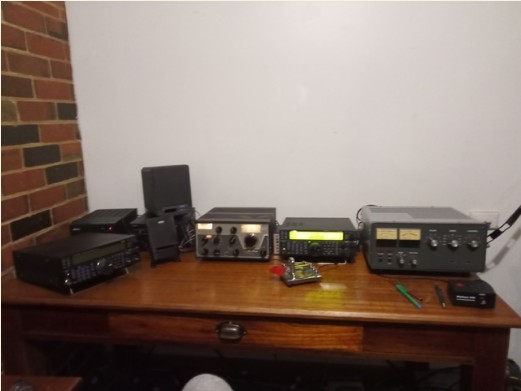
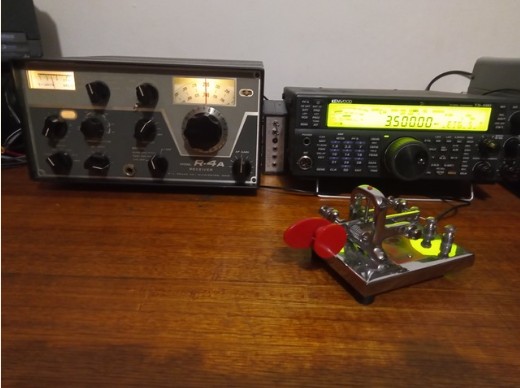
Hanks this week to Paul, VK3LKE for sharing his operating position from last Tuesday night. I’m sure we’ve all tumed a little the same shade of the Kenwood’s display at the sight of the beautiful Drake receiver.
‘Sounds like we had some variable conditions again for this week’s CQQRS Slow CW Practice QSO net – some people heard lots, others struggled – but what always makes me smile is that even for less-than-perfect conditions, most of our players came away with a grin on their faces!
It’s just that kind of community. And speaking of our community, last week Lance commented that he was amazed to see that the previous week’s newsletter had 39 contributors; well last week’s had 49, and this week’s has 35!
Bloody amazing – Imagine how many groups like ours have that many contributors? Not too many I’d suggest. I’m really glad that our family members can treat RagChew as an opportunity to share thoughts with friends – without getting wrapped around the axle.
My procrastinator side (= the dominant side of the brain) has been working on an article about phasing-type noise cancellers for AR Magazine for months now…. yet with our newsletter, things just flow so easily.
‘Among the flow, I see that Carlos CT7BPF at Lisbon in Portugal has shared the view from his side of the net – and that he’s keen to read about what others heard of his 15 Watts.
Great to read that Ross MONNK chatted to Carlos as well – and that there were broad smiles on both sides of the Channel as a result.
A thought for Carlos – many people (in both Oceania and Europe) use the fabulous Ironstone Range KiwiSDR (http://sdr:ironstonerange.com:8073/?user=VK6QI%20CQQRS%20Net) as a signal strength reference during the net.
The SDR belongs to our team member Paul VK5PH and is located near Adelaide – kind of middle South of the country – so it won’t tell Carlos how his signal is getting into say VK6 or ZL, but it’s a starting point.
Great to read the reports from people like Jamie VKSIDK who is at the starting end of the CW journey, and Phil VK4BVM who enjoyed using the Ironstone KiwiSDR on his journey of returning to CW after many years.
So it doesn’t matter whether you heard or worked lots, or nothing – I really enjoy reading about it in everyones’ reports.
On a different subject, last week I reported on our mate Max VK6FN, who had come far too close to his last QRT call after an accident on his farm. I spoke to Max on Wednesday this week and I’m very happy to report that he is now on the improve.
Max has had more surgery, and from the sounds of things, the surgeon has had some success. Although Max is still frail, slowly, slowly things are getting better – and it’s going to be a very long rand risky road to recovery, but he told me that he’s planning to “not let the bastards win”.
Max even was able to do a bit of phone-to- microphone chatting on 40m this week, thanks to his mate Lee VK6TY. And with the return to the cheekiness of old, his mates like Donald VK6JDM and so many others around the traps are on notice.
Max has even been given the nod to have his mobile phone in the ward… and he tells me that he’d love to hear from some of his CW mates. So if you have a moment, how about giving him a quick shout – that’s what families do!
And he’s doing pretty well at recalling callsigns already… tricky without a log for the best of us! If you don’t have Max’s number, flash me a note (cqarsnet@gmail.com) and I’ll share it privately with you.
And by the way, Max has repeated the nod for me to write about the details of his condition – recognising that he has so many mates out there who are interested in his welfare. What a great family we have! So, looping back to this week’s RagChew newsletter.
Lance and the team have put together another great read – with a bit of a slant on home-brew, restoration, tinkering with things and getting out into the fresh air etc.
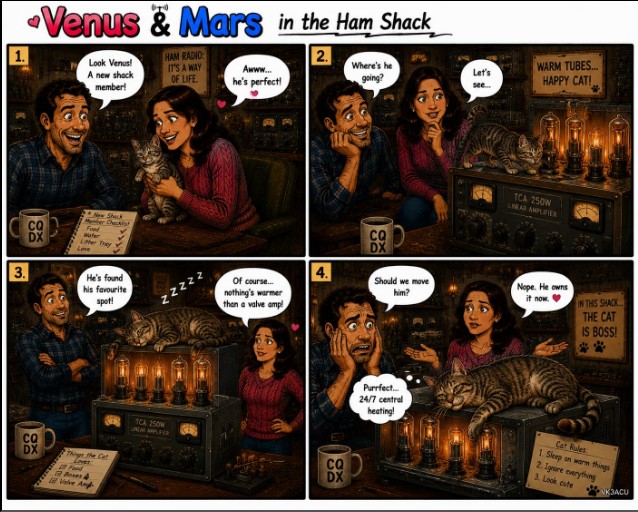
I really hope that you can make to time to sit back and enjoy what they have put together from our members’ contributions for you this week…. don’t stop until you get to this week’s Venus and Mars from Jordan. |’m off to so some work on George – woo hoo!
Website
Lance Mark Bosma Patrick VK7TO VK2KI / VK6QI VK2IOW Margate TAS Beautiful South Bowning Milthorpe NSW Editor NSW Assistant Editor cqqrsnet@gmail.com CQQRS Convenor cqqrsnet@gmail.com John Nigel Richard VK2RU G4RWI VK6HRG on a track somewhere our other grey nomad Padbury WA Assistant Editor Assistant Editor Assistant Editor Jordan Ross VK3ACU MONNK
Nith thanks to Nigel G4RWI’s clever software, and John VK2RU’s clever spreadsheet work, here’s the 55 stations heard by 38 members of our team on Tuesday:
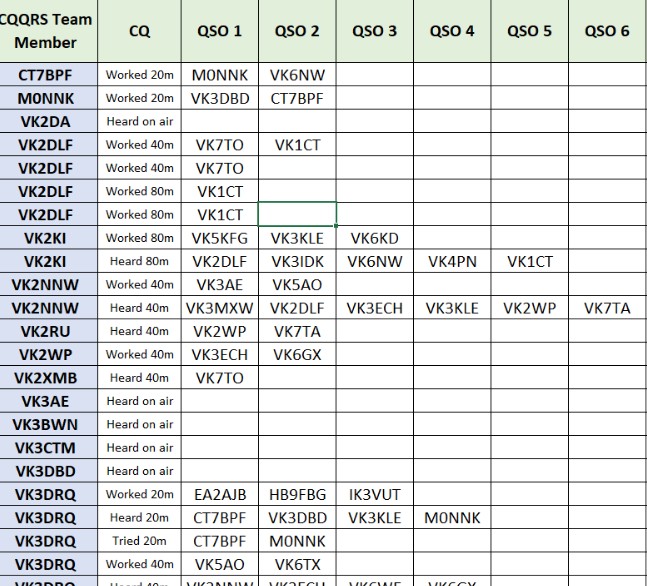
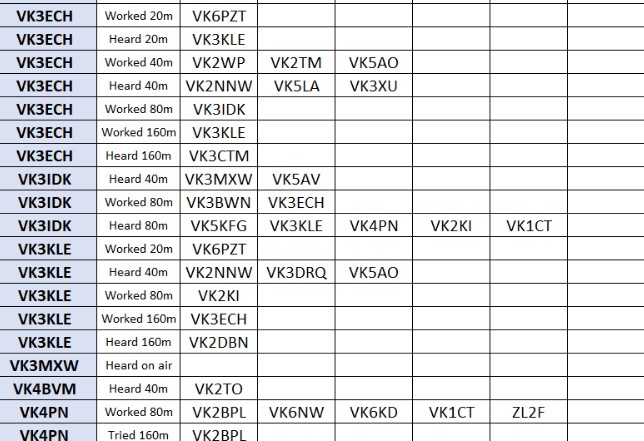
John’s spreadsheet above shows the known stations heard or worked on last Tuesday’s CQQRS Net (reported via our webform bit.ly/CQQRSNET ); the comments in the team members’ reports follow.
The comments were compiled for us by the clever software built by Nigel G4RWI and the layout was perfected by Patrick VK2IOW. Thanks again to Nigel, Patrick and John for the work, and to every team member who submitted a report –
[20m] It was a morning of frustratingly weak signals – strong enough to know there was someone there; not quite strong enough to make out their callsign.
The two exceptions were David VK3DBD (I gave him RST 539; he gave me 549 but “very auroral”), and Carlos CT7BPF who called me just before I was about to give up. Carlos has nice slow well-crafted Morse whi a high. A big “thank you” to both of you.
[40m] My evening started with George VK2DLF (holder of the most musical of callsigns) and I recalling how in the past, knowing the phone numbers of family and friends as entirely normal, but now struggle to remember operator’s names without our logs.
Next were two new stations |’d not worked
Next were two new stations I’d not worked before. VK3MXW was calling at a lovely leisurely 10 wpm. Unfortunately, after exchanging reports the circuit deteriorated such that I lost them altogether. Hopefully we can hook up again next week and exchange names.
The evening ended with another QSO unable to last beyond the first over due to QSB/QRN. Nonetheless Paul, VKSPH and I got to work each other for the first time.
I popped down to 80 m, but despite the RBN showing fairly strong reports to the mainland, there was very strong static crashes and general QRN which may have turned others away.
I also moved up to 30 m where the band was in much better condition, but no one found my CQ calls. I know we’re meant to be gnashing our teeth with the decline of the solar cycle, but I’m looking forward to much quieter conditions on the low bands.
[40m] Lots of QSB and small amounts of QRM were affecting CW operations at this end on 40m.
[40m] The band was very noisy in my QTH and there was a lot of QSB as well. I listened to VA3MXW work a couple of stations and then tried to work him but his signal faded to nothing, I am unsure if I was heard responding to his call.
[80m] 20m caoamead a int clearer than 40m tonioaht hit there
• r et re ee el re at rt et? Set ree Dont Soe elt al ie OE a at was still the odd lightning crash. As only my second night of panttaiection in this group, I am not sure I received everything that was sent to me but I had a lot of fun anyway.
The QSO I had with VK3BWN was great except for the fact that for most of the QSO I thought I was chatting with VK3BRN, thankfully that was sorted out before we went our separate ways. Thank you all for a fun evening.
[80m] A nice chat with Mark in between the static crashes. Mark thought I must have been jesting when I asked if he had finished QMX kit. Apparently, to my surprise, it is still in its postal package! He did explain, though, that has been off doing other
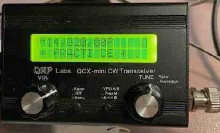
Sensible things such as putting lights in the shed and installing an irrigation system for the veggie patch (with 12 solenoids). It must be a big veggie patch.
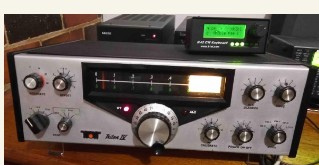
[40m] I started in the shack a bit late at around 1800HRS WST and had a quick check of 20m. There weren’t any stations which stood out so quickly moved to 40m and 80m to hear where all the action was happening.
40m had very little activity from the CW QRS gro running at QRQ pace but were too fast for me to YHOONN was calling CQ relatively slowly so I tri
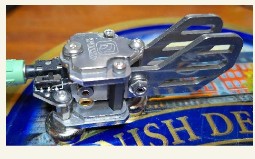
“SUT Naa Very WUE ACUVITY TOM) Ine UV¥ Wino Group. IMere Were OWN? StavOns Neal running at QRQ pace but were too fast for me to decode. Indonesian station YHOONN was calling CQ relatively slowly so I tried a response.
I don’t they could hear my signal so it did not result in a QSO there.
[80m] 80m seem to have all the activity last night. While I experienced QRN and QSB similar to last week, signals appear to be just making it through so they could be decoded. This resulted in 2 successful QSOs. One with Mark VK2KI and another with Sava VK4PN.
Pleased to report no SDR receivers were utilised or harmed during the making of the said QSOs, hi hi. 73 to all.
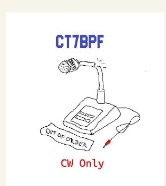
[20m] Hello everyone, It’s very interesting to know that my signal can travel over 16,000 km and still be recognizable. I had the pleasure of having a QSO with OM VK6NW.
[20m] Hello everyone, It’s very interesting to know that my signal can travel over 16,000 km and still be recognizable. I had the pleasure of having a QSO with OM VK6NW.
My rig is a simple Xiegu G90 running only 15W, my antennz > 20m band and a 1:49 unun on one end, it’s an EFHW. antenna to the roof was I able to reach Australia. I wasn’t ossible. Thank you Wayne VK6NW for the QSO.
[20m] CTIBRF Hello everyone, It’s very interesting to know that my signal can travel over 16,000 km and still be recognizable. I had the pleasure of having a QSO with OM VK6NW.
CW Only My rig is a simple Xiegu G90 running only 15W, my antenna is just a wire cut for the 20m band and a 1:49 unun on one end, it’s an EFHW. Only after I moved the antenna to the roof was I able to reach Australia. I wasn’t confident it would be possible.
Thank you Wayne VK6NW for the QSO. I also had a QSO with Ross MONNK, thank you, it’s always a pleasure to talk to you. Well, thank you all and until next time!! 73 Carlos CT7BPF Seneresnmneemer ee
Ie i eee ee PS Oe a 8) ee Oe is just a wire cut for the 20m band and a 1:49 unun on one end, it’s an EFHW. Only after I moved the antenna to the roof was I able to reach Australia. I wasn’t confident it would be possible. Thank you Wayne VK6NW for the QSO.
I also had a QSO with Ross MONNK, thank you, it’s always a pleasure to talk to you. Well, thank you all and until next time!! 73 Carlos CT7BPF et are een geen? Serr
[40m] I’m in a motel room in northern NSW listening on the Ironstone Range SDR. ORN is quite high but I can hear several stations and even copied words here and there. The only station call sign that I can confirm is VK2TO.
[40m] Nice to be back on the QRS Net again. Didn’t have a lot of time in the shack. He ance copy initially with Max VK3MXW, but conditions quickly changed and he Q on 40m later in the evening but no
[40m] Lovely to catch Carlos on 20m with his 15w. The auroral scatter noise descended at about 1900HRS WST and made things difficult.
[20m] I tuned around and heard nothing: no cw stations at all. Then F6FJI appeared with a decent signal. Subsequently I heard F6ARC, and we exchanged RST 599 on an otherwise dead band!
I put out a call which did seem to generate responses, but all too low to copy. I could identify one slower call with a 7 in it, so it could have been Carlos? Anyway, I’m sorry to say that I could not pull out a callsign from what! could conv.
[40m] I heard no stations on 40m and so put out a call. I got responses from VK6 and California.
[80m] After a QSO on 40m with VK6KHZ I headed down to 80m hoping to hear him there. Nothing heard. So was the newly-erected 80m antenna no good, or was it the band, or both?
[40m] Very poor conditions. Sorry OM Mike VK6TX , very poor cndx. I hope to hear you agn better.
[80m] I notice on 40 and 80m bands a QRM from SSB and also on 40m it was very QSB.
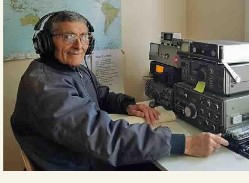
[80m] This week we had one of our team members Martin VK6MJ and his wife Jean visiting; Martin helped kick off the CQQRS net on 80m before becoming lost in his PhD in Education studies. Being their last night with us, we all went out for dinner
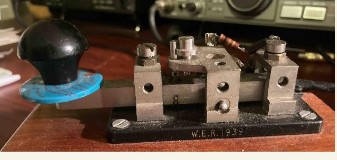
Die UAL did we get to celebrate Martin’s Birthday at breakfast on Wednesday – he also announced that he’d received advice overnight from his PhD supervisor that the American assessors had passed his PhD.
Six years of efforts to determine whether the Amateur Radio on the Intemational Space Station project actually increased the uptake of Science Technology Engineering and Maths in the long-term, were rewarded.
The ARISS program uses amateur radio to allow high school kids to have live question-and-answer sessions with one of the licensed ISS astronauts (for which coincidentally, VK6MJ is one of two Australian ground stations). Quite something to celebrate!
I’m looking forward to the pictures of the funny floppy hat and gown that PhD graduates get to wear; quite the fashion statement in the shopping centres of Mandurah WA I suspect. Me ada rae Rath ca Ih N SN talhh~ hetrar h h coeds fh So back to Tuesday’s net…
I didn’t fire up my trusty Trio TS-120S until we arrived home around 1045Z, by which time I went straight down to our funnest band, 80m.
I hooked up straight away with Greg VKSKFG at Willunga who was calling CQ and rolling in nicely here RSN 582 with SOW from his IC-7300 this time. We had a nice ambling chat for about 40 minutes and after a mandatory comfort stop, I heard Paul VK3KLE calling.
Paul’s nice TS-590SG was RSN 562 to me and another 40 minute amble was enjoyed. To round-out the evening, it was great to have a half decent QSO with David VK6KD at last!
This week, David was RSN 432 – a bit of the normal QSB and a stray drifting SMPS sprog slightly spoiling an otherwise terrific QSO. Great to have a return to conditions good enough for us both to enjoy the chat – hooray!
David and Pauline will be the next of the CQQRS family to visit Beautiful South Bowning in the next month or so. For a mob of people who don’t actually talk to each other, the CQQRS team can be a remarkably sociable lot eh?!
[80m] I am finding it really hard to get on air at a reasonable ‘ time, 11:00 UTC on this occasion. Checked Ironstone SDR which looked busy found the strongest trace and tuned onto it, to my surprise it was ZL2F booming in.
Keying style sounded familiar and while chatting Tony tolc me he chanaed from his old call 7ZL2AGY. We had
Numerous QSOs under that call sign in the past when CW was more common. So it was nice to catch up. The reason for his booming signal was modest 500 W he was running.
There was an interesting signal combination on Ironstone SDR a strong signal working a fairly weak signal (red and pale green), I guessed a southern stations working WA and I was not wrong VK2KI was just finishing with VK6NW.
VK6NW was fairly strong at my QTH, at the noise level at least (my noise level on 80 mis S7 with CW filter on) so I gave Wayne RSN report of 477.
Since 80 m looked busy we did not keep it long and after finishing with Wayne I picked up another weak signal on Ironstone SDR, tuned on frequency and VK1CT was calling CQ. Surprisingly Chris was only 477 at my QTH.
Obviously either the short skip was out or one of our antennas had a null on our bearing. This was our first QSO so I will be looking for Chris next week just to see if his signal is stronger to get the null assumption confirmed.
QSO with Paul VK2BPL was quite interesting. Our first contact by the way. During the rag chew he mentioned he was using TS520 and a long wire of very reasonable length! Since I used the TS520 in the past |
Numerous QSOs under that call sign in the past when CW was more common. So it was nice to catch up. The reason for his booming signal was modest 500 W he was running.
There was an interesting signal combination on Ironstone SDR a strong signal working a fairly weak signal (red and pale green), I guessed a southern stations working WA and I was not wrong VK2KI was just finishing with VK6NW.
VK6NW was fairly strong at my QTH, at the noise level at least (my noise level on 80 m is S7 with CW filter on) so I gave Wayne RSN report of 477.
Since 80 m looked busy we did not keep it long and after finishing with Wayne I picked up another weak signal on Ironstone SDR, tuned on frequency and VK1CT was calling CQ. Surprisingly Chris was only 477 at my QTH.
Obviously either the short skip was out or one of our antennas had a null on our bearing. This was our first QSO so I will be looking for Chris next week just to see if his signal is stronger to get the null assumption confirmed.
QSO with Paul VK2BPL was quite interesting. Our first contact by the way. During the rag chew he mentioned he was using TS520 and a long wire of very reasonable length! Since I used the T$520 in the past I remembered that it is capable of 160 m operation.
I suggested to Paul to QSY to 1825 kHz and he agreed. Last QSO on 80 m was with VK6KD. We had worked before and on this occasion David was the strongest ever (RSN 477) but the QSO was affected (badly) by very strong and persistent QRN!
Not sure where it was from but boy was it strong. [160M] Before finishing our 80 m QSO Paul told me he will need few minutes to tune up. I do not need much to switch to 160 m so I just started calling “test VK4PN” to check my trace at Ironstone SDR.
It was reasonable, solid green. After couple minutes of calling test a new signal appeared and went from pale green to solid red, Paul was tuning up and I could hear his carrier between QRN crashes at my QTH. Promising thus far.
He was at least 478 or 488 at peaks. After he finished calling CQ I responded quite a few times but Paul did not copy. So I am not sure if propagation was one way or he was slightly off frequency with his RIT on.
I was tuned on 1825 kHz and could just detect him at the edge of my CW filter. I had to use RX RIT at my end to pull him in and he came up to S7. After 4 or 5 minutes Paul must have given up as his signal disappeared.
As there was some activity at 1840 kHz (FT8) I stayed on 160 ma bit longer, but couldn’t detect anything before returning to 80 m. It was
VK6KD David VKNW Wayne VK6QI Mark VK6HRC VK6MRB Muligan swl
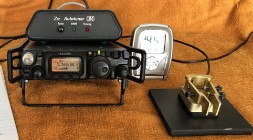
David managed to get into the shack after 18:00 local, scanned 20 m and then 40 m. The real action was on 80 m where he worked VK4PN,VK6AA and finaly VK2KI (no Kiwi sdr help this time !) Wayne worked two on 20 m VK5CUG Clive and CT7BPF Carlos.
( Carlos on his Xiegu G90 ) On 40 m worked VK3XU Drew , Max VK8MXW and Mike VKSAAV, Then on to 80 m to work Sava VK4PN, Mike VK6AAV and Tony ZL2F. Balmy 4.7C in Bridgetown this morning.
Mark was out socialising with visitors Martin VK6MJ and his good wife Jean but did not miss out on the QRS fun by getting on air later in the evening. Worked several stations, one being a sucesful contact with David VK6KD on 80 m eventually.
I worked from home somewhat of a let down after a couple of weeks out at the club, had a couple of contacts and tuned around but was struggling with the noise as reported by others on the Post Morsum still enjoyed myself though.
Thank you to all on last night and this morning. 73 Richard.


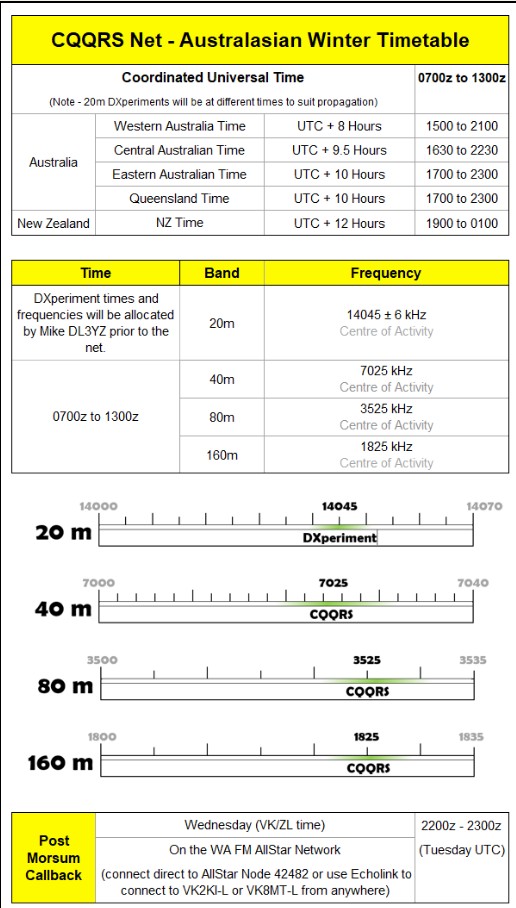
The Post Morsum callback happens the every week between 2200Z – 2300Z on Wednesday morning (Tuesday UTC). You can join via AllStar node 42482, or Echolink on VK2KI-L or VK8MT– L
Reporting
Even if you didn’t hear anyone, we’d still like to know that you had a go. And to make your report more interesting, please consider sending a photo: cqarsnet@gmail.com So, please help attract new and old team members to have a go by submitting your report each week.
Submissions close 1300 (Eastern Australian Summer time)_on Thursdays.
How it all started for me
Long ago, like some 20 years after I was first licensed (with of course required a 12 WPM Morse test to get my licence,) I had been using a straight key only and had in those days progressed from my first QSO on 160M with “Ancient Modulation” and home brew valve gear with local Amateurs ( who were traditionally superbly helpful to a beginner).
It was the time the “Donald Duck Mode” SSB was rapidly coming to be the fashion . Few commercially ready made radios were readily available. Home brew was the norm.
Transceivers were hardly even heard of at least in UK, but it was the time of USA bases still in England and a few Swan and Drake items were about.
I had owned an 1155 receiver for a few years which was the N type- the marine version which covered 160M and the “Fish Fone band always a fascinating listen in the evenings the hear the calls between ships and coast stations and fishing boats plying to and from from Grimsby to the Northern Fishing grounds – Bear Island, North of Norway and Iceland.
All this was on going prior to my thoughts of becoming a radio Amateur myself. Fast forward a few years to the mid 1980S A good friend, Fred, G4VHH a “dyed in the Wool Morseman” who was taught the code ( Forcibly he said….) by his father who had, interestingly been a wireless operator in a Royal Navy Submarine in the early 1920S.
Fred and his two brothers were seemingly been brought up in what sounded to be a Strict Victorian household – with Naval discipline applied. At meal times the three boys had to communicate by Morse dits and dahs (Like ” Pass the salt and pepper”).
Many folk will remember Fred as a outstanding operator on the bands with his simple wire Many including myself had many qsos with Fred lasting over an hour. His wire antennas which came into his upstairs radio shack through a hole in the brick wall…
To several jack sockets, these he could plug in jumpers to configure the two wires in different ways. When we moved to VK in 1999 we had daily qsos on 20m..
This continued for a long while although changed to twice a week QSO and often We were out shopping or traveling somewhere at sked time and I would chat with him from my Mobile. It was seldom we failed. Fred became SK in about 2016.
He mostly used a Paddle key, In England, prior to our move, his enthusiasm and gentle persuasion rubbed off as he worked on everyone on our local bands, to Do More CW!
Frequent chats on almost every band from 160 to 70CC when possible were on going and our regular presence on the bands in the East Lincs area were noted by others, who often joined in. I have memories of some wonderful Old Timers who are no longer with us.
I for one soon doubled my comfortable speed. Ihad never used a Paddle key but I had acquired and used an Eddystone Bug a little (probably not very well), but no one complained!
He had a surplus to requirements Vibroplex Paddle called a Racer I think (that model was available on a square or a triangular base and was tensioned by magnets). All new to me then, but quite a simple key.
I borrowed it for a while and found it quite easy to use, the Squeeze mode seemed to come naturally and it was not long before I was looking at making something similar.
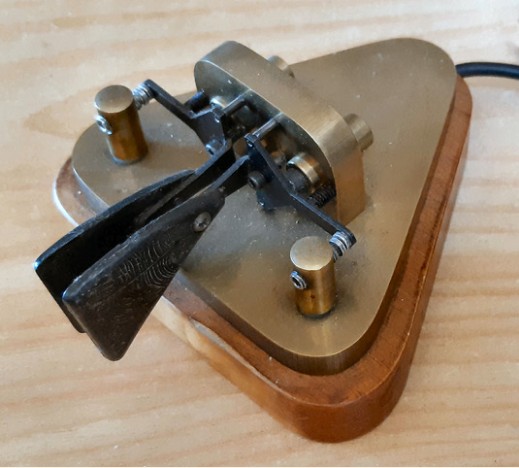
It was the first of several similar from my workshop, all slightly different – due to availability of metal on offer at my local scrapyard. Most went to friends and are probably still in use.
I made a few small improvements on the Vibroplex, I think the Magnets on mine were made with an Adjustable Screw thread instead of the Push/slide.
The pivots I created which allowed the simple and effective rocking motion of the lever arms I made from modified Brass Computer board Stand off posts, Which were easily available.
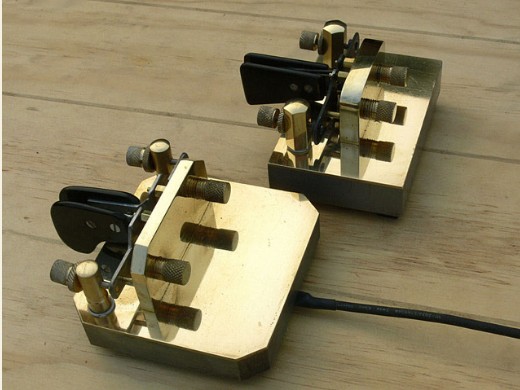
Rather small objects to turn in my quite large lathe, but with care and a magnifying glass, it worked. On the very first of these, I wanted a heavy and nice looking base and I purchased a short length of 1/2 inch thick brass bar about 3 ” x 3.5″, from a Local supplier (in VK) and was pretty shocked at the price.
(since then Brass prices have more than doubled !) That was Number One of it’s kind. I still have that key. Quite a few more were made for various friends mostly built on a chunk of Steel with a Brass plate on top surface, using brass and stainless for other parts
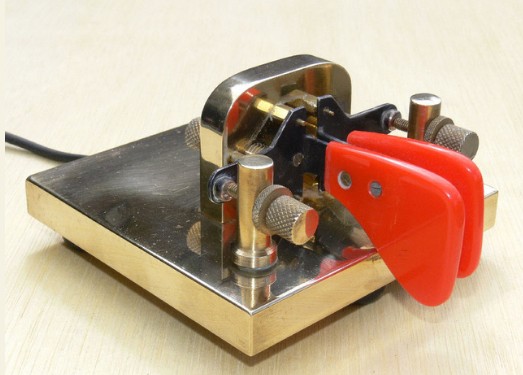
After a period of practice and use (with the Bug) (using my right hand as I am right handed. I found I could not use the Bug key. My muscular memory just would not seem to re learn. The lesson is I should have taught the left hand to use the Paddle…
( most bugs are definitely Right handed- Left handed ones do exist, but very rare indeed) I can in fact manage a paddle with left hand but it requires concentration as well as more practice.
I still use a straight key quite a lot and find it more conducive to the slower speeds, much less than say 18-20 wpm does not seem to work so well on a paddle. It is my opinion that everyone should learn to use a straight key first.
But first step is to receive GOOD Morse at a reasonable speed and get to know the sounds which instantly translate to a letter.
Best not to touch a key until you can do that but everyone is anxious to send before their time – it is human nature and I too did it the wrong way at a very young age of 7 or 8 reading Baden Powell’s book Scouting for Boys where signalling by Morse Code by lamp or, flag wagging and of course semaphore too fascinated me.
Memorising the printed pictures of the A, B, C, etc in dots and dashes was not the ideal with radio… !
Scotty’s POTA Pack
This is an abridged version of a post Scotty from May this year. To read the full article, visit his blog post. I’ve been meaning to write this post since the end of last year – as much for myself as for the handful of others who might see it.
I’ve talked a bit about how much I am enjoying the portable side of Amateur Radio – both POTA and SOTA. I did my first couple of outings with other members from the Brisbane Amateur Radio Club using both their experience but also their gear to get on the air.
I pretty quickly started to put together my own portable kit around my Icom IC-705 and the earlier iterations had too much stuff. Which meant more wreight to carry, and just more bulk.
I aim for an average of a park a week (and hit that in 2025) so I’ve had plenty of time to dial in my setup to what works for me. I don’t think this will ever be completly static – half the fun of Amateur Radio for me is the gear.
However the pack out in this post has been pretty stable now for about 12 months. I’ve got a couple of photos of both (yes that’s right deuce) setups.
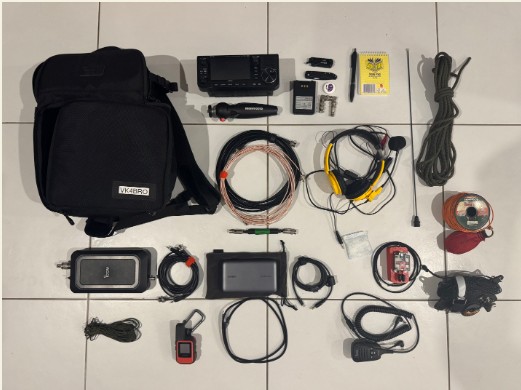
This is my main POTA setup that has hands down done the vast majority of my activations. Drive ups (and operating from my boot), walk ins and some pretty decent hikes!
It hasn’t let me down yet and with a couple of optional extras I’ll cover at the end is likely what I will stick with for a while yet. This setup is built around my Icom IC-705 and ICOM LC-192 back pack that I got with my IC-705.
Most of it is pretty self explanatory. What’s not pictured is my iPhone, I always log using HAM2K Polo. I also have a Haverford 10M squid pole. I tend to use the throwline in a tree if I can – but beaches and some parks have meant the pole is required.
I also have a Helinox Table One Hard Top and Helinox Chair One that I also take depending on where and for how long I am going. I’ve operated from the boot of my car if I can drive in, tables and benches, tree stumps etc.
The chair and table give me a nice platform to setup on and keep me and my gear off the ground and out of the sand etc:
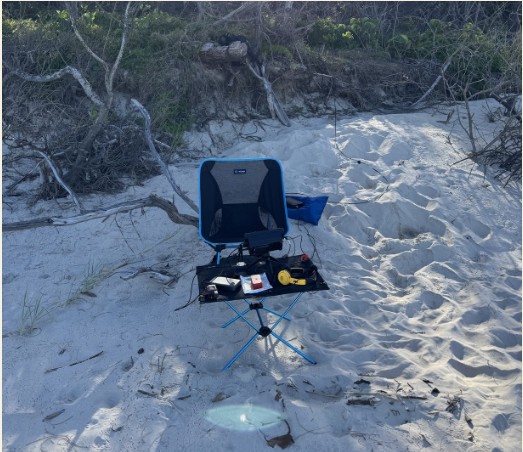
You’ll see above there is no amp in my gear – so all of my portable work has been 5- 10 watts (ie QRP). As for my second portable load out – it’s based around the fact I can now do an ok-ish job of CW – to the point I have done CW only POTA activiations.
With that in mind and wanting something even more portable and to be able to travel with – late last year I bought an Elecraft KH1. While not cheap they are amazing and ultra portable.
The kit below lives in my car and is with me all the time so I can get an activation in whenever between home, work and life in general.
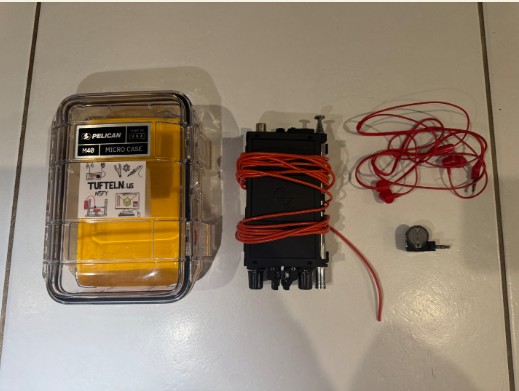
• Elecraft KH1 ¢ I bought the edgewood package with all the bits. I made my own radial from some brighter and easier to handle silicon coated wire ¢ Modified Pelican M40 made by Tufteln ¢ Apair of red JBL buds that have a small right angle 3.5mm adapter so they fit while the case is on and open ¢« Acapacitive touch paddle made by K6ARK These are a little harder to get, but after my inital Elecraft paddle failed in the field on my first activation I wanted a spare/back up.
Elecraft service was amazing and I got a replacement for the failed factory paddle – this second K6ARK paddle is my back up. That’s it – super tiny and water proof in the little modified M40 Pelican case.
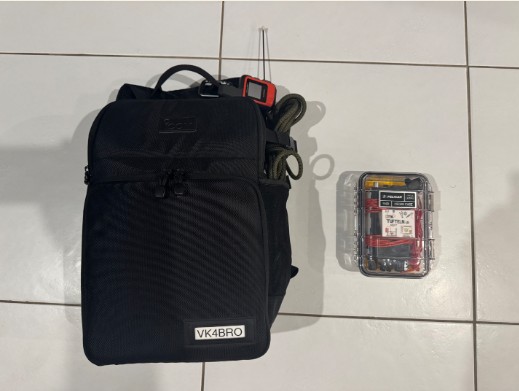
You can see a size comparison below – noting the ICOM LC-192 backpack is actually pretty small too – it just looks big next to the KH1.
Jamie’s QMX Build
To paraphrase a well known band from the 80’s – ‘itis a fine fine line between pleasure and pain, I built a QMX once but would I do it again?” Background lam a relatively new ham radio operator and as such I am still exploring all aspects of the hobby.
One that I have enjoyed is POTA activations and getting out in the wild with my radio. Unfortunately, this has required me to take the equivalent of my full shack with sufficient electrons in storage to power it out into the field.
While I have activated a few parks this way, having all the gear on a small trolley converted from a portable esky is not ideal. The combination of small wheels and heavy gear has limited my activations to near carparks or a limited distance onto beaches.
So I felt that a small portable QRP radio may fit well into my arsenal of radio equipment. Looking around, the logical choice seemed to be the QRP Labs QMX. This small radio promises 5-6 bands in a small portable box with a SW output.
It is also very reasonably priced compared to many simitar POTA and SOTA rigs especially in kit form. Having done some soldering in my earlier life and some more since starting the hobby as well as working on a limited budget, I bought a QMX in kit form.
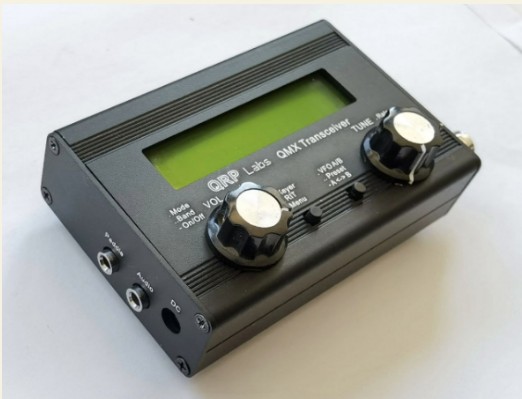
After waiting eagerly for the post to arrive, the kit then sat on my workbench for close to a year while I got the courage up to attempt to make it.
The kit is largely pre-built, most of the components being surface mount devices (SMD) the construction parts left to do are through hole solder of capacitors, diodes and winding and fitting toroid inductors as well as various connectors.
The board is a marvel of construction, to my eye well designed and made to fit together in the perfect way to fit a lot of radio into a small space. The Build When I finally got the courage to embark on the build, it went surprisingly well.
Over a few hours across a couple of weekends I managed to complete it. That said I did have a few issues along the way, the components are very close together in the QMX and even soldering through hole, the holes are very close and I learnt over the course of the build how to rectify solder bridges on many occasions.
The instructions are very detailed and recommend purchasing a jewelers magnifying glass to check solder joints etc.. I followed this recommendation and the magnifier was probably the most used piece of equipment on the bench.
Before too long the QMX was finished (| had reached the end of the instructions anyway) and sitting in its nice case ready for testing.
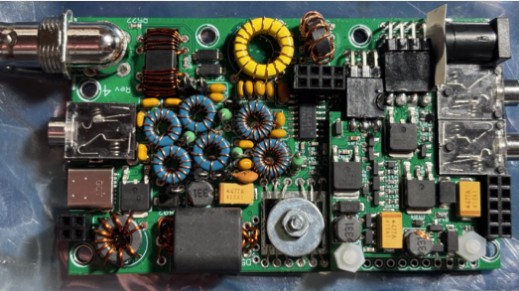
The QMX has a lot of self diagnostic tools onboard and these run both on the small LCD and more practically can be run and viewed on a PC using the program Putty.
My QMX powered up and came to life, was able to be connected to the computer and diagnostics were looking good. Although from the beginning it had an unstable 5v supply, visible in the diagnostic screen.
I connected it to my main shack antenna and on receive it sounded great. The other great thing about QRP Labs is that they have an excellent online forum of people to help you troubleshoot your build and QRP Labs devices generally.
I turned to them for assistance and the first advice is to check your soldering and some of the values for your power lines.
So I reflowed a few solder joints and did some basic voltage testing and could not see anything too obvious as to why it was not working.
However, after the initial troubleshooting, the QMX would no longer come back on, no computer connection, no screen, nothing. Further testing of the now dead QMX showed the 5v SMPS PCB was not working and likely had shorts on two of the transistors.
The shorts meant that the voltage was high on several of the power lines without the ‘power on’ being pressed. Including, crucially I think, the 5v PWM line being exposed to voltages approaching 12v.
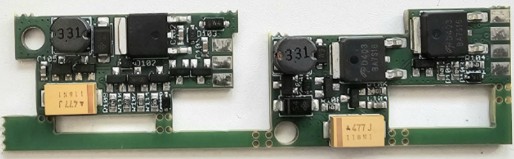
The QMX has two SMPS boards, one for 5v one for 3.3V which connect to the main board. I purchased a couple of new boards from QRP Labs and replaced them but it still did not turn on.
Looking through the schematic I traced a few lines but the 5v PWM line goes directly from the SMPS board to the main processor chip. My issue appeared to be that my 5v PWM line was shorted to ground.
As I had a power line shorted to ground, it was near impossible to trace the cause as every component is now grounded on both sides.
I don’t know what caused the initial failure in the transistor in the SMPS 5v board but I think one transistor was initially dead causing the unstable supply. It was struggling to stay at 5v as it was being pulled to ground.
I think this plus running the initial diagnostics including test transmissions probably put too much current through the already shorted transistor which caused high voltages where they shouldn’t be which caused the shorting of the other transistor and provided a higher voltage/current path through the PWM 5v line which going straight to the main chip, fried the chip to ground internally.
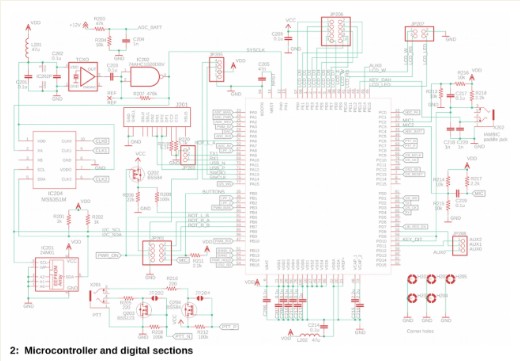
• ees As the chip is likely fried, it can be replaced but despite being above my soldering abilities I would need to source a chip with the bootloader programmed in.
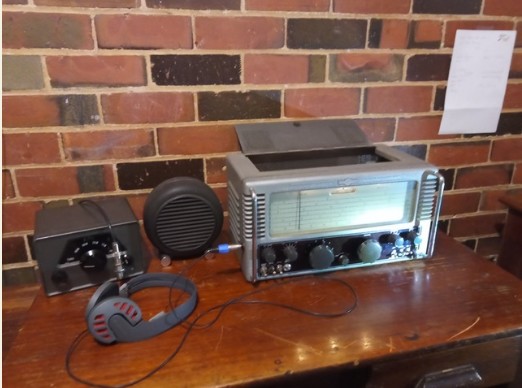
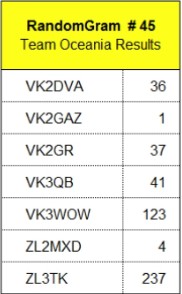
These are not sold publicly, but there is a retired electronics engineer in the USA who has some and does a lot of QMX repair work for cost of parts and a donation plus postage. My QMX While I don’t like the idea that someone else will be finishing my build, the choice of having a small pile of parts that will never work or a working QMX that I have put a lot of time and effort into ultimately meant it got to travel to the USA. I understand the cost of repair should be less than the cost of a new kit. Not only does the small box contain a marvel of QRP radio design, it has given me several hours of soldering fun and many more hours of troubleshooting torment. I now wait for my report from the USA and hopefully the return of a working QMX radio. So given the radio building pleasure weighed against the limited (so far) financial pain, would I do it again? ‘tis a fine fine line and I will wait and see whether America gives me back some QMX pleasure or just more pain. 73. Jamie VK3IDK – Point Cook, VIC If you have an article or two that you think might be of interest to our readers, please let me know so we can share more thoughts and ideas; for guidance on writing for RagChew, see Articles below. Please email material to Mark VK2KI: cqqrsnet@gmail.com Thought i’d show a photo of this week’s ham station bench.ahh clean and tidy fo once!! The drake r4a has previously been worked on by myself. This week it came out of storage and back on the bench. A small amount of deoxit gold G100I fluid was applied to most contact wipers , the pots and earth screws, tube socket screws, basically any point that oxidation may cause problems was retreated. I rebuilt the caps around the noise blanker as it was not performing well. Big improvement afterwards. This was followed by minor check of IF strip and 5.495 MHz osc alighnment. A check with the Marconi sign gen confirmed very gocd sensitivity on all bands. The filter caps all were replaced less than a year ago with a new can cap from heyseed hamfest in USA. They have new parts for most drake can caps. These fit perfectly with no mods to the chassis and look fantastic!! My TS590 SG has a rx out port via drv button , this was connected to the r4a and the small netcurtice interface does the rx mute for the r4a and separate keying for the amp. On long QSO I sometimes use the amp at low drive to keep the final and case of the Kenwood TS590 cool. The second Kenwood ts 590 was this evening’s station monitor, no antenna used. I prefer to hear my actual RF on my sent CW confirming I know what I’m sending to air. In the shack I packed up a few items not been in use for a while. Then setup a nice Eddystone 888A with RME preamp for one of the other benches. It had the 50KC strip alighnment redone using X,Y mode on the cro . Tap for the X axis was the volume pot and the Marconi sign gen provided the Y axis signal. The 888A has a previous added AGC CCT copied from a drake TX4C , same first mixer now too 6EJ7. Sensitivity with the RME DB23 preamp is about .2 mV all bands. Considering it is using the stock 6c4 local oscillator without a buffer it’s really quiet good. It holds equal RF in audio level from about 1mv to 500UV. When there is low band noise the Eddystone sounds a bit like old analogue vinyl with tube amps, that’s before the audio plays. It has a little hiss and the natural whooshing sound of the ionosphere can be heard. Makes for plesant monitoring and is very relaxing. When there is CW, after a long warm up ( 24 hrs) it’s relatively stable Regards Paul Paul VK3KLE – West Victoria What’s going on on your workbench? If you have an article or two that you think might be of interest to our readers, please let us know; email to cqqrsnet@gmail.com For guidance on writing for RagChew, see Articles below. Our net is a fun get-together that people enjoy returning to each week. It’s really nice to know who’s on the other end of the QSO. So, please share some thoughts about yourself to cqqrsnet@gmail.com for a future RagChew. This year we’re using Aesop’s Fables. These are short moral stories, often using talking animals, that illustrate simple truths about human behaviour and character. ‘Aesop’s Fables originated in ancient Greece, traditionally attributed to the storyteller Aesop who is thought to have lived around the 6th century BCE. The fables are generally smaller files of two to three hundred words that have been recorded at 15 wpm and run for about 15 minutes. If 15 wpm is a bit quick for you, load it onto your phone and set the playback speed at 0.75 X or even 0.5 X- whatever works for you. 0.75 X will play the MP8 at a bit under 12 wpm. Itis suggested that you read the text file before listening to the audio file. That will make it easier to follow the audio file and prepare you for any unusual words. Any punctuation that is not usually used with CW has been removed. This week’s fable is ‘The Axe and the Trees‘, and the MP3 and TXT files are attached here: If you prefer a different speed or tone, you can create your own MP3 files by converting the text file with the Ebook2CW app — https://fkurz.net/ham/ebook2cw.html. You can either play the MP3 files in any media player, or load the text file into the Ditto CW: Morse Player app — https://dittocw.andro.io/. Both options work well, however Ditto CW gives you complete control over all Morse settings, while a normal media player only allows changes to playback speed, and does that in steps (e.g. +1.25x, 1.5x, 1.75x). ‘Ey up Lads, pour thee a mug a‘ot reyt gradely Yorkshire Tea, sit down in t’comfortable chair and read about two Amateur Radio activities currently engaged in a torrid symbiotic relationship, where we discover that mutualism is but one of several forms of symbiosis. We can easily stretch that concept to tripartite symbiosis, if one chooses to include oneself in the narrative, which I believe you should. Wot’s he on aba-a-a-art then? Ihear you cry. Well a clue lies in the initials of reyt gradely, which means excellent, fine, better-than-average or flippin’ marvelous, in both Yorks and Lancashire dialects. Yes, Rand G, the same two ubiquitous letters that keep cropping up every time one marvels at the prospects offered from getting personally involved with reyt gradely RandomGram. Overlooked until now, RandomGram in combination with ‘Morse with Purpose’ (MWP), through mutualism becomes significantly more powerful as a Morse skill- building tool. How? Because it’s no longer a blank wall, MWP provides defined, attainable goals! Folks are coming to recognise when those two get together as. symbiotic partners, the result is always going to be reyt gradely. During 29 July’s Post Morsum I mentioned that to validate the inclusion of MWP’s ‘RG 100-points’ badge, it was necessary for me to prove 100 points is not only possible but surpassable … even for us here in ‘outback’ Oceania. No actual scores were given but a slight misinterpretation has resulted in PM’s report stating that 100 points was achieved. Well, yes it was, not just once but twice, and the accompanying table goes on to show how three others got within easy reach of part-qualifying for a 50-pointer badge. Is that not powerful enough encouragement to engage any who doubt their ability? RandomGram’s creator and manager, Drew AF2Z, has made it clear that RG focuses on accuracy, it doesn’t matter how one intercepts the code groups. Even RF-mute SWLs can earn one point for each correctly copied group, the same as transmitting stations. After a few hours listening to Stateside SDRs, you’ll have all the points you need for an MWP badge. Without doubt, you’ll reap handsome rewards in improved Morse skills, catalyst enough for painting yourself into the bigger MWP RG picture. Gird your loins for August’s reyt gradely RandomGram # 46. To receive advance warning get yourself on Drew’s mailing list, register your interest now by email: RG+owner@groups.io in order for your log to be officially validated. 73 de Stan Stan ZL3TK – Waitarere Beach, NZ Hello Fellow CW enthusiasts, This month I’m thrilled to be interviewing Bernd Langer VK2IA. Bernd has many years of experience as a CW operator, successful DXer and contester. Most recently he participated in the World Radiosports Team Contest (WRTC26) in the UK where he and his team-mate Jacky ZL3CW put in a great effort. Live from the National Radio Centre at Bletchley Park Me on Saturday at the National Radio Centre, in a QSO with a Swedish station with a dozen visitors watching. My old mono-tasking brain switches between speech mode and CW mode. You can almost see the steam coming out of my ears! Simon also shared the unexpected (to us muggles) location of the Nimrod’s CW key. Hi All, Maybe along the lines of vanity callsigns, I found what I think is a vanity web- domain… just like there are new gTLDs like “.info” and “.tourism” and “.woodside” which exist alongside the country TLDs (like, “.au” and “.uk” etc.) there’s a top-level domain called “.radio”, so I could, for instance, have https://vk6kv.radio They’re administered by a European collaboration called, dotradio, which sets out to provide domain services for “everything radio, including commercial, broadcast, and amateurs!” at a cost of course. If any of that piques your fancy, check out https://register.radio/ Cheers, Dave VK6KV – Southern River, WA David Broadfoot was the radio officer of the Princ ria car between Scotland and Northern Ireland. When you have some spare time, put your feet up and listen to this recording from the 70s. It’s worth letting it play all the way through for the immersive experience. Such a variety of envelope shaping and keying style. It really demonstrates how ops were easily recognisable by their fist and transmitter. 4b WHILE! OPIN 4, 11, 18, 25 August A simple and fun activity for amateur radio stations to contact as many other amateur radio stations as possible within the 1.5 hour time limit. Each Tuesday in August: 0800-0829 UTC (2000-2029 NZST) CW only 0830-0859 UTC (2030-2059 NZST) SSB only 0900-0929 UTC (2100-2129 NZST) FT4 only For more info, see https://nzart.org.nz/activities/contests/sprints/. WENT PVE! VIPAT aty 9th August It’s time for the annual VK1 Winter SOTA QSO Party. This year we’re proposing Sunday 9 August 2026 as the day to rack up some summit-to-summit contacts with each other, plus the usual chasers. As the day gets closer, please post your planned summit and time as an alert as normal so others can plan to work you Many of the VK1 SOTA activators are active on CW. If you’ve not tried your hand at chasing SOTA or parks on yet, this is a good opportunity. You may want to brush up on the standard CW exchange so that you know what the activators will be expecting. They’re a friendly low and would welcome beginner ops chasing them. LL) AR Sd IT} PJ A et PAN hd NSD VA 16 August. It is one of the most popular international amateur radio events in existence probably because there are very few rules and it is not the usual contest type event. There will be plenty of CW DX available. Listen for stations calling CQ ILLW. For more details, see https://illw.net/. PICS iMINMIi Give May WVIteol 15-16 August. This contest commemorates the Amateurs who died during World War II and is designed to encourage friendly participation and help improve the operating skills of participants. It is held on the weekend closest to the 15TH August, the date on which hostilities ceased in the southwest Pacific area. This is Australia and New Zealand’s most participated in contest of the year, with a growing number of CW participants each year. There are plenty of slower ops, so why not try a mixed mode entry this year and give CW a try. For more details, see https://www.wia.org.au/members/contests/rdcontest/. WIVISS TGHhiiyy INCL Every Wednesday, 19:00 3580 kHz Many of our team learned Morse code with the support of our team member Nic VK7WW, and the weekly training session comes highly recommended for anyone who wants to learn the Code, or simply brush up. Everyone’s welcome – 3580KHZ at 7pm Eastern time every Wednesday; you’ll hear lots of the CQQRS team on that net. Jordan VK3ACU has also recorded the complete set of lessons which you can now find here. Contact Nic VK7WW for more info nicholaschantler@hotmail.com including how to join the Northern Tasmania Amateur Radio Club DISCORD group to follow the action, or just come along to 80m and join-in on Wednesdays. If you’ve read something that you think might be of interest to our readers, please let us know cqqrsnet@gmail.com • I think the first lesson in Teachering 101 is to always tell students “There’s no such…” (I’m sure you know the rest) and “…the only dumb questions are the ones not asked”. John VK2RU reckons that there’s lots of questions out there among both our new and our experienced operators – about CW, amateur radio operating and about theory. What does an aurora affected signal sound like? During the last Net, a very competent op gave me a signal report with the comment “…but sounds very auroral”. That flummoxed me – what does “auroral” sound like? Ross MONNK – Bundleigh Salterton UK Over to you team, let’s hear your preference and the reasons behind it? [Do you have a question or two or a discussion starter worth sharing? cqarsnet@gmail.com if so.]
[Put it on a sticky note near your key as a reminder for Tuesday…. and tell us how you went!]
One of our readers’ daughter was running some school science workshops for young teenagers, and wanting to incorporate some Morse code, found a random snippet online. After having been used in multiple schools over many months, it was only when it was played for our reader that she discovered what it was saying: “No, please don’t touch me… don’t get near me…”. After a nervous chuckle about having presented some dubious material, our dad in question, ever the hero, made an alternative recording instead. Thank goodness Morse code is inaccessible to 99.9 % of the population. [If you have some intel about other team members… or even yourself… that’s worth sharing, please let us know cqqrsnet@gmail.com | So back to the CQQRS Slow CW QSO practice net. Our CQQRS Group will be on as always on Tuesday from around 0600Z until about 12002; see https://bit.ly/CQQRSWebsite and navigate to the Net Details page for details. Doesn’t matter whether you’re brand new and want to try just exchanging callsigns and RST reports, or you’re ready for a good old rag chew. We’ll have fun. There’s usually people around until after 1200Z – so keep calling in the segment of the band designated in the table below until you catch someone. Please let us know via our Reports form bit.ly/CQQRSNET who you work or hear on Tuesday’s Group. The report form closes at 1pm (Eastern Australian time) on Thursday. And how about helping to make the reports even more interesting by sending a photo? If you have a photo that you’d be happy to include, please email it to: cqqrsnet@gmail.com And of course, we’re always on the lookout for more photos for the newsletter, so if you have something that might be of interest aside from the reports, please send it through as well. Email to cqgrsnet@gmail.com please. Oh and by the way, I recommend that you don’t keep the Reports Form website open between submission of reports from one week to the next. If you’re unlucky, there’s an undocumented feature in the software that could cause your current week’s report to be combined with your previous report – it’s happened to your editor several times – much to the chagrin of our Reports editor 🙂 Richard VK6HRC will run our phone Post Morsum on Wednesday mornings on the South West AllStar net (via repeaters and hotspots all over WA) from 0600 WA time, then from 0700 WA time on 80m (3605 LSB). See https://bit.ly/CQQRSWebsite and navigate to the Net Details page for details of how you can connect via Echolink from anywhere in the world. Could you write a short article or articles for RagChew? You bet! Writing not your strong point? Don’t worry, I’m very happy to help as much or as little as needed. Oh, and one more thing (actually two) – copyright material: * please use your own images – don’t use images copied from the internet unless you have the producer’s permission, or they’re marked ‘Creative Commons’ or similar; ¢ if you include other peoples’ written material, unless you have permission, you may only include small snippets (unless it’s marked ‘Creative Commons’ or similar), and you’ll need to site the source and author. For more guidance on writing for the RagChew newsletter (including how you might even try using one of the new Artificial Intelligence tools), head to our website bit.ly/CQQRSWebsite then click the menu on the top right and then click RagChew Newsletter. A reminder; if you send me any information by email, our report form or WhatsApp – unless you specifically state that material is not to be published, I’ll assume that you’re happy to see your thoughts in the RagChew newsletter. Thank you so much to our team of 35 contributors: CT7BPF, MOKBJ, MONNK, VK2DLF, VK2IOW, VK2KI, VK2NNW, VK2WP, VK2XMB, VK3ACU, VK3DBD, VK3DRQ, VK3ECH, VKSIDK, VK3KLE, VK3QB, VK4BRO, VK4BVM, VK4PN, VK5AO, VK5AV, VKSKFG, VK6GX, VK6HRC, VK6KD, VK6KHZ, VK6KV, VK6NW, VK6PZT, VK6QI, VK6TX, VK6WE, VK7TA, VK7TO, and ZL3TK And a special thank you to our editorial team, Nigel G4RWI (head of software development), Patrick VK2IOW (reports coordinator), John VK2RU (spreadsheet manager, Richard VK6HRC (post morsition), Jordan VK3ACU (head gagster) and Ross MONNK (seconded from the Philosophy Department). Great work all! GU CW on Tuesday, Lance VK7TO Margate TAS Editor For the current schedule and more information about the CQQRS net, please go the the Net Details page on our website: The opinions expressed in the RagChew newsletter are those of the individual contributors. The opinions do not necessarily reflect that of the editors or of the CQQRS Group members. Any material and images received from members by the editor or published on the CQQRS WhatsApp groups may be published in this newsletter unless specifically requested otherwise. The RagChew newsletter is considered to be exempt from the Australian Government’s ban on social media for under 16 year olds because it is a service that has the primary purpose of enabling users to share information about products or services, engage in professional networking or professional development services or of supporting the education of users per the Australian Government eSafety Commissioner FAQ webpage “Which platforms have been excluded from the age restrictions” dated 10DEC25. The values, doctrine and guidelines for the Group and for the newsletter are published on the Principles page of the group’s website https://bit.ly/CQQRSWebsiteOn My Workbench
Paul’s station on a spotless bench
QRZ?
CW Practice


Other News
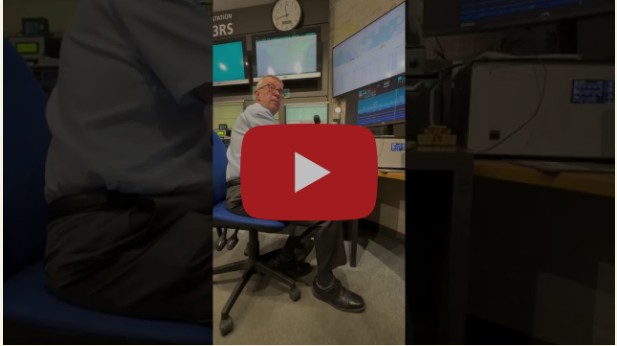
radio domain names available
CW Activities
ZL Winter Sprints
VK1 Winter SOTA Party
Remembrance Day Contest
Morse Training Net
Readable Five
There’s No Such Thing…
Prosign/Character/Signal of the Month
I Hear Tell…
Di-dah-di-dah-dit
Next Tuesday’s Net
Reports & Photos
Post Morsum
Articles
Material
About the CQ QRS Net