Below is a reconstruction of the 2026 31 CQ QRS RagChew newsletter designed to support full text searching. This reconstruction was built using OCR, and will contain errors.
To view the Mailchimp original, click here. To search the entire newsletter archive, click here.
Contents
- CQ QRS RagChew
- Dah-di-dah-di-dah
- Website
- Reporting
- Off Centre Fed Dipole
- (OCFD) antenna
- RAF Flameproof Key
- On My Workbench
- The next version.
- QRZ?
- CW Practice
- Other News
- Prosign/Character/Signal of the Month
- Accepting ADIF files for weekly reports
- Hoddywell SDR offline
- Ross’ mystery key identified – Clansman key
- A comfy chair with the RagChew
- CW Activities
- ZL Winter Sprints
- VK1 Winter SOTA Party
- International Lighthouse Lightship Weekend (ILLW)
- Remembrance Day Contest
- Morse Training Net
- Readable Five
- There’s No Such Thing…
- Exclamation mark
- I Hear Tell…
- Di-dah-di-dah-dit
- Next Tuesday’s Net
- Reports & Photos
- Articles
- Material
- About the CQ QRS Net
CQ QRS RagChew
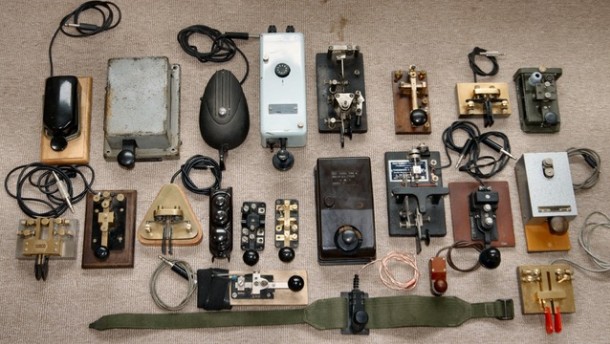
Thanks this week to David VK3DBD for turning us all green with envy with a sample of his key collectior
Dah-di-dah-di-dah
Dan-di-dan-ali-dan Mark VK2KI / VK6QI CQQRS Convenor Hopefully, a fun net was had by all again on Tuesday. For me, it was quality over quantity… I had only three QSOs…. but they were 3/4 to 1 hour doozies!
And in between times, I listened-in on lots of others’ chats, and when I had enough arms and legs available, posted Alerts on our CQQRS WhatsApp Alerts group.
I don’t know about you, but even with QRS, my brain becomes a bit unreliable when I try to listen to my QSO in train (including QSB and QRM), others’ QSOs on the KiwiSDRs, fill out my spreadsheet log, write notes in Apple Notes for my weekly report and post on WhatsApp.
A fun challenge though, and surely this must help maintain a level of cognitive ability as my body gets older?
By the way, to help the process I use the audio from my old Trio TS-120S and two notebook computers; the three audio feeds come into a little mixer – which allows me to adjust the levels easily, but also the main QSO comes out in both ears of my headphones, and the two SDR feeds can be fed separately to my left or right ear via individual balance controls.
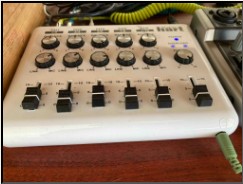
Interesting thing for others to try pethaps? Now to more important matters. I’ve had questions about how our mate Max VK6FN. is going after the accident at his farm.
I reported last time that I’d had a chat with Max by phone at Bunbury hospital, that he was out of ICU and was now happily causing chaos among the normal wards. Max gave me the thumbs-up to keep our readers in the loop too.
So I checked with his brother-in-law Graeme this week – and unfortunately Max is still in the wars. He’s been diagnosed with a tumour in the bladder which surgery was unable to remove – so more work needed, but Max needs to get a lot fitter before this can be done and of course, time is the enemy…
And lying around in hospital rather than exercise doesn’t help! The severe pain in his right knee has been given a name… so his best friends the physiotherapy staff have something to annoy him about. And to top it off…
As seems usual these days, a bacterial infection that, like Max, is special… resistant to the normal treatments. So to keep the load off Graeme a bit, we’ve agreed that I’ll touch base each week for an update for Max’s CW mates via the newsletter.
So back to this week… in this edition Lance has found a nice bunch of things that will be of interest to our reader(s). Our newest team member Jamie VK3IDK over at Point Cook has produced a second article already!
Jamie is another keen antenna- builder, and has sent us a tettific discussion about how the Off Centre Fed Dipole works.
David VK3DBD up at Yackandandah has given us a nice write-up about one of the many keys in his collection, and our Editor Lance has done it again, this time a beautiful looking modification to piggy-back a tiny battery pack to his equally tiny QRP-Labs QMX; nicely done for a guy who works for a living and still manages to find time to edit the newsletter as well!
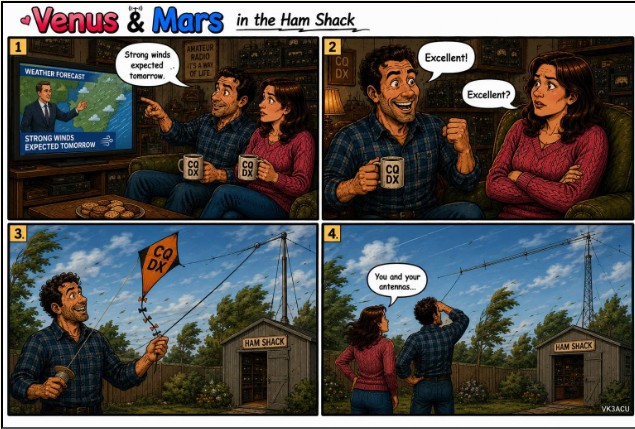
And there’s a bunch more to read. To round it all off, Jordan VK3ACU has once again come up with a laugh for us – another Venus & Mars in the Ham Shack – thanks mate – well done that man!
Finally, it was pleasing to see the feedback from eagle-eyed readers who saw the error in last week’s Prosign of the Month; here was I thinking we had found some obscure new version version! Thanks for the feedback folks. So…. once again, please enjoy!
I know I will when Lance presses send and I get the newsletter for my newest indulgence. relaxing and reading the newsletter from cover to cover. Dit-dit Mark Bosma VK2KI/ VK6QI GQQRS Convenor
Website
If you’d like to find out a bit about our net, or would like to pass information to others about our Tuesday get-togethers, here’s the link to our website. bit.ly/CQQRSWebsite So here we go – on behalf of the CQQRS Editorial team, please enjoy the newsletter.
Lance Mark Bosma Patrick VK7TO VK2KI / VK6QI VK2IOW Margate TAS Beautiful South Bowning Milthorpe NSW Editor NSW Assistant Editor cqqrsnet@gmail.com CQQRS Convenor cqqrsnet@gmail.com John Nigel Richard VK2RU G4RWI VK6HRG on a track somewhere our other grey nomad Padbury WA Assistant Editor Assistant Editor Assistant Editor
Nith thanks to Nigel G4RWI’s clever software, and John VK2RU’s clever spreadsheet vork, here’s the 63 stations heard by 43 members of our team on Tuesday:
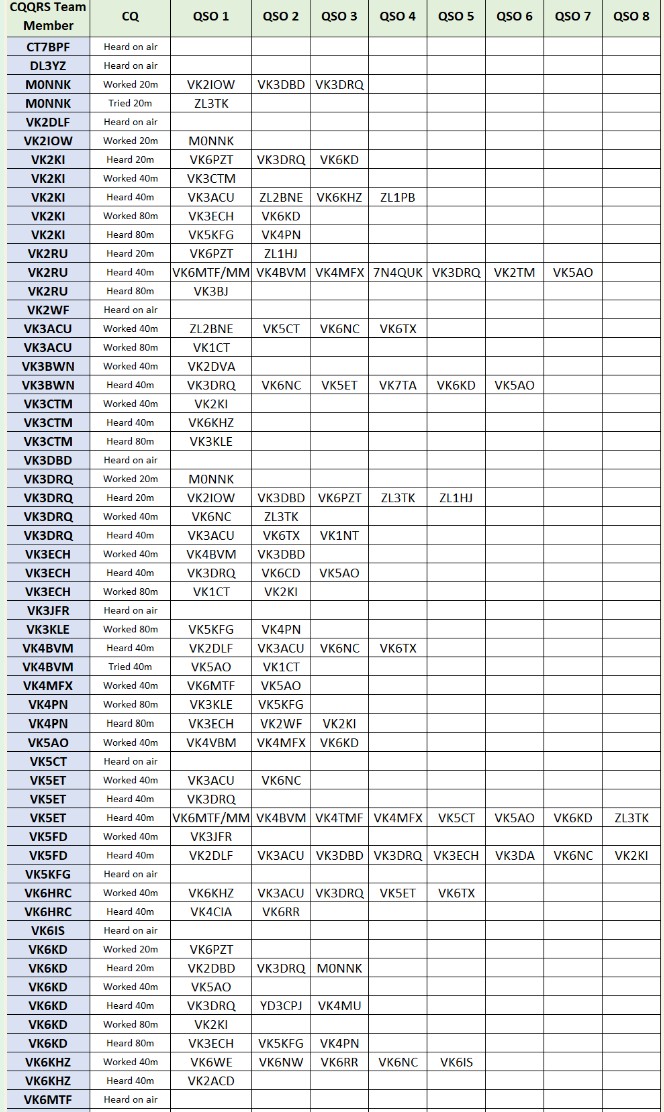
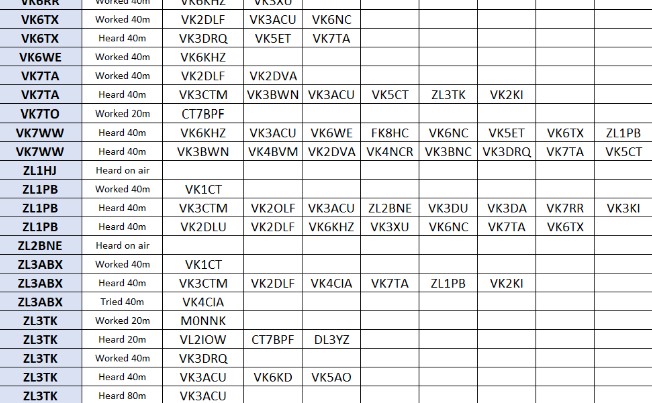
WEE ESS ENE EB ewwe John’s spreadsheet above shows the known stations heard or worked on last Tuesday’s CQQRS Net (reported via our webform bit.ly/CQQRSNET ); the comment in the team members’ reports follow.
The comments were compiled for us by the clever software built by Nigel G4RWI and the layout was perfected by Patrick VK2IOW. Thanks again to Nigel, Patrick and John for the work, and to every team member who submitted a report –
[20m] After several weeks of being out for a duck, it was bonzer to get a few runs on the scoreboard! VK2IOW Pat came booming in (if you call S4 “booming”, which I do); VK3DBD David wasn’t quite as strong (S3); and VK3DRQ Manny started weak and quickly became unreadable.
I then had a quick “local” ¢ Lisbon, Portugal. When we finished I heard son
Became unreadable. I then had a quick “local” chat with CT7BPF Carlos down in Lisbon, Portugal. When we finished I heard some very faint Morse which I think was ZL3TK Stan.
For fun, I gave him RSN 101 because his signal didn’t even register on my S-meter and was unreadable. 10 out of 10 for Perseverance though, Stan. Thank you to all of you – you are Stars!
[80m] Thanks to all on air tonight. I’m perfecting a 40m direct conversion Rx that can now successfully differentiate between two signals 100HZ apart. That’s the first part! More to come….Yay!
[40m] 40M was on fire tonight! Running the QMX made some great contacts. Really good to have a QSO with Nev ZK2BNE with his home brew QRP rig
[80m] Great rag chew with Chris on 80m but no other station
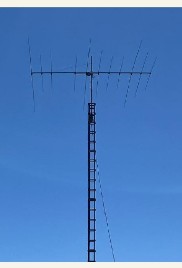
[20m] I managed to get an earlier start at 3:109m WST and could just make out Ross MONNK all the way from UK in QSO on 20m. Not enough clarity with QSB hampering my reception to try a contact. My Hex Beam usually does an OK job.
Those in the know are aware that the antenna is a Ss out to be a 2 element (dog-leg configuration)
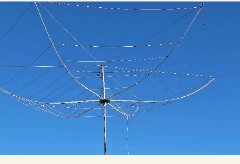
Beam. Perhaps next week will be my time to shine, you never know.
[40m] From comments on the Whatsapp chat group 40m band opened quite well. I could hear lots of activity from the Ironstone SDR but not so legible from my QTH in Ballajura WA. CW activity was heard late into the night from the SA SDR.
I’m starting to wonder if my antenna only works on transmit, hihi. I can hear my signal getting into Ironstone but most stations heard on the SDR couldn’t be heard from my QTH. Lots of natural causes could create this scenario.
Good night of decoding practice, one 40m QSO. Thanks Maitland VK5AO.
[80m] Alittle more activity was heard on 80m last night than previous weeks. The band appeared to open for a short time then drop out. By 9:40pm WST the lower part of the band where we run our CWQRS was totally clear on my waterfall display.
I managed to squeeze a QSO in with Mark VK2KI but with poor propagation, we had cour work cut out for us exchanging RSN signal reports. All good practice and loved the challenge. 73 to all
[20m] Was hearing all the EU DXperiment stations RSN 551 or better on SDR in Cornwall but no sign of them direct at all. Ross gave me RSN 101 direct while I could hear myself on the same SDR 521. Pat VK2IOW wins the chocolate fish with a peak of 581 in
Albeit with ~ 600 ms delay via the Cornish SDR. Congrats to all stations for the lovely well-spaced keying! Stations were found at different times and on different frequencies than those advertised on the LSM, which would be fine had the LSM been kept up to date, but not for the first time its value was diminished by outdated data.
[40m] 40 m oscillated between reasonable and poor, rather like an ocean swell Fantastic that Jordan’s 5 W was the only signal heard on 80 m!
[40m] There was a lot of activity tonight, the greatest number of stations that I’ve heard since becoming a CQQRS member. The first station I heard was Chris VK1CT calling CQ. I answered twice but he didn’t hear me. The last station I heard was Maitl:
Noise level had risen to S7 by this time. I thought that I had missed a letter after the O and was so fixated on that I became unsettled and even made mistakes sending my own call sign.
Later, during the early hours of the morning I realised that there wasn’t a missing character and it was the context separator (= sign) that I was hearing. Sorry Maitland.
The series of V band articles in the Ragchew magazine inspired me to buy an $8 mouse three weeks ago. But I still needed a connecting lead and luck was on my side again in the form of a mangled pair of ear buds just waiting for me to find on the footpath.
Once I had the mouse apart and the lead soldered in place I was soon connected to the practice channel. Now all I need to do is to learn how to use the paddle to send readable code. Last Sunday, I attempted a QSO with the Vband robot.
This was a very frustrating experience, so much so, that I was at the point of throwing the wretched paddle through the window! Fortunately, I heard CQQRS member, Merv VK3ADX, calling on 7025 kHz and I decided to answer.
We managed reasonably well until QSB got the better of us. The following day I had a brief @SO with Rob VK3ECH. Weak signals and a mobile whip aren’t a good combination. [80] Nothing heard, even on the Ironstone Range SDR.
[20m] OM Ross was only heard with the big help of Adelaide SDR VK5ARG where he was 341. CT7BPF OM Carlos, nil was heard from him. Bands were very quiet.
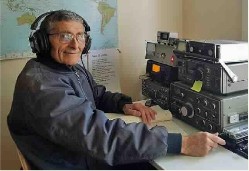
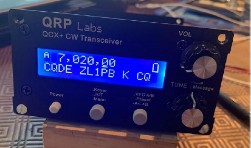
[80m] I was very pleased to work Carlos, CT/7BPF, one of our DX experimenters in Portugal. His signal was very weak, so after an exchange of report, name and QTH, I bade him a triumphant 73.
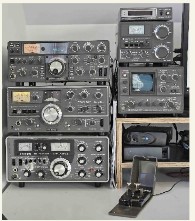
From Mark VK2KI at Beautiful South Bowning N&
[20m] Richard VK6PZT was very weak at the start, but as we got closer to 0800 he came up to RSN 521. David VK6KD was up and down but about RSN 511; I was very surprised to hear them working each-other – Bunbury to Perth on 20m is kinda unusual – skip-zone wise.
No Aliana Tener Daas RAARIAILZIED td ALS ame
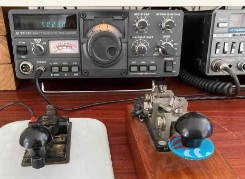
Sausages from Ross MONNK/P into VK2 again a this week, and for reasons unknown, I missed Carlos CT7BPF’s scheduled time – when I listened at 0800Z, he’d already signed off on the DL3YZ Runners Point page; oh well, there’s always next week.
[40m] Jordan VK3ACU and Nev ZL2BNE were nice copy into SNSW. Tony VK3CTM was thundering in RSN 592 from his linked dipole and SOW; great to catch Tony for an hour-long chat again after about 18 months.
I heard Ron VK6KHZ weakly – and he was being called by Phil ZL2PB at Tauranga – however, Ron wasn’t copying
[80m] enjoyed a long rag chew with Rob VK3ECH who was using 10W tonight, but was a nice respectable RSN 552 to me. However, toward the end of our long conversation one of those pesky Switch Mode Power Supplies started drifting in and out of my passband, at about the same strength as Rob on his QSB peaks…
Became a bit challenging… and of course he asked a question right at the critical time (no I actually hadn’t drifted off myself this timel). What fun.
After tuning in to the terrific rag chew between Sava VKAPN in Brisbane and Greg VKSKFG at Willunga, I was pleased to come back to 3525KHZ and hear David VK6KD calling me.
I sent him RSN 222 (because that was his report!) but had to ask for many repeats to copy his report to me. I got: RSN 22-, 433, 323, 2-3, 243, 243; the last two happened to be on QSB peaks, so I QSLed that one.
Thanks for hanging in there with mission impossible David; great fun.
[20m] VK6PZT VK3DRQ ZL2HJ were all coming in nicely to the Ironstone Range KiwiSDR in SA.
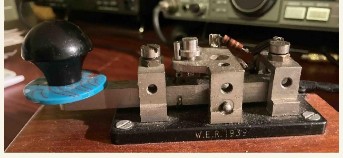
[80m] Rob VK3ECH was using 10W tonight and was coming through ok to the VK6BL KiwiSDR at Mount Barker. I tried to fire-up the VAGCRO remote station at Carnarvon to see if we could make the greater distance, but then remembered that the low band long-wire had failed (just after Rob VK6LD drove all the way up to Carnarvon from Albany to put the station back on air a couple of weeks ago!).
From Patrick VK2IOW between Bathurst and Orange
[20m] I was on for only a short time; however, after an absence of some months, it was great to QSO with Ross, MONNK again.
I imagine him setting up his quarter wave vertical in a field or somewhere in the English countryside, and then managing to send Morse to the other side of the planet, with just enough power to illuminate a light bulb!
And my 3 lengths of aluminium tubing, albeit 16 metres up, were able to catch the signal! Conditions seemed good; I gave him an RST of about 539. I kept the QSO fairly short because I was aware there was probably a bit of an Antipodean queue.
[80m] I Managed to get on air just after 11:00 UTC. Customary check of activities in FT8 segment to ascertain conditions, just a single JA station working US. Very discouraging, called a few CQ QRS while observing my signal into Marahau (ZL) and VK6BL.
Both looked OK but the number of traces observed on several SDRs was just two ndancea Cyne trace wae a OSD in nranroace hahavaan VKOK!
RAIN AD AS AAI we J NIN AS men Bel Ne en a Nett NI Maem) mer Det Nat metre NAS mp ne ene) Neem Pro Nr AAI I ema ne I a Nt DAA DAI NN INAS and VK3ECH. Both reasonably strong at my QTH and clearly visible at VA6BL SDR. The second trace was VK3KLE calling CQ.
I gave Paul a call and we had a lengthy QSO. Despite running 100 W Paul was way down at my QTH, just 459 and S7 noise. Usually Paul is much stronger so near skip was really problematic. Mark and Rob were still chatting so I had no option but to keep calling CQ.
After a good while VKSKFG came back but boy was he down in noise – I could barely copy Greg. I thought he said he was running QRP but was not sure. Anyway I gave Greg RST of 369 with noise at S7AND had enough copied to log a QSO.
On return from 160 m I put out a few more CQ QRS calls and to my surprise VK5KFG responded but this
Time at his usual 589 signal. Greg confirmed that he was running QRP previously. This time I could observe his signal into VA6BL and his 50 W was doing far better than my 200 W.
Anyway his QRP in fact did not do that badly, he was punching through S7 noise at my QTH. As we kept chirping about QRP and noise levels my kitchen timer went off so I had to QRT for a while, while attending my yoghurt maker but could copy Greg across the house.
It took a while before I returned to my hobby room and fortunately Greg was still patiently waiting, thanks for that. At 13:00 UTC after the net finished and out of curiosity, I checked my signal into Marahau (ZL) SDR, solid red, very strong but it was 01:00 UTC in ZL so no takers.
[160] Did not make any contacts on 160 m but had a quick check, a lot of noise, nil FT8 activity just” Harvest” net buzzing at 1855 KHz.
From Tony VK3CTM at Junortoun [40] I really enjoyed my QSO with Mark VK2KI. He was sending at a steady pace and was very easy copy.
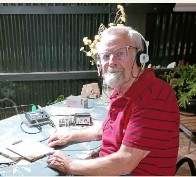
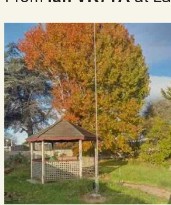
[40m] I operated from the Northern Corridor Radio Group club house alternating with Lin VK6NT using the club call VK6NC causing some unintended confusion! Highlight working Jordan VK3ACU/ QRP, with an S7 signal into WA.
Mark listened out on the ironstone Range Kiwi sdr heard Ross MONNK on 20 m and later on David VK6KD and Richard VK6PZT chatting away.
On 40 m worked ‘TonyVK3CTN and on 80 m worked Rob VKSECH braving the QSB and switch mode power supply gremlins then on to David VK6KD and after many repeats got the job done!
David worked Richard VK6PZT on 20 m, VK5AO on 40 m and on 80 m after a series of repeats managed a contact with Mark VK2KI. David also reminded us of their trip over East soon so we will be listening out for VK6KD/P again.
Stan in chilly Waitarere Beach (2.5 c) called in with his report. Making use of a Kiwi sdr in Cornwell was hearing Ross MONNK well on 20 m and recived a 101RSN on 20 m in return.
He then took time out to join the NZ net then came back to work 40m also heard David VK6KD with an S7 signal. Stan also managed to score 100 points on the weekend Randomgram after putting in a good effort.
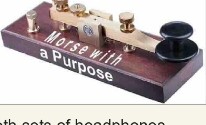
Last but not least check out Morse with a Purpose at Groups.io/g/mwp. joined Lin VK6NT at the NCRG clubhouse Whiteman Park using the club callsign VK6NC where we caused some confusion with the name swap as we took turns at the key!
Thank you to all on last night and this morning. 73 Diceharel
The Post Morsum callback happens the every week between 2200Z – 2300Z on Wednesday morning (Tuesday UTC). You can join via AllStar node 42482, or Echolink on VK2KI-L or VK8MT– L
Reporting
After next Tuesday’s Group, please remember to send me a list of who you worked and / or who you heard using our web form here:

Even if you didn’t hear anyone, we’d still like to know that you had a go. And to make your report more interesting, please consider sending a photo: cqgrsnet@gmail.com So, please help attract new and old team members to have a go by submitting your report each week.
Submissions close 1300 (Eastern Australian Summer time)_on Thursdays.
Off Centre Fed Dipole
(OCFD) antenna
| was looking for ideas for a good antenna to take on POTA activities. Something that was multiband. So what is an OCFD and why would you want to use one? The OCFD is a dipole antenna that is multibanded.
You get the advantages of a dipole antenna as well as the advantages of a multiband antenna. The standard centre fed halfwave dipole is fed in the centre as this is a high current point and provides a low (72 ohm) impedance that matches well with our 50 ohm cable and transceiver.
The standard dipole is cut to be resonant on one band (usually) with a quarter wave in each half of the dipole making a halfwave from end to end.
As you move from the centre of the dipole, the impedance increases until you get to a maximum impedance at the end. This is why an end fed antenna requires a large transformer (49:1 or 64:1) to transform the 50 ohm line to the approximate 2,500+ ohm impedance required at the end of a halfwave antenna.
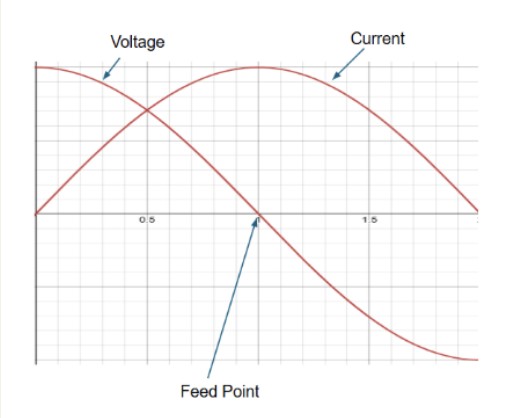
So why an off centre fed dipole? If you plot out all the current patterns of all the bands from the lowest resonant band on a given length of dipole to the highest band you get a mess of a plot that looks something like this:
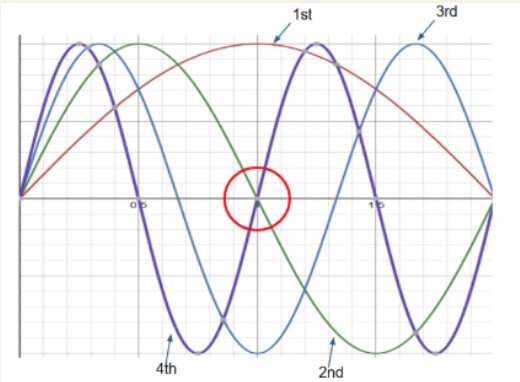
But what this shows is that when fed in the centre, it is a high current point for the odd harmonics but the even harmonics all have a current low at the centre, meaning you can’t get even harmonic bands if you centre feed a dipole (this is why on a 40m antenna you can get 15m (black line in above graph) because it is the third harmonic of 40m (7MHz(1st harmonic) – 14MHz(20m band) (2nd Harmonic) – 21MHz(15m Band) (8rd Harmonic)).
However, if you want to multiband a dipole and get even harmonics, you can find a place along the antenna where more bands have a reasonable current level (not the highest, but better than zero).
As shown in the above diagram, a common form of OCFD has the feed at the point one third along the antenna. At this point there is a reasonably high current point for 10m, 12m, 40m, 80m, 6m, 20m and 17m although not 15m.
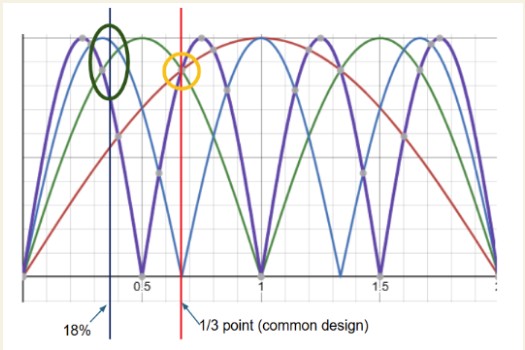
This can be varied and as you do, different bands will be achievable and others will drop off. To model my antenna I used the website – https://portable- antennas, com/ocfd.php – which allows you to play with the position of the feed point and see which bands have the best SWR and compare current patterns and gain.
Itis not quite as easy as that though. As noted above, as you move away from the centre or the high current point, the impedance increases. This is no different for an OCFD.
The position chosen for the feed in an OCFD generally requires a transformer of about 4:1 taking the 50OHMS to approximately 200OHMS.
My goal was to get a shorter multiband antenna for POTA activations and decided to build a 20m long antenna to be a halfwave on 40m.
Using the modelling tool above I concluded that a feedpoint 18% of the way along the line would give me the bands I wanted being 40m (primary), 20m, 15m, 10m and a bonus of 6m.
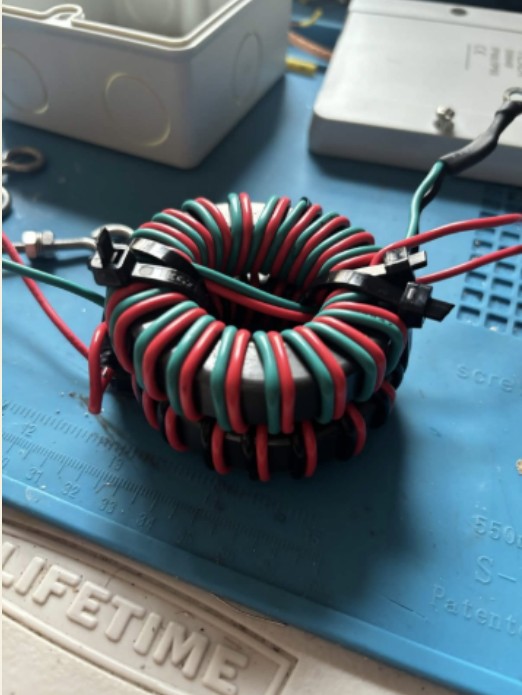
I built a4:1 Guanella Balun https://q82.uk/4‘balun-transformer to feed the dipole and built the dipole with one leg approximately 18% of 20m = 3.6m and the other leg 82% of 20m = 16.4m.
I chose to use the Guanella balun as it provides the required impedance transformation from 50 ohms to 200 ohms as well as providing some common mode current choking.
Because the OCFD dipole is an uneven dipole, there is a risk that you get common mode current feeding back as the short leg and long leg return waves will not always cancel. So the Guanella provides a good feed and common mode protection.
When tuning the antenna, my antenna was initially too long. I trimmed the long leg first, taking two lots off of the long leg before taking a quarter of what I had taken off of the long leg off of the short leg to keep the proportions the same.
After trimming and checking I got to the best SWR on the bands of interest that I could. I have to admit, I was not very happy with the final numbers.
40m <1.5:1 across the band (Good) 20m 2.2-2:1 across the band (a little disappointing) 15m 2.4-2:1 across the band (equally disappointing) 10m 2.5-1.5:1 across the band (looks okay ish but best SWR was above the band edge) 6m <1.5:1 across the band (bonus!) Given my previous experience with an end fed halfwave that got all bands of interest less than 2:1 across the bands, I was a little disappointed with the above.
However, SWR is not everything and for an OCFD you will need an antenna tuner. So all the bands of interest are well within the <3:1 which is achievable with most internal tuners in radios or easier stil for external tuners.
So for the first live test I activated a park I had not activated yet being the Point Cook Coastal Park AU-0278. The antenna was suspended by the Guaella balun hanging off a rope around a branch about 8m in the air and the two legs taken off in an inverted V format with the long leg being about 2.5m off of the ground at the end.
I first tuned up on 40m being the lowest band and the SWR was about 1.2:1 with no tuner. I tuned around and found another park operator on the other side of Victoria, and received 59 both ways (park to park).
I then switched to the 20m band and with my small Kenwood external tuner, I easily tuned the antenna to a good 1:1 match. Now, time to call CQ.
Within a few minutes I had a number of local (NSW, QLD and Vic) contacts with solid reports including a 59+ into Brisbane.
I also had some overseas contacts including two from Italy (one 53 report, one 57), one from England (54), Ukraine (53), Finland (61), Japan (57) and USA (Colorado at 57). 19 QSOs in 30 minutes.
Before shutting down I tuned around and picked up a couple of German operators coming in clear as. a bell (59 to me). I am willing to accept that the band conditions on 20m must have been particularly good when I was operating but even so, I have not had another operation this good even from my QTH antenna.
If this is a sign of how good the antenna is I think it will be getting a lot of use. Maybe I need to build a bigger one for home.
RAF Flameproof Key
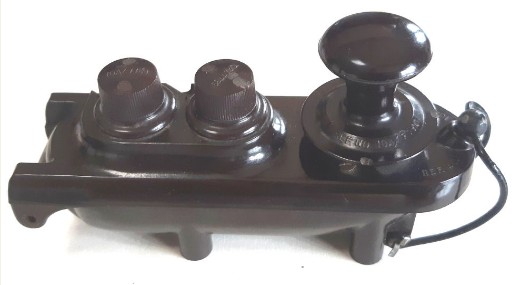
Used by virtually every Radio op who flew in the RAF. In times of enemy action in Lancaster, Wellingtons and other bombers where aviation spirit (Petrol) might often have been sloshing around on the cockpit floor a Key switching big volts and current from operating the quite fearsome 1154 Transmitter (-an 813 in the final) it was deemed very wise to keep that spark isolated.
Here is the said key, of which very many were made, in Brown bakelite officially known as a 10 A/7741 model but not unsurprisingly unofficially called a “Bathtub key” I have never seen a Canadian made version of this key, but apparently they were made with Black Bakelite.
It would be a good crossword question to ask – “What type of morse key would you use upside down?
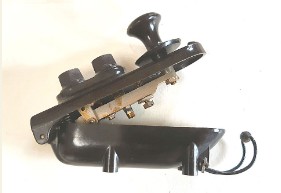
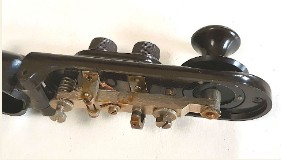
The photos show that indeed the works are hanging from the top Those who are not familiar may wonder what the stiff springy spring does at 1 operator end.
The photos show that indeed the works are hanging from the top Those who are not familiar may wonder what the stiff springy spring does at the ey en
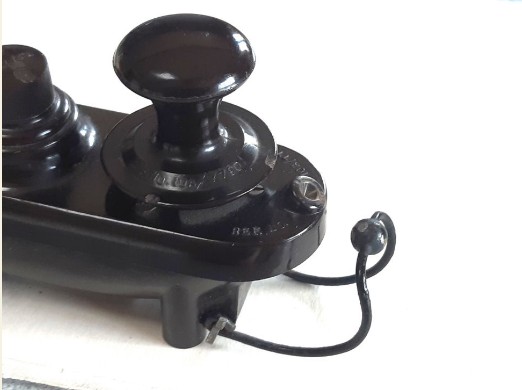
Well it keed the hinged parts fastened together .. But it has another use, When the skipper says “Bail out lads” it is good if someone somewhere knows just where the parachutists might land and to that end the aforementioned clip is moved further forward over the flange of the key knob, holding the Transmitter carrier on as the final journey to earth ( or sea) takes place.
Providing a lengthy carrier for bearing purposes which hopefully might be recorded by colleagues In a Lancaster unfortunately it could often be difficult, often impossible, for some of the (about 8 crewmen) to make it to the single doorway.
So there was no reason for the wireless op to go down with his ship as an action of valour!
If you have an article or two that you think might be of interest to our readers, please let me know so we can share more thoughts and ideas; for guidance on writing for RagChew, see Articles below. Please email material to Mark VK2KI: cqqrsnet@gmail.com
On My Workbench
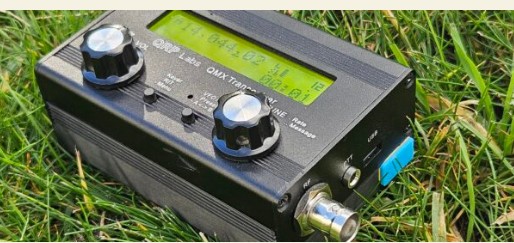
Carrying an external battery sounds like a simple affair, but when you’re operating portable, and tired from a tough hike, or setting up in a blowing gale, every separate bit of kit feels more like a required-effort multiplier rather than a simple addition.
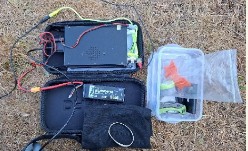
And so it was that my QMX ended up with a battery backpack. The Parts: * 1x VE7ZAX QMX Buddy Back — Shallow + 1x XT60 male cap + 1x XT60 Socket * 1x QMX DC plug blank * 3x 102050 3.7V 1000MAH Lipo Cells + 1×3 LiPo BMS The Case The QMX Buddy Back comes in three 5 depths, each with an additional vertical height of: + X-Shallow: 5mm * Shallow: 10 mm * Medium: 15 mm * Deep: 20 mm + X-Deep: 25 mm I used the shallow size.
As standard the case has no holes for connecting power, so had planned on drilling and filing. Fortunately a friend is a bit of a 3D printing wiz, and modified the model to add the hole.
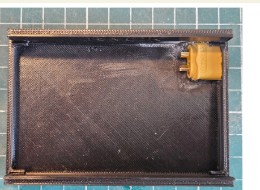
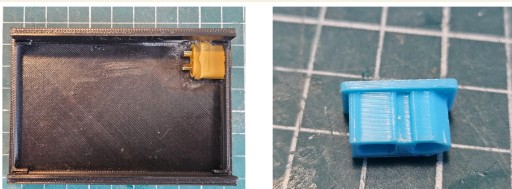
Once printed the XT60 connector was attached with a liberal application of super glue. the end of the connector sits flush with the outside of the case.
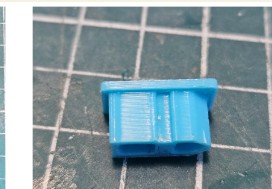
I printed the XTE0 cap too, so that the power pins were tucked away safely from any potential short circuits lurking in my bag whilst walking.
Carrying an external battery sounds like a simple affair, but when you’re operating portable, and tired from a tough hike, or setting up in a blowing gale, every separate bit of kit feels more like a required-effort multiplier rather than a simple addition.
And so it was that my QMX ended up with a battery backpack.
| used the shallow size. As standard the case has no holes for connecting power, so had planned on drilling and filing. Fortunately a friend is a bit of a 3D printing wiz, and modified the model tc add the hole.
Once printed the XT60 connector was attached with a liberal application of super glue. the end of the connector sits flush with the outside of the case.
I printed the XT60 cap too, so that the power pins were tucked away safely from any potential short circuits lurking in my bag whilst walking.
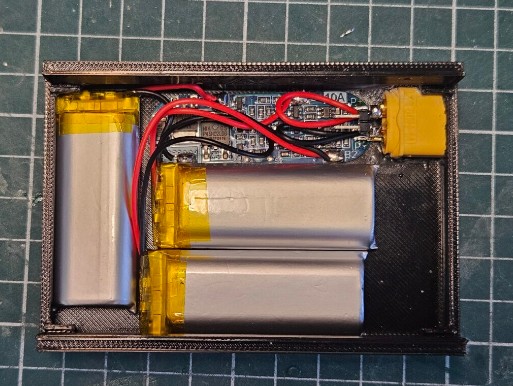
The electronics It was a fairly simple matter of dry fitting everything into the case, cutting the battery leads to length, then soldering it all together.
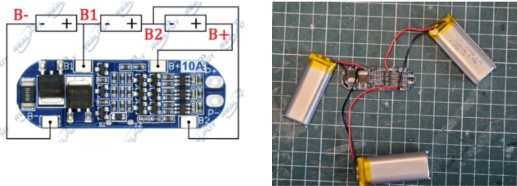
There’s actually lots of space in the case, and multiple combinations are possible. I decided however with this configuration as it leaves a nice open spot next to the connector which I may be able to do something with down the track.
I’m thinking of a mini tuner perhaps. The cells were hot glued into place. The placement of the BMS would have allowed me to solder the main + and — directly to the XT60 connector, but in the end opted for pig tails as it would more easily allow me to remove it down the track for maintenance.
Note also the two pin header soldered to the XT60. That’s for the QMX power. I would have liked to use a normal connector, but vertical space was at a premium.
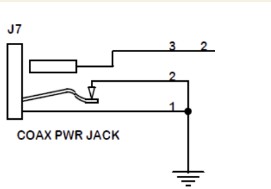
Powering the QMX The barrel jack on the QMX has a ground pin which floats when a plug is inserted, pin 2 in the diagram below. This allows for the battery to be disconnected when external power is applied.
The BMS’ positive and negative lines were connected tc the QMX’s positive (pin 3), and switching ground (pin 2) respectively.
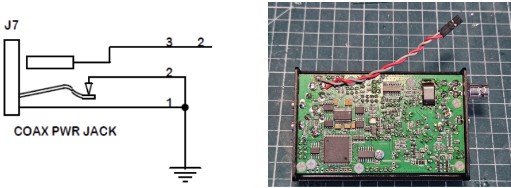
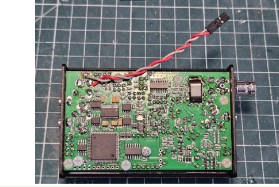
Now all that was left to do was put it all together and charge it up.
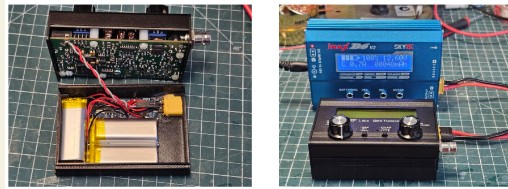
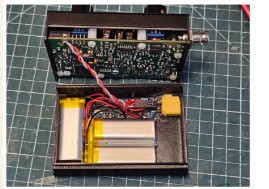
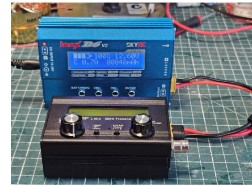
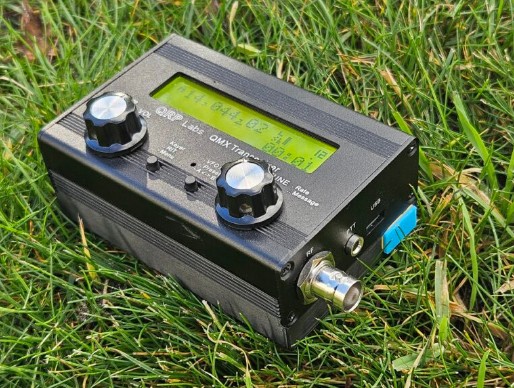
It really is a very neat package, with the added utility greatly outweighing the extra height, which is barely noticeable.
The black print means you don’t really notice that there’s an aftermarket base on it, though perhaps a white or coloured print would be a nice way of customising the unit. I’ve added some images from a variety of angles to help convey the final product.
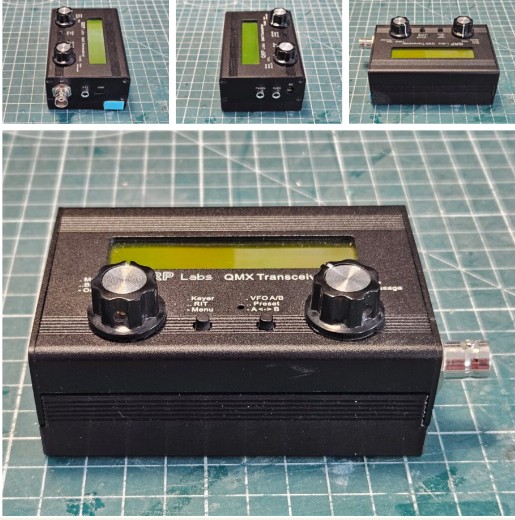
The next version.
There are a couple of things I would like to change. Move the power port to the same side as the QMX’s power socket. That will negate the internal power cable needing to cross from one to the far corners.
To be hones I thought I had worked it all out, but when the print was done, it wasn’t. Doh! I’m now very aware that if the power knob is knocked during transport, it’s going drain the battery.
I’ll lend my mind to it somewhat, and see if there’s a neat solution. Will it really be an issue though? The QMX already has a travel cap, and has never come off when packed, so only time will tell, though I’m probably over thinking it.
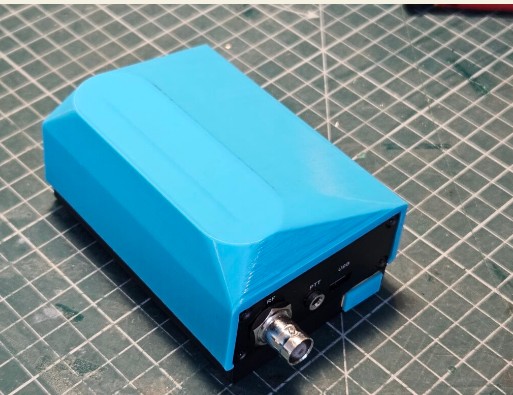
Who’s a happy chappie? Lance is. PostScript After posting this build, Zak, the designer of the extension case, mentioned that he uses a trimmed down DC plug to disengage the battery when not using it. Brilliant.
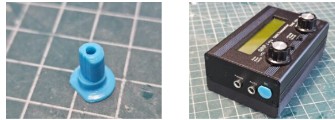
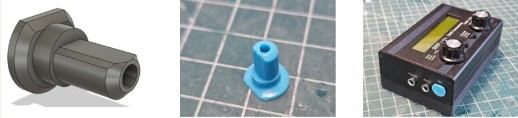
So this morning I designed and printed a rotatable plug blank, flat side up to disable the battery, flat side down to enable. Such an elegant solution. I’ve added a link to the 3D model is in the “parts” section above.
What’s going on on your workbench? If you have an article or two that you think might be of interest to our readers, please let us know; email to cqqrsnet@gmail.com For guidance on writing for RagChew, see Articles below.
QRZ?
Our net is a fun get-together that people enjoy returning to each week. It’s really nice to know who’s on the other end of the QSO. So, please share some thoughts about yourself to cqqrsnet@gmail.com for a future RagChew.
CW Practice
This year we’re using Aesop’s Fables. These are short moral stories, often using talking animals, that illustrate simple truths about human behaviour and character.
Aesop’s Fables originated in ancient Greece, traditionally attributed to the storytelle Aesop who is thought to have lived around the 6th century BCE.
The fables are generally smaller files of two to three hundred words that have been recorded at 15 wpm and run for about 15 minutes.
If 15 wpm is a bit quick for you, load it onto your phone and set the playback speed at 0.75 X or even 0.5 X- whatever works for you. 0.75 X will play the MP8 at a bit under 12 wpm. Itis suggested that you read the text file before listening to the audio file.
That will make it easier to follow the audio file and prepare you for any unusual words. Any punctuation that is not usually used with CW has been removed. This week’s fable is ‘The Lion and the Mouse’, and the MP3 and TXT files are attached here:


If you prefer a different speed or tone, you can create your own MP3 files by converting the text file with the Ebook2CW app — https://fkurz.net/ham/ebook2cw.html.
You can either play the MP3 files in any media player, or load the text file into the Ditto CW: Morse Player app — https://dittocw.andro.io/.
Both options work well, however Ditto CW gives you complete control over all Morse settings, while a normal media player only allows changes to playback speed, and does that in steps (e.g. +1.25x, 1.5x, 1.75x).
Other News
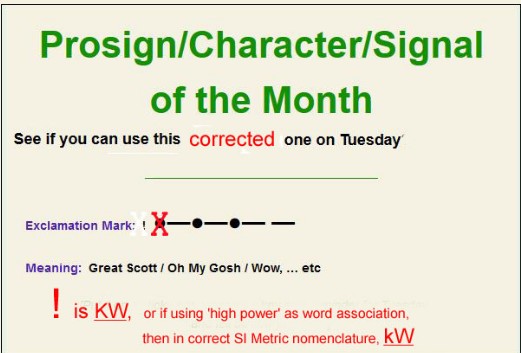
Prosign/Character/Signal of the Month
Stan ZL3TK – Waitarere Beach, NZ I think there might be an error in the prosign of the month (exclamation mark) and as this will be repeated in subsequent newsletters I thought it was worth mentioning to you.
My understanding is that it is formed by
I only remember it because an LICW instructor really liked that prosign, used it regularly in zoom sessions and we got to know it. It manages to sound exclamatory, just like a question mark seems to sound interrogative.
David VK3DL – Geelong, VIC Iread about the prosign of the month in the latest newsletter, but the dot/dash diagram is wrong. The exclamation mark is Dah Di Dah Di Dah Dah not Di Dah Di Dah Di Dah Dah as shown.
Dave VK5PL – Williamstown, SA Great Scott, Oh my gosh, Wow! How could I have made such a silly mistake. Thank- you eagle-eyed readers. My cheeks are suitably flushed, while my mouth wears a matching grimace.
The signal has been corrected in this week’s edition, so if you did print the old one, please update it! – Lance
Accepting ADIF files for weekly reports
Upload ADIF files for weekly reports? Jordan VK3ACU has , suggested that it may be useful to upload ADIF files when completing the weekly activity report. Would you find this useful? Let us know your thoughts via email for next week’s Ragchew.
For people who do SOTA I Parks etc who are going to submit logs, they already need to create ADIF files for submission to the SOTA / VKFF / POTA etc system. Ditto for contests. Perhaps they’re an option for logging programs too?
Jordan’s suggestion might be a nice little enhancement to allow people to use their already- created logs to put the callsign info in. So over to our reports software guru, Nigel G4RWI… currently touring in the South of France (as you do).
Nigel’s response: It would be quite complicated to add that to the current system. Number of problems: 1. where would you store the upload? currently we use google forms, and thats not a database 2. current python script would need a major rewrite 3.
Logging programs tend to just og who you worked, not who you tried or heard. Plus no simple way to include comments If we ever moved to a system where the reports end up in a database, this would be much more doable. Thanks Nigel.
Mark VK2KI – Beautiful South Browning, NSW
Hoddywell SDR offline
HiAll, Peter VK6YSF attended the Hoddywell site today to check on the Kiwi SDR. Peter found the voltage to the Kiwi SDR was normal, but it wasn’t obtaining an IP address from the network. He took the Kiwi SDR back to his home QTH and found the same symptoms.
Peter will be doing some further testing with the on-board diagnostic LED’s and should that be unsuccessful, he will post it to me to look at further, possibly reflashing the SD card or replacing the beagle Bone Green single board computer..
Iwill also be asking the SEG committee to look at purchasing a Web-888 SDR to replace the KiwiSDR at Hoddy Well. (https:/Avww.rx-888.com/web/) If the KiwiSDR can be resurrected (it might take some time) and it could be located at a new site, giving a second SDR.
Regards, Rob VK6LD – Albany, WA Thanks for the heads up Rob. I’m sure those who use the SDR on Tuesdays and beyond will be happy to hear it’s not a terminal situation. – Lance
Ross’ mystery key identified – Clansman key
The key Ross wanted info one is the British Army ” Clansman ” key. The clansman radio were / are a SSB rig very robust and tough looking for use in rough conditions and there are groups of folk in UK use those radio quite a lot.
I know they have one rather strange characteristic and that is the display of frequency shows a different one from what you think you are on! I cannot remember exactly which way it went but it is connected with upper and lower sidebands differential.
‘Some one will be better informed than |. I would describe it as a key you probably cannot break…… Looks as if runover by a tank etc it would still work. I have one here in near perfect condx and did offer it for sale recently but there were no takers.
I was interested to see the photo of his later model of the Marconi 365 I have one of a much earlier date in its real life used condition Plenty of “patina” It does though have the original brass cover which a few folk used to polish, but the majority were used as Ash trays and lost.
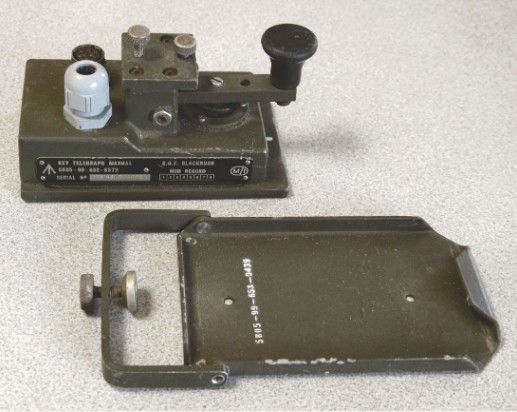
David VK3DBD – Yackandandah, VIC What a great key! For those interested in learning more about the Clansman, Ray G4NSJ has a couple of videos where he explores his new-to-him Clansman radios. – Lance
What a great key! For those interested in learning more about the Clansman, Ray G4NSJ has a couple of videos where he explores his new-to-him Clansman radios. Lance
A comfy chair with the RagChew
Tonight I had the pleasure of sitting back and reading RagChew 30/2026 cover-to- cover…. what a glorious read! We have some fantastic contributors these days – such a pleasure to immerse myself in the words and just enjoy what our team members have written.
Loved your snoop-loop article too…. hopefully it’ll inform and inspire others to have a listen for their noise sources…. starting with me! Cheers and thanks to you and your contributors. Mark VK2KI – Beautiful South Bowning, NSW Thanks Mark. When !
Took over the editing of RagChew I was amazed to find the number of contributors at the end of each edition which I’d never took note of. Last week 38, yes thirty eight, people contributed to the newsletter through operating reports, articles or letters.
CW Activities
ZL Winter Sprints
42BL WHC! OVITIlo 4, 11, 18, 25 August A simple and fun activity for amateur radio stations to contact as many other amateur radio stations as possible within the 1.5 hour time limit.
Each Tuesday in August: 0800-0829 UTC (2000-2029 NZST) CW only 0830-0859 UTC (2030-2059 NZST) SSB only 0900-0929 UTC (2100-2129 NZST) FT4 only For more info, see https://nzart.org.nz/activities/contests/sprints/.
VK1 Winter SOTA Party
WNT WIC OWIA Faity 9th August It’s time for the annual VK1 Winter SOTA QSO Party. This year we’re proposing Sunday 9 August 2026 as the day to rack up some summit-to-summit contacts with each other, plus the usual chasers.
As the day gets closer, please post your planned summit and time as an alert as normal so others can plan to work you Many of the VK1 SOTA activators are active on CW. If you’ve not tried your hand at chasing SOTA or parks on yet, this is a good opportunity.
You may want to brush up on the standard CW exchange so that you know what the activators will be expecting. They’re a friendly low and would welcome beginner ops chasing them.
International Lighthouse Lightship Weekend (ILLW)
TLC CU RIMMVUUSe LIMMoOM WYOCACIIU LILLY) 16 August. It is one of the most popular international amateur radio events in existence probably because there are very few rules and it is not the usual contest type event. There will be plenty of CW DX available.
Listen for stations calling CQ ILLW. For more details, see https://illw.net/.
Remembrance Day Contest
MCMCMVidalivte Way VUILest 15-16 August. This contest commemorates the Amateurs who died during World War II and is designed to encourage friendly participation and help improve the operating skills of participants.
It is held on the weekend closest to the 15TH August, the date on which hostilities ceased in the southwest Pacific area. This is Australia and New Zealand’s most participated in contest of the year, with a growing number of CW participants each year.
There are plenty of slower ops, so why not try a mixed mode entry this year and give CW a try. For more details, see https://www.wia.org.au/members/contests/rdcontest/.
Morse Training Net
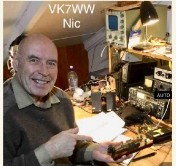
WIVISS TGHhiiyy INCL Every Wednesday, 19:00 3580 kHz Many of our team learned Morse code with the support of our team member Nic VK7WW, and the weekly training session comes highly recommended for anyone who wants to learn the Code, or simply brush up.
Everyone’s welcome – 3580KHZ at 7pm Eastern time every Wednesday; you’ll hear lots of the CQQRS team on that net Jordan VK3ACU has also recorded the complete set of lessons which you can now find hora
Contact Nic VK7WW for more info nicholaschantler@hotmail.com including how to join the Northern Tasmania Amateur Radio Club DISCORD group to follow the action, or just come along to 80m and join-in on Wednesdays.
Are you aware of any additional CW activities on the horizon? Be they a regular activity or a one off, let everyone know by emailing us the details and we’ll spread the word.
Readable Five
If you’ve read something that you think might be of interest to our readers, please let us know cqgrsnet@gmail.com
There’s No Such Thing…
—_— I think the first lesson in Teachering 101 is to always tell students “There’s no such…” (I’m sure you know the rest) and “…the only dumb questions are the ones not asked”.
John VK2RU reckons that there’s lots of questions out there among bott our new and our experienced operators – about CW, amateur radio operating and
[Do you have a question or two or a discussion starter worth sharing? cqqrsnet@gmail.com if so.]
Exclamation mark
[Put it on a sticky note near your key as a reminder for Tuesday…. and tell us how you went!]
I Hear Tell…
We’re a little light on gossip this week, so tell us what you’ve heard that made you feel amused, concerned or relieved?
[If you have some intel about other team members… or even yourself… that’s worth sharing, please let us know cqqrsnet@gmail.com |
Di-dah-di-dah-dit
Next Tuesday’s Net
Our CQQRS Group will be on as always on Tuesday from around 0600Z until about 1200Z; see https://bit.ly/CQQRSWebsite and navigate to the Net Details page for details.
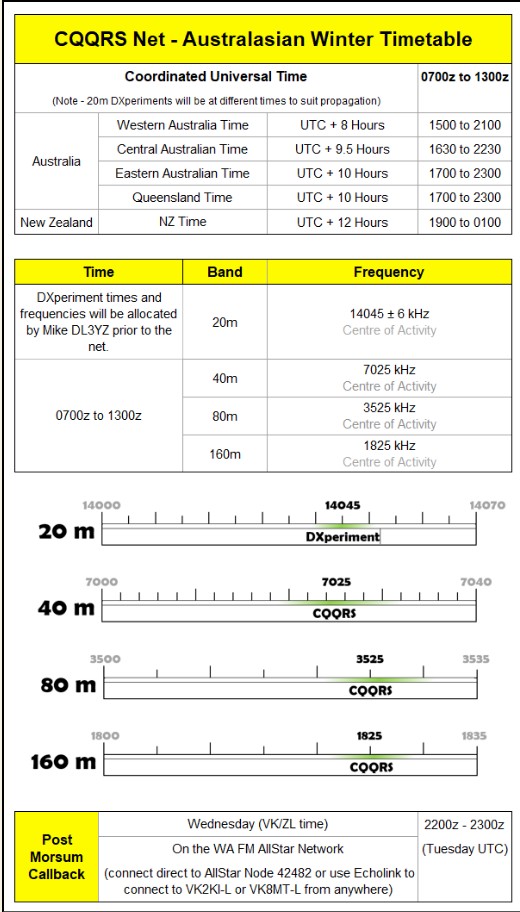
Doesn’t matter whether you’re brand new and want to try just exchanging callsigns and RST reports, or you’re ready for a good old rag chew. We’ll have fun.
There’s usually people around until after 1200Z – so keep calling in the segment of the band designated in the table below until you catch someone.
Reports & Photos
Please let us know via our Reports form bit.ly/CQQRSNET who you work or hear on Tuesday’s Group. The report form closes at 1pm (Eastern Australian time) on Thursday. And how about helping to make the reports even more interesting by sending a photo?
If you have a photo that you’d be happy to include, please email it to: cqqrsnet@gmail.com And of course, we’re always on the lookout for more photos for the newsletter, so if you have something that might be of interest aside from the reports, please send it through as well.
Email to cqgrsnet@gmail.com please. Oh and by the way, I recommend that you don’t keep the Reports Form website open between submission of reports from one week to the next.
If you’re unlucky, there’s an undocumented feature in the software that could cause your current week’s report to be combined with your previous report – it’s happened to your editor several times – much to the chagrin of our Reports editor 🙂
Richard VK6HRC will run our phone Post Morsum on Wednesday mornings on the South West AllStar net (via repeaters and hotspots all over WA) from 0600 WA time, then from 0700 WA time on 80m (3605 LSB).
See https://bit.ly/CQQRSWebsite and navigate to the Net Details page for details of how you can connect via Echolink from anywhere in the world.
Articles
Could you write a short article or articles for RagChew? You bet! Writing not your strong point? Don’t worry, I’m very happy to help as much or as little as needed.
Oh, and one more thing (actually two) – copyright material: * please use your own images – don’t use images copied from the internet unless you have the producer’s permission, or they’re marked ‘Creative Commons’ or similar; * if you include other peoples’ written material, unless you have permission, you may only include small snippets (unless it’s marked ‘Creative Commons’ or similar), and you’ll need to site the source and author.
For more guidance on writing for the RagChew newsletter (including how you might even try using one of the new Artificial Intelligence tools), head to our website bit.ly/CQQRSWebsite then click the menu on the top right and then click RagChew Newsletter.
Material
A reminder; if you send me any information by email, our report form or WhatsApp unless you specifically state that material is not to be published, I’ll assume that you’re happy to see your thoughts in the RagChew newsletter.
Thank you so much to our team of 49 contributors: CT7BPF, DL3YZ, G4RWI, MONNK, VK2DLF, VK2IOW, VK2KI, VK2RU, VK2WF, VK32IOW, VK3ACU, VK3BWN, VK38CTM, VK3DBD, VKS8DL, VK3DRQ, VK3ECH, VK3IDK, VK3JFR,VK3KLE, VK4BVM, VK4MFX, VK4PN, VK5AO, VK5CT, VK5ET, VK5FD, VK5KFG, VK5PL, VK6HRC, VK6IS, VK6KD, VK6KHZ, VK6LD.
VK6MTF, VK6NW, VK6PZT, VK6QI, VKGRR, VK6TX, VK6WE, VK7TA, VK7TO, VK7WW, ZL1HJ, ZL1PB, ZL2BNE, ZL3ABX, and ZL3TK

And a special thank you to our editorial team, Nigel G4RWI (head of software development), Patrick VK2IOW (reports coordinator), John VK2RU (spreadsheet manager, Richard VK6HRC (post morsition), Jordan VK3ACU (head gagster) and Ross MONNK (seconded from the Philosophy Department).
Great work all! GU CW on Tuesday, Lance VK7TO Margate TAS Editor cqqrs.ragchew.editor@gmail.com
About the CQ QRS Net
For the current schedule and more information about the CQQRS net, please go the the Net Details page on our website:

The opinions expressed in the RagChew newsletter are those of the individual contributors. The opinions do not necessarily reflect that of the editors or of the CQQRS Group members.
Any material and images received from members by the editor or published on the CQQRS WhatsApp groups may be published in this newsletter unless specifically requested otherwise.
The RagChew newsletter is considered to be exempt from the Australian Government’s ban on social media for under 16 year olds because it is a service that has the primary purpose of enabling users to share information about products or services, engage in professional networking or professional development services or of supporting the education of users per the Australian Government eSafety Commissioner FAQ webpage “Which platforms have been excluded from the age restrictions” dated 10DEC25.
The values, doctrine and guidelines for the Group and for the newsletter are published on the Principles page of the group’s website https://bit.ly/CQQRSWebsite