Below is a reconstruction of the 2026 26 CQ QRS RagChew newsletter designed to support full text searching. This reconstruction was built using OCR, and will contain errors.
To view the Mailchimp original, click here. To search the entire newsletter archive, click here.
Contents
- CQ QRS RagChew
- Dah-di-dah-di-dah
- New Team Members
- Post Morsum 24th June 2026
- Reporting
- V Band Part 5 – The Decoder
- However…
- …or go to the ‘No Decoder’ Channel 5 ND
- A Role for SDRs
- On My Workbench
- Airzone AM Valve Radio Restoration – Continued
- Quiet 13.8V Power Supplies
- QRZ?
- Hello everyone!
- QRZ? Who’s on the other end?
- CW Practice
- Other News
- Emails to the Editor
- Hi Mark
- 73, Mark VK2XMB
- Good afternoon Mark.
- In Defence of SI Nomenclature, and Those Who Ignore It
- Morse with a Purpose
- Making Crystals in 1926
- Bendigo Telegraph Office
- Morse Training Net
- We’re not on the Dog and Bone nah Guv, this is Brarn Sauc
- DXperiment Etiquette
- From Lance VK7TO
- There’s No Such Thing…
- Paddle or Straight Key?
- Question: BALUN for ZS6BKW Doublet
- Answer:
- Prosign/Character/Signal of the Month
- Di-dah-di-dah-dit
- Next Tuesday’s Net
- Reports & Photos
- Post Morsum
- Articles
- Material
- Teamwork
- About the CQ QRS Net
CQ QRS RagChew
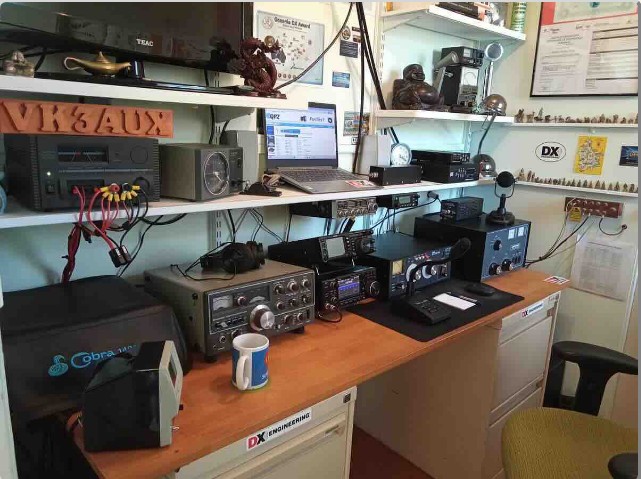
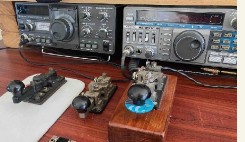
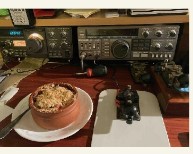
Thanks this week to one of our new members, Rob VK3AUX for this image of his very neat shack. Yet another TS-5205 on our net soon I hope! See more from Rob below in the second of our QRS? segments this week.
Link to our Weekly CQQRS Net Reporting Form bit.ly/CQQRSNET
Dah-di-dah-di-dah
I hope you had an opportunity to tune-in to our CQQRS Slow CW Practice QSO net on Tuesday. Conditions were ok, and we seemed to have a goodly number of people on air again this week.
And thank you again to those who sent us a report – I know it’s time-consuming, but your report is just so important to our readers – so thank you.
‘Speaking of reports – Patrick VK2IOW compiles the reports into a neat bundle each week, and makes them easy to skim by adding photographs.
We’re always looking for more photos to accompany the reports – so please keep them coming – email to cqgarsnet@gmail.com please In this edition, you’ll find so many emails to the editor – thank you one and all for making the effort to drop me a line.
And just look at all the articles that our team members have sent through – fantastic! I hope our readers will enjoy them as much as I have. And it doesn’t all have to be straight down the line.
Last week, Ross MONNK went out on a limb with some different thoughts about signal reporting; and he does it again this week – he tells us the decoders aren’t necessarily all bad, especially if in VBand it helps bring new people in.
The VBand decoder helped Ross to get going and be motivated to go on to become a very active CW operator, for whom head copying is now no problem.
So a huge thank you to the 35 contributors to this week’s edition – imagine if other amateur radio-related newsletters and magazines had that number every week like we do! Something must be right with this QRS CW stuff!
New Team Members
Welcome this week to David GDJB who lives near Wellingborough, North East of Northampton, somewhere near Chris G7BED I imagine. For David, amateur radio is all about QRP CW, so he’ll be among friends here!
David is actively involved as a volunteer at Bletchley Park – as are our team mates Simon MOKBJ, Nigel G4RWI and Chris G7BED.
And starting off on the right foot – David and Chris have written an article about Bletchley Park which you’ll find in this week’s RagChew edition.
Welcome David, and I look forward to getting reports from you about the net via our webform, either from being on ait, or as an SWL via one of the brilliant KiwiSDRs.
Warwick VK7WOZ lives at Glenorchy just North of Hobart and has joined our happy team this week. Also adding to the CWops Academy training team, Dennis VK3SPI has joined us from Melbourne and Rob VK3AUX from Bayswater North.
Welcome one and all – and I’m certain you’ll have some fun in our team.
If you’d like to find out a bit about our net, or would like to pass information to others about our Tuesday get-togethers, here’s the link to our website. bit.ly/CQQRSWebsite So here we go – on behalf of the CQQRS Editorial team, please enjoy the newsletter.
If you’d like to find out a bit about our net, or would like to pass information to others about our Tuesday get-togethers, here’s the link to our website. bit.ly/CQQRSWebsite
Mark Bosma Patrick John VK2KI / VK6QI VK2IOW VK2RU Beautiful South Bowning Milthorpe NSW on a track somewhere NSW cqqrsnet@gmail.com non impsditi ratione cogitationis Nigel Richard Lance G4RWI VK6HRC VK7TO our other grey nomad Padbury WA Margate TAS Jordan Ross VK2ACII MONNK
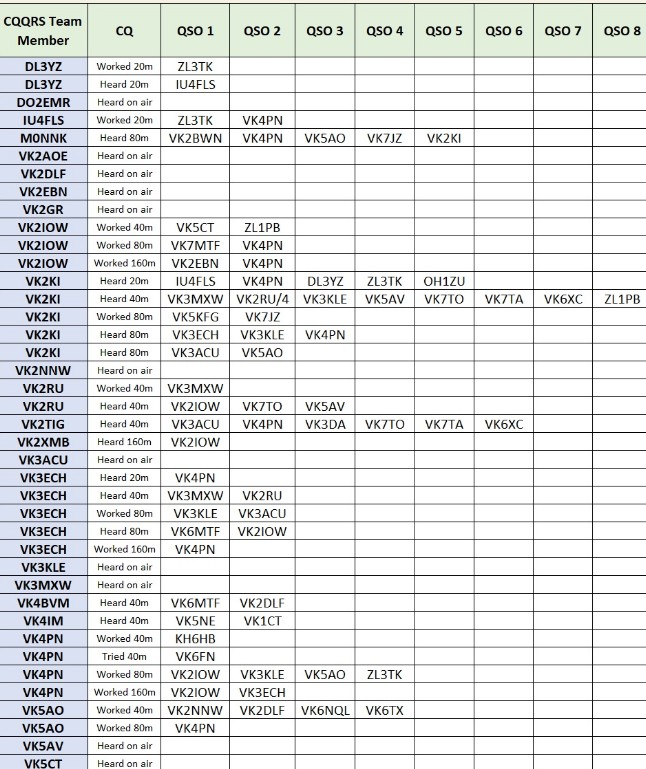
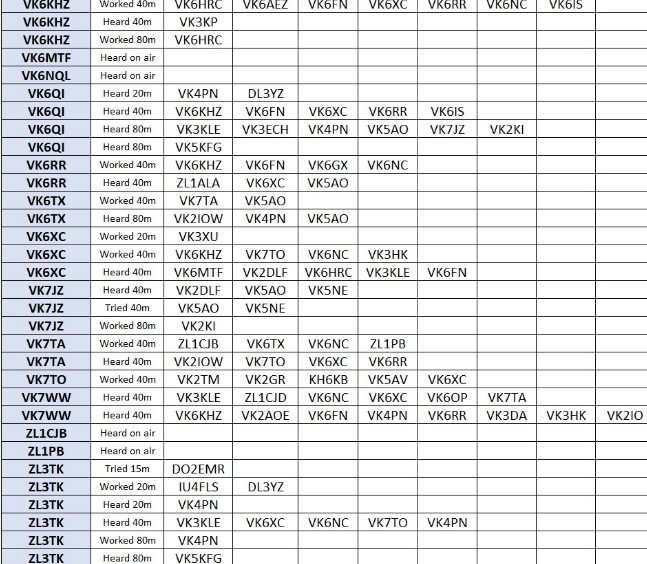
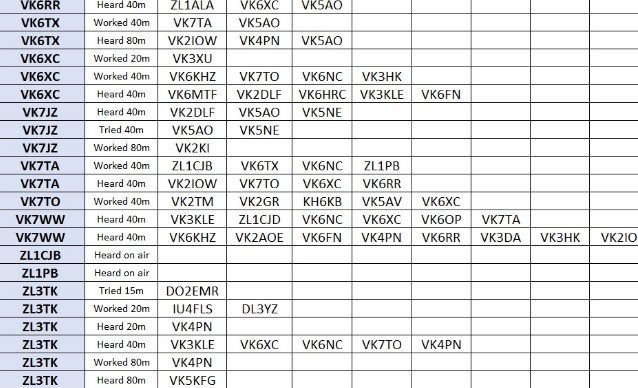
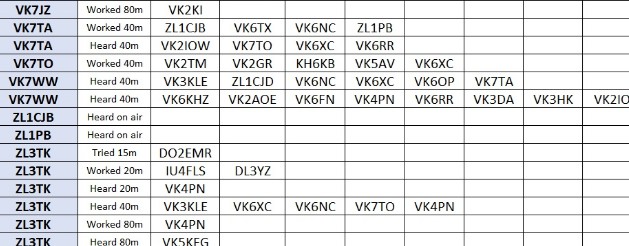
John’s spreadsheet above shows the known stations heard or worked on last Tuesday’s CQQRS Net (reported via our webform bit.ly/CQQRSNET ); the comment in the team members’ reports follow.
The comments were compiled for us by the clever software built by Nigel G4RWI and the layout was perfected by Patrick VK2IOW. Thanks again to Nigel, Patrick and John for the work, and to every team member who submitted a report –
John’s spreadsheet above shows the known stations heard or worked on last Tuesday’s CQQRS Net (reported via our webform bit.ly/CQQRSNET ); the comments in the team members’ reports follow.
The comments were compiled for us by the clever software built by Nigel G4RWI and the layout was perfected by Patrick VK2IOW.
[20m] There was activity on 14.041 MHz therefore I set the radio and sent CQ on 14.042 MHZ. Anyway, it was impossible at my end to detect any signal on the radio either from ZL3TK or VK4PN.
Following Stan suggestions (tks Stan) I opened Ironstone 1 and changing earphones as soon as I saw a signal on the waterfall, I was a RSN report from Ironstone given to ZL3TK 541 and to VK4P friends and TU.
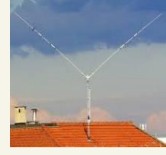
[20m] Condx were quite nice today, some QRN up here. After a short DX chat with Stan – ZL3TK, a station from Finland called me and stole my frequency after we finished 🙂 .
I think I’ll stop answering to European traffic in future Tuesday’s operations completely. Have a great week, 73 Mike
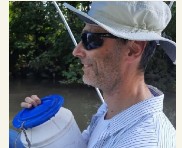
[40m] Lots of VK6 coming through early on!
[80m] Using a 40m DC Rx I just built…and ‘designed’. Apologies for absence, had a very bad cold! Lovely to hear all the CW activity…@ @
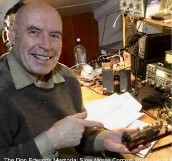
[80m] I couldn’t get the Summerland ARC internet accessed radio to work so fell back on the lronstone web SDR for a short session of SWL.
I’ve never worked the 80 m band before so it was interesting to hear these stations coming in so clearly from all over Australia.
[40m] Lots of QSB followed by QRM during my QSO with VKSAO.
[15m] Called and listened for DO2EMR on SDR in NW Ireland and was not expecting to hear only myself RSN 421. From all observations 15 m was firmly closed, but clearly it was not, just that nobody was there.
Despite the possibly band-open status, did no 2 in Ireland? Because the G8JNJ SDRs in Cornwall
WUEELT (efit Ay Ce Ela thins Un) Uytele Inert’ Leksters eis) MIs) ete p kt!) UE RES) LI eek eTLT lost internet connection, as indeed did Mike’s entire DXperiment website for more than 30 minutes.
[20m] In the spirit of DXperiment, a sked with Fausto IU4FLS was successful with easily readable signals, both ends using pre-planned SDRs for receive. See RagChew article for the background story.
A short time later successfully worked DL3YZ, my receive via G8JNJ SDR but I think direct from ZL for Mike.
[40m] 40 m was wiped out most of the time by serious noise, no idea where it’s coming from.
[40m] I couldn’t hear any of the group on 7MHZ using my own SDR and I could just discern a station on 3.5 MHz but it was at the upper edge of my Morse skills and too weak ir any case.
From Allen VK5FD at Blakeview [40m & 80m] 40m nothing heard when I listened. 80m more stations there but some local noise was annoying.
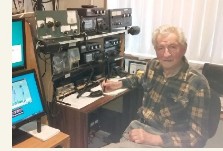
[40m] While working VK6FN, Max, his TX shifted frequency then after the QSO had started his transmissions stopped! Not sure what had happened.
[80m] 40m seemed to be less populated than a normal QRS I evening, OQRXed on HF bands but nilo heard of our friends
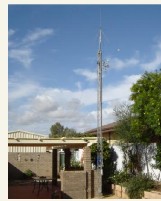
[80m] Another nice night out playing radios but not so successful in the QSO department. It was cold up on Mount Nelson but Morgan and I were prepared for winter in VK7. We had to strictly keep to operating on separate bands.
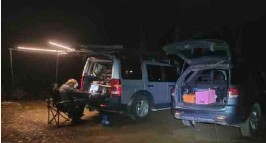
PWas USIly 2 ICUNSITINY VUE AIM alilUot resonant (it could do with a trim) first time used QRP antenna. The tuner brought it close enough. On 40 meters I called and called and called but no love. I could only hear 3 stations and even then it was a struggle.
At the conclusion of their respective QSO’s I called VK5SAO, then VKSNE, and it was obvious they could not hear my whisper quiet QRP calls. Only later did I check the chat group to find out 40m was rubbish this week.
I started packing up and was offered a go on Morgan’s radio on 80m, and had a nice QSO with Mark VK2KI, then that was us for the night.
Sorry Morgan but this operating from the same place at the same time thing will have to come to an end, I will go higher up the mountain (and colder) next week. Hoping to finalise my antenna builds this weekend and bring my ‘A’ game next Tuesday night.
[40m] , [didn’t hear anything from VK3 or VK5, which is unusual. On: very weak VK4 in disguise, and a huge signal from VKGNC: mostly RST599 or RSN590, peaking 10DB over that.
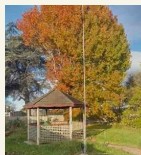
From Sava VK4PN at Mount Ommaney Brisbane [20] No grand kid minding duties this week so another opportunity to participate in the DX experiment. Spent a lot.
Time scanning the listed frequencies and checking the waterfalls on SDRs at various EU locations in UK, Italy Germany and Scandinavia. Couldn’t see my carrier on any
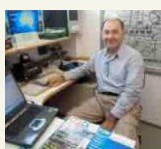
I credit the re-emergence to the number of our EU QRS contingent. Surprisingly there was very little activity on CW for such a big ham population like EU!
In my teenage days when I still was on air in EU any time you turned on your rig on 20m it would be buzzing! There is a dramatic change no doubt =) see near 40m. Only a short amount of time devoted to 40 m this Tuesday, band sounded quiet but empty.
Responded to VK6FN CQ several times but did not manage to get through.
[80m] Band sounded quieter than usual (noise down to S5 with CW filter on), few DXs were coming through on FT8 but no QRS traffic. Finally a signal popped up at Ironstone SDR and I tuned on that frequency.
It was VK2IOW booming in at my QTH, we had a QSO on 160 m only 15 min earlier. Boy it was refreshing to copy without noise and QSB and confirm some of the missing details from our earlier QSO.
Patrick has a great antenna full length loop for 80m at 10m elevation, very decent. With just 80w he was 10 dB over S9 and S1 on receive. Imagine a noise level of S1, I do not get close to S1 even on 6 m!
VK5AO must have been monitoring ragchew with Patrick so as soon as I finished with Patrick he called me. It has been a long time since we had a QSO so I had to flip through a lot of pages in my paper log to find the name.
Mait was not at his usual level this time only 4 but that was not the only problem, Ergon must have just enabled Tariff 2 power and the local water heaters came to life.
For me that means sweeping interference which slowly creeps into the CW filter at a low level then rises, when it hits the passband it drowns the signal and then drifts out only to creep back again within seconds.
Combining with my bad flu and incessant coughing both sending and receiving were a bit challenging. After working VK5AO I had a go at 160 m (more later) and on return managed two more QSOs on 80m.
By this time the Ergon nightmare was over or at least the heaters were not turning on that frequently but the coughing was just as bad, when you got to cough, you got to cough no matter what mid sentence or mid word, it was embarrassing.
I managed to work Paul VK3KLE after a long while and I think on 80 m for the first time and Stan ZL3TK. QSOs between myself and Stan are never short as he is looking for VK on 160. He had luck with Patrick but I am yet to make it.
As it was getting too close to midnight in ZL I had to let him go finally. [160] Twice during the evening I ventured to 160M and managed a QSO each time, pretty rewarding. On the first occasion I spotted signal on Ironstone SDR at 1820.
I knew that was VK2IOW so I moved to his frequency and rematched my antenna. Patrick was pretty strong at my QTH but the noise was very high, Ergon was in a full swing and occasional QSB would wipe the signal off but after a while I had plenty copied for a valid QSO.
At Patrick’s end situation was better as he gave me RSN of 541. On second occasion I heard Rob VK3ECH calling just under my advertised frequency and we had another successful exchange.
This time his signal was not as strong as last week nor as stable, a fair bit of fading. Anyway conditions were good enough for a hard-earned QSO but with a lot of repeats.
[80m] Good chat with Mark before the Sandman arrived and sen me back into the house to nod off by the fire. Conditions were quite good and 1 watt ended up being enough.
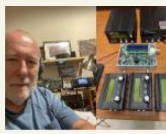
[40m] It was certainly an interesting Tuesday. I got on earlier than usual, and it seemed like the QRQ folks had arrived first. After calling for a while with no takers I noticed a nice strong signal lower on the band.
I tuned down to find Trev, 2TM calling away at 26 wpm, so I slid my Ly Junker key to the side and grabbed the fawkes for
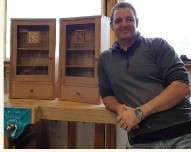
An enjoyable bit of ORG Into the biue Wlountains. After our chat I tuned back up to the CQQRS area, and started calling again with my straight key.
I was soon answered by another regular QRQ operator, Allan, 2GR, who being the gentleman, slowed down to my QRS calling speed. I did notice that towards the end of our QSO that my speed had crept up to about my limit with a straight key.
A natural QRS (ish) speed limiter Next up was a very faint signal smack bang in the middle of the CQQRS area. Assuming it was a VK4 or 6, I narrowed the filters and donned the headphones, only to discover it was Ken in Hawaii, KH6KB.
It took a couple of attempts to exchange callsigns. Being still on the straight key, Ken too slowed down to match my speed Having worked several times before, and given the tough circuit, we exchanged WX reports and 73’d each other.
And then finally the QRS signals arrived First was Tim, SAV in Mt Gambier who I’d never worked before. We enjoyed a great QS0, even though he didn’t think he was any good at rag chewing. Either I have low standards or he was doing well. I think the latter.
One element (©) about the ASO think worth highlighting: we were running EFHW antennas, my apex at 8 meters, his at 5, both of which most would agree is sub-optimal, yet enjoyed armchair copy over a path close to 800 km.
It just goes to show, a compromised antenna in the air is infinitely better than an optimised one waiting to be built. My final QSO was with Ben, 6XC, another new one for me.
Unfortunately the circuit wasn’t great so only shared names and station details before calling 73. Perhaps I need to build that optimised antenna 😉 . In closing, I’d like to make two observations from tonight’s operating:
1. Don’t be scared of operating beyond the CQQRS Tuesdays. As I experienced on two occasions, very fast ops were more than happy to slow to my speed without me needing to ask. Just call at a speed at which you’re comfortable. 2.
Some ops need to drink a cup of cement and harden up. I received multiple WX reports of “cold” along with temps ranging from 12 to 22 C. Sheesh, I would suggest amore apt description of “balmy”. 😉
Plt at ttt Paha aatched ene te iceel el eet hit Sah fd
[15m] Nothing seen from Edi DOZEMR despite knowing from Mike’s Runners Point website that he was on and calling.
[20m] I was actually on time this week! Fausto was
Coming through very weakly, but was RSN 311 into Ironstone Range – with a touch o QSB taking him in and out of the noise floor on occasions. Mike DL3YZ was romping in to Ironstone Range – peaking RSN 511. Very weak with me though; occasional letters only.
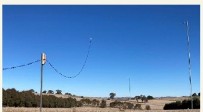
I set out into the 6 degrees to check that both ends of my antenna were still up – hard to see 50+m either way in the gathering dusk but the wires seemed to be heading off in the right direction.
[40m] Nice signals from Max VK3MXW at Werribee and John VK2RU/4 when I came down from 20m to 40m; pleasant to listen in to the conversation. Ditto for the chat between Lance VK7TO at Margate and Tim VKSAV at Mount Gambier.
I went and had a listen on the VK6SEG KiwiSDR for a while, but when I came back I could hear that the band was starting to open across the country.
I listened-in to lan VK7TA at Latrobe chatting to Phil ZL1PB at Tauranga – Phil’s QRP was just making i across the Tasman to here and he was the only ZL I heard on 40m.
Again this week, the Southern States including the VKSPH KiwiSDR at Ironstone Range were hearing the Sandgropers much better than I was. Nevertheless, there was still a goodly amount of activity to listen to.
[80m] After dinner I slipped down to 80m – nice signals from around and about. The VK6SEG confirmed that the band was open to WA, but I didn’t notice any VK6S coming through this way.
James VK7JZ reported that he and Morgan VK6MTF were back at Mount Nelson Signal Station causing trouble again this week; my old TS-120S’s S-meter was peaking $9 which is pretty unusual.
However, despite the good signal, James tried several times to tell me what antenna he ended up with this week (after some unsuccessful testing over the weekend) – however, I kept being distracted (making notes, logging, sending an email and connecting a new member to WhatsApp) – you’d think my brain would work better at head copy than that!
Sorry mate – I look forward to reading about your antenna in your report. Anyway after bidding the frozen duo adieu, I caught up with Greg VKSKFG at Wilunga.
My brain still wasn’t working at peak efficiency – I was sure he said he was operating from somewhere different, but after some discussion, I concluded that I was imagining things.
Meanwhile, my sending had gone down the tubes as well – I had more repeats than Dame Nellie! So we busied ourselves with a little experiment Greg was running his IC-7300 turned down to 20W, and he was peaking RSN 592 He reduced the power to SW and was RSN 572, then down to 1W where he was RSN 552; my ancient TS-120S’s S-meter wasn’t doing too badly, especially linearity wise, considering there was QSB etc.
Thanks Greg, great fun and great practice.
Also from your out-going editor Mark VK6QI at Beauti VK6SEG KiwiSDR at Hoddys Well near Northam WA
[15m] Nothing seen from Edi DO2EMR in WA either.
[20m] Mike was just starting to dribble into WA when work g: in the way, and he went QRT; guess you gotta pay fo it somehow Mike!
Ron – but Max had his clarifier on and so they were actually about 1KHZ apart; that explains why Max didn’t hear Ben calling him. Thank goodness for waterfall displays!
[80m] The band was open across Australia; my 50W was coming through to the Hoddys Well KiwiSDR near Northam RSN 551, and when Greg VKSKFG turned his IC-7300’s power down to 1W, he was still RSN 321 for the few seconds that I had a listen. What a great band!
[40m] The band seemed less busy than usual. Conditions were initially good but faded out for closer stations. [80m & 160M] Condx on 80 metres were good. I also managed 2
Post Morsum 24th June 2026
From Richard VK6HRC. Four on the VK6RLM rptr and AllStar/Echolink hub this morning.
VK6QI_ = Mark VK6FN Max ZL3TK Stan VK6HRC
VK6QI Mark VK6FN Max ZL38TK =Stan VK6HRC and our short wave liteners.
Mark called in from a foggy but still beautiful South Bowning with his report. Making use of the Ironstone Range and Northam Kiwi sdr receivers as well as ‘the home station heard five on 20 m, twelve on 40 m and had short contact with Jim VK7JZ and longer QSO with Greg VK5KFG on 80 m.
Max had a contact with Ron VK6KHZ and a Partial with Roy VK6RR on 40 m as signals dropped away. Stan listened out for our Northern Hemisphere friends with the help of a Kiwi sdr on the higher bands, unfortunately 40 m was unworkable due high noise so no contacts there.
Just a reminder here is that Stan has a very handy PDF spread sheet on his web page with information regarding the QRS net with call signs names and location.
I also use the QRZ data base as well but sometimes no name is in the profile or different name to the one they prefer to use. For example a friend of mine is listed as Frank VK???
But everyone knows him as John I So Stan would like you to have a look over information and let him know of any amendments that need to be made eg : change of call sign, location ete.
I made use of a Kiwi sdr out in the wheatbelt North of Toodjay where Mike DISYZ was coming in at a respectable s5 nothing from home.
Had one contact on 40 m and two on 80 m then into SWL mode an enjoyable evening in all Thank you once again to all on last night and this morning. 73 Richard
Reporting
After next Tuesday’s Group, please remember to send me a list of who you worked and / or who you heard using our web form here:

Even if you didn’t hear anyone, we’d still like to know that you had a go. And to make your report more interesting, please consider sending a photo: cqarsnet@gmail.com So, please help attract new and old team members to have a go by submitting your report each week.
Submissions close 1300 (Eastern Australian Summer time)_on Thursdays.
V Band Part 5 – The Decoder
From Ross MONNK Some old-school CW operators enjoy the characterful Morse timing typified by some (but by no means, all) eccentric bug users. I can understand their enjoyment of eccentricity but my copying is simply not up to it and probably never will be.
And I probably don’t need to tell you what a blessing a decoder can be when you’re just starting out in Morse code – it can fill in those gaps when your brain absolutely refuses to recognise any character you hear.
The decoder also has another use – this time connected with sending rather than copying. The decoder gives you near instant feedback on how well you’re managing to send Morse with that desirable standard timing.
After my over is complete (not whilst sending – that’s far too distracting), I usually have a quick scan of the decode to see how well I’ve done. It’s like a micro-competition between me and the decoder – can it catch me out? Not this time, ha-haa!
It’s like having a Morse Buddy who can give you honest advice without causing offence.
However…

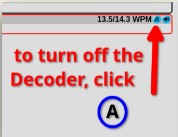
…or go to the ‘No Decoder’ Channel 5 ND. But you might find it rather lonely there because it’s a fact that at least 50% of Vband users would be lost without the decoder; and the other 50% like to have someone to talk to.
Love it or loathe it, I’m convinced that the success of Vband is largely due to the decoder. It’s on by default; it’s used by most operators on there; it helps with polishing your sending; and it promotes communication when at least one operator is not good at Morse.
It certainly has its downsides, not least of which is the dreaded Decoder Dependency. But these are downsides that are easily lived with. So, don’t let pre-conceived ideas about the decoder put you off Vband. Somehow I don’t think they will!
Next time – a few useful tips to finish this series with.
…or go to the ‘No Decoder’ Channel 5 ND
Based on publicly available historical sources including the Radio Society of Great Britain (RSGB), Bletchley Park Trust, and UK National Archives material written and edited as an original interpretive text by David Brown G3DJB and Chris Rayner G7BED.
The RSGB National Radio Centre (NRC) is a keen supporter and active promotor of CW, with a number of volunteers who are also members of CWops and CQaQrRs.
David Brown (G3DJB, #3448), Chris Rayner (G7BED, #3431), and Mervyn Foster (G4KLE, #3283) can regularly be found demonstrating CW and running hands-on sessions at the NRC for all generations — young, old and everyone in between.
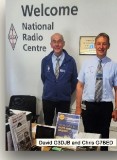
BLETCHLEY PARK and the NRC The Bletchley Park Estate and the RSGB National Radio Centre (NRC) tell the remarkable story of how so many people together with civilian radio amateurs helped win the Second World War, and how their legacy lives on today.
During the war, nearly 10,000 people worked in Bletchley Park, and over 1,500 Voluntary Interceptors used their own radios and technical skill to intercept enemy Morse transmissions.
They fed vital intelligence to Bletchley Park’s codebreakers and played a crucial role in Allied ee ee
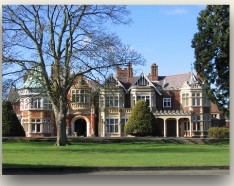
MICU Today, Bletchley Park and the RSGB National Radio Centre continue that tradition as a living museum and heritage attraction, featuring a working radio station and interactive exhibition.
Visitors can explore the evolution of radio from Morse code to Satellites, take part in hands-on demonstrations, and even speak to people around the world via the on-air GB3RS amateur radio station – whether or not they hold a licence.
By linking wartime history with modern amateur radio, the NRC preserves one of Bletchley Park’s most human and technically ingenious stories, showing how ordinary people with radios helped change the course of history – and how those same skills still connect the world today.
Bletchley Park and the Birth of Signals Intelligence Bletchley Park begins its recent history as an English country house and estate in Bletchley, Buckinghamshire, in central England, now part of the city of Milton Keynes.
Bletchley Park became the principal top-secret centre for Allied codebreaking during the Second World War. The estate housed the Government Code and Cypher School
(GC&CS) which later became known as GCHQ, playing a pivotal role in defeating the Axis powers by deciphering secure German, Japanese, and other communications.
Historians widely credit the work carried out here with shortening the war, with some estimates suggesting it ended the conflict two to four years earlier than it might otherwise have done.
Beyond its immediate wartime impact, Bletchley Park pioneered early computing technology and laid the foundations of modern signals intelligence, later embodied in GCHQ.
As the centre of Allied codebreaking during the Second World War, it regularly penetrated the secret communications of the Axis Powers, most importantly ae oa pees oes eee
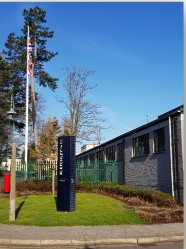
The German Enigma ana Lorenz ciphers. The GC&CS team of codebreakers included among others, John Tiltman, Dilwyn Knox, Alan Turing, Harry Golombek, Gordon Welchman, Hugh Alexander, Donald Michie, Bill Tutte and Stuart Milner-Barry.
The team at Bletchley Park, a high proportion being women, helped to develop automatic machinery to assist with decryption. This work culminated in the development of Colossus, the world’s first programmable digital electronic computer.
Codebreaking operations at Bletchley Park ended in 1946, and all information about the wartime operations remained classified until the mid-1970s.
After the war, the site had various uses and now houses the Bletchley Park museum, now an award- winning museum and heritage attraction which tells the story of the Allied codebreakers.
House and Pre-war History Bletchley Park estate was first known as Bletchley Park after its purchase in 1877 by the architect Samuel Lipscomb Seckham, who built a house there. He was an English Victorian architect, developer, magistrate and brewer.
Born in Oxford, he later became the City Surveyor and was the original architect employed by St John’s College, Oxtord, to develop parts of North Oxford.
The estate, comprising 581 acres (235 ha) was purchased in 1883 by Sir Herbert Samuel Leon, who expanded the house into what architect Landis Gores described as a “maudlin and monstrous pile”, combining Victorian Gothic, Tudor, and Dutch Baroque styles.
Following Herbert Leon’s death in 1926, the estate continued to be occupied by his widow, Fanny Leon (née Higham), until her death in 1937. In 1938, the mansion and much of the site were purchased by a builder for a proposed housing development.
This never came to fruition. Instead, in May 1938, Admiral Sir Hugh Sinclair, head of the Secret Intelligence Service (SIS or MI6), purchased the site for use in the event of war.
He bought the estate using £6,000 of his own money (equivalent to approximately £450,000/%485,000 in 2025), as the government department concerned claimed it did not have the necessary budget.
The private purchase also helped keep both the department’s involved and the location itself secret. Preparation for War As war became inevitable; the estate was destined for use by the Secret Intelligence Service.
A key advantage identified by Sinclair and his colleagues, who inspected the site under the cover of “Captain Ridley’s shooting party”, was Bletchley’s geographical centrality within the United Kingdom.
The site was immediately adjacent to Bletchley railway station, where the Varsity Line between Oxford and Cambridge operated. The universities in those cities were expected to supply many of the codebreakers. Bletchley was also a major transport hub.
It lay on the main West Coast railway line connecting London, Birmingham, Manchester, Liverpool, Glasgow and Edinburgh. By road, Watling Street (the AS), a principal route linking London with the north-west, was nearby, while high-capacity communications were available at the telegraph and telephone repeater station in nearby Fenny Stratford.
Only a small number of bombs fell on the site and surrounding area, perhaps aimed primarily at the adjacent railway infrastructure.
There were no antenna systems on site, and the single-storey brick and timber huts may well have resembled a hospital complex when viewed from the air.
Ne rears OF reacemnne Bletchley Park now features a Polish Memorial commemorating the pre-war work of Marian Rejewski, Jerzy Roézycki and Henryk Zygalski, mathematicians of the Polish intelligence service who first broke the Enigma cipher.
Their achievements greatly assisted the Bletchley Park codebreakers and contributed significantly to the Allied victory in Second World War.
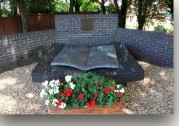
June 2014 saw the completion of an £8 million restoration project by museum design specialists Event Communications. The restoration was marked by a visit from Catherine, Duchess of Cambridge, whose paternal grandmother, Valerie Middleton and great-aunt Mary (née Glassborow) both worked at Bletchley Park during the war.
The two sisters served as Foreign Office civilians in Hut 6, where they managed the interception of enemy and neutral diplomatic signals for decryption. Valerie later married Catherine’s grandfather, Captain Peter Middleton.
A memorial at Bletchley Park commemorates the work of Mary and Valerie Middleton. Continuing its educational mission, the Bletchley Park Learning Department offers educational visits and active learning programmes for schools and universities.
These activities help visitors understand the site’s wider significance in the history of computing and national security. Workshops cover introductions to codebreaking, cyber security and the story of Enigma and Lorenz.
Additional notes: Many further records are held by institutions throughout the United Kingdom including: Government Code and Cypher School, Foreign Office and General Post Office: Maintenance of Foreign Office Intercept (Y) Stations.
The Foreign Office maintained a number of Wireless Intercept (Y) Stations at strategic overseas locations during the years leading up to the Second World War.
Staffed by Foreign Office personnel, these stations operated from 1938 in accordance with priorities established by the inter-departmental Y Committee rather than by the Foreign Office itself.
Foreign Office personnel also undertook traffic analysis and evaluation work overseas under the direction of GC&CS. The RSGB National Radio Centre – A Showcase for Radio Communications Technology The National Radio Centre – Where History Meets Modern Communication Nestled within the wider Bletchley Park site, the RSGB National Radio Centre (NRC) reflects both the history and continuing evolution of radio communication.
It displays the full spectrum of radio technology, from the disciplined precision of Morse code through voice transmission to the complexity of modern digital modes and satellite systems. At the heart of this story is the crucial role played by civilian radio =
Amateurs during the war – men and women whose skills in tuning, listening, and decoding signals directly supported Bletchley Park’s intelligence effort.
It is this unique connection between amateur radio and wartime codebreaking that the NRC exists to preserve and interpret.
The Voluntary Interceptors: Britain’s Secret Listeners Voluntary Interceptors (Vls) were more than 1,500 skilled British radio-amateur civilians – often including teenagers – were recruited early in the Second World War to monitor enemy radio traffic.
Initially recruited through amateur radio circles such as the London Wireless Club (which later became the Radio Society of Great Britain) and carefully vetted by the security services, these volunteers used their own radio receivers, and later government-supplied equipment, to detect and log secret Morse transmissions that regular military intercept stations might miss.
These volunteers worked under the direction of the Radio Security Service (RSS), a covert British signals-intelligence organisation created to locate and monitor enemy radio transmissions.
The RSS initially operated under MI8 during the early war years before becoming part of what is now the Secret Intelligence Service (MI6) in 1942, forming an essential civilian complement to the military Y-station intercept network.
At first, the VI’s task was to detect clandestine enemy agents operating within the UK, but as the war progressed, they shifted focus to monitoring German military and sectet-service traffic.
Most notably, they intercepted transmissions from the Abwehr – the German military intelligence service – which were copied onto log sheets and forwarded to innocuous-sounding “PO Box 25” in Barnet, North London, before being sent on to Bletchley Park for decryption.
The VI intercepts provided unique, raw material – often unobtainable from any other source – that helped Bletchley Park’s codebreakers, crack complex ciphers and gain crucial insight into German operations.
The work was demanding, reaching their required monthly quota of logged intercepts could even exempt volunteers from onerous home-front duties such as fire-watching, providing some recognition of their contribution.
All were bound to strict secrecy under the Official Secrets Act, often unable to discuss their vital work for decades after the war ended.
Inside the RSGB National Radio Centre (NRC) Today, the NRC is not simply a museum of radio history, but a working communications hub that brings the story of amateur radio into the present day.
Visitors move through a series of themed zones that combine historic equipment with modern operating positions, allowing them to see – and often experience – how radio communication
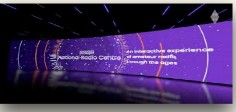
Works in practice. Across the centre, the hands-on exhibits explain how signals are generated, transmitted, and received, from basic Morse code and voice transmission through to more advanced techniques.
Interactive displays allow visitors to experiment with tuning, filtering, and decoding signals, revealing how even faint transmissions can be recovered from background noise – just as the Voluntary Interceptors once did during the war.
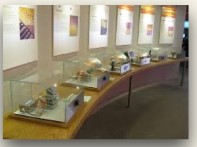
Understanding Modern Radio Modes For visitors unfamiliar with radio technology, the centre demystifies modern communication methods.
“Digital modes” refers to computer-based radio communication where messages are encoded as data rather than voice or Morse code – enabling everything from sending text and images to accessing email via radio waves.
“Satellite working” means communicating through amateur radio satellites orbiting Earth, which act as relay stations in space, allowing operators to contact stations thousands of miles away that would normally be beyond reach.
The GB3RS Amateur Radio Station A key feature of the NRC is its live amateur radio station, callsign GB3RS, which is on the air daily.
From this operating position, licensed radio amateurs make real contacts with stations across the UK and around the world using a wide range of frequencies, antennas, and transmission modes, and visitors are very much part of the
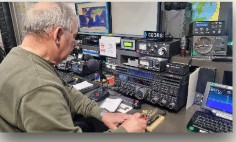
Delivering exceptional coverage and signal strength far beyond what most home stations can achieve. In addition to HF (high frequency), VHF (very high frequency), and UHF (ultra-high frequency) operation, the station also demonstrates digital communication and satellite working, showing how modern radio amateurs can communicate through orbiting spacecraft as easily as through ionospheric refraction – the “bouncing” of radio waves off layers of Earth’s atmosphere.
This continuity – from hand-sent Morse to space-based relays – mirrors the wider story of radio itself, linking the skills of wartime interceptors to the technologies of today.
The station is operated by volunteers from the Radio Society of Great Britain (RSGB), and RSGB members also benefit from free admission to Bletchley Park, making the NRC not just a museum, but a practical and welcoming hub for the UK’s amateur radio community.
Through GBSRS, the NRC connects past and present: a place where visitors, radio amateurs, and history meet – not as a static display, but as a living, transmitting station.
Preserving a Living Legacy The RSGB National Radio Centre stands on the same ground where some of the most important intelligence work of the Second World War was made possible by radio.
The Voluntary Interceptors – working quietly in their homes with headphones, receivers, and Morse keys – formed an invisible frontline, feeding Bletchley Park with the raw signals that would become decoded messages, strategic insight, and ultimately contributed to Allied victory.
Today, that spirit continues at the NRC. Although the technology has evolved from simple receivers and hand-sent Morse to digital modes and satellite links, the underlying principles remain unchanged: careful listening, technical skill, and the human desire to communicate across distance.
The centre succeeds in making history accessible and relevant. While the wartime exhibitions at Bletchley Park showcase the codebreaking achievements of mathematicians and linguists, the NRC tells a parallel story – one of ordinary people with technical skills who made extraordinary contributions.
It’s a reminder that intelligence work wasn’t only conducted in the grand mansion and huts of Bletchley Park, but also in spare bedrooms and garden sheds across Britain.
By bringing together wartime history and modern amateur radio in a working, hands- on environment, the RSGB National Radio Centre does more than preserve the past – it demonstrates its continuing relevance.
Every signal heard, every contact made from GB3RS, and every visitor who speaks on the air for the first time adds a new chapter to a story that began at Bletchley Park more than eighty years ago – a story that remains unfinished, evolving with each new generation of radio enthusiasts.
A Role for SDRs
Some still believe the use of SDRs is cheating. Let’s face it, there’s nothing more abhorent to a POG than a cheat. ‘An occurence on the recent NZ Straight Key Night provides an example.
Despite clear rules, blatant cheating emerged wherein ‘CQ SKN’ was being sent on a bug, easily IDed by its unmistakable dialect.
It got right up my nose, and a couple of others were offended by it too, but don’t expect the able-bodied miscreant to own up, that’s not the nature of cheats. Think of that SKN cheater as amateur radio’s.
Answer to Trevor Chappell, brother of the erstwhile Australian cricket team’s captain, who in 1981 at the close of a one-day test match at the MCG, bowled the final ball underarm to ensure New Zealand could not achieve a draw.
Shameful, but regrettably quite legal. If every Tuesday’s QRS FFA was a contest, then unless specifically allowed in the rules, using SDRs would also be considered shameful. But QRS FFAs are neither competitive nor exclusive, quite the opposite.
QRS FFAs are founded on the premise of cooperation to provide a safe on-air practicing environment for Morse newbies. With that definition in mind and to ensure a range of operating experiences, this POG has relaxed his ascerbic view on the use of SDRs by members of the QRS Group.
In fact, SDRs should be encouraged in certain circumstances, especially when deployed to establish meaningful contacts with group members in Europe.
Despite arguably having been dealt a pretty dreadful hand in latter-day propagation terms, the DXperiment members are still putting in the effort to participate, their efforts regularly stymied by poor conditions.
Unfortunately the QRS nursery on 40 m is often occupied by the same folks for far too long. We’d better pull up our big-boy pants and face reality.
Worse is to come now the peak of Solar Cycle 25 was passed in October 2025, so expect to see ionisation of the F-layers gradually wane over the corning years, and the need for operating expertise to increase.
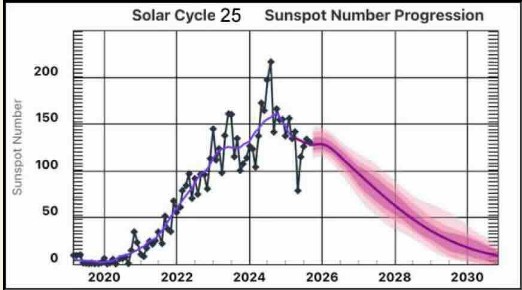
Who thinks it’s time to wheel-in a readily-available ‘leg-up’? Since some are unfamiliar with how SDRs can be deployed in the FFA DXperiment environment, here’s a simple explanation.
Happily almost nothing changes, except both stations choose to receive using an SDR located on the other side of the world.
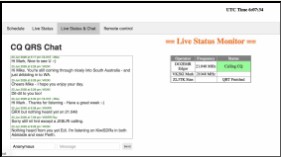
Transmitting arrangements and the advertised DXperiment station’s 2 KHz sked ranges remain the same, and for those whose rig has no waterfall and also haven’t started using DL3YZ’s superb Live Status Monitor, suddenly the convenience of being able to see the whole 2 kHz spectrum on an SDR of the possible frequencies where the DX station in question might pop up, is a real boon.
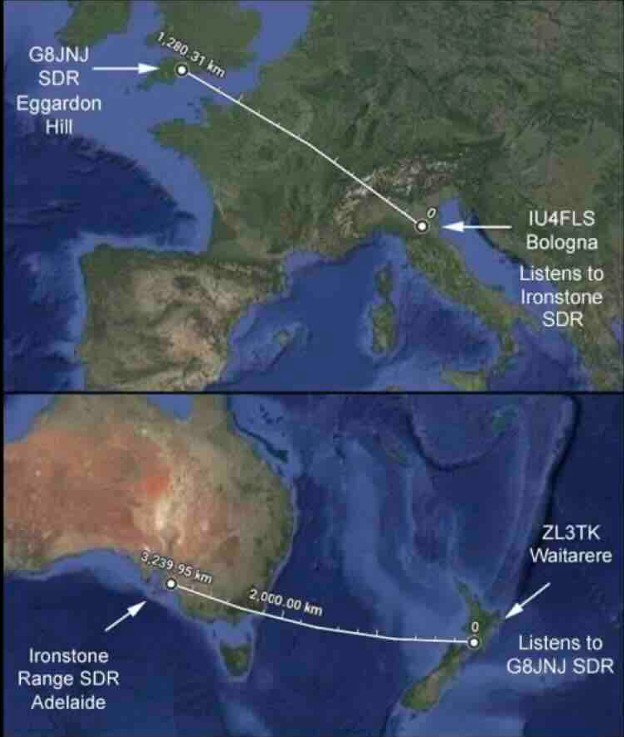
‘Two excellent examples of KiwiSDRs with loop antennas and optimally located for low noise, can be seen on the map below.
Each is nominally outside the ‘dead’ zone between loss of ground wave and manifestation of sky wave for most stations currently active on the DXperiment,. The sensitivity of well-run SDRs ensure locals nearby can get into them regardless.
The maps show how two KiwiSDRs were used to facilitate a CW QSO on HF between Italy and New Zealand on 23 June 2026 at 0605Z, with a leg-up courtesy of the internet.
IU4FLS was heard in New Zealand via the UK SDR at RSN 561, while ZL8TK was heard in Italy RSN 541 via Ironstone, perfectly clear but weaker as. expected.
The reason will be obvious to those who read a previous article in Ragchew, this is just another QED scenario.
RSN for intelligent signal reporting still applies for the most obvious and supportable of reasons. KiwiSDRs show a bar-graph S-meter across the lower edge of the control panel, thus both band noise and the incoming signal are easily determined.
This set up provides opportunities for successful DX contacts while still maintaining a long-distance HF link at both ends, ie compliant with the CQQRS FFA basic premise to provide experiential practice and fails to meet the definition of cheating.
Those with differing opinions please speak up now, because we’d all love to benefit from your offer of a more convenient and economic alternative to SDRs and internet assistance, if such a thing exists.
Reasonable antipodean HF communication is likely to rely on such systems in the foreseeable future. Aword of advice about choosing DXperiment frequencies.
Not everyone has the luxury of a waterfalland the majority of operators go straight to whole-number frequencies ending in zero or five.
It’s a mistake to do the same, instead choose odd-ball frequencies, eg 14.0417 MHz or 21.0483 MHz, where there is a reduced likelihood of it being already occupied or succumbing to QRM midway through a QSO. The same principle applies to all bands and all times.
One slight disadvantage of the G8JNJ SDRs is a15 minute time limit. That’s plenty of time to pass a signal report, greetings and station details both ways.
Refer to the recent sage observation by OM Manny VK3DRQ about the proper, gentlemanly way to conduct yourselves, known as etiquette. Please restrict DXperiment traffic to confirm the contact with signal reports, it’s not meant to be a rag chew.
I’ve so far had no luck finding an email address for Martin G8JNJ to request an increased timeout, so have tried others, which if carefully chosen, work equally well.
Anyway, we’re not limited to kiwiSDRs, so try some other brand for yourselves, and pass on any good news you discover. 73 from the resident softened POG, softened only on the subject of efficient SDR usage.
If you have an article or two that you think might be of interest to our readers, please let me know so we can share more thoughts and ideas; for guidance on writing for RagChew, see Articles below. Please email material to Mark VK2KI: cqqrsnet@gmail.com
On My Workbench
Airzone AM Valve Radio Restoration – Continued
From Martin VK6MJ I have just finished restoring a 1945 AM valve radio receiver by Airzone (Sydney) to listen to the milliwatt valve AM transmitter I built a number of months ago.
This radio works so much better than the solid-state stereo on the shelf above it, with a warm and strong sound and is a delight to listen to.
If you are interested in this kind of project, please remember that these radios use very high voltages (around 450 volts) to power the valves. So be careful.
I suggest also building an AC-isolated dim-bulb tester as a safety measure as well – some of the older radios have their chassis connected to one side of the mains!
Airzone AM Valve Radio Restoration – Continued
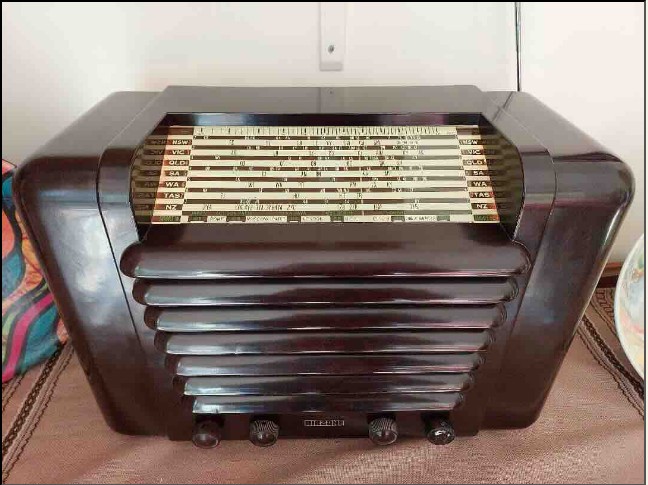
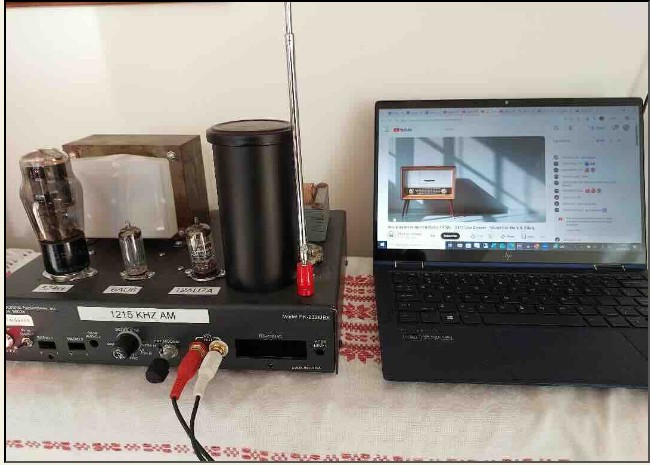
Here, the milliwatt AM transmitter is transmitting audio from a laptop to the receiver on the other side of the room. The transmitter is from an old Electronics Australia circuit and has been discussed several times by me and other authors in earlier RagChew newsletters.
There is an easier way to transmit AM with solid-state components, but as I had decided to transmit to a 1945 receiver, I decided to use similar (albeit much later) valve technology to that found in the Airzone. Cheers all Martin Diggens VK6MJ
Quiet 13.8V Power Supplies
From Rob VK6LD in Albany Hiall, Irecently obtained a new 13.8V DC bench power supply from a VK2 seller. These power supplies are switch mode, originate in computer servers (this one being aHP) and are suitable for 13.8V DC operation.
What is amazing about these units are the size and output – The units are about the size of a packet of biscuits – think Tim Tams – and 58A @ 13.8V DC…!
I have a linear 60A @ 13.8V DC power supply, that is about the size of a small apartment and weighs about 25KG. Ithas a nice 8D printed enclosure over the output terminals, incorporating a LED voltmeter, banana terminals and a 40A blade fuse, which of course limits the 58A output from being maxed out.
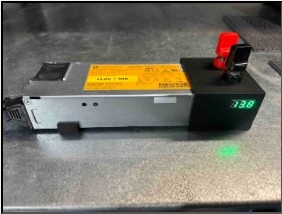
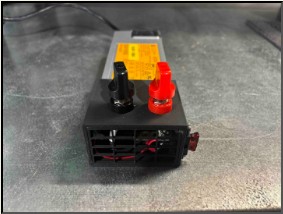
The VK2 seller informs me he has tested these on his remote HF station and cannot detect any increased switch mode noise. I have only tested mine on 10M and there was no noticeable difference to my SO noise floor.
The VK2 seller has sold-out of the 58A / 13.8V supplies, but has let me know he has some 100A / 13.8V supplies, the same sizing enclosure as the 58A available for $180 + $15 postage. Hmm, I’m already thinking I might need the 100A!
Please let me know if you would like the seller’s details. cqarsnet@gmail.com Regards, Rob… VK6LD
What’s going on on your workbench? If you have an article or two that you think might be of interest to our readers, please let Mark VK2KI know; email to cqqrsnet@gmail.com For guidance on writing for RagChew, see Articles below.
QRZ?
This Week – Introducing Kevin VK6AFG Design Faults or Operator Error? A Contemporary Approach to Pain.
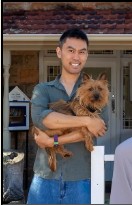
Hello everyone!
Thank you for letting me join the secret club, everyone has been so welcoming! My name’s Kevin VK6AFG, I’m new to CW and very new to ham radio.
I’m also a Chiropractor, Software Developer and Lecturer at Murdoch University, and have been asked to contribute a couple interesting things to the RagChew. I hope you find this useful!
I’m still waiting on my VBand adapter but I’m very excited to get started. If my EchoLink account gets verified in time (which I found through your website this morning), I’l definitely be hopping on this evening, at least to listen!
Aye I found out about CQQRS through Dave VK6KV of the WA VHF Group, who was so generous with his time, patiently explaining everything and answering all my specific questions during the Foundation exam.
He was the one who mentioned that your group is my best bet for CW. Prior to meeting him, I had just learned the alphabet & numbers via lwco.net and Morse Mania.
Long Island CW Club and Vail have also been extremely welcoming communities online, although I haven’t quite got the nerve to join into their broadcasts yet (I don’t even know the Q and prosigns yet, and my copy speed is extremely novice…
Something I’m working towards!) Regardless, I don’t have a profound reason for my interest, I’ve a wide range of hobbies that I obsessively pursue.
CW just feels so meditative practice – hopefully the bug bites and I’l chase the rabbit hole into amateur radio setups, but for now I’d be very content with getting my feet wet with CW and SDRs.
Thank you again for the introduction, looking forward to meeting you soon! Now a bit more about me. As you can probably imagine, as a chiropractor, my bread and butter with work is back pain, which is the most common reason for disability in Australia.
In the 12+ years I’ve been in practice, these are some of the interesting things about back pain I would love to share: — 30% of asymptomatic people in their 20s (Ie. people with no pain), have a disc bulge somewhere in their spine.
This is 60% of people in their 50s, and 84% of people in their 80s. Disc bulges are normal. — We, as a population, are more sedentary than we’ve ever been at any point in history.
And let’s be honest, ham radio doesn’t exactly have us climbing towers all day (well, some of you do, and your backs probably thank you for it). — Pain is not necessarily an indication of injury. All pain has a brain component to. it.
We need to work collaboratively with pain, and respect it as a neutral message from the brain, not to fear/mask/avoid it as an always-dangerous signal.
Remember that pain is just the brain’s opinion of how much danger you’re in (and we all know what they say about opinions). Think of it less like an SOS and more like a weak, garbled signal that still needs decoding rather than panicking.
If] could give two pieces of advice to the general population with back (or most) pain in general, it’s: — “Use it or lose it. With exercise, the bare minimum is: 20 minutes of zone 2 exercise”.
That is, walk/jog/swim/cycle/weights to the point where you’re breathing harder than normal and your heart rate is increased, but can still hold a conversation (or a QSO).
I’m sure the majority of ham radio operators work sitting down, but have a look at desk treadmills. You can get them quite cheaply now and will be the best investment you’ll ever make for your health!
— “Treat pain like a signal report, not a fault condition.” A “2 by 1” doesn’t necessarily mean the rig’s broken, it might just mean conditions are a bit rough right now. You don’t need to chase total silence (zero pain) before you’ll move at all.
Keep moving, adjust as needed, and let things settle with use, rather than waiting for perfect conditions that may never come. Thana thie hae haan jeafill I lava what! de and Inva charina knawiadnel Iankinn
Also this Week – Introducing Rob VA3AUX w Recruit from the Current CWops Academy Cc
Hi Mark. I have been lucky to find a large amount of Amateur Radio operators that are very happy to help to learn the Code. My journey into CW has always been a bit rocky, this has been like this for some time.
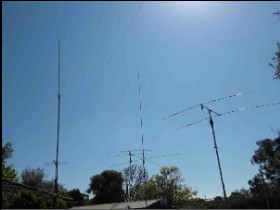
| was trying to teach myself through various apps and using a straight key and for some reason just could not seem to really get anything happening. Being slightly familiar with Chris VK3QB I discovered the CW Ops Academy and the beginners class.
After trading the straight key for a dual-lever paddle, and having Chris advise us and help steer us in the right direction, the curriculum was all starting to come together.
|’m relatively happy with my sending, feeling relatively confident about having all the characters memorised. When it comes to copying, some more work is needed.
Having listened to the net the last Tuesday night I was able to copy many characters and some words from the QSOs transmitted. As I’m sure many others have felt ~ rather anxious about those first QSOs – I may be more of a listener at the start.
But I certainly do want to get on air, as that is the aim of what all the learning has been about. 1am quite active on air as VK3AUX, with SSB being my favourite mode, but I have always had a respect for the Code and yearned to be able to understand it.
When I do my practice I thoroughly enjoy it, there are some frustrating moments, but not so many now. So instead of constantly chasing DX on phone it would be a nice change to do some CW QSOs.
I’m hoping I’ve given you enough information and are looking forward to this next Tuesday night certainly to try to copy as much as possible. Last Tuesday I was receiving signals of 6/9 plus 10 DB. Thanks for your assistance Rob VK3AUX.
QRZ? Who’s on the other end?
CW Practice
This year we’re using Aesop’s Fables. These are short moral stories, often using talking animals, that illustrate simple truths about human behaviour and character.
Aesop’s Fables originated in ancient Greece, traditionally attributed to the storyteller Aesop who is thought to have lived around the 6th century BCE.
The fables are generally smaller files of two to three hundred words that have been recorded at 15 wpm and run for about 15 minutes.
If 15 wpm is a bit quick for you, load it onto your phone and set the playback speed at 0.75 X or even 0.5 X- whatever works for you. 0.75 X will play the MP8 at a bit under 12 wpm. Itis suggested that you read the text file before listening to the audio file.
That will make it easier to follow the audio file and prepare you for any unusual words. Any punctuation that is not usually used with CW has been removed. This week’s fable is ‘The Three Tradesmen’, and the MP3 and TXT files are attached here:


If you prefer a different speed or tone, you can create your own MP3 files by converting the text file with the Ebook2CW app — https://fkurz.net/ham/ebook2cw.html.
You can either play the MP3 files in any media player, or load the text file into the Ditto CW: Morse Player app — https://dittocw.andro.io/.
Both options work well, however Ditto CW gives you complete control over all Morse settings, while a normal media player only allows changes to playback speed, and does that in steps (e.g. +1.25x, 1.5x, 1.75x).
Other News
Emails to the Editor
Hi Mark
My apologies for the delayed response, Telstra’s Bigpong email server put your email into a spam folder where I discovered it only yesterday!
The CW Academy class has instilled a sense of purpose in my participation in amateur radio, it’s just a pity that I too worked that out 40 years too late! Like many I attempted the Morse exam in 1986 when I was licensed. Sending was OK but I failed copying.
It wasn’t practical to put more time and effort into it at the time so CW and amateur radio in general were sidelined until my semi-retirement in 2019.
Thank you for the Ragchew subscription, Ragchew is very readable and I look forward to receiving it each week. Ihave followed your travels with interest, my wife and I visit Albury, The Rock and Wagga annually so we know the area quite well.
I hope you enjoyed the ACO concert, I have not heard them live but did attend a concert given by ACO2 some years ago. Pekka Kuusisto was the leader, they performed the Mendelssohn Octet which was brilliant.
Pekka made it look like he was out for a stroll so effortlessly did he play. You could see him conducting with his eyes. Ihave put the net times into my calendar.
I did listen in a couple of weeks ago without success but as my home QTH is not in a good location that was no surprise. Chris VK3QB has issued the challenge to our beginner class to have a QSO on air before the course completion.
As the course finishes on Thursday 25!” June that means we have to make the attempt next Tuesday! That should be good for lots of RF mayhem! Finally, could I ask you to send me the link to the WhatsApp group please? Having access to it will be invaluable.
73, Mark VK2XMB [Thanks Mark. Did you get to have that first on-air CW QSO? If not – never fear… that’s just what we’re here for; we’ve had many many first CW QSOs on our little net – and to a tee, the experience of every one of them has been great – both for they with the sweaty palms, and for the operators who had the pleasure of sharing the
73, Mark VK2XMB
Good afternoon Mark.
ES ES A a ‘Two weeks in a row I see a significant error in the Weekly Reports Table. Edition 24 shows I tried to work Fausto IU4FLS on 80m (sic) and Edition 25 alleges I actually worked him on 80m (sic).
Obviously both entries are complete nonsense and neither claim was made in my online report. Ifthe errors are because my reports are configured correctly in mandated SI Metric nomenclature, then the false interpretation of my reports is clearly down to those who prefer to play the rather misguided game of ‘Follow the Leader’, rather than to comply with international standards.
Because AR is a science and engineering- based discipline, I will not be downgrading the standard of my nomenclature to conform with anyone else’s flawed preferences.
That means if RagChew is to retain credibility, the problem needs to be fixed at programming level. No offence intended, I’m simply telling how it is. 73 de Stan ZL3TK
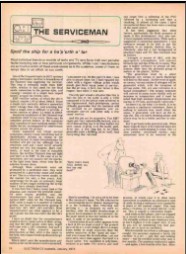
Hi Mark Thanks for relating my On My Workbench articles to the Electronics Australia The Serviceman articles of old. Yes I do I remember them. I was an avid reader of all electronic articles in that era.
My first industry job being in a Tandy store Bourke Street Melbourne. I had the numerical merchandise catalogue numbers memoriesed in just weeks down to the physical shelf location. I did minor rearranging to put it into library
Catalog areas and sequence. I’d worked as a library assistant as a teen. The older workers except for the region manager were a little upset. He of course new the inventory was supposed to be sequential and was delighted with progress made.
I left a full time job opportunity to study electronics at what is now Victoria University (a former TAFE college). I can say having worked in the industry that high density multi later surface mount tech has a intended short life.
That EICO 720 chassis with point to point Construction will outlive a few more CW Ops yet hihi. Best regards Paul VK3KLE
Many thanks Mark, for all your sterling efforts in making the QRS Net the leviathan it is today. And good luck to our new editor and the planned new approach. I’m looking forward to the upcoming developments! Ross MONNK (The Philosophy Department)
You seem to have forgotten that I am one of a tiny minority who actually read every word in RagChew. It therefore should come as no surprise that in last week’s edition I saw immediately what you had done to the title of my article.
That little back-door ruse was not only quite unnecessary, but was neither appreciated nor clever and altered the intended tenor.

This should not be necessary, but since the polite request which accompanies all my articles is now being ignored, here instead is an inclusive, non-negotiable formal instruction: WITHOUT CONSULTATION AND PRIOR AGREEMENT WITH THE AUTHOR, NO ADDITIONS, DELETIONS OR MODIFICATIONS SHALL BE MADE UNDER ASSUMED EDITORIAL LICENCE TO ANY PART OF CONTRIBUTIONS SUBMITTED BY STAN ZL3TK, FOR PUBLICATION IN ‘RAGCHEW.
THIS INSTRUCTION APPLIES TO AND INCLUDES TITLES, SUB-TITLES, TEXT, PHOTOGRAPHS, DIAGRAMS, SIGNATURE LINES AND ANY EMBEDDED INFORMATION REGARDLESS OF CONTENT OR SOURCE. Hopefully that clears up any doubts you have been harbouring about my seriousness.
I’m well aware that to you even mandated international standards are an anathema, but if my contributions fail to meet your, as-yet unspecified editorial standards, just say so, I am happy to respect them.
If my carefully-considered contributions still fail to meet your needs, I can easily redirect what remains of my time to more productive pursuits, toward folk who would appreciative the effort I am, some would say, misguidedly putting in to RagChew.
In Defence of SI Nomenclature, and Those Who Ignore It
Hove order, I love rules, and the older I get, the more I think anything new is silly and unnecessary, unlike in my youth when it was welcome progress and change.
Good grammar is a delight, the correct choice of “you and me” or “you and I” causes my heart to soar. It is most distressing to hear that the Oxford English Dictionary has again added new words.
How will modern vocabulary allow us to better express hopeless despair than Tolstoi, wickedness, hope and achievement than Dickens and the heart wrenching passion of both love and betrayal than Jane Austin?
And so it is that when our resident POG laments the poor use of SI nomenclature I recognise a kindred spirit, albeit one who is happy to rattle his chains whilst I choose instead to float silently by.
My response is tempered perhaps by the fact that it is only due to some relatively recent post grad science studies where I discovered the existence of the oft-ignored space between value and unit.
Alas, all of my prior written material is testament to my ignorance, preserved for posterity. It is often said that languages, both written and spoken, are about communicating ideas, and that if effective, the form doesn’t matter.
That sentiment leans a little too much to the side of hippy-living, pot-smoking, bra-burning antiestablishmentarianism to me.
However, I have come to recognise that ignorant and idiot are far from the same, and that areas of conformity which matter to me are different to those which matter to others.
When confronted by those who have made a wrong different choice regarding language, I make an effort to instead focus on the idea they’re communicating, rather than the form.
Thank-you Stan for your most informative “Living on the Edge” article. I’ve often wondered about asymmetric signal strengths along DX paths.
Your explanation was both clearly explained and very plausible across the routes where I regularly experience the phenomenon.
Morse with a Purpose
Ross’ reflections in “Morse with a Purpose” is exactly how I ended up loving CW. I like staying fit, and climbing mountains isn’t a bad way to do so, but find it somewhat pointless as an activity in and of itself.
Add a radio for SOTA and suddenly there’s purpose.
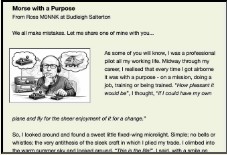
However, portable radios were expensive, but CW-only rigs weren’t, so if I wanted t do SOTA I needed to learn CW. So I learned CW to do SOTA to climb mountains to stay fit. I wonder why she swallowed a fly, perhaps she’ll die. Till next time Lance, VK7TO
Making Crystals in 1926
From Bob VK6POP (reproduced from the WAHAMS email group) Hi all I was researching history stuff for NewsWest, and came upon this – interesting, but too long and dry for a news broadcast. Bob VK6POP
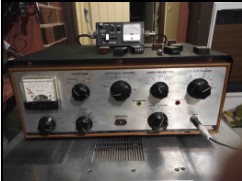
Ground down and mounted, when placed in the transmitting circuit, has the effect of keeping the wave-length stable. Thus with a crystal-controlled station, the wave-length never varies.
In this State the ether is not overcrowded — not even with amateurs; but in other countries, especially America, both broadcasting and amateur stations have wave lengths close to one another, and with the incorporation of the quartz control they can ensure that their wave-length never varies.
The piezo-electric effect is the property possessed by quartz and a few other substances of generating an electric charge when stressed, or, conversely, of altering their dimensions when electrically charged.
Hence a quartz plate can be made to generate or maintain an alternating current, at a frequency depending solely upon certain physical properties of the quartz. Among these are the thickness along certain axes, and the density.
Although the constants of quartz are such that the approximate frequency is that corresponding to a wave length of 105 metres per millimetre, the majority of experimental work has been done with plates whose ratio is about 150 metres per millimetre.
It has often been stated that quartz will not oscillate when unpolished, scratched, greasy or damp. With a good specimen, enough power will be available through the inter-electrode capacities of the valve to maintain oscillations.
Data on the power that may be handled are very meagre, but as a rough guide, the plate volts should not exceed 1 volt per kilocycle, with a maximum of 400 when the quartz is connected between filament and grid.
If the plate has been cracked in use, or fractured by dropping, it never seems to be capable of use again as an oscillator, though it may work as a resonator after grinding to a reasonable shape. Quartz may be used in two ways.
As a resonator, it is used to absorb power from a variable source, and hence we can find out the frequency of the latter. As a generator or oscillator, the quartz actually controls the frequency of the source.
Without elaborate equipment, cutting a slice of quartz by hand takes about ten hours, and the results are apt to be disheartening.
After cutting off top and bottom from a natural crystal, it is examined under polarised light to locate the optical axis and to see that itis either all right handed or all left-handed.
Cuts are now taken at right angles to the correct axes, and the first plate is forced to oscillate somehow. Knowing the wave length of the sample, further cuts are made to yield plates of the desired frequencies.
The following stages in the grinding process are usually necessary: (1) : Straight from the saw:- (2) coarse carborundum powder finish; (3) valve grinding powder (4) fine emery or putty powder finish; (6) rouge finish, which leaves the surface transparent.
Occasional wave length tests should be made while the work is in progress, and once within, a metre of the desired value the micrometer should be discarded and reliance placed upon actual tests alone.
The final stage is to mount the crystal between metal plates slightly humped in the middle, the bottom plate being very slightly larger than the quartz.
Bendigo Telegraph Office
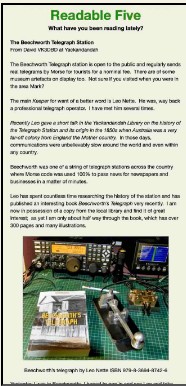
From Kees VK1KVS Hello Mark, It’s been a while… I thought I just respond to David VKS3DBD’s ‘PS’ in CQQRS RagChew 24/2026 where he suggested you visit Bendigo. I have some information that is relevant.
The Bendigo Telegraph Office was previously located in the old Bendigo Post Office where until a few years ago several former PMG telegraphists (‘Morsecodians’) on Sunday mornings gave
Demonstrations sending Morse code messages for visitors, somewhat similar to what Leo Nette is doing in Beechworth. Following the passing of Ted Rankins in 2022 – one of the last former PMG telegraphists there — this arrangement no longer exists.
In Bendigo, only Peter Shaw – also a former PMG telegraphist — still operates the Eaglehawk Telegraph Office from his home in Eaglehawk, Bendigo, where he is one of the links in Leo Nette’s Beechworth Telegraph Office network, receiving and forwarding Morse Code messages from Beechworth.
| visited Peter Shaw on May 2nd and he is still active, despite his advanced years. I did not ask Peter to pose in the pictures, but you see his operating desk at his home in Eaglehawk
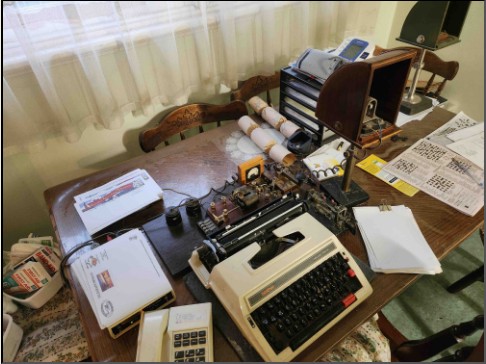
Where he receives the messages from Beechworth before (snail) mailing the typed text on a commemorativ e telegram form to the recipient. During the busy school holidays when Beechworth
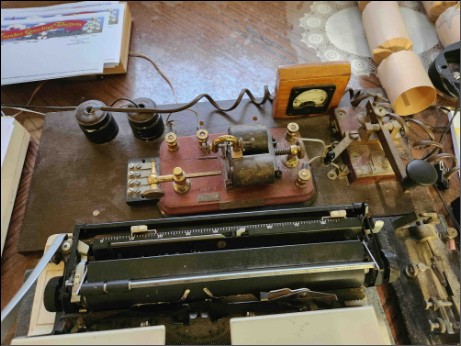
Welcomes many visitors, Peter can take some 200 messages, supporting the claim that Beechworth is the busiest telegraph station in the world.
Peter was also recently featured alongside Leo Nette in an ABC article, which can be accessed at hit station-amateur-radio/106141386. I suspect many readers will have also seen the documentary featuring Leo and the Beechworth Telegraph Station at https:/www.
Youtube. com/watch?v=‘taa-quTHJI. Yes, all is well here, and in the midst of renovations with the certain chaos that brings.
When around I do keep an ear out during the Tuesday evening CQQRS transmissions although I am not always available to keep an eye on the WhatsApp alerts and frequency changes. But do keep up the good work! All best wishes, 73 Kees VK1KVS
Morse Training Net
Our team member Nic VK7WW runs an on-air Slow Morse training net every Wednesday at 7pm EDST on 3580 for 30 mins. He uses the callsign of the Northern Tasmania Amateur Radio Club VK7TAZ on that net.
Many of our team learned Morse code with the support of Nic, and the weekly training session comes highly recommended for anyone who wants to learn the Code, or simply brush up.
Everyone’s welcome – 3580KHZ at 7pm Eastern time every Wednesday; you’ll hear lots of the CQQRS team on that net. Jordan VK3ACU has ralso ecorded the complete set of lessons which you can now find here:
Https://www. youtube.com/playlist?list=PLHsQmZz6fBXO7swAfbT mutrbbEL17fUQL Contact Nic VK7WW for more info nicholaschantler@hotmail.com including how to join the NTARC DISCORD group to follow the action, or just come along and join in on Wednesdays.
We’re not on the Dog and Bone nah Guy’, this is Brarn Sauce
From Stan ZL3TK Cockney rhyming slang can still be heard in East London among the working class and the criminal underworld. It can be amusing, but more-often it’s just outright confusing for those not in-the-know, innit?
Morse code is incapable of conveying the intonations of any language, but has anyone in the group had the rare and delightful experience of working a died-in-the wool Cockney on phone?
Here are a couple of quatrains which might pass as part of a QSO with a Cockney. Both of them, one from each category mentioned above, lack even the slightest glimmer of technical merit, but make up for any deficiency with lashings of humour This one from the ‘can be amusing’ category is spoken with a strong Cockney accent: There was a bleedin’ sparra Flew dahn a bleedin’ spart Dahn came the bleedin’ rain And washed the bleeder aht.
Apropos Morse Code, this one from the ‘just outright confusing’ category; to be spoken in both Cockney accent and Cockney dialect: There once was a bleedin’ straigh’ Bruce Lee Wot made a bleedin’ great Box o’ Toys It got swapped aht for a bleedin’ Steam Tug Which proved a really bleedin’ bad Rolls Royce.
Calling for help here. Warning: responding to this call for help might result in your first article for RagChew. Does anyone in the QRS group claim to have been born within earshot of St Mary-le-Bow’s church bell in Cheapside?
If not, can someone not so blessed but maybe later in life having set foot in nearby Hackney or Bethnal Green, produce a translation for the second quatrain, to go in next week’s RagChew?
We’re not on the Dog and Bone nah Guv, this is Brarn Sauc
DXperiment Etiquette
From Stan ZL3TK In last week’s edition of Ragchew, another pearl of wisdom was cast across the path of the QRS Group. OM Manny VK3DRQ, gave a timely reminder that the DXperiment gives only short windows of opportunity to work DX stations, and it is not intended as a chat platform.
So that everyone gets a fair chance to work the group’s DX contingent in the short, usually 30 minute window, QSOs should be handled with contest- like efficiency, ie kept very brief and devoid of all waste-of-time niceties, no
Weather, no goss, and no ego-stroking pieces of news, unless the DX station invites such comment. The only exception to contest-like protocol is in providing a proper signal report in RSN format so that both stations understand the other fellow’s true conditions, thus the contact provides an element of experiential education.
599 is almost always a waste-of-time, utter nonsense and quite unacceptable in DX circumstances. OM Manny didn’t mention that DX stations themselves can help their own cause by setting an example for how to operate. e.g.
Every station is responsible only for self identification. No regulation has ever been written which mandates one must repeatedly remind the other operator of his own call sign.
The only occasion when the other fellow’s call sign need be used is to establish the contact. In any other circumstance, repeating two call signs over-and-over is simply a needless waste of time.
‘TU 78 de (your call sign) SK’ is copperplate-adequate for both sides when ending the contact. Again, it’s up to the DX station to indicate if he wishes to engage in chat, such as at the end of his 30-minute window.
Finally, the reason for my extreme brevity may not have been appreciated prior to this explanation. Therefore I offer an apology for any offence caused, real or imagined.
I work by the rules as explained above in order to minimise my on-air footprint, meaning that others can get a fair bite of the biscuit.
At the end of the day, it’s up to the DX station to decide how much time he wishes to spend on each contact, and to terminate politely but firmly whenever he sees fit.
Best to remember the DX operator is probably not interested in your grass mowing habits, especially when other things such as a waiting queue is at the front of his mind. 73 de Stan ZL3TK
From Lance VK7TO
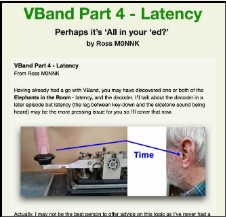
| was interested in Ross’ perspective on latency, and that he’s not affected by it. I first came across the perils of latency when playing lead guitar in a live band and needing to switch to isolating in-ear monitors (IEM).
No longer could I hear my playing directly from my amplifier; it came through a DSP processed
Audio chain. It didn’t take much of a delay to make for a very unpleasant experience in the early transition until the correct hardware configurations were found.
Now to CW, until recently I’d been routing my radio’s sidetone through my computer (don’t ask, it was a temporary necessity), and out to wired headphones. Some observations. With a straight key, I had no issues as I didn’t need a sidetone for timing.
With paddles however it was terrible once I approached 20 wpm. Over time I adapted to it and had no problem … until I went portable with headphones direct to the radio with almost no latency.
So for me, yes, latency matters, and yes, one’s brain does adapt to deal with it. In the last week I’ve reconfigured the shack back to direct monitoring of my CW signal, so no computer induced latency in the chain anymore.
Now I just need my brain to adapt to the direct timing again. C’est la vie. Something else to note, you will get vastly different latency from your computer’s audio based on the sound drivers available from the hardware and software combination you use: ASIO: 2-10 ms.
Pro audio hardware. WASAPI exclusive: 10-30 ms. Modern Windows, special audio software WASAPI shared: 30-100 ms. Modern Windows’ default. WDM (KS): 5-30 ms. Old Windows API. MME: 50-200+ ms. Legacy Widows driver.
When you consider that at 15 wom, a dit is 80 ms, it could be very troublesome for a paddle operator using the default windows drivers. It’s easy to see why it becomes a real challenge at 25+ wpm with dit lengths less than 50 ms.
So if you are monitoring your sidetone through a computer, see what drivers the software or hardware offers as it could make a significant difference… once your brain adjusts. Lance, VK7TO
The Tasmanian Ham Radio Conference is on on November 6, 7 & 8th in Hobart. Click above for more information.
If you’ve read something that you think might be of interest to our readers, please email to Mark VK2KI: cqgrsnet@gmail.com
There’s No Such Thing…
Pho WEEN 2 YMC UlIViios I think the first lesson in Teachering 101 is to always tell students “There’s no such…” (I’m sure you know the rest) and “…the only dumb questions are the ones not asked”.
John VK2RU reckons that there’s lots of questions out there among bot! our new and our experienced operators – about CW, amateur radio operating and about theory. So here we go…
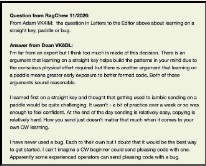
Responding to the discussion in Editions 11/2026 and 12-2026 There’s No Such Thing, Ross MONNK discusses his thoughts. Thanks Ross.
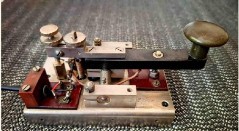
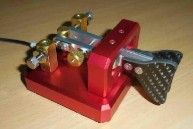
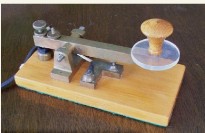
Paddle or Straight Key?
From Ross MONNK Ah, the decades old debate about which is better to learn Morse code on (setting aside cooties, sideswipers and bugs – only a determined masochist would learn on one of those anyway).
The very fact that the debate is decades old tells us straight away that there are merits to either choice. Personally I now use both, so I feel I can approach the subject with some objectivity. But (Disclaimer) I did get started on the paddle.
I was attracted to the paddle by its very weirdness. Any uninformed member of the public can see how a straight key works – it is, essentially, just an ON/OFF switch. But a paddle
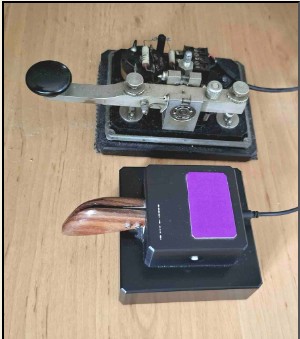
Makes no sense whatsoever. That is just the sort of mystery that makes me want to know how it functions. And to know it properly, I had to learn how to use it.
In practical terms, a paddle forces you into a steady overall speed rhythm – that remorseless stream of dits and dahs that makes Copying so damn frustrating. And Morse sending, by whatever means, is all about the rhythm.
Not only that but you get to listen to an awful lot of perfectly formed dits and dahs, and that sound gets burnt into your brain. Which comes in handy if you transition onto the straight key later on.
With a paddle, you’re working in partnership with the electronics, so your timing (the joining together of those perfectly formed dits and dahs to form letters) has to be spot on too.
Paddles are not easy to master but, once you get the hang of them, there’s a wonderful feeling of racing along that a straight key cannot match. But let’s not deride straight keys.
They have formed the foundation of our craft from the day it started, and they epitomise the spitit of Morse code even today. There is something captivating about the straight key that is hard to put into words.
It’s something to do with the direct physicality of converting thought into sound. It’s something that’s enhanced by using an old well-used key with a hidden history.
It’s something to do with being forced to slow down and focus on quality rather than speed, entering “Morse Time” (the message will take as long as it takes – the essential spirit of QRS).
Both the straight key and paddles require high personal standards of accuracy, timing, and rhythm. Both are hugely satisfying to get to grips with. Both are masterpieces of human ingenuity in their own way.
I suppose what I’m trying to say, in a rather roundabout way, is that (IMO) it doesn’t matter – choose whatever you enjoy the most, whatever feels most natural to you.
The important thing is that you stay motivated during the frustrating early years of learning Morse code. Besides, the real challenge of Morse code is not Sending, but Copying…and no Morse key will help you with that.
Come to think of it, to pass the time whilst you’re learning to Copy, maybe you should start with a Cootie, Sideswiper or Bug after all!
Question: BALUN for ZS6BKW Doublet
From John VK5ET G’day Mark, hope you & Ms. Elizabeth are enjoying your touring break. Very quiet last night. Listened mostly on VK5PH KIWI SDR, & that went quiet around 9 pm local time so had an early night.
What type of BALUN do you use on your doublet (ZS6BKW) with the ladder line? Most bods on the internet say better to use a 1:1 BALUN due to multi bands & frequencies being used when fed with 450 Ohm ladder line.
I may have to revert back to the 1:1 BALUN for time being use a mono band antenna??? 73s John
Answer:
Isn’t Paul’s KiwiSDR network just the duck’s guts? Works so well. I use 1:1 Current BALUNs on the ZS6BKWS with 300 Ohm TV ribbon feed-line, but I feed the transmitting end of the coax with an antenna coupler.
| have done some impedance measurements with a Nana-VNA and experimented a bit with different lengths and BALUNs – but I didn’t come to any conclusions.
Memory fading, but I think I also built a double-core 4:1 Current BALUN but I don’t think it was successful – so
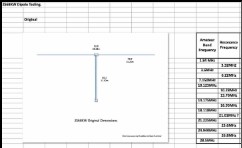
Back to the standard 1:1 current BALUN. Does anyone other reader have other experience with the various feed options? Pleased to hear others’ comments: cqgrsnet@gmail.com. Have fun John – as you know, these simple home-brewed antennas are terrific!
Bit of a pain to put up every time when portable, but they work unbelievably well. Mark VK2KI / VK6QI
[Do you have a question or two or a discussion starter worth sharing? cqqrsnet@gmail.com if so.]
Prosign/Character/Signal of the Month
[Put it on a sticky note near your key as a reminder for Tuesday…. and tell us how you went!]
Di-dah-di-dah-dit
So back to the CQQRS Slow CW QSO practice net.
Next Tuesday’s Net
Our CQQRS Group will be on as always on Tuesday from around 0600Z until about 1200Z; see https://bit.ly/CQQRSWebsite and navigate to the Net Details page for details.
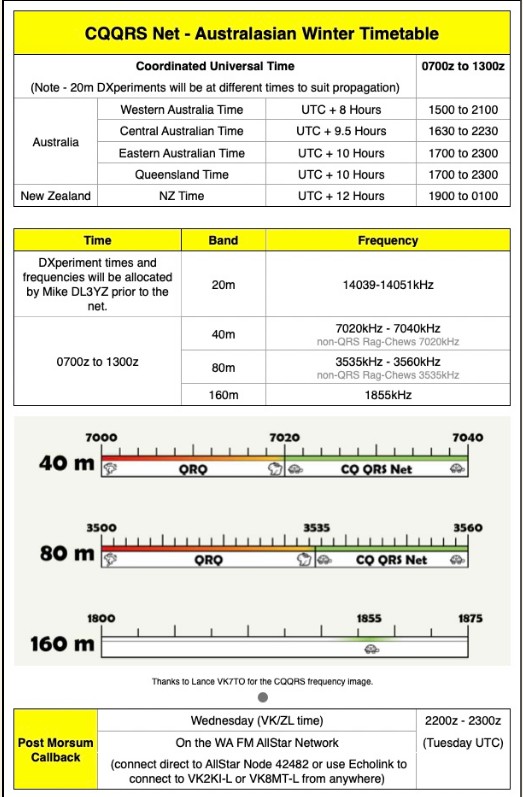
Doesn’t matter whether you’re brand new and want to try just exchanging callsigns and RST reports, or you’re ready for a good old rag chew. We’ll have fun.
There’s usually people around until after 1200Z – so keep calling in the segment of the band designated in the table below until you catch someone.
Reports & Photos
Please let us know via our Reports form bit.ly/CQQRSNET who you work or hear on Tuesday’s Group. The report form closes at 1pm (Eastern Australian time) on Thursday. And how about helping to make the reports even more interesting by sending a photo?
If you have a photo that you’d be happy to include, please email it to: cqqrsnet@gmail.com And of course, we’re always on the lookout for more photos for the newsletter, so if you have something that might be of interest aside from the reports, please send it through as well.
Email to cqgrsnet@gmail.com please. Oh and by the way, I recommend that you don’t keep the Reports Form website open between submission of reports from one week to the next.
If you’re unlucky, there’s an undocumented feature in the software that could cause your current week’s report to be combined with your previous report – it’s happened to your editor several times – much to the chagrin of our Reports editor 🙂
Post Morsum
Richard VK6HRC will run our phone Post Morsum on Wednesday mornings on the South West AllStar net (via repeaters and hotspots all over WA) from 0600 WA time, then from 0700 WA time on 80m (3605 LSB).
See https://bit.ly/CQQRSWebsite anc navigate to the Net Details page for details of how you can connect via Echolink from anywhere in the world.
Articles
Could you write a short article or articles for RagChew? You bet! Writing not your strong point? Don’t worry, I’m very happy to help as much or as little as needed.
Oh, and one more thing (actually two) – copyright material: * please use your own images – don’t use images copied from the internet unless you have the producer’s permission, or they’re marked ‘Creative Commons’ or similar; ¢ if you include other peoples’ written material, unless you have permission, you may only include small snippets (unless it’s marked ‘Creative Commons’ or similar), and you’ll need to site the source and author.
For more guidance on writing for the RagChew newsletter (including how you might even try using one of the new Artificial Intelligence tools), head to our website bit.ly/CQQRSWebsite then click the menu on the top right and then click RagChew Newsletter.
Material
Areminder; if you send me any information by email, our report form or WhatsApp – unless you specifically state that material is not to be published, I’ll assume that you’re happy to see your thoughts in the RagChew newsletter.
Teamwork
Inank you so mucn to our team OT so contributors: VDLoYZ, G3DJB, G7BED, IU4FLS, The Resident POG, MONNK, VK1KVS, VK2IOW, VK2RU, VK2TIG, VK2XMB, VK3ACU, VK3AUX, VKSECH, VKSKLE, VK4BVM, VK4IM, VK4PN, VKSAO, VKSET, VK5FD, VKSKFG, VK6AFG, VK6HRC, VK6KHZ, VK6LD, VK6MU, VK6POP, VK6RR, VK6TX, VK6XC, VK7JZ, VK7TA, VK7TO, VK7WW and ZL3TK.
And a special thank you to our editorial team, Nigel G4RWI (head of software development), Patrick VK2IOW (reports coordinator), John VK2RU (spreadsheet pilot), Richard VK6HRC (post morsition), Lance VK7TO (director of the archive department), Jordan VK3ACU (head gagster) and Ross MONNK (seconded from the Psychology Department).
Great work all! GU CW on Tuesday, mb Mark Bosma VK2KI / VK6QI Beautiful South Bowning NSW cqqrsnet@gmail.com non impediti ratione cogitationis
About the CQ QRS Net
For the current schedule and more information about the CQQRS net, please go the the Net Details page on our website:

The opinions expressed in the RagChew newsletter are those of the individual contributors. The opinions do not necessarily reflect that of the editors or of the CQQRS Group members.
Any material and images received from members by the editor or published on the CQQRS WhatsApp groups may be published in this newsletter unless specifically requested otherwise.
The RagChew newsletter is considered to be exempt from the Australian Government’s ban on social media for under 16 year olds because it is a service that has the primary purpose of enabling users to share information about products or services, engage in professional networking or professional development services or of supporting the education of users per the Australian Government eSafety Commissioner FAQ webpage “Which platforms have been excluded from the age restrictions” dated 10DEC25.
The values, doctrine and guidelines for the Group and for the newsletter are published on the Principles page of the group’s website https://bit.ly/CQQRSWebsite