Below is a reconstruction of the 2024 47 CQ QRS RagChew newsletter designed to support full text searching. This reconstruction was built using OCR, and will contain errors.
To view the Mailchimp original, click here. To search the entire newsletter archive, click here.
Contents
- CQ QRS RagChew
- Last Tuesday’s Group
- Masthead Image
- Reports
- Submissions close lunch time on Thursday.
- Reports & Comments
- Comments:
- Post Morsum Report
- This Week’s Topic of Interest
- Tuning Troubles Sorted
- Other News
- That’s Perfectly Normal..
- Royal Australian Corps of Signals Centenary
- Three CW Pet Hates
- 3. Operators who send a stream of Dits after they’ve made an error. This is probably necessary if you’re sending encrypted code but it has no place in normal messages – if you make a mistake, just send that word again. This is particularly a problem with beginners because they make a lot of mistakes (no problem – that’s part of the learning process), and have read that dit-streams are the way to indicate an error (which is technically correct). But listening to lots of dit-dit-dit-dit-dit-dit-dit-dits is very hard on the ears and on the brain. It drives me crackers. Guys, I can hear that you’ve made a mistake so Just Send That Word Again.
- Morse Training Net
- Brain teaser
- Exam Questions – Foundation-level Only:
- Answers from last week’s Quiz:
- Di-dan-ali-aan-aii
- Next Tuesday’s Net
- Post Morsum
- Teamwork
- The Joy of Daylight Saving
- About the CQ QRS Group
- Frequencies and Times
- QRL?
- Speed? Rhythm?
- Matching
- PSE QRS
- Landing Zone
- CW Tips
CQ QRS RagChew
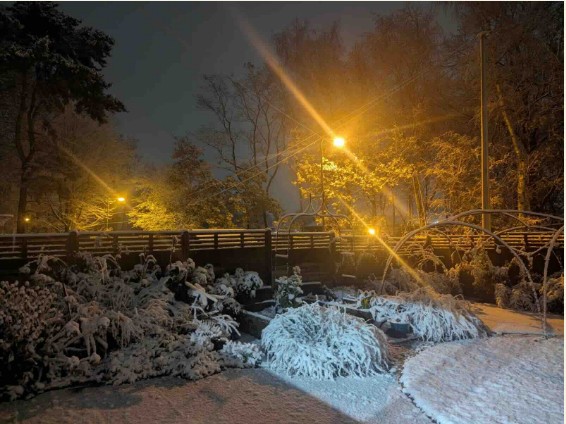
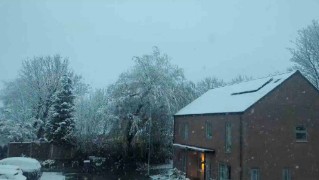
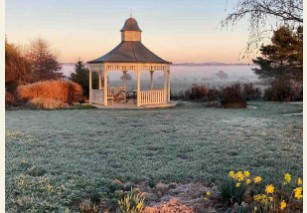
Early Tuesday morning UK time at the start of this week’s CQQRS net. First snow of the season – Simon MOKBJ at Wolverhampton
So many stations on air…. so much fun had! Tuesday’s net was great fun, with lots of stations on 40m. Conditions were good on 80m, but only a few brave souls were on this time.
The same couldn’t be said about 20m, 15m and 10m used by our four intrepid Europe / UK operators who braved the early morning rather brisk conditions; the long-path just wasn’t cooperating; there were some QSOs into VK, but conditions weren’t great.
Thanks for all the reports this week; I really enjoy reading your thoughts about each week’s net – and I know others also look forward to the good read. And this week I’ve introduced a new training aid…. cunningly disguised as a crossword puzzle.
Last Tuesday’s Group
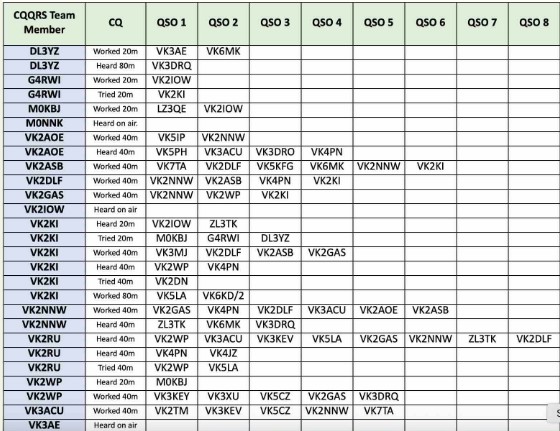
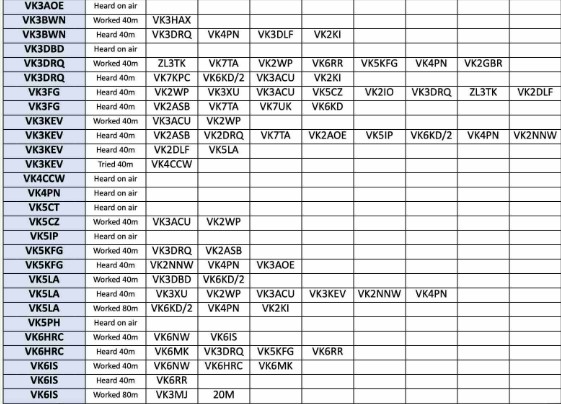
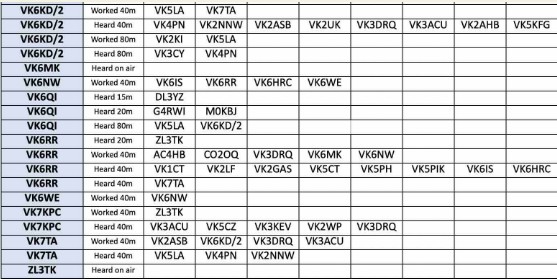
Here’s this week’s list of the 61 stations heard:
Masthead Image
And thanks this week to Simon MOKBJ at Wolverhampton for getting up early for the CQQRS net and taking this terrific photo of the first snow of the season. Wonder why he wasn’t out portable this week?
Reports
After next Tuesday’s Group, please send me a list of who you worked and / or who you heard using our web form here:

Submissions close lunch time on Thursday. If you hear or work one of our team on a different band on Tuesday, please just use the 80m report area and annotate which bit applies to which band.
And when you enter the list of callsigns worked, heard or missed, please append an ‘@band’ to each callsign without a space (eg VK2KI@20 VK6QI@15 etc).
The head of our software department, Nigel G4RWI has continued to work furiously to produce a simple way of reporting on contacts with our team outside of 40 and 80m; I still have a Beta version sitting on my pile of projects waiting to be tested.
Please help attract new and old team members to have a go by submitting your report each week.
Submissions close lunch time on Thursday.
Reports & Comments
The spreadsheets above show the known stations on last Tuesday’s Group. Comments distilled from the reports I’ve received follow:
Comments:
[40m] * Great for Rx practice – Slowly getting my ear in hihi.
From Nigel G4RWI near Axminster, Devon + First attempt to join the fun from the UK.
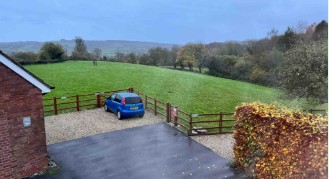
• First attempt to join the fun from the UK. * We are house sitting on the Sth Coas of Devon for a few weeks on a small farm owned by my cousin.
• The motorhome is now a full-time shack with my trusty EFHW for 40m semi-permanently installed.
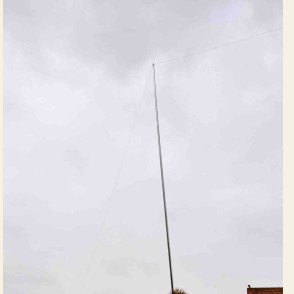
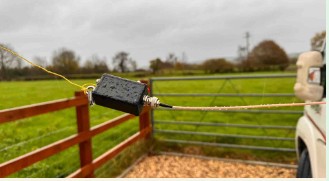
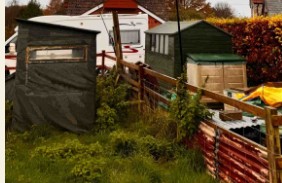
• Very enjoyable QSO with Pat VK2IOW. I think this was my first VK contact from the UK under “my own steam”. Have worked VK from Bletchley Park but thats with 1Kw to a beam. This felt like proper radio. Great fun!
[40m] * Tnx for the fun evening guys. I hope to catch you all again soon and maybe some DX. Keep up the good work.
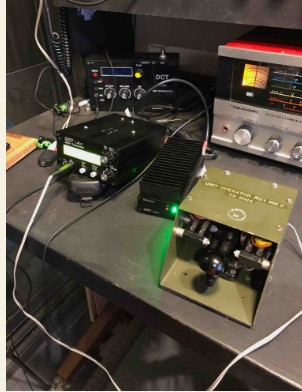
[40m] «| tried out my new (old) ex-army key on the QMX + paired with the QRP Labs 50W amp. Works a treat!. + Nice way to spend the evening (with the obligatory cleansing ale). 73 de VK2AOE George
From Mike DL3YZ at Stuttgart + Today I was able to work for 2 hrs from inside the hut in the meadows. Its maybe not the most charming environment, and I had to share the hut with some cute small furry animals and too much clutter.
But Its dry and at least warmer than outside (6 C). + Even if it was very windy today, it was quiet inside. So great for listening to weak DX signals.
+ Unfortunately the 15 m band was not open today, and I didn’t hear myself on 10 m at the ironstone SDR as well. So much on the propagation forecast tools telling me the shorter bands are better for DX during winter season.
+ Maybe its not cold enuf yet to finally shrink the bands Hi. + On my 20 m shift I was happy to chat with Dylan ( VK8AE ) again, who had a nice and clear signal up here in Stuttgart. Again, the VK station clearly won the WX report :-).
+ And I had the honour to work a Stuart ( VK6ME ) for the first time. At that time, [had some QRN from an remote thunderstorm. But we managed to understand most of our sendings. * Before I got to the hut this morning, I listened to Simons QRG during breakfast.
I heard Manny ( VK3DRQ ) loud and clear here on my SDR at home. + Greetings to the team from Germany, and thanks for the fun.
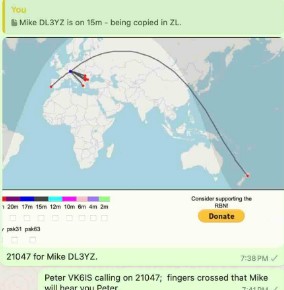
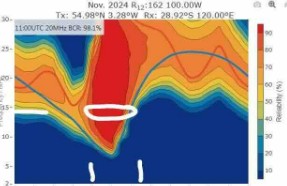
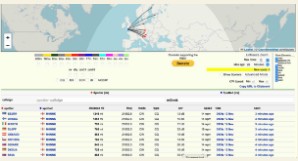
[Great work Mike, and thank you for coordinating the DXperiment again. As it turned out – the 15m band was actually open from you to ZL Mike; here’s the Reverse Beacon Network spot. Did you get a photo of the “cute furry creatures”?]
[20m] +I could just hear a hint of Simon MOKBJ on 20M but not well enough for a aso.
[40m] * My RSI flared up badly in my right hand, so I was keying left-handed with a paddle. Despite the challenge, I had some great contacts, particularly with VK2NNW. Adam’s CW was excellent, and I was able to head-copy our entire aso.
+ We have some fantastic operators in the group now, which makes for faster contacts when both operators are proficient. However, I’m always mindful of beginners and those who haven’t had their first contact yet…
+ Keying left-handed actually worked out well—it slowed me down a bit and helped me focus on improving my head-copying skills. This is an important step for me, especially when my RSI makes it difficult to write down or type what I copy at higher speeds.
+ I’m wondering if anybody else suffers from RSI and if you have tried a touch paddle or something simitar?.. [Great report Jordan. Far too young for RSI and such ailments mate; suggest you hold off on such diseases until you’re old and crotchety like me.
Actually I’d be interested in comments from Doctor Donald about what operators could do to reduce the risk. Ditto from other operators with experience with this form of trouble.
I had similar things probably caused by keyboard use years ago and cortisone injections may have helped – but I reckon when I went to a standing desk (including for my current (temporary – hal) radio shack), and my computer keyboard was able to be lowered further than a sitting desk could, the problems slowly abated.
However, QLFs aside, operating with the opposite hand like you’re doing may help develop the corpus callosum which might help balance your logical and artistic brain functions (ask Google, ChatGPT etc)….
Not to mention help with manual logging, note-taking etc]
[40m] + Many stations found having QSOs on 40m. I found I was waiting for many stations to finish QSOs and stay on freq long enough for my call. No apparent lightning crashes heard from my location however my basic noise floor sat around S8.
[80m] + Not as many stations heard on 80m. May have been due to a report saying lighting storms passing hence shut down of stations.
From Ross MUNNKA near Exeter. 8 degrees centigrade, wind, steady rain. That doesn’t sound like a recipe for Portable DX. But I was out there this morning, calling “CQ VK”…
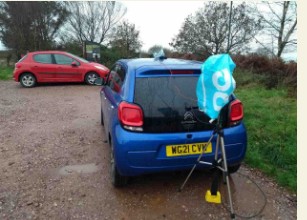
It didn’t help that this guy in the red car pulled up and parked in front of me, directly in line with my signal path to Australia. I don’t know if it made any difference but I would have preferred if he’d parked somewhere else.
I live on a small crowded island so you have to get used to this sort of thing.
Anyway, in accordance with my published schedule, I got busy on the key. Unfortunately I had no luck today. I almost expected this because ¢ I was trying out a modified CB radio whip antenna, cut down for 28 MHz, ona mag mount on my car roof.
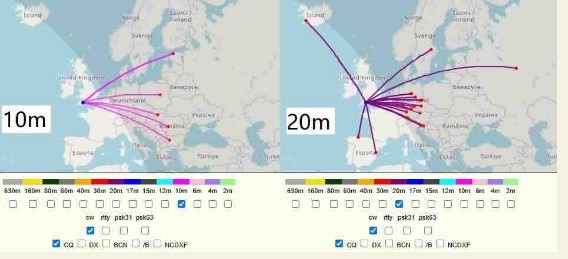
I would’ve been very pleasantly surprised if that had yielded a contact but I thought it was worth a try. ¢ Mike DL3YZ showed me a Proppy forecast https://soundbytes.asia/proppy/p2p that showed a great opening of the 20m band over a wide period of 0800-1300z.
| doubted this forecast (| expected a narrow window 0800-09002) so I put in for a slot 0930-1000z, right in the middle of the supposed opening. As I didn’t have any luck, I think I’ve proven the Proppy forecast to be inaccurate.
The weather was miserable and I didn’t get any contacts.
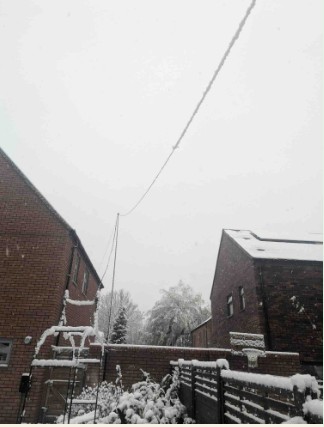
From Simon MOKBJ at Wolverhampton, UK + I woke to a covering of snow outside, the first of this winter. We usually get 3 to 7 days of snow each year in Wolverhampton but I don’t remember it ever arriving this early.
• I worked Ando LZ3QE in Bulgaria at 0645Z but the 20m band didn’t open to the southern hemisphere until over an hour later.
* 90 minutes after I started calling (I must set up a memory keyer so that I don’t have to make each CQ cal manually!), Patrick VK2IOW came through with a nice signal, clearly above my S4 noise floor. I’m grateful
To the stations that called and sorry I didn’t hear you this time. [Great fun Simon. Thanks for the terrific snow pictures, including the beautiful pre- dawn mast-head image…. hopefully that made your early start worthwhile!
The majority of people in Australia never see snow, but in New Zealand, they grow their mountains really really tall, so that they’re snow-capped all year round (in the South crumpled Island anyway).]
[40m] + Another message reply sent to Stan. One WA request from Stan. I think the rest was ok. + Managed to send 25 Word msg without any botched characters that I detected. Just waiting on report on Stan’s website.
[40m] + Listened for MOKBJ and others on higher bands but were to weak to work. Last Tuesday was a wipeout due to a large lightning storm overhead. Next week hope to be portable in conjunction with a SOTA activation, weather permitting. May be rain about..
[I’ll keep an eye out for you on the parksnpeaks.org CW Spots SMS feed Wal; wh can I’ll copy/paste them to the CQQRS WhatsApp Alerts.]
[40m] + Listened for MOKBJ and others on higher bands but were to weak to work. Last Tuesday was a wipeout due to a large lightning storm overhead. Next week hope to be portable in conjunction with a SOTA activation, weather permitting. May be rain about..
[I’ll keep an eye out for you on the parksnpeaks.org CW Spots SMS feed Wal; w can I’ll copy/paste them to the CQQRS WhatsApp Alerts.]
[40m] + Not enough signals for a frantic night but enough to keep most people busy. The noise was down and the signals were good making for lots of 599 reports and pretty much armchair copy. A good night..
[80m] + Looked in on 80m at 1115Z but there was no activity at all then threw the big switch.
[Higher bands] + I did spend long time searching for the OMs Simon, Ross and Mike on their respective frequency and times but Nil was heard. Checking the RBN I found the answer, no signals coming out of
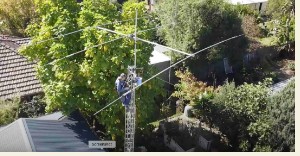
[40m] + variable conditions QSB and QRN at times.
[80m] + very quiet, only one station heard not strong enough to get a callsign unfortunately.
[40m] + it does get noisy after 1700WST. + and there is still an lot of stations that are missed.
[80m] + there was no activity heard on 80m this week. + did try to work the EU stations, again this week, but they were too weak.
[40m] + I tried answering Wal and Andy on 40m but couldn’t get through. After a while I gave up and thought that I’d done something to my antenna that I’d been playing with during the afternoon.
+ Much later in the night I noticed that F-BKIN or BKIN wasn’t on the IC7300 screen. I had attended 2 LICW classes during the day and had turned BKIN it off so I could use my key during the class. + Hopefully I won’t do that again. [Great practice though mate!)
From your editor Mark VK2K at Beautiful South Bowning
[20m] + Once again, I was out having too much fun on my ancient zero turn mower slashing through the 50CM tall grass along the 600M front verge of our property and our two neighbours’… so I was late to the party at the start of the net.
I had a quick look on 40m and could hear stations on, including Wal VK2WP up at Bathurst, before re-tuning my antenna coupler and noise canceller for the higher bands.
+I tried calling Simon MOKBJ at Wolverhampton at around 0730Z when I saw him spotted on the Reverse Beacon Network via Mike DL3YZ‘s web page.
+ I could see and hear Simon weakly on the Tecsun KiwiSDR at Araluen NSW, bu nothing at home – probably my very wide Trio TS-120S receiver and the loss through my phasing-type noise canceller (the Araluen SDR is in a low noise area).
+ At about 0810Z, I saw on our CQQRS WhatsApp Alerts that the chief information officer of our software development laboratory Nigel G4RWI was on air from Devon.
Nigel and I could just hear each other coming in and out of the noise as the vagaries of the long-path propagation did their thing.
I set up the WA KiwiSDR to be in the right side of my headphones, the NSW SDR in my left ear, and my home transceiver in both ears… a brain-managed diversity receiver.
+ sent Nigel RSN 211, and over the next 10 minutes or so, Nigel tried again an again to pass his report – he even doubled his output power for me – from 5 Watts to 10 Watts – but I was just getting the occasional numbers.
I assembled the numbers into a RSN 421 report… but later Nigel advised via WhatsApp that I got it wrong; he had also been struggling to copy anything but the occasional letter from me.
• Meanwhile, I could see / hear Simon working Patrick VK2IOW up at Millthorpe, and I was again surprised that I could hear Patrick on 20m over such a short distance – around 200KM; short skip because of strong ionisation I suspect.
+ Around 0930Z I heard Mike DL3YZ calling CQ – but signals were very weak and I don’t think he could hear me this
• Awhile later, I could hear Stan ZL3TK from Waitarere Beach calling Ross MONNK portable near Exeter. However, I could see from the Reverse Beacon Network that Ross was calling 500HZ higher, but Stan wasn’t on the CQQRS WhatsApp group, so I couldn’t help bring the two together.
[40m] + After concluding that the long-path propagation gods were frowning on the higher bands this week, I came back to 40m and was pleased to hear that there were too many stations on our net to find a quiet spot using my barn- door width Trio TS-1208.
+ I heard Sava VK4PN at Mount Ommaney and Arthur VK2ASB at Wentworth Falls calling CQ, but others jumped in before I called either of them…
Which is a good thing 2) + Instead I had a chat to Mark VK3MUJ at Geelong using his 20m dipole, Georg VK2DLF at st Marys and then Arthur VK2ASB.
+ I was called by a station that I thought was VK2DN, but he didn’t come back to my call, and instead I had a chat to Armin VK2GAS at Norwest, before my eyelids and QLF told me at 1130Z that it was time to have a quick look on 80m.
[80m] + When I slipped down to 80m, I could see on the VK6QS KiwiSDR that the band was wide open to WA from the East, and could see Sava VKAPN in Brisbane chatting to Andy VK5LA at Winkie with solid signals into WA.
Having chatted to Sava last week, I picked Andy and we had a nice half hour chat using his TS-8208. + Around 1210Z David VK6KD called in – this time he was portable VK2 in Tamworth, continuing his clockwise journey around Australia.
At the late hour of the night, and after four months in Queensland both David and I had trouble sending his callsign without automatically sending 4 after the /; the so-called (incorrectly named in my opinion) ‘muscle memory’ that the American helicopter instructors kept telling Elizabeth and me about.
From your editor Mark VK6QI at via the VK6QS KiwiSDR near Brookton
[15m] + At around 0840 I saw Mike DL3YZ at home in Stuttgart on the Reverse Beacon Network via Mike’s web page, with his signal reported in New Zealand (see previous screenshot in Mike’s report).
+I could see Mike coming through to Western Australia on the VK6QS KiwiSDR near Brookton, but not on the Tecsun KiwiSDR at Araluen NSW.
My old Trio TS-120S doesn’t work above 20m any more, and I didn’t get an opportunity to crank up the Southern Electronics Groun VK6SR Remote South of Perth to try
• After concluding that the long-path propagation gods were frowning on the higher bands this week, I came back to 40m and was pleased to hear that there were too many stations on our net to find a quiet spot using my barn- door width Trio TS-1208.
+ I heard Sava VK4PN at Mount Ommaney and Arthur VK2ASB at Wentworth Falls calling CQ, but others jumped in before I called either of them…
Which is a good thing 2) + Instead I had a chat to Mark VK3MUJ at Geelong using his 20m dipole, Georg VK2DLF at st Marys and then Arthur VK2ASB.
+ I was called by a station that I thought was VK2DN, but he didn’t come back to my call, and instead I had a chat to Armin VK2GAS at Norwest, before my eyelids and QLF told me at 1130Z that it was time to have a quick look on 80m.
[80m] + When I slipped down to 80m, I could see on the VK6QS KiwiSDR that the band was wide open to WA from the East, and could see Sava VKAPN in Brisbane chatting to Andy VK5LA at Winkie with solid signals into WA.
Having chatted to Sava last week, I picked Andy and we had a nice half hour chat using his TS-8208. + Around 1210Z David VK6KD called in – this time he was portable VK2 in Tamworth, continuing his clockwise journey around Australia.
At the late hour of the night, and after four months in Queensland both David and I had trouble sending his callsign without automatically sending 4 after the /; the so-called (incorrectly named in my opinion) ‘muscle memory’ that the American helicopter instructors kept telling Elizabeth and me about.
From your editor Mark VK6QI at via the VK6QS KiwiSDR near Brookton
[15m] + At around 0840 I saw Mike DL3YZ at home in Stuttgart on the Reverse Beacon Network via Mike’s web page, with his signal reported in New Zealand (see previous screenshot in Mike’s report).
* I could see Mike coming through to Western Australia on the VK6QS KiwiSDR near Brookton, but not on the Tecsun KiwiSDR at Araluen NSW.
My old Trio TS-120S doesn’t work above 20m any more, and I didn’t get an opportunity to crank up the Southern Electronics Group VK6SR Remote South of Perth to try Mike. Oh well, next time perhaps?
• So overall, although the long-path experiments from the UK and Germany weren’t as good as previous weeks, the lower bands were alive with our CQQRS team, out there having fun. How lucky are we?.
[40m] + Great condx on Tuesday night, low noise and little static at Chez Winkie a couple of nice QSOs on 40m.
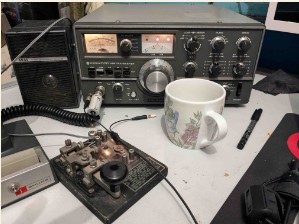
[80m] * Headed down to 80m after the SSB Boatanchor net and called CQ. After working out that I needed to use the RIT control to find who was replying to me as there’s no CW filtering on the TS-520, I had QSOs with 3 stations, including our illustrious leader – A great night!
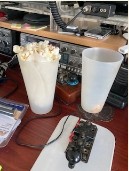
Like transceivers of its vintage, the TS-520S needs to be tuned 700 to 800HZ off frequency on receive to copy CW in the filter’s passband. Luckily, the dial is marked for that purpose… unlike the later digital gear like the TS-120.
What’s the rectangular thing to the left of the key I wonder?
Post Morsum Report
Hello Mark, five on the AllStar / Echolink and VK6RLM repeater network. Happy to report we got off to an early start with a general catch up before the net.
On today : VK6KD/2 David VKeQl Mark VK6NW Wayne VK6FN Max VK6HRC Richard SWL: VK6KRC Bob VK6MRB Mulligan and others. David checked in from the country music capital Tamworth and was happy with his efforts on the night.
Mark managed to check in from home and let us know that he had four DX contacts , local contacts on 40MX and on 80MX. Plus a brief description of his audio setup with multiple feeds to his headset, mind boggling !
Wayne had a couple of contacts on 40MX tested out his vertical later but had to head off to an SES call out instead of a training night. Max has had some success with his antenna, all being well we will be treated to. some fine CW from Manajimup again.
Ihad a couple of contacts on 40MX, did the usual tuning around and tried 80MX later with one very weak signal not strong enough to decode unfortunately.
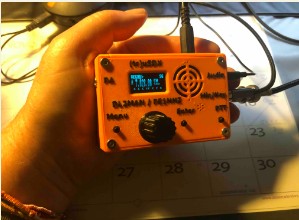
As usual the WhatsApp link was very busy last night keeping us informed on what was going on in the background, lots of humour plus lovely photos. Thanks to everyone last night and this morning. 73 Richard VK6HRC
How many radios do you need? One more apparently!
This Week’s Topic of Interest
Tuning Troubles Sorted
Tuning troubles sorted As you will see, ‘m not an antenna expert. But you clearly don’t need to be an expert to enjoy ham radio – you only need enthusiasm and I have plenty of that (and so, probably, do you). So where’s this going then?
Well, I’ve been messing about with simple wire verticals recently (wire is cheap) and I thought I’d share something I’ve discovered about tuning the % wavelength flavour when matched with two elevated radials.
The internet wisdom is that one’s radials should be “at least as long as the radiating element”. So, I made the radiating element several centimetres longer than the theoretical length obtained using an online calculator (so I could trim it down to the resonant length), and then made a pair of elevated radials somewhat longer than the radiator.
I put a 1:1 balun on and connected it to my nanoVNA using 7 m of coax. Then I “got my knickers in a twist” trying to tune it – I kept trimming the radiating element but the resonant frequency simply wouldn’t increase to what I was aiming for.
In the end I was left with a ridiculously short stub of antenna wire. And then I had a bit of an “Ah-hal” moment…more in desperation than anything else, I started trimming the radials and the resonant frequency started moving in the right direction!
After restoring the radiating element to its original length and some further trimming, this is what my results came out as:
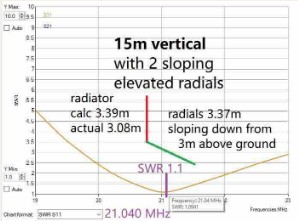
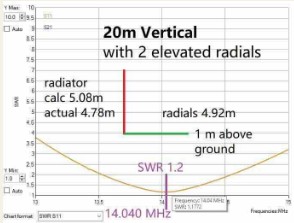
As you can see, in both cases the radiating element ended up somewhat shorter than the theory would suggest. The elevated radials are, indeed, a bit longer than the radiator – quite close to its theoretical length, in fact.
For the nerds amongst you, here is the Smith chart for the 20m version:
Resistance and Impedance are both 50 ohms at 14.040 MHz. No doubt some Antenna Wizard out there will know that those figures suggest that I still haven’t got the tuning right. But (and this is where “enthusiasm” triumphs over “knowledge’).
I then connected the antenna to my new QCX-mini QRP radio and had a contact into Germany from the south of England, so it can’t be that imperfect.
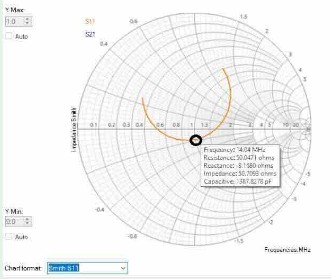
Returning to the whole purpose of this article, the Pearl of Wisdom I’ve discovered and which I want to share with you is… Elevated Radials are not some vague arbitrary length – their length directly affects the resonant frequency of the antenna as a whole.
So, both the radiating element and the radials need to be trimmed in order to adjust the resonant frequency. Sorry if that’s all a bit technical. We learn by experimenting and I enjoy experimenting.

Other News
That’s Perfectly Normal..
Royal Australian Corps of Signals Centenary
Noyal AuStralian VOrps OT vignals Ventenary from Rob VK2COS Next year the Royal Australian Corps of Signals will celebrate its Centenary Year.
One of the activities will be the activation of a special callsign VI100SIG which will be active from 14 Feb – 31 Dec 2025.
I’m planning to operate with that special event callsign for members of the CQQRS net – perhaps on Monday or Wednesday evenings if there’s interest from the group.
Instructions: Fill in each answer using the clues below.
TileVe’t ons: Fill in each answer using the clues below
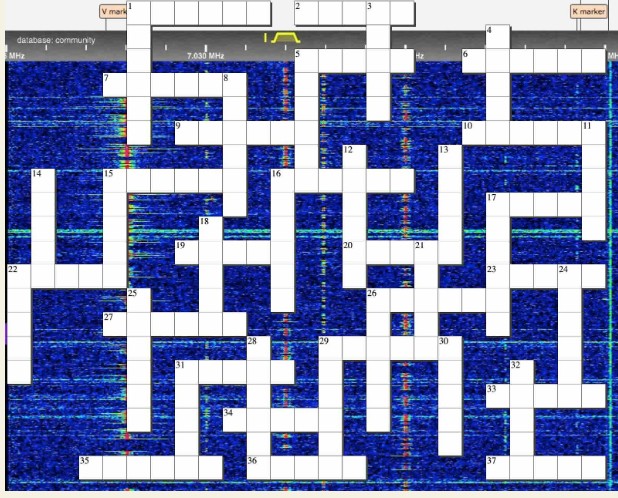
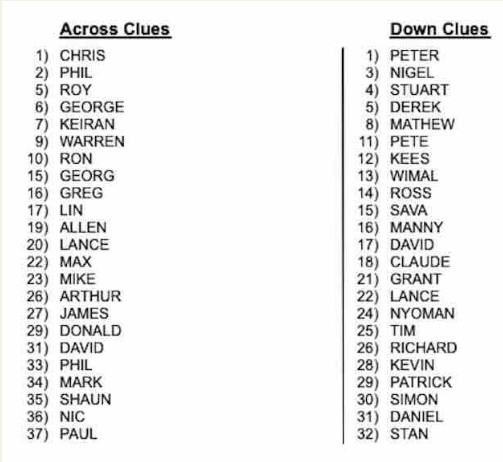
Round of applause goes to Rush Software’s Martin Fitzgibbons the Australian creator of the Crossword Wizard puzzle generation application, focussed primarily on creation of crossword puzzles for education.
Martin has stepped up and provided help to me to create puzzles that can be brought into MailChimp; he has even made changes to the software as a result, with two new version updates created in response.
Amazing, considering Martin created the original software 29 years ago! Thank you Martin! Please let me know if you like or dislike the puzzles.
If you’d like a printable version of this crossword and future crossword puzzles to do later with a cup of coffee, please let me know: cqqrsnet@gmail.com
What disease did cured ham actually have?
Three CW Pet Hates
Tnree OW Pet rates from Ross MONNK This is a follow-up to my article “Three Portable Pet Hates”. Who knows, this could be an ongoing series! 1. Operators who don’t know anything about Prosigns.
A Prosign is morse code shorthand and each one has its own distinctive sound. To avoid having to write out the Dits and Dahs, these are usually abbreviated using two uppercase letters. underlined or in angle brackets. For example, “_.
__.” means “over to you and nobody else” and is often written as KN or
It could just as correctly be written NG or
Technically, the quantum unit of Morse Code is the Dit. However long your Dits are, your Dahs should be three times as long. Between each Dit or Dah, there should be a space which is one Dit long. Between each character, there should be a space three Dits long.
And here we come to my bugbear. Between each word, there should be a space of seven Dits long. Seven Dits is over twice the length of the gap between characters.
This is not a Rule for its own sake – the inter-word space has to be that, length so that the guy listening at the other end knows when one word ends and the other begins.
If the sending operator doesn’t use this inter-word spacing, his message is just heard as a stream of letters, which is terribly difficult to understand. ‘Some guys get carried away with their sending and forget to empathise with the guy on the other end.
But your Sending is pointless if it can’t be Copied.
3. Operators who send a stream of Dits after they’ve made an error. This is probably necessary if you’re sending encrypted code but it has no place in normal messages – if you make a mistake, just send that word again. This is particularly a problem with beginners because they make a lot of mistakes (no problem – that’s part of the learning process), and have read that dit-streams are the way to indicate an error (which is technically correct). But listening to lots of dit-dit-dit-dit-dit-dit-dit-dits is very hard on the ears and on the brain. It drives me crackers. Guys, I can hear that you’ve made a mistake so Just Send That Word Again.
Morse Training Net
Nic VK7WW runs a Slow Morse training net every Wednesday at 7pm EDST on 3580 for 30 mins. He uses the callsign of the Northern Tasmania Amateur Radio Club VK7TAZ on that net.
Many of our team learned Morse code with the support of Nic, and the weekly training session comes highly recommended for anyone who wants to learn the Code, or simply brush up. Everyone’s welcome – 3580KHZ at 7pm Eastern time every Wednesday.
The NTARC also feeds the CW live via the Discord phone / computer audio stream, and previous weeks’ recordings are available. Contact Nic VK7WW for more info nicholaschantler@hotmail.com – or just join in on Wednesdays.
Brain teaser
Atienentiennstiitemed — =” How did you go?
Jules Perrin JP VK3JFP has created a terrific resource to help guide learning for all levels of amateur radio licenses: https://ww lesworkshop.net/Amateur%20Radio.htm| Jules Workshop site is upgraded to provide easier and direct access to training material.
The Practical assessment material is updated to reflect the 20 sections in the ACMA assessment questionnaire. Several areas in the Advanced licence learning material is updated to address some questions from past exams.
If you find errors or omissions, please let me know so I can fix them and keep the site current. Jules Perrin JP 0457585974 VK3JFP www,julesworkshop.net Support our veterans.
Exam Questions – Foundation-level Only:
Why does sunspot activity impact HF radio communications? The distance a VHF or UHF signal can travel under normal circumstances is defined by four factors. What are these? What is Tropospheric ducting? What is the MUF? What is the radio squelch?
What does RIT stand for and how does this help the operator? Can a Foundation licence holder modify their radio internals? Answers next week.
Answers from last week’s Quiz:
What are the four layers in the ionosphere that impact HF communications? Answer: F2, F1 E and D layers. Voltage variable capacitor (varicap or varactor) diodes behave as capacitors when: * biased in the forward direction * un-biased « saturated * biased in the reverse direction Answer: biased in the reverse direction Which of the following solid state devices has the highest input impedance?
* PNP bipolar transistor « JFET * NPN bipolar transistor * MOSFET Answer: MOSFET
Di-dan-ali-aan-aii
So back to the Slow CW QSO practice Group.
Next Tuesday’s Net
Our CQ QRS Group will be on as always on Tuesday from around 07002Z until about 1300Z; see below for details. Doesn’t matter whether you’re brand new and want to try just exchanging callsigns and RST reports, or you’re ready for a good old rag chew.
Please let me know via our Reports form bit.ly/CQQRSNET who you work or hear on Tuesday’s Group. The report form closes at lunchtime on Thursday.
Post Morsum
Richard VK6HRC will run our phone Post Morsum on the South West AllStar net (via repeaters and hotspots all over WA) from 0600 WA time, then from 0700 WA time on 80m (8605 LSB).
For the 0600 (22002) net, if you’re in WA all you need is an FM 2m or 70CM transceiver and an AllStar node nearby. If you’re elsewhere in the world, you may be able to connect your local AllStar-enabled repeater to the net, or you can connect via Echolink.
Let me know (cqqrsnet@gmail.com) if I can help with that. and if you can’t connect that way, give 3605KHZ SSB a try from 0700 (23002).
Teamwork
Thank you so much to our team of 28 contributors: DL3YZ, G4RWI, MOKBu, MONNK, VK2AOE, VK2ASB, VK2DLF, VK2GAS, VK2NNW, VK2RU, VK2WP, VK3ACU, VK3BWN, VK3DRQ, VK3FG, VK3JFP, VK3KEV, VK5CZ, VK5KFG, VK5LA, VK6HRC, VK6IS, VK6KD/2, VK6NW, VK6RR, VK6WE, VK7KPC, VK7TA ad Martin Fitzgibbons of Rush Software.
The Joy of Daylight Saving
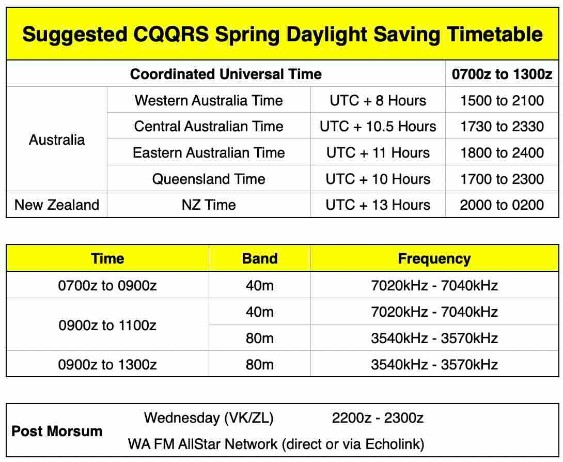
There’s usually people around until after 1300Z on the Tuesday Group – so keep calling in the segment of the band designated in the table below until you catch someone.
I should be on as usual from home in NSW or via the Remote at Bedfordale WA, and I’ll also be watching the proceedings using the VK6QS and Tecsun SDRs in WA and NSW respectively. Hope to hear you there.
GU CW on Tuesday, mb Mark Bosma VK2KI / VK6QI Beautiful South Bowning NSW mark.bosma@icloud.com non impediti ratione cogitationis

An Ode to CW – thanks to David VK3RU: In days of old, when ops were bold, And sideband was not invented, Words were passed by pounding brass, And all were quite contented. – Unknown author
About the CQ QRS Group
Frequencies and Times
QRL?
So tune around and call anyone you hear, or find yourself a quiet spot in the designated segment, send “QRL?” and if the frequency is quiet, start calling CQ QRS at about 75% of the speed you’re comfortable receiving at; hopefully responders will match (or send slower to their comfort level).
And if you are already having a QSO and someone sends “QRL?”, respond with “R”, “C”, “Y”, “YES” or QRL to let the caller know that the frequency is in use.
If we’re on 40m and you can hear that the band is open outside Australasia, perhaps consider calling 500HZ above each 1KHZ slot – to minimise the chance of having to copy our team through QRQ QRM that’s often dead-on the kHz markers.
Speed? Rhythm?
If you’re proficient at CW and can race along at 20 or 30WPM – terrific, but please remember, the Group’s aim is to encourage participation and learning, not show how fast you can hammer the key.
Please send slowly where you can and concentrate on rhythm – listen to your side-tone, get that wrist action going and make a special effort to make it sound like perfect CW; the longer we go with our Group, the more I understand just how many non-transmitting listeners we have – and they will most likely appreciate your QRS!
So, if you’re an experienced operator, please try to send nicely balanced slow CW to give them a chance to practice and gain confidence…. they’ll reward you one day by coming up on air to say g’day and thanks – how good is that?
And if you’re new or like me, just rusty…. ignore the above… just have a go – the lather of sweat will be worth it and there’s plenty of time to get the details sorted out as you practice.
Matching
And also for the oldies like me, when you hear someone new, please match their sending speed – or slower. The person you’re replying to may not be as deft on the decoding as you – it may be their first ever CW QSO – remember your first?
Lather of sweat, key that refuses to send that you tell it, brain that refuses to decode those complex letters that were right there half an hour ago, etc!
PSE QRS
And if someone is sending too fast to comfortably copy – “PSE RPT PSE QRS” or “AGN? PSE QRS’ will make life easier for everyone…. and might just encourage other listeners to have a go themselves.
The other thing to remember – most operators are writing down what they hear… so when you put it back to them, expect a delay while they read your words of wisdom, before replying.
The aim is to give everyone a go at contacting others – no-one owns their calling frequency in this Group. So unlike working DX, if you hear someone signing off – jump in and call – doesn’t matter who was first on the frequency – we really are all good mates in this Group….
And besides, at the speed we’re sending, after a QSO most of us will have forgotten who was first!
If you really want to move off frequency (eg because of a spurious switch mode power supply signal that’s just drifted into the conversation), you could try sending an abridged callsign of the person you’re after, followed by “UP 5” or “DN 5” then K; then call that person on the designated frequency and keep your fingers crossed, they may have understood you and followed…
Landing Zone
If the band goes really quiet, call and listen on 7032KHZ (7028KHZ secondary) or 3555KHZ. If you catch someone, there’s no need to QSY – enjoy the frequency.
But don’t forget to tune around if it’s quiet – we have lots of operators with crystal locked transmitters – and they could be anywhere within the segments.
For those who are locked, or can only transmit outside the segments, send a message on our WhatsApp CQ QRS – Alerts group advising of your current frequency.
And of course, put the frequencies in a memory so outside of the Group, if you’re not tuning around, leave your receiver on one of the primary frequencies – you never know who you’ll hear (7032 is used in VK and ZL for SOTA / PARKS during the day so you’ll often hear activity there).
CW Tips
As always, for newbies, operating suggestions are available from the operating hints link here: https://www.parg.org.au/ files/ugd/ebe236 3ca5ca08bb38429db4eee524bda2t97a. pdf. mb VK2KI / VK6QI