Below is a reconstruction of the 2026 25 CQ QRS RagChew newsletter designed to support full text searching. This reconstruction was built using OCR, and will contain errors.
To view the Mailchimp original, click here. To search the entire newsletter archive, click here.
Contents
- CQ QRS RagChew
- Dah-di-dah-di-dah
- This Week
- Movement at the Station
- Website
- Post Morsum 17th June 2026
- Reporting
- V Band Part 4 – Latency
- Getting the F-Layer in Proportion
- Hardly the Thickness of a Coat of Paint, or Getting the F-Layer in Proportion
- QRZ?
- Morse with a Purpose
- QRZ? Who’s on the other end?
- CW Practice
- Other News
- Signal Reports?
- Seasonal Movement of the Earth’s Terminator.
- Morse Training Net
- Prosign/Character/Signal of the Month
- Di-dah-di-dah-dit
- Next Tuesday’s Net
- Reports & Photos
- Post Morsum
- Articles
- Material
- About the CQ QRS Net
CQ QRS RagChew
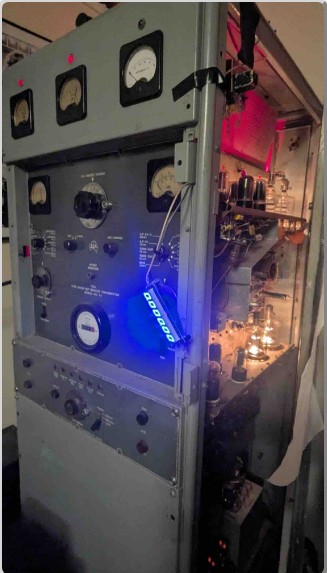
As the days get shorter and the nights get colder, a radio amateur’s thoughts turn to…. a shack warmer. Thanks this week to Jordan VK3ACU for this warm image of his TCA (ex-Non-Directional Beacon) transmitter.
Dah-di-dah-di-dah
As Winter settles-in in Oceania and propagation conditions change, isn’t it fun doing some experiements via our CQQRS Practice QSO net each Tuesday (evening or morning, depending whether you’re top-side or bottom-side respectively).
Great to see our team experimenting with propagation. So Elizabeth and I are nearly at the end of this round of PubPacking (public transport travel, staying in pubs when we can) travels – the newsletter was started at Culcairn in Southern NSW (between Albury on the border and Wagga Wagga which isn’t).
Staying in old pubs can be an interesting experience – some are outstanding… some not! Because of some management / staff problems, our planned rough stay at Culcairn this week was cut short to one night….
We opted for a motel knowing we could have a good wash the next day! The motel was like chalk and cheese… and the newsletter made leaps and bounds in the right direction!
This Week
So in this week’s edition, we again have some outstanding reading for you. This week our reporters seem to have gone the extra mile and written really interesting notes from Tuesday’s net – thank you one and all.
It’s always interesting to read the reports from our fellow participants, and I’m really pleased to see we’re getting more from team members who couldn’t get on air or didn’t work anyone, but just enjoyed listening-in as SWLs.
Elsewhere in the RagChew newsletter, Ross tackles one of the elephants in the room with his next article about VBand, while Stan ZL3TK poses some thoughts on F-layer propagation experienced on both the CQQRS net and the VKCW net.
Isn’t it great that these guys have taken a scientific (ie experimental) approach to the topics? Paul VK3KLE discusses just how he goes about pairing-up a vintage transmitter with slightly less vintage receiver, while Ross MONNK dons his gown, hood and mortarboard and delves into some philosophy about work and relaxation.
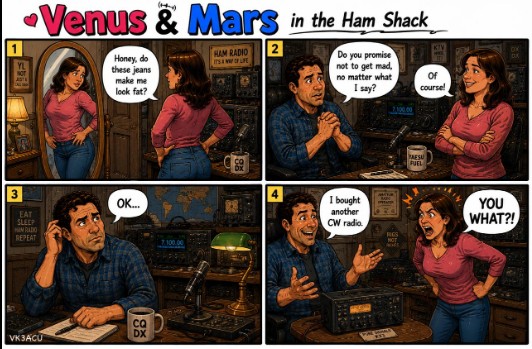
Great reading chaps – thank you! And of course, to round-out this edition, Jordan VK3ACU has come up with yet another Venus & Mars in the Ham Shack; this one is a pearler and my equity advisor and I are still cracking-up about it! Thanks mate!
Dare I ask where he gets the inspiration? Heh heh!
Movement at the Station
You may have read previous discussion about the frequencies we use for the CQQRS Net – including calling frequencies. |’ll address this next week – and hopefully will publish the new schedule. In the mean time…. close readers (I use the plural….
Taking a leap of faith that we have more than one reader) may recall that I had posed the problem of my backing- out of the editorship of the RagChew newsletter a few weeks ago.
We have a wonderful support team now, meaning that the editing is less of a sink-hole than before – so the time is right to step away.
Alors, next week I’ll announce the new line-up of editors, including a new editor-in chief (sounds a bit like like the WIA doesn’t it?).
I’ll be staying at the helm as the CQQQRS Convenor and will (for the time being at least) continue with the editorials (even though I won’t be the editor – if you can follow that lack of logic). So tune-in next week for more as the hand-over starts.
Website
If you’d like to find out a bit about our net, or would like to pass information to others about our Tuesday get-togethers, here’s the link to our website. bit.ly/CQQRSWebsite So here we go – on behalf of the CQQRS Editorial team, please enjoy the newsletter.
Niall kh DOSITa VK2KI / VK6QI Patrick John Beautiful South Bowning VK2IOW VK2RU NSW Milthorpe NSW on a track somewhere cqqrsnet@gmail.com non impsditi ratione cogitationis Nigel Richard Lance G4RWI VK6HRC VK7TO our other grey nomad Padbury WA Margate TAS Jordan Ross VK32ACU MONNK
With thanks to Nigel G4RWI’s clever software, and John VK2RU’s clever spreadsheet work, here’s the 51 stations heard by 42 members of our team on Tuesday:
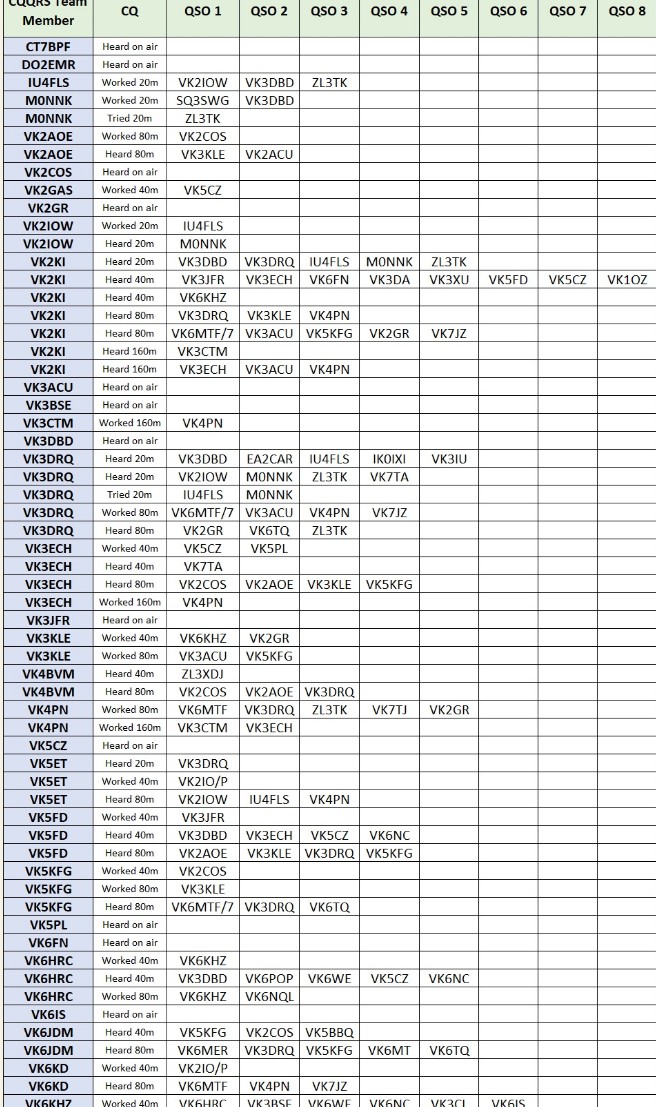
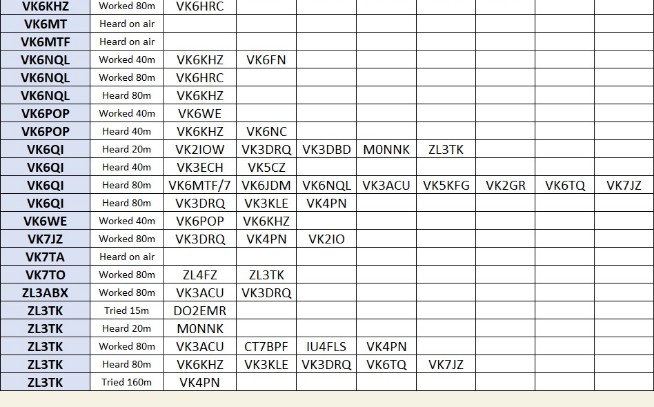
John’s spreadsheet above shows the known stations heard or worked on last Tuesday’s CQQRS Net (reported via our webform bit.ly/CQQRSNET ); the comments in the team members’ reports follow.
The comments were compiled for us by the clever software built by Nigel G4RWI and the layout was perfected by Patrick VK2IOW. Thanks again to Nigel, Patrick and John for the work, and to every team member who submitted a report –
Dt it Pal a Rt iti rl Nt. A et raat Rl tt att Sr alert nl rel tn ls
[20m] My first QSO was with Poland’s SQ3SWG Adam, a classic example of a CW beginner sending slow clear Morse. Well done, Adam. Then David VK3DBI came around the world to greet me, weak but clear at first and then slowly fading into nothing.
But we made a good contact so I hada smile on my face.
Stan ZL3TK and I had a brief electronic discussion on the ethics of using a web SDR as a receiver (| was, apparently, RSN 581 on the Ironstone SDR) – I can’t help feeling it’s cheating.
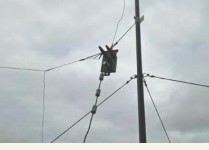
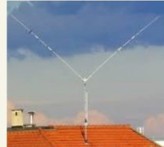
I heard Manny VK3DRQ calling on Ironstone but not a sausage on my G90 in England. Thanks for trying, Manny. Photo shows the top of my quarter wave vertical for 20 m and two tuned elevated radials for directional gain, Sotabeams 1:1 balun, and 5 m of RG174/U coax with 3 clip-on ferrules.
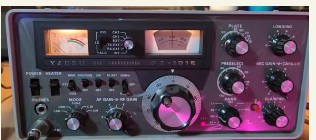
[80m] sot out the venerable Yaesu FT101E. Noisy conditions but nice to natter with Rob! 73
[15m] Nothing heard from Edi DO2EMR even at the mt later time this week. We knew he was transmittil because he’d posted on Mike DL3YZ‘s Runners Point website. One day it’ll all happen Edi!
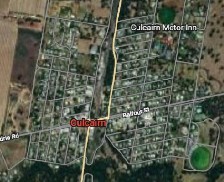
[20m] Bad start… I was actually on time for the first time in ages, 0630Z – trying to listen on 14041kHz on the VKSPH multi-KiwiSDR network – only to find that all channels on were fulll I snuck over to the Techsun KiwiSDR – knowing that it had a 60 minute timer.
Fausto was coming through weakly and Stan was calling him. When I switched to the Ironstone Range SDR, Ross was coming through a nice RSN 411 when chatting to David VK3DBD. Ross’ signal got better as we went along and at one stage he peaked at RSN 431
[80m] Nice to hear a good number on 80m again this week; conditions were good [160M] Terrific to listen in to Rob VK3ECH at Echuca chatting to Sava VK4PN on 160M, followed by several other QRS QSOs, including a return by Tony VK3CTM at Bendigo; well done guys.
Also from your editor Mark VK6QI PubPacking at Culcaim NSW but receiving via the VK6SEG KiwiSDR at Hoddys Well near Northam WA.
[15m] Nothing from Edi on 15m at the later time this week. jundaring jal
[20m] On ci On the VK6SEG KiwiSDR, Manny VK3DRQ was
[40m] lan VK5CZ and Rob VK3ECH were coming through nicely into WA when I caught them at around 0800Z. gl a ig fh
[40m] lan VK5CZ and Rob VK3ECH were coming through nicely into WA when I caught them at around 0800Z.
Great conditions – the band was nice and quiet and signals were making the journey across to WA from the East – including from Morgan VK6MTF portable in Tasmania on 10 Waits. [160M] Nothing heard on 160M of the East Coast stations who were having fun.
[15m] When a superb SDR in south west England can’t hear a signal originating 912 km away, and indeed the waterfall is entirely devoid of all life, one may rightly assume the band is dead, ergo, Edgar was not heard. Regrettable but not at all unusual.
Could it be the DXperiment has proven it’s past time to sub some sweet CW from Esslingen Am Neckar?
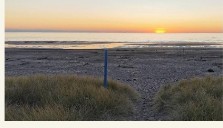
[40m] Heard a few stations on 40 m but only in passing, was distracted by making comparisons on the Ironstone SDR and failed to write them down, suffice to say all were extremely weak direct and surprisingly, a couple, e.g. VK3KLE, were weaker into the SDR.
[80m] The QRS FFA managers in both hemispheres use the sobriquet DXperiment, for activity on 20 m and above, so I did. See separate article to justify taking this liberty. [160M] A VK 160 m SSB net was running on 1.855 MHz, but no sign of any CW.
However on the Ironstone SDR there was OM Sava, on 1.851 MHz. Even more surprising – I could hear myself RSN 521. Gave Sava a call but he could not resolve, so I followed him when he announced his intention to QSY to 80 m, whereupon a decent QSO took place..
[40m] Tuning in I was met with an empty waterfall which began prodding with CQ calls. After some time Bob responded with a strong clear signal. I was pleased to make my first CW contact with him.
After that QSO Ron appeared with an equally goox : limit of my decoding ability of his brisk cadence.
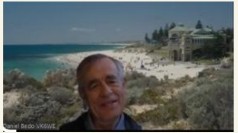
[40m] Not a lot being received at my end on 40m. I concentrated on logging onto SDRs in VKS5 and VK7 to hear which ones I could hear my CQ calls coming through. I was getting out but just. Probably not enough to support easy QSOs.
Using the Ironstone SDR for receiving, I was able to provide a contact to VK2IO/P out catching contacts for FF activation.
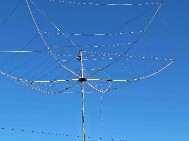
80m] Vly 80m receiving this week from my home QTH was poorer than usual. The ronstone SDR gave me an opportunity to record some listening and decoding oractice.
I logged onto the VK7 SDR in Tasmania and noted my test signal getting hrough from WA but very weak. No QSOs on 80m for this week. 73.
[80m] Up at Mount Nelson Signal Station with Morgan VK6MTF/7 again this week. Noise floor on 40m = not much. Noise floor on 80m = even less. I was a late starter due to some other commitments early in the evening.
This time I was prepared for 80m, bought an 80m
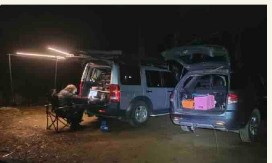
EFHW antenna with me that I had made months ago but never used in anger or had a QSO with it. [had a QSO with Manny, then a super quick parks contact with Gerard VK2IO, then another QSO with Sava VK4PN.
Some interesting fun tonight, the antenna was tuned in just nice at about 1.1:1 SWR, but then as a rain shower passed and everything go wet the antenna demonstrated something I have not seen before, first 20 seconds or so of sending SWR was OK, but then the SWR meter started steadily climbing to over 3.
Stop transmitting and wait 10 seconds, repeat, did it again. It was like some kind of capacitance charging thing that would take a while to build up, then it would discharge.
I was thinking wet trees perhaps, but then the rain went away and problem gone, straight back to 1.1:1 match. I was using a portable antenna that winds up on winder with the impedance transformer exposed to the water and only held on with cable ties – so it was something to do with the water.
I have operated with another EFHW in the rain before and never had this problem, but that other antenna was also protected in heat shrink – given it rains a bit in VK7 perhaps I can replicate the problem next week and see what happens.
[20m] If some operators will exchange the NECESSARY information when contacting others DX, instead of telling how the grass is = growing and how the wind is blowing, maybe we would have some i chances of a QSO before the DX operator runs out of his time. |.
Apart from that it was a well-enjoyed night. And I must congratulate the t operators Morgan and Jim, VK6MTF/7 and VK7JZ to Conquering Mount the dark of a cold night. Very brave gentlemen.
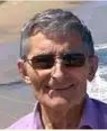
[80m] I had very hard conditions with deep QSB making a rag chew impossible. Only the two contacts, both with NZ on 80. On the bright side, I got to ask OM Stan what POG stood for, so now feel like I’m in the cool kids club.
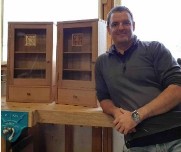
[80m] I was able to operate for a very short time only and had a brief QSO with Sava, VK4PN on 1.850 MHz. at 1050Z. Next Tuesday I plan to put more space between my signal and the SSB net on 1.855 MHz which I joined for two rounds along with four other members of our local Bendigo Amateur Radio and Electrics Club.
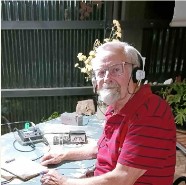
[40m] ZL3XD4J called CQ for quite some time without a reply. I was only able to copy his call sign because it was repeated so many times.
[80m] I don’t have a suitable aerial for 3.5 MHz so all stations a’ which makes decoding difficult. A repeated call sign and
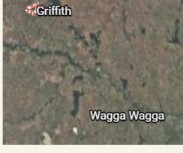
[80m] I had just an hour to spare. Sent out CQ’s on 40 and 80 metres but no response; however I could hear plenty of stations both in VK6 and over east. There was marked QSB of up to 20 dB on the path to NSW but stations were still Q5 in the troughs.
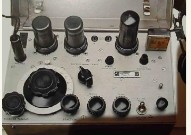
[40m] Very quiet band . Propagation dropping off as the nig progressed. I QSY to 80m
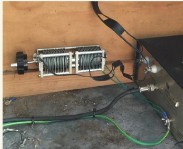
[20m] This last Tuesday I did not have to look after my grand kids so had some time to scan higher bands for our EU QRS contingent. None heard this time.
I did not expect much since a quick check of FT8 bands had no EU stations coming through on 20 m or 15 m just Asia and both Americas.
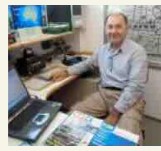
Beet Fun started with a chatty QSO with Manny VK3DRG@ followed by a marathon with Stan ZL3TK, we have been trying to hook up on 160 m for a second week in a row still no luck.
Stan’s signal into Brisbane was $9 but my signal into ZL was way down to start so I appreciate his perseverance in trying conditions. Strange how propagation can be so lopsided.
My other two QSOs on 80 m were similarly lopsided, both VK7JZ and VK6MTF (stationed in Tassie) gave me RST of 599 but I could barely copy either of them.
After finishing with VK6MTF I had a quick look up at QRZ.COM to make sure I got the name right – well it is Morgan, not Gordon that I copied. I rarely get it this wrong just shows how bad propagation was but again one way only!
[160M] Finally some success on the top band, couple of nice contacts. VK3ECH was S7 into Brisbane no fading nice and steady with 50 W only. Rob always has good signal here on all bands so his antenna must be over a very conductive ground.
I wonder how far his is QTH from the Murray. VK3CTM was also S7 but with a strange fading dropping just a letter or two in a quick succession making copy difficult, but we managed.
Harvest Net was on again at 1855 kHz it started at 11:00 UTC and it was still going at 13:00 UTC so we definitely lost that frequency.
I was calling just under at 1850 kHz +/- 1KHZ to avoided wobbling switching power supply noise from somewhere in the neighborhood. So if you are looking for me on 160 m sweep round 1850 KHz.
[20m] I had the pleasure, this time, to hear again my very first contacts: ZL3TK Stan whose signal unfortunately was very weak and with QSB. Nice to hear again VK3DBD David, regretfully I lost him due to QRM at my end .
Really happy to meet VK2IOW Patrick for the first time. To all of you my gratitude for your patience and tolerance in trying to understand my poor CW . 73 Fausto
Post Morsum 17th June 2026
From Richard VK6HRC. Five on the VK6RLM rptr and AllStar/Echolink hub this morning.
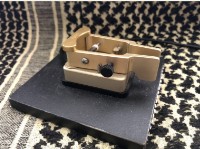
VK6QI_ = Mark VK6FN Max VK6KD David VK6HRC VK6MRB Mulliga
Mark was in Culcairn near Wagga NSW with a few more days left of the walk about. Monitoring the activity on the Kiwi sdr network heard six on 20 m, nine on 40 m and eleven on 80 m lastly four on 160 m.
He also kept busy spotting on the WhatsApp link as well as others throughout the evening. Max worked lan VK5CZ, Ron VK6KHZ and Peter VK6IS on 40 m and then into listening mode.
David got into the shack a little later and tuned around also logged onto the Ironstone Kiwi sdr and monitored the activity for a while. He is also going walk about and will not be on next week, non AR activities !
Conditions were not great but I was hearing signals from the Eastern states. lan VK5CZ was heard just above my noise level and was happy to hear Max VK6FN catch up with him. The others were not quite strong enough for a decode unfortunately.
The locals were well above the noise floor, worked one on 40 m and two on 80 m then went into listening mode. Thank you to all on last night and this morning.

Reporting

Even if you didn’t hear anyone, we’d still like to know that you had a go. And to make your report more interesting, please consider sending a photo: cqarsnet@gmail.com So, please help attract new and old team members to have a go by submitting your report each week.
Submissions close 1300 (Eastern Australian Summer time)_on Thursdays.
V Band Part 4 – Latency
Perhaps it’s ‘All in your ‘ed?’ by Ross MONNK
From Ross MONNK Having already had a go with VBand, you may have discovered one or both of the Elephants in the Room – latency, and the decoder.
I’ll talk about the decoder in a later episode but latency (the lag between key-down and the sidetone sound being heard) may be the more pressing issue for you so I’ll cover that now.
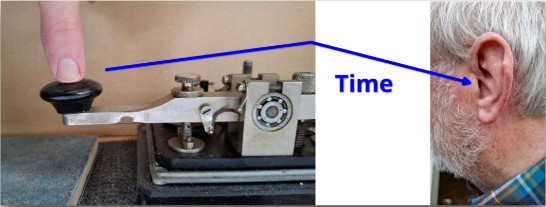
Actually, I may not be the best person to offer advice on this topic as I’ve never had a problem with latency. In fact, few people seem to find it a problem, but it can be a real nuisance for those who do.
Mike DL3YZ reckons I don’t notice it because I’ve learnt and developed my Morse skills on the internet and have thus adapted to latency.
Hmmm, I think that’s a load of old cobblers but my wife tells me it’s important to be respecttul of alternative opinions (admittedly, mainly hers).
‘Anyway, moving swiftly onwards, I described my own no latency set-up in Part 3 of this series on Vband so that would be the obvious place to start.
But, assuming there are reasons why you won’t (or can’t) emulate my set-up, here are a few things for you to look into. On Vband, there are, in fact, two areas of latency.
The first is the time it takes for your signal to get across the world and come out into the ears of your listener. Trials have shown that this is in the order of 1 to 2 seconds and might appear as a delay between your end-of-the-Over “K” or
So this latency will probably not be noticed. The other latency is the delay between you hitting the key and Vband sounding the beeps (the ‘sidetone’).
Mike DL3YZ is an IT professional and says that Vband sidetone latency can be demonstrated to be a problem with your own computer. To prove this, go to the Vband Practice Channel…
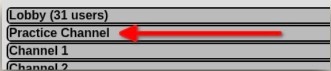
..and send a few characters; then disconnect your internet connection; now send some more characters. You can still send and hear your Morse, therefore it is generated and heard locally (not at the Vband cloud end).
To eliminate whatever’s slowing your computer down: © Minimise any background tasks and close any other open applications; close all other browser tabs © Use wired connections – wi-fi and Bluetooth generate lag © Avoid using HDMI for sound © Avoid noise-canceling headphones © Update your USB device driver ¢ Is your anti-virus interfering?
@ Is there a conflict with any of your web browser plugins? © Try closing any other web browser tabs; try closing your web browser then re- start it.
It you’re stil experiencing latency then I have to ask the question, “Are you using an ancient computer with an equally ancient operating system?’.
Hands up all you dinosaurs who stil have a 32-bit laptop and think Windows 95 is the best thing since sliced bread, so there’s no reason to change it.
If you have your hand up, you’re probably also of the opinion that “surfing the interweb” is only for young folks. In which case, Vband is not for you. Sorry. The world moves on.
Next time, we’ll cover the second Elephant in the Room – the decoder (or, as some people refer to it, ‘that bloody thing!”).
Getting the F-Layer in Proportion
Hardly the Thickness of a Coat of Paint, or Getting the F-Layer in Proportion
We think it’s a long way away, but astonishing as it may sound, the height and thickness of the ionosphere’s F-layer is only 1.2 % of the altitude of GPS satellites at 20,180 km, and a mere 0.7 % of our geostationary communication satellites at 35,786 km.
For years, we of the VKCW Net have observed poor 20 m propagation in Winter. One has simply taken for granted that traffic handling will become extraordinarily difficult, but no one in Oceania has dug deeper into the phenomenon.
This year’s Winter, while still in its infancy meteorologically, has already been dealing harshly with trans-Tasman comms on 20 m and 40 m, with 80 m suffering only slightly less.
The two regular VKs who check-in to the NZ Net on 3.535 MHz are well aware of this phenomenon. Last Wednesday, two ZL stations checked-in to the VKCW Net on 14.049 MHz, one with a 3-element Yagi and the other with an end-fed random wire.
It is believed both had similar transmitter power. As expected, the latter was somewhat weaker than the former, however in the time it took to QNI, both were affected in the same way by a fickle ionosphere and vanished completely – neither were heard again by the NCS in Melbourne.
Meanwhile, the NCS still had fine copy with the only other Net participant, in Perth. This raises the question, why were signals from west of the NCS in Melbourne so much better than signals from the east?
That got me thinking about the QRS FFA, where on 40 m, VK6S are often $6 in ZL, while VK2S and VK4S can hardly be heard.
A bit of research has uncovered a possible, logical contributory factor we haven’t thought about before, that of continental influence on the ionosphere.
We’re aware almost daily of continental influence on ambient terrestrial temperatures, but how could it affect the ionosphere, considering it is so jolly far away? Oris it?
Well, it turns out that when drawn to scale, one can see the ionosphere isn’t that far away at all, in fact the closest incidence of F-layer ionisation is only 1/16 of the distance of Australia’s East-to-West continental span, hence the analogy to the hickneestolatcoatat parntrelativettaratelitestencispcacetcistancest
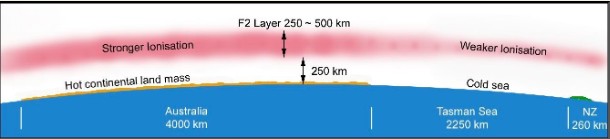
Reportedly, heated air and reflected photons at ground level are capable of rising through the troposhere, stratosphere and mesosphere to the home of the ionosphere, viz.
The thermosphere, where convection currents cause not only ripples, but also promote enhanced ionosation. Differentially, the effect is most noticable when crossing the boundary between a continental land mass and the sea.
A slightly blurred but natural example is the juxtaposition of the dry, solar heated Great Australian Desert and the moist, cold, non-contributory Tasman Sea. But that doesn’t fully explain the signal enhancement we often experience between ZL and VK6 on 40 m.
Some additional detail is needed. Over multiple hops between ground and the F-layer, an RF signal’s take-off and arrival angles tend to flatten out and stabilize between 15° and 4° above the horizon.
Despite the cold Tasman Sea intervening, strong reflections over the desert and a very low angle of incidence often result in reasonably good signals arriving in ZL from VK6. The reverse path however is plagued by an obvious asymmetry.
Starting from ZL at a higher-than-optimum angle of radiation and poor reflectivity over the Tasman Sea, such signals have been severely weakened long before they reach more favourable conditions provided by the collection of central Australian deserts, so ZL signals tend to get lost on arrival in VK6 when having to compete with stronger ‘local’ stations.
QRO and giant antennas would undoubtedly improve matters, but can anyone offer a simpler and more effective solution than just waiting for Summer? 73 de Stan ZL3TK
If you have an article or two that you think might be of interest to our readers, please let me know so we can share more thoughts and ideas; for guidance on writing for RagChew, see Articles below. Please email material to Mark VK2KI: cqqrsnet@gmail.com
| have been calling CW on 80m for a while on the Eico 720 we discussed last week and had a nice QSO tonight with VK2EBN with an RST 559 from my 50 Watts.
I’ve been using the keyboard as I’m feeling tired after today’s antenna mast work in my yard. A 20m 1/2 vertical had bent in the wind and needed removal and retirement. The mast was still in perfect condition and supports my end-fed 80 dipole.
It’s up higher now with another 1.8m section added to the telescoping mast.
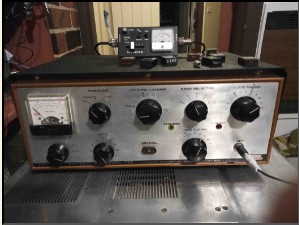
| have taken a few new photos of the accessories required to pair the RX and TX tc give decent QSK-like operation.

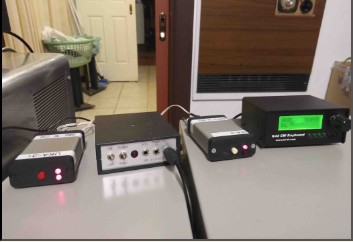
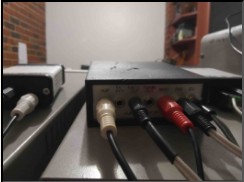
The K42 keyer and Netcurtice interface are providing QSK between letters and from what I can hear locally, are keying the vintage thick original FT243 crystals with enough lead time to mask all chirp.
The RX I have had here for many years. It was a payment in-lieu of restoration I did of a better FR101 froma friend years ago. He had two sets and the set I have was the parts-donor set. Terry was very generous, however it took me many attempts to get
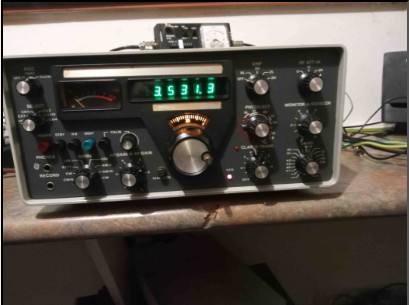
The donor Yaesu RX sorted as all good boards and xtals were swapped into the set Terry retained… leaving me with a fun tech special restoration project.
These old FR101 receivers have excellent mutes for CW, with a monitor function to hear your own CW TX – that’s a great facility to have.
It enables flawless netting so you know what you and the other station are up to as far as both being near a common frequency. The UKA-3 interface boxes are for keying and mute isolation.
The traditional way to get from TX and back to RX is via hand switches, this works ok but if the other CW Ops has a modern rig they won’t understand the delay at the end of an over.
The Netcurtice has a normally closed contact for RX mute and amp keying output as. well as a send line for the PTT from the K42. Sounds complicated, but when patched up it seems to work really well. Unfortunately those cw keying interfaces are rare these days.
Looks like it was a kit build. It has a genuine Curtice keying chip that reproduces all key elements but with a slight delay to allow the amp line the right advanced keying sequence to occur. Regards Paul VK3KLE
What’s going on on your workbench? If you have an article or two that you think might be of interest to our readers, please let Mark VK2KI know; email to cqqrsnet@gmail.com For guidance on writing for RagChew, see Articles below.
QRZ?
Who’s on the other end? Thoughts on Morse as Relaxation from Ross MONNK
Morse with a Purpose
From Ross MONNK at Budleigh Salterton We all make mistakes. Let me share one of mine with you…
As some of you will know, I was a professional pilot all my working life. Midway through my career, I realised that every time I got airborne it was with a purpose – on a mission, doing a job, training or being trained.
“How pleasant it would be”, I thought, “if I could have my own
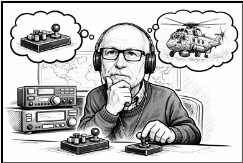
Plane and fly for the sheer enjoyment of it for a change.” So, I looked around and found a sweet little fixed-wing microlight. Simple; no bells or whistles; the very antithesis of the sleek craft in which I plied my trade.
I climbed into the warm summer sky and looked around. “This is the life!”, I said, with a smile on my face. A few minutes later, having surveyed the English countryside from on high, I asked myself the fateful question – “Right, now what shall I do?” And there, right there, was the problem I hadn’t anticipated.
I hadn’t realised that flying with a purpose was not a distraction from an important pleasure; it was, in fact, the source of much of the reward and satisfaction I derived from my flying. To simply be in the air was, from long exposure, no longer enough.
I needed something to do. Oh dear. Which brings us round to radio. Monday evenings, I make sure my battery is charged and that my gear is all present before positioning it in the hallway ready for the morning.
I check the UTC time my DX slot starts and set my alarm accordingly. During breakfast, I glance at the weather forecast and wash my porridge down with a mug of strong tea – got to get the blood sugar levels up if I want to be on top form.
At the pre-calculated time, I head out to the car. I allow fifteen minutes to get to my operating site, and thirty minutes to get set up, using my compass to align my directional antenna towards the /ong path to Australia.
If have a few minutes to spare, I might take some photos for RagChew. Settled in my camp chair, mobile phone on the Runners Point site and my published radio frequency set on the G90, I check my watch. On the dot, I send “CQ VK CQ VK de MONNK MONNK PSE K”.
Just like in the old days, the mission has begun. And just like in the old days, doing Morse with a purpose has spoilt me for the casual “any time” radio that most amateur operators would regard as the norm.
Whenever I feel that all that planning, preparation and careful timing is a whole load of hassle, I remember bimbling along in that sweet little microlight and the unanswerable question, “Now what shall 1 do?” [What a great story from the CQQRS Philosophy Department Ross – thank you for delving down into the depths to assemble this for us.
I’ve experienced similar phenomena myself – and I suspect others have as well? So for anyone who’d like to share some of their similar stories, please let me know: cgarsnet@gmail.com Not confident in your ability to assemble your thoughts in writing?
QRZ? Who’s on the other end?
CW Practice
This year we’re using Aesop’s Fables. These are short moral stories, often using talking animals, that illustrate simple truths about human behaviour and character.
‘Aesop’s Fables originated in ancient Greece, traditionally attributed to the storyteller Aesop who is thought to have lived around the 6th century BCE.
The fables are generally smaller files of two to three hundred words that have been recorded at 15 wpm and run for about 15 minutes.
If 15 wpm is a bit quick for you, load it onto your phone and set the playback speed at 0.75 X or even 0.5 X- whatever works for you. 0.75 X will play the MP8 at a bit under 12 wpm. Itis suggested that you read the text file before listening to the audio file.
That will make it easier to follow the audio file and prepare you for any unusual words. Any punctuation that is not usually used with CW has been removed. This week’s fable is ‘The Thirsty Pigeon’, and the MP3 and TXT files are attached honat


If you prefer a different speed or tone, you can create your own MP3 files by converting the text file with the Ebook2CW app — https://fkurz.net/ham/ebook2cw.html.
You can either play the MP3 files in any media player, or load the text file into the Ditto CW: Morse Player app — https://dittocw.andro.io/.
Both options work well, however Ditto CW gives you complete control over all Morse settings, while a normal media player only allows changes to playback speed, and does that in steps (e.g. +1.25x, 1.5x, 1.75x).
Other News
Congratulations on putting out a Bumper Edition of Ragchew this week – what a great selection of interesting and informative content. There would’ve been something for everyone.
[Thank you on behalf of everyone who took the time and made the effort to contribute that interesting and informative content. How lucky are we?]
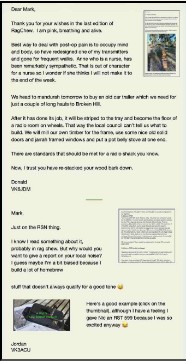
Signal Reports? RST or RSN? That, as Hamlet would’ve said if he’d been living 400 years later, is the question. If an operator sends me an RST, I always send back 5 [something] 9. If an operator sends me an RSN, I always send back 5 [something] 1. Why?
Because I simply don’t have the mental capacity to simultaneously make an assessment of three
Signal Reports?
Complex signal qualities AND decode a Morse message, both at the same time. For the sake of maintaining a long-standing amateur radio tradition, I do make the effort to provide one meaningful number though. It’s the best I can manage. Sorry.
But, honestly, I can’t see the point of any type of Signal Report. It doesn’t make any difference to me what the other operator tells me – I’m not going to take the slightest bit of notice of it. I have a modern digital radio and can’t mess with its innards.
And if that station is having difficulty with my Readability or Strength, that’s their problem not mine. The prevalence of meaningless “699” reports suggests that many other operators feel the same way.
It would be far more efficient and informative if, on request only, the receiving station provided a plain language description of the quality of the received transmission. That was, in fact, the way it was done in my days of professional (voice) radio usage.
So, that takes us back to the question we started with: RSN or RST? Now, you will not be surprised when I tell you that my preference would be for “neither of the above”! Ross MONNK
RG Event # 44 will run for 24 hours starting Thursday 18 June at 22002. That means unless the DX bands are open, Team Oceania’s big time will be our Friday night 19 June, 0700Z ~ 1000Z.
Trans-Tasman 40 m has been rather poor lately, and is completely dead as I write, so RG for us may possibly be only on 80 m, we won’t know until the day, of course. Code groups will consist of five alphabetic characters this time.
Please affiliate with Team Oceania when requesting your groups. Drew apologises for the short notice. Explaining the odd choice of a weekday, he just discovered the sked.SKCC webpage will be occupied by SKCC events every weekend slot this month, making it unavailable for RG.
Seasonal Movement of the Earth’s Terminator.
Movement of Earth’s terminator – the edge between the shadows of nightfall and the sunlight of dusk and dawn – causes many of us to experience seasons.
Because Earth rotates on a tilted axis, the orientation of this line changes over the course of a year in sync with the seasons.
On the September and March equinox, when Earth is at a right angle to the sun, light is spread evenly across the globe and the terminator runs from pole to pole.
But on the December and June solstice, when Earth is tilted away from and toward the sun, respectively, light is cast disproportionately on each hemisphere, causing the terminator to appear slanted.
Watch the video to view the migration of Earth’s terminator across the seasons.

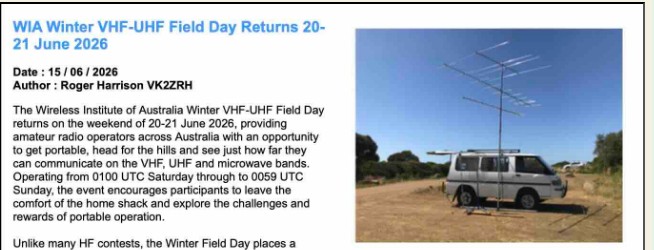
Thanks to Nasa’s Adam P Voiland for these images and the video, which are non-copyright for information sharing and education.
Morse Training Net
Our team member Nic VK7WW runs an on-air Slow Morse training net every Wednesday at 7pm EDST on 3580 for 30 mins. He uses the callsign of the Northern Tasmania Amateur Radio Club VK7TAZ on that net.
Many of our team learned Morse code with the support of Nic, and the weekly training session comes highly recommended for anyone who wants to learn the Code, or simply brush up.
Everyone’s welcome – 3580KHZ at 7pm Eastern time every Wednesday; you’ll hear lots of the CQQRS team on that net. Jordan VK3ACU has ralso ecorded the complete set of lessons which you can now find here:
Https://www. youtube.com/playlist?list=PLHsQmZz6fBXO7swAfbT mutrbbEL17fUQL Contact Nic VK7WW for more info nicholaschantler@hotmail.com including how to join the NTARC DISCORD group to follow the action, or just come along and join in on Wednesdays.
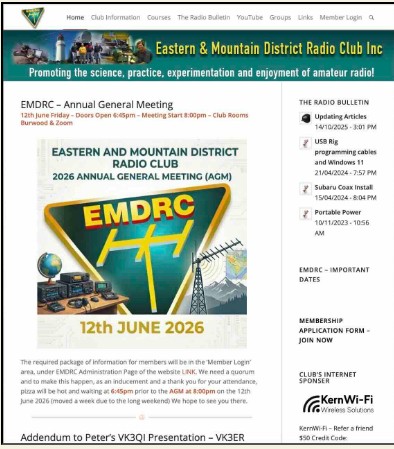
If you’ve read something that you think might be of interest to our readers, please email to Mark VK2KI: cqgrsnet@gmail.com Or perhaps, do you have a question or two ora discussion starter worth sharing?cqqrsnet@gmail.com if so.]
Prosign/Character/Signal of the Month
[Put it on a sticky note near your key as a reminder for Tuesday…. and tell us how you went!]
Di-dah-di-dah-dit
Next Tuesday’s Net
Our CQQRS Group will be on as always on Tuesday from around 0600Z until about 12002; see https://bit.ly/CQQRSWebsite and navigate to the Net Details page for details.
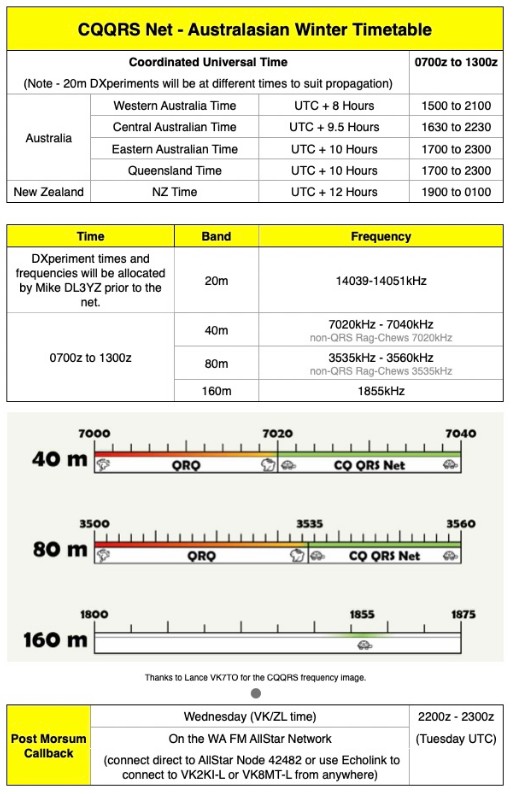
Doesn’t matter whether you’re brand new and want to try just exchanging callsigns and RST reports, or you’re ready for a good old rag chew. We’ll have fun.
There’s usually people around until after 1200Z – so keep calling in the segment of the band designated in the table below until you catch someone.
Reports & Photos
Please let us know via our Reports form bit.ly/CQQRSNET who you work or hear on Tuesday’s Group. The report form closes at 1pm (Eastern Australian time) on Thursday. And how about helping to make the reports even more interesting by sending a photo?
If you have a photo that you’d be happy to include, please email it to: cqqrsnet@gmail.com And of course, we’re always on the lookout for more photos for the newsletter, so if you have something that might be of interest aside from the reports, please send it through as well.
Email to cqgrsnet@gmail.com please. Oh and by the way, I recommend that you don’t keep the Reports Form website open between submission of reports from one week to the next.
If you’re unlucky, there’s an undocumented feature in the software that could cause your current week’s report to be combined with your previous report – it’s happened to your editor several times – much to the chagrin of our Reports editor 🙂
Post Morsum
Richard VK6HRC will run our phone Post Morsum on Wednesday mornings on the South West AllStar net (via repeaters and hotspots all over WA) from 0600 WA time, then from 0700 WA time on 80m (3605 LSB).
See https://bit.ly/CQQRSWebsite and navigate to the Net Details page for details of how you can connect via Echolink from anywhere in the world.
Articles
Could you write a short article or articles for RagChew? You bet! Writing not your strong point? Don’t worry, I’m very happy to help as much or as little as needed.
Oh, and one more thing (actually two) – copyright material: * please use your own images – don’t use images copied from the internet unless you have the producer’s permission, or they’re marked ‘Creative Commons’ or similar; ¢ if you include other peoples’ written material, unless you have permission, you may only include small snippets (unless it’s marked ‘Creative Commons’ or similar), and you’ll need to site the source and author.
For more guidance on writing for the RagChew newsletter (including how you might even try using one of the new Artificial Intelligence tools), head to our website bit.ly/CQQRSWebsite then click the menu on the top right and then click RagChew Newsletter.
Material
A reminder; if you send me any information by email, our report form or WhatsApp – unless you specifically state that material is not to be published, I’ll assume that you’re happy to see your thoughts in the RagChew newsletter.
Thank you so much to our team of 27 contributors: IU4FLS, MONNK, VK2AOE, VK2GAS, VK2IOW, VK2RU, VK2ZRH, VK3CTM, VK3DRQ, VK3ECH, VK3KLE, VK4BVM, VK4PN, VK5ET, VK5FD, VK5KFG, VK6HRC, VK6JDM, VK6KD, VK6KHZ, VK6NQL, VK6POP, VK6WE, VK7JZ, VK7TO, ZL3ABX and ZL3TK.
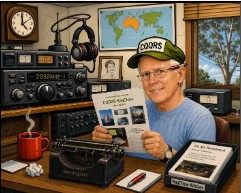
And a special thank you to our editorial team, Nigel G4RWI (Mister “why don’t you just use your computer to do that?”), Patrick VK2IOW (from the report formatting department), John VK2RU (maestro de la spreadsheet), Richard VK6HRC (trainee wheelie bin driver), Lance VK7TO (trying the green cap for size), Jordan VKSACU (“You What?!”) and Ross MONNK (escapee from the Philosophy Department).
Grea work all! GU CW on Tuesday, mb Mark Bosma VK2KI / VK6QI Beautiful South Bowning NSW cqqrsnet@gmail.com non impediti ratione cogitationis
About the CQ QRS Net
For the current schedule and more information about the CQQRS net, please go the the Net Details page on our website:

The opinions expressed in the RagChew newsletter are those of the individual contributors. The opinions do not necessarily reflect that of the editors or of the CQQRS Group members.
Any material and images received from members by the editor or published on the CQQRS WhatsApp groups may be published in this newsletter unless specifically requested otherwise.
The RagChew newsletter is considered to be exempt from the Australian Government’s ban on social media for under 16 year olds because it is a service that has the primary purpose of enabling users to share information about products or services, engage in professional networking or professional development services or of supporting the education of users per the Australian Government eSafety Commissioner FAQ webpage “Which platforms have been excluded from the age restrictions” dated 10DEC25.
The values, doctrine and guidelines for the Group and for the newsletter are published on the Principles page of the group’s website https://bit.ly/CQQRSWebsite