Below is a reconstruction of the 2025 48 CQ QRS RagChew newsletter designed to support full text searching. This reconstruction was built using OCR, and will contain errors.
To view the Mailchimp original, click here. To search the entire newsletter archive, click here.
Contents
- CQ QRS RagChew
- Reports
- Website
- POST MORSUM 26th November
- This Week’s Topic of Interest
- QRZ?
- Introducing Ron VK4EV from Everton Park
- QRZ? Who’s on the other end? From your editor Mark VK2KI / VK6QI When you’re on the key, it’s really hard to find out a bit more about the person you’re chatting to; it’s really nice to know who’s on the other end of the QSO. So, would you be willing to share some thoughts about yourself? Please let Mark VK2KI know: cqqrsnet@gmail.com For guidance on writing for RagChew, see Articles below.
- QRZ? Who’s on the other end?
- Head Copy Practice
- You can either play the MP3 files in any media player, or load the text file in last week’s Newsletter into the Ditto CW: Morse Player app — https://dittocw.andro.io/. Both options work well, however Ditto CW gives you complete control over all Morse settings, while a normal media player only allows changes to playback speed, and does that in steps (e.g. +1.25x, 1.5x, 1.75x).
- Other News
- CW Ops
- Tasmanian Portable Adventure
- Morse Training Net
- Ops Normal Check – Mal VK6MT
- DXperiment Bands
- DXperiment – Station Status Display
- There’s No Such Thing…
- Question
- Response
- Now in the case of the
- Prosign/Character/Signal of the Month
- I Hear Tell…
- Di-dah-di-dah-dit
- Next Tuesday’s Net
- Reports & Photos
- Post Morsum
- Articles
- Material
- Teamwork
- About the CQ QRS Net
CQ QRS RagChew
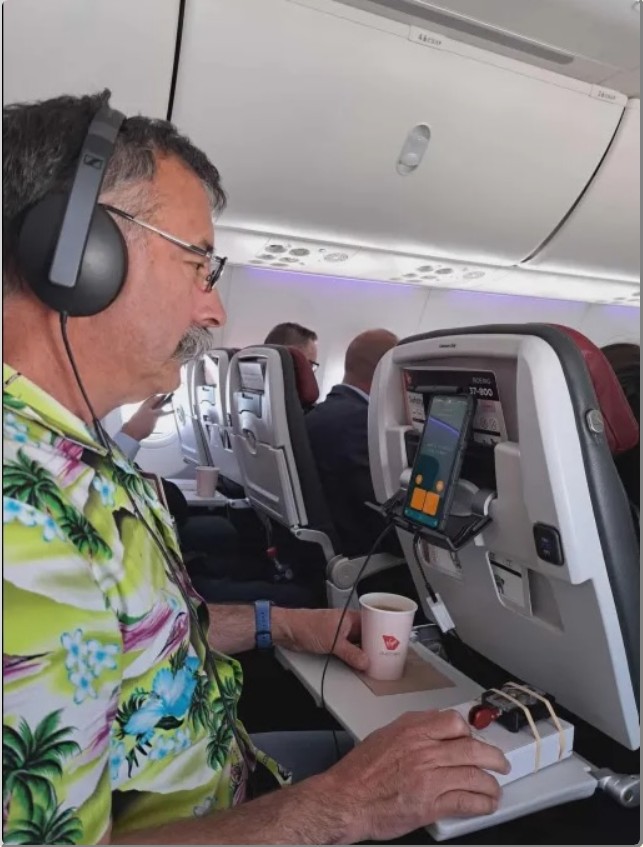
Ron VK7ME caught en-route to Bundaberg using the Morse Mania App with his shiny new BaMaKey paddle. Careful Ron – they warned you that CW could be habit-forming!
I’m used to reading reports from some contributors who had tough conditions during our CQQRS Slow CW Practice QSO net on Tuesdays – static crashes, switch mode power supply hash, poor propagation, failed antenna feeds, incorrect settings on the transmitter, incorrectly set GMT clock, dog ate my Morse key, etc.
Well, this week it was my turn to have a whinge – QRN up the gazoo from static crashes made things less than pleasant. So I was pleased to read the positive reports from our team who reported that there was at least 63 stations heard – excellent work folks!
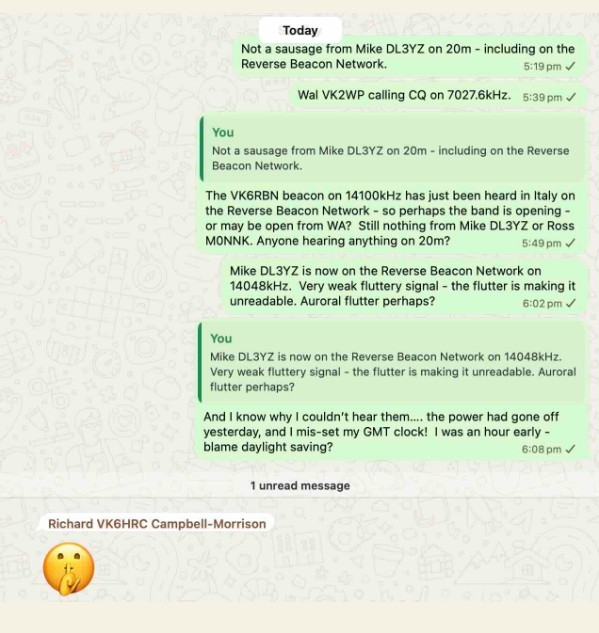
As it turned out, I had mis-set my GMT clock in the shack after a power failure, and I spent the first hour of Tuesday’s net listening to the noise on 20m, hoping to hear this week’s DXperiment participants.
I checked the Reverse Beacon Network to see if others in Oceania were having any luck and noticed possible grey line propagation from New Zealand to Europe.
So I thought it would be a good time to write something about the phenomenon in our There’s No Such Thing section… but luckily, I saw a Wagga Amateur Radio Club member’s comments about a grey line article in the Club’s latest QRM newsletter. Perfect timing!
Thanks again to John Shutte VK2EMF for permission to re-print the article as this week’s Topic of interest. And this week, we’re introducing one of our new team members, Ron VK4EV who’s very kindly let has have a look around the mouth-watering home-brewed projects in his shack – thanks Ron and welcome again.
In Other News, Mike DL3YZ discusses the new Runners Point status display and he’s invited the team to have a look at the system under test. Also this week, we’ve received three questions for our There’s No Such Thing section – excellent!
Which reminds me, I still haven’t answered lan VK1HF‘s last question! I now use his Snowline KiwiSDR every week during the net – so the least I could do is give him the courtesy of an answer to his current-limit question!
Finally – thank you to the 31 contributors and our editorial team who made this newsletter so interesting – very much appreciated folks. Alors… bon appétit!
Reports

To make your report more interesting, please consider sending a photo to be attached. If you have a photo that you’d be happy to include, please email it to: cqarsnet@gmail.com To make it even easier for Patrick and Mark, see if you can compress or reduce the siz of the image (preferably to less than 100KB file size).
No problems if your computer or phone can’t do that – just send it through anyway please. So, please help attract new and old team members to have a go by submitting your report each week. Submissions close 1300 (Eastern Australian Summer time) on Thursdays.
Website
If you’d like to find out a bit about our net, or would like to pass information to others about our Tuesday get-togethers, here’s the link to our website. bit.ly/CQQRSWebsite
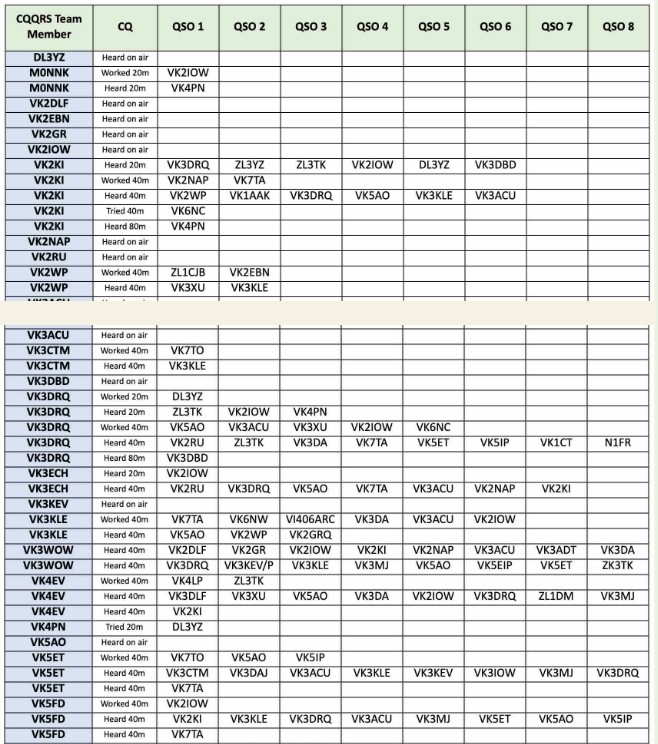
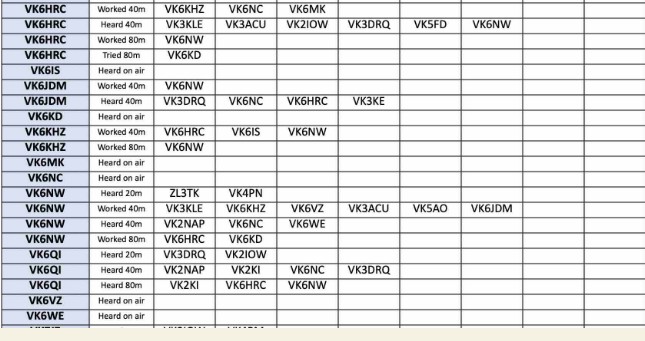
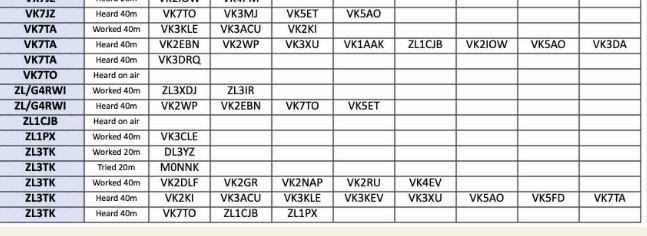
The spreadsheets above show the known stations on last Tuesday’s Group; the comments in the team members’ reports (Submitted via our webform bit.ly/CQQRSNET ) follow:
This week’s comments from our webform reports have been compiled for us by Patrick VK2IOW; thanks Patrick.
[20m] My car portable setup is not the most efficient but it’s too cold and damp now to § outside. So thank you to those operators who tried to contact me but were unsuccessful.
Conditions were strange – I could hear VK4PN weak but clear, yet he couldn’t hear me. And I only caught the “3”
[40m] VKS3CLE (Charles) and I weren’t really sure we were in a QSO. Condx were poor to very bad. I gave him a 479 and he gave me a 229. There were quiet pauses after each of my overs, so I think he was doing his best to read my sending and figure out a reply.
[20m] Only lots of noise heard on 20 mts.
[40m] -orty meters was quite civil tonight with little QRN and he east/west Faraday curtain missing for once. Had a ovely chat with Donald. Jordan was very strong here considering he was using 100W.
[20m] The original of this report was fully compliant with the mandated rules for SI metric nomenclature. Achieved a successful exchange of signal reports with a very weak Mike DL3YZ.
Could not hear any sign of Ross MONNK direct, however although I could hear both Ross and myself well enough for a QSO via the G8JNJ SDR near Dorchester, ~ 50 km mostly across water from Budleigh Salterton, it wasn’t to be.
The original of this report was fully compliant with the mandated rules for SI metric nomenclature. The 40 m band sounded quite dead until about 0745Z after which it got better and better.
But alas, suddenly at ~ 1050Z wide band noise sounding like OTHR swept from bottom-to-top. This has been happening more often on 40 m in the past six months.
It makes copy very difficult and renders some stations QNP, not only due to the noise but also by reducing receiver gain from AGC action; it lasts between 10 and 30 minutes.
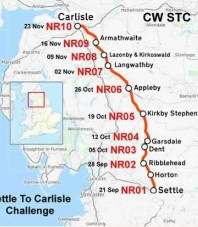
One station took advantage of our notified STC sked and passed NR10, his final QTC in the STC challenge. See STC Report 11 elsewhere.
40m] irst time operating at this NZ QTH. Band eemed quiet with deep QSB, with only 5 watts idn’t manage to work outside of NZ. Using a K after 40 years was bordering on hysterical ) anyone unfortunate enough to hear me!
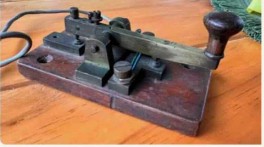
FIOM) MOM EVCriigianll VAGEY al DiSoDale
[40m] Conditions were not good here with constant QRN from approaching storms.
[40m] I didn’t hear much activity when I first got on air at 1815, but I did Rx a good signal from Paul VK3KLE. There were, as usual, more stations heard after dinner (about 1950).
I had a couple of nice long chats, and hope that wine with dinner hadn’t made me too loquacious.
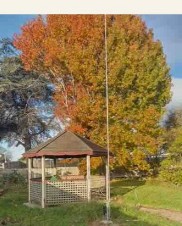
From your editor Mark VK2KI at Beautiful South Bowning NSW
[20m] Well 20m seemed very very quiet! I listening from my home station, the Snowline and Ironstone Range KiwiSDRs and the Reverse Beacon Network – not a sausage from our team this week apparently!
Funny, I couldn’t help thinking that Mike DL8YZ had made a comment about “starting the shift a little later, when the DX window has finally opened up completely”. Should have twigged that something was amiss. An hour of listening to noise later…
I started hearing a very weak and fluttery signal on 14048kHz; the flutter was so deep that I couldn’t actually make out any characters. The Reverse Beacon Network showed that Mike was on 14048kHz – so I think it was his signal I was hearing.
The penny then dropped…. I rechecked my GMT clock…. it was an hour fast! The power here had gone off yesterday during a storm, and the battery back-up in my clock hasn’t worked for years (I keep replacing the battery – living in hopel)….
But when I re-set it earlier in the arvo, I’d set it an hour ahead. No wonder things were quiet! So as the correct hour continued signals started emerging from people working Mike, but Mike remained pretty weak here.
Interesting to look at the RBN for signals from NZ vs Australia at grey-line time.
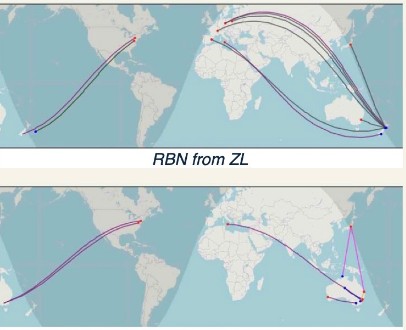
Propagation, and why does it happen? Down on 14045, Ross MONNK/P was calling according to the Reverse Beacon Network, and I think I could hear Stan ZL3TK working him. An email confirmed that he was hearing someone (Stan ZL3TK I think) very weakly.
So the propagation gods didn’t smile on us non-gain-antenna types this week! Oh well… next week will be much better.
40m was just horrible when I finally got my times sorted out. Static crashes galore. I think the crashes and bangs ha driven others of our team under the covers too – there was a few times when I could see on the KiwiSDRs six or eight QSOs going on in our segment, but there were other times when there was only ‘one or two.
I was pleased to hook up with Chris VK2NAP at Marrickville and lan VK7TA al Latrobe again. Chris was in and out of the noise a bit, but lan was stronger.
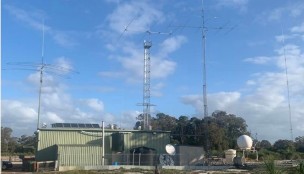
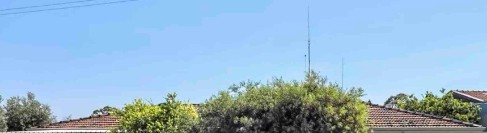
Later I tried calling Lin VK6NT operating the Northern Corridor Radio Group’s thre element Ultrabeam UB-04EL-640 Yagi (on the middle in the image) from VK6NC but he couldn’t hear me.
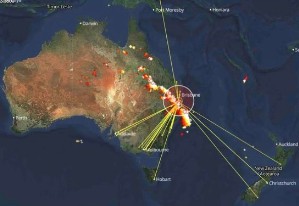
Nothing on the SDRs on 80m when I listened, and the band seemed a bit less affected by the static crashes than 40m. So I started calling CQ on 3555KHZ – however, I was just talking to myself apparently.
I did discover that it’s hard to send with a straight key with one hand while sneezing with the other. I did notice a trace on the VK6SEG KiwiSDR from Richard VK6HRC and Wayne VK6NW on 3560KHZ – but there was no sign of them here in NSW.
I think I sawa very weak signal from Sava VK4PN but I couldn’t hear him well enough to work. So by 11PM I gave it away, hoping for better conditions next week.
[20m] I managed to have QSOs with Mike, DL3YZ and Ross, MONNK, though conditions were not as good as last week. The QSO with Ross in particular was an interesting challenge.
Initially I gave him an RST of 229 We were sending each word twice to improve intelligibility. However signals did improve during the QSO, Ross said that my signal became clear but faint; his signal improved to about 339.
I was using 100 watts I think Ross’ power from his car setup is about 20 watts. EET beg nln Oe FEY RG RR CRE EET Leey pameew el (ye eny ee Liem gen
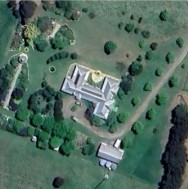
| think Ross’ power from his car setup is about 20 watts. I could have switched my amp on. However, that would not have helped me to hear Ross any better — the limitations of amplifiers, hi.
[40m] Conditions were noisy; lots of static crashes. Had QSOs with ZL, VK3 and VK5.
[40m] My biggest surprise, was to copy OM Lin VK6NC a way from WA and readings 592+20. It was no wonc he was using a FOUR ELEMENTS YAGI!
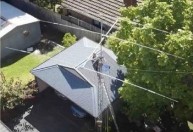
[20m] Was working from my home QTH and paid a QRM penalty for that. One of these days I will score a trifecta of; (1) being available a little earlier in the afternoon; (2)
Being at a park and away from the QRM and lastly; not forget to connect essential items to the antenna. Still a pleasant evening of casual listening while paying some attention to other things; I followed the spots for the DX operators and pleased I could hear VK2IOW and VK4PN on 20m and I could hear but not discern from the noise their contacts – I am guessing it was the other side of that mythical DX.
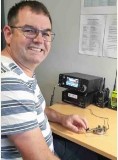
[40m] Then, on 40m I could hear VK7TO, VK3MJ, VK5ET and VK5A0. Was nice not feeling the pressure of deep concentration as I did not TX and just picked up what I could. This does get easier right?
Thanks to Mark and Ketut for the weekend CW rag chews when I had a day to kill in Melbourne, I enjoyed the chatting till a helo overhead interrupted my mojo x 30 seconds.
Every time I do this I think, that was hard, yet every time I get more words down and ask for less repeats so all is good.
[40m] Very good evening on 40m . For those I worked bui didn’t get to say, I was using my vintage FT101E . It’s quite a good rig for CW. Spent a few days this week sorting out replacing old Yaesu mica caps which are prone to failure.
Rebuilding the driver stage eventually with mostly new caps. One of the fixed chanel Xtals I have: a fixed Xtal for 7.025000(
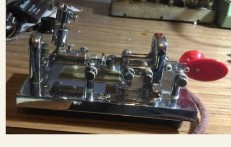
Fixed chanel Xtals I have; a fixed Xtal for 7.0250000 or there abouts and it holds tightly on that frequency . The VFO is fairly stable as luck has it in any case. Despite close adjacent strong signals the filters and AGC performance was quite good.
I’ve modified the first RF mixer with a pair of J310 FETs, and replaced a FET on the NB poard with a J310 using a green LED for its fixed bias. I think many of the CW oe ss oat ae ese se a oes Tee rl PR fel eee ee
For anyone interested you can expect to salvage some caps on some boards only on these vintage sets. New generation 1 kV ceramic caps from Taiwan seem to work well in RF applications. Regards Paul, VKSKLE
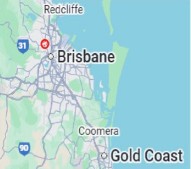
From Sava VK4PN at Mount Ommaney Brisbane
20m] Again late to get on air but managed a quick QSO with Mike, DL8YZ. Conditions were pretty poor at my QTH, a lot of noise, I could barely read Mike. He gave me RSN of 541.
I would love to =xperience noise at that level on air just cat wpec alt wea pene Wage et gtr eg eee age @ee ole eam nina’
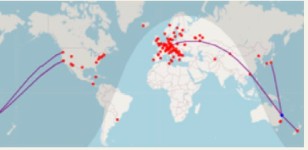
Once, I called a few more CQs to get RBN report and did not get any calls from EU stations which is unusual and inconsistent with the RBN report.
Somebody was calling me though way down in the noise; I thought it could be someone from our G contingent, but despite all the effort I couldn’t copy enough to confirm my guess.
[40m] After a customary ZLCW net check-in I turned off my QRO rig and reverted to QRP. A number of stations were having extended QSOs so I would select one randomly and listen to see whether the QSO was close to finish.
Had to wait a long time for a chance to make a call, but as usual lost to a QRO station every time. So I called few CQs in-between and no takers. After a while I was wondering if I was getting out at all and logged on to Araluen VK2-based Kiwi SDR.
Called a CQ and, guess what, I could see my trace on the waterfall. Kept calling CQs and competing with QRO stations; still no luck. VK6NC was booming into Qld so I thought there is my chance but too many QRO stations were queuing up.
Out of curiosity I logged onto Ironside (VKS5) Kiwi SDR and you guessed it, I could see my trace there as well. So I was making it halfway to VK6 at least.
By this time of the evening a massive storm was moving in from the west and the lightning strikes were hitting too close for comfort, so I switched the gear off and disconnected the antennas.
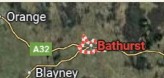
Storm season up here started very early and some storms were just horrendous. Orange-sized hail in some beach suburbs!
[40m] Strong winds with nearby storms caused a lot of static.
[40m] I was feeling a bit seedy on Tuesday night, so decided to treat the occasion as a listening opportunity, and to do so with no RBN ‘assistance’.
I was hoping, among other things, I might get to detect some faint stations not obviously visible on the Icom 7300 waterfall, but this proved not to be the case.
Overall, I was most impressed (and pleased) to find that nearly all the QSOs on which I eavesdropped represented actual CONVERSATIONS! I find this comforting.
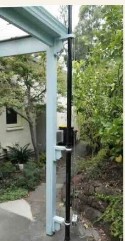
NINE EE LUPE ENE Ne 8 PEERED REIN MEE ENE AEE Ne In the hour I listened, I stumbled upon one OM whom, for complex reasons, I must admit I have come to regard as a kind of personal nemesis of mine — if you know you know, and if you don’t, it certainly doesn’t matter — and my goodness, well before I heard his callsign, his sending stood out to me (in a generally very good field) as absolutely beautiful, and a quite perfect model.
Hat tip from me, OM, if you ahniild ho raadinna thic!
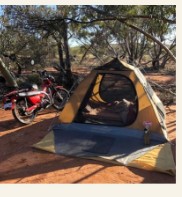
[40m] I was able to operate on one band only and for a very brief period but managed a short QSO with OM Lance, VK7TO, near Margate. I sent him a 579 report and received a 559. I was /QRP/P from our ‘bush camp’ near Bendigo.
My HB1B (‘squeak box’) certainly is a very handy little rig.
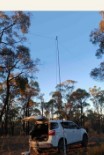
[40m] Enjoyed the better conditions this week, very little QRN and East / West early opening made for a busy session, lots of signals on the waterfall display.
[80m] Tried calling David VK6KD after he signed with Wayne VK6NW but too late as he had moved on.
POST MORSUM 26th November
From Richard VK6HRC. Eight on the South West repeater and AllStar / Echolink hub this morning.
VK6NW Wayne VK6QI Mark VK6KD David VK6FN Max ZL/G4RWI Nigel ZL3TK Stan VK6HRC VKARARR Milllinan
Wayne took a break during his morning walk to call in letting us know that he had fun on 40m and 80m enjoying the quieter conditions after last weeks electrical storm. Nothing on 20m but 15m seemed to be open, worth checking in the future?
Mark had to endure the QRN this week with a big electrical storm off the East coast ! Only just hearing Mike DL3YZ on 20m and then on to 40m to work six stations. 80m drew a blank unfortunately, even spared some time to spot on WhatsApp for our benefit.
David caught up with Wayne on 80m then tried catching Lin VK6NT on 40m operating from the NCRG clubhouse but was unsuccessful. Max was in listening mode again, still a fair way to go with the big clean up in town before resuming regular operation.
Nigel being very brave got on with a borrowed straight key something he has not done for quite a while! Nothing in the log apart from some weak signals from VK.
‘Stan was on hand with a lot of helpful information, so bigger and better things from Nigel next time. Stan tried catching up with Ross MONNK on 20m but was unsuccessful conditions not good enough. On 40m five in the log and heard eleven.
With conditions much better for us in WA this week and an early opening East/West on 40m it got very busy at times. Three on 40m and one on 80m in the log, had to.
Wait until near the end of the session to catch up with Lin operating from the NCRG clubhouse using the four element 40m mono bander! The pile ups had eased off somewhat so managed to get Lin’s attention. Thanks to to all on last night and this morning.
This Week’s Topic of Interest
Reprinted with permission from the Wagga Amateur Radio Club’s QRM November 2025 Newsletter The phenomenon known as the ‘Grey Line’ is one of the most fascinating aspects of amateur radio propagation, offering unique opportunities for long distance communication, particularly on the High Frequency bands.
The article Grey Line: The Twilight Zone of Radio Propagation fromDX Engineering’s OnAllBands.com delves into this intriguing propagation mode, explaining its mechanics, significance, and practical applications for radio enthusiasts.
This propagation profile summarises and expands upon the key points of the article, providing a deeper understanding of the Grey Line and its role in radio communication.
What is the Grey Line? The Grey Line, also referred-to as the terminator, is the transitional zone between day and night on Earth where twilight occurs. It is the dividing-line between the
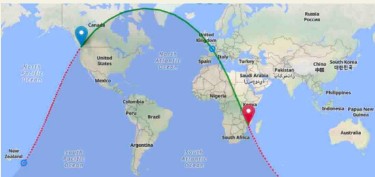
Illuminated and shadowed portions of the planet, moving continuously as the Earth rotates. In the context of radio propagation, the Grey Line is significant because it creates unique ionospheric conditions that enhance long-distance communication, particularly on the lower HF bands such as 160 meters, 80 meters and 40 meters.
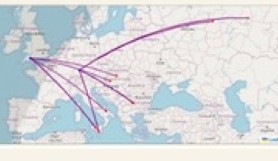
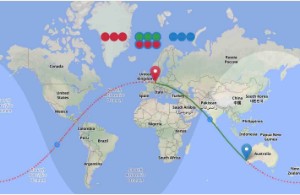
‘An example is shown in the graphic above. Near sunset in Vancouver on June, 1st, 2026, the grey line provided an opportune path to New Zealand, through western Europe and Africa.
The ionosphere, a layer of the Earth’s atmosphere extending from approximately 50 to 600 miles above the surface, is critical to HF radio propagation. It contains ionised particles that refract radio waves, allowing them to travel beyond the line-of-sight.
During twilight, the ionosphere undergoes rapid change due to the transition between solar illumination and darkness, creating a sweet-spot for radio signals to propagate over great distances with minimal loss.
How the Grey Line Works The OnAllBands article explains that the Grey Line enhances propagation due to the ionosphere’s behaviour during twilight.
During the day, the ionosphere’s D-layer, which absorbs lower-frequency radio signals, is strongly ionised by solar radiation. At night, the D-layer dissipates, allowing signals to reach the higher F-layer, which reflects them back to Earth over long distances.
Along the Grey Line, the ionosphere is in a transitional state: the D-layer is weakening, but the F-layer remains sufficiently ionised to support long-distance propagation.
This combination creates a low-loss propagation path, particularly for signals traveling along the Grey Line corridor where one station is in daylight and the other is in darkness, or both are near the terminator.
The article highlights that this effect is most pronounced on lower HF bands because these frequencies are less affected by solar activity and ionospheric absorption compared to higher bands.
Practical Applications for Amateur Radio Operators For amateur radio operators, understanding and leveraging the Grey Line can significantly enhance long-distance communication.
The author offers some practical tips for utilizing this phenomenon: + Timing is Critical: Grey Line propagation is time-sensitive, occurring during sunrise and sunset at either the transmitting or receiving station.
Operators must align their communication schedules with the Grey Line’s position, which can be tracked using software tools like propagation prediction programs or Grey Line maps.
+ Band Selection: The lower HF bands (160M, 80m, and 40m) are most effective for Grey Line propagation due to reduced D-layer absorption during twilight. Operators targeting DX contacts should prioritise these bands during Grey Line windows.
+ Geographic Awareness: The Grey Line follows a predictable path based on the Earth’s rotation and tit. Operators can use tools like VOACAP or online Grey Line maps to identify when the terminator aligns with desired communication paths, such as between North America and Asia or Europe and Australia.
+ Antenna Optimisation: Directional antennas, such as Yagis or dipoles oriented toward the Grey Line path, can maximise signal strength. The article emphasises that low-angle radiation patterns are particularly effective for Grey Line DXing.
Scientific and Technical Insights From a technical perspective, Grey Line propagation is a result of complex ionospheric dynamics. The article notes that the F-layer, which splits into F1 and F2 layers during the day, merges into a single layer at night.
Along the Grey Line, the F- layer is still active but less turbulent, providing a stable medium for signal refraction. The D-layer’s reduced absorption during twilight further enhances signal efficiency.
The phenomenon is also influenced by seasonal and solar cycle variations. During equinoxes (March and September), the Grey Line aligns more closely with the Earth’s meridians, creating favourable conditions for north-south communication paths.
Conversely, during solstices, the Grey Line’s tilt favours east-west paths. Solar activity, measured by the solar flux index or sunspot number, can also affect Grey Line propagation, with moderate solar activity often providing optimal conditions.
Challenges and Considerations While the Grey Line offers unique opportunities, it also presents challenges. The window for Grey Line propagation is narrow, typically lasting 30-60 minutes during sunrise or sunset.
Operators must be precise in their timing and prepared for rapidly changing conditions. Additionally, the Grey Line’s effectiveness can vary depending on geomagnetic activity, with disturbances like solar flares or coronal mass ejections potentially disrupting ionosphericstability.
The OnAllBands article also cautions that Grey Line propagation is not a guaranteed phenomenon. Operators may need to experiment with different bands, times, and antenna configurations to achieve success.
Patience and persistence are key, as the Grey Line can sometimes yield unexpected contacts with distant stations that would otherwise be unreachable.
Tools and Resources To assist operators in exploiting Grey Line propagation, the article recommends several tools: + Grey Line Maps: Software like DX Atlas or websites like VOACAP provide real-time visualisations of the Grey Line’s position.
+ Propagation Prediction Software: Programs such as W.ELProp or HamCAP can forecast optimal times and bands for Grey Line DXing.
+ Amateur Radio Communities: Online forums and clubs, such as those hosted by the American Radio Relay League, offer valuable insights and real-time reports from operators worldwide.
The Grey Line is a captivating aspect of radio propagation that blends science, timing, and skill. The OnAllBands article effectively captures its allure, describing it as the “Twilight Zone” of radio communication – a fleeting but powerful window for connecting with distant stations.
By understanding the ionospheric dynamics behind the Grey Line and employing strategic planning, amateur radio operators can unlock its potential for remarkable DX contacts.
Whether you’re a seasoned DXer or a newcomer to HF radio, the Grey Line offers a unique opportunity to explore the boundaries of radio propagation and connect with the global amateur radio community.
For more details, visit the original article on OnAllBands.com. ~ On All Bands, July 2025 Mark Haverstock, KBMSH — I See |
Illuminated and shadowed portions of the planet, moving continuously as the Earth rotates. In the context of radio propagation, the Grey Line is significant because it creates unique ionospheric conditions that enhance long-distance communication, particularly on the lower HF bands such as 160 meters, 80 meters and 40 meters.
An example is shown in the graphic above. Near sunset in Vancouver on June, 1st, 2025, the grey line provided an opportune path to New Zealand, through western Europe and Africa.
The ionosphere, a layer of the Earth’s atmosphere extending from approximately 50 to 600 miles above the surface, is critical to HF radio propagation. It contains ionised particles that refract radio waves, allowing them to travel beyond the line-of-sight.
During twilight, the ionosphere undergoes rapid change due to the transition between solar illumination and darkness, creating a sweet-spot for radio signals to propagate over great distances with minimal loss.
Thanks to John Shutte the Editor of the Wagga Amateur Radio Club’s QRM Newsletter for permission to re- print this timely article.

If you have an article or two that you think might be of interest to our readers, please let me know so we can share more thoughts and ideas. Please email material to Mark VK2KI: cqgrsnet@gmail.com
Alternatively, what’s going on on your workbench? Please let Mark VK2KI know; email to cqqrsnet@gmail.com For guidance on writing for RagChew, see Articles below.

QRZ?
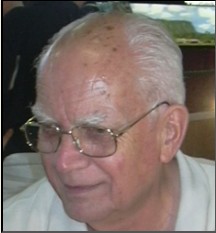
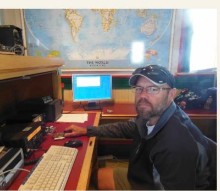
Introducing Ron VK4EV from Everton Park
| became an Amateur in 1966 and did the usual thing in those days and built an AM transmitter for VHF and then HF but no CW. I became interested in QRP operation as the wife and I used to go out to western Queensland in our camper trailer. I had built a 80M.
DSB transceiver putting out about 700MW. I was so impressed with the contacts I made with it and then started to build a low power CW QRP TX so I was able to use CW portable.
I built QRP transmitters for 160, 40, 20 ,15 and 10 Metres as well as a direct conversion receiver and QRP test gear.
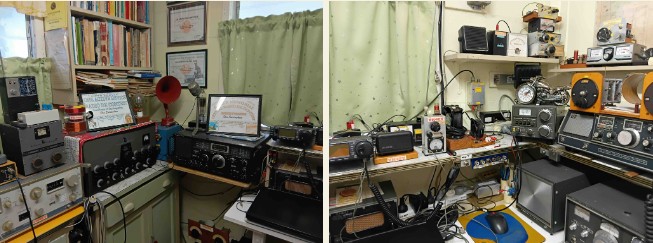
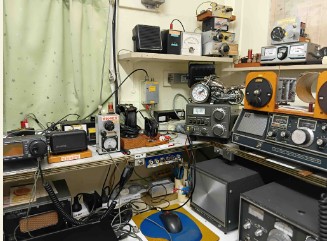
The thing above the Atlas 210X is a DX Crystal Set with the S meter and matching transformer above in the black box.
On the left is a German level meter used for LF reception and there is the IC 706 transceiver.
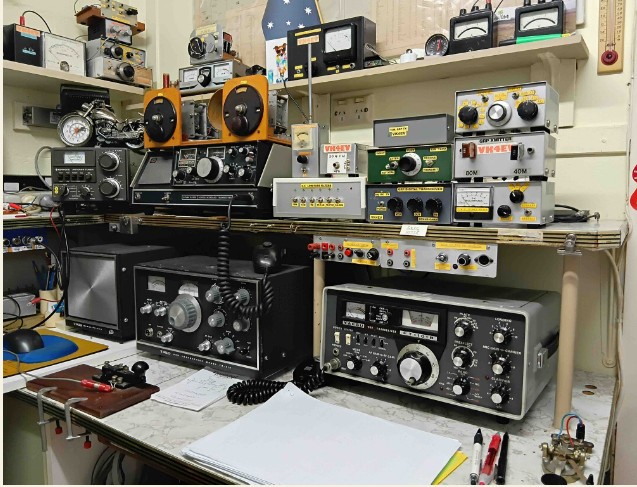
A few of my home-brewed QRP bits and pieces. The low pass filter box is for QRSS transmitters and is made from filters out of a C735 transceiver that called it a day. I am on the air on QRSS on 30M with 200MW.
I’m going to make a couple more transmitters for QRSS, and instead of having to make filters for them I can just put the output through the appropriate filter. My QRSS stuff is upstairs as I run it for a number of hours.
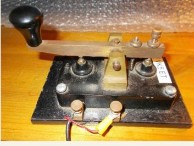
I no longer go out bush as age has crept up but I use CW at home using a key. Lately I have been practicing using a paddle.
I have had a few on-air QSOs but I’m not real confident as yet; I hope to be on the air for some of the nets and hopefully build my confidence again. Thanks again. Ron Everingham VK4EV. [Welcome Ron – fantastic.
I think you’ll get a few questions and hopefully some comments from the team about your mouth-watering home-brew and classic gear. I look forward to hearing you on air on Tuesdays when you can make it.]
QRZ? Who’s on the other end? From your editor Mark VK2KI / VK6QI When you’re on the key, it’s really hard to find out a bit more about the person you’re chatting to; it’s really nice to know who’s on the other end of the QSO. So, would you be willing to share some thoughts about yourself? Please let Mark VK2KI know: cqqrsnet@gmail.com For guidance on writing for RagChew, see Articles below.
QRZ? Who’s on the other end?
Head Copy Practice
Anyone who is just starting out with head copy should look at edition 23 ~ 2025 where we first started with Winnie the Pooh recorded at 12 wpm.
In edition 23, and for a few following Newsletters, there are instructions on how to use these files, and edition 25 – 2025 has information on the Ditto CW : Morse Player app. This week we have the second half of Wind in the Willows Chapter 9 – Wayfarers All.
Itis suggested that you read the text file before listening to the audio file. That will make it easier to follow the audio file and prepare you for any unusual words. The MP3 files have been recorded at 16 wpm and 650 Hz tone.
If you prefer a slower speed or different tone, you can create your own MP3 files by converting the text file included in last week’s Newsletter with the Ebook2CW app — https://fkurz.net/ham/ebook2cw.htm|.
Because of MailChimp’s size limits, I’ve split Chapter 9 into 5 parts. Each part is over 1 hour playing time @ 16 wpm. Parts 3, 4 and 5 are attached below.
Uncommon punctuation has been removed (the Ditto CW app doesn’t recognise some of it), and contractions have been simplified (for example, we’ll becomes we will). This week’s attachments are Chapter 9 parts 3, 4 and 5 MP3 files.

You can either play the MP3 files in any media player, or load the text file in last week’s Newsletter into the Ditto CW: Morse Player app — https://dittocw.andro.io/. Both options work well, however Ditto CW gives you complete control over all Morse settings, while a normal media player only allows changes to playback speed, and does that in steps (e.g. +1.25x, 1.5x, 1.75x).
Other News
MiVivot WwW, ay Vitis cilia Vy ii PIV i Vee y Many of us (well, most of us) will hopefully have the privilege of growing old. However, as we can all attest, as we age things begin to ache.
Getting out of a chair is sometime accompanied by a groan, and, if we’re honest, our mental capacity and cognitive health begin to decline as well.
But just like taking care of our bodies with exercise and a good diet, we can do things to maintain good brain health. This also applies to recovering from brain trauma, such as a stroke.
A friend of mine (and my mathematics teacher at high school) is also an amateur. Steve, VK3CAX wrote to me recently with the news that he was recovering from two strokes last year.
He asked me to share this story with other amateurs as a bit of a “good news story”. “| think I told you I had 2 strokes last year while I was in Germany. Lost use of my right hand and the ability to walk. After intense physio etc, I’m virtually back to normal.
However, one thing I learned was that to recover lost abilities, I needed to practice the skill intensely until it returned. I was advised that I had about 6 months to do this. Of course, you don’t always know what you’ve lost.
I got back to Melbourne about 2 months after the strokes, able to walk and write again. Then I discovered I couldn’t send CW! After about 10 days and 30 mins practice per day, it was back. Your discussion of muscle memory resonated with me.
In an ageing amateur population, my experience of losing my Morse must be happening quite frequently. My advice is to immediately get on the key and start re-learning ….
Not the intellectual component, but the muscular one!” Maybe you could pass on this advice via QTC”.
In a related story, Terry Jackson, WBOJRH revealed in an interview with Bruce Pea on the podcast, Dit Dit FM, that he was suffering from dementia.
Terry was quite candid about his condition and relayed the story that his daily Morse code practice was almost certainly delaying some of the symptoms and progression of his disease.
Discussions with a neuropsychologist confirmed that activities like Morse code can aid in building and retaining mental acuity. I wrote to Terry asking him for an update and received the following: “Thanks for your email and wonderful info on muscle memory.
I believe sending and copying CW has slowed down my memory impairment. The major impact for me is very short memory loss. I can copy words at 40 WPM, although I usually forget the first word by the time another passes. I am working on improving this.
I am optimistic that this will get better. The real upside is that working with CW has improved my expected memory loss.” It’s great to read both these stories and have confidence that even if we think we are too old, or simply not able to learn the code, there is still hope.
Regular practice coupled with a proven technique will greatly enhance your chances of success. And of course, it’s great to hear two positive experiences from Steve and Terry and I really appreciate their willingness to share their personal stories.
CW Ops
CW Academy is a great learning environment, and CW Ops runs these classes three times per year. If you’re at all interested, the next intake is in January 2026.
I’m running a survey until the end of November to register your interest in classes here in VK and ZL at VK/ZL friendly times. If you are at all interested in a class in January/ February 2026, please complete the survey.
Https:/Aorms.gle/j6YCUcgdDARDFExnZ9 Courses are eight weeks long and no matter your level, you’ll come out the other side with better skills and more enjoyment from the code. CW Academy is immersive,
• ngaging and fun. https://cwops.org/cw-academy/ I can confirm that there will be a
‘Can COMM tat Mere Wil DE a DEGINNelS Ulass — commencing 5‘ January and running for 8 weeks. I’ll almost certainly be running an Intermediate Class as well. Email me if you’d like more information.
As always, if you have any questions or feedback, please drop me an email. 73, Chris VK3QB CW Ops OC Ambassador vk3qb@hotmail.com
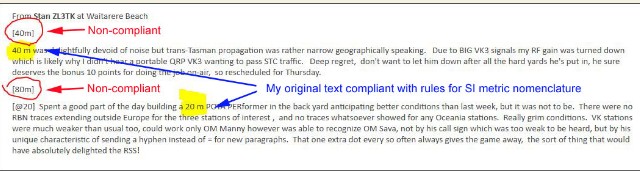
From Stan ZL3TK Mark, Thank you for providing my original QRS FFA script from last weeks edition. I wasn’t imagining it, skulduggery has been going on, my report was tampered and the evidence is presented below – shameful and unacceptable behaviour in anyone’s language In future, if there is a future for me in QRS Group, I shall retain a screen shot of my contributions.
Right now I’m seeing that my contributions are deemed to have such little value that they can be downgraded, edited willy-nilly, have the meaning changed, and/or be used to portray me as a common law-breaker.
Yes, believe it or not, the correct use of S| metric nomenclature has been enshrined into Australian legislation through the National Measurement Act 1960. Time to admit: who is the actual law breaker(s)?
Here is an annotated copy of my original contribution to prove it was fully compliant, except of course for the sub-headings where the editor deliberately flouts the legislation week-after-week:
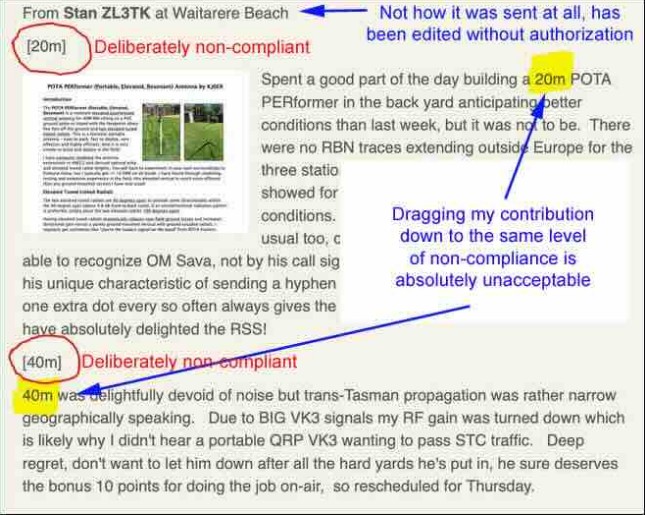
Here is the non-compliant rubbish that unauthorized editing has made of my contribution. I cannot object strongly enough. Such editorializing casts aspersion: on the fundamentals of my technical qualifications, ability and experience.
Were iy Mb three statio showed for conditions. usual too, ¢
We are little better than savages without societal rules and laws. Persistent non- compliance by persons who continue to defy those rules while in possession of full knowledge of those rules, as you are, set a very poor and misleading example to all members of the group.
_In addition to me there is one exception who refuses to be negatively influenced by the flawed editorial policy -_ he is a German educated to EU standards.
Those same standards have been internationally adopted for all engineering and scientific pursuits, one such pursuit being amateur radio. From discussion with DL3YZ, he clearly knows and fully complies with the rules for SI metric nomenclature.
Look at his high quality contributions, a valuable member indeed whose contributions – which do not suffer from idiotic local modifications as mine has.
The increasingly-common phenomenon of refusing to comply with rules and standards, in spite of having the knowledge, is known as ‘wilful ignorance!
In continental-EU-style countries, a sort of soft-soap expression indicating a laisez faire attitude expressed in almost-excuse-granting weasle-words.
However, the phenomenon is taken far more seriously and is deeply frowned upon by those who are capable of independent thought, so much so that in the US the phenomenon is known among the informed by the harsher and more honest term, ‘contrived stupidity’.
‘Contrived stupidity’ has a nice ring to it don’t you think? It describes contemporary behaviour perfectly. Again, just to make the principle crystal clear, let’s look at one simple example of non-compliant nonsense throughout RagChew: 40m ___ Ifa technical journalist was to write 40metres or fortymetres he qualifies to be called an idiot by any editor worth his salt of a technically-responsible magazine, and asked, ‘where is the space?!
How unsurprising it is to find exactly the same reasoning applies to 40m. Readers shouldn’t have to, but are expected to work out that the quantity and unit are actually separate entities, the meaning is lost without the mandated space, in fact 40m means absolutely nothing, whereas 40 m conveys the required information.
Why do you think the space is there if it’s so unimportant it can be left out willy-nilly? Standards for SI metric nomenclature, exactly as those adopted by Australia and New Zealand, make very clear the absolute necessity for the space by including and mandating that space in every example throughout the NIST manual.
Exactly the same applies to 7020KHZ in all it’s variations of unmitigated terminological stupidity. 7.020 MHz is the ONLY correct presentation, clearly explained in the manual. I’d like to know why you want to keep RagChew readers in ignorance?
_ Is the motivation something akin to that of an egocentric, deluded priest – to keep power and control over the ignorant masses?
_ Is there any possibility of upgrading RagChew to conform with your country’s statute on SI metric nomenclature, or is leading the field in technical correctness too confronting?
Ineed to know whether or not my contributions are going to be downgraded in future to conform with RagChew’s currently deeply-flawed editorial policy to encourage non-compliance. Let me know please.
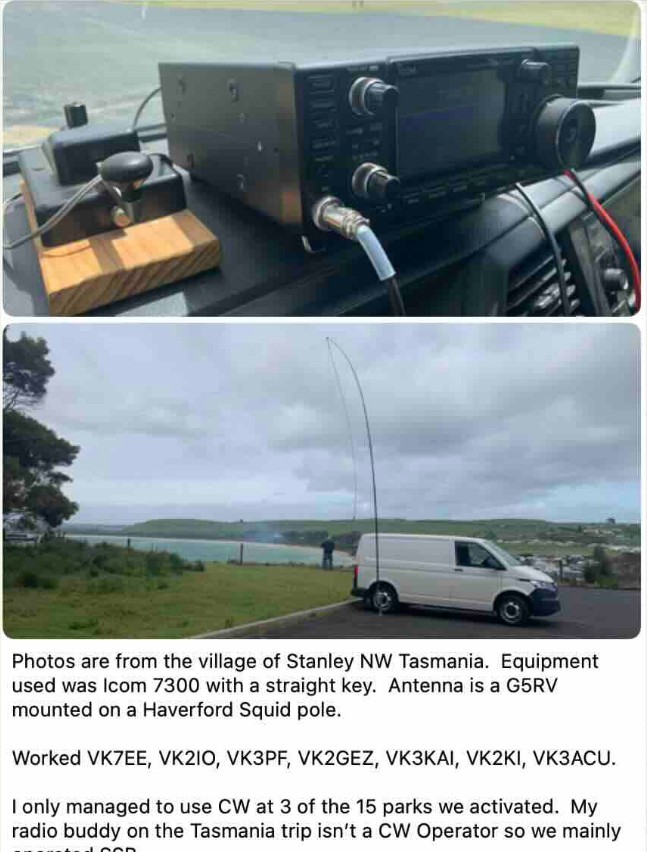
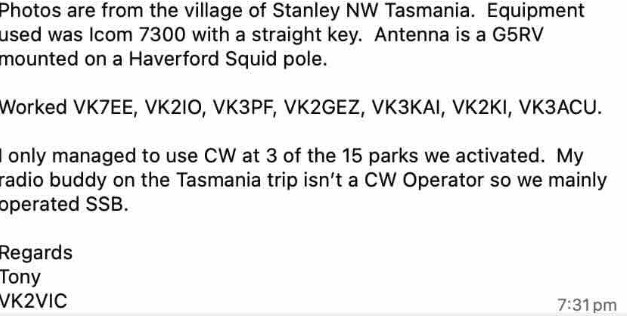
Tasmanian Portable Adventure
Morse Training Net
Our team member Nic VK7WW runs an on-air Slow Morse training net every Wednesday at 7pm EDST on 3580 for 30 mins. He uses the callsign of the Northern Tasmania Amateur Radio Club VK7TAZ on that net.
Many of our team learned Morse code with the support of Nic, and the weekly training session comes highly recommended for anyone who wants to learn the Code, or simply brush up.
Everyone’s welcome – 3580KHZ at 7pm Eastern time every Wednesday; you’ll hear lots of the CQQRS team on that net. Jordan VK3ACU has recorded the complete set of lessons which you can now find here:
Https://www. youtube.com/playlist?list=PLHsQmZz6fBXO7swAfbT mutrbbEL17fUQL Contact Nic VK7WW for more info nicholaschantler@hotmail.com including how to join the NTARC DISCORD group to follow the action, or just come along and join in on Wednesdays.
Ops Normal Check – Mal VK6MT
[Mal’s reply to an Ops Normal check after the recent severe tropical cyclone.]
Hi Mark Yes, all good, a lot of trees down, like the one 50m down the street (see photo). The building is fine, and we didn’t even lose
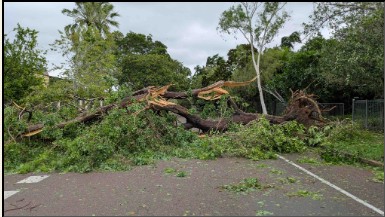
Power (unlike many). It was easy to stow antennas as I live in a flat and nothing is installed with any degree of permanence. Cheers Mal
DXperiment Bands
VK6QI Question: On this morning’s Post Morsum callback, Wayne VK6NW noted that the VOACAP prediction system was indicating that 15m was probably the go for EU-VK during our net.
I also noticed last night that there were more VK-EU reports on 15m and 10m on the RBN. Perhaps time to re-run the Long Path predictions on VOACAP and other systems and perhaps have a think about whether to give the multi-band skeds another go?
Reply from Ross MONNK: Mark. I’ve tried 15m on several occasions for just that reason, but had only one VK contact on it.
I’ll stick to 20m as I’ve had plenty of success on there (if fact, contrary to the VOACAP predictions) and my gear is simpler if single band. But it would be interesting to know if anyone finds 15m that much better than 20m.
Ross Reply from Simon MOKBJ: Hi Ross and Mark, I regularly tried 15m as well as 20m when I was out and about but couldn’t get a single VK contact on it. I had a little more success on 17m, which produced one contact with Patrick VK2IOW.
Simon Reply from Mike DL3YZ: Hi everybody, back then when we tried ( August and September 24) I had 13 contacts on 15m and as I remember they were all quite good readable. Of course that was with the big beam out in the hut.
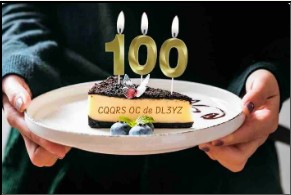
And in the moment, I dont have a 15m antenna at the shack. But If you guys want to give it a try, tell me and I can put up a 15m loop and check the best times on Ironstone. Checking my log I realized I already have 99 QSOs to VK.
So the next QSO is my 100TH – HI. 73 Mike
From Stan ZL3TK “The end is nigh”, so sayeth Rorschachs. If one injects a little imagination, his rather odd two-minutes-to-midnight doomsday emoji says it too!

However in this case the end is both nigh and good – very good in fact – as the STC challenge draws to a surprising close. In last week’s QNC, little known Armathwaite, a tiny village in the Eden Valley was brought into focus for the best of reasons.
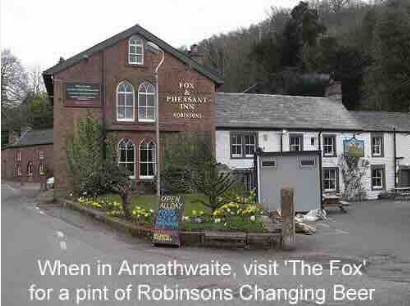
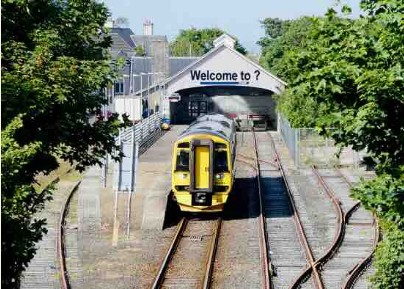
This week, the long-awaited finale has arrived. In a burst of imagination-on-steroids, STC NR10 takes us to Carlisle, ostensibly at the end of the journey. However it is merely a facade, a wardrobe through which one may access the land of Narnia.
Consult the NR10 sound file to discover at which very special station this educational railway soirez really concludes, as well as finding a couple more places to visit on the way.
Results of the STC challenge will be released as planned soon after 07 Dec 25. 73 de Stan ZL3TK
DXperiment – Station Status Display
From Mike DL3YZ Hello dear CQ QRS team. We have built a new tool to replace the RBN frequency spotting link of the DXperiment stations. Here you can see in real time which frequency we are on and which state of operation we are in.
No more guessing and chasing ghosts below the noise. We will update our states while we are operating, so you will have the information fresh from our shacks. Hope this will make things easier for both sides.
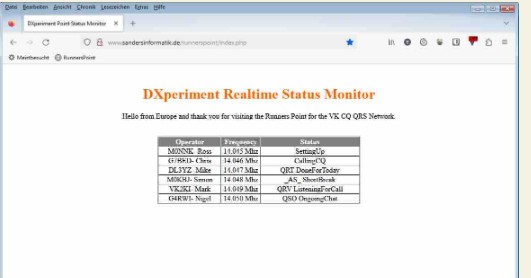
You can access the new status monitor from our DXPeriment web site. hitp:/Awww.sandersinformatik.de/dxperiment/ Just click on the link above the schedule. sent out by email from Mark each week.
At the moment we are still testing around with it, so please note that the displayed data will only be meaningful during Tuesday’s sked 😉 But feel free to check it out and see us playing around and trying to crash down the server! Have a great week !
If you’ve read or heard something that you think might be of interest to our readers, please let me know so John VK2RU and I can share more thoughts and ideas. For guidance on writing for RagChew, see Articles below.
Please email material to Mark VK2KI: caqgrsnet@gmail.com
There’s No Such Thing…
Fills WOUR o YUCOLVIlS. I think the first lesson in Teachering 101 is to always tell students “There’s no such…” (I’m sure you know the rest) and “…the only dumb questions are the ones not asked”.
John VK2RU reckons that there’s lots of questions out there among both our new and our experienced operators – about CW, amateur radio operating and about theory.
So John didn’t step backwards quickly enough when asked to volunteer to compile readers’ questions; thanks mate. So here we go…
Question
MMUCSLUUIT Good evening Mark. I am intrigued as to why the DXperiment group states “Wwe are operating long path”. I have a non-directional antenna, so I don’t choose to work long path.
Sure, my signal may get to the other side via the long path, but that’s in the laps of the propagation gods. So why bother specifying?
Response
PcopVvilol You’re right – you may not have any choice in the matter of which way we send our signals around the globe… but many of our operators do use Yagis or other directional antennas.
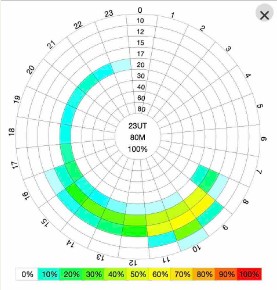
Unless they happen to know that at that time of day the long path is favoured, they could easily get it wrong and be trying the wrong way – or off the back of the beam.
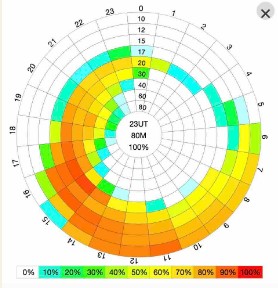
VOACAP Propagation Prediction DL to VK6 – Short Path, 25W CW.
VOACAP Propagation Prediction DL to VK6 – Long Path, 25W CW.
MMUCSLUUIT A couple of times now I’ve seen you make reference to some kind of “index” that you maintain for RagChew. What’s not clear to me is whether members of the Tuesday night group are supposed to be able to make use of this index to find that “thing they know they read about in RagChew once” but cannot otherwise locate.
I guess my question is, what is this “index” used for, and if I wanted to take advantage of, how (if at all) would I do so.
AHesponse Although using the MailChimp (spam marketing) system for the RagChew newsletter produces something that look nice, and that opens in the readers’ email applications and phones without further ado.
One of the disadvantages of using this system is that there’s no index. For quick navigation within the newsletter I could spend even more time manually creating internal anchor points and an index, then manually link each index entry to the corresponding anchor point; however, I already spend at least a day each week writing the RagChew – so unfortunately, it’s not going to happen.
Similarly, we could use our CQQRS Website for some sort of index or better still, some sort of searchable archive of the newsletters.
Lance VK7TO is investigating the latter for us; but of course, unlike some of us – he has a job, family, life etc – all of which come absolutely first! So back to the question about my Index; don’t get too excited…
It’s just a flat file with the list of opening dot-points from each newsletter (the usually less-than- accurate and less-than complete list that follows the Masthead image each week).
Recent requests have demonstrated that that system is less than satisfactory – I usually can’t find what readers have asked for.
So the next option is to do a text search in my email application – hoping that a filter on the particular subject’s words will identify the email concerned. Sometimes I get lucky – sometimes not! So in the interim…
If you’re searching for something from RagChew that you can’t find using the search function in your email application, send me an email to cgarsnet@gmail.com and I’ll see if I have more luck.
That will also provide me with some feedback about what things our readers are interested in.
MMUCSLUUIT How can I identify the call signs of users who show up in our CQQRS WhatsApp chats? Yesterday a message came up on my screen as coming from “~ Bettle LIN”.
Whenever I can figure out the callsign of a user with a name like this from some hint or other that gets dropped, I create a WhatsApp contact for that user, and include the user’s callsign in that contact’s definition.
I know how to search a WhatsApp chat, and so far my searches for “Battle” have not yielded any hits that help me identify a callsign for this OM.
Would it be possible to implement some protocol whereby you identify both the name and callsign of a newly added user at the time you add them in WhatsApp? If this is not practicable, how would you suggest users identify this OMs call sign?
Sure, maybe I could message him individually (I haven’t tried this), but if everyone was to do this… well, poor Bettle LIN. Anyway, would appreciate your thoughts on this — maybe, as I say, in the form of a little par or two in RagChew.
Inher] patil From what I’ve been able to work out, in the absence of anything else, the sender’s phone number appears against their entries; not very usefull However, if the sender has set their WhatsApp up, they would have had the option of putting their name, profile image etc in.
Messages from those people show their little image and what ever name details they’ve provided; I recommend that our team put their first name hyphen callsign then their surname.
That way, everyone in the group who receives their messages know from whence it came. The downside of this is that the callsign will appear in any other WhatsApp groups that person posts to as well – a talking point perhaps?
But you’re right – in the absence of a sender’s information, you can create a Contact for each of the team members when you see them for the first time – and can include their callsign with their name.
When a new team member joins WhatsApp, I usually send out a little welcome message with first name and callsign, so they know they’re connected correctly and so that interested members can add their callsign details.

Now in the case of the
It would have been from Lin VK6NT who joined way way back – in fact he was among the earliest of our team members, back when we operated on 80m only (we started over four years ago would you believe?!).
Lin was then operating as VK6LIN, a callsign that he’s now passed to his Foundation-licensed son – also Lin. Lin (senior) now usually operates from the Northern Corridor Radio Group’s station at Whiteman Park, using the callsign VK6NC; the messages you received this week would have been about that.
I guess “~ Bettle LIN” is what he’s put in is name details at his end – perhaps we should ask Lin what the significance of bettle and the ladybug image are?
[Do you have a question or two that are worth sharing? How about a discussion- starter? Please let me know cqgrsnet@gmail.com and I’ll pass them to John VK2RU for compilation each week.]
Prosign/Character/Signal of the Month
[Suggestion – put it on a sticky note near your key as a reminder for Tuesday. Tell us how you went!]
I Hear Tell…
Last week we reported on the amateur who travelled half way around the world witr his gear…. but left the key and antenna behind for the last hop!
Well this week, another of our team reported: Ah, just thinking, I’ve brought my radios, but left the key behind (2). That was careless; the net’s definitely not happening for me this week!
[If you have some intel about other team members… or even yourself… that’s worth sharing, please let me know cqqrsnet@gmail.com J
Di-dah-di-dah-dit
So back to the CQQRS Slow CW QSO practice net.
Next Tuesday’s Net
Our CQQRS Group will be on as always on Tuesday from around 0600Z until about 12002; see https://bit.ly/CQQRSWebsite and navigate to the Net Details page for details.
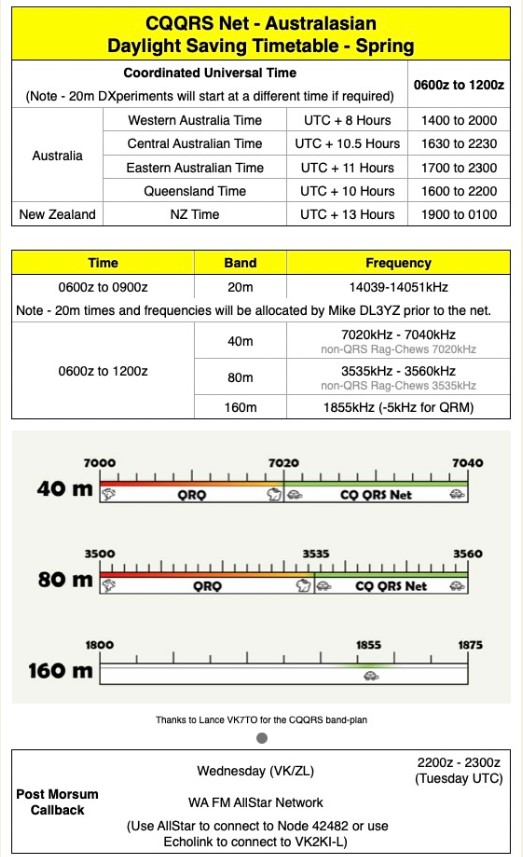
Doesn’t matter whether you’re brand new and want to try just exchanging callsigns and RST reports, or you’re ready for a good old rag chew. We’ll have fun.
There’s usually people around until after 1200Z – so keep calling in the segment of the band designated in the table below until you catch someone.
I should be on as usual from home in NSW or via the Remote at Bedfordale WA, and I’ll also be watching the proceedings using the VK6QS and Tecsun SDRs in WA and NSW respectively. Hope to hear you there.
Reports & Photos
Please let us know via our Reports form bit.Jy/GQQRSNET who you work or hear on Tuesday’s Group. The report form closes at lunchtime (Eastern Australian time) on Thursday. ‘And how about helping to make the reports even more interesting by sending a photo?
If you have a photo that you’d be happy to include, please email it to: cgqrsnet@gmail.com To make it even easier for our Reports editor Patrick VK2IOW, see if you can reduce the size of the image (to less than 100KB file size by preference).
No problems if your computer or phone can’t do that – just send it through anyway please. And of course, I’m always on the lookout for more photos for the newsletter, so if you have something that might be of interest aside from the reports, please send it through as well – I always enjoy the photos that our readers send – and I’m sure our readers do too.
Email them to cqarsnet@gmail.com please (reduced size if possible – but whatever you send will be great). Oh and by the way, I recommend that you don’t keep the Reports Form website open between submission of reports from one week to the next.
If you’re unlucky, there’s an undocumented feature in the software that could cause your current week’s report to be combined with your previous report – it’s happened to your editor several times – much to the chagrin of our Reports editor 🙂
Post Morsum
Richard VK6HRC will run our phone Post Morsum on the South West AllStar net (via repeaters and hotspots all over WA) from 0600 WA time, then from 0700 WA time on 80m (8605 LSB).
See https://bit.ly/CQQRSWebsite and navigate to the Net Details page for details of how you can connect via Echolink or even possibly via your local FM repeater.
Articles
The newsletter is interesting to readers because of the material contributed by so many people – be it the reports each week or the various articles. Could you write a short article or articles for RagChew? You bet! Writing not your strong point?
Don’t worry, I’m very happy to help as much or as little as needed. Here’s a thought – although our readers will much prefer your own writing, perhaps have a go at using a Large Language Model Artificial Intelligence tool such as ChatGPT, Microsoft Copilot or Google Gemini to check your writing or even to actually draft the whole article in a relaxed easy-to-read manner!
You can find out more about how to do that on the Newsletter page on our website bit.ly/CQQRSWebsite. Our website also includes a suitable prompt (the command you feed to the Al to make it do what you want).
Please remember though – you must fact-check anything that an Al tool drafts for you because Als ‘hallucinate’ – ie if an Al can’t find what you’re looking for, it will make up an answer and present it as a fact!
This is one of the dangers of using Als – it’s quite probable that the tool will create a very readable and convincing draft that is 100% wrong! You as the submitter are responsible for fact-checking.
But it’s a learning experience – please let us know how you went if you had a go with this new generation of tool. And by the way – lam very concerned about our future in a world of Al – but I’m pleased to see that school and university curriculums now focus on understanding the risks – for instance, kids are now learning critical thinking something that used to be taught mostly at post-graduate level.
When the typewriter was invented, people predicted the downfall of handwriting; when the word processor was invented, the art of writing was thought to be on the way out – ditto for the spreadsheet and arithmetic, AM, SSB and FT-8 for amateur radio etc.
We can ignore Al and hope that it just goes away… or we can learn to handle it through experimentation and use. For more guidance on writing for the RagChew newsletter (including help with using an Al), head to our website bit.ly/CQQRSWebsite then click the menu on the top right and then click RagChew Newsletter.
Material
A reminder; if you send me any information by email, our report form or WhatsApp unless you specifically state that material is not to be published, I’ll assume that you’re happy to see your thoughts in the RagChew newsletter.
Teamwork
Thank you so much to our team of 31 contributors this week: DL3YZ, G7BED, K8MSH, MOKBJ, MONNK, VK2EMF, VK2IOW, VK2RU, VK2VIC, VK2WP, VK3CTM, VK3DRQ, VK3ECH, VK3KLE, VK3QB, VKSWOW, VK4EV, VK4PN, VK5ET, VK5FD, VK6HRC, VK6JDM, VK6KHZ, VK6NW, VK7JZ, VK7ME, VK7TA, VK8MT, ZL/G4RWI, ZL1PX, ZL3TK.
And a special thank you to our editorial team, Nigel G4RWI (Nigel is on holiday this week – software development on hold while he re-learns the gentle ar of straight key use), Patrick VK2IOW (one man went to mow…), John VK2RU (fencer, cattle yard and electric fence fixer, lumberjack, water tank and fridge installer, and caravan demolisher), Richard VK6HRC (Post Morsition extraordinaire) and Lance VK7TO (indexing researcher).


About the CQ QRS Net
For the current schedule and more information about the CQQRS net, please go the the Net Details page on our website:

The opinions expressed in the RagChew newsletter are those of the individual contributors. The opinions do not necessarily reflect that of the editor or of the CQ QRS Group members.
Any material and images received from members by the editor or published on the CQQRS WhatsApp groups may be published in this newsletter unless specifically requested otherwise.
The values, doctrine and guidelines for the Group and for the newsletter are published on the Principles page of the group’s website https://bit.ly/CQQRSWebsite