Below is a reconstruction of the 2025 34 CQ QRS RagChew newsletter designed to support full text searching. This reconstruction was built using OCR, and will contain errors.
To view the Mailchimp original, click here. To search the entire newsletter archive, click here.
Contents
- CQ QRS RagChew
- Masthead Image
- Reports
- Website
- Aussies are stronger than Germans
- POST MORTEM – 20th AUGUST 2025
- This Week’s Topic of Interest
- On My Workbench
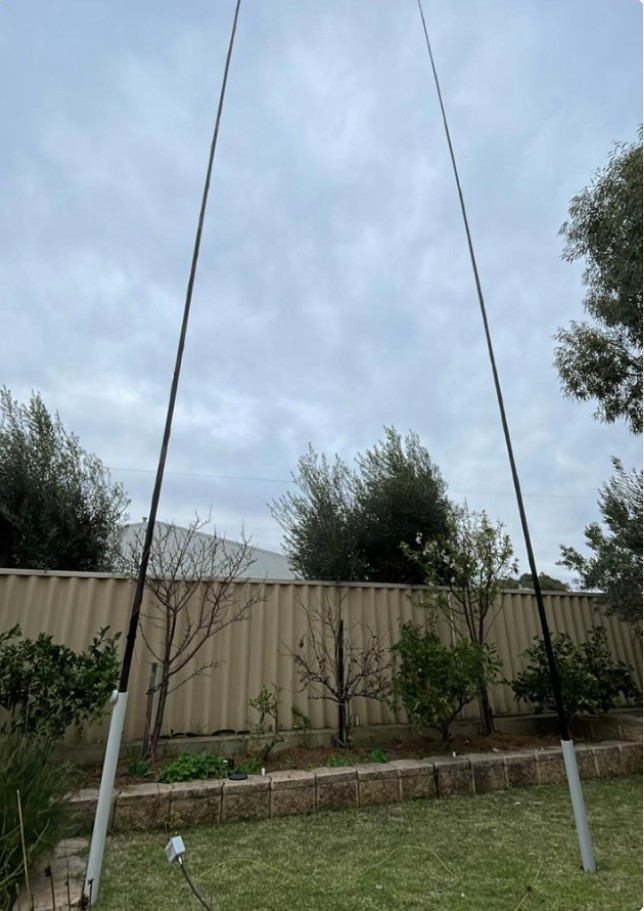
- A Two Element Vertical Yagi for 20m
- Hand Copy Practice
- QRZ?
- QRZ? Who’s on the other end?
- Other News
- How often have you been asked
- Morse Training Net
- Progress report on the QRS International Flight Contest
- The Mysteries of an SSB Receiver Revealed
- Readable Five
- There’s No Such Thing…
- Question:
- Answer:
- Prosign/Character/Signal of the Month
- I Hear Tell…
- Di-dah-di-dah-dadit
- Next Tuesday’s Net
- Post Mortem
- Articles
- Teamwork
- About the CQ QRS Net
CQ QRS RagChew
Here we are – another Friday evening finishing the RagChew newsletter! This week Elizabeth and I had to head to Canberra unexpectedly on Wednesday – so everything had to move to the right again. One day I’ll work out how to get it all done in a single day….
One day! However, with the help of the fantastic editorial team, and 38 contributors, I think we’ve built yet another bumper edition for your reading pleasure. On behalf of the team – thank you all.
So this week, you’ll read about a whole lot of good things – including Artificial Intelligence and Amateur Radio from Nigel G4RWI, another way of building your own open-wire feeder from Phil VK6GX, and from the antenna test range of Richard VK6PZT, another novel antenna trial; Richard’s simple end-fed antenna design from a few weeks back sure has been popular.
And what about Tuesday’s net I hear you wondering? This week we had at least 66 stations reported by 44 of our team family members on our Tuesday CQQRS Slow CW Practice QSO net; outstanding!
Conditions were somewhat variable – some reported the bands on fire, others said the bands were dead! Isn’t electromagnetic propagation interesting? Great to hear Ross MONNK on air using Mike DL3YZ’s station by remote control – you’ll enjoy his fun article.
Also good to hear Chris G7BED back home after venturing around France for a few weeks. And as one of our family members told me during the week – one of the great things about our net is that it’s well past critical mass – you can just about be assured that if you bother to have a listen or call CQ, you’re almost guaranteed to hook up with someone you’ll enjoy chatting to – you might have one QSO or a dozen – who knows?
And – it doesn’t matter whether you’re ready for 3 or words per minute – or 10 – there’s a bunch of people out there who have been in your shoes (some not too long ago either) who’d love to either just exchange the basics… or chew the rag with you.
Really really not ready to transmit, or just not in the mood? There’s always lots of different interesting conversations to listen-in to – but if you do, please donate to the cause buy sending an SWL report via our web-form – see below for the link.
Masthead Image
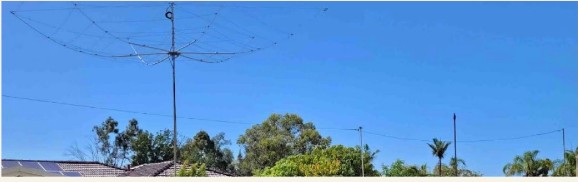
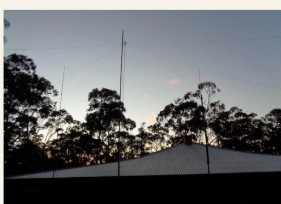
Thanks this week for the masthead image to one of our founding family members, Richard VK6PZT at Dalyellup near Bunbury. Richard outlines his temporary two- element 20m Yagi below.
Reports
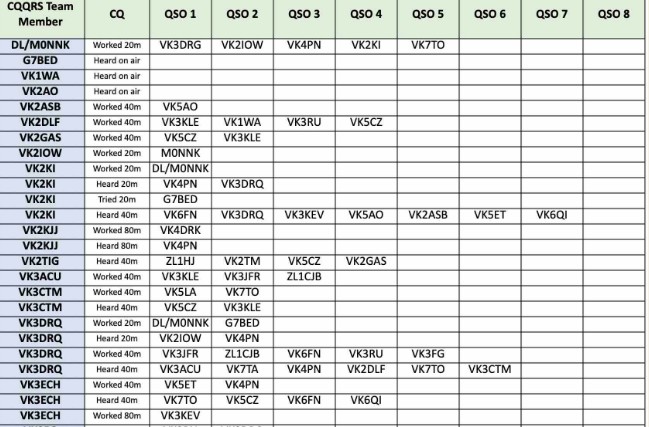
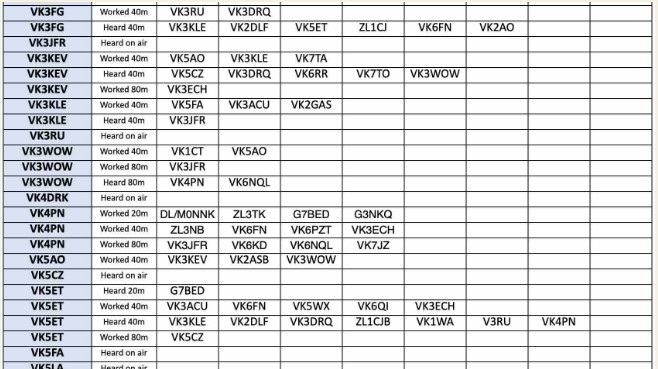
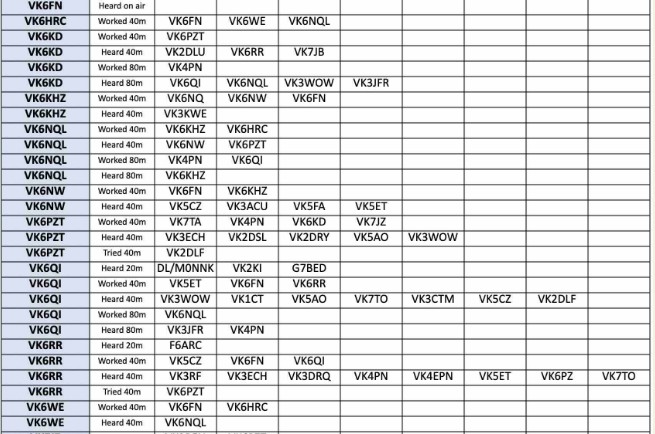
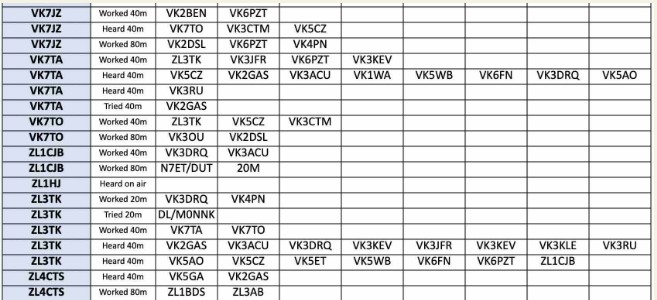
After next Tuesday’s Group, please send me a list of who you worked and / or who you heard using our web form here:

Please help attract new and old team members to have a go by submitting your repo! each week. Submissions close 1300 (Eastern Australian time) on Thursday.
Website
If you’d like to find out a bit about our net, or would like to pass information to others about our Tuesday get-togethers, here’s the link to our website.
Bit.ly/CQQRSWebsite Cheers, mb Mark Bosma VK2KI / VK6QI Beautiful South Bowning NSW mark.bosma@icloud.com non impsditi ratione cogitationis
[40m] 40m was on fire. Got two contacts in VK7, very happy.
40m] I was experiencing a lot of QSB. May have been due to the heavy rain fronts comir hrough the Perth area. 80m] QSB also experienced on 80m. Worse than usual. Could be the rain.
[20m] DL/MONNK RSN 112, could pick out only the – occasional letter. QSO with VK4PN short and sweet, just long enough to tell him where to find DL/MONNK ON 20m then his signal all but disappeared.
Maybe it should be clarified that when a DX station’s operating range is given as 2 kHz wide, in this case 14. to the center frequency.
[40m] Terrific conditions on 40 m. Was able at last to exchang information with VK7S, meanwhile VK6S were coming in
[20m] DL/MONNK RSN 112, could pick out only the occasional letter. QSO with VK4PN short and sweet just long enough to tell him where to find DL/MONNK ON 20m then his signal all but disappeared.
Maybe it should be clarified that when a DX station’s operating range is given as 2 kHz wide, in this case ° tn tha rnantar franiiann:
[20m] DL/MONNK RSN 112, could pick out only the me ooletee occasional letter. QSO with VK4PN short and sweet, just long enough to tell him where to find DL/MONNK 1:3 ER borbasi ON 20m then his signal all but disappeared.
Maybe it should be clarified that when a DX station’s operating range is given as 2 kHz wide, in this case 14.051 ~ 14.053 MHz, it defaults to the center frequency.
[40m] Terrific conditions on 40 m. Was able at last to exchange meaningful station information with VK7S, meanwhile VK6S were coming in like locals.
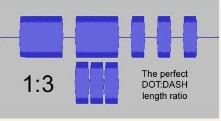
It should be clarified that when a DX station’s operating range is given as 2 kHz wide, in this case 14.051 ~ 14.053 MHz, it defaults to the center frequency.
[40m] Terrific conditions on 40 m. Was able at last to exchange meaningful station information with VK7S, meanwhile VK6S were coming in like locals.
[160M] I called slowly and carefully on 160 meters out received no ‘bites’. I had my 80/160 meter dipole connected for ‘top band’ as I had stayed up late to work that band during the period 1 AM till 5:59 AM local time during the RD Contest.
As always I learnt much and had lun. I note that several members have worked Mike, K1OV.
[40m] Conditions not good. A lot of QSB.
[40m] You know when the brain is needing a rest! I neard the call VK6QI, so I immediately looked at my list of c/s – nothing – looked thru’ my log 900K – nothing – so apologised for not knowing nis name – Mark was the reply – still brain didn’t register – then finally the light came on – “it’s ann inznadaw tf am mare makings analanman tan
[80m] Still need some folks from WA on this band, & even during the week – would be great.
[40m] I worked my first contact from home before dinner and as usual, lots of QRM making it hard work. After dinner I went and found a park, yes, another park, one where I could set up and also hide in the car away from 7 PAA oe et ed] ee nen He ee ee eee
Aaron ele had Pas aching ig the cold. 40m noise dropped from $8-9 down to $5 and it was like the band came alive for listening.
I had this week decided it was time to commit and undertake the next CW Ops course, I know this is a commitment to an hour a day of drills and practice – perhaps it’s brain factor magic or something because then listening to VK7TO and VK3TCM (which was too fast for me) I could still pull snippets like them discussing the RD Contest – I thought that’s decoding progress.
[80m] I really enjoyed 80m (and the entire evening actually). 3 contacts on 80m confirming that the new dipole I cut just for 80m CW works just fine. Really pleased with the night with QSOs (or could hear the QSOs) from right around the country.
This week the mast stayed up so no dummy spits from me. This week I took the IC-7300 with me and it was a bit cumbersome to set up, I think next week I will take the 705 and see how it goes as it MUST be more portable.
Thank you for those who made a QSO with me and were patient throughout a number of my keying mistakes.
[20m] On 20m both Ross and Chris were very weak, RS 332, but I was able to enjoy their chat.
[40m] Conditions were very good on this side of VK, thei were plenty of stations coming and having fun, BL
Some operators need to remember LISTEN, LISTEN, LISTEN before you start to transmit. On one occasion it was so much QRM during one of my, in other ways enjoyable QSO, that I had great difficulty finishing the contact.
So, PLEASE, don’t forget to LISTEN before you press the key.
[20m] Had a nice QSO with Ross, MONNK, operating remotely from Stuttgart. Good signal reports both ways.
[40m] I had two brief sessions this week. Starting early Max, VK6EFN responded to my CQ and we had a short exchange with good clear signals. I returned later in the afternoon getting a response from Richard, VK6HRC.
After this contact a station with a weaker signal tried to call me but I had difficulty copying with indistinct signals and QSB. I thought it might have been Max having a second call but could not confirm the contact.
I discovered it was indeed Max on the next morning’s net! Why his signals changed en miichie curinie 3 I need mnra nrarticre
[40m] Good turn up to 40m QRS. Signals faded as evening
FROM YOUR CONOR NMAIR VINZAE at DELAUUIUL COUNT DOWN
[20m] I was distracted by chores this time – but when I came in I could hear Ross DL/MONNK chatting happily to Sava VK4PN.
I then caught Ross, sent RSN 521 and reported that he was S4 into the VK5PH KiwiSDRs at Ironstone Range, and S3 into the VK6SEG SDR at Hoddys Well. I then caused more confusion by telling Ross that there were
More contusion by telling Moss that there were others waiting in the wings – I’d seen a comment on WhatsApp about Ross’ signal from Patrick VK2IOW – not realising that Patrick had already had a QSO with Ross. Back in my box!
After Ross I slipped down to the frequency designated for Chris G7BED. Chris was a comfortable $2, S5 into VK5 and S2 into WA. However, by the time he’d finished chatting to Manny VK3DRQ and Sava VK4PN, his signal had dropped and was Q4.
Chris was struggling with me – and despite tapping as hard as I could on the key, Chris was not able to QSL my report. Oh well – we tried – and he did get through ok to the operators with at least twice the power and the Yagi antennas – which is fair enough.
[40m] After dinner I had a look on KiwiSDRs in VK1, VK5 and VK6 – 40m was really jumping – finding a quiet slot in our little segment may have been fun – especially for those who didn’t have narrow-bandwidth receiving options.
Around that time I received an SMS from Rob VK6LD advising that he’d spent the day getting the VK6SR Remote station back on air from a new location – but that it was now up and running, having been off air for a fair while when Rob sold his Bedfordale property; strange that the new owners didn’t embrace the Remote, along with its 60m long Marconi-Tee antennal So I ended up using the Remote and my VKE callsign for the rest of the night.
Also from your editor Mark VK6QI at Beautiful South Bowning via the VK6SR Remote HF station, the VA5PH KiwiSDR network at Ironstone Range and the VK6SEG KiwiSDR at Hoddys Well
[20m] Ross MONNK’s signal from Mike DL3YZ‘s Remote was a decent S4 into the iconic VK5PH Ironstone Range KiwiSDR network, and S3 into the Southern Electronics Group SDR near Northam WA.
Chris G7BED was §S5 into South Australia and S2 into WA Aren’t the KiwiSDRs just the duck’s guts when it comes to propagation experiments?
[40m] As my alter-ego said, Rob VK6LD told me that the Southern Electronics Group VK6SR Remote was back on air from its new location at Jandakot, using a 30m long Inverted-L 10m high, fed against a five-foot ground stake and the frame of a shed.
I was pleased to be the first user to give it a go – and it seemed to perform well. The noise level on 40m and 80m was much higher than at the old location of course (Rob had done extensive sniffing and modification of things around his previous property), but unlike the VK6CRO Remote at Carnarvon, the front-end of the FT-991 was still intact and so turning off the front-end pre-amp – also known as IPO-On (Insertion- Point Optimisation) in Yaesu-speak – dropped the noise enough to improve the S/N ratio.
The down-side was that the signal reports I gave out weren’t as nice as those I received. I heard Max VK6FN signing and gave him a call, at the same time as John VKSET called. So why not; let’s have a three-way QSO?
For those who haven’t tried this on CW – it’s lots of fun and a bit of a challenge. Unlike phone, where it’s easy to pass the parcel from one station to the next, on CW the others need to be concentrating to get the sequence right, to know which signal report belong to whom, etc.
Anyway, I think we all survived – and no operators were harmed in the making of this story. After listening-in to a number of Eastern States’ QSOs, I decide to just try calling CQ for awhile. That was rewarded by a call from Roy VK6RR up at Geraldton.
We had anice chat and it was good to hear that Roy had been able to get at least a little time for amateur radio, having been pretty snowed by his Marine Rescue volunteer radio operator role.
[80m] When I finished up with Roy, I slipped down to 80m, and was really pleased to see that the Remote was able to couple to the antenna via its ATU on our segment of the band.
The previous set-up had a curious habit of being able to tune above and below our segment, but not our bit (to the kiloHertz!) – which required tune-up outside our bit, and operation with a less-than perfectly coupled antenna in our segment.
‘There were a few stations coming through to WA when I listened, including James VK3JFR at Ararat and Sava VK4PN near Brisbane. I put out a CQ call and had a nice chat with Peter VK6NQL.
Peter was having fun getting his keyer around the letter Q on the night – which was a challenge with both our callsigns as it turned out; ATER Oe ao iam.
[20 m] Whilst waiting for Ross to come on air, I tuned around the 20 m band and worked five DX stations across the USA, Sweden, New Caledonia and Sardinia.
Whilst some were only interested in a 599 TU, Lars from Sweden and Uno from Sardinia were happy to exchange names and Se eS ae ae
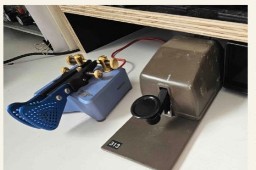
The wait paid off when Ross, DL/MONNK’s signal could be heard calling CQ. Very weak with lots of character elements not making the distance, we none-the-less managed to make the contact. Oddly enough, I was perfectly readable into Germany.
The oddities of propagation, antennas, different TX power, or perhaps just my ears. Thanks for the contact, Ross.
[40m] It was great to work Stan, ZLSTK, with a nice strong signal after very poor conditions on our previous couple of QSOs. This allowed a nice and easy relaxed chat. Next was lan, VK5CZ. Another strong signal, and an enjoyable long QSO.
Tony, VK3CTM, was next, and while we chatted about antennas and radios and club stations, I couldn’t quite suppress my envy of his access to a 160M antenna.
[80m] Upon popping down to 80m, the most prominent signal was Andy, VK3OU. He wasn’t part of the net, calling CQ at 27ISH WPM on his bug. I stretched my legs a little and we had a quick QSO before returning to the QRS segment of the band.
The only other station offering a workable SNR was Shaun, VK2DSL. We didn’t chat too long as conditions were tough, but it was nice to meet a new operator.
Tony, VK3CTM, was next, and while we chatted about antennas and radios and club stations, I couldn’t quite suppress my envy of his access to a 160M antenna.
[80m] Upon popping down to 80m, the most prominent signal was Andy, VK3OU. He wasn’t part of the net, calling CQ at 27ISH WPM on his bug. I stretched my legs a little and we had a quick QSO before returning to the QRS segment of the band.
The only other station offering a workable SNR was Shaun, VK2DSL. We didn’t chat too long as conditions were tough, but it was nice to meet a new operator.
[40m] re Was only able to be on for a limited time at the start of o35 the session, conditions were good worked a few stations “ei before heading off. Also good to see lots of signals in “<< the waterfall display.
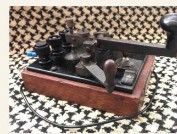
[20m] Massive pile up at 14.040 MHz, half of Japan must have been chasing a DX, couldn’t copy the DX so no idea what the fuss was all about. Scanned the rest of the EU QRS segment nothing heard.
Just to see the Reverse Beacon report I called a longish CQ around 14.046 MHz and ZL3TK responded, good reports both ways. Towards the end of our QSO I asked him if he heard any of our EU contingent and he told me DL/MONNK was on 14.052.
I had a listen and VK2IOW was just finishing QSO with Ross. Both signals were feeble particularly Ross. I decided to try my luck and call him and he came back. I had a lot of trouble copying him he was in and out of noise frequently.
It took 3 overs to copy enough for a legitimate QSO so I logged him. Again Reverse Beacon report ( see picture ) and poor copy of both Ross and VK2IOW did not make sense. Scanning back towards ~ay SN,
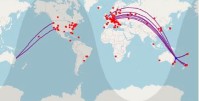
Coming back big at least 575 so I waited patiently for Manny and Chris to finish and call G7BED. We had an easy QSO with good reports both ways.
My RX has a calibrated attenuator so out of curiosity I switched in 6 than 12 than 18 dB and Chris was still coming through. If anything he sounded better with 18DB of attenuation as the noise was almost inaudible.
[40m] It was well after 17:00 hrs when I moved to 40 m band. Pretty quiet so I called CQ and ZL2NB came back. It was a solid signal so I expected trouble free QSO but fading was so strange, I kept loosing the signal completely just to hear it again strong after a long pause.
After persevering for a while it was obvious propagation was unreliable and I gave up and moved to 80 m for ZLCW net. About an hour latter I checked 40 m again and VK6 stations were coming through nicely so managed to work VK6KD and VK6PZT.
Both were running relatively low power and modest antennas indicating good propagation on lower bands. Last contact on 40 m was with VKSECH.
Rob just arrived back from his adventures in the bush, I hope he writes up about working from those noiseless ares of west QLD, must be a dream.
[80m] By 20:00 hrs it was time to move to 80m. It is just after sunset in WA and propagation should be OK. Nothing heard no traces on Araluen SDR so I called CQ few times. First QSO on 80 m was with VK3JER, excellent signals both ways.
I couldn’t see anything on the SDR but FT8 segment at 3,573 was full of traces so I moved up to check. Boy what a DX night Asia and North America jamming the 2KHZ FT8 block with few strong locals in the mix.
Very tempting but I returned to QRS segment and continue to call CQ. It eventually paid off managed 3 longish contacts VK6KD, VK6NQL and VK7JZ. Another enjoyable night working QRS Net.
Won’t be on air next Tuesday, may be the following Tuesday as well – visiting family in North QLD. Cheers Sava
Aussies are stronger than Germans
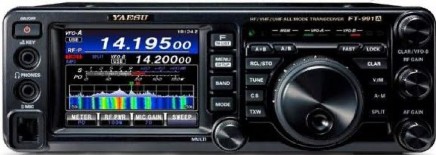
As you might imagine on a Monday evening in central Europe, there were lots of stations beeping away. I had 100 watts out of a good antenna and the RBN showed that I was getting out all over Europe and even over to the east coast of the USA.
So I was expecting some fun. But no. Not a sausage. I tried Tail-gating for 20 minutes but no-one came back to my calls. Then I called CQ for 20 minutes without success, except for a guy in Lithuania who asked me to repeat my callsign and then disappeared.
I can only assume that my unusual callsign (DL/MONNK) frightened them off.
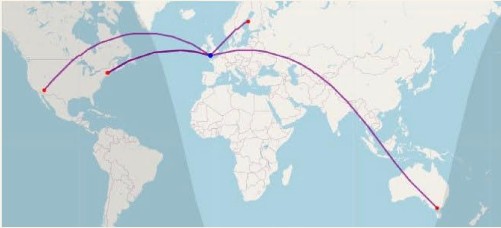
Aussies are clearly built of stemer stuff because things were very different on the QRS Net this moming. As you can see, Mike’s radio was reaching all across the world and five Aussie operators made it a great morning’s work for me.
Mark VK2KI‘s sending was a classic example of using QRS to make a QSO with a very weak signal. Slow but accurate Morse was the original weak signal mode so thanks for continuing that noble tradition, Mark.
A quick mention should go to Lance VK7TO down (up?) on the southern tip of Tasmania as I don’t think he’s ‘one of ours’. I know I’m beginning to sound like a stuck record as I’ve now thanked Aussie operators many times for their efforts with the DXpeditions.
But it really is the most wonderful thing to hear their signals reaching all the way around the world to me. There are many ways of doing radio but this is my chosen one and I LOVE IT!
[Thanks Ross – love the comments – and I’m really pleased that it’s good fun for you. And yes, our Lance VK7TO is certainly one of the family; you may have seen him referred-to as VK7ZA.
Lance changed his callsign recently because under normal RF conditions, too many folks were struggling to differentiate the dah-dah-di-di-dit from dah-dah-di-dit – one little sub-hundred millisecond sound lost to QSB makes all the differencel]
From Richard VK6HRC. Six checked in on the South West AllStar / Echolink and Repeater Hub. VKS5ET John VK6KD David VK6FN Max VK6QI_ Mark VK6HRC VK6MRB Mulligan swi and others.
Good to have John back with us, he had a good session worked six on forty heard seven even had a three way at one stage ! Monitored 20m and heard Chris G7BED and Mark VK6QI.
David worked 40m and 80m, had good contact with Sava VK4PN on 80m be- fore closing down making sure to get enough shut eye before having to head off to work. Max enjoyed the good conditions working seven on 40m including one from ZL.
Max was being troubled with QSB and was not quite sure of the callsign o’ ZL station but John confirmed it was ZL1CJB Clive. Mark worked Ross M@NNK on 20m heard Chris G7BED.
On 40m Mark had fun a three way with Max and John I Also cranked up the Southern Electronics remote back on line now and is working well, thanks to Rob VK6LD, Duncan VK6GHZ and Dave swl for their hard work.
I was only on for a while before heading off, worked three on 40m. It was great to have good conditions with lots of signals on the waterfall display. Thank you to all on last night and this morning
POST MORTEM – 20th AUGUST 2025
This Week’s Topic of Interest
She’s not magic—she’s a Large Language Model (LLM), a powerful form of machine learning (ML), which itself falls under the broader umbrella of artificial intelligence (Al) And while she’s not the only digital brain in town, she’s currently the most popular, holding over 60% of the LLM market share just two years after launch.
The graphic below shows the most popular LLM contenders in mid-2025.
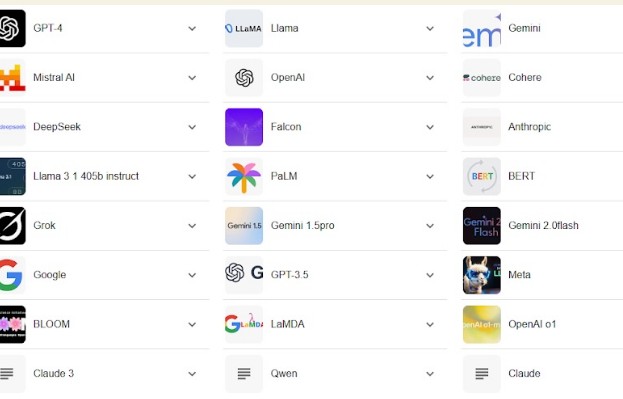
G Google » OGorras o 4 meta i 100M © Gel Lavon : = openatot Ciaude 3 ¥ Quen ¥ Claude Of course ML, ChatGPT or other LLMs weren’t specifically designed for Ham Radio but these tools can help unlock new levels of education, efficiency, experimentation, and accessibility in our hobby.
The secret of using Al is knowing how to ask the right questions and being able to separate the signal from the noise. Below are six practical examples of how Al is being used with Ham Radio – today: + Antenna Design Assistance from ChatGPT Instead of flipping through the ARRL Antenna Book, many Hams now ask ChatGPT for help with designing antennas.
The key is to provide detailed input to avoid the ‘garbage in, garbage out’ problem. ChatGPT can suggest design parameters and even offer follow-up questions, like “Would you like me to display the radiation pattern of this antenna?” You must stil be careful when using Al.
It can “hallucinate,” meaning it can confidently provide incorrect answers. Always cross-check its suggestions with other large language models (LLMs) like Gemini, DeepSeek, Claude, MS Copilot, and Grok.
Irecently thought about raising my VHF omni antenna height from 3 meters to 6 meters above the roof. Is it worth the effort and expense? Find out the surprising answer I discovered from ChatGPT here. TLDR: No, it’s not worth it.
Another potential project: Replace my 40m Inverted V with a Delta Loop or a Groundplane antenna. Again, ChatGPT is perfect for this kind of comparison and deeper analysis of what these antennas are capable of. More on that here.
The interactive dialogue with ChatGPT makes antenna design fun while encouraging experimentation and deeper learning. * Transcribing and Searching Audio with Al One of the most practical Al applications for Hams today is audio transcription.
Tools like Turboscribe (free, for 3 uploads a day) can automatically transcribe recorded audio files, turning long nets or contest recordings into searchable text.
For example, a Ham could upload a recording of a weekly net to Turboscribe, then use a simple script to search the transcript for a ‘keyword’ like “DX.” This capability saves operators hours of manual listening by instantly pinpointing segments of interest.
Here is an example of a recorded 2 meter Simplex QSO between two local Hams. But the magic doesn’t stop there. The transcribed text can be uploaded to Google’s NotebookLM, an Al program that summarizes and simplifies complex documents, videos, web pages or even entire books.
Recently, NotebookLM added a feature to convert these summaries into educational-style videos, giving Hams a fresh way to digest dense technical material or recaps of lengthy on-air discussions.
Here’s an example of how NotebookLM summarized a YouTube video of “An Introduction to Ham Radio” by 4Z1ZV, into a user-friendly podcast format (in Hebrew).
* Noise Reduction and Signal Enhancement via Al Servers Another breakthrough is Al-powered noise reduction/filtering. Instead of relying solely on local DSP filters in transceivers, applications like RM Noise stream audio to remote Al servers that process the signal in real time.
For SSB, this can produce near-FM quality audio, dramatically reducing static and interference. For CW, Al can virtually eliminate background noise on even very weak signals, making the incoming code sound as clean as if it were generated by a perfect code oscillator.
This, technology is a game changer for operators struggling with challenging band conditions or urban noise. Learn more about RM Noise here.
* Data Analysis of Digital Modes with Al Digital modes like WSPR and FT8 generate vast amounts of data that can be overwhelming to analyze manually.
A more clever approach is to save decoded data into an Excel file and then upload the data to Al platforms like ChatGPT or DeepSeek.
Within seconds, these tools can analyze the data and provide detailed insights such as: furthest station heard, closest heard, most commonly logged countries, rare DX spots, propagation trends by time of day, plus much more.
This rapid, Al-driven data crunching helps operators better understand band openings and optimize their operating schedules.
Here’s a summary analysis of the WSPR 20M data for 12 July 2025 * Circuit Design and Reading Schematics ChatGPT is capable of creating or reading schematic diagrams. I recently used it to suggest improvements for an old ICOM IC-735.
Here’s a snippet from the dialog: Sure! Please upload the schematic of your ICOM IC-736, and I’ll analyze it for improvements such as: + Signal clarity & labeling (e.g., adding missing component values, clearer net labeling).
+ Modern component replacements (substitutes for obsolete parts, better efficiency or noise performance). + Power supply & grounding enhancements (reduce noise or hum). + Layout optimizations (reducing coupling, improving shielding).
+ Service documentation improvements (annotations, test points). Once you upload it, ! can highlight weak points, redraw sections more clearly, and recommend specific upgrades (like swapping op-amps, RF transistors, or caps for modern equivalents).
Can you upload the schematic? See the full dialog here + Robo-QSOs: Al as an Active Operator A fascinating frontier is Al-driven automated QSOs. Recently, a Ham in Belgium, ON7OFF. set up a system in which Al acts as a “robo-QSO” operator.
The Al- generated voice calls “CQ-DX” with the operator’s callsign, listens for replies, converts received audio to text, and carries out a conversation in perfect, non- accented English. It even reads the S-meter to provide accurate signal reports.
After the exchange, it logs the QSO and uploads the contact information directly to popular logging software like LOG4OM. Watching this seamless interaction between Al and human operators feels like witnessing the future of Ham Radio in real time.
I haven’t tried this myself as I’m concerned about the ethics of Robo-QSOs and the very real possibility of this type of technology being used by bad actors in contests or chasing awards like DXCC.
‘Summary: Al – A New Era, also for Ham Radio This article only scratches the surface of what is possible. There’s so much more to explore and discover! Ifyou haven’t done so already, head over to OpenAl/ChatGPT and start a conversation.
The first thing you will notice is that ‘the machine’ has endless knowledge but never an opinion (how refreshing @). Be sure to compare feedback with other Al platforms mentioned in the beginning of this article since Al can ‘hallucinate’ and come up with ‘facts’ that range from outright wrong to hilariously funny.
From transcribing net recordings and cleaning up noisy signals, to analyzing WSPR and FT8 data and operating robo-QSOs, Al and machine learning are revolutionizing how Hams communicate, learn, and experiment.
ChatGPT and other Al tools are ‘empowering operators to transcend traditional boundaries, making the hobby more efficient, accessible, and exciting than ever. Click here to listen to an Al generated audio summary of this entire article (~14 minutes)
If you have an article or two that you think might be of interest to our readers, please let me know so we can share more thoughts and ideas; for guidance on writing for RagChew, see Articles below. Please email material to Mark VK2KI: cqqrsnet@gmail.com

On My Workbench
By Phil Hartwell VK6GX. I enjoyed Sava’s innovative method of construction of open wire feeder (CQQRS RagChew 33/2025); that particular one is new to me and hopefully will encourage others to home-brew their own low-loss feeders.
For the past 30 odd years I had used handmade 100MM long, narrow strips of Perspex as spreaders for my open wire fed antennas. They were very durable but all those were destroyed by the 2021 Wooroloo bush fire that tore through Gidgegannup.
A couple that weren’t incinerated were shrunk and distorted by the intense heat, so much so that the previous approx. 600 Ohm feeder would have reduced to around 400 Ohm, had they all survived and shrunk to the same extent!
Fortunately, when I was considering resurrecting my antennas, a local friend, Garry VK6GLX, put me on to a product that makes open wire feeder construction a breeze. The idea was probably based on the article by Donald VK6JDM in AR Magazine.
These spacers excellent products are intended for the wine industry and hail from ZL land, where they make excellent wine too. They are made by Klipon.
There are two types, Vine ties and Trellis ties, both made from black, UV stabilised polypropylene and come in bags of 1000 (minimum quantity).
If that quantity is too much for you, maybe your local radio club could purchase them and divide them amongst interested parties, or you could on-sell surplus ties yourself. Don’t forget to allow for your next antenna project!
Limagine places with large wine industries, such as California, produce similar products. Trellis Ties, suitable for 2.5mm diameter wire, 100MM wide, feeder wire centres 90MM apatt….. https:/Avww.klipon.co.nz/products/trel Specifications….. htt pdf?
Y=3533197314397085540 Vine Ties, suitable for 2.5mm diameter wire, 70MM wide, feeder wire centres 60MM. v=7473260124948878887 Specifications v=7473260124948878887 Your favourite search engine will provide local suppliers.
Our Perth area supplier is Crackpots Marine & Rural Supplies. Trellis Ties are $59.40 (inc GST) per bag of 1000, see…. #https:/Awww.crackpots.com.au/RKTT1001000/TRELLIS-TIES-100MM-LONG- X- 1000/PD.
Phpfilters=Department%3ARural%7C Vine Ties are $48.40 (inc GST) per bag of 1000, see…. #https://www.crackpots.com.au/RKVTO701000/VINE-TIES-70MM-LONG- Department%SARural%7C Incidentally, Crackpots had a stall at my local Gidgegannup Agricultural Society Field Day Show (last weekend of every October), a couple of years ago.
I explained the alternate use for these ties to the manager, and to expect further orders from amateur radio operators. He was both surprised and delighted! Altronics sell suitable “Extra heavy duty hook-up cable”, PVC insulated, 2.55mm_ OD.
Dark colours are less visible at my QTH, due to the background being mainly eucalyptus trees. There are several other colours that may blend in better at your QTH.
As the cable is ever so slightly over-size, it’s a tight fit in the clips, but made easier by leaving the ties in the sun for 1/2 hour. Otherwise you will end up with a sore thumb forcing the wire in. Altronics P/no.
W 2284, Black, https://wvww.altronics.com.au/p/w2284-32-0.20- black-tinned-extra-heavy-duty-hook-up-cable/ $99.00 for a 100M roll, or $1.10/m Altronics P/no.
W 2280, Brown, https://www.altronics.com.au/p/w2280-32-0.20- brown-tinned-extra-heavy-duty-hook-up-cable/ $99.00 for a 100M roll, or $1.10/m My method of construction:- Ideally on flat ground, without obstructions or trip hazards:- * Measure approx length of feeder required, add a few metres for unforeseen circumstances, and double it.
* Cut two equal lengths, tie the ends together and loop one end over a convenient fence post. * Lay the cable out straight on the flat clear land, tie a rope around the free end knot and secure it to another object, so that there is sufficient tension to lift it all off the ground, so that each wire has exactly the same degree of sag.
If not, return to the end looped on the fence post and adjust the knot so that the degree of sag is identical. * Luse the Trellis ties and put a sufficient quantity of pre-warmed clips in my tool belt pockets, then, facing the fence post, put my head between the two parallel wires so that they lay across my shoulders.
I affix each tie approx 30CM apart whilst walking very slowly backwards. Hence the requirement for no trip hazards! The whole process should take around 2 hours if using an entire 100M roll of wire.
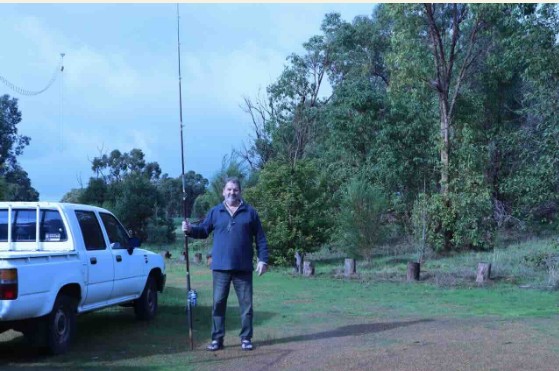
The resultant feeder, attached to the base of my 80m flat top delta loop, is visible, top lett, in the photo above, of me posing beside my trusty old Hilux ute, with the beach fishing rod I use for antenna erection in tall trees.
Yes, that’s a brick hanging from the base of the antenna and a back stay to tension the feeder. It was featured in a recent CQ QRS newsletter by Mark VK2KI & VK6QI My feeder has been in use for a couple of years on my 80m flat top delta loop.
The impedance stays constant regardless of weather. During the February 2025 Super-cell thunderstorm, micro-burst, that devastated my property and a wide area of Gidgegannup and Perth’s Eastern Hills, the feeder survived even though the antenna didn’t, but it has since been re-erected.
The feeder has needed no maintenance, except for a couple of spreaders needing re-alignment after being struck by flying debris during the storm.
The result is a really effective HF multi-band antenna that can be matched on all bands from 6m to 80m, by either my Palstar BT-1000A balanced ATU or my Palstar HF Auto, via an external W2FMI 2kW 9:1 balun.
Prices are in AUS and correct at the time of writing, 14″ August 2025 and include GST, but don’t include freight charges. Phil Hartwell, VK6GX. https://www.qrz.com/db/VK6GX
A Two Element Vertical Yagi for 20m
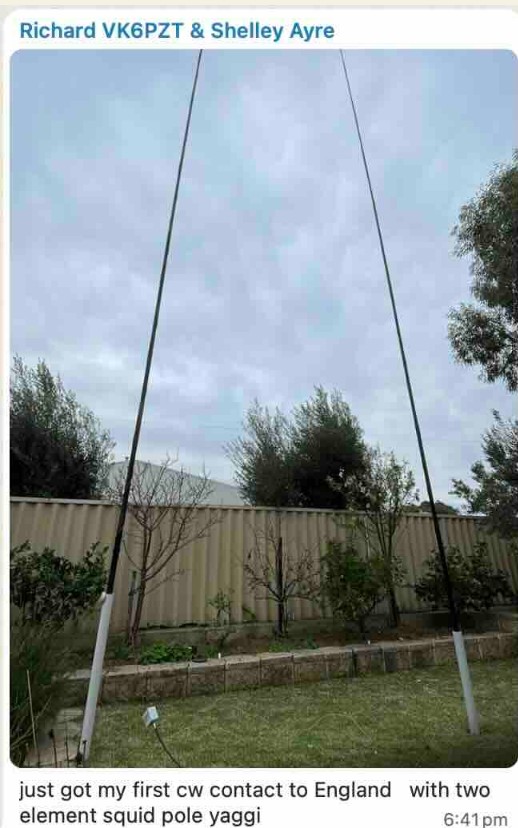
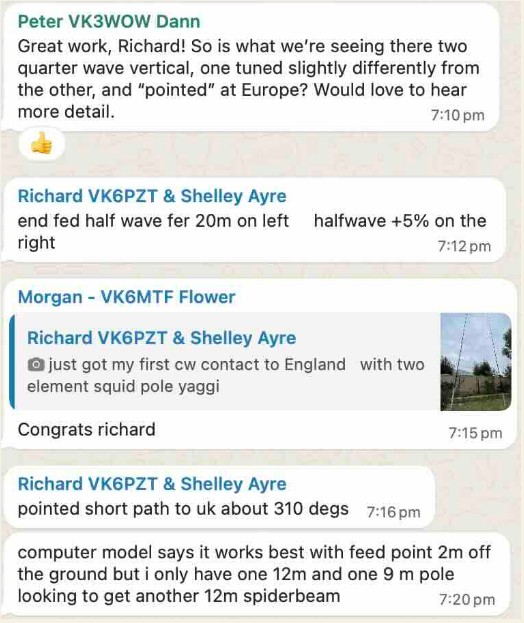
What’s going on on your workbench? If you have an article or two that you think might be of interest to our readers, please let Mark VK2KI know; email to cqqrsnet@gmail.com For guidance on writing for RagChew, see Articles below.
Hand Copy Practice
Last week we began The Wind in the Willows by Kenneth Grahame, with the first part of Chapter 1, The River Bank. First published in 1908, it’s a timeless story of friendship, mischief, and the quiet beauty of life along the river.
I’m sure quite a few of us were force fed this book when we were younger and never truly appreciated its charm. Here’s your chance to put that right, while also sharpening your head copy skills. This week we continue and complete Chapter 1.
Because of MallChimp’s size limits, I’ve had to split the remaining Chapter 1 audio into three parts. If you’d like the full chapter in a single file, you can use the complete text of Chapter 1 (attached to last week’s newsletter) and convert it yourself with the Ebook2CW app — https://fkurz.net/ham/ebook2cew.html.
I’ve made a few small adjustments to the text to keep it “Morse friendly”. Uncommon punctuation has been removed (the Ditto CW app doesn’t recognise some of it), and contractions have been simplified (for example, we’ll becomes we will).
This week’s attachments include: + Three MP3 files (second half of Chapter 1) + Three text files matching the MP3 segments










You can either play the MP3 files in any media player, or load the text files into the Ditto CW: Morse Player app — https://dittocw.andro.io/.
Both work well, but Ditto CW gives you complete control over all Morse settings, while a normal media player only allows changes to playback speed, and does that in steps (e.g. +1.25x, 1.5x, 1.75x).
WIESEL YUU VENTE IVE OSs FVIVE/IIVIOS HPIGAVIIVE avn
From Peter VK3WOW How would you like to create your own Morse code audio practice tracks in a code/voice/code format like this brief example?
I made this track using a local desktop installation of Kurt Zolgmann’s excellent (anc free) Morse Code Ninja software to help me get better at copying sequences where numbers are mixed with letters. This is just one of many ways of using this software.
In the example, you hear, for each learning example: + acombination of letters and/or numbers sent as Morse code * a voice reading out what has been sent + the Morse code repeated * acourtesy tone indicating a new example is about to be played Once I have got proficient at copying one set of combinations, I may: * create anew track using different examples * create anew track using different Morse code speeds and/or Farnsworth speeds * create a new track using larger groups (for example, four characters/numbers instead of three) You can use this software to create similar tracks focussing on particular sets of words, abbreviations, sentences, common QSO patterns — really any combination of letters and text you think you need to get better at copying.
To install this software on your computer, you will need to be comfortable issuing terminal commands like: * gitclone + /configure * make * sudo apt-install (or its equivalent on your own operating system) You will also need to feel comfortable with running per!
Scripts from a command line, and, if you want to generate new kinds of content not already covered by the software, with modifying some of the perl scripts included in the software installation. The software itself is free.
You will, however, eventually incur a small fee from ‘Amazon Web Services for the use of their text-to-voice service (called by the software) — but you will get your first six months use of this service free of charge.
After that, the AWS pricing of $USD 4.00 per million characters of text-to-speech processing sounds very inexpensive to me.
Creating each Morse Code practice track typically involves two steps: * First, you run a so-called generator perl script that creates a human-readable text file.
* Second, you pass this text file as an input to a rendering perl script that turns the content described in the text file into one or more .mp3 files.
To generate the sound file example above, I created a file “ragchew.txt” that comprised the following two lines: M70 [M, 7, O}* RQ3 [R, Q, 9)” To generate the example sound file (which has a character speed of 18 wpm and a Farnsworth speed of 9 wom) in a subdirectory called “output”, I executed the following command: perl render.pl -i ragchew.xt -o output -s 13/9 I encountered only two problems installing the software.
First, there is a bug at around line 661 in render.pl. To fix that bug, change $cmd = “ffmpeg -i $output_directory/sentence-${speed}0000.mp3 -filter:a “volume=0.5″ Soutput_directory/sentence-lower-volume-S{speed}.mp3n”; to $cmd = “ffmpeg -i $output_directory/sentence-${speed}.mp8 -filter:a “volume=0.5″ $output_directory/sentence-lower-volume-${speed}.mp3n”; Second, I learned that if you want to create your practice tracks in their own directory using the “-o, output” directive documented in README.md, you need to ensure that directory is a subdirectory of wherever the render script is run.
QRZ?
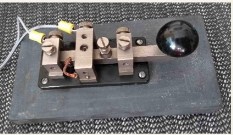
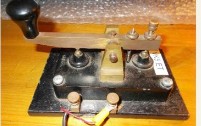
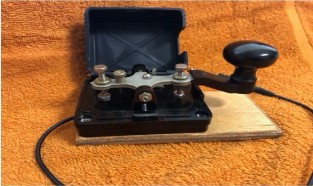
From Roy VAOFR at Geraiaton The last oil rig I was on had this installed. Once the Global Maritime Distress and Safety System (GMDSS) came in it was no longer needed.
I had hopes of getting one of the receivers, clock and as much of the other gear that I could get ashore and home – we were working in the Bass Strait at the time.
However whilst I was on leave one of my co-workers decided he would strip it and it got sent ashore in a skip bin for scrap! I could have murdered him when I returned and found out what he had done! It was a great radio set up.
I have only the Amplidan key which I use all the time. What an absolute tragedy – I still get wound up even now when I think of the wastel!!
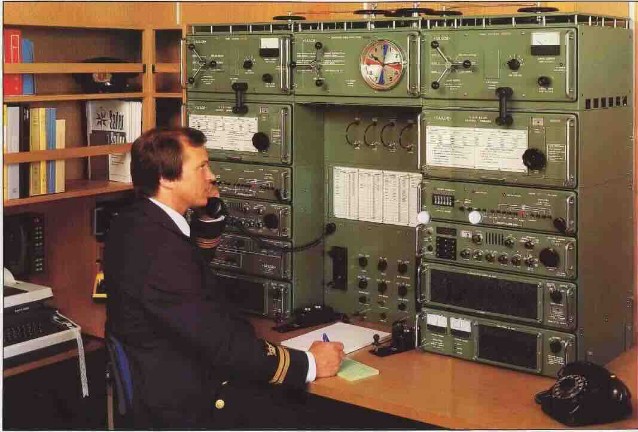
SAILOR RADIO of Copenhagen, Denmark – Ship’s Radio Station of 1980-1990. Key was by Amplidan also of Copenhagen. Fabulous Station.
The transmitter had 1 KW output from 410 kHz to 29,999.9 kHz with emission types of Al, A2, ASA, A3J, ASH (single side band with full carrier – to be AM RT compatible).
The A2 tone was 400 Hz so it made a beautiful tone and you could hear tones at 400, 800 and 1200 Hz in a wide selectivity receiver).
Notice the automatic-send-receive teleprinter to the left with the tape reader and 5 level Baudot tape, the radio room clock with red and blue sectors (this was the ‘Scandinavian colours they used – blue instead of green).
The antenna used was normally a vertical whip with a capacitive top hat, and above the console notice the insulators from which copper tubing exits – this was the single ended feediine used on ships – no coaxial runs were used because the whole system was an antenna and matched at the transmitter.
73877 Roy VK6RR [Thanks Roy – nice story] QRZ? Who’s on the other end? From your editor Mark VK2KI / VK6QI Key to the success of our net is helping to make it a get-together that people enjoy returning to each week.
But when you’re on the key, it’s really hard to find out a bit more about the person you’re chatting to. So I’m really keen to share the harkar inde af eama nf niirtaam mamhare . ite really nies da knaw wha’e an the,
QRZ? Who’s on the other end?
Other News
How often have you been asked
How often nave you been asked SIG RPT AGN PSE?
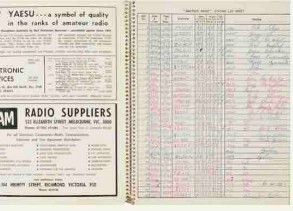
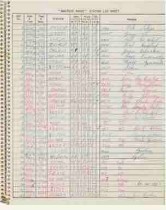
From Stan ZL3TK My active QRS FFA log is a lined sheet from an A4 pad, which can get pretty full after a few hours operating. Occasionally one is asked to repeat a signal report.
If nothing has been noted down one can only guess or at best provide a current estimate, quite likely different to the first report. Plus, it’s good to have a record of the report one received as well.
To do the job properly then, one should develop the habit of writing down both outgoing and incoming signal reports. But how to quickly and simply distinguish one report from the other?
An easy way is to annotate them with a single arrow: up-pointing for outgoing reports and down-pointing for incoming reports. Think of it like the developmental V2 rockets launched from tPeenemiinde against I Great Britain.
When written ona log sheet, a typical sent report would appear as 1542 and the renor received as cay LABS now
Report received as, say, 1465, now easily distinguishable. It is obvious that if the third digit is between 1 and 8 inclusive, the vastly more informative RSN reporting system is being used. Why wouldn’t you? 73 de Stan ZK3TK
The (extremely) reluctant Morse code help-seeker
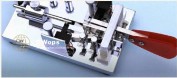
From Peter VKSWOW Call it, if you like, a personality defect — but when it comes to learning new skills like Morse code, I have always been attracted to 100% self-help solutions.
When I reactivated my licence a few years ago, I was therefore immediately drawn to Morse learning solutions like Icwo.net (an online CW trainer), the Morserino device, anc Fabian Kurz’s terrific ebooks2cw utility that converts large plain text files into morse code listening tracks.
All these have proved very helpful to me. Nevertheless, when I saw a piece by CWOps Ambassador Chris Chapman (VK3QB) in a recent Rag Chew
Ambassador Chris Chapman (VK3QB) in a recent Rag Chi inviting readers to send him any question they liked about life a la CW, I was prepared to take the huge risk (!!) of sending Chris an email — in my case, asking him whether other users find, like myself, that specific combinations of letters tend to give them difficulty during sending.
From that one email, I can honestly say a whole new world of learning opportunity has opened up for me — and, just as importantly, my Morse code journey has become a more optimistic one than the dour drudge I was tending to make it before.
I don’t think this is the time or place to be going into what Chris communicated to me specifically (via a series of emails) after that initial contact, save to say that everything he suggested to me was based on a clear understanding of where I was currently at, in terms of my practice routines and current abilities, and also in terms of what my own learning goals were (a matter I had not given much thought to before beginning my correspondence with Chris).
As I write this now, I have not even, as yet, had an actual QSO with Chris — yep, that’s how bad my case of ‘reluctant help-seeker’ is — though I think that is about to change.
I have, however, already gained a new level of confidence, and have begun working on some additional new practice routines that have immediately proved their worth.
If there is anyone else out there who is, like me, a natural loner when it comes to learning Morse code, but who is also curious as to whether there may be some way of making that learning easier, more enjoyable, or more effective, I would heartily recommend dropping Chris a line, at vkiah@homl.com — Peter VK3WOW
Morse Training Net
Our team member Nic VK7WW runs an on-air Slow Morse training net every Wednesday at 7pm EDST on 3580 for 30 mins. He uses the callsign of the Northern Tasmania Amateur Radio Club VK7TAZ on that net.
Many of our team learned Morse code with the support of Nic, and the weekly training session comes highly recommended for anyone who wants to learn the Code, or simply brush up.
Everyone’s welcome – 3580KHZ at 7pm Eastern time every Wednesday; you’ll hear lots of the CQQRS team on that net. Jordan VK3ACU has recorded the complete set of lessons which you can now find here:
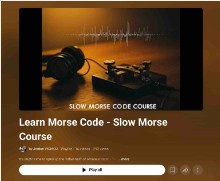
Https://www. youtube.com/playlist?list=PLHsQmZz6fBXO7swAfbT mutrbbEL17fUQL Contact Nic VK7WW for more info nicholaschantler@hotmail.com including how to join the NTARC DISCORD group to follow the action, or just come along and join in on Wednesdays.
Progress report on the QRS International Flight Contest
Progress report on the QRo International Flignt Contest
From Stan ZL3TK Flight NR 10, the final journey in this contest, took off on Wednesday 20 August at 0000Z. It is heading on a south-easterly bearing from a 99 % islamic west-African country to one which has become a stable constitutional republic with less than a 1 % muslim population since its civil war ended in 2002.
Let’s hope the passengers aren’t going there to foment religion-based political instability again.
All QRS IFC information is available at bit.ly/qrsifc 73 de Stan
The Mysteries of an SSB Receiver Revealed
Ihe Mysteries Of di oobD Neceiver Nevedied
From Jules VK3JFP I was granted permission to dissect a project 5W HF SSB heterodyne transceiver for training purposes. This transceiver uses mainly discrete components, and the heterodyning stages are explained.
The circuit is broken down to stages, in both block and circuit diagrams, for ease of understanding by examination candidates. The reason a transceiver was chosen is that the candidate can see shared sections common between transmit and receive.
The material is available at https:/Awww.julesworkshop.net/Amateur%20Radio%20Group/1 %20Advanced/Less 0n%2013A.pdf Let me know if you or your members find this material useful.
TRE MYSLETCS OF dil OOD NCCEIVE! Mevedlea
From Jules VK3JFP I was granted permission to dissect a project 5W HF SSB heterodyne transceiver for training purposes. This transceiver uses mainly discrete components, and the heterodyning stages are explained.
The circuit is broken down to stages, in both block and circuit diagrams, for ease of understanding by examination candidates. The reason a transceiver was chosen is that the candidate can see shared sections common between transmit and receive.
The material is available at https://www.julesworkshop.net/Amateur%20Radio%20Group/1 %20Advanced/Less 0n%2013A.pdf Let me know if you or your members find this material useful. Jules Perrin JP 0457585974 VK3JFP www,julesworkshop.net ‘Support our veterans.
Jules Perrin JP 0457585974 VK3JFP www. julesworkshop.net Support our veterans.
From Chris VK3QB [In this week’s reminder net email I forwarded a note from Chris VK3QB the Oceania Ambassador for the CWops organisation about the CWops monthly video conference get-together that he runs.
In my haste I mis-read the time and in my covering note, wrote the wrong time for the net – luckily, his text included the correct time. In response, Chris has written the following guidance on the use of UTC for our readers.]
Readers.] Hi Mark, Thanks for your email. This is the problem with not following accepted best practice. You’ve just done it… a simple, unintended mistake but with consequences. Mistakes are far easier to make when we introduce ambiguity.
I’m forever getting mixed up when I try referring to ZL to VK6 time zones. Now I just use UTC. UTC might seem like a small thing. But my presenter missed the session last month for the same reason. Like you, he also thought it was 8.30pm.
The use of standards has been a touchstone in our hobby and related professions since time began. And with good reason. Standards help remove ambiguity and overcome natural barriers such as different languages, and in this case, time zones.
It’s the accepted calibration of world time zones and provides a common reference point. As leaders we have an inferred responsibility to provide accurate information and to inspire people to participate and do better.
Your net and newsletter have achieved a remarkable level of acceptance by dozens (maybe hundreds) of CW practitioners and you’ve received a prestigious award from CW Ops for your efforts.
I understand that not everyone will want to be a ‘gun CW operator’, but we must promote good practices and subscribe to proven methods and techniques when encouraging our fellow amateurs. Especially the newcomers.
One of the tenets of ‘Amateur Radio is seff-training and improvernent. Every hobby has a ‘cost of entry’. For us, it’s a simple theory exam, regulations ‘exam, and practical assessment.
From there we are permitted a great privilege; largely unfettered access to an incredibly broad range of the RF spectrum – for free! We need to foster a sense of responsibility and acceptance of this privilege.
And a willingness to learn, experiment and develop our skills. Understanding UTC is not difficult. Applying it is not difficult.
I think you are doing your readers a disservice by assuming they can’t (or maybe don’t want to) aspire to improve their operating skills. Afterall, that’s what it’s all about it, isn’t it?
There are phone apps and websites that can help people as they are learning what needs to become a second nature time reference. UTC is only one manifestation of the issue at hand. You’ve now got readers across all of VK, ZL and even EU.
Using local times is inefficient and leads to mistakes, as we have seen. There are other practices and techniques that we can introduce and provide pathways for those who wish to take up the opportunity.
Recognising the lowest common denominator is important, but we need to provide them with a hand up, encouragement to do better, and most importantly, to lead by example.
I strongly encourage you to leverage off the success and recognition you have achieved with the QRS Net and Newsletter. Maintain the culture and camaraderie and let’s collaborate to introduce and encourage people to aspire to be better.
By developing skills and operational knowledge, Morse code becomes so much more rewarding and enjoyable. Coupled with the support of CW Ops and local members I can provide that pathway for those who choose to take the leap. Please consider what I’m saying…
And the reason I’m saying it. You have achieved a great following with the concept. Take it to the next level. 73, Chris VK3QB CW Ops # 2949 Wwww.cwops.org
73, Chris VK3QB CW Ops # 2949 www.cwops.org

If you’ve read something that you think might be of interest to our readers, please let me know. For guidance on writing for RagChew, see Articles below. Please email material to Mark VK2KI: cqqrsnet@gmail.com
Readable Five
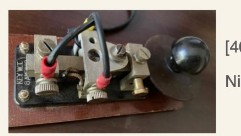
There are quite a few of us that use a Key WT 8 This week I’m looking at the Morsum Magnificat WT8A Key Survey, which is a deep dive into the history and variations of the British made WT 8 Amp Morse key, a staple of WWII era wireless communication.
The document includes first hand accounts from former workers who assembled these keys during the war, offering a personal touch to the technical details.
With over 100 documented variations produced across six countries, the survey provides a comprehensive look at the evolution of the WT 8 Amp.
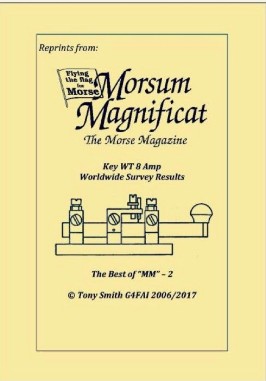
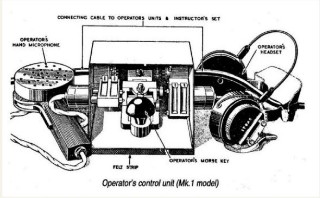
Whether you’re a seasoned collector or a newcomer to the world of vintage Morse keys, this survey is both informative and accessible. It’s available for free download here: https./ia802302.us.archive.org/5/items/Morsum_ Magnificat WT8A Key Survey/
If you’ve read something that you think might be of interest to our readers, please let me know so John and I can share more thoughts and ideas. For guidance on writing for RagChew, see Articles below. Please email material to Mark VK2KI: cqqrsnet@gmail.com
There’s No Such Thing…
Fills WOUR o YUCOLVIlS. I think the first lesson in Teachering 101 is to always tell students “There’s no such…” (I’m sure you know the rest) and “…the only dumb questions are the ones not asked”.
John VK2RU reckons that there’s lots of questions out there among both our new and our experienced operators – about CW, amateur radio operating and about theory.
So John didn’t step backwards quickly enough when asked to volunteer to compile readers’ questions; thanks mate. So here we go…
Question:
MIMO OLIV. Hi Mark, Not sure what is going on but can not log on the bit.ly/CQQRSNET this afternoon! Do I need to create an account on bit.ly to be able to log on to CQQRSNET?
Last time I think I went to the site from the RagChew publication itself and only needed to enter my call sign and I was on the editing page. Tonight I went to bit.ly/CQQRSNET and couldn’t do anything! Could you or one of the other (new ) editors educate me.
Is there anything on the bit.ly site I could read to come to the bottom of it? I know you are all busy but if I can do it right that would relieve you guys of constantly intervening.
Answer:
Spreaashee}) tile. [ne form was created by our tamily member Nigel G4HVVL Wno took pity on me when he visited a couple of years ago and saw that I was manually converting each individual report (which were then done via email) to a spreadsheet, and cross-referring every line to stations who hadn’t submitted reports.
The written comments were then individually copy/pasted to MailChimp – pretty much my whole week was taken up with that process – every week. Good for the net – bad for me!
So once I have the downloaded .csv file, I run a software program that Nigel has written for us in the Python programming language; that magic application generates the nicely formatted spreadsheet you see each week, and a .docx (Word) file with the comments.
I go through the spreadsheet converting the @20 entries for example, to separate lines for the non 40 and 80m entries, and delete the generated lines for the stations that are not part of our group and pick out any errors that I spot.
The final spreadsheet then gets Screenshotted (Ie converted to image files using a very ‘smooth pixel-capture function in my clever Apple MacBook), and I save each page as a separate low-resolution image file, which gets uploaded to the MailChimp web- based spam-marketing generator that I use to distribute the final formatted newsletter.
However, in parallel, when I use the Python software to generate the spreadsheet, the application also generates the .docx (Word) file from your written report.
I now send that file to Patrick VK2IOW who goes through an sorts out the formatting and other errors, and inserts the images against each report.
(we actually usually do this in two chunks – one on Wednesday afternoon, and the final one on Thursday afternoon – two smaller chunks of work for Patrick).
Patrick then sends the formatted Word file back to me which I then open in Apple Pages (the word processor that comes with the MacBook. The conversion process always affects some of the formatting, which I can quickly correct.
I then export the .pages file as .jpg images (one for each page); the process leaves a large blank area on the last page unless the reports just happen to fill that page exactly, os I do a Screenshot of the last page to generate a separate image file of just the text without the blank area.
Once exported, the individual image files get uploaded to MallChimp, ready for transmission by email (which is handled by MailChimp). Why go to all the trouble of generating images?
The MailChimp html editor is fairly clunky (its not at all as flexible as a word processor – for example, text and images can’t be mixed).
The free version also only allows one person to edit – and you cain’t send files around either – it’s all hidden in the internet.
So because I believe that our images make the newsletter so easy to read or skim, and of course add significant interest, and I have to separately load images and any small adjacent text blocks, the process is very time-consuming.
That’s why Patrick produces a word processed file for me which I then export as images which can be loaded into complete page-size blocks. That’s also why I prefer to receive articles in word processed (.docx or -pages) form.
For more on that, see Articles below. So you can perhaps see why I’m so thankful for the work done by the editorial team and the wonderful contributions by our team family. So back to the question.
The reason is that the webform has to be turned off early on Thursday afternoon to allow the above process to be done, so that I can send the newsletter out on Thursday afternoon if possible.
There’s no need to do anything with bit.ly – all that URL does is re-direct your request to the Google Form – we could use the Google Form address – but it’s about 2-1/2 furlongs long… the bit.ly/CQQRSNET address is a bit simpler!
[Do you have a question or two that are worth sharing? How about a discussion- starter? Please let me know cqgrsnet@gmail.com and I’ll pass them to John VK2RU for compilation each week.]
Prosign/Character/Signal of the Month
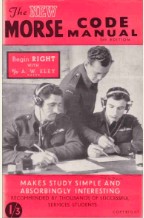
Our resident CW trainer Nic VK7WW (see Other Notes above for the link to Jordan VK3ACU’s recordings of Nic’s latest training transmissions) was asked about a standard two-or three-letter designation for an exclamation mark.
Nic has always used
[Suggestion – put it on a sticky note near your key as a reminder for Tuesday. Tell us how you went!]
I Hear Tell…
• Who reported dropping signals on 20m… until he discovered that he’d forgotten that he’s turned his Yagi away? ¢ And, who had to double away to clean the house…. before the cleaner arrived?
¢ And how many of our family get so relaxed during QRS CW that they completely forget what they’re sending mid-sentence – and sometimes mid- word? Ok, perhaps we should ask, who doesn’t?
E And – who accused whom of sending bananas across the world instead of signal reports?
[If you have some intel about other team members… or even yourself… that’s worth sharing, please let me know cqqrsnet@gmail.com J
Di-dah-di-dah-dadit
So back to the CQQRS Slow CW QSO practice net.
Next Tuesday’s Net
Our CQQRS Group will be on as always on Tuesday from around 0700Z until about 1300Z; see https://bit.ly/CQQRSWebsite and navigate to the Net Details page for details.
Doesn’t matter whether you’re brand new and want to try just exchanging callsigns and RST reports, or you’re ready for a good old rag chew. We’ll have fun.
There’s usually people around until after 1300Z – so keep calling in the segment of the band designated in the table below until you catch someone.
I should be on as usual from home in NSW or via the Remote at Bedfordale WA, and I’ll also be watching the proceedings using the VK6QS and Tecsun SDRs in WA and NSW respectively. Hope to hear you there.
Please let us know via our Reports form bit.ly/CQQRSNET who you work or hear on Tuesday’s Group. The report form closes at lunchtime (Eastern Australian time) on Thursday.
And by the way, a reminder; if you send me any information by email, our report form or WhatsApp – unless you specifically state that material is not to be published, I’ll assume that you’re happy to see your thoughts in the RagChew newsletter.
Post Mortem
Richard VK6HRC will run our phone Post Morsum on the South West AllStar net (via repeaters and hotspots all over WA) from 0600 WA time, then from 0700 WA time on 80m (8605 LSB).
See https://bit.ly/CQQRSWebsite and navigate to the Net Details page for details of how you can connect via Echolink or even possibly via your local FM repeater.
Articles
The newsletter is interesting to readers because of the material contributed by so many people – be it the reports each week or the various articles. Could you write a short article or articles for RagChew? You bet! Writing not your strong point?
Don’t worry, I’m very happy to help as much or as little as needed. Here’s a thought – although our readers will much prefer your own writing, perhaps have a go at using a Large Language Model Artificial Intelligence tool such as ChatGPT, Microsoft Copilot or Google Gemini to check your writing or even to actually draft the whole article in a relaxed easy-to-read manner!
You can find out more about how to do that on the Newsletter page on our website bit.ly/CQQRSWebsite. Our website also includes a suitable prompt (the command you feed to the Al to make it do what you want).
Please remember though – you must fact-check anything that an Al tool drafts for you because Als ‘hallucinate’ – ie if an Al can’t find what you’re looking for, it will make up an answer and present it as a fact!
This is one of the dangers of using Als – it’s quite probable that the tool will create a very readable and convincing draft that is 100% wrong! You as the submitter are responsible for fact-checking.
But it’s a learning experience – please let us know how you went if you had a go with this new generation of tool. And by the way – lam very concerned about our future in a world of Al – but I’m pleased to see that school and university curriculums now focus on understanding the risks – for instance, kids are now learning critical thinking something that used to be taught mostly at post-graduate level.
When the typewriter was invented, people predicted the downfall of handwriting; when the word processor was invented, the art of writing was thought to be on the way out – ditto for the spreadsheet and arithmetic, AM, SSB and FT-8 for amateur radio etc.
We can ignore Al and hope that it just goes away… or we can learn to handle it through experimentation and use. Anyway, back to you writing something for RagChew.
Our net is primarily there to help encourage new operators to have a go on air with CW in a safe relaxed environment. Well guess what, the RagChew newsletter is no different – it could be an opportunity for YOU to have a go at penning something that others might enjoy or find interesting…..
Unlike a real magazine, where you may feel reluctant because you’re not an experienced writer, you might make a mistake that others might judge you by, it’s all too hard to assemble your thoughts into something others will pay to read, etc etc. Well….
This might be an opportunity to have a go; I’m standing by to help. For more guidance on writing for the RagChew newsletter (including help with using an Al), head to our website bit.ly/CQQRSWebsite then click the menu on the top right and then click RagChew Newsletter.
Teamwork
Thank you so much to our team of 38 contributors: DL/MONNK, G4RWI, VK2ASB, VK2DLF, VK2GAS, VK2I0W, VK2KJJ, VK2RU, VK2TIG, VK3ACU, VK3CTM, VK3DRQ, VK3ECH, VK3FG, VK3JFP, VK3KEV, VK3KLE, VK3QB, VK3WOW, VKAPN, VK5AO, VKSET, VK6GX, VK6HRC, VK6KD, VK6KHZ, VK6NQL, VK6NW, VK6PZT, VK6RR, VK6WE, VK7JZ, VK7TA, VK7TO, ZL1CJB, ZL3TK, ZL4CTS and 4X1DA.
Anda special thank you to our editorial team, Nigel G4RWI (head software wrangler), Patrick VK2IOW (reports coordinator), John VK2RU (researcher and head-copy guru) and Richard VK6HRC (Post Morsition); great work all! UY CW on Tuesday, mb.
Mark Bosra VK2KI/ VK6QI Beautiful South Bowning NSW mark,bosma@icloud.com non impediti ratione cogitationis

About the CQ QRS Net
For the current schedule and more information about the CQQRS net, please go the the Net Details page on our website:

The opinions expressed in the RagChew newsletter are those of the individual contributors. The opinions do not necessarily reflect that of the editor or of the CQ QRS Group members.
Any material and images received from members by the editor or published on the CQQRS WhatsApp groups may be published in this newsletter unless specifically requested otherwise.
The values, doctrine and guidelines for the Group and for the newsletter are published on the Principles page of the group’s website https://bit.ly/CQQRSWebsite