Below is a reconstruction of the 2025 17 CQ QRS RagChew newsletter designed to support full text searching. This reconstruction was built using OCR, and will contain errors.
To view the Mailchimp original, click here. To search the entire newsletter archive, click here.
Contents
- CQ QRS RagChew
- Last Tuesday’s Group
- Reports
- Website
- Reports & Comments
- Comments:
- From Nic VK7WW at Legana, TAS
- From Paul VK3KLE at Stawell
- From Phil VK6GX at Gidgegannup
- And finally…
- Post Morsum Report
- This Week’s Topic of Interest
- The Bundle
- Wire
- On My Workbench
- Other News
- In case you missed the memo…
- Morse Training Net
- After Starlink?
- Auroral BUZZ
- The Code Shelf
- There’s No Such Thing…
- Question from Ian VK1HF:
- I Hear Tell…
- Blame the internet?
- Di-dah-di-dah-dit
- Next Tuesday’s Net
- Post Morsum
- Teamwork
- About the CQ QRS Net
CQ QRS RagChew
Well well well…. wasn’t Tuesday’s net interesting? The Bureau of Meteorology’s Space Weather Services predicted difficult conditions following two solar flares – anc the prediction was right. We all had fun, but things were challenging.
Our DXperiment stations in the UK (Chris G7BED in the East Midlands North of London and Simon F/MOKBJ near Avignon in the South of France) struggled this week – Chris managed a single 20m long-path QSO with Kevin VK3KEV at Seymour (both were using simple wire antennas) before the band dropped out, but Simon just wasn’t being heard down this way.
Our operators on 40m struggled with QSB and 80m wasn’t performing as well as expected either – there was even a Sudden lonospheric Disturbance experienced.
However, I was sad to hear of our team mate Max VK6FN at Manjimup who lost his beautiful Telrex Christmas Tree array (stacked 20, 15 and 10m Yagis) in a bush fire on his property that happened during this week’s net.
Max was remarkably positive about the situation during Wednesday’s post-

Morsum, and was already looking forward to something bigger and better! I’m pretty proud that our team can bring such pleasure that even in the face of such a disaster, our mate could keep smiling; he’s had a pretty tough 12 months.
And I know Max isn’t the only one who gets such satisfaction out of Morse code and our team. Thanks to all our contributors this week – as usual we had lots and lots of contributors – 30 this time.
And a special thank you to Warren VK3BYD, one of our keen SOTA and Parks operators from Wangaratta who responded to last week’s article by Ross MONNK and my question about rapid antenna set-up.
This week, we’ve continued our series about interesting reads relating to CW and we have also started a section on answers to questions you might have relating to CW, amateur radio and the like. I hope you can make the time to enjoy the read.
Last Tuesday’s Group
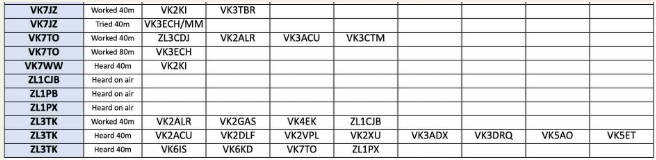
Here’s this week’s list of the 60 stations heard or worked by our 39 family members:
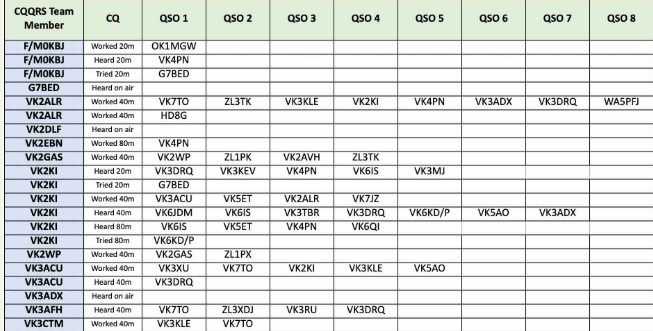
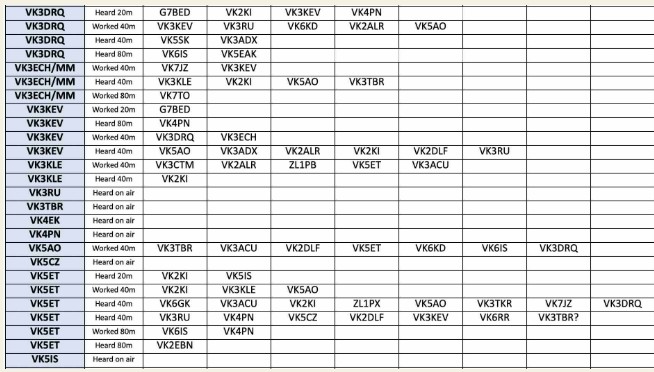
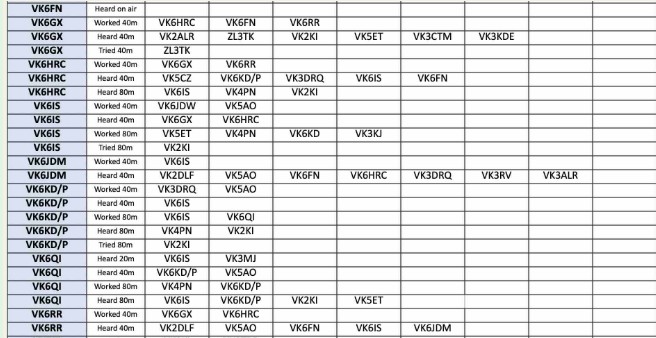
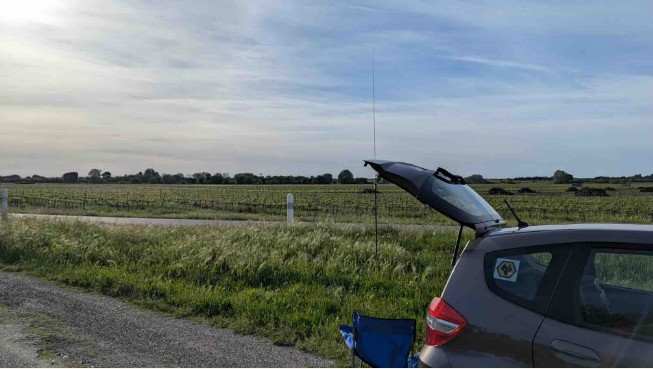
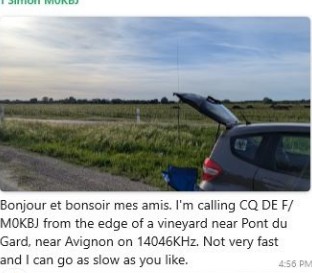
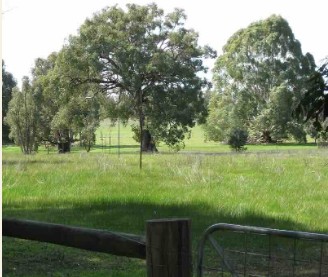
And thanks this week to Simon F/MOKBu for the early morning photo of his portable set-up next to a vineyard near Avignon in the Provence region of France. Nice place to be – pity that propagation wasn’t playing the game this week!
Reports
After next Tuesday’s Group, please send me a list of who you worked and / or who you heard using our web form here:

Please help attract new and old team members to have a go by submitting your report each week. Submissions close 1300 (Eastern Australian time) on Thursday.
Website
If you’d like to find out a bit about our net, or would like to pass information to others about our Tuesday get-togethers, here’s the link to our website.
Bit.ly/CQQRSWebsite Cheers, mb Mark Bosma VK2KI / VK6QI Beautiful South Bowning NSW mark.bosma@icloud.com non impsditi ratione cogitationis
Reports & Comments
So the spreadsheets above show the known stations on last Tuesday’s Group; the comments distilled from the team members’ reports follow:
Comments:
From Nic VK7WW at Legana, TAS
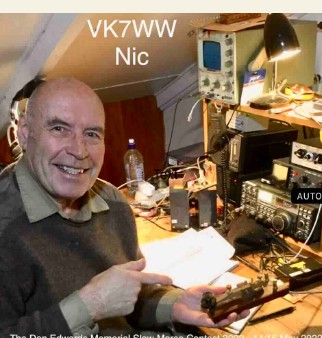
40m] * Severely limited over Easter with family socials…but son Marcus seems very interested in AR and especially CW !! “Knock me over with a feather” He’s now talking of getting his licence!.
[80m] * Heard 3 ZLs going for it on high speed CW training on 3580! Great!. [Wow! Interesting question follows that – what is it about CW that seems to be attracting younger members? Certainly wouldn’t happen in my day!]
From Donald VK6JDM at 20 km west of Esperance WA
[40m] + Lots and lots of good signals on 40 tonight. I had not been on air for over a month due to work and family matters getting in the way. Found myself struggling to decode Morse tonight despite a lot of people sending very clear sounding code.
On sending I seemed to be using left foot instead of fist, so after one QSO with Peter who |
Accused of being Mark (the one who is leading me down the path of Morse depravity), I decided to just listen and try to get the Morse cogs in my brain to function again; they clearly need oiling and the backlash adjusted before I try sending again.. [ @,
[40m] + Really enjoyed tonight, two stations worked and each time I make a QSO I am getting better. Was really pleased to hear VK3ECH/MM, and to hear his MM QTH was Lakes Entrance as this
My home town where I grew up. Unfortunately after getting call sign and QTH it started to fade in and out for me. I will be listening next week and in a couple of weeks operating QRP from Lakes Entrance myself..
[40m] +* ZISTK, sorry Stan, conditions were not good enough.. + I am sure we can have a good contact one day. Working ZL cannot be that hard.. + Regards from “Gruyere” VK2GAS.
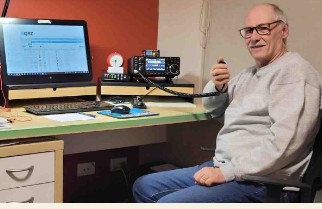

[40m] + Listened in to few stations enjoying long QSO’s… good receiving practice 🙂 Not many others heard or worked tonight though.
[80m] * Only 3 stations heard, 2 QSO’s, very quiet. Noisy on 20m..
From David VK6KD/P at Esperance (Pink Lake CV Park)
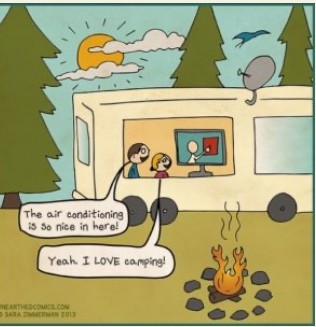
[40m] * Caravan parks are no place for working 40m. S8 to s9 noise floor. But still workable..
[80m] * Working 80m inside a caravan is not good due to high noise levels. Played a lot with filters and made it work..
[80m] + Adisappointing day and I can’t quite fathom why. I heard at least one VK station and RBN showed my signals getting out well but after a lot of work, only one in the log..
+ I was on 20m pushing out 20W into a vertical antenna on the edge of a vineyard in Provence..
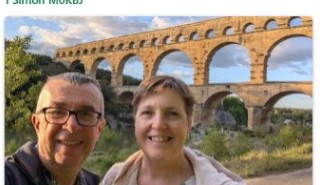
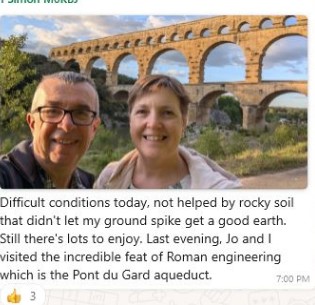
[Bad luck Simon – but thank you for trying. The double solar flare may have caused trouble somewhere along the long path.
In a RagChew last year, Ross MONNK and Mike DL3YZ did an interesting bit of analysis on the hops associated with propagation around the world – amazing that anything ever gets through! Where-to for you both now?]
[40m] * Had good QSO with Phil and Rich. Not many readable sigs and had to leave QRS early..
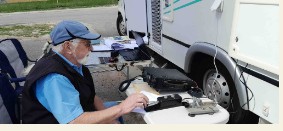
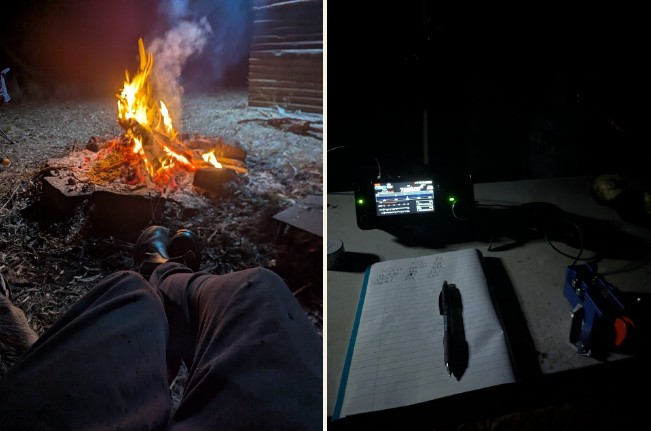
[40m] + Headed out for an overnight camp at a friend’s property in Elaine, Victoria. I brought along my QRP rig and a 20- meter end-fed half-wave antenna. The location was wonderfully quiet, with fantastic signal reports.
Running 5 Watts into an inverted-L configuration, I managed to snag 5 contacts. While the noisy cockatoos made concentrating a bit of a challenge at times, it was still a great night out, and portable operating remains one of my favourite aspects of the hobby..
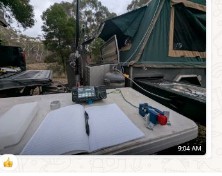
[40m] + What a great evening. I got on early hoping someone would be about, and was greeted by Brian, ZL3XDU.. * That was followed by Skip, VK2ALR who was a new call for my log.
It was nice to hear an accomplished station join the net for the first time with the goal of supporting learners.. + I found myself inadvertently going a little faster than would be helpful for new ops with those first two QSOs, so as a way of penance, put out my next CQ call with a very slow pace.
Was answered by Jordan, VK3ACU. Of course, at those speeds only a brief QSC takes a while, but we got to say hi to each other..
+ It was then time for dinner and some family time before calling again later in the evening, to be answered by Tony, VK3CTM, also a new contact for me, who was operating on his veranda.
He was either brave or very thick skinned, as it was far to chilly here to even think about being outdoors..
[80m] + Later, with no new stations on 40 m that I could copy, I moved down to 80m. After calling for a while, I was answered by Rob, VK3ECH. It was not the easiest copy, but assuming as it got later the band would open further, so pushed on.
Rob was at anchor in his yacht near Lake’s Entrance; the first MM stations I’ve worked. I was really
• njoying our chat about boats when the band simply died for me. I was only receiving intermittent dits and dahs and thought it more polite to interrupt him and sign off, than let him keep sending into the void.
In hindsight, I should have suggested we QSY to 40 m. Sorry Rob, I hope it didn’t come across as rude. I look forward to continuing the conversation another time.. + All in all, another thoroughly enjoyable evening on the key..
[Fabulous report, thanks Lance; I appreciate how much time and effort it takes to write such a comprehensive report – thank you.
Interesting to speculate on the cause of such Sudden lonospheric Disturbances – especially when mixed in with the predicted impact of the double solar flare on Tuesday.
Had you in fact been able to try 40m, that would have given us some further guide about what happened. And of course, the more folks we get on our CQQRS WhatsApp groups, the better our chances of being able to use it as a back channel for liaison in case of such things happening.
[20m] *On 20m G7BED was only RSN 332 and very QSB, I called but didn’t receive any answer. Waited for about half an hour but no luck.. + F/MOKBUJ was not here to be seen..
[20m] * The local RBN heard G7BED calling, but I forgot to take note of the signal report (sri). * But I listened to the DX activity ona local Kiwi SDR – hoping for better conditions next time.
[40m] + In spite of average conditions I managed to get two contacts in the log using my FT817 @5W.
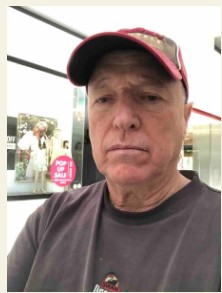
• vil « Chris G7BED was a firm signal here. I think I got lucky as he had QSB during the QSO. «| have an 80m half wave dipole 10m up between trees. It is aligned NE/SW -good for DX into Europe.
I was using approx 60W via an Icom IC-706 MK2G purchased back in 2008.73 Kevin
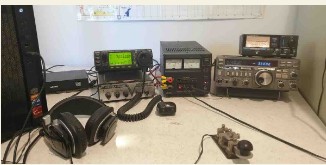
From your editor Mark VK2KI at Beautiful South Bowning NSW
[20m] + At the start of the net, I could hear Kevin VK3KEV down at Seymour working our newest team member, Chris G7BED at Northamptonshire who was using his dipole up 12m.
Chris was coming through into Southern NSW RSN 421, but of course, I was struggling to copy Kevin in the 20m skip zone. When they finished, it was
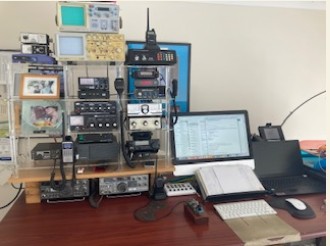
On for young an old… Sava VK4PN near Brisbane, Manny VK3DRQ near Melbourne and I (near nowhere in particular) all took turns (we’re all gentlemen after all) at calling Chris.
Chris and I were liaising via our WhatsApp Alerts group so I could tell him who was transmitting when – but unfortunately, Chris wasn’t able to copy any of us, despite our best efforts at keying nicely; the signals were going down hill as well, so it looked like Kevin won the Easter egg this week..
+ We all also listened out for Simon F/MOKB4J portable at a vineyard near Avignon in the Provence region of France; we could hear who he was working in Europe, but there was no sign of our travelling duo down this way in either VK2 or VK6…
[40m] + On 40m I hooked up with Jordan VK3ACU at a spot callled Elaine (DX-pedition…. must be all of 10KM away from is place) for quick chat; then John VKSET and I had a nice little rag chew.
I then slid up to the K-Marker frequency and sent a few test calls to see if I was making it into any of the Reverse Beacon Network receivers; nothing popped up on the RBN webpage (perhaps transmitting on the K-Marker frequency wasn’t such a clever ideal) but Skip VK2ALR did – so we had a chat…
+ I heard Donald VK6JDM from near Esperance coming through into NSW, but by the time I got my TS-120S netted to his frequency, Peter VK6IS had hooked him. I then came across Jim VK7JZ in Hobart chatting to Tim VK3TBR at Horsham. Such a dilemma – who to call?
Jim was the unlucky winner this time, and we had a nice chat.
[80m] + After a late dinner, I slipped down to 80m and was very pleased to hear a number of people on. I tried to catch David VK6KD/P portable in Esperance, but Peter VK6IS hooked him instead; signals were pretty marginal from David…
+ I noticed that all signals were down somewhat on 80m from normal – even the East coast stations were noticeably weaker than usual; there was a Space Weather Services warning about a double flare affecting conditions – so we’ll go with that as the explanation.
Either the D-layer didn’t quite dissipate as expected, or the F-layer wasn’t strong enough to support propagation… but there were signals on 40m (which would require a stronger F-layer for refraction) – so who knows?.
Also from your editor Mark VK6QI at via the Southern Electronics Group VK6SR Remote near Perth and KiwiSDR near Northam
[20m] + This week when I listened on the Southern Electronics Group KiwiSDR near Northam, there was no sign of our DXperimenters in the UK or Europe..
[80m] * This week I played a trick on the Southern Electronics Group Remote station at Bedfordale South of Perth.
[20m] + This week when I listened on the Southern Electronics Group KiwiSDR near Northam, there was no sign of our DXperimenters in the UK or Europe..
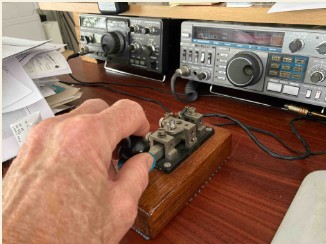
Once again, it coupled nicely into the big Marconi-Tee antenna antenna above and below our little segment of the band, but refused to bring the SWR below 2.7:1 where I wanted to operate.
I suspect that somewhere along the line, the automatic coupler had got some odd LC mixes in its memory and defaulted to something that doesn’t work.
So instead, I did a tune below our segment (8539KHZ – just one kHz lower than our bit), and the remote returned a happy 11 SWR report. I left the coupler set like that and was able to operate in our bit of the band..
• Again, signals weren’t strong, but workable. As the evening moved on, I again saw on the Northam KiwiSDR the auroral buzz creeping up the band. I moved up a bit higher to where the band was clear and was happy to chat
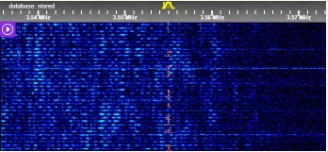
To both Sava VK4PN near Brisbane and David VK6KD/P at Esperance. Toward the end, the buzz had got to where I was working.. * So overall, a terrific night for me once again. Thank you to everyone who was on air – very much appreciated..
[40m] * the band is still fairly quiet, until after 1700 local.
[80m] * this band is fairly quiet, as well, as most stations are heard an bit later on..
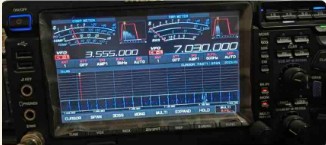
40m] + Learned I should have taken more notice of valuable signal report RSN 598 before embarking on a non- contextual data string. Despite S9, N8 proved a killer. Apologies to OM Clive ZL1CJB, thank you for trying so hard..
[Slowly, slowly folks are starting to appreciate the value of the RSN reports Stan; thank you for introducing RSN to the CQQRS net.]
From Paul VK3KLE at Stawell
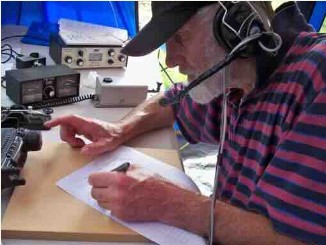
[40m] * VK3ACU Jordan was camping and operating QRP. So the copy took some concentration but was also quite a bit of fun too. Most stations had QSB so signal fade was strong .
The operators were smart enough to stay with standard format QSO in these conditions making it easy to compensate for a few missed letters
From Phil VK6GX at Gidgegannup
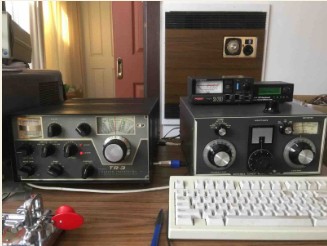
[40m] * Very few VK6 stations during the afternoon, but quite a few East coast and ZL stations heard on the East Beverage, which is still on the ground, but too weak to work on my just repaired 80m Flat Top Delta Loop.
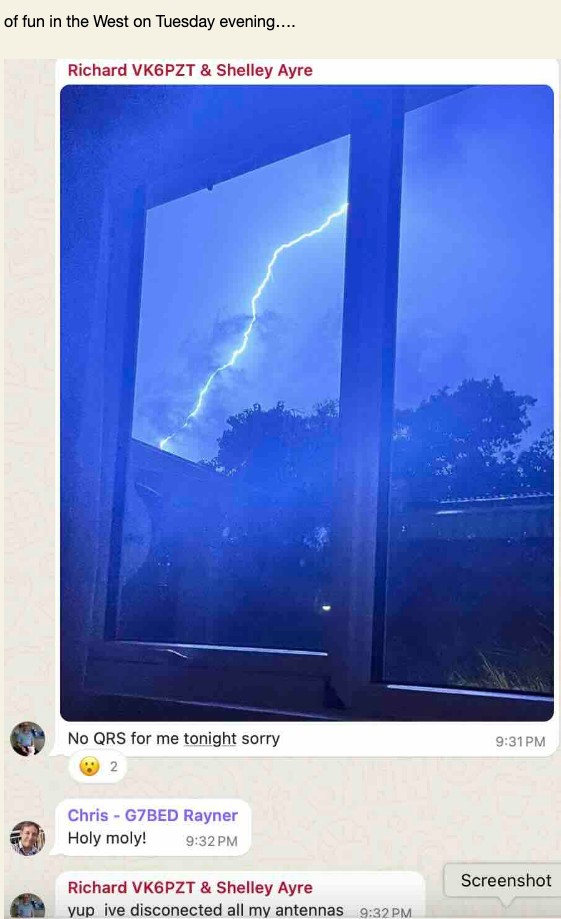
The session was cut short by approaching thunderstorms, which also prevented evening 80m operation and only cleared inland Wednesday arvo..
[80m] + Local thunderstorms prevented operation during the evening..
And finally…
Missing in action this week was Andy VK5LA; but we did get a note from his mum – away camping somewhere nice in Victoria.

From Richard VK6HRC on the AllStar / Echolink and linked SW repeater hub this morning. VK6KD/P David, VK5ET John, VK6QI, Mark VK6FN, Max VK6HRG, VK6MRB SWL and others. David and Pauline are now in an electrically noisy caravan park, Esperance WA.
They even had a chance meetup with a local celebrity VK6JDM at the local coffee shop in town. David managed to work on 40MX and 80 Mx in spite of the 8/9 noise but is planning on moving further East along the coast and to a quieter spot hopefully.
John had fun on 40MX and observed that when the band got busy you had to queue up and jump in when a QSO ended otherwise no contact! He is also planning on being on the net next Tuesday.
Mark had a go listening out and trying to work the DX stations on 20 Mx as well as a fair few locals. Mark reported that Kevin VK3KEV made contact with Chris G7BED in spite of the average conditions.
Mark worked five on 40 Mx, heard seven and on 80 Mx worked two and heard another four while also multitasking monitoring multiple Kiwi SDR receivers and spotting on WhatsApp – great job thank you.
Max had just got going chatting to Phil VK6GX on Tuesday arvo but had to sign off quickly when he received a phone call letting him know that a bushfire was approaching his boundary!
The local fire brigade managed to get the blaze under control, but the end result was the loss of his Telrex Christmas Tree HF array, his Northern fence-line lost and multiple gates left open – so hopefully the cattle made it to safety.
Max was having to wait for daylight before heading out to get a better idea of the damage sustained. Max reported later that the cattle were all ok; hope you get your property back in order ASAP young Max.
I had hooked up my FT817 early on, made a couple of contacts on 40 Mx and listened out on various SDRs for my signal and was amazed at the results. I spent most of the evening tuning around listening to wall to wall great Morse code. Thanks to all, 73
Post Morsum Report
VK6KD/P David VK5ET John VK6QI = Mark VK6FN Max VK6HRC VK6MBB swil and others
This Week’s Topic of Interest
Last week Ross MONNK discussed the question of what’s the bare minimum of gear to take portable? But the question buzzing around my head was… why does it still take me an hour to set up an antenna and get on air?
I invited our portable ops gurus to comment…. and I’m pleased that Warren stepped up. Warren is one of our frequent SOTA and VKFF Parks operators – and here’s his secrets to getting on aur quickly in the field.
| have always kept my gear simple, light and easy to set up in the field and generally it takes around 10 minutes for me to have the antenna system ready to go.
The Bundle
While I carry a small 6m squid pole, if there is a tree convenient to my operating location I will use it instead of the pole. I carry a 15m throw-line with a small bag on the end that is filled with small rocks or sand to make it heavy.
The bag was repurposed from a bear bag kit used by hikers in the USA where bears will steal hikers food so things need to be out of reach; for me its small and light to carry. For antennas 90% of the time I use an end-fed wire and external ATU.
For the other 10% I have a doublet fed with open wire feeder. Regardless the principles are the same, both antennas have 3mm rope attached ready to go; for the end-fed its 7m on the far end and 3m at the radio end.
The doublet is 4m at each end and there’s a loop in the centre to attach the centre point to the throw line or squid pole.
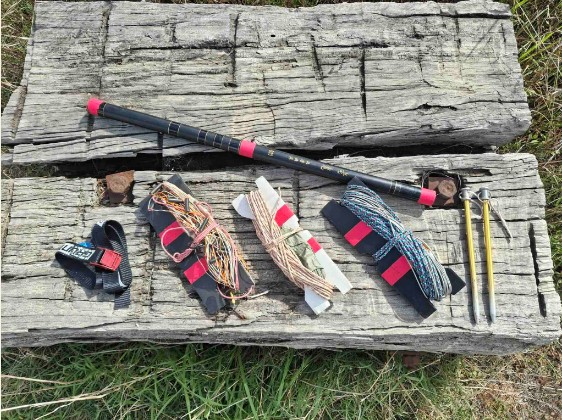
The strap then the doublet are on the left throw line in the centre and the end-fed is on the right.
All three of these items are stored on winders made out of corflute board and wound ina figure-8 method. For the end-fed, the far end goes on the winder first; with the centre-fed, I start at one end and wind the entire antenna including feeder onto one winder.
I have found the centre-fed unwinds with no tangles using this method. Setting up the squid pole takes around the same effort, I have found they will stay up with little support.
I use a short strap from the local hardware to hold the bottom against a tree and on the very rare occasions it needs guying the antenna and the throw line make up the guys. Wire For the doublet, I used a pair of wires from a 15m CAT5 patch cable.
The top is 13.8m end-to-end with a feeder length of 4.9m. There was some mathematics around these sizes but it was also about keeping size of the footprint down. For matching I use an EmTech ZM2 auto-tuner.
As for the end-fed, I have three different ones: * Two are simple wires, one of 22m and the other is 14m – and for matching I use an L-Match tuner.
+ The third is an end-fed half wave which I have trapped to get 40, 30, 20, put a link in for 17m & a high impedance coil for 15m.
For this antenna, I use a simple external half wave matching unit from QRP Kits My 6m counterpoised is used for alll three end-feds. Wire size, is mostly what I could get my hands on.
I have some very light-weight and thin wire with about 6 steel strands and a synthetic fibre core. My other favourite is figure-8 speaker wire generally a light to medium type.
Wire
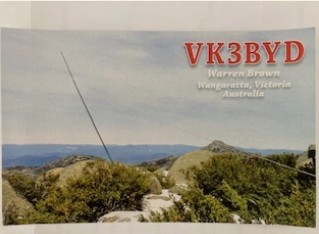
Over the years I have experimented with various antenna types. The above are the ones I fall-back to as I find them the easiest to use in the field. Cheers, Warren
If you have an article or two that you think might be of interest to our readers, please let me know so we can share more thoughts and ideas; email to cqqrsnet@gmail.com

On My Workbench
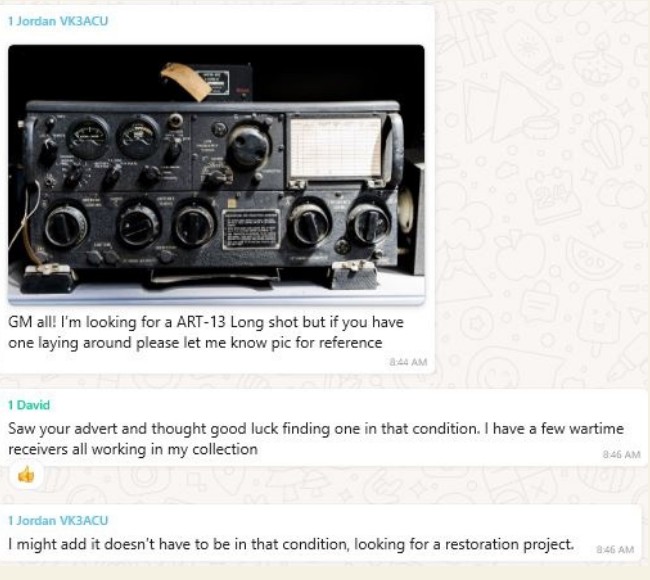
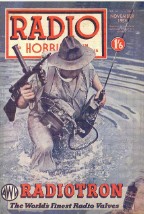
Other News
In case you missed the memo…
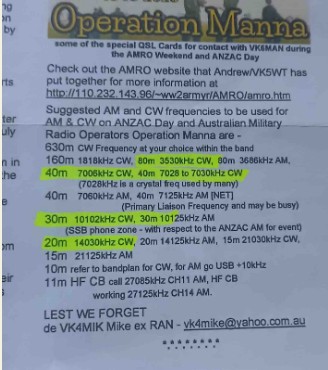
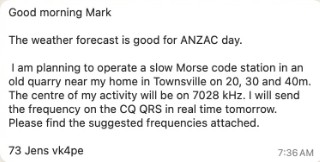
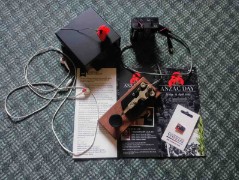
Keep an ear out this weekend for other Operation Manna and ANZAC Day stations (see my Thursday email for the Army Radio Operators’ website link), including the VK80MAN special callsign.
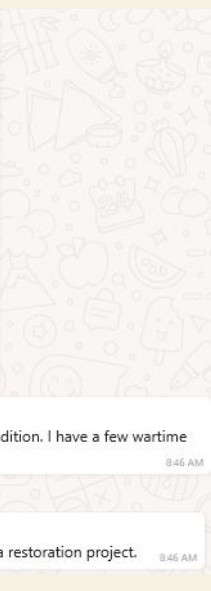
[Thanks Richard – another excellent YouTube video from Hayden VK7HH – this time about the steps you must take to renew your new Class licensed callsign.
The new Class amateur radio license expires after five years – and following the modern doctrine of making the customer do the routine work, the ACMA has now left itup to licensees to renew their callsign allocation every five years – according to Hayden, we will no longer receive reminders that our licenses are about to expire!
We are somehow expected to keep track of this ourselves. Easy enough for those among us who use computer/phone reminders… as long as we are confident that the reminders will still work in four years time….
Software updates, applications no-longer available, replacement computers or phones… and how will your computer skills be by then?
But what about the significant proportion of amateurs who are no-longer able to sort through the mire of computer applications, websites etc? For instance, do you have a “digital ID” – necessary to establish a log-in on the ACMA website?
Hayden’s video will help – but I reckon a significant proportion of us will struggle, and unfortunately, give up! Clubs and groups like ours can help of course… but from what I’ve seen, lots of our older amateurs drift away from such clubs….
And unless they have a teenage computer supporter… who knows how they will cope? By the way, I’m always happy to help any of our team with this sort of thing (while I can anyway!) – and I reckon we have others who can also do the same.
So if you’re worried about whether or not your license is still current, please send me an email, and I’ll see if I (or someone near you) can help: cqarsnet@gmail.com ]
Morse Training Net
Our team member Nic VK7WW runs an on-air Slow Morse training net every Wednesday at 7pm EDST on 3580 for 30 mins. He uses the callsign of the Northern Tasmania Amateur Radio Club VK7TAZ on that net.
Many of our team learned Morse code with the support of Nic, and the weekly training session comes highly recommended for anyone who wants to learn the Code, or simply brush up.
Everyone’s welcome – 3580KHZ at 7pm Eastern time every Wednesday; you’ll hear lots of the CQQRS team on that net. Jordan VK3ACU is recording this round of training lessons – you’ll find the link to the YouTube recordings on our website here:
Bit.ly/CQQRSWebsite then navigate to: useful-resources-and-links Contact Nic VK7WW for more info nicholaschantler@hotmail.com including how to join the NTARC DISCORD group to follow the action, or just come along and join in on Wednesdays.
After Starlink?
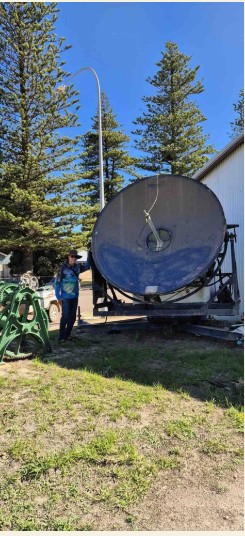
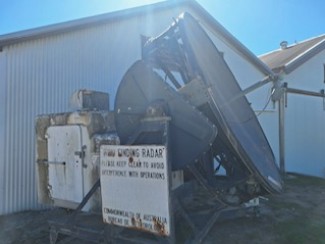
From David VK6KD back in WA. Pauline and I are now back in our home state of WA. While walking around Esperance I think I found the next ARISS tracking antenna for my back yard, hihi. The old wind-tracking antenna was located at the Esperance museum.
Auroral BUZZ
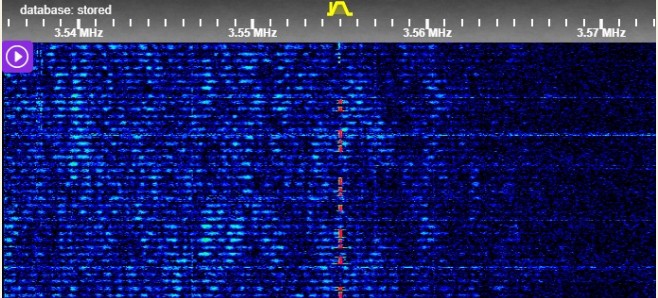
AUrOrdal DUZZ from the editor Mark VK2KI / VK6QI In the RagChew newsletter last week and the week before, I talked about auroral scintillation, and I posed a question about what I’ve called “auroral buzz”, and in particular, why it appears as ‘blobs’ of noise in the frequency / time domain on a waterfall display.
Database: stored Trio 7 ee a ee 354! 3.56! I can visualise the effects of scintillation (discussed last week – rapid fluctuation of radio-frequency signal phase and/or amplitude, generated as a signal passes through the ionosphere), but not what appears to be either generated noise or selective propagation of noise from another source (eg sun noise, galactic noise, etc) in auroral activity.
I also wondered why the noise appears to usually move slowly from lower frequency to higher frequency? Why not just appear across the whole band?
I didn’t get any comment from our reader so I thought I’d check in with Roger Harrison VK2ZTB, who has had professional experience with ionospheric propagation; Roger is also the Editor-in-Chief of the Wireless Institute of Australia’s Amateur Radio magazine..
Here’s what Roger thought: Thanks Roger; I followed up with more questions (of course): “From your description, I can visualise the arriving 0.1 to 10s of Hertz Elfven waves contributing to buzzing component of the ionospheric scintillations.
I wonder though what such scintillations are modulating at the low HF frequencies? Does the arriving solar
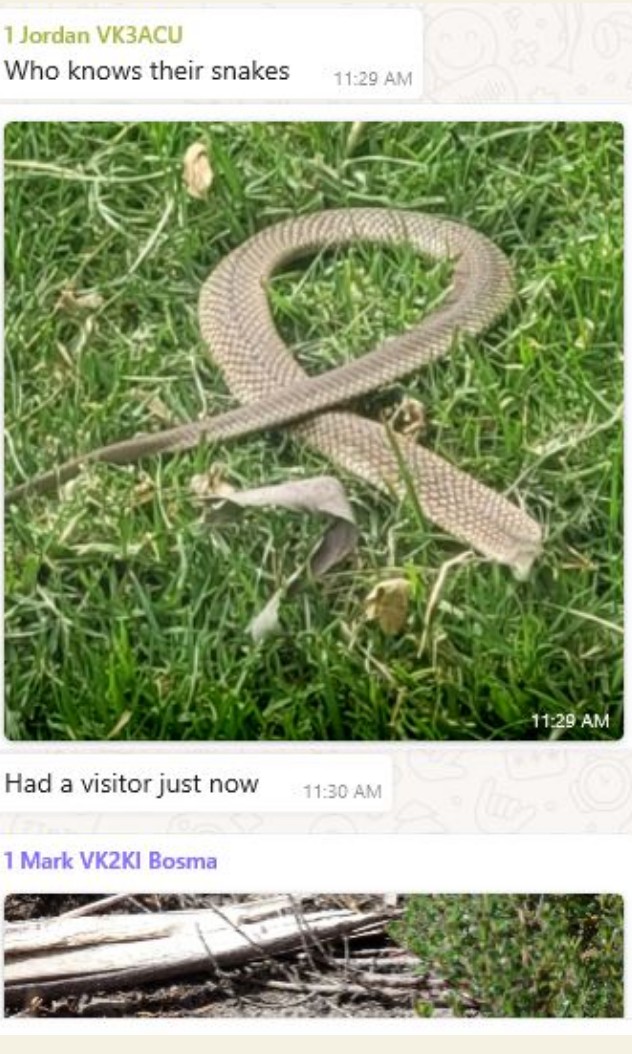
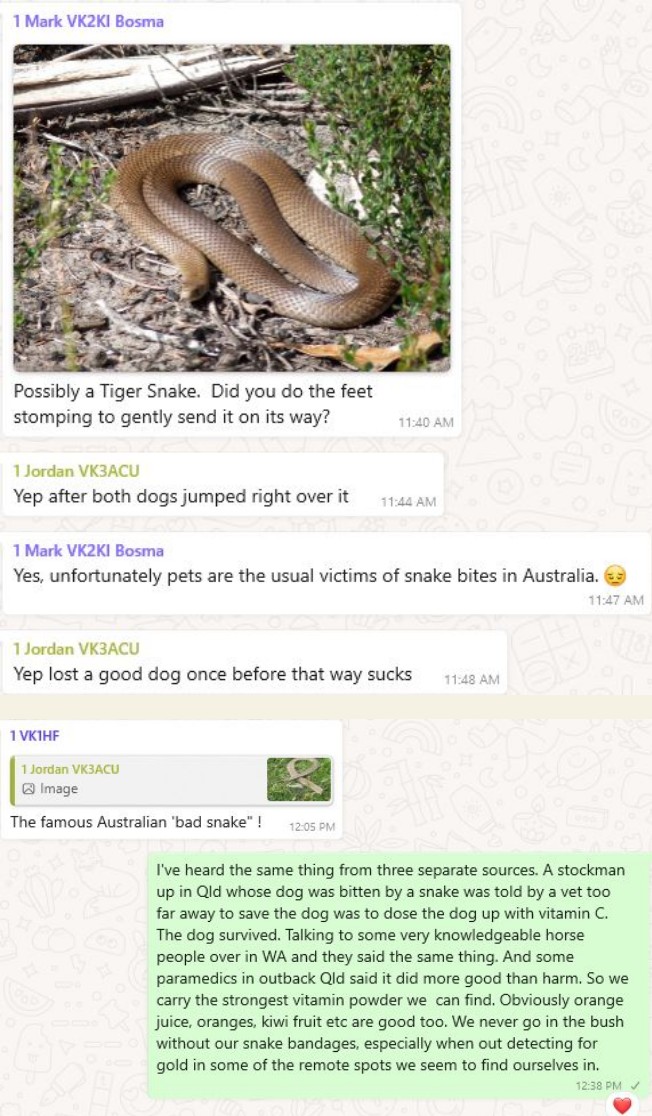

The things you find when searching through your email Spam / Junk folders – I four this from Peter VK6IS – President of FISTS: Hi Mark, The things that you find, when there is No CW Activity… . http://vkew.wikidot.com/att which was replaced by this . .
Httpy/30cw.wikidot.com/att which then leads to here . . https://www.noSnn.org/att/ – – These are the TOP 5 kHz of each exclusive CW band section. – – “Over the years there have been many calls for “HF CW Calling Frequencies”.
Indeed the founder of FISTS intended the FISTS frequencies to be calling frequencies, with QSY after establishing QSO. This did not however materialise, although it was successful some years ago in VK with 7050.
– back then, by LOU VKSEEE – 73 Peter VK6IS aka – still promoting CW in the Wild Western Frontiers.
The Code Shelf
What have you been reading lately? Compiled on the track somewhere by John
What have you been reading lately? iled on the track somewhere by John VK2RU
The Victorian Internet by Tom Standage is a surprisingly fun and eye-opening read, especially if you like history with a twist of tech.
It draws this fascinating parallel between the invention of the telegraph in the 19TH century and the rise of the internet in the 20TH.
Standage takes what could be a pretty dry topic and turns it into a fast-paced story full of quirky inventors, unexpected rivalries, and even some early forms of online dating (yes, really).

What’s great about the book is how it makes you realise that a lot of the excitement, hype, and even anxiety we associate with the internet today actually happened over 150 years ago—just with wires and Morse code instead of fibre optics and Wi-Fi.
It’s not super technical, so even if you’re not a history buff or a techie, it’s still really accessible. All in all, it’s a fun, thoughtful read that gives you a fresh perspective on how history kind of repeats itself—just in slightly updated packaging.
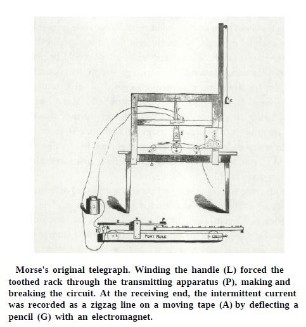
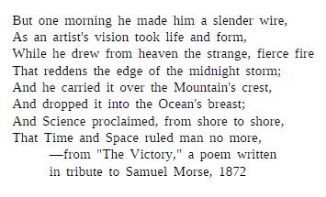
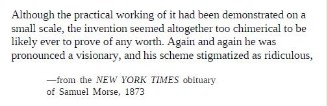
Free book download here – https://archive.org/details/vdoc.pub_the-victorian- internet-the-remarkable-story-of-the-telegraph-and-the-ni
If you’ve read something that you think might be of interest to our readers, please let me know so we can share more thoughts and ideas; email to cqqrsnet@gmail.com
There’s No Such Thing…
Inis weeks questions. I think the first lesson in Teachering 101 is to always tell students “There’s no such thing as…” (you know the rest) and “…the only dumb questions are the ones not asked”.
John VK2RU reckons that there’s lots of questions out there among both our new and our experienced operators – about CW, amateur radio operating and about theory.
So John didn’t step backwards quickly enough when asked to volunteer to compile readers’ questions; thanks mate. So here we go…

Okay, I can work out that VK2DI is CW on 14.032, but what is AU-9877? And if I make contact, what information does VK2DI want from me, and what information will VK2DI send me? From your editor – VK2KI / VK6QI ‘Well as it turns out – I can answer this one!
When an Australian or New Zealand operator is on a Summits On The Air (SOTA), VKFF (VK Flora and Fauna) Parks, POTA (Parks on the Ait) or similar activation, they can use one of a number of smart-phone type tools to advertise that they are on air looking for contacts (eg I use our team member VK6AYL‘s iParksnpeaks iPhone app, a lot of others use VK Port-a-log).
Now another of our team members, Allen VK3ARH at Lal Lal runs a server that receives such posts and consolidates them onto a single webpage www.parksnpeaks.org – this is also where many users post Alerts advising of forthcoming SOTA or PARKS activations, or Spots – which Is when they are actually on air – and they (if they have phone coverage) or others advise that the station is on air on such-and-such a frequency.
Now here’s the especially good bit for us CW fans…. if there’s a Spot on Allen’s website from an VK or ZL where the mode is shown as CW – the server sends out an ‘SMS to those who have asked for it – so what you see above is a copy of the SMS that I received about one of our team members (Mark VK2DI in this case), which I’d copy/pasted to our CQQRS WhatsApp Alerts group.
So in the alert above, AU-9877 refers to the POTA park reference number – which happens to be Whiting State Park Beach. See below for more about this.
Question from Ian VK1HF:
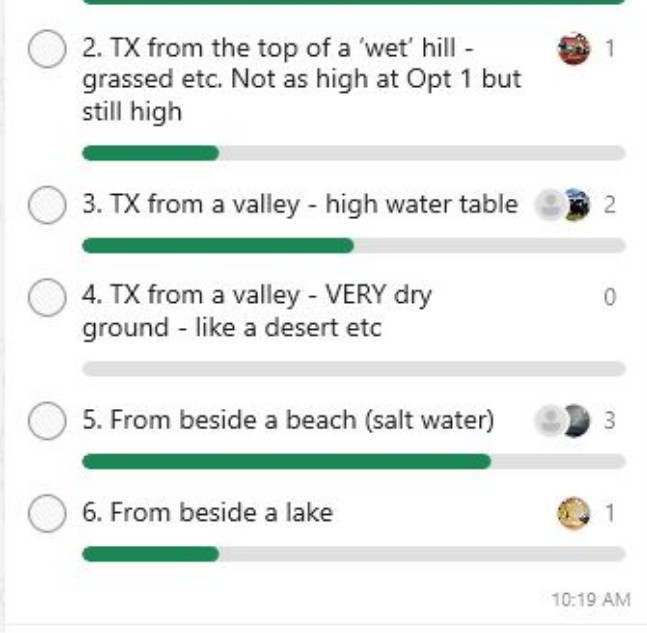
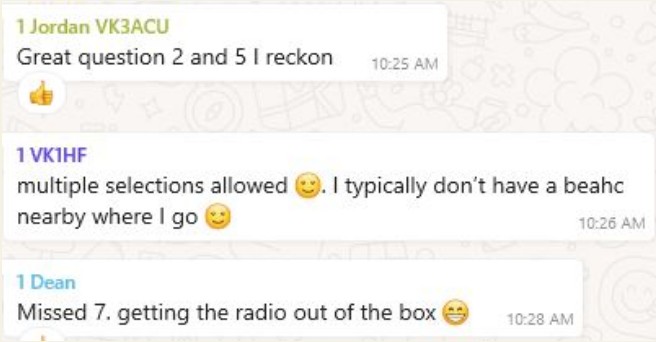
Question to the engineering minded out there… lets say you have a few options for a given day for transmission of your QRP signal, which one do you choose..; 4. TX from the top of a rocky mountain 2. TX from the top of a ‘wet’ hill – grassed etc.
Not as high at Opt 1 but still high 3. TX from a valley – high water table 4, TX from a valley – VERY dry ground – like a desert etc 5, From beside a beach (salt water) 6.
From beside a lake lets assume you can chop and change all at exactly the same time, same radio, same antenna, same power, same mode, same HF WX, same Freq etc. Assume : 40/20 Mtrs which would result in the best signal form an RX (skip) perspective ?
I had always thought a valley with a high water table, ie. wet ground (opt 3) Weird question I know., but just something I would like to understand a bit better.
I get the feeling when I am motorbike QRP I often make bad choices in this regard – impacting my TX signal efficacy etc if you ACTUALLY do know (at an engineering level) that’s great but practical experience responses welcome also..
Feel free to just rate the options in order also. Poll to follow – but free form also welcomed
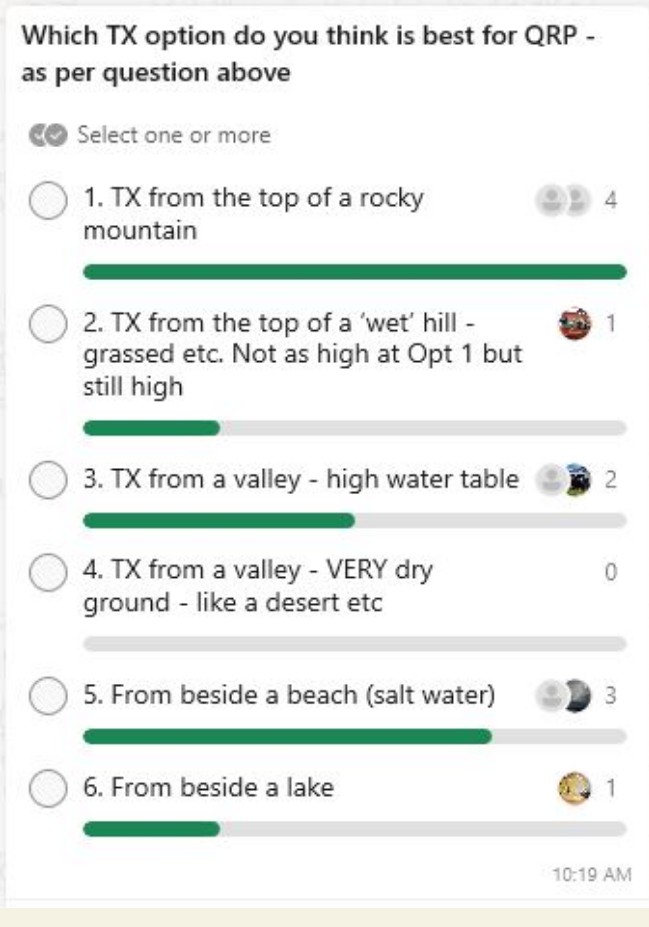
Question: I often hear operators calling CQ WWFF, CQ POTA, CQ SOTA etc. Who does the caller want to hear a reply from? What information do they want to receive? What information will they send?
From your editor – VK2KI/ VK6QI Well – perhaps I can answer this one too! Many SOTA and Parks activators are trying to work as many stations as they can (to qualify for an ‘activation’ of that particular location); so most QSOs are bare minimum – callsigns, RST exchange, and possibly names – that’s it.
Although this might sound unfriendly, from the activator’s perspective – they’re very happy to work as many as they can…
But they’re usually limited by battery capacity, activation time, wanting to give as many ‘chasers’ as possible an opportunity, the incoming weather, etc – so it’s wham-bam, next? However, there’s an upside…..
For new operators, it’s a terrific opportunity – very basic QSOs with a bare minimum information exchanged. The other side is that many SOTA and Parks activators are themselves CW novices…. so they’ll usually go slow if you call at a QRS speed.
[Over to our readers – please send me your thoughts for next week’s RagChew (including some images from the website if possible please?) cqgrsnet@gmail.com
Do you have a question or two that are worth sharing? How about a discussion- starter? Please let me know cqgrsnet@gmail.com and I’ll pass them to John VK2RU for compilation each week.]
I Hear Tell…
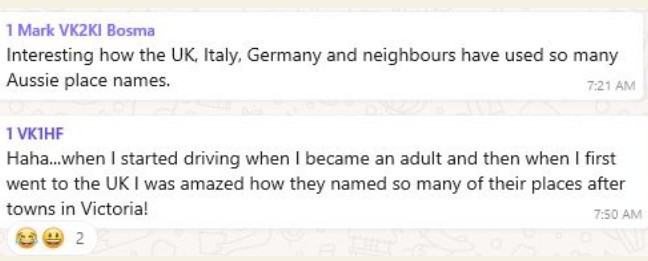
Why were a couple of our team discussing a Texas house of ill repute this week I wmeanmaAar)

Which one of our team went away camping for Easter…. but just happened to loop back via a different destination to pick up a new boat anchor? |’m sure his wife would have been overjoyed with his new acquisition.

Blame the internet?
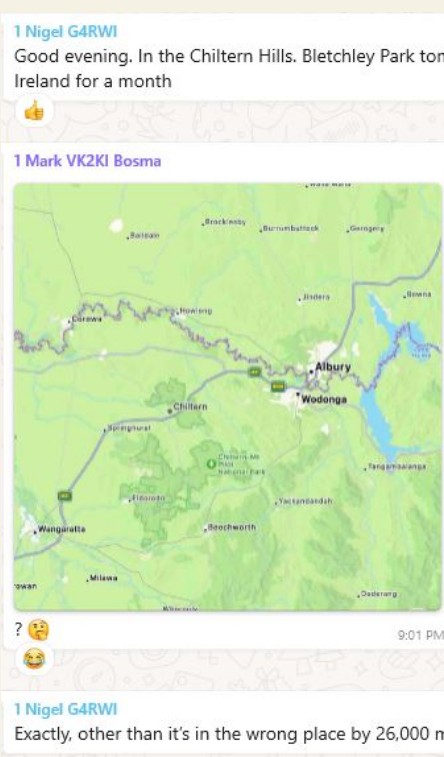
Which one of our team sent an email from a rural location… but bumped into the recipient in a café before it got there?
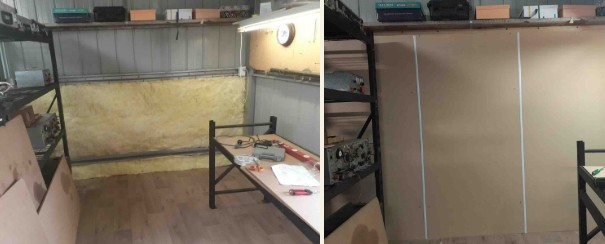
| hear tell that our sometime carpenter and apprentice Croweater Peter VK7KPC ha been making great progress building his new shack on the South coast of SA.
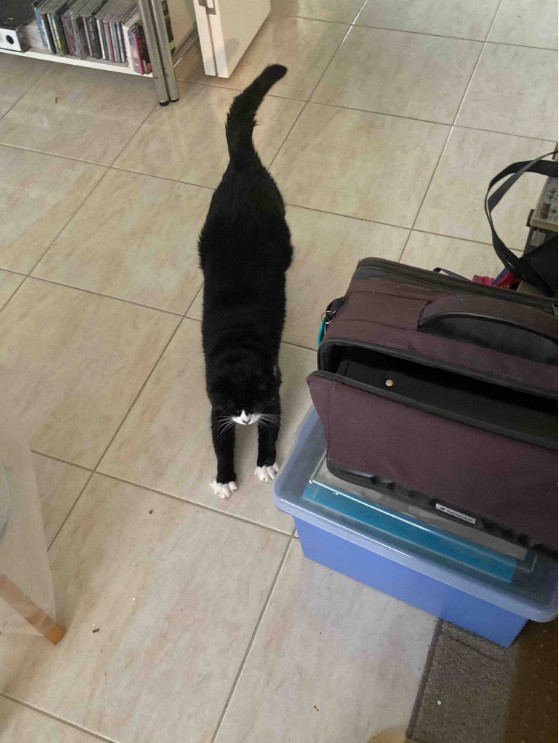
[If you have some intel about other team members… or even yourself… that’s worth sharing, please let me know cqqrsnet@gmail.com J
Di-dah-di-dah-dit
So back to the CQQRS Slow CW QSO practice net.
Next Tuesday’s Net
Our CQQRS Group will be on as always on Tuesday from around 0700Z until about 1300Z; see https://bit.ly/CQQRSWebsite and navigate to the Net Details page for details.
Doesn’t matter whether you’re brand new and want to try just exchanging callsigns and RST reports, or you’re ready for a good old rag chew. We’ll have fun.
There’s usually people around until after 1300Z – so keep calling in the segment of the band designated in the table below until you catch someone.
I should be on as usual from home in NSW or via the Remote at Bedfordale WA, and I’ll also be watching the proceedings using the VK6QS and Tecsun SDRs in WA and NSW respectively. Hope to hear you there.
Please let me know via our Reports form bit.ly/CQQRSNET who you work or hear on Tuesday’s Group. The report form closes at lunchtime (Eastern Australian time) on Thursday.
Post Morsum
Richard VK6HRC will run our phone Post Morsum on the South West AllStar net (via repeaters and hotspots all over WA) from 0600 WA time, then from 0700 WA time on 80m (8605 LSB).
See https://bit.ly/CQQRSWebsite and navigate to the Net Details page for details of how you can connect via Echolink or even possibly via your local FM repeater.
Teamwork
Thank you so much to our team of 35 contributors this week: F/MOKBJ, G4RWI, G7BED, VK1HF, VK2ALR, VK2EBN, VK2GAS, VK2RU, VK2WP, VK2ZRH, VK3ACU, VK3AFH, VK3BYD, VK3CTM, VK3DRQ, VK3ECH, VK3KEV, VK3KLE, VK4PE, VK5AO, VKSET, VK6DSL, VK6GX, VK6HRC, VK6IS, VK6JDM, VK6KD/P, VK6PZT, VK6RR, VK7HH, VK7JZ, VK7KPC, VK7TO, VK7WW and ZL3TK.
And a special thank you to Warren VK3BYD and John VK2RU for the articles, and to our editorial team, Nigel G4RWI (head of software development), John VK2RU (WhatsApp spy and research) and Richard VK6HRC (Post Morsition and spy). Thank you all.
UY CW on Tuesday, mb. Mark Bosra VK2KI/ VK6QI Beautiful South Bowning NSW mark,bosma@icloud.com non impediti ratione cogitationis



About the CQ QRS Net
For the current schedule and more information about the CQQRS net, please go the the Net Details page on our website:
The opinions expressed in the RagChew newsletter are those of the individual contributors. The opinions do not necessarily reflect that of the editor or of the CQ QRS Group members.
Any material and images received by the editor or published on the CQQRS WhatsApp groups may be published in this newsletter unless specifically requested otherwise.