Below is a reconstruction of the 2024 41 CQ QRS RagChew newsletter designed to support full text searching. This reconstruction was built using OCR, and will contain errors.
To view the Mailchimp original, click here. To search the entire newsletter archive, click here.
Contents
- CQ QRS RagChew
- Challenges
- Daylight saving Blooper
- Last Tuesday’s Group
- New Team Members
- Masthead Image
- Reports
- Reports & Comments
- Comments:
- Options
- Other Uses
- Conclusion
- Portable at Home
- QRP Labs QCX-mini CW Transceiver
- Johnson Adventurer
- Other News
- Oceania DX Contest 12Oct24.
- So What is PZT?
- Richard
- Who Invented the Morse Code?
- On page 41 there’s an excellent article about Alfred Vail.
- QR Codes Decoded
- Inverter Hash
- Regards
- From Phil VK6GX
- More Daylight Savings Blues
- Morse Training Net
- Brain Teaser
- Exam Questions:
- Answers from last week’s Quiz:
- Di-dah-di-dah-dit
- Next Tuesday’s Group
- Post Morsum
- Teamwork
- About the CQ QRS Group
- Frequencies and Times
- Speed
- Matching
- PSE QRS
- Landing Zone
- CW Tips
CQ QRS RagChew
Sounds like a broken record doesn’t it? Another outstanding CQQRS Practice QSO Group get-together on Tuesday afternoon / evening / morning, depending where in the world you were.
Conditions were challenging for many people – static crashes from the line of thunderstorms through SE Queensland, auroral flutter from the Coronal Mass Ejection and high Absorption Limit Frequencies from the high level of solar radiation with the current high sunspot count.
Yet, many persisted and were rewarded with plenty of nice QRS ambles.
Challenges
I’ve always enjoyed a challenge; be it driving on race tracks, flying fixed wing light aircraft or helicopters, managing people, airworthiness, or logistics systems, managing large acquisition programs, process improvement or corporate risk…
Even trying to squeeze a weekly newsletter into a ridiculously busy retired life. Thank you to our team of over 200 who have made our QRS activity such a relaxing and fun challenge for me.
I’m very keen to get feedback on what you like, and in particular, don’t like about our weekly newsletter; see below. I’m bowled over by the articles and comments that our team members send for the RagChew – unlike other similar newsletters, we’re never short of material – thank you one and all!
Please keep it coming folks. I’m also keen to find some partners who would like to get involved in producing the weekly RagChew. To do this will mean I’d need to buy a paid subscription to the.
MailChimp system (at a cost of about $240 per year) so that the editing can be shared, but Ms E thinks it’d be worthwhile if I could spend less time every week editing. Please let me know if you’re interested in joining the RagChew production team.
Daylight saving Blooper
Apologies for forgetting last week that QLD was sensible and hadn’t gone to Daylight Saving; the timetable I’d sent out in the RagChew didn’t note the unique Queensland time for our Group on Tuesdays.
In particular, to David VAK6KD operating portable in Far North Queensland… who responded be putting his clocks forward, only to discover that Daylight Saving didn’t apply there. ©
Last Tuesday’s Group
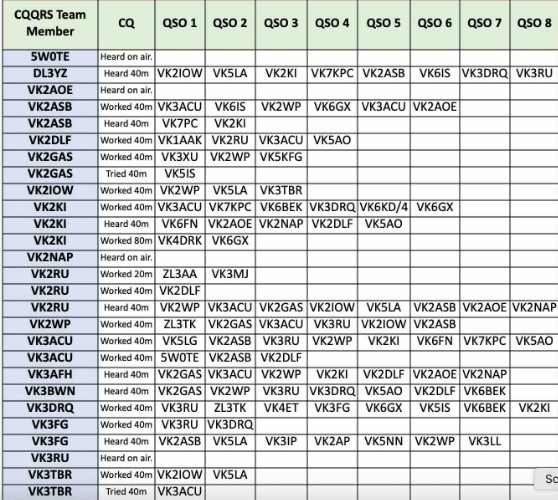
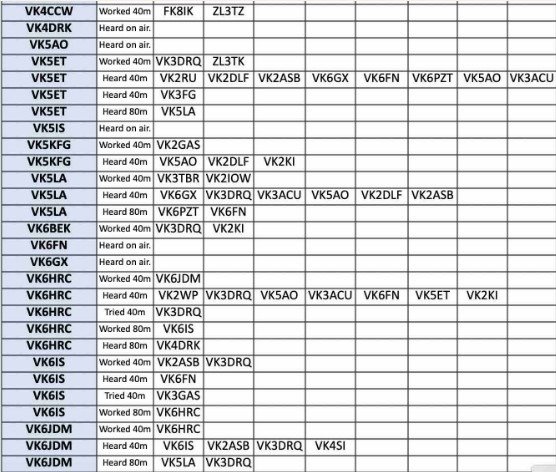
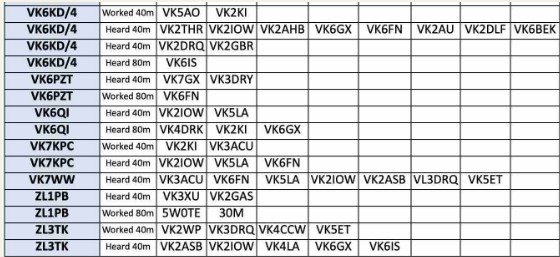
Here’s this week’s list of the 61 stations heard on this week’s Tuesday get-together:
New Team Members
This week I’d like to welcome Gerard VK6QM from Armadale, Simon MOKBJ from Wolverhampton, Yosef VK2ABL from Liverpool and Phillip VK7ID from Kingston; welcome to the fold gents, and I look forward to hearing you on air, or hearing from you if you’re not on air on CW yet.
Masthead Image
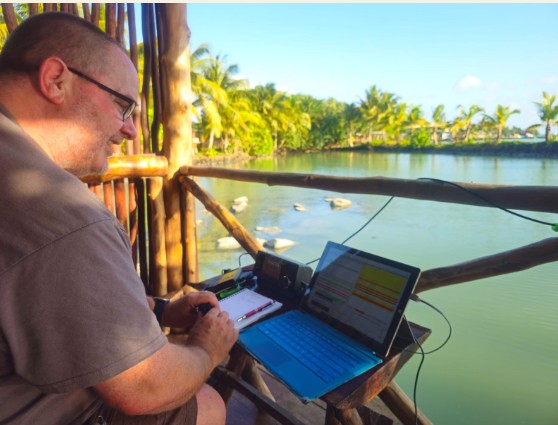
And thanks this week to Pete ZL4TE for the great shot of his high-risk operation from Samoa. See below for more.
Reports
After next Tuesday’s Group, please send me a list of who you worked and / or who you heard using our web form here: bit.ly/CQQRSNET

Please send the reports through by lunchtime Australian time on Thursday. Getting reports from stations and listeners is important to me – even if you listened and didn’t hear anyone or weren’t able to copy anything – the fact that you had a go needs to get recorded so we know that the Group is working and attracting new and old team members to have a go.
As our team outside of Australasia grows, we’ve seen lots of interest in expanding our activities to other bands to catch our overseas members.
The head of our software department, Nigel G4RWI has been working furiously to produce a simple way of reporting on contacts with our team outside of 40 and 80m.
But in the mean time, please just use the 80m report area (Separate out your 80m report from other bands of course), and when you enter the list of callsigns worked, heard or missed, please append an ‘@band’ to each callsign without a space (eg VK2KI@20 VK6QI@15 etc).
Reports & Comments
The spreadsheets above show the known stations on last Tuesday’s Group. Comments distilled from the reports I’ve received are below:
Comments:
[40m] + Very noisy band. Local QRN very heavy and band conditions down.
[40m] + Sorry for my absence on air today. The dirt road to the site was not passable this morning due to the constant rain during the past days. So I did some SWLing from the wonderful Ironstone SDR instead of DX.
Was great to hear you guys having fun, and the band condx today were no problem on 40m. + As the winter is coming, I need to think about hibernation, or a way to work DX from another place 🙂 + Have a great week and greetings from Stuttgart, Mike.
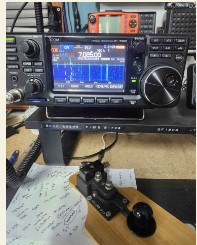
[40m] * Condx quite good tonight and lots of activity. + Both contacts tonight were quite lengthy, over 30 mins each which was really fun! + Fantastic to see the CW portion lightinc AN SILO oon |
[40m] * Very high QRN – static crashes from the ether gods peaking 20 over 9!
[40m] * Very high QRN – static crashes from the ether gods peaking 20 over 9!
[40m] * Tuesday, October 8th, I had my first two contacts (VK5LG and VK2ASB) while driving home. I pulled over to work them mobile. All other contacts were made from home.
• It’s quite cold here, with temperatures dropping to freezing last night. To stay warm, I brought my Penntek TR-45 Lite into the lounge room and connected it to my matching unit with a length of coax.
Running just under 5 watts, I had some great contacts, including Pete (SWOTE), who was also doing QRP. + I worked VK2ASB again when I got home, so I put Arthur down twice. I started to get sleepy by the fire around 9:30 PM, so I decided to call it quits.
I had a quick listen on 80 meters but didn’t hear anything.
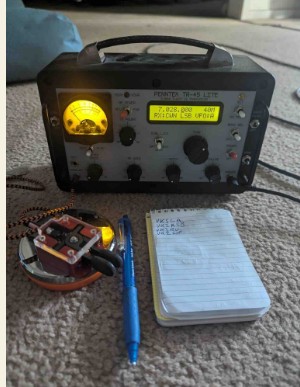
• 40 meters was very good for me, with Mark VK2KI pegging my S meter with excellent signals. It was great to hear lots of QRS stations having a go.
[80m] + I had what looked like QRM on 80m between 3.5474 and 3.5624MHz. Very inconvenient when trying to listen on 3.555MHz. Probably someone’s inverter in the camp ground. Hopefully not mine, hihi. [See Other News below.]
[40m] + Signals were few and very weak. I sent CQ several times and got a weak response which I could not copy. I requested a resend but got no reply.
[40m] «Very poor conditions. Abandoned traffic at 0847Z after one reply to the previous week’s QTC Three QTCs were left waiting. * Generally weaker-than-usual signals and very fast-QSB from the coronal flare, like a random Oerlikon…
Until ~ 1020Z when there was considerable
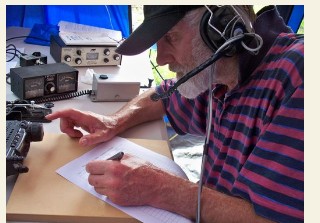
[80m] « Noise, noise and more noise, could see a couple of stations on the waterfall but they were too weak and shattered by the Oerlikon to read callsigns.
[40m] + A large belt of lightning over SE VK4 produced a lot of static which made things a bit difficult at times. Still made reasonable number of contacts.
[40m] + Very very noisy so I did not call.
[40m] + Good to see the waterfall chockablock again with stations on 40. + Had a couple of nice QSOs… but I found condx a bit average, lots of QSB.
[80m] + Had a bit of a listen on 80, called CQ but no takers. + GFN Max was a very nice sign into VKS.
[40m] + Very quiet to start with locally so listened in on a SDR in VK5 until propagation changed and the Eastern states signals came up.
[40m] + Once again an exiting evening. + Thought Condx were some how weird with unusual NOISE. + Last QSO, even though we finished a bit late and tired, it was the most enjoyed with OM Mark. TU OM. (Sorry gentlemen, U are all important).
[40m] + Just listening on 40m this week.
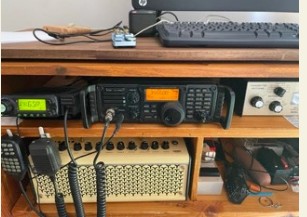
[80m] * Great to have low noise on 80m again, my neighbours must be away * Had a nice chat to Max in Manjimup. Keeping it local this week. Hoping for some DX on 20m soon!.
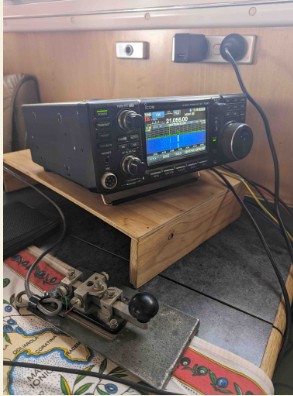
From Pete ZL3TE operating as 5WOTE in Samoa e My wife and I are here in Samoa to celebrate my silver wedding !!!! I contacted Atsu 5W1SA before coming out here.
¢ When I arrived I had brought a 156WH battery and as an afterthought chucked in a larger battery I use on my id-52. I had done a couple of Parks On The Air activations testing all the kit, withno issues.
¢ On arrival, I couldn’t get 10w out so had to revert to the afterthought battery (no charger packed as it wasn’t going to be used!). That ran down and I noticed the charge light on the 705 was on, when I had the USB lead from the PC connected.
• I contacted Atsu to see if there was an electrical supplier. No, he has to get everything from online traders. He invited me over to check things over and a simple multi meter test, showed the lead was OK.
* Soon return, I have to drop the 708 off at the Icom suppliers, handily just § minutes from the airport, and thank heavens for 5 year warranty.
* Net result has been a focus on ft8 (sorry), some superb results on 2v 85 QSOs mainly JA, USA, but als VK, OH, ES, SP Italy and Spain. * come back home to NZ on Thursday evening.
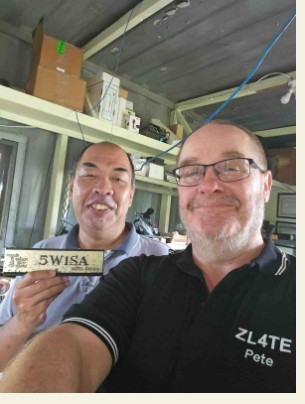
[Terrific to work you on Monday Pete – thanks for the Alert on our CQQRS WhatsAp| Group. Boy – taking radios to a Pacific paradise during your Silver Wedding Anniversary…. living on the edge! Don’t try this at home folks]
From Patrick VK2IOW between Bathurst and Orange
[40m] + Initially the 40 metre band seemed very noisy (storms in Queensland?). * However it seemed to improve, and all 3 stations I worked had strong signals.
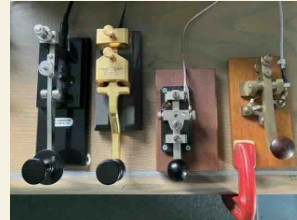
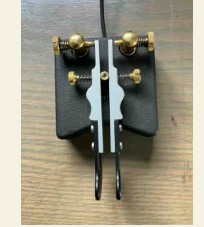
Probably this one! I find it hard to QRS on a straight key, while it is easy on this Begali Simplex dual lever (iambic) paddle (the cheapest Begali paddle).
Not that dual lever paddles are better than single lever paddles, just that I’ve only ever done iambic keying (mode B). I guess it is all about what one is used to.
From Mark the Editor VK2KI at Beautiful South Bowning [15m & 20m] + I’ll blame Daylight Saving but Elizabeth and I were having too much fun on the tractor moving mulch, so I was late to the Group, and completely missed Mike’s DXperiment skeds.
[40m] + Timing of when the absorption limiting frequency dropped and dinner time here meant I also missed hearing Pete ZLATE operating as SWOTE. Luckily I had chatted to him on Monday on 40m.
Hopefully Pete had some success, considering the risk he was taking…. taking his IC-905, notebook computer, antenna, battery etc to Samoa to help celebrate his Silver wedding anniversary with his lady!
+I started the evening with QRP chats with Jordan VK3ACU who was running a massive 300MW from his Penntek TR-45 LITE, then Peter VK7KPC.
There was a line of thunderstorms running through South-East Queensland and out to sea, which was causing me some difficulty; if nothing else, the static crashes made adjustment of my phasing-type noise canceller difficult.
Nevertheless, enjoyed a nice chat with Shaun VK6BEK and was keen to hear about his latest antenna experiments, but the static crashes made copy difficult.
When I then chatted to Manny, I was able to report that at long last I was going to be able to provide the answers to his questions about noise cancellers, via the article that you’ll find later in this newsletter.
+ I was surprised to work David VK6KD/4 portable at Ball Bay North of Mackay; l expected that the duty storms in Queensland would have driven him under the covers. I then wrapped up on 40m with a chat to Phil VK6GX.
Phil reported auroral flutter on signals, but I hadn’t heard any from here, although I did briefly hear an echo on Jordan’s signal earlier.
• | moved to 80m fairly late (NSW time) and responded to Derek VK4DRK‘s CQs that I’d heard on the VK6QS KiwiSDR, before having a final late- night chat to Phil VK6GX. *
[80m] Daylight Saving meant I was having too much fun on the tractor, so I was late to the Group, and completely missed Mike’s NXneriment ckedsc.
From John Dubbelaar VK2RU at Kilcoy, Qid
[40m] + I’ve been away for a few months attending to some family matters. Many thanks to Mark for sending the reports during that time. I haven’t been using my radio so I was a bit rusty.
+l used my new homebrew multiband 1/4 wave vertical which appeared to work well.
[80m] + I didn’t get to try 80m as I had to get my antenna down early because of an approaching storm with heaps of thunder and lightning.
From John Dubbelaar VK2RU at Kilcoy, Qid
[40m] + I’ve been away for a few months attending to some family matters. Many thanks to Mark for sending the reports during that time. I haven’t been using my radio so I was a bit rusty.
+l used my new homebrew multiband 1/4 wave vertical which appeared to work well.
• Just before I switched over to 40m at 0700 I heard a CQ call from ZL8AA on 20m. I had a good QSO with Ken before we both lost signals very quickly. Just after I sent ‘sri qsb 73’, VK8MJ called and Mark and I had another good QSO.
I’m not sure if either of these operators are part of the group, and it didn’t occur to me to ask at the time. + It was good to be using the key again after a long break. I was a bit rusty but I don’t think I disgraced myself.
Working three stations whose sending was very good and easy to copy made it a good night for me.
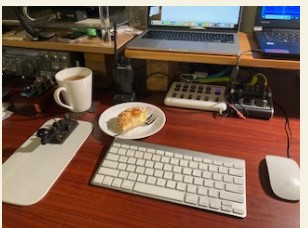
[40m] +I got my Loop on the Ground set up (mostly on the ground) and into my SDR. I managed to have exactly the right length of wire to go around the entire perimeter of the backyard here, and it’s definitely got a lower noise level, as well as allowing me to see a waterfall without without relying on online ones.
I had to spend some time fiddling with software to get it working and matching my radio but considering that was something I was planning on when I purchased my FT891 nearly a year ago (why I didn’t get something larger with a waterfall, it’s about time I got to that!.
+ I had been working late the night before so was having a hard time staying awake, but did hear a number of VK2 stations reasonably well. Hearing VK2AOE/VK2NAP perked me up for a bit (two ships in the night?
579 here with QSB) but I’m not sure if that QSO ended suddenly or I fell asleep, I think the latter :). + Also, I’ve not participated in a contest before, hearing about the CW one this weekend made me start reading up and getting prepared.
I think I know what I’m doing and am getting excited to give it a go! Thanks for the reminder about that, and also an extra thanks to Mark for your work on the newsletter – the editors comments are always a particular highlight for me (when you manage to wrangle them in there of coursel)..
[Thanks Mathew. I’m excited (and jealous) that you’ve got your SDR up and running and I’ll be interested to read about how the Loop-On-Ground works, if you get time to doa little write-up one day.
Phil VK6GX has had good success with a similar concept antenna – a near-to-ground Beverage. I hope you have fun in the CW Contest this weekend – let us know your thoughts; hope others will have a go as well – doesn’t matter whether you’re into contests, wan the practice or just having fun, CW contests are a terrific way of getting practice and stretching your receiving ability; there’ll surely be callsigns you miss, but hey, it’s all good practice, and no sheep stations will be harmed.
Thanks for your remark about my green comments in the RagChew. I’ve heard that some of my comments can be annoying and indeed, offensive. I sometimes find Editors’ comments in magazines such as AR to be patronising to article authors.
So last week and this week I’ve tried to keep my green comments to a minimum. Pm interested to get honest feedback on this from all of our readers.
I won’t be offended by whatever responses I get; I want the newsletter to appeal to, and be read by, as many of our team as possible, and I’m happy to adjust the style to achieve that. Comments to cagrsnet@gmail.com please.]
[40m] + Very noisy , weak signals & heaps of QSB. ZLSTK barely audible, noisy & fluttering sigs from OM Stan, had to abort traffic session.
[40m] + 5W on C718 still setup from last weekends Oceania Contest SSB and ready for this weekend’s Oceania DX CW Contest.
Post Morsum Report from Richard VK6HRC ‘A good session on Wednesday morning on the VK6RLM repeater and the linked AllStar / Echolink nodes.
On this morning / evening : * VK6KD/P David * ZL3TK = Stan * M7VLV Brett + VK6QI Mark * VK6HRC Richard * and our regular SWLs VK6MRB Mulligan and Bob VK6KRC, who checked in before the net.
David called-in from Ball Bay Northern Queensland, worked 2 on 40 Mx and heard 12 stations. Stan reported that there was one request for a QTC, four for exercises and no requests for the accuracy exercises.
Stan also helped our Echolink friends with their audio levels so all good for next time. Brett was informed about the purpose of the net and fortunately we did not scare him off and he plans to join us in the future.
Mark got distracted driving his tractor around and with daylight saving changes not helping, joined the QRS net later than planned. As usual got busy on the key and spotting on WhatsApp. I worked one on 40MX heard seven.
Had trouble with flutter on the local stations. Worked one on 80MX – that being Donald VK6JDM on his home brew rig . Thanks to all on the net last night and this morning.
73 Richard [Thank you for running the net and running up this report every Wednesday Richard.]
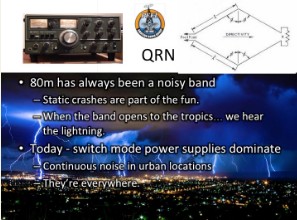
Most HF operators know that 80m and 160M are great for local contacts under 500KM and for DX beyond, but the reality is that they are just plain noisy bands.
Static crashes, power line hash, TV line output radiation used to be the bane of the low band operators’ lives. Now, switch mode power supplies are the dominant parties…. and the havoc they create affects the higher bands as well.
The little plug-pack that powers everything these days is a marvellous device – small, light weight and cheap as chips… but that comes at a cost. Quality varies. Traditional DC power supplies (these days called linear power supplies… even
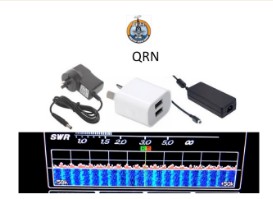
Though they’re not) use a transformer to drop the mains voltage to a lower value, which is then rectified, the ripple removed and usually regulated using some sort of solid state circuit. Big, heavy, inefficient… but quiet.
However, the switch mode power supplies rectify the applied mains to a high DC ripple, then use pulse-width modulation circuitry to turn on the rectified mains, charging a capacitor to just the right voltage, then turning off the mains until that voltage drops under load.
The resulting switching produces a square wave at several tens or hundreds of kiloHertz – and it’s the harmonics of that switching process that we hear on our lower bands. Phase-Cancelling Noise Cancellers But something can be done.
Enter the Phase-Cancelling Noise Canceller. These noise cancellers work by having a separate ‘noise antenna’ that picks up the hash in and around your location.
The circuitry allows the phase and strength of that noise to be varied; the resulting signal is then added to the signals from our main antenna.
By varying the phase to 180 degrees out of phase with the main antenna and balancing the levels, it’s possible to cancel out that part of the main antenna signal picked up by the noise antenna.
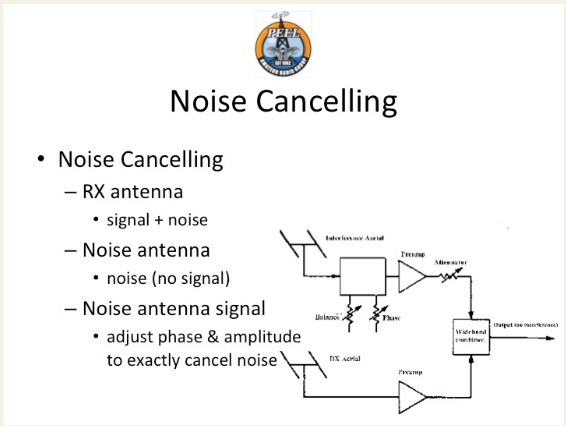
NE IEE + The noise antenna should pick up the undesired hash, but not the desired signals (otherwise, the wanted signals will be cancelled). So a very simple indoor antenna is usually best.
The commercial phase-cancelling noise cancellers usually come with a little whip antenna on the box or able to be plugged in – often that’s all that’s needed.
I’ve tried four different antennas selectable via an antenna switch – a simple 50CM whip orientated in the same polarisation as the main antenna works best most of the time.
+ The adjustments can be quite tricky – especially on 80m and particularly with a receiver with a slow-reacting digital bar-graph type S-meter and good AGC. Static crashes make things even harder.
+ The best noise null also attenuates your desired signals – adjusting for best signal-to-noise ratio is the aim, at the expense of indicated signal strength of the desired signal.
+ The phase relationship between the noise and what the main antenna picks up varies with frequency; significant changes of frequency require re-tuning of the noise canceller. Adjusting your antenna coupler also changes the phase relationship.
+ Switch mode power supply harmonics aren’t good operators; they have a tendency to drift around the band causing havoc… especially during weak signal contacts.
When a sprog drifts onto your frequency, the noise canceller may need adjusting, the noise antenna may need to be changed, or sometimes, nothing works.
* Cancelling the noise after it’s got into your antenna and feed-line isn’t anywhere as good as getting rid of the sources of the noise. However, as soon as the next plug-in device is adopted into your home…
Options
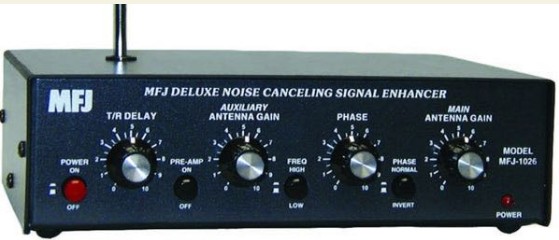
There’s a number of options for the phase-cancelling type noise cancellers. ¢ The excellent VK5TM noise canceller kit « Avery cheap Chinese copy of the above kit ¢ The MFJ-1026 Noise Canceller ¢ Other less common phasing noise cancellers The first option is a terrific solution – unless you’re like me and have the kit still sitting in the pile waiting to be built!
Terry will also assemble them for a small extra charge… if nothing else, get him to mount the surface-mount FETs; if you’re anything like me eyesight-wise, the flea-sized FETS are a challenge!
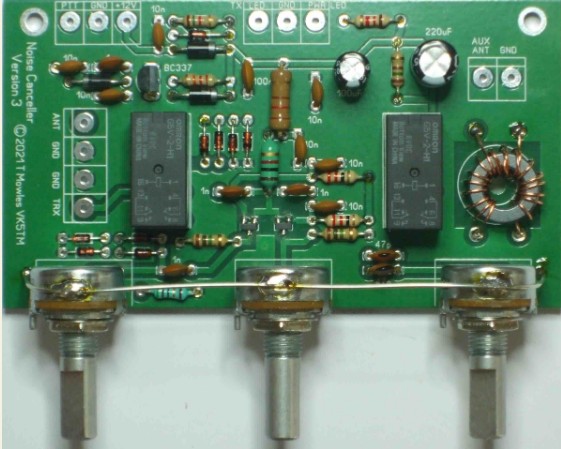
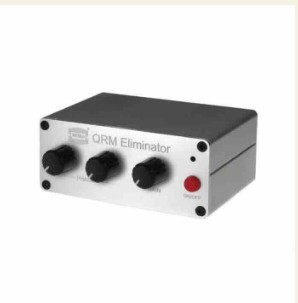
The second option although morally questionable is the quickest and easiest. After looking at my VK5TM kit for too long, I opted for the quick and dirty option – buy a cheap Chinese copy, knowing that if it didn’t work, I could use the nice box it came in to build Terry’s kit!
As it turned out, the thing worked like a charm. I’ve modified i to replace the balance inductor with the same one that’s in the VK5TM kit, and it no works even better!
My S9+10-20dB noise get’s knocked down to between SO and S3, using only the 50CM telescopic whip that came with the box; providing I orient the whip to be the same polarisation as my main antenna.
To find the unit, search AliExpress (or perhaps eBay) for QRM Eliminator or Noise Canceller, and you’ll find them for much less than $100 from China.
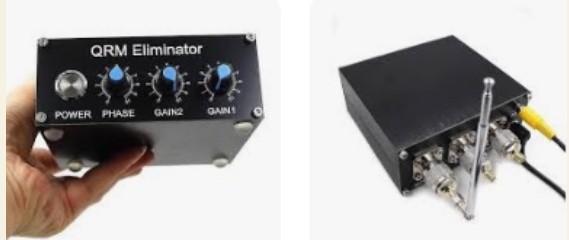
As you can see, it comes in a nice aluminium box and comes with adapters, a noise pick-up whip, the power cord (12 Volts) and the cable to connect to your transmitter’s PTT (So that you don’t accidentally transmit power into the unit when you hit the PTT…
Which will kill the FETs immediately if that happens!). They can be a little tricky to adjust, but with practice, these things are very effective. I can help with tips when you get one.
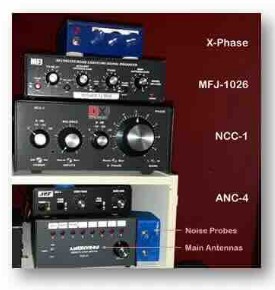
There are other commercial options such as the Wimo QRM Eliminator, US4LG QRM Eliminator X-Phase, Timewave ANC-4, DX Engineering NCC-1 etc which should be considered as well; however, I haven’t tried any.
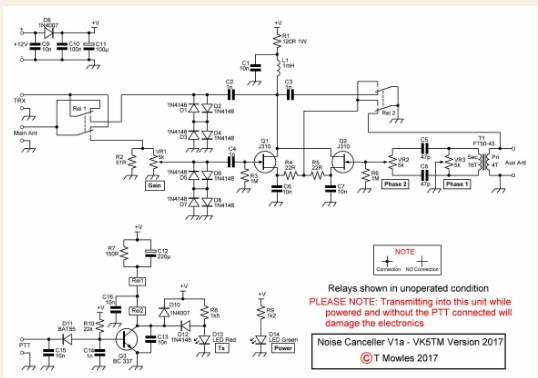
The bottom transistor of the design just does the switching to bypass the circuitry when transmitting. In the top half , the incoming main antenna signal is switched through the relay and fed to a FET via a diode limiter (I think to safely get rid of residual RF during the transmit-to-receive switching and vice-versa).
The noise antenna signal comes in from the right via a balanced phase-shifting circuit, which is fed to the second FET. The two FETs’ drains are connected together to add the two signals together and the sum is fed to the receiver via the switching relay.
Very simple, but effective; bloody good design Terry VK5TM. You’ll find the kits on Terry’s website – https://www.vk5tm.com/homebrew/noisecancel/noisecancel.php The circuit below is the MFJ-1026.
The principle is the same, but the phase balance circuitry is different (potentially easier to adjust, and there are more stages of gain than the kit.
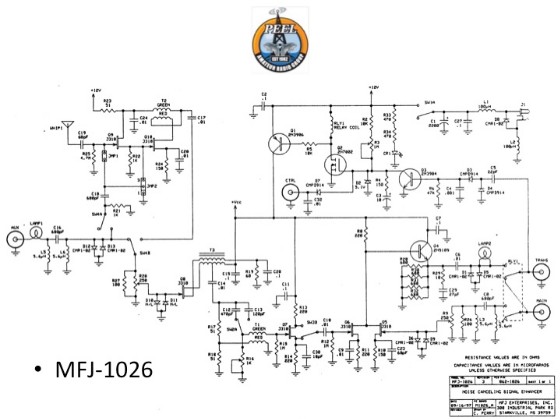
The main antenna signal comes in from the lower right and is amplified by the right hand lower FET. The noise signal comes in from the left or the in-built whip – which is fed via a two- FET preamplifier making it an active antenna; the amplification can be turned off via internal jumpers if not needed.
The noise signals are fed via a phase-splitting FET to a centre-tapped RF transformer and the phase-shifting mechanism; there are various switches to switch in pre-amplification, select lower bands and invert the phase to make the phase potentiometer adjustment easier.
The phase shifted noise is sent to the left hand lower FET and combined with the main antenna signal as above, but there’s a further stage of amplification on the way out to the receiver.
The circuitry at the top manages the switching – including a TX signal-operated option for the change-over relay – which I suspect may have generated a lot of after- sales service revenue for MFJ when it was still in business.
‘Some of the options are cheap, some are expensive. A new MFJ-1026 will set you back over half a kilobuck in Australia, despite being not very complex and being poorly built.
A VK5TM noise canceller kit will cost you less than $100, and you’ll need a metal box, coaxial connectors etc… but you get to build it and and know it so much better than if you just bought a ready-built one… and it’s from Australia.
The Chinese copy of the same unit will cost much less, comes in a nice metal box with all the accessories (including the whip antenna) – plug in a power supply, your antenna, the PTT line from your transmitter and off it goes.
As I mentioned, Terry’s kit is still sitting in my pile waiting to be built, and I couldn’t afford one of the new MFJ units, but I bought a second-hand one from a friend’s Estate – but as I said, she just didn’t work below 20m.
Meanwhile I came across the Chinese QRM Eliminator. I thought I’d buy one to get me going, intending to use the box for Terry’s Kit if it didn’t work.
Terry advises on his website that he has never allowed any manufacturers to use his design’s intellectual property – so if you decide to buy one of the copies, be aware that Terry is missing out – someone has stolen his design.
I feel slightly less embarrassed about this having bought Terry’s kit as well. As it turned out, the cheap copy did work really well and it allowed me to get going on 40m and 80m quickly.
I didn’t like the balance transformer in the copy – a nasty two-hole TV BALUN core with a few turns on it – so I built one of Terry’s transformers and swapped it over.
Of course, I can’t be sure whether or not it’s any better in use – but it feels as if the nulling is easier and more effective on 80m… and I feel better!
The noise canceller requires a power supply (careful… another switch mode power supply in the shack!) and is connected between your antenna and your receiver as shown.
The unit is also connected to the PTT output of your transmitter (usually used to drive an external power amplifier), so that when you hit the key, the noise canceller is bypassed via internal relays.
Failure to connect the PTT (or if the connector drops off unexpectedly while you’re ratting around the cables behind the equipment) will result in tears.
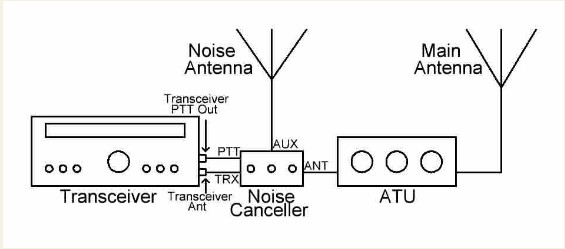
Adjustment can be tricky, especially if your receiver’s AGC work well and you don’t have a real or virtual S-meter – the bar-segment type S-meters are very hard to interpret when adjusting the canceller.
As discussed above, the trick is to aim for best signal-to-noise ratio, which will come at the expense of signal strength.
With it all hooked up and ready to go, what usually works for me is: * turn the main antenna gain down to zero * adjust the noise antenna gain and phase alternately to null the noise from the sense antenna right down to zero (bliss) * increase the antenna gain to about half scale and re-adjust the noise antenna gain and phase to re-null * if there’s no null, repeat the nulling with zero main antenna gain then increase the main antenna gain to about 1/4 way then adjust the noise antenna gain and phase for best null * sometimes you’ll be able to then alternate between main antenna gain and the other two controls and get best null, but at other times, just notch up the main antenna gain and re-null the others, until you get a decent null (leaving perhaps S1 of noise) but as much gain out of the main antenna control as possible.
As you get used to using the noise canceller, you’ll be able to hear the sound of the noise antenna phase control being incorrect – one side of the null will have a crackling sound, and the other side will have a white-noise sound.
When correctly adjusted the signal strength will be several S-points below the original strength (about 16 to 36DB is normal), but the noise will be many S-points lower than before (often up to 74DB here – ie S-O compared to S9 + 20DB).
Other Uses
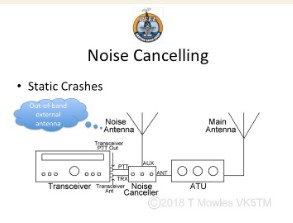
Now let’s have a think about other uses of the noise canceller. If you’ve got rid of all noise sources at home but are annoyed by static crashes, how about feeding the noise antenna input from an antenna that picks up signals well outside the band you’re using?
Experimentation needed, but I suggest trying another band’s short helical mobile whip orientated with a different polarisation to your main antenna – it’ll pick up the static crashes but if tightly wound, very little of the desired 80m or 40m signal.
Voila – you may be able to reduce the severity of the static crashes.
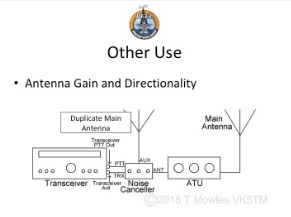
Ok, here’s another thought – what if you fed the unit with two external antennas in the desired band? By varying the gain and phase relationship, you may be able to effectively steer the receive antenna, or importantly, null undesired signals or noise.
And what if you fed the noise pick-up with a magnetic loop?
Conclusion
Getting rid of the sources of noise are by far your best option. The Radio Amateur Society of Australia has a bunch of resources that could help with that journey.
Https://vkradioamateurs.org/fight-qrm/ However, for all their challenges, I think a phase-cancelling noise canceller is the quickest way to come to a workable arrangement with your switch mode power supply hash on 40m and 80m.
Removing the sources is obviously better, but a noise canceller will get you on air quickly at least. Let me know how you got on, and hoy if you’d like more information. cqarsnet@gmail.com
Interested in contributing a short article to RagChew? Please let me know so we car share more thoughts and ideas; email to cqqrsnet@gmail.com

Portable at Home
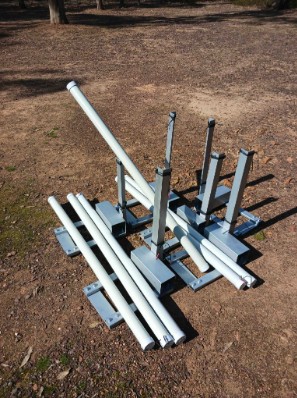
The image attached is of my ‘build’ for the Bendigo Amateur Radio and Electronics Club’s recent radiofest. I believe that portable operation may be the best solution for hams who live in retirement villages, on ‘micro’ blocks of land or who live in high — rise apartments (‘cliff dwellers’ hi hi) A mast base and squid pole container take up very little space in the rear compartment of my vehicle
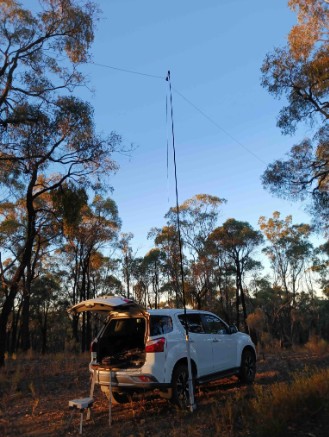
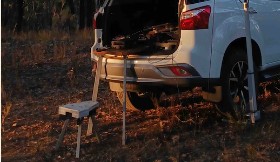
Additionally I have constructed a three — legged stool and two – legged table for portable operation.
| had better fire up the little HB1B and energise my EFHW antenna ! Tony (VK3CTM).
QRP Labs QCX-mini CW Transceiver
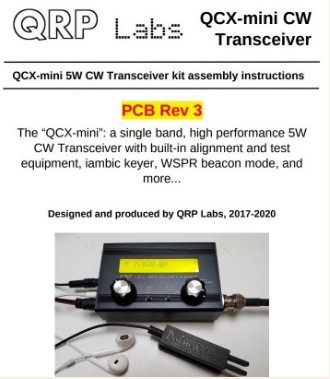
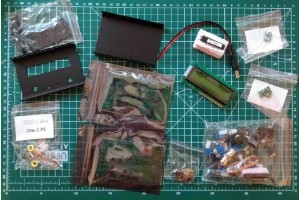
My QRP Labs QCX kit has arrived from Turkey! Happy Days. QRP DX anyone?
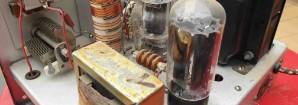
Johnson Adventurer
From Andy VK5LA Here’s a pic of my latest undertaking…a Johnson Adventurer Novice CW TX from the 50s. |’m updating this to use on the QRS net…making it safe and adding a DDS VFO.
Does about 75 Watts input with a tail wind…about 30WATT out to the Antenna jack… Cheers Andy 5LA

Other News
Other things I’ve received from our 200-odd readers.
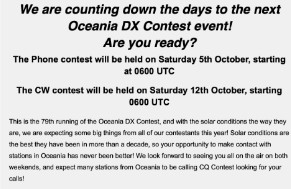
Oceania DX Contest 12Oct24.
The Oceania DX CW Contest is on next weekend, Saturday starting at 0600Z. https://www.oceaniadxcontest.com Might be a bit of fun, good practice… and a good promotion for the success of
Our Group if we have a bunch of QRS operators out there demonstrating how much fun CW can be. Perhaps also an opportunity for our team members in the US, UK, EU, Indonesia and Argentina to have some fun in our direction.
Bletchley Park Group activity perhaps Nigel?
So What is PZT?
From Richard VK6PZT When I upgraded recently to an Advanced license, I considered upgrading to a 2 letter call. However my call PZT is a bit of a link to my profession as a sonographer.
PZT is a crystal our transducers use to generate ultrasound and receive the echoes. Lead Zirconate Titanate. So I’m quite fond of it…it is a bit long in CW though.
I can see why Ray picked VK6ET In response to your prodding, I might take a look at the ACMA website and check what is available again some time. Sorry Ive not been involved in the QRS net as much as I would have liked…
But as you may know, I’m opening my own medical imaging business. Myself and two other partners are opening a new radiology practice in VASSE, just west of Busselton.
It’s been a full on journey so far, lots of stress and problems to solve, but we are getting close to opening. Hopefully I will be on-site scanning my first list of patients by the end of this month.
Until then my main job is organising the IT infrastructure, which is a bit out of my comfort zone, and the driving to Busselton and endless meetings is severely limiting my Radio time at the moment; but one day it will settle back down I’m sure!
Hopefully catch you on Tuesday… I’ve just got a website to build, prepare a presentation for Thursday night, and organise delivery of all our computer equipment by Friday… Catch up with you soon.
Richard TBest of luck Richard – and I hope thinas settle down ouickly]
Richard
Who Invented the Morse Code?

On page 41 there’s an excellent article about Alfred Vail.
QR Codes Decoded
QR Coages Decoded from Ron VK6KHZ Ron VK6KHZ sent me a link to an excellent YouTube video about how QR Codes work. hitps:/Awww.youtube.com/watch?v=w5ebcowAJD8&ab_channel=Veritasium The video is very long, but really well done – so good in fact that my wife Elizabeth enjoyed watching it as much as I did.
The video is sponsored, and has one of the most effective YouTube ads I’ve seen – if only the advertising on other sponsored videos was that good!
Inverter Hash
Hi Mark As reported this morning, last night I was experiencing QRM on 80m which I think may have been generated by an inverter from another site at the campground here at Ball Bay. See attached a screen shot of the noise signature at 3.554MHz
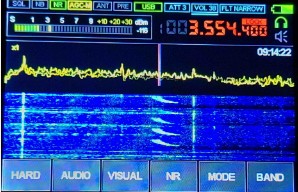
Investigation underway to find the source of interference. Regards David VK6KD/4 Ball Bay QLD [1 can just visualise you sniffing around the other campers’ fridges and solar panel regulators with arms full of transceiver, battery etc David!]
Regards
From Phil VK6GX
Hi Mark, Great to catch you on both 40 & 80m yesterday. Another CW related e-Zine I subscribe to is the K9AY Telegraph, it’s free too. Robert F. Heytow Memorial Radio Club and K9YA Telegraph.
Hittp://www.k9ya.org/index.php/k9ya-telegraph/about Always a good read, enjoy! 73, Phil VK6GX.
More Daylight Savings Blues
More Vaylignt savings biues from John VK5ET Got out of bed at the wrong time for our Post Morsum net on Wednesday morning, one hour earlier. Nothing heard so presumed I missed the session & OM Stan as well. Dohhh © 73 John
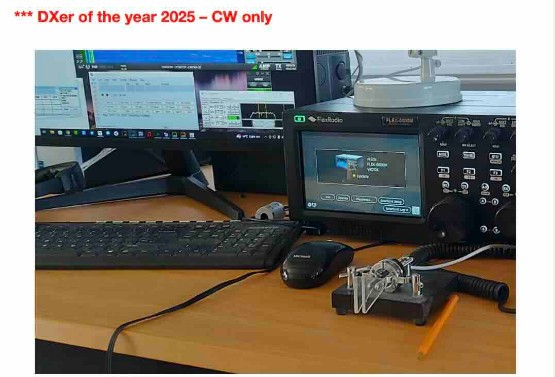
To our surprise, we got eight registered entrants. Good old Morse rolling in his grave! However, we still need two more to officially introduce the CW ONLY category and assign the prize.
To register: send $29 to 599QSY@gmail.com, accept the terms and conditions and notify us of your callsign. And because you are special: this one-off payment would allow you to also participate in the ZONE chaser category as well as in the regular DXCC category.
Yes, if you have more than one callsign: you pay only once. However the total score can not be combined. Meaning: one call, one score. Here is the list of registrants: VJ6X, VK6WX, VK3HJ, VK3QB, VK3VB, VK3IU/VJ3U, VK5GG, VK4DRK. Gentleman, you are almost there-
Morse Training Net
Nic VK7WW runs a Slow Morse training net every Wednesday at 7pm EDST on 3580 for 30 mins. He uses the callsign of the Northern Tasmania Amateur Radio Club VK7TAZ on that net.
Many of our team learned Morse code with the support of Nic, and the weekly training session comes highly recommended for anyone who wants to learn the Code, or simply brush up. Everyone’s welcome – 3580KHZ at 7pm Eastern time every Wednesday.
The NTARC also feeds the CW live via the Discord phone / computer audio stream, and previous weeks’ recordings are available. Contact Nic VK7WW for more info nicholaschantler@hotmail.com – or just join in on Wednesdays.
Brain Teaser
Jules Perrin JP VK3JFP has created a terrific resource to help guide learning for al levels of amateur radio licenses: https:/Awww.julesworkshop.net/Amateur%20Radio.html With thanks to Baz VK6MU for he idea, and Jules for the good learning website, here’s this week’s quiz questions from Jules’ Workshop example test questions:
Exam Questions:
What is a BALUN? The frequency of the local oscillator is ¢ 910KHZ © 3625KHZ ¢ 4080KHZ e 4990KHZ
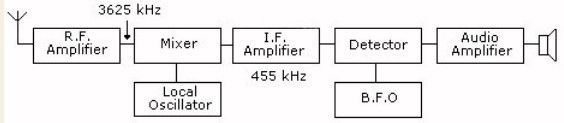
• ripple on the power supply ¢ under modulation ¢ oscillation of the RF power amplifier stage ¢ the antenna being too near the ground Answers next week.


Answers from last week’s Quiz:
What device would you use if you wanted to test the output power of the transmitter without sending a signal up the antenna? Answer: Dummy load.
The mixing of audio and radio frequency signals is * frequency multiplication * frequency mixing * detection * modulation Answer:modulation ‘The hfe or beta of a transistor is: * noise figure * current gain * operating speed * breakdown voltage Answer: current gain How did you go?
Di-dah-di-dah-dit
So back to the Slow CW QSO practice Group.
Next Tuesday’s Group
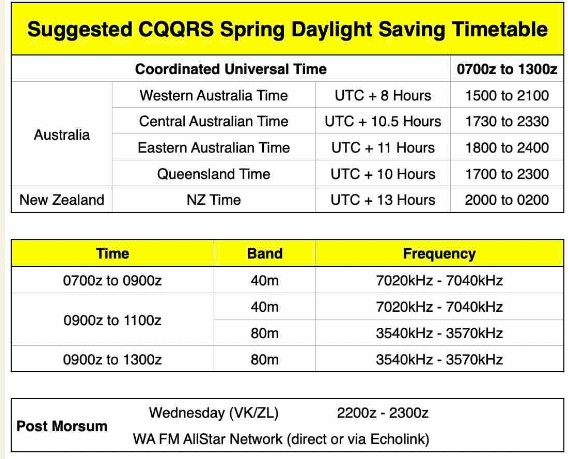
Our CQ QRS Group will be on as always on Tuesday from around 07002Z until about 1300Z; see below for details. Doesn’t matter whether you’re brand new and want to try just exchanging callsigns and RST reports, or you’re ready for a good old rag chew.
Please let me know via our Reports form bit.ly/CQQRSNET who you work or hear on Tuesday’s Group; the form closes at lunchtime in Australia on Thursday, so the RagChew newsletter production can be completed.
For stations on bands other than 40m and 80m, please just use the 80m report area (annotate and separate out your 80m report from the other bands), and when you enter the list of callsigns worked, heard or missed, please append an ‘@band’ to each callsign without a space (eg VK2KI@20 VK6QI@15 etc).
Post Morsum
Richard VK6HRC will run our phone Post Morsum on the South West AllStar net (via repeaters and hotspots all over WA) from 0600 WA time, then from 0700 WA time on 80m (8605 LSB).
For the 0600 (22002) net, if you’re in WA all you need is an FM 2m or 70CM transceiver and an AllStar node nearby. If you’re elsewhere in the world, you may be able to connect your local AllStar-enabled repeater to the net, or you can connect via Echolink.
Let me know (cqqrsnet@gmail.com) if I can help with that. and if you can’t connect that way, give 3605KHZ SSB a try from 0700 (23002).
Feedback on Editor’s Comments Please As I said above, I’m keen to get some feedback on your thoughts about whether or not you like the comments I insert in green in response to others’ words.
Do they add to the readability and interest, or are they seen as just patronising and naff? I won’t be offended by whatever responses I get; I want the newsletter to appeal to, and be read by, as many of our team as possible, and I’m happy to adjust the style to achieve that – by either returning to the previous style of commenting often, or cutting them back as in this issue and issue 40/2024.
Teamwork
Thank you so much to our team of 31 contributors: DL3YZ, MONNK, VK2ASB, VK2DLF, VK2GAS, VK2IOW, VK2RU, VK2WP, VK3ACU, VK3AFH, VK3BWN, VK3CTM, VK3DRQ, VK3FG, VK3JFP, VK38TBR, VK4CCW, VK5ET, VK5KFG, VK5LA, VK6BEK, VK6GX, VK6HRC, VK6IS, VK6JDM, VK6KD/4, VK6KHZ, VK6PZT, VK6WE, VK7KPC, VK7WW, ZL1PB, ZL3TK.
Outstanding work team! GU CW on Tuesday, mb Mark Bosma VK2KI / VK6QI Beautiful South Bowning NSW mark.bosma@icloud.com non impediti ratione cogitationis

An Ode to CW – thanks to David VK3RU: In days of old, when ops were bold, And sideband was not invented, Words were passed by pounding brass, And all were quite contented. – Unknown author
About the CQ QRS Group
Frequencies and Times
Speed
Matching

PSE QRS


Landing Zone
CW Tips
The opinions expressed in the RagChew newsletter are those of the individual contributors. The opinions do nat necessarily reflect that of the editor or of the C@ QAS Group members.