Below is a reconstruction of the 2024 42 CQ QRS RagChew newsletter designed to support full text searching. This reconstruction was built using OCR, and will contain errors.
To view the Mailchimp original, click here. To search the entire newsletter archive, click here.
Contents
- CQ QRS RagChew
- Last Tuesday Evening’s Group
- Masthead Image
- Reports
- This Week’s Topic of Interest
- Crackers Electrical Abbreviations
- Other News
- IARU 40m Band Harmonisation Submission
- SKCC Oceania QRS Saunter
- DXperiment
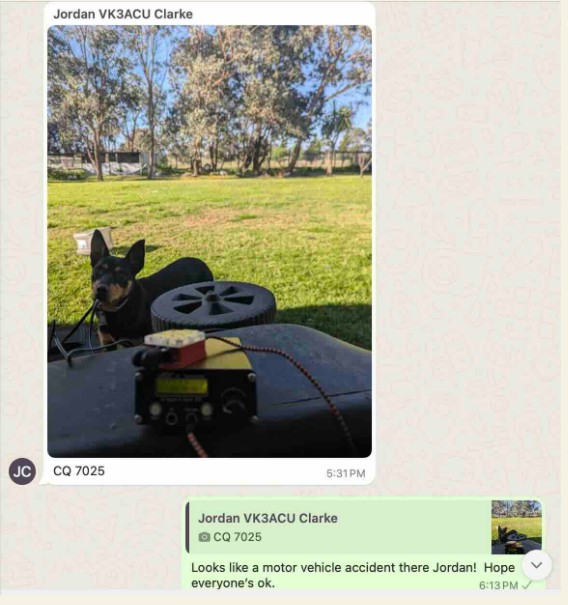
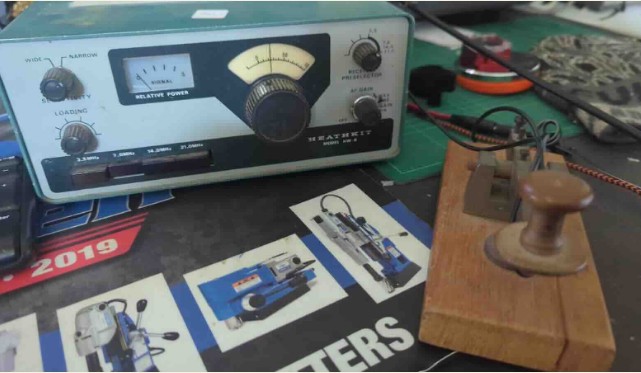
- VK3ACU Portable on a Wheelie Cart.
- QRP Hours Contest – Sunday October 20th
- 160m
- Old Arlie
- V Band
- A Survey by Stan ZL3TK
- Timetable Presentation A
- From the DXing.com.au Newsletter:
- For Sale QRPLabs QCX Portable QRP Transceiver
- Morse Training Net
- brain teaser
- Exam Questions:
- Answers from last week’s Quiz:
- Answer: 4080kHz
- Di-dah-di-dah-dit
- Next Tuesday’s Net
- Post Mortem
- Teamwork
- The Joy of Daylight Saving
- About the CQ QRS Group
- Frequencies and Times
- QRL?
- Matching
- Landing Zone
- CW Tips
CQ QRS RagChew
Boy oh boy! Another bumper RagChew edition packed full of articles from so many contributors. Thank you one and all. I wonder whether the tough conditions on Tuesday evening had anything to do with so many of our team members having a go at writing something?
Ross MONNK has written us two terrific articles about his decision to buy a Q@RPLabs QCX-mini kit, and his first two days building. Mouth-watering; so much so that I couldn’t wait until next week’s newsletter… I’ve included both this time.
And what’s more, Ross has also written a very interesting article about de-mystifying the nomenclature of Electrical Abbreviations.
Last Tuesday Evening’s Group
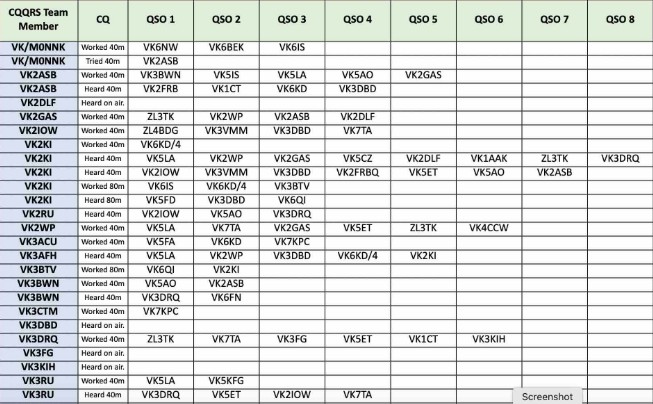
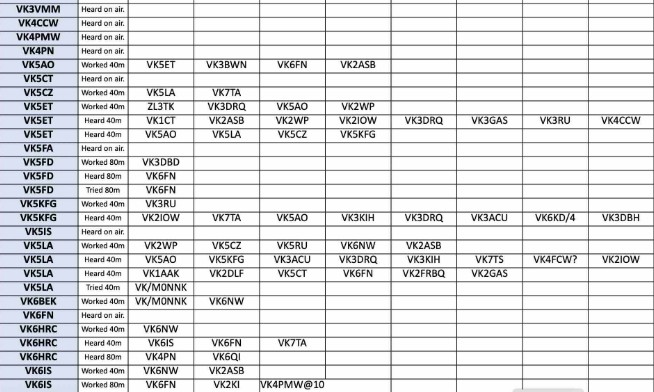
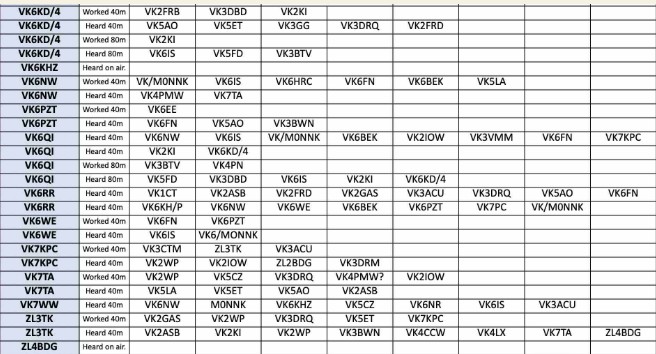
So back to Tuesday’s CQQRS Slow CW Practice QSO Group get-together on 40m and 80m. Here’s the 65 stations heard on the Group on Tuesday evening:
Masthead Image
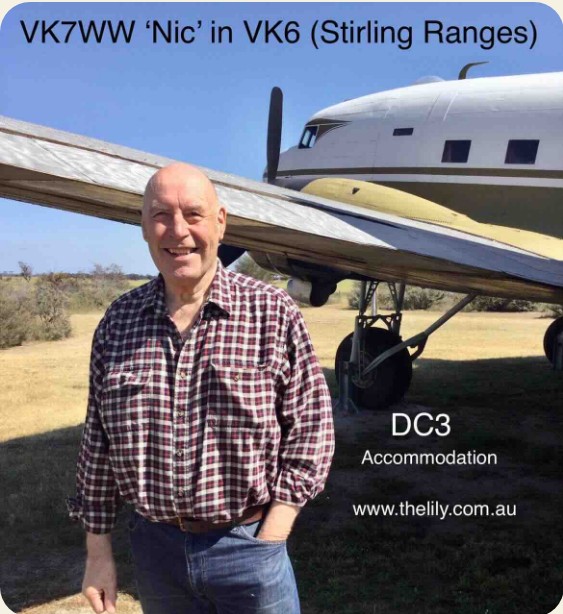
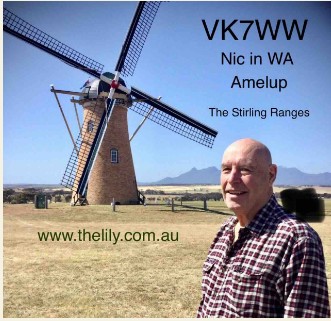
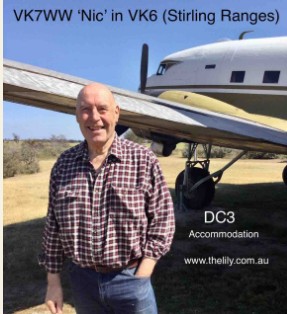
Thanks to Nic VK7WW for sharing the shot of his accommodation while visiting Amelup WA in the Stirling Ranges, where he listened-in to our Group on Tuesday.
Reports
As always, after next Tuesday’s Group, please send me a list of who you worked and / or who you heard using our web form here:
Submissions close lunch time on Thursday. If you hear or work one of our team on a different band on Tuesday, please just use the 80m report area and annotate which bit applies to which band.
And when you enter the list of callsigns worked, heard or missed, please append an ‘@band’ to each callsign without a space (eg VK2KI@20 VK6QI@15 etc). Please help attract new and old team members to have a go by submitting your report each week.
Submissions close lunch time on Thursday. Ifyou hear or work one of our team on a different band on Tuesday, please just use the 80m report area and annotate which bit applies to which band.
And when you enter the list of callsigns worked, heard or missed, please append an ‘@band’ to each callsign without a space (eg VK2KI@20 VK6QI@15 etc). Please help attract new and old team members to have a go by submitting your report each week.
Cheers, mb Mark Bosma VK2KI/ VK6QI Beautiful South Bowning NSW mark,bosma@icloud.com ‘on impact rations cogiationis
The spreadsheets above show the known stations on last Tuesday’s Group. Comments distilled from the reports I’ve received follow:
[40m] + Unusually weak signals out of Australia tonight. A huge number of lightning storms reported over NW NSW causing QRN havoc into SA, yet the band showed no sign of them here. From lan VKSCZ at Clare
[40m] + Thunderstorm came back QRN was really bad…
• If it’s not Aurora, it’s Lightning! Condx were very tough for me in VK5 with S9+ static crashes, struggled with most stations, tried very hard to copy Ross VK/MONNK but just a bit too difficult. We will get there!
2 firsts, busted out the straight key (WT Key 8 amp No.2) and purely pad and pencil tonight (in hindsight probably the worst night to begin weaning off the phone decode app) for copy as I need to get better at head copy without assistance.
David 3RU was a good signal for QRP. See you next week!
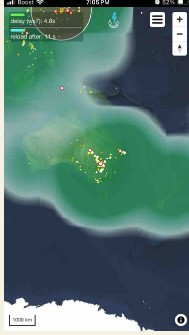
[40m] + NOISY, & SOME VERY WEAK SIGNALS. Plenty of QSB.
[80m] *No one home on this band. Shut shop 10:00 Z.
• Just a few contacts tonight, Started late with all the storm and lightning activity so wanted to wait till that had disappeared. I was trying out a little Venus SW-6B QRP rig.
I was sent a video from WA from a friend who had a little pocket world band receiver receiving my signal, Despite all the lightning static, lots of strong signals.
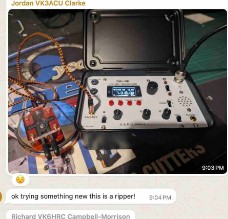
From Ross VK/MONNK at Exeter UK via Perth WA
[40m] «| was on the VK6SR remote access radio in Perth WA. VK5LA made truly hero’ efforts to copy my callsign despite QSB at his end, for which I thank him greatly.
I tried to call VK2ASB but VK6IS jumped in (it’s easy to do in the heat of the moment) so I had a brief QSO with him but couldn’t copy much. A good morning’s work.
[40m] + Using a Digitech AR1780 RX near the Stirling Ranges at The Dutch Windmill and DC3 (www.thelily.com.au) for a family birthday and wedding luncheon. Sneaking out from the birthday to listen to CW on 40m with 3m length of wire!
[80m] * No luck on 80m , but I did contact VK6KD/4 David working mobile from Sarina in VK4 on 20m. I was all set up for the Dx experiment on 20/10 m with
Two sauid poles set up as driven elemer and reflector for a bit of gain on the Long Path to the UK and Germany. But alas I didnt hear Ross or Mike. However, I did call CQ and got a responce from AC7GG in the USA.
Also, in preperation for this evening i managed my first CW contact to DL while testing the antenna at the weekend. om. © os pe. -# ee
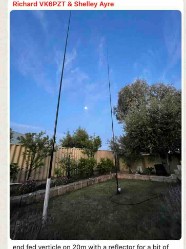
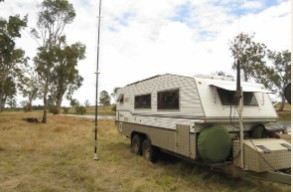
[40m] + Report from VK2KI said my squid pole mobile ant was making it into vké from vk4 on both 40m and 80m. Very happy with performance of ant. Now to work on my CW, hihi, 73.
[80m] + I was reaching vké from vk4 but conditions were more favourable on 40m…
[80m] * Got on late after a hectic night – had no idea that I’d worked the same joker twice in WA and NSW – you were a pretty rough copy from WA, Mark!
[40m] + Alarge electrical storm in the far west and north gave steady S5 static. A couple of ZL stations tried to call in but were swamped by the static. Otherwise conditions were quite good with strong signals at times..
[40m] + Good conditions here in Bridgetown. From lan VK7TA at Latrobe
[40m] + Unfortunately I have missed the last two weeks. I had usually heard a couple of ZL’s early on, and VK6’s later on. Tonight neither. I hope I copied VK4PNW correctly, signal was very weak just above the QRN..
• No contacts tonight. A band of storms came through so I took the antennas down. I put one back up after the storm had passed but there was far too much QRN. I heard a few QSOs but it was very difficult to copy through the noise..
[40m] + Attempted copying QTC from VK3DRQ and Nr 146 from ZLSTK. I think I copied enough to make an answer attempt next week.. From your editor Mark VK6QI via the VK6QS KiwiSDR near Brookton and the VK6SR Remote at Bedfordale
[40m] + I was in and out during the early evening, but at the start it sounded to me like the static crashes from the band of thunderstorms through North Western NSW had driven some of our team to look for other things to do.
Later in the evening there were more signals on the 40m waterfall as the band opened between the West and the East..
[80m] + After a late dinner, I had a listen on 80m; the band was open nicely to the East and there was some evidence of Auroral noise, but luckily, not too much in the way of static crashes..
+I cranked up the Southern Electronics Group VK6SR Remote at Bedfordale which easily matched the Marconi-Tee this time, and performed nicely.
I had a late night chat with Keiran VK3BTV at Lilydale who had a nice QS signal East-to-West, but was struggling to hear me; I’ll blame the static crashes, or one-way-propagation… but my poor keying may have had something to do with it too.
+ also heard Sava VK4PN near Brisbane at 1245Z on his usual late-night fishing expedition after the ZL net, and we rounded out the evening nicely with a late-night chat.. From your editor Mark VK2KI at Beautiful South Bowning
[40m] + I heard Andy VKSLA first-up chatting to Wal VK2WP. It was good to hear several people who were around through most of the period – Armin VK2GAS, Georg VK2DLF, Partick VK2IOW, Arthur VK2ASB, and so many others.
+ After a late dinner, I had a go transmitting on air but I was getting pretty tired and my keying reflected that. So many mistakes in my chat with David VK6KD/4 at Sarina! Come on boz… concentrate…
Right hand on the key base, left hand fingers at 10 and 11AM, tiny bit of pressure on the underside of the key knob with the thumb, wrist-action… that’s better!
Then next thing, I’m not sure whether I sent VK2KD instead of VK2KI when I was typing on WhatsApp in parallel or listening to who else is on the band. Sorry David – I’ll try harder next time..
+ I’ve been amazed at the performance of David VK6KD‘s antenna on both 40m and 80m on his journey around Australia – consistently heard in the West and usually heard in the Lower East as well.
I’m hoping that David can send us a photo of the arrangement using his helically-wound squid pole and mobile whip…. and amazingly, just the vehicle capacity to earth as his ground.
Yet so many other people struggle to be heard from their home station; good to see there’s still some mysteries to be explored in amateur radio…
[80m] + The band was open to the West nicely when I slipped down to 80m at around 11152. Everyone that I could hear here in VK2 was also coming through to VK6. Nice to work Peter VK6IS, David VK6KD/4 and Keiran VK3BTV…
To give his ear-strain a rest after he struggled to hear me from VK6..
[40m] + Even after my Monday hospital procedures, I managed to have some little fun. Thank you all..
[40m] * Good signals but the Metro hash made for difficult copy..
[80m] + Managed to listen in on VK4PN Sava and VK6QI towards the end of net.
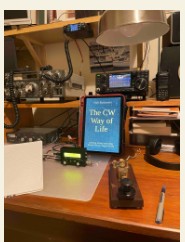
[40m] * David VK3RU, QRP from Burwood, coming in loud and clear at Willunga.
[40m] * The Oceania DX CW contest recently was a fun experience – I did manage to find someone sending at a reasonable speed that I could copy and got a contact logged though, so mission accomplished!
Some stations I managed to copy the callsign of (after enough repetitions) but it just took me too long. The abbreviations TU and TEST are hopefully well embedded in my memory after that hihi.
* Heard a few QSOs on Tuesday in between work – was interesting to see which stations I could hear on my radio vs see on my SDR (I will have to note these down next time, that way its not just playing around, it’s science) as well as the intermittent interference..
+ With regard to feedback/comments, I am unlikely to take any offence myself. I’m relatively new to the hobby and although I may know some things, I assume any feedback is genuine advice from someone who likely knows more
Than me until proven otherwise. It either gives me something I hadn’t considered, something to research further or confirms what I thought I knew is actually correct!
I can see how others with more years of experience may not have need of such feedback and see it differently though, so it’s certainly a balancing act..
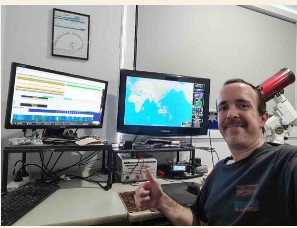
[Thanks Mathew – great report. And thank you for your comments about receiving feedback and my green Editor’s comments. I’m keen to hear others’ thoughts as well, so / can adjust the RagChew so it’s seen as something that motivates participation and teamwork.]
[40m] + This week we had visitors and I was chief BBQ cook trying to balance our 40m QRS net with a couple of very nice lamb backstraps. Typically I started off looking for Manny VK3DRQ but by the time I arrived, he was sending his very long message.
So I tuned off looking for stations of which there were not as many as I expected. I managed to work Andy VKSLA before retiring to consume my slightly overdone backstrap but when finished I returned to the key.
I found Greg VKSKFG for the first time and we had a very long QSO, probably the longest in my time using CW which was very pleasant and plenty of mistakes my end but by that time, I expect everyone had migrated to 80.
I do not have an 80m antenna available to my house shack. + Since we began with QRS I have been using a home built QAP Labs QCX but during winter, I decided to build another QRP Labs tig, this time a QMX.
Its a great little rig, I am truly amazed just how for we get on just 5W and the reports are really encouraging. + Thanks Mark and the QRS Gang.. [Excellent report David; tough to exchange QRS practice for over-done lamb.
See David’s advert below if you’re after a QRPLabs QCX.]
From Patrick VK2IOW between Bathurst and Orange
[40m] + The 40m band was a bit noisy due to storms to the west. However most signals were pretty good… Post Morsum Report from Richard VK6HRC Hello Mark, Six on the VK6RLM and AllStar / Echolink nodes this morning.
VKeQl Mark VK6NW Wayne ZL8TK Stan VK6KD/4 David VK6EN Max VK6HRC Richard and our shortwave listeners, Bob VK6KRC and Mulligan VK6MRB our regulars checked in before the net.
Mark joined the net a little while after the net started but wasted no time spotting on WhatsApp and having fun on the key. Also reported hearing Wayne and Peter on 40MX early on.
Wayne got on using his squid pole / vertical antenna and was not hampered by QRN reported by the Metro stations. He had to head off to his regular SES duties after a while.
Stan had a successful exchange with Manny VK3DRQ receiving part two of a previous message and sending part one of another. Stan also worked ZL4BDG whom has had the honour of being a visitor to the ZL3TK shack in the past (rewarded with tea and bikkies).
David, being the co-pilot in the mobile shack on their way to Yepoon (just out of Rockhampton) from Sarina Beach checked in and let us know how he got on. A very successful evening using his squid pole antenna from the local caravan park.
Max also had a successful evening, working four stations on 40MX and one on 80MX. I managed to work Wayne on 40 Mx and do some tuning around but had to go QRT as my son came by to check up on me!
Was lucky enough to listen in on the late- night exchange between Mark VK6QI and Sava VK4PN on 80 Mx right at the end of the net. Thanks to everyone on last night and this morning. 73 Richard VKeHRC © Traffic Report for 15 October 2024
From Stan ZL3TK Three stations met at the new time of 0820Z and did the business as well as possible. Signals into VK5 were not crash-hot, more like static-crash awful, while eastbound signals were much stronger and easy to read, RSN 652.
OM Manny’s signal was solid RSN 582 for his sending the second half of answer to NR 143. QNC CT NR 40 R VK3DRQ CK 24/22 BLACKBURN 0432Z 130CT24 = ZL3TK = SECOND ANSWER TO YOUR NR 143 STOP ANOTHER STRUCTURE WAS FOUND, WITH SAME PURPOSE COMMA BUNKER FOR CAMOUFLAGE AMMUNITION RED NUMBER 8 = VK3DRQ AR QRU QSL?
K And finally another from the ‘Focus on Australia’ series, this time VK7-land. This QTC was delayed by a week due to bad conditions on 080CT24.
QTC CT NR 146 R ZL3TK 24/18 WAITARERE 0015Z 80CT24 = VK5ET VIACQ CRS FFA = NAME SECOND HIGHEST PEAK IN TASMANIA COMMA ELEVATION COMMA COORDINATES AND AIR-LINE DISTANCES FROM VK7TA AND VK7KPC = ZL3TK AR QRU K All are invited to answer the compound question in NR 146 on Tuesday 220CT24.
This Week’s Topic of Interest
Wwe SESE ES Ewoesswe SF weew §& Why did I choose the QCX-mini?
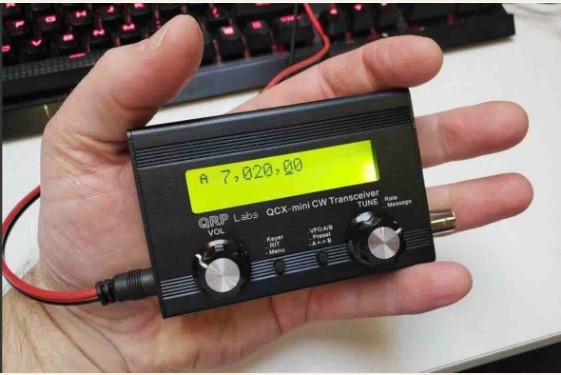
Many CW operators have this fantasy where they walk into a wild area and find a pleasant spot on the top of a gentle hill. The weather is fine and the views stretch out in all directions. A perfect location for some CW work.
So they take off their small backpack and extract their radio gear. For the next hour, they work contacts all across the continent, just like the guys on YouTube. They have a great time.
I’m not immune from such fantasies but I have the advantage of quite a bit of Portable operating behind me now so I have my own opinions. But that stil leaves the question, “Can one have an enjoyable time by working lightweight portable QRP?”.
Part of me wants to say, “No”. But another voice in my head (| have several) says, “You can’t say that until you’ve given it a good trial.” So I started to gather together some gear for that trial. Ihave a straight key – the excellent WT 8 Amp.
But do I take a camp chair – the single heaviest and bulkiest item I’m likely to carry? But what a difference it makes. Hmmm.
For the antenna, there’s a lot to be said for a resonant single band wire – non- resonant antennas require a tuner, and multi-band antennas can add unnecessary complication.
Getting contacts with QRP can be a challenge so the best place to look for them is where there are lots of operators. The 20 m band seems pretty busy here in Europe so that was the obvious choice.
An End Fed Half Wave for that band is fairly easy to put up but I have a compact and lightweight cheap Chinese 6m “carbon fibre” mast which is ideal for a quarter wave vertical.
From the UK, most CW activity is to the east so I could pair it with a couple of elevated radials in a V- formation for some useful directional gain (although supporting those radials does involve additional gear). Next, the radio.
This is just a fun project idea so it needs to be inexpensive. A kit would be nice, as I enjoy a bit of soldering and it would keep the cost down (why pay 45 dollars to have someone else to take the fun away from you).
That ruled out the expensive waterfall radios like the ICOM-705 and the Xiegu X6200, and the likes of the less-expensive Mountain Toppers and the SW-3B. And you take a bit of a risk with the Chinese clones.
I considered the cute little (tr)uSDX https://di2man.de/ …
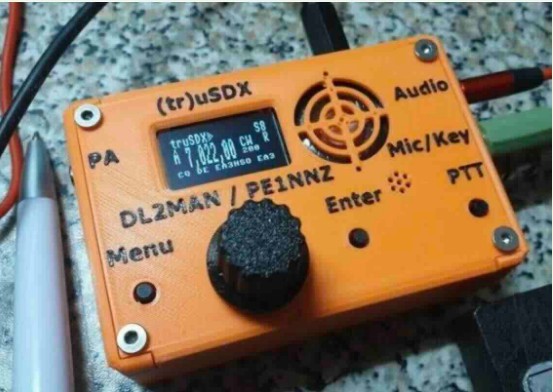
..-but came to the conclusion that it’s a complicated experimenter’s radio and I wanted something simpler, less clever. QRP is hard enough as it is without struggling with a development device. Years ago, I built a QCX (for the 30 m band) from QRP-Labs.
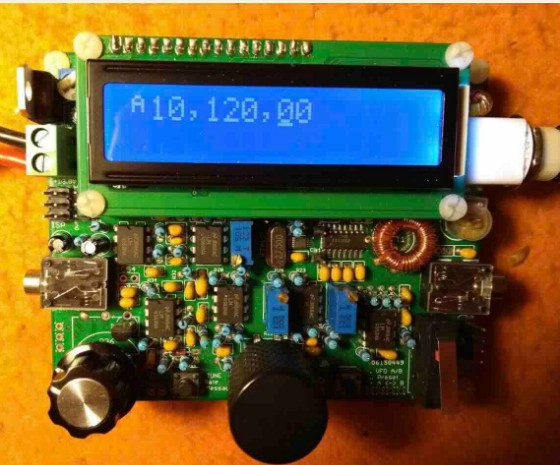
At that time, I was too inexperienced for QRP so it wasn’t a success. But I was impressed by the build instructions and its simplicity.
Their latest radio is the QMX multi-bander and that looked quite tasty.https://qrp- labs.com/gqmx.html Digital modes, CAT control, IQ out and all the modern bells and whistles.
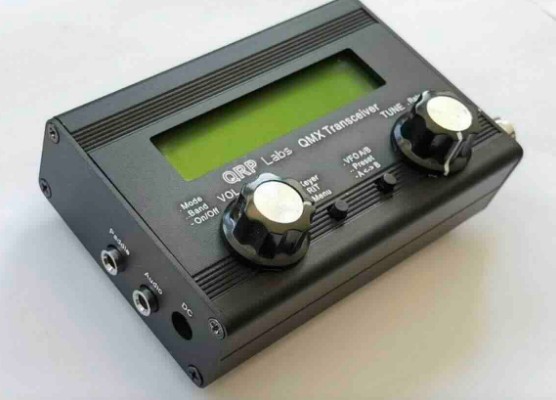
But the sensible voice in my head told me that I didn’t need a complicated multi- band radio – I already have one in the form of my wonderful Xiegu G90. And so the QMX would be an unnecessary expense. That brought me to the single bander QCX-mini.
It’s been around for a number of years now and is a development of the original QCX, so it’s a very mature device. It’s highly regarded by those who have one. It’s cheap, simple to operate, compact, robust and draws little power.
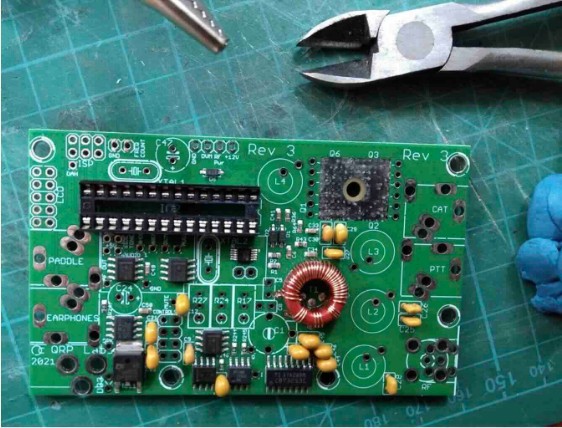
For an all-round radio, I have the G90. But for this limited trial application, the QCX-mini would be all I need. So I clicked on “Buy Now” and here I am, in the Man Cave, winding my first toroid!
[Il just couldn’t wait until next week for the next episode Ross… so here we go with the build…]
From Ross MONNK: As the manual says, “FOLLOW THE INSTRUCTIONS!!! Don’t try to be a hero and do it without instructions!” So the first thing to do is to read the Introduction and general guidelines.
They’re very well written with copious diagrams and photographs, so this is not a chore. The manual encourages you to “work in a well-lit area, with peace and quiet to concentrate”. With that arranged, your first task is to wind the Transformer.
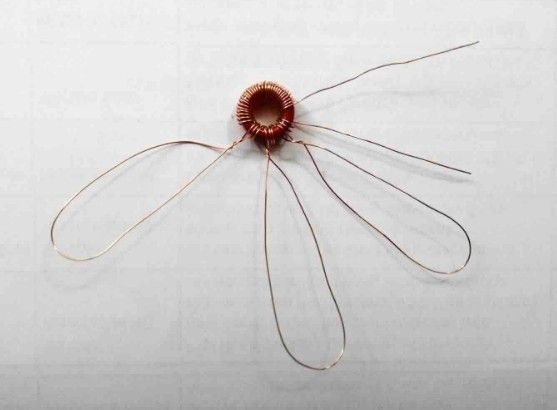
For this, you need steady hands and sharp eyesight. I have neither so another requirement is Patience with Yourself. After a strong mug of tea to steady the nerves, it’s time to heat up the soldering iron.
The holes in the circuit board are all very close together so you have to be careful you get the eight wires in the right holes.
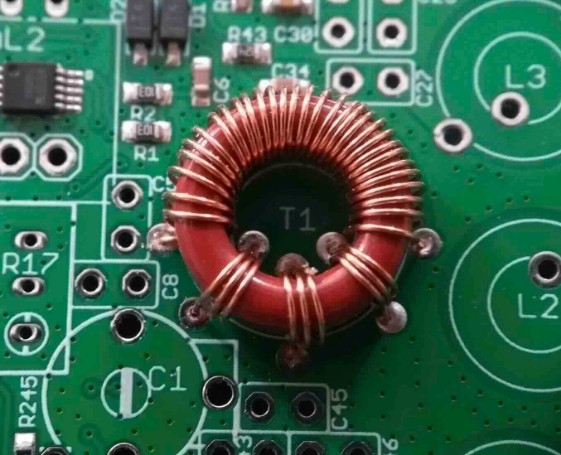
Half an hour later and the job is done. The Primary Winding is the middle of the three smaller windings. This isn’t going to be a boring component-by-component story so I’ll spare you the installation of the ic socket and the (brown) capacitors.
Crackers Electrical Abbreviations
Power == Capacitance Charge == Q Inductance Reactance Impedance == watts (W) C == farads (F) But, having investigated with the help of Mike DL3YZ and the Google Al, it all (kinda) makes sense to me, now that I know the (history behind those abbreviations…
Current is I because the French got involved (those pesky French again). “I” stands for “intensité de courant” or intensity of electron flow.
The unit of electrical current, the ampere, is named after the French physicist André- Marie Ampére who formulated Ampére’s Law, which relates the magnetic field to the electric current producing it.
Volts are the unit of Potential Difference or Electro-Magnetic Force. But what on earth is the difference between Voltage, PD and EMF? Beats me. Most normal people represent volts within a formula with the letter V. For example, V =IR.
The European alternative, U, seems to be derived from latin “urgere”, to urge. The German physicist, Georg Simon Ohm (who formulated Ohm’s Law) used the letter “E” to represent the EMF, although his term “Electro-Motive Force” is less commonly used today (as Mike DL3YZ says, “A force would have to be measured in Newtons” and it’s now not regarded as a force as such).
This unit of electrical potential is named after the Italian physicist Alessandro Volta who invented the voltaic pile, an early form of electric battery. Resistance has the symbol the Greek letter © (omega).
This symbol was chosen because it resembles the shape of a horseshoe magnet, which was used in early electrical experiments.
Power has the unit of watts because it is named after the Scottish engineer James Watt who made significant improvements to the power output of steam engines, which played a crucial role in the Industrial Revolution. Capacitance is C because it begins with a C!
The unit of electrical capacitance, the farad, is named after the English physicist Michael Faraday who was The Big Man in the early days of electrical discovery. Charge is Q because it comes from the Latin word “quantitas,” meaning quantity.
In the early days of electrical studies, scientists recognized that electrical charge was a measurable Quantity, similar to mass or volume.
The unit of electric charge, the coulomb, is named after the French physicist Charles- Augustin de Coulomb, who formulated Coulomb’s Law which describes the force between two charged objects.
Inductance is L because it’s derived from the name of the German physicist Heinrich Lenz who formulated Lenz’s Law. This states that the direction of an induced current in a conductor is such as to oppose the change in magnetic flux that produced it.
The unit of electrical inductance, the henry, is named after the American physicist Joseph Henry who was a pioneer in the study of self-induction and mutual induction in electro-magnetism.
Veering off course a little, but still relevant to electrical equations… The prefixes Tera (T), Mega (M), and Giga (@) have upper case letters because they represent numbers greater than one.
Conversely, the prefixes deci (d), cent (c), milli (m), micro (u), nano (n), and pico (p) all have lower case letters because they represent numbers smaller than one. But Kilo (k) and Hecto (h) have lower case letters even though they’re greater than one.
This inconsistency is because upper case K is allocated to the Kelvin temperature scale. And, yes, you guessed correctly – centigrade is represented by an upper case C. It still makes my head hurt, but they do say that “Knowledge is Power” (or should I sayN=P?)

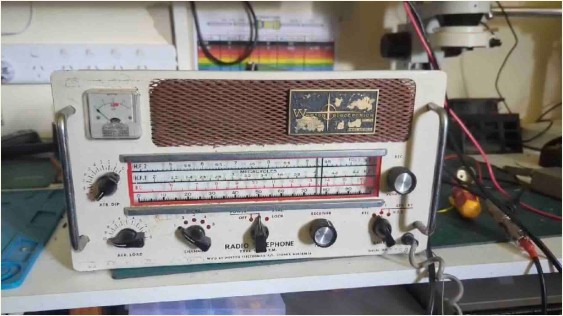
From Jordan VK3ACU – I hope to get this back on the air soon. No CW sad
Other News
IARU 40m Band Harmonisation Submission
This week on VKClassifieds was a link to the IARU Submission on 40m band harmonisation from the Chairperson, IARU Region 3 HF Band Plan Committee https:/Awww.iaru-r3.org/wp-content/uploads/2024/10/IARU_R3_19-ADM-03-40m- Band-Plan-Proposal-document-for-IARU-R3-Conference-FINAL-V1.0.pdf
SKCC Oceania QRS Saunter
SKCC Oceania QRS saunter from Garry VK2GAZ The SKCC Oceania QRS Saunter will take place this Saturday, 19TH October, 2024 from 00:00 UTC until 11:59 UTC a 12 hour event. All are welcome to join in!
All the details for the Oceania QRS Saunter (OQS) can be viewed on the SKCC website at: https://www.skecgroup.com/operating_activities/oas/ Please make use of the SKCC Sked Page and the CW Club RBN Spotter.
Https://sked.skecgroup.com/ look forward to contacting you during the event. Best regards,
Garry VK2GAZ/VK2ZP #5460C Manager – SKCC Oceania QRS Saunter
DXperiment
• te ae from Mike DL3YZ Hi Mark. You did the right thing with cancelling this weeks DXperiment. Here the rain hasn’t stopped, and the road to the site has finally turned into a swamp during the week.
If things are hopefully getting better, I will send a mail in time for one of the next Tuesdays. I plan to do at least one or two sessions, then it will be to cold to operate outdoors.
Maybe our local HAM group can restore the hut which was victim of a landslide earlier this year. It doesn’t look good though. I will do some SWL on Tuesday’s Group instead. Mike.
VK3ACU Portable on a Wheelie Cart.
QRP Hours Contest – Sunday October 20th
From Garry VK2GAZ The VKQRP Club will again be running the QRP Hours Contest on 40 meters this coming Sunday, 20TH October 2024. 40m only for one hour of CW then an hour of voice modes.
Full contest details can be located at: https://vkarpclub.org/arp_hours/QRP Hours Contest 2024 Oct Rules.pdf look forward to making a contact with you during the contest. Best regards, Garry VK2GAZ #121 VK QRP Club Contest Manager
Best regards, Garry VK2GAZ #121 VK QRP Club Contest Manager
160m

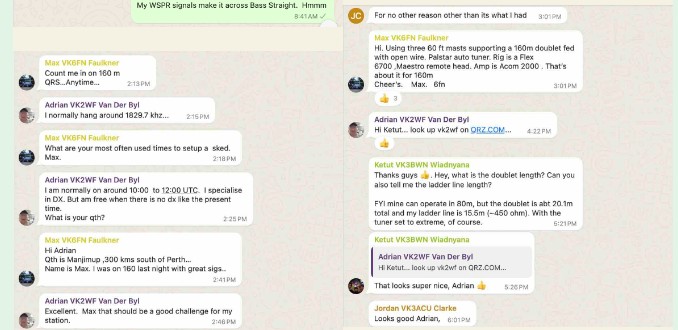
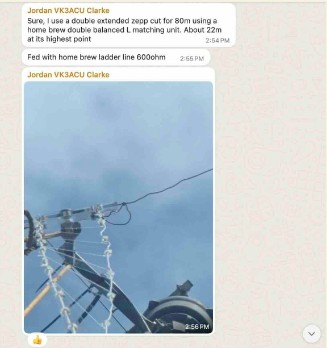
Old Arlie
From VK3BTV When I first came up on air at the in 1977 (as VK3NJO) I was using a Gemtronics GTX-2325 SSB CB with an 80m transverter and an 80m helical whip on my Dad’s double carport — all loaned from the local radio club, apart from the carport, of course.
Later, my grandparents gifted me a new FT-7 from Fred Swart at Chirnside Electronics and I concocted my first GSRV, hanging between trees on my parent’s block.
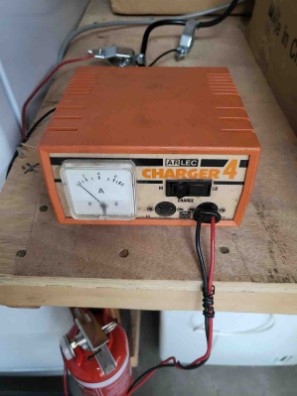
My power source was always a clapped-out car battery on trickle charge from an Arlec 4 Amp charger to keep it alive — even while I was transmitting. A hefty battery works well as a noise cancelling capacitor, thank goodness.
This Tuesday night I was operating “Off- Grid” using my new 75AH battery, unassisted. It was my first time on HF with battery power for about 40 years. I had been charging it from a second- hand solar panel and regulator in my garage.
But I gave the battery a kick in the pants first, from my trusty old charger. Old “Arlie” – the first piece of ‘radio’ gear that I ever owned – still going strong, working faithfully after 47+ years! © Keiran VK3BTV.
[Pleased to have worked you and Old Arlie on Tuesday mate]
VBand from Patrick VK2IOW A month or two ago I had contacts with Ross, MONNK and Mike, DL3YZ when they joined our QRS net on 20 metres. After the QSO I checked Ross’s QRZ page and read his info on VBand. I thought it might be interesting to give ita try.
I followed Ross’s instruction, adapting an old mouse by soldering wires to the left mouse button contacts and connecting a morse key to the mouse. However the latency inherent in my rural NBN internet connection made sending difficult.
I figured I would have to use an external keyer and turn the computer audio off for my sidetone. My Picokeyer kit, ordered on eBay, finally arrived after a month in transit. While waiting I bought a suitable soldering iron and a few soldering accessories.
Also watched some Youtube soldering videos for beginners, hi. Luckily the kit went together without any problems yesterday. By chance I even got to have a brief @SO on VBand with Ross, Mike and Ron, VK6KHZ. It seems to work pretty well.
VBand also has a practice channel where one can just send code to a decoder. The decoder appears to work well on a straight key, I will have to see how it goes on my sideswiper!
V Band
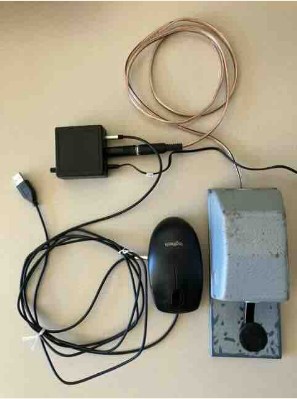
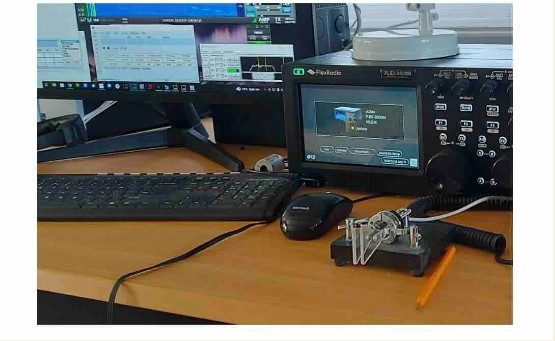
The photo shows my setup: An old Junker key plugged into the Picokeyer – a lead from the Picokeyer going to the mouse, which is plugged into a USB port on the computer.
The internal speaker on the Picokeyer is very low volume but it drives a pair of headphones well. My headphones happen to have a build-in volume control which is also useful. Patrick VK2IOW
A Survey by Stan ZL3TK
Here is an ultra-short survey to examine Ragchew readers’ perception and application of logic. Please examine the two versions below of Tuesday’s FFA timetable.
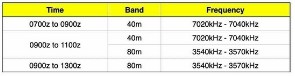
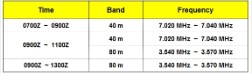
Timetable Presentation A
Please answer the following questions with a single letter for each, a total of eight letters. This survey is not a test about empirical knowledge, meaning no opinions or comments are sought.
A little research may be required so that no emotion or politics enters into it, your answers should be based on logic alone! 1. Is it important to have consistency in data delivery by following established international standards, Y or N? 2.
Is amateur radio, primarily, a scientific and engineering discipline, Y or N? 3. Which presentation complies with the mandated SI Metric rules for scientific and engineering documentation, A or B? 4.
Inpublications such as RagChew, which presentation provides the correct, therefore the best example, for readers to learn and follow, A or B? 5.
If writing a technical article, would you care enough about your readers to strive for the highest quality by using only correct SI Metric nomenclature, Y or N? 6.
If you had the choice between writing/reading a mediocre or a high-quality document, for exactly the same time investment, would you choose high quality, Y or N? 7. Which presentation conveys the information more clearly, A or B? And now for the clincher … 8.
Looking at the Frequency columns, which presentation more-closely, or even identically matches the format of the digital readout on your transceiver, A or B?
When you have eight one-letter answers in question-order based upon pure logic, please email those eight letters to zi3tk@qsl.net
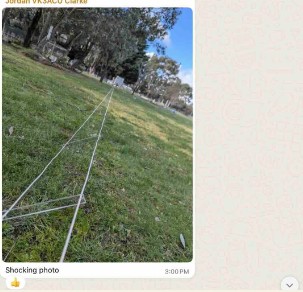
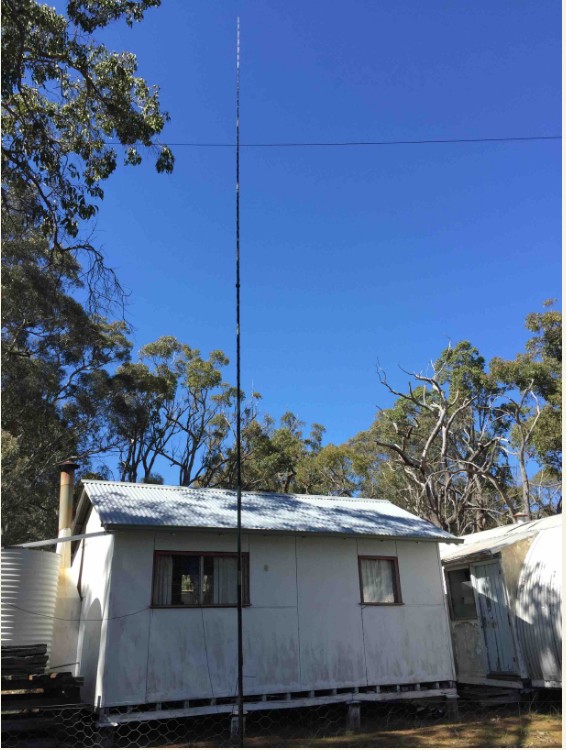
Squid pole ant – VK7JJ design – using the fence as a counterpoise, worke
From the DXing.com.au Newsletter:
We are struggling to get ten CW participants for the 2025 CW DX Chaser of the Year. Exactly as I’ve predicted. So far, only 8 brave souls have put their hand up (depriving themselves of $29) which is still 2 short from the bare minimum of ten participants.
I would like to think that it is the administration / prize fee that is preventing our most skilled form joining the fun. Surely they are not the last remaining Morse ops left in a county of 15,000 licensed operators?
To get yourself on the list, send $29 to QSY599@gmail.com and notify us in writing so we can add you on to the list.
For Sale QRPLabs QCX Portable QRP Transceiver
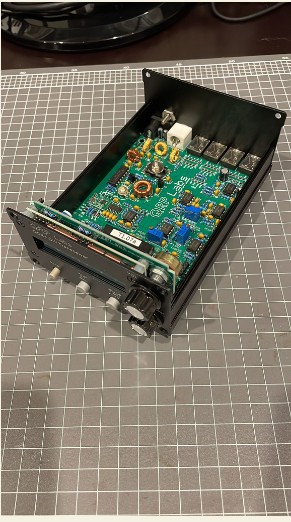
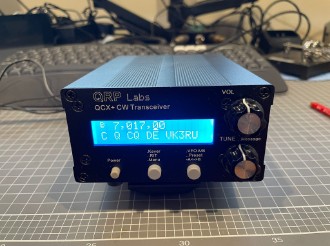
For sale QHFLaDS QUA Portable UHI from David VK3RU If anyone is looking for a QCX, mine is surplus. During winter, I built a QMX which I now use during our Tuesday nights for the last few QRS sessions. I am looking for $100 for the QCX.
It is built for 40m, in a case and was used in our earlier QRS sessions. Great little rig. Cheers David VK3RU
Morse Training Net
Nic VK7WW runs a Slow Morse training net every Wednesday at 7pm EDST on 3580 for 30 mins. He uses the callsign of the Northern Tasmania Amateur Radio Club VK7TAZ on that net.
Many of our team learned Morse code with the support of Nic, and the weekly training session comes highly recommended for anyone who wants to learn the Code, or simply brush up. Everyone’s welcome – 3580KHZ at 7pm Eastern time every Wednesday.
The NTARC also feeds the CW live via the Discord phone / computer audio stream, and previous weeks’ recordings are available. Contact Nic VK7WW for more info nicholaschantler@hotmail.com – or just join in on Wednesdays.
brain teaser
Jules Perrin JP VK3JFP has created a terrific resource to help guide learning for all levels of amateur radio licenses: https:/Awww.julesworkshop.net/Amateur%20Radio.html With thanks to Baz VK6MU for he idea, and Jules for the good learning website, here’s this week’s quiz questions from Jules’ Workshop example test questions:
Exam Questions:
What do the terms horizontal, vertical and circular polarisation mean with regards to antennas? The RMS value of a sine wave can be calculated by * peak x 2 + peak +2 * peak x 0.707 + peak x 1.414 Image interference in a superheterodyne communications receiver is caused by an unwanted signal operating on * half the frequency to which the receiver is tuned + the same frequency as the local oscillator in a dual conversion receiver * twice the frequency to which the receiver is tuned * twice the intermediate-frequency away from the desired signal frequency Answers next week.
Answers from last week’s Quiz:
What is a BALUN? Answer: Matches balanced to unbalanced feedline to the antenna. The frequency of the local oscillator is ¢ 910KHZ © 3625KHZ ¢ 4080KHZ e 4990KHZ
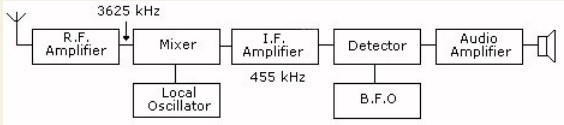
Answer: 4080kHz
• ripple on the power supply ¢ under modulation ¢ oscillation of the RF power amplifier stage ¢ the antenna being too near the ground Answer: oscillation of the RF power amplifier stage How did you go?
Di-dah-di-dah-dit
So back to the Slow CW QSO practice Group.
Next Tuesday’s Net
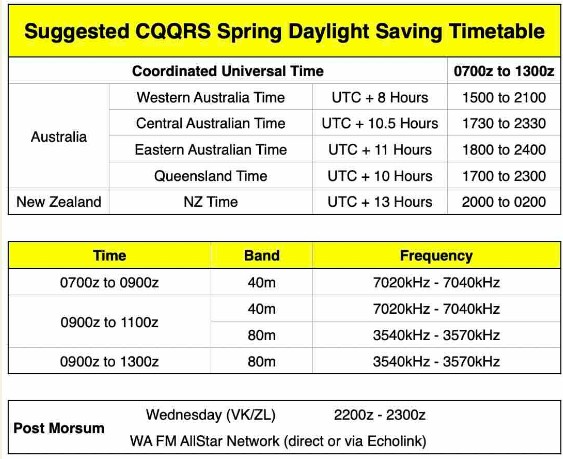
Our CQ QRS Group will be on as always on Tuesday from around 07002Z until about 1300Z; see below for details. Doesn’t matter whether you’re brand new and want to try just exchanging callsigns and RST reports, or you’re ready for a good old rag chew.
Please let me know via our Reports form bit.ly/CQQRSNET who you work or hear on Tuesday’s Group. The report form closes at lunchtime on Thursday.
Post Mortem
Richard VK6HRC will run our phone Post Morsum on the South West AllStar net (via repeaters and hotspots all over WA) from 0600 WA time, then from 0700 WA time on 80m (8605 LSB).
For the 0600 (22002) net, if you’re in WA all you need is an FM 2m or 70CM transceiver and an AllStar node nearby. If you’re elsewhere in the world, you may be able to connect your local AllStar-enabled repeater to the net, or you can connect via Echolink.
Let me know (cqqrsnet@gmail.com) if I can help with that. and if you can’t connect that way, give 3605KHZ SSB a try from 0700 (23002).
Teamwork
Thank you so much to our team of 35 contributors this week: DL3YZ, VK/MONNK, VK2ASB, VK2GAS, VK2GAZ, VK2IOW, VK2RU, VK2WP, VK3ACU, VK3AFH, VK3BTV, VK3BWN, VK3CTM, VK3DRQ, VK3JFP, VK3RU, VK5A0, VK5CZ, VK5ET, VK5FD, VK5KFG, VK5LA, VK6BEK, VK6HRC, VK6IS, VK6KD/4, VK6ENW, VK6PZT, VK6RR, VK6WE, VK7WW, VK7KPC, VK7TA, VK7WW, ZL3TK.
The Joy of Daylight Saving
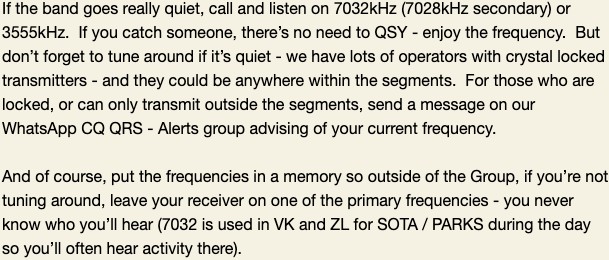
There’s usually people around until after 1300Z on the Tuesday Group – so keep calling in the segment of the band designated in the table below until you catch someone.
I should be on as usual from home in NSW or via the Remote at Bedfordale WA, and I’ll also be watching the proceedings using the VK6QS and Tecsun SDRs in WA and NSW respectively. Hope to hear you there.
GU CW on Tuesday, mb Mark Bosma VK2KI / VK6QI Beautiful South Bowning NSW mark.bosma@icloud.com non impediti ratione cogitationis
An Ode to CW – thanks to David VK3RU: In days of old, when ops were bold, And sideband was not invented, Words were passed by pounding brass, And all were quite contented. – Unknown author

About the CQ QRS Group
Frequencies and Times
QRL?
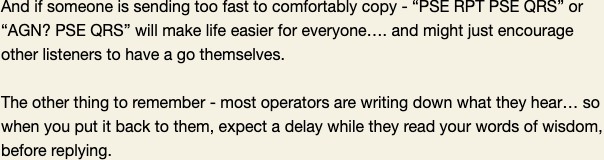
So tune around and call anyone you hear, or find yourself a quiet spot in the designated segment, send “QRL?” and if the frequency is quiet, start calling CQ QRS at about 75% of the speed you’re comfortable receiving at; hopefully responders will match (or send slower to their comfort level).
And if you are already having a QSO and someone sends “QRL?”, respond with “R”, “C”, “Y”, “YES” or QRL to let the caller know that the frequency is in use.
If we’re on 40m and you can hear that the band is open outside Australasia, perhaps consider calling 500HZ above each 1KHZ slot – to minimise the chance of having to copy our team through QRQ QRM that’s often dead-on the kHz markers.
If you’re proficient at CW and can race along at 20 or 30WPM – terrific, but please remember, the Group’s aim is to encourage participation and learning, not show how fast you can hammer the key.
Please send slowly where you can and concentrate on rhythm – listen to your side-tone, get that wrist action going and make a special effort to make it sound like perfect CW; the longer we go with our Group, the more I understand just how many non-transmitting listeners we have – and they will most likely appreciate your QRS!
So, if you’re an experienced operator, please try to send nicely balanced slow CW to give them a chance to practice and gain confidence…. they’ll reward you one day by coming up on air to say g’day and thanks – how good is that?
And if you’re new or like me, just rusty…. ignore the above… just have a go – the lather of sweat will be worth it and there’s plenty of time to get the details sorted out as you practice.
Matching

Landing Zone