Below is a reconstruction of the 2024 34 CQ QRS RagChew newsletter designed to support full text searching. This reconstruction was built using OCR, and will contain errors.
To view the Mailchimp original, click here. To search the entire newsletter archive, click here.
Contents
- CQ QRS RagChew
- Doctrine
- Last Tuesday’s Net
- Masthead Image
- Reports
- Reports & Comments
- Comments:
- Other News
- Europe to VK: a personal strategy
- Morse Training Doctrine
- International Lighthouse & Lightship Weekend
- 40m Band Plan – According to Chris
- Cheers
- Morse Training Net
- This Week’s Topic of Interest
- Brain Teaser
- Exam Questions:
- Answers from last week’s Quiz:
- Di-dah-di-dah-dit
- Next Tuesday’s Net
- Post Morsum
- Teamwork
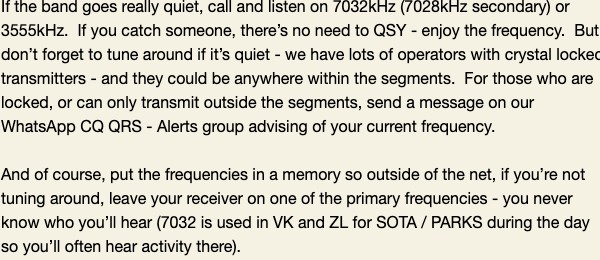
- Frequencies and Times
- Speed
- Matching
- PSE QRS
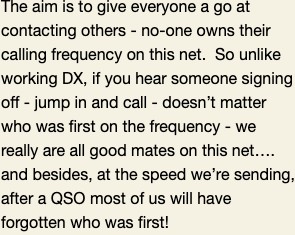
- Landing Zone
CQ QRS RagChew
Wow! Another sensational Tuesday on the CQQRS Slow CW Practice QSO net – at least 79 stations on air or known to be listening! Another gold medal to you all with our new world record!
And what’s more – we had 1-1/2 first CW solos on the net this time – thanks again to our Chief Flyingtnsirueter First QSO Officer Jordan VK3ACU; outstanding!
I’ve been pleased to see some interest in providing information to the Technical Advisory Committee about the proposed IARU reduction to the CW-only portion of the 40m band.
I’ve also read comments that even if the digital modes are allowed lower, we will still be able to share the band; true, but the digital transmissions won’t listen to make sure the frequency is clear of CW before transmitting – operating CW in among FT-8 etc would be a nightmare – a clear frequency one moment will be full of tones the next.
So we need more input to the TAC – please send your thoughts (no matter how brief) to the Technical Advisory Committee: tac@wia.org.au – again, it doesn’t matter what your views are about the WIA, and whether or not you are a member (or even what country you happen to live in) – the engagement between the WIA and the IARU is the only avenue we have to try to nip this in the bud.
I’ve heard back from Grant VKSGR the Chairman of the Technical Advisory Committee – and like last week, I’ve included his comments in the Other Topics of Interest section below.
I’m keen to hear whether the NZART is also making a submission; if so, New Zealand and would prefer not to approach the WIA, please approach the NZART about this important problem.
Doctrine
In last week’s RagChew, I had a bit of a late-night rant about the bad old days of cliquy CW groups and the old CW learning doctrines that went hand-in-hand.
I realised afterwards (20/20 hindsight) that I’d meant it as an invitation to others to air their thoughts – I wasn’t trying to be divisive…
What I happen to think about the topic is pretty much irrelevant to the net and our 200 readers – but what our team thinks about training and attracting new CW operators to the art is much more important.
I was glad to see that Andrew VK1DA has penned some thoughts – see Other Topics of Interest below; I’m keen to hear your thoughts as well.
Last Tuesday’s Net
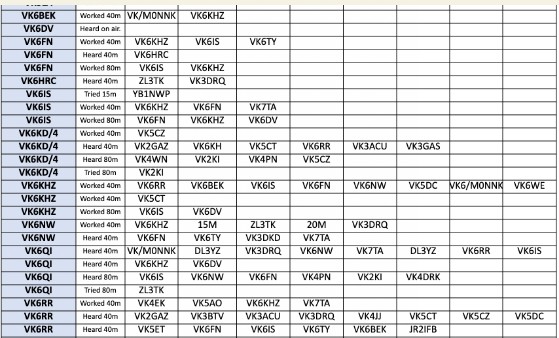
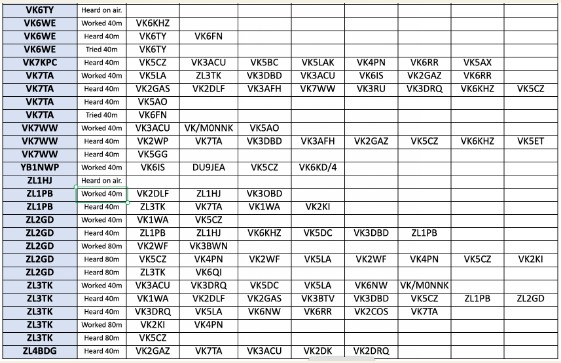
Here’s this week’s list of the 79 stations heard by our team or listening-in:
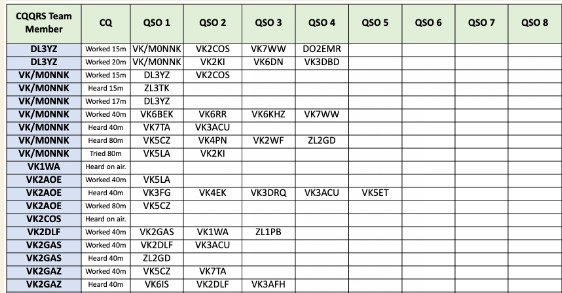
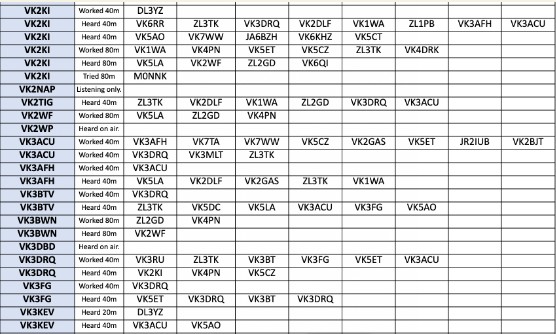
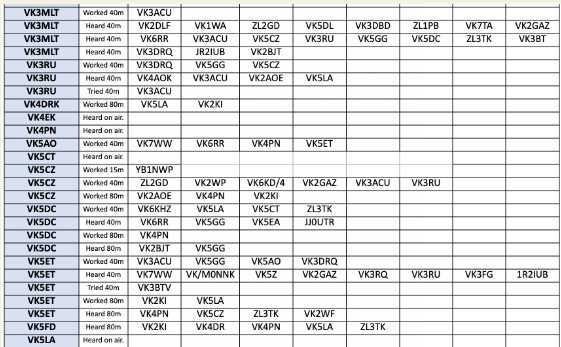
Welcome this week to Clint VK2TIG from Cremorne. Although licensed for 8 years, Clint hasn’t had time to be very active – but he’s adopted a CW only approach – so our net should be just what the doctor ordered!
Clint reported that he listened in this week – and decoded a good number of stations… welcome mate.
Masthead Image
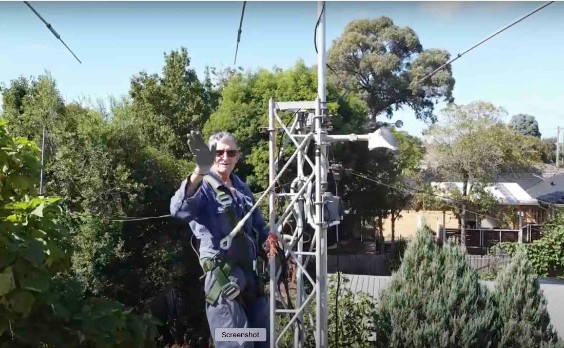
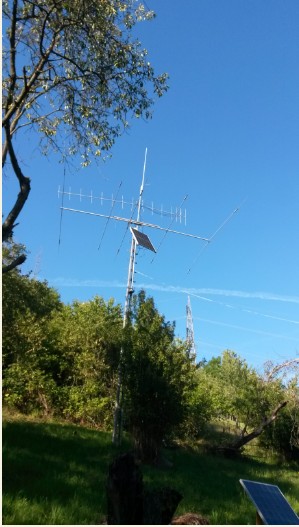
And thanks this week to Manny VK3DRQ and his son for the terrific tower-climbing image (the excellently produced video is here https://youtu.be/qKjMUM35EJ0).
The tower is 8m tall and supports the TET-Emtron TE-33 antenna, a trap Dipole (20+40+80m), a 1OMHZ 1/2 wave antenna, and an end fed half wave for 80m.
Since the back yard is very small, the EFHW on 80m is designed in a triangular shape, inverted-L designed by none other than OM Stan ZL3TK.
I’d be interested to learn and share with the group how the two antennas compare on 80m, both for transmitting and receiving Manny.
Reports
After next Tuesday’s net, please send me a list of who you worked and / or who you heard using our new web form here:

As our team outside of Australasia grows, we’ve seen lots of interest in expanding our activities to other bands to catch our overseas members.
The head of our software department, Nigel G4RWI has been working furiously to produce a simple way of reporting on contacts with our team outside of 40 and 80m.
But in the mean time, separate out your 80m report from the other bands of course), and when you enter the list of callsigns worked, heard or missed on the other bands, please append an ‘@band’ to each callsign without a space (eg VK2KI@20 VK6QI@15 etc).
Please don’t use the @band for 40m and 80m. Depending on Nigel’s progress, this procedure might change – keep an eye on the Tuesday reminder email for updates.
Getting reports from stations and listeners is important to me – even if you listened and didn’t hear anyone or weren’t able to copy anything – the fact that you had a go needs to get recorded so we know that the net is working and attracting new and old team members to have a go as well.
Reports & Comments
The spreadsheets above show the known stations on last Tuesday’s net. Comment distilled from the reports I’ve received are below:
Comments:
• Most stations I heard I could only « the odd word or phrase, however there were a couple of slower transmissions that I managed to co} most of. + Awork in progress. * This QRS session is really helping * Thanks.
[16m] + Think I was so overjoyed at working Mike DL3YZ on 15m earlier, I’m still glowing with pride ©. It happened like this. + I had set up the rig on 21.051 rather early and couldn’t hear anything so I sent a ‘2’ to see if the fx was clear.
At the same moment my XYL ‘The Darling of Rupert Light-horse’ arrived home and a French station sent his callsign once. + Ah hal The band is open to Europe! But my darling takes precedence, so I retired to sit and relax with her and the usual double scotch.
+ After enjoying our interlude on the enclosed deck looking across the Tamar river, we went inside. I could hear some CW coming from upstairs.
+ Wondering if it was Mike DL3YZ, I became an Olympian sprinter and arrived in front of the rig upstairs to hear him calling CQ. I gave him 579, a great contact into Stuttgart.
Which just goes to show the importance of the 7 ‘P’s in having the rig set-up ready for action! (Prior Planning and Preparation, Prevents Piss Poor Performance! @&).
[40m] + Later on I was using the KX2 on 40m, 10w and a ‘bug’ key (I hadn’t used it for months and months). It sounds great when you get it right! But quite a bit of fumbling and brain-fade, probably from the RD Contest at the weekend…
+ Nice to hear a newbie doing great! VK3AFH – well done! …working Jordan VK3ACU. + Mark VK2KI thank you, you are doing a great job! I also appreciate your input to the WIA’s Technical Committee Re 40m Harmonisation of the IARU.
+ I hope others will send comments in! Interesting to note that the US military is teaching CW again after many years of not! This could mean that our CW ranks will continue to swell over time @)….
+ ps I think the overall speeds on the QRS ‘net’ are getting faster, probably as a result of practice each week. 6 Bn Pm aning tn maka a eanerin ie affart ta elauw mu CW rinht dawn hararca |
Don’t want any of our growing team of novice CW newbies to find it hard to find a station to contact, or feel intimidated hearing increased speeds.
[80m] + Didn’t hear any QRS stations on 80m… boo hoo!
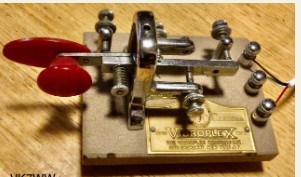
[80m] + Really nice to hear so many conversations going on these days on this CW net, shows improvements made by having this net to build skills and confidence for the operators. + Well done everyone for stringing it all together.
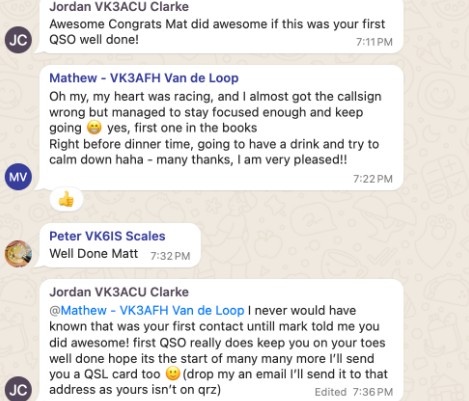
[40m] + That was a fun night on 40m. * My favourite part of QRS night is when new CW ops have a crack at their first contact. + I was lucky enough to be Mathew’s (VK3AFH) first CW contact.
+ Honestly, I wouldn’t have known as your CW was really good (not just saying that). + You’ve clearly put a lot of time and effort into it mate. + That was a great first contact!. + Anyone wanting to give CW a go, shout out.
+ I’m happy to go slow enough for you to read each letter from a chart if it gets you on the air. + Getting on the air and making that first contact is hard, it really gets the adrenaline going, like Mat said. + No turning back now, I’m sure you’re hooked.
+ Hope to catch you alll on the air again soon. [Great work Jordan! Here’s how it unfolded on WhatsApp:]
From Ross VK/MONNK at Exeter UK via Perth WA [18, 17 and 40m] + It was great to have quick contacts with Mike DL8YZ on 15m and 17m from the VKESR remote access radio in Perth WA. + It was also nice to work VK7WW.
[80m] + Thanks for your insight into the Remote’s problem on 80m Mark. It might partially explain why I haven’t been having much luck on 80m. I’ve been hearing other stations fine but not always being heard myself.
+ Next week I’ll try your trick of offset tuning and see if that makes any difference (or pray for rain in the Bedfordale areal).
+ Having said that, I really appreciate the availability of this remote access radio – it has enabled me to enter a world that would otherwise have been closed to me. I’m working on the UK-VK project but I have no idea whether that will bear fruit.
In the meantime, I’m making friends Down Under. © +l was hoping to work my first New Zealand station (ZL2GD) but when he finished his QSO someone else called his QSO partner so that was my chance gone.
+I got to listen to stations from alll over Australia though, so that was wes,
[You may also have experienced the one-way propagation we often get on 80m as the grey-line moves West – signals from the East pour into WA, but the VK6 signals are considerably weaker the other way.
Three or four potential hypotheses about the cause have been floated in previous RagChews. Glad you’re making friends down- under… sounds like the 1961 Tony Hancock episode called “The Radio Ham” – HI!
Perhaps when the other station called Grant’s partner, a quick ‘2DG UP 5’ might have worked (although probably not with the weak signal from WA)… easy to say in hindsight I know! But it is possible to make the distance to ZL on the Remote Ross….
AS you can read above Grant did hear me on the Remote later in the evening. Hopefully we’ll be able to twist Rob’s arm to find out why the once excellent Marconi-Tee (12m high and 60m across the top!) isn’t working as well as it used to and why the coupler just doesn’t like our band segment!]
[40m] + I’m about 3/4 the way through BC2 with LICW and have only ever sent a few short TU UR 5NN for last week’s Remembrance Day competition or WWFF activations. * I spotted VKSACU’s invite on WhatsApp and thought why not have a go.
5th letter into his callsign and drew a blank on the C of all letters! I somehow gathered my thoughts and bumbled on not knowing what to senc + Big thanks to Jordan for his QRS sending and his patience decoding m’
[Congratulations Martin – and Jordan! Doesn’t quite qualify as a first CW QSO on tt net… but it’s pretty close – and hopefully had all the nerves, sweaty palms, and excitement that goes with that achievement!
And by the way, I still get tripped up b some letters that I know well…. Stan ZL3TK sent me a RandomGram exercise this week… and I had to stop and think what a dah-dah-di-dit was mid-way through!
Then there’s the fun of trying to spell while mid-way through a sentence, the ‘was that a 1 oraJ?’, ‘aQoraZ?’, etc. Lots of fun ahead mate! And it wasn’t all that long ago that Jordan was where you are now…. and look at him go now!]
[40m] * Busy band tonight – noisy, qrm & doubling in background. * Had a good session copying Stan’s formal message exchange reply sent by Manny to Stan’s previous question… good practice.
[80m] * Bit more quiet than 40 mts tonight. [Yes I imagine it can be interesting living in Adelaide listening to stations in the West, East and New Zealand, all on the same frequency not hearing each-other! Great thé
• Jolly good night all told. * One TDIH and one RG x 10, both close to 100 % accuracy.
[80m] * Conditions average but good enough to achieve 100 % round-trip RG x 10, then a fine chat with OM Sava in tropical QLD.
From Mike DL3YZ at Stuttgart / Germany [20m & 15m] «Wow, the waves were really on our side today. Not a single station I heard, which |
Couldn’t work using just my FT-891 and 100 Watts. + Thank you to all the stations taking par in the DXperiment, and for all the nice contacts. Hey, its so cool to actually beep around the globe. Great fun :}).
+ It was really challenging to answer all the stations and keep in time with the announced schedule. It didn’t work out every time to be on the new band on the spot. Sorry for that – next time I try to do better.
+ The RST reports were better on both sides when using the 15m band. + QSOs in total were almost scoring equal, 4:3 for 20m – so I think15m is a keeper. + Now let’s wait for next week, I heard there may be a big surprise coming. No I won’t spoiler HI.
+ Have a great week! +73 de Mike DL3YZ (the Antipodean ).
[Danke Herr Antipodean. This is a terrific activity for the team – lots of interest to try to work a team member from the other side of the world – outstanding work. For the team, I’d emailed Mike about the RTTY stations on 21050.2 and 21051.2kHz…
His insightful reply after the event was as follows: received you mail just at the very moment. As allis still quite new to me, its hard to handle all things in parallel.
So had no time to set up the laptop or even go to the toilet during my schedule 🙂 Thanks for your info about the RTTY station, which of course was no RX here. Ihad really many stations today on both bands. Reports on 15 were rated better.
Detailed report will follow. Cond were great and now I’m really mentally exhausted.. Had almost constantly traffic to handle, and even my 75AH Car battery is leaked now HI Thanks for the nice QSO and for having me on our net. Thanks Mike.
I know from experience, that you’re not the first CW operator to be up to their arms in signals, schedules, computers, busting to go to the toilet etc during our net]
From Clint VK2TIG at North Sydney 40m] First time as a listener. – Hopefully next time as a participant… I’m preparing myself to give it a go next Tuesday evening.
– From now till then I will be practicing (Basic) QSO protocols – (still wondering where to put all the pro signs
Thanks Clint and a terrific start from you first week on the net – lots of stations’ sallsigns decoded. My thoughts on prosign use – don’t get too worried about the prosigns – I’m still learning them!
Did you find the basic exchange info in the link at he bottom of the newsletter? That’s a start – perhaps try to learn * di dah-di-dah-dit dah-di-dah
* Also you’ll hear lots of dah-di-di-di-dah
* You’ll hear the occasional (dreaded!) di-di-dah-di-dit
If I’ve fallen asleep and someone asks a question, more often than not I need to respond with AGN? or PSE RPT? so I can work out what I was being asked – HI! Take care mate and thank you for your first report – well done!
From David VK6KD/4 at Mareeba QLD, 40KM E of Cairns. 15m] A. QSO with YBINWP (W Java), heard VK5CZ on 21.022KHz. 80m] – Great night on both 40 and 80m. – After a long day as a tourist in QLD I had to shut down my gear before Falling aclean —
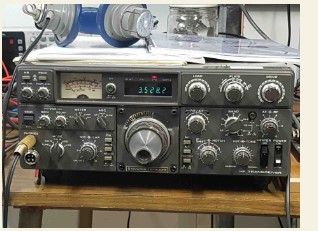
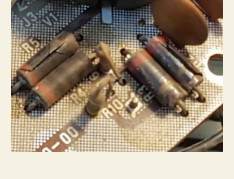
[80m] + Just finished doing High Voltage repairs on a Kenwood TS-830s for a friend VK2QK. + After setting up the quiescent current and a tune up, I plugged it into the 80m vertical and had 3 quick QSOs. * Thanks to VK5LA, ZL2GD and VK4PN.
«| expect a ppt presentation will be forthcoming for the Goulburn ARC.
From Roy Jones VK6RR at Geraldton WA [15 & 20m] + Heard VK3DRQ & ZL3TK calling DL3YZ on 20m. I also called, nil heard. * Called on 15m nil heard.
[80m] + Otherwise engaged this week but heard a few stations late on 80 m.
• On 40m using my new kit built QRP Labs QCX+ 5 Watts into my 40 foot (you can tell I’m old school) vertical and was really pleased with the few stations I heard.
Lots of QSB so it got a bit scratchy at times but thank you to the stations that put up with my weak signal and sending mistakes.
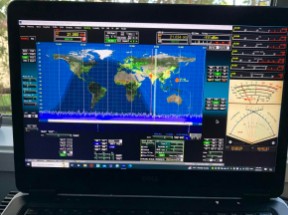
From Mark the Editor VK2KI at Beautiful South Bowning * Busy busy busy – another terrific evening’s fun!
[20m] + This time I started by listening-out for Mike DL3YZ on 20m, having arrived home just too late for the first 15m sked at 0645Z.
+ I managed to work Mike with 50 Watts to my 80m double-extended Zepp (on 2 it would be a five wavelength doublet with who knows what radiation pattern – n doubt lots of peaks and nulls).
+ I was again amazed that Mike heard my weak signal through all the European QRM; the band was otherwise quiet here. rari
• When Mike moved up to Tom, I was disappointed to hear two strong high baud-rate RTTY stations on 21051.2 anc 21050.2 via the Tecsun KiwiSDr at Araluen NSW; I could just see/hear Mike on 21051, and the variable bandwidth SDR might have helped had I tried.
However, my rusty old Kenwood TS- 120S decided that it’s phase-locked loop wouldn’t work on 15m, so I couldn’ have worked him even if the RTTY wasn’t there.
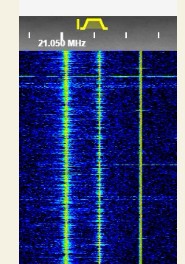
• I did hear Roy VK6RR up at Geraldton calling Mike as well, but sounded like Mike couldn’t hear Roy that time.
[40m] + After the fun of the DX, I had a listen on 40m and heard lots of activity from ZL, VK1 and VK3. + After dinner I returned to 40m and heard the tail-end of yet another of our net’s first solos – this time it was Mathew VK3AFH at Wantima having his very first CW QSO with Jordan VK3ACU across at Meredith.
+ Congratulations Mathew – your CW sounded really smooth – I wound’t have guessed that it was your first go on the key! And well done Jordan – yet another first CW QSO under your belt! This is exactly what the net is about – I’m really really pleased!
+ listened to other QSOs and then heard JA6BZH calling CQ with a lovely slow rhythm; I posted an Alert on our WhatsApp group but wasn’t able to get my gear back on 40m in time to catch him myself. Did anyone else catch him?
+ The 40m segment was full of signals – Bourke Street… a challenge for my barn- side-wide TS-120S 3KHZ receiver (‘m on the look-out for a Kenwood YK- 88C CW filter)! So I slipped down to 80m for a look-see instead.
[80m] + I decided to have a listen on 80m early in the evening, well before the D-layer had faded across Australia. I was pleased to catch up with Wimal VK1WA about 65KM down the road in the ACT.
+ At 1030Z, I tried to work Ross VK6/MONNK who was in and out of the noise – Ross could hear me, but not the other way around – he was just too weak for me to pick out his report; one-way propagation as the grey line moved across the continent again (we’ve had lots of discussion about three possible theories about this phenomenon in past RagChews)..
+ I caught up with Sava VK4PN at Mount Ommaney, John VKSET and lan VK5CZ at Clare – all with nice signals into NSW. + I was really pleased to hear quite a few of our stations chatting on 80m this time – terrific!
I had a late night (NZ time) chat with Stan ZL3TK Waitatére Beach and we exchanged a RandomGram exercise – I was surprised that he gave me a 10/10 for that one; I must have made the right guesses!
+ I rounded out the night with a really fun QSO with Derek VK4DRK up at Toowoomba. Derek usually has a Tuesday night date at a tennis court, but managed to finish early this time. We decided to give the VK1TE Ping- PongCW —_ head-copy exercise a try.
I’d send a three letter word which Derek would head- copy (le without writing it down) and send back to me – along with another three —_letter word of his choice. I’d then reply with that word (if copied / remembered it) and send another word.
That went back and forth really well for perhaps 10 minutes, and I upped it to 4 letters without warning. + Derek was on a roll, and I don’t think he made any mistakes (If he did send a wrong word, I’d repeat the correct one and he’d try again).
Sounds pretty simple, but it is a bit challenging – head-copying, remembering the word, thinking up the next word on the fly etc.

[20m] + Using the VK6QS KiwiSDR near Brookton, I heard Ross VK6/MONNK working Mike DLSYZ on 20m, then I heard Manny VK3DR@Q chatting to Wayne VK6NW on the frequency, but I don’t know if they caught up with Mike.
[40m] + I heard a number of stations chatting as the 40m band opened across Australia and New Zealand – terrific!.
[80m] +I cranked up the Southern Electronics Group VK6SR Remote at Bedfordale and like Ross, had all sorts of trouble with the antenna coupler – just in our segment; a few kHz outside of 3540-3576, it tuned up fine, but just not in our band.
I tried tricking it by tuning up just above or below our segment then not re-tuning in the band – which sort of worked but the SWR climbed quickly and with the SWR protection the output power was down.
+ I tried to have a QSO with Stan ZL3TK at Waitatére Beach on the Remote; Stan was nicely Q5 but he couldn’t hear me – perhaps one-way grey-line propagation, but it was very late, so I expected the D-layer to be cooperating – not so apparently, or perhaps there wasn’t enough ionisation in the F-layers across the long stretch?
Stan went on to work Sava VK4PN in Brisbane – and both were nice copy in the West, as were Derek VK4DRK from Toowoomba and me from Southern NSW when we chatted and did the Ping- Pong CW head-copy exercise.
From Nyoman YB1NWP at Lippo Cikarang, near Jakarta
[40m] + Hello Mark. + I made several QRS QSO tonight. + No VK stations heard on 40m. Band conditions on 40m were terrible – noise floor was on $9 +10DB – no way could I hear DX, so I moved to 15m where the noise floor was much better.
[16m] +I started on 21020, but someone was using the freq. I heard VKGIS calling and we then moved to 21022 and had a quick QSO. Thanks Peter. + Next I got DUSJEA. Even though my Yagi was not beaming North, he was strong.
After quick exchange and introduction, I continued with the next CQ. + VK5CZ and VK6KD/4 pile up but no problem copying them.
• Nice signal from OM lan VK5CZ ever with only 10W from his KX3. » Then VK6KD/4 become my last QSO on thi: night. Thanks Dave. + I will try next week again. * Hopefully 40m band’s conditions wo get better. * Thanks and 73. ae Ahsvaman VDIAINAID
[40m] + This week was when it all came together and I put my practice to work doing the real thing – many thanks to all, especially Jordan and also everyone else I’ve been able to listen in on and study lately!
+ I was definitely a little unprepared for the adrenaline rush that started once I heard a reply, but I think I managed to stay focused on sending properly with only a few mistakes, and copying everything coming my way.
+ It felt like it could go on into a ragchew but I was not going to attempt that on my first time even if it did seem to all be going according to plan!
+ immediately stepped away after the QSO and spent some time trying to calm down again, it took quite a while and I didn’t get much sleep – kept hearing Morse code and needed to double-check my radio and everything else was actually off – I was definitely just hearing things.
+ realised after coming back from dinner that I had been so intently focusing on the CW that I had completely forgotten to note what frequency I was on and the time, but the CQQRS WhatsApp Alerts group had my back on that this time!
+ I have since mostly recovered, except for my cheek muscles which are now complaining about the huge grin I have had on my face since last night :-).
+ Another goal ticked off my list, many thanks again, and maybe next time I’ll try for two QSOs if I can remain calm enough!.
[80m] + I have modified my antenna setup so I can relatively easily (via a Banana plug) swap between 40m and 80m, but I did not try 80m this week – I have not made any contacts on 80m yet so a future goal of mine will be to make my first a CW one! [Fantastic!
Congratulations Mat – another successful first solo on the CQQRS practice QSO net. Who’s next I wonder? And by the way, I still hear CW when I’m
[80m] + It was fun to be on 80m on a Tuesday night again, just after 10PM local. It was a clear night here, not too cold, and quite visibly, a full moon. * There was some QSB on the band, but that was negated with a few repeats.
* Overall, the conditions seemed good, and the CW was worthwhile.
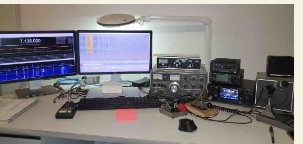
Rom Ben ZL4BDG at Upper Hutt 40m] Abit more listening for me this time, there were not as many CQs being alled, but lots of long rag chews! I started hearing more VK stations fter 9pm NZ time. No luck with my CQs.
Rom David VK3RU at Burwood Vic 40m] I called Jordan several times but SW from my QCX was not enough to beat the ig boys. 30m] I was using a QCX set only for 40, so 80 is out of the question. QMX is on the way.
Jordan’s fussy like that!] rom Peter VK6IS at Wundowie 40m] There seemed to be more activity, this week. 15m & 20m] Couldn’t hear DL3YZ this week. ratfic Report for 20 August 24 rom Stan ZL8TK {ere is OM Manny’s very-thorough answer to the previous week’s QTC.
Itis curate in every respect. Yep, he’s quoting from an iconic Aussie ballad; didn’t ot spanish immigrant do well? Which raises the question: Considering there were no ther takers to NR 110, how many Aussies know the answer?
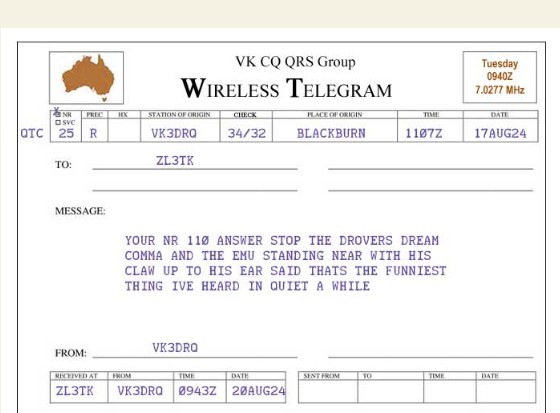
This week’s QTC moves to the big, nationally-divided island across Torres Strait. It is shown below exactly as sent so that anyone may configure their own formal reply using the message protocol used on traffic nets.
Serial numbers reset to NR 7 for the first QTC sent from your station in any calendar year. QTC
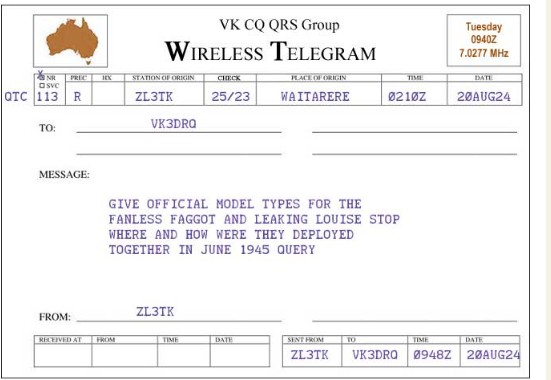
NEE EEE EE DN IE sven if the reply sent is only message text, devoid of preamble. Seek help if you reed clarification on any point while advancing your skills.
Zi3tk@qsi.net One rather complex ‘Today in History’ message was sent to the always-keen OM Jordan VK3ACU, who returned it near-enough perfectly: SPANISH CONQUISTADORS UNDER HERNAN CORTES CAPTURED AZTEC =MPEROR CUAUHTEMOC TODAY 1521 ENDING THE AZTEC EMPIRE.
Despite a couple of missing ‘E’s, ¢.g., AZTC, the message was still easily inderstood due to the context; ‘E’s are easily masked by QRN, their loss is no eflection on the operator’s ability.
Repeat requests were not needed for OM Mark’s RandomGram exercise, he eturned alll ten groups 100 %. Well done that man!
Ifin doubt about the accuracy of anything received, don’t be shy, simply request a repeat according to the sreviously-provided protocol in ‘RagChew’.
Though often heard, efficiency dictates hat there is no need for time-wasting niceties such as PSE and
Nishing all a splendid week, 73 de Stan. Thanks again Stan for the extra training opportunities offered to our net.) Post Morsum rom Richard VK6HRC. Seven on the net in spite of the occasional network drop outs for Max and Wayne!
Dn the net via the AllStar/ Echolink and the South West repeater network : * VK6KHZ Ron + ZL3TK Stan * VK6QI Mark * VK6FN Max * MONNK Ross * VK6HRC Rich * VK6NW Wayne + and our shortwave listeners.
On was happy with his new record of eleven contacts for the evening. Stan had a successful evening on multiple frequencies and treated us with a formal exchange of traffic with Manny VK3DRQ, more details about this raining opportunity in the RagChew.
Mark was busy as usual, frequency hopping and keeping the WhatsApp crew nformed of potential contacts ax got on and some fun before he was called away oss stayed up late to join the Post Morsum net with some discussion of the VK/ srefix possibly deterring people from having a go at a contact.
Nayne managed to check-in and let us know about the home built key he was using defore we lost him when the link dropped out. could not spend much time in the shack on Tuesday but managed to be around hen Stan and Manny were on, thank you gentlemen.
I made mention of the VK7TAZ CW training net run by Nick VK7WW on 3580 KHz at 19.00 EST Wednesdays. Jnfortunately I got distracted that evening and missed the CW segment but stayed around for the Tech session that followed; however, I know that Max listened in on ne VKSPH Ironstone Ridge KiwiSDR.
Thanks to all on the net, looking forward to more comprehensive reports in the RagChew. 73 Richard VK6HRC Thanks for running the net and writing the report Richard – terrific.]
Other News
Other things received from our 200-odd reader:
Europe to VK: a personal strategy
I’m coming at the QRP Europe-to-VK project from four directions: Transmit; Receive; Location; and Propagation Prediction. Receive I’m currently evaluating antennas for my RTL-SDR dongle. Loop-on-Ground antennas are supposed to be very good.
They’re stealthy and easy to deploy. But my first trial showed that there was no difference between a 20m circumference LoG and a 6m vertical wire. I’ve just built a simple transformer for it to see if that makes any difference.
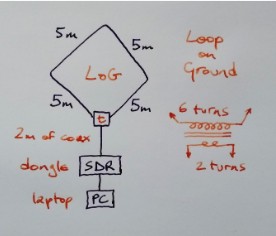
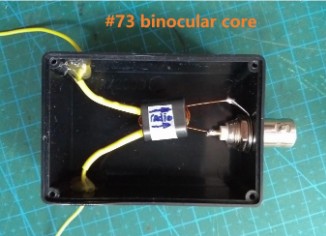
To my very great surprise, it makes a significant difference – this antenna is now noticeably better than the vertical wire.
My G90 has a very good receiver and so using a separate SDR and antenna system may be more trouble than it’s worth, especially as I’m portable. Only further experiments in the field will tell.
Transmit I think I’m close to optimising my transmit antenna but, with only 20 watts, it would be nice to have some directional gain. To that end, Mike DL3YZ and I are currently discussing parasitic reflectors.
To be practical when portable, it will have to be simple to set up. But as I’m only going to be working on 20m, it doesn’t need to be anything too complicated.
Location I’m intending to do some reconnaissance of a nearby estuary that promises quiet sheltered salt water, rather than the crashing waves of my local beach. I know of a location on the east side that would be good for the Long Path.
And there’s a possible location on the west side for Short Path.
To my very great surprise, it makes a significant difference – this antenna is now noticeably better than the vertical wire.
My G90 has a very good receiver and so using a separate SDR and antenna systen may be more trouble than it’s worth, especially as I’m portable. Only further experiments in the field will tell.
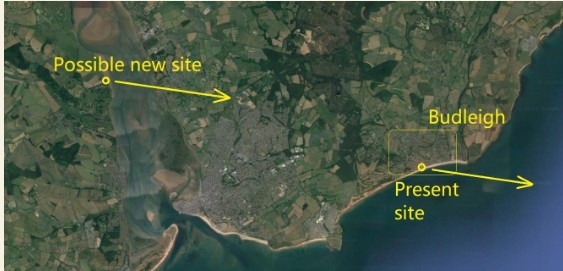
Rropagation Frediction Even though we are coming to the peak of a sunspot cycle, conditions in the last week have been pretty awful. For instance, today’s forecast says this “WWYV Alert: Space weather for the next 24 hours is predicted to be moderate.
Radio blackouts reaching the R2 level are expected.”
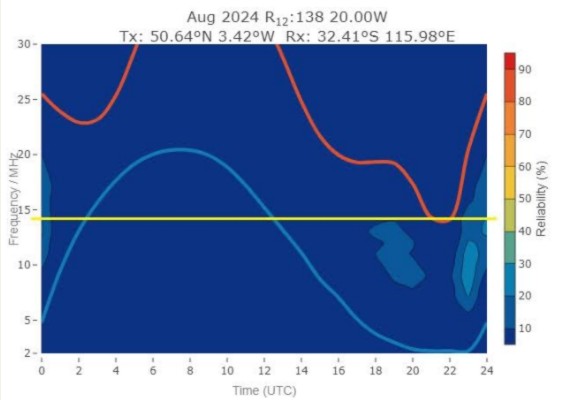
The graph above shows that the best probability of a contact on 20m today is only 20% if I go out portable at midnight local. Oh dear.
The trick to successful contacts around the globe is going to be working the best path when propagation is good so I need to improve my knowledge of propagation forecasts and how to interpret them.
But, hey, if it was easy, there’d be no satisfaction in success. [Terrific article and approach Ross. The Loop-on-Ground receive antenna is interesting; bit like a beverage antenna – low noise.
I can’t imagine that it would work better than a vertical for the low-angle propagation required for the around-the- world attempts – but we’ll see – [look forward to learning more.
Your experiments with parasitic antennas will be interesting – the challenge of course is to get a low angle of radiation from an antenna close to the ground – phased or parasitic verticals with good RF and DC grounding perhaps – Mosquito Estuary might be the go as you suggested?
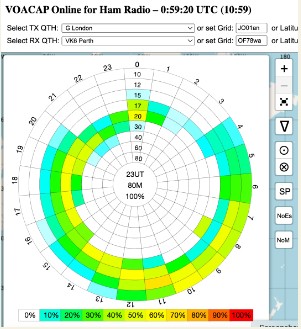
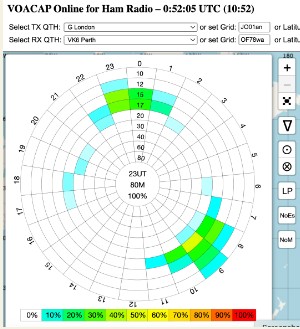
I’m glad you picked up on the propagation prediction; happy to help with that if you want. Attached are the VOCAP-Ham short path and long path predictions for UK to VK6 (7m vertical at your end, dipole at 7m in VK, 25 Watts output).
You can see why I suggested 15m to Mike for the DL-to-VK test (although, with 100W and gain antennas at both ends, the prediction would be quite different reliability-wise.
And re: “…if it was easy, there’d be no satisfaction in success…”: spoken like a true rotary wing pilot! Thanks Ross – what fun – well donel]
0m Band Harmonisation – TAC Consultation 2024-2 discussed at the start of the newsletter, Grant VKSGR the Chair of the WIA echnical Advisory Committee has written to me again about my submission of the ast few months’ CQQRS log spreadsheets for the IARU 40m band harmonisation roject; Grant’s first response was in the last RagChew.
Ark, hank you for the additional information. I will add it to the pool of data we have eceived for review once the consultation period closes.
Vhile I am not willing to enter an argumentative discussion during the consultation athering phase (to avoid diversifying the discussion points such that not everyone is ware of all of them, which would remove the fairness and equality the intended rocess was designed to maintain), there are a couple of points I feel I need to make > address some of the negative, combative and at times quite disrespectful sedback I have received from various people in the community, (including nfortunately from a number of CW operators).
It might be helpful for you to pass nese on to your readers. 1. In answer to your question about the ACMA, unfortunately during this process I am finding that some respondents don’t yet understand the concept of what a band plan is, how they work and why they should be respected.
They are not authoritarian documents, rather guidelines that try to show all amateurs how to select frequencies on the bands to minimise mutual disruption to each others’ on air activities.
They are ultimately coordinated globally by the IARU, although domestically we do have some freedom where there are no international impacts. One respondent today has, however, stated that they have already sought to challenge the process through the ACMA.
The ACMA however has no jurisdiction over voluntary agreements made within the amateur service and are not involved in this process.
The respondent’s approach is therefore frustrating and uncalled for, as no one has said anything about forcibly restricting anything. That is not what a band plan is for in the amateur service.
It would be good to make clear more widely that band plans are simply guidelines that, by voluntary observance throughout the amateur community, help to promote orderly interference-free use of the amateur radio spectrum. 2.
People need to also understand that this is only a preliminary paper from the WIA and is part of a rather long process. It will undergo reviews and further feedback to members once this information gathering stage is complete.
Further proposals may be drawn up as a wider base of information is gathered to help us make informed recommendations. That means, whether CW stays as 7000-7040, changes to 7000-7025 or even something else is not yet determined.
Any presumption that this is the only option on the table is false (although I will concede that due to the structure of the paper, if a reader didn’t follow the arguments along in detail it is now clear that they may have mis- construed our intent).
Once we have collected the feedback from WIA members and non-members alike, and indeed other IARU Region 3 societies, then a way forward will likely be sent to the IARU Region 3 board and member societies for consideration at a regional level, hopefully at the November conference.
Subject to what is agreed in that international forum, the proposals will then go forth to the IARU Region 1 and 2 boards and member societies for further discussion during 2025, before eventually (possibly in 1-2 years’ time) helping to reach a consensus agreement across the IARU globally.
Its final form will be built on a global consensus of what is best for the amateur service. 3. Finally, I am seeing misinformation also circulate where multiple people (many from the CW community?) have made repeated claims that we have ignored the 7200-7300 kHz band segment.
The truth is we haven’t ignored it, but rather it is simply out of scope in the context of IARU region 3. Within our region, only Australia and New Zealand have access to that segment.
It is not even footnoted in the ITU band plan (attached below) for Australia. Given the work ultimately is destined for a global audience, it is only appropriate that it is not coloured by the exceptional circumstances we find ourselves with here in VK/ZL.
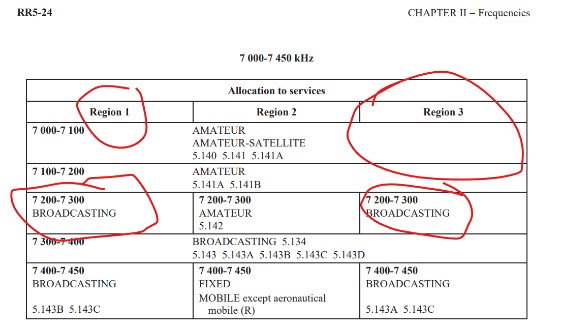
Please consider reminding your readers that band plans are all about balance. The process now underway is about finding a new equilibrium that delivers better voluntary interference management outcomes for all amateurs around the world.
Regards, Grant Willis VK5GR WIA TAC Chairman Thank you Grant – nicely done; your voluntary role and that of the other TAC members is very much appreciated.
So again for our readers – please send your thoughts to the Technical Advisory Committee tac@wia.org.au before September 6th. And for our New Zealand members, I haven’t been able to find anything about the IARU 40m band harmonisation on the NZART website.
While chasing up the NZART’s response to the IARU proposal, please send a submission to the WIA TAC to be considered part of a coordinated Region 3 input.
Morse Training Doctrine
Hi Mark, Just a few thoughts in response to your editorial in the RagChew newsletter 33/2024. 1. I think there is no use in bemoaning the old fashioned prejudices of greybeards in the early 70s.
These attitudes plagued amateur radio all over the world and were not unique to the vk6 situation. Neither were they unique to ssb/cw, the same kind of grumpy buggers objected to AM, and later to SSB. Then digital modes, what next?
The greybeards of the 70s are mostly no-longer with us now so they cannot either apologise or update their old attitudes. Novice licensing, reduction of Morse test speed, abolition of Morse testing all would have given them conniptions.
Maybe that played a part in sending them off. But either way, they are now, 50 years later, all dead. Their grumpy responses to progress just don’t matter now. 2. When I did the Morse test in 1965 it was 14 wpm.
I didn’t think the 10WPM change happened only 5 years later, maybe it did. 3. Be sure to distinguish accurately between WWFF and POTA schemes. They are not merely “parks” contacts as the two schemes use different codes for the parks.
WMFF is the older scheme and POTA is the copy, renumbering the parks and recently assigning different country codes. 4. The best thing for operators who have trouble recognising non-VK callsigns, or sorting out Q codes and pro signs as they flow in during contacts is to do a lot of listening to others.
When you see “73 es CUAGN SN” and don’t know what it means you can work it out with references on the internet and there is no stress if it isn’t a live contact with you!
Plunging in without any knowledge of the codes is like going to another country and expecting to understand the language on the first day – ie do your homework and find out first hand what codes are used and when to use them yourself.
You can always print out a typical contact and have it available for reference purposes. Use a pencil and paper if that’s easier than using an computer. Often it’s much easier to send from a script than send out of your head.
When listening to QSOs that are at a higher speed than you are used to, just try to copy the first letter of each word. The rest will come with practice. But it will never come by giving up the first time you try it.
Re the cw-only segment of 40m, there has been a lot of discussion on ozsota and on vkzigrp lists, both on groups.io. Join the groups using your existing membership and login details, or if not, find the groups and request to join.
Then you can read the history going back as far as you like, by using the website rather than emails. That would save you going over old ground. Peter VK3YE is the group owner for vkziqrp and is the owner of the facebook group.
The ZLs have been running QSO parties over the last few months. They have been publicised on ozsota. Hopefully members have been seeing those promotions. A few years ago we had a CW promotion where we aimed to make 4 contacts per day.
Alot of SOTA people participated. luse the groups.io service in various modes. Some groups I have set to send me every post immediately. Others i set to send a daily summary.
Others i have set to “no email” but I can always go to the groups.io website and scan the list of posts in the last week to see if anyone has posted something of interest and I can read it from the website.
This avoids clogging your email inbox with discussions you aren’t interested in. Also lets you catch up on discussions. So a few thoughts, one or two might merit inclusion in a future newsletter, or none might. No problem. Cheers.
From Roy VK6RR Afraid my contacts from Point Moore Lighthouse on Sunday didn’t include any lighthouse – but I did have CW QSOs with VKSGG, VK2ARZ and HA7TM. The weather was windy and the occasional shower.
There was approx 120 people visiting the site and a lot were interested in the portable station and keen to learn about Morse code – and the amount of people taking part in the QRS net. All good for promoting our hobby!
Glad I wasn’t portable from this lighthouse in Iceland! 78 &77 (CW for ever)
International Lighthouse & Lightship Weekend
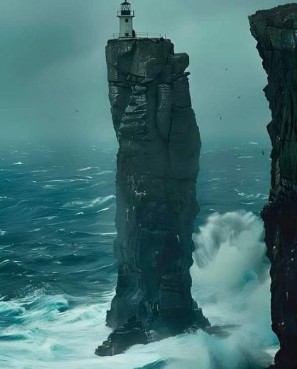
[Thanks Roy. Unfortunately I was tied-up rewiring the studio at our local Community Radio station all weekend, so I missed the ILLW opportunities this year. Good work on the publicity!]
40m Band Plan – According to Chris
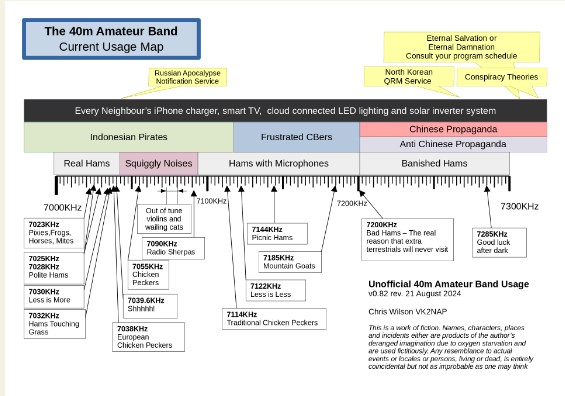
Whilst I was otherwise committed on Tuesday, save a bit of SDR in the car on the way to the gig, I did read the review of the WIA’s request for comment in the Fists Down Under newsletter that came this week Whilst there is a lot of two and fro, and the potential effect on our unique past time is serious, I thought it appropriate to share with the group a visual analysis of the ‘current usage patterns’ that I have noted between 7000KHZ and 7300KHZ for one’s own entertainment, as, I keep reminding myself, this is a hobby.
Anyway, if you find it usable, please feel free to share Thanks for all you do. Always appreciated
Cheers
Morse Training Net
Nic VK7WW runs a Slow Morse training net every Wednesday at 7pm EDST on 3580 for 30 mins. He uses the callsign of the Northern Tasmania Amateur Radio Club VK7TAZ on that net.
Many of our team learned Morse code with the support of Nic, and the weekly training session comes highly recommended for anyone who wants to learn the Code, or simply brush up. Everyone’s welcome – 3580KHZ at 7pm Eastern time every Wednesday.
The NTARC also feeds the CW live via the Discord phone / computer audio stream, and previous weeks’ recordings are available. Contact Nic VK7WW for more info nicholaschantler@hotmail.com – or just join in on Wednesdays.
This Week’s Topic of Interest
By Stan ZL3TK It is feared that without the CQ QRS Group, the epoch-making event documented here would not have been possible.
The QRS Group is young compared to the nine years which have passed since the Oceania Enigma project was imagined, and the six years which passed before the inaugural intra-ZL amateur Enigma exchange was accomplished in September 2021.
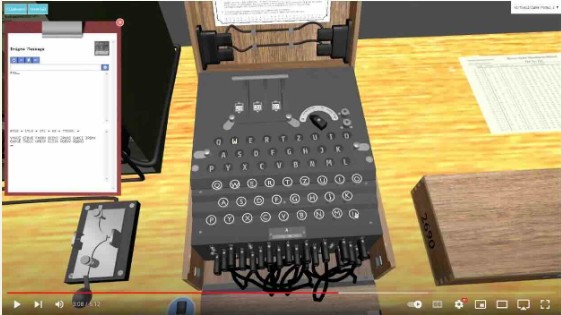
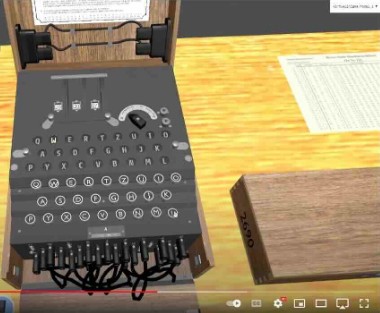
It would be naive to think that 2021 saw the first Enigma transmission from South Pacific waters. The German raider HKS Orion, which laid a total of 228 mines in the approaches to the Hauraki Gulf in June 1940, would have wirelessly telegraphed reports using Enigma encryption back to the boss, Admiral Erich Raeder at OKM.
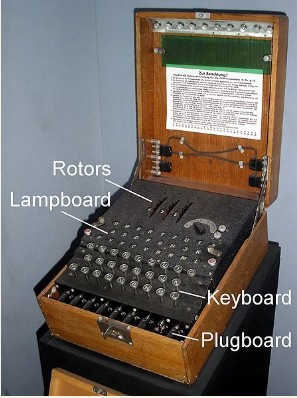
The use of Enigma to stay in secure contact with Kriegsmarine headquarters was widespread and led to the addition of a fourth rotor in 1943 after Admiral Karl Doenitz became suspicious of the M3 machine’s security.
No messages between OKM and Orion seem to have been recorded. Now, almost three years since the first successful intra-ZL Enigma exchange in which OM Stephen ZL1ANY took part, the first-ever trans-Tasman exchange has been achieved.
When Enigma was first mentioned within the Group, four members indicated an interest. Each was followed up by email, but only one replied and grasped the nettle.
That one OM who saw the potential was prepared to put in considerable effort to become a competent Enigma user through seff-training.
What makes this achievement even more significant is that this VK protagonist was new to CW, had never handled traffic before and was unfamiliar with the plethora of challenging Q-codes. His courage beggars belief – real Croix de Guerre material.
Where is the evidence? you ask. Firstly, quoting from an email penned by the intrepid VK operator: After successfully decrypting the KPH Challenge last January, after the event, and “catching the bug”, I was contacted and asked if I’d like to participate in the SAS.
Net. I was a bit circumspect about getting involved, but I sought council from some learned friends who agreed “as long as the key to the decryption of the transmission fs clearly included in that transmission, all is well”.
It’s been a learning exercise — numbers exchanges are pretty simple to decrypt using a spreadsheet. Enigma messages (using the Enigma simulator program) are a bit trickier.
But the hardest part has been getting my CW skills up to another level, and understanding the common CW abbreviations used. Propagation from VK3 to ZL has been problematic, especially because of my tiny dipole antennas.
But there’s no denying the smile on my face when a message was finally decrypted. Stan ZL3TK has been very helpful and encouraging throughout. And he does QRS.
Keiran VK3BTV Secondly, there are the two Enigmagrams from the SAS Net archives sent during the inaugural VK-ZL Enigma exchange. Notice they are dated a week apart. It’s by coincidence, not design, that both have the same word count.
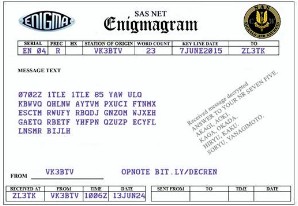
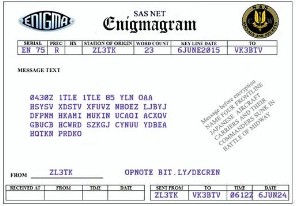
Reply a joy to read. It’s taken all these years to accomplish because no one had the courage to try; so many excuses. Hoping all members can now see how the CQ QRS Group played such a decisive role in this achievement, and the potential of the Group offers for members to achieve CW excellence.
In light of this proof and despite the dubious grammar, it’s easy to recognize the wisdom in a quote from ‘The Imitation Game’: “Sometimes it is the people no one can imagine anything of, who do the things no one can imagine. — Alan Turing Stan ZL3TK
If any of our readers would like to write something for the RagChew about something you think might be of interest to our 200-plus readers, please let me know so we can share more thoughts and ideas; email to cqqrsnet@gmail.com

Brain Teaser
Jules Perrin JP VK3JFP has created a terrific resource to help guide learning for all levels of amateur radio licenses: https://Awww.julesworkshop.net/Amateur%20Radio.html With thanks to Baz VK6MU for he idea, and Jules for the good learning website, here’s this week’s quiz questions from Jules’ Workshop example test questions:
Exam Questions:
Why should antennas be fitted with lightening protectors? Crystal oscillators are often used for frequency control in receivers because they + have more output than other oscillators * are more stable than L-C oscillators * radiate fewer harmonics than other oscillators * generate more harmonics than other oscillators A capacity hat or capacitive top loading is used on a vertical antenna to * to increase the bandwidth of the antenna * make the antenna more stable in high winds * to decrease the electrical length of the antenna * to increase the electrical length of the antenna Answers next week.


Answers from last week’s Quiz:
What instrument would you use to test the continuity of a cable? Answer: Ohm meter The best method of eliminating TV set front-end overload caused by proximity to an 80, 15 and 10 metre amateur transmitter is to * use a high pass filter on the tv receiver * use a low pass filter on the transmitter * install a wave trap in the TV set’s feedline * install a power line filter Answer: use a high pass filter on the tv receiver ‘Two tone tests are done to test the * linearity of an FM transmitter * power output of a CW transmitter * linearity of an SSB transmitter + symmetry of an FSK transmitter Answer: linearity of an SSB transmitter How did you go?
Di-dah-di-dah-dit
So back to the Slow CW QSO practice net.
Next Tuesday’s Net
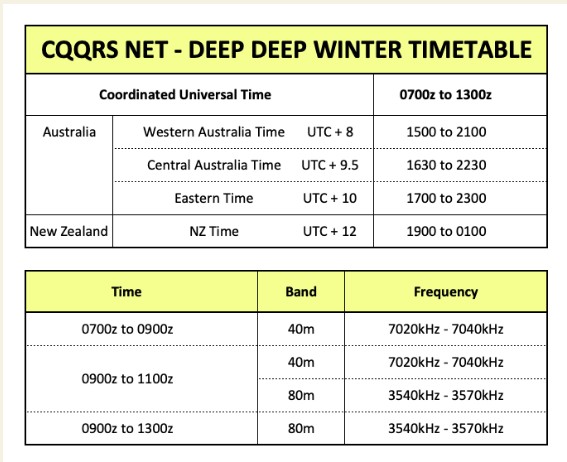
Our CQ QRS Net will be on as always on Tuesday from around 0700Z until about 1300Z; see below for details. Doesn’t matter whether you’re brand new and want to try just exchanging callsigns and RST reports, or you’re ready for a good old rag chew.
Please let me know via our Reports form bit.ly/CQQRSNET who you work or hear on Tuesday’s net. For stations on other bands (ie not 40m or 80m, please just use the 80m report area (separate out your 80m report from the other bands), and when you enter the list of callsigns worked, heard or missed, please append an ‘@band’ to each callsign without a space (eg VK2KI@20 VK6QI@15 etc); please don’t do the @band for 40m and 80m stations though.
Post Morsum
Richard VK6HRC will run our phone Post Morsum on the South West AllStar net (via repeaters and hotspots all over WA) from 0600 WA time, then from 0700 WA time on 80m (8605 LSB).
For the 0600 (22002) net, if you’re in WA all you need is an FM 2m or 70CM transceiver and an AllStar node nearby – if not… try 80m LSB.
If you’re elsewhere in the world, you may be able to connect your local AllStar-enabled repeater to the net, or you can connect via Echolink. Let me know (cqgrsnet@gmail.com) if I can help with that.
And if you can’t connect that way, give 3605KHZ SSB a try from 0700 (23002).
Teamwork
Thank you so much to our team of 45 contributors: DL3YZ, VK/MONNK, VK1DA, VK2AOE, VK2DLF, VK2GAS, VK2GAZ, VK2NAP VK2TIG, VK2TIG, VK2WF, VK3ACU, VK3AFH, VK3BTV, VK3BWN, VK3DRQ, VK3FG, VK3JFP, VK3KEV, VK3MLT, VK3RU, VK4DRK, VK5AO, VK5CZ, VK5DC, VK5ET, VK5FD, VK5GR, VK6BEK, VK6FN, VK6HRC, VK6IS, VK6KD/4, VK6KHZ, VK6NW, VK6RR, VK6WE, VK7KPC, VK7TA, VK7WW, YB1NWP, ZL1PB, ZL2GD, ZL3TK, ZL4BDG.
How good is that – 45 contributions – outstanding! GU CW on Tuesday, mb Mark Bosma VK2KI / VK6QI Beautiful South Bowning NSW mark.bosma@icloud.com non impediti ratione cogitationis

An Ode to CW – thanks to David VK3RU: In days of old, when ops were bold, And sideband was not invented, Words were passed by pounding brass, And all were quite contented. – Unknown author
Frequencies and Times
Speed
Matching
PSE QRS


Landing Zone
The opinions expressed in the RagChew newsletter are those of the individual contributors. The opinions do nat necessarily reflect that of the editor or of the C@ QAS Group members.