Below is a reconstruction of the 2024 20 CQ QRS RagChew newsletter designed to support full text searching. This reconstruction was built using OCR, and will contain errors.
To view the Mailchimp original, click here. To search the entire newsletter archive, click here.
Contents
- Last Tuesday’s Net
- New Team Members
- Masthead Image
- Reports
- Reports & Comments
- Comments:
- « From Pete ZL4TE at Cambridge:
- Identification
- Brain Teaser
- Answers from last week’s Quiz:
- Di-dah-di-dah-dit
- Next Tuesday’s Net
- Post Morsum
- Teamwork
- About the CQ QRS Net
- Matching
- Landing Zone
- CW Tips
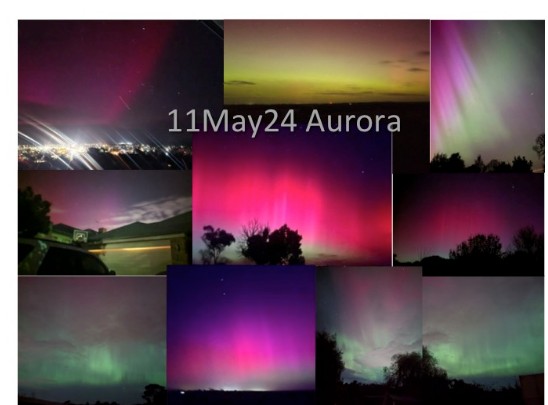
Well this week was an opportunity of a lifetime for many to see an Aurora in lower latitude skies to normal, and to experience the unusual effects of the geomagnetic disturbances that go with the mass coronal ejections expected at the peak of the sunspot cycle.
Thanks to all for the excellent photos; where I was was covered with cloud, so we missed out on the visual delights, but I was pleased to see our team members’ photos.
I expected that band conditions on 40m and 80m for our CQQRS Practice QSO net on Tuesday would be poor and that we’d be experiencing lots of auroral buzz, but that wasn’t to be.
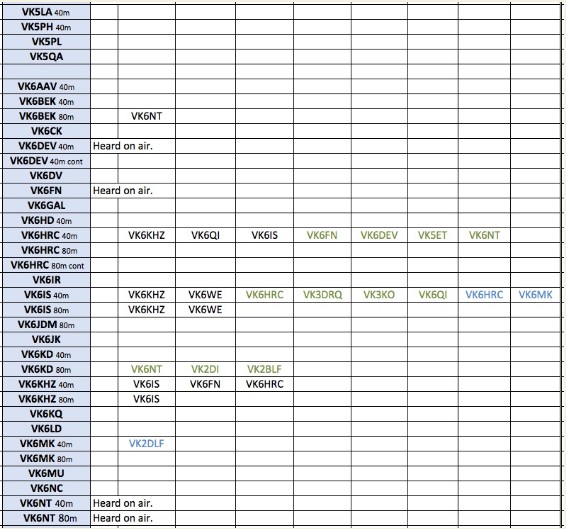
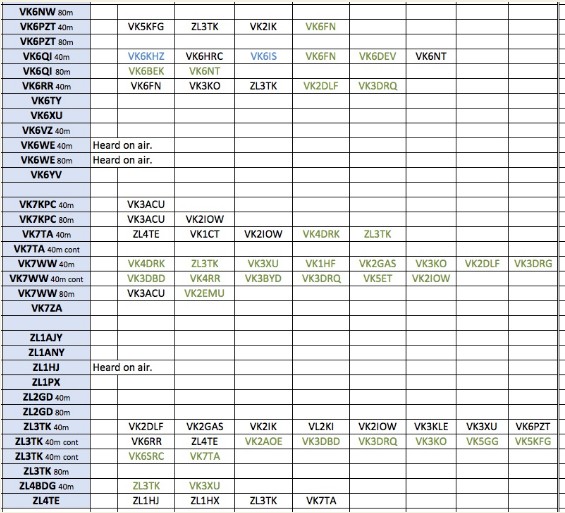
Conditions were on the whole ok – we didn’t get the strong ZL to WA 40m path experienced lately, and 80m wasn’t open from one end to the other either, but most Southern stations reported ok conditions; unfortunately, a couple of our team adventuring around the remote parts of Western Queensland and the Kimberley really struggled with the conditions – better luck next week guys.
Last Tuesday’s Net
New Team Members
This week I’d like to welcome Scott VK4MGL from Wellington Point to the team; Scott is a keen SOTA/Parks operator, who I’ve heard and worked a number of times from various portable locations.
I’d also like to welcome Arthur VK2ASB who joined in on Tuesday; like several others on our net, Arthur has been involved in promoting QRS for many years, having run the FISTS Tuesday night CW net and the Wednesday night QRS nets for five years some years back.
Masthead Image
And thanks this week to VK7WW, VK3AE, VK3ACU, G4RWI, VK6MJ and VKS5ATQ’s daughter for the spectacular aurora images. A virtual almond croissant goes to the first person to correctly identify which image was not of Aurora Australis (the person who provided the image has excluded him or herself from this quiz!); cqqrsnet@gmail.com.
Reports
After next Tuesday’s net, please send me a list of who you worked and / or who yot heard using our web form here: bit.ly/CQQRSNET
Getting reports from stations and listeners is important to me – even if you listened and didn’t hear anyone or weren’t able to copy anything – the fact that you had a go needs to get recorded so we know that the net is working and attracting new and old team members to have a go.
And if you have any trouble with the form, please let me know – I may be able to help cqgrsnet@gmail.com Thanks again to Nigel G4RWI for building the Google Form, the Python software back-end that does the processing, the new link and the QR code.
Cheers, mb Mark Bosma VK2KI / VK6QI Beautiful South Bowning NSW mark.bosma@icloud.com non impsditi ratione cogitationis
Reports & Comments
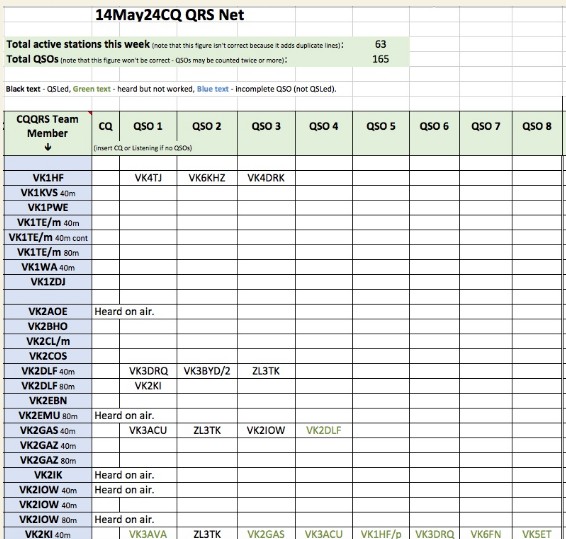
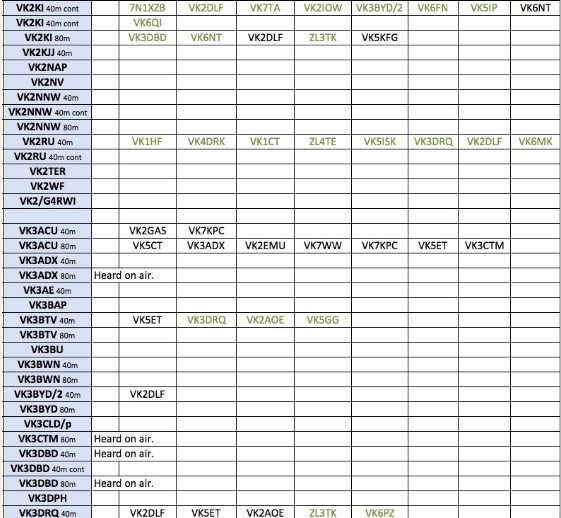
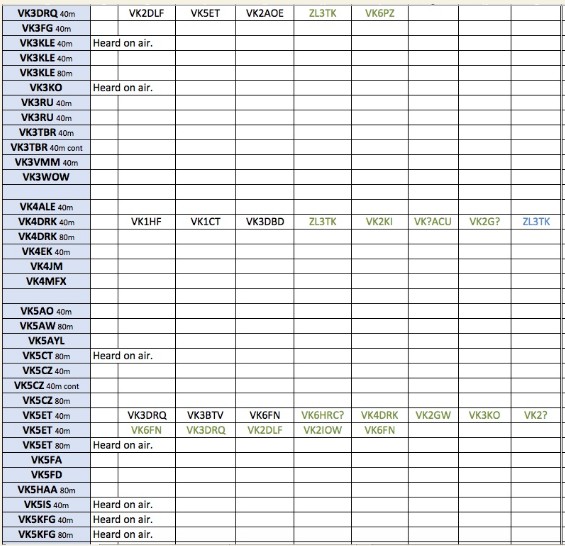
The spreadsheets above show the known stations on last Tuesday’s net. Comments distilled from the reports I’ve received are below:
Comments:
« From Pete ZL4TE at Cambridge:
[40m] ¢ Love not having any filters switched in! ¢ Hearing three stations at once and being able to switch from one to the other, using my brain as the ‘focus filter’ [80m] ‘© Some great QSOs tonight – thanks everyone who came up. © 80M was great [40m] © Good to hear so many CW stations active. [40m] © Thanks to my ten contacts, all of whom accepted the experiment of single sentence “Today in History’ QTC, along the lines of a Whisper without the attendant responsibility. © For five of the ten OMs, sufficient interest was raised to extend those QSOs surprisingly well. [40m] ¢ I had 3 QSOs, all on 40m; 2 between 0800Z and 0930, and then I came back late for another one after 1200Z. ¢ Thanks everyone; it was a good night of CW. [80m] © Tuned my receiver to 3.563MHz and was listening in on a CW QSO when I noticed my noise floor was an S1 © This never happens at my home QTH © What had changed? I hadn’t tuned my antenna yet ° After tuning my antenna the noise floor was back to normal S8 [80m] ¢ Squadcal again with 7W on the 80m band. ¢ Pat VK2IOW was very patient with my slow rx speed – tnx. From John VK2RU 100KMS West of Boulia QLD: © [40m] © I had very poor signals coming in all night © I could make out call signs after a few repeats © I wasn’t confident that I would be able to copy properly and didn’t make any contacts. © [80m] © 80m was dead for me again. strange conditions John. Others seemed to do ok on 40m, and some had some luck n 80m, but Stuart VK6MK in the Kimberleys also heard very little; see below]. From John VK2RU 100KMS West of Boulia QLD [40m] I had very poor signals coming in all night. I could make out call signs after a few repeats. I wasn’t confident that I would be able to make any contacts. From John VK2RU 100KMS West of Boulia QLD: © [40m] © I had very poor signals coming in all night © I could make out call signs after a few repeats © I wasn’t confident that I would be able to copy properly and didn’t make any contacts. © [40m] © Got started late © Could hear a number of very light stations, but there were only 4 that I could really copy successfully © I guess that’s what I get for running an 8m long 40m dipole at 4.5m elevation 🙂 © Enjoyed my QSO with John VK5ET – he remembered my name and ever spelt it correctly – bonus! [40m] Some missed opportunities in there, somewhere. [80m] Still not much action on 80m tonight. [Tell us about the interesting looking display Peter.] ¢ From Stuart VK6MK at Mandangala Community, NE Kimberley ° [40m] © No contacts low conditions up here. [Interesting that both you and John VK2RRI7 in the lower latitudes reported really poor conditions. More research by me needed to understand the way the fonosphere works at those latitudes as the tilt of the earth increases exposure to the sun’s radiation around the equinox… Then throw the high solar activity into the mix! The prediction for Kununurra to Melbourne shows that the Absorption Layer Frequency is above the 40m band for both first (one hop) and second (two hop) modes until between 0800 and 0900Z. Kununurra to Perth and Mt Isa to Melbourne have the second mode ALF lowering a little bit earlier. Thanks for trying mate.]
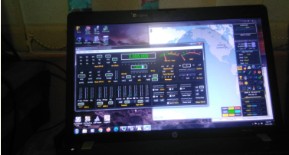
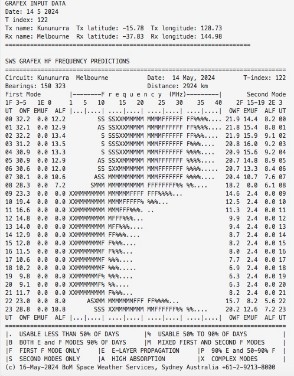
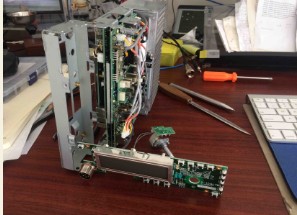
From me VK6QI via the VK6SR Remote at Bedfordale: ° [40m] e The VK6QS KiwiSDR at Brookton had been down for a few days; Matt the owner did a great job trying to get it back up and running in time for the net, and advised me just before the start that he’d re-connected the cellular network data, but hadn’t been able to get the SDR back on air – thanks very much for trying Matt. So instead I used three other KiwiSDRs in WA – our team member Nick VK6DV at St James has one, the Southern Electronics Group has one being tested at the location of the VK6SR Remote, anc There was another one at Baldivis; I didn’t get to try the AusTravelSafetyNet one at Yarloop. First up on 40m I heard Ron VK6KHZ at Yangebup calling CQ and went back to him from the VK6SR Remote; unfortunately once again Ron couldn’t hear my call despite his big signal. However, I also saw Richard VK6HRC calling CQ from Padbury – and we hooked up for a nice QSO. Peter VKGIS called in from Wundowie at the start as we were establishing comms, exchanging RSTs etc – and by the time we called him in, he’d headed off to find more interesting pasture. Meanwhile, Max VK6EN at Manjimup had hooked up with Ron then Phillip VK6DEV at Dalyellup, and Peter had hooked-up with Richard. I did manage to solve a problem though. = I’d experienced really lousy sounding audio from the Remote over a long period of time – CW sounded like a raspy buzzer, which had been a mystery to me and to Rob VK6LD who built the system. Most of the time, others didn’t have the same problem. = Well Tuesday was my lucky night… after playing with all the Remote’s settings I discovered that knocking the RF gain down, fixed the problem… and explained why when I worked Richard, he wasn’t moving the S-meter… sure enough the AGC was turned off! = When I use the Remote, I usually put it on frequency using one of the memories where I’d saved 3555KHZ and 7032KHZ CW = Looks like the memory setting had the AGC switched off – so strong signals were over-loading the receiver… simple as that! = You’d think after playing with shortwave receivers for 60 years, I’d be a bit quicker on the uptake – HI! In listening to the various SDRs, it was interesting to note that local signals (ground wave or high incidence angle skywave) were well down on normal; possibly a result of the geomagnetic storms. By around 1000Z, the band was starting to open up from the East, and I listened-in to Manny VK3DRQ at Blackburn chatting to John VET at Hope Valley, then later Georg VK2DLF at St Marys working Warren VK3BYD portable somewhere in NSW. = As it turned out, Warren was camping at Jugiong, just down the Hume Highway from me. Jalso listened to Max working VKSIP at Kadina. = The South Australian signal had a very pronounced echo – so strong that it was impossible to distinguish the CW characters. = On the SDR his signal was just a burble of stronger and slightly weaker characters. = An interesting Auroral effect I reckon. = I spoke to Max the next day and he said the echo was not heard at all at Manjimup. Next up I hooked up with one of our early team members, Lin VK6NT at Hamersiey; it was good to chat to Lin again on one of the rare Tuesdays when he could get on ait. After that chat, it was time to slide down to 80m to cast a line [80m] Again this week, the Southern Electronics Group VK6SR Remote station refused to play the game for me on 80m. = The magnificent 12m high x 60m top-hat Marconi-Tee used to be a very effective antenna for both local and DX on 80m. = But something has changed in the last year or so, and it just doesn’t want to play ball any more. = The FT-991A is connected to an automatic antenna coupler (the so-called and mis-named automatic antenna tuning unit) which would produce a 1.5:1 or even 1:1 SWR in the middle of the band. = However on Tuesday, as soon as I moved below 3574KHZ, the ‘SWR shot up. = A 1KHZ change and the SWR would go from 1.5:1 to about 7:1 = I suspect a problem with the coupler – and understandably, Rob VK6LD (the SEG’s do-everything member) has had too many other priorities to think about it. So, because our net’s segment is from 3540 to 3570, I couldn’t TX from VK6 on 80m on Tuesday. Instead on 80m I concentrated on operating from VK2 (see below), but I also used one of the plethora of KiwiSDRs in WA to watch the band However, because I was late to the game, I only heard one late night @SO between Shaun VK3BEK at Quinns Rocks and Lin VK6NT at Hamersley And unlike last week, there was no sign of any signals at all from over East, so by 1300Z I headed to bed • Also From me VK2KI at Beautiful South Bowning: © [40m] © First up on 40m I heard VK3AVA calling CQ, but I hooked up with Stan ZL3TK at Waitarere Beach who was romping in at RSN583 (the noise leve would have been 9 if not for my cheap Chinese phasing-type noise canceller). ° Stan was trying a new messaging experiment… sending a short ‘on this day in history’ phrase – this time the topic was Australian football, with the first recorded game on April 14TH. See below for more from Stan about this exercise. » In return, I was having transmitter problems again; the output power intermittently dropping off. A couple of years back I completely disassembled my nice little Kenwood TS-50 chasing what I thought was either a poor solder joint in the PA, or a fault in the ALC loon. Turned out to be a problem with a bit of intermittent resistance in the 13.8 Volt supply; because the LCD illumination is powered off a regulated supply, the dropping DC voltage wasn’t visible on the display. So on Tuesday when it happened again, Stan waited patiently while I squirted contact cleaner here and there, replace the blade fuse, continually re-tightened the terminals on the power supply, tightened the contacts in the DC plug on the transceiver and even swapped power supplies. More work needed – what fun! Meanwhile on the Tecsun KiwiSDR at Araluen NSW I heard our new team member Armin VK2GAS at Norwest chatting to Jordan VK8ACJU at Meredith, then lan VK1HF/P at Mount Coree chatting to Manny VK3DRQ at Blackburn. By 1000Z, the band was starting to open across Australia and I heard Manny chatting to John VKSET at Hope Valley, then CQ calls by 7N1XZB (a Japanese callsign apparently) and Georg VK2DLF at St Marys. Iheard Patrick VK2IOW at Millthorpe worked lan VK7TA at Latrobe then Stan ZL8TK, while Georg went on to catch up with our traveller, Warren VK3BYD portable somewhere in NSW… just down the road from me as it turned out. Jalso listened in to the QSO between Max VK6EN at Manjimup and VKSIP – there was no Auroral echo on VKSIP’s signal coming back to NSW, despite his CW being unreadable when I listened in WA due to the very strong echo. I then listened to my VK6QI QSO with Lin VK6NT at Hamersley before we tried from VK2; Lin was a solid Q5 with slow rolling QSB, but he was struggling to hear me the other way. By then it was time for us both to slide down to 80m. • On 80m listened to David VK3DBD spelling his QTH (Yakandandah) to Lin VK6NT; I figured that the first few times David operated from there, he probably had to write the name down before sending it by Cw! I then hooked up with Georg VK2DLF who I thanked for his efforts to promote our QRS activities; Georg explained that he’d been actively promoting and running QRS activities for the past 20 years; well done Georg. To round-out the night, I caught up with Greg VK5KFG at Willunga whose “The CW Way of Life: Learning, Living and Loving Morse Code” book review was in the last RagChew. In parallel I could hear Stan ZL3TK calling CQ a bit further down the band – and I thought I was burning the midnight oil! The next day on the Post Morsum net, Stan reported that he’d hit the hay at 2:45am! Good thing his wife Ruth is also an amateur, and understands these things – HI! So all in al, it sounded to me like there wasn’t as many stations on as last week’s record effort of 82 stations (| reported 51 in the newsletter, but I chatted later to Trevor VKSATQ and learned that he had also been listening in last week… And no-doubt there were many others we don’t know about too); but time will tell – let’s see what the reports tell us. [40m] © After the NZ Net, I almost forget the CQ QRS CW and started tuning and preparing everything for Wednesday’s VK CW Net on 14049 @ 06082. © Allof a sudden, I just realised, and tuned everything back to 7032. © After a couple of calls, I started to get the benefits. © As per the previous times, it was fun to have three OMs coming and none of them I can recall have met before on my 42 years of CW as a Radio Amateur. © They all were RSN 595 with a +10 to 30 dB margin. © After just under two hours of tapping and just one day after my visit to the TORTURER (aka the Chiropractor), my body started to ache, so slowly, slowly I was getting ready to hit the sack. © I tried but was sorry to miss VK6PZT but by then the noise level was creeping, reading already S6 and VK6PZT was only RSN 366. Oh well, another time hopefully. © Happy CQ QRS CW, Manny VK3DRQ+ 73877 to you all. * [40m] © Worked three on 40m – VKSKFG, ZL3TK and VK2IK. © [80m] © Called on 80 for a while but it was dead. From Richard VK6HRC. Only a small group called in on AllStar Wednesday morning. I was ready to go well before the 06:00 start time and Stan ZL3TK called in and got the net going on time. As it turned out, the WA AllStar network was suffering from gremlins so others like Max VK6EN were not able to hear the net. On this morning : + ZL3TK Stan + VK6QI_ Mark * our short wave listeners and + myself. Stan has come up with another very interesting idea to keep us on our toes, a simple message handling exercise that he kicked off last night. Apparently well received by all accounts, there will be an update in this RagChew. Mark gave us a quick report on how he got on but numbers recorded seemed below last week’s 52 stations on air, and conditions were not that great. Thank you Mark, hope the Handy-Dandy software behaves. 73 Richard VK6HRC | am not surprised you had 52 on air last week. Amateur radio needs the enthusiasm and positive culture you have driven your project with. After the factional war that occurred in WIA a few years back and the animosity shown to those who dared to set up RASA, I think a lot of the amateur community felt drained of energy. We turn to the political pages of the news if we want to see supposedly adult people brawling over trivia, we do not need it in our area of interest. For AR to survive it needs projects such as our net. CW is seen by some as a preserve of those who are skilled in CW. That made many who wanted to develop skill over time in a friendly environment feel excluded. G-QRP is another group that has a positive culture and seems to be thriving Some local electronics and amateur groups in Australia likewise seem to be floating well. Your contribution to AR is significant and I hear people on air who have not joined yet talking about it. Some I am aware are listening in to our clumsy attempts at the code. Culture is the glue that makes or breaks groups. You have triggered a great outbreak of positive culture – do not under-rate your achievement. Talking of achievements, when I get that KRC chap on the net – that will be an achievement. 73 Donald Howarth VK6JDM. [Why, thank you Donald. 1 know you’re a busy man, and I appreciate that you took the time to pen your thoughts. Yes, it’s great to see the positive response, new team members joining most weeks, and the fun the team is having. I think you’re right; we’re lucky to have a terrific positive culture. I also experienced the divisive exclusive CW culture when I was first licensed in the early 70s. But now we have lots of people on air at different speeds and abilities – on-air mistakes and difficulty are par for the course and no-one gets their nose out of joint, because someone’s learning from the problems. Hopefully we’re giving newcomers some confidence and opportunities to have a go in our safe sand pit. And while you’re revving up that KRC fellow… keep the pressure on that other CW learner – Six Oscar India too.) [Why, thank you Donald. I know you’re a busy man, and I appreciate that you took the time to pen your thoughts. Yes, it’s great to see the positive response, new team members joining most weeks, and the fun the team is having. I think you’re right; we’re lucky to have a terrific positive culture. I also experienced the divisive exclusive CW culture when I was first licensed in the early 70s. But now we have lots of people on air at different speeds and abilities – on-air mistakes and difficulty are par for the course and no-one gets their nose out of joint, because someone’s learning from the problems. Hopefully we’re giving newcomers some confidence and opportunities to have a go in our safe sand pit. And while you’re revving up that KRC fellow…. keep the pressure on that other CW learner – Six Oscar India too.]
Ayoung woman submitted the tech support message below. She got a reply from Tech Support that was way too good to keep to herself. Dear Tech Support, Last year I upgraded from Boyfriend 5.0 to Husband 1.0 and noticed a distinct slowdown in overall system performance, particularly in the flower and jewellery applications, which had operated flawlessly under Boyfriend 5.0. In addition, Husband 1.0 uninstalled many other valuable programs, such as Romance 9.5 and Personal Attention 6.5, and then installed undesirable programs such as: NBA 5.0, NFL 3.0 and Golf Clubs 4.1. Conversation 8.0 no longer runs, and House cleaning 2.6 simply crashes the system. Please note that I have tried running Nagging 5.3 to fix these problems, but to no avail. What can I do? Signed: Desperate The response (that came weeks later out of the blue): Dear Desperate, First keep in mind, Boyfriend 5.0 is an Entertainment Package, while Husband 1.0 is an Operating System. Please enter command: I thought you loved me.html and try to download Tears 6.2. Do not forget to install the Guilt 3.0 update. If that application works as designed, Husband 1.0 should then automatically run the applications Jewellery 2.0 and Flowers 3.5. However, remember, overuse of the Tears application can cause Husband 1.0 to default to Grumpy Silence 2.5, Happy Hour 7.0, or Beer 6.1. Please note that Beer 6.1 is a very bad program that will download Snoring Loudly Beta version. Whatever you do, DO NOT, under any circumstances, install Mother-In-Law 1.0 as it runs a virus in the background that will eventually seize control of all your system resources. In addition, please do not attempt to re-install the Boyfriend 5.0 program. These are unsupported applications and will crash Husband 1.0. In summary, Husband 1.0 is a great program, but it does have limited memory and cannot learn new applications quickly. You might consider buying additional software to improve memory and performance. We recommend Cooking 3.0. Good Luck Tech Support BOSS [Thanks to our Team’s Software Support, Nigel G4RWI – now back in the UK for six months]
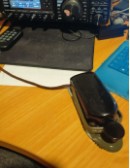
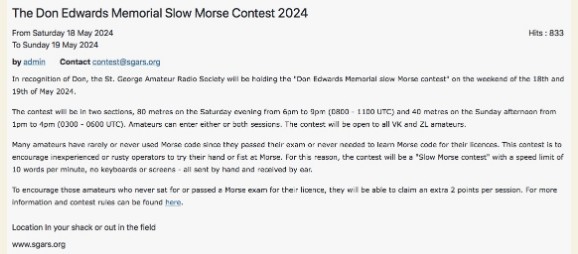
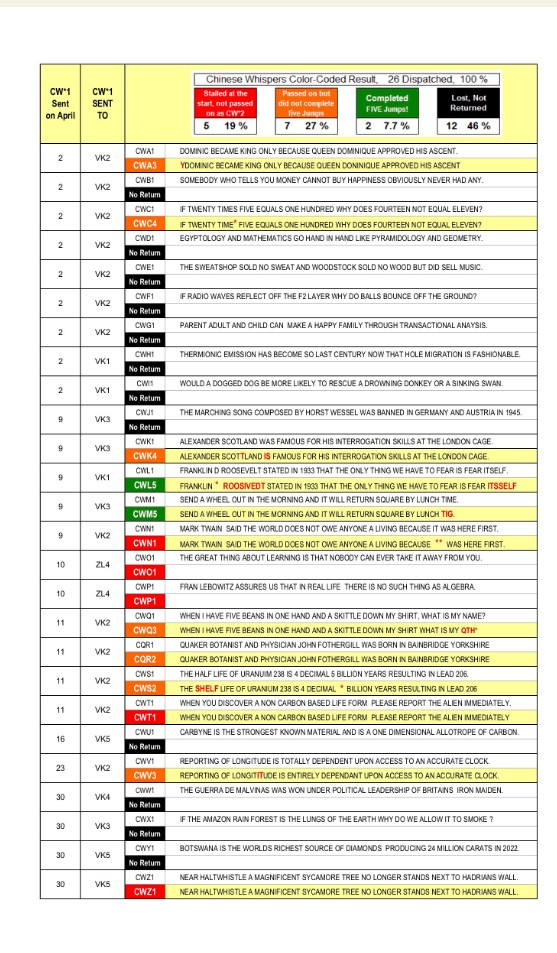
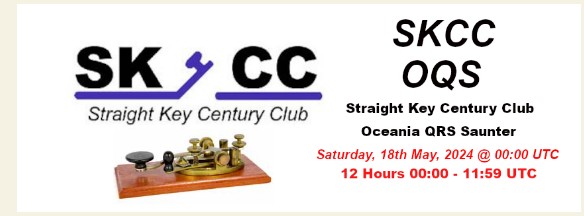
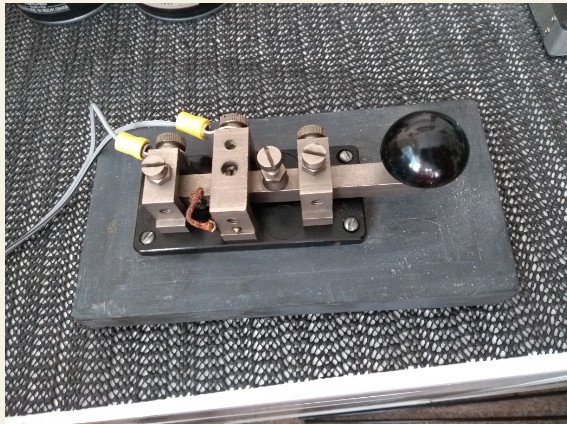
Don Edwards Memorial Slow Morse Contest 2024 Saturday Anm ~- GQnm (Gvdnev time) an RNm Jon Edwards Memorial Slow Morse Contest 2024 Saturday 6pm – 9pm (Sydney time) on 80n Siindayv Iinm ~- dnm (Svdneay time) an ANm Here’s the rules: https://www.sgars.org/index.php/downloads/1-contest-and-field-days/146-the-don- edwards-memorial-slow-morse-contest-2024-rev3 Thanks to Peter VK2EMU for running this event again]. WE CCR ww VE Sewer awe www SUE Vere To help our CQQRS Community celebrate International Morse Code Day, Stan ZL3TK offered to run an exercise called Chinese Whispers. ¢ The event went for the entire month of April. ¢ Stan created 26 short phrases and passed them to the the team and other CW operators. ¢ The phrases were passed from operator to operator as accurately as possible. « Any phrase that had been passed five times was sent back to Stan for comparison with the original, a-la the Chinese Whispers game. Well lots of us had fun trying to both copy accurately and send accurately; surprisingly, it wasn’t as easy as it first appeared; concentration was required, especially for those used to head copying. TVUU Vall OOS NUIT LUIS OUTTA y. ¢ Stan sent out all 26 messages over the month when people asked. ¢ Five weren’t able to be passed on by their first recipients. « Seven made a second or more hops, but didn’t make it to the end. ¢ Two messages actually made it all the way around, and found their way back to Stan after five hops. ¢ 12 messages are still out there… lost and lonely! So of the ones returned, how did they compare to Stan’s originals? | was surprised to see that despite being sent letter-by-letter, changes still happened along the way. Just goes to show eh? Thank you to Stan for coming up with the idea, compiling the messages, managing the activity in April then compiling the results. And in turn, thank you to all recipients of the 26 messages for having a go, and an especial congratulations if you handled one of the messages that progressed completely or even partly around the loop. The results can also be found here: https://qsl.net/zl3tk/whispers/whispers.htm Thanks Stan – your efforts were much appreciated by everyone who had a go. Now… what are we going to do to celebrate Alfred Vail’s Birthday in September I wonder? Greetings to all, The SKCC Oceania QRS Saunter will take place this Saturday, 18TH May, 2024 fre 00:00 UTC until 11:59 UTC for the 12 hour event. All are welcome to join in! All the details for the Oceania QRS Saunter (OQS) can be viewed on the SKCC website at: https://www.skecgroup.com/operating_activities/oas/ Please make use of the SKCC Sked Page and the CW Club RBN Spotter. Https://sked.skeegroup.com/ https://ron.telegraphy.de/ look forward to contacting you during the event. Best regards, Yf PO Unt a Ld) Le) from Stan ZL3TK It’s always the unexpected, the out-of-context, the unfamiliar, which catches us out. Standard QSOs consisting of a signal report, name, QTH and tig are great for practice, but offer no real challenge for more experienced operators; after a few months operating on small get-togethers, everyone knows everyone else and only the weather changes. There’s the odd Alzheimic exception of course. The ‘Today in History’ experiment carried out on the CQQRS Net on May 14TH, was done to provide the unexpected, in the same way as old Maritime and Coast Station operators were confronted every day by commercial reports from ships’ captains and personal traffic between passengers and their land-based correspondents. A ‘Today in History’ message consists of a single sentence and a 4-digit year. Unlike our Chinese Whispers, they come without any requirement to be passed on…. they’re simply for self-assessment. To make the most of this training opportunity, after receiving a “Today in History’ sentence read it carefully; if it doesn’t make sense ask for a repeat using the standard non-contiguous prosigns: WA, WB, AA, AB or BN. Here are the ‘Today in History’ sentences distributed on 14 May: * THE NETHERLANDS SURRENDERED TO INVADING GERMAN FORCES, TODAY 1940, THE FIFTH EUROPEAN COUNTRY TO BE OVERRUN. Sent to VK3KLE & ZL4TE + DAVID BENGURION DECLARED THE ESTABLISHMENT OF THE STATE OF ISRAEL TODAY 1948 AND BECAME THE COUNTRYS FIRST PRIME MINISTER. Sent to VK6RR: * THE CEO OF META MARK ZUCKERBERG BORN TODAY 1984 SAYS HE PREFERS MAKING DECISIONS HIMSELF AND DOES NOT BELIEVE IN DELEGATING. Sent to VK2IOW * DLEGATES GATHERED IN PHILADELPHIA TODAY 1787 TO DRAW UP THE CONSTITUTION FOR A NEW AMERICAN GOVERNMENT. Sent to VK2GAS & VK2IK * UK DOCTOR EDWARD JENNER TODAY 1796 ADMINISTERED THE WORLDS FIRST VACCINATION TO AN 8 YEAR OLD BOY, AGAINST SMALLPOX. Sent to VK3XU & VK2DLF * AUSTRALIAS FIRST AND OLDEST FOOTBALL CLUB WAS FOUNDED TODAY 1859 IN MELBOURNE. Sent to VK2KI & VK6PZT It has been noted that accurate sending is almost as much of a challenge as receiving, so everyone is invited to create their own ‘Today in History’ exercises for transmission to their contacts. It’s real easy to set up: + simply Google the phrase ‘Today in History’ and construct appropriate sentences from the information provided. + Read them carefully to ensure they make sense. + The more the merrier. DIY training like this can be spread right through the CQ QRS Group. Nic VK7WW runs a Slow Morse training net every Wednesday at 7pm EDST on 3580 for 30 mins. He uses the callsign of the Northern Tasmania Amateur Radio Club VK7TAZ on that net. Many of our team learned Morse code with the support of Nic, and the weekly training session comes highly recommended for anyone who wants to learn the Code, or simply brush up. Everyone’s welcome – 3580KHZ at 7pm Eastern time every Wednesday. The NTARC also feeds the CW live via the Discord phone / computer audio stream, and previous weeks’ recordings are available. Contact Nic VK7WW for more info nicholaschantler@hotmail.com – or just join in on Wednesdays. Key, Signalling, WT 8 Amp No.3, mk1 Called the WT (wireless telegraphy) 8 Amp because it was rated for 8 Amps, being tested for 10 minutes of normal operation with 12 Amps applied to the contacts. An unusual feature of its construction is that the main contacts are at the back (well away from the knob). One contact is located on the top of the rocker arm; the fixed contact is on a screw attached to a stirrup-shaped piece of metal (“bracket”). The bracket closest to the knob supports a further contact that can, if required, send a signal to turn the receiver off and the transmitter on when the rear contact is made (the opposite of QSK?). • Gerard Electric Manufacturers Ltd. of Adelaide (aka “Clipsal”?); + Department of Defence Australia; + EWT (oD contractor); + LC (DoD contractor); + Postmaster-General, Postal Workshops, Melbourne (after the war the Workshops converted some of these keys for use on PMG landlines). Shortly after the introduction of this military key (possibly due to pressures of war and scarcity of materials) several design changes took place – a change of bearing type from taper pin to parallel pin, and of spring tensioner from the PO-style to a simple screw and locknut tensioner. Identification While some keys have various forms of lever insulation (depending on the use to which they were put), other identical keys may or may not have such insulation. The most common insulation is a simple sleeve of square section that slides over the arm of the key and is secured by the knob screw. Insulating sleeves found on key arms were used when a key was fitted in a ‘Key & Plug Assembly’ – protective cases covering the key for field use, having thigh straps which enable the key to be located on an operator’s leg. Many keys have had these original protective cases removed but nevertheless retain the insulation. Lever insulation does not, therefore, appear to be a useful identification characteristic. This same qualification applies to finger plates or knob skirts – some keys have finger plates of various sizes and materials while other similar keys are without them. My variant is distinguished by its: + three brackets + simplified spring tensioner (compression spring) * parallel bearing pin * plain simple knob, no lever insulation My particular key has the serial number “*ZA4605″ which denotes that it was manufactured by Ericsson Telephones Ltd, Beeston, Nottinghamshire (later part of Plessey and GEO), probably in 1941. ‘Two or more versions were made by this company: * No.2, serial number ZA4511, 1940. * No.3, serial number ZA4605, 1941 “*(this one)** SPECIFICATION TO MANUFACTURERS Description Asingle-current key with tungsten contacts, brass lever, flexible connection, ebonite knob and guard; mounted on an ebonite base. Overall dimensions: 5 13/32 ins long x 2 1/4 ins wide x 1 13/16 ins high approx. Materials * Brass -To be 70/30 hard drawn or rolled of best quality, free from splits and other defects. * Brass castings – To be 70/30, free from blow holes, pitting and other defects. * Ebonite -To conform to the latest B.S. specification No.234, 45 * Steel – To be stainless and of best quality. * Steel for springs – To be best quality, hard drawn. * Wire electric R13, Mk.1-To conform to the latest R.S. specification, Screw Threads & Nuts To conform to the latest BS Specification No.93 for BA threads; even numbers only to be used. Construction * Base – to be of ebonite. + Front bracket, centre bracket, back bracket, lever – each to be of brass. * Contacts – to be of steel, faced with Tungsten, the latter to be welded to the former in such a manner that neither of the metals will develop rust. * Spring – steel wire No.22 SWG. When stretched by 3/8 ins and released it must return to its original length. The metal shall not develop rust. * Connection, flexible – to be Wire Electric R.13 mk1, securely soldered to 2 No.8 BA lugs, holes of lugs to be 1 3/4 ins apart. Resin only to be used as a soldering flux. * Axle pin, axle pin screw, spring adjusting pin, spring adjusting screw, spring retaining pin – to be of Stainless Steel. Finish * Eborite – to be finished smooth and dull * Brass – to be finished smooth and dull nickel plated * Spring – to be dull nickel plated * Contacts – to be finished flat and their surfaces burnished Markings The key to be engraved on the front edge of the base in No.8 characters. The makers initials only are to be marked. Any other marking callled for is to be adhered to. It’s good to see that the WT 8 Amp is popular in Australia too. They’re a key with a bit of history to them. Like a British equivalent of the J-38. Maybe we should start a WT 8 Amp fan club! Ross MONNK [Thanks Ross – fantastic work! Ross has also provided a document by which followed a world-wide survey of WT 8 Amp keys – this is an amazing document – which I think will be agreed by anyone with even the vaguest interest in keys. Click on the button below to download the document. Enjoy…]
If you have something you’d like to share with others via the RagChew, please let me know; email to cqqrsnet@gmail.com Jules Perrin JP VK3JFP has created a terrific resource to help guide learning for all levels of amateur radio licenses: https://www. julesworkshop.net/Amateur%20Radio. Html With thanks to Baz VK6MU for he idea, and Jules for the good learning website, here’s this week’s quiz questions from Jules’ Workshop example test questions: Why do we have dedicated amateur bands? An interfering signal from a Standard transmitter appears on 56.6MHz. This could be due to the: * crystal oscillator operating on its fundamental frequency * second harmonic of a 10 metre transmission * third harmonic of a 15 metre transmission * seventh harmonic of an 80 metre transmission The maximum frequency deviation in an FM transmitter is 3000HZ. The modulation index, when the highest modulating audio frequency is 1000HZ is: * 0.3 ed *3 * 30 Allog book must be kept: (a) For use at the licensed address, but it is not necessary for mobile operation (b) To be shown to a police sergeant on request (c) To record any distress messages (d) By club stations How did you go? What band would 2M or 144MHZ band fall within? Answer: VHF band To extend the range of an ammeter it is necessary to use at * resistor in series with the meter * resistor in parallel with the meter * rectifier in series with the meter * capacitor in parallel with the meter Answer: resistor in parallel with the meter The time constant of a 500 microHenry inductor and a 50 ohm resistance is * 0.2 microsecond * 5 microseconds * 10 microseconds * 125 microseconds Answer: 10 microseconds A television picture is required to be identified: (a) By having the callsign shown permanently in one corner of the picture (b) By showing the callsign at least once every 10 minutes and at the beginning and end of a series of transmissions (©) By having the callsign shown in the frame blanking pulse in digital form (d) By showing a picture of the amateur station and operator at least every 10 minutes Answer: (b) By showing the callsign at least once every 10 minutes and at the beginning and end of a series of transmissions How did you go? So back to the Slow CW QSO practice net. Our CQ QRS Net will be on as always on Tuesday from around 0700Z until about 1300Z; see below for details. Doesn’t matter whether you’re brand new and want to try just exchanging callsigns and RST reports, or you’re ready for a good old rag chew. Richard VK6HRC will run our Post Morsum on the South West AllStar net (via repeaters and hotspots all over WA) from 0600 WA time. If you’re in WA, all you need is an FM 2m or 70CM transceiver and an AllStar node nearby. If you’re elsewhere in the world, you may be able to connect your local AllStar-enabled repeater to the net, or you can connect via Echolink. Let me know (cqgrsnet@gmail.com) if I can help with that. Thank you so much to our team of 33 contributors this week: ZLATE, VK2GAS, VK7WW, VK3ACU, VK6RR, VKSET, ZL3TK, VK6BEK, VK4DRK, VK6KD, VIIHE, VK7TA, VK6HRC, VK6KHZ, VKSBYD, VK7KPC, VK2RU, VK3BTV, VK6IS, VK6MK, VK3DRQ, VK2DLF, ZL4BDG,VK6PZT, G4RWI, VK2GAZ, VK2EMU, MONNK, VK3AE, VK6MJ, VKSATQ, VK6JDM and VK3JDM; a special thank you to Ross MONNK for the excellent research into the WT 8 Amp key. Thank you team – GY CW on Tuesday, mb. Mark Bosra VK2KI/ VK6QI Beautiful South Bowning NSW mark,bosma@icloud.com non impediti ratione cogitationis The opinions expressed in the RagChew newsletter are those of the individual contributors. The opinions do nat necessarily reflect that of the editor or of the C@ QAS Group members.
Identification


Brain Teaser

Answers from last week’s Quiz:
Di-dah-di-dah-dit
Next Tuesday’s Net
Post Morsum
Teamwork

About the CQ QRS Net
Matching


Landing Zone
CW Tips