Below is a reconstruction of the 2024 19 CQ QRS RagChew newsletter designed to support full text searching. This reconstruction was built using OCR, and will contain errors.
To view the Mailchimp original, click here. To search the entire newsletter archive, click here.
Contents
- New Team Members
- Reports
- Reports & Comments
- Comments:
- This Week’s Topic of Interest
- Brain Teaser
- Answers from last week’s Quiz:
- And a correction by Stan ZL3TK:
- Di-aqah-ai-aan-ait
- Next Tuesday’s Net
- Post Morsum
- Teamwork
Boy! Did you have fun on Tuesday night? This time we had lots of people on both 40m and 80m, good propagation and for most people, low band-noise conditions which made for a great night for all concerned. How did you go?
See further down the newsletter for reports from many of our participants.
Here’s this week’s list of the 51 stations hear«
Here’s this week’s list of the 51 stations heard:
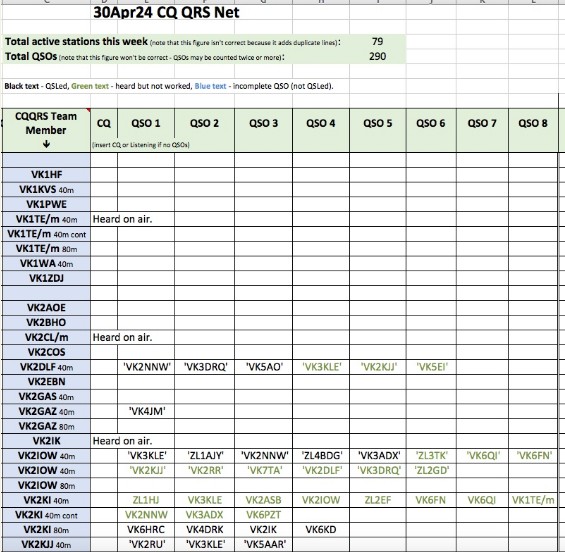
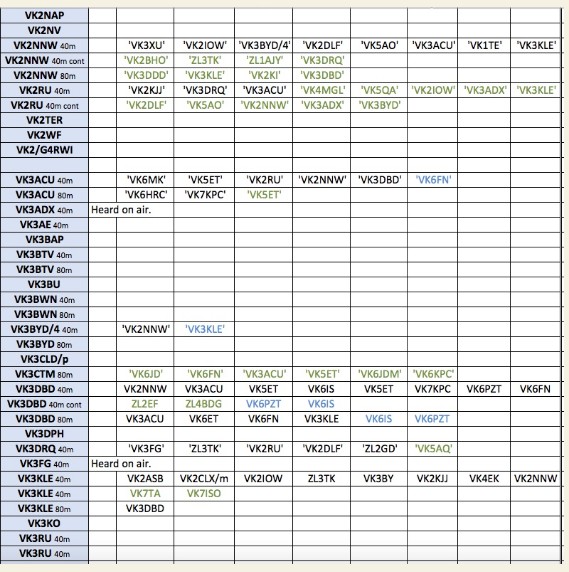
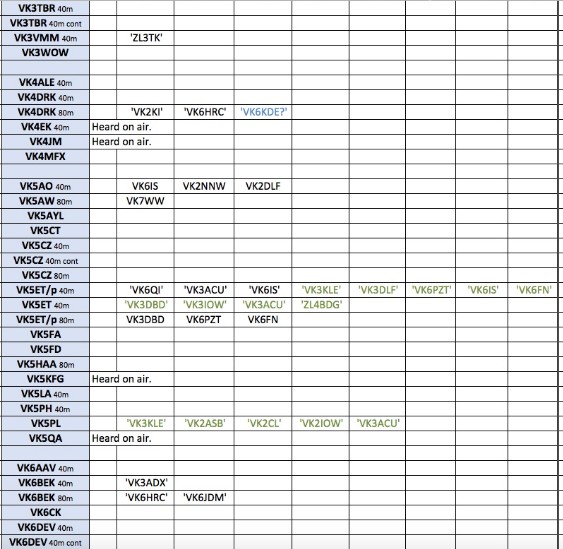
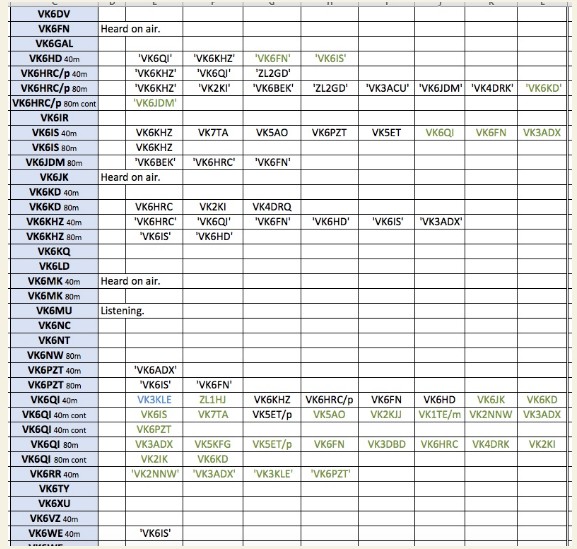
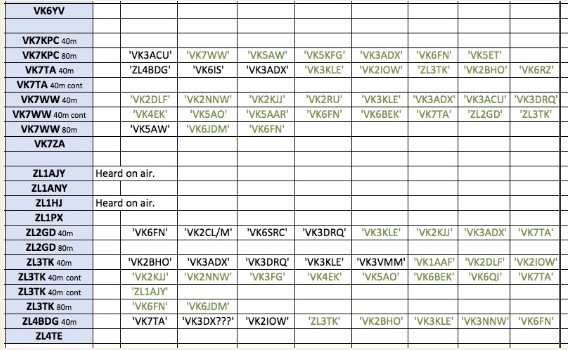
Yes… you read that right – 51 of our team were on air… a new world record for our net! And there were many others on who either weren’t yet part of the team, or who were listening in but we don’t know about.
I’m over the moon at that result – congratulations all and thank you for making this net just the ducks guts! And by the way – sorry about the inverted commas around the callsigns in the spreadsheets.
Here’s the story: * As you may recall, Nigel G4RWI is developing the software to process the report form you all filled out.
+ However, somehow when I was entering my data, I some how accidentally deleted the “enter your callsign” annotation on the first field of the form (despite trying to always access the form with a different browser so that I’m in user mode, not in edit mode…
Obviously I buggered it upl). + So when I ran Nigel’s software, of course it crashed because it needs to know all of the field names to do its thing.
+ And what’s more, the folks who entered their data after me, couldn’t see the first fleld which asks for their callsign! Which meant I had to do some reverse engineering to try to work out who had sent the responses.
If I got any wrong – and you sent an entry that doesn’t appear, or your stations have ended up being attributed to someone else…. I apologise, but please let me know!
+ Anyway, Nigel and Jo were back in the UK when I tried to do the run on Thursday afternoon – and there was a flurry of WhatApp chat activity back and forth between us just after 6am UK time as we tried to work out why the software was crashing.
Jet lag can be a good thing apparently – meant Nigel was alert and able to use all three hemispheres of his brain to figure out what I’d done wrong. * To solve the problem, Nigel ran a not-yet released version of his software and voila – problem solved…
Except for the minor inconvenience of the inverted commas around the callsigns! Of course, this meant that my schedule for publishing the RagChew slipped – Thursday night and Friday were both choc-a-block…
So here we are, Saturday afternoon, and I’m still hacking away at the newsletter! So my apologies for this edition being so late….
But I really appreciated the couple of emails I received from concerned members wondering whether they’d dropped off the distribution list; I’m really pleased that some of our team do want to read our newsletter!
Hey – have you sent your left-over and un-loved Chinese Whispers to Stan ZL3TK yet? It’s not too late – see his note in Other News below.
New Team Members
This week I’d like to welcome Ross MONNK from Budleigh Salterton near Exeter on the Devon coast, South West of London; Ross was in our International Morse Code Day Quiz on April 27TH, both this year and last.
Ross has got his feet wet, already submitting an article for RagChew which will appear next week – thank you Ross and welcome.
Ross is joined by Mike DL3YZ from Oberboihingen near Stuttgart; Mike was also in this year’s Quiz, and both he and Ross have regular VBand (an internet- based virtual amateur band for CW) QSOs with Ron VK6KHZ, who has been sending them both our RagChew newsletters – thank you Ron.
An a special welcome to John VK2RU (who is also VK4QA), because John had his first ever CW QSO on our net last week. John finally plucked up the courage and worked George VK2AOE.
So congratulations John, and welcome – the sweaty palms will settle and it gets better from now on (mostly – HI!). This is exactly why we run the net!
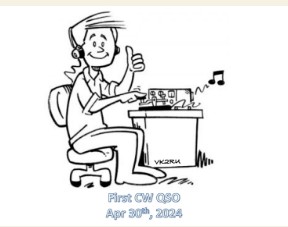
Also this week I’d like to welcome Tony VK3CTM from Junortoun near Bendigo who joined in the fun on 40m a few weeks back, and also welcome to our forth YL operator, Beth VK2A0 at Glenwood; Beth operates mainly on 80m and is keen to ge her ear back in with CW.
Hopefully she’ll be able to listen to our net when she can o Tuesdays and send us reports of who she hears. Before long, I hope we’ll hear her having a go on the key again. Welcome Beth.
Reports
After next Tuesday’s net, please send me a list of who you worked and / or who you heard using our new web form here: bit.ly/CQQRSNET
Getting reports from stations and listeners is important to me – even if you listened and didn’t hear anyone or weren’t able to copy anything – the fact that you had a go needs to get recorded so we know that the net is working and attracting new and old team members to have a go.
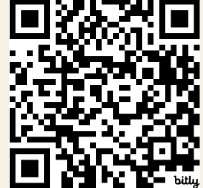
Thanks again to Nigel G4RWI for building the Google Form, the Python software back-end that does the processing, the new link and the QR code.
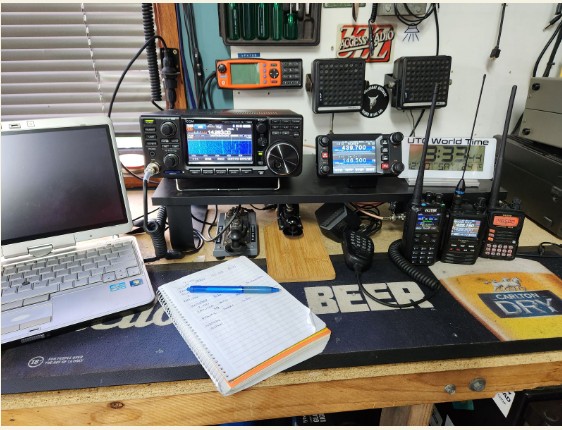
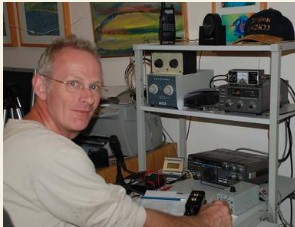
Thanks this week to Tim VK3TBR at Horsham for the nice shot of his work area. Cheers, mb Mark Bosma VK2KI / VK6QI Beautiful South Bowning NSW mark.bosma@icloud.com Non impediti ratione cocitationic
Reports & Comments
The spreadsheets above show the known stations on last Tuesday’s net. Comments distilled from the reports I’ve received are below:
Comments:
[40m] = I was using an Elecraft K1 at 5W. = I was really surprised how my au stations heard me! = It was more fun using the K1 than the 7300 :). = Great night
[40m] = good condition with good signals
[40m] = I can’t believe Claude VK2CL actually sends whilst driving….and on dirt roads to boot….amazing ! [And did he tell you about the night-time kangaroo hazard?] ¢
[40m] = Excellent RXing practice with a couple of QSOs almost on the same FX.
[80m] © Don’t think the VK6S could hear us, as they came up only a few Hz away after we had started. But it was great practice with slight QRM =
• Adam must have wondered why my sending got strange mid QSO then recovered. My dog came in and started barking had to shut her out of the shack… all this with one hand on the key still sending. A dog bark is really quite distracting ha!
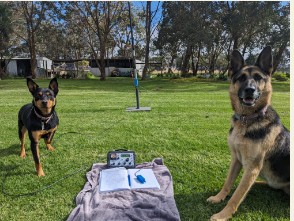
[40m] = Tonight conditions were not that bad. = was happy to meet some new faces and to have some new QSOs and happy to recognise other OMs from old. * Conditions were fine, but it doesn’t look like there were many Stations operating.
From Michael VK3VMM at Ballarat: © Very poor conditions. © I’m limited to getting on the radio after 21.30 and it was very quiet from my QTH. +
[40m] * Quiet band, as in low noise, mostly good signals with only one instance of QSB. = Russian ‘K’ beacon S7. = Thought VK2BHO was a bit faster than usual members, turned out he’d not heard of the group.
[40m] = Another station chimed in while I was working VK6IS which confused me as I had not signed off yet. = Unfortunately the signal was weak and I could not decipher it so I just sent 73 and left!
[40m] = Still have an injured hand, so could not send tonight. From lan VK7TA at Latrobe: ©
[40m] = [had a smile listening to Stan appear to encounter a bit of resistance to his RSN report.
[40m] = Conditions at my QTH were not the best for radio on Tuesday night.
[80m] = 1am slowly managing to copy Morse for more than a few minutes. I might eventually get my old brain to get Morse. = Iwas only using the 5 Watts of the Paraset. = [noted that I did not hear VK6KRC who promised to be on using CW.
I presume he either was there but not heard or had problems again with his peddle-powered rig. = [had a QSO with Max, VK6FN, who is putting up new towers that are 65 feet high – § feet higher than mine; however I was able to point out to him that my chainsaw is 2 cc larger than his and is the correct brand.
He still struggles with one of those inferior German machines and only recently bought a small one from the superior manufacturer in Sweden.
= At Max’s end of the QSO billions of transistors arranged in a FPGA and numerous ICs produced a sine wave to throw out into the either. At my end single 6V6 valve created a sine wave to throw back. = There are different ways to achieve the same result.
[ROFL! I aways enjoy your reports Donald. Now need to encourage Maxwell and Roberty Bob to post some appropriate retorts in future RagChews – HI!]
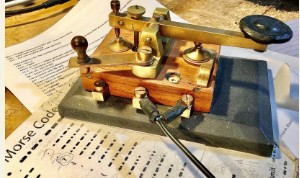
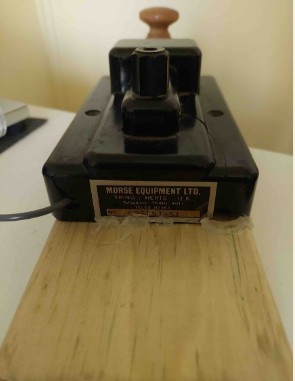
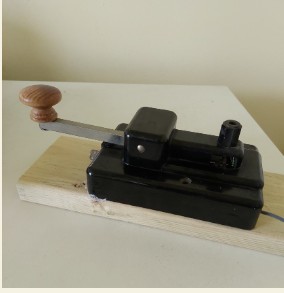
[40m] = It was a great night on Tuesday. = 40m was full of CW. = Thanks to everyone who worked me. = Here is the key I used. = It’s from a friend Viv who used to work in the PMG. = He also taught Morse Code at the Coffs Harbour Amateur Radio Club years ago.
= Viv was never a ham but used Morse Code over the telegraph when it was around. = It has a nice, precise feel also.
[80m] = I was happy to be at the shack from about 10PM local time tonight. = [had a good chat with Mark, VK2KI on 80m, who had a great signal. = I then worked VK6HRC, who gave me a good report in amongst the QSB – I finally heard 599, and logged that.
[80m] = Very relaxing to copy slow Morse. = Saying much with few words is the key to CW rag-chewing!
[40m] ° Band was in good shape for a while and busy which made for exciting listening. © Band opened from the East for a while but then faded rapidly. © Sol only managed two contacts on 40m.
© I was using and end-fed half wave and my rig was an Elecraft KX3 at 10v
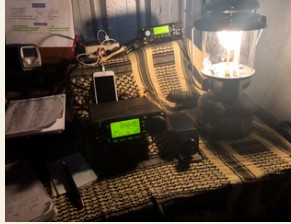
[80m] © Rig was my IC-706 at 20 W. e Ant was a horizontal random wire loop.
[40m] © Iwas using my IC-705 QRP with a temporary Rybakov vertical, 9:1 UNUN and home-brew L-Match.
[40m] = Conditions to Auckland (Paul, ZL1AJG) were very good. = Signal heard from Melbourne (Manny, VK3DRQ) was stronger than < closer Sydney station (George, VK2DLF), which surprised me.
[40m] = This was my first serious night on the QRS CW net and I managed t work three stations which brings my total of CW QSO’s up to five (my first was last week on the net with George VK2AQE).
= There was some QSB which made things a bit difficult, but overall it was good fun. = We were near Longreach, Qld and 40m dropped out for me abit before 1100Z. = I checked 80m after that but there was nothing there either.
= Next week I might try to get on 40m a bit earlier. = Many thanks to Mark for everything he does to make all this possible. = Regards John VK2RU
From Warren VK3BYD/4 at the Sunshine Coast: ©
[40m] = Operating QRP portable from the Sunshine Coast in VK4. +
[80m] = Magnetic base paddles are good as long as they don’t slide away from you when you’re transmitting. +
From Richard VK6PZT at Dalyellup: © Iwas using the pressure paddle kit from Lance VKSIL. © Works a treat and totally silent, great for operating whilst my daughter was studying in the same room! +
[80m] © Allittle vague on who I heard, as did not make any notes, apart from those in my (paper) log. © Re stns worked… VK6EN on 80 m was good signal but terminated the QSO quickly due to a problem with his key.
That is why I always have two connected at the same time! © Not much time spent QRV as during the early session, I was busy with meals etc. © John, VK5ET was particularly good signal on 3555 with a 589 from his camp site 100KM from Adelaide.
So was Max VK6FN then I lost him as his key mis-behaved. I waited, but he failed to get QRV again. © I seldom have any CW QSOs on 80m these days. My CQs fall on stoney ground! I recently erected a new 80m dipole.
Seems OK and I suspect the above QSO with Max might be my only one ever on 80m band in some 25 years QRV in Vic ad VK3DBD, and before that a year as VK3DER in 1981.
[40m] © Hi Mark – finally got my 80/10 EFHW back up and working. © [listened to your QSO with VK6HRC on 7035 on Tuesday. © Now need to learn CW all over again ! © regards, Baz +
From Claude VK1TE/M and VK2CL/M South of the ACT: ©
[40m] = Hi Mark, = [hope you and your family are doing well. = I’ve been quite busy with more work than expected lately, so I’ve been less active on the air for the past two weeks, and it looks like i wil continue for the next few as well.
= On Tuesday, on 40 meters, I had the pleasure of copying you as remote VK6QL, along with some other VK6 stations, very clearly despite using my tiny “screwdriver” Yaesu antenna, while unloading the ute in the middle of the bush.
Unfortunately, I didn’t have time tc callin. = The VK6 stations kept coming in smoothly throughout the evening, while the VK3, VK2 and VKS appeared to be less powerful than usual, with a lot of QSB. = The 40-meter band was crowded, so I mainly listened.
= While driving, I managed a few QSOs on 40 meters and some long DxX/rag-chew contacts with the UK on 20 meters with RST 579/559+QSB. It’s amazing what we can achieve with good propagation. = Once again, I had to keep moving and didn’t stop to log the QSOs.
Can no longer remember five QSOs in a row like I used to many years ago. Now, I can hardly remember one for five minutes! 🙂 = Again, thank you for your efforts in promoting QRS CW. CW sn 73s, k
[40m] © Good signals. Great conditions, hardly any noise. © First time the HB ZS6BKW was put to work in portable mode. © This had 13MTS each leg, 13MTS 450 ohms ladder line, a 1:1 Home Brew ugly balun & 20 mts RG58 to Mat 30 ATU/ FT891.
© The mat 30 was busy clacking away looking for a low SWR. © System worked well. Was using 40W so that may account for low signal strength. © Location was near Stonefield (or Steinfeld) 25 Km East of Truro, & 8 Km North of the Sturt highway, camping in scrub.
© No moon for the 2 nights I was here, pitch black as the Ace of Spades. © Very quiet ,relaxing time away. Good company with me as seen on top of the bed in the photo. © 73s, John VK5ET
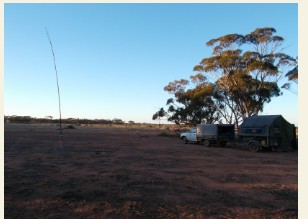
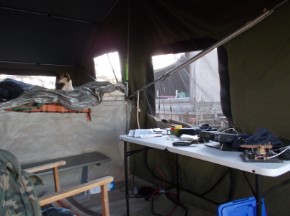
• From me VK6QI using the VK6QS Remote station at Bedfordale and the VK6QS KiwiSDR neat Brookton: ©
[40m] = The 40m band was starting to open from New Zealand and the lower Eastern States to WA when the net kicked off at 0700Z. = [heard Paul VK3KLE at Stawell calling at RST 549 to the VK6QS KiwiSDR at Brookton. I tried calling Paul, but he couldn’t hear me.
= Next up I heard Ron VK6KHZ at Yangebup and when no-one answered, I fired up the Southern Electronics Group’s VK6SR Remote at Bedfordale and we had a brief exchange.
= After that I had a short QSO with Richard VK6HRC using an end-fed half wave antenna and his battery-powered IC-707 at his portable location at Gidgegannup.
= One-Way Propagation = Around 0800Z there was a return of apparent one-way propagation, with a very strong station from the East not hearing our QSO from the West and calling CQ on the frequency, along with another conversation coming through in the background.
= Toward the end of last year, we had discussion with three propagation experts over several RagChew newsletters about the apparent one-way propagation that was happening on 80m the time.
= In summary, the phenomenon was thought most likely to be a result of either variations in the density of the ionospheric layer concerned as darkness falls, leading to an effective ‘sloping’ of the layer, or alternatively, birefringence (differing refraction and splitting of polarisation, depending on the direction of incidence).
= Either could cause different refraction of incident waves coming from different directions; heading toward the equinox, I wondered if the effect may also be seasonal? = More research and reports from listeners’ experimentation needed.
= Solar Flare Affecting Keying? = Next up I heard Max VK6FN at Manjimup chatting to Ron before I had a short QSO with Geoff VK6HD/P at Erskine running 10 Watts from his nice IC-708; like the QSO with Richard, I was settling-in for anice rag chew but Geoff had to disappear rfn; I assumed that he didn’t like my lousy keying.
= I’d heard several people saying on Tuesday that they were having trouble manipulating their key – I was really struggling to send the number 6 and the letters H and J for some reason.
= [had to pull my socks up and really concentrate on making my CW sound vaguely copyable (for me, that meant moving the key toward the edge of the desk, and holding the key base with the other hand).
= Because others reported that they were having trouble as well, I’m going to propose another Boz April 1st hypothesis (insert roll-eyes here – Hil) – the solar-flare predicted by the BOM Space Weather Services in the alert for Tuesday was also affecting operators’ ability to smoothly key.
We’ll see? = Back to the Net After signing with Geoff I heard Jeff VK6JK from Gwellup calling Ron unsuccessfully through Ron’s noise-floor I suspect, and heard Geoff chatting to David VK6KD at Ballajura before I hooked up with Max.
= was pleased to work Max – although we frequently chat on the South West AllStar 2m/70cm/10m FM network, I hadn’t worked Max on CW for way too long.
= In parallel, with the third half of my brain, I noticed lan VK7TA at Latrobe working Peter VK6IS at Wundowie, and Peter then went on to chat to Maity VK5AO at Banksia Park.
After that I caught up with John VKSET portable at Truro in the Riverland just the other side of the Barossa Valley; great to chat to John – another of our Group’s founding members again as well.
= Next up I heard Joe VK2KJJ over at Wagga chatting to Paul VK8KLE; great to hear Joe on the net. = Lalso heard Adam VK2NNW up at Deepwater working Claude VK1TE/M driving South of the ACT before Adam and I hooked up.
= Lalso heard Merv VKSADX at Ballarat working Richard VK6PZT at Dalyellup. = Itwas then getting well after the scheduled change-over time, so I then swapped to 80m. ©
[80m] = Iwas not able to convince the VK6SR Remote to match the antenna on 80m; another Boz hypothesis – I think the superintendent Rob VK6LD has done something clever with a high-pass filter to make the Remote’s Marconi-Tee antenna not play the game in our selected 80m segment!
= So I resorted to using only the VK6QS KiwiSDR. = [heard Merv VK3ADX at Ballarat chatting to Greg VK5KFG at Willunga – both had nice signals into WA.
= I then heard Max VK6EN chatting to John VKSET/p before Max went on to work David VK3DBD who was putting in a nice solid signal from Yakandandah.
= I then listened to Derek VK4DRK up near Toowoomba RST 569 working me (as VK2KI from beautiful South Bowning) RST 589, then Richard VK6HRC/p at Gidgegannup who using his horizontal loop.
= Lalso listened to my QSO with Paul VK2IK 150KM up the road at Moss Vale; we were both about RST 589 into the KiwiSDR. Paul was using 20 Watts into his 32m doublet, 15m (3/16 wavelength) up whereas I was using 70 Watts into my 106M long double-extended Zepp, up only 6m (about 1/16 wavelength).
Jut shows to go – height is everything with horizontal antennas. * Also from me VK2KI at beautiful South Bowning: ©
[40m] = At the start of the net using the Tecsun KiwiSDR at Araluen NSW, I heard Paul VK3KLE at Stawell calling CQ and I heard Mick ZL1HJ at Te Kuiti trying to contact him without success. = Paul hooked up with VK2ASB then Patrick VK2IOW at Millthorpe.
* Abit later I heard ZL2EF calling CQ, then I listened in to my QSO (as VK6Q)) with Max VK6FN at Manjimup. = Somewhat later I had another listen and could just hear Claude VK1TE/M South of Canberra working Adam VK2NNW up near Glen Innes.
= [also listened to Merv VK3ADX at Ballarat working Richard VK6PZT; Richard was much easier to copy on the Araluen NSW SDR than the Brookton WA one. = Finally I heard Paul and Adam chatting away happily before I swapped to 80m. ©
[80m] = As| said above, I could not get the VK6SR Remote station to couple to the Marconi Tee antenna on 80m, so instead I fired up my home- station TS-50; once again it was being difficult telling me there was a bit of variable resistance in the 13.8 Volt cables’ fuse and power supply connection – so a bit of diving into the rat’s nest with a can of squirt was required.
= I managed to catch up with Derek VK4DRK at Deepwater who had got on late after he returned home from his weekly tennis match. = After Derek, I responded to a CQ call from Paul VK2IK up the road in the Southern Highlands at Moss Vale.
= Then to round out the night, David VK6KD and I had a nice chat – despite both suffering (solar-flare influenced?) flakey key-operation syndrome, but having fun anyway.
So in all, we had pretty good conditions on both 40m and 80m on Tuesday in Australia and New Zealand – despite (or perhaps because of) the predicted sola flare.
40m was really hopping – including some apparent one-way propagation, and 80m was performing excellently. It was so nice to get on 80m again without lots of auroral and static-crash noises, and have nice strong signals across Australia.
By Richard VA6HRC ‘Seven were on the Wednesday morning post-Morsum on the AllStar net. + VK6FN Max + ZL3TK Stan + VK6QI_ Mark + VK6KD David * VK6KRC Bob ( listening ) + VK6LD Rob + VK6HRC and * our SWLs The VK6RLM repeater and AllStar link was busy well before the 06:00 net.
Once the net got going the general consensus was that everyone had a fun night on the QRS frequencies. Looking forward to the reports in the next RagChew.
Stan has kindly offered/been pressured into putting an article together about the ZL call sign prefix numbering. David also commented on how good the WhatsApp link was for alerting us on potential activity.
The net went for approximately three quarters of an hour. Thank you Mark for your time and efforts running the QRS net. Have a great day 73 Richard. [Thanks mate – excellent report once again; thanks for getting up early].
I ‘Synopsis by Greg Fisher VK5KFG NN Book Title: The CW Way of Life: Learning, Living and Loving Morse Code Author: Chris Rutkowski MorseBusters Publishing 2023 This book has a whole 301 pages devoted to the Code, without repetition or padding.
The author covers a comprehensive list of topics that are well laid out in the opening index and addressed in the body of the book.
These include: * the history of the Code, * the rhythmic underpinning of the Code (fitting dits, dahs and spaces into a steady rhythm which the author refers to “getting on the dit train”), * “hard copy v head copy”, * the learning path to recognising characters, + the ergonomics of correct keying (he regards ‘arm on the table’ as an ergonomic error and has his key on the edge of the table), * his preference for the “navy knob” in straight keys, * the value of “code talking” in learning and sending, * QSO etiquette and structure, + abbreviations and useful Q codes.
Chris includes a number of training exercises and drills to increase accuracy and speed, drawing parallels with the athletic world. Irate this book highly (and have already moved my key to the edge of the desk) Greg VKSKFG.
[Thank you for the insight Greg – something I think many of our readers will follow up]
A ees eae Just a correction to what you wrote about Alfred Vail in the last RagChew. I said in my original email that “…Alfred Vail was there as well, not always considered or even recognised.” You re-wrote this as: “his contribution as the inventor of the International Morse Code is not always considered or even recognised”, which is not quite correct, and its history is in fact quite a bit more complex.
Vail was instrumental in developing between 1838 and 1844 what became American Morse or Railroad Morse. Further developments by Friedrich Gerke in Germany in 1848 resulted in Continental Morse.
By 1865 further changes — but incorporating much of Gerke’s work — resulted in International Morse. A summary is at Wikipedia: https://en.wikipedia.org/wiki/Morse_code, which is largely useful, although I would take issue with its reference to “only two coding elements”.
The third element, spacing, often not mentioned, remained equally important; something surely understood by Gerke, and its timing and the necessary ‘muscle memory’ to be practised by QRS learners.
73 Kees VKIKVS, [Thanks Kees – appreciate your efforts to set the record straight.]
NWHOSIIY VII oS WihoVers Stan ZL3TK tells me that he has not yet received all the incomplete Chinese Whispers; he’s extended the deadline to 1200Z on Sunday 12TH May.
To eliminate confusion, serial numbers should not be incremented; the messages that were still in transit on the closing day should be returned to Stan exactly as received.
So to allow Stan to summarise how the messages progressed in our International Morse Code Day month exercise, please email the text of the messages you’re holding to zl3tk.radio@gmail.com by 1200Z on Sunday evening.
On Tuesday I used my Vibroplex bug modified with the manufacturer’s added QRS weights. My sending was not as clean as usual and the vibroplex weights for QRS were expensive too, so I hope everyone enjoyed listening to the slower bug.
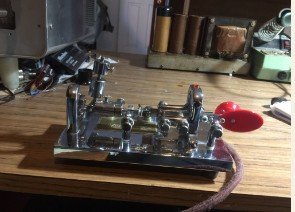
Table and have the bug close to my body s shown. That means no radio gear on the front edge of keying table. There are three extra weights; a small one on the shaft plus a big and a medium one on the genuine vibroplex variarm.
As supplied, the thumb screw in the variarm has only three threads – it’s how they make them; not to be overtightened or it will strip the fine thread. The dental floss in the image is to adjust the dit duration ratio a little.
The speed now goes down now from its previous min of 25 wpm to a lazy 10-12 wpm; I haven’t measured it, but it’s now a match to my copy speed. If ever can copy 25WPM I can take it off @ For completely mechanical key it did a fair job on Tuesday.
Regards Paul VK3KLE [Thanks Paul – interesting].
Mark. Thank you for taking the trouble to compose that introduction to the QRS Group, the regular QRS net, the What’sApp group, and the Newsletter. As a radio operator, I suffer from “Imposter Syndrome”.
Although I can just about manage a 25 wpm chat with a good partner (on a good day), I’m more of a Morse Man than a Radio Man.
Domestic constraints mean that I’m portable only, and “fair weather portable” at that as the British winter weather is absolutely miserable. Also I find radio work rather stressful – probably because I don’t do enough of it.
On the plus side, I’ve never had an SSB QSO – all my HF contacts have been CW. And VBand (morse-over-the-internet) has been a daily event for me, as I can jump on in the gap between breakfast and any other morning activities.
I’ve recently acquired a straight key – a WT 8 Amp, built in 1941 – and dropping down from 25 wpm on my touch paddle to 10 wpm has been a humbling experience! Strangely, I’m finding the Straight Key great fun.
My key is a slightly later version of that owned by Martin VK3FG, as featured in
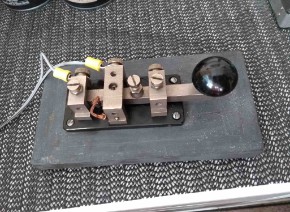
The Newsletter you sent me (some versions were manufactured in Australia so his key might be one of those). ‘Speaking of the Newsletter, Ron VK6KHZ has sent me a couple to browse through. You’re doing a tertific job there. No wonder your numbers are swelling.
The Net is a great thing too. I know Ron really looks forward to it even though he struggles to copy enough to join in. And the spreadsheet is a good visualisation aid.
As for the What’sApp group, I have been a member of a similar group in western Europe that uses the Signal messaging app in a very similar way.
It was great, but my sporadic radio ops take place solely during the summer and it was annoying to keep getting a stream of messages during the winter months so I dropped out.
The weather finally having made a turn for the better, I’m away on a camping trip next week but the week after next I shall have a go (as you suggest) at listening-in to the Net via a KiwiSDR (can you recommend any particular ones?).
If that becomes a habit, it would be interesting to get the Newsletter. But, as it stands, the action is all rather far away for me to get much out of it.
The What’sApp group would not be that helpful either (for reasons previously stated) unless anyone wants a QRS chat on Vand… Ihope that doesn’t sound too much of a negative response to your offer of joining in.
Being a Vband guy, I feel like I’m in a tiny niche of the CW world, which is itself a ‘small niche of the wider amateur radio world, which is an obscure niche of Real Life. But I love my Morse. Best wishes Ross MONNK
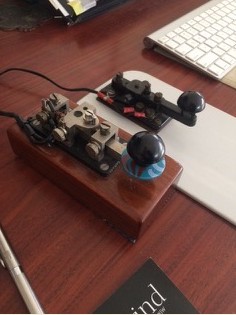
Reply: Morning Ross. I have two of the same keys – one in my shack and one for portable. Elizabeth donated one member of her button collection to make a thumb rest on the shack version.
Ross’ reply: Tell Elizabeth that I like her button! You learn something new every day – I thought those collars were spark protectors but now you tell me that they’re thumb rests, I shall have to look out for one of my own ‘cuz I’m still finding it awkward to get an efficient hand position on the key.
It’s good to see that the WT 8 Amp is popular in Australia too. They’re a key with a bit of history to them. Like a British equivalent of the J-38. Maybe we should start a WT 8 Amp fan club!
Ross [Thank you Ross – and welcome mate; articles like this are always welcome. Ross has written two more articles which will be in following editions of RagChew – thank you Ross – very much appreciated].
Re CW, it was that mode which gave me the impetus to get my amateur radio ticket.
When you heard me on the key I was probably out on a sheltered corner of the veranda of our home in Junortoun east of Bendigo. The rig was an HB1B, ~ 20 meter EFHW antenna + inductor and tail to get it to load on 80 mx and Bencher iambic paddle.
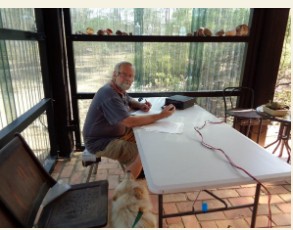
| believe that portable QRP CW operation with an EFHW antenna may well be one c the best means by which to demonstrate our hobby to ‘non — hams’. Regards, Tony (VK3CTM) [Thanks Tony and welcome. You didn’t mention your four-legged companion!]
From Michael DL3YZ: Thank you for the invitation to your newsletter; I’d really like to be on your distribution list. Yes, I think on 80m it could be quite a challenge :-).
My first QSO this year was indeed with Mark VK3MJ_a station in Geelong on 14.055 MHz at 9:30 UTC. So it is possible, even with my shabby dipole. My actual project is to reach Ron VK6KHZ in Freo on HF. Ron has a high noise level (S5) in his QTH.
So I could hear him last time, but he didn’t hear me. But I will keep up with it, and I think that one of those days we will actually hear each other. In the next weeks we will try my home-brew cubical quad on 17m. I could reach ZL, so there is hope.
These remote controlled stations are quite an interesting thing. Can you give mea link or an contact ? Thanks for the Info and the great work of keeping this group together. 78 and have a nice week ! Mike ( DL8YZ) [Thanks Mike – and welcome!
Quite a challenge to work Ron from Germany… but then again, he has a high noise level, but nothing like the QRIM level you experience on the bands in Europe].
With over 50 members, our CQQRS WhatsApp community is proving very useful to members. The CQ QRS WhatsApp Community has two sub-groups: « CQ QRS Alerts – for spotting CQ calls and QSOs during the net, and for QRS alerts and members’ CQ calls (QRS or QRQ, simple exchanges or rag chews) at other times.
¢ Rag Chews – for chats and photo exchanges between team members about who knows what – current projects, technical questions, in fact, anything of interest to CW operators… excluding religion and politics of course.
The nice thing is that you can set different notifications on your phone – eg a sound when there’s an Alert, and silence when there’s a rag chew message for instance.
If you’d like to join the team using the App on their cellular phone or computer, please let me know by email to cqqrsnet@gmail.com
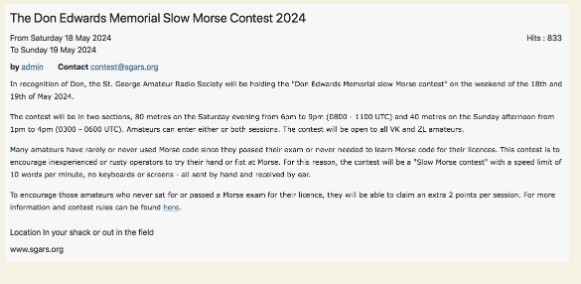
Next weekend will be the monthly Straight Key Century Club’s Oceania Slow CW Saunter; this isn’t a contest – rather an opportunity to get on air and have some fun.
Several of our team members will be on, so keep an eye out on our WhatsApp Alerts for frequencies they’re calling on.
Nic VK7WW runs a Slow Morse training net every Wednesday at 7pm EDST on 3580 for 30 mins. He uses the callsign of the Northern Tasmania Amateur Radio Club VK7TAZ on that net.
Many of our team learned Morse code with the support of Nic, and the weekly training session comes highly recommended for anyone who wants to learn the Code, or simply brush up. Everyone’s welcome – 3580KHZ at 7pm Eastern time ever Wednesday.
The NTARC also feeds the CW live via the Discord phone / computer audio stream, and previous weeks’ recordings are available. Contact Nic VK7WW for more info nicholaschantler@hotmail.com – or just join in on Wednesdays.
This Week’s Topic of Interest
By Kees van der Spek VK1KVS The Junker semi-automatic ‘bug’ is a clone of theVibroplex number 6 Lightning/J-36 key for which no patents existed.
There are nevertheless differences with the Lightning bug, including the high binding posts and the steel base which has routed grooves for the wiring and a screwed-on aluminium covering plate which also holds the rubber suction feet.The circuit-breaker that is a feature of the Vibroplex Lightning and J-36 bugs is absent on the Junker version.
They come in slightly varying shades of silver hammer-tone.
Their production history remains obscure: flooding of the River Rhine in 1993 destroyed most of the Junker company records at BadHonnef. The closest documented dates that will be accurate would place their manufacture between March 1962 and 1974.
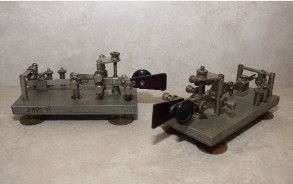
When visiting the Junker factory during November 2000, Martin DK4XL was shown the surviving first technical design drawings dated March 1962.
Production may have ceased during the early 1970S, although by 1974 at least one distributor (the Hannes Bauer Company) was still offering them for sale.
Today, two versions may be recognised: + The so-called ‘civilian’ version (at right in picture); these were not numbered, and were likely used at ship-to-shore coastal radio stations.
+ Those produced in limited quantities for the Polizei Haupt Funk Stelle (PHFS, Police Radio HeadQuarters (at left in the picture) of the Federal German Border Police (the Bundesgrenzschutz). There are only very minor differences between the two issues.
While both versions are now rare, this is especially so for the police version. The latter can be recognised by the engraved letters PHFS followed by a serial number.
‘Some 40 PHFS bugs were scrapped by the Bundesgrenzschutz during the late 1990S but a number of these were salvaged. As a result, I only know of the following surviving numbers and (with some exceptions) their links to known collections: + PHFS 5; PHFS 11; PHFS 12; PHFS 15 (location uncertain); PHFS 16; PHFS 18; PHFS20; PHFS 27; PHFS 28; PHFS 32 (location uncertain).
Sparse information on the Junker bug can be found int he following: Odenbach, Martin, N7CFO Keyletter #32, 20 November 2000, pages 390-391; Odenbach, Martin, N7CFO Keyletter #39, 27 March 2006, page 484; Ulsamer, Gregor, Faszination Morsetasten — German telegraph keysCollector’s guide, 2001, pages 101-102; Willemsen, Herman, OTN – Old Timers’ News — Journal of the RadioAmateurs Old Timers Club Australia Inc., Number 40, March 2008, pages 28-29.
[Thank you Kees; it’s great to see how much fascination our keys hold for operators young and old.
I’m always on the lookout for interesting articles by team members; if you’d like to share some knowledge, thoughts or ideas, please let me know; please email to cqqrsnet@gmail.com

Brain Teaser
Jules Perrin JP VK3JFP has created a terrific resource to help guide learning for all levels of amateur radio licenses: https://www. julesworkshop.net/Amateur%20Radio.
Html With thanks to Baz VK6MU for he idea, and Jules for the good learning website, here’s this week’s quiz questions from Jules’ Workshop example test questions: What band would 2M or 144MHZ band fall within?
Answer: VHF band To extend the range of an ammeter it is necessary to use at * resistor in series with the meter * resistor in parallel with the meter * rectifier in series with the meter * capacitor in parallel with the meter The time constant of a 500 microHenry inductor and a 50 ohm resistance is * 0.2 microsecond * 5 microseconds * 10 microseconds * 125 microseconds A television picture is required to be identified: (a) By having the callsign shown permanently in one corner of the picture (b) By showing the callsign at least once every 10 minutes and at the beginning an end of a series of transmissions (©) By having the callsign shown in the frame blanking pulse in digital form (d) By showing a picture of the amateur station and operator at least every 10 minutes How did you go?

Answers from last week’s Quiz:
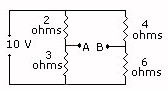
What do the terms MF, HF VHF and UHF represent and what frequency range appli to these? Answer: MF = Medium Frequency 300KHZ to 3MHZ HF = High Frequency 3 to 30MHZ VHF = Very High Frequency 30 to 300MHZ UHF = Ultra High Frequency 300 to 3000MHZ When compared to ground wave propagation, sky wave propagation usually has: * Much smaller effective range + Much greater effective range + The same effective range * Differing effective range depending of the weather Answer:Much greater effective range The voltage across terminals A, B is:
Which of the following is the correct calling procedure for radiotelephony? (a) THIS IS VK7APL CALLING VK6AB, 7APL CALLING 6AB (b) VK6AB VK6AB VK6AB THIS IS VK7APL VK7APL VK7APL OVER (c) VK7APL TO VK6AB VK7APL TO VK6AB COME IN PLEASE (d) VK6AB VK6AB DE VK7APL K Answer:(b) VK6AB VK6AB VK6AB THIS IS VK7APL VK7APL VK7APL OVER How did you go?
And a correction by Stan ZL3TK:
Another very fulsome edition OM Mark, with a generous helping of very nice but plagiarised photographs from history! Good idea to draw on largely undiscovered resources, proves you’ve been doing your homework!
Drawing your attention to the answers from the quiz in Edition 17/2024. One answer is patently incorrect because the statement, posing as a question, is itself flawed.
This illustrates the value of the ‘perfect practice’ principle, else we just waste our tim: cycling through nonsense.
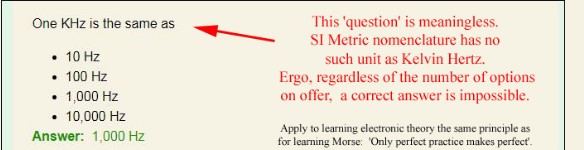
| make no apology for being a pedantic old git, standards have already fallen far too low and will likely never recover! 73 de Stan
Di-aqah-ai-aan-ait
So back to the Slow CW QSO practice net.
Next Tuesday’s Net
Our CQ QRS Net will be on as always on Tuesday from around 0700Z until about 1300Z; see below for details. Doesn’t matter whether you’re brand new and want to try just exchanging callsigns and RST reports, or you’re ready for a good old rag chew.
Please let me know via our Reports form bit.ly/CQQRSNET who you work or hear or Tuesday’s net.
Post Morsum
Richard VK6HRC will run our Post Morsum on the South West AllStar net (via repeaters and hotspots all over WA) from 0600 WA time. If you’re in WA, all you need is an FM 2m or 70CM transceiver and an AllStar node nearby.
If you’re elsewhere in the world, you may be able to connect your local AllStar-enabled repeater to the net, or you can connect via Echolink. Let me know (mark.bosma@icloud.com) if I can help with that.
Teamwork
Again, my apologies for this edition being so late… and I really appreciated the concerned emails. And thank you so much to our team of 42 contributors this week: DL8YZ, MONNK, VK1KVS, VKITE, VK2DLF, VK2GAZ, VK2IOW, VK2KJJ, VK2NNW, VK2RU, VK3ACU, VK3BYD, VK3CTM, VK3DBD, VK3DRQ, VK3UFP, VKSKLE, VK3TBR, VK3VMM, VK3DRK, VK5AO, VKSAW, VKSET, VKSKFG, VKSPL, VK6BEK, VK6HD, VK6HRC, VK6IS, VK6JDM, VK6KD, VK6KHZ, VK6MU, VK6PZT, VK6RR, VK6WE, VK7KPC, VK7TA, VK7WW, ZL2GD, ZL3TK, ZL4BDG.
Yup – 42 contributors! Thank you so much team for your support. UY CW on Tuesday, mb. Mark Bosra VK2KI/ VK6QI Beautiful South Bowning NSW mark,bosma@icloud.com non impediti ratione cogitationis