Below is a reconstruction of the 2024 16 CQ QRS RagChew newsletter designed to support full text searching. This reconstruction was built using OCR, and will contain errors.
To view the Mailchimp original, click here. To search the entire newsletter archive, click here.
Contents
- Last Tuesday’s Net
- Reports & Comments
- Comments:
- From Richard VK6PZT:
- The Sequence
- Remember
- Don’t Have a Whisper to Send?
- CQ QRS WhatsApp Group
- Wait Aloud (or NOT)
- More Thinking Aloud
- NTARC Morse Training Net
- Community Radio
- Brain teaser
- Answers next week.
- Answers from last week’s Quiz:
- Di-dah-di-dah-dit
- Next Tuesday’s Net
- Reports
- Post Morsum
- Teamwork
- About the CQ QRS Net
- Matching
- Landing Zone
But other people reported similar phenomena on 40m – so let’s go with the hypothesis that we were hearing some sort of ionospheric anomaly – possibly associated with aurora or other solar radiation / geomagnetic activity.

This month’s CQ QRS International Morse Code Day month Chinese Whispers event is going well; there are lots of Stan ZL3TK’s short messages out there and circulating – see below for details.
Some of our team are really enjoying the exercise, but for others it’s not their cup of tea – which of course is all good.
The process is actually quite simple; however, if someone asks you on air if you’d like to receive a Chinese Whisper but you don’t want to have a go – just reply ‘NO TKS’.
Last Tuesday’s Net
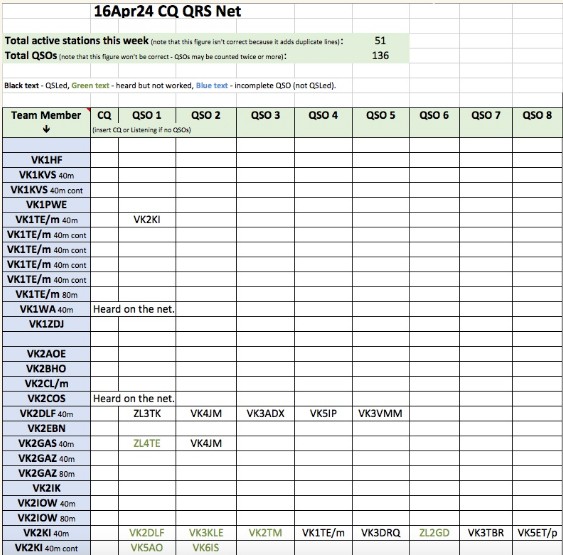
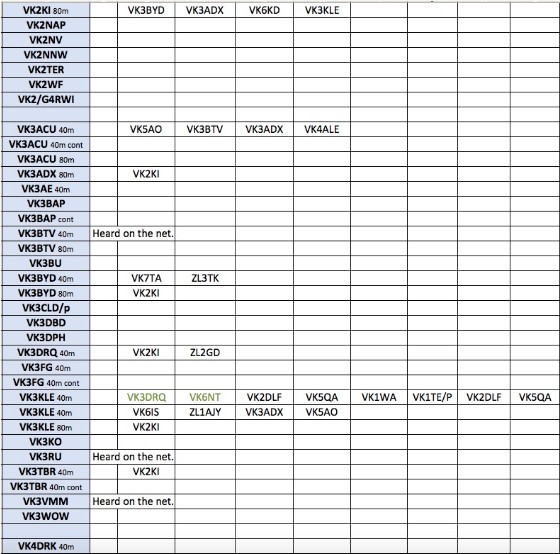
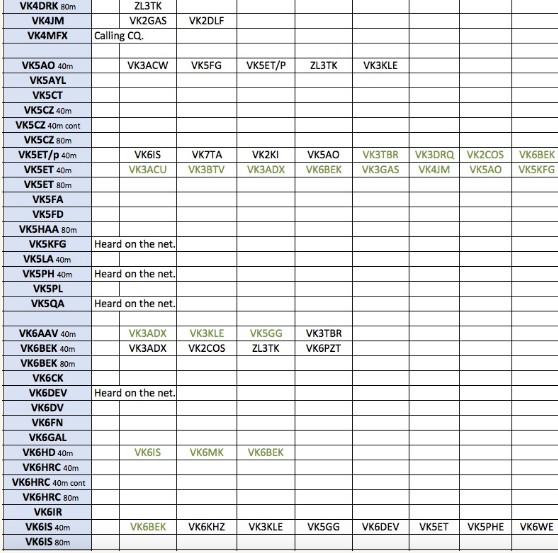
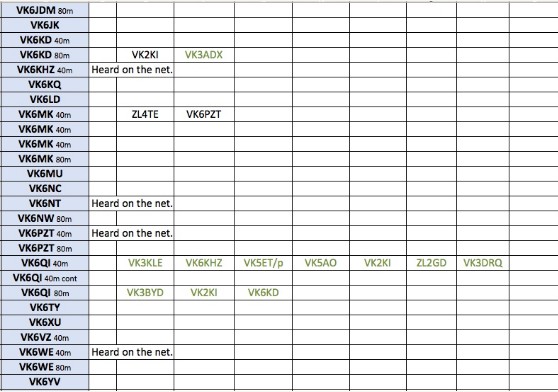
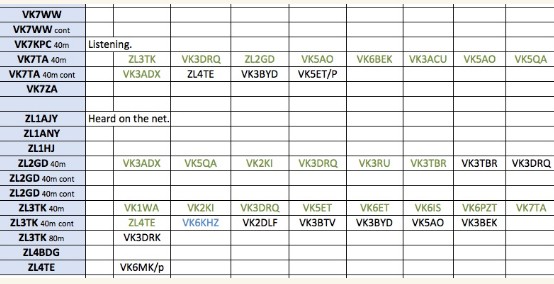
Here’s this week’s list of the 41 of our stations heard:
After next Tuesday’s net, please send me a list of who you worked and / or who you heard using our new web form here: bit.ly/CQQRSNET
Getting reports from stations and listeners is important to me – even if you listened and didn’t hear anyone or weren’t able to copy anything – the fact that you had a go needs to get recorded so we know that the net is working and attracting new and old team members to have a go.
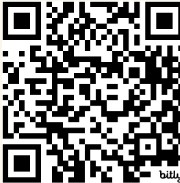
Thanks again to Nigel G4RWI for building the Google Form, the Python software back-end that does the processing, the new link and the QR code.
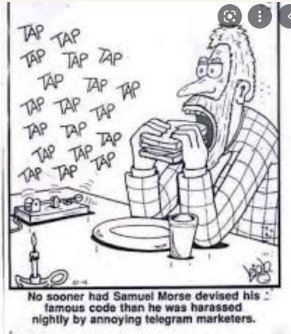
The CQQRSNet Chinese Whispers event is underway for the month of April to celebrate International Morse Code Day (which is Samuel Morse’s birthday – April 27TH). See below for details.
But now it’s time to prepare for the return of our riotous IMCD Quiz on Saturday April 27TH; more below.
As foretold last week, we’ve had another surge in numbers of team members this time – we now have over 170 readers would you believe?
Joining us this week are Wal VK2WP from West Bathurst, Armin VK2GAS from Norwest, Ben VK6XC from Forrestfield, Anthony VK3OCD from Stawell, Shaun VK2DSL from Ballina, Emily VK1EMK from Canberra, Bob VK4EK from Muirlea and Ketut VK3BWN (whose mantra is appropriately “Never let a QRS CQ go unanswered”) from Keilor East.
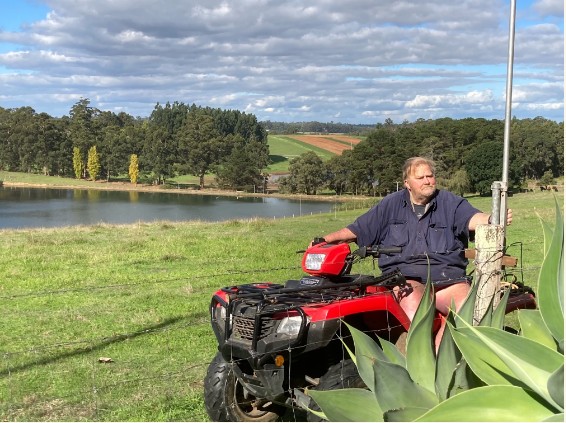
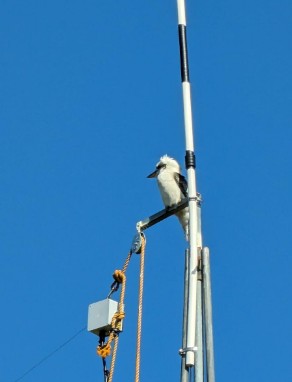
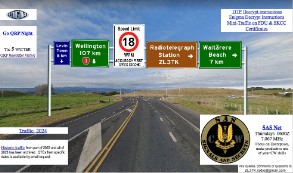
And thanks this week to one of our founding members, Max VK6FN at Manjimup for the photo at the top of this newsletter.
Max is in the process of putting up another pair of 60 foot self-supporting towers on his farm, so no doubt we’ll see more photos soon – although from the sound of things, the meadows may not be as green as the photo.
Cheers, mb Mark Bosma VK2KI / VK6QI Beautiful South Bowning NSW mark.bosma@icloud.com non impsditi ratione cogitationis
Reports & Comments
The spreadsheets above show the known stations on last Tuesday’s net. Comments distilled from the reports I’ve received are below:
Comments:
‘Some interesting signals around on 40. Abit of warble again – just makes it more interesting. I was running 20 Watts and had a great night with some nice long Qsos. Had a nice long chat with Merv VK3ADX down the road from me.
Thanks again everyone who came up and don’t forget about the slow morse course if your are interested on Wednesday nights 09:00UTC with Nic VK7WW. Catch you all next week.
From Stan ZL3TK at Waitarere Beach: « 40m © Could hear ZL6 stations reasonably well on 40 m but was unable to be heard… or maybe they just didn’t want to the ZL pest to pester them with Whispers!
« 80m e VK3DRK was armchair copy on 80 m, much better than most stations on 40 m, yet there was nobody else to be heard and no responses to CQs right out to 1300Z.
• 80 mts quiet as a mouse. ¢ Is it correct to send ONLY my callsign, followed by a “K” to an operator who has just signed off ( ie. 73 ) rather than send their callsign followed by mine? Keeping it quick & simple.
[I think for a DX pile-up or a SOTA/PARKS station that would be right. However, if it follows a normal QSO where you (and possibly the other operators) don’t know who was there first, how would they know who you’re calling?
Sounds risky that the wrong station, both stations, or neither station might respond! What do others think?]
• From me VK6AQLI via the VK6SR KiwiSDR at Brookton WA: + 40m © 40m was starting to open from the East to WA at 0700Z, and I could hear Paul VK3KLE at Stawell coming through to the VK6QS KiwiSDR at Brookton.
© My own signal from VK2KI was evident, but down in the noise. © I heard Ron VK6KHZ calling CQ from Yangebup and a while later, heard John VKSET/p at Dublin and Maitland VKSAO at Banksia Park having a good old chat.
+ 80m © Very quiet on 80m on the Brookton KiwiSDR; the band was well and truely open to the East around 1200Z though, with Warren VK3BYD at Wangaratta and me VK2KI at Beautiful South Bowning romping in.
Needless to say, later David VK6KD’s signal was also bending the red S-pixels when I chatted to him from VK2.
• From the get-go at 0700Z, I heard Georg VK2DLF at St Marys chatting away to Paul VK3KLE at Stawell; but other than those two, our portion of the 40m band was absolutely devoid of activity on the Tecsun KiwiSDR at Araluen NSW.
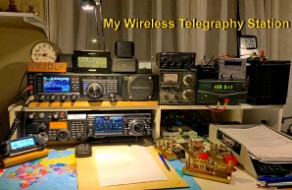
Georg VK2DLFS nice station – how many bugs? © I disappeared to have an early dinner, and when I came back, the band was still quiet; where was everyone?
© I wondered if there was something on NZ and Australian TV (I haven’t watched broadcast TV for over 20 years… but I’m told that occasionally there’s something worth watching – but I reserve judgement)?
Perhaps another repeat of the famous ABC Hard Quiz featuring Richard VK6PZT and his topic Morse Code was being aired in NZ or Australia?
© I heard Claude VK1TE/M parked in Faraday Driveway Pearce working Paul VK3KLE, who in turn caught up with Peter VK6IS at Wundowie. © Sol put out a few CQs and caught Claude – still parked in his Faraday drive.
After exchanging pleasantries (ie RSNs) we swapped Chinese Whispers – which was a good practice exercise for me. © Then, even though the signals had dived down with QSB, we decided to give Claude’s Ping-PongCW head-copy exercise a try; the idea was: = I would send a word of four letters, and Claude would head-copy, and reply with that word, plus any second word.
= I’d respond with his new word and another word of four letters. = We’d continue back and forth attempting to head copy, remember, reply and think up a new word.
= I cheated and had a list of words of four letters from the internet, but Claude was having fun looking around the car for inspiration: REVS, HEAT, COOL, FAN, SWR, SCAN, WHEEL, SHIFT, RIT, TUNE, SPLIT, KEY etc… not all of which were strictly four letters…
But it didn’t matter – we had so much fun! © Around that time I noticed a distinct warble on Claude’s signal – both a very sharp variation in strength, and what appeared to be a slight frequency shift.
© And even though the signals were fading right down to below the noise level at both ends, we managed to keep the Ping-PongCW exchange going for about half an hour with very few ‘2’ or ‘AGN?” replies.
© Claude is developing the Ping-PongCW exercise, and the last RagChew included his first prototype; so if you’d like to have ago, just put a note on our CQQRS WhatsApp Alerts, email or call Claude or me if you hear us.
© After Claude, I was called by our new team member Manny VK3DRQ at Blackburn; Manny had a solid signal to me, and I was very pleased to exchange a pair of Chinese Whispers. I noticed the same warble on Manny’s signal that I’d heard from Claude.
© Next up I saw Tim VK3TBR at Horsham with an Alert on WhatsApp advising that he had a Chinese Whisper to send; we hooked up and exchanged the Whispers without any problems – and again, I could hear the (possibly Auroral) warble on Tim’s signal as well.
Interestingly, the QSB aspect of the Aurora(?) sounded just like an intermittent antenna problem at this end on receive, yet it wasn’t so noticeable on the Tecsun KiwiSDR at Araluen.
That SDR used a pair of vertically polarised (low radiation angle) antennas fed together, whereas at home I was using my 80m double-extended Zepp as a 106M long doublet, but only 6m off the ground – ie a high angle of radiation.
© Later when talking to Warren VK3BYD at Wangaratta on 80m, Warren also reported that he’d noted the Auroral activity on 40m – another good report for me…. perhaps not an intermittent antenna problem at my end.
© Finally, I was pleased to hear another of our founding members, John VKSET/p – camping at Dublin North of Adelaide. We enjoyed the nice relatively quiet conditions of 40m – quite a change from the noise struggles we’ve had from time to time on 80m in the past.
• When John and I finished our nice chat on 40m, I slid down to 80m – imagine snakes-and-ladders… but with lots of frequency changing on my TS-50 and the two KiwiSDRs, adjusting my manual Tee antenna coupler then careful adjustment of my phasing-type noise canceller….
10 minutes later… all dressed up but nowhere to go; where was everyone? I called CQ on 3555KHZ and fortunately I was answered by Warren VKS3BYD down at Wangaratta.
Warren reported that he’d had a busy night on 40m, which was pleasing; I had had back-to-back rag chews, Chinese Whisper exchanges and Pin-PongCW on 40… and hadn’t had much time to listen in to what else was happening. Great to know things were busy.
I then chatted to Merv at Ballarat and then had a really nice QSO with David VK6KD at Ballajura – the band was nicely open and the noise level was down – perfect 80m conditions.
Finally, just to make sure I wasn’t the only Easterner awake that late, I had a chat with Paul VKSKLE at Stawell who by that time had been pounding away on the net for about 6 – 1/2 hours.
From Paul VK3KLE at Stawell: « 40m © Good conditions – all stations good copy. « 80m © Perhaps a bit earlier ?
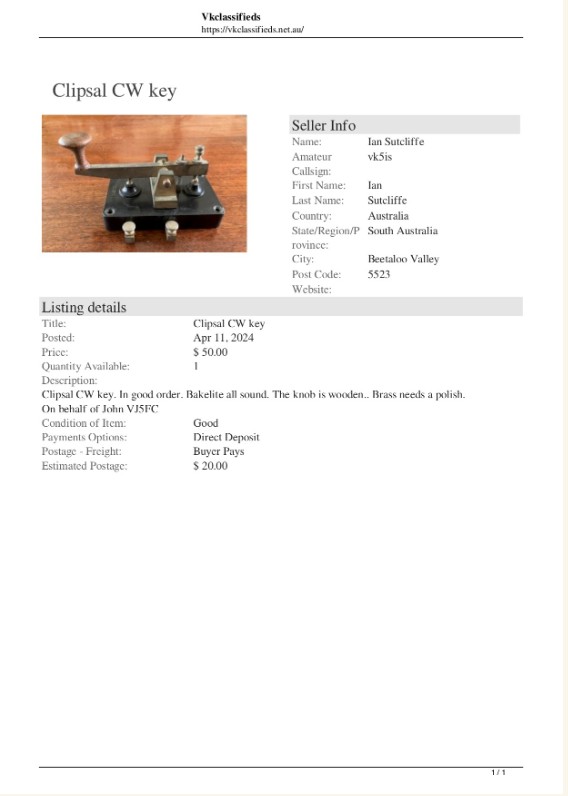
From David VK6KD at Ballajura: o My old key was having contact pressure issues in the plug socket so I thought I should buy another key before pulling the old one apart. (Just in case my repair attempt failed and I ended up with no working keys).
© Nothing like a hot coffee, Danish biscuits and a slow CW night. Magic. ° The key has magnetic feet however slides a little when on the biscuit tin. Yet to perfect a solution. Good mobile option, especially if the tin is full of biscuits hihi.
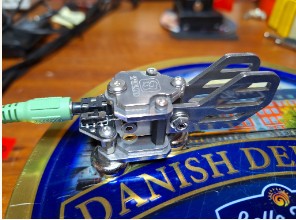
• The key has magnetic feet however slides a little when on the biscuit tin. Yet to perfect a solution. Good mobile option, especially if the tin is full of biscuits hihi. ¢ Slides a little when in on a biscuit tin.
From Mike VK6AAV at Forrestfield: « 80m © This band appears to be abandoned in favour of 40 M. ¢
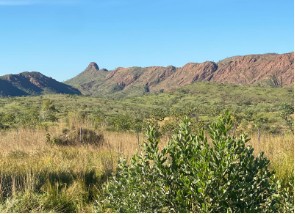
• I’m portable with 20 Watts near the NT border 15KM from Lake Argyle – Jungdranung Remote Community ¢ Contacts with VK6PZT and ZL4TE on 40m
• Post Morseum Report from Richard VK6HRC at Padbury: © Gday Mark. Good to catch up with all on the QRS net via the VK6RLM repeater and associated AllStar links on Wednesday morning.
Wednesday’s group: = VK6KD/m_ David = VK6QI Mark = ZL3TK Stan =» VK6LD/M Rob =» VK6HRC_ Richard = and our shortwave listeners.
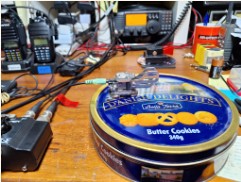
• Wednesday’s topics: © David’s new key © Passing on whispers © Correct pronunciation of some place names in New Zealand from Stan – (BTW welcome Stan).
David’s new paddle © The net lasted approximately half an hour with a lot more discussed that will no doubt be included in the next RagChew. e Thank you Mark, have a great day, Richard. [Thank you Richard. As best!
Can work out, Stan’s location is pronounced by us Aussies ‘why-tar-rare-ee’ or perhaps ‘why-tar-rrare-dree’. Don’t ask me to pronounce ‘Whangarei’ – noting the pronunciation has changed since I lived in NZ.
Then again, there’s one or two places in Australia with challenging native names].
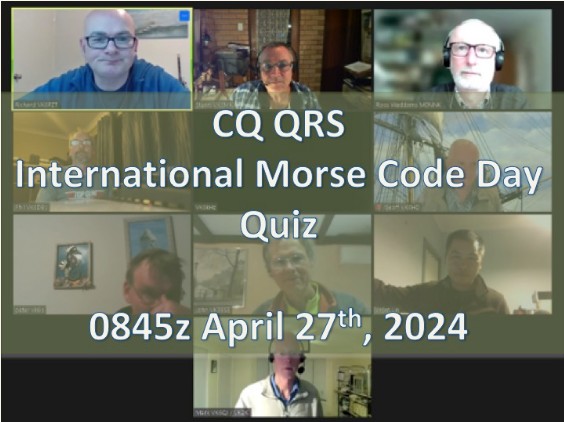
Join the Celebration In previous years, we’ve celebrated International Morse Code day with a Quiz hosted my Mister Morse Code himself, Richard VK6PZT via Zoom videoconference.
In addition, we’ve run the International Morse Code Day Corroboree, an on-air QRS event held close to IMCD. Well this year, we’re doing two things for your entertainment – the popular, definitely fun and not too serious Quiz will be held on the Saturday once again.
And instead of a one-day on-air Corroboree event, Stan ZL8TK is running a fun and challenging Chinese Whispers event for us over the whole month of April. Celebrate International Morse Code Day – Saturday April 27TH
From Richard VK6PZT:
Do you know your Dits from your dahs? Have you got what it takes to be the next International Morse Code Day quiz champion?
Well, even if you don’t, why not celebrate Samuel Morse’s birthday and International Morse Code Day by registering for our Morse Code Quiz, hosted by the CQQRS, slow Morse code team?
The quiz will be lots of fun and very informal – we don’t take ourselves too seriously. We have lots of easy multiple-choice questions, aimed at both novices and experts alike.
So, if you’re interested, then please send me an email to vk6pzt@gmail.com , and I will reply with the details, and a zoom link to join the quiz. Once again, the quiz will be held on International Morse Code Day – Saturday April 27TH, via Zoom.
If you would like to register, send an email to vk6pzt@gmail.com
To celebrate International Morse Code Day (IMCD) this year, as well as to provide an opportunity to hone your CW skills, we are running a Chinese Whispers project from 1 April, ending 30TH or earlier if the exercise is completed and we’re out of new stock.
Don’t worry, this is not a contest, there are no winners per se, yet all are winners from the experience to be gained.
The Sequence
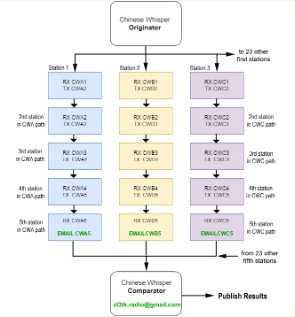
Our Chinese Whispers works like this: + Twenty-six, single-sentence Whispers have been prepared and are ready to be sent to willing volunteer recipients.
+ When a Whisper has been received, it needs to be passed on to one (and only one) other station via QRS CW. + Each Whisper has been assigned a name in the range CWA ~ CWZ followed by the digit 1 in the first instance.
+ That digit is incremented as the Chinese Whisper is on-sent five more times, eg CWAI becomes CWA2, which becomes CWAS…. until it’s passed around four times and produces CWAS. + The recipient of CWAS is the end of the line for that Whisper.
He or she sends the received text by email to zi3tk.radio@gmail.com with the subject line CWAS completed (or CWBS, CWCS etc as appropriate). + The resulting message will be compared with the original and the results will be published in RagChew.
Hopefully some may be quite amusing. + And don’t worry, the identity of the stations along the path won’t be known to the organisers… we’ll know only the identity of the first and last stations in the chain.
+ Exchanges won’t be limited to the Tuesday net – as long as they’re passed by QRS CW during the month of April, we’ll be happy.
The whole Whisper send and receive procedure can be conducted in plain language, however for those wanting to extend their skills by employing an efficient traffic-net- style exchange, here’s one suggested protocol.
+ This Whisper-passing protocol is very gentle… no pressure. * This is also an opportunity to use RSN (as an alternative to RST) if you’d like to clearly indicate your reception conditions to the other op so they can decide how best to send the Whisper…
Speed, Farnsworth, repeats, etc. * Let’s say conditions are pretty poor but you’d like to proceed anyway. * The sending station could send ‘QRV CWSPR? BK’ (ie are you ready to receive a Chinese Whisper?).
© Affirmative response: Acceptance could be in the form of a signal report followed by QRV BK (eg ‘RSN432 QRV BK’ (your signal is mostly readable, I am ready to give it a go, break) or simple: ‘R BK’ (Roger – break).
One way to give yourself a better chance to receive as much as possible in one go is to send PSE QSZ, meaning ‘Please send each word twice’. © Negative response: The other side of the coin is to decline.
Simply send: ‘NO TKS BK’, or ‘QRX 15 MINS BK’ (call me again in 15 minutes) or simply ‘N TU’ (negative – thank you). * So let’s say the receiving station is good to go.
The sending station sends: [callsigns if needed] then (say) ‘CWGS -’ followed by the text of the Whisper then ‘QSL? BK’.
* Ifthe receiving station misses a word, they could send ‘PSE RPT WORDS 3 ES 7 – WORDS 3 ES 7?” Alternatively: © ‘RPT WA XXXXX’ (le repeat word after XXXXX) © ‘RPT WB XXXXX’ (ie repeat word after XXXXX) © ‘RPT AA XXXXX (je repeat all after XXXXX) © ‘RPT AB XXXXX (le repeat all before XXXXX) of, © ‘RPT BN XXXXX YYYYY (ie repeat between words XXXXX and YYYYY).
* But if the receiving station has enough words to fill in the blanks, they could send ‘QSL ALL – TU BK’ or similar.
So it’s a fun thing to try through April in celebration of International Morse Code Day.
Remember
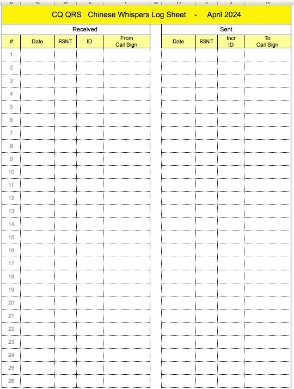
• Astation can only pass a particular Whisper to one station, regardless of its serial number. So if someone offers you CWT3, but you’ve previously sent the same message to someone else (eg as CWT1), you’ll need to decline – eg ‘SRI NO – SENT CWT1 BEFORE” * There is no restriction on the number of Whispers any one station can pass to another if they have them ready to go.
Fo keep track of the Whisper messages /ou’ve handled during April, you could Ise a spreadsheet like this one (available from https://asl.net/zi3tk/whispers/whisy
Don’t Have a Whisper to Send?
If you haven’t already received a Whisper from someone, please email zl3tk.radio@gmail.com with the subject line ‘Chinese Whispers’.
You could also use the WhatsApp Alerts to advertise: ‘CQ 7030 – I have a CWSPR message to send’ or ‘CQ 7030 – anyone have a IMCD CWSPR message to pass?’.
If you’re not in our WhatsApp group, but want to have a go sending or receiving a Chinese Whisper, send me an email cqqrsnet@gmail.com or an SMS to +61 418161773 and if I get it in time, Ill post it on WhatsApp.
CQ QRS WhatsApp Group
The Community has two sub-groups: « CQ QRS Alerts – for spotting CQ calls and QSOs during the net, and for QRS alerts and members’ CQ calls (QRS or QRQ, simple exchanges or rag chews) a other times.
¢« Rag Chews – for chats and photo exchanges between team members about who knows what – current projects, technical questions, in fact, anything of interest to CW operators… excluding religion and politics of course.
You can set different notifications on your phone – eg a sound when there’s an Alert, and silence when there’s a rag chew message. And once set up, you can also use your computer.
If you’re missing out, please send your mobile phone number to me at cqqrsnet@gmail.com or Stuart VK6MK at stujen55@gmail.com and we’ll get you going.
VUGIQIE NCY VOCHlUry VIN – VUCdIlid UNO Oder
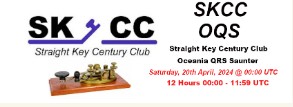
From Garry VK2GAZ The SKCC Oceania QRS Saunter will take place this Saturday, 20TH April from 00:00 UTC until 11:59 UTC for the 12 hour event. All are welcome to join in!!
All the details for the Oceania QRS Saunter (OQS) can be viewed on the SKCC website at: https://www.skccgroup.com/operating_activities/oqs/ You’re also welcome to make use of the SKCC Sked Page and the CW Club RBN Spotter.
Https://sked.skccgroup.com/ https://rbn.telegraphy.de/ Please circulate. See more details concerning line check area
Join Our Post-Morseum From me VK2KI / VK6QI at Beautiful South Bowning NSW Last week, Stan ZL3TK asked me about how to join our weekly Post-Morseum, then successfully joined in on Wednesday morning.
The Post-Morseum get-together is hosted on the Western Australian South West AllStar network by Richard VK6HRC; one of the beauties of AllStar is that it can be accessed anywhere in the world – perhaps via your FM local repeater or even using your computer or phone on Echolink.
The net runs from 0600 – 0700 hours in WA every Wednesday; this translates to 2200-2300z Tuesday (thanks Stan ZL3TK for correcting my calculations on this!).
The get-together is intended for CQ QRS net participants and interested SWLs to exchange thoughts, achievements and frustrations about the previous evening’s CQ QRS net; the discussion often extends to related topics related to CW and HF ops.
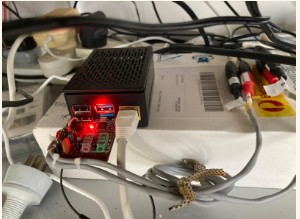
The SW AllStar network uses the internet to connect many of WA’s 2m, 70CM and 10m repeaters and AllStar hotspots to form a continuous (24 hours per day) voice network; there’s no setting-up required – accessing the network or any of the repeaters immediately transmits audio around the whole network.
The network is also connected to various other (quiet) repeaters in other parts of the world, such as the UK, and users can also make other temporary connections to other nodes or networks using simple DTMF commands.
‘Team members who are not in WA can access the SW AllStar network as follows: * For those who already have an AllStar node or hotspot (a fun Raspberry Pi project for anyone wanting to learn about these brilliant tiny computers – there’s even a step-by-step YouTube video on how to build!) – use your Supermon controller to connect to one of the WA nodes: Node 42482, 51077 or 42732 (three of the key hubs that connect the individual nodes together) should work.
* For those who’d like to come in using Echolink on your phone or computer, search the Stations list for *VK6-HUB” (with the asterisks) or 9610. From the Connect screen, you can Add to Favourites, to make it easier to find next time.
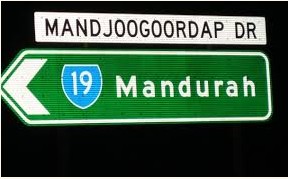
* Ifunsuccessful with *VK6-HUB”, you could try the node I built for the Mandurah WA repeater by searching for VK6RMH-R or 692831.
Note however, the audio level from you via this node will be reported as being a bit low; after we sort out a problem with the VPN used to connect to the AllStar node (which requires a site visit….
A bit far for me – 3,700km), we’ll see if we can sort out the audio level as well. So Richard and I look forward to hearing you on the Post-Morseum net on Wednesdays. Also, let me know if you’d like any help getting on AllStar.
I have an AllStar hotspot here at home that’s permanently connected to the South West Net; so if you would like to say g’day, give me (VK6QI or VK2K)) a hoy on the network; if ‘m within earshot of my $20 Baofeng BF-888 hand-held I’ll hear you.
Not as much fun as slow CW, but for a voice network, it’s pretty good! Observations from the Latest Issue of RagChew
From Stan ZL3TK at Waitarere Beach Observations from the last editiot + To make each issue of ‘RagChew’ identifiable, how about a serial number, maybe use the number of the week in the year? e.g. 7~ 13 April is week 15.
* Glad to see that when call signs are entered alphabetically in Nigel’s magnificent logging form, they remain that way when published (that’s my OCD speaking!) + Did OM Manny VK3DR@ really need arm twisting to show up in the group? Not on your nellie.
The event was mentioned to him as casually as casual can be. In the style of a true Spanish conquistador that he is, he followed up. Never underestimate OM Manny, he’s one of the best and most considerate operators.
Appreciate your thoughts Stan – no-doubt you noticed the new Edition number].
From David VK5PL via Richard VAK6HRC A new Long Island CW Club BC1 CW training Class will commence on Monday evening in our local time zone at 8PM AEST (1000UTC) (6am US EST) as atrial. So come along and learn 3 letters in the first BC1 Carousel.
The VK/ZL-friendly training will run for 6 weeks and may change to a BC2 after that depending on a new instructor coming on board. See you all next Monday evening.
Dave VK5PL [See Richard VK6HRC’s article in This Week’s Topic of Interest below for details about how to join the Long Island CW training].
From Stan ZL3TK at Waitarere Beach Something I’ve always found a bit strange. One is always reading in ‘ham’ publications and hearing on the air, folk talking about ‘amateurs’. But amateur in what activity?
It could be in anything, there are thousands of possibilities! Only a supporting context can provide the answer. Does anyone know of another activity in which the participants, aficionados, whatever, refer to their peers by the bald epithet ‘amateur’, as in ‘he’s an amateur’, subverting the word to a noun from its intended purpose as an adjective?
Wait Aloud (or NOT)
Awhile ago I sent out an email stating that education is a very important part of our hobby. Without education and encouragement, we would not attract new members to the hobby.
I developed a fee free and advertisement free web site for anyone to help them prepare for their examinations. The site is https://Awww.julesworkshop.net/Amateur%20Radio.html The Advanced material is based on the syllabus and the Foundation material is based on the Foundation manual and syllabus.
Since the initial launch of the website, a process of continuous improvements was implemented. The site now has more questions and answers in all categories, errors corrected and explanations reformatted for easier reading.
They have been over five thousand visits to the site so far. Ihope you and your members will find this material helpful; let me know if you have members or anyone interested who may use the site.
I encourage feedback and tell me how to improve the site and expand on any critical information I missed. Thank you Jules Perrin JP 0457585974
[Thank you for providing this service Jules, and for allowing us to use your questions in our weekly quiz below].
From Stan ZL3TK at Waitarere Beach In a previous edition you included ‘Which Hand?” I’m a leftie keyer and occasionally swap to the right hand – the results are predictable. LH operators deploy the right side of their brain, and vice versa.
It’s been hypothesised that YLs have a better-developed corpus callosum, the nerve-fibre highway which connects the two cerebral hemispheres, than we of the testosterone- enhanced variety. Apparently a fatter corpus callosum enhances the ability to multi- task.
Which raises an interesting but vexed question: to become truly ‘dual-ham-fisted’’, is the modern fetish for gender reassignment worth considering? If yes, then what about the plumbing, is antenna construction likely to suffer?
Morse is unswervingly binary, while the emerging plethora of new genders are ‘celebrated’ (beats me why) as non-binary, so could gender reassignment render a previously competent operator CW-impotent?
Think it through carefully before visiting the ‘Black Bag’ for your assessment.
More Thinking Aloud
NTARC Morse Training Net
Nic VK7WW runs a Slow Morse training net every Wednesday at 7pm EDST on 3580 for 30 mins. He uses the callsign of the Northern Tasmania Amateur Radio Club VK7TAZ on that net.
Many of our team learned Morse code with the support of Nic, and the weekly training session comes highly recommended for anyone who wants to learn the Code, or simply brush up. Everyone’s welcome – 3580KHZ at 7pm Eastern time every Wednesday.
The NTARC also feeds the CW live via the Discord phone / computer audio stream, and previous weeks’ recordings are available. Contact Nic VK7WW for more info nicholaschantler@hotmail.com – or just join in on Wednesdays – 3580KHZ LSB.
Community Radio
Many readers know already that I do a stint as a volunteer presenter on the local Community radio station, YassFM on Friday afternoons NSW time.
We usually have a number of the CQ QRS team listening-in via the Live Stream on the internet. 1pm until 40m NSW time I have a guest, my mate Dennis who has a Vineyard in Yass is a great classical music fan – and he brings his music to
Share from 1pm until 4pm. And from 4pm until 5pm, I do the Your Shed program – things of interest to local rural businesses primarily. To listen, www.yassfm.org and click on Listen Live. Send me an SMS to say g’day if you’re listening in.
Discussing the topic of Learning the Morse Code could be, in the words of one of our team members “a very brave move Minister”. There seems to be as many, if not more, opinions as options!
However, it’s an important topic about a question that I get asked from time-to- time… but one that I can’t answer from recent experience.
And I know that I wouldn’t recommend the method I used in the early 70s; but fortunately, there are better ways these days.
So to prepare for a presentation I gave via Zoom to the annual PARGFEST in February, I’d asked a few of our team for their thoughts; this week and in future weeks, I’ll bring you their thoughts. This week, Richard VK6HRC kicks-off our topic.
Richard Campbell-Morrison VK6HRC_ My Journey I started with the G4FON software package and joined the Long Island CW Club’s internet-based training in February 2023.
Our CQ QRS net came to my attention probably around May/June 2023 when I heard Max VK6EN chatting to someone on the AllStar network about the net – so I started listening-in on the net after that.
It was also around that time that I was listening in on the VK6SR Southern Electronics Group Remote to compare signals to my home station, and Mark VK6QI and I had a chat via the Remote’s text Chat system.
Mark started sending me the RagChew news letter and I started sending Tuesday SWL reports in return. Ithas been a fun and sometimes stressful journey as I am a bit of a worry-wart!
But I really appreciate the support and encouragement from the whole CQ QRS crew. I really like the way so many of the team go out of their way to be on as often as.
Possible, to give both active stations and our SWLs an opportunity to practice at real QSOs under real and variable conditions.
Long Island CW Club Training https:/longislandewelub.org/ The link below is a Youtube video about the Long Island CW Club, hosted by Kyle ‘AAQZ a very active tuber focussing on CW.
Https://www.youtube.com/live/wiCJYrrQO-A?si=ac93tT3s6wFeJe9Z In the rather lengthy video Kyle talks to the founders of the club and they go through how the club was formed and the evolution of the classes, a very successful program with thousands of members worldwide.
In a nutshell, the first classes are conducted via Zoom and in what they call BC1 (Beginners Carousel), which start with three letters in the first lesson and add three new letters in the next and so on until all the letters of the alphabet have been covered.
It is possible to start at any time as the name suggests it is a carousel just go toa lesson and follow on. The LICW has a great web practice page that is used in conjunction with the lessons, but can be accessed anytime.
Once you are confident in BC1 you can go on to BC2 where they add numbers and prosigns; BC3 then focusses on QSO protocol. To take part you need to join the club, $30 per year up to the top tier $100 lifetime membership.
Software The G4FON Application works on both IOS devices and Windows; I also use Precision CW Fistcheck which is only used on Windows so far.
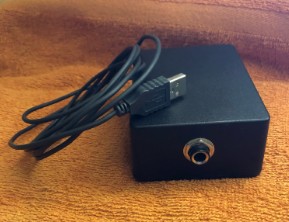
This is the internal circuit of a USB mouse that has been hacked, put in a box and fitted with a socket. Connections run from the socket to the switch on the left mouse button. The interface is good for straight key operation with the G4FON application.
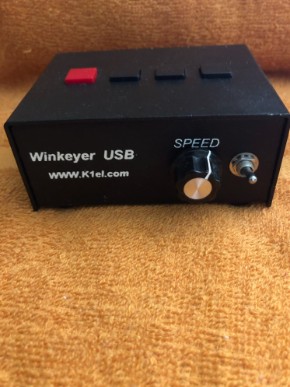
Here’s the Winkeyer USB2 that can be connected to the USB interface instead of the mouse box above, allowing me to practice using a paddle.
To the left is a screen shot of the Precision CW Fistcheck software. The application shows you how accurate your keying is; if you miskey it just comes up with question marks until you get it right.
Plus if I hear a character on air that I am not sure of just key what was heard and most of the time it prints out nicely.
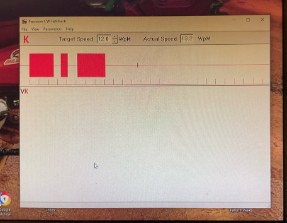
| started using the G4FON software package before joining LICW club and was doing fine. However, the LICW on-line lessons took over after a while. I found the software easy to use and being able to install it on my phone was very handy.
The G4FON software is a very user-friendly package with multiple selections. * side tone pitch + wpm/ Farnsworth spacing * selectable letter list + words and many more functions. I started at 12/8 Farnsworth wpm as that was where the LICW training started.
There is a G4FON sending trainer available after you have learned a set amount of letters… but I could not get it to work @; actually, I did not try too hard to fix it – the CQ QRS net came to the rescue for real transmitting practice.
Things to do when Learning CW + Have fun * Practice every day * Get on air ASAP – our net is the perfect place to have a go – and Mark will even issue a special certificate if you have your very first CW QSO on the net * Relax + Have fun + Avoid © mnemonics © decoders if possible (maybe only to start with – the fun and challenge is letting your head do the decoding) © CW Wall charts (as above) [Thanks very much Richard – I appreciate the time taken to assemble your thoughts on how you learned and what you recommend.
I’m certain that others will too.] The Topics of Interest are where you can share your knowledge and thoughts about things that others in the team may be interested in.
Please send me any material you think may be of interest, so we can share more thoughts and ideas in the future; email to cqqrsnet@gmai

Brain teaser
Answers next week.

Answers from last week’s Quiz:
Calculate the following powers: * E=20v1=0.2A Answer:4 Watts * 1=2AR=1000 Answer: 400 Watts + R= 10000 E = 500V Answer:250 Watts Aradio frequency bypass capacitor: * blocks radio frequencies and passes direct current * blocks direct current and passes radio frequencies + must have a high reactance in order to be effective * provides a low impedance path for direct current Answer:blocks direct current and passes radio frequencies Which of the following statements is incorrect in relation to a full wave bridge rectifier circuit * its transformer does not require a centre tap + the circuit requires two diodes * all diodes conduct at the same time * the output ripple frequency is 100HZ Answer:the circuit requires two diodes and all diodes conduct at the same time The callsign prefix “AX” may be allocated: * for use during a special commemorative event in Australia * to an amateur network passing emergency traffic * to an ocean-going ship in Australian waters * for communication with manned satellites Answer:for use during a special commemorative event in Australia How did you go?
Di-dah-di-dah-dit
So back to the Slow CW QSO practice net.
Next Tuesday’s Net
Our CQ QRS Net will be on as always on Tuesday from around 0700Z until about 1300Z; see below for details. Doesn’t matter whether you’re brand new and want to try just exchanging callsigns and RST reports, or you’re ready for a good old rag chew.
Reports
Please let me know via our Reports form bit.ly/CQQRSNET by Thursday lunchtime who you work or hear on Tuesday’s net.
Post Morsum
Richard VK6HRC will run our Post Morsum on the South West AllStar net (via repeaters and hotspots all over WA) from 0600 WA time. If you’re in WA, all you need is an FM 2m or 70CM transceiver and an AllStar node nearby.
If you’re elsewhere in the world, you may be able to connect your local AllStar-enabled repeater to the net, or you can connect via Echolink. Let me know (cqgrsnet@gmail.com) if I can help with that.
Teamwork

About the CQ QRS Net
Matching

Landing Zone
As always, for newbies, operating suggestions are available from the operating hints link here: https://www.parg.org.au/ files/ugd/ebe236 3ca5ca08bb38429db4eee524bda2f97a. pdf.
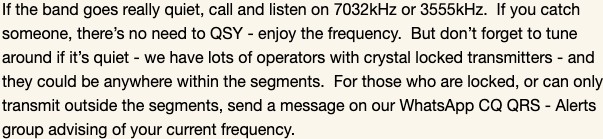
There’s usually people around until after 1300Z – so keep calling until you catch someone. I should be on as usual from home in NSW and via the Remote at Bedfordale WA, and I’ll also be watching the proceedings using the VK6QS and Tecsun SDRs in WA and NSW respectively.
The opinions expressed in the RagChew newsletter are those of the individual contributors. The opinions do nat necessarily reflect that of the editor or of the CQ QAS Group members.