Below is a reconstruction of the 2024 17 CQ QRS RagChew newsletter designed to support full text searching. This reconstruction was built using OCR, and will contain errors.
To view the Mailchimp original, click here. To search the entire newsletter archive, click here.
Contents
- Reports
- Reports & Comments
- Comments:
- From Tim VK3TBR at Horsham:
- From Jordan VK3ACU at Meredith:
- From Roy VK6RR at Utakarra:
- Post Morsum
- How One Sentence sent a Whole Town Fleeing
- Other News
- From Richard VK6HRC:
- From Stan ZL3KK:
- From our wanderer George VK2AOE
- Morse Training Net
- Community Radio
- Complete Immersion
- Personal Meaning
- Conventional Training
- Learning Rule
- Training Content
- Starting
- Brain Teaser
- Amateur Radio Exam Questions
- Answers from last week’s Quiz:
- Di-dah-di-dah-dit
- Next Tuesday’s Net
- Teamwork
- About the CQ QRS Net
- Matching
- Landing Zone
- CW Tips
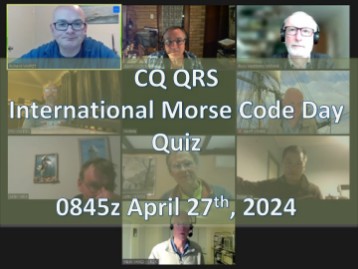
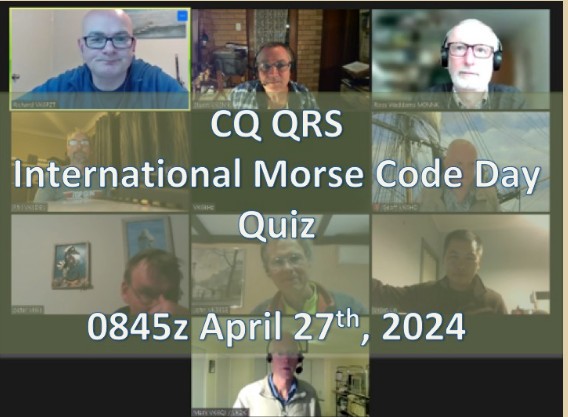
First and foremost….. Saturday April 27TH is International Morse Code Day, and to celebrate Samuel Morse’s Birthday, we’re running the Zoom videoconference quiz at 0845Z this coming Saturday evening.
And don’t worry – it’s all about having fun, not whether you know more about the topic than the next person. Please email to Richard VK6PZT vk6pzt@gmail.com to join in the fun.
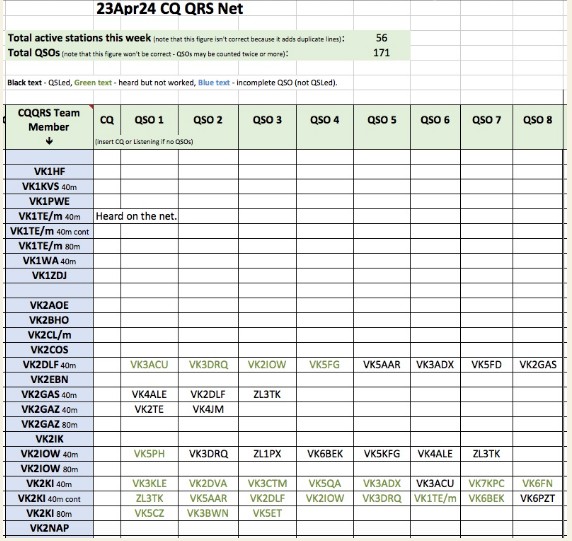
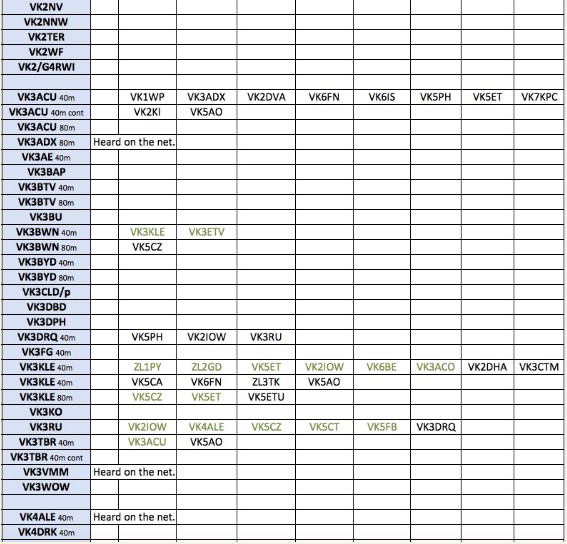
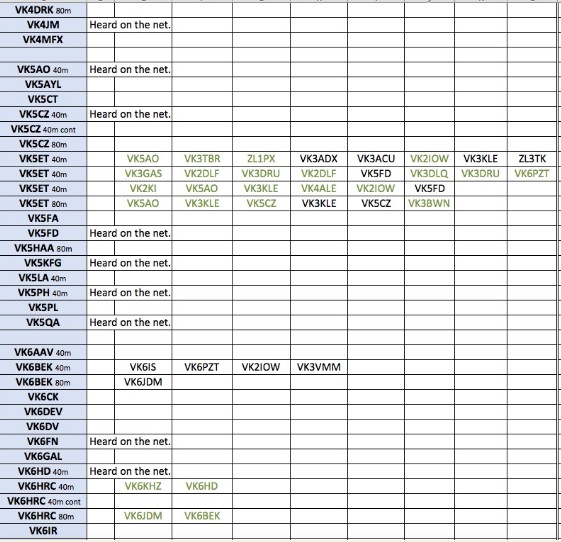
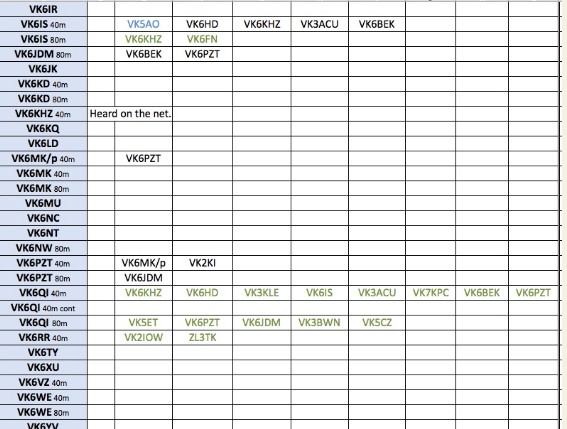
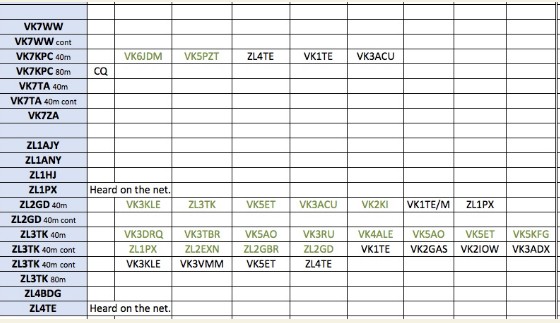
Thank you to everyone who took the time to send a report about what you heard on the CQ QRS Slow CW Practice QSO net last Tuesday. I’ve heard varying condition reports – 40m seemed to be working ok, but 80m was very quiet again.
Things might change as we head into Winter with lower excitement of the ionosphere as the solar radiation drops in the Southern hemisphere; time will tell. Here’s this week’s list of the 40 stations known to be on:
Reports
Next Tuesday’s net will be on as always from 0700Z until 1300Z; see the end of the newsletter for times and frequencies. After next Tuesday’s net, please send me a list of who you worked and / or who you heard using our new web form here: bit.ly/CQQRSNET
Getting reports from stations and listeners is important to me – even if you listened and didn’t hear anyone or weren’t able to copy anything – the fact that you had a go needs to get recorded so we know that the net is working and attracting new and old team members to have a go.
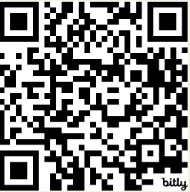
Thanks again to Nigel G4RWI for building the Google Form, the Python software back-end that does the processing, the new link and the QR code.
International Morse Code Day Events Did I mention that this Saturday is Samuel Morse’s Birthday? And…. our annual riotous Quiz via Zoom. vk6pzt@gmail.com for the info on how to connect.
Richard has done an outstanding job creating a huge range of fun questions… some are even related to Morse Code. Even if you don’t go for quiz-type things, getting together for a laugh with our team will be great – I’m looking forward to putting faces to callsigns for those with cameras on their computers or phones!
And you don’t need the Zoom application or anything any more fancy than a computer or a phone with a web browser to join us.
Do you know your dits from your dahs? Have you got what it takes to be the next International Morse Code Day quiz champion?
Well, even if you don’t, why not celebrate Samuel Morse’s birthday and International Morse Code Day by registering for our Morse Code Quiz, hosted by the CQQRS slow Morse code team?
The quiz will be lots of fun and very informal – we don’t take ourselves too seriously. We have lots of easy multiple-choice questions, aimed at both novices and experts alike.
So, if you’re interested, then please send me an email to vk6pzt@gmail.com , and I will reply with the details, and a zoom link to join the quiz. Once again, the quiz will be held on International Morse Code Day – Saturday April 27TH, via Zoom.
I you would like to register, send an email to vk6pzt@gmail.com Quiz Calendar Link
Well this coming Tuesday will be the last CQ QRS net for April – which means the last net before the Chinese Whispers practice message handling exercise finishes. Of course, you can exchange messages outside of the net, but it all finishes on Tuesday.
Welcome this week to Jon VK4ALE at Carseldine, Peter Z_1PX at Waiuku and Dave VK2NA at Charlestown – I look forward to hearing you all on our Tuesday get- togethers.
Cheers, mb Mark Bosma VK2KI / VK6QI Beautiful South Bowning NSW mark.bosma@icloud.com non impsditi ratione cogitationis
Reports & Comments
The spreadsheets above show the known stations on last Tuesday’s net. Comments distilled from the reports I’ve received are below:
Comments:
From Grant ZL2GD at Oxford: © Peter ZL1PX had just arrived home from Jacobs Well on the Gold Coast – apparently the midges are a bit nasty there? In the 80s, Queensland used to advertise that it was “Beautiful one day, perfect the next”. Wonder what happened?
From Tim VK3TBR at Horsham:

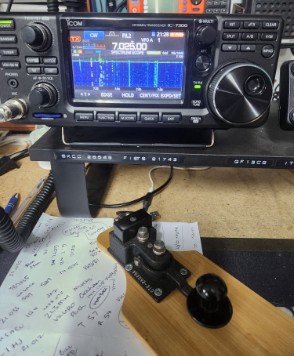
A great night again, unfortunately only had time for one, but passed on a whisper to Mait VK5AO and had a nice long chat.
I last worked Mait in Nov ’22 (I could probably barely string a QSO together back then!) Great to see the waterfall so busy again in the CW region. 73 all.
From Jordan VK3AGU at Meredith: © What a night! © I turned the radio off just before 9 pm after starting at 6 pm. © I discovered that 3 hours of non-stop CW is my limit; beyond that, I become CW drunk.
© I was gearing up to exchange whispers with VKSAO when mid QSO my brain went QRT. Maitland could tell and suggested we try again another time. © Truth be told, it might have happened after Mark sent me a few more whispers.
I had a good laugh as we both had a bit of confusion at the start of our QSO; for some reason, we both thought we each had to go to dinner? Haha – all good. © [really enjoyed the night and I’m keen to pass some whispers on.
If anyone’s interested, drop me an email; you can find me on QRZ to organise a time. © And don’t forget the slow Morse course on Wednesday nights with Nic VK7WW on 3.580.
© Thanks to everyone who joined, and a huge shout-out to Mark for organising the rag-chew every week. Well done, mate! [Received loud and clear Jordan… unlike our hilarious pre-Whisper conversation – Hil]
From Jordan VK3ACU at Meredith:
From Donald VK6JDM at Dalyup: © Iwas using about 4 watts from a Paraset on transmit. It uses a cathode-keyed 6v6. © Iused my home-brew transceiver for reception because the Paraset receiver section is hard to tune and not very sensitive.
© Iwas at the bottom end of the part of the 80 metres that we use for the QRS CW nights, because the only ancient crystal I have for 80 is 3540KHZ. I gather these sets break the modern styles of crystals.
© Iwill see if I can get some others from the QRP club and so move up where everybody else is. © Iwas still expecting to hear Bob VK6KRC who promised he would be listening out for my signal but surprisingly… I did not hear him.
I am sure he was there somewhere as he did promise! [Great to hear you Donald; your frequency was 3539.2kHz, which as you implied, many of our tune-arounders with narrow filters may not listen that far down.
1 wonder whether a small sneaky NPO capacitor in series with the crystal might pull it higher and into the band? Say 20PF or maybe a trimmer capacitor – depending on how tolerant the oscillator is – the lower you go with the capacitor (le higher in frequency), the less reliable the oscillator will be of course.]
From Roy VK6RR at Utakarra:

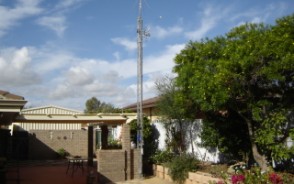
• Could only listen for 15 mins. ¢ I heard VK2IOW and ZL3TK. ¢ Didn’t hear any others.
[Hi Roy. Thank you for the report, and glad you picked up the two stations; I look forward to our next CW QSO – you may recall we chatted on CW during the last International Lighthouse and Lightship Weekend when you were out portable].
From Stan ZLSTK at Waitdrere Beach: © Another very busy night with further evidence of improving skills. © Conditions reasonable, slightly higher noise than usual but made little difference with a notch filter. © Nothing heard on 80 m. +
From John VKSET at Hope Valley: ° 40m © 40 mts is booming & I’m getting plenty of practice listening to other stations making contacts as well as getting few on my own. © Much better conditions compared to 80 mts.
© Alot of overlapping CW from background stations on this band. Matter ¢ picking out best signal. © By the time 22:00, local time rolls up I now have a dozen or more stations heard & made a few QSOs. © Tnx to you opening up the 40MTS QRS Net.
© Hard to catch up with other ops on the band, yourself included as its all go, good fun & practice never the less.

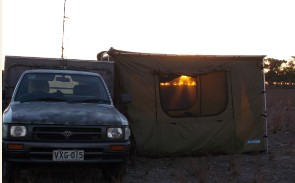
80m Still good to hear that some ops are popping up now & then. Also great to hear & occasionally work ZLs.
From Richard VK6HRC at Padbury: © 40m was quiet to start with but picked up later. +
From Manny VK3DR@ at Blackburn: © Tonight, after finishing on the NZ Net, I managed to have a little time to spare, so I called CQ QRS CW on 7026. © From 0921Z to 1029Z I worked VK5PH Paul, VK2IOW the OM Pat and VK3RU the OM David.
© Unfortunately I still couldn’t unload any Chinese Whispers. When it comes to asking someone a favour, I am too ashamed. © Tomorrow it will be my QNN time on the VKCW Net which goes to air every Wednesday at 0603Z on 14049 KHz.
© Have a good night OM and keep up the good work. © 78&77 Manny VK3DRQ [Fingers crossed that you pass those Whispers on before the calendar turns Manny. There’s lots of us keen to receive them while there’s still time.]
From me VK2KI at Beautiful South Bowning: ° 40m © I tried to crank up the Tecsun KiwiSDR at Araluen NSW as usual, but the unit wouldn’t respond all night; so instead I used the VK1CM KiwiSDR at Farrer to monitor the goings-on.
© I heard Paul VK8KLE at Stawell working Colin VK2DVA and Tony VK3CTM who haven’t joined our team yet. © Craig VKSQA/p (VK3CLD in disguise) was putting in a nice signal from his portable set-up.
© I then listened to Jordan VK3ACU at Meredith chatting to Merv VK3ADX at Ballarat then Peter VK7KPC at Evandale, followed by Paul working Max VKGEN at Manjimup and Stan ZL8TK at Waitarere Beach.
© Next up I listened to Georg VK2DLF at St Marys chatting to Arthur VKSAAR who hasn’t yet joined our team, Manny VK3DRQ at Blackburn working Patrick VK2IOW at Millthorpe and Claude VK1TE/M chatting to Merv.
© I hooked up with Jordan for what turned out to be a fun pair of Chinese Whisper exchanges; as he explained above, confusion reigned while we both thought the other needed to rush away after a final dinner call…
But it turned out that I had mis-heard what Jordan had said, then he thought I was saying I needed to QRT… what fun! Just shows to go how easy it is, to completely fail to understand what’s going on when using CW when your head-copy is as bad as mine – Hl!
© After recovering from the two Whisper exchanges, I heard Shaun VK6BEK from Quinns Rocks chatting to Patrick before I hooked up with Richard VKG6PZT at Dalyellup for another Whisper pass.
I had to QRX in the process to squirt more contact cleaner into the 13.8V line fuse on my Kenwood TS-50; hate it when the transmitter dies on key-down during a Whisper pass!
© We then both slid off to 80m, which for me is as simple as: swap bands, pre-set my Tee-coupler, set my SWR bridge calibration, adjust the coupler for minimum reflected power / maximum forward power, then very carefully adjust the noise canceller (which for 80m means – antenna gain to zero, adjust noise pickup antenna gain and phase to a complete null, increase antenna gain a bit, re-null noise phase and gain, increase gain a bit more, re-adjust null, etc – aiming to try to get a reasonable null while maximising the antenna gain).
None of this fancy press the ATU button and Bob’s your uncle business – Hl! © 80m © I spent most of the 80m time listening in on the VK6QS KiwiSDR but I did hear nice signals from both Ketut VK3BWN at Keilor East and John VKSET at Hope Valley chatting to lan VK5CZ at Clare.
– And also from me VK6QI using the VK6QS KiwiSDR at Brookton: ° 40m

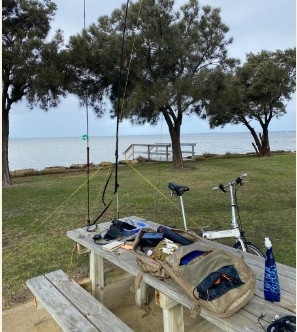
• Using the VK6QS KiwiSDR at Brookton, I listened-in to Geoff VK6HD at Erskine working Ron VK6KHZ at Yangebup. ¢ Last week Geoff had tried using his magnetic loop indoors without much luck, so this week he’d quickly assembled a temporary 8m Ryakov with 9:1 UNUN and his home-brew coupler.
Lalso heard Paul VK3KLE coming through early from Stawell, followed by Jordan VK3ACU at Meredith working Merv VK3ADX at Ballarat, and both Craig VK5QA/P (aka VK3CLR/p) from Victoria and Peter VK7KPC at Evandale calling CQ.
Next up I heard Paul working Max VK6EN at Manjimup, Geoff chatting to Peter VK6IS at Wundowie and Jordan hooking up with Peter.
Jordan and I (as VK2KI) exchanged Chinese Whispers and later in the evening Shaun VK6BEK at Quinns Rocks was heard chatting to Richard VKG6PZT at Dalyellup I then heard Shaun work Patrick VK2IOW at Millthorpe, while Richard and l exchanged Whispers before sliding over to 80m.
80m On 80m, I listened to John VKSET coming through nicely from Hope Valley as well as Richard VK6PZT from Dalyellup. Next up I heard a solid signal from Donald VK6JDM at Dalyup near Esperance who was crystal-locked on 3639.2kHz.
I tried to crank up the Southern Electronics Group VK6SR Remote; however while the Group’s new KiwiSDR II was being tested, the Remote was on a temporary bit of wet string, which I couldn’t get the SWR low enough to use.
I also tried the Group’s VK6CRO Remote up at Carnarvon, but as usual, it was in use on 6m FT8; nevertheless, Richard VK6PZT slipped down to the frequency and had a chat with Donald.
Lalso heard lan VK5CZ at Clare chatting to our new team member Ketut VK3BWN at Keilor East then to John VKSET at Hope Valley.
Things then got pretty quiet on 80m and because I couldn’t come up on either of the Remotes, I gave it away around 1300Z and continued doing my tax – what fun!
Post Morsum
From Richard VK6HRC at Padbury: A good group on the South West AllStar link on Wednesday morning (22002). Seven all up : VK6KRC Bob VK6FN Max VK6KD/M Dave VK6QI. = Mark ZL3TK Stan KA3BMS Hank our shortwave listeners and myself VK6HRC.
Reports varied from unable to be on the net to eight stations worked and twelve heard by ZL3TK – well done Stan. Also mentioned by Stan they are working on emergency backup RF links using Winlink etc to be available if ever the Internet goes down in the inevitable earthquakes in that part of the world.
Max VK6FN reported that he had taken delivery of another you-beaut Flex radio system and gave it a run last night. They might have had Max in mind when asked how many radios do you need? Max’s answer would surely be “one more”!
Of course we talked about Chinese Whispers (I’m keeping mine nice and warm here and especially importantly, the International Morse Code Day Quiz this coming Saturday.
Thanks to all 73 Richard VK6HRC [Thanks Richard – very well managed net, and another great report mate.]
CPCs tiVilcal IVINVEOS *% Hosted by Stan ZL3TK
How One Sentence sent a Whole Town Fleeing
Scratcher scratching: secondly, can the stimulus to scratcn be mitigated Answers may be found in the expressions of reticence, even fear, when so many of those who appear to be quite capable of conducting a sensible CW QSO, albeit slowly (that’s no crime), figure that being asked to pass one, plain-language sentence is a bridge too far.
Considering that these same folk have been constructing sentences in their heads for months, some for years, then converting their thoughts to muscle movement, makes it all the more bemusing.
They have also been able to understand other folks’ thoughts perfectly well after they’ve been carried by electromagnetic waves from hundreds or thousands of kilometres away and converted to audible compression waves.
Yet the concept of having to receive a single sentence is somehow seen as too much of a challenge. The phenomenon is all too common and frankly, beggars belief. What’s going on here?
What has triggered a CW-literate population the size of a ‘small town to flee from the prospect of receiving, then sending one sentence in Morse Code? Hasn’t sending and receiving sentences in Morse Code been their goal all along?
This is about the Whispers project. Is anyone willing to help stop the head scratching? Please? The instructions are simplicity itself: receive one sentence, increment its serial number then send it on to one other in the group.
When the whisper you receive bears serial number 5, email itto zi3tk@qsLnet . Yes, it’s as simple as that. ‘An excuse given for not accepting a whisper was, ‘I might muck it up’. What sort of a display of defeatism is that?
Mucking it up is the only path to a humorous conclusion, everyone will learn from it. So quit fleeing the town, please mitigate the head scratching on or before the 30TH April by accepting one or more of the five remaining virgin whispers, or one of the 20- odd still in circulation.
Send an email to ziStk@qsl.net to arrange a sked on HF or echolink – the choice is yours – it really is that easy. Stan ZL3TK
Other News
From Richard VK6HRC:
Hi Mark, just some more QRM from me. The first beginners BC1 class from the Long Island CW club was on at 1000 UTC last Monday – timed to suit people in Oceania and some early birds in other time zones. It went extremely well with twenty three attendees!
Another item that may be of interest is that the April edition of Silicon Chip has an article by VK3DSM on becoming a Ham, a lot of very useful information for anyone interested in taking their interest further.
I have also been diverted from my regular activities with some family work so a fair amount of time is being taken up with that, but I will get on air in any spare moment. Enough QRM for now, as usual thank you for your time and hard work.
Cheers Richard VK6HRC [Thanks Richard – wow, what a terrific turn-up for the LICW training to suit us down- under. Thanks for all you do for the net mate, and I hope you can get on air again soon.]
From Stan ZL3KK:
Quatrains are adaptable, succinct and can be quite addictive. Thanks to David VK8RU, the quatrain in ‘RagChew’ for week 15 triggered a fond memory… only some of which is true.
The Royal Navy established a wireless telegraphy station at Irton Moor in North Yorkshire in 1912. It was relocated in 1943 eventually to become GCHQ Scarborough.
With the advent of encrypted voice communications, the old boys’ usefulness to Britain’s security disappeared and in his retirement, one wag wrote a quatrain.
To get a real feel for his lament, read it in a North Yorks dialect and be sure to sound the glottal stops. Let’s set the scene. Imagine a well-lubricated cohort of old-time Morse operators reminiscing in t’local.
An old chap struggles to his feet, a hush descends and he speaks … In t’days of old when ops were bold And traffic were handled thrice daily Words were passed by pounding t’brass Aye, and he on t’key were reet gradely.
There’s loud applause from the whole clientele … then the buxom barmaid brings over a round of best bitter raising another burst of applause.
From our wanderer George VK2AOE
Dear Mark I’m missing the Morse QRS fun. Presently in beautiful Prague and Germany. The loca museum in Munich has a dedicated amateur radio display and station (since the 1940’s!!!). Below is a link to a Morse practice project I think is pretty useful.
Magic Morse Box https://youtu.be/bHkILOg-6c0 See you all on my return! 73 de VK2AOE George [Ah ha! Now we know why George has been so quiet of late! Cheers mate and thanks for the update.]
Morse Training Net
Nic VK7WW runs a Slow Morse training net every Wednesday at 7pm EDST on 3580 for 30 mins. He uses the callsign of the Northern Tasmania Amateur Radio Club VK7TAZ on that net.
Many of our team learned Morse code with the support of Nic, and the weekly training session comes highly recommended for anyone who wants to learn the Code, or simply brush up. Everyone’s welcome – 3580KHZ at 7pm Eastern time every Wednesday.
The NTARC also feeds the CW live via the Discord phone / computer audio stream, and previous weeks’ recordings are available. Contact Nic VK7WW for more info nicholaschantler@hotmail.com – or just join in on Wednesdays.
Community Radio
Many readers know already that I do a stint as a volunteer presenter on the local Community radio station, YassFM on Friday afternoons NSW time.
We usually have a number of the CQ QRS team listening-in via the Live Stream on the internet. 1pm until 40m NSW time I have a guest, my mate Dennis who has a Vineyard in Yass is a great classical music fan – and he brings his music to
Share from 1pm until 4pm. And from 4pm until 5pm, I do the Your Shed program – things of interest to local rural businesses primarily. To listen, www.yassfm.org and click on Listen Live. Send me an SMS to say g’day if you’re listening in.
Learning the Morse Code II In last week’s RagChew, Richard VK6HRC outlined his journey to learn the Morse Code. This week, we’ll hear from Nic VK7WW who runs the Northern Tasmanian Amateur Radio Club’s Wednesday evening CW training sessions on 3580KHZ and via the DISCORD phone App at 7pm Tasmanian local time using the callsign VK7TAZ.
Complete Immersion
My preferred approach is ‘Complete Immersion’, initially, with no pen and paper; and no Morse code chart at all! ¢ You are told what the letter is and then you hear it being sent and repeated, several times using the Farnsworth method – characters being sent at 7 to 10 wpm, but with larger spacing between characters which works out at about 5 wpm.
¢ Pause, to let it ‘sink in’…(no talking – just thinking/‘resting’) then move on to the next character. ¢ Max of 5 letters and 2 numbers in first session/day.
Personal Meaning
Adding your ‘Personal Meaning’ to help remember characters See resource #1 below.
Conventional Training
This is what I try to cover especially in a Face to Face setting
Learning Rule
1. Do not send CW/use a key, until you have learnt all the characters and can receive ok. 2. Ifyou don’t recognise the character – do not dwell on it; let it go and focus on the one that’s coming.
Stopping and thinking about it will throw you and you will probably miss the next couple of characters! 3. Don’t try and guess the next letter thinking you know the word that’s coming!
This is called journalising and if it’s not what you guessed, it will throw you and you will probably miss the next couple of characters! Better to be slower and accurate, than fast with mistakes. 4. Never send faster than you can comfortably rx.
If a station comes back too fast; ask them to ‘QRS PSE’. There are some CW ops who con’t know the polite way to operate. In fact many don’t know Morse code at all, but their PC does!
Way way back when I was learning CW, I had just built up enough confidence to go on air. I called CQ on 40m at 10 wpm and a ZL came back at 25 wpm. First, this knocked me for six, being so impolite. When I went back to him I asked PSE QRS.
He came back to me at the same speed but with larger spaces. I was now completely thrown. But then I realised he was probably using a computer and didn’t know how to change the speed. I sent ’73’ and sat there so annoyed and disappointed; but I got over it.
However, it has tainted my view of some ops, especially the LID who called me that day.
Training Content
1. Intro – what the code is, Samuel Morse, transmission advantages, QRP, simple TXs…a simple CW station to work the world! 2. Learning the Code. (6 letter groups not words at this stage) 3.
Accurate reading and recording – writing fast block capitals or use a keyboard (or even a typewriter). 4. Abbreviations, Q Codes, prosigns, (SOS not S O SI). Include SWLF and LIDS 5. Sending, Keys, correct way of holding, developing rhythm. Also bad habits!
‘Learnt’ before? Changing hands for logging! Arthritis? Sound to key (hum, whistle, finger tap, CW keyboard. Have a cheat sheet of what to TX. 6. Practice & resources (Apps, on-air, online etc). VK2WI 3.699 MHz slow CW beacon.
Having an Uncle Elmer – someone who will come up on ait to have an V/training contact with. 7. Software CW readers and senders – know how to operate them properly! 8.
How to have a contact/QSO/CQ – protocols, contests, rubber stamp contacts and conversational/rag chew QSOs. 9. Nets: QRS, QRP Awards, SKCC, VKQRP and GQRP Clubs etc.
Starting
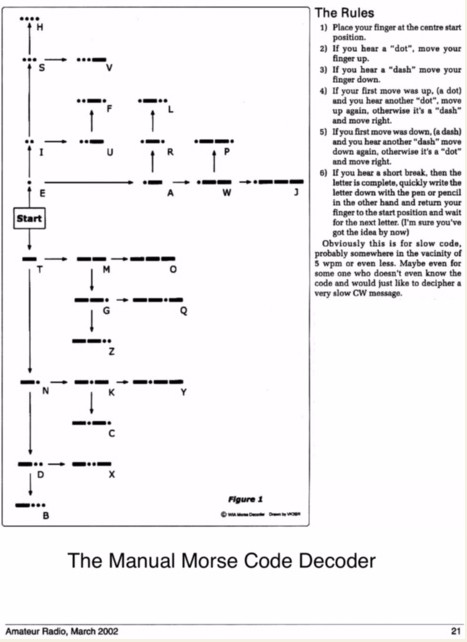
This is Great with a Classroom Situation. To build up confidence I show how easy it is to ‘read’ a CW message even if you don’t know the code, by sending various characters that students can decode using the following sheet. I explain how to use the sheet.
This is only done once to demonstrate that everyone has the ability to read CW. I use an audio oscillator plus key to send CW; characters sent at about 7WPM with huge spaces between them – probably works out at about 2 or 3 wpm.
This is the revised “Manual CW Decoder” AR March 2002 p21 (Article by Steve VK6BGN).
Think I’ve trained about 15 people that I know of since I started in 2020. What is interesting is I get people coming out of the woodwork telling me how they listened to the slow Morse course, but never called in – and they now use CW.
I’ve had a couple of people tell me how they stumbled across the net; a nd, though they knew the CW characters, they had no clue about protocols, abbreviations, how to have a QSO…etc and because of the additional info, they now use CW.
There’s one guy who in his words was much more comfortable using a keyboard and decoder now that he understands more about using CW – he’s a keen QRP SOTA fan! I think some of these people are lacking confidence to try CW, worried that they will stuff it up…
So one-on-one confidence building (usually starting with phone calls) is important. This has also happened with a couple of old-timers coming back to CW.
Always make myself available for a guided one-on-one series of ‘your first CW QSOs’ to anyone who wants to have a go. Hope that helps, 73, Nic VK7WW. Resources 1.
LEARN MORSE CODE from a MEMORY CHAMP (in 15 minutes) https://youtu.be/D8tPkb98Fkk?si=L6LRVbBGbI F7DPU 2. Learn Morse Code in 20 minutes: Classic US Army Training (1966) https://youtu.be/walFtVodHHM?si=AnOYIAXNfiCK3Ggx 3.
US Navy Training Video – Technique Of Hand Sending Morse Code (1944) https://youtu.be/YQyP7VJqvgE?si=NCxjYXyp1p2JodgP plus plenty to be found on YouTube!
[Thanks Nic – excellent work! The number of people you know of, that you’ve trainec or helped attests to your dedication; many of them are now part of the CQ QRS tea as well].
If you have a topic of interest, thoughts or ideas that you’d like to share through the newsletter, please let me know; email to mark.bosma@icloud.com

Brain Teaser
Jules Perrin JP VK3JFP has created a terrific resource to help guide learning for all levels of amateur radio licenses: https://Awww.julesworkshop.net/Amateur%20Radio.html With thanks to Baz VK6MU for he idea, and Jules for the good learning website, here’s this week’s quiz questions from Jules’ Workshop example test questions:
Amateur Radio Exam Questions

A station using the callsign VK1NSR/4 is indicating that: ¢ Itis an ACT station temporarily operating in Queensland ¢ The operator’s licence has now been held for four years ¢ A Queensland station is operating mobile temporarily in the ACT ¢ VK1NSR also holds three other callsigns Answers next week.
Answers from last week’s Quiz:
What do the following readings mean? Eg 1kV means ‘kilo volt or 1000V + 6mv = Answer: 6 millivolts or .006 volts + 10MO = Answer: 10 megaohms or 10,000,000 Ohm.
+ 66UA = Answer: 66 microamps or .000066 amps Long distance high-frequency communication at night is normally via the ionospheric + Diayer + Flayer + Elayer + Nlayer Answer: F layer To increase the efficiency of a simple electromechanical relay the relay coll (motor) is wound on * aluminium * soft iron * ceramic * lead Answer:Soft iron Which callsign could be issued for the operation of a Standard station?
(@) VKANG (b) VK2NKA () NK3BKM (@) VNINRP Answer: (b) VK2NKA
Di-dah-di-dah-dit
So back to the Slow CW QSO practice net.
Next Tuesday’s Net
Our CQ QRS Net will be on as always on Tuesday from around 0700Z until about 1300Z; see below for details. Doesn’t matter whether you’re brand new and want to try just exchanging callsigns and RST reports, or you’re ready for a good old rag chew.
Please let me know via our Reports form bit.ly/CQQRSNET who you work or hear or Tuesday’s net.
Richard VK6HRC will run our Post Morsum on the South West AllStar net (via repeaters and hotspots all over WA) from 0600 WA time. If you’re in WA, all you need is an FM 2m or 70CM transceiver and an AllStar node nearby.
If you’re elsewhere in the world, you may be able to connect your local AllStar-enabled repeater to the net, or you can connect via Echolink. Let me know (mark.bosma@icloud.com) if I can help with that.
Teamwork
Thank you so much to our team of 23 contributors this week: VK2DLF, VK2GAS, VK2GAZ (this is going to get confusing!), VK2IOW, VK3ACU, VK3BWN, VK3DRQM VK3KLE, VK3TBR, VK5ET, VK6BEK, VK6HRC, VK6IS, VK6JDM, VK6MK, VK6PZT, VK6RR, VK7KPC, ZL2GD, ZL3TK, VK3UFP and VK7WW for the Learning Morse Code article.
Thank you team – very much appreciated. Don’t forget the Quiz on Zoom this coming Saturday! UY CW on Tuesday, mb. Mark Bosra VK2KI/ VK6QI Beautiful South Bowning NSW mark,bosma@icloud.com non impediti ratione cogitationis

About the CQ QRS Net
Matching


Landing Zone
CW Tips
The opinions expressed in the RagChew newsletter are those of the individual contributors. The opinions do nat necessarily reflect that of the editor or of the C@ QAS Group members.