Below is a reconstruction of the 2026 11 CQ QRS RagChew newsletter designed to support full text searching. This reconstruction was built using OCR, and will contain errors.
To view the Mailchimp original, click here. To search the entire newsletter archive, click here.
Contents
- CQ QRS RagChew
- Website
- Post Morsum 11th March 2026
- Reporting
- This Week’s Topic of Interest
- The Whaddon Mark VII aka the Paraset.
- On My Workbench
- 2m 144 MHz Hourglass Antenna Construction
- Loop Dimensions
- Grey-Line Propagation – Cont…
- Further to the thoughts on HF propagation by Ross MONNK
- Hi Mark
- I Got Rhythm, Man
- CW Practice
- Other News
- John Moyle National Field Day Contest
- An Idle Moment
- Morse Training Net
- Stack at Stack’s Bluff
- Letters to the Editor
- Dear Mark.
- On a side note:
- Ham College Foundation Training Course
- Thanks
- Erratum:
- There’s No Such Thing…
- Question:
- Answer:
- Prosign/Character/Signal of the Month
- I Hear Tell…
- Di-dah-di-dah-ait
- Next Tuesday’s Net
- Reports & Photos
- Post Morsum
- Articles
- Viateria
- About the CQ QRS Net
CQ QRS RagChew
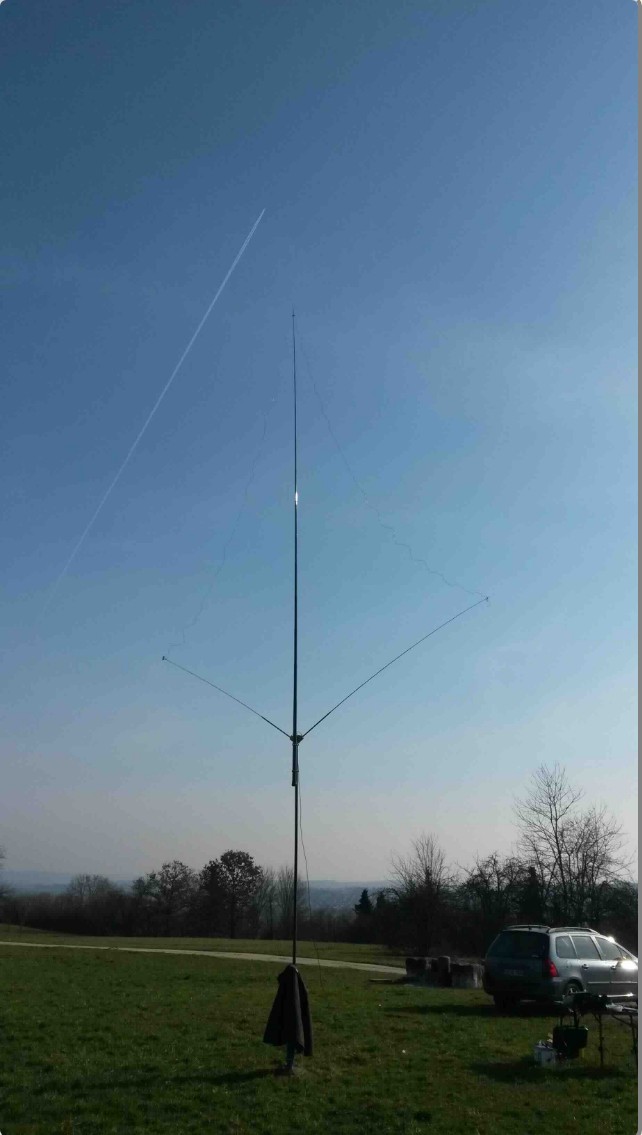
This week Mike DL3YZ has been back to his favourite antenna test range near Stuttgart. This time testing 15 m to VK, using a new triton hybrid multi-band antenna, a full-wave loop made out of 2 telescopic whips.
Stay tuned for the April 1st edition, where Mike might explain more about his unique rain-coat decoupling sleeve.
Did you have some fun on Tuesday’s CQQRS Slow CW Practice QSO net? I hope so. This week 50 of our team members reported hearing or working 82 different stations – not quite the 99 stations heard by 60 team members reported last week, but still a remarkable continuing upsurge in CW activity – and more importantly, an upsurge in CW fun being had by so many people who, like me, never thought the words CW and fun could be used together in the same sentence!
I’d like to thank each an every individual who took the time this week to send us their thoughts about Tuesday’s net via our webform.
I think that it’s genuine words like these from normal people that might just encourage non-CW operators into having a go themselves – knowing it’s possible, challenging, safe and even maybe fun, on our net.
So thank you folks – reading through the comments is very very satisfying to me… please keep them coming. So in this week’s RagChew, Donald VK6JDM discusses the Whaddon Paraset, and presents a very interesting and well-crafted discussion about the regenerative detector used.
I know that several of our team members have built, or are currently building their own version of the Paraset, so we might need to host a Paraset comer in the newsletter! Thanks Donald.
Ross MONNK continues his delightful Ross’ Philosophy series – this time examining how paddie-use may or may not improve straight-keying. And interestingly, one of our There’s No Such Thing questions is similar but different.
Also, Ross’ previous articles about the so-called grey-line propagation phenomenon have as hoped, lead to a couple of replies, from which I’ve learned lots about this interesting effect that I had no prior understanding of; thank you.
I hope we’ll get ‘some more thoughts, ideas and theories from any of our readers who have experience with this, or who would like to comment on Ross’ deliberations.
I’ve started a Letters to the Editors section this week as well – hopefully that’ll encourage more readers to put pen to paper (or even, taps to Al) about the net, the newsletter, or really anything except, politics, religion and TV.
This week I’ve published another article from Andrew VK1AD (the other Andrew) from the SOTAVK1Area.io group about the counter-intuitive horizontally-polarised 2m hourglass portable antenna.
Early field experiments by the VK1 portable team indicate that this simple light-weight antenna may have as much gain as a 4- or 5- element Yagi. So what does this have to do with QRS CW?
Two things: * Many of our team members are keen SOTA and Parks activators or chasers – and having a simple portable antenna for 2m SSB or CW will be of interest to them.
+ I’m really keen to encourage more 2m portable CW operation; for many of our team, setting up HF antennas and lugging batteries, cables, couplers etc up hills may not be attractive or even feasible.
However, having little more than a CW-capable 2m hand-held transceiver and a simple but effective horizontally- polarised wire-type antenna might make portable ops from hill-tops quite possible and indeed easy.
And speaking of hill-tops, this week we have a nice story from James VK7JZ about his recent climb of the appropriately-named Stack’s Bluff – thanks to his son Finlay who was quick enough on the camera to capture James’ decent skills at their best.
More stories and images like this one please folks! Finally, I’d like to point out that I’ve finally got off my base-plate and updated our Prosign of the Month in this edition; something to try on Tuesday. Why am I telling you his you ask?
You’ve probably heard my bleats about how many hours (days) per week I spend on our beloved newsletter, but that I’m so pleased that we have such a great team of sub-editors who help out with both the slog-work and the technical aspects of collecting and manipulating material and archiving (thanks team – tip my hat to ya all).
However, updating the Prosign was just one of those round-tuits that I didn’t get. So…. would you be interested and able to spend say 15 minutes or so once a month or so to produce a new Prosign of the Month segment for our RagChew?
Please let me know if you can by email to caqrsnet@gmail.com So…. here we go… with thanks again to the 46 team members who contributed to this edition – please enjoy the read.
Website
If you’d like to find out a bit about our net, or would like to pass information to others about our Tuesday get-togethers, here’s the link to our website. bit.ly/CQQRSWebsite On behalf of the CQQRS Editorial team, please enjoy the newsletter. dit-dit
WVlarK bosma VK2KI / VK6QI Patrick John Beautiful South Bowning VK2IOW VK2RU NSW Milthorpe NSW on a track somewhere cqqrsnet@gmail.com non impsditi ratione cogitationis Nigel Richard Lance G4RWI VK6HRC VK7TO our other grey nomad Padbury WA Margate TAS
With thanks to Nigel G4RWI’s clever software, and John VK2RU’s clever spreadsheet work, here’s the 82 stations heard by 50 members of our team on Tuesday:
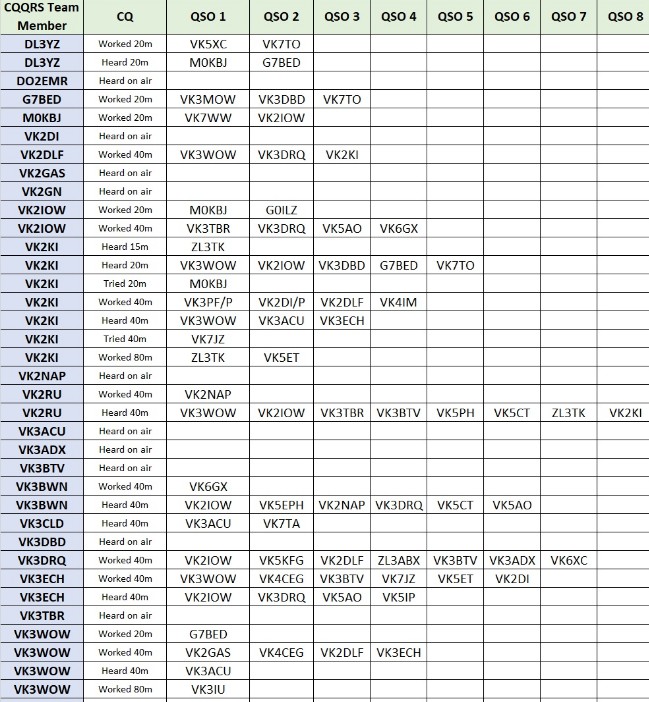
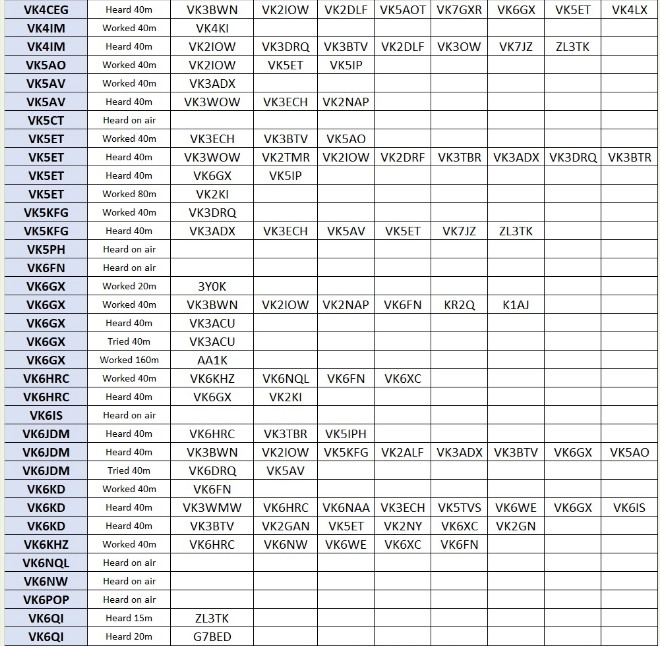
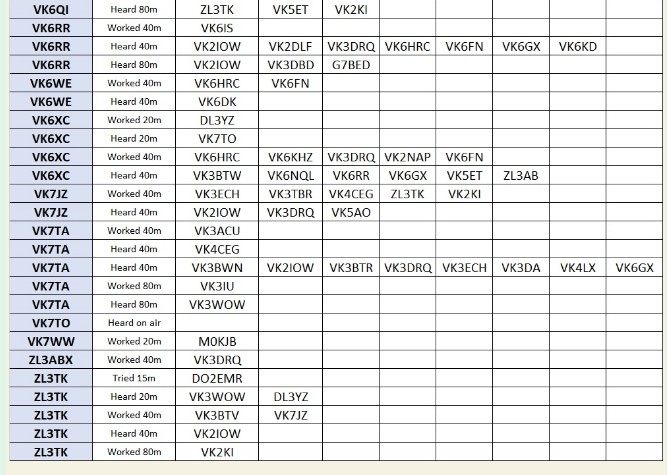
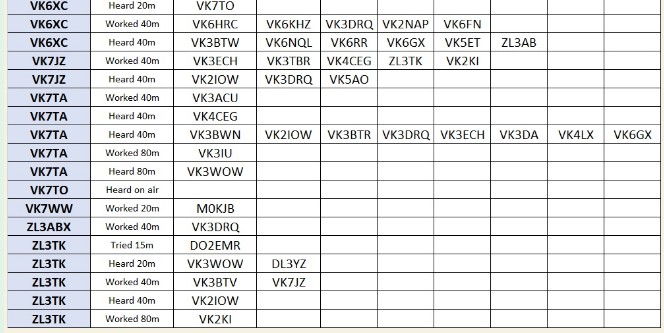
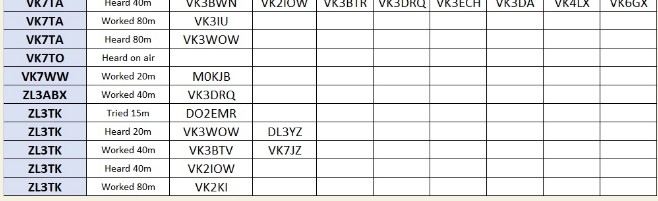
John’s spreadsheet above shows the known stations heard or worked on last Tuesday’s CQQRS Net; the comments in the team members’ reports (submitted via our webform bit.ly/CQQRSNET ) follow.
The comments were also compiled for us by the software built by Nigel G4RWI and the layout was perfected by Patrick VK2IOW. Thanks again to Nigel, Patrick and John for the work, and to every team member who submitted a report –
[20m] I only had some minutes this week, and so I am very happy to have short chats with Ben VK6XC and Lance VK7TO. Have a great week, M
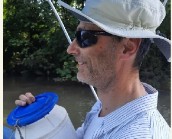
[20m] Back to it after a few weeks away travelling, and it was great to get some new VK call signs in the log. I also found another CWOps buddy Lance (VK7TO) who was doing a mighty fine job on a straight key, far better than my poor paddle performance.
I really do need to get back to some practice :-). Conditions were s booming in at 559 to 579 – so, I didn’t need the
SDR. All the above entries take pride of place in my log book above 3YOK which I finally managed to work after missing out 3 years ago. So, my log is looking great this morning … Bouvet Island, followed by 3 VKs …
OK, 3Y0K was on FT8, but hey, I’ll use anything to get them in the log … I’m now hunting them on CW of course. Thanks for the contacts guys and look forward to working you again next week. Best Regards, Chris, G7BED
[40m] Interesting conditions for me tonight, and very different to last week. 5 QSO’s and 3 stations heard. Of my 5 QSO’s 3 of them were very hard copy with either QSB, or only just barely above the noise floor, yet I was receiving good reports, sorry I could not return the same, sending 2s and 3s for the most part.
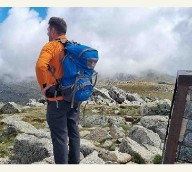
Hear Rob VK3ECH and Stan ZL3TK a little better but it was still against noise. That said, very happy to have gotten a few more QSOs in the log, also glad to have some QSOs that were a chat rather than a simple call sign and signal report exchange after I have walked (or fallen over) in the wild places.
Now that Rob knows I learnt to sail where he parks his yacht, and I spent most of the time upside down, in the water, and sopping wet, I doubt I will receive an invite to his yacht anytime soon. Thank you all for another very nice Tuesday evening. 73, Jim
[40m] I’ve been working to improve my RX for a few weeks and tonight I had my first meaningful QSO in absolutely years. What I found out: My desk is too high and with my dodgy shoulder, it gets painful to send with a straight key.
This causes errors in sending 1 – I have to – this is just too much fun!
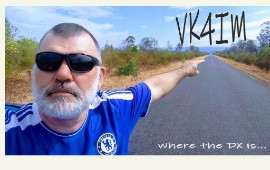
[40m] From my QTH in Ballajura WA the 40m band was alive with mostly weak signals very hard to hear. I’m hoping I decoded the 14 stations I heard correctly. Check this week’s report table, it could be interesting reading if I’ve copied them incorrectly, hihi.
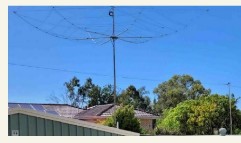
TEENA ER RONEEY s PERE ED. SNEE AGRE TREE REIN, PO. TEINS IGA VINE IN IME MI VIM ey rag chew on 40m. I needed the practice.
[80m] I could only hear 1x very weak station on 80m at 2224HRS WST right at the top of the band on 3.698990 Mhz. 80m is not my favored band at present. Hopefully conditions next week will open up for me on 80m.
I monitored lots of activity on 20m but did not attempt any CW QSOs.
[40m] Bit quiet until 20:00 local then band conditions improved
[80m] More noisy around 22:00 hrs local, compared to 40m. Short QSO with VK2KI due to noise. No other station
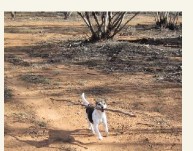
[20m] I warmed up the TS-530 and tuned up on 20m and straight away heard Nic VK7WW calling CQ. Well the radio might have been warmed up but my straight key fist needed a few more minutes to get going!
Nic and I haven’t made contact before, nor have I worked Tasmania, so big smiles at this end. Another first came in my next QSO. I have never heard the word lTalmanran’t im = VAL Fie i wureem Datrinal LLZOIONAL latina ma Lr
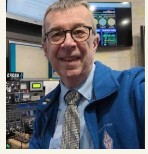
[40m] A quick visit to the shack tonight. 40m was very low noise here. I am working on going back to the paddle after a couple of years on the straight key. Taking a bit of getting used to.
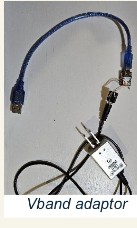
One FB QSO with Merv VK3ADXX in Ballarat where he shared his fond memories of time here in Mount Gambier. Based off some CQQRS notes from a couple of weeks ago, I have built a V-Band adaptor utilising a Seeeduino I had lying around.
I found a couple of similar write-ups on the web. It ed to the slight delay between hitting the paddle and hearing the so I consider it a work in progress.
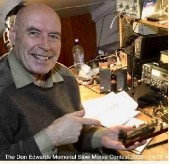
From Graham Vayro VK4CEG at Jandowae QLD.
[40m] I was using my QCX 5 watt rig with a 40 meter long end fed antenna 10 meters high, location was Western Darling Downs QLD. I am happy to copy and QSO with AU stations and NZ with just a 5 watt radio..
I find it difficult to send well with a paddle when changing speeds between 15 and 12 wpm. Next week I will be back at Logan with a better paddle.

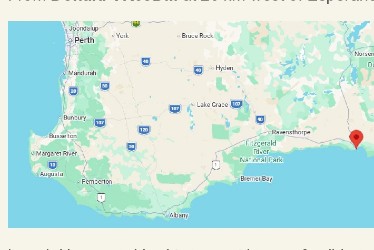
[40m] The Tuesday night Bosma effect resulted in the CW segment of the 40 metre band being fully occupied. By the time I got on air there were no gaps wider than about 500 Hz.
I was again using 5 watts and am not surprised I was not ving practice, which is just what
It was great seeing stations going slow for those who, like me, are semi-CW literate; that is how AR works well to include newcomers.
Finally for those wanting CW practice that is available when you are free, I have found Teach 2000 available from the NZART very useful. You download and move it into documents, then open the file with the NZART blue tile.
There are hundreds of one paragraph messages with the ability to adjust Farnsworth, character speed, audio pitch and you can store your settings.
Another contribution to world civilisation from the superior islands to the east (not that I am, in any way, biased).
[40m] Lowest level of noise on 40 m I have heard for a long time.
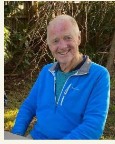
[40m] I went out for the evening and didn’t get home until jus after NZ midnight. I switched on the radio and heard a ORS COQ from VK3DRQ. I replied using 8 Watts from my wee Icom, and I was pleased to get a response. Thanks Manny.
I didn’t tune around to look for anyone else because it was well past my
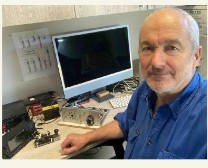
After talking to experienced CW operators…. and listening to a lot of fast Morse on the air… I thought maybe it is time to think about using a paddle. _| have only ever used a straight key and I don’t have an inherent desire for a paddle.
One thing I like about a straight key is that I can work without a side-tone if I’m sending at a comfortable (ie slow) pace and this suits me and my home-brew gear… and others within earshot of the shack.
But when I look at HamAlert I see that so much of the Morse detected is whizzing through the atmosphere at speeds of maybe 17 to 30 words per minute.
Which is a bit daunting to somebody who starts to lose the ability to cope at around 15 WPM (or less if the conditions or sending aren’t ideal). Anyway… I ordered a paddle with good reviews from Aliexpress, and it arrived a couple of days ago.
It worked when I plugged it in. But I had a lot of trouble operating it. The damn thing kept sending out gratuitous dits and dahs.
So while I almost hated the first trial, I realise that I need to keep trying so that I can instinctively know when to release the levers. 73.
From Patrick VK2IOW between Bathurst and Orange
[20m] QSO with Simon, MOKBJ. I gave him RST 429 and he gave me 339, though he mainly listened to me using the webSDR at Ironstone. After we finished our QSO, I was called by Martin, GOILZ, near Ipswich NE of London, and we moved up 2KHZ for a QSO.
He was using 100 watts and a vertical antenna and we had good copy on each
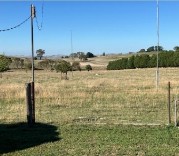
[40m] Conditions on 40 metres seemed good; and busy. Had QSOs with Victoria, South Australia and West Australia.
[40m] Again other commitments left me with only a short stay.
[80m] Itis hard to get a DX QSO when successful callers to the DX station have a long chat about the weather etc.
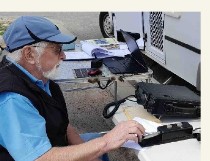
From your editor Mark VK2KI at Beautiful South Bowning NSW
[15m] Nothing heard of Edi DO2EMR this week; I knew from Mike DL3YZ‘s DXperiment Status page that Edi was on and calling, and I could see him on the Reverse Beacon Network as well. However, his EMR wasn’t making it this far.
I did hear Stan ZL3TK calling him; Stan had a good signal into the Snowline KiwiSDR as well
[20m] Well the planets aligned this week – I was actually on time for the DXperiment… unlike the previous several weeks!
Skeds, where I managed to be exactly one hour late each time, Chis G7BED at Northamptonshire was back on this week (and copyable despite the ‘open circuit on the balanced feed-line to my 80m double-extended Zepp) and was being kept busy by lots of antipodeans.
I also heard Simon MOKBJ who was weaker but copyable on peaks. I tried calling Simon but he couldn’t hear my SOW radiated who knows where by my what effectively was a very long but odd-shaped long-wire antenna.
I was pleased to hear him hook-up to the effective radiated power of Patrick VK2IOW‘s Yagi.
[40m] I managed to hook up with Mark VK2DI/P at the Garigal National Park near Middle Harbour in North Sydney, despite my broken feedline and my noise canceller that had been specially modified by Nigel G4RWI when we got on air together from CQQRS HQ a month or so back.
James VK7JZ followed, and he was also struggling with noise at his home. so I’ve cou
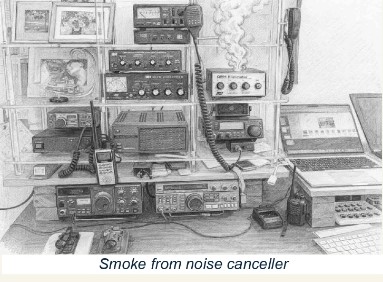
After dinner, I hooked up with Georg VK2DLF up at St Marys. I saw on our WhatsApp CQQRS Alerts group that Adam VK4IM had been copying, because he commented about my signal into Brisbane despite my broken feed-line.
Adam joined our team about a month ago, having decided to return to CW after a 20 year absence, and had been submitting reports on what he’d heard each week. So with a tiny bit of arm-twisting, Adam was convinced to have a go transmitting.
Nothing wrong with his sending either – sounded just as competent as anyone else on the net, despite his 20 year hiatus; welcome back Adam!
[80m] Despite my lack of a working noise canceller and decent antenna, I heard Stan ZLSTK at the South end of the North calling CQ on 80m – well into the morning NZ- time.
Stan’s new shorter long-wire was hearing me $8 with only an $1 noise level (ie RSN 581); wish I could say the same – S8 noise made copy a bit tough here. After Stan I was called by John VKSET in the North Eastern suburbs of Adelaide.
The noise had risen to S9 and I needed several repeats of John’s report before confirming the contact. Thanks for hanging in there John.
15m] Nothing heard from Edi DO2EMR on the Hoddys Well KiwiSDR this week, but Stan ZL3TK was coming through into WA when he called. 20m]
ON SD I DE EI EEN OES seen of Simon MOKBJ. III TIAN INI NAR SAIS) AAS DASA J
[40m] I heard Max VK6FN at Manjimup plaintively calling CQ; the band hadn’t open to the East, so I tried cranking up the Souther Electronics Group’s two HF Remotes; unfortunately neither would connect to the RCForb application, so I missed out on what no-doubt would have been a nice chat with Max.
Later I heard Max chatting to Phil VK6GX at Gidgegannup – no doubt the two of them enjoying a mid-speed rag- chew. Watching the VK6SEG KiwiSDR’s waterfall display, I saw a signal pop up on 7035KHZ – I neatly fell off my chair (pretty good, considering I use a standing desk!) when I read “VK6POP“; Bob VK6POP now retired to Albany has been a long-time reader of the RagChew newsletter, which I had sent him back when he was running the weekly NewsWest broadcasts on Sundays – however, I didn’t think that CW was on Bob’s bucket list!
Knowing the Remotes weren’t on air, and that the band wasn’t open yet, I flashed a message the team on our CQQRS WhatsApp Alerts system – and Richard VK6HRC came up on frequency. However, by that time Bob had gone.
I sent Bob an email, and he tried to hook-up with Richard – but of course, doing that via infrequent email ain’t as successful as the WhatsApp instant messages – so the two didn’t land on the same frequency at the same time.
As it turned out, Bob had no intention of coming up for what could have been his first-ever CW QSO… which if it happened during the net would qualify him for the coveted CQQRS First CW QSO award.
Bob was doing some testing with the Northern Corridor Radio Group’s Reverse Beacon Network system, and was using just enough power to trigger the system.
Having done the testing, Bob continued to practice on the key, forgetting (Freudian perhaps??) that he was actually still transmitting rather than practicing with side-tone only, which is what I’d heard. Next week perhaps Bob?
[80m] Stan ZL3TK‘s new short long-wire was doing a good job, rolling into the VK6SEG KiwiSDR near Northam late in the evening (actually, early in the morning at Stan’s end).
[40m] Early on I heard no stations, but Jordan’s 20w gave a good signal here so the band was open somewhere. More stations were heard after dinner.
From Stan ZL3TK at Waitarere [20] G7BED while working VK2WOW was too weak to copy. Ran out of time to call DL3YZ who was RSN 541 and sounded in popular demand before QRT.
[40m] Tao hieyv with nroiecte ta aenend mich time on-cvair
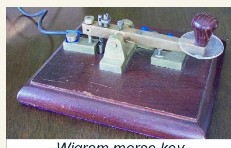
Ds OPS ill I Ue a a lnm Naas ad Well aethtn| Ancint heetheh lata just a few minutes at the beginning aa) end had to suffice, hence the low number logged. Nonetheless, conditions sounded slightly better than average.
[80m] In the first hour of a new day, no signals heard on 80 m, however because of the unusual lack of QRN decided to put out a CQ on spec before heading to bed. To my surprise VK2KI came back RSN 521.
A brief but satisfactory QSO resulted in which Mark detailed a number of impediments in his system, including one side of balanced feeder open circuit, so his surprise at getting out so well was only matched by mine at hearing him.
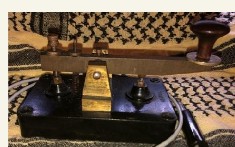
Post Morsum 11th March 2026
From Richard VK6HRC. Six on the VK6RLM rpir and AllStar/Echolink hub this morning.
NEON EE BEEN OUND CE i ee ORE VK6QI_ Mark VK6FN Max VK6KD_ David ZL38TK Stan VK6HRG VK6MRB Mulligan swl.
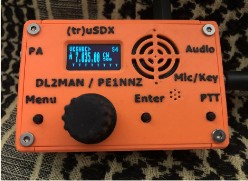
Mark battling with a partially working noise canceler and suspected feed line problem still enjoyed the evening. ON15M heard Stan ZL3TK nothing from Edi DOZEMR.
On 20m heard four then on to 40m to work four stations one being Adam VK4IM whom has been monitroring the net for a few weeks now. As usual Mark was monitoring several Kiwi sdr receivers around the country and posting on WhatsApp.
Max worked six on 40m and was struggling with QRM at times as more stations came up in the QRS slot. David heard six local stations on 40m and one on 80m.
Stan gave us a run down of his new end fed antenna which is performing well,on 20m conditions unfavourable no contacts in the log.
Stan also let us know that there is a net in ZI every night on 40m in Summer and on 80m in Winter, hence some of the QRM last night as conditions allowed. I worked worked four on 40m and went into SWL mode when it got busy !
Thank you to all on last night and this morning.
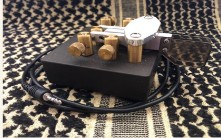
Reporting
After next Tuesday’s Group, please remember to send me a list of who you worked and / or who you heard using our web form here:

Even if you didn’t hear anyone, we’d still like to know that you had a go. And to make your report more interesting, please consider sending a photo to be attached.
If you have a photo (compressed if possible) that you’d be happy to include, please email it to: cqgrsnet@gmail.com So, please help attract new and old team members to have a go by submitting your report each week.
Submissions close 1300 (Eastern Australian Summer time) on Thursdays.
This Week’s Topic of Interest
The Whaddon Mark VII – Paraset Medical authorities warn that normal people should not to build a Paraset unless they can afford therapy
The Whaddon Mark VII aka the Paraset.
From Donald VK6JDM This is a radio with a history. Hundreds of them were made during WWIII for use by British agents and collaborators behind enemy lines both in Europe and Asia.
The need was for a small light weight set with a few Watts output and a receiver capable of receiving signals from powerful base stations.
Because the SOE (Special Operations Executive) had sensitive receivers and good antennas on home soil the paraset did not have to put out many Watts.
The chosen design was a very simple 3 valve radio built with the controls on the same panel that housed the valves, crystal and plugs.
The transmitter and receiver were quite separate circuits with the transmit/receive switch transferring the antenna connection between the two and the HT supply between the two.
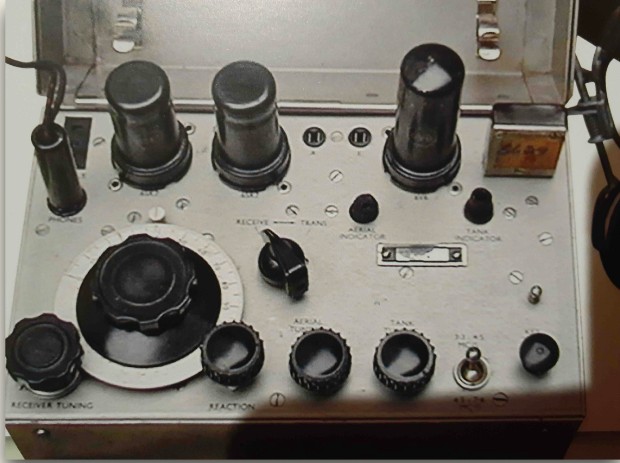
The transmitter is a 6V6 metal cased valve, crystal controlled, oscillator. The oscillator is keyed at the cathode. This means that the key has a high voltage on the non-earth side on key up.
Perhaps that is why early ones had the key built in under the chassis panel with just the knob sticking out. Later ones had either a socket for the option of an external key or just an external key.
The oscillator tank circuit is parallel tuned with a variable capacitor that sits at HT voltage. Most replicators of the paraset chose to make life safer by earthing one side of the cap and connecting the other side via a high value cap.
There is no meter to assist plate tuning, so a single wire loop inside the tank winding leads to a 6.3 volt globe of the type old valve radios lit their dials with.
An adjacent coupled antenna coil is series tuned, one end leading to the antenna, the other to earth. Again tuning of that winding is indicated by a single loop powering a light globe.
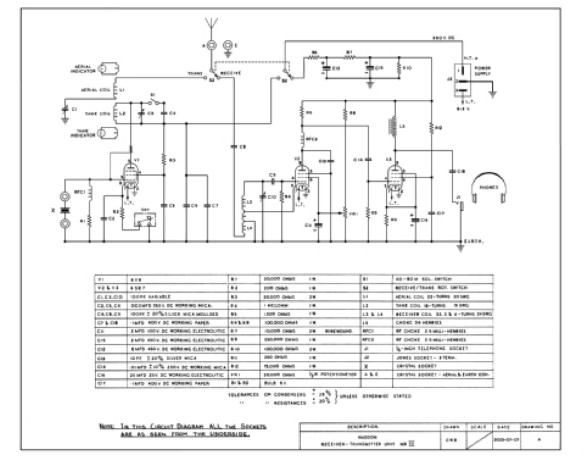
When transmitting both globes flash with each key down. As the oscillator is turned off when key up, each dit and dah requires the oscillator to start up and each start up involves a slight increase in frequency as the oscillation builds up.
This results in the characteristic chirp you hear when listening to such transmitters. The receiver is a regenerative detector followed by an audio amplifier. High impedance head phones are required.
Regenerative detectors look like a simple circuit but involve quite a complex signal processing path. They are generally considered to be the invention of Edwin ‘Armstrong though a couple of others also developed the circuit at the same time and a dodgy court decision awarded the patent on appeal to Lee De Forrest who definitely did not develop the circuit.
Armstrong developed the regenerative detector while a 3 year engineering student at Columbia University in New York. His professor realised that he was looking at the first really sensitive receiver and introduced his student to both the head of Naval communications and the American head of the Marconi company.
The correspondence of both show they realised a breakthrough had occurred. In the case of the Marconi mob they wanted to know if they could break any patent that might arise.
The Armstrong detector when oscillating was also the first simple source of pure CW signals at HF frequencies. The same Armstrong developed FM and the super heterodyne radio and was involved in early SSB research.
He died by suicide after arguing with his wife following RCA breaking his FM patents in a shocking court decision that basically said that FM did not exist and so could not be patented.
Now the regenerative detector is a combination of a circuit called a grid leak detector and a controlled positive feed back amplifier and a direct conversion mixer all in one.
Looking at the receiver circuit you see that the grid leaks to ground via a 1 meg resistor and receives the incoming RF signal via a 100 pF cap. These values are fairly critical.
The incoming signal alternatively charges and discharges the grid of the 6SK7 tube. With an AM signal the grid of the tube acts as the plate of a diode detector, the audio frequency modulation building up on the 100 pF cap.
That audio voltage then is amplified by the valve and the amplified audio is extracted from the plate. At the same time the positive feedback applied to the valve via the cathode to.
The tap on the coil increases the RF voltage going to the grid by the step up turns ratio between the feedback part of the coil to the whole coil. The positive feedback has another effect.
It increases the effective Q of the receiver tank circuit and so produces very sharp tuning. The degree of gain in the tube is controlled by adjusting the screen grid voltage. For AM demodulation the gain is adjusted just short of oscillation.
Now using the regenerative detector to detect CW is different again. The feedback is increased until the circuit just starts to oscillate and the incoming signal is thus fed into a grid of a tube that is switching on and off at the frequency of oscillation — we have thus a direct conversion mixer.
So that was all pretty straight forward, I am sure you will agree. We could if you like make the discussion a little more complex by discussing the shape of the grid voltage to current curve and its use a low signal levels of AM.
Now the original paraset had a number of OHS (occupational health and safety) issues. The power supply entered the set via a female socket, which meant the power lead from the power supply ended in three live prongs of a Cinch/Jones plug.
We have mentioned the live plate tuning cap which had a shaft to a grub screwed knob! Not good on rainy nights hiding out in the scrub.
Worse is the problem that when receiving CW the input tube oscillates and thus the receiver tank coil has an oscillating signal that couples through the input winding to the antenna.
Thus if the enemy knew what frequency the set was going to be tuned up on to receive messages from home base, they could direction find the receiver. The survival time of the operators was short and that was one of the reasons.
There are very few genuine WW2 parasets still in existence. I have seen one at the Norwegian Resistance Museum in Oslo Castle. There is another at Bexley Park.
A few operators who survived the war disobeyed the order to destroy them and so there are a few scattered around the world. There are quite a few replica sets now on air around the world. So chirp is back.
Making a replica of a paraset involved collecting a lot of old stuff. There are websites dedicated to telling the journeys of fellow OCDs (obsessive compulsive disorder sufferers) who have gone down the rabbit hole of making a paraset.
They exchange sources of ancient parts required and have detailed drawings of chassis panels, dials, knobs etc. Having nearly completed my paraset I am aware that I am part of a community that, while benign, is probably not mentally normal. Do not follow me!
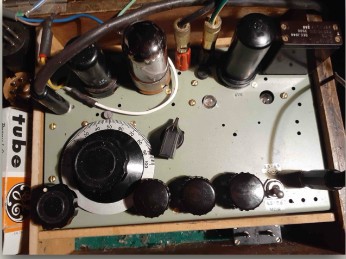
References: Circuit diagram from radiomuseum.org website Photo of a genuine one from J-L Perquin The Clandestine Radio Operators Paris Histoire et Collections undated,
If you have an article or two that you think might be of interest to our readers, please let me know so we can share more thoughts and ideas; for guidance on writing for RagChew, see Articles below. Please email material to Mark VK2KI: cqqrsnet@gmail.com
On My Workbench
CQQRS RagChew newsletter 10/2026 included a report from Andrew VK1DA on a field test of the portable 2m horizontally polarised Hourglass antenna that produced remarkable results compared to a 4 element Yagi.
Your editor has aspirations of creating interest in portable 2m CW operations in Australia
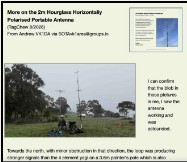
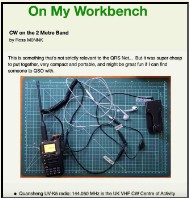
Using (for for example a hand-held transceiver such as the one discussed by Ross MONNK in RagChew 39/2025) and a simple horizontal antenna like this might just be a catalyst.
The other VK1 Andrew VK1AD has written an article on a simple construction method for the antenna in the VK1AreaSOTA.io group site.
2m 144 MHz Hourglass Antenna Construction
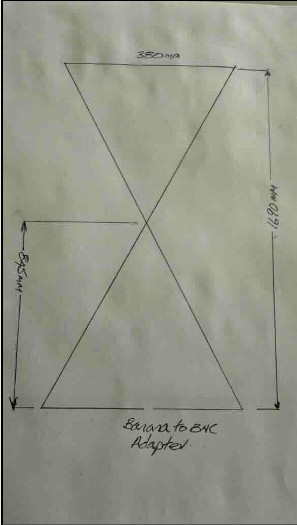
Wire: I chose is 18 AWG multi-strand copper wire with silicon insulation. Allow additional wire for tuning. Cross arms: 16 mm dowel x 430 mm long. You can use plastic pipe or other types of lightweight insulating material.
Use your imagination }) Feed point: Binding post (Banana) to BNC female adapter. See pic ‘Support pole: Non-metallic telescopic pole. Do not use carbon fiber poles, your antenna will be de-tuned. I use fiberglass telescopic poles.
Loop Dimensions
Loop Vimensions This is the wire dimensions. 1. Width: 380 mm (If you change the width then all other dimension will change.) 2. Height: 1690 mm 3. Center Cross Over: 845 mm 4. Diagonal: 1740 mm 5. Perspex center plate: 80 mm x 50 mm
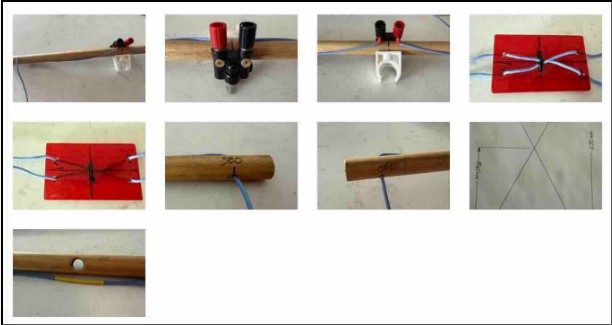
Start by making the cross arms and drill holes for the wire to pass through. The top arm has a 9 mm hole for the telescopic pole. The pipe clamp on the bottom arm is required to keep the top and bottom arms in alignment.
The clamp clips onto my 6m telescopic pole. When tuning make small even cuts to both sides of the loop at the feed point. I recommend the cuts be no more than 5 mm at a time (from experience) be patient and don’t rush the tuning process.
Cut wire, adjust the center plate and measure the VSWR until you reach the preferred operating frequency. The wire cross over point should be in the center of the loop. Happy to respond to questions.
Regards Andrew VK1AD [Thank to Andrew for this article in the SOTAVK1Area.i site]
What’s going on on your workbench? If you have an article or two that you think might be of interest to our readers, please let Mark VK2KI know; email to cqqrsnet@gmail.com For guidance on writing for RagChew, see Articles below.
Grey-Line Propagation – Cont…
Continuing the interesting discussion on Grey-Line propagation re-started by Ross MONNK in RagChew Edition 10/2026.
Further to the thoughts on HF propagation by Ross MONNK
From Stan ZL3TK Might it be a rather a self-limiting paradigm to believe that a single mode is the transport medium for antipodean radio signals?
Although a single mode may be responsible under optimised conditions, such as traversing the grey zone, it is more likely that two or more propagation modes operate simultaneously over any given path, each accounting for only part of the journey.
There is no way of empirically knowing. Why is it those who use omni-directional vertical antennas rarely consider multipath propagation? Likely because CW operators are not greatly affected by phase distortion resulting from multipath.
If experienced it at all it may be heard as. subtractive QSB, and very rarely though still possible as additive QSB. Otherwise there is little to draw our attention to it other than a wateriness in the signal similar to auroral effects, which may be at least partly suppressed by AGC.
Whereas were we dealing with a full-bandwidth analogue television signal, we would see ghosting and understand the cause immediately.
Amateur AM signals were often subject to significant phase distortion, even over a short path, however SSB for obvious reasons, has largely eliminated the experience for latter-day voice operators, hence it is rarely remarked upon these days.
Further to the thoughts on HF propagation by Ross MONNK
Ken ZL4KF makes some interesting antipodean observations in his article at hitps://zl4kf.nz/antipodean-focusing-of-hf- radio-signals/ 73 de Stan ZL3TK
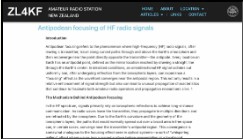
Hi Mark I enjoyed reading the discussion about chordal ducting from both Ross and you last week.
Hi Mark
One of the reasons I love my winter POTA activations is that late afternoon operation gets me into grey-line time, and I can often work quite a few Europeans with my little 5W transmitter.
Wanting to learn a bit more, I dug out my copy of “Radio Amateur’s Guide to the lonosphere” by Leo McNamara. He recognises the value of chordal mode and remarks that “The tilts in the ionosphere associated with dawn and dusk offer ideal methods for getting energy into and out of chordal modes”.
He goes on to say “It is … possible to create artificial
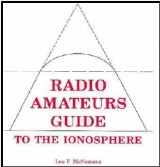
Situations for the successful coupling of HF energy into and out of chordal modes. This is done by heating the F region with a high power radar (a few megawatts), thus creating a region of field-aligned irregularities which scatter the signal into or out of the mode”.
So there you go. Anybody got one of those lying around? Of more use is that he provides a reference for a paper where a prediction scheme for chordal mode is proposed. I haven’t got the paper but here’s the reference: Donnelly, R. F. (Ed.).
Solar Terrestrial Predictions Proceedings, Vol. 4 Predictions of Terrestrial Effects of Solar Activity. No. 003-017-00479-1, U.S. Department of Commerce, U.S. Government Printing Office, Washington, D.C. 20402, 1980. Cheers, Mark VK2DI
[Thanks gents; more readers thoughts, experiences and ideas please cqqrsnet@gmail.com ]
I Got Rhythm, Man
From Ross MONNK Ihave this theory (“Oh, no! Not another one of Ross’s theories!”) that my paddle sending at 25 wpm improves my straight key sending at 14 wpm. Please, let me explain…
There were a few articles in last week’s RagChew about the benefits and satisfactions of working at higher speeds. I have mixed feelings about that.
Certainly, many Euro operators seem to fly along at breakneck speed and it would be good to know what they’re saying. On the other hang, I’ve learnt to appreciate cruising along in what a buddy calls “Morse Time” – the slow unfolding of a message that takes as long as it takes.
And DX most definitely requires slow Morse due to the weak signals and difficult conditions often prevalent. If speed is important, Morse is probably not the right medium anyway.
Nevertheless, responding to a challenge is part of the human psyche and I’m as human as the next amateur radio operator (…?!). So, a while ago now, I responded to a suggestion to raise my paddle sending and my head copy speed from 17 wpm to 25 wpm.
Unlike those recent RagChew correspondents, I didn’t undertake a formal course – I want my hobby to be a pleasant ramble, not a forced march (but each to his own) – so I just jumped in. And surprised myself.
I don’t copy everything (maybe 70 or 80%) but it’s weird that I can copy anything at all at that speed. My sending at 25 wpm is mainly good but with occasional lapses. It’s all about getting the Correct Rhythm.
If I go too fast, my electronic keyer doesn’t keep up and garbage comes out. if I go too slow…well, the whole point is to go faster, isn’t it? But the main thing is to get into a rolling pace where the characters simply pour out without thinking.
Then the speedboat starts planing and away we go! It feels great, but tuning your mind into that state is the act of a Jedi adept. Jumping between my paddle and the straight key is another Morse skill ‘ve learnt.
Actually, it wasn’t that difficult compared to some of the other mental gymnastics of Morse code. I prefer the straight key but I do one day a week on the paddle to retain my hard-won paddle skills.
I don’t use a paddle on radio because my copying speed drops dramatically when I’m on the air and I don’t want to give the impression that I’m better than I actually am.
And so, finally, we come to the point of this article (“Hooray!”) – why has my paddle sending improved my straight key sending? I think the answer must be that
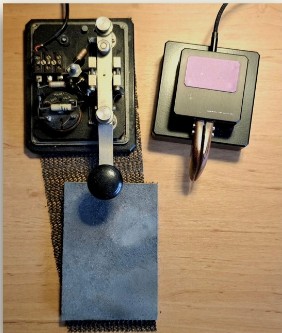
Senaing: I Tnink the answer must De that focus on Rhythm that fast paddle sending forces upon you. With a straight key, anything goes. And that allows some straight key operators to sound absolutely bl***y awful.
But you can’t get away with that sort of sloppy sending rhythm on a paddle at 25 wpm. Thus I’ve been unconsciously transferring my new-found sense of Morse rhythm across to the straight key.
Not only does the Vband decoder appreciate it (and I hope my DXpedition contacts do too), but it just feels better to get into that rolling I’m not encouraging you to aim at QRQ speeds – as I’ve said, each to his own – but if you can find that rolling rhythm, man, hey, you’d be hip to the groove.
CW Practice
This year we’re using Aesop’s Fables. These are short moral stories, often using talking animals, that illustrate simple truths about human behaviour and character.
‘Aesop’s Fables originated in ancient Greece, traditionally attributed to the storyteller ‘Aesop who is thought to have lived around the 6th century BCE.
The fables are generally smaller files of two to three hundred words that have been recorded at 15 wpm and run for about 15 minutes.
If 15 wpm is a bit quick for you, load it onto your phone and set the playback speed at 0.75 X or even 0.5 X- whatever works for you. 0.75 X will play the MP8 at a bit under 12 wpm. Itis suggested that you read the text file before listening to the audio file.
That will make it easier to follow the audio file and prepare you for any unusual words. Any punctuation that is not usually used with CW has been removed. This week’s fable is ‘The Kid and the Wolf’, and the MP3 and TXT files are attached here:


If you prefer a different speed or tone you can create your own MP3 files by converting the text file with the Ebook2CW app — https://fkurz.net/ham/ebook2cw.html.
You can either play the MP3 files in any media player, or load the text file into the Ditto CW: Morse Player app — https://dittocw.andro.io/.
Both options work well, however Ditto CW gives you complete control over all Morse settings, while a normal media player only allows changes to playback speed, and does that in steps (e.g. +1.25x, 1.5x, 1.75x). Dit-dit John, VK2RU
Other News
PRIORITY TRAFFIC. ORIGIN: BUNKA RADIO SITE FROM: VK1HF TO: INTERESTED PARTIES / OPERATORS SUBJECT: SNOWLINESDR SERVICE INTERRUPTION REPORT DATE: 7 MARCH 2026 BUNKA RADIO SITE INCIDENT REPORT SnowlineSDR / Remote Radio Infrastructure: Prepared: 7 March 2026 Prepared by: VK1HF BUNKA Radio Site ‘Snowy Mountains Region, NSW, Australia ‘Somewhere south of Canberra and somewhere north of Antarctica Operated by: VK1HF and VK2JAP SUMMARY FOR NON-AMATEUR: RADIO OPERATORS Assmall remote radio site located in the Snowy Mountains provides internet-accessible radio receivers for hobbyists around the world.
These receivers allow people to listen to shortwave and amateur radio signals remotely via the internet. Many radio operators today transmit from their homes but prefer to listen using a receiver located in a quiet rural area.
Modern homes contain many electronic devices which create electrical interference that makes radio reception difficult. Because of this, many operators connect to the receiver (a KiwiSDR) located at the BUNKA site so they can listen to signals without the electrical noise present at their own houses.
At approximately 01:14 Canberra time on the morning of 4 March 2026, the battery voltage powering the BUNKA site dropped unusually low overnight.
The site controller computer received unstable power and, instead of shutting down cleanly, entered a stalled state. From that moment the remote radio receivers at the site became unreachable from the internet.
The situation persisted quietly for several days until the system was manually restarted on 7 March 2026 following an in-person attendance visit by VK1HF.
Once power was restored and the computer rebooted, the SnowlineSDR receiver returned immediately to normal operation. No permanent equipment damage has been detected, however the site remained offline until that manual restart occurred.
EXECUTIVE SUMMARY (TL;DR) Between 04 Mar 2026 01:00 and 07 Mar 2026 ~11:44 the BUNKA radio site experienced a low-voltage brownout event.
The Raspberry Pi controlling site connectivity entered a hung state and the radio infrastructure at BUNKA became unreachable.
Estimated impact: + ~82 hours of outage ~400 listening sessions prevented + ~60-70 individual users likely affected The root cause was battery voltage falling below safe operating levels overnight.
A Victron BatteryProtect device already exists at the site but is not currently wired and configured in the optimal configuration for this use case.
If it had been active in the correct configuration, the system would likely have shut down cleanly and restarted automatically once solar charging resumed. 1.
SITE DESCRIPTION The BUNKA radio site is a remote amateur radio installation located somewhere in the Snowy Mountains region of New South Wales.
The site hosts several pieces of remote radio infrastructure which collectively form a small but well-used monitoring station.
Systems at BUNKA include: + SnowlineSDR remote receiver + Raspberry Pi 4 site controller and VPN gateway + KiwiSDR receiver platform + Solar power system and LIFEPO4 battery storage + Victron charge controller and associated monitoring ‘SnowlineSDR is the publicly accessible receiver hosted at the site and is widely used by amateur radio operators around the world for HF monitoring and listening.
The Raspberry Pi acts as the network gateway that allows users to reach the SnowlineSDR system remotely via the internet. 2. INCIDENT TIMELINE Last confirmed normal operation: 03 Mar 2026 SnowlineSDR operating normally with active listeners.
Battery telemetry shows: 04 Mar 2026 01:00 Battery voltage recorded at 10.97 V This voltage is well below the normal operating range for a 12 V LIFEPO4 system and indicates deep battery discharge conditions.
After this event: + The Raspberry Pi experienced unstable supply voltage + The system did not shut down cleanly * The site entered a partially hung state + Remote access to BUNKA ceased Recovery occurred only after manual intervention.
Manual reboot: 07 Mar 2026 ~11:44 The system immediately returned to full operation.
‘Typical voltage characteristics: Fully charged: 13.4- 13.6 V Approx 50% charge: ~13.0 V Approx 20% charge: ~12.8 V Practical empty: ~12.0V Recorded voltage during incident: 10.97 V This indicates a deep discharge event.
LIFEPO4 batteries generally tolerate occasional deep discharge and there is currently no evidence that permanent battery damage occurred. However repeated events of this type should be avoided. 5.
SOLAR GENERATION CAPACITY Victron telemetry following sunrise shows: Charging current observed: 4-18 A Charge controller returned to BULK charging state Battery voltage recovered rapidly This indicates the solar array is capable of recharging the system once sunlight is available.
Based on current power consumption and the 300 Ah battery capacity, the site is capable of operating for several days without solar input under normal load conditions. Conclusion: Solar generation capacity appears adequate.
The primary issue is the absence of a protective cutoff when battery voltage falls below safe operating levels. 6. USER IMPACT ANALYSIS SnowlineSDR connection logs were analysed from the KiwiSDR system.
‘Typical activity levels: ~60-70 connection sessions per 12 hour period ~15-25 unique users per day Estimated outage duration: ~82 hours Estimated impact: ~400 listening sessions prevented ~60-70 individual users affected The SnowlineSDR system has clearly become a widely used receiver within the amateur radio community.
At least one user (VK5FB) contacted the operators during the outage, indicating that the disruption was noticed by the community. 7. INFRASTRUCTURE OBSERVATION A Victron BatteryProtect device already exists at the BUNKA site.
However: + Itis not currently wired in the optimal configuration for the intended protection use case + Voltage thresholds are not currently configured + Therefore it did not intervene during ‘the brownout event The purpose of this device is to: + Disconnect loads before battery voltage becomes unsafe + Prevent deep discharge conditions + Protect connected electronics from brownouts + Allow automatic restart when battery voltage recovers If correctly configured, the likely behaviour would have been: 1.
Battery voltage drops below threshold 2. BatteryProtect disconnects load 3. Site powers down cleanly 4. Solar charging restores battery voltage 5. BatteryProtect reconnects load 6.
Systems reboot automatically In that scenario the outage would likely have lasted only until the first solar recharge period rather than several days. 8. OPERATIONAL COST The site was attended by VK1HF in order to restore service.
Estimated round trip distance: ~380 km Vehicle consumption: 10.5 L/100 km Fuel used: ~39.9L Fuel price: $2.10/L Estimated travel cost: ~$84 9.
RECOMMENDED ACTION The Victron BatteryProtect device already present at the site should be wired and configured correctly for the intended protection role.
‘Suggested configuration for LIFEPO4 battery protection: Disconnect voltage: 12.0V Reconnect voltage: 12.8V This configuration will: + Prevent deep battery discharge + Avoid Raspberry Pi brownout conditions + Allow the BUNKA systems to power down safely + Enable automatic restart once solar charging restores voltage 10.
NOTE FROM THE OPERATORS The BUNKA radio site has been developed collaboratively by VK1HF and VK2JAP, who have been friends for roughly two decades and amateur radio operators for considerably longer.
Over the past few years the site has gradually evolved into a small but well-used remote radio installation serving listeners around the world.
Victron telemetry following sunrise shows: Charging current observed: 4-18 A Charge controller returned to BULK charging state Battery voltage recovered rapidly This indicates the solar array is capable of recharging the system once sunlight is available.
Based on current power consumption and the 300 Ah battery capacity, the site is capable of operating for several days without solar input under normal load conditions. Conclusion: Solar generation capacity appears adequate.
The primary issue is the absence of a protective cutoff when battery voltage falls below safe operating levels. 6. USER IMPACT ANALYSIS, SnowlineSDR connection logs were analysed from the KiwiSDR system.
‘Typical activity levels: ~60-70 connection sessions per 12 hour period ~15-25 unique users per day Estimated outage duration: ~82 hours Estimated impact: ~400 listening sessions prevented ~60-70 individual users affected The SnowlineSDR system has clearly become a widely used receiver within the amateur radio community.
At least one user (VK5FB) contacted the operators during the outage, indicating that the disruption was noticed by the community. 7. INFRASTRUCTURE OBSERVATION A Victron BatteryProtect device already exists at the BUNKA site.
However: + Itis not currently wired in the optimal configuration for the intended protection use case + Voltage thresholds are not currently configured + Therefore it did not intervene during ‘the brownout event The purpose of this device is to: + Disconnect loads before battery voltage becomes unsafe + Prevent deep discharge conditions + Protect connected electronics from brownouts + Allow automatic restart when battery voltage recovers If correctly configured, the likely behaviour would have been: 1.
Battery voltage drops below threshold 2. BatteryProtect disconnects load 3. Site powers down cleanly 4. Solar charging restores battery voltage 5. BatteryProtect reconnects load 6.
Systems reboot automatically In that scenario the outage would likely have lasted only until the first solar recharge period rather than several days. 8. OPERATIONAL COST The site was attended by VK1HF in order to restore service.
Estimated round trip distance: ~380 km Vehicle consumption: 10.5 L/100 km Fuel used: ~30.9L Fuel price: $2.10/L Estimated travel cost: ~$84 9.
RECOMMENDED ACTION The Victron BatteryProtect device already present at the site should be wired and configured correctly for the intended protection role.
‘Suggested configuration for LIFEPO4 battery protection: Disconnect voltage: 12.0V Reconnect voltage: 12.8V This configuration will: + Prevent deep battery discharge + Avoid Raspberry Pi brownout conditions + Allow the BUNKA systems to power down safely + Enable automatic restart once solar charging restores voltage 10.
NOTE FROM THE OPERATORS The BUNKA radio site has been developed collaboratively by VK1HF and VK2JAP, who have been friends for roughly two decades and amateur radio operators for considerably longer.
Over the past few years the site has gradually evolved into a small but well-used remote radio installation serving listeners around the world.
Working on the site together has provided plenty of opportunity for experimentation, learning, and the occasional piece of friendly banter — which, in many ways, is exactly what amateur radio is meant to be about.
In a world where people increasingly seem to have fewer hands-on hobbies and fewer opportunities to collaborate with friends on interesting technical projects, we strongly encourage others to build systems like this and experiment with remote radio infrastructure of their own.
Amateur radio has always been about learning, sharing knowledge, and helping each other build things. VK1HF and VK2JAP would be very happy to share lessons learned from the BUNKA site.
Anyone interested is welcome to reach out for advice or make contact via the QRZ pages for the operators. END OF MESSAGE
Hobbyists around the world. These receivers allow people to listen to shortwave and amateur radio signals remotely via the internet. Many radio operators today transmit from their homes but prefer to listen using a receiver located in a quiet rural area.
Modern homes contain many electronic devices which create electrical interference that makes radio reception difficult. Because of this, many operators connect to the receiver (a KiwiSDR) located at the BUNKA site so they can listen to signals without the electrical noise present at their own houses.
At approximately 01:14 Canberra time on the morning of 4 March 2026, the battery voltage powering the BUNKA site dropped unusually low overnight.
The site controller computer received unstable power and, instead of shutting down cleanly, entered a stalled state. From that moment the remote radio receivers at the site became unreachable from the internet.
The situation persisted quietly for several days until the system was manually restarted on 7 March 2026 following an in-person attendance visit by VK1HF.
Once power was restored and the computer rebooted, the SnowlineSDR receiver returned immediately to normal operation. No permanent equipment damage has been detected, however the site remained offline until that manual restart occurred.
EXECUTIVE SUMMARY (TL;DR) Between 04 Mar 2026 01:00 and 07 Mar 2026 ~11:44 the BUNKA radio site experienced a low-voltage brownout event.
The Raspberry Pi controlling site connectivity entered a hung state and the radio infrastructure at BUNKA became unreachable.
Estimated impact: + ~82 hours of outage ~400 listening sessions prevented + ~60-70 individual users likely affected The root cause was battery voltage falling below safe operating levels overnight.
A Victron BatteryProtect device already exists at the site but is not currently wired and configured in the optimal configuration for this use case.
If it had been active in the correct configuration, the system would likely have shut down cleanly and restarted automatically once solar charging resumed. 1.
SITE DESCRIPTION The BUNKA radio site is a remote amateur radio installation located somewhere in the Snowy Mountains region of New South Wales.
The site hosts several pieces of remote radio infrastructure which collectively form a small but well-used monitoring station.
Systems at BUNKA include: + SnowlineSDR remote receiver + Raspberry Pi 4 site controller and VPN gateway + KiwiSDR receiver platform + Solar power system and LIFEPO4 battery storage + Victron charge controller and associated monitoring ‘SnowlineSDR is the publicly accessible receiver hosted at the site and is widely used by amateur radio operators around the world for HF monitoring and listening.
The Raspberry Pi acts as the network gateway that allows users to reach the SnowlineSDR system remotely via the internet. 2. INCIDENT TIMELINE Last confirmed normal operation: 03 Mar 2026 SnowlineSDR operating normally with active listeners.
Battery telemetry shows: 04 Mar 2026 01:00 Battery voltage recorded at 10.97 V This voltage is well below the normal operating range for a 12 V LIFEPO4 system and indicates deep battery discharge conditions.
After this event: + The Raspberry Pi experienced unstable supply voltage + The system did not shut down cleanly * The site entered a partially hung state + Remote access to BUNKA ceased Recovery occurred only after manual intervention.
Manual reboot: 07 Mar 2026 ~11:44 The system immediately returned to full operation. 3. ROOT CAUSE ANALYSIS The most likely cause was a low- voltage brownout event in the power system. Sequence of events: 1.
Battery voltage dropped below safe operating levels overnight 2. Raspberry Pi received unstable supply voltage 3. System entered a hung state rather than powering down cleanly 4, Remote services stopped responding 5.
Automatic recovery scripts could not execute Because the system never fully powered off, it remained in a stalled state until a manual reboot was performed. 4. BATTERY HEALTH ASSESSMENT
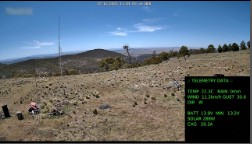
[Thought: Hi lan. The proposed addition of the Battery Protect Device may reduce the risk of incorrect shut-down. In my little experience, RPis are fantastic – a terrific, tiny, flexible and easily programmed training device – and for those reasons perhaps, not necessarily reliable.
Now my vast experience is limited to just building a few AllStar nodes only… so I’m probably off-beam here; however, “needs a reboot” is I suspect a frequent call.
For that reason, one of the Remote HF stations I’ve had a little involvement with in the past used a Grid Connect brand mains controller – one of those $30 Bunnings WiFi things that looks like a piggy-back mains plug and socket, which can be controlled from your phone; when all else failed, it could be commanded off and then on to force the system to re-boot.
Much easier than driving somewhere to do a manual reset…. and both cheap and reliable. Food for thought?]
John Moyle National Field Day Contest
One of many reasons that some operators dislike contests is trying to work their way through the complexity of electronic log submission.
But then again, imagine what it must be like for the volunteer who tries to manage the log entries if the logs weren’t electronic (and in the right format).
Thanks to David VK6FAAZ, we’ve run slow CW contests in the past using simple spreadsheets for logs; that was a nightmare, even for the low number of participants we had!
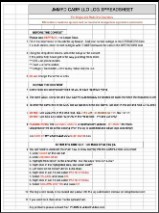
However, in an attempt to simplify the process for thos not using the right sort of electronic logging systems, Alan VK4SN the National Field Day Contest CManager has produced a spreadsheet template with a useful guide on the first page.
Thanks to the Wagga Amateur Radio Club, here’s the spreadsheet. The John Moyle National Field Day is on March 21ST & 22ND.
An Idle Moment
An idle moment from Ross MONNK. The speed of radio waves in a vacuum is 299,792 km/s. The speed of radio waves in the Earth’s atmosphere is 299,705 km/s.
The distance between London UK and Sydney Australia via The Long Path is 23,000 km, give or take a few kilometers. Therefore the latency between the transmission and reception of a Morse code dit sent by CW is 0.08 seconds.
Morse Training Net
Our team member Nic VK7WW runs an on-air Slow Morse training net every Wednesday at 7pm EDST on 3580 for 30 mins. He uses the callsign of the Northern Tasmania Amateur Radio Club VK7TAZ on that net.
Many of our team learned Morse code with the support of Nic, and the weekly training session comes highly recommended for anyone who wants to learn the Code, or simply brush up.
Everyone’s welcome – 3580KHZ at 7pm Eastern time every Wednesday; you’ll hear lots of the CQQRS team on that net. Jordan VK3ACU has recorded the complete set of lessons which you can now find here:
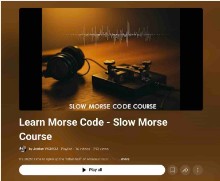
Https://www. youtube.com/playlist?list=PLHsQmZz6fBXO7swAfbT mutrbbEL17fUQL Contact Nic VK7WW for more info nicholaschantler@hotmail.com including how to join the NTARC DISCORD group to follow the action, or just come along and join in on Wednesdays.
From James VK7JZ on a Mountain Somewhere Hi Mark, I notice you have been asking for photos and short stories. On Saturday I went walking with my son and son in law both much younger than me. I thought you might like to share a giggle at my expense.
My son Finlay is into knocking off his list of Abels, which are the Tasmanian summits over 1100 meters; this aligns well with my desire to knock off SOTA summits so while Finlay has no interest in amateur radio, or CW, our
Stack at Stack’s Bluff
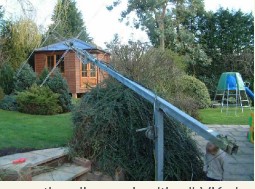
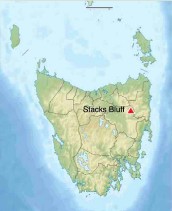
EE St SEEN PONE hg SE BR GREET IRD VUNSEE VEER ED BER MAUR be BNE Finlay has no interest in amateur radio, or CW, our mountain bagging pursuits are aligned. On Saturday we tackled Stacks Bluff VK7/NE-002 @ 1527 meters.
It was a hard climb and due to the time required to make it back down the scree field before dark it was a short activation; there was no time to be changing bands and repeatedly calling and hoping for just one more contact.
In short order I had 5 CW contacts, another 4 on voice, then it was time to get the boots moving again.
So a bit of SOTA humour and a lesson to why you don’t go bush
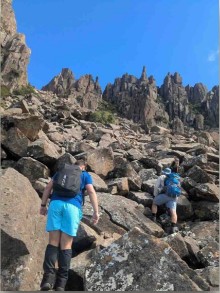
Why you don’t go bush walking with that generation that always have a phone in their hand. We had to scramble up a steep scree field to get our elevation gain to the alpine plateau before the summit proper.
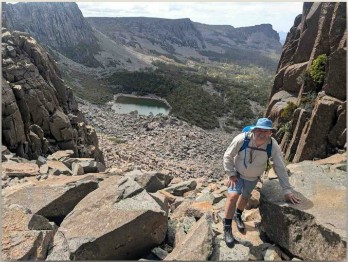
On the way up Finlay took the first two photographs, very kind photos, made me look like the master of my domain.
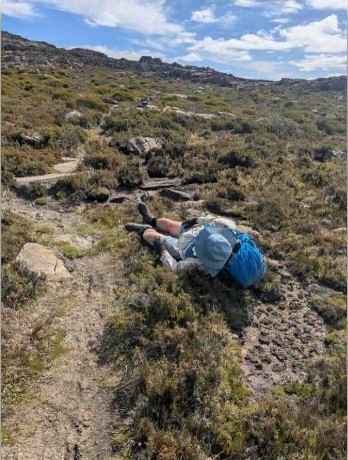
Then on the way back, like a fool on a flat section before the final descent I stumbled and fell, no reason, just fell over — it was stupid, and the prickly bush that I fell on and wane licensed) sence Pa eawucles sueteteee senaed
And fell, no reason, just fell over needled my hands arms and legs was not fun. Ihear this voice from behind me call out ‘Are you OK Dad?” what I did not hear was he had the phone out again and took the third photo which was compromising, stupid, and proves I am was absolutely not mastering much of anything.
Anyway, thought you might all have a giggle. I am now about year on from my first CW based activation, a lot more comfortable with it all, and a lot of the credit and thanks goes to 2x CWA classes, a foundation and an intermediate, and the weekly CQ QRS CW net.
Hobart, Tasmania (or a mountain somewhere) Email: hobartjim@qmail.com QRZ: https://Awww.qrz.com/db/VK7JZ
Letters to the Editor
Dear Mark, As a citizen of a country that has glaciers, I am concerned that you’re insulting these
Dear Mark.
Are as slow as the morse on the qrs net. When I return home later in the year I will appologise to Franz Joseph in person. Donald VK6JDM
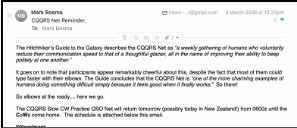
Love it – good explanation of my CW skills… 73, Jim VK7JZ
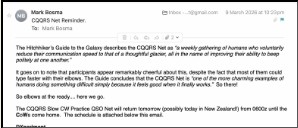
Mark It was my pleasure to catch up with you last night on the net… ifI’m honest I’m a bit of a procrastinator, so your little push has done me the world of good.
That has always been my problem, I send fast characters but try to space them out a bit, and then I get carried away in the moment and go to fast and then can’t copy when the other op matches my speed.
Also, I try to send from my head and not from the written word. This does slow me down a bit…until I get on a roll, hi hi.
There was another last night, something like VK3BTW or V maybe(?) he was chatting with Manny. He was similar to you, strong signal and easy to follow along. You both had nice spacing with good character speed.
Funny thing is, I find it harder to copy really slow character speeds, around 12-15 character speed is about right at the moment, anything slower and I tent to sound them out in my head and get confused.
I’ll work on the faster characters and big spacing technique. Thank you.
A few times I got hung up on “what was that last character” or got distracted by looking at what I was typing. My receive suffers when I hand write things down. Not sure why?
This was when I was off work for 3 months and my node was permanently connected to one of the VK6 hubs, can’t remember which one.
My node (#61703) is still connected to the network and can be accessible via both Allstar & Echolink (VK4IM-L), but the Motorola 338 I was using as a simplex node has given up the ghost.
It’s the second Motorola that has failed in 6 months so its via the net and Echolink only for the moment. It was running at 15 watts with a 3-minute time out and a 100MM fan on the heatsink, but still failed. Maybe just too old or not up to the task…
Not sure. It’s a real pity too, because it was gaining a pretty good following as a simplex node locally and it had a great foot print from my location, even to mobiles. I’m trying to source another, more reliable node radio with a higher output.
Something around 50 watts or better to run at 20 watts. Less stress on the output stage that way. Maybe something like a Yaesu FT-8800R or FTM-100DR, something with the DIN data port on the back, I think Kenwood and Alinco had some models that used the same DIN pin outs, and it only really needs to do 2m.
Ilike the idea of the cronjob. There are a few ops locally I’m sure would be interested in the QRSnet and also Post Morseum. Theres’ a local Hamfest coming up after Easter, so I might find something there.
I’ll keep you posted for when the node is back on air; 145.275MHz simplex (123HZ sub-audible tone for access). On a side note: I mentioned last night that my arm started to ache. It’s an old injury that flares up if my arm is in the wrong position for too long.
The up down movement with the straight key sets it off because I tend to hold my arm off the desk while sending. For this reason, I wonder what your thoughts on learning to use a bug are?
With a bug I can rest my arm on the desk to reduce the ache, but wonder if I should persevere and master the straight key first? Awhile ago I picked up a 1927 Vibroplex Lightning, complete with a
On a side note:
| mentioned last night that my arm started to ache. It’s an old injury that flares up if my arm is in the wrong position for too long. The up down movement with the straight key sets it off because I tend to hold my arm off the desk while sending.
For this reason, I wonder what your thoughts on learning to use a bug are? With a bug I can rest my arm on the desk to reduce the ache, but wonder if I should persevere and master the straight key first?
Awhile ago I picked up a 1927 Vibroplex Lightning, complete with a longer weight to slow it down. There’s a photo of it on my QRZ page. I’ve sourced the original black finger pads for it since that photo was taken, so its back to original now.
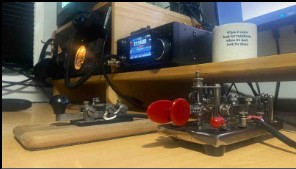
Again thanks for giving me the nudge I needed and the encouragement. ‘Til next time Cheers Adam VK4IM [Over to our readers for thoughts on initial learning on a straight key vs a bug or paddle please.
Also, ideas on reducing the effects of repetitive strain injury, carpal- tunnel syndrome, osteoarthritic inflammation, tennis elbow, golfer’s elbow and likely other (physiological) problems associated with keying.
Cqgrsnet@gmail.com for thoughts, recommendations, remedies, etc please.]
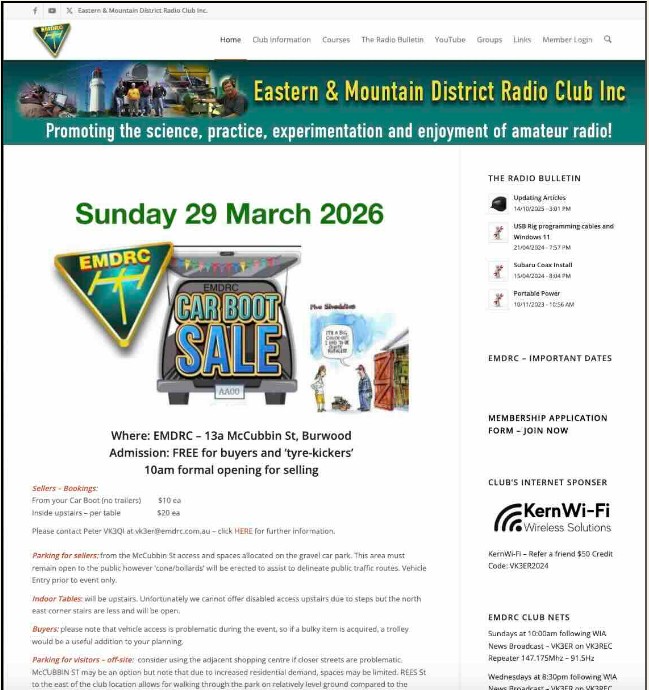
Mark – I am not sure If you mention this website in your weekly newsletter. Maybe the CQQRS group could be added to the list of members. I was in the CFO group mentioned in the list a long time ago around 1980.
Https://internationalcwcouncil.org/ https://internationalcwcouncil.org/me mber-organizations/ Jeff Pohl (WB2GDZ)

Ham College Foundation Training Course
From Mike VK6XM via the WAHAMS email group. All, Please note the next HAM College Foundation course is being held on the weekend of April 11TH and 12TH (and exams on April 18TH).
We’ve got a few spots available right now, so would appreciate your assistance in spreading the word. If you know of someone who’s been thinking about getting into Amateur Radio and would like to book a spot on the course, please pass on this message or ask them to go have a look at our webpage and put in their expression of interest via the Contact form.
Https://www.hamcollege.org.au/study/foundation-licence-course/ Thanks
Thanks
Perth, Western Australia https://plus.google.com/u/0/+MikeGroeneweg
Telegram: nttps://telegram.Meée/r arrotneraer HAM: VK6XM (was: VK6MKG)
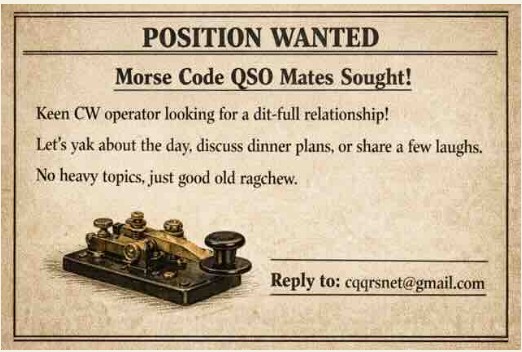
I’m pleased to say that we have our first starter for Morse Mates,. Here is their cv: One of our members is sending and copying around the 12-14 wpm mark, and is keen to push on to about 15-18 wpm, and then see where the journey goes!
He currently prefers to use a straight key, but can easily change to a paddle. Happy to do QSOs over the air, on VBand, or any other way that works. Times are very flexible, anywhere between say 10AM and 8pm, any day/s of the week.
MM260312a If you’d like to be put in touch with MM260312a, please email to: cqqrsnet@gmail.com
Erratum:
My apologies to Andrew VK1DA for errors that I introduced while editing his QRZ? article in RagChew 10/2026. The AR7
Receiver had been donated to a school radio club at Lyneham in 1963, not the Canberra Amateur Radio Club (which did not exist at the time), and the keyer that Andrew donated to your editor was different to the ones he discussed.
In hindsight, it may have been better to enter my guesses via an Editor’s note rather than using Andrew’s voice; however, although they’re the correct way to do things, I actually dislike such editor’s notes, which can seem patronising to a reader.
Anyway, apologies to Andrew and thanks again for the insights.
If you’ve read something that you think might be of interest to our readers, please let me know. For guidance on writing for RagChew, see Articles below. Please email material to Mark VK2KI: cqqrsnet@gmail.com
There’s No Such Thing…
Pho WEEN 2 YMC UlIViios I think the first lesson in Teachering 101 is to always tell students “There’s no such…” (I’m sure you know the rest) and “…the only dumb questions are the ones not asked”.
John VK2RU reckons that there’s lots of questions out there among bot! our new and our experienced operators – about CW, amateur radio operating and about theory. So here we go…
Question:
UCSUUTI. rom Mal VK8MT: what do people use for portable antenna wire?
Answer:
Answer: No doubt there’ll be lots of thoughts and experiences from our portable operators out there… so please let me know your thoughts for a future RagChew. cqqrsnet@gmail.com
From Adam VK4IM: the question in Letters to the Editor above about learning on a straight key, paddle or bug.
Answer: Over to our readers for views and experience (eg ‘had / known about …. I wouldn’t have started on…’, or perhaps ‘/ started on…. but then found it hard/easy to move to….’, etc). cqgrsnet@gmail.com
From Adam VK4IM: the question in Letters to the Editor above about ke
ATISWECT. Over to our readers for views and experience on keying injuries or pain. cqqrsnet@gmail.com
[Do you have a question or two that are worth sharing? How about a discussion- starter? Please let me know cqgrsnet@gmail.com and I’ll pass them to John VK2RU for compilation each week.]
Prosign/Character/Signal of the Month
Bowing to Pressure – a New Prosign See if you can use this one on Tuesday?
Frosign: <9AK> go Meaning: End of Contact
[Suggestion – put it on a sticky note near your key as a reminder for Tuesday…. and tell us how you went]
I Hear Tell…
My wife just came out laughing from our shared study that I use as a radio shack. She said she just overheard (name deleted so as to not hurt any feelings) saying on the WA AllStar net: “So do you have any idea what on earth I was just talking about?” Can you guess who it was that she heard?
[If you have some intel about other team members… or even yourself… that’s worth sharing, please let me know cqqrsnet@gmail.com J
Di-dah-di-dah-ait
So back to the CQQRS Slow CW QSO practice net.
Next Tuesday’s Net
Our CQQRS Group will be on as always on Tuesday from around 0600Z until about 12002; see https://bit.ly/CQQRSWebsite and navigate to the Net Details page for details.
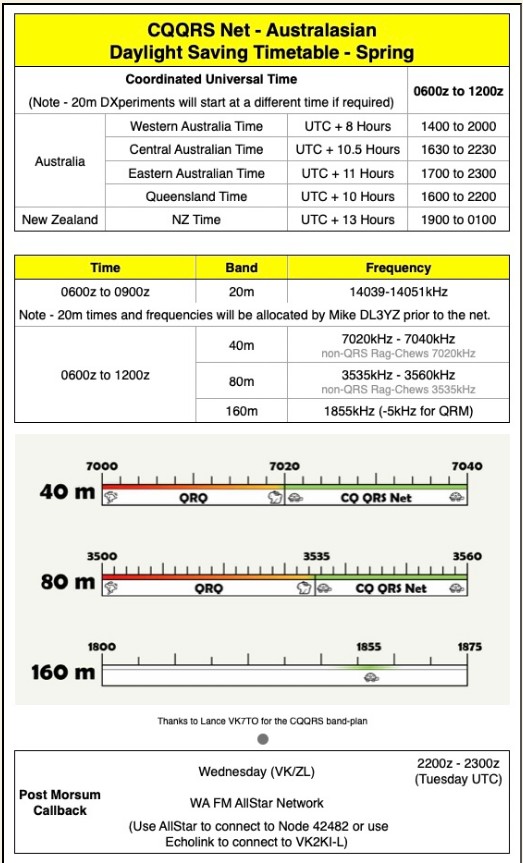
Doesn’t matter whether you’re brand new and want to try just exchanging callsigns and RST reports, or you’re ready for a good old rag chew. We’ll have fun.
There’s usually people around until after 1200Z – so keep calling in the segment of the band designated in the table below until you catch someone.
I should be on as usual from home in NSW or via the Remote at Bedfordale WA, and I’ll also be watching the proceedings using the VK6QS and Tecsun SDRs in WA and NSW respectively. Hope to hear you there.
Reports & Photos
Please let us know via our Reports form bit.Jy/GQQRSNET who you work or hear on Tuesday’s Group. The report form closes at lunchtime (Eastern Australian time) on Thursday. ‘And how about helping to make the reports even more interesting by sending a photo?
If you have a photo that you’d be happy to include, please email it to: eqqrsnet@gmail.com To make it even easier for our Reports editor Patrick VK2IOW, see if you can reduce the size of the image (to less than 100KB file size by preference).
No problems if your computer or phone can’t do that – just send it through anyway please. And of course, I’m always on the lookout for more photos for the newsletter, so if you have something that might be of interest aside from the reports, please send it through as well – I always enjoy the photos that our readers send – and I’m sure our readers do too.
Email them to cqqrsnet@gmail.com please (reduced size if possible – but whatever you send will be great). Oh and by the way, I recommend that you don’t keep the Reports Form website open between submission of reports from one week to the next.
If you’re unlucky, there’s an undocumented feature in the software that could cause your current week’s report to be combined with your previous report – it’s happened to your editor several times – much to the chagrin of our Reports editor 🙂
Post Morsum
Richard VK6HRC will run our phone Post Morsum on the South West AllStar net (via repeaters and hotspots all over WA) from 0600 WA time, then from 0700 WA time on 80m (8605 LSB).
See https://bit.ly/CQQRSWebsite and navigate to the Net Details page for details of how you can connect via Echolink or even possibly via your local FM repeater.
Articles
The newsletter is interesting to readers because of the material contributed by so many people – be it the reports each week or the various articles. Could you write a short article or articles for RagChew? You bet! Writing not your strong point?
Don’t worry, I’m very happy to help as much or as little as needed. Here’s a thought – although our readers will much prefer your own writing, perhaps have a go at using a Large Language Model Artificial Intelligence tool such as ChatGPT, Microsoft Copilot or Google Gemini to check your writing or even to actually draft the whole article in a relaxed easy-to-read manner!
You can find out more about how to do that on the Newsletter page on our website bit.ly/CQQRSWebsite. Our website also includes a suitable prompt (the command you feed to the Al to make it do what you want).
Please remember though – you must fact-check anything that an Al tool drafts for you because Als ‘hallucinate’ – ie if an Al can’t find what you’re looking for, it will make up an answer and present it as afact!
This is one of the dangers of using Als – it’s quite probable that the tool will create a very readable and convincing draft that is 100% wrong! You as the submitter are responsible for fact-checking.
But it’s a learning experience – please let us know how you went if you had a go with this new generation of tool. And by the way – lam very concerned about our future in a world of Al – but I’m pleased to see that school and university curriculums now focus on understanding the risks – for instance, kids are now learning critical thinking something that used to be taught mostly at post-graduate level.
When the typewriter was invented, people predicted the downfall of handwriting; when the word processor was invented, the art of writing was thought to be on the way out – ditto for the spreadsheet and arithmetic, AM, SSB and FT-8 for amateur radio etc.
We can ignore Al and hope that it just goes away… or we can learn to handle it through experimentation and use. Oh, and one more thing (actually two) – copyright material: * please use your own images – don’t use images copied from the internet unless you have the producer’s permission, or they’re marked ‘Creative Commons’ or similar; * if you include other peoples’ written material, unless you have permission, you may only include small snippets (unless it’s marked ‘Creative Commons’ or similar), and you’ll need to site the source and author.
For more guidance on writing for the RagChew newsletter (including help with using an Al), head to our website bit.ly/CQQRSWebsite then click the menu on the top right and then click RagChew Newsletter.
Viateria
A reminder; if you send me any information by email, our report form or WhatsApp – unless you specifically state that material is not to be published, I’ll assume that you’re happy to see your thoughts in the RagChew newsletter.
Thank you so much to our team of 46 contributors: DL3YZ, MOKBJ, MONNK, VK1AD, VIDA, VKIHF, VK2DI, VK2DLF, VK2IOW, VK2RU, VK2TIG, VK2WP, VK3ACU, VK3BWN, VK3CLD, VK3DRQ, VK3ECH, VK3WOW, VK4CEG, VKAEV, VK4IM, VK4PN, VKSAV, VK5CZ, VKSET, VKSKFG, VK6HRC, VK6JDM, VK6KD, VK6KHZ, VK6MTF, VK6NW, VK6PZT, VK6RR, VK6WE, VK6XC, VK6XM, VK7JZ, VK7ME, VK7TA, VK7WW, VK8MC, VK8MT, WB2GDZ, ZL3ABX and ZL3TK.
Anda special thank you to our editorial team, Nigel G4RWI (head software tier), Patrick VK2I0W (reports enhancer), John VK2RU (spreader of sheets), Richard VK6HRC (6am cat-herder) and Lance VK7TO (director of archiving).
Great work alll UY CW on Tuesday, mb Mark Bosna VK2KI/ VKEQI Beautiful South Bowning NSW ‘eqarsnet@gmail.com non impedit ratione cogitationis
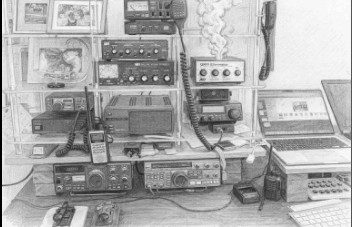

About the CQ QRS Net
For the current schedule and more information about the CQQRS net, please go the the Net Details page on our website:

The opinions expressed in the RagChew newsletter are those of the individual contributors. The opinions do not necessarily reflect that of the editor or of the CQQRS Group members.
Any material and images received from members by the editor or published on the CQQRS WhatsApp groups may be published in this newsletter unless specifically requested otherwise.
The RagChew newsletter is considered to be exempt from the Australian Government’s ban on social media for under 16 year olds because it is a service that has the primary purpose of enabling users to share information about products or services, engage in professional networking or professional development services or of supporting the education of users per the Australian Government eSafety Commissioner FAQ webpage “Which platforms have been excluded from the age restrictions” dated 10DEC25.
The values, doctrine and guidelines for the Group and for the newsletter are published on the Principles page of the group’s website https://bit.ly/CQQRSWebsite