Below is a reconstruction of the 2026 17 CQ QRS RagChew newsletter designed to support full text searching. This reconstruction was built using OCR, and will contain errors.
To view the Mailchimp original, click here. To search the entire newsletter archive, click here.
Contents
- CQ QRS RagChew
- Dah-di-dah-di-dah
- Quote
- Website
- Post Morsum 22nd April 2026
- Reporting
- Vintage Radio – Repair & Restoration
- Back to My Adventures
- Points of Order
- A MODEST REBUTTAL TO THE HONOURABLE MEMBER’S POINT (CORNER
- Submitted for the consideration of Honourable Members, John VK2RU Spreadsheet Pilot
- On My Workbench
- Oscillators and Oscilloscopes Part 1
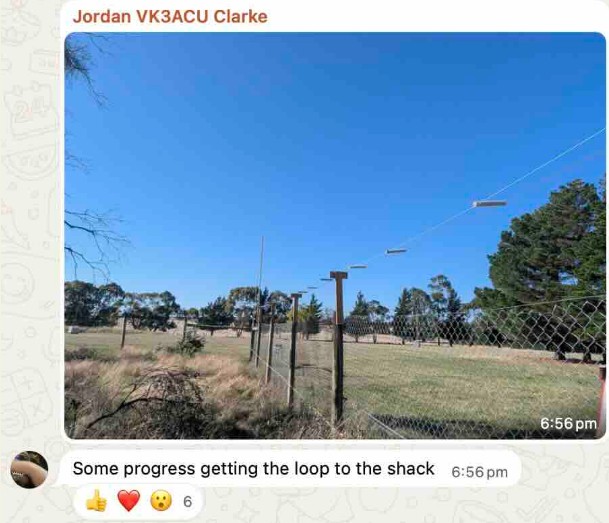
- Jordan VK3ACU’s Directional EWE Antenna
- QRZ?
- QRZ? Who’s on the other end?
- CW Practice
- Other News
- Report on Team Oceania’s First RandomGram Ever
- Marconi Day Troubles
- Morse Training Net
- Prosign/Character/Signal of the Month
- I Hear Tell…
- Quotes from Near and Far.
- Di-dah-di-dah-dit
- Next Tuesday’s Net
- Reports & Photos
- Post Morsum
- Articles
- Material
- Teamwork
- About the CQ QRS Net
CQ QRS RagChew
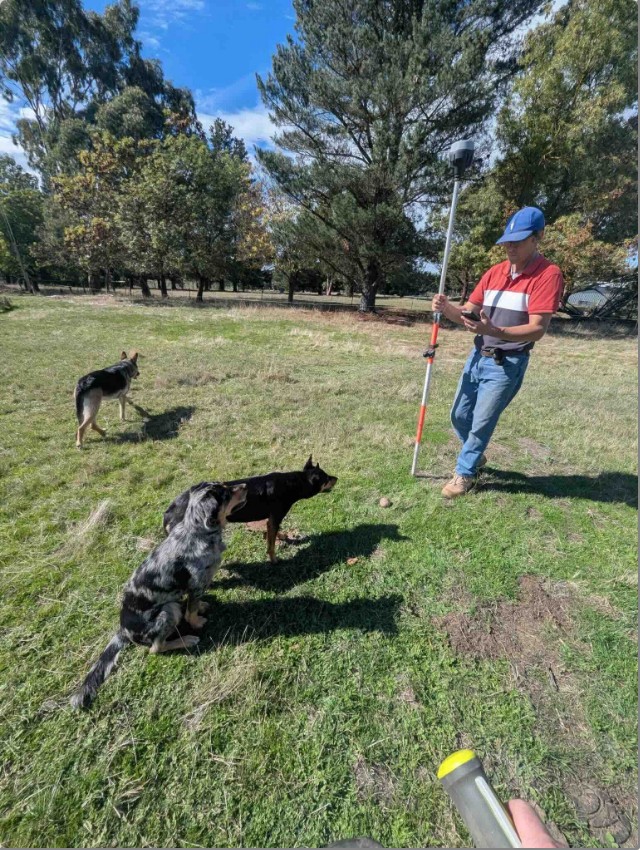
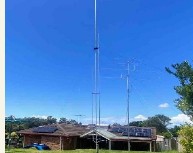
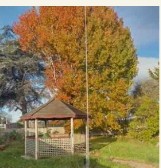
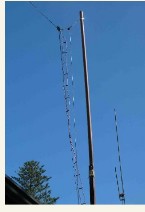
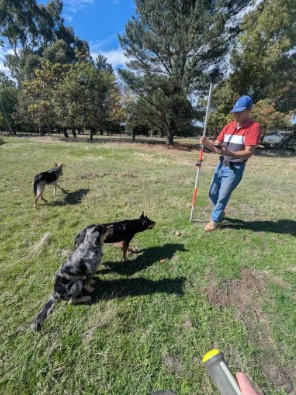
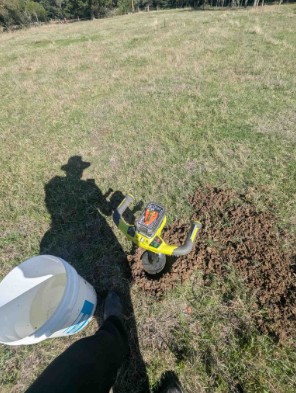
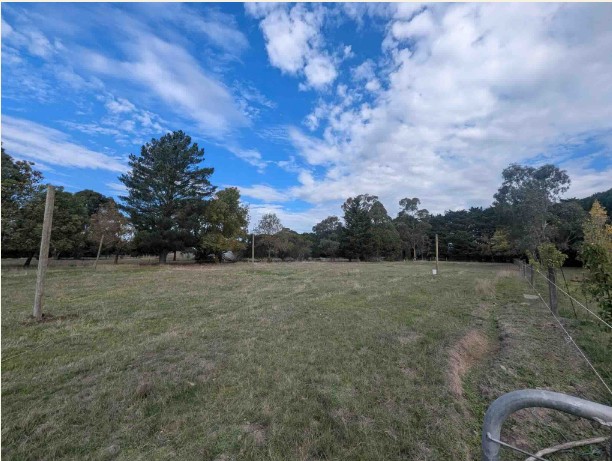
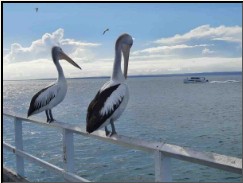
Thanks this week to Jordan VK3ACU for this shot of his neighbour Martin VK3ADH helping to geolocate the latest antenna at the Meredith antenna test range – see below for more.
However, the dogs think that’s a really boring caption for such an interesting picture; how about a few readers’ ideas on how to spice it up a bit? cqgrsnet@gmail.com if you have some suggestions!
Link to our Weekly CQQRS Net Reporting Form
Dah-di-dah-di-dah
Take a look if you will at this week’s reports from Tuesday’s CQQRS Slow CW Practice QSO net! For most people, conditions were pretty poor – and the Space Weather Services’ depressed conditions and aurora warning seemed to play out.
Our mates down in Tasmania suffered, as did others, with some reporting radio black-out conditions.
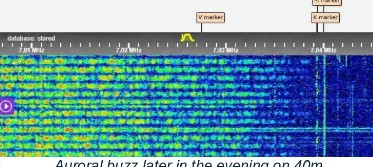
And as I was about to trudge off to bed, I saw a strong segment of auroral buzz on 40m on lan VK1HF’s Snowline KiwiSDR; I zoomed out and was interested to see that it was a blob of noise, that went from around 6950KHZ
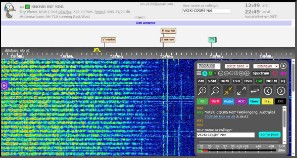
To about 7035KHZ. I’ve learned some of the ideas as to why the auroral buzz appears as little blobs of noise on a waterfall display through the RagChew newsletter, and could possibly guess why the upper frequency might be limited, but I wonder why there’s a noticeable lower limit as well?
Any thoughts folks? cqqrsnet@gmail.com Anyway, back to the main point of my rant… please check out this week’s reports from your mates who took the time to pen some words in their report.
My hypothesis is that with the increase in geomagnetic storm activity comes a corresponding increase in the entertaining words written by our team! Cause-and- effect, or correlation I wonder?
Quote
GIUOteS Anyway, and completely unrelated… I thought this week that I’d put some interesting quotes in our / Hear Tell… segment… and as it turned out, many of this week’s interesting things came from our members’ reports!
Thank you folks – please keep it up – makes for interesting and fun reading for our members.
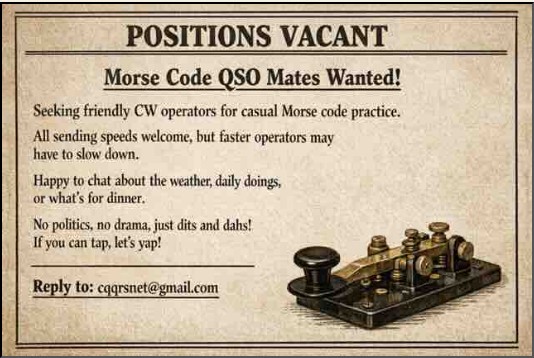
Morse Mates Heading down to our weekly cartoon at the tail-end of the newsletter, you may have noticed an advertisement calling for Morse Mates.
To explain, at least one of our members would like to arrange regular chat-type skeds with others who enjoy a nice rag-chew about who knows what, and also appreciate the practice opportunities.
There’s a bit of it going on in WA already, led by some of our team who enjoy getting together during the week for a nice CW natter or two on 40m. So would you like to set up a regular chat with one of our Eastern States team?
If so, please send me an email to cqqrsnet@gmail.com and I’ll pass your contact details to our member. Similarly, if you’d like to join the list of people looking for a regular sked, please let me know so we can see about getting more going.
Website
If you’d like to find out a bit about our net, or would like to pass information to others about our Tuesday get-togethers, here’s the link to our website. bit.ly/CQQRSWebsite So here we go – on behalf of the CQQRS Editorial team, please enjoy the newsletter.
WVlarK bosma VK2KI / VK6QI Patrick John Beautiful South Bowning VK2IOW VK2RU NSW Milthorpe NSW on a track somewhere cqqrsnet@gmail.com non impsditi ratione cogitationis Nigel Richard Lance G4RWI VK6HRC VK7TO our other grey nomad Padbury WA Margate TAS Jordan VK2ACII
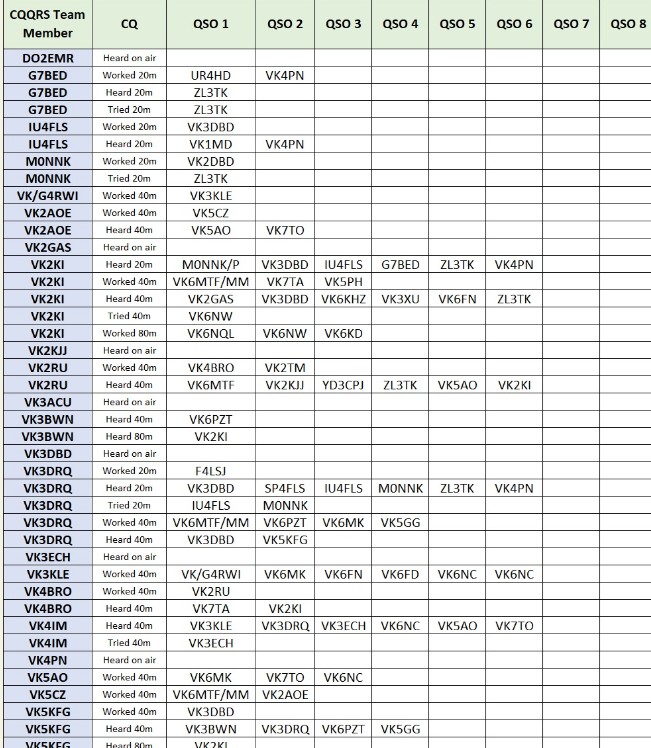
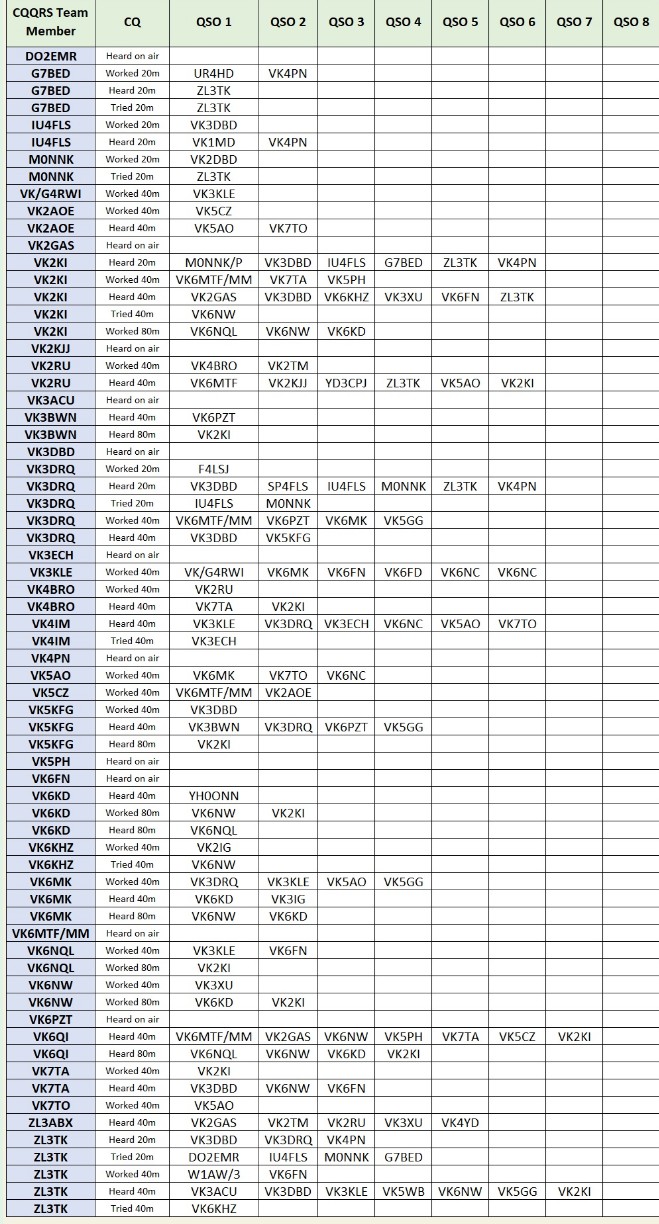
John’s spreadsheet above shows the known stations heard or worked on last Tuesday’s CQQRS Net (reported via our webform bit.ly/CQQRSNET ); the comments in the team members’ reports follow.
The comments were compiled for us by the clever software built by Nigel G4RWI and the layout was perfected by Patrick VK2IOW. Thanks again to Nigel, Patrick and John for the work, and to every team member who submitted a report –
From Chris G7BED at Northampton, England
[20m] Reasonable conditions (using a WebSDR) and great to get VK4PN in the log. I could hear Stan (ZL3TK) and called back several times, but didn’t manage to get the QSO in the log. Let’s try again next week Stan.
As always, thanks for the short session and for giving it a go. Wishing you all good DX and look forward to working you next week.

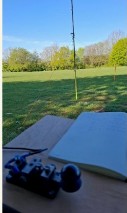
[20m] Only 7 C here this morning, so rather nippy for Portable. I could sit in the sun in a very cold wind, or shelter in the shade. I chose the latter and still froze. Still, David VA3DBD made my day by giving me an RST 439 (I gave him RSN 541).
We both had some QSB but managed a short chat. Kept hearing VERY faint morse but couldn’t make out any callsigns. Cold fingers and a quiet band stopped play early.
From Scotty Brown VK4BRO at Gold Coast, QLD
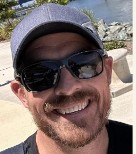
[40m] Only time for one QSO but it was a great one thanks John!
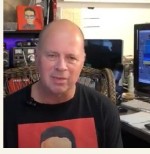
[40m] Came out of the sauna….sweaty mess. Can’t work CW whilst sauna is on as it transmits on all bands! Went into the shack for a quick QSO with lan. 73 de VK2AOE CW will never die!
[20m] Wx was bad in Bologna: rain, lightning and consequently QRN. My freq14044 kHz and power 90 W . First heard was VK1MD followed by VK4PN, both signals were just above noise floor. I had the pleasure to hear David VK3DBD again.
We shared RST report and little else due to QRN. I apologize for not having been able to conclude QSO properly. 73 de IU4FLS Fausto
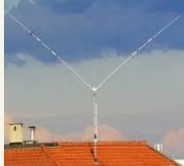
[40m] Not much heard from my QTH on 40m. The VK5 SDR located at Ironstone Range was quite active with 40m stations.
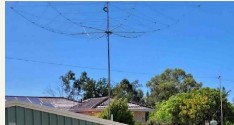
80m was open to the East with reports of lots of QSB. My noise floor was S7 so struggled to hear stations with signals under S7. Wayne VK6NW bounced in bending my needle at +20 so I switched off all of my preamps and reduced my Tx PWR as did he.
I can say it’s a much relaxed QSO when you’re not fighting QSB. Mark VK2KI responded to my calls however I needed to Rx him using the Ironstone SDR in VK5 as there was almost no signal from him showing on my rig.
Clearly I was getting to him as his report to me was an RSN of 321 with OSB. Word of advice, when using SDRs, be careful not to change frequency when the SDR screen tries to go into sleep mode. It adds a panic moment when half-way through a QSO.
Same result if you bump your VFO on your home rig, hihi. Reminds me of a song “The Sound of Silence” by Simon and Garfunkel. Thanks to all for another exciting QRS CW night, 73. VK6KD
From Stephen Coote ZL3ABX at Nelson New Zealand
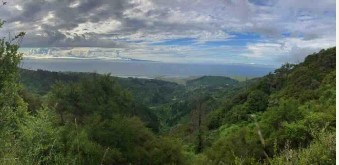
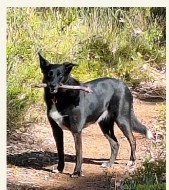
[20m] All paths from ZL to EU were closed more securely than the Strait of Hormuz, however while the guards weren’t looking, IU4FLS managed to slip through allowing a positive ID. The station he was working was asked to ORS….
But from where I was listening, speed wasn’t really the problem. Even with an S5
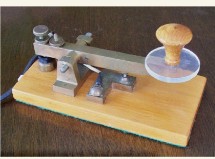
Signal, the ‘local’ on a straight key was unreadable at times, his usual problem characterized by negligible spacing and poor character formation.
When he obliged by slowing down, spacing became acceptable but character formation could do with quite < bit of work, especially on dashes which are often barely discernible from dots.
Previous recordings have shown instead of 3:1 ratio, at speed the ratio is < 2:1 much of the time. Good on him for getting into northern Italy, and thanks for again, unwittingly, providing a sobering lesson that ‘QUALITY, not quantity’ is what really matters.
It’s not just the Iran war, but also Tuesday’s episode which brings to mind the closing line of every verse in Pete Seeger’s famous 1956 folk classic, ‘Where have all the Flowers Gone’.
[40m] Similar to last week. VK6S Q5, everywhere else mediocre. Replied to W1AW just as a joke but to my surprise he came back with 599 bereft of all politeness. Yeah right, pigs are flying today Mr Kilowatt.
I sent an honest RSN 532, which was acknowledged by TU CQ CQ, draw your own conclusion. Nonetheless, it proved everything here was working satisfactorily.
[80m] Called CQ until 1300Z but nothing seen or heard.
From your editor Mark VK2KI at Beautiful South Bowning NSW
[15m] I missed Edi on 15m this week; when I got on he had already gone QRT according to Mike’s status reporting page. Hope Edi had some luck despite the strange conditions.
[20m] I went out and checked that my antenna was still up – I could hear / see some of our DXperiment players on the Snowline KiwiSDR, but very little here, only 150KM away.
Se Signals across Australia weren’t too hot this week. The VK6S were coming thought early, but quite weak. And closer signals were a real jumble.
Stations who would normally be good copy here were pretty weak mostly; for example, lan VK5CZ was not audible at all, yet Morgan VK6MTF/MM was Q4 with ic 10 Wlatte and varchtuconfir
With is 10 Watts and yacht-confined but probably well-grounded antenna.
[80m] When the ALF dropped, 80m was performing better than 40m across Australia. I hooked up with Peter VKG6NQL, Wayne VKE6NW then David VK6KD before trudging tiredly off to bed after a fun evening.
[40m] Interesting to listen to both lans VK7TA and VKS5CZ coming through nicely to the KiwiSDR near Northam, yet both were pretty weak with me in SW NSW.
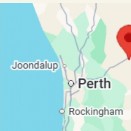
[40m] Only one aborted QSO this week. The bands were very quiet here, until VASAO popped up with a good 559. However, after exchanging signal reports, Mait’s signal quickly progressed down to 119.
Despite calling on 40 and 80 m for a while, either no-one was hearing me, or I wasn’t hearing their responses, so called it a night.
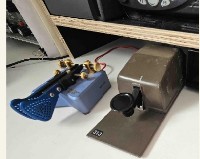
[40m] I had made some small changes to the antenna and initially thought that I had left it disconnected since I heard nothing! So assuming I had not done something stupid conditions were the worst yet on a Tuesday evening. ranh…1
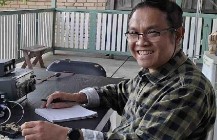
[40m] I joined the net pretty late (8.30 pm). Maybe that’s why I missed many of the activities. However, I worked W1AW/3 after VK6PZT did. Maybe with the drop in solar activity, there is an improvement in the 40 m band DX.
[20m] After trying IU4FLS and MONNK, both QNP and no answer came back.
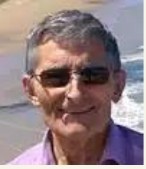
[40m] Stations were quite weak and had deep WSB from VK6 to Stawell. But managed to have successful QSO and enjoyment.
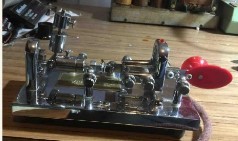
[40m] I had so much noise tonight which made things very difficult. I managed short QSOs with VK2TM and VK4BRO. Thanks to both of them for the contacts.
40m seemed to drop out for me a bit earlier than usual, and I’ve never had great success on 80m, so it was an early night for me.
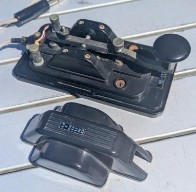
[40m] So 100% success rate, but unfortunately because the one station I heard was the one I worked! Terrible conditions, that just got worse as the evening progressed. Did think of joining in on 7.028 with all the other stations talking on top o each other!
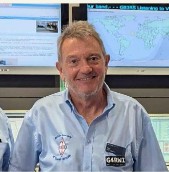
Post Morsum 22nd April 2026
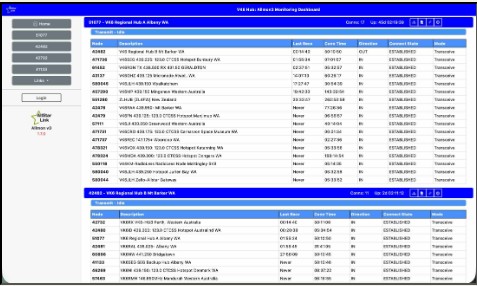
From Richard VK6HRC. Seven on the VK6RLM rptr and AllStar/Echolink hub this morning.
Ne NE RN OWN VK6KD David VK6QI_ = Mark ZL38TK = Stan VK6NW Wayne VK6FN Max VK6HRC
David two contacts on 80m, no problem with Wayne VK6NW but had to resort to listening on a Kiwi sdr to complete the contact with Mark VK2KI. Mark heard six on 20m via the Snowline sdr, worked three on 40m heard six and on 80m worked three.
Mark also let us know that Morgan VK6MTF/MM anounced his proposed departure from Esperence to VK7 during their 40m qso. Stan called in 13 degrees and no storms in Waitarere Beach !
Worked two on 40m, Max VK6EN ( 333 report ) conditions marginal and W1AW/3 also heard Fausto IU4FLS at one point during the evening. Stan also took part in the RandomGram event last weekend, for more information check AF2Z Drew’s QRZ page.
Wayne worked one on 40m caught up Mark VK2KI on 80m and tried swapping between vertical and horizontal antennas with Mark reporting very little difference at his end. Fausto IU4FLS was heard via a Kiwi sdr.
Wayne is busy once more with volunteer work, so much for retirement ! Max was hearing stations in VK2 and VK3 but nothing from the locals, he even got a call from Wayne VK6NW on the AllStar network to compare notes on the poor band conditions.
I was unable to take part due to a social gathering but it was great to catch up this morning and hear from some of the QRS crew, Mark was in fine form with some subtle stirring going on to jolly things along !
Thank you to all on last night and this morning 73 Richard.
Reporting

Even if you didn’t hear anyone, we’d still like to know that you had a go. And to make your report more interesting, please consider sending a photo: cqgrsnet@gmail.com So, please help attract new and old team members to have a go by submitting your report each week.
Submissions close 1300 (Eastern Australian Summer time)_on Thursdays.
Vintage Radio – Repair & Restoration
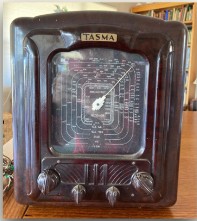
My neighbour Mark (who you might know as VK2KI) asked me to provide an article related to my hobby, which is vintage radio restoration and repair.
I thought a good point to start would be an introduction to the Historical Radio Society of Australia, and its magazine “Radio Waves”. I think that many of the articles published in the magazine would be of interest to members of the Amateur Radio community.
Here’s a brief list of interesting articles published over the last two years:
• January 2024 — + July 2024 — + October 2024 — + January 2025 — + April 2025 — + July 2025 — + January 2026 — * April 2026 —
“Morse Code Transmitter 1925” “Audio Output Transformers — Replacement and Testing” ‘Vlalve Substitution” “A 144MHZ Valve Transmitter” “Made in Australia: Distance Measuring Equipment (1)” “100 Years of Broadcasting in South Australia” “The Reflex Receiver” “Made in Australia: Distance Measuring Equipment (2)” “Restoration of a Kingsley K/CR/11 — AR7 Comms Receiver” “Australia’s Domestic 230 volt Power System” “Build Peter Lankshear’s ‘Mate’ — low power broadcast transmitter: courtesy Silicon Chip and Electronics Australia magazines”
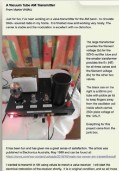
I’m presently collecting the components I need for the last project, so I can transmit to my vintage radio at home. hitps://nzvrs.com/ wp-content/uploads/2018/10/mate-low-power-am-transmitter.pdf Mark tells me that his friend Martin VK6MJ built the same one which was featured in RagChew.
Some of these articles are of historical interest, while others focus on technical issues, some of which may apply to Amateur Radio. Please visit the website https://hrsa.org.au should you wish to join nagazine.
Back to My Adventures
My very first job was helping out at a local TV/radio repair shop, Carl’s TV. I also had a neighbour who was an engineer at a nearby electronics firm.
I am deeply indebted to Carl and Marvin for their early support, and the many others who mentored me along the way. University came along and I ended up more involved with software than electronics, and spent most of my early career in software support roles.
My interest in electronics was renewed after I followed my wife to Australia from California and working for NASA’s Jet Propulsion Laboratory, was running receiver installation and training at the Tidbinbilla Deep Space Tracking station in the ACT.
After I retired, I took a part-time job at repairing TVs, radios and stereos – working for ‘one of the CQQRS members – Claude VK1TE. Somewhere along the way, I stumbled into an HRSA meeting and bought a couple of vintage valve radios to fix up…
And I’m still doing that. I love the old valve sets, their beautiful bakelite or wood cabinets, their interesting smells and the side-benefit of house heating.
There’s a lot of old radios out there that need repair, and can be found online or at the HRSA meetings. I’m not a collector, so I resell most of what I repair – I usually break even, but sometimes I score a treasure and even occasionally turn a small profit Please contact Mark cagrsnet@ gmail.com if you’d like to touch base with me about my obsession interest.
Stop fiddling with those old radios, and take me for a walk!
Points of Order
There’s Order in the Disorder by John VK2RU
A MODEST REBUTTAL TO THE HONOURABLE MEMBER’S POINT (CORNER
From John VK2RU In response to the Point of Order raised by the Honourable Member of Waitarere Beach in last week’s Newsletter, I offer the following observations.
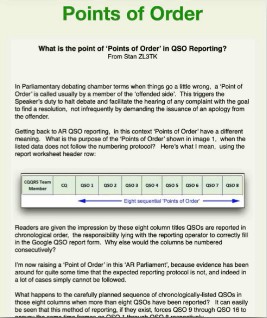
The point that headings such as ‘QSO 1’ through ‘QSO 8’ suggest a neat chronological sequence is entirely fair. It does look that way at first glance. Unfortunately, the data itself has other ideas.
In practice, that tidy sequence does not really exist – or at least, itis not something that can be reliably preserved. During processing, callsigns are grouped, tidied, and occasionally moved between bands (for example, from an 80 m row to a 20 m row), which already nudges some of them out of any original position they may have had.
ANE Abu HTT eS ON ULERY ULES Uae) LUE Additionally, the source reports do not include timestamps. Even with the best intentions, there is no consistent way to determine when a QSO occurred, whether a set of QSOs happened over 20 minutes, two hours, or somewhere in between – or which one actually came first.
And then, of course, there is the final touch – presentation. The callsigns are arranged by “visual width” so the sheet is easier to read – widest on the left (think VKSECH/ MM, or larger still, VK6MTF/MM when Rob or Morgan head offshore), tapering down to the more compact ones on the right (e.g.
VK2KI). It is a small thing, but it makes the table a little less of a wall of text and a little more user-friendly. After that, the eight QSO columns are gently persuaded into a consistent pattern – typically one or two wider columns of about 110 pixels on the left (or 134 pixels when our sailing members are feeling nautical), perhaps a couple around 90, and the rest settling in around 80 – 85.
By the time everything arrives in the final worksheet, the columns are best thought of as slots rather than a strict timeline.
So yes, the Honourable Member of Waitarere Beach is quite right: the numbering can give the impression of a sequence that is not really there. A label such as “QSO Slot 1 – 8” would probably be a more accurate description.
That said, the current numbering is simply a convenient way to display up to eight callsigns per row ina consistent layout, rather than a claim about who worked whom, and precisely when.
EU A PE SUE I PAH Aa f UL UA Leb Additionally, the source reports do not include timestamps. Even with the best intentions, there is no consistent way to determine when a QSO occurred, whether a set of QSOs happened over 20 minutes, two hours, or somewhere in between – or which one actually came first.
And then, of course, there is the final touch – presentation. The callsigns are arranged by “visual width” so the sheet is easier to read – widest on the left (think VKSECH/ MM, or larger still, VK6MTF/MM when Rob or Morgan head offshore), tapering down to the more compact ones on the right (e.g.
VK2KI). It is a small thing, but it makes the table a little less of a wall of text and a little more user-friendly. After that, the eight QSO columns are gently persuaded into a consistent pattern – typically one or two wider columns of about 110 pixels on the left (or 134 pixels when our sailing members are feeling nautical), perhaps a couple around 90, and the rest settling in around 80 – 85.
By the time everything arrives in the final worksheet, the columns are best thought of as slots rather than a strict timeline.
So yes, the Honourable Member of Waitarere Beach is quite right: the numbering can give the impression of a sequence that is not really there. A label such as “QSO Slot 1 – 8” would probably be a more accurate description.
That said, the current numbering is simply a convenient way to display up to eight callsigns per row ina consistent layout, rather than a claim about who worked whom, and precisely when. In short, it is structured, not sequential.
For those curious about what happens behind the curtain, the process starts with the original data submitted by members, which is run through Nigel – G4RWI‘s very clever Python script to produce a clean Excel sheet in this format:

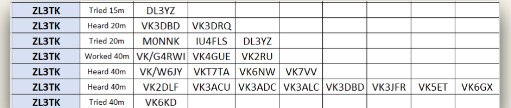
All up, the workbook uses 14 queries and around 78 processing steps, completing the task in a little over 1% minutes. By comparison, the original fully manual process could take up to 30 minutes.
Along the way, apart from the “visual width” adjustment noted above, the workbook preserves most of the original order, though not always.
This is particularly the case during the unpivoting and regrouping stages, where calls are reconstructed into lists without a fixed sequence.
It would be possible to retain the original order by introducing an index prior to unpivoting, allowing the data to appear exactly as submitted.
However, this would not resolve the reordering caused by band corrections, and the spreadsheet would lose the visual balance it now has.
So, while the column headings may hint at parliamentary precision, what you are really seeing is a practical, tidy, and, hopefully, readable way of presenting the data.
Submitted for the consideration of Honourable Members, John VK2RU Spreadsheet Pilot
If you have an article or two that you think might be of interest to our readers, please let me know so we can share more thoughts and ideas; for guidance on writing for RagChew, see Articles below. Please email material to Mark VK2KI: cqqrsnet@gmail.com
On My Workbench
Oscillators and Oscilloscopes Part 1
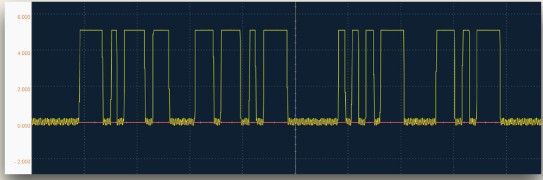
It began before my interest in radio. It led me into some basic electronics. It was a rabbit hole that I’m still trying to find my way out of. It was a fascination with Oscillators – the rhythms of the Universe.
And, I might nervously add, Oscillators both real and ‘apparent’. Real oscillators are: clock pendulums, your legs whilst walking, pogo sticks with a child aboard, the membrane of your radio speaker.
‘Apparent’ oscillators (my concept) are activities that look like oscillations but are really the result of circular motion. For example, the waxing and waning of the moon, the flash of a lighthouse, the oar of a rower.
Ocean waves create oscillations – oscillations of their amplitude when viewed at a stationary location (although their wavelength, frequency and direction are generally constant).
Interestingly, water molecules within an ocean wave travel in a circular motion as the wave passes overhead. So, although the energy wave can travel long distances, the water itself is also in local (circular) movement.
Having pondered the everyday visible oscillations, my attention then turned to the less visible ones. I was aware of radio waves as oscillations of amplitude and/or frequency but I started with those in the audio range, and that was my route into the world of Electronics.
The wonderfully named “Reverse Avalanche Oscillator” only requires a single transistor; the boringly named Astable Multivibrator has two.
But I was soon onto the ICs: the classic N555 timer, various op-amp Non-linear Relaxation Oscillators, and the six Schmitt Triggers of the CD40106 for a real cacophony of sound!
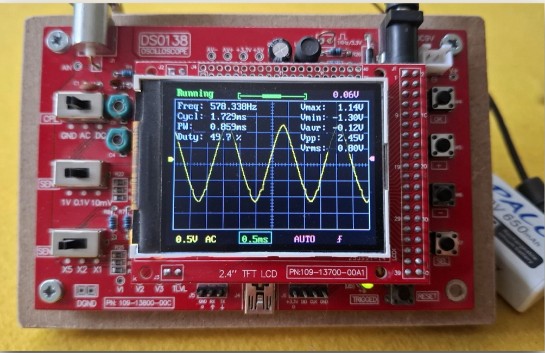
It was dirt cheap and I built it from a kit that came in the post from China. The DS0198 is famous for a reason – it has all the main functionality of a “proper” oscilloscope including AC and DC coupling, several trigger modes, display of useful information about the waveform, and a Square Wave output for calibration.
Amazingly, as the name suggests, this is also a Digital Storage Oscilloscope, so you can freeze an interval of waveform and scan through it at your leisure.
This little guy taught me how to use an oscilloscope and, even now, is in use if there’s any chance I might probe in the wrong place. Having said that, I have a Golden Rule: never probe anything with mains voltage running through it.
If you don’t know what you’re doing (and I don’t know what I’m doing), the least bad thing that can happen is that you fry your oscilloscope.
I’d be the first to admit that the DSO138 has some pretty severe performance limitations, which is why I upgraded to a better ‘scope. Next week I’ll show you what I bought to replace it.
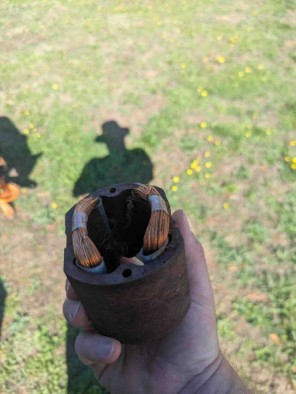
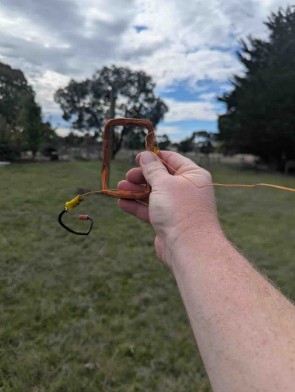
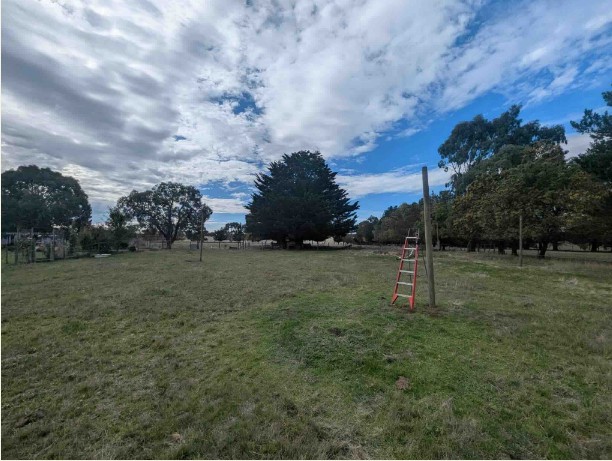
Jordan VK3ACU’s Directional EWE Antenna
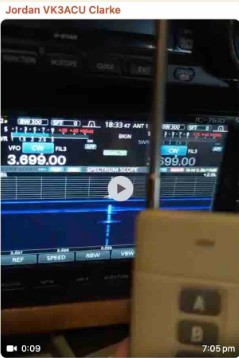
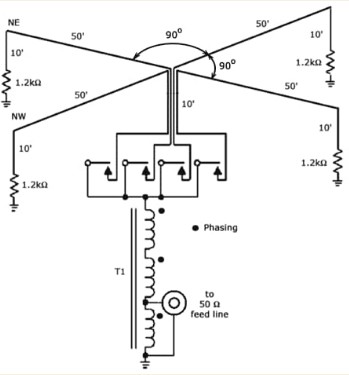
Click for a demonstration of performance – watch the S-meter.
What’s going on on your workbench? If you have an article or two that you think might be of interest to our readers, please let Mark VK2KI know; email to cqqrsnet@gmail.com For guidance on writing for RagChew, see Articles below.
QRZ?
Who’s calling me? Who’s on the other er Mike VK6TX at Hervey Bay QLD
From Mike VK6TX who was heard last week on the CQQRS Slow CW Practice I Net: Mark CW has always been on my list of things to do and now I am retired I have no excuses, so I hope to slowly come out of my shell and appear on CW.
QRZ? Who’s on the other end?
CW Practice
This year we’re using Aesop’s Fables for our CW practice. These are short moral stories, often using talking animals, that illustrate simple truths about human behaviour and character.
‘Aesop’s Fables originated in ancient Greece, traditionally attributed to the storyteller ‘Aesop who is thought to have lived around the 6th century BCE.
The fables are generally smaller files of two to three hundred words that have been recorded at 15 wpm and run for about 15 minutes.
If 15 wpm is a bit quick for you, load it onto your phone and set the playback speed at 0.75 X or even 0.5 X- whatever works for you. 0.75 X will play the MP8 at a bit under 12 wpm. Itis suggested that you read the text file before listening to the audio file.
That will make it easier to follow the audio file and prepare you for any unusual words. Any punctuation that is not usually used with CW has been removed. This week’s fable is ‘The Fox and the Goat’, and the MP3 and TXT files are attached here –


If you prefer a different speed or tone you can create your own MP3 files by converting the text file with the Ebook2CW app — https://fkurz.net/ham/ebook2cw.html.
You can either play the MP3 files in any media player, or load the text file into the Ditto CW: Morse Player app — https://dittocw.andro.io/.
Both options work well, however Ditto CW gives you complete control over all Morse settings, while a normal media player only allows changes to playback speed, and does that in steps (e.g. +1.25x, 1.5x, 1.75x).
Other News
Report on Team Oceania’s First RandomGram Ever
MEVUre OF [Call VOCdINda os Fist MaANUGCiilara
From Stan ZL3TK We very much welcomed the contribution made by Hiro-san JJ1FXF. He has been active in recognising the value of Randomgram for a long time and accepted our invitation to join the Oceania team.
‘Soccer usenet Sennen? Sseeesuner Sunt: Suuethnnnee UU] Unt: Sues I Get SUUtn Cent Suter Use (Gt: SuteGtun I Seetsnnc’!, Sues lee cracking job in a new and strange environment.
Considering the amount of promotion the event was given, one might have expected a decent number to turn out. But with excuses we’ve heard over-and-over, it came as no surprise that the large, enthusiastic attendance we hoped for failed to materialise on the day.
Those special folk who did put in the effort got their just reward, not only in terms of points earned, but also from gaining valuable experience, along with that incomparable, but elusive, feeling of achievement from a job well done.
Unlike those ubiquitous ‘599’ contests, RandomGram is a unique event in which accuracy in handling Morse actually matters. It has a real purpose with measurable results, achieved only through the operators’ skill and determination to succeed.
The rules are simple and classic cheating is impossible. Affiliation with Team Oceania costs nothing and engenders camaraderie, strengthening esprit de corps.
Unfortunately the team was denied 90, yes ninety valuable points, due to non-affiliation, though in the end it made no difference to our team’s placing. Hopefully all VK RandomGram participants will register their affiliation with Team Oceania in the future.
The next event is likely to be held 23/24 May. We will stand a better chance of showing the world how Oceania is a force to. be reckoned with, despite its isolation, if all Oceania participants affiliate for each event. Affiliation does not carry over.
Monitoring RBN during the event, it was immediately obvious why US stations are able to accumulate such big scores. The map was nearly blotted out with traces right across the contient from almost every station.
For ordinary 100 W stations down here in the SW Pacific, we need a sizeable team because DX propagation is often not in our favour.
Nonetheless, despite RBN showing no sign of 20 m signals travelling beyond Fiji, a QSO was made with KASBPN, albeit resulting in a one-way ‘exchange of a code group.
But boy, how we tried to make it two-way, using the very best of traffic handling techniques which included subjecting each of the code group’s five characters to QSZ5.
Tony was running 200 against my 100 W; yet that seemingly insignificant + 3 dB just tioped the scales and showed how exciting RandomGram can get!
The results from Event # 42 can be seen at https://groups.io/g/RandomGram/message/667 We’re hoping for a lot more takers next month, can we count you among them? 73 de Stan
Marconi Day Troubles
From David VK3DBD at Yackandandah Hi Mark, I fully intended to send this early today but have been fraught with Murphy’s operations. Car troubles, computer troubles and radio troubles… all at similar time of course …
No doubt you have already mention Marconi day in your current Blog? I intended to send a reminder as it was only yesterday I realised his birthday on 25TH and the nearest Saturday to that is always the day of the radio celebrations.
We all have our interests owing to him even though he was not the first to play and realise RF might be useful in the future, but he made it happen.
On that score I was going to send you a photo which did not go to plan connected with my occasional supply of Maritime clocks which I make up when I can get the right type to convert.
I cannot recall if you saw my maritime reproduction on the occasion of your visit? I took a photo on the phone, never easy for me I am only a professional photographer, phones are a mystery… they make computers look simple.
If in the future you wish to fill your pages with yet another photo here is my leaflet which might tell a few folk some history they do not know.
Incidently I learned not long ago that Danish ships who had these clocks in the radio cabin had a blue sector instead of the green one. See I am full of useless info.
But no one has asked me to supply one like that and they have gone to very many places in UK and parts of EU as well as in VK land. I Think I have managed to attach one of the intended two. Now here is one which does not date particularly.
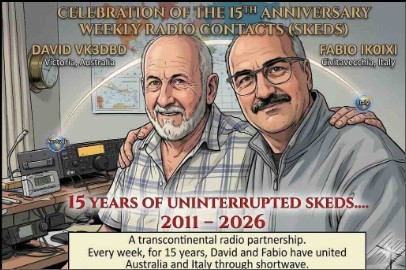
It was rx a week ago from my friend Fabio who did write and publish a superb book on the history of Vibroplex. I have the book, which is rather hard to read as it is in Italian…
But I can manage some of it with the aid of a bit of rusty Latin from schooldays over 70 years ago and an Italian dictionary… the pictures make up for the foreign text.
I also have two Vibroplex Bugs – but my skills or lack of same – deter me to use one on the bands. The picture, obviously an, Al creation I thought excellent and a great memento of our radio friendship.
We have never met in person and the picture utilises a background of my old radio shack in UK in later years. Of course, I have not changed a bit! I will just try and send that phone photo on
Another PC ARRGH… it will keep until next week I blame Windows 11 for everything 73 David VK3DBD
The information below, kindly supplied by Eddie Lingard, G3WNQ A ships Radio Officer and later operator at Humber Radio for many years
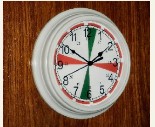
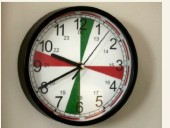
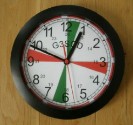
“The 12 red coloured blocks around the edge af the clock mark 4 secand intervals with 1 second between, I believe that itwas after the Titanic sinking that it was decided that a means of alerting ships with only one Radio Officer should be found in order to alert the R/O if/when he was aff watch.
Merchant ships unless aver 1600 tons carried only ane R/O sa obviously couldn’t monitor the distress frequency (500 kHz) 24 hours a day.
They came up with the “automatic alarm” receiver which was designed to only respond to a certain number of consecutive dashes (usually 3 (4) which were 4 seconds long with an interval of 1 second between them.
This was chosen to prevent spurious alarms from been generated by dozens of ships all sending on S00 the same time and by long statle bursts.
The first alarm receivers were electro-mechanical devices: electrc-motor driven, fl of latching relays and rotating cams and valves of course. By the 1960’s they were replaced by transistorised timing circults which dd away with all the mechanical stuf.
In an emergency and if there was time, the idea was thatthe R/O would transmit 12 four- second dashes and then wait a couple of minutes or so before sending the datrass message – giving time for R/Os on ‘other ships to get ta their radia roams.
The alarm receiver in these other ships activated an alarm bell in the radio room and Inthe R/O’ cabin, just above thelr beds!
The red sectors onthe clack were to enable the R/O to time precisely the duration of the dashes and spaces – get it wong and the alarm receiver would reject them as false.
So the operator would transmit the dashes by holding down the Marse key whilst looking atthe clack – which was always placed where he cauld see from the keying position!
Later, an automatic keyer was designed called an “Automatic Keying Device” (or AKD for short) which sent out the dashes atthe press of a switch – provided the the R/O had switched on the transmitter and chosen the correct frequency!
Again, the early ones were mechanical The trlangular sectors marking 15-18 and 45-48 minutes of each hour were to remind operators ofthe “Silence Period’ on 500 kHz.
500 kH was the WT {CW distress frequency and also the international W/T calling frequency and in the early days, even up to the 1970’s, was always busy so the silence period gave an opportunity for distress signals, specially law powered ship’s lifeboat transmitters, tobe heard.
As far as I know these sectars have always been coloured red on the clack. ‘The green sectors were brought in later to mark the silence periods on the R/T distress and calling frequency, 2182 tz, These were from 00-08 and 30-38 minutes.
Any station sending on the distress frequencies durin the silence periods usualy drew a caustic remark from the. nearest coast station!
The alam recelvers were not foolproof and have been called out to many a false alarm especially out East where the statics continuous during the summer months.
Coast stations were also fitted with AKDs and would send the alarm signa before retransmitting acistress message received from a ship/aireraft. Incidentally there was a corresponding RT alarm signal for 2182 kHz.
This consisted of a one minute transmission af two-tone audi signal which could be detected by an automatic alarm receiver or by ar. ‘Reproduction clocks available from David Dunn viddbd@gmail.com
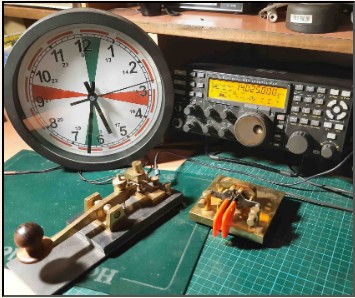
Post-script: ..–Only Took me an hour to get a picture off the phone …… And just for record as clock does not live just there ! 73 David VK3DBD
Morse Training Net
Our team member Nic VK7WW runs an on-air Slow Morse training net every Wednesday at 7pm EDST on 3580 for 30 mins. He uses the callsign of the Northern Tasmania Amateur Radio Club VK7TAZ on that net.
Many of our team learned Morse code with the support of Nic, and the weekly training session comes highly recommended for anyone who wants to learn the Code, or simply brush up.
Everyone’s welcome – 3580KHZ at 7pm Eastern time every Wednesday; you’ll hear lots of the CQQRS team on that net. Jordan VK3ACU has ralso ecorded the complete set of lessons which you can now find here:
Https://www. youtube.com/playlist?list=PLHsQmZz6fBXO7swAfbT mutrbbEL17fUQL Contact Nic VK7WW for more info nicholaschantler@hotmail.com including how to join the NTARC DISCORD group to follow the action, or just come along and join in on Wednesdays.
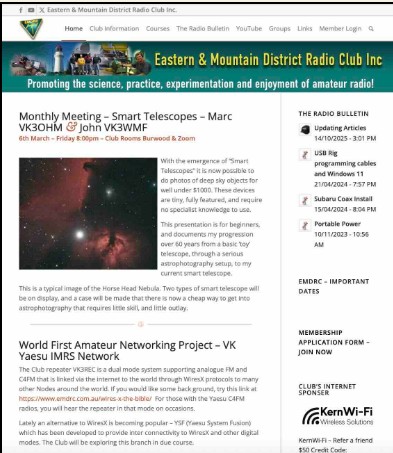
If you’ve read something that you think might be of interest to our readers, please email to Mark VK2KI: cqgrsnet@gmail.com
Prosign/Character/Signal of the Month
Frosign: <9AK> go Meaning: End of Contact
[Put it on a sticky note near your key as a reminder for Tuesday… and tell us how you went!]
I Hear Tell…
Quotes from Near and Far.
Signals were down today and some serious QSB with it! Procrastination is a design flaw of the human animal, not an appalling and unique personal failing. It adds a panic moment when half way through a QSO. I’ve never had great success on 80m.
Can’t work CW whilst sauna is on as it transmits on all bands! While the guards weren’t looking, IU4FLS managed to slip through. My deepest apologies for tempting you in a moment of weakness; this will weigh heavily on me.
Only time for one QSO but it was a great one thanks John! 80m actually was behaving itself. Whodathought editing a Morse Code enthusiasts’ newsletter could be such fun! Cold fingers and a quiet band stopped play early.
Reminds me of a song “The Sound of Silence” by Simon and Garfunkel. Where have all the Flowers Gone? I went out and checked that my antenna was still up. Initially thought that I had left it disconnected since I heard nothing! Where did everyone go?
[If you have some intel about other team members… or even yourself… that’s worth sharing, please let me know cqqrsnet@gmail.com ]
Di-dah-di-dah-dit
So back to the CQQRS Slow CW QSO practice net.
Next Tuesday’s Net
Our CQQRS Group will be on as always on Tuesday from around 0600Z until about 12002; see https://bit.ly/CQQRSWebsite and navigate to the Net Details page for details.
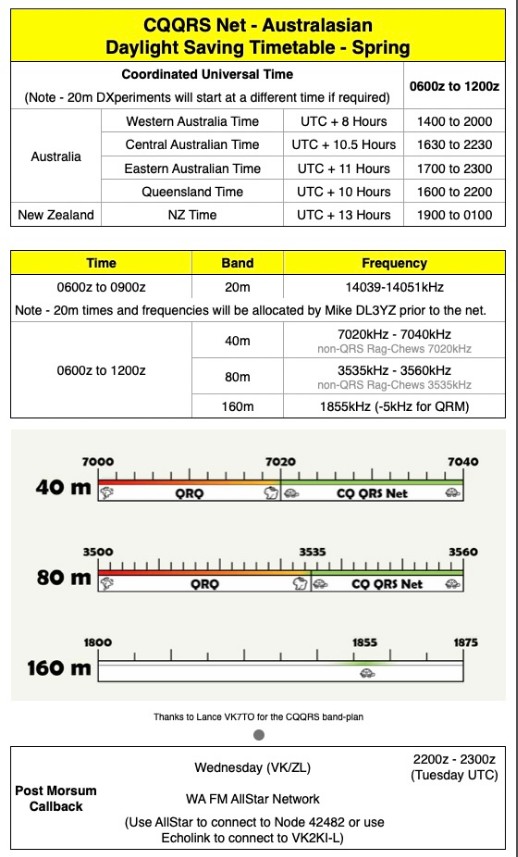
Doesn’t matter whether you’re brand new and want to try just exchanging callsigns and RST reports, or you’re ready for a good old rag chew. We’ll have fun.
There’s usually people around until after 1200Z – so keep calling in the segment of the band designated in the table below until you catch someone.
Reports & Photos
Please let us know via our Reports form bit.ly/CQQRSNET who you work or hear on Tuesday’s Group. The report form closes at 1pm (Eastern Australian time) on Thursday. And how about helping to make the reports even more interesting by sending a photo?
If you have a photo that you’d be happy to include, please email it to: cqqrsnet@gmail.com And of course, we’re always on the lookout for more photos for the newsletter, so if you have something that might be of interest aside from the reports, please send it through as well.
Email to cqgrsnet@gmail.com please. Oh and by the way, I recommend that you don’t keep the Reports Form website open between submission of reports from one week to the next.
If you’re unlucky, there’s an undocumented feature in the software that could cause your current week’s report to be combined with your previous report – it’s happened to your editor several times – much to the chagrin of our Reports editor 🙂
Post Morsum
Richard VK6HRC will run our phone Post Morsum on the South West AllStar net (via repeaters and hotspots all over WA) from 0600 WA time, then from 0700 WA time on 80m (8605 LSB).
See https://bit.ly/CQQRSWebsite and navigate to the Net Details page for details of how you can connect via Echolink from anywhere in the world.
Articles
Could you write a short article or articles for RagChew? You bet! Writing not your strong point? Don’t worry, I’m very happy to help as much or as little as needed.
Oh, and one more thing (actually two) – copyright material: * please use your own images – don’t use images copied from the internet unless you have the producer’s permission, or they’re marked ‘Creative Commons’ or similar; ¢ if you include other peoples’ written material, unless you have permission, you may only include small snippets (unless it’s marked ‘Creative Commons’ or similar), and you’ll need to site the source and author.
For more guidance on writing for the RagChew newsletter (including how you might even try using one of the new Artificial Intelligence tools), head to our website bit.ly/CQQRSWebsite then click the menu on the top right and then click RagChew Newsletter.
Material
A reminder; if you send me any information by email, our report form or WhatsApp – unless you specifically state that material is not to be published, I’ll assume that you’re happy to see your thoughts in the RagChew newsletter.
Teamwork
Thank you so much to our team of 29 contributors: G7BED, IU4FLS, MONNK, SWL-Jack, VK/G4RWI, VK2A0OE, VK2RU, VK3ACU, VK3BWN, VK3DBD, VK3DRQ, VK3KLE, VK4BRO, VK4IM, VK5A0O, VK5CZ, VK5KFG, VK6HRC, VK6KD, VK6KHZ, VK6MK, VK6NQL, VK6NW, VK6TX, VK6WE, VK7TA, VK7TO, ZL3ABX and ZL3TK.
And a special thank you to our editorial team, Nigel G4RWI (head of software
Development), Patrick VK2IOW (reports coordinator), John VK2RU (Spreadsheet pilot), Richard VK6HRC (post morsition), Lance VK7TO (director of the archive department) and Jordan VK3ACU (head gagster). Great work all!
GU CW on Tuesday, mb Mark Bosma VK2KI / VK6QI Beautiful South Bowning NSW cqqrsnet@gmail.com non impediti ratione cogitationis
About the CQ QRS Net
For the current schedule and more information about the CQQRS net, please go the the Net Details page on our website:

The opinions expressed in the RagChew newsletter are those of the individual contributors. The opinions do not necessarily reflect that of the editors or of the CQQRS Group members.
Any material and images received from members by the editor or published on the CQQRS WhatsApp groups may be published in this newsletter unless specifically requested otherwise.
The RagChew newsletter is considered to be exempt from the Australian Government’s ban on social media for under 16 year olds because it is a service that has the primary purpose of enabling users to share information about products or services, engage in professional networking or professional development services or of supporting the education of users per the Australian Government eSafety Commissioner FAQ webpage “Which platforms have been excluded from the age restrictions” dated 10DEC25.
The values, doctrine and guidelines for the Group and for the newsletter are published on the Principles page of the group’s website https://bit.ly/CQQRSWebsite