Below is a reconstruction of the 2026 03 CQ QRS RagChew newsletter designed to support full text searching. This reconstruction was built using OCR, and will contain errors.
To view the Mailchimp original, click here. To search the entire newsletter archive, click here.
Contents
- CQ QRS RagChew
- Website
- Reporting
- Post Morsum 14th January 2026
- 73 Richard.
- This Week’s Topic of Interest
- Decoders.
- On My Workbench
- QRZ? Who’s on the other end?
- CW Practice
- Other News
- Update from New Zealand
- John Moyle National Field Day Contest – 2026 Rules
- Morse Training Net
- SHORTWAVE IN 2025 — THE AIRWAVES ARE ALIVE AGAIN
- Want to Try Your Luck Tuning In?
- We’d Love to Hear From You
- Keyers
- Usability Issues with RagChew
- T Index Map
- ZS6BKW Doublet vs End-Fed Half-Wave
- There’s no such thing…
- Prosign/Character/Signal of the Year
- Di-dah-di-dah-dait
- Next Tuesday’s Net
- Reports & Photos
- Post Morsum
- Articles
- Material
- Teamwork
- About the CQ QRS Net
CQ QRS RagChew
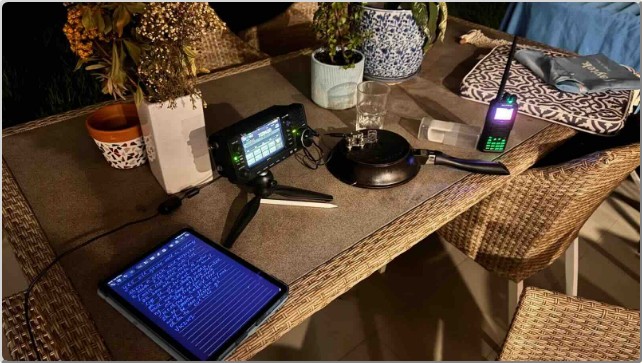
Thanks this week to Nigel G4RWI for the shot from his current VK4 location Note the patented frying pan paddle stabiliser.
Wowee… I think another world record of 72 stations on our Tuesday CQQRS Slow CW Practice QSO Net! Bloody amazing! Even more surprising when we consider that the Bureau of Meteorology Space Weather Service had predicted depressed geomagnetic conditions as a result of incoming radiation from a solar flare; weren’t we lucky ducks?!
So this week, the new and improved editorial team has been hard at it while your editor has been swinging in a hammock…
Well the hard working editorial team bit is true anyway; planned and unplanned visitors and a large Rural Fire Service strike team deployment saw me somewhat behind the drag curve (working straight 25 hours on a fire response is good – but it kinda upsets the routine for a few days).
And speaking of bushfires – our thoughts are with our members and their families impacted by the bushfires in Victoria and elsewhere this week. Some of our affected friends have made the time to keep us up-to-date with the goings-on in our newsletter.
I haven’t heard of anyone affected by the floods up in Queenstand – but if you’ve been affected by any of our recent emergencies, please let me know so I can keep your friends in the loop.
And I think it should go without saying, if there’s anything any of the team can do to help, please flash me a note to cgarsnet@gmail.com or send me a WhatsApp message or SMS.
I’m sure many of your friends would be able to provide accommodation or other welfare things, not to mention radio gear. And speaking of that… who packed their three favourite Morse keys in the car as a bushfire approached I wonder?
I reckon many readers could guess! Last thing this week… just a reminder please – if you’re on 20m for the weekly DXperiment, please avoid using the lower frequency of each member’s segment for local chats.
If someone calls you, please flash them an ‘UP2 UP2’ rather than chat over the top of our distant friends; down this way it’s usually easy to move – in Europe the bands are often chockablock and finding a quiet spot difficult; and stations down this way may not hear that the frequency is occupied (due to skip Zones) and my be listening on the frequency hearing nothing.
So – on-on….. please enjoy the fruits of our team’s labours with this week’s RagChew newsletter.
Website
If you’d like to find out a bit about our net, or would like to pass information to others about our Tuesday get-togethers, here’s the link to our website. bit.ly/CQQRSWebsite So here we go – please enjoy the newsletter.
Cheers, mb Mark Bosma VK2KI / VK6QI Beautiful South Bowning NSW cqqrsnet@gmail.com non impsditi ratione cogitationis
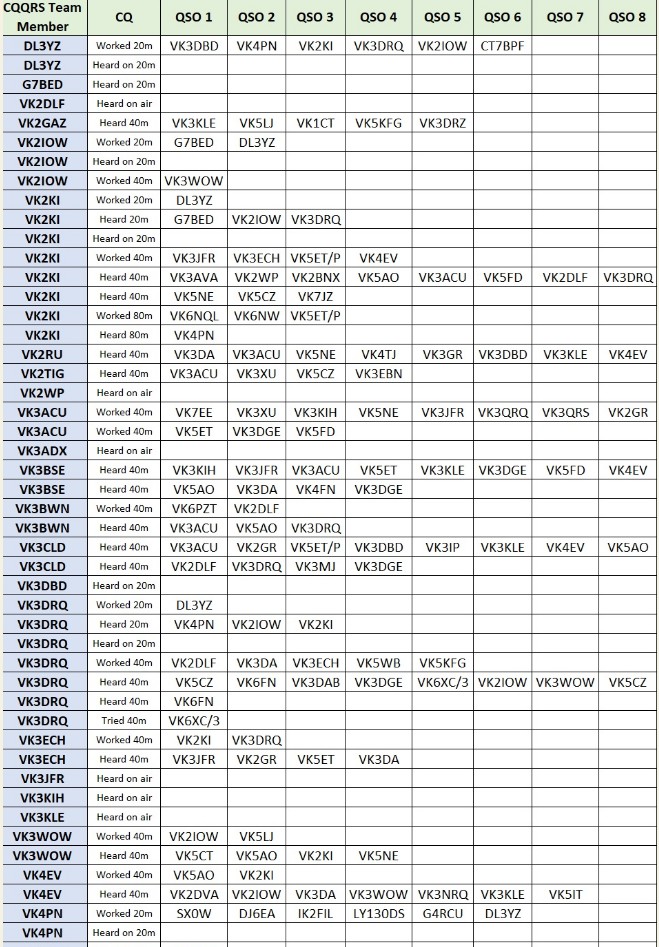
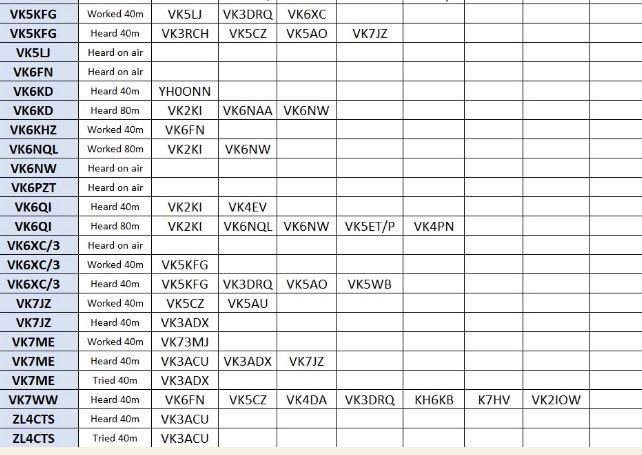
; week’s comments from our members’ reports have been compiled for us by the er software built by Nigel G4RWI and the layout perfected by Patrick VK2IOW; nks Nigel and Patrick.
[20m] The 20m band was more noisy than usual, and my signal was very weak on the SDR in Ironstone. But I am really happy that a lot of stations were calling me today, and we had great fun chatting around the globe.
Still anazes me the we can hear each other and communicate over more than 15,000 miles distance, even with portable gear. Seems I am
15,000 miles distance, even with portable gear. Seems I am getting old, my _ concentration on the last QSOs was somehow weak, so sorry for the dropouts 🙂 Thanks for the fun! Have a great week. 73 Mike.
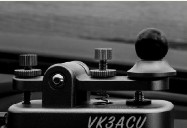
[160M] Later in the evening I heard Jordan, VK3ACU testing on 1.870 MHz on AM 5/9!
[40m] Worked 11 stations tonight started off very slow called for about 30MINS and had nothing before it all kicked off. Really happy to be the 1000TH contact for James VK3JFR! Well done mate, your CW has progressed so far in such a short time.
Conditions were excellent I ran 20WATTS all night.
[40m] Monitored activity from AREG Kiwi SDR from motel room. Didn’t start till late. Still working on my head copy.
[40m] Experiencing a lot of QSB on 40m. Station from Indonesia was being received well.
[80m] 80m opened up early then closed. 40m was experiencing more activity. Also QSB making conditions
[40m] What a shambles my brain was tonight. Lesson to not let hubris overtake ability. This last couple of weeks I have been doing drills and code groups at home and listening to CW recordings on my daily walk.
In the morning I was copying more than I had on previous test runs and my

What a shambles my brain was tonight. Lesson to not let hubris overtake ability. This last couple of weeks I have been doing drills and code MS groups at home and listening to CW recordings on my daily walk.
In the morning I was copying more than I had on previous test runs and my drills were improving. For amoment| thought things were going my way.
Then it got real, after CWA class the 40 meter band seemed to improve and I called CQ, VK5CZ responded and my brain went for a walk somewhere and clearly not operating at my station.
After that short QSO I gathered my skirts decided to pause a minute, think, then have another go, next a QSO with VKSAO, who was so kind as to slow right down for me, how painful for them, arghh, I was awful.
Anyway, this is a great group and the other stations always prove to be patient – I have not yet had somone burn
From Ron Everingham VK4EV at Everton Park Brisba
[40m] Conditions were good at the beginning and had my first ever CW QSOs with Mait VKSAO and Mark VK2KI. I we hoping to make some more contacts but my noise floor went up to S9 so I decided that was it.
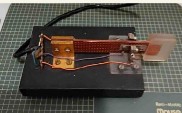
[40m] QRP on the QCX mini this week, saving on the power bill. Good copy with Lawrie and Manny. I heard Ben, VK6XC, calling but quite faint at my QTH. Pleasantly surprised that Ben picked up my reply.
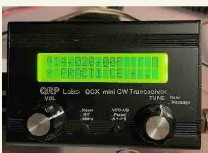
[40m] The 40m band did not open until 1730 AWST, and then the signals were quite weak.
[80m] The 80m band is still very quiet, even during the week, and overall, signals are down, across the HF band, with few stations being heard.
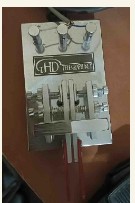
[40m] GREAT night, should go portable more often, hi hi. Location, Humbug Scrub, Adelaide hills & only 30KM North of my QTH. Ant, EFHW @ 7MTS + c/poised, worked wonders on the night.
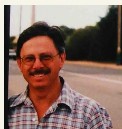
[40m] First of all, it is sad that I have had to remove my favourite 40m EFHW antenna because the neighbour removed a dangerous tree that was hiding it. To make things worse, the neighbour is now selling his house and the antenna and pole is a real eye sore.
When I saw what it looked like from the other side of the fence, in good conscience, I could not leave it there.
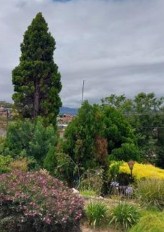
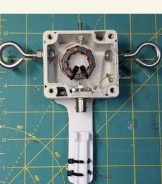
My replacement is a shorter EF mane PAS long wire. One of those lengths that is not resonant on the amateur bands. I chose 58 feet as it lines up nicely with a 4m bushy spruce pine where I can hide most of the 5m pole.
Of course, the EF long wire is fed with a 1:9 UNUN balun which I spent all Tuesday making. I now need to use my antenna tuner and a coax balun choke at the radio end to block those nasty common mode currents.
Being unsure of the performance of the new shorter and lower and maybe compromised antenna, I risked giving it a go on Tuesday night with my 10W radio. I was extremely happy to have a great QSO with Mark VK3MJ.
Mark helped me out with giving me more space between characters and I just about decoded everything he sent. All of this with Mark using a straight key which really impressed me. This has inspired me to have a go with a straight key once I get a bit better.
Time will tell but maybe my replacement EF long wire will be OK after all?
[40m] When I started listening there were quite a few ca signs I could not identify due to low strength and QSB into noise. Even with stronger stations som parts of conversation lost due to long QSB.
[20m] Again, nothing was heard from OM Edi or OM Carlos CT7BPF on their respective frequencies
[40m] All went well, only a bit upset for not being able to hear properly the VK6X??? My apologies to the operator.
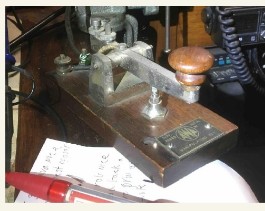
[40m] Again I was listening to the Snowline and Strathbogie SDRs which was good for CW but I was also playing with the sound of both together with the effects of latency and the beat of the beats when tuned a few Hz off.
I have started to build an 80m EFHW witha 49:1 UNUN looking good from 80 to 10 and some HV capacitors for the UNUN.
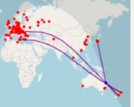
Grandkids are with the other lot of grandparents in Tasmania so Ihad a relatively free afternoon. As usual I checked 20m first as lower bands at 17:30 were vacant, just noise here in QLD. Nothing heard between 14039 and 14051 – no QSOs in progress.
Called numerous CQs next to suspect frequencies 14042 and 14048; no luck with our EU contingent but other EU stations kept coming back. Most were higher power and with directional antennas so I was losing faith, but finally I heard VK3DBD/ZL working with Mike.
Waited patiently for them to finish and called Mike, we had a nice QSO with reasonable RSN both ways. A lot of fading mind you.
Ina QSO with G4RCU, fading was augmented with dual propagation, I was copying both paths, very unusual phasing distortion making copy difficult despite a very strong signal.
[40m] After a long session on 20m and even longer break for a scheduled meeting I got back on air around 21:30. The band was deserted, no activity at all, still kept calling CQ, QRP as usual. RBN report showing I was heard in ZL but not in southem states.
VK3XU saved the day 559 from Melbourne, his home brew 100 W and dipole were booming into Brisbane. We had a nice chat as I am a home brewer as well (not beer) mind you I am slowing down due to age and eyesight. So slim pickings on 40m just one QSO.
[80m] No luck on 80m this time, I could see my trace at Ironstone and in Perth but no one came back to my CQs. Heard VK2KI in a QSO and watched his trace for a long time while calling a few kHz lower waiting for a chance to call him but that QSO finished abruptly so I missed him.
Next Tuesday I will be in Mackay so want to be on air for the QRS Net.
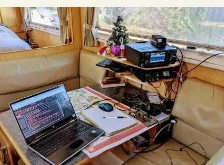
[40m] No QSO’s for me tonight. Just happy spinning the dial and doing a bit of listening.
[15m] Unfortunately nothing heard from Edi DO2EMR on 15m this week, even thought Mike DL3YZ‘s DXperiment reporting system showed Edi calling CQ.
[40m] 40m started opening across Australia at around 0900. this week; signals weren’t strong.
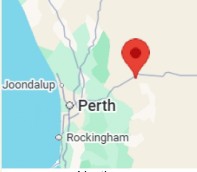
Didn’t listen to see if there was anything coming through into WA from New Zealand. I decided to give the Southern Electronics Group VK6SR Remote at Jandakot a try.
The remote decided to replicate an earlier strange antenna coupler problem; it would not tune on 3555KHZ – SWR remained at 7:1. So again, I snuck up on it – it coupled fine at 3540KHZ, then 3550KHZ… so I left it at that.
But the Remote had another trick up its sleeve this week; no response to my key (no side-tone and no carrier). Switching from Break-In to manual keying activated the transmitter – with no carrier as expected – but key down resulted in no output power.
I sent a note to Richard VK6HRC via WhatsApp to give it a try as well – same result. I also tried zipping up to the VK6CRO Remote at the Space Technology Museum at Carnarvon to see if it wanted to play, but I couldn’t get it to load on the RCForb remote control software at all.
[15m] Nothing heard of Edi DO2EMR this week.
[20m] I came to 20m a bit late this week – makes a change from being an hour early! Chris G7BED at Northamptonshire (we’ve agreed that it’s fun to spell-out in CW!) was chatting to Patrick VK2IOW at Millthorpe.
Up the band, Mike Piwhose callcign I missed When Mike scent a CO
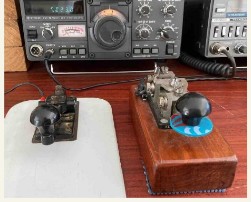
DL3YZ was just finishing with a VK3 whose callsign I missed. When Mike sent a CQ Thad a go and was pleased to hear him respond.
I reported RSN 311 and Mike gave me RSN 331 in return; the 12 dB is likely to be related to the 50 year difference in the ages of our transceivers (and perhaps our own ages, who knows?).
I then slipped down to Chris’ frequency, but he’d pulled the plug when some of our team started chatting on his calling frequency again – so I missed the boat this time.
[40m] James VK3JFR at Ararat responded to my early net CQ. There was interesting QRM/QRN sliding in and out of the passband of my RX – which looked like local switch mode power supply hash that was getting through my phasing noise canceller…
But it was also visible on the Snowline KiwiSDR – so possibly auroral, even though it was only a few kHz wide? When the noise stopped, James’ FT-817 with 5W to a dipole was good copy. After a nice chat with James, Rob VK3ECH at Echuca called.
There was some QSB but Rob reported that the band was very quiet there – SO – so he reported my signal as RSN 570 – excellent! My S-meter doesn’t go down to zero (too much front end noise in my 50 year old Trio TS-120S – H)….
But again this week there were the distinct sounds of an intermittent T/R relay – very quiet at times! Rob was trying a new paddle – he was having lots of fun and made very few mistakes that I heard – certainly less than I made.
Rob also tried adjusting the power from SOW to 100W – I wasn’t watching the S-meter and with the QSB and an effective AGC, I couldn’t tell any difference by ear. When we signed, there was a little-little signal from John VKSET/P.
With the QSB, John was RSN 211, but we made it. I disappeared for nose-bags and the DXperiment, but after returning at 0915Z, 40m was becoming more active. My CQs were answered by Ron VK4EV and we had our first chat with nice signals.
Ron was in my spreadsheet log in previous years where I’d tried to work him without luck from SOTA and VKFF PARKS; good to finally hook up.
The band was starting to open to VK6, and both Ron and I were starting to squeak through on the VK6SEG Hoddys Well KiwiSDR… so I was game, and slipped down to 80m to try the VK6SR Remote (see my VK6QI report).
[80m] After unsuccessfully trying to get the VK6SR Remote to work on CW (see the VK6QI report), I returned to my home station and after a few CQ calls at around 1040Z I hooked up with Peter VK6NQL; I reported RSN 322 and Peter reported RST 229.
Next up, Wayne VK6NW called me and we had a nice chat despite the weak signals and QSB. To round-out the night, John VKSET/P called in – much better signal RSN 562 from his campsite, 5 hours North of Adelaide.
My keying had started to become even more ratty than normal – drawing comments from my QSO partners – so as we approached 1200Z, it was time to hit the hay here.
From Patrick VK2IOW between Bathurst and Orange
[20m] Shortly after Mike, DL3YZ was scheduled to start calling, I listened on his frequency of 14.048 MHz and heard him chatting to Sava, VK4PN; so I went down to 14.042 and answered Chris, G7BED‘s CQ.
After our QSO I went back t 14.048 and listened while Mike chatted to Mark, VK2KI and then Manny, VK3DRQ. I finally called him and we had a ver brief QSO, he was a little late for work.
Reporting
After next Tuesday’s Group, please remember to send me a list of who you worked and / or who you heard using our web form here:
Even if you didn’t hear anyone, we’d still like to know that you had a go. And to make your report more interesting, please consider sending a photo to be attached.
If you have a photo (compressed if possible) that you’d be happy to include, please email it to: cqgrsnet@gmail.com So, please help attract new and old team members to have a go by submitting your report each week.
Submissions close 1300 (Eastern Australian Summer time) on Thursdays.
Post Morsum 14th January 2026
From Richard VK6HRC. Five on the South West repeater and AllStar / Echolink hub this morning
FA NID DT ah DSI VK6KD David VK6QI Mark VK6NW Wayne VK6HRC
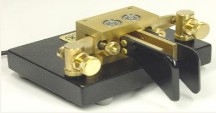
David had some repairs to be done on his Hex beam before getting into the shack, still going through all the filter options on the mighty C7610 montored 40m.
Signals poor to start with but improved later and callsigns without the familiar VK prefix started coming in catching him off guard for a while! On 80m listened in on Mark VK2KI and Wayne VK6NW chatting away.
Mark checked in from the breakfast table with his report. Nothing heard from Edi DO2EMR on 15m and on 20m had a contact with Mike DL3YZ nothing from Chris G7BED unfortunately. A good haul on 40m working VK8JFR VK3ECH VKSET/P VK4EV.
On 80m worked Peter VK6NQL, Wayne VK6NW and John VKSET/P then tried the SEG remote at Jandakot managed to get it on line but could not get the key input to work, gremlins again!
Wayne was also struggling with poor band conditions with very weak local signals on 40m but enjoyed the better conditions on 80m. He is also planning to get on air through the week when he has time.
I was in SWL mode due to the conditions but managed to follow on as conditions varied also made use of the great Ironstone Range KiwiSDR at times. Thank you to all on last night and this morning.
73 Richard.
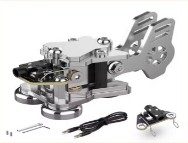
This Week’s Topic of Interest
From Ross MONNK I was on Vband (the internet Morse code chat website) the other day when a young person turned up. I didn’t know for certain that this person was young but I’ve learnt to recognise the tell-tale signs. For instance, I was hailed with EMO ;
| then invited this person to say “hello”. There was a long pause, then the letter “S”, another long pause then the letter “H”, another long pause and the letter “T” followed by “E”, then gibberish.
At this stage, my suspicions were confirmed – here was someone having a first go at Morse by reading each letter off a crib sheet. They never did get to the end of “hello”, probably having realised that Morse is harder than it looks.
On the plus side though, the decoder had just given that person a chance to dip their toe into the world of Morse code. They learned that Morse is not the same as text-messaging, and that they need more practice. All good so far.
I wouldn’t be surprised if, by the application of youthful energy, that person does that extra practice and re-appears. At that stage, the addictive nature of Morse code kicks in and they start chatting.
“Sending Morse code” is the seductive partner of the awkward and taciturn “copying Morse code”, and decoders are the dating agency, facilitating those awkward early meetings.
Decoders.
Decoders enable two operators of widely different skill levels to enjoy a conversation in a mode they both love. The technology is widely available. And if you feel any shame (and why should you?) no one need know your dirty secret.
What’s not to like about decoders then? The problem is that we’re inherently lazy (not you, dear reader, of course). That’s what makes us efficient –
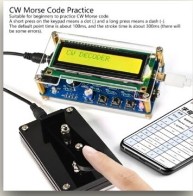
Minimum effort for maximum reward. The dark side of decoders is that they remove any incentive to make the considerable extra effort required to learn to head-copy, and thereby deny us the real rewards of Morse code – the pleasure and satisfaction to be got from not only being able to head-copy (regardless of how slow that might be) but also from knowing that you are using both halves of your beloved hobby.
The asymmetry of being able to send fluently but not being able to copy a word, strikes most victims of Decoder Dependency sooner or later. Unfortunately, by then, they’re trapped and have to settle for half a hobby.
That seems like a rather downbeat note on which to end a Ragchew article so I’m going to finish with A Ray of Hope, by offering a possible way out of Decoder Dependency.
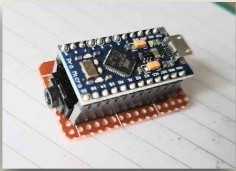
From Peter VKSWOW To be honest, I’m as surprised as anyone I’ve ended up enrolled in the eight week CW Academy Advanced Course Chris Chapman (VK3QB) started running last week for interested Australian and New Zealand amateur operators.
You could possibly blame it all on this very newsletter. It was here, in Ragchew, that I first came across an invitation from Chris to email him with any questions I might have about improving my Morse code skills.
I did TS Re NE al Set ee Ey Pee il bagel fel jae
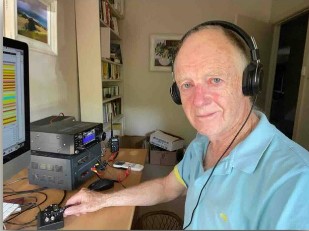
Not? — 25 wpm. Having clarified to myself that I actually had this personal goal (a matter, as I say, that was not really clear to me previously), I told Chris, and indeed showed him on air, that I make plenty of mistakes in my sending, and don’t feel at all strong sending or receiving numbers.
However, on the strength of a splinter skill I happen to have developed over the past three years at head copying works of fiction at up to 35, wpm, Chris thought I would make a suitable candidate for the CW Academy Advanced Course he was contemplating running in early 2026.
Flash forward then to the present moment when, as I write this, I and two other amateur operators find ourselves one week and a bit into that Advanced course. So, what’s it like?
Well, the first thing it’s important to understand — and this is made very clear from the outset — is that students are expected to put in an hour of practice on course- related material every day.
Not only that, but they’re expected to maintain an online spreadsheet in which they record details of every component of this practice (as in, I spent 10 minutes working on such and such an exercise at such and such speeds, and then fifteen minutes working on this other exercise at such and such speeds, and so on).
The course has a set curriculum, which is publicly available, as are the prescribed listening exercises, each of which is available in a range of speeds, spanning, for the first few weeks of the Advanced course, from 20 wpm up to 35 wpm.
These listening exercises include brief QSOs, lists of short words, lists of words with similar prefixes or suffixes and an occasional ham-related short story.
Students are asked to listen to each twice, initially at 20 wpm, though also at faster speeds if they can manage this, and not to write down what they hear, but rather to copy what they can in their heads.
Itis assumed the student’s head copying will not always be perfect — or, indeed, even very good at all. Not a lot of time or attention appears to be devoted in the written curriculum to sending, beyond an expectation that students will daily run through a set of supplied warm up exercises that involve sending (at 25 wpm) all numbers and characters in different patterns.
One of the more appealing of these involves sending “BEN’S. BEST BENT WIRES”. Try it, and youtll soon see (ar rather, hear) the peculiar attraction of this little party piece.
At the moment, at least, i’s my impression that the course assumes that if one can head copy accurately at 25 wpm, one will likely be able to send accurately at the same speed.
I find this an odd assumption — but then I may well have the wrong end of the stick here. For what it’s worth, Chris has certainly been encouraging me personally to give rather more weight in my homework to sending (for example, sending the text of an article) than to receiving, given that I already have the kind of “splinter skill” in Morse code listening I described above.
‘As well as making a commitment to undertake, and log, at least an hour’s homework every day, students are expected to attend two fifty-five minute group Zoom sessions with Chris each week.
At the time I am writing this, I have now attended two of these sessions, and I have found them to be very friendly get-togethers. Chris generally goes around the group and asks each member how they have been faring with the homework.
From there, the pattern seems to be that Chris conducts what you might call a live firing exercise’ where each student is asked to send over Zoom, by audio, some text (ar numbers) at 25 wpm, while the other students and Chris attempt to head copy what was sent.
For our first session, the sent content was simply a sentence. For our second session it was a list of five made-up callsigns, each followed by a two-digit or three-digit number (in effect, the kind of information one might need to send in a contest).
I found this last a pretty challenging exercise, never being quite as sure as I would like to be whether I had sent a B or a 6,aVorad.
As yet, it’s early days, but already my impression is that the combined effect of having a clear personal goal in mind, of working for an hour a day on some reasonably challenging sending and receiving exercises, and the sense of peer pressure, but also camaraderie engendered by the twice-weekly Zoom sessions together may well prove have a powerful shaping effect in improving my overall Morse sending and receiving skills.
Will this CW Academy course turn out to be all it’s cracked up to be? Well, in seven weeks from now (as long as I can stay the distance) I’m going to find out, one way or another. Stay tuned. — Peter VK3WOW
If you have an article or two that you think might be of interest to our readers, please let me know so we can share more thoughts and ideas; for guidance on writing for RagChew, see Articles below. Please email material to Mark VK2KI: cqqrsnet@gmail.com

On My Workbench
From Wayne VK6NW at Bridgetown My trusty DX88 multi band vertical started giving random SWR readings on various bands, which after 20 years of service in all weathers from plus 48c to minus 43c, sun, rain, hail, snow, freezing rain. No idea why…’
From Wayne VK6NW at Bridgetown My trusty DX88 multi band vertical started giving random SWR readings on various bands, which after 20 years of service in all weathers from plus 48c to minus 43c, sun, rain, hail, snow, freezing rain. No idea why…
The design consists of 6063 aluminium tubing, low loss, high-Q tunable piston capacitors and multiple coils. The tube sections are joined by tubes sleeved with each other and fastened by either bolts or hose clamps. All fastening hardware is stainless steel.
It is designed to be free standing but a guy plate has been added to. stabilise the antenna in high winds.
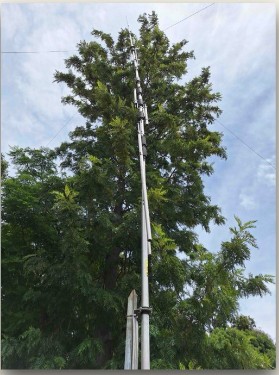
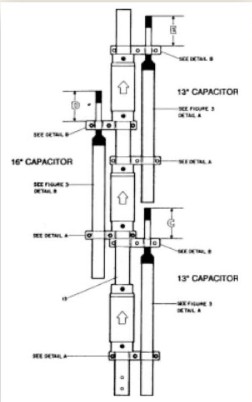
This design gives numerous opportunities for corrosion to occur, given there are approximately 57 separate joints for water to ingress and cause corrosion issues.
When last assembled after a QTH change, the main tube sections were assembled with electrical corrosion prevention paste. The coils had never been inspected since new, so the opportunity arose to do a complete disassembly, inspection and clean.
Example of the 10m, 12m and 15m trap assembly
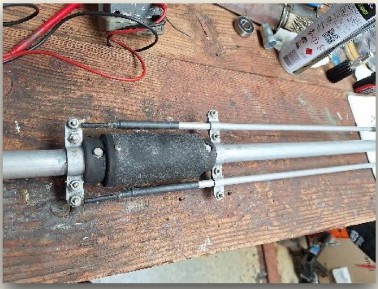
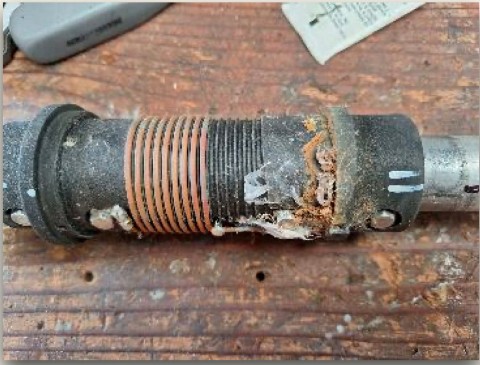
Somewhat unsurprisingly corrosion was found in multiple locations, especially with the coil contacts onto the tubing sections. Also various critters were found to have taken residence inside some of the coil assemblies.
30m trap assembly Each section was completely disassembled, corrosion and critters cleaned out, anti corrosion paste applied and the sections reassembled. This took approximately four Asv)e tn arcromniich
Each section was completely disassembled, corrosion and critters cleaned out, anti corrosion paste applied and the sections reassembled. This took approximately four days to accomplish.
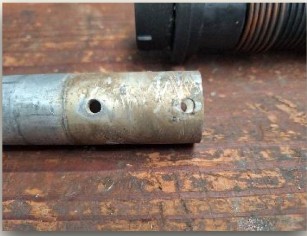
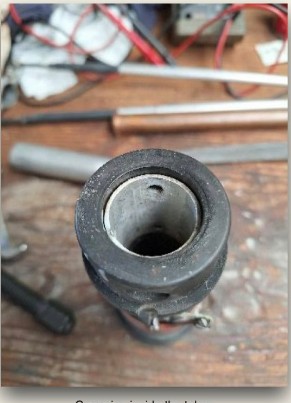
Example of corrosion at corroded coil contact surfaces
| am happy to report the antenna is usable again on all bands from 80m through to 10m including the WARC bands.
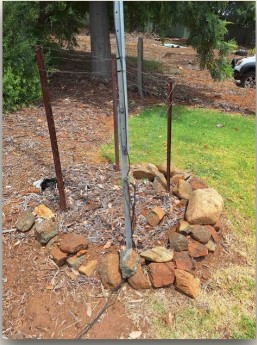
What’s going on on your workbench? If you have an article or two that you think might be of interest to our readers, please let Mark VK2KI know; email to cqqrsnet@gmail.com For guidance on writing for RagChew, see Articles below.
QRZ? Who’s on the other end?
CW Practice
This year I’m using Aesop’s Fables. These are short moral stories, often using talkin animals, that illustrate simple truths about human behaviour and character.
‘Aesop’s Fables originated in ancient Greece, traditionally attributed to the storytelle ‘Aesop who is thought to have lived around the 6th century BCE.
The fables are generally smaller files of two to three hundred words that have been recorded at 15 wpm and run for about 15 minutes.
If 15 wpm is a bit quick for you, load it onto your phone and set the playback speed at 0.75 X or even 0.5 X- whatever works for you. 0.75 X will play the MP8 at a bit under 12 wpm. Itis suggested that you read the text file before listening to the audio file.
That will make it easier to follow the audio file and prepare you for any unusual words. Any punctuation that is not usually used with CW has been removed. This week’s fable is ‘The Dag and His Shadow’, and the MP3 and TXT files are attached here –
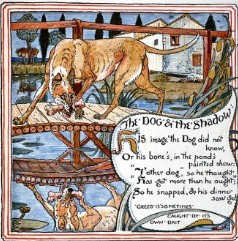
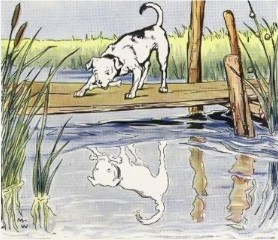
If you prefer a different speed or tone you can create your own MP3 files by converting the text file with the Ebook2CW app — https://fkurz.net/ham/ebook2cw.html.
You can either play the MP3 files in any media player, or load the text file into the Ditto CW: Morse Player app — https://dittocw.andro.io/.
Both options work well, however Ditto CW gives you complete control over all Morse settings, while a normal media player only allows changes to playback speed, and does that in steps (e.g. +1.25x, 1.5x, 1.75x).
Other News
Update from New Zealand
From David VK3DBD The temp setup here seems to be working quite well. It consists of a 80m dipole with traps in it for 17m and 30m (although 80 is virtually a dead band for CW I find, both here in ZL and in VK too).
I also have an inverted-vee dipole for 20m, centre supported on a fishing pole lashed to a balcoare – it works very well. Then there is a dedicated 40m dipole which is held by a 36FT bamboo pole at each end and at right angles runs the 80m dipole.
The 40m dipole which by dint of its relationship (nearly three quarter waves ) with 15m – also works on that band, though only one stn heard heard so far – a JA at 599 each way assured me it was putting out some RF.
I will hopefully be QRV again for next Tuesday’s QRS session.
| made up a new ZL-related QSL which depicts an old fellow and this interesting QTH a cedar house built on split levels on the outskirts of Kerikeri. These days I email QSLs as a .PDF file which the recipient can print if desired.
Note these are not the stereotype stock cards like many I have been flooded with lately. I still send out
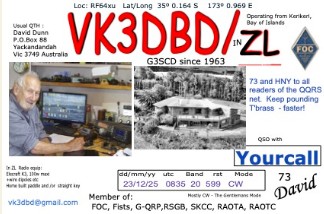
QSLs to those who supply the postage of course – sadly an international stamp is now over $4; they are killing off the nice tradition of the original amateur radio, but I feel it should be continued when asked . 73 to all and HNY David VK3DBD/ZL
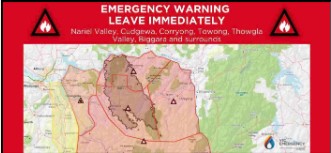
Many Australian readers will be aware of the devastating bushfires in Victoria ove! the past week. A number of our team members were affected.
Craig VK3CLD and Leonie found themselves evacuated from their new home at Alexandra on Friday morning and spent the night at a refuge of last resort where there were very high winds, no power and the temperature was up to 40 degrees.
With the power out for an indeterminable period, they were
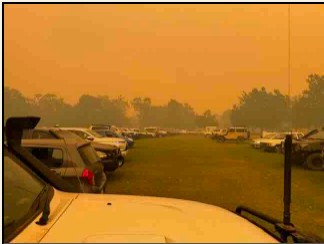
Lucky to have a camper fridge and a backup in the motorhome on gas. The fire-front came directly toward their home and then split in two and went past. The Country Fire Authority said that one house was lost but they were lucky that the town survived at all.
On Saturday, the wind changed again and they were told to take shelter again.
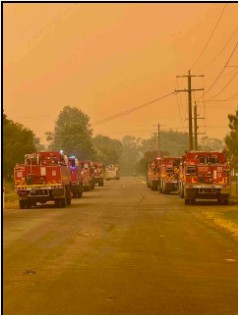
CFA Volunteers assembled at Alexander waiting for the fire-front Craig and Leonie returned home on Sunday. No damage, just a house full of ash/soot.
Craig and Leonie returned home on Sunday. No damage, just a house full of ash/soot.
Kevin VK3KEV and Meredith at Seymour had just arrived home from a 4 week holiday, to be evacuated the next day. They are in process of moving house after 26YRS – and reckon
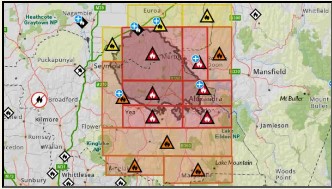
Things might be a bit quiet on CW-front for a few weeks. They were lucky to be able to spend two nights in the driveway of their new home closer-in to Seymour during the emergency.
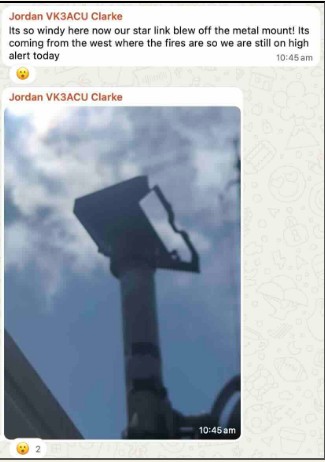
Jordan VK3ACU at was also on his toes (left foot only though) as a fire skirted his
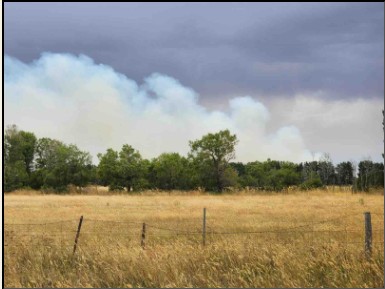
There was an emergency warning with variable winds, dry lightning and embers from the fire at Bamgani State Forrest. Jordan reported on WhatsApp: “Don’t laugh too hard but
When throwing some items in the car ready to leave, I grabbed my three favourite keys Q”. Jordan also recommended bushfire.io to monitor fires. [Thanks Jordan.
Having been in a Bural fire Service strike team (navigating, logging and situational awareness monitoring in the Strike Team Lead vehicle) on Saturday and Sunday, the bushfire.io appears more comprehensive (eg spot wind, forecast, marked fireground, aircraft movement, etc) than the RFS mobile data
Terminal I was using. ! still have more to learn about the supplied system, but next time I suspect I’ll be using bushfire.io on my phone in parallel to the Command and Control system].
Terminal I was using. ! still have more to learn about the supplied system, but next time I suspect Ill be using bushfire.io on my phone in parallel to the Command and
Ketut VASBWN was camping a little further East at Fridays Cambground. On Friday morning, CFA people came and warned them to leave.
Similarly, John VK2RU and Jenny were camping near Corryong and aware of the fires at Walwa to the West, up- sticks and headed North on Thursday night.
John Moyle National Field Day Contest – 2026 Rules
March 21ST and 22ND are the dates for this year’s John Moyle National Field Day Contest. You’ll need remember the dates for the weekend leave pass application form ©) For details, including the new logging requirements, head to: https://www.wia.org.au/members/contests/johnmoyle/ Here’s a summary of the rules if you’d like a quick look.
Morse Training Net
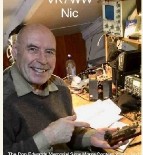
Our team member Nic VK7WW runs an on-air Slow Morse training net every Wednesday at 7pm EDST on 3580 for 30 mins. He uses the callsign of the Northern Tasmania Amateur Radio Club VK7TAZ on that net.
Many of our team learned Morse code with the support of Nic, and the weekly training session comes highly recommended for anyone who wants to learn the Code, or simply brush up.
Everyone’s welcome – 3580KHZ at 7pm Eastern time every Wednesday; you’ll hear lots of the CQQRS team on that net. Jordan VK3ACU has recorded the complete set of lessons which you can now find here:
Https://www. youtube.com/playlist?list=PLHsQmZz6fBXO7swAfbT mutrbbEL17fUQL Contact Nic VK7WW for more info nicholaschantler@hotmail.com including how to join the NTARC DISCORD group to follow the action, or just come along and join in on Wednesdays.
SHORTWAVE IN 2025 — THE AIRWAVES ARE ALIVE AGAIN
Shortwave is far from silent. From new transmitters humming to life in the Pacific, to hobbyists catching signals from the other side of the world, there’s been plenty happening lately on the bands. Here’s a look at some of the most interesting updates.
New Voices on the Airwaves: Shortwave Australia Over the past few weeks, a station identifying itself as Shortwave Australia has been heard broadcasting on 2310 kHz and 4835 kHz.
Reports from listeners across the country describe strong signals and a program of nostalgic, old-time music drifting across the dial — a refreshing discovery for anyone who enjoys exploring the lower shortwave bands.
While official details are limited, a growing number of hobbyists have confirmed regular activity on these two frequencies.
The station’s broadcasts have been logged during afternoons and evenings (local time), with 4835 kHz often producing the strongest results in daylight hours before fading around dusk.
At night, 2310 kHz seems to take over, offering surprisingly consistent reception when conditions are right.
Programming so far appears to focus on music and general entertainment, with minimal announcements or station IDs — a style that gives the broadcasts a distinctly nostalgic feel.
Listeners have described the experience as “like tuning into a forgotten corner of the radio world.” Online, discussions about the station have started to appear on hobby forums and monitoring blogs, where enthusiasts are sharing signal reports, audio clips, and reception logs.
Some have uploaded recordings to YouTube and SDR platforms, while others are tracking the station on sites like Shortwave.Live, which lists it as active on both frequencies around the clock (though actual transmission times vary).
Want to Try Your Luck Tuning In?
We’d Love to Hear From You
Have you caught Shortwave Australia on the dial? What times, signal strengths, or music have you logged? If you’ve captured a short audio clip or screenshot, share it with us — we may include listener reports in a future blog post to help map out the station’s reach and schedule.
Shortwave lives on through discoveries like this, and with help from the listening community, we can keep these new voices heard far and wide. https:/Avww.tecsunradios.com.au/store/contact/

Keyers
From David VK3DBD. I feel I just have to comment on the writings about Keyers/paddles and the mention of Ultimatic. The word means nothing to me but the writer, and he is not alone, speaks of lambic which really does mean short and long (according to the dictionary), relating to the metre of syllables in poetry.
So without any doubt in my mind, all Morse code is lambic! I suppose a twin paddle key if connected to a electronic keyer could be said to be lambic.
But a twin paddle key or indeed a single paddle, connected to a straight key jack in a radio can send dots or dashes either side according to the operators choice.
Keyers however are far from identical and different brands or origins work in slightly different ways. Two which should really be distinctive are the terminology which calls them type A or type B.
However that is far from cut and dried: Elecraft have their own versions which seem to be a sort of compromise between the two. I find it suits me well.
My learning to use a paddle came fairly late within my own experiences. I started with a “pump key” – as I think everyone should, Later I acquired a Bug from a SK sale, the classic Eddystone which I was told was not really a good model, and used it a
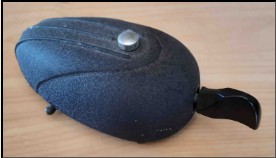
Little. Perhaps the code which went out may have left much to be desired but true to form within the Amateur fraternity, no one complained. Far too polite! Probably some 20 years later I was introduced to the paddle key.
My early radio gear was mainly home brew, an electronic keyer (using valves) was a complex device and solid state ones were as futuristic as Star Wars.
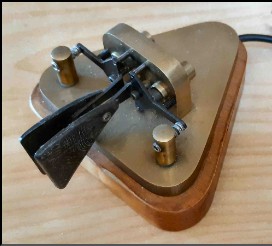
First efforts were using a borrowed Vibroplex Racer, (I think that was the name it was called). These were a simple key with magnetic tension and available on a brass square base or a triangular one.
From the first try I took to squeeze keying, it seemed natural. “CQ CQ CQ” just happened without thinking.
Of course it took time and effort to install Muscular memory into my hand-my right hand. The one I used for the bug… mistake number one. I ought to have taught the left to use the paddle, as now the right only remembers the paddle action not the bug type!
Muscular memory for paddle use seems to be indelibly installed now. My collection of keys has several bugs which I cannot effectively use, and probably never will now….. 73 David VK3DBD
Usability Issues with RagChew
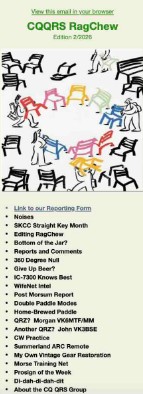
One of the distinctive, and to me unfortunate, ‘features’ of RagChew that makes it difficult to find what I’m looking for (and a feature, which, incidentally, is likely in practice to cloud attempts to make archived issues of RagChew meaningfully searchable by Google) is the practice of embedding textual information as images.
To take but one example: OM Ross MONNK wrote a very interesting article in the last edition about paddle modes. However, for reasons that appear (to me, anyway) to defy common sense, the entire content of his contribution is treated as a sequence of images, making it very difficult to find for anyone searching through the long newsletter using ordinary ‘find’ functions — and, of course, utterly impossible for Google ever to index.
It’s as if prettification is being treated as a higher goal than searchability. If prettification is so very important, could I suggest that after you have embedded significant chunks of text in RagChew as images, you follow each such image with a line of plain text that gives a searching user (or a search engine) some clue as to what the content of that effectively hidden article actually is?
In the case of the article I have mentioned, that line might read “[Tags: double paddle, squeeze mode, ultimatic, iambic A, iambic B, Ross MONNK]”.
One way of helping readers quickly identify which items in any given edition of RagChew are likely to be most of interest to them would be to provide a Table of Contents where each entry gets a meaningful ‘by line’.
In the last issue, for example, one Table of Contents entry read “Bottom of the Jar?”; as a way of helping readers identify what’s in the newsletter, a Table of Contents entry like that (at least on it’s own) is just not very useful.
Imagine if, instead, that entry read: Bottom of the Jar? Are you able to see the whole of each RagChew in your email client? It would be helpful, too, if items listed in the Table of Contents actually appeared as headings somewhere in the newsletter.
In the last issue, the following items all appeared in the Table of Contents, but did not feature again (at least, not under a heading) in the remainder of the newsletter: 360 Degree Null Give Up Beer?
IC-7300 Knows Best WifeNet Intel This is not how a conventional Table of Contents operates. RagChew now has many readers, and many contributors.
It has the potential to be a really valuable resource for the amateur radio community, and certainly for that part of the local community interested in CW.
I find it frustrating and disappointing that it is not set up to be more easily navigated, searched and archived. It could be so much more useful. — Peter VKSWOW
T Index Map
From Mark VK2KI / VK6QI On Tuesday evening during our CQQRS Slow CW Practice QSO net, Wayne VK6NW emailed me a T Index map from the Bureau of Meteorology Space Weather Service. The map depicted depressed conditions over WA at 0830Z.
At 1100Z he sent an updated map; the two maps are shown below.
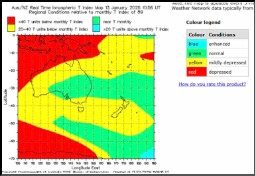
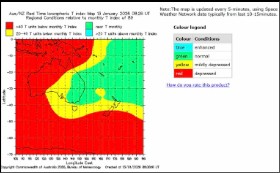
The T Index is forecast by Space Weather Service and is used in the prediction of point-to-point frequencies in HF communication. The T index is an indicator of the highest frequencies able to be refracted from regions in the ionosphere.
The higher the T index, the higher the frequencies able to be refracted from an ionospheric region. The index is based on the measurement of ionospheric FOF2 obtained from ionograms.
Following geomagnetic activity the typical ionospheric response at mid latitudes is to become depressed, this will result in a drop in the value of the T index produced from ionospheric stations within the depressed ionospheric region.
The T Index map shows the difference between the current ionospheric conditions and the monthly predicted conditions. Moderate level geomagnetic activity can depress Southern region (roughly below 30 degrees) ionospheric support levels, stronger geomagnetic activity can depress the entire region.
The finger-like shape of the Normal and Mildly-Depressed areas on the maps was intriguing to my small mind. The SWS had predicted impact of a solar flare on the ionosphere, so a disturbance was likely – but I wondered why that wouldn’t be felt across the whole region – why the finger of less disturbance?
And why does moderate disturbance depress the Southern region, while stronger activity depresses the whole area? Anyone know?
I’m aware that the earth’s magnetic field in combination with the earth’s rotation causes non-uniform distribution of the effect of solar radiation (including the North- ‘South waves and regions of auroral activity); I wonder if that has something to do with it?
Thoughts? So thanks Wayne – so much to learn, so little time!
After Action Report: KPH Cryptography Broadcast From the Maritime Radio Historical Society Newsletter 101 Once again cryptographers were huddled over their receivers (or, increasingly, computers connected to Software Defined Radios accessible via the Internet) copying an encoded CW message transmission broadcast by the “Wireless Giant of the Pacific,” historic maritime radio coast station KPH.
On Saturday, August 30 2025 at 2000 GMT KPH broadcast an encrypted message in the famous ENIGMA format. Here is the imaginative scenario for the broadcast: The year is 1939. War looms over Europe like a gathering storm.
And deep within the quiet halls of a remote country estate, a small, secretive group of the Allies’ brightest minds works tirelessly to pierce the veil of the German military’s most complex encryption device – the Enigma machine.
In just three weeks, a critical radio transmission is expected to be sent in Morse code: a stream of meaningless five- letter groups, indecipherable to ordinary listeners but believed to contain plans of the highest importance.
Intelligence believes the message may detail the movement of German forces in a way that could change the course of the war before it has even truly begun.
Ina daring operation that cost brave agents and precious resources, a codebook has been wrestled from enemy hands. It is stained, scarred by fire…and perhaps incomplete, but it is the best chance we have.
You are now part of the smail team entrusted with this task. The clock is ticking; every day that passes brings the transmission closer, and once it arrives, you must work with speed and precision to decode its secrets.
The fate of ships at sea, soldiers in the field, and perhaps the fate of nations rests in your hands. Time is of the essence – crack the code before it’s too late!
KPH Cryptography Manager Kevin McGrath/KM provided the following information concerning this latest event. Thanks, KM! Also, a word of thanks to Maintenance ‘Supervisor Bill Ruck/RK, who once again handled the issuance of the coveted award certificates.
This year a particular dose or realism was added to the exercise when a major solar flare erupted at the very beginning of the broadcast, interfering with efforts to copy the message by intercept stations around the world!
Despite that significant handicap 160 decodes were submitted for verification. Of that number there were 141 successful decodes.
Well done to all those who submitted entries and congratulations to all who were able to decode the message and were awarded a certificate!
Entries were received from stations all across the USA, but also from Canada, England, France, Germany, Finland, Belgium, Netherlands, Italy, Czech Rep., Argentina, Chile, Brazil, Japan, New Zealand, and Australia.
While 40% of listeners copied the message from their home stations another 60% used one of the many Software Defined Radios accessible via the Internet. A number of stations used vintage receivers such as the Collins R890, RCA RBC-2, Mackey 3020A.
Noteworthy is that one station used an original World War 2 era ENIGMA machine. Eleven other stations used replica ENIGMA machines. This is of particular interest in that for the 2022 ENIGMA cryptography event only two stations used replica machines.
Most participants used one of the several simulators that are available on the Internet or as standalone apps.
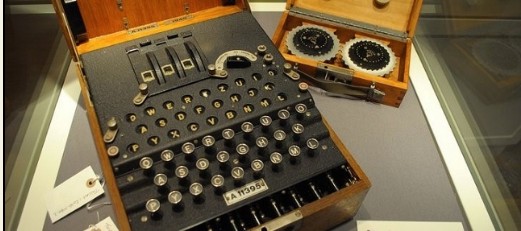
Decode the message using the codebook page provided. To add to the challenge this codebook page was stained and scarred by fire. In fact, The code book page was purposely designed such that the date is missing and one of the plugboard pairs is ambiguous.
Here is the encrypted ENIGMA message as broadcast by KPH: KAPT REINEKE FR GR ADM RAEDER 2312 MAY 27 = 120 = JXY LYI BSTHH GMBOA WGOCL FRCYT VQHDB.
TIAUJ ILARX NKQWV HVTXM VJGCF ZYUGP ZBBZW VLQFR ODBBC PPBDK XBWTZ MXKGP JAFKA QKKFU UULYV WXUZK DUFXW FZOFT QXKFS And here is the decoded message: KAPITAN REINEKE FROM GRAND ADMIRAL RAEDER, BEGIN PLANNING CROSS CHANNEL OP X OBJECTIVE ENGLISH MAINLAND X DETAIL NAVAL AND AIR SUPPORT REQS X CODE WORD SEALION X REPORT IN FIVE DAYS X As an historical note, “Operation Sea Lion” was the codename for German plans to invade Great Britain during World War 2.
Here is a small sample of some of the comments received from participants of the event: + Thanks for arranging this interesting activity. My first time. + These challenges have been some of my all-time favorite on-air activities. * Got up at 5am in Australia!
* Thank you all so much for putting on this event — it’s one of my very favorite events of the year + This was my first time interacting with KPH and it was a blast. Thank you to all the volunteers who put this event together!
* Thank you for running this event. I always look forward to them. * It’s been a very long wait since 2028 but worth every minute, many thanks for another extraordinary opportunity.
+ Thank you for an excellent activity and keeping history vibrant * Sailed as RO on French tankers (Shell and BP). Used a McKay RX to listen to Enigma transmission. * Good experience for my eventual transfer to Hut 6 at Blechley to work with Flowers and Turing.
* We are the Royal Canadian Sea Cadet Corps. Thanks! * My boys had a lot of fun pretending to be codebreakers. Nice history lesson too. * This rocked! Thank you so much. + Hope more is to come. Thanks to all at MRHS. This was a great exercise and really fun!
+ Thanks to all for organizing this neat and engaging event * QSAS5 on 22 MHz in Puerto Rico Click Here to see the scene at the Point Reyes receive site as the broadcast begins. Randy Hall, K7AGE in Gold Beach OR created an excellent video of the broadcast.
Click Here to copy the ENIGMA message (Including the audio of the Teletype format broadcast of the message)! And here is Randy’s video documenting his efforts to decode the message.
This video is a very helpful tutorial for those new to decrypting ENIGMA messages. By any measure this latest ENIGMA broadcast was a tremendous success. Stay tuned for our next cryptography event. We will keep you posted here in your MRHS Newsletter!
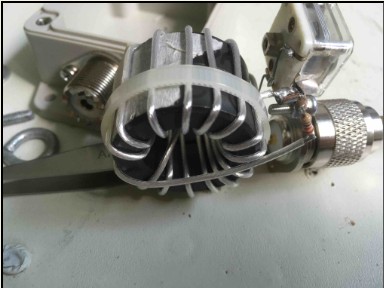
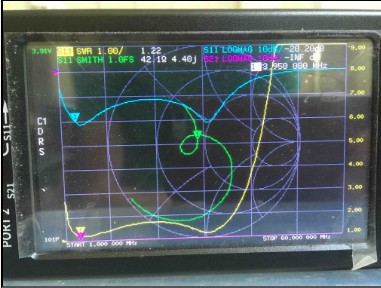
This is my work in progress for getting back on air. So further to last week’s story, I have chosen an EFHW, as the house aka shack is near the end of the block and the feedline can go straight out of the shack and up.
Above: Test set-up. Left: Vano VNA display from the test. 73 John VK3BSE
ZS6BKW Doublet vs End-Fed Half-Wave
ZSODAW Voubiet vs End-red rial from John VK5ET/P G’day Mark, good night Tuesday for CW. The EFHW did a good job, how do you think it compares with the ZS6BKW?
I have made up a portable ZS6BKW (same dimension as my home base) but haven’t tried it out yet in the bush.
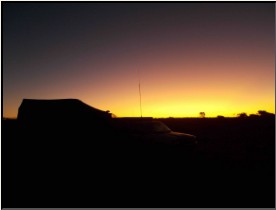
On Tuesday at mates property at Humbug Scrub) or doesn’t get high enough. Hopefully catch you next week, maybe from my noisy home QTH. 78, John VKSET [Hey John. Yes, good to catch up on 80m, considering how poor 40m was.
Re the ZS6BKW doublet compared to an End-Fed Half-Wave – good question! There’s a few Australian SOTA and VKFF PARKS operators who swear by the ZS6BKW in simple inverted-Vee configuration off a single squid-pole (one is Andrew VK1DA / VK2DA from our group).
I have mainly used it as a flatish doublet rather than as an inverted-Vee – and as you know, I love it – amazing antenna. However, it is hard work to put up like that – usually takes me at least an hour, and requires a lot of space…
Whereas an EFHW could be up in minutes and fits most places easily. The ZS6BKW covers 80m of course, but if you’re willing able to change the coupling from high impedance to low, add a decent ground system and put up with an interesting radiation pattern, a 40m EFHW should work as an 80m leaning quarter wave.
So…. the answer is…. try them both, and let us know mate! On the other question…. getting them up in the air – hal 1 used to use an 8 Ounce fishing sinker attached to that fluorescent builder’s twine.
8 ounce seemed a good compromise for me, and the twine was strong as anything…. but the builder’s twine sticks to bark like the proverbial!
I’ve certainly lost too many 8 ounce sinkers, but luckily, I’ve always managed to get them down from trees, despite the sticky builder’s twine (1 didn’t want to leave any dangling…. too dangerous when they finally decide to come down).
So more recently I’ve bought a 150 foot arborist throw line from eBay (a 75 or 100 foot one would have been ok too). This has a nice soft weight full of lead-shot attached to a poly-something-carcinogenic rope ina cary bag; the rope is amazing – it’s slippery, doesn’t tangle, and doesn’t stick in tree/branch/twig/leaf forks (so far).
At my age, I’m struggling to get much above 8-9m elevation on my portable antennas (I have height markings on the TV-ribbon feeder on the ZS6BKW doublet). I have aspirations for height…
But both my strength and more often than not, embarrassing lack of aim, think otherwise.]
If you’ve thought of something or read something that you think might be of interest to our readers, please let me know. For guidance on writing for RagChew, see Articles below. Please email material to Mark VK2KI: caqqrsnet@gmail.com
There’s no such thing…
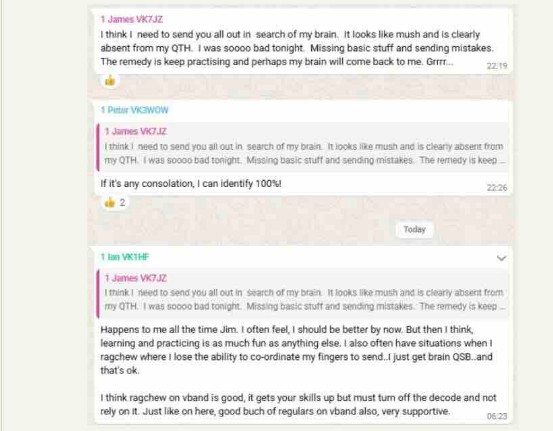
In the WhatsApp Alerts last Tuesday night, ragchew on Vband was mentioned. What is this? How do I join? What additional programs or equipment do I need? What else do I need to know?
[Do you have a question or two that are worth sharing? How about a discussion- starter? Please let me know cqgrsnet@gmail.com and I’ll pass them to John VK2RU for compilation each week.]
Prosign/Character/Signal of the Year
[Suggestion – put it on a sticky note near your key as a reminder for Tuesday. Tell us how you went!]
[If you have some intel about other team members… or even yourself… that’s worth sharing, please let me know cqqrsnet@gmail.com J
Di-dah-di-dah-dait
So back to the CQQRS Slow CW QSO practice net.
Next Tuesday’s Net
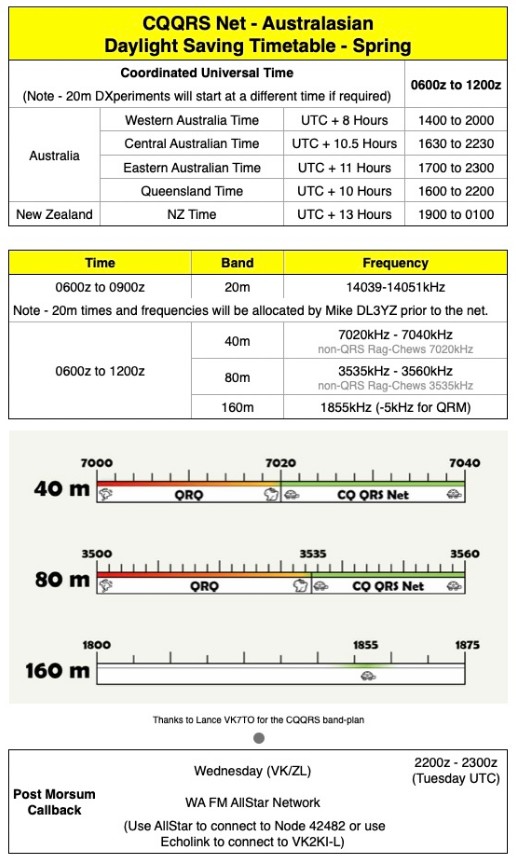
Our CQQRS Group will be on as always on Tuesday from around 0600Z until about 12002; see https://bit.ly/CQQRSWebsite and navigate to the Net Details page for details.
Doesn’t matter whether you’re brand new and want to try just exchanging callsigns and RST reports, or you’re ready for a good old rag chew. We’ll have fun.
There’s usually people around until after 1200Z – so keep calling in the segment of the band designated in the table below until you catch someone.
I should be on as usual from home in NSW or via the Remote at Bedfordale WA, and I’ll also be watching the proceedings using the VK6QS and Tecsun SDRs in WA and NSW respectively. Hope to hear you there.
Reports & Photos
Please let us know via our Reports form bit.Jy/GQQRSNET who you work or hear on Tuesday’s Group. The report form closes at lunchtime (Eastern Australian time) on Thursday. ‘And how about helping to make the reports even more interesting by sending a photo?
If you have a photo that you’d be happy to include, please email it to: eqqrsnet@gmail.com To make it even easier for our Reports editor Patrick VK2IOW, see if you can reduce the size of the image (to less than 100KB file size by preference).
No problems if your computer or phone can’t do that – just send it through anyway please. And of course, I’m always on the lookout for more photos for the newsletter, so if you have something that might be of interest aside from the reports, please send it through as well – I always enjoy the photos that our readers send – and I’m sure our readers do too.
Email them to cqqrsnet@gmail.com please (reduced size if possible – but whatever you send will be great). Oh and by the way, I recommend that you don’t keep the Reports Form website open between submission of reports from one week to the next.
If you’re unlucky, there’s an undocumented feature in the software that could cause your current week’s report to be combined with your previous report – it’s happened to your editor several times – much to the chagrin of our Reports editor 🙂
Post Morsum
Richard VK6HRC will run our phone Post Morsum on the South West AllStar net (via repeaters and hotspots all over WA) from 0600 WA time, then from 0700 WA time on 80m (8605 LSB).
See https://bit.ly/CQQRSWebsite and navigate to the Net Details page for details of how you can connect via Echolink or even possibly via your local FM repeater.
Articles
The newsletter is interesting to readers because of the material contributed by so many people – be it the reports each week or the various articles. Could you write a short article or articles for RagChew? You bet! Writing not your strong point?
Don’t worry, I’m very happy to help as much or as little as needed. Here’s a thought – although our readers will much prefer your own writing, perhaps have a go at using a Large Language Model Artificial Intelligence tool such as ChatGPT, Microsoft Copilot or Google Gemini to check your writing or even to actually draft the whole article in a relaxed easy-to-read manner!
You can find out more about how to do that on the Newsletter page on our website bit.ly/CQQRSWebsite. Our website also includes a suitable prompt (the command you feed to the Al to make it do what you want).
Please remember though – you must fact-check anything that an Al tool drafts for you because Als ‘hallucinate’ – ie if an Al can’t find what you’re looking for, it will make up an answer and present it as a fact!
This is one of the dangers of using Als – it’s quite probable that the tool will create a very readable and convincing draft that is 100% wrong! You as the submitter are responsible for fact-checking.
But it’s a learning experience – please let us know how you went if you had a go with this new generation of tool. And by the way – lam very concerned about our future in a world of Al – but I’m pleased to see that school and university curriculums now focus on understanding the risks – for instance, kids are now learning critical thinking something that used to be taught mostly at post-graduate level.
When the typewriter was invented, people predicted the downfall of handwriting; when the word processor was invented, the art of writing was thought to be on the way out – ditto for the spreadsheet and arithmetic, AM, SSB and FT-8 for amateur radio etc.
We can ignore Al and hope that it just goes away… or we can learn to handle it through experimentation and use. For more guidance on writing for the RagChew newsletter (including help with using an Al), head to our website bit.ly/CQQRSWebsite then click the menu on the top right and then click RagChew Newsletter.
Material
Areminder; if you send me any information by email, our report form or WhatsApp – unless you specifically state that material is not to be published, I’ll assume that you’re happy to see your thoughts in the RagChew newsletter.
Teamwork
Thank you so much to our team of 28 contributors: DL8YZ, G4RWI, MONNK, VK2GAZ, VK2IOW, VK2RU, VK2TIG, VK3ACU, VK3BWN, VK3BSE, VK3BWN, VK3CLD, VK3DBD, VK3DRQ, VK3ECH, VK3KEV, VK3WOW, VK4EV, VK4PN, VKBAV, VKSET, VK5FD, VKSKFG, VK6HRC, VK6KD, VK6KHZ, VK6NQL, VK6NW, VK6XC/3, VK7JZ, VK7ME, VK7WW, ZLACTS and the MRHS Newsletter.
And a special thank you to our editorial team, Nigel G4RWI (head softie), Patrick VK2IOW (Mister Report Wrangler), John VK2RU (spreadsheet wizard), Richard VK6HRC (Post Morsum cat- herder) and Lance VK7TO (technical editor and search bit magician).
Great work alll UY CW on Tuesday, mb Mark Bosna VK2KI/ VKEQI Beautiful South Bowning NSW ‘eqarsnet@gmail.com non impedit ratione cogitationis

An Ode to CW – thanks to David VK3RU: In days of old, when ops were bold, And sideband was not invented, Words were passed by pounding brass, And all were quite contented. – Unknown author
About the CQ QRS Net
For the current schedule and more information about the CQQRS net, please go the the Net Details page on our website:

The opinions expressed in the RagChew newsletter are those of the individual contributors. The opinions do not necessarily reflect that of the editor or of the CQQRS Group members.
Any material and images received from members by the editor or published on the CQQRS WhatsApp groups may be published in this newsletter unless specifically requested otherwise.
The RagChew newsletter is considered to be exempt from the Australian Government’s ban on social media for under 16 year olds because it is a service that has the primary purpose of enabling users to share information about products or services, engage in professional networking or professional development services or of supporting the education of users per the Australian Government eSafety Commissioner FAQ webpage “Which platforms have been excluded from the age restrictions” dated 10DEC25.
The values, doctrine and guidelines for the Group and for the newsletter are published on the Principles page of the group’s website https://bit.ly/CQQRSWebsite