Below is a reconstruction of the 2025 14 CQ QRS RagChew newsletter designed to support full text searching. This reconstruction was built using OCR, and will contain errors.
To view the Mailchimp original, click here. To search the entire newsletter archive, click here.
Contents
- CQ QRS RaaChew
- Too Busy
- New Team Member
- Masthead Image
- Report:
- Reports & Comments
- Comments:
- From Jordan VK3ACU at Meredith
- From Richard VK6PZT at Bunbury WA
- From Roy VK6RR at Geraldton
- From Kevin VK3KEV at Seymour
- From Richard VK6HRC at Padbury
- Post Morsum Report
- Fists Down Under Summer QSO Party
- This Week’s Topic of Interest
- Input Methods
- On My Workbench
- VK6SEG KiwiSDR
- QRZ?
- Other News
- Deep Dark Secret
- Morse Training Net
- Whose frequency is this anyway?
- German Navy Submarine U-17
- And where’s David this week?
- And from a listener in Hong Kong
- Report Trouble
- Really Really QRP
- I Hear Tell…
- Di-dah-di-dah-dit
- Next Tuesday’s Net
- Reports
- Post Morsum
- Teamwork
- About the CQ QRS Net
CQ QRS RaaChew
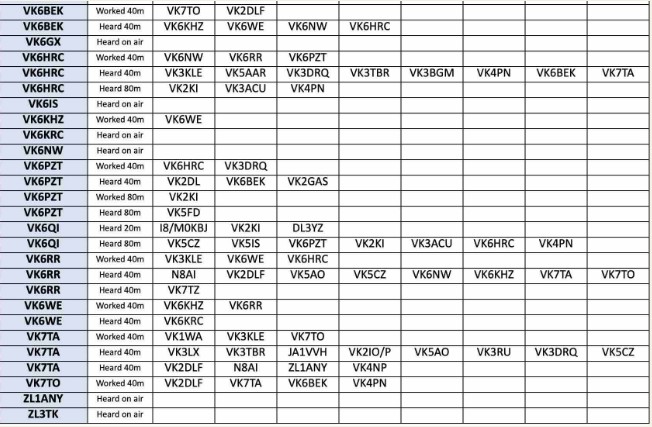
If I said there was 67 stations worked or heard on Tuesday’s CQQRS Slow CW practice QSO net… would you believe me? What a great team!
So in this newsletter you’ll read the reports from our reporters, you’ll learn about how to use another internet CW QSO application, see some amazing video footage from the WA Southern Electronics Group’s new KiwiSDR site, we get to meet Lance VK7TO and we’ll learn about a project to set up a CW radio room in a German U-Board submarine.
Too Busy
Like just about everyone, you’re probably busy… and reading the RagChew newsletter can become just another layer on the pile of things awaiting your attention.
I wish I had a solution – you should see the stacks of magazines, emails, income tax material etc waiting here for my attention. Stressful eh? So I really hope that every week you do find our newsletter inspiring, fun and relaxing to read or at least to skim…
So when you get to the end you feel better than you did when you started. In turn, I really love getting feedback about the newsletter, the WhatsApp groups, our website and of course, our Tuesday net – so many people really do enjoy the product of everyone’s efforts – thank you.
Whether it’s what people have written, or the fact that there’s so many on air – it’s so nice to get feedback. As an aside, I normally write this at my standing shack desk, but today after returning from a morning of trouble-shooting at YassFM our local community radio Station, I’m
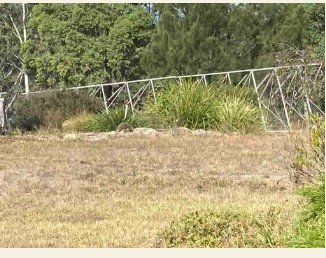
Now sitting in the lounge with Ms Elizabeth having a cup of tea with my MacBook on my lap (romantic eh?). Looking out the window, I spotted a large echidna about 10m away, ambling its way across our garden – doesn’t get better than that!
We’ve had them here from time to time before, and I’ve always wondered how they manage to get through the rabbit proof (ha – that’s another story) fencing.
The photos and material provided by our readers is the heart and sole of both the RagChew newsletter, and the fun and friendship we share on air; everything you submit contributes to our team members’ enjoyment… thank you!
But please remember, as the editor I have no control over what our readers do with the material published; your material may subsequently appear in other publications or internet sites (I try to get copyright permission if I’m using material from elsewhere – but that doesn’t necessarily happen with our newsletter).
So do let me know if there’s something you send to me or publish on our WhatsApp groups that you don’t want published in our newsletter.
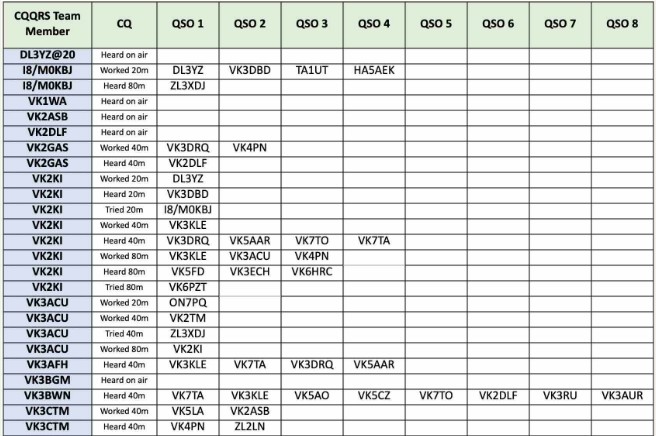
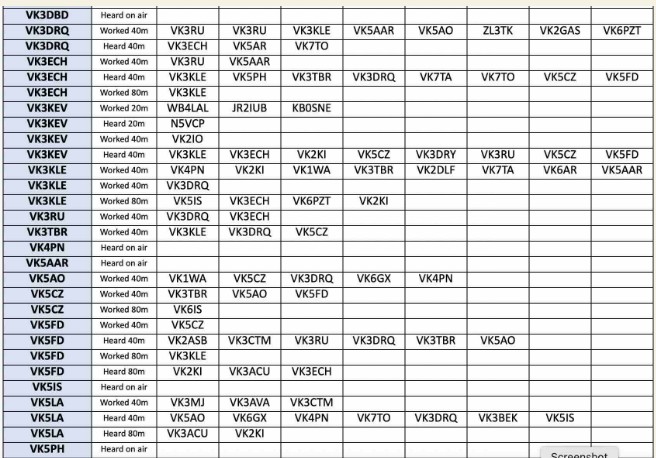
Here’s this week’s list of the 67 stations heard by 42 of our team
New Team Member
Welcome this week to John VK2EMF from Leeton; John is a keen creator, restorer and tinkerer – check out his workshop on QRZ.com!
John has recently returned as the editor of QRM, the newsletter of the Wagga Amateur Radio Club, which I have used to source material in the past (including an article to follow from John VK2YW, the out-going QRM editor).
We already have a number of our team in the WARC, but hopefully John will find some things of interest for QRM that might peak even more Slow CW interest in the Riverina area.
Masthead Image
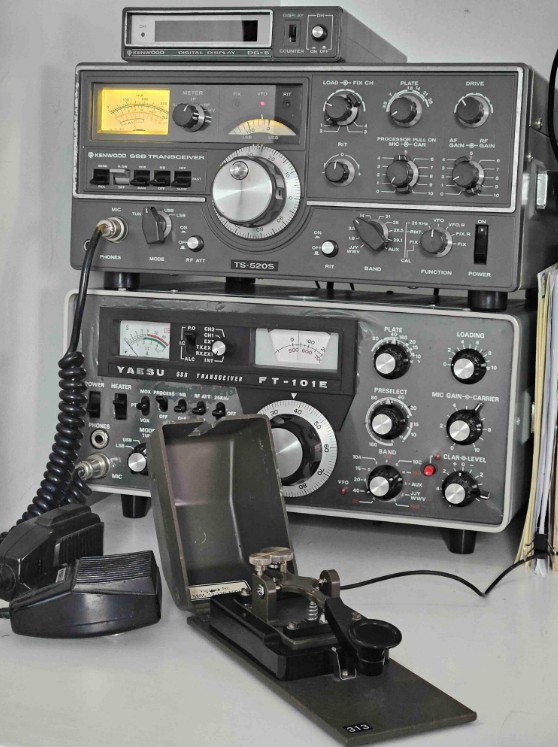
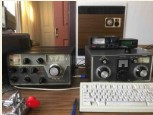
And thanks this week to Lance VK7TO for the beautiful almost monochrome shot of a couple of classics – his ubiquitous Yaesu FT-101E and Kenwood TS-520S transceivers, doing their thing on 40m and 20m.
Do you have one of these or similar classics gathering dust somewhere? Perhaps consider a little restoration project to get it going again for the CQQRS net? Sure – today’s SDR rigs are just the ducks-guts….
But fun-factor wise, I reckon these old beauties are the next best thing to an old two-seat sports car, wooden boat or rag and wire aircraft. And if you do have a project in train, don’t forget some pictures for our On My Workbench section!
Report:
After next Tuesday’s Group, please send me a list of who you worked and / or who you heard using our web form here:
If you’d like to find out a bit about our net, or would like to pass information to others about our Tuesday get-togethers, here’s the link to our website.
Bit.ly/CQQRSWebsite Cheers, mb Mark Bosma VK2KI / VK6QI Beautiful South Bowning NSW mark.bosma@icloud.com non impsditi ratione cogitationis
Reports & Comments
So here we go! The spreadsheets above show the known stations on last Tuesday’s Group; the comments distilled from the team members’ reports follow:
Comments:
[40m] * Quiet band with fast QSB. Enjoyed listening to all the other stations’ transmitter quirks and keying.
From Jordan VK3ACU at Meredith
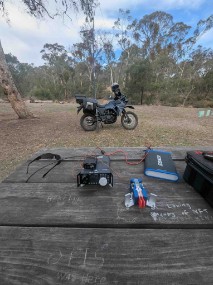
[40m] + Making the most of daylight savings and the last of the good weather on the bike. Worked VK2TM portable. I then worked ON7PQ on 20M (he was using a bug). My G90 was playing up. Didn’t stay out portable long I had to get home.
[80m] + Just one contact on 80m before bed with Mark. Great sig mate!
From Richard VK6PZT at Bunbury WA
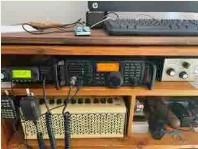
[20m] + I’m 2500KM from home in the beautiful south Italian region of Campania, staying in Oliveto Citra, a hilltop village around 350M above the Sele Valley.
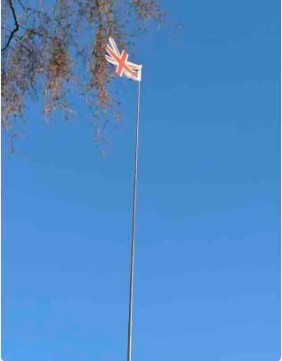
Early this morning I found a quiet spot on the side of the road, far enough away from houses to reduce the noise floor and pitched my JPC-12 antenna, with its union jack
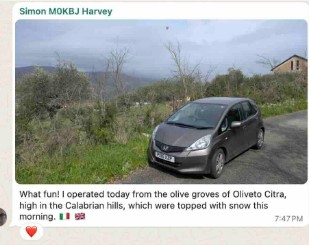
Flying high.. «| heard Brian ZL3XDJ but could not break the pile up to reach him.. + It was a pleasure to meet fellow European CQ QRS teammate Mike DLSYZ for our very first QSO.
His sending was superb and his signal from Stuttgart one of the strongest on the 20m band.. * It took me a while to copy David VK3DBD as there was a bit of fading and his signal was RST 439 to me. But we made it!.
From Roy VK6RR at Geraldton
[40m] + Nothing heard for some time, then things improved and a few were heard..
[80m] «| listened on 20m for our intrepid traveler, heard weak signals on 14046.17+/- but unreadable..
From Kevin VK3KEV at Seymour
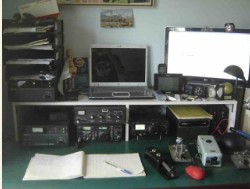
20m] «It was also SKCC slow speed saunter day, so I concentrated on dx qrs on 20m. 2 contacts USA and one from Japan, all signals weak but readable – lots of fun..
[40m] + Lots of stations on tonight on 40m,.
From Richard VK6HRC at Padbury
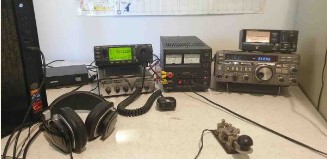
40m] * Quiet locally until the band opened up to the East with a mix of short QSOs and rag chews going on, a great session in all. Thank you..
[80m] * Signals from the East not that strong but managed to follow Jordan VKS3ACU and Mark VK2KI chatting away. Unfortunately the path to VK4 not great so missed out on working VK4PN Sava only hearing part of his transmission.
Thanks Mark for the nice and unexpected chat around the globe 🙂 I didn’t think it would work with my humble trap dipole hanging only 3 m high in the bushes, but the condx were nice to us today.
At the end of our QSO there was quite a lot of QRM from other stations coming up, so I may have missed some of your last closing words. But the rest was coming up nicely over here.
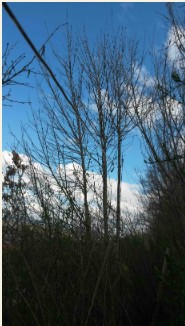
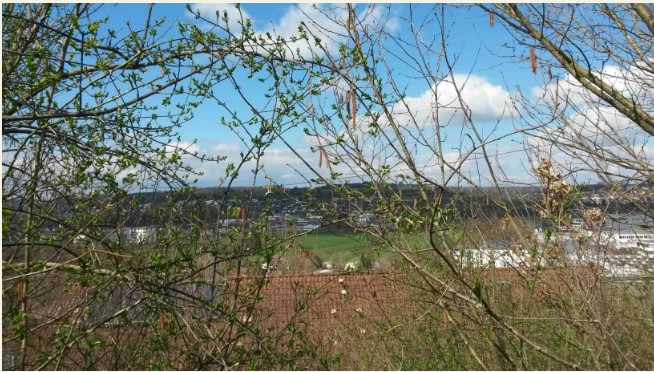
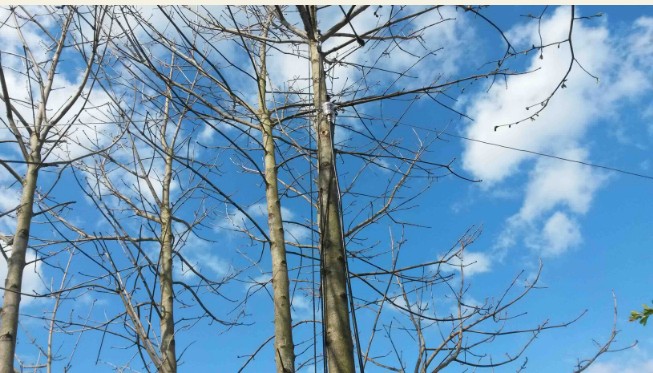
Trap 20/40M dipole hidden among the branches.
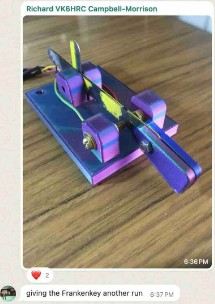
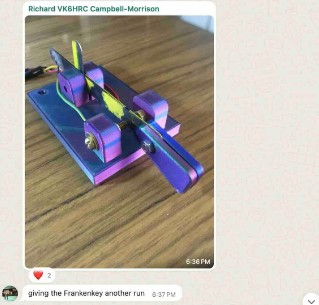
It was the first QSO with a new key I bought for 5 Euros / 9 AUD in NOS condition on a HAM fest in February. It’s a 70s East German replica of a “Baumuster 1” German military key, used in WW 1 and early WW 2.
Works gud, just need to tweak it to my habits of course. Sometimes i think the guys
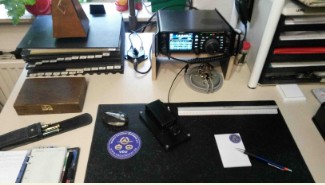
Back then when CW was really commonly used, really had done their jobs great. Next week, I think I can use the beam and the hut in the meadows again, hoping for a better signal in VK. The owner of the hut is seriously ill, so we hope the best for him.
I hope everyone had a great evening on the net Have a great day Mike
[40m] + All went well until my last attempt to QSO with OM Richard VK6PZT. He was only RSN 321 very QSB. Thanks OM Richard for trying so hard. I hope next time we will make it better..
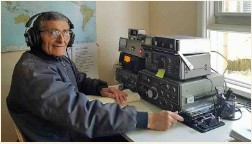
From your editor Mark VK6QI at Beautiful South Bowning via the VK6QS KiwiSDR near Brookton
[20m] * The Southern Electronics Group KiwiSDR at Northam wasn’t available on Tuesday, but Simon I8/MOKBJ was coming through to the VK6QS receiver near Brookton at RSN 321 on QSB peaks from his portable location among the olive groves of Oliveto Citra, high in the Italian Calabrian hills.
There was of course a fair amount of QSB and Simon wasn’t copyable when he dropped back into the noise.
• However, when Mike DL3YZ came up to work Simon, Mike was a solid RSN 541 with 100 Watts to his dipole in the trees at only 3m off the ground.
What amazed me was that at that time of the morning in Europe (after 9am), there wasn’t many other stations visible here on the waterfall display – I expected that the band would be full of signals. I wonder if Simon and Mike
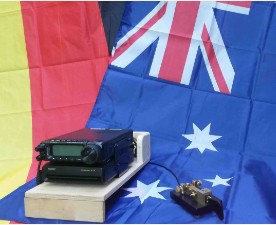
Had lots of QRM that wasn’t coming through to here?.
[80m] * By around 1000Z, 80m started opening nicely from WA to SA and further East. As the band opened, the more Southern stations were coming through better than my own signal from Southern NSW, but by 1200Z I was hearing Sava VK4PN just West of Brisbane nicely with his off-centre fed dipole up 8m.

[20m] «| knew from Simon |8/MOKBu’s posts on the CQQRS WhatsApp Alerts group that he was on air, and I could hear him on the Brookton WA and Paul VK5PH‘s Ironstone Ridge KiwiSDRs. However, he was well down in the noise not copyable here in Southern NSW.
Simon reported on WhatsApp that he’d already heard a ZI3 and David VK6DBD, but it looked like the band was closing to the East by the start of our activities at 0700Z.
• However, then Mike DL3YZ came up and worked Simon, and with Simon’s assistance to arrange a QSY, Mike and I had a nice QSO.
Despite his stealthy trapped 20/40M dipole being up among the tree branches at only 3m, Mike had a respectable RSN 421 in QSB, and he reported RST 539; very respectable again with the European QRM and my 50 Watts to my 80m double- extended Zepp (a 5-1/4 wavelength doublet on 20m) up 7m..
+ Great that Simon was able to get on air from the snow during his holiday in Italy, and that Mike was able to work into Australia again via the long path..
[40m] + After the fun on 20m, I had a listen on 40m from around 0800Z; the band was pretty quiet at that time, but I hooked up with Paul VK3KLE who was coming through nicely from Horsham.
After dinner Tim VK3TBR let me know that once again I’d forgotten to turn our CQQRS Reports form back on – I had double-checked it, but still missed that step!
My apologies to everyone who tried to use the form for their weekly reports before I switched it on again!. + Around 1000Z I listened in to Manny VK3DRQ‘s QSO with VKSAAR, then the Two Tassie Ts, Lance VK7TO chatting to lan VK7TA, before I slid down to 80m..
+ So many people to chat to on 40m, and so little time! Perhaps next week?.
[80m] + Soon after 1000Z I tried 80m for a bit of fun. + By the time I got there, Paul VK3KLE was chatting to Allen VK5FD; great to hear Allen back on air for our net. Paul went on to work Richard VK6PZT in Bunbury then Rob VK3ECH at Echuca.
Richard and I tried to have a QSO, but the signals were very marginal – RSN 212 with just the occasional letter popping above the noise.
But it was nice to hear another one of our founding members back on the net – he’s been somewhat distracted with setting up his new business.
+ I hooked up with Paul VK3KLE again RSN 562 and Jordan VK3ACU who was really giving my old Trio TS-120S’s S-meter a work-out with RSN 592 from his double-extended Zepp at Meredith.
I did hear Richard VK6HRC calling CQ but signals were really marginal, so I went on to chat to Sava VK4PN at Mount
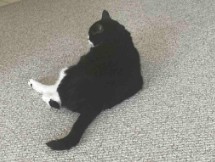
Ommaney; Sava reported having 60CM of rain during March (about our annual rainfall!).. * By around 1300Z things had gone quiet so I negotiated the cat obstacle course and headed to bed after yet another really pleasing night..
[40m] + Just a short session this time before dinner. Initially worked Manny but he was Called for a cuppa after a short time and we signed. Rob VK3ECH called after a short beak and we had a good chat. After we wrapped up,
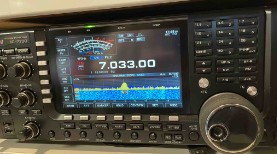
Manny called back for a longer chat. Whilst Rob was a new one in my log, Manny i my primary mentor, always up for a chjat and with positive feedback.
With his support and other members of the QRS group I find my Morse is slowly improving, certainly from the early QRS days.. * Thanks all..
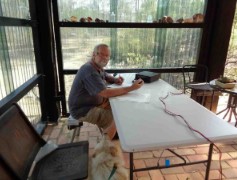
[80m] + Always fun. Perhaps we should regard CW mode as being akin to texting on our phones!.
[40m] + When I switched on just before 9pm, 40 m was brimming with S9+ signals, a very uncommon occurrence for my station in Southern Tas.
As it transpired conditions were rather strange, with the whole band fluctuating between S9 and S1 over a roughly fifteen-minute cycle, a new phenomenon for me.
Whilst manifest as deep, slow QSB, based on my normal station performance, I would actually characterise it as slow cycles of enhanced propagation, as the troughs were more in keeping with my regular experience…
+ None the less, the peaks allowed me to enjoy four contacts across the country… + First was George, VK2DLF with his immediately distinctive callsign.
Despite only having worked twice in the past, once each in ’23’ and ’24, his callsign’s most musical rhythm heralds his arrival as though a chorus of sweetly trumpeting angels.
I’ve always considered that the Germans have the most musical prefix, which George has co-opted with the additional embellishment of the “F”.. + Next was lan, VK7TA.
I ensured I looked at his written call every time I sent it, as the potential for sending the wrong call when a VK7TO works a VK7TA is rather high.
It was nice working another VK7 on CW; there aren’t many of us on the air and we’ve only worked once before, over a year ago.. + The night concluded with two very enjoyable chats with Shaun and Sava, 6BEK and 4PN. Two stations I’d not worked before.
* With so much activity on the bands, I was pleasantly surprised that I never
Had to go beyond two CQ calls to hook a contact.. «| had intended to stretch the FT- 101’s legs this evening, but exhibited some odd relay chattering on strong signals, so was added to the ER waiting list and turned to stillness.
I briefly contemplated switching to my TS-5208S, but with the bands being so busy, and not having a CW filter, I played it safe and turned to my trusty TS-590 instead.. + Allin all, a most enjoyable evening..
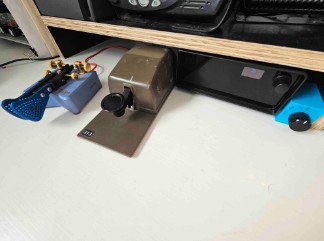
Left to right: Bengali paddles, Junker straight key which is used whenever operating below 18 wpm, home brew keyer, and keyer radio selector switch.
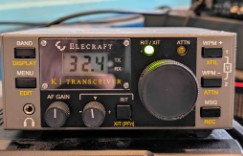
[40m] + Good session on 40m, worked 3 stations on the little Elecraft K1 @ 5 Watts and heard a heap of others..

Post Morsum Report
Post Morsum Report by Richard VK6HRC Happily the AllStar / Echolink and South West network worked well for Wednesday morning’s Post Morsum call-back after Tuesday’s CQQRS net.
Call-backs : VK6KD/5 David VKeQl Mark VK6NW Wayne VK6KRC Bob VK6HRC ‘SWLs VK6MRB Mulligan, VK6BSA Mark and others no-doubt. David checked in from the QTH of Mark VK5MK, a friend in Adelaide.
David was not on the net last night as they had a very pleasant social evening instead. David and Pauline are heading off again today to spend some time on the Ayre peninsular before heading West.
Mark focussed on DX to start with, and heard Simon MOKBJ in snowy Italy on 20MX – no contact unfortunately. He then went on to work Mike DL3YZ on 20MX before heading down to 40MX where he worked Paul VK3KLE and then to 80MX to catch up with Paul again, Jordan VK3ACU and Sava VKAPN.
Plus listening out on various Kiwi SDR receivers and spotting on WhatsApp, doing a fine job as usual. Wayne was using a different setup this week taming a paddle and succeeding in that respect; However, a fine Bencher unit was on the way to replace the old unit.
He is still busy with his SES duties so on Tuesday he headed off early after a short stint on the net. Mark and Bob let us know that Max VK6FN was on sick parade and wouldn’t be on as he was heading off to get the other cataract removed and back to 20/20 vision
Ihad three contacts on 40MX and tried 80MX for a while with no contact but followed Jordan VK3ACU and Mark VK2KI happily chatting away.
The net was busy on 40MX when the band opened up East to West and I enjoyed following along listening to all the different fists and various speeds.
Thank you 73 Richard VKeHRC [Thank you for your support to the net and the hard work writing these reports mate.]
Fists Down Under Summer QSO Party
Plots MUWET VHC! OQUIINIIC! Wow Faity from Richard VK6HRC Final get together of the Fists Down Under Summer QSO Party was on Friday March 28TH. I managed to work three FDU stations and two VKFF stations during the evening, another fun event.
Thank you to all for your support and advice; I’m looking forward to the next event already. 73 Richard VK6HRC
BTW My sending will be substandard as I have been infected with a bug ! The Vibroplex is the Whiteman Park trophy which was donated to the Northern Corridor Amateur Radio Group by Geoff VK6NX SK.
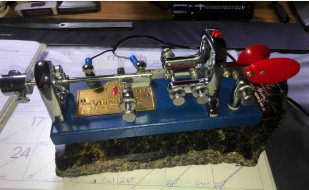
It was presented to John VK6NU in recognition of his work with SOTA; John is also a keen CW operator and a member of the CQQRS team. The Vibroplex was kindly lent to me by John to try out.
I managed to slow it down to about 16 wpm, but it does not like going slow! I do not think I will keep it for long but it is fun to try.
This Week’s Topic of Interest
Vail – Morse Code Over the Internet (no, it’s not an obituary – that’s the other vale!) by Ross MONNK
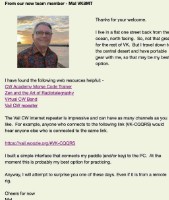
Mal VK8MT wrote a short piece about the Vail Internet Morse Code application in last week’s Ragchew. As many of you will know, I’m a VBand regular, but I’m open to new ideas so I thought I’d have a look at Vail…and I’m glad I did.
The first thing you notice, it looks very nice – clean and simple. There are no hidden menus – what you see is what you get. I didn’t find the “Help” particularly helpful but the FAQs were where all the interesting stuff was to be found.
WARNING to all those of you suffering from ‘Decoder Dependency’: there’s no decoder! Eeek. There are three sections to the web page: “On the left is the Action section * In the middle is the Notes section (which personally I find pointless but YMMV) “On the right is the Settings section
The “rx delay” time seems to serve two purposes: “Even on the lowest setting, some delay is introduced, to help with any latency issues. The source code states *_.-higher-latency networks will need a larger value”.
“ Longer delays (up to 10 seconds) give you a chance to get ready for the other operator’s reply. But your consequent delay in replying might confuse the
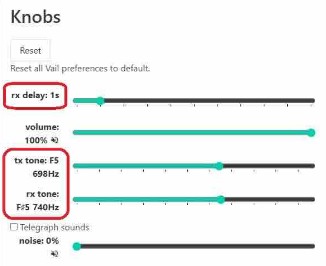
Other operator if you don’t tell them about it. Adjust “tx tone” and “rx tone’ to your taste. Some operators like to hear a low tone (it’s supposed to cut through QRN better) but I prefer to hear my morse in the 700 – 750 Hz range so I adjusted those.
Adjust “tx tone” and “rx tone’ to your taste. Some operators like to hear a low tone (it’s supposed to cut through QRN better) but I prefer to hear my morse in the 700 – 750 Hz range so I adjusted those.
You can either select one of the pre- configured channels from the drop- down box, or go to a private channel. You can create a channel easily by entering in your web browser address box the Vail address followed by /# and a channel name.
For example, https://vail.woozle.org/#VK-CQQRS. Anyone else who types in that address can join you.
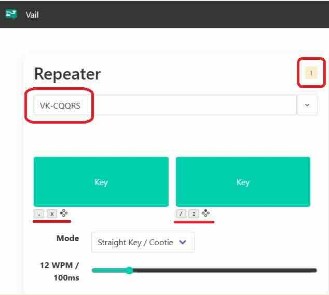
How many other operators are on that channel. It flashes annoyingly when Morse is being received.
Input Methods
There are several input methods: * Ona computer keyboard, you can press the Enter key as well aszxc ./[] keys. My . and / keys gave flakey results, and you might think the z and x keys are the wrong way round for paddles, but everything else worked fine.
* Put your cursor on one of the two green “key” pads and click with the left mouse button to mimic a straight key, or use both the left and right mouse buttons to mimic a paddle. * Ifyou have a game controller, you can press A or B.
* Ifyou have a MIDI keyboard, you can play C in any octave. * Ifyou have a USB hardware interface, you can use any Morse key.
The speed setting is only relevant if you’re using one of the paddle modes, of which there is a comprehensive selection (I’m pleased to see).
Using your own key Ihave a mouse interface and an Arduino USB interface that I use on VBand and they both worked fine with Vail – see my QRZ.com page and RagChew edition 8/2025 of 20FEB25 for more details on USB interfaces (hint: if you can solder, the mouse interface is the easiest to make).
When I use a paddle, I run it through an electronic keyer (normally a K-16 module, but a Morserino-32 or a cheap Chinese Open CW Keyer Mk2 will be just fine).
All have to do then is set Vail or VBand to “Straight Key Mode” and I don’t have to worry about any other settings. But this way of working is an idiosyncrasy of mine. Just plug your Morse key into the hardware interface and you’ll be fine.
Conclusion * Vand is like hanging out on a street corner on a Saturday night, hoping to hear about a rave or party that you can crash. * Vail is like inviting your friends around for a glass of sherry and a game of “Blind Man’s Bluff”.
Lexaggerate for comic effect. But these are two different ways of addressing the ‘same functionality – how to use your Morse code if you don’t have access to the radio waves. They each have their strengths and weaknesses and I can see myself using both.
And if anyone would like a QSO via Vail (speed and content to suit you and your skill level), please let Mark know via email to cqgrsnet@gmail.com and he will pass your email address to me so we can set up a sked or two. So, Viva Vial!
[Thank you Ross for putting this excellent article together for us, and thanks also to Mal VK8MT for pointing out this application last week. Who’s up for an internet QSO with Ross, Mal and perhaps others?]
If you have an article or two that you think might be of interest to our readers, please let me know so we can share more thoughts and ideas; email to cqqrsnet@gmail.com

On My Workbench
VK6SEG KiwiSDR
In last week’s RagChew newsletter (CQQRS RagChew 13/2025) I discussed the 40m performance of the Southern Electronics Group’s new KiwiSDR receiver at Hoddy Well near Northam, which I used on the net.
This week with very little arm-twisting, Peter VK6YSF has given us more of the technical details about the set-up and importantly, the antenna used.
Here’s a video of the site (pre-SDR antenna): https://youtu.be/Fz5PBUgb MwQ?si=StQPpM2E93SOgxaB [This is a beautifully produced video – I hope readers can relax for four minutes and enjoy!]
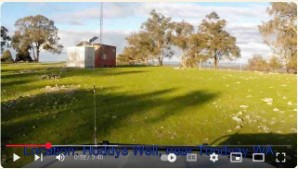
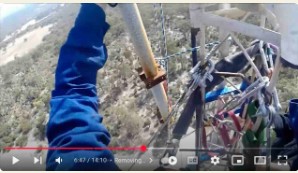
And here’s an old video of the VK6RAV 2m antenna replacement: https://youtu.be/mXXS TywnXqQ? si=-1uQAyzwT_cOcFQ3 [Geez Peter… my feet hurt watching this work – 54m up!]
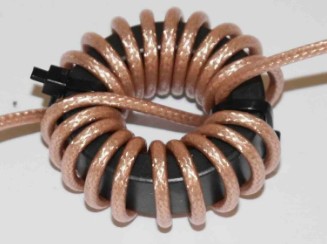
Balun details: https://vk6ysf.com/balun_choke_balu n_hf_reisert.html [At the bottom of Peter’s UNUN design page, you’ll find a really handy set of links to other BALUN and UNUN designs.
Straight to the Pool Room – actually, straight to the Links page on our website so we can all find them again!]
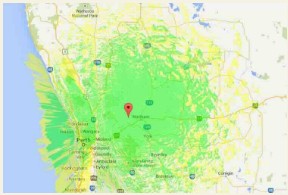
And the VK6RAV repeater details: https://vk6ysf.com/VK6RAV– AVON VALLEY REPEATER.htm [An alternative to VK6RLM for Perth and surrounding stations for our Wednesday morning Post Morsum call-backs on the WA AllStar network?]
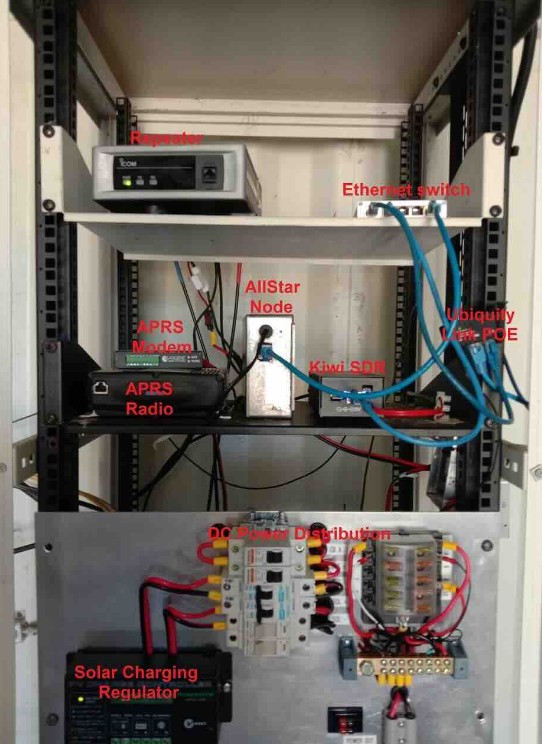
The very neat VK6RAV repeater equipment housing at Hoddys Well – now housing the VK6SEG KiwiSDR as well
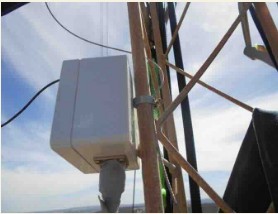
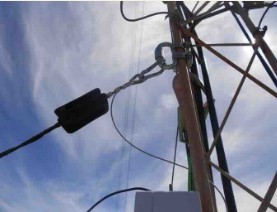
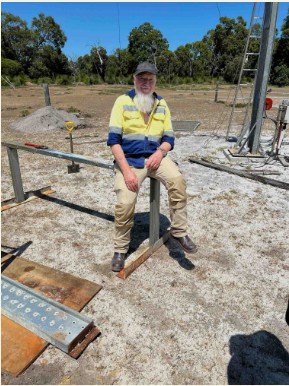
Antenna attachment to the tower. Choking BALUN attachment. The hose clamp is the ground attachment for the cold side of the balun. The KiwiSDR antenna is a 30-meter-long wire, with its feed point located 22 meters up the tower.
At the feed point, a 1:1 choking balun is used, with no impedance matching (Such as a 1:9 unun for example). This design ensures the antenna remains as broadband as possible, covering the full receiver range of the KiwiSDR from <10 kHz to 31 MHz.
The other end of the antenna is secured to a metal pole approximately 1 meter above the ground. The cold end of the chock balun is connected to the tower.
Tower guy wires are galvanised steel and are loosely grounded at the ground end and bonded to the tower at the top end. The tower is grounded.
The ground conditions are very dry with sporadic granite just below the surface, therefore likely very poor ground conductivity.
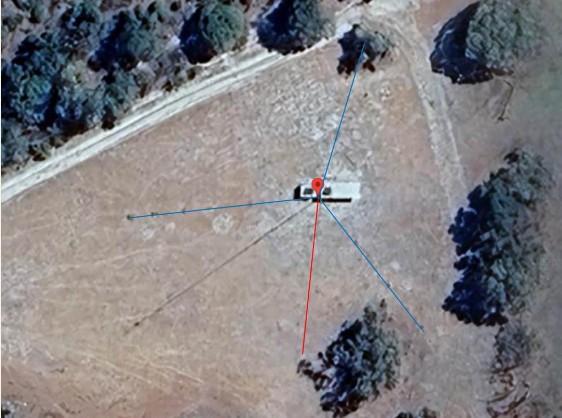
KiwiSDR antenna = RED Guy wires = Blue Google map: https://maps.app.goo.gl/mAbKaQVManvUwtTFA
[Thanks Peter – an outstanding article! Would anyone like to have a go at modelling the horizontal and vertical radiation patterns of this antenna on 160M, 80m, 40m and 10m for us?
Intuitively, I reckon on 40m, a 3/4 wavelength antenna would have two main lobes near the axis of the wire – but add a 47 degree slope, fed against a grounded tower – what would that do to the vertical and horizontal patterns I wonder?]
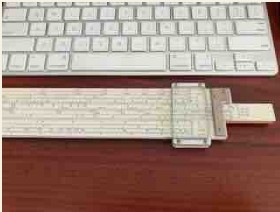
My 1974 slide rule (calculators not allowed in those days) helped with the angle – but wasn’t all that good at predicting the radiation patterns!
QRZ?
Who’s calling me? Who’s on the other end?
This week, we feature one of our most Southerly team members, Lance VK7TO fror Margate near Hobart. I’m a relative late comer to Amateur Radio, though I have two enduring memories from my primary school years.
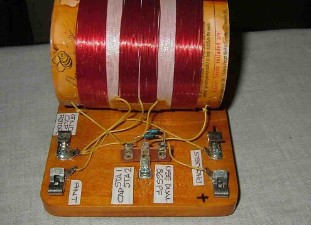
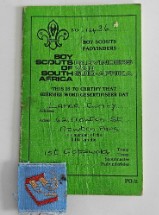
As a young cub scout, Mr Brown, a local amateur, helped me build a crystal set for my radio badge. After my dad and I strung a length of copper wire across our garden, I would fall asleep at night with the tiny speaker tucked into my pillow slip.
The other was my best friend’s dad’s voice emanating from the TV when it was his turn to read the local amateur news. Fast forward about thirty years, and a protracted recovery from an injury left me with plenty of time and a restless mind, the perfect ingredients to study for, and gain my Amateur Radio license.
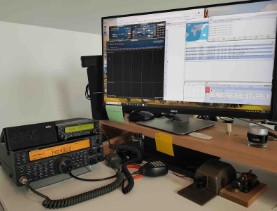
Buying my first HF radio, a TS-590, exhausted the toys budget, but I had a strong interest in portable operating. I was enticed by the low cost of QRP CW only rigs, and so my CW journey began. With the help of LCWO I learned the standard 40-character set.
As soon as I knew the characters, I packed my straight key, headed for my closest WWFF site and had a thoroughly rewarding session. I worked more DX to North America and Europe with five Watts than I’d ever managed at home with SSB and a hundred Watts.
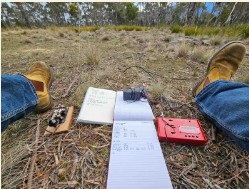
It quickly became clear that despite achieving my goal of being able to activate ‘summits and parks, there was so much more that CW had to offer. And so began my journey toward the ultimate expression of CW, the rag chew.
I progressed slowly but surely with the help of CW Academy and numerous QSO partners who, from my earliest attempts on the air, persisted with the contact despite my faltering CW.
Having achieved reasonable CW proficiency, I really appreciate the CQ QRS nets where I can give back by encouraging others to get on the air and start to experience the joy of pounding brass.
‘Some may wonder about my recent change of callsign from VK7ZA to VK7TO. Well, with my new CW skills, I found that with only 100 W and a wire, weak signal DX stations really struggled with the …7Z…
Transition, requiring multiple repeats, and sometimes simply giving up. Too many dits to get lost and too similar sounding, I guess. Since switching to my new dah-heavy suffix, trouble being copied is no longer an issue.
It’s a shame though; I still prefer the rhythm of VK7ZA.
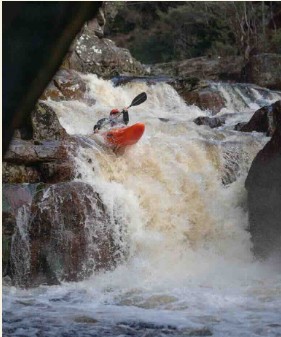
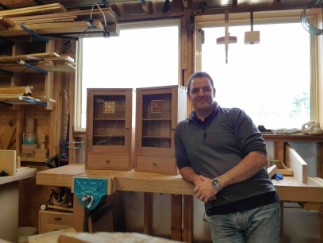
Lam a software engineer by profession, whilst enjoying white water kayaking and woodworking outside of the shack.
Kind regards from Southern Tasmania Lance, VK7TO [Terrific story Lance – thanks for sharing it with us… reckon we might get one or two woodworking conversations on Tuesdays!
So for the rest of the team, would you be willing to share some thoughts about yourself? Doesn’t matter if you think you’ve always been a crap writer… I’m very happy to quietly help you shape some thoughts.
So please let me know: eqarsnet@gmail.com Alternatively, lan VK1HF is keen to record and produce some short audio segments for RagChew about some of our team members.
If you’d like to have a chat with lan rather than writing something, send me an email and I’ll pass your details to him. So… QRZ2]
Other News
Deep Dark Secret
From Peter VK3BGM at Geelong: Hi Mark, The CQ QRS Newsletter is good stuff. Lot of work. You must have started a Morse code renaissance. I could see stations up and down 40m on the previous Tuesday. Even 80m is alive again.
In the past whenever I’ve mentioned using or liking Morse code, I felt akin to having leprosy. Peter Munro VK3BGM
Morse Training Net
Our team member Nic VK7WW runs an on-air Slow Morse training net every Wednesday at 7pm EDST on 3580 for 30 mins. He uses the callsign of the Northern Tasmania Amateur Radio Club VK7TAZ on that net.
Many of our team learned Morse code with the support of Nic, and the weekly training session comes highly recommended for anyone who wants to learn the Code, or simply brush up.
Everyone’s welcome – 3580KHZ at 7pm Eastern time every Wednesday; you’ll hear lots of the CQQRS team on that net. Jordan VK3ACU is recording this round of training lessons – you’ll find the link to the YouTube recordings on our website here:
Bit.ly/CQQRSWebsite then navigate to: useful-resources-and-links Contact Nic VK7WW for more info nicholaschantler@hotmail.com including how to join the NTARC DISCORD group to follow the action, or just come along and join in on Wednesdays.
Whose frequency is this anyway? The normal amateur radio courtesy and protocol is to respect the frequency that others are operating on.
So if Station A is calling CQ and Station B responds, Station B should move off to another frequency before continuing with other stations.
But what happens on if Station C comes across the QSO and when it’s finished, calls Station B (not knowing that Station A was on frequency first)?
Normal courtesy on SSB Is to respond with the caller’s callsign and advise ‘down 3KHZ’ or similar, both stations QSY and Station A can then continue. However, on CW, this can be quite tricky.
One CW tone sounds like the next, and it can be a challenge to rattle out a quick ‘2KI DN 3’ or similar without interrupting the original station’s activities. And, on our net we have many new operators who won’t expect or understand such a request.
Confusion reigns! So for the CQQRS net, we don’t necessarily stick to the normal protocol. The aim is to give everyone a go at contacting others – no-one owns their calling frequency in this Group.
So unlike working DX, if you hear someone signing off – jump in and call – doesn’t matter who was first on the frequency – we really are all good mates in this Group…
And besides, at the speed we’re sending, after a @SO most of us will have forgotten who was first! Ifyou really want to move off frequency (eg because of a spurious switch mode power supply signal that’s just drifted into the conversation), you could try sending an abridged callsign of the person you’re after, followed by “UP 5” or “DN 5” then K; then call that person on the designated frequency and keep your fingers crossed, they may have understood you and followed…
Or not. So if you’re looking for information on this or similar net protocol, our website is the place to go: https://sites. google.com/view/cagrs/home/net-details#th.ypmmghuSlav
Whose frequency is this anyway?
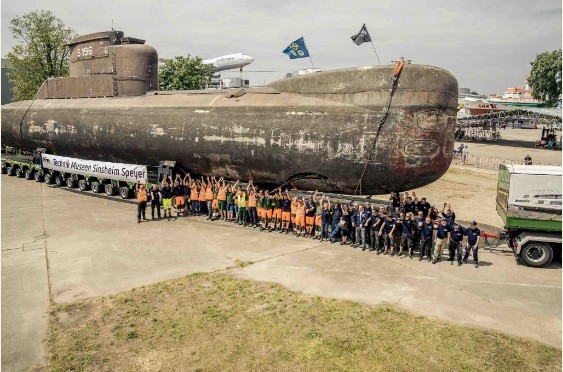
From Mike DL3YZ: I am part of a team that is responsible for bringing the submarine U-17 on the air again, on the ARRL museum ship weekend on 7 / 8 June this year.
It will probably be the weekend when it will be opened to the public at the Technik Museum Sinsheim, about 1 hr driving from my QTH. The transport of the 500 tons ship, about 1000 km from the sea to south Germay was a monster project on its own.
It was shipped up the rivers Rhine and Neckar, and the rest was an oversized transport though the villages..
German Navy Submarine U-17
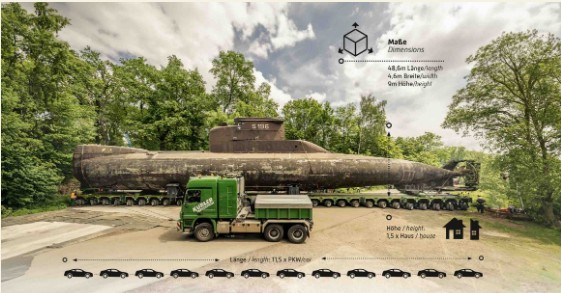
There are really great videos and still images about its journey on their site : https://u17.technik-museum.de/en/ The submarine was saved from being wrecked by their original crew, and so we have three of the original radio operators on board who actually served on this boat.
They don’t have licences, so I am needed to provide my training call, set up the antennas, and being officialy responsible if something goes wrong HI.
My HAM colleague ( and the leading officer) is a German Navy seal, who has entered and left this submerged ship through the torpedo pipes on his missions! We did the licence course together. Will be great fun to listen to the professional CW skills of the ROs.
We already had a meeting with them – great guys. Today they receive vBand adapters, which I made for them, and Morse keys to brush up their CW skills.
The “Pusters” ( Blowers ) as the German navy radio operators call themselves, will be very pleased if we could hook-up with the HMAS Vampire’s station at the Australian Maritime Museum in Sydney. Chances are the ships had seen each other before?
Oh and by the way, I wasn’t in the Navy, just Army… so I just serve as a ship mascot HI =) So a really fun project, and I will write something about it in the RagChew one day.
Maybe some of our team might like to try to work our station and get a QSL card from a German U-Boat 🙂 We will do SSB, CW, RTTY and FT8, as well as Echolink on the local 70CM repeater for anyone who wants to chat with us.
Have a great day Mike. [What a great project Mike! As you know, Mark VK2DI is one of the volunteers who operates the VK2VMP station aboard the HMAS Vampire, a retired Royal Australian Navy destroyer that’s tied up at the Australian Maritime Museum at Sydney’s Darling Harbour.
I wonder if an attempt could be made to have a CW QSO between the two stations? If not, I’m sure there will be team members out there keen to learn more about the project and perhaps chase a QSL card too?
Please send us the story when you’re ready, and keep us in the loop of planned on-air activity.]
And where’s David his week? from David VK6KD/5 Sorry for my absence on CWQRS 1 April 2025. My travelling around Oz managed to align planets and gave me a short opportunity to catch up with my HAM buddy Mark VK5MK at his home QTH in the Adelaide Hills.
There was much to discuss both HAM and his recent trip to Antartica. Mark offered for me to connect my CW paddle to his IC7610 which I was very excited about.
I had only a relatively short time to configure his radio for CW and work out how to operate all the filters. It all became a bit of a rush and decided I would just have to buy one for home use and study the user manual in depth.
Another bottle of red was opened and that was the end of me reading and sending CW, hihi.
And where’s David this week?
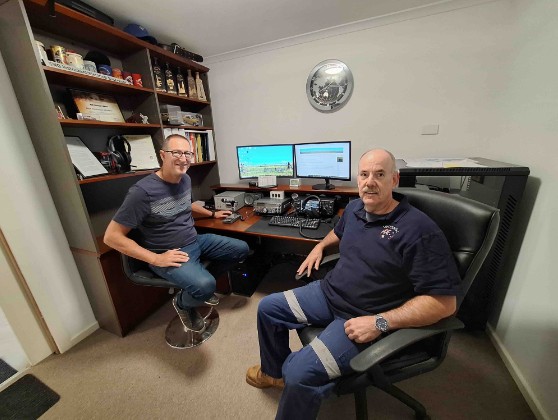
Here’s a photo of my buddy Mark VK5MK (RHS) and myself on the microphone (LHS) at his radio desk. Very neat setup! 73 David VK6KD
And from a listener in Hong Kong
Sometimes I am hearing the net here in Hong Kong. It is good net but missing is something found at other Morse clubs. Their members have unique member number each one and the number between stations is exchange at QSO.
But the CQQRS net has no member numbers to exchange to make better learning of Morse – I think you should give number. [Thank you to our listener in Hong Kong for the suggestion. I hope you continue to enjoy our net on Tuesday evenings.]
Hi from (off-the-air) Gerry VK3ZXC at Pakenham My apologies for being missing in action for a month or so; I have been swapping rigs between my car and my radio room.
The good news is that I now have 100W available but it seems my antenna will only resonate on the 14MHZ band. So my inside radio is a Yaesu FT891. I am disappointed with its performance, actually. The little Xiegu incorporates an ATU which works like a charm.
Tunes anythink [sic]. The FT891 on the other hand needs an expensive external ATU which is very pernicketi about what it tunes. My very basic dipole resonates perfectly on 20m but the tuner won’t tune it to any other band; I tell a lie; it does work for 28MHZ).
Ihave packed away the wee 20W Xiegu G90 (you say Xiegu, I say Xiegu) for future POTA or even SOTA use… well hopefully one of the many and sundry OTAs (I wanted to get up ARGOTA: Aussie Rules Grounds On The Air, but nobody was interested!) Anyway, my fingers are literally itching to get to work again so I am going to cajole my (non-ham) neighbour into footing the ladder while I fix that antenna and get back to all the bands, including 3.5MHz.
Thanks again for all your work with the Net/Club. Gerard Watts VK3ZXC at Pakenham PS: Are you by any chance a Latin scholar? I was thinking of doing a course in Latin, revisit my High School days.
[Thanks for the update Gerry; I hope you and your neighbour get your antenna sorted out – good excuse to share a beer afterwards anyway! !| look forward to hearing you back on air mate. Latin scholar? Heh heh…
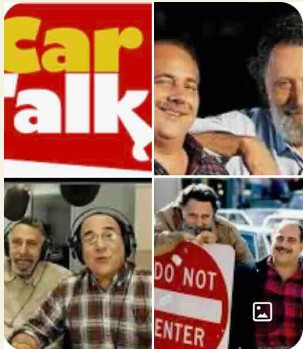
I’ma scholar of most things in life, and although I have a vague technical interest in etymology (that’s words, not insects by the way), the right side of my brain doesn’t work – so my signature block (blatantly stolen from the US National Public Radio show Car Talk) is both the length and breadth of it I’m afraid!]
Report Trouble
From Clive ZL1CJB Thanks for the very comprehensive report. Just to update your records I worked VKAPN and VK2WP last week on March 25TH. I tried your form but my antivirus didn’t like it. Keep up the good work! Regards & 73 Clive Brumby ZLACJB [Thanks Clive.
That’s really odd that your anti-virus got upset; being a passive Google Web-form. First time I’ve heard someone say they had an anti-virus problem. I wonder if it’s rejected a different bit.ly address previously and thinks it’s the same?
What anti-virus do you have and what indication did you get can you remember? If you like, I could send you the full Google Forms URL to try and / or use for future reports. Has anyone else had this problem with an anti-virus system?]
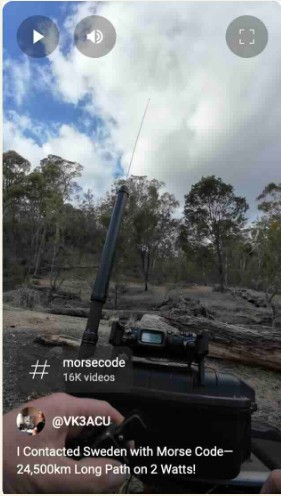
Really Really QRP
I Hear Tell…
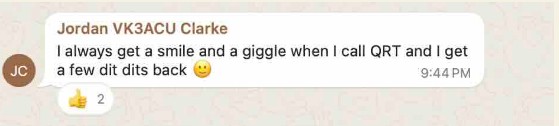
| wonder who it was that decided to watch Antiques Roadshow on television, in preference to getting on the CQQRS net on Tuesday?
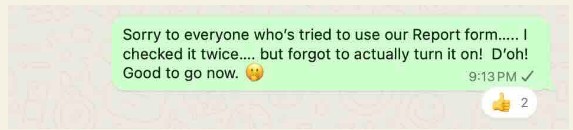
[And by the way, if you do go to use our report form and get the “…sorry, but I’ve now turned the form off for responses…” message, please send me a WhatsApp message, SMS and/or email so I can correct my mistake before anyone else has the problem…
Or worse, spits the dummy and takes their bat and ball elsewhere.]
[If you have some intel about other team members… or even yourself… that’s worth sharing, please let me know cqqrsnet@gmail.com J
Di-dah-di-dah-dit
So back to the CQQRS Slow CW QSO practice net.
Next Tuesday’s Net
Our CQQRS Group will be on as always on Tuesday from around 0700Z until about 1300Z; see https://bit.ly/CQQRSWebsite and navigate to the Net Details page for details.
Doesn’t matter whether you’re brand new and want to try just exchanging callsigns and RST reports, or you’re ready for a good old rag chew. We’ll have fun.
There’s usually people around until after 1300Z – so keep calling in the segment of the band designated in the table below until you catch someone.
I should be on as usual from home in NSW or via the Remote at Bedfordale WA, and I’ll also be watching the proceedings using the VK6QS and Tecsun SDRs in WA and NSW respectively. Hope to hear you there.
Reports
Please let me know via our Reports form bit.ly/CQQRSNET who you work or hear on Tuesday’s Group. The report form closes at lunchtime (Eastern Australian time) on Thursday.
Post Morsum
Richard VK6HRC will run our phone Post Morsum on the South West AllStar net (via repeaters and hotspots all over WA) from 0600 WA time, then from 0700 WA time on 80m (8605 LSB).
See https://bit.ly/CQQRSWebsite and navigate to the Net Details page for details of how you can connect via Echolink or even possibly via your local FM repeater.
Teamwork
Thank you so much to our team of 33 contributors: DL3YZ, 18/MOKBJ, MONNK, VK2GAS, VK2KI, VK3ACU, VK3AFH, VK3BGM, VK3BWN, VK3CTM, VK3DRQ, VK3ECH, VK3KEV, VK3KLE, VK3RU, VK38TBR, VK3ZXC, VK5AO, VK5CZ, VK5FD, VK5LA, VK6BEK, VK6HRC, VK6KD/5, VK6KHZ, VK6PZT, VK6QI, VK6RR, VK6WE, VK6YSF, VK7TA, VK7TO and ZL1CJUB.
Thank you team. GU CW on Tuesday, mb Mark Bosma VK2KI / VK6QI Beautiful South Bowning NSW mark.bosma@icloud.com non impediti ratione cogitationis
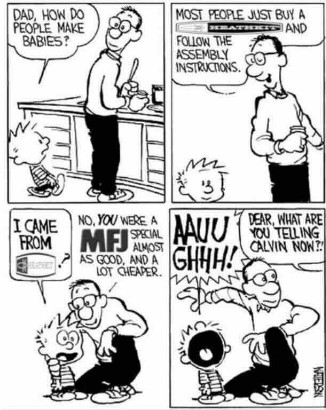

Thanks to John VK2EMF and the Wagga Amateur Radio Club’s QRM newsletter for this Calvin & Hobbs episode . —>
About the CQ QRS Net
For the current schedule and more information about the CQQRS net, please go the the Net Details page on our website:
The opinions expressed in the RagChew newsletter are those of the individual contributors. The opinions do not necessarily reflect that of the editor or of the CQ QRS Group members.
Any material and images received by the editor or published on the CQQRS WhatsApp groups may be published in this newsletter unless specifically requested otherwise.