Below is a reconstruction of the 2024 24 CQ QRS RagChew newsletter designed to support full text searching. This reconstruction was built using OCR, and will contain errors.
To view the Mailchimp original, click here. To search the entire newsletter archive, click here.
Contents
- Last Tuesday’s Net
- Reports
- New Team Members
- Reports & Comments
- Comments:
- Conclusion
- Ping-Pong CW
- reciprocal Callsign
- Meet and Three VE:
- by me (VK2KI / VK6Q)
- A Spanish QTC Peon
- roianu otation
- By Ross Waddams
- Brain Teaser
- Exam Questions:
- Answers from last week’s Quiz:
- Di-dah-di-dah-dit
- Next Tuesday’s Net
- Post Mortem
- Teamwork
- PSE QRS
- Landing Zone
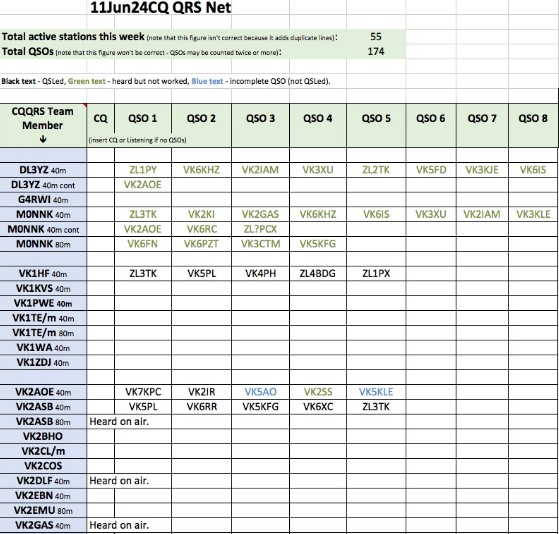
Last Tuesday’s net was another corker; we only had 39 known stations on, but most of us had lots of fun. This time we also had members listening in Germany (our member Mike DL3YZ in Oberboihingen (try sending that in Morse Code!) near Stuttgart) and the UK (Ross MONNK in Budleigh Salterton (that one too!) near Exeter) – both using the KiwiSDRs in Australia.
And what’s more, Ross joined us again for a late night (UK time) chat on our Post Morsum on Wednesday morning here. IIsn’t this just great?
Last Tuesday’s Net
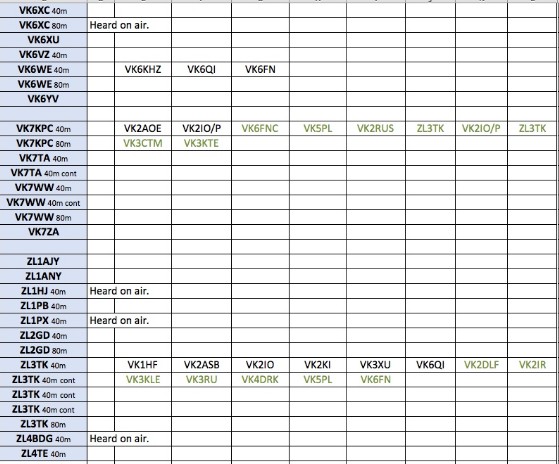
So here’s this week’s list of the 39 stations heard – and we know there were many more out there listening as well:
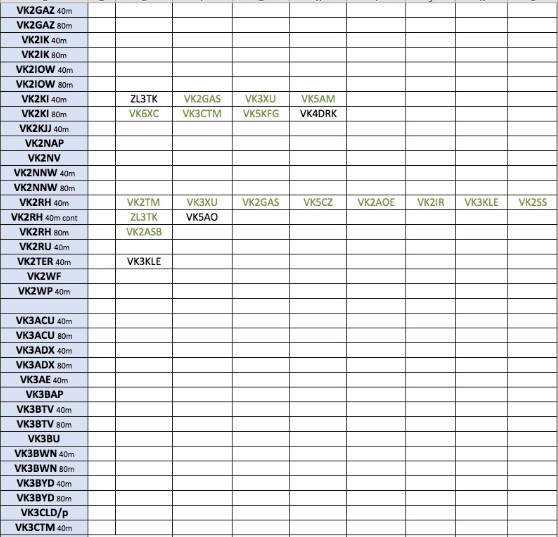
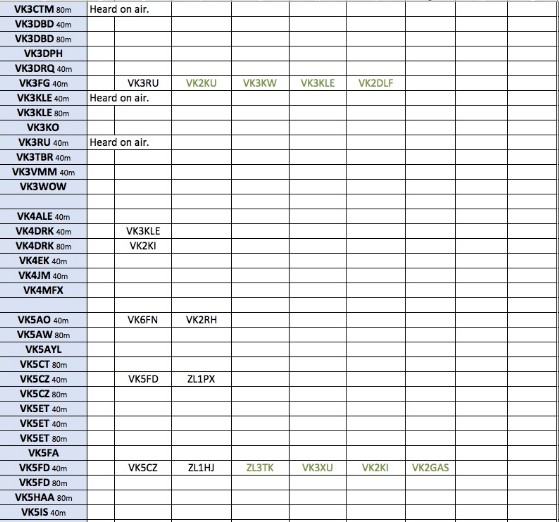
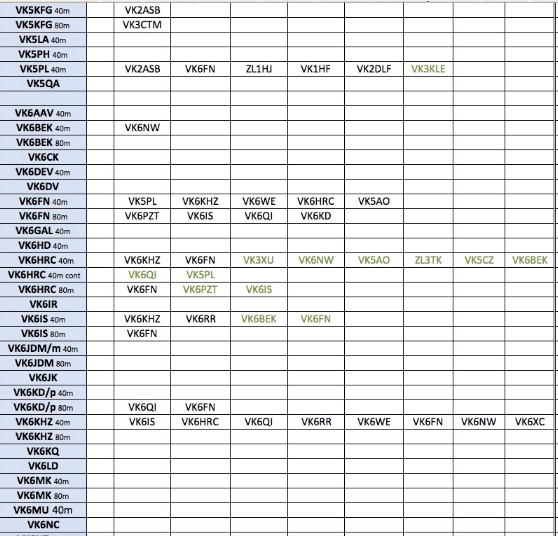
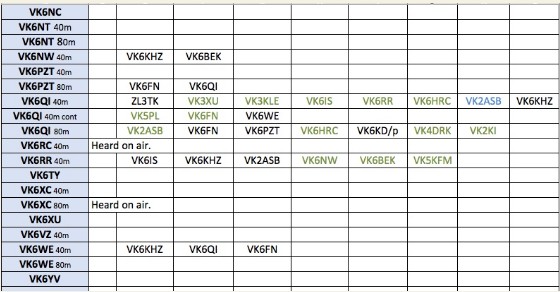
Reports
As always, please send me a list of who you worked and / or who you heard after next Tuesday’s net using our new web form here: bit.ly/CQQRSNET
Getting reports from stations and listeners is important to me – even if you listened and didn’t hear anyone or weren’t able to copy anything – the fact that you had a go needs to get recorded so we know that the net is working and attracting new and old team members to have a go.
Thanks again to Nigel G4RWI for building the Google Form, the Python software back-end that does the processing, the link and the QR code.
New Team Members
This week I’d like to welcome Bob VK4RT at Coomera near the Gold Coast who joined in the fun last week. And welcome to Stephen VK2RH who really got among i on Tuesday this week as you’ll see in the log above, and reported below.
Stephen has an interesting website: https://vk2rh.com/about/ – and, like a number of our team, is also interested in code-breaking… and lots of other things. Welcome to the team gents.
Cheers, mb Mark Bosma VK2KI/ VK6QI Beautiful South Bowning NSW mark,bosma@icloud.com ‘on impecst rations cogiationis
Reports & Comments
The spreadsheets above show the known stations on last Tuesday’s net. Comments distilled from the reports I’ve received are below:
Comments:

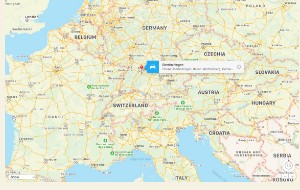
[40m] ¢ Was great fun hunting SWL down under 🙂 ¢ All OPs did a great job
[Really pleased that you found the KiwiSDR and had some fun Mike – terrific to get our first report from Germany. As it turns out, we have a house sitter for next week who comes from Langenau…. so there you go!]
[40m] + Met Peter ZL1PX tonight on CW from ZL. He had only been CW few yrs – doing very well
[40m] + Met Peter ZL1PX tonight on CW from ZL. He had only been CW few yrs – doing very well ¢
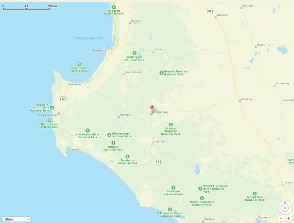
[40m] ¢ Good sigs and band not too bad ¢ Only had time for a quick couple of QSOs before ducking off to SES training.
[40m] + ZL3TK was first out of the gate, calling CQ at 0701 UTC + He was quickly answered by VK2KI + They did a successful “This day in history” + That’s a tough head copy task!
You guys in the southern hemisphere don’t seem to suffer from QSB – “This day in history” would be a nightmare with the frequent QSB we get up here + I could hear VK6KHZ near Perth (rather weak but readable) on a Sydney webSDR + That was a nice example of long range propogation using modest power, and would’ve made an enjoyable challenge for one of the more experienced east-coast operators
[80m] + Slow and accurate Morse * Apleasure to listen to
[40m] ¢ For the first two or three hours of the net there were quite a few stations with solid signals, but I was too busy cooking dinner!
Lesson from my first QRS Net is the early bird catches the contacts ¢ There were still QRS signals on 40m after 1000Z but they were harder to dig out with my very compromised dipole ¢ Great fun all the same!
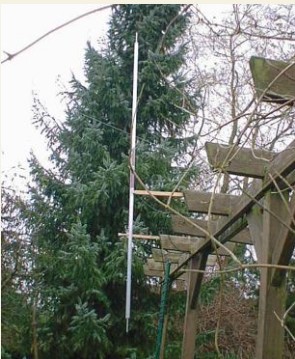
[40m] * Tried my AOE monster pile of junk and had no joy * The QRP Labs QCX mini (5WATTS) got me to TASSY and VK7KPC in Evandale ¢«
[40m] * Sorry had to leave early! NAlorking three ctatinne and hearing throaea more – nretty qnnd for having tn loaave early
• Had a go at CQ ping pong with Mark + Lots of head-copy fun + Worked up from 3 letter words to 5 letters words then my head exploded * Back to downward dog for me! [Thanks for being the first to try Ping-Pong CW developed by Claude VK1TE / VK2CL Richard.
I really enjoy the exercise – it’s great fun eh? I recommend it for anyone who’s got the hand-written code going well and would like to try head-copy. And!
Think Richard as a sonographer, is referring to downward dog the yoga position that places your heart above your head, allowing gravity to increase blood flow and improve your circulation.]
— BAUR WY UUWIIWald Uy IU Te [Thanks for being the first to try Ping-Pong CW developed by Claude VK1TE / VK2C! Richard. I really enjoy the exercise – it’s great fun eh?
I recommend it for anyone who’s got the hand-written code going well and would like to try head-copy. And! think Richard as a sonographer, is referring to downward dog the yoga position that places your heart above your head, allowing gravity to increase blood flow and improve your circulation.]
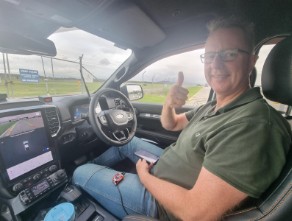
SI I ¢ Had a really nice night working from the car by the lake ¢ Nice to see so many ZLs on!
[40m] + Arguably one of the poorer nights, trans-Tasman propagation wasn’t playing ball at all + Fruitful in that a successful two way ‘Today in History’ QSO with VK2KI was heard by a number of others, including OM Ross MONNK via SDR – well done!
[80m] * Could hear (and see) a significant number of stations via SDR on 80 m but not a whisper to be heard direct, ie much worse than the already poor 40 m * Called CQ for 20 minutes, however as expected no QSOs resulted Thanks for the fun This Day in History Stan.
Well you did work me in WA – onditions couldn’t have been too bad!]
[40m] + Plenty of action on 40 + The noise was there but at this QTH it wasn’t too bad + It’s good to hear so many new ops on air + Hoping we will eventually get back to the situation where you could go on air at most times and have a chat on CW
[80m] + The noise on 80 was exceptionally high + It wasn’t the usual white noise but a sort of motorboating + I’ve heard this noise before and it was associated with solar activity + Didn’t hear any stations, didn’t even hear the BMARC SSB net but I was very late going over to 80 and the net could well have folded by then.
[Hi Arthur – yes, it would be nice for CW operators to be there all the time… togethel we’re heading in the right direction.
| suspect what you were hearing on 80m was Auroral activity; we’ve had it quite often at the sunspot cycle peak during the net.]
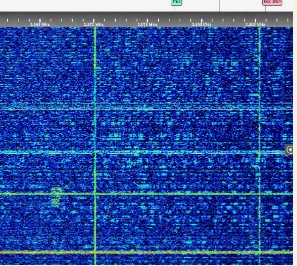
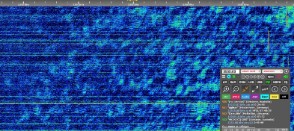
[40m] + Very quiet in WA to start with. So I monitored the Eastern States on the ironstone range KiwiSDR – good copy practice. + When the band improved I went back to my home set up.
+ I had fun listening in on Stan and Mark doing a this day in history exchange – I managed to decode bits and pieces by head-copy but I could not keep up!
[80m] + Called it quits after working Max; my sending was deteriorating rapidly! [Uh-oh! I’ve been dobbed-in for sending too fast… or more importantly, not leaving long enough spaces between letters! I try to keep the pace down 1.
Because there’s always people listening who are trying to learn and be encouraged to have a go on air, and 2. because my receiving / decoding has always been woeful, Point taken mate – thank you.
And welcome to the CW fist fatigue club mate; my hand keying often gets pretty ragged around the edges (er, and in the middle) after six or seven hours on our net.)
• I turned on the rig just to check the band and ended up talking to three stations tonight «| must be getting more confident; I even exchanged a couple of words in
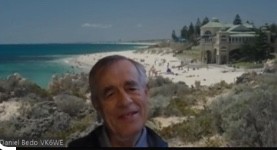
[U’étais heureux d’échanger quelques mots de frangais avec toi Daniel. Merci beaucoup Monsieur]
• Next time I’l try it with QRP + It was maybe not the best condx, but it was still workable
[80m] + After calling for a little bit, Mark came back + Perhaps not the best conditions, but again, it was still workable! Thanks everyone From me VK6QI at via the VK6SR Remote and VK6QS KiwiSDR
[40m] + When I fired up the VK6SR KiwiSDR at Brookton and the Southern Electronics Group Remote HF station at Bedfordale, I heard Stan ZL8TK at Waitdrere Beach chatting to Drew VK3XU at Wonga Park.
+ Ialso heard Paul VKSKLE at Stawell, Richard VK6HRC at Padbury and Peter VK6IS at Wundowie chatting to Roy VK6RR up at Geraldton.
+ I then tried calling Arthur VK2ASB at Wentworth Falls without success, but went on to have a nice chat with Ron VK6KHZ at Yangebup.
+ I could see that while I was using the Remote, VK6ANB was listening in for quite a while; does anyone know his email address so I can invite him join in in future? + I then listened to David VKSPL at Williamstown chatting to Arthur then Max VKGEN at Manjimup.
+ also listened to Ron chatting to Roy before I attempted to work Stan. + We experienced apparent grey-line one-way propagation (see previous RagChews for analysis and hypotheses about this ionospheric phenomenon that we have often experienced on our net) and although Stan was a comfortable RSN 531, he was struggling to respond with RSN 311, and resorted to one of the KiwiSDRs to copy me.
+ After that I caught up with Daniel VK6WE at Cottesloe for a nice chat before I disappeared for dinner with our house guest from Germany.
[80m] + When I returned from dinner, I slid down to 80m to see if we could stir up some fun. + The VK6SR Remote station was a bit more cooperative this week, and allowed me to get a usable but variable SWR on 3565KHZ.
+ First up I heard Arthur VK2ASB at Wentworth Falls working our new member Ben VK6XC at Forresttield. + Interestingly, I could hear Arthur coming in to WA from 1700KM away, but not Ben (who was running only 5 Watts) over 25KM; however, listening from home in NSW I could hear Ben, but not Arthur.
+ Next I listened in to Max VK6FN at Manjimup chatting to Richard VK6PZT at Dalyellup then Richard the Second VK6HRC at Padbury while I chatted to Richard.
+ I thought I’d see if Richard was interested in having a go at Claude VKITE’s creation – Ping-Pong CW a head copy exercise (see later in this newsletter); Richard was worried and told me that his head-copy ability was not good… but I insisted…
And I think we had a ball. * We started exchanging three letter words and while he wasn’t looking, I notched it up to four letters per word. + Soon Richard asked for fives! So much for his head copy being poor!
Anyway, about 45 minutes later (!) we gave it away! This is a terrific exercise created by Claude that I highly recommend for people who would like to start moving from hand-written copy to head-copy.
+ When Richard’s brain was suitably deep-fried, we gave it away and I said g’day to Max who had been listening in; Max offered up the “I have to go cook dinner” excuse when I challenged him to try the Ping-Pong CW… but I knew it will hannean hefnre Inn
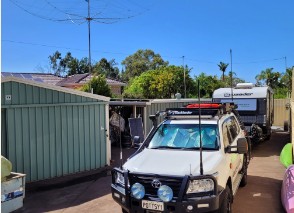
• After Max I was called by David VK6KD/P, using his mobile whip antenna from 126KM East of Karratha – mid-way to Port Hedland. « David was a steady RST 549 over the 1300KM path and we had a nice chat.
• David reported nothing but rain, rain, rain on the first segment of his, around-Australia journey; I hope they will have had enough rain by the time they get to the Northern Territory and will have fine weather for the rest of their travels around; it’s no fun in a caravan when it’s raining…
And makes much of the North and inland inaccessible. + David went on to chat to Max – who was tickled pink when talking about about the long-haul QSO to David’s mobile station on 80m the next day on AllStar.
+ It was quite funny – when I started writing this on the day after the net, Iwas listening to Max on the WA AllStar network telling Bob VK6KRC about his terrific contact with David over 1700KM during the net; and just then, up popped a WhatsApp message from David saying they’d arrived in Port Hedland, and that he could hear Max on the VK6NAD AllStar node on 2m – but couldn’t access it to share the glory!
+ Later on Tuesday while working Derek VK4DRK at Wyreema from my home in Vk, I could hear us both coming through into WA around S5; so the band was nicely open across the continent at that late hour.
Around-Australia journey; I hope they will have had enough rain by the time they get to the Northern Territory and will have fine weather for the rest of their travels around; it’s no fun in a caravan when it’s raining…
And makes much of the North and inland inaccessible. + David went on to chat to Max – who was tickled pink when talking about about the long-haul QSO to David’s mobile station on 80m the next day on AllStar.
+ It was quite funny – when I started writing this on the day after the net, Iwas listening to Max on the WA AllStar network telling Bob VK6KRC about his terrific contact with David over 1700KM during the net; and just then, up popped a WhatsApp message from David saying they’d arrived in Port Hedland, and that he could hear Max on the VK6NAD AllStar node on 2m – but couldn’t access it to share the glory!
+ Later on Tuesday while working Derek VK4DRK at Wyreema from my home in Vk, I could hear us both coming through into WA around S5; so the band was nicely open across the continent at that late hour. Also from me VK2K{ at Beautiful South Bowning
[40m] + I had less success on the net from home and using the Tecsun KiwiSDR at Araluen also in NSW, than using the KiwiSDR and Remote in WA.
+ From the start I hooked up with Stan ZLSTK in Waitdrere Beach and we had lots of fun exchanging a This Day in History message each way. + And just to make it more challenging, Stan asked me to send back what I’d received from him for marking and evaluation.
+ I missed an i from the word Louisiana (QSB2), but Stan gave me an A-minus report card, so I was happy. + Stan also had fun following my slow-drifting TS-120S; a minor fault since I bought it new back in the mid-70s…
I’ve got the replacement VFO capacitor somewhere safe still… hope… i’s only been nearly 0 years since I bought it! One day.
+ It also started raining here, so the impedance of my temporary feeder ribbon which is supported for some of its length by rope was changing – requiring a couple of re-tunes of my antenna coupler.
+ In parallel with my conversation with Stan, I could hear Armin VK2GAS at Norwest just finishing up with another ZL – but listening to them while trying to work to Stan meant I missed the other callsign.
+ Ialso heard May VK5AM working Drew VKSXU before I fired up the WA equipment where I was kept busy on 40m.
[80m] + When I returned from dinner I listened to Tony VK3CTM at Junortoun near Bendigo chatting to Greg VKSKFG just South of McLaren Vale at Willunga, before I got busy on the Remote and KiwiSDR in WA.
* When I came back to listen on my home transceiver and the Tecsun SDR at Araluen NSW just before hitting the hay, I heard Derek VK4DRK up near Toowoomba calling, and had a nice late-night chat to him from home before giving it away around midnight.
Conclusion
• Sonciusion: * So I had fun – as usual. + I enjoyed hearing a number of people on 80m again, had a ball with the Ping-Pong CW exercise with Richard VK6PZT, and enjoyed the challenge of the This Day in History exercise with Stan ZL3TK.
¢ Thanks to everyone for making our net work so well.
Max in Manjimup enjoyed the CQQRS net on Tuesday, stayed up later than normal working as many stations as possible and got rewarded with a contact with David VK6KD up in Karratha on 80MX.
Stan did not do too well with poor propagation but when conditions allow he would like to encourage us to get past the rubber stamp hello goodbye exchange (ideas, thoughts appreciated).
To expand on that theme Mark has been actively involved with the ‘This day in history’ exchange and the fun Ping Pong exercise, more details ina future RagChew.
Ross commented on the big difference between monitoring the bands from home as ‘opposed to logging on to the VK SDR online nodes. He has also been pressured into providing another article for the RagChew on this when he has time.
The net went for approx one hour and was very enjoyable as usual. 73 Richard VK6HRC [Thanks Richard – well done again mate.
Ross responded very quickly and by the end of the day I had another article from him – discussing how CW goes in Europe compared to Australasia. But I’ve run out of room again, and it’ll have to slide to next week. Thank you my friend – excellent work]
Ping-Pong CW
Claude VK1TE / VK2CL has come up with an innovative and really fun way of helping CW operators start the transition from hand-copying CW (je writing down each letter as it’s received) to head-copying (je listening to the CW and assembling the letters into words and the words into sentences without writing anything down.
Claude manages to do this when he’s on air while driving! Claude and I have done the exercise a number of times and found it to be not only good practice, but hilarious. Every time we tried it, we both came away grinning from ear to ear.
As I said above, the first public beta-test was this week with Richard VK6PZT who thought his head-copying wasn’t good enough… but ended up with that same silly grin after over 45 minutes of fun!
Claude has taken the time to write up a full article on the exercise, but I can’t fit this week’s edition – so it’ll wait until next week. But in the mean time – here’s the idea: in * We have 2 correspondents, A & B. + They agree to PPCW, three letter words.
* After callsigns are sent, A sends her first three letter word: DOG * B replies with: DOG, followed by his own word: CAT.
+ Asends: CAR (Error: should be CAT), then sends her new word: ROW * B sends: ROW then sends the word CAT again because A got it wrong the first time (he might have to resend the word CAT several times until she gets it right) * Asends: CAT, which is now correct, and sends: PIG + B sends: BIG (Incorrect), followed by: TOW + Asends: TOW and resends: PIG + B sends: ?, asking for a repeat.
* Arepeats: TOW and resends: PIG * B sends: PIG followed by: RIG… and so on until one correspondent says they’ve had enough, or wants to increase to four, then five letter words, or perhaps two words then three words per phrase.
+ Remember to identify every 10 minutes… the session can be five minutes or 60 minutes long – you’ll be amazed how addictive it is! That’s about it!
It sounds simple – but it’s actually quite challenging – not only to head-copy, but to remember what you sent so you can pick up errors, and all the while thinking up the next word. People in their shacks inevitably end up sending things they can see…
KEY, MAN, VOX, OFF, PTT, GAIN, TUNE etc – when Claude and I practiced, he was in his car so we got lots of AIR, HOT, TEMP, HEAT, COOL, HORN, GEAR, HAND, LEFT, OPEN, RIGHT, BRAKE, PEDAL, CLOSE, etc! So who’s ready to give this a go on a Tuesday night?
If someone asks, and you’re not ready, signals aren’t good, or you need to take a break – just say NO TKS. But if you want a real laugh – have a go! PPGW anyone?
reciprocal Callsign
The readers of RagChew might be interested to know that I’ve been incorrect in using the callsign MONNK when routing through the VK6-HUB for the Post Morsum net.
My Echolink signal is being broadcast on local repeaters in Western Australia therefore I should properly be using the callsign VK/MONNK.
That’s a bit of a mouthful so please bear with me – I want to operate correctly in accordance with my license and the Australian regulations. The same applies if I use any remote access radios in Australia.
Now…. the WA AllStar net is also usually connected to a node in New Zealand, another one in the US, and another in the UK! How many prefixes will you need – heh heh!
I suspect that no one is willing to ask the question of the Australian regulator (Australian Communication and Media Authority)…
Because there’d be a high risk that a decision-maker without knowledge of amateur radio might decide that things like the AllStar network must not cross outside Australia, must not be
Operated by people not in the country and that the network must not be connected to (allocated license) repeaters and (non-allocated license) local hotspots.
I’ve had a career in an arm of Government, and my comments aren’t pointed specifically at the ACMA – any Government policy-maker could be make the same decision given the information to-hand; that’s just how it works.
Sometimes it’s better to not ask a question if you’re not prepared for the answer! The WA AllStar network is used several times every day by overseas amateurs – mainly from the US and the UK – either by the operators having an AllStar node of their own (like me), using their DTMF microphone to command a connection from their local repeater to one of the nodes in the network, or by using Echolink to connect to an AllStar node in the network (ie *VK6-HUB* or the node I built to connect the Mandurah WA repeater VK6RMH to the network).
I have not heard many (or even any) of those operators using the reciprocal callsign V/xxxx. However comma, that being said, when I pull my finger out and give you the info you need to connect to the Southern Electronics Group Remote HF station as requested, you would then most definitely use VK/MONNK as your callsign to transmit on HF….
Or do what Gary WAGAL and I both do, have a separate VK6 callsign… it’s much easier and causes much less confusion in CW…. just ask Nigel G4RW/I about the fun and games he had here when operating on the CQQRS net for the six months that he was here!
Good questions well asked Ross – thank you,]
Meet and Three VE:
In amateur radio speak, ‘Meat and Three Veg’ translates to Name, Location, Rig and Weather. As astutely pointed out by Ross MONNK on this week’s Post Morsum and paraphrased here, in Europe this bland diet is served up with many variations due to the huge population and multitude of languages.
However, in the relatively confined geography of Oceania, that unwavering diet can become boring rather quickly. The same limited number of operators dishing up their unchanging ‘Meat and Three Veg’ month-after-month provide scant opportunity to learn new facts, improve thinking and muscle dexterity, or develop new skills.
Hence the introduction of activities such as ‘Chinese Whispers’ and ‘Today in History’. These have been conducted at a remarkably consistent, considerate slow speed to conform with the CQ QRS Group paradigm, but have shown disappointing levels of participation.
Some operators even seem to actively avoid such opportunities yet no one has come up with any better ideas … so far. Now is your chance to have a say, tell us what you would find sufficiently attractive to justify stepping outside your self-limiting comfort zone.
Please send your ideas to Mark at cqarsnet@gmail.com and the me at ZL3TK.radio@gmail.com [Thanks Stan. Ross MONNK’s discussion about European vs Australasian CW ops will be in next week’s RagChew. Thanks for your thoughts again Stan.
As you know, I’m just overjoyed that our net attracts people to have a go – either for the first time or after they’ve become rusty – and if meat and three is what kept the net growing for three years, then so be it.
However, I agree that our team may have ideas to make the net work better for everyone; the move to 40m, and the ZL-friendly start time are both good examples of where my old-factory thoughts were overtaken by much better ideas.
I used to be in the business process improvement world toward the end of my career so there’ll be no ‘change just for change sake’ – most people don’t like organisational or process change, but I’m hoping for some fresh ideas that help us better meet our goalls, as long as our fundamental raison d’etre remains…
Providing encouragement and an opportunity for new and rusty operators to get on air in a safe supporting environment supported by experienced operators willing to help. So – thoughts folks?
What would you like to see happen that would enhance our goals, grow the net and keep old operators interested?]
by me (VK2KI / VK6Q)
Today on the Southern Electronics Group email group, a member posted a link to a YouTube video about Artemis – a multi-platform application (even runs on Mac) that brilliantly allows users to identify the multitude of strange signals heard (and seen or HF, VHF and UHF bands).
Https://youtu.be/W_8Y_ 4FvoHI?siz=CFUO43rE5huGY0eE So things like different forms of analogue and digital transmissions, over-horizon radars, etc can be viewed and heard, and even looked up on a database by frequency. So many toys, so little time…
Wish I was retired…. hold on, I am! Hmmn
A Spanish QTC Peon
There’s always time to learn lessons and have a laugh. Some folks may have noticed OM Manny VKDRQ plodding away in the Group last Tuesday week working five stations. He is such a gentleman, a rare Old Timer with the patience of a saint!
He richly deserved a note of appreciation so a QTC in his native language, or at least an approximation of it, was sent to him on the 20 m VKCW Net.
NR76 R ZL3TK 28/26 WAITARERE 0544Z 5JUN24 = VK3DRQ = GRANDE ESCUCHAR A EL SENOR PACIENCIA Y SU ALIADO CERCANO EL. SENOR TRABAJOCONFIABLE MIEMBROS DEL GRUPO CQ QRS ANOCHE DETENTE SU APORTE ES LO MAS VALIOSO = ZL3TK
K It was composed with only seconds to spare before the net started on Wednesday at 0608Z_ on 14.049 MHz – so there was no time to fine-tune the code to Spanish characters. The N in SENOR was sent as -. instead of –.– (N tilde).
If it is possible to hear tears of joy over the air then this was it. OM Manny expressed most eloquently his deep gratitude… “from my heart” in CW of course!
But like any operator worth his salt, and let’s face it, OM Manny’s experienced plenty of salt in his maritime travels, that didn’t stop him from pointing out two identical mistakes, one in each instance of the word SENOR.
It’s fair to say both parties got a rather big thrill from making a simple change to the usual traffic protocol on the 20 m VKCW Net.
Translation: GRAND TO HEAR MR PATIENCE AND HIS CLOSE ALLY MR RELIABLE WORKING CQ QRS GROUP MEMBERS LAST NIGHT STOP YOUR CONTRIBUTION IS MOST VALUABLE. And the lesson to be learned? Don’t be afraid to innovate.
[Thanks for the nice story Stan, and congratulations to you, Manny and the numerous other OT CW Ops who enjoy helping us young whipper snipers learn and practice the art of CW]
The SKCC Oceania QRS Saunter will take place this Saturday, 15TH June, 2024 from 00:00 UTC until 11:59 UTC a 12 hour event. All are welcome to join in!!
All the details for the Oceania QRS Saunter (OQS) can be viewed on the SKCC website at: https:/Awww.skccgroup.com/operating_activities/oqs/ Please make use of the SKCC Sked Page and the CW Club RBN Spotter.
Https://sked.skccgroup.com/ https://rbn.telegraphy.de/ I look forward to contacting you during the event.
Best regards, Garry VK2GAZ/VK2ZP #5460C Manager – SKCC Oceania QRS §
Best regards, Garry VK2GAZ/VK2ZP #5460C Manager – SKCC Oceai
Nic VK7WW runs a Slow Morse training net every Wednesday at 7pm EDST on 3580 for 30 mins. He uses the callsign of the Northern Tasmania Amateur Radio Club VK7TAZ on that net.
Many of our team learned Morse code with the support of Nic, and the weekly training session comes highly recommended for anyone who wants to learn the Code, or simply brush up. Everyone’s welcome – 3580KHZ at 7pm Eastern time every Wednesday.
The NTARC also feeds the CW live via the Discord phone / computer audio stream, and previous weeks’ recordings are available. Contact Nic VK7WW for more info nicholaschantler@hotmail.com – or just join in on Wednesdays.
roianu otation
By Ross Waddams
NF ae Narre hrethenestnnare MONNK I’ve just come back from a few days camping on the Lizard peninsula, in Cornwall in the far south-west of England (as far south as we can go before getting our feet wet). In radio terms, the Lizard is notable for two things:
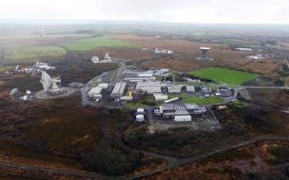
• the Goonhilly Satellite Communications Earth Station (unfortunately not open to the public), and ¢ the Marconi sites at Poldhu and at Lizard Point.
On a previous holiday I visited the latter but that will have to be the subject of another article. This time I visited the site at Poldhu where Marconi did his first trans-Atlantic experiments.
Fifty acres of land were bought in 1900 and initial construction work finished in January 1901.
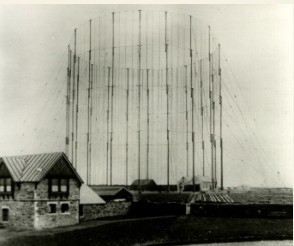
The original 20 mast circular cone shaped aerial was destroyed in a storm on 17 September 1901.
For Marconi’s trans-Atlantic experiments, a temporary installation of two 61 m masts with a fan shaped aerial was used. The transmitter operated with a power of roughly 13 kW and a wavelength usually estimated at 366 metres.
Marconi and two assistants travelled to Newfoundland in December 1901 and on 12 December the pre-arranged signal of three dots (the letter ‘s’ in Morse code) was heard by Marconi on Signal Hill at St John’s, Newfoundland, Canada.
By early 1902 the temporary masts were replaced with a four lattice wooden mast design, at 850 kHz and 25 kW. Poldhu also communicated with deep sea shipping using the callsign MPD and also transmitted a regular nightly Morse code news bulletin using the callsign ZZ.
This was used by liners to print daily newspapers, whose owners paid for the copyright.
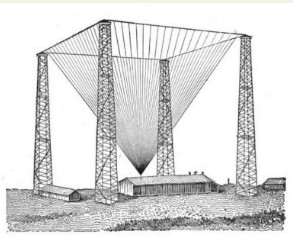
The Poldhu station was taken over by the Royal Navy during the First World War. “What has all this got to do with Australia?” I hear you say. Well…
In 1923 and 1924 Marconi used Poldhu for further shortwave experiments, to his yacht off the Cape Verde Islands in the Atlantic and to Beirut in Lebanon.
The success of these experiments took the world by surprise and quickly resulted in development of the directional Beam Wireless Service for the British General Post Office.
The service opened on 25 October 1926 (beaming to Canada), followed by the Tetney Beam Station (situated near Grimsby in the north-east of England) sending wireless telegrams to India and Australia starting on 8 April 1927.
The receiving station was 40 kms south, at Winthorpe (near Skegness). I can highly recommend looking at his webpage as there are some excellent photos of the installation at Tetney.
Https:/Awww_britishtelephones.com/cto/tetney.htm#:~:text=Tetney%20Beam %20was%20the%20transmitter be%20isolated%20before% 20worked%200n.
At the Australian end, the corresponding beam stations were at Ballan (tx) and Rockbank (rx) 80 and 60 kms west of Melbourne (they also beamed to Canada). After almost 90 years both of these sites are mostly intact.
Australia had other beam stations; there’s a very interesting article about them at https://bpadula tripod.com/australiashortwave/id55.html Poldhu continued to operate as a research station until 1983.
The site was cleared in 1935, but a granite monument was erected in November 1987 by the Marconi Company.
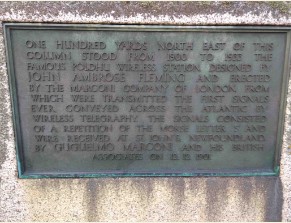
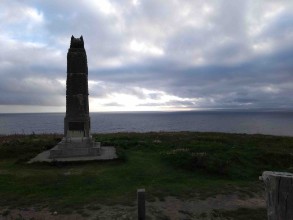
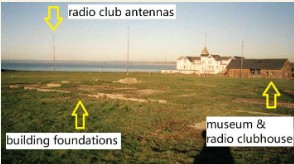
A number of concrete foundations and earth structures also remain. In 2001 the museum building was erected. It is also the clubhouse of the Poldhu Radio Amateur Club who man the museum.
[Wow – thank you Ross – another fantastic article about a historic site with links to VK/ZL. Looks like a great site for an International Light Houses and Light Ships https://illw.net/ activation in August mate!
And what a terrific idea for an amateur radio club station to use a historic site, in return for volunteer support. In Australia, similar arrangements exist for some AR Clubs eg the WA VHF Group at the Wireless Hill museum and the Northern Corridor Radio Group at Whiteman Park, the HMAS Vampire radio room at Darling Harbour NSW that we heard about recently, and probably a myriad of others in VK and ZL thai I can’t recall off the top of my head…
But I know if at least one amateur radio club in Australia that’s looking for a home like that.]
Next week, Ross will tell us about what he found in the Poldhu museum. If you’d like to contribute something like Ross’ superb article to the weekly RagChew newsletter, please let me know so we can share more thoughts and ideas; email to cqqrsnet@gmail.com

Brain Teaser
Jules Perrin JP VK3JFP has created a terrific resource to help guide learning for all levels of amateur radio licenses: https://Awww.julesworkshop.net/Amateur%20Radio.html With thanks to Baz VK6MU for he idea, and Jules for the good learning website, here’s this week’s quiz questions from Jules’ Workshop example test questions:
Exam Questions:
What does the term USB LSB mean? To convert alternating current to direct current, use is made of a: * thermister * resonant circuit * diode * carbon resistor A 10.7MHz first stage IF is commonly used in VHF receivers to: * provide a high degree of adjacent channel selectivity * reduce noise generated in the receiver * achieve the high gain required * provide an adequate degree of image rejection The “Q” code signal “QSY 3575” means: (a) Emergency traffic is being received on 3575 kHz (b) Please change the frequency of transmission to 3575 kHz (c) Please send a series of Vs (d) Your exact transmitting frequency is 3575 kHz Answer: (b) Please change the frequency of transmission to 3575 kHz eve it’s outside our chosen CQQRS band segment.
Answers from last week’s Quiz:
To transmit information over a distance, a carrier signal needs to be modulated in some way. The two common ways this is done is by AM and FM. What do these terms mean and how does it work?
Answer: AM amplitude modulation is where the amplitude of the carrier wave changes in sympathy with the voice modulation. FM frequency modulation- frequency of the carrier wave changes in sympathy with the voice modulation.
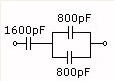
The reactance of an inductor ¢ increases as the applied frequency rises ¢ decreases as the applied frequency rises ¢ decreases as the inductance rises ¢ is proportional to the current flow Answer: increases as the applied frequency rises The total effective capacitance of this circuit is:
400 picoFarads 800 picoFarads 200 picoFarads 3200 picoFarads
Severe static is harming reception. The appropriate “Q” code to use would be? (a) QRM (b) QRN (c) QSB (d) QRO Answer: (b) QRN How did you go?
Di-dah-di-dah-dit
So back to the Slow CW QSO practice net.
Next Tuesday’s Net
Our CQ QRS Net will be on as always on Tuesday from around 0700Z until about 1300Z; see below for details. Doesn’t matter whether you’re brand new and want to try just exchanging callsigns and RST reports, or you’re ready for a good old rag chew.
Post Mortem
Richard VK6HRC will run our Post Morsum on the South West AllStar net (via repeaters and hotspots all over WA) from 0600 WA time. If you’re in WA, all you need is an FM 2m or 70CM transceiver and an AllStar node nearby.
If you’re elsewhere in the world, you may be able to connect your local AllStar-enabled repeater to the net, or you can connect via Echolink. Let me know (cqqrsnet@gmail.com) if I can help with that.
Teamwork
Thank you so much to our team of 26 contributors this week: DL3YZ, MONNK, VK1HF, VK2AOE, VK2ASB, VK2RH, VK2TER, VK3FG, VK3JFP, VK4DRK, VK5AO, VK5CZ, VK5FD, VKS5KFG, VK5PL, VK6BEK, VK6FN, VK6HRC, VK6IS, VK6KHZ, VK6NW, VK6PZT, VK6RR, VK6WE, VK7KPC, ZL3TK.
And special thanks to Ross MONMK for his very interesting article on Poldhu Station. Thank you team. GU CW on Tuesday, mb Mark Bosma VK2KI / VK6QI Beautiful South Bowning NSW mark.bosma@icloud.com non impediti ratione cogitationis

An Ode to CW – thanks to David VK3RU: In days of old, when ops were bold, And sideband was not invented, Words were passed by pounding brass, And all were quite contented. – Unknown author
PSE QRS


Landing Zone