Below is a reconstruction of the 2026 24 CQ QRS RagChew newsletter designed to support full text searching. This reconstruction was built using OCR, and will contain errors.
To view the Mailchimp original, click here. To search the entire newsletter archive, click here.
Contents
- CQ QRS RagChew
- Dah-di-dah-di-dah
- New team Members
- Website
- Post Morsum 10th June 2026
- Reporting
- Packing Light
- But Wait, There’s More
- The Secret: USB-C PD and the Trigger Cable
- How it Works.
- Final Thoughts
- QRZ?
- I’m Not Much of a Talker
- QRZ? Who’s on the other end?
- CW Practice
- Other News
- Updated Call Sign Directory
- 2026 VKFF National Get Together
- October – Sunday 1st November 2026 – Albury, New South Wales
- Morse Training Net
- Semi-Submersible Benreoch
- Green Men – Dual-Band Portable
- Readable Five
- The Beechworth Telegraph Station
- There’s No Such Thing…
- Question:
- Answer:
- Prosign/Character/Signal of the Month
- Di-dah-di-dah-dit
- Next Tuesday’s Net
- Reports & Photos
- Post Morsum
- Articles
- Material
- About the CQ QRS Net
CQ QRS RagChew
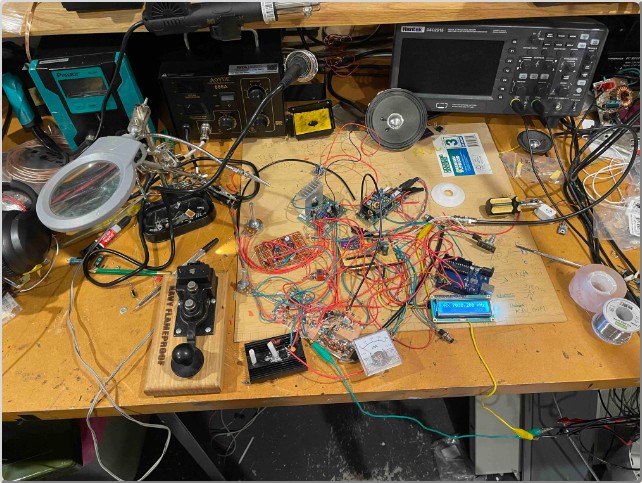
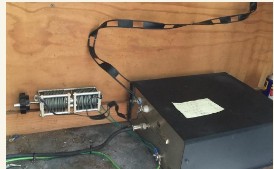
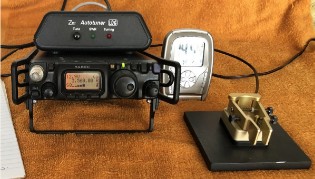
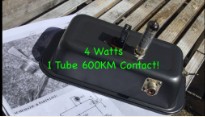
Thanks this week to George VK2AOE for sharing his latest and most neatly laid-out transmitter. Some of us heard this little device in full flight on last week’s CQQRS net – including George’s comment to Maitland “I just need to put it in a box”.
Another Venus & Mars in the Ham Shack opportunity here I think?
Dah-di-dah-di-dah
‘So much activity this week on our CQQRS Slow CW Practice QSO net on Tuesday… busy, busy, busy! There was a bunch of our team on 20m this time, including for the first time, Carlos CT7BPF from Lisbon Portugal who has been one of our CQQRS family for some time.
Funny that the popularity of the DXperiment can make things challenging – c’est la vie with skip distances on 20m; there were lots of our team on 20m who couldn’t hear each-other.
So I was pleased to hear David VK3DBD send “DOWN 2 DOWN2” when responding to a call from another Oceania station. Keeping the sked frequencies clear of local QSOs is important – especially when the 20m propagation characteristics mean that Oceania stations may not hear that there are others on frequency, and of course, there will always be people listening out for our Europeans’ calls.
Well done all – please move off the sked frequencies on 20m if someone apart from the designated DXperiment station calls you. So our public transport travels continue – this week we returned to Lorne on the Great Ocean Road West of Melbourne.
We didn’t know that last weekend had a long weekend public holiday – boy this place can turn into Bourke Street very quickly… and back again just as quickly!
Phew – we’ll know for next time 🙂 Our pub-packing will continue on Saturday – off to Melbourne for another Australian Chamber Orchestra concert – woo hoo!
So for Tuesday’s CQQRS net, I’l be listening on the KiwiSDRs from a pub in Culcairn NSW – I hope I hear you on air then, and I look forward to reading your report. And thanks again to the 31 contributors to this newsletter – fantastic work folks!
New team Members
Welcome this week to Kevin VK6AFG who lives in North Perth. Kevin has just passed the Foundation qualification and has been allocated his callsign.
He does not have any amateur gear as yet, but on Tuesday he got himself established on Echolink and was pleased as punch to have a QSO with a station in Holland.
Kevin will be getting himself established on VBand next, and hopefully will be able to take his first CW steps with our family members on that mode.
I hope that Kevin will be able to use KiwiSDRs to join in on our net in the future as a Short Wave Listener, and perhaps one of our CQQRS family in WA might lend him a bit of receiving gear so he can start enjoying the pleasures of our net?
I look forward to receiving his reports about the net from him via our webform bit.ly/CQQRSNET and before long, hopefully he’ll be reporting proudly on his first on-air QSOs. Welcome mate. Atul VK2AXT from Dubbo was on 80m on Tuesday.
He tells me that the Orana Regional Amateur Radio Club at Dubbo is interested in starting a slow CW group. Hopefully we’ll be able to help make that happen and that soon we’ll have a few more from Central NSW joining in.
Welcome Atul and I hope to be able say g’day to you on air when I return home in a week or so.
Website
If you’d like to find out a bit about our net, or would like to pass information to others about our Tuesday get-togethers, here’s the link to our website. bit.ly/CQQRSWebsite So here we go – on behalf of the CQQRS Editorial team, please enjoy the newsletter.
Niall kh DOSITa VK2KI / VK6QI Patrick John Beautiful South Bowning VK2IOW VK2RU NSW Milthorpe NSW on a track somewhere cqqrsnet@gmail.com non impsditi ratione cogitationis Nigel Richard Lance G4RWI VK6HRC VK7TO our other grey nomad Padbury WA Margate TAS Jordan VK32ACU
With thanks to Nigel G4RWI’s clever software, and John VK2RU’s clever spreadsheet work, here’s the 58 stations heard by 40 members of our team on Tuesday:
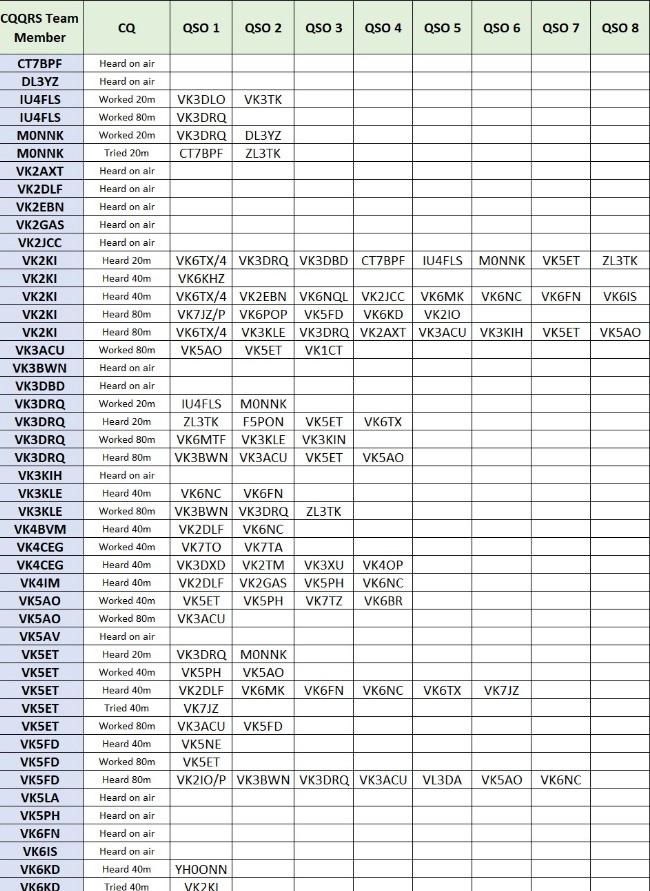
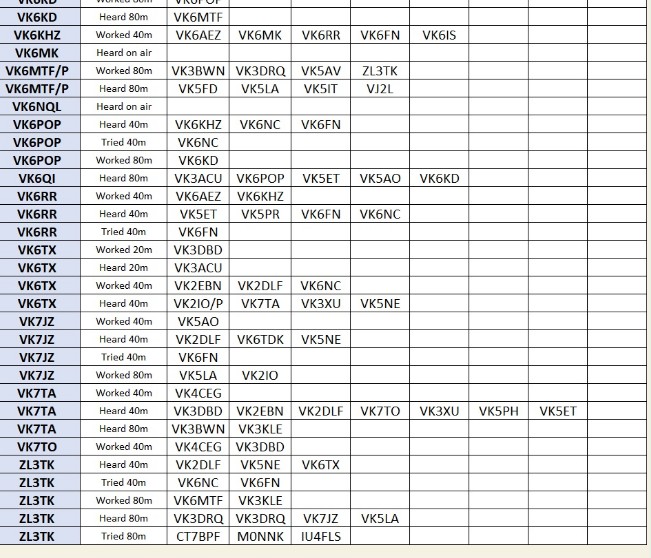
John’s spreadsheet above shows the known stations heard or worked on last Tuesday’s CQQRS Net (reported via our webform bit.ly/CQQRSNET ); the comments in the team members’ reports follow.
The comments were compiled for us by the clever software built by Nigel G4RWI and the layout was perfected by Patrick VK2IOW. Thanks again to Nigel, Patrick and John for the work, and to every team member who submitted a report –
[20m] Manny VK3DRQ made my day despite a weak signal. Mike DL3YZ almost blew my eardrums with his strong signal from Germany. I could hear some VERY weak CW which I think might have been Stan ZL3TK but I couldn’t make out the callsign.
I tried calling Carlos CT7BI Then along came a rain shower and I got busy keeping m session so “Thanks” chaps.
[40m] Very poor conditions with the “sweeper” busily brushing away, causing heavy QRM mixed with deep QSB. Pretty hopeless at this location.
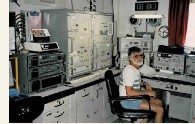
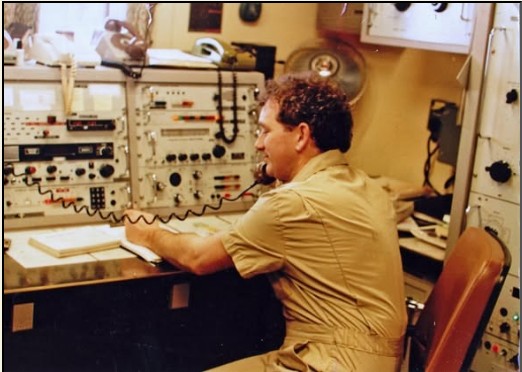
Had a listen to our DX friends but nothing heard – again bad QRN. But had a wonderful QSO with VK6AEZ, Ziggy. Ziggy and I were both radio operators ona semi-submersible oil rig called the “Benreoch” going back to the early 1980S!!
Wonderful to hear him especially as he was only 5 watts & managing to get thru’ all the noise. Great to meet up again after all these years.
[20m] Hello dear friends. Wx was sunny and warm in Bologna last June 9th. Noise level was lower at 14042 kHz, bouncing between S2 – S3, so I used this frequency for CQ.
I got ZL3TK Stan with pleasure, while others were either too weak or overlapping one another. Just above noise floor I got VK3DLO or possibly VK3DRQ I’m not sure, sorry about it. Hope to hear you soon. Take care .73 de IU4FLS – Fausto
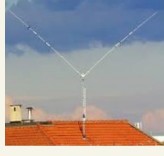
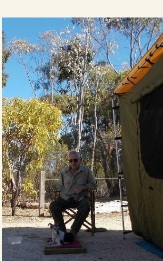
[40m] Noisy, some stations at RSN 595, QRM, then disappeared or very weak to QSL. Good to hear more VK6 stations tonight, although weak .
[80m] NICE TO HAVE CAUGHT UP WITH ALLAN, VKSFD, GOOD CHAT.
[40m] High levels of QRM on 40m but appeared more active than 80m.
[80m] 80m was remarkably quiet from my QTH. I heard a number of stations but QSB and QRM drowned them out. I also put out a CQ on 160M without response. I logged into a SDR on the East of Australia and heard a Net being run on our landing frequency of 1855KHZ.
I found a quiet spot and called CQ agaii moved onto scanning 40m and 80m. 73s
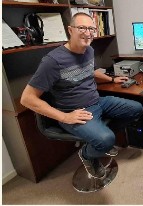
[80m] Managed to sneak in a POTA on the way home 20m was great! Then a few 80m contacts on QRS night. Nice long rag chew with Chris was fun discussing all things portable.
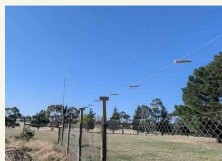
[20m] Another no-go night. Signal heard on 14.042 MHz too weak to ID and MONNK reported same condition when I was calling him.6 kHz higher an hour later. No sign at all of CT7BPF.
[40m] Very good signals coming from VK6 but neither station I called heard me. All east coast VK sign
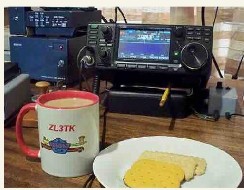
[80m] Very nice first QSO with old-salt Morgan VK6MTF, who was briefly on terra firma. Didn’t think there had been much rain in Hobart, so it struck me as quite funny when he said he was using a paddle … on dry land.
[160M] Called CQ a few times to no avail, but at least heard a VK SSB net on 1.855 MHz, which at least proved things here are working. A request, when someone is heading to 160 m, could an alert be sent to zli3tk@qsl.net please?
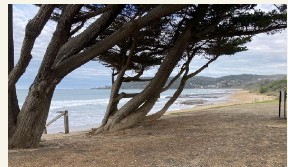
[15m] Nothing at all heard from Edi DO2EMR this week on 15m; Edi reported via Mike DL3YZ‘s Runners Point website that he was calling CQ – but the propagation gods weren’t smiling on 15m this week.
| heard Fausto IU4FLS coming through RSN 531 into the VKSPH Ironstone Range KiwiSDR network. Manny VK3DR@Q tried calling him and he responded, but it then sounded like there was so many of our team members calling CQ (and apparently not copying either Fausto or the other locals) that Fausto and Manny may have given up.
Funny that the popularity of the DXperiment can make things challenging – c’est la vie with skip distances on 20m. There were lots of our team on 20m who couldn’t hear each-other.
I was pleased also to hear David VK3DBD send “DOWN 2 DOWN 2” when responding to a call from another Oceania station. Keeping the sked frequencies clear of local QSOs is important – especially when the 20m propagation characteristics mean that Oceania stations may not hear that there are others on frequency, and of course, there will always be people listening out for our Europeans!
Calls. I was pleased to hear Ross MONNK coming through this week from his QRP portable station working Manny VK3DRQ. Great that Carlos CT7BPF in Lisbon Portugal was able to join the net for the first time this week.
Carlos got on air two hours earlier than planned, and was coming through nicely RSN 531 around 0800Z. Stan ZL3TK tried to hook-up with Carlos without luck, but where were all the other Oceania stations? Dinner time perhaps?
Anyway, I reported that he was coming through Q5 via Mike DL3YZ’s Runners Point webpage, and Carlos responded by calling me on CW; I’m away from home, with no transmitter this week, so our half-Internet QSO was the best we could do.
So we had a kind of exchange – he transmitted, I listened on the Ironstone Range KiwiSDR and replied via the webpage chat! What fun
[40m] 40m was working well again this week – lots of stations on air working across the country well; mainly VK6S but no ZLs heard this time though.
Lin VK6NT was again operating the Northern Corridor Radio Group’s club station VK6NC at Whiteman Park; the big 4 element yagi was thundering in to the Ironstone Range KiwiSDR so+.
[80m] Again this week I slipped down to 80m early and enjoyed listening to the goings-on. Terrific to hear so many people on air enjoying the nice conditions as the band opened up – fantastic! [160M] I had a listen around on 160M – unfortunately nothing heard.
Also from your editor Mark VK6QI at Lorne V Northam WA.
[80m] The Ironstone Range KiwiSDR kept me busy this week – so I didn’t get much opportunity te listen from the West this time.
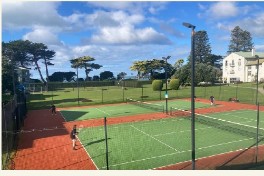
[40m] Tried calling CW on 40m but no reply. There were plenty of strong stations on 7.032.
[80m] Conditions on 80m were quite good. Some QSB, however the noise floor being winter
FIOM] Srdaiidalll VayliO YVAGYVE al LOYdI! VITAE, IQ
[40m] It is always good to get 599 reports from interstate using just 5 watts and a dipole.
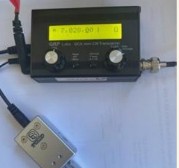
[40m] I didn’t hear much on 40m, yet managed a QSO with VK4CEG who was running SW.
[80m] I had a listen on 20m but heard nothing. I couldn’t Tx on 80m but heard one CW OSO.
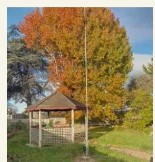
From Jim Semmens VK7JZ at Mount Nelson Signal Sta
[40m] lam a regular complainer about QRM at the QTH and an impossible noise floor and over the last couple of months I have been trying various parks and open spaces around Hobart trying to find something better for the Tuesday CQ QRS net.
Last night I think we found it, my wife asked ‘Have you tried the Mount Nelson Signal Station yet?’, then like a pro she said, ‘You have lots of elevation there, plenty of sky, surrounding bush land, not boxed in by hills, no monn pave poe [Hoa U I pH 4) I poo I He RS ber OHI II OO
OE gy MINES NRE BEE By Fr et GRE EN FURR RNIN BEE WY PRUE Eas CEN ante a major power lines.’ Right I said – good idea, why did I not think of that.” I picked up Morgan VK6MTF who is currently /MM docked in Hobart and up to the signal station we went.
40m band noise floor = Zero. 80m band noise floor = Zero, why had I not thought of this location earlier. I made a poor antenna choice (vertical) so could not flip between 40m and 80m quickly, but enjoyed a fab QSO with Mait VKSAO on 40, then later a quick one with Gerard VK2I0 on 80 who was activating a park (Gerard don’t muck around), then a longer QSO with Andy on VK5LA on 80.
There were others I heard on 40 that were mid QSO and I listened a bit while tuning around but as the evening moved on 40 seemed to drop out and I moved over to sharing Morgan’s 80m antenna (EFHW), so I heard more than I managed a QSO with.
Either way, best spot, best CQ QRS night yet – will be going back to the same
Major power lines.’ Right I said – good idea, why did I not think of that.’ I picked up Morgan VK6MTF who is currently /MIM docked in Hobart and up to the signal station we went. 40m band noise floor = Zero.
80m band noise floor = Zero, why had I not thought of this location earlier I made a poor antenna choice (vertical) so could not flip between 40m and 80m quickly, but enjoyed a fab QSO with Mait VKSAO on 40, then later a quick one with Gerard VK2I0 on 80 who was activating a park (Gerard don’t muck around), then a longer QSO with Andy on VKSLA on 80.
There were others I heard on 40 that were mid QSO and I listened a bit while tuning around but as the evening moved on 40 seemed to drop out and I moved over to sharing Morgan’s 80m antenna (EFHW), so I heard more than I managed a QSO with.
Either way, best spot, best CQ QRS night yet – will be going back to the same spot next week (Tassie weather permitting), no more heavy thinking about where might possibly be a good portable spot – we found it Thanks Morgan for the company.
[40m] No QSO’s on 40m tonight as Jim VK7JZ was operating 40m from the same location.
[80m] Great night operating portable from Hobart with Jim VK7JZ. Mount Nelson Signal Station was an excellent location for portable operation with great trees for antennas, park benches, and most importantly almost zero noise!
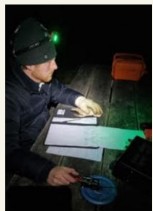
Working only 80m I had four great QSO’s with Manny, Ketut, Tim and Stan. Jim allowed me to try my hand at sending with a paddle for the first time. Apologies Stan for the rapid fire of mistakes!
When I eventually invest in a paddle, I shall slow down to practice. Good fun none the less. Thanks all.
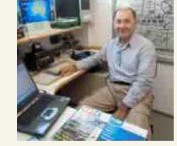
From Sava VK4PN at Mount Ommaney Brisbane [160M] First I want to apologise to anyone who was checking for m’ activity on 1855 kHz. I was not on air or in Brisbane.
My brother-in-law was admitted to Hervey Bay Hospital and I had to drive to Hervey Bay Sunday pm and I am still at Hervey Bay. I hope to be back for the QRS Net next Tuesday, but things may be different.
Last Tuesday I did loc around 11:00 UTC and checked 1855 KHz. To my surprise I could see on VKSAGR and Ironside sites. Well these are the owner of the frequency:
Lay, but things may be different. Last Tuesday I did log on the Kiwi SDR at d 11:00 UTC and checked 1855 KHz. To my surprise there was an SSB signal I see on VKSAGR and Ironside sites. Well these are the details of the new of the frequency:
Net Name Harvest Net Every Tuesday from 11:00 UTC Net Controller VK3GSR Net started 3 weeks ago. Number of check-ins 15 mostly VK3 but some VK2 and VKS as well. Net finished at 12:30 UTC.
So next week (if I make it back to Brisbane) I will be on 1850 kHz + or — 1KHZ in case of interference. Use Ironside SDR to check for activity I know my carrier is visible on that site. Few more details re 160M activity.
I monitored FT8 a few nights in a row and checked recordings. I was surprised to see that around 11:00 UTC good signals were recorded from VK3 and YB (Indonesia).
A few weeks ago again by fluke I stumbled across VKS and VK4 having a QSO so 160 is alive and active, have a go.
Net started 3 weeks ago. Number of check-ins 15 mostly VK3 but some VK2 and VK5 as well. Net finished at 12:30 UTC. So next week (if I make it back to Brisbane) I will be on 1850 kHz + or — 1KHZ in case of interference.
Use Ironside SDR to check for activity I know my carrier is visible on that site. Few more details re 160M activity. I monitored FT8 a few nights in a row and checked recordings.
I was surprised to see that around 11:00 UTC good signals were recorded from VK3 and YB (Indonesia). A few weeks ago again by fluke I stumbled across VK5 and VK4 having a QSO so 160 is alive and active, have a go.
[80m] It was nice to be able to work (just) VA6MTF OM Morgan visiting VK7. Nothing was heard from OM Carlos CT7BPF.
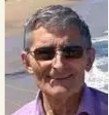
[40m] It’s always a little special making contact with OLD on 40 m, unfortunately the circuit was plagued by QSB so was unable to hold the conversation with Graham, 4CEG, for very long.
That was followed however by a nice quick chat with David and his ditty ralleinn 2NRN Wea had qaneacte for dinnar cn aftar a
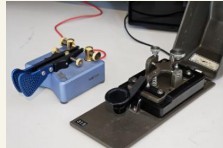
Post Morsum 10th June 2026
From Richard VK6HRC. Seven on the VK6RLM rpir and AllStar/Echolink hub this morning.
VK6QI_ = Mark ZL38TK Stan VK6KD David VK6FN Max VK7JZ Jim VK6HRCG VK6MRB Mulligan sw
VK6QI_ = Mark ZL38TK = Stan VK6KD David VK6FN Max VK7JZ = Jim VK6HRC
Mark called in from Lorne on the Great Ocean road in Victoria where the weather was fine. Making use of various Kiwi sd receivers nothing heard on 15 m and on 20 m heard eight. Nine on 40 m and eleven on 80 m, good to see more activity here.
Stan reported the conditions as very flat, signals from the East coast very weak better signals from VK6 and VK7 where Morgan VK6MTF was doing well.
Stan not having access to social media would like to be informed of activity on 160 m etc during the evening via email. David monitored 160 m for a while where it was quiet so tuned up on 80 m and worked Bob VK6POP heard Morgan VK6MTF no contacts on 40 m but heard an Indonesian station.
Contemplated trying for a contact, maybe next time ? Max had bit of a gremlin in his set up to start with but sorted that out and went on to work multiple stations on 40 m.
Jim joined us at the tail end of the net comenting on the high noise levels at his QTH and battling the weather to activate in the great outdoors.
It is great when we get the occasional check in from one of our group that are normally busy with daily activities but make time to call in and say hello. Thank you to all 73 Richard.
Reporting
After next Tuesday’s Group, please remember to send me a list of who you worked and / or who you heard using our web form here:

Even if you didn’t hear anyone, we’d still like to know that you had a go. And to make your report more interesting, please consider sending a photo: cqarsnet@gmail.com So, please help attract new and old team members to have a go by submitting your report each week.
Submissions close 1300 (Eastern Australian Summer time)_on Thursdays.
Packing Light
Last week’s Editorial mentioned how successfully your editor had procrastinated over not unpacking (let alone building) the QRP Labs QMX transceiver for the current pub-packing (public transport/pub accommodation/backpacking) adventure.
The kit had actually been ordered six months earlier for the previous expedition, and was still sealed in the postal package.
| lamented that the procrastination was a positive thing – because as it turned out, I couldn’t fit any sort of radio in my backpack – too bulky…
And the batteries were just too heavy for something that would be carried snail-like for three weeks on the road. Well, I was overjoyed when Warren VK3BYD and Geoff VK6HD both popped up this week with some words of advice on the battery problem.
But Wait, There’s More
From Warren VK3BYD Since Mark had posted his thoughts around which voltage to build his QMX for, I felt it worth sharing my experience. I built my QMX Mid Band as a 9V (T501, 3:2 ratio) unit.
Once the QMX was built and working, curiosity got the better of me and I changed T501 to a 3:3 ratio for 12V. I measured the TX output power (Watts), supply current on TX (Amps) and receiver stand by current (Amps) for both builds for the range of supply voltages I expected to use.
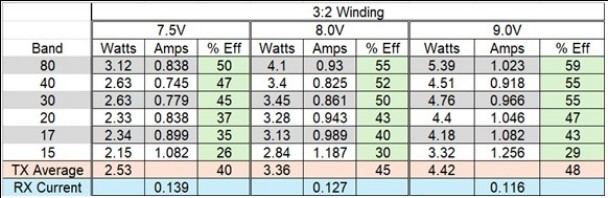
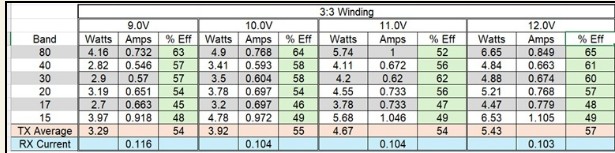
Power was measured using a QRP-Ometer, and current via an in-line Amp meter. The QMX was powered from the bench power supply for each range tested.
While everyones’ build will be different, two other QMX owners reported similar performance for a 12V build with a supply of 12V. So I have left it as a 12V unit, primarily for the slightly better efficiency and better power output on 15MX.
The 12V unit also increases the power supply options.
For powering in the field, I generally use either a 3X18650 (2500MAH) pack or a USB-C battery bank/ phone charger (5000MAH 18.5Wh) which was on special cheap at Jaycar about 6 months ago.
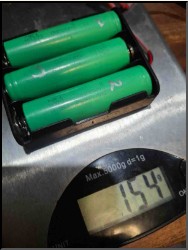
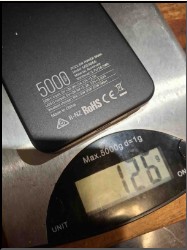
For the 18650 battery pack, I will either use it direct or I have experimented with 9 & 12 Volt Pololu DC-DC up/dwn convertors to get a constant voltage. For the battery bank I use a 12V USB-C trigger board.
I have since added a diode to drop the voltage a little for a bigger safety margin. The advantage of the battery bank is easy field charging.
For the 3X18650 pack I picked up a USB-C to 3S1P (3 series 1parallel) 1 Amp charging board from ebay, so the 3X18650 batteries are now field chargeable without pulling the pack apart to charge each cell individually.
For the gram counters, the pack is 154G and the bank is 126G.
Go Light, Go Anywhere: Revolutionizing QRP Power with USB-C
From Geoff VK6HD For those of us hooked on QRP and portable operating, the holy grail has always been minimising weight without sacrificing performance. We obsess over the grams of our antennas, the thickness of our coax, and the size of our rigs.
Yet, for years, the heaviest brick in our packs has remained the same: the battery. If you are lucky enough to operate the fantastic QRP Labs QMX transceiver, you already know how incredibly light, compact, and capable a modern digital CW rig can be.
But if you are still hauling around a traditional, bulky LIFEPO4 battery and a dedicated charger just to power it, it is time for an upgrade.
By marrying the QMX with a modern USB-C PD (Power Delivery) power bank and a clever little accessory called a trigger cable, you can create the ultimate featherweight field station.
The Secret: USB-C PD and the Trigger Cable
Standard USB ports output 5 Volts— well short of what the QMX needs to achieve its full output power. However, modern USB-C ports utilise a protocol called Power Delivery (PD).
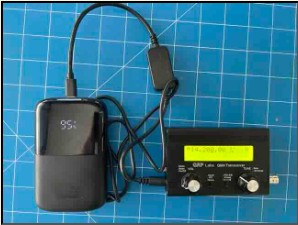
This allows the power bank to output higher voltages (up to 12V) if the connected device requests it. Since our QRP Labs radios don’t yet know how to talk USB-C protocols, we use a USB-C PD Trigger Cable (sometimes called a decoy cable).
How it Works.
This inexpensive cable contains a tiny internal microchip that mimics a high-power device. It negotiates with the power bank, essentially saying, “Hey, give me exactly 12 volts,” and routes that clean 12v power directly to a standard 2.imm DC barrel plug (or raw leads for your Powerpole connectors).
The result? A perfectly regulated 12V power source for your QMX, straight out of a pocket-sized battery. Why This Setup Changes the Game Ifyou haven’t made the switch to a USB-C setup yet, here is why you should consider it for your next activation: + Absurdly Lightweight: Traditional amateur radio batteries are dense and heavy.
A multi-voltage USB-C power bank slips easily into a pocket or the smallest corner of a backpack, weighing a fraction of a standard radio battery. + The Ultimate Multi-Tasker: When you carry a dedicated radio battery, it does one thing.
If your phone or tablet dies on the trail, you’re out of luck. A high- quality USB-C power bank, however, is a universal utility. It can power your QMX for hours, and then seamlessly switch to topping up your phone, logging iPad, or even a USB-C capable laptop.
One battery rules them all. + Simplified Charging: Forget about bringing a specialized, bulky balance charger into the field or on trips. You can recharge your power bank using the exact same USB-C wall charger you already use for your phone or computer.
Putting it Together: Tips for the Field If you want to build this lightweight kit, keep a couple of things in mind: 1. Check the Power Bank Specs: Ensure your power bank explicitly states it can output 12V under its USB-C PD profile (¢.g. 12v – 1.54).
Mine actually also supplies Qv – 2A. 2. Watch out for RF Noise: Some ultra-cheap power banks use noisy switching regulators that can cause hash on the HF bands.
Stick to reputable brands (like Inui or Anker) which generally feature much cleaner circuitry and better shielding. 3. Get the Right Trigger: Order a trigger cable pre-set to 12V.
Double-check the polarity with a multimeter before plugging it into your pristine QMX! Final Thoughts The QRP Labs QMX has already rewritten the rules for how small an HF rig can be.
By ditching the traditional battery shack mentality and embracing modern USB-C. technology, your entire power system can finally match the sleek, lightweight spirit of QRP operating. See you in the parks or on the peaks—with a much lighter pack! 73, Geoff VK6HD
Final Thoughts
[This is amazing! Only a year or so back, I couldn’t find a simple solution to series charging of 18650S. I also couldn’t make either a phone-type powerbank or a glovebox vehicle jump-starter deliver continuous power for a low-current load (my (tpuSDX portable CW transceiver).
And… before Warren and Geoff opened my eyes, I had no idea that USB-C chargers could be controlled externally to provide different voltages.
I’d looked at my MacBook charger which has several different voltages listed on the case, and couldn’t work out that the external load tells the charger what to produce via the USB-C. Bloody amazing!
Then again, not many years ago I was fascinated that on Thunderbirds, a “Calling International Rescue” call from a small transmitter would be picked up by a space station (think about that ….
In about 1962, the idea that such a thing as a space station could exist!). Or that Supercar could actually fly. Or that Ilya Kuryakin could talk to Mister Waverley using a transmitter in a pen.
Not to mention the personal communicators carried by the Starship Enterprise crew. Just goes to show! Beam me up Scotty.)
If you have an article or two that you think might be of interest to our readers, please let me know so we can share more thoughts and ideas; for guidance on writing for RagChew, see Articles below. Please email material to Mark VK2KI: cqqrsnet@gmail.com
Such is the burning question. Imagine two pieces of radio equipment, an IC-7300 transceiver and an LDG RT-11 automatic antenna coupler, both would supposedly be perfectly happy working together without any operator intervention.
So why would one want to interfere with this established convenience they allegedly offer? Because that combination poses a serious potential risk, and I’m not known for being arisk taker!
The convenience of full automation often comes with a price tag, this is one of those occasions. For only a slight loss of convenience, it makes sense to take out an insurance policy, arranged with some creativity and bench work.
To achieve the highest level of convenience safely, in addition to the bare RT-11 antenna coupler, two additional small units are required, a wired remote control for the RT-11 and a wired accessory for the IC-7300.
When the IC-7300 detects an unfriendly VSWR, it invokes RF-power fold back via its efficient ALC circuit, limiting drive to the final transistors to prevent damage, but not necessarily to a level below the 25 W power limit advised for the RT-11 coupler.
It would be expedient to avoid the tedium of having to adjust transceiver power manually by rotating the ‘Mult’ knob four full turns each way several times a night.
Now that the IC-7300 has been touted by sales count to be the most popular HF transceiver of all time, the principles used in this small accessory could become usefully deployed in hundreds of shacks around the world.
Reading the respective equipment manuals lists their specific requirements. Suffice to say, in the past when manually activating the coupler and using an earlier iteration in which only the transceiver’s ALC socket was involved, I would sometimes forget to switch back to high power.
Often it didn’t matter, but at times it was a time-wasting oversight. This small, simple, home-brewed accessory not only ensures longevity of relays in the coupler, but also makes it impossible to forget to return to full power.
If one doesn’t switch the accessory off, the transceiver remains in TX mode with zero RF output.
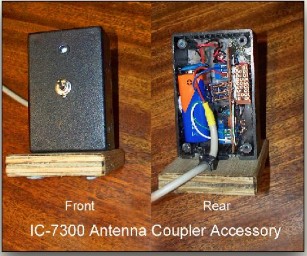
The accessory connects to the IC-7300 via an OEM-supplied, 13-pin DIN plug which fits the rear accessory socket and is dployed like so: when the DSDT switch is moved to ‘TUNE’, regulated minus 4 V is applied to the ALC input, while the 2N7000 pulls the TX line low.
Now when the Morse key is pressed, output power will never exceed a preset limit determined by the 10-turn potentiometer. Then, with a momentary press on the coupler’s remote control ‘TUNE’ button, the matching process is set in motion.
It’s all over in less than three seconds, often much less, at which point one releases the key and switches the accessory off. You won’t forget because the transceiver will remain in transmit mode with zero RF output if you don’t.
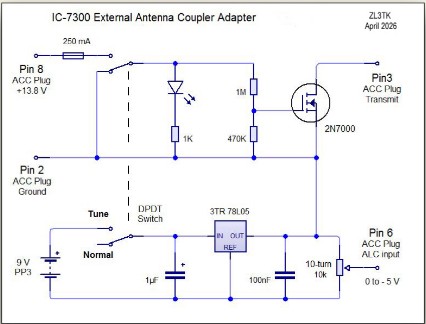
To adjust the ALC voltage provided by the accessory, in CW mode with transceiver power set to 100 W, connect a suitable 50 ohm dummy load.
My home brew dummy load has two Schottky diodes and a 100 n reservoir capacitor in series, connected across it, to provide peak DC voltage, ready for direct reading with a simple voltmeter.
Then by referring to the chart available at https://qsl.net/zl3tk/rf-power_dc- volts.jog the RF PEP can be quickly determined.
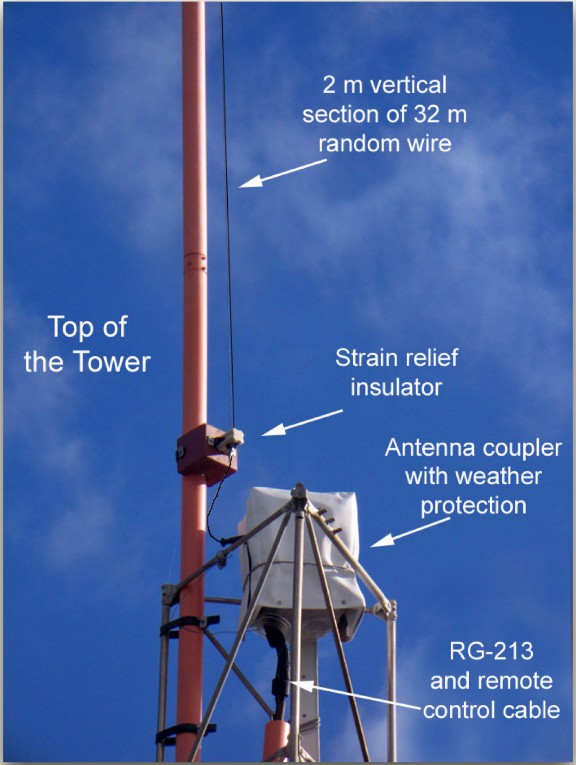
My 10-turn potentiometer is set to give 40 V PeakDC, indicative of 17 W PEP, an adequate margin of safety for the RT-11 coupler’s relays. Physical installation of the LDG RT-11 antenna coupler at the top of my modest tower has been subject to long gestation.
Despite the manufacturer’s claim that it is weatherproof and the O-rings and silicon rubber gasket lending plausibility to the claim, to satisfy my risk aversion it is housed inside a stout, rectangular, empty plastic 10-litre water cask.
Then belt-and-braces, it has a white-painted canvas cover, just to be sure it inhabits a safe environment regardless of summer heat or when being battered by driving rain and westerly winds from the nearby Tasman Sea.
Although LDG, the antenna coupler’s manufacturer, provides an optional CBU remote control module, one was not included with my second-hand purchase, so home-brewed one from workshop junk to the tune of an LDG schematic.
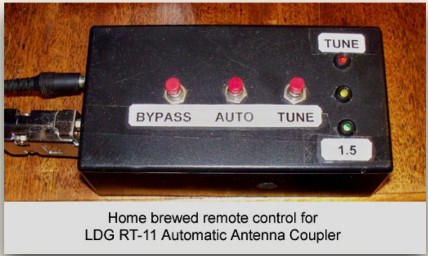
With a nod to standard traffic light configuration, three 3 mm LEDs indicate the operational status of the coupler. A red LED illuminates only after the ‘TUNE’ button has been momentarily pressed, and stays on until a match has been achieved.
A yellow LED indicates stand-by mode with 13.8 V supply present, while the green LED illuminates only when the VSWR is less than 1.5:1 and RF is present, so it flashes faithfully in sync with Morse bits, even when only 1 W of RF is present.
Back to the original question: ‘why would one go to all that trouble?” Simply because with the equipment configuration at this station, it is the most efficient way to ensure the fulfilment of five very desirable parameters: small footprint, near perfect antenna matching on all HF bands including WARC and 60 m, longevity of equipment, ability to make very fast band changes and idiot proof.
73 de Stan [Thanks Stan. Australian Foundation Class readers may be particularly interested in the bottom half of your circuit diagram… to help solve the problem of how to legally operate a commercial transceiver limited to 10 Watts output.
The simple 9 Volt battery, regulator and potentiometer (arranged with positive to ground) would be a simple way of applying a negative Automatic Level Control voltage to the transmitter, to tone its output down to 10 Watts.
Could I twist your arm for a follow-up article on what ALC is for, how it works and how Foundation licensees might build a power control for a common 100 Watt transceiver perhaps?).
Been busy fixing my vintage EICO720 tube transmitter. It has had multiple tech revisions to get to the current circuit. The tube line up is now a 6CL6 osc, 6BA6 buffer multiplier, 6BA6 driver, 6146B final and OD3 VR150 voltage reg.
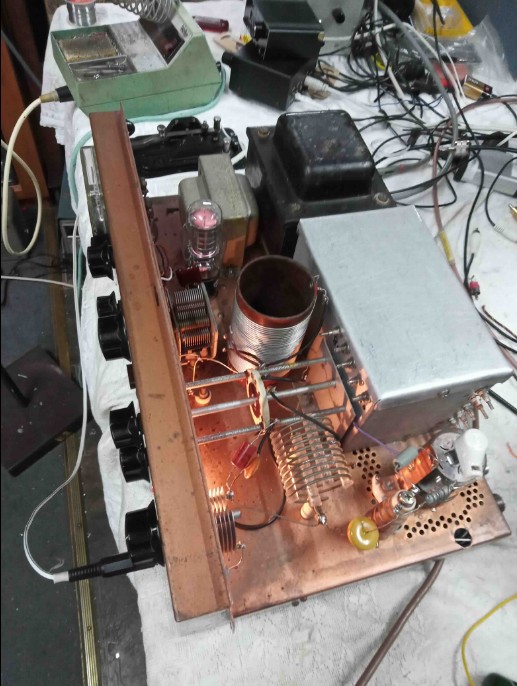
The 6BA6 driver with 250 B+ and 150 screen provide enough drive for a healthy plate dip on all bands except 15m, sometimes depending on line voltage variations and xtal exhitation. Both buffer and driver have individual tuning ccts.
The 6CL6 runs un- tuned from the rock into the 6BA6 grid via an input choke and 4.7k resistor. It runs up to -20v grid self bias depending on band and xtal activity.
The output tank is from a military transmitter that was MF band; therefore the transmitter is now 160, 80, 40, 20 & 15m. Originally it had 10m, but triple-driving a multiplyer doesn’t give a nice CW tone.
I may in future when I get some 30m rocks drop 15m in favour of 30m. Just one tap on the tank and wind new buffer and driver coils (again). So it has about 60W peak key-down and drops to 52WATTS solid key.
The 6146B has protective bias of 60v and the 6BA6 driver will lift the grid bias of the 6146 via rectification of the drive RF to about neg 65-75 Volts.
It’s working Class AB1-AB2 depending on how you set the drive pot and tuning; without drive there is about 20MA of idle current on the plate.
This TX is a USA import originally in 1960 as new to Australia, and the wholesaler put in an Australian HiFi 240 V transformer. It used to struggle to produce 15 Watts RF from plate volts of 400V; it suffered from B+ rail sag on key-down.
Some rework and careful use of available taps and supply current was required. My solution to this conundrum… a voltage doubler. There was an additional set of 300V AC taps on the transformer for the exciter stage and another for neg bias.
So it now sports -100V DC, 400V DC and 850V DC. The big voltage regulator tube and a few heavy wattage wire wound resistors gives the range of lower voltage for the exciter stage now.
The 850 voltage doubler has a double set of capacitors utilising the original power supply filter inductor. It looks like a pi filter, with doubler first stage and it now doesn’t sag much on key-down with a single 6146B tube in AB1. Ahhh…
Power supply sorted after all those years going light on volts. Ow yea that’s a lot of volts for a 6146. Same actually with slightly less screen volts than a Kenwood or Yaesu hybrid. I have set my screen at 195V via a zener string.
As it’s only going to be used for CW, I didn’t have to use AM Class C voltages. Those are lower like 650V and 150 screen. Plate and screen in AM modulation would have those go up high on modulated audio via the mod transformer.
The xtals are now plugged into a new socket at rear (close to the osc) with a trim capacitor for xtal frequency adjustment. I’ve also added a neat circuit I designed to un-key the oscillator, that I now keep running during my over.
Constantly keying the oscillator gave some chirp. The new seperate PTT line solves this and gives a quiet receiver after the over is finished, when you can conveniently stop the oscillator. The PTT line is then un-keying the oscillator, turning it off.
I fitted an RCA socket via a string of 4 green LED diodes to drop the cathode of the oscillator to cut-off. I can un-key the 6CL6 with a foot switch or external keyer that has PTT.
I have enough xtals to run this transmitter in straight-though mode on 160, 80, 40 and 20m. So the CW tone should be very sweet on those bands. I’m going to answer a question that readers may ask. Why the 6BA6 driver and buffer?
Well the 6CL6 is one of the lowest plate-to-grid capacitance tubes. So is a 6AU6 – it does have enough volts for the grid of the 6146 as long as you’re not thinking about Class C. If it wanted a Class C final than I’d have used a 6CL6 or 12BA7 driver.
That and the original supplier used a HiFi transformer. The AC transformer is alittle light on current. When it had the original 6AQ5 driver the power supply had voltage sag when keyed in CW. It wasn’t a happy setup.
The 6BA6 driver is only using about 10MA in Class A. A 6CL6 more like another 30MA. The buffer tube I’m running at reduced plate and screen. About 210V and 125V with 100 Ohm cathode resistor for self safety bias combination.
So it would be running 6mA or so – that equals 16MA for two tubes – half of a Class C driver tube. The 6BA6 is a remote cut-off version of the 6AUG (sharp cutoff) tube.
As crystals vary in activity, I thought it would self-bias well, which it does as a buffer stage. Class C needs a good amount of drive current (3 mA for the 6146). However you need very little current for Class AB1.
So at 250V plate 150V screen it’s very stable in Class A and doesn’t need neutralisation. The driver pot runs close to max, but it’s all voltage regulated and set for Class A anyhow. The TX of course has no SSB mode.
For CW only in AB1-2 and a single 6146 it has enough drive (just) for this CW setup. Clean, simple but with no excess drive current to be abused. The 6146 if our readers check the photo does have a 10PF Russian nuet cap and a tube screen strip too.
The new driver circuit was designed by me so I could add neutralisation which connects to the cold side of the driver coils array.
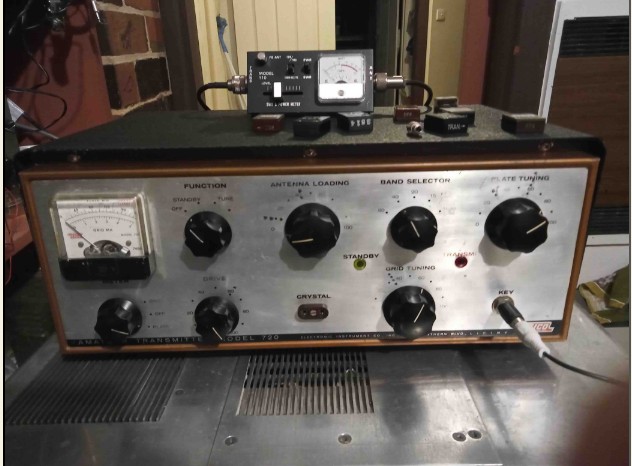
And just yesterday I moved the plate supply for the 6CL6 to 150V from the OD3 tube. That dropped about 25 Volts DC. Also I added a capacitive divider T network from the oscillator plate to the grid of the first buffer to reduce the 80m and 160M self-bias voltage, which was tending to send the 6BA6 towards cutoff.
The oscillator signal looks much more sinusoidal on those bands now – it previously showed a few harmonics on the sine wave via my CRO. They looked like a little squiggle hihi. The grid input of the buffer has a shunt inductor and 4.7k resistor bypassed.
A standard voltmeter at that test point shows the crystal drive to the buffer tube. It now runs around -5 Volts most bands and -12 to 18V on 160M where my vintage hand-made Max Howden crystals operate.
He ran his crystal lab from home in his garage with help from his son. He was one of the few suppliers of early Australian crystals to ham operators. The rocks are slightly cushion shape, thicker in the centre.
The driver 6BAG shows no grid leak bias voltage so it’s just self biased via a 100 Ohm cathode resistor. The 6CLE crystal oscillator is a standard Colpits circuit with 25PF to 250PF caps. Ithas a 15k screen-dropper resistor.
Running at lower voltage it doesn’t stress any crystal I have tried. The grid resistor is just 47 K ohms. Regards Paul VK3KLE 73 [Reminiscent of The Serviceman articles in Electronics Australia in the 70s, Paul’s articles are just so much fun and educational to read; thanks Paul].
What’s going on on your workbench? If you have an article or two that you think might be of interest to our readers, please let Mark VK2KI know; email to cqqrsnet@gmail.com For guidance on writing for RagChew, see Articles below.
QRZ?
I’m Not Much of a Talker
From Ross MONNK I have a confession to make. I’ve managed to progress from a UK ‘Foundation’ license to ‘Intermediate’ and then to a ‘Full’ amateur radio license without ever having had any sort of exchange using SSB.
Actually, I’m rather proud of that achievement, for reasons I’ll come to later.
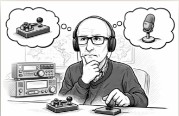
There and I shall forever be grateful to them for the trouble they took to get me started with CW. That is what I always wanted to do anyway, so there was no incentive to repeat my VHF trials and tribulations on SSB HF (accepting that SSB is more one-to- one than VHF).
Of course, Morse ragchewing can also be a bit “declarative” when the other operator feels he wants to explain something at length (like those CB-ers who keep holding down the mic key and ramble on about nothing in particular, or give us the benefit of their a/c whirring away while they think and belch).
I have a VERY short attention span, so those kinds of overs seem to go on forever. But the conversations I enjoy most are the back-and-forth between two operators, kind of like on the telephone but at the glacial pace of QRS Morse, which gives me time to think.
These can be done over radio so long as neither of you gets carried away with all that ‘c/s de c/s’ malarkey at the beginning of each over. But internet Morse has no such preambles and so really lends itself to this sort of style.
There’s an American chap on Vband who will break into my sending with a HI HI when he can sense the punchline of my witticism coming up. I love that spontaneous interrupting – it’s not rude, he’s telling me he’s right there with me.
After all, that’s what friends do in real life. I appreciate that this sort of exchange will be far beyond the capabilities of half the operators on our QRS Net.
But I have finally, after years of hard work (and nota little frustration), arrived at where I wanted to be – chatting using Morse code – and I wanted to share the warm satisfaction of my achievement with you. I hope you get there too some day.
QRZ? Who’s on the other end?
CW Practice
This year we’re using Aesop’s Fables. These are short moral stories, often using talking animals, that illustrate simple truths about human behaviour and character.
‘Aesop’s Fables originated in ancient Greece, traditionally attributed to the storyteller Aesop who is thought to have lived around the 6th century BCE.
The fables are generally smaller files of two to three hundred words that have been recorded at 15 wpm and run for about 15 minutes.
If 15 wpm is a bit quick for you, load it onto your phone and set the playback speed at 0.75 X or even 0.5 X- whatever works for you. 0.75 X will play the MP8 at a bit under 12 wpm. Itis suggested that you read the text file before listening to the audio file.
That will make it easier to follow the audio file and prepare you for any unusual words. Any punctuation that is not usually used with CW has been removed. This week’s fable is ‘The Partridge and the Fowler’, and the MP3 and TXT files are attached here –


If you prefer a different speed or tone, you can create your own MP3 files by converting the text file with the Ebook2CW app — https://fkurz.net/ham/ebook2cw.html.
You can either play the MP3 files in any media player, or load the text file into the Ditto CW: Morse Player app — https://dittocw.andro.io/.
Both options work well, however Ditto CW gives you complete control over all Morse settings, while a normal media player only allows changes to playback speed, and does that in steps (e.g. +1.25x, 1.5x, 1.75x).
Other News
Updated Call Sign Directory
From Stan ZL3TK Download your copy from _https://bit.ly/qrsdirectory There’s no best time to issue an updated call sign directory. Tradition has it any update will be obsolete in some way before ink has even been been poured into the press.
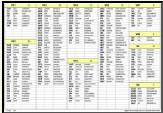
There are two sides to any coin though. While this update includes the call signs of those who have been welcomed to the QRS FFA in the past 19 editions of Ragchew, quite a few more have slipped away during the same time.
It would be good to make room for new members, after all, who wants the inconvenience of a second page? To delete any listings without proper knowledge is foolhardy, so I request you do the group a big favour.
Sift through you logs and memories to figure out who hasn’t been active for a few months or longer and please let me know. ZI8TK (at) qsl (dot) net.
Flipping back again to this coin’s positive side, likewise if you know of any further new or regular operators who should be added. 73 de Stan
Dear Mark, Thank you for your wishes in the last edition of RagChew. I am pink, breathing and alive. Best way to deal with post-op pain is to occupy mind and body, so have redesigned one of my transmitters and gone for frequent walks.
Anne who is a nurse, has been remarkably sympathetic. That is out of character for a nurse so I wonder if she thinks I will not make it to the end of the week.
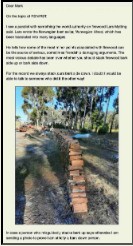
We head to mandurah tomorrow to buy an old car trailer which we need for just a couple of long hauls to Broken Hill. After it has done its job, it will be striped to the tray and become the floor of a radio room on wheels.
That way the local council can’t tell us what to build. We will mill our own timber for the frame, use some nice old solid doors and jarrah framed windows and put a pot belly stove at one end. There are standards that should be met for a radio shack you know.
Now, I trust you have re-stacked your wood bark down. Donald VK6JDM
Mark. Just on the RSN thing. I know I read something about it, probably in rag chew. But why would you want to give a report on your local noise?
I guess maybe I’m a bit biased because I build a lot of homebrew stuff that doesn’t always qualify for a good tone |
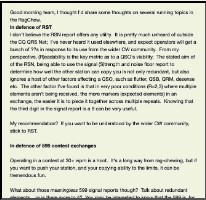
Here’s a good example (click on the thumbnail), although I have a feeling I gave Nic an RST 599 because I was so excited anyway &)
2026 VKFF National Get Together
CLEA TE Ud SS at Friday 30TH October – Sunday 1st November 2026 – Albury, New South Wales
From Paul VKSPAS National VKFF Parks Coordinator Here’s an update from Paul VK5PAS on the VKFF PARK National Get Together.
Looking at the website, Paul and Marija have put in a huge effort to put together a remarkable event with things of interest to Parks activators and others.
The event includes a Friday evening dinner, Saturday presentations, a raffle, various displays, a Saturday evening dinner with a quiz & guest speaker, a Sunday morning BBQ breakfast, antenna construction projects, Sunday afternoon VKFF park activations, and a Sunday evening dinner.
Guest speakers this year include Dave G4AKC, Sands VK9WX, & a member of the VJ2L Lord Howe Island DXpedition Team. Registration is required to attend the Get Together. Walk-ups will not be accepted.
More information on the event, including cost & the registration process, can be found on the WWFF Australia website at… https://www.wwftaustralia.com/2026-vkff-national-get-togetherhtm!
October – Sunday 1st November 2026 – Albury, New South Wales

Morse Training Net
Our team member Nic VK7WW runs an on-air Slow Morse training net every Wednesday at 7pm EDST on 3580 for 30 mins. He uses the callsign of the Northern Tasmania Amateur Radio Club VK7TAZ on that net.
Many of our team learned Morse code with the support of Nic, and the weekly training session comes highly recommended for anyone who wants to learn the Code, or simply brush up.
Everyone’s welcome – 3580KHZ at 7pm Eastern time every Wednesday; you’ll hear lots of the CQQRS team on that net. Jordan VK3ACU has ralso ecorded the complete set of lessons which you can now find here:
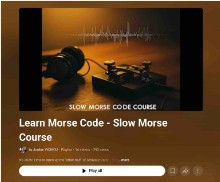
Https://www. youtube.com/playlist?list=PLHsQmZz6fBXO7swAfbT mutrbbEL17fUQL Contact Nic VK7WW for more info nicholaschantler@hotmail.com including how to join the NTARC DISCORD group to follow the action, or just come along and join in on Wednesdays.
[Thank you Ketut! I hope all of our WhatsApp Group members put their callsigns in the new Member Tag – this will help those who haven’t been adding this information manually (either as senders or receivers).
I know some of our team don’t want to have their callsigns in their name fields because they use WhatsApp for work and other things as well; so this will now solve that problem.
Note, each member will need to add the tag for each of the CQQRS WhatsApp groups (Alerts, Rag Chew and The RF Exchange) as three separate steps.]
Semi-Submersible Benreoch
From Roy VK6RR Just came across this photo of part of the radioroom of the Semi-Submersible off- shore oil rig Benreoch, on which VK6AEZ (Ziggy) and myself served as Radio Operators in the 80s. The R/O in photo is another operator. 73 Roy
Green Men – Dual-Band Portable
WE or EE SVEN EE Be EREE EERSTE ENS ES OWE SEER EN
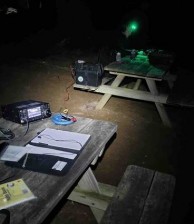
From James VK7JZ Mark, A couple of photos for you from Mount Nelson Signal Station. Yes we were of course wearing our warm clothes for being outdoors at night in the VK7 winter. The operator on the paddle (green head torch) is Morgan VK6MTF/7.
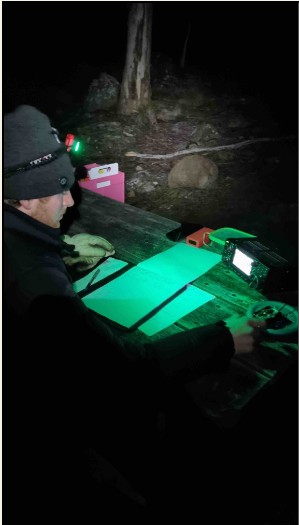
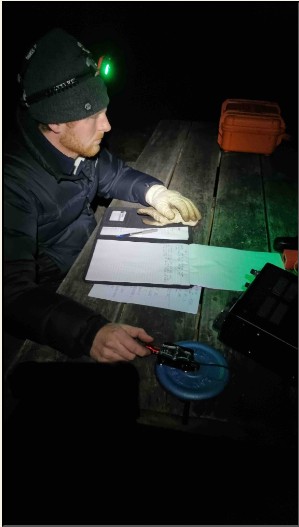
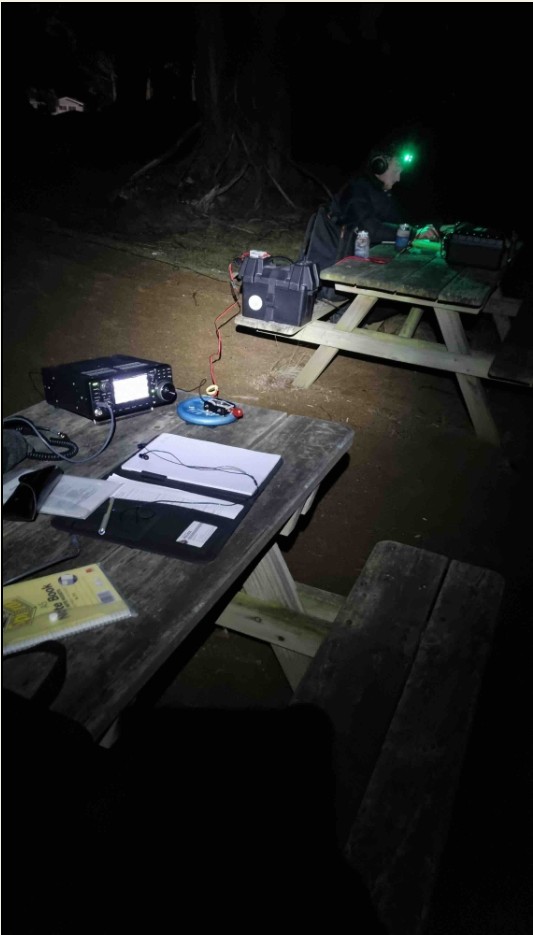
When on his radio Morgan was 10 Watts into his EFHW thrown between some trees. I was using 100W into a vertical staked in the ground. I chose wrong, that antenna does not do 80m!
Next time I will bring one that does both 40 and 80 m; I was foolish to not bring all my antenna options. 73 Jim VK7JZ
If you’ve read something that you think might be of interest to our readers, please email to Mark VK2KI: cqgrsnet@gmail.com
Readable Five
The Beechworth Telegraph Station
From David VK3DBD at Yackandandah The Beechworth Telegraph station is open to the public and regularly sends real telegrams by Morse for tourists for a nominal fee. There are of some museum. artefacts on display too.
Not sure if you visited when you were in the area Mark? The main Keeper for want of a better word is Leo Nette. He was, way back a professional telegraph operator. I have met him several times.
Recently Leo gave a short talk in the Yackandandah Library on the history of the Telegraph Station and its origin in the 1850S when Australia was a very far-off colony from England the Mother country.
In those days, communications were unbelievably slow around the world and even within any country. Beechworth was one of a string of telegraph stations across the country where Morse code was used 100% to pass news for newspapers and businesses in a matter of minutes.
Leo has spent countless time researching the history of the station and has published an interesting book Beechworth’s Telegraph very recently.
I am now in possession of a copy from the local library and find it of great interest; as yet I am only about half way through the book, which has over 300 pages and many illustrations.
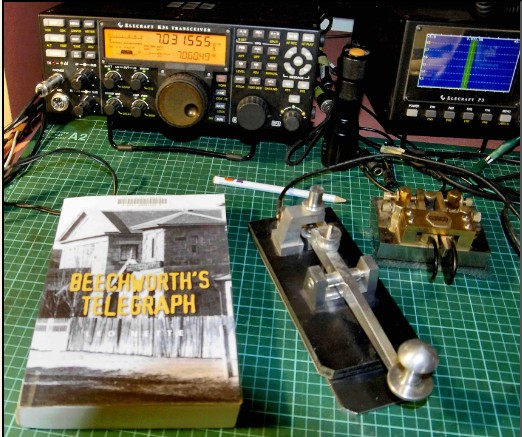
Beechworth’s telegraph by Leo Nette ISBN 979-8-3694-8742-6 Yesterday I was in Beechworth; I hoped to pop in and see Leo and take some photos for the newsletter. Unfortunately I missed him, so perhaps I will manage that in the near future.
In meantime, here is a pictorial record of his new book in appropriate surroundings! ps Mark, on your current travels as mainly a SW, I wonder if you have plans to visit Bendigo, where I am sure there is a similar active tourist-related Telegraph office, run, most likely, by the Morsecodians.
I am sure it would be worth looking-in if any of our readers are in the area. In fact, if you have the time, do not miss the reproduction working Victorian town for tourists…… an excellent day out.
It is years since I went but it will ikely be even better now! 73 David [Thanks David – I’m sure our readers will find the new book interesting. And to answer your question, no on this trip we got to Chiltern, Wallan and Ballarat. Benaigo.] but not
There’s No Such Thing…
Pho WEEN 2 YMC UlIViios I think the first lesson in Teachering 101 is to always tell students “There’s no such…” (I’m sure you know the rest) and “…the only dumb questions are the ones not asked”.
John VK2RU reckons that there’s lots of questions out there among bot! our new and our experienced operators – about CW, amateur radio operating and about theory. So here we go…
Question:
Question: Silly newbie question: is it possible to join in on the slow CW session via EchoLink? =) Kevin VK6AFG
Answer:
GAL There’s no such thing as a silly question around here mate! However, unfortunately not easily is the answer! You could send and receive to someone on Echolink by using MCW (modulated CW) – ie using an external audio oscillator with a key – feeding CW in as audio.
However, you can’t put that to air unless there was someone using some sort of Echolink to HF set-up – which I’m not aware of in Australia. However, there are couple of alternatives.
+ First one I’d suggest for someone like you who hasn’t yet set up a station is to get started using VBand, which I know you’re on the way to (do you want me to send you some back-issues of Rag Chew with articles about VBand)?
* Next option is to borrow an HF transceiver from a friendly CQQRS team member to have a go with – initially listening until you get yourself a resonant antenna to transmit into.
* Third option is to use the many KiwiSDRs around Australia to listen-in to the net on your computer… which is exactly what I’m doing tonight while away from home.
The SDRs can be a little tricky to use at first until you get used to the display and functions, but they’re a game-changer.
As we speak, our writer and philospher Ross MONNK in the UK is putting together a series of articles on how to use the KiwiSDR system on our net – stay tuned for those articles.
+ Fourth option is to use one of the Remote HF stations set up for CW – but that’s for another time!
[Do you have a question or two or a discussion starter worth sharing? cqqrsnet@gmail.com if so.]
Prosign/Character/Signal of the Month
[Put it on a sticky note near your key as a reminder for Tuesday…. and tell us how you went!]
Di-dah-di-dah-dit
So back to the CQQRS Slow CW QSO practice net.
Next Tuesday’s Net
Our CQQRS Group will be on as always on Tuesday from around 0600Z until about 12002; see https://bit.ly/CQQRSWebsite and navigate to the Net Details page for details.
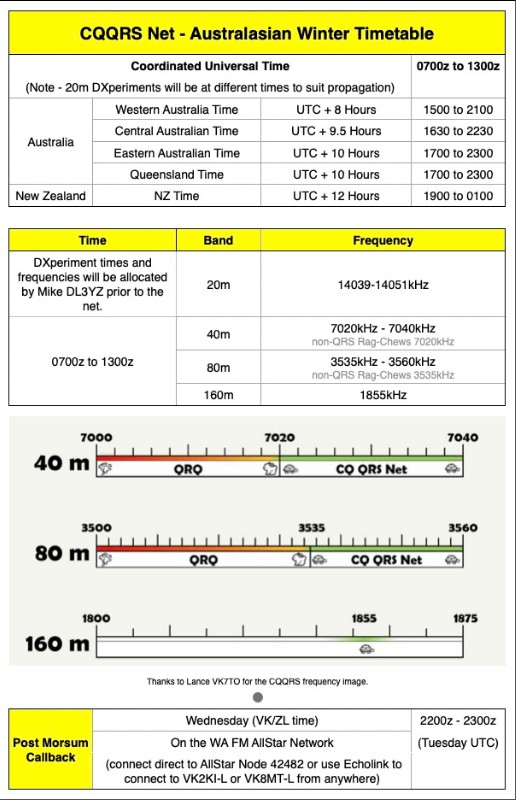
Doesn’t matter whether you’re brand new and want to try just exchanging callsigns and RST reports, or you’re ready for a good old rag chew. We’ll have fun.
There’s usually people around until after 1200Z – so keep calling in the segment of the band designated in the table below until you catch someone.
Reports & Photos
Please let us know via our Reports form bit.ly/CQQRSNET who you work or hear on Tuesday’s Group. The report form closes at 1pm (Eastern Australian time) on Thursday. And how about helping to make the reports even more interesting by sending a photo?
If you have a photo that you’d be happy to include, please email it to: cqqrsnet@gmail.com And of course, we’re always on the lookout for more photos for the newsletter, so if you have something that might be of interest aside from the reports, please send it through as well.
Email to cqgrsnet@gmail.com please. Oh and by the way, I recommend that you don’t keep the Reports Form website open between submission of reports from one week to the next.
If you’re unlucky, there’s an undocumented feature in the software that could cause your current week’s report to be combined with your previous report – it’s happened to your editor several times – much to the chagrin of our Reports editor 🙂
Post Morsum
Richard VK6HRC will run our phone Post Morsum on Wednesday mornings on the South West AllStar net (via repeaters and hotspots all over WA) from 0600 WA time, then from 0700 WA time on 80m (3605 LSB).
See https://bit.ly/CQQRSWebsite and navigate to the Net Details page for details of how you can connect via Echolink from anywhere in the world.
Articles
Could you write a short article or articles for RagChew? You bet! Writing not your strong point? Don’t worry, I’m very happy to help as much or as little as needed.
Oh, and one more thing (actually two) – copyright material: * please use your own images – don’t use images copied from the internet unless you have the producer’s permission, or they’re marked ‘Creative Commons’ or similar; ¢ if you include other peoples’ written material, unless you have permission, you may only include small snippets (unless it’s marked ‘Creative Commons’ or similar), and you’ll need to site the source and author.
For more guidance on writing for the RagChew newsletter (including how you might even try using one of the new Artificial Intelligence tools), head to our website bit.ly/CQQRSWebsite then click the menu on the top right and then click RagChew Newsletter.
Material
Areminder; if you send me any information by email, our report form or WhatsApp – unless you specifically state that material is not to be published, I’ll assume that you’re happy to see your thoughts in the RagChew newsletter.
Thank you so much to our team of 31 contributors: IU4FLS, MONNK, VK2RU, VK3ACU, VK3BWN, VK3BYD, VK3DBD, VKS3DRQ, VK3KLE, VK4BVM, VK4CEG, VK4IM, VK4PN, VK5AO, VK5ET, VK5FD, VK5PAS, VK6AFG, VK6HD, VK6HRC, VK6JDM, VK6KD, VK6KHZ, VK6MTF/P, VK6POP, VK6RR, VK6TX, VK7JZ, VK7TA, VK7TO and ZL3TK.
And a special thank you to our editorial team, Nigel G4RWI (head cryptographer), Patrick VK2IOW (image consultant), John VK2RU (Mister Rows and Columns), Richard VAK6HRC (dumpster diver), Lance VK7TO (potential saviour), Jordan VKS3ACU (the thinker) and Ross MONNK (je ne parle pas).
GU CW on Tuesday, mb Mark Bosma VK2KI / VK6QI Beautiful South Bowning NSW cqqrsnet@gmail.com non impediti ratione cogitationis

About the CQ QRS Net
For the current schedule and more information about the CQQRS net, please go the the Net Details page on our website:

The opinions expressed in the RagChew newsletter are those of the individual contributors. The opinions do not necessarily reflect that of the editors or of the CQQRS Group members.
Any material and images received from members by the editor or published on the CQQRS WhatsApp groups may be published in this newsletter unless specifically requested otherwise.
The RagChew newsletter is considered to be exempt from the Australian Government’s ban on social media for under 16 year olds because it is a service that has the primary purpose of enabling users to share information about products or services, engage in professional networking or professional development services or of supporting the education of users per the Australian Government eSafety Commissioner FAQ webpage “Which platforms have been excluded from the age restrictions” dated 10DEC25.
The values, doctrine and guidelines for the Group and for the newsletter are published on the Principles page of the group’s website https://bit.ly/CQQRSWebsite