Below is a reconstruction of the 2025 32 CQ QRS RagChew newsletter designed to support full text searching. This reconstruction was built using OCR, and will contain errors.
To view the Mailchimp original, click here. To search the entire newsletter archive, click here.
Contents
- CQ QRS RagChew
- Masthead Image
- Net Frequencies
- Reports
- Website
- Post Morsum – 6th August 2025
- This Week’s Feature Topics
- The Great Thing About the QRS Net is..
- On My Workbench
- Other News
- Re: Ross MONNK’s Life’s Too Short for QRP Article in RagChew 31/20
- Hi Mark
- /MM Question
- The CW Ops Column
- 7-Aug-25
- CW Sked
- CW Ops
- Helpful Hint
- RD Contest
- Have Fun
- Morse Training Net
- Progress report on the QRS International Flight Contest
- Handy Key for Sale
- Readable Five
- Samuel MORSE, HISTORIC CODES and TELEGRAPH APPARATUS
- Head Copy Practice
- Prosign/Character/Signal of the Month
- Di-dah-di-dah-dit
- Next Tuesday’s Net
- Post Morsum
- Articles
- Teamwork
- About the CQ QRS Net
CQ QRS RagChew
Well despite the dire and enigmatic prediction from Space Wether Services for lousy conditions on Tuesday, I reckon we all had fun! Surprise, surprise I hear you say! Yes it’s true…. one day I’ll complain about something… but not this week!
‘And why would I? We had at least 41 of our team members on air, and we worked at least 62 stations; not the record numbers like last week, but outstanding anyway! And then there’s this newsletter…
So many contributions from 33 of our team – thank you one and all – and again, I had to carry material over to next week. What a great family team we havel.
So I hope you can make time to read and enjoy the work contributed by so many of our team members once again this week. Last week we concentrated on Artificial Intelligence – as a tool to learn about, be scared of, to boldly go where no man has gone before, and so on.
Nigel G4RWI our Head of Software Development has continued the theme and dug deeply this week to explain the basis of how the current batch of Al tools are trained.
And the information about how to grapple with these tools will continue in future weeks’ editions. I hope to convince you to have a go with these free tools – and even use them to write for our newsletter!
Humans, walking and talking bags of water and trace chemicals that we are, have managed to convince organised sand to pretend to think like us. The world has got much stranger, very quickly.
Also this week, Ross MONNK continues his beautiful philosophical musings – and our net is in the spotlight; should I be worried?
Following John VK2RU‘s efforts to compile our Head-Copy (or hand-copy) training audio files, Stan ZL3TK explores whether there really is a house at Pooh corner?
And what’s more, Sava VK4PN shows us this week how to build a simple balanced feed-line – why use expensive and lossy coax, when you can build a virtually loss-less feeder for very little hard- earned. And that’s just the start – please enjoy.
So I’ve had lots of fun compiling the newsletter – especially having had surgery to remove several carcinoma from eyelids and eyebrows on Wednesday, so I’ve been more one-eyed than normal this time…
And probably have made a bunch of grammatical errors; oh well – I’ll try harder next week!
Masthead Image
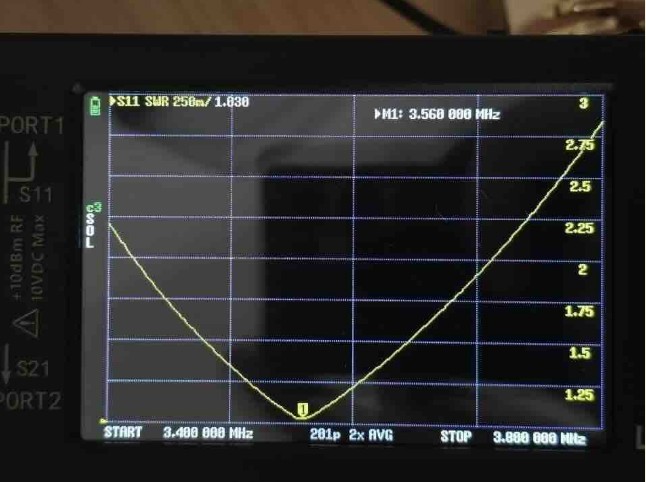
Thanks this week to Johnathan VK4SEC for this SWR plot from his NanoVNA of his end-fed half wavelength antenna, strung through the tree and along a fence. Minimum SWR of 1.03:1 and the 1.5:1 points are at about 3.48MHz and 3.65MHz.
Recently John VK2RU ran a question on the CQQRS WhatsApp Rag Chew group about readers’ opinions about the NanaVNA versus the RigExpert tools. The discussion has spurred others to consider buying one of these great tools.
And I’m hoping that John will have time to summarise and share his findings in a future edition of RagChew.
Net Frequencies
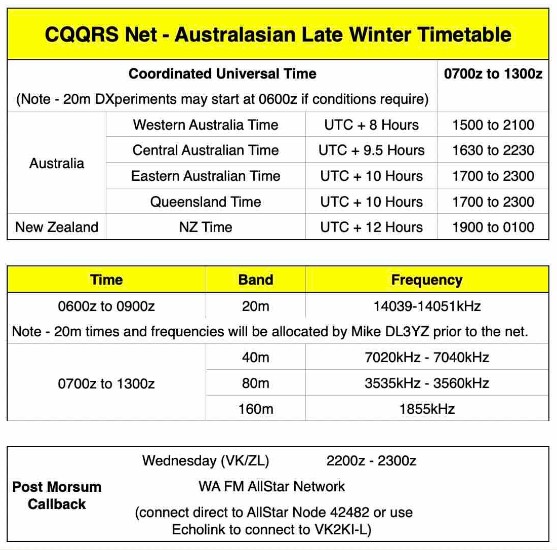
The current week’s frequencies are shown on our website here: https://sites.google.com/view/cqqrs/home/net-details However, just because you asked so nicely, here’s the current schedule:
Reports
After next Tuesday’s Group, please send me a list of who you worked and / or who you heard usina our web form here:

Please help attract new and old team members to have a go by submitting your report each week. Submissions close 1300 (Eastern Australian time) on Thursday.
Website
If you’d like to find out a bit about our net, or would like to pass information to others about our Tuesday get-togethers, here’s the link to our website.
Bit.ly/CQQRSWebsite Cheers, mb Mark Bosma VK2KI / VK6QI Beautiful South Bowning NSW mark.bosma@icloud.com non impsditi ratione cogitationis
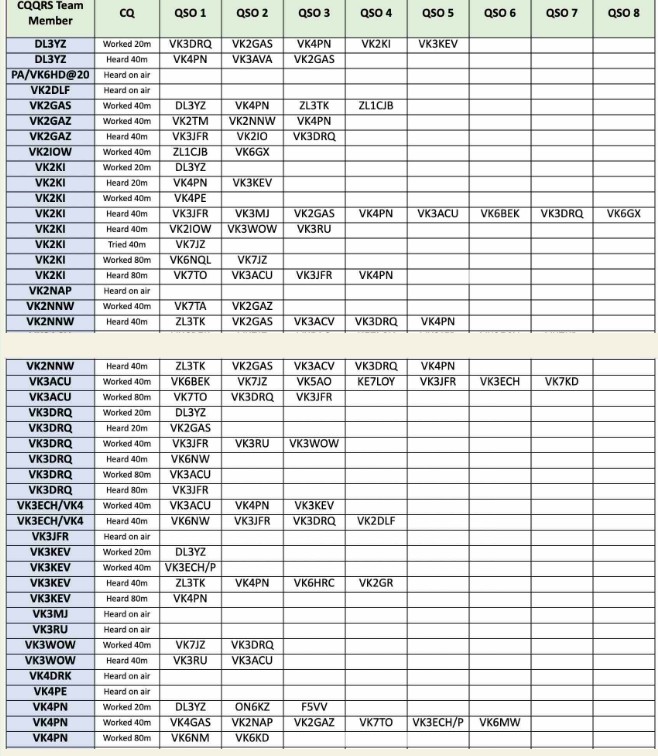
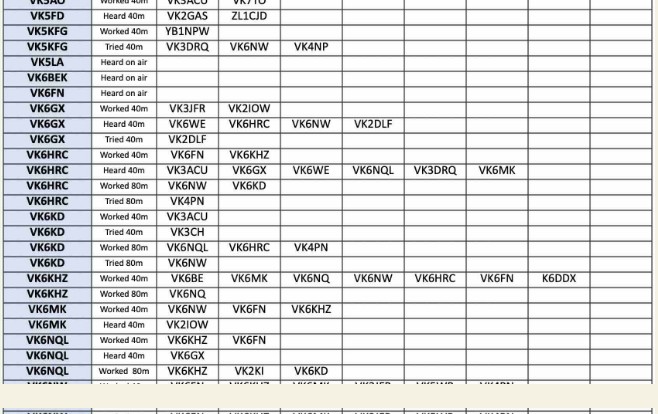
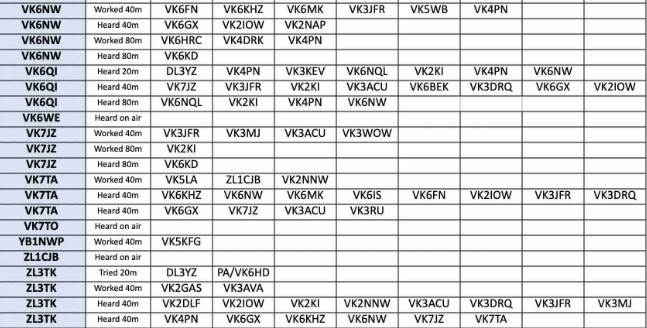
The spreadsheets above show the known stations on last Tuesday’s Group; t comments in the team members’ reports (Submitted via our webform bit.ly/CQQRSNET ) follow:
[80m] DX was a real fun again this morning. Yesterday’s fears of bad conditions did not eventuate, and so your signals were all readable, and your great fists made copy reall easy. Thanks to all stations that sent me some beeps around the globe.
[80m] picked up DLSYZ on 20m. Unfortunately, the signal was weak and went into the noise. I arr sorry, Mike, to stop the contact. We shall have another go.
• | [40 m] “| Plenty of stations heard, Jordan VK3ACU was ” exceptionally strong and faster then heard before, : estimate 21 wpm?
[80m] Signals heard on 80 m and 20 m were too weak to ID and only intermittently visible on waterfall.
[40m] Great to work some DX on 40 had a really good rag chew with KE7LOY. Some great contacts tonight! Hope to catch you all agai next week,
[40m] Tuesday night is a busy night for me. Hardly available for heating up the atmosphere .. hi hi
[40m] Noise floor on S5 tonight. Was making it from WA to VIC (just).
[80m] Low noise floor of S1 on 80m here in Ballajura WA. Almost couldn’t hear VK4 stations but managed a brie QSO with Sava VK4PN. 73s
[80m] The Hy-Gain DX88 vertical is not too flash on 80m so swapped to the TET-Emtron 80/40 dipole and signals improved markedly.
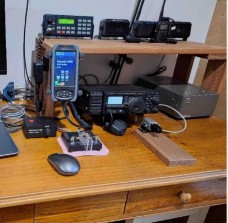
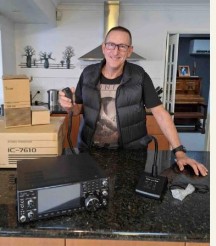
[40m] Nice to be able to get back on the air for a change.
[40m] Some big signals tonight. Lots of VK6 heard. Not much from VK2, very strong signal from VK2IOW but very weak from Adam VK2NNW.
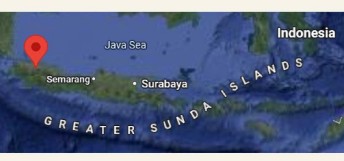
40m] areat new QRS contact with Nyoman in 3EKASI Indonesia. 80m] fter my boat anchor cast me adrift in the niddle of the boat anchor net with what looks ike a challenging intermittent, I listened on 80

very quiet band and good signals from ne eastern states. I only made two SOs, but they were very enjoyable ong chats. George, VK2DLF was trong, but he had a high noise level, vhich sadly scuppered our attempt at a oT nT oe
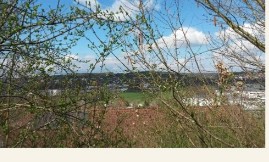
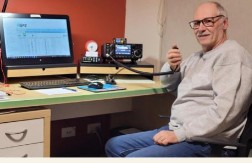
From Jim Semmens VK7JZ at Hobart (Home Q1
[40m] Last night was an exercise in FUN, DUMMY SPIT FUN. I live in suburbia with my home about 3 blocks from a local park and exercise field.
Last night my noise at home on 40m was S7-8, when moving to the park S1-2, the park is much better when it comes to listening.
Successful QSOs from home on 40m with VK3JFR (James), then VK3MJ (Mark), with only the last couple of overs with Mark fading into the noise, I got a signal report, name and QTH from Mark after that it got quite hard.
Then a bite to eat and down to the park, VK3ACU (Jordan) was booming in, a noise floor of 1-2 and then a big $9 signal made it easy (oh my, did I just use the word easy in reference to CW, silly me). Then a QSO with VK8WOW (Peter) in Geelong.
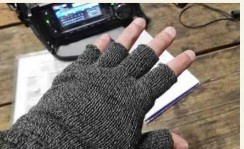
I was getting the hang of it, but a bit cold, fingers in the breeze not keying the paddle quite like the brain was thinking and a few mistakes. I proposed to give up, but the audience suggested I stick it out.
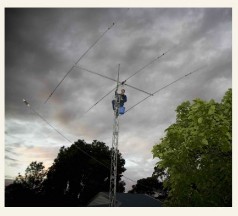
Then ‘crash’, down went my mast and my antenna was grounded, nothing broken but in the forming damp/frost and a bit of wind on the antenna the bottom of the pole kicked out and down it went. OK, no problem let’s set it up again.
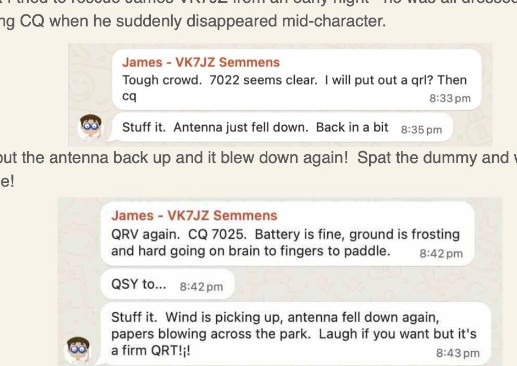
I could then hear VK2KI (Mark) calling CQ and was about to respond when my cheat sheets blew off the table then another ‘crash! down came the antenna again and I had my rumplestiltskin moment, decided I was done in the cold park.
Mark helpfully posted my dummy spit, he was spot on, that’s exactly what I did. Packed up and went home and managed a QSO with Mark on 80m from the home station.
I left the headphones on for a few minutes and could hear VK6KD (David) calling but he was in the noise and I had to cheat and look at Whatsapp to ID the caller.
The 80m whip section of my antenna at home was set up for voice and it is incredibly narrow banded, won’t tune down in the normal CW section.
A weekend job I think to pull the antenna down and extend the whip to bring the resonant spot down a bit lower in the band. I never use 80m on SSB anyway so may as well set it for CW. Thanks all for a great night, I will try not to dummy spit next week.
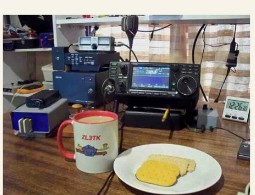
Om] vas a nice surprise, arriving home only a few nutes before the time to listen for OM Mike 3YZ, tune my Radio and, there was Mike himself ling CQ. We had our QSO with RSN 331 QSB for ke and, big surprise, he gave me 559.
You made ‘day mate all the way from near Stuttgart. Today, > every Wednesday, I’ll be with the VKCW Net on 049 MHz starting at 0603Z, I wonder if I will ,
From your editor Mark VK2KI at Beautiful South Bowni
[20m] Mike DL3YZ was coming through nicely when I came in from wiring the shed at 0615Z (Elizabeth had to remind me that the net started an hour early!). Terrific to hear Mike chatting away happily to other members of our QRX family.
By the time I hooked up with Mike, signals had dropped and the QSB was knocking him about a bit – I reported RSN 321 w/QSB. Sava and Kevin were very weak into Southern NSW. Nice to hear all the dit-dits from around Australia when Mike signed off for the day.
Nice signals up to Southern NSW from Tasmania and Western Victoria from VK7JZ and VK3JFR. At the same time, my own signals from Southern NSW were S8 into VK5 and only S2 into WA.
Worked Jens VK4PE up at Townsville – been quite a while since I heard him; weak signal with slow and deep QSB – one minute he was a nice Q5 and the next down in the noise; but we got there.
[80m] Conditions weren’t as much fun on 80m this week. Still there was a few around enjoying the band. Peter VK6NQL and I really struggled to make it across Australia in the end I had to resort to listening on the VK5PH KiwiSDR – Peter’s signal was losing the battle with the QSB – and he was struggling to copy me as well.
Had a nice chat with James VK7JZ who had resorted to his home QTH after his antenna in the park blew down – twice! Not to mention the frost on the ground already.
We ended up intruding on hallowed turf by using 3610KHZ, because his antenna was a tad too short at one end. Also from your editor Mark VK6QI at Beautiful South Bowning NSW via the VK6SEG KiwiSDR at Hoddys Well and the amazing VK5PH KiwiSDR network at Ironstone Range.
VK6SEG KiwiSDR at Hoddys Well. Sava was copyable in both locations, and Kevin was strong into WA, but less so into SA.
[40m] Strong signals across Australia on 40m at the start of the net. Tassie James VK7JZ was S8 into VK5 and S4 into VK6. Ararat James VK3JFR was S9 into SA and S4 into WA. I was S8 from Southern NSW.
Weer Once again, interesting propagation into WA – with the lower Eastern States’ people coming through nicely, some propagation from VK4 to WA, but my own signal from Southern NSW was pretty weak.
Maybe my 106M long double-extended Zepp (two five-eighths in phase) has actually fallen down? Must have a look when I recover from Wednesday’s eye surgery!
[40m] QSB and weak signals made copy difficult.
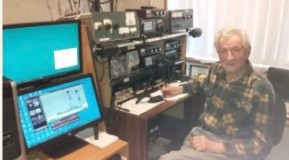
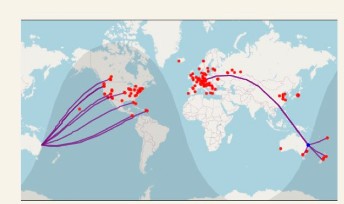
[20m] Got on 20m at around 06:20 UTC and scanned the QRS Net segment for our EU friends. DL3YZ was coming through quite nicely and responded to my first call. He was 444 at my QTH which is not bad for 100W and GSRV at his end.
Last time I worked him he was using a Yagi so I do not know what happened in the meantime. We did not chat for long, I was conscious that others might be queuing up. I was not wrong. Mike responded to VK2KI immediately after we finished our QSO.
I couldn’t hear VK2KI at all. Just in case other EU QRS friends might be on I continued scanning the segment and occasionally called a CQ just to score a couple of EU DXs ONG6KZ and F5VV.
The Frenchman was huge so I asked him what the hell he was using, 150W and a 9 element Yagil!
[40m] 40m band is usually very quiet at the beginning of the QRS Net but this Tuesday I managed an early contact with VK2GAS, very strong signals both ways then nothing for a while.
Obviously people were just getting home after work or having an early dinner; returned an hour later and there were a few QSOs in progress. Couldn’t wait for them to finish, instead checked SDR waterfall and spotted a weak trace which looked interesting.
After tuning on the trace frequency I could copy VK2NAP quite well. After exchanging standard info name, RST etc we started chatting and Chris told me he was using just 20W and a magnetic loop. I was surprised as he was solid 584 at my QTH.
Deep fades during the QSO though. Subsequent QSOs with VK2GAZ and VK7TO were also affected by deep fades which made chatting difficult Interestingly two contacts with the stations west of me VK6NW and VK3ECH/p were not affected by fading.
Rob’s (VK8ECH/p) QTH was Ayre Creek which is north-west of Birdsville. That would put him in the Simpson desert, but Rob told me the place was lush green with plenty of bird life! I could only imagine how low RX noise must be out there.
[80m] Very few QRS stations on 80m this time, called CQ multiple times no luck but I could see on the Reverse Beacon Network that I was heard all over the place.
Checked the FT8 segment plenty of activity both local and DX (VK5,VK6,a few VK4S, a number of US and JA) so decided to persevere. Went back to KiwiSDR at Araluen and spotted a weak trace at 3.550MHz. Tuned in and VK6MW was coming through but feebly.
I tried my luck and called him, bingo he came back. I struggled to copy him at 334 he copied me a bit better at 449. We managed to complete the QSO. It took a while.
I assume VK6KD was waiting for Wayne and me to finish before he called me and we struggled through yet another noisy QSO. I stayed on 80m till the end of the net and didn’t hear any other QRS Net stations only VK6MW calling CQ tirelessly.
At this stage of the evening he was good 564 and I was compelled to call him again and let him know he was now strong into eastern states. So putting everything together it was not a bad evening.
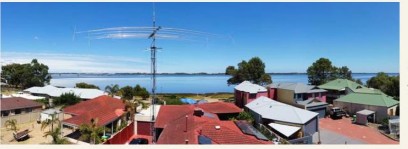
[40m] There was some activity heard tonight, and the northerners moved in.
[80m] This band is fairly quiet, even during the week as well. I didn‘ hear the dxperiment this week, either.
Post Morsum – 6th August 2025
David had a good evening on 40m and 80m in spite of the variable conditions, managing to get to work without getting lost now ! Wayne worked eight on 40m and three on 80m, his vertical antenna was fine on 40m but a change to the dipole for 80m was in order.
Mark was slightly late for the 20m segment due to enjoying a leisurely cup of tea out in the shed! Managed to work Mike DL3YZ and was around for the flurry of dits from VK well wishers when Mike signed off.
Unfortunately Geoff PA/ VK6HD was unable to come up, maybe next week? On 40m had a good contact with Jens VK4PE and on 80m caught up with Peter VK6NQL and Sava VK4PN.
Scanned the various KiwiSDR nodes around the country to monitor the net, plus spotting on WhatsApp. I enjoyed the evening working two on 40m and two on 80 and started following along sometimes only hearing one side of a contact due to band conditions.
Caught up with Max VK6FN on HF later for his report he had six contacts before retiring for the evening. VK6NW, VK6KHZ, VK6MK, VK6NQL, VK6HRC, and VIKAUK OD Net enre difficiit eany die ta najes
DI IS Th Nh ITI hI Fd orth Eh ht Nod LIA A big thank you to all on last night and this morning. Stay safe Richard VK6HRC
This Week’s Feature Topics
The Great Thing About the QRS Net is..
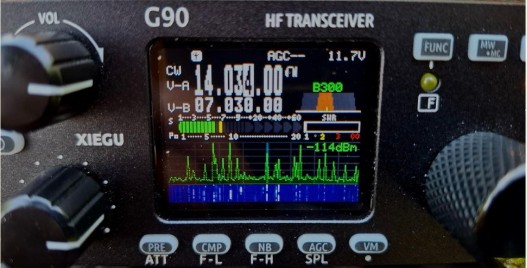
Old men like me are hard-wired to be grumpy, so let me get something off my chest… I’m not a frequent user of the airwaves and when I do, it’s solely CW – I just can’t think of anything to say out loud on SSB.
Maybe my forty-odd years as a professional aviator drained me of the urge to speak on air. CW, for me at least, is different – I positively enjoy a leisurely chat at the key and I’m rarely lost for words.
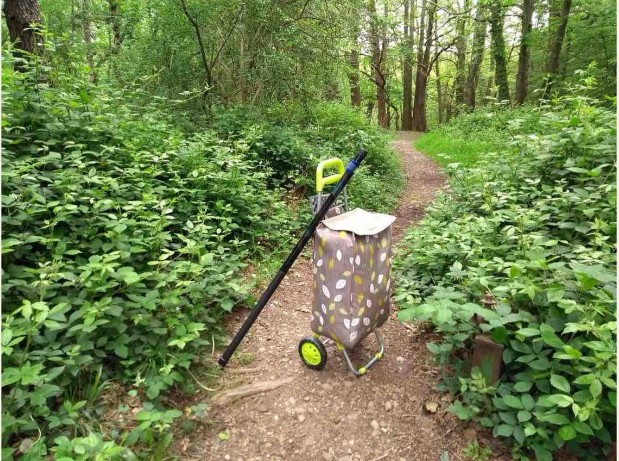
But it seems that, in this regard, I’m very much in the minority. On the few occasions when I get out Portable, I find that most other Euro operators just want my name and a signal report in the shortest possible exchange.
They’re like train spotters who have no interest in trains – they just want the numbers on the front. I confess that the resultant frustration has made me question my participation in the hobby.
Thank goodness for Morse over the internet, and Vband in particular. There, all sorts of people come specifically to chat using Morse. And they’re not all beginners either – abilities range from the painfully hopeless to the ex-professional radio officers.
But I’d be the first to admit that it’s not Radio – its reach is certainly world-wide but it lacks that charm of pulling a contact out of the ether. And then, thanks to Ron VK6KHZ, I discovered the QRS Net.
Of course, its sole purpose is slow Morse, but an interesting side-effect of that slowness is the willingness to take the time to have a chat.
It’s what an old Morse operator described to me as “Morse Time”, in which the world slows down to the pace of the slowest sender. It takes as long as it takes. If you enjoy your Morse, why would you want to tush?
So, don’t be a “meat and three veg” operator – use the QRS Net to say a few extra words and make a grumpy old man a little less grumpy. And here’s “Three Cheers” to. the QRS Net, for restoring my faith in Radio and keeping me in the game. Hip Hip Hooray!
[Thank you Ross – a terrific follow-on to your most relaxing article Life’s Too Short for QRP in last week’s RagChew. I reckon that Ross has captured the essence of what makes our CQQRS net so good; well done that man!]
HMTeEnIQent: AICTE! Magic: by Nigel G4RWI Following on for last week’s newsletter (31/2025), I thought it might be interesting to write a few articles explaining how I have found Al a useful tool in this hobby.
But be- fore diving into that, why don’t we start with how does Al actually work? You may have played with ChatGPT or have used Al unwittingly.
Anyone taking a pic- ture with a smart phone in the last 8 years will have had Al (on the phone) adjust the photo But how does it work? Is it intelligent? Is it magic? What it actually is, is a non linear statistical model that makes predictions.
So what it produces is a guess, and now those guesses are so good, that in many cases the guess is indistinguishable from what a super knowledgeable human would have said. As radio amateurs we like to know how things actually work.
What follows is a simple explanation as to how we could build an Al that could recognise cats and dogs. In the end, we’ll have something that can look at a picture of a cat or dog it hasn’t seen be- fore and tell us which one itis.
The basis of all Al’s are neural networks. A neural network is a large collection of simple processing elements called neurons that are all connected together. A neuron is non linear processing element, and each has a gain setting.
So a signal entering a neuron will exit it having been changed in a non linear way, and will be either ampli- fied or attenuated, depending on how the gain was set. Before our new Al is going to be of any use, we need to train it. This is true for alll Al.
Training Lets imagine we have a pile of pictures of cats and dogs, say 100,000 examples. When we start, all of the gain settings will be randomly set to a different value. We show it the first example (say a cat), and look at the output.
It will be a random value at this point. There is 50:50 chance of it being right. Lets say it was wrong, it suggested Dog.
We mark it as wrong, and the network tweaks all the gain settings by a small amount until it gets the right answer, Cat Now if we show it that exact picture a second time, it will get the right answer. We proceed with the second picture.
It gets it wrong again, so it tweaks the values further, but this time it needs to tweak them so both the first picture and the second picture give the correct answer.
We proceed through the pile of pictures and when we get to the 100,000th, it will be tweaking the gain, so that not only is it getting the last one right, but the proceeding 99,999.
Now we have trained the model, if we show it any of the 100,000 images, it will be 100% correct. But what if we show it an image it has never seen before?
It will almost certainly be correct. For ex- ample if we show it a Lion, it will suggest Cat, even though all the training data was of domestic cats. What we have created is a model that understands the differences between Cats and Dogs, in a very subtle way.
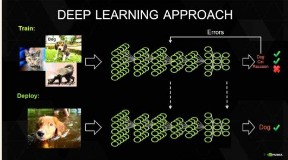
So how does this relate to ChatGPT and other so call Large Language Models? At their heart, they are exactly the same, other than the scale is eye watering. Of course there are other nuances that I haven’t gone into.
All that ChatGPT and others are doing, is based on the words you give it (your ques- tion or prompt), statistically predicting what the most likely next word is, and then the following word, etc ete Those words that it’s predicting, are the answer.
To give you an idea of scale, the ChatGPT model has billions of neurons, will have been trained on trillions of pieces of data (essentially the entire contents of the inter- net, every book ever written and anything else it can get its hands on!) The training will have used 10’s of thousands of high end Graphics Processing Units working in parallel in massive data centres, and will have taken months.
It will have consumed power equivalent to a small nation. Next time I will give you examples of how I am using it in this hobby. As an example I very rarely “google” anything anymore, but more of that later. Cheers, Nigel G4RWI

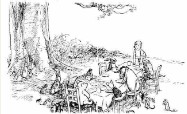
Maybe it’s my age, but being able to revisit in my mind the adventures of Winnie-the- Pooh and his friends is quite delightful.
Cleverly reincarnated as Morse Code head- reading exercises, OM John, VK2RU, has provided us with a priceless gift through his adapting, recording and presentation of a series of sound files.
For the first time in my CW career, I have copied training files into an audio recorder which I play while riding my ebike, not just to improve head-reading, but to set the scene when visiting one particular geocache for the sole purpose of carrying out maintenance.
It is located in the north Waitarere forest, 3 km from the nearest public road and 220 m inland from the sand dunes at the beach.
By now, astute readers will probably be asking two questions: how come geocaches suddenly need maintenance, and how could Winnie-the-Pooh possibly have any relevence to geocaching? There wasn’t any internet or GPS in 1926!
Answering the first question: there’s nothing sudden about geocaches needing maintenance, they always have needed maintenance but few ever receive any.
Despite signing up to the rules, the majority of geocache owners leave their caches untended for years, during which time log books become sodden from condensation, and in some cases the entire container fills with rain water.
At the opposite end of the scale, the geocaches I maintain for my German friend Herr Witzcowitz are well sealed, and unconventionally, each contains a small, vapour- porous pack with 17 grams of recyclable blue, cobalt chloride-infused silica gel crystals inside.
These dessicant packs get swapped out every two months after the contents have turned pink from absorbing water vapour. Tthis simple technique ensures the geocaches are kept ‘as dry as a bone’, despite being located in the diurnal temperature-cycling and often very wet forest.
Answering the second question: One of Herr Witzcowitz’s eleven geocaches has been hidden at ‘Pooh Corner’. Because he is too old now to hike through the forests to do maintenance, I agreed to carry it out for him, thus providing some new and unlikely connections between my ebike, being able to visit ‘Pooh Corner’, not in my imagination but physically, and head reading CW all the while.
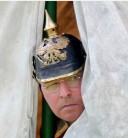
7 This beautifully restored photograph shows Herr Fritz Witzcowitz, the geocache owner, sporting his grandfather’s pickelhauber.
A treasured family heirloom, the pickelhauber is from the days when the Grossvater of Fritz served in the Prussian Army at the end of the 19TH century.
By way of thanks for my carrying out maintenance on his geocaches, Herr Witzcowitz agreed to my placing laminated souvenir cards in them. On the back of each card is an invitation for finders to request by email a Wireless Telegram Form.
Instructions are provided how to fill in the forms and address them to friends and family in order to have Waitarere’s only Morse Telegraph Radio Station send and receive messages on their behalf by Morse Code, a service identical but free-of-charge, to old- fashioned maritime traffic.
It may have been noticed that AROs don’t perform this function any more, and I ask why not? Let’s make use of our still-viable, loosened- up, third-party traffic rights.
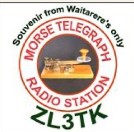
A Over the years, several dozen of my souvenir cards have been uplifted from the geocaches in the Waitarere forests, but the sad truth is not a single request for a third party traffic Telegram Form has ever been received.
Guess it’s just another symptom of the ubiquitous cell phone rendering an antiquated, mostly forgotten mode of communication too cumbersome to even consider. We recall it was Eeyore who occupied the ‘House at Pooh Corner’.
What, then, are the links between Herr Witzcowitz’s geocache in the north Waitarere Forest, and the beautiful Ashdown Forest in East Sussex upon which was supposed to be the ‘100- aker forest’?
(sic, Christopher Robin’s spelling) The first link is obviously that the two forests, Ashdown and Waitarere are, within reason, considered antipodean.
The second link is found in the name of the book authored by Christopher Robin’s loving father, Alan Alexander Milne, ‘The House at Pooh Corner’, and the inversely-named geocache, ‘No House at Pooh Corner’.
Le Over the years, several dozen of my souvenir cards have been uplifted from the geocaches in the Waitarere forests, but the sad truth is not a single request for a thirc party traffic Telegram Form has ever been received.
Guess it’s just another symptom of the ubiquitous cell phone rendering an antiquated, mostly forgotten mode of communication too cumbersome to even consider. We recall it was Eeyore who occupied the ‘House at Pooh Corner’.
What, then, are the links between Herr Witzcowitz’s geocache in the north Waitarere Forest, and the beautiful Ashdown Forest in East Sussex upon which was supposed to be the ‘100- aker forest’?
(sic, Christopher Robin’s spelling) The first link is obviously that the
Two forests, Ashdown and Waitarere are, within reason, considered antipodean. The second link is found in the name of the book authored by Christopher Robin’s loving father, Alan Alexander Milne, ‘The House at Pooh Corner’, and the inversely-named geocache, ‘No House at Pooh Corner’.

There genuinely is no house at our local ‘Pooh Corner’, imaginary or otherwise, proven by each of the 41 visitors who have hunted down the geocache.
Decades ago a tall, fire-watch tower and a number of staff houses were in the north forest, but today there is no tower and no dwellings, which makes the geocache’s name particularly apropos. Aca.
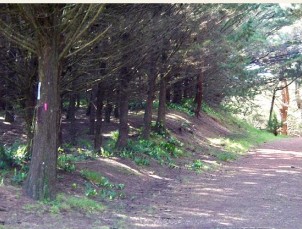
Twenty-year-old radiata pine identified only by a small, vertical, pink blaze bearing the words ‘Pooh Corner’ in black ink, is the only visible indication that the geocache is nearby.
A GPS will take one 140 m north from ‘Pooh Corner’, where by turning sharp-left at the orangey-brown, sun-lit tree shown in the far-right of the photograph, the geocache, ‘No house at Pooh Corner’ may be found hidden a short distance away from an ill-defined track heading west.
Now we can see how OM John’s CW-inspired head-reading project has brought us half way round the world. Whether by long path or short path is immaterial, however an ebike and sound files do make taking the ‘long path’ rather worthwhile.
Thank you John, keep right on feeding us those brilliant recordings which bring back to life innocent childhood tales from the 1920S. 73 de Stan ZL38TK [Wow! Thank you for your efforts here Stan – a bloody terrific read!]
If you have an article or two that you think might be of interest to our readers, please let me know so we can share more thoughts and ideas; for guidance on writing for RagChew, see Articles below. Please email material to Mark VK2KI: cqqrsnet@gmail.com

On My Workbench
This week, Sava VK4PN lets us into some of the secrets about why he has such good signals around Oceania. Originally published by the Sunshine Coast Amateur Radio Club and similar to the balanced feedline design published in AR Magazine in 2023 by our family member Donald VK6JDM, Sava’s design uses commonly available components.
Balanced line or open wire feeder is an alternative to coaxial cable but not as readily available. It is however easy to make one with all components available off the shelf from Bunnings or similar retail outlets.
The picture shows two items required, the third item is figure 8 PVC coated cable either for 240 AC or a heavier gauge speaker wire ( for power over 400 W ).
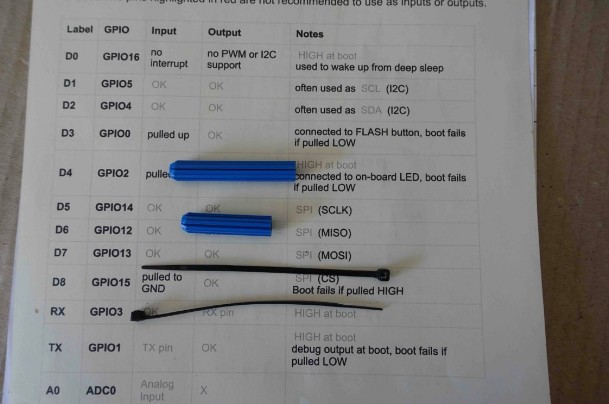
The first step is to determine how much wire is required for antenna element and the approximate length of the feeder. A plastic masonry plug ( blue ) will be spaced every 25 to 35 cm of feeder length.
Blue plugs have the largest inner opening and accept two back to back zip ties. Zip ties should be 15 cm long and 2.5 mm wide. 1.5 mm zip ties are even better but not ready available. Make sure that zip ties are UV rated!
Before describing feeder construction few words about random wire antennas. Dipole is most common with all parameters well defined but it has few restrictive characteristics, it has to be centre fed and the line needs to be balanced.
72 Ohm balanced lines are virtually impossible to buy. So coaxial cable is used instead requiring a BULAN. All the weight ( and there is a quite a bit of it ) is in the centre). In many cases centrally fed antenna does not suit our back yards.
So off centre fed dipole ( OCF ) or any length of wire (preferably longer than ¥% wavelength ) is a good alternative, The fact that random length wire is not resonant and that in most cases there will be a total mismatch between the feeder and the antenna wire is irrelevant.
Open wire feeder is very low loss, it does not radiate ( due to proximity of the two opposing currents in the feeder conductors ) and the random length wire will radiate all the energy delivered by the feeder.
The only differences from the dipole are the radiation pattern which will be asymmetrical and the impedance. All OCF antennas will work even the one fed at the very end ( true ZEPP ) but the feeding impedance gets very high close to the end of wire.
The best is to keep the feeding point as close to the centre as possible. These types of antennas should never be connected to the transceiver directly, a balanced type tuner must be used. Assembling the balanced line is relatively straight forward.
A suitable length of figure 8 wire is split into two separate conductors. Each conductor is attached to a pole or a fence approximately 10 cm apart. Comfortable working height is waste high.
The other end of the two conductors is attached to any suitable object at approximately the same height and spacing and starched tight, the two wires will be almost parallel.
Spacers are made of blue masonry plugs with two zip ties treaded through the central hole back to back.
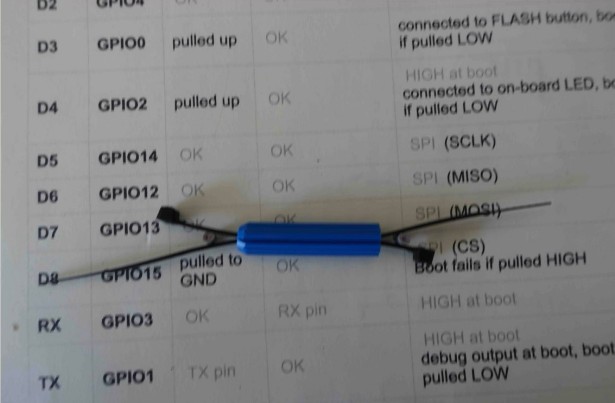
Notice that the locking boxes are facing in opposite directions. Zip ties are looped around each conductor and loops tightened but not too firm. After half a dozen or so spreaders are fitted they need to be spaced along the wire. Using a ruler slide
Spacers along the wire to be evenly distributed at approximately 30 cm. This process continues until the full length of the balanced line is spaced. At this stage spacers can be fixed permanently.
The best method is to use two pairs of pliers and pull zip ties ends in opposite directions until loops firmly grip feeder wires. Excess zip tie ends can be snipped off but approximately 3 mm tails should be left for any future re- tightening. Job is done.
If you want to know impedance of your balanced line there are numerous calculators on the WEB. With parts shown in the associated pictures ( 50 mm blue masonry plugs and 0.75 mm# figure 8 wire ) impedance will be somewhere between 450 and 600 Ohms.
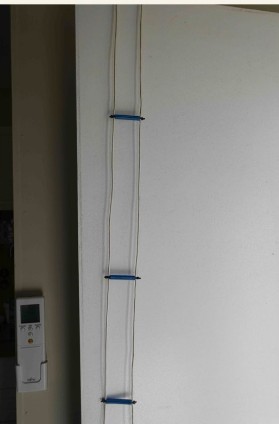
Aii OVY VIITTS. az CS I The same size wire can be used for the two antenna elements which should be attached to a spreader for OCF excitation.
I use egg type plastic insulator and loop each element’s end through holes at insulator ends, twist the wire end around itself, than solder together. Feeder wires can passed through the insulator holes as well and be soldered to element ends.
Suspending of the feeder and the antenna will depend on structures available and will vary from installation to installation. Trees are fine, non-metallic risers above house roofs are ok.
If metallic structure is to be used than space the feed point away from the structure by using non-metallic support. A lot of houses these days have metal roofs or Aluminium foil under tiles.
This will affect your effective height and angle of maximum radiation. EZNEC or MMANA-GAL antenna analysing software ( both are free ) are excellent for analysing your antenna performance ( feed impedance, VSWR and radiation pattern ).
Both are highly recommended. And finally, antenna height is everything, sky hook it if you can! 73 VK4PN [Thanks Sava – excellent! Looking forward to your follow-up article about matching BALUN aesign.]
What’s going on on your workbench? If you have an article or two that you think might be of interest to our readers, please let Mark VK2KI know; email to cqqrsnet@gmail.com For guidance on writing for RagChew, see Articles below.
Other News
Re: Ross MONNK’s Life’s Too Short for QRP Article in RagChew 31/20
Re: ROSS MUNNKA’S Life’s foo snort for QAP Articie in RagUnew 31/2UZ90
From Geoff PA/VK6HD Ross said: “And if you find making contacts stressful, you might want to give QRP a go, as you won’t be troubled by many of them!” Never a truer word spoken! 🙂
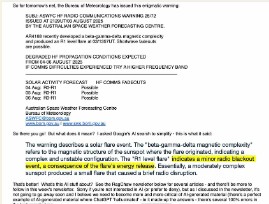
MOCSVPUIISe LO OPAaCS WCaUIC! CCIVILes FICUit from Paul VKS3KLE This week’s email reminder about the CQQRS net included notification of the rather confusing propagation warning from the Bureau of Meteorology’s Space Weather Services – and Google Gemini Artificial Intelligence’s English interpretation.
Paul VKSKLE has responded with his experience of propagation anomalies.
Hi Mark Well for my two bits worth. Prior to big impact of a flare, the HF background noise sounds a little more active. Once it hits us the ionisation changes and a radio blackout lasting several hours occurs.
Often background noise becomes absent along with wanted propagation signals Then on the tail end, you can sometimes hear unusual DX amongst a lower noise floor. Jordan and I may still be able to work 80m or 160M on ground waves as we are close in, under 200KIM.
I’d expect NSW and QLD to be unreachable in Victoria during the Class One flare. Perfect excuse to go QRO as conditions will be poor. Could be worth trying 10m, I’d suggest around 28.050 and 15m. QRO only as we expect poor propagation.
By the way I find if two operators get a good path on 10m the QSO is like gold – FM type of quiet. Ihave a full wave vertical for 10m that rocks into the reverse beacon stations in Asia quiet reliably on the grey line.
Problem is as the stations are weak you need a designated frequency to listen to. The vertical is quiet high above ground and physically looks like a vertically full wave centre-fed with a coil match network.
As the centre coil network is a taped affair if you can cope with a 1:18 swr ratio it will propagate on 20m nicely . Many thanks to NBL antenna for the technical support for this antenna . I added a couple of 45 deg radials for 15m and 20 m.
They are just wire that also work double duty as guy wire support in the middle. My local Council seems to like the vertical I have up. It’s a good alternative compromise to a mast and a Yagi – although I’m confident a small Yagi would be a fine thing too lol.
Nice low angle of radiation expected withe the reports I get from Asia (wouldn’t be otherwise possible). I find a separate 20m dipole that is horizontal is a better Rx antenna by far as vertical antennas are noisy that way.
That horizontal one is centre fed coaxial with commercial 1:1 current balun. Interestingly a few stations are sometimes quiet strong Rx wise on the vertical just to reverse the argument. In my opinion it’s good to have both for 20m and above if room permits.
And just incase your wondering, my 160M doublet has one leg on a straight in-line tun, it’s other half of the wire is in a C shape lower than the first wire with its end section finishing in the same plane as the first one.
Sounds complicated but it’s linear loading and is a good tx antenna for CW on top band. To summarise I’m suggesting we pick 10m and 15m fixed frequency to use as. backup if 40m and 20m are inoperable. Regards Paul VK3KLE 73
Hi Mark
/MM Question
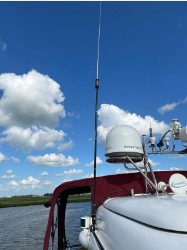
‘NIE wuesuon from Geoff PA/VK6HD On the canals of Holland, as I am (technically and physically) on the water, 1. Should I be VK6HD/MM, and then if/when I go ashore be PA/VK6HD? 2. Should /MM only be used when “underway and making way”? 3.
If so, should I be PA/VK6HD when anchored or alongside, or in any other way connected to mother earth? 4. Should I be PAVK6HD/MM as I am in inland waterways? 5. What about if I go on the Ijsselmeer or the Wadden Zee, or even the North Sea? 6.
Should my VK6HD/MM call only be used in international waters?
| recall using my VK call with /MM when at sea in Young Endeavour and countless other yachts in many parts of the world. Perhaps time for the brains trust to wade in (no pun intended)? Ciao G
The CW Ops Column
7-Aug-25
Hello everyone, I’m going to try to stick to a standard format each week – that way you know what to expect.
CW Sked
Would you like a sked outside of the Tuesday sessions (ideally Monday night) – where you can get feedback and ask questions? Email and VK1CWO can help! vkicwo@outlook.com.
Or if you have any general questions around sending, receiving, or developing your skills, please drop me an email.
CW Ops
CW Ops was formed in 2010 with an initial focus on educating the next generation o1 CW operators, with CW Academy the first major offering – it’s come a long way in 15 years, but the basic principles remain the same.
Well over 12,000 students have successfully completed the program, with over 100 Advisors contributing to the growth of CW. In the coming weeks I’ll talk more about CW Academy, but if you’d like to know more, head over to the website, or just drop me an email.
Helpful Hint
Create good habits: Practice your callsign, name and QTH off-air until you can senc them accurately without thinking. Set your speed to 13-18WPM and increase the spacing if required. Record on your phone and then listen – is your timing and spacing good?
Email it to VK1CWO if you’d like feedback. Establish a ritual of sending your callsign and a few “v” before each on-air session.
RD Contest
The very popular Remembrance Day contest is coming up on the 16TH and 17TH of August. This is a great low-pressure contest and well suited to those looking to dip their toes in the contesting water.
You don’t have to stay on-air for the full 24 hours – just try one or two of thee-hours segments and see how you go. If anyone would like me to setup a Zoom session for Q&A and configuring the logging software just drop me an email – I’ll aim for Wednesday or Thursday of next week.
Https://www.wia.org.au/members/contests/rdcontest/
Have Fun
Morse Training Net
Our team member Nic VK7WW runs an on-air Slow Morse training net every Wednesday at 7pm EDST on 3580 for 30 mins. He uses the callsign of the Northern Tasmania Amateur Radio Club VK7TAZ on that net.
Many of our team learned Morse code with the support of Nic, and the weekly training session comes highly recommended for anyone who wants to learn the Code, or simply brush up.
Everyone’s welcome – 3580KHZ at 7pm Eastern time every Wednesday; you’ll hear lots of the CQQRS team on that net. Jordan VK3ACU has recorded the complete set of lessons which you can now find here:
Https://www. youtube.com/playlist?list=PLHsQmZz6fBXO7swAfbT mutrbbEL17fUQL Contact Nic VK7WW for more info nicholaschantler@hotmail.com including how to join the NTARC DISCORD group to follow the action, or just come along and join in on Wednesdays.
Progress report on the QRS International Flight Contest
Flight NR 08 took off eastbound across the Indian Ocean on Wednesday 0000Z. The contest is running really smoothly, but there’s still no sign of those who would benefit most from this
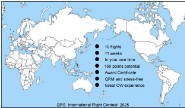
Type of low-pressure exercise. Do we know the cause of such reticence? Likely there are several, each one personal and kept well hidden. Remember the wise old adage, ‘Failing to plan is planning to fail’?
The same applies to deliberately turning one’s back on great opportunities. With two flights left before the final event, only those who have been active participants right from the start will find it possible to gain the 20 bonus points on offer.
In a similar vein to the education system, IFC has been structured to reward those who get stuck in and put in effort. All QRS IFC information is available at bit.ly/qrsifc 73 de Stan

Fives: This eight-week event has the following objectives: © To promote regular on-air QSOs primarily between VK and ZL operators. Other DX operators and contacts are welcome.
© For CW operators to have as many QSOs as possible whilst meeting the minimu criteria for a QSO. © To provide an event that meets the needs of different types of CW operators. © Touse these sessions to build on existing skills and satisfy your own goals.
© For aperson who normally operates POTA/SOTA, this might mean extendin their QSO vocabulary to include a few new words or phrases. © For an operator comfortable at 12WPM and basic QSOs, this might mean aiming to increase speeds by 2-3 WPM once a week.
© For acontester this might mean exchanging station details they don’t normal exchange. Participants are encouraged to notify the Event Administrator of their personal goals prior the event.
When: Start date: Tuesday 17 June 2025 End date: Sunday 10 August 2025 This is an eight-week event aimed at our CQQRS family, with one-hour sessions commencing 17 June 2025 and taking place on Tuesdays, Thursdays, and Sundays at 0930-1030z.
And there’s a bonus for QRS operators as well. How about having a go? Read more and review the rules here: https://morsecodesessions. wordpress.com/morse-mania-winter-2025/
Handy Key for Sale
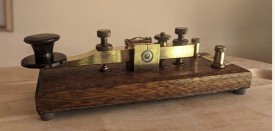
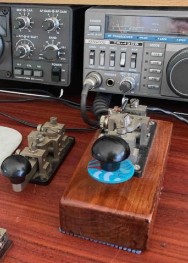
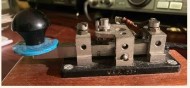
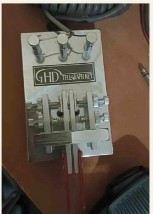
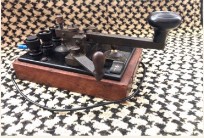
From David VK3DBD: Hi Mark. You may be well aware I cannot stop making keys. Perhaps a Collectamania_of sores, but keeps me off the streets.!
Last Christmas period for a few weeks I was in NZ at my daughters + family QTH – where I have a shack and radio and a nice workshop too, I made up a small straight key from various bits of brass and stainless steel that fell to hand and brought it back to VK with me with intentions of some minor changes I felt it required.
These now completed and the verdict of the key – which I have been using for a good number of QSOs, has passed my critical judgement with flying colours. But how many keys does one need ??__ I have a small collection of commercial ones anyway.
As well as my several home brew models both pump and paddle. Now I am a real enthusiast of your brainchild the QRS NET and regret I have difficulties in spending more time on that for various reasons.
Instead I thought I would offer this very nice little key to anyone in VK (free of postage costs) and although you are not an advertising site I am fully aware, wondered if you fancy the idea of displaying a couple of photos and my comments Iwas going to sell on the “VKclassifieds” site but will give others a chance first.
And I will pay the postage, saving about $15
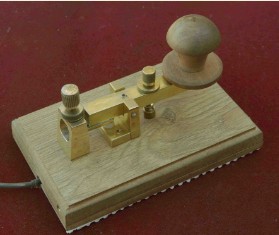
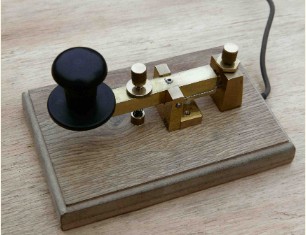
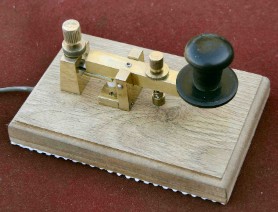
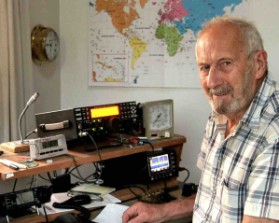
My attached blurb gives more info and photos too are atrached, Mark, perhaps you would read “Handy key and would let me know your thoughts? very 73 David VK3DBD vk3dbd@gmail.com
[Thanks David. I occasionally come across amateurs who are using a key hand-made by themselves, or someone has made it for them – inevitably, they’re proud owners. I’m sure one of our family would love to adopt one of these beauties.]
If you’ve read something that you think might be of interest to our readers, please let me know. For guidance on writing for RagChew, see Articles below. Please email material to Mark VK2KI: cqqrsnet@gmail.com
Readable Five
What have you been reading lately? Compiled on the track somewhere by John VK2RL
Samuel MORSE, HISTORIC CODES and TELEGRAPH APPARATUS
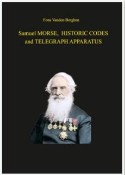
Readers may have heard of the Belgian telegraph historian Fons Vanden Berghen. Fons asked me to let you know that he has just published the English language version of his 7 and latest telegraph history book and that he has made this as pdf available at no cost on the internet, along with his other books.
These books represent his lifetime of work in collecting, studying and writing about telegraph instruments and telegraph history.
This 7″ book represents an in-depth presentation of the history of the telegraph starting from the earliest attempts to extend communications beyond the capabilities of the human voice through the various stages of the development and evolution of the electric telegraph.
Four of his earlier books are in Dutch and three in English. For details on his other books I suggest that you visit his very extensive website: “FORWARD” TO THE PAST – hitos:/Avww.telegraphy.eu The title of this seventh volume is ‘Samuel MORSE, HISTORIC CODES and TELEGRAPH APPARATUS’.
It is a 351-page work with more than 500 illustrations that are mainly color photographs of the related equipment. Since this latest book is mainly aimed at Amateur Radio Operators, it will be of interest to a wide spectrum of people who are involved in radio-related activities and studies.
As such, and as also advised in the Introduction, there is no need to read the book from A to Z in that order, and readers can skip and jump to chapters that have their interest. It can be downloaded for free from the internet: via BOOK7V2c Cheers, Kees, VKIKVS
Head Copy Practice
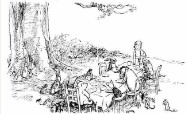
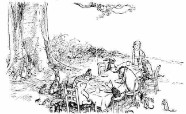
Over the past three months, each newsletter has brought you a chapter from A.A. Milne’s classic, Winnie the Pooh. This week, we reach the final chapter. Join us as Pooh is celebrated with a party, and we bid a fond farewell to this timeless tale.
For those who are afraid they may now find themselves adrift without their weekly morsel of fine literature to share with companions, or to quietly practice Morse in the Stillness of their own minds, fear not.
Another classic is already stirring on the breeze, and it may just meander down a riverbank near you, with a slight whisper through the willows and the reeds.
The book, ‘Winnie the Pooh’ was chosen for head copy practise because it contains simple, familiar, and sometimes predictable words that makes learning to head copy a bit easier.
Previous ‘Winnie the Pooh’ chapters and suggestions on how you might use them can be found at the CQ QRS website – https://bit.ly/CQQRSWebsite . Here are this week’s files.
There is one .txt file with the whole chapter, two .mp3 files with about a half of the chapter each, and two text files containing the text for each .mp3 file. We have to split the .mp3 files because of size limitations in Mail Chimp.
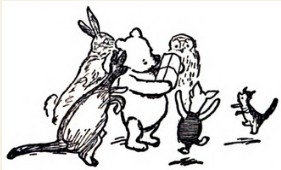
The original text contains some punctuation that is not normally used in morse today This punctuation is not recognised by the Ditto CW app, and it also causes the ebook2cw app some headaches, so it has been removed.
Where a word contains an apostrophe such as “won’t” I have removed the apostrophe. Some words such as “we’ll”, have been changed to ‘we will to avoid confiicion—
[Outstanding work John – thank you for making these available for readers – either for head copy or for written copy practice (using the variable play-back speed feature on smartphones as you’ve discussed before.
Looking forward to which ever path you take us down next… watching out for Woozles of course.]
If you’ve read something that you think might be of interest to our readers, please let me know so John and I can share more thoughts and ideas. For guidance on writing for RagChew, see Articles below. Please email material to Mark VK2KI: cqqrsnet@gmail.com
Prosign/Character/Signal of the Month
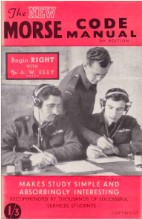
Our resident CW trainer Nic VK7WW (see Other Notes above for the link to Jordan VK3ACU’s recordings of Nic’s training transmissions) was asked about a standard two-or three- letter designation for an exclamation mark.
Nic has always used
[Suggestion – put it on a sticky note near your key as a reminder for Tuesday. Tell us how you went!]
Di-dah-di-dah-dit
So back to the CQQRS Slow CW QSO practice net.
Next Tuesday’s Net
Our CQQRS Group will be on as always on Tuesday from around 0700Z until about 1300Z; see https://bit.ly/CQQRSWebsite and navigate to the Net Details page for details.
Doesn’t matter whether you’re brand new and want to try just exchanging callsigns and RST reports, or you’re ready for a good old rag chew. We’ll have fun.
There’s usually people around until after 1300Z – so keep calling in the segment of the band designated in the table below until you catch someone.
I should be on as usual from home in NSW or via the Remote at Bedfordale WA, and I’ll also be watching the proceedings using the VK6QS and Tecsun SDRs in WA and NSW respectively. Hope to hear you there.
Please let us know via our Reports form bit.ly/CQQRSNET who you work or hear on Tuesday’s Group. The report form closes at lunchtime (Eastern Australian time) on Thursday.
And by the way, a reminder; if you send me any information by email, our report form or WhatsApp – unless you specifically state that material is not to be published, I’ll assume that you’re happy to see your thoughts in the RagChew newsletter.
Post Morsum
Richard VK6HRC will run our phone Post Morsum on the South West AllStar net (via repeaters and hotspots all over WA) from 0600 WA time, then from 0700 WA time on 80m (8605 LSB).
See https://bit.ly/CQQRSWebsite and navigate to the Net Details page for details of how you can connect via Echolink or even possibly via your local FM repeater.
Articles
The newsletter is interesting to readers because of the material contributed by so many people – be it the reports each week or the various articles. Could you write a short article or articles for RagChew? You bet! Writing not your strong point?
Don’t worry, I’m very happy to help as much or as little as needed. Here’s a thought – although our readers will much prefer your own writing, perhaps have a go at using a Large Language Model Artificial Intelligence tool such as ChatGPT, Microsoft Copilot or Google Gemini to check your writing or even to actually draft the whole article in a relaxed easy-to-read manner!
You can find out more about how to do that on the Newsletter page on our website bit.ly/CQQRSWebsite. Our website also includes a suitable prompt (the command you feed to the Al to make it do what you want).
Please remember though – you must fact-check anything that an Al tool drafts for you because Als ‘hallucinate’ – ie if an Al can’t find what you’re looking for, it will make up an answer and present it as a fact!
This is one of the dangers of using Als – it’s quite probable that the tool will create a very readable and convincing draft that is 100% wrong! You as the submitter are responsible for fact-checking.
But it’s a learning experience – please let us know how you went if you had a go with this new generation of tool. And by the way – lam very concerned about our future in a world of Al – but I’m pleased to see that school and university curriculums now focus on understanding the risks – for instance, kids are now learning critical thinking something that used to be taught mostly at post-graduate level.
When the typewriter was invented, people predicted the downfall of handwriting; when the word processor was invented, the art of writing was thought to be on the way out – ditto for the spreadsheet and arithmetic, AM, SSB and FT-8 for amateur radio etc.
We can ignore Al and hope that it just goes away… or we can learn to handle it through experimentation and use. For more guidance on writing for the RagChew newsletter (including help with using an Al), head to our website bit.ly/CQQRSWebsite then click the menu on the top right and then click RagChew Newsletter.
Teamwork
Thank you so much to our team of 38 contributors: DL8YZ, G4RWI, MONNK, PAVK6HD, VKIKVS, VK2GAS, VK2GAZ, VK2IOW, VK2NNW, VK2RU, VK8ACU, VK3DRQ, VK3ECH/VK4, VK3KEV, VK3QB, VK3WOW, VK4PN, VK4SEC, VK5AO, VKSED, VKSKFG, VK6GX, VK6HRC, VK6KD, VK6KHZ, VK6MK, VK6NQL, VK6IS, VK6NW, VK7JZ, VK7TA, YB1NWP and ZL3TK.
And a special thank you to our editorial team, Nigel G4RWI (head of software development), Patrick VK2IOW (reports coordinator), John VK2RU (researcher and Winnie the Pooh reader) and Richard VK6HRC (Post Morsition). Great work all! UY CW on Tuesday, mb.
Mark Bosra VK2KI/ VK6QI Beautiful South Bowning NSW mark,bosma@icloud.com non impediti ratione cogitationis
In distant lands with radios bright, Signals danced through the day and night. Mike from Stuttgart, bold and clear, Sent beeps afar for friends to hear. Armin’s call from Norwest rang, But faded fast, a fleeting clang.
Stan at Waitarere Beach stood tall, Yet signals weak did barely call. Jim in Hobart braved the chill, With mast that toppled, lost his will. But laughter rose where dummies spit, For radio’s joy won’t ever quit.
From Bekasi to Ballajura’s shore, CW friends connect and more. Despite QSB and poles that fall, The net lives on, uniting all.

About the CQ QRS Net
For the current schedule and more information about the CQQRS net, please go the the Net Details page on our website:

The opinions expressed in the RagChew newsletter are those of the individual contributors. The opinions do not necessarily reflect that of the editor or of the CQ QRS Group members.
Any material and images received from members by the editor or published on the CQQRS WhatsApp groups may be published in this newsletter unless specifically requested otherwise.
The values, doctrine and guidelines for the Group and for the newsletter are published on the Principles page of the group’s website https://bit.ly/CQQRSWebsite