Below is a reconstruction of the 2025 21 CQ QRS RagChew newsletter designed to support full text searching. This reconstruction was built using OCR, and will contain errors.
To view the Mailchimp original, click here. To search the entire newsletter archive, click here.
Contents
- CQ QRS RagChew
- Last Tuesday’s Group
- Masthead Image
- Reports
- After next Tuesday’s Group, please send me a list of who you worked and/or you heard using our web form here:
- Website
- Reports & Comments
- Comments:
- Post Morsum Report
- This Week’s Topic of Interest
- On My Workbench
- Other News
- From Nigel G4RWI:
- Morse Training Net
- Andrew VK1DA
- Congratulations to Donald VK6JDM
- Dear Mark.
- Debrief from the SAS Net Thursday 22 May
- QRP to QRP QSO during the Don Edwards Memorial and Sangster §
- Contests
- Adjustment
- There’s No Such Thing…
- Causing QRM
- Editor’s Answer:
- Di-dah-di-dah-dit
- Next Tuesday’s Net
- Post Morsum
- Teamwork
- may end up where you are heading. Lao Tzu
- About the CQ QRS Net
CQ QRS RagChew
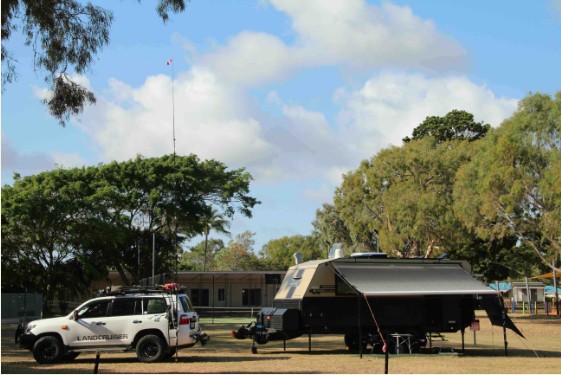
So much fun on Tuesday – and so variable the reports! For some the bands were alive during our CQQRS Slow CW Practice QSO net; for others very quiet! Really interesting conditions on 40m and 80m…. and success with some of our European / UK team too!
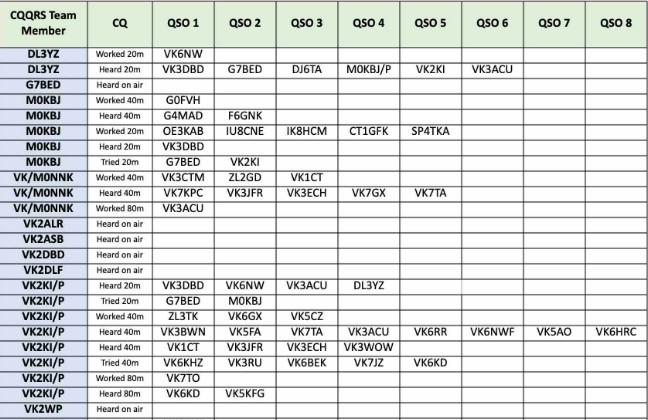
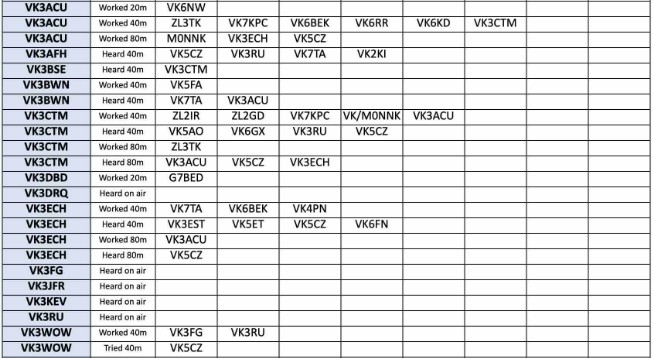
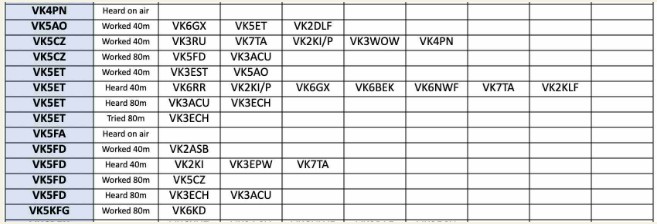
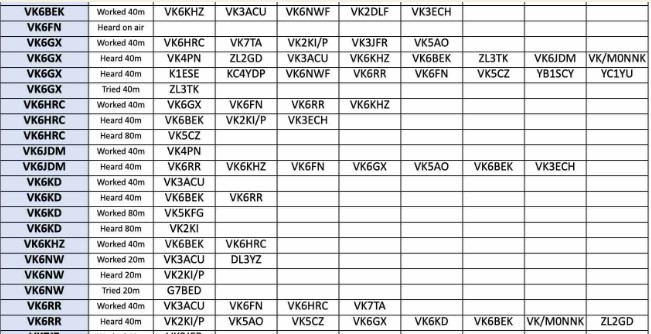
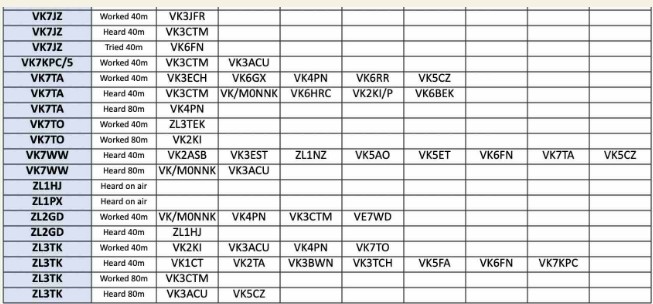
As it turns out, there were 78 stations heard or worked by at least 48 of our team members! So please enjoy the read – including: the long wait syndrome, Peter the optimist, what on earth have I bought, a new partner for our software department, the myth of low antennas, new mother-in-law, the Ameco K-4 Telegraph Key, Causing QRM on CW and the flag effect.
Last Tuesday’s Group
Here’s the 78 stations heard by 48 members of our team on Tuesday:
Masthead Image
Celebrating a year on the road travelling clockwise around Australia, David VK6KD and Pauline have now arrived back in Perth safe and sound.
David managed to get on air most Tuesdays no matter where he was – and as it turned out, the vast majority of his radio activities were on CW! Pretty good arancidqarinn that
Reports
After next Tuesday’s Group, please send me a list of who you worked and/or you heard using our web form here:

Please help attract new and old team members to have a go by submitting your repo! each week. Submissions close 1300 (Eastern Australian time) on Thursday.
Website
If you’d like to find out a bit about our net, or would like to pass information to others about our Tuesday get-togethers, here’s the link to our website.
Bit.ly/CQQRSWebsite Cheers, mb Mark Bosma VK2KI / VK6QI Beautiful South Bowning NSW mark.bosma@icloud.com non impsditi ratione cogitationis
Reports & Comments
The spreadsheets above show the known stations on last Tuesday’s Group; the comments distilled from the team members’ reports follow:
Comments:
[20m] * Today I was just looking how things work out for our DXperiment team, as I heard Wayne VK6NW calling on 20 m. As no other station answered, I took a chance and was happy he could hear me. 🙂
[40m] «It was great to be Ross VK/MONNK’s first ZL QSO. Conditions were very strange indeed tonight. I could hardly hear Mick ZL1HJ and some of the VKs were very watery with deep QSB – Jolly aurora playing havoc again I NW —-yoyo—
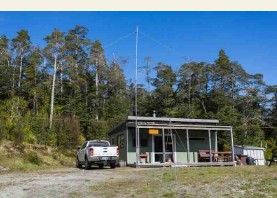
[40m] + Tail-gating a QSO can be frustrating when, after a long wait, they both disappear, or someone jumps in before me! Glad to have a VK1 cralician in
Log though – now I’m only missing a VK4..
[80m] * Called CQ without much hope of a reply as I thought it might be too early for 80m to open. Then, to my delight, I had my first ever contact on 80m, thanks to Jordan’s excellent sending 🙂 Then it was time to do the supermarket shopping 🙁 [Heh heh – the long-wait syndrome of QRS!
All part of the joy mate! I find using a KiwiSDR in parallel is a useful addition to using a Remote – you can then see new stations pop up while you’re listening in to aa rag chew. And good stuff with the joy of 80m Ross!
When it opens, it really rips around VK & ZL. Our net used to be only on 80m and we had lots on – so I enjoy having a look there as the sun goes down across the wide brown land (funny name… area-wise, most of it is actually red!)] From lan VK5CZ at Clare
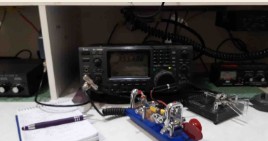
—— a had where 14 WPM and bit faster which means everyone is improving making this net more worthwhile. Thanks all Regards lan VK5CZ
[80m] * Great to make 10 contacts tonight and be Ross’s first 80m contact. I had just updated the firmware on the G90 to v1.80b.
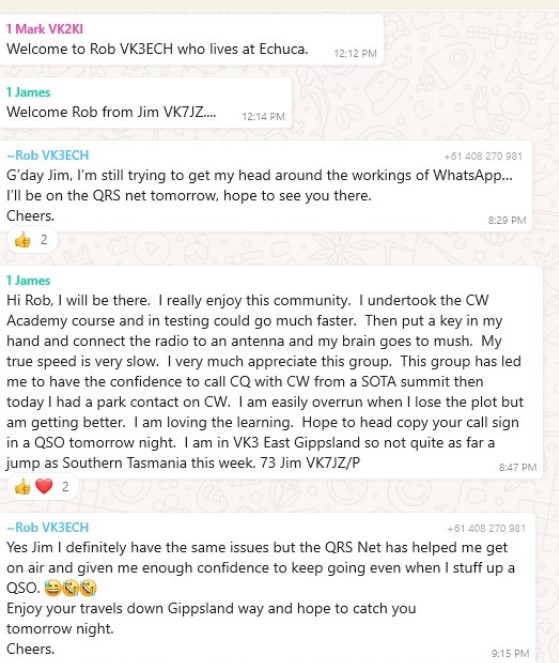
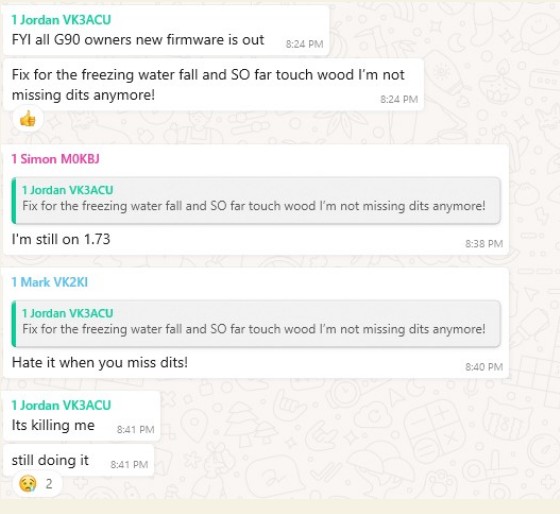
It recently came out and seems to have fixed the waterfall issue and it has made some difference to the AGC, but it still misses dits on the keyer! It drives me crazy.
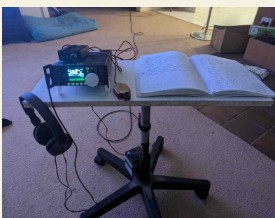
Ross thanked me for sending nice CW, and I also got a text from a listener complimenting my sending. I can only laugh as I thought at that particular time my sending was terrible on account of that dit-dropping rig.
I then plugged the Vibroplex into it and went back to Rob, who was calling CQ. I quickly unplugged the Vibroplex as it’s not really that suitable for QRS night and went back to the external keyer I have stuck on top of the G90.
All in all, I had a great night, thanks all! Hope to make some more contacts during the week..
[40m] «| worked the frequencies a bit earlier today. I thought the propagation gods have not been out in action so QSB was a bit strong and QRN was heavy. However, Rex’s signal was coming in good to my location. The
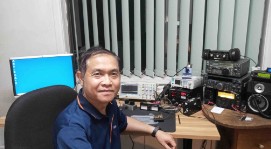
Family always has something happening on Tuesday nights, so I cannot spend mucl time on air. Catch you guys again later..
From Simon MOKBJ at Aqualate Mere Nature Reserve POTA GB-0345
[20m] + In very pleasant and mild conditions (sunshine and clouds, dry, no wind, 12C) and under whirling red kits and skeins of geese I had a great time at ‘Aqualate Mere Nature Reserve.
The Mere sits in a groove carved in the last ice age and is apparently the largest natural lake in the English Midlands…
+l only had an hour before the gas engineer’s visit to service our boiler, 80 I couldn’t quite manage the ten QSOs necessary for a POTA activation but I’m not bothered about that. + The noise floor was very low indeed.
Only the birdsong distracted me from Mark VK2K’s very faint signal. I could only copy about one letter in three, so Ireckon he was RST 219. Poor chap couldn’t hear me at all.. + Lalso quite distinctly heard David
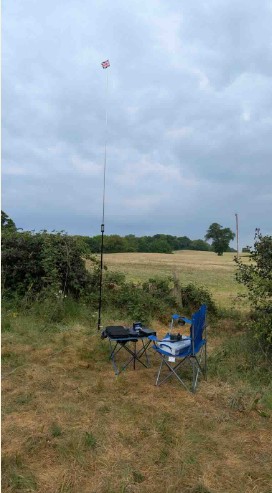
VKS3DBD and Chris G7BED having a natter a few kHz down from my slot but neither could copy me.. [Looks like a nice peaceful spot Simon. And I’m happy to take second place to the birds any time! See more from Simon below.]
[40m] « Aremarkable recovery after the dead and buried weekend resulting from the previous week’s CMEs. Working VK7S always seems more difficult than it ought to be.
[80m] « The first time QRS FFA stations have been heard for months on 80m..
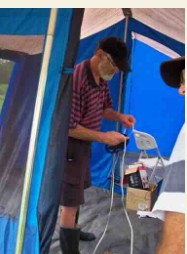
[40m] + Difficult night, lots of noise in my temporary QTH in VK3, but I got in one contact and copied 99% of it so I am super nlosacan $I will ho hark naoyvt
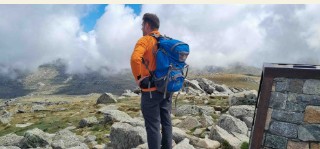
[80m] * Yes I heard VK2KI after logging into the Keilor East SDR. Sorry Mark, nothing heard here in Ballajura WA from your 5W. Better luck next week.. [Welcome home mate. Noise cancelle
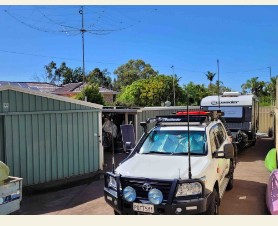
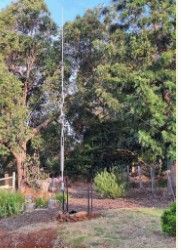
[40m] «40m seemed to be a bit dead during the afternoon.
[80m] * Called CQ on 80m later in the evening but all quiet.
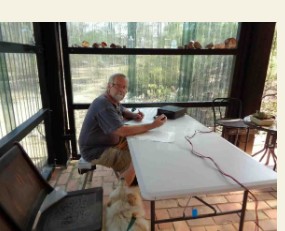
[40m] * Very good path on 40 meters to the ‘Shaky Isles’!.
[80m] + Again, great fun. I am usually operating from the back veranda of our home in Bendigo with my HB1B transceiver and an EFHW antenna.
Temperatures are now dipping so I operated indoors on my FT450 with power turned down to 40 Watts. It certainly helped.. [Brrr!….]
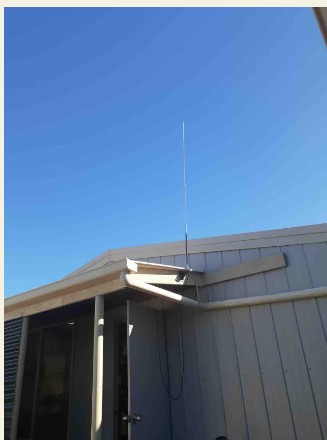
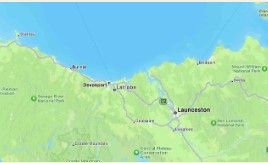
[40m] + Like last week, didn’t hear closer stations but conditions favoured more distant ones. I heard more from VK6 than VK3 and VK2 combined.
[80m] +1 don’t have an antenna for 80m (yet), but heard VK4PN on my 40m quarter wave vertical. [Signals can be very strong on 80m when the D-layer has disolved…. your 1/8TH vertical might be all you need – along with an antenna coupler of course lan.
[40m] «| could only operate from 4pm until just after local sunset at 5.22pm WST. 40m condx were very good, on a noise free band, enabling weak signal
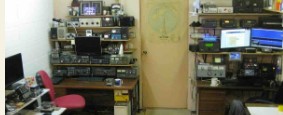
Reception. I can tell when winter is due, the ZL’s start coming through in daylight!
[80m] * Sorry folks, I had intended to come up on 80m after dinner, but fell asleep watching the news. When I awoke, the CQ QRS Net was all over! [There’s a lesson in there Phill]
[40m] * I copied along with several QSOs from VK5CZ, but all one-way, I could hear almost nothing of the other side (though I tried!). Conditions seemed to drop quickly and even lan faded into the background…
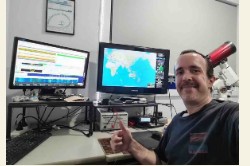
[80m] *| tried 80m after taking part in the local ‘boat anchor’ net. As the ‘boat anchor’ was to hand, I gave it a go on CW QRS.
While those old ‘boat anchors’ have an undeniable rustic charm, the current SDRs, with their DSP filters eliminating everything either side of the signal you are lictaning
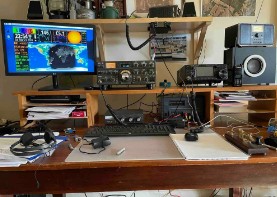
To, are a quantum leap ahead. Anyway, the ‘boat anchor’ stretched its chain all the way to Perth, where, it was good to hear, David VK6KD had just returned home from their year long trip around Aus all safe and sound.. [Ahhh – the joy of boat-anchors!
See more about wide receivers in There’s No Such Thing below.]
Good night tonight, had to go QRT 10:30 Z as I had an early morning departure for bush camping for couple nights in the Riverland. Might try 3.535 Mhz around 18:45 SA time on Wednesday for quick on the net, if i am not frozen.
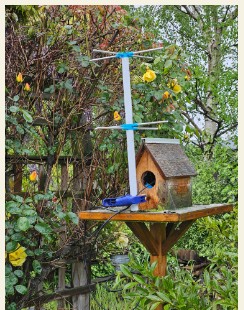
[40m] * Conditions were poor for me, with only a single brief QSO with Stan ZL3TEK. I hoped to snag a stronger signal but got no responses to my CQs.. The birds were enjoying stronger signals at the VK7TO QTH than Lance on HF this week.
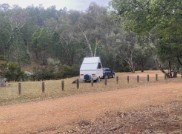
Photo of the VK7TO TinyGS. station with a turnstile antenna. ——>
| stopped hearing George VK2DLF and had to sign off, but then worked Rob VKS3ECH later with no problem. Then it all faded out. There are a lot of hams with good CW skills hanging around the net these days. Regards
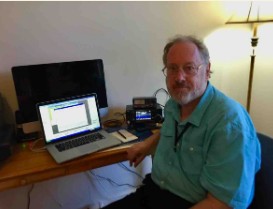
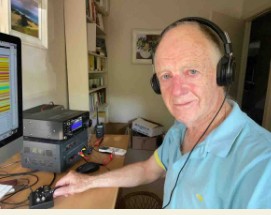
[40m] + Manny VK3DRQ planted in my mind the idea that maybe I could attend the next AGM of Eastern Mountain Districts Radio Club. I’ve been a member for a few years, but have never attended anything.
During QSO, happened to ask VK3RU, whose QTH is near mine, if he is a member of the
Club. He then informed me he is the secretary, and that immediately before chatting with him I had been having QSO with the club president. It would seem the stars are all aligning, just for me!. [And I’m sure you know what happens at AGMs Peter!
Good luck :)] From your editor Mark VK2KI/P at Jemalong Weir campgrounds, 25KM West of meek AIO UAT
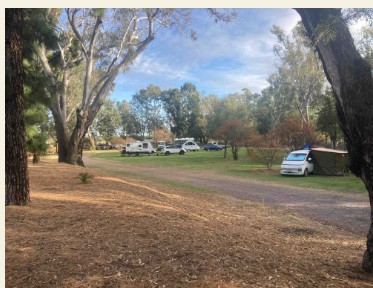
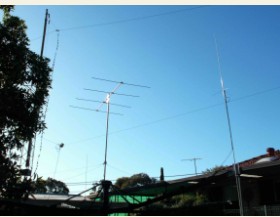
[20m]. * Elizabeth and I had arrived at Jemalong Weir campground (25KM West of Forbes) in time for me to put up my ZS6BKW doublet; this time I got it up 8m between two nice trees about 50m apart. The campground had five other sets of campers
Card!) – Chris did… but of course coulant help but ada some his: tried calling Chris when they finished to report that he was pouring in at RSN 581… but he couldn’t hear my 5 Watts…
+ Having had coffee, Simon MOKBJ headed off early and set up at what might become a favourite spot – Aqualate Mere Nature Reserve (a Parks On The Air spot as it turned out), not too far out of Wolverhampton.
Wayne VK6NW was thundering in to me, but couldn’t raise Simon – needless to say, nor could |; he was RSN 211 to me, and with 6dB less power, there was no way that he was going to hear my pleas.
+ Meanwhile, I was pleased to hear Jordan VK3ACU hooking up with Chris; I also heard Wayne chatting to our DXperiment coordinator, Mike DL5YZ – Mike had a nice signal with me, but I didn’t get to test his hearing.
+ So overall, a fun DXperiment again, with better conditions on 20m than last week. I really enjoyed being able to chat to both Simon and Chris via our WhatsApp back-channel.
Although I recognise that many will consider using WhatsApp as somewhat counter to the challenge of CW, when the going gets tough, it’s so nice for the people at each end to be able to say g’day and provide assurance that their efforts aren’t in vain.
Of course, it also allows the excitement to be shared and encourage others to have a go – after all… that’s why we’re herel. + Thanks to Simon, Chris and Mike for having a go at the difficult long-path..
[40m] * Stan ZL3TK has said in the past that sometimes, working Aussies on 40m during our net is like shooting fish in a barrel.
I didn’t look on any of the KiwiSDR waterfall displays on Tuesday, but when I came down to 40m, the band sounded like that might be true – finding a quiet slot was a bit ofa
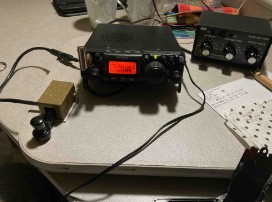
Challenge! There was also that dreaded DX coming through from all over the place (primarily short path to the US from the sound of things) which added to the congestion…
+ I was also aware that some of our newer team members were on having a go, and I didn’t want to be too close to them, in case they didn’t have narrow filtering available, ready at hand or turned on – not that my 5 Watts was going to be a threat, but the stations I worked might have been.
See Causing QRM in There’s No Such Thing below. + I heard Ketut VK3BWN at Keilor East chatting Rex VK5FA at West Lakes – and it was interesting to hear that Ketut’s signal from Melbourne was unusually quite weak.
After listening to other QSOs I heard Ron VK6KHZ calling; I knew that Ron had a high noise level at his place and probably couldn’t hear my 5 Watts… I was right.
Anyway, Stan ZL3TK came up with a solid RSN 591 signal – great to hear the band working so well across the Tasman, and it was nice to catch up with Stan again. He went on to work Phil VK6GX, and Phil and I then had a quick exchange.
I’m guessing he was using his 80m one wavelength loop up 20m… + I enjoyed listening to all the QSOs, but tried to catch David VK3RU at Burwood – no luck this time…. like Ketut and all the other Melbourne stations, signals weren’t in our favour this time.
Interestingly, I listened to James VK3JFR at Ararat who had a really solid signal, even though he was not too far from Melbourne…
+ I caught up with lan VK5CZ and tried to hook Shaun VK3BEK up at Quinns Rocks North of Perth – no luck again, so I figured it was time to have a look at 80m…
+ Awhile later I came back to 40 and attempted a QSO with James VK7JZ who was portable down at The Entrance – but he must have been too close to Melbourne – no luck.
Finally I tried to hook David VK6KD – not portable this time, but happily settled back at home in Ballajura. David was romping in $8 – but you know the story… just noise at his end with no intelligence; ok, I might have left myself open there!.
[80m] * Signals from David VK6KD home in Perth and Greg VK5KFG at Willunga were good and I was hoping for some luck…. hmmm! However, Lance VK7TO came to the rescue – he was RSN 591 with me….
But despite me tapping as hard as the little Soviet key would take… Lance still had to try really hard to copy my RST 339 signal. Thanks for hanging in there mate..
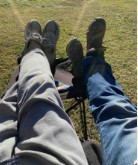
• So in all – very strange conditions on 40m but fun on 20m and 80m. Too many campers at Jemalong…. off to the much nicer Terarra Creek campground at the Nangar National Park. Home for next Tuesday’s net..

From Richard VK6HRC Hello Mark Happily all good on the VK6RLM rptr AllStar / Echolink network on Wednesday morning. VK6NW Wayne VK6EN Max VK6QV/P Mark VK6KD David VK6HRC VK6MRB Mulligan and our other SWL’s monitoring.
Wayne called in from a rather chilly Bridgetown – @ degrees C – to report that he tried calling Chris G7BED on 20 Mx but was unsuccessful there but went on and had a good contact with Mike DL3YZ.
Heard Mark VK2KV/P and Jordan VKACU calling as well but had to shut down and attend to a call out. Max had three contacts on 40 Mx and then went into listening mode.
Mark was portable at Jemalong Weir West of Forbes NSW and started out on 20 Mx but the milliwatts were not heard by our Northern Hemisphere members. Then onto 40 Mx to work three and tried another five and heard 13.
The variable band conditions make life difficult for one and all. On 80 Mx VK7TO) and heard another two (David VK6KD and Greg VKSKFG).
David was back home now and trying hard to drop the /P off his callsign after he and Pauline’s year-long trip away. The antennas were put back up in the air for Tuesday – well done.
However, the return of the high noise levels at home meant that David promised himself that he was going to tackle that problem ASAP. He managed to work Jordan VK3ACU, heard Shaun VK6BEK and Roy VK6RR on 40 Mx, and also had a nice chat with Greg VKSKFG.
Post Morsum Report
| started listening out on a Kiwi SDR to the activity on 20 Mx and heard Chris G7BED chatting with David VKS3DBD. Others were heard calling but I got onto the home station to call on 40 Mx where I got four in the log before the band changed.
Tried 80 Mx and no contacts, but heard VK5CZ calling later on. Thanks to all on last night and this morning.
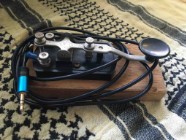
This Week’s Topic of Interest
What on Earth Have I Bought? by Ross MONNK
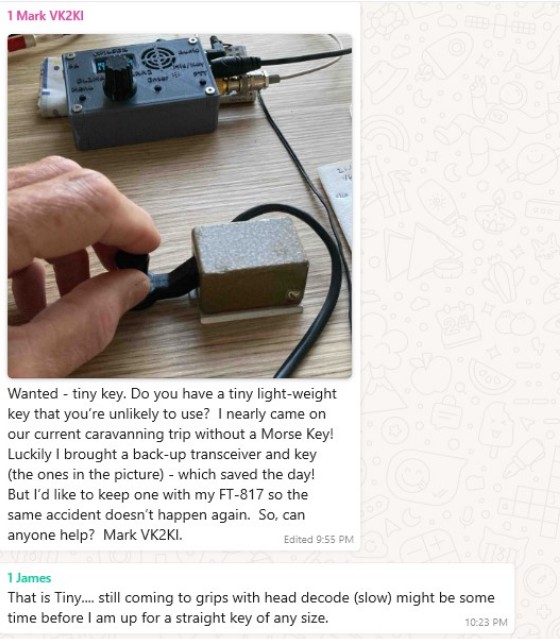
As some of you will be aware, I’ve been putting together a QRP Portable kit. To avoid swapping keys from one kit to another, I went looking for another WT 8 Amp straight key.
Unfortunately, they don’t seem to be around just now for the price that I’m prepared to pay (max A$70). So I widened my search. I swear that I had not been drinking when I put in a bid for this key.
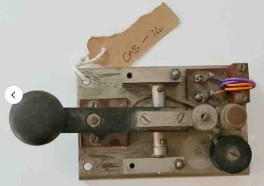
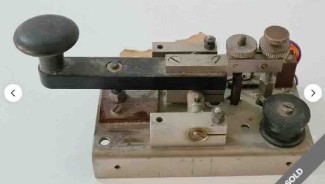
Yes, it’s plug ugly but I was attracted by its quirkiness (the story of my lifel). Alot of straight keys look the same (‘form follows function’?) and are thus rather boring – this is certainly not a boring key. It’s also in rather scruffy condition.
But then, ‘ugly’, ‘quirky’ and ‘scruffy’ are epithets that could be applied to a great many of us amateur radio enthusiasts! It will thus need some cleaning up and lubrication before I can tell if I’ve wasted my money.
On the subject of money, I put in the only bid for it (A623 + A$7 postage) so it would be no great loss if it turned out to be a dud.
But one of the attractions of these old straight keys is that they all have a bit of history behind them, they all have a story to tell. My problem is that I have no idea what make or model this one is.
Knowing the story behind the key you’re using makes it special – it becomes more than just a device for making dots and dashes. If that’s all you want, you only have to get a cheap Chinese 3-D printed toy.
If can discover the story of this key, it will restore it just as much as any wipe over with a rag or any splash of lubricating oil.
The QRS Net has some very knowledgeable operators, so can any reader of RagChew help me bring this unloved and uncared-for survivor back to life by giving it a personality?
[Lovely story Ross – does Mrs W subscribe to your theory about you bing attracted to quirkiness I wonder? So… handing over folks – can anyone help Ross and shed some light on this old guy? Have you seen one of these before? Please respond to
If you have an article or two that you think might be of interest to our readers, please let me know so we can share more thoughts and ideas; email to cqqrsnet@gmail.com

On My Workbench
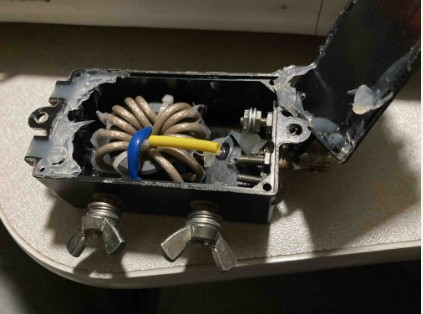
Discovered why the current BALUN on my ZS6BKW doublet wasn’t… the centre conductor in the yellow spaghetti was supposed to be connected. Destined for the workbench.
Other News
From Nigel G4RWI:
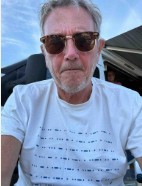
Hi Mark & CQQRS team, and greetings from the IT dept. We are nearly 4 weeks into a circumnavigation of Ireland, and so far have not seen a drop of rain!
Apart from enjoying the magnificent scenery and the “odd” point of the black stuff, I have been doing some vibe coding. Vibe coding if you havent heard, is the new idea of coding alongside an Al. You describe what you want and the Al writes it.
You then play with it and suggest changes, improvements. Anyway Ive been producing a web app to replace the current google form. It’s a much slicker user experience and will cover all the amateur bands, without slowing down just the 40m crowd.
The idea is the app will send the data to a database. We will then generate the weekly report from the database, but of course we will now have the capability of doing a whole lot more in the future.
Ive also got the app (or more correctly got the Al) to build a lot of the data validation into the front end. For example the app will notify the user if they have entered an incorrect callsign. Ihave identified a number of places we can host this for free.
At the moment it’s all running locally on a raspberry pi in the MH. Once I get it on the Internet, I’ll let you know and we can “vibe” together.
[Thanks Nigel – great to hear you’re having fun in Ireland. I’m guessing the black stuff would include a creamy foam on top with a yeasty smell as well?
Thanks for the update on the work developing the next version of the CQQRS report form; as you know, I’ve been getting some odd effects – duplication of previous weeks’ data.
But the ability to enter individual selectable bands, and subsequent storage of results in the spreadsheet and band-by-band reports or similar will be good – great work – what else would you want t obe doing when touring around Ireland in your motorhome?
Guessing your last unreleased Google Forms version with the selectable bands will be put on hold – perhaps for emergency reversion if we have a problem with the new more swept-up version?
And yes – the National Radio Centre volunteers have made an interesting addition to our net – well done all! Thanks again to the team (Jo and Nigel) in the software department.]
Morse Training Net
Our team member Nic VK7WW runs an on-air Slow Morse training net every Wednesday at 7pm EDST on 3580 for 30 mins. He uses the callsign of the Northern Tasmania Amateur Radio Club VK7TAZ on that net.
Many of our team learned Morse code with the support of Nic, and the weekly training session comes highly recommended for anyone who wants to learn the Code, or simply brush up.
Everyone’s welcome – 3580KHZ at 7pm Eastern time every Wednesday; you’ll hear lots of the CQQRS team on that net. Jordan VK3ACU is recording this round of training lessons – you’ll find the link to the YouTube recordings on our website here:
Bit.ly/CQQRSWebsite then navigate to: useful-resources-and-links Contact Nic VK7WW for more info nicholaschantler@hotmail.com including how to join the NTARC DISCORD group to follow the action, or just come along and join in on Wednesdays.
Putting the myth of the orientation of a low HF dipole to death
From Andrew VK1DA – reprinted from the SOTAvkiarea website. As we all studied in our antenna theory, the half wave dipole has a figure 8 pattern in azimuth. The theoretical dipole has huge nulls in its coverage in line with the antenna element.
However this is not borne out in practice, some a/b tests I’ve done when I have had two similar antennas to compare, neither of the antennas had a significant advantage over the other.
| have been checking out the website www.portable-antennas.com, the author of which has done the hard work of feeding antenna parameters into a well respected antenna modelling package and has built a website that lets you examine the
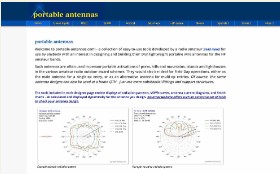
Parameters of various popular antennas. One such antenna is the centre-supported, centre-fed half wave dipole, the basic reference antenna we all should build for experiments and comparisons.
Looked at the radiation patterns of the half wave dipole and found it very easy to look at the effects of increased or decreased height. Also the use of two 5/8 antenna halves (the double extended zepp) can be modelled.
The remarkable thing is that at a centre height of 6m, which many of us use with a 7m fibreglass pole, and ends drooping down to say, 1 metre off the ground through the use of rope or cord, the half wave dipole has an almost circular (oval) radiation pattern, differing from perfection by only 8db or so in the directions that the old antenna handbooks predicted an almost infinite null.
You can rarely hear or be certain of a 3db loss or gain in signal, especially in the presence of fading which can reduce or increase signals by much more, say 30 db.
Next time you put up your half wave dipole on a summit, don’t pay any attention to its orientation, because it doesn’t really matter.
If you have a 40m dipole at a height of 40m, the end nulls become more noticeable, but I’d like to know who can put an antenna up that high on any summit.
‘Anyway the main message is – have a look at this website, play with the antenna designs, move a few angles and heights and see what you think about the results. You may be surprised by how effective our SOTA dipoles really are. Http://portable-antennas.com
Andrew VK1DA
Congratulations to Donald VK6JDM
Close readers may have noticed my comment last week about two of our team members – Donald VK6JDM and Rob VK6LD, both of whom have just received WIA Annual Awards. I sent a note to both…
And thought you’d like to read Donald’s reply (reprinted by permission):
Dear Mark.
| presume they were drunk when handing out awards. I will be back on air this Tuesday. I have been snowed under with things of late with uni exams for the students and having to go down to Perth to pick up Anne on her way back from sorting out her mum’s estate in Queensland.
Her mum was 92 and died rather quickly after a Pilates session. I pointed this out to Madame Lash who runs the local Pilates group Anne makes me go to but it did not result in a less strenuous session, if anything she upped the ante – perhaps trying to replicate the result in Qld.
As for Anne’s mum, she was a great mother in law – always seemed to take my side if Anne and I disagreed. I told Anne that I might now have to find a new mother in law. I think I am in trouble.
Some would disagree with your diagnosis that my mind works, or works properly. Anne returned form Qld with a husband-training device.
You press the button and it gives suggested appropriate responses such as “why didn’t I think of that” and “if you’re happy, I’m happy”. She clearly thinks the mind could be improved. Medical administrators also seem to think rewiring would be appropriate.
Mind you I have discovered a device that gives useful responses when dealing with idiots. “you have no need to worry it does not eat brains” being one example. 73 Donald warm
From Stan ZL3TK: tA eats OE EE SAS Net Thursday 0940Z 7.0257 MHz Please don’t check-in if you have no traffic to send, The NCS does not keep records so QRUs serve no purpose and waste net time.
To give an insight to what will happen on SAS Net on Thursday: _the NCS has one QNC to send, a manual OTP message intended for last week but delayed due to tertible conditions.
There is also pending traffic from another station consisting of possibly of two QTCs, one encrypted and one in-clear. At the end of the NCS QNC message text you will hear a standard postamble: = ZL8TK
But that is not the end of the matter. Now come three characters .?? which means everything will be repeated except the preamble. This enables you to verify each character eliminating most repeat requests. The transmission ends with NW FILLS?
K This is when any repeat requests can be sent. You may use the standard check-in format sending only your sine (one or two letters from you call sign’s suffix) and wait for an acknowledgement of your sine from NCS.
Then request the group you missed by its number. e.g. GRP 14? Encrypted message texts, whether all letters or all digits, are by definition non- contextual. Suggest you record the transmission for playback later.
If it’s too fast, se this great online app to reduce speed by up to 50 % without any change of pitch: _https://audiotrimmer.com/audio-speed-changer It is so much quicker and easier than Audacity.
The slowed-down file can be played immediately and/or downloaded – it’s an excellent app in any man’s language. Replies to the QNC may be sent by email to ziStk@qsLnet or on next week’s SAS Net, both encrypted and in-clear are acceptable.
Also useful is MCW on echolink, or CW on VBand or Vail by arranging a sked. 73 de Stan
Debrief from the SAS Net Thursday 22 May
The SAS Net failed to convene on Thursday May 22ND. 40 m was dead so we shall have to wait another week then see if NR 97 will finally launch.
Conditions were a repeat of last weekend – utterly impossible – all thanks to ionospheric disturbance which we knew about in advance from the Australian Space Weather Prediction Service telling about recent spates of multiple EMCs.
ZL in Blenheim a mere 150 km away reported he could barely detect my signal, meaning there was not even any NVIS. Managed only one contact last Saturday on RandomGram, and again only one on KCC, then Tuesday turned out quite good for the QRS FFA.
Peak of the sunspot cycle you reckon? Apparently it is chronologically, but it’s nothing like the peaks we used to get in the 60s and 80s.
I sometimes wonder if there is any effect from the elevated levels of methane and carbon dioxide in the upper atmosphere, no one’s said anything about that possibility yet. So we wait another week then see if NR 97 will finally launch. 73 de Stan
QRP to QRP QSO during the Don Edwards Memorial and Sangster Shield Contests
From Grant ZL2GD Gidday Mark Great to hear you on over the weekend. Well it was a bit of a struggle and I do thank you for persevering pleased to pick your callsign out of the noise….. fantastic.
We were doing the annual Sangster Shield contest which is a 5 Watt maximum output affair and we don’t usually hear very many VKs….particularly not QRP ones !! So congrats to you Mark… QRP to QRP.
Iwas really Sorry for not hanging around as we had 6 – 1/2 hr periods in the contest. I managed to work 101 ZLs and 2 VKs – yourself and David VK3DBD (he was on 100W) Thanks again…..l must make an effort to get back on the Tuesday sessions.
I have been tied up with other Nets on the same night which makes it a long day. 73 Grant ZL2GD. [Great stuff Grant – I wondered how come there was so many ZLs on 40m that afternoon – 101 ZLs on CW – amazing! 6 x half hour sessions would be quite a challenge!
Look forward to when you can make it back on a Tuesday night mate]
QRP to QRP QSO during the Don Edwards Memorial and Sangster §
Contests
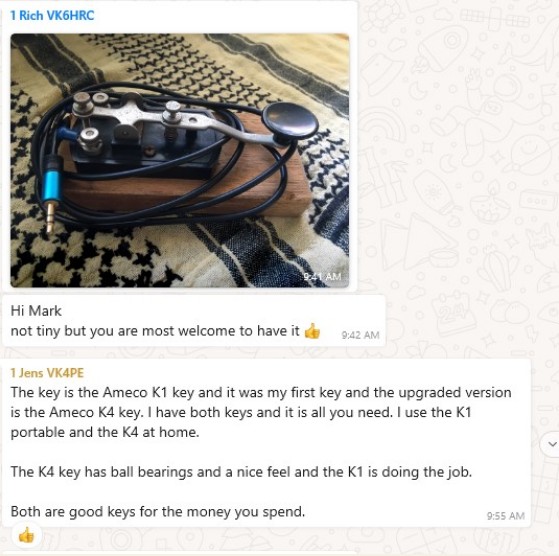
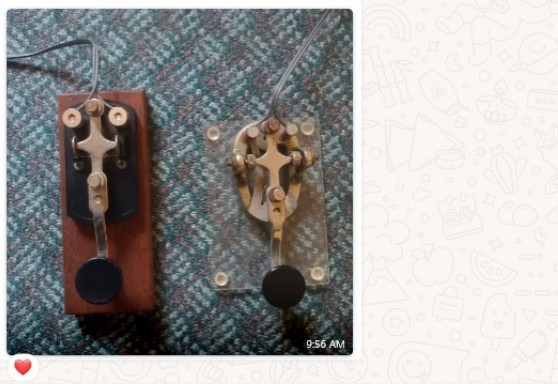
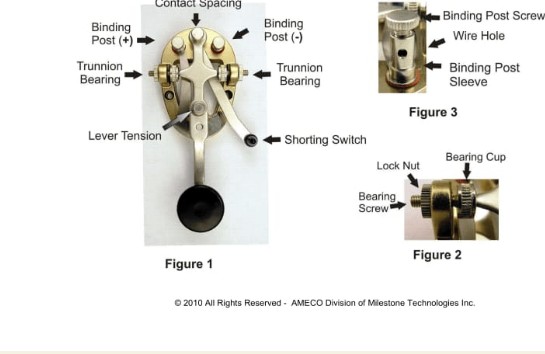
• , Two wires connect the K-4 to the device that is to be keyed (code practice oscillator, transmitter, etc). The wires coming from the device will be nominally polarized positive (+) and negative (-) and this polarity should be observed when connecting to the K-4, In Figure 1 you will see that the positive binding post is on the left.
It is connected only to the lower front contacl. The negative binding post, on the right, is “ground” or “common,” connected to all other parts of the key.
To attach the wires to the binding posts, refer to figure 3 and unscrew the binding post screw until the hole through the post is clear.
Insert the bare end of the wire and tighten the binding post screw until the wire is clamped in position, If your wire has a spade lug you can insert it under the head of the binding post screw and clamp It down against the binding post sleeve.
To operate the key, press the knob down until the upper and lower contacts meet, completing the circuit and “keying” the device. The shorting switch is rotated away from the contacts in normal operation.
Rotating it toward the contacts will close the key, causing uninterrupted keying until the switch is opened. This is useful for tuning and adjusting equipment and for sending a continuous tone.
Adjustment There are three adjustments, each consisting of an adjusting screw and a lock nut, The lock nut holds the adjusting screw in place when correct adjustment has been achieved.
Contact spacing and lever tension are adjusted simply by loosening the lock nut, turning the screw in or out, and re-tightening the lock nut adjusting the screw.
If you have not developed other preferences or are using a straight key for the first time, the contact spacing should be set for about 1/16″ or the thickness of a folded business card.
Tension should be light enough that you can easily send with minimal effort but adequate control. The trunnion bearings should be correctly set at the factory, but If itis necessary to adjust them, refer to Figure 3 and loosen the lock nut, Rotate the bearing cup in or out and re-tighten the nut.
When properly adjusted, the lever should sit squarely in the center of the key with the contacts lined up, and move up and down freely with no apparent drag, and little or no perceptible sideways movement or “play.”
Adjustment
There’s No Such Thing…
Nis Weeks quesSuons. I think the first lesson in Teachering 101 is to always tell students “There’s no such…” (I’m sure you know the rest) and “…the only dumb questions are the ones not asked”.
John VK2RU reckons that there’s lots of questions out there among both our new and our experienced operators – about CW, amateur radio operating and about theory.
So John didn’t step backwards quickly enough when asked to volunteer to compile readers’ questions; thanks mate. So here we go…
Causing QRM
Question:Some time ago you did a short piece on tuning up – how far to stay off another signal and not cause interference. Can you point me to where that was please?
Editor’s Answer:
Eattors Answer. Ok – you say I’ve discussed the perennial problem of QRM on CW in the past…. 1 have to admit that I can’t remember!
Our website does discuss ‘frequency ownership’ and why we discourage it on our net, despite it being a gentlemanly (gentlepersonly?) thing to do at all other times; see https://sites. google. com/view/cagrs/home/net-details#th.
YpmmghuSlav I’ve twisted the arm of Lance VK7TO to write a bit about netting and tuning CW signals on receive on non-digital VFOs for a future RagChew edition after his life settles down again, so I won’t steal his thunder.
However, my comment in the Reports above about trying to avoid causing interference to our new CW operators prompted me to give a short intro (a Morsle pethaps?).
With modern transceivers with synthesised or digital VFOs, many of our operators use the whole kiloHertz frequencies for our net.
Of course, these Hertz-accurate VFOs and super-effective AGCs mean that if two stations who can’t hear each-other are on the same frequency, listeners who can hear both, could find reception virtually impossible – the two stations’ dots and dashes merge together (and AGC keeps them sounding the same) causing both CW signals to be unreadable; in the past, analogue VFOs meant that there was usually a slight difference between stations’ frequencies, allowing a skilled operator to separate the two using the brain’s speech / sound recognition software.
Those using receivers with tight filters will often solve the problem but sliding between the whole 1KHZ frequencies by 500HZ say. However, what about our many operators using classic gear – especially, those that don’t have narrow CW filters?
For transceivers with 3KHZ SSB filters only using say a 700HZ side-tone, signals anything up to about 400HZ lower ie 700HZ minus 300HZ (the lower cut-off frequency of the SSB
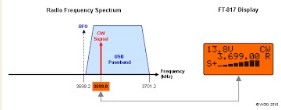
Passband) or 2.3kHz higher ie 3KHZ (the upper cut-off frequency of the SSB filtering) minus 700HZ will be audible. And what about our many operators with pre-SSB receivers with 6+ kHz wide (AM) receivers using a Beat Frequency Oscillator?
It can be very very tough for them; I know of at least one of our team in the past who was forced to give our net away because it had become so popular that they weren’t able to operate their beautiful classic gear – I know – a really nice problem to have – too many people on our net!
Lance’s article will probably include some visual depictions of how this all works – so don’t worry if you don’t follow my ramblings just yet!
Experienced operators may be able to use that brain software to tune-out the interference, or more likely, will be able to use their more modern receivers’ CW filters, notch filters, IF shift, reverse sideband (switching to LSB instead of the standard USB used for CW) and/or RF gain controls to reduce or eliminate the problem….
But what about our new CW operators who either haven’t yet discovered the joys that their equipment could provide, or whose brains are flat out trying to manually decode and write down the received CW, and don’t yet have the wherewithal to fiddle with their gear when concentrating on receiving?
So of course, the answer is where possible, avoid operating too close to the new operators (primarily, within two kiloHerts above). Easy to say of course…
Firstly because * how will you know which signals are from new operators, and * you won’t hear them yourself because they are out of your receiver’s passband on the lower side. Much of the time of course, you can’t!
It’s part of the challenge of being an amateur radio operator using our beloved CW mode. However, if you do hear one of our new operators, or can tell from the beautiful sound (or the RagChew newsletter) that an operator uses classic gear on the net, perhaps give them a little more elbow room if you can?
The corollary of this is that if you find yourself being interfered-with (hate it when that happens), recognise that the person causing you the strife may not even know that they are within your passband – because you’re on the lower side, beyond their receiver’s cut-off.
Please try to smile and enjoy it as a challenge of our hobby amateur radio, rather than take it to heart. And of course – please don’t be so worried about this that you avoid transmitting on our net, lest you cause angst to others!
It happens in our community – we’re all in it together enjoying the challenges and learning along the way. Keen to hear others’ thoughts on the topic…
And I’m looking forward to Lance’s article about netting and tuning with older equipment (sorry mate – really dobbed you in for your return didn’t 12) Take care.
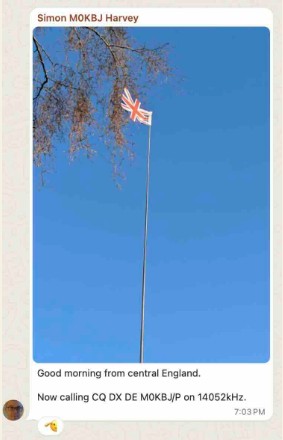
Question:Simon MOKB4 usually has a flag on top of his portable antenna – does it help? Answer: My flag is 150MM x 100MM. I bought a pack of ten for £1.99, so I have nine spare!
They come with sticks for waving but conveniently they have a stitched sleeve on the short side which is perfect for the top element of my telescopic whip. I put a staple in the top to prevent the flag slipping. Performance?
Perhaps I’d better check Andrew’s reference: www.portable-antennas.com Thanks for the newsletter once again. It’s a terrific read.
[Do you have a question or two that are worth sharing? How about a discussion- starter? Please let me know cqgrsnet@gmail.com and I’ll pass them to John VK2RU for compilation each week.]
Di-dah-di-dah-dit
So back to the CQQRS Slow CW QSO practice net.
Next Tuesday’s Net
Our CQQRS Group will be on as always on Tuesday from around 0700Z until about 1300Z; see https://bit.ly/CQQRSWebsite and navigate to the Net Details page for details.
Doesn’t matter whether you’re brand new and want to try just exchanging callsigns and RST reports, or you’re ready for a good old rag chew. We’ll have fun.
There’s usually people around until after 1300Z – so keep calling in the segment of the band designated in the table below until you catch someone.
I should be on as usual from home in NSW or via the Remote at Bedfordale WA, and I’ll also be watching the proceedings using the VK6QS and Tecsun SDRs in WA and NSW respectively. Hope to hear you there.
Please let me know via our Reports form bit.ly/CQQRSNET who you work or hear on Tuesday’s Group. The report form closes at lunchtime (Eastern Australian time) on Thursday.
Post Morsum
Richard VK6HRC will run our phone Post Morsum on the South West AllStar net (via repeaters and hotspots all over WA) from 0600 WA time, then from 0700 WA time on 80m (8605 LSB).
See https://bit.ly/CQQRSWebsite and navigate to the Net Details page for details of how you can connect via Echolink or even possibly via your local FM repeater.
Teamwork
Thank you so much to our team of 36 contributors: DL3YZ, G4RWI, MOKBUJ, VK/MONNK, VK1DA, VK3ACU, VK3AFH, VK3BSE, VK3BWN, VK3CTM, VK3DBD, VK3ECH, VK3RU, VK3WOW, VK4PE, VK5AO, VK5CZ, VKSET, VK5FD, VKSKFG, VK6BEK, VK6GX, VK6HRC, VK6IS, VK6JDM, VK6KD, VK6KHZ, VK6NW, VK6RR, VK7JZ, VK7KPC, VK7TA, VK7TO, VK7WW, ZL2GD and ZL3TK.
And a special thank you to our editorial team, Nigel G4RWI (head of software development), John VK2RU (WhatsApp spy and research) and Richard VK6HRC (Post Morsition and spy). Great work alll UY CW on Tuesday, mb.
Mark Bosra VK2KI/ VK6QI Beautiful South Bowning NSW mark,bosma@icloud.com non impediti ratione cogitationis

may end up where you are heading. Lao Tzu
About the CQ QRS Net
For the current schedule and more information about the CQQRS net, please go the the Net Details page on our website:

The opinions expressed in the RagChew newsletter are those of the individual contributors. The opinions do not necessarily reflect that of the editor or of the CQ QRS Group members.
Any material and images received by the editor or published on the CQQRS WhatsApp groups may be published in this newsletter unless specifically requested otherwise.