Below is a reconstruction of the 2024 35 CQ QRS RagChew newsletter designed to support full text searching. This reconstruction was built using OCR, and will contain errors.
To view the Mailchimp original, click here. To search the entire newsletter archive, click here.
Contents
- CQ QRS RagChew
- Last Tuesday’s Net
- Masthead Image
- Reports
- Reports & Comments
- Comments:
- Other News
- Hearing Things?
- Morse Training Net
- This Week’s Topic of Interest
- My First Ever DX
- What’s next?
- Brain Teaser
- Exam Questions:
- Answers from last week’s Quiz:
- Di-dah-di-dah-dit
- Next Tuesday’s Net
- Post Morsum
- Teamwork
- Frequencies and Times
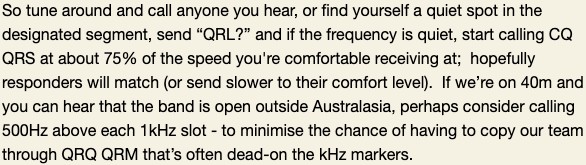
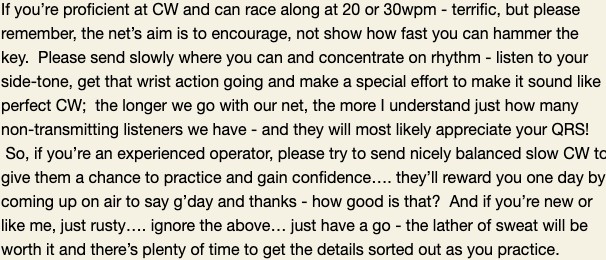
- speed
- Matching
- PSE QRS
- Landing Zone
CQ QRS RagChew
Last Tuesday’s Net
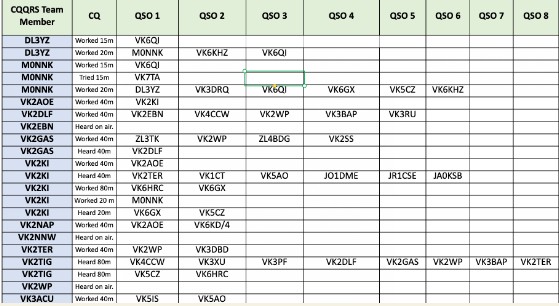
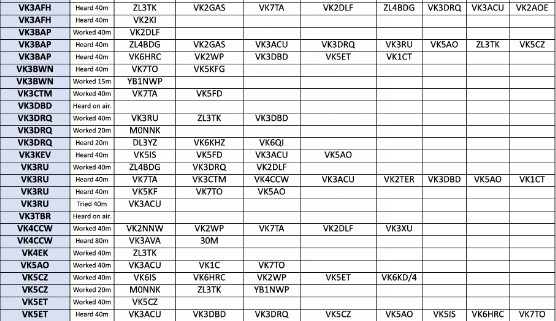
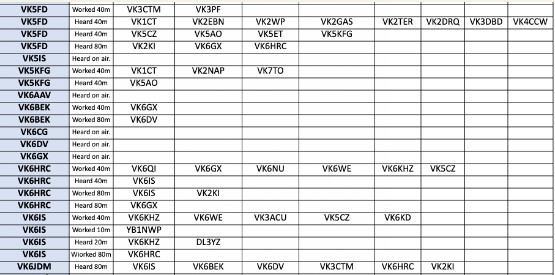
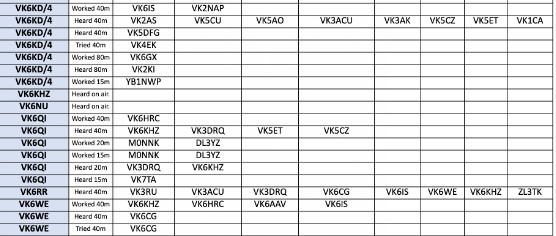
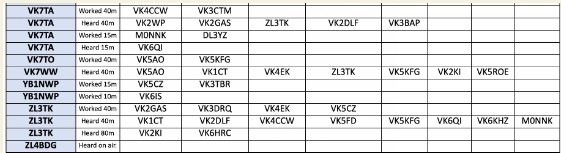
Here’s this week’s list of the 61 stations heard:
Masthead Image
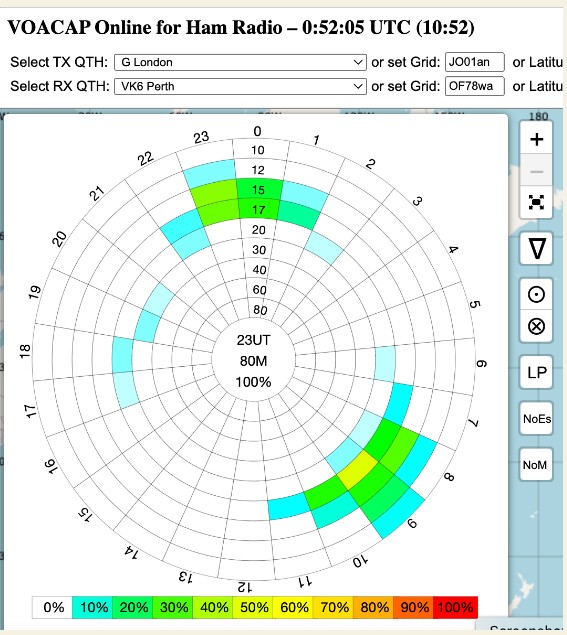
The image this week is the VOCAP-Ham circle long path ionospheric prediction of the VK6 to UK path, showing how lucky we were on Tuesday to get through.
The VOCAP-Ham prediction is a web-based system available free on-line and allows details of the station configuration (including noise level) at each end to be factored- in.
Reports
After next Tuesday’s net, please send me a list of who you worked and / or who you heard using our web form here:

As our team outside of Australasia grows, we’ve seen lots of interest in expanding our activities to other bands to catch our overseas members.
The head of our software department, Nigel G4RWI has been working furiously to produce a simple way of reporting on contacts with our team outside of 40 and 80m.
But in the mean time, please just use the 80m report area (Separate out your 80m report from other bands of course), and when you enter the list of callsigns worked, heard or missed, please append an ‘@band’ to each callsign without a space (eg VK2KI@20 VK6QI@15 etc).
Getting reports from stations and listeners is important to me – even if you listened and didn’t hear anyone or weren’t able to copy anything – the fact that you had a go needs to get recorded so we know that the net is working and attracting new and old team members to have a go.
Reports & Comments
The spreadsheets above show the known stations on last Tuesday’s net. Comment distilled from the reports I’ve received are below:
Comments:
[40m] +1 sat down at the radio early in the evening and jumped straight into a POTA with Peter VK3PF who was on 7082. + Soon afterwards I answered George VK2DLF and we had a very nice QSO.
+ It’s been a while since I’ve made a QSO on QRS Net so it was great to work George who has always been on air whenever I’ve listened in on a Tuesday night.
+ Unfortunately I had to leave the radio but came back later in the evening and listened in for a while, heard 13 stations in all.
+I didn’t get a chance to make another QSO due to numerous distractions in the household but was glad to get at least one run on the scoreboard.
[80m] + Very many thanks to the seven operators who made this a very special day for me. + Having my very first DX contacts is a radio high-point for me. [See this week’s Topic of Interest below for more from Ross about the test.)
[40m] + There is a windstorm tonight in Melbourne. * My transmission line is blown around and reception is very erratic. + There is probably a loose connection somewhere, along with static crashes it is a pretty bad condition tonight.
[80m] + YB1NWP was 339 in Melbourne. + Ihad to take care of the family so I only had a chance to peek into 15m for a minute. + Hopefully better timing and condition next week.
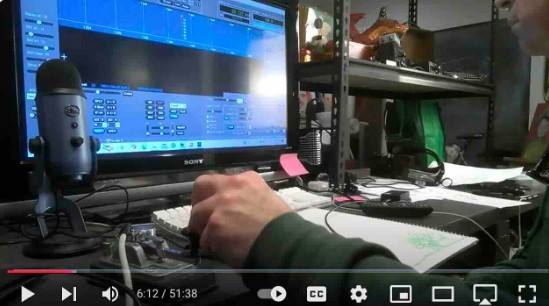
[40m] + Ihad a very crude attempt at a live stream on Youtube. + Managed only one QSO but it was the man himself Mr Bosma VK2KI. + Link to that video here:. + https:/www.youtube.convlive/}5JIDeDweiY?si: -T-Bs JkRwWHWb860.
From Donald VK6JDM mobile 20 km west of Kalgoorlie
[80m] * Was trying to work with a mobile whip antenna tuned for low end of 40 metres. * was able to hear multiple stations but having tried to get out last week with the whip, I restricted myself to just listening.
+ After an hour had followed the conversations of 6 stations but the mosquitoes arrived in squadrons and ignoring my bushman’s air defense system. inflicting multiple hits on face and hands.
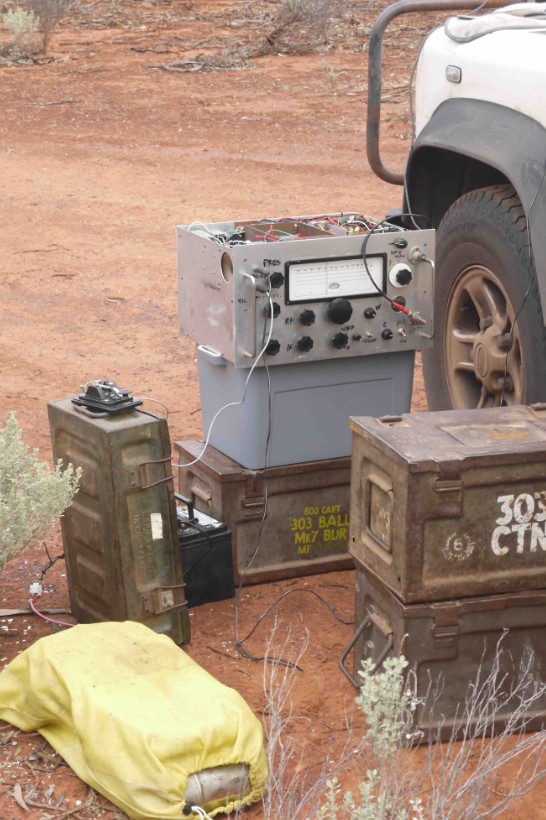
A photo of my operating position 20 km west of Kal. Great receiving set up with the whip, but no one could hear me so just used the tin to sticky beak on everyone’s QSO’s. Will use a better antenna next time.
I think the signal I was putting out (10 W) into the whip was probably just a bit wea Did not matter as I am finding I can now concentrate on CW for up to an hour and get enough of it to be able to fill in the lost letter here and there and know what is being said.
Just listening when no one can hear you is great practice and makes 0 more enthusiastic about using CW as ‘missing letter anxiety’ diminishes.
I will be back in Esperance next week so hope to pop up using the 100 W afterburner on the rig and of course have a much better antenna at home. I switch out the final power amp when mobile to spare the battery.
1am beginning to see why CW is such an addiction for some. I used not to understand the enthusiasm displayed by so many in the CW and especially the QF CW communities. I suspect I am getting to the point where I could enjoy it.
A bit of an acquired taste like blue vein cheese. Kind regards, Donald Howarth
[80m] + VK3CYD running a CW beacon asking for RST to be sent to 0427 262 064. +I sent one asking if it was QRP, but got no response.
From Mike DL3YZ at Stuttgart [15m & 20m] + Thanks to all stations calling me today, I heared you under lots of strong european traffic running on the same QRS frequency ( 14.054 ) today.
+ Sorry, I had no chance to copy your calls, as their signals were so strong. + Did anybody finally have a chat with Tom ( FAGOU ) ?
( He heared you as well and tried to answer,,,) Now I went down to 14.053, but I guess nobody found me there, as I had troubles with my power source (lead acid battery ), so was just running on 50 Watts. +I will definitely need some LIFEPO4 for next time.
+ And hey – what a big success for Ross, doing portable below “sea level” – Chapeau mon ami !:-).
[40m] + Signals last night were good little noise and easy QSO.
[80m] + used my 40m 1/4 wave vertical on 15m, running 100W. +I struggled to copy call signs only as signals were very weak.
From David VK6KD/4 at Newell QLD. (10KM NW of Port Douglas)
[40m] + Lots of stations to choose from. + Good decoding practice while stations are having a good ragchew on CW.
[80m] + VK6 started to come through into far North QLD around 1200 UTC. + had to QRT. + Hope to catch all next week.
[40m] + had my most productive session to date calling CQ and getting replies from several stations. + It seems to be getting easier even though I occasionally consult my code sheet.
+ The band was quiet with a single weak station after my last QSO so I tried calling it but did not get a response. + A good time to end a satisfying session.
[40m] + I enjoyed two lovely rag-chew contacts into SA with VKSAO and VKSKFG at over half an hour each. + Thanks for the long conversations, Maitland and Greg. + With respect to CW learning doctrines.
+ I would like to raise the discrepancy between apparent widespread agreement on the benefits of learning with the Kock-Farnsworth method, contrasted with the lack of hearing learners using it on air.
+ Groups such as CW Acadamy and the Long Island CW Club train hundreds of of each year, in addition to countless online tools, with this method employing a character speed of around 25 WPM with longer letter spacing.
+ This is still QRS operation, but with a better foundation to increasing speeds with experience. + Yet because it’s not heard on the air in Australia, people may be reluctant to be the odd one out, and so force themselves to use slow character speeds to fit in, thereby making it harder for themselves in the process.
+ know that when starting out, I never heard Famsworth operation on-air, despite my American and European course colleagues saying it was very common in their regions.
+ I would like to see our net’s learners feel comfortable calling with the Farnsworth speeds they’ve learned with. + Under the “About the CQ QRS Net” -> “Speed” heading of the newsletter, would it be worth noting that as long as the effective speed remains QRS, ops are encouraged to call with whatever character speed they’re comfortable with?.
+ I would be interested in hearing others’ thoughts. + Lance, VK7TO (former VK7ZA).
[40m] + Volunteer work and domestic chores took up most of the evening so could’t participate as much as usual.
[40m] + A ‘low-noise! night all told. + Few contacts without any exercises passed, however we had avery successful formal traffic exchange without any repeat requests – a noise-free first! No one other than OM Manny came up with an answer to NR 113.
+ It still staggers me that training opportunities are being missed week- after-week because folks either don’t read ‘RagChew’ or can’t understand the information therein. + It’s got me beat!.
[80m] + Truth to tell, OM Richard was QRP, only just detectable. + However good info was gained which gave a prescient explanation for the AllStar links on VK6-HUB not connecting for Post Morsum the next morning.
+ No evidence of any other stations except VK2WI on 3.699 MHz.
[40m] * Quiet at the start locally so listened on the Ironstone Range Kiwi SDR until propagation changed and we started hearing the Eastern states here. + We were treated with a wide variety of fists and speeds, thanks to all.
+ Unfortunately some ssb activity came up and messed up the formal exchange hoping for better conditions next week.
[80m] * Good to catch up with Peter VK6IS after a bit of a drought ! Lost count of how many times I messed up Marks VK6QI / VK2KI callsigns ! So back into the corner for me.
[20m] + I was very excited when at about 0725Z I could copy Mike DL3YZ coming RSN 431 QSB and he was calling Ross MONNK who was 541 QSB.
+ When they interchanged info, I called Ross and for my delight he came back giving me 569 and telling me that I was his first DX contact. + think, we will remember the occasion for some time.
+ Being a DXPeriment, I suppose, we should limit our QSO so to give others the opportunity for a QSO. So I was a bit upset hearing one VK giving to Ross every possible detail of himself, his station, his antenna, his WX and I think, he even gave his grandmother’s name.
+ Thanks OM Mark for the ENORMOUS JOB you are doing fir the benefit of CW, our HOBBY.
[40m] + it does get noisy after 1800 wst.
[40m] + I had to work this Tuesday night (Banking software upgrades) so I was only listening in. + I was surprised to see some YouTube notifications from VK2AOE where he was attempting to live steam the QRS net, it looked like he was having some struggles getting it going but A for effort.
+ Soon enough I was both listening on my radio as well as watching the live stream! (and working). + I was very longingly casting glances at my key while listening to George call CQ a number of times – it would have been a perfect second CW QSO for me but the Digital Card issues I was troubleshooting had to take priority (unfortunately).
+ There will be a next time :). + Very entertaining night, was more good practice at copying in my head. + Thanks alll.
From Chris Wilson VK2NAP at Marrickville – Craft Beer capital of The Universe
[40m] + It got off to a great start by vicariously participating via George VK2AOE‘s Art of Engineering Googletubes Livestream whist I cleaned up after dinner.
+ Accompanied by the better part of a bottle of a crisp Hunter Valley Semillon (Why does autocorrect want me to have drunk a semicolon), and after my duties had been attened to, George and I sat down for a solid key pounding marathon rag chew on 7041KHZ, where both George’s and my fist was put to the test with the FLDigi decoder.
+ While character spacing was “fluid” our letters were, for the most part, on point. + However, I noted some spelling issues crop up as we progressed. + and as the wine was consumed.
+ We had a quick post QSO chat on the phone and I sent a short video of his signal as interpreted by FLDigi. + Not to be deterred by the dwindling bottle, + I managed to get an instant response to a call on 7026KHZ with Greg VK2KFG, in one of my favoutite parts of SA.
+ One that grows grapes. * Abit of a fight with the local hash and a bit of QSB, but we had a good 20+ minutes discussing antennas and and such. + There was time for one more. + Smashed out a CQ and pulled in a very very faint David VK6KD in Newell QLD.
+ He was so far down in the thick mush of the electromagnetic soup that comes with living on an Inner city block, so I deferred RX to a KiwiSDR located the home of my bottle’s viticulturist to complete the QSO. + It was still a challenge.
+ Did a quick tune around after we wrapped up and heard a QRS Japanese station calling, but it slipped away shortly after. + With a quarter of a bottle remaining, I decided to pull up stumps.
+ I will say that it brings me joy to hear so many stations on a Tuesday night and the community that’s building up brings a smile to my face. +73. * Chris VK2NAP. + dit dit.
[40m] * Wow, it’s Tuesday already! Where did this week go?. + Just a few contacts tonight a the wind was extreme so I decided to shut down the station. +I could hear my ladder line banging in to my house and tower outside.
[80m] * With strong winds affecting QSB and not quite ready to get on the air I tried as best as I could to hear the group.
[40m] + Although I worked only two stations I found the CQQRS net very satisfying. It appears to me to be the ideal format to learn CW skills.
[80m] + I heard no stations on the 80 meter band but listened only briefly. +1 will attempt to join the net on a more frequent basis. Regards, Tony
From David VK3RU at Burwood, suburban Melbourne
[40m] + I finished my QMX in time for last Tuesday and finally took it out for a run for real last night. + Its a great little box with just short of SW available on 40, 30 and 20, solid SW on 80.
+ Strangely the keyer did some odd stuff at one point with George but we will work it out. + Also first outing for my (new to me) Galbraith key, so there was a bit of getting used to the available adjustments and hopefully we will fine tune with some improvement to both soon.
+ Lots of fun and as the WX improves, looking forward to comparing the QCX and QMX for a real test in the parks during the coming months.
[80m] * My antenna is not resonant on 80 (or 30) at this time of year, Summer time shack only.
[40m] + Very high noise floor on 40m (S94), had to move to high band to work DX. + Thanks for everyone who has worked with me. + CUAGN. From the Editor VK2KI at Beautiful South Bowning
[20m] + This week I concentrated on the DXperiment with Ross MONNK’s epic feet stuck in the swamp (see Douglas Adams’ Life, the Universe and Everything) experiment form near Exeter South West of London, and Mike DLSYZ’s how fast can I flatten the battery test from Stuttgart in the South of Germany.
From VK2 I heard Ross on 20m but only RSN 311 on my 106M doublet up 6m an nearly 50 year old Kenwood TS-120S with no CW filter; Ross was working Phil VK6GX at Gidgegannup and lan VKSCZ at Clare.
[40m] + After dinner, I came back to 40m and could see lots of activity on the Tecsun KiwiSDR as we’ve come to expect on our net.
+ was pleased to hear James VK2TER re-claiming his callsign (see Other News below) as well as Manny VK3DRQ at Blackburn chatting to David VK6DBD at Yakandandah and Maity VK5AO at Banksia Park working VK1CT.
+ also noted a couple of Japanese stations calling and working at nice QRS speeds; |’ll be writing to them soon to let them know about our net.
+ So please let me know if you hear any other QRS stations on the net frequencies so I can let them know what we’re up to. + As I was about to wrap-up on 40m, I gave a final CQ which was answered by George VK2A0E at Kogara.
+I’d seen a note from Jordan VK3ACU on the CQQRS WhatsApp Rag Chew grour advising that George had been conspiring with Chris VK2NAP and was live- streaming his QSOs via YouTube aiming to encourage more CW ops by demonstrating how easy slow CW QSOs can be.
+ So while chatting to George, I brought up his YouTube transmission, and was able to listen to my poor attempts at CW via the slightly delayed video. + What fun – thank you George and Chris for the initiative.
+ Georges recording of what he heard and worked is here:. + https:/Awww.youtube.com/live/jSulDeDweiY?si=gGVgcSFBm9gkJ-vs.
[80m] + After the excitement of 40m, I had a go on 80m. + I had another nice chat with Richard VK6HRC at Padbury – it was nice to be able to work Richard across Australia on 80m despite the apparent one-way propagation that been common lately; Richard was RSN 433 but replied with RST 599 (of course this might have also been my old wide receiver compared to Richard’s swept-up IC-7300 receiver).
+ And after Richard I had a chat to Phil VK6GX at Gidgegannup who was a solid RSN 593 from his delta loop up 20m. + By the time I caught up with Phil, I was getting pretty tired and noticed that our speed had crept up – so apologies to any listeners who were looking for QRS copying practice (which is after-all, why we’re here!).
Also from the Editor VK6QI at via the VK6SR Remote at Bedfordale and the VK6Q KiwiSDR near Brookton
[20m] + To start this week’s Europe to Oceania Dxperiment using the VK6SR Remote at Bedfordale at 0730Z I heard Ross MONNK/p using 20 Watts from his bottom-loaded whip at the River Exe swamp near Exeter coming through nicely on 20m chatting to Manny VK3DRQ at Blackburn.
+1 then hooked up with Ross and sent him RSN 421 and was surprised that he reported RST 569 back to me from the 12m high Marconi-Tee at Bedfordale! After that Ross and Ron VK6KHZ hooked up which was great to hear at last.
+ At 0820Z I caught up with Mike DL3YZ at the Club station at Stuttgart. + Mike was RSN 521 and reported RST 569; terrific to have caught both members of the Europe to Oceania DXperiment, and interesting to hear that both stations were about the same signal strength (albeit that they were 45 minutes apart), despite Mike’s 100 Watts and Yagi antenna.
[16m] + At 0805Z I hooked up again with Ross MONNK/p on 15m; Ross’s 20 Watts and loaded whip was a really nice RSN 521 and reported RST 569. + Ross went on to work lan VK7TA at Latrobe while I moved back to 20m to look for Mike DL8YZ.
+ When I came back to 15m, Mike was RSN 511 (not quite as strong as Ross 40 minutes earlier), and reported RST 569 via the Long Path. + Mike said that the solar-powered battery was again going flat and he had dropped his power to 50 Watts (same power as me).
+ He then tried turning his antenna around to favour the Short Path and signals were weaker, indicating that we were off the back of his Yagi and that as predicted, the Short Path wasn’t working.
+ lan VK7TA then came up and had a chat with Mike as well; so lan was also successful catching both DXperiment stations.
[40m] + Early in the net I fired up the Southern Electronics Group’s VK6SR Remote at Bedfordale and had a nice chat with Richard VK6HRC. + On the VK6QS KiwiSDR near Brookton I heard Ron VK6KHZ at and Manny VK3DRQ at Blackburn.
+ After dinner before sliding down to 80m, I heard John VKSET at Hope Valley chatting to lan VKSCZ at Clare with nice signals into WA.
[80m] + Things got so busy on the other bands that I didn’t get to have a go on 80m from VK6 this time. + I also needed an early night with an early start the next day, but I was really happy with the QSOs I had in the time available.
+ Thanks to everyone for making this a tertific Tuesday evening of QRS once again. Traffic Report for 27 August 23 By Stan ZL3TK Here is OM Manny’s well-researched answer to the previous week’s QTC. First exactly as sent then printed formally.
QTc
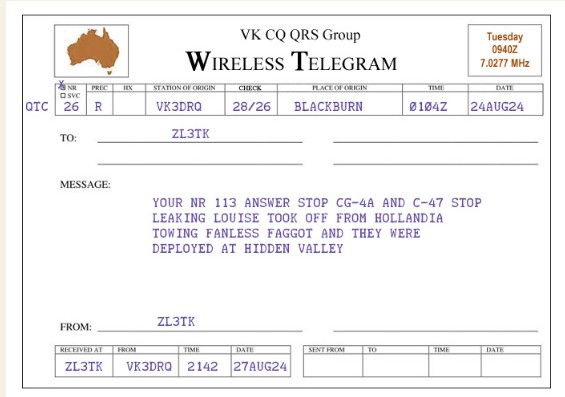
Traffic was sent by both stations very slowly, ca.8 wom, making it readable, and therefore able to be answered by (almost) everyone! This week’s QTC (to which everyone is invited to reply) is focused on VK6.
The lamp post will be familiar to a nearby CQQRS member. First exactly as sent then printed formally. Serial numbers reset to NR 1 for the first QTC sent from your station in any calendar year.
QTC
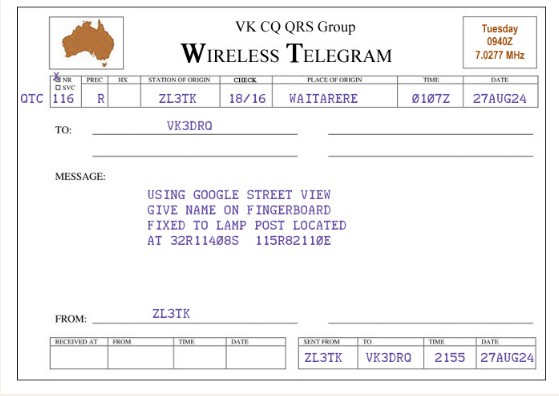
Everyone is invited to dip their toes into traffic by answering the question in NR 116, even if the reply sent is only message text, devoid of preamble. Seek help if you need clarification on any point while advancing your skills.
Zi3tk@qsl.net No exercises were sent or requested, and again it was disappointingly obvious how few read the detail presented on’RagChew’.
It’s simply not feasible to explain at 10 wpm, several times a night, the structure and benefits of participating in training exercises. That’s one important purpose of the nesletter!
Post Morsum Report By Richard VK6HRC Hello Mark, As you know it was a non-event for me this morning with the Echolink /AllStar nodes not connected to the VK6RLM repeater and no traffic on 80MX .
Fortunately both OM Stan ZL3TK and Ross MONNK came to the rescue with their RF-free aprés-ski report, thanks once again.
From Stan ZL3TK: An eerie silence was the only greeting on both the Mandurah and VK6-HUB nodes at 2200Z Tuesday for the weekly Post Morsum Net.
Things livened up by ~2208Z after three check-ins on Mandurah from MONNK, VK6KHZ and ZLSTK, all on echolink so not a lot of RF happening, at least on the repeater’s input!
An enthusiastic discussion and hearty congratulations ensued on the 20 m contact between OMs Ron and Ross, with only 20 W and a ‘salt-water’ amplifier at the UK end. That’s just the sort of adventurous ether-probing more AROs could well do to emulate.
OM Ross worked five VKs on 20 m and 1.5 (his words) on 15m, which he summarized with the phrase, “I was pleased as Punch!”. And so he should be.
OM Ross also picked up on a couple of VK stations bucking the obsolete RST signal reporting tradition by using the much-more useful RSN protocol. Upon request, Stan delivered a few words of explanation.
OM Ron reported three contacts on 40 m, and ZL3TK omitted to report that he had worked five stations. A rather productive RF-free aprés-ski, all told.
From Ross MONNK: Last night’s/morning’s “Post Morsum” was a rather informal affair. Three of us found the “VK6-HUB* deserted but found each other on the Mandurrah repeater. We then took it in turns to chip in our threepenny worth.
+ Stan ZL3TK said that he couldn’t quite pull the Euro stations out of the noise ‘on 20m because his antenna is not optimised for frequencies as high as those.
+ Ron VK6KHZ said that he’d had a disappointing session with only three stations in his log for the net, but one of those was myself (ust). * Both congratulated me (Ross MONNK) on my successful DX session into Australia on the 15m and 20m bands.
I was still aglow from that session and basked in the applause! * Finally, Stan explained the origin of the RSN signal report and its differences from the “standard” RST signal report. That was interesting as I’ve been given a few RSN on the net now.
There being only three of us (where was everyone else?), we wound up after a pleasant half an hour. [For reasons unknown, the hubs of the WA AllStar network had become disconnected from each-other.
I was driving in to Canberra at the time listening to Stan, Ross and Ron on the Mandurah Repeater via Echolink on my phone. However, because I wasn’t at home I couldn’t do anything about temporarily patching the nodes together to the Mandurah node.
Oh well, it was terrific to hear the excitement of the DXperiment anyway, even if Ross couldn’t share it with the team.]
Other News
Hearing Things?
On Monday, James VK2TER let the team know via our WhatsApp group that he was hearing someone on 7144KHZ (the SOTA/Parks SSB calling frequency) using his callsign on 40m CW.
Jordan VK3ACU and I listened in, appreciating how James was feeling at the time listening to his callsign being used to work a bunch of SOTA / Parks stations.
However after some sleuthing, Jordan and James think there’s an explanation for what we all heard on 7144.4KHz: + The callsign was VK2TER/p. + The QSOs came in rapid succession with no breaks between callers.
+ The operator knew some of the other station operators’ names. + There was some music played on occasions on LSB between the CW. + The transmission would occasionally stop instantly in the middle of his callsign.
+ The music was the same music that James uses on his YouTube videos. With some clever deduction, Jordan proposed that it was actually some of James’ YouTube videos that they were listening to.
James agreed – it sounded like someone was watching his YouTube videos while having their transceiver VOX on – so the CW and music was being transmitted as the videos were being watched! Wow – phew! James is signing a huge sigh of relief! Mark VK2KI
Morse Training Net
Nic VK7WW runs a Slow Morse training net every Wednesday at 7pm EDST on 3580 for 30 mins. He uses the callsign of the Northern Tasmania Amateur Radio Club VK7TAZ on that net.
Many of our team learned Morse code with the support of Nic, and the weekly training session comes highly recommended for anyone who wants to learn the Code, or simply brush up. Everyone’s welcome – 3580KHZ at 7pm Eastern time every Wednesday.
The NTARC also feeds the CW live via the Discord phone / computer audio stream, and previous weeks’ recordings are available. Contact Nic VK7WW for more info nicholaschantler@hotmail.com – or just join in on Wednesdays.
This Week’s Topic of Interest
My First Ever DX
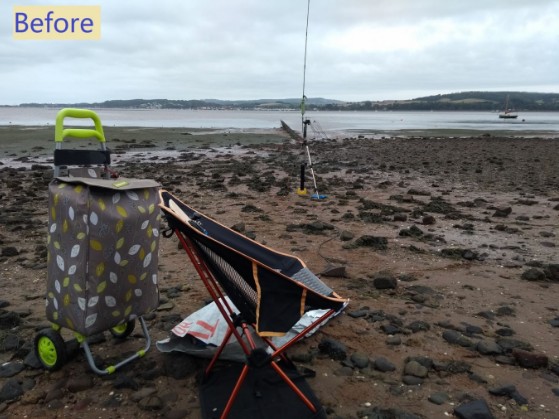
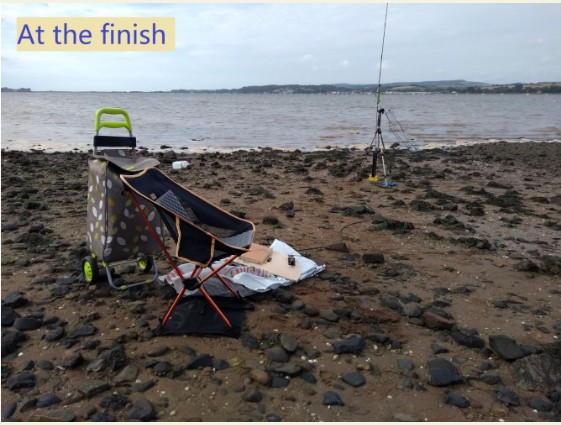
I don’t mind admitting that, with the help of Mike DL3YZ, weeks of preparation went into this attempt. We tried out different antenna set-ups and different locations. Mike gave me loads of accurate signal reports so that proper comparisons could be made.
The winner was the “Salt Water Amplifier” with a 4 wave vertical, and 8 radials in a tight fan for some directional gain. I confess that I was rather sceptical that 20 watts would reach the Antipodes using such simple equipment.
But you see it done on YouTube with even less power so I figured it ought to be possible. Finally the stars lined up – equipment configuration, decent weather, good propagation, tide times aligning with the QRS Net times. Now it was SHOWTIME!
For the curious, here’s a short video of the set-up I used: https://youtu.be/ZQV9tQe3P1E Sorry about the wind noise (I’m not a proper YouTuber). This DXpedition used the Long Path, with the estuary of the River Exe as the “salt water amplifier”.
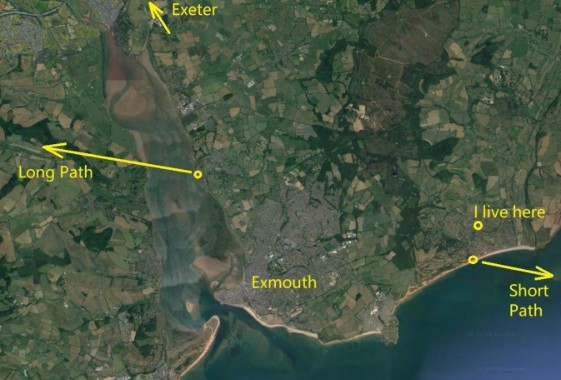
| had tried the local beach for the Short Path but it slopes steeply so the waves crash onto it creating a lot of ambient noise. Also, in late August, it’s very popular with holiday-makers.
So I decided to move to the quieter estuary between Exmouth and Exeter even though it meant using the Long Path (there are no suitable sites on the west bank of the estuary). So,how did it go? Well, I was amazed!
I got five contacts on 20m (three in VK6, one in VK3, and one in VK6), all at a good signal strength and easy to copy. And then I got another easy contact on 15m.
I almost got a second but struggled to copy the morse (if that was you, lan VK7TA, please let Mark know). As you can imagine, given that this was my first ever DX, I was over the moon!
Thank you so much to the seven guys in Australia who made this possible for me – you are Stars!
What’s next?
Whats nextf I was particularly pleased to have had a contact with my good friend Ron VK6KHZ, whose QTH suffers from QRM. I can’t say that we copied much of what the other sent but a contact is a contact. However, I’m sure we can do better.
I want to try a more-directional antenna and have in mind a “Half Square” on that beach at the mouth of the estuary, which will enable use of the Short Path. That’s the thing about this radio game – the possibilities are endless if you put your mind to it.
Thanks Ross – fantastic! And if like Ross you’d like to write a short article for RagChew, please drop me a line so we can share more thoughts and ideas; email to cqqrsnet@gmail.com

Brain Teaser
Jules Perrin JP VK3JFP has created a terrific resource to help guide learning for all levels of amateur radio licenses: https://Awww.julesworkshop.net/Amateur%20Radio.html With thanks to Baz VK6MU for he idea, and Jules for the good learning website, here’s this week’s quiz questions from Jules’ Workshop example test questions:
Exam Questions:
Name five types of antenna. The purpose of the AGC in a superheterodyne receiver is to: + maintain a constant current drain from the power supply + maintain a constant output level with wide input variations * provide a small variation in receiver tuning * keep the local oscillator frequency constant A linear repeater station accepts + FM signals only + SSB signals only + SSB, FM and CW signals + RTTY signals only Answers next week.

Answers from last week’s Quiz:
Why should antennas be fitted with lightening protectors? Answer: To stop damage to equipment and injury to operators. Crystal oscillators are often used for frequency control in receivers because they + have more output than other oscillators * are more stable than L-C oscillators * radiate fewer harmonics than other oscillators * generate more harmonics than other oscillators Answer: are more stable than L-C oscillators A capacity hat or capacitive top loading is used on a vertical antenna to * to increase the bandwidth of the antenna * make the antenna more stable in high winds * to decrease the electrical length of the antenna * to increase the electrical length of the antenna Answer: to increase the electrical length of the antenna How did you go?
Di-dah-di-dah-dit
So back to the Slow CW QSO practice net.
Next Tuesday’s Net
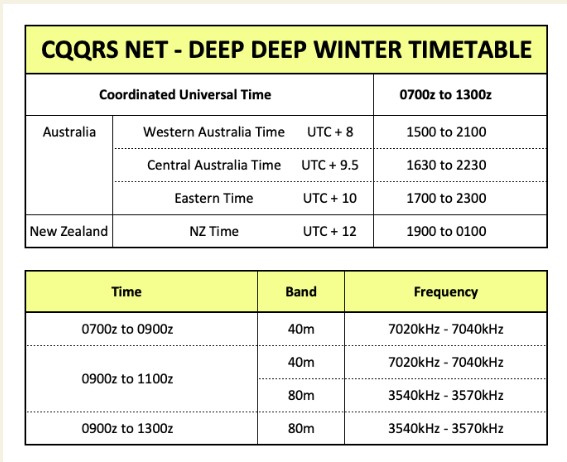
Our CQ QRS Net will be on as always on Tuesday from around 0700Z until about 1300Z; see below for details. Doesn’t matter whether you’re brand new and want to try just exchanging callsigns and RST reports, or you’re ready for a good old rag chew.
Please let me know via our Reports form bit.ly/CQQRSNET who you work or hear on Tuesday’s net. For stations on other bands, please just use the 80m report area (separate out your 80m report from the other bands), and when you enter the list of callsigns worked, heard or missed, please append an ‘@band’ to each callsign without a space (eg VK2KI@20 VK6QI@15 etc).
Post Morsum
Richard VK6HRC will run our phone Post Morsum on the South West AllStar net (via repeaters and hotspots all over WA) from 0600 WA time, then from 0700 WA time on 80m (8605 LSB).
For the 0600 (22002) net, if you’re in WA all you need is an FM 2m or 70CM transceiver and an AllStar node nearby. If you’re elsewhere in the world, you may be able to connect your local AllStar-enabled repeater to the net, or you can connect via Echolink.
Let me know (cqqrsnet@gmail.com) if I can help with that. and if you can’t connect that way, give 3605KHZ SSB a try from 0700 (23002).
Teamwork
Thank you so much to our team of 36 contributors: DL3YZ, MONNK, VK2AOIE, VK2DLF, VK2GAS, VK2NAP, VK2TER, VK2TIG, VK3ACU, VK3AFH, VK3BAP, VK3BWN, VK3CTM, VK3DRQ, VK3JFP, VK3KEV, VK3RU, VK4CCW, VK4EK, VK5A0, VK5CZ, VK5ET, VK5FD, VK5KFG, VK6BEK, VK6HRC, VK6IS, VK6JDM, VK6KD/4, VK6RR, VK6WE, VK7TA, VK7TO, VK7WW, YBINWP, ZL3TK.
Thank you team. GU CW on Tuesday, mb Mark Bosma VK2KI / VK6QI. Beautiful South Bowning NSW mark.bosma@icloud.com non impediti ratione cogitationis

An Ode to CW – thanks to David VK3RU: In days of old, when ops were bold, And sideband was not invented, Words were passed by pounding brass, And all were quite contented. – Unknown author
Frequencies and Times
speed
Matching
PSE QRS


Landing Zone
The opinions expressed in the RagChew newsletter are those of the individual contributors. The opinions do nat necessarily reflect that of the editor or of the C@ QAS Group members.