Below is a reconstruction of the 2024 30 CQ QRS RagChew newsletter designed to support full text searching. This reconstruction was built using OCR, and will contain errors.
To view the Mailchimp original, click here. To search the entire newsletter archive, click here.
Contents
- CQ QRS RagChew
- Last Tuesday’s Net
- New Team Member
- Masthead Image
- Reports & Comments
- Comments:
- Other News
- From David VK6KD – Portable at Muttaburra QLD
- Today in History’s New Sibling – Starting NOW
- International Pixie Day
- Feedback on the Feedback
- Tower Zero 2m Repeater
- CQ QRS Group Traffic Report 23 Jul 24
- TEMPLATE
- An Intangible Cultural Heritage
- Hi Mark,
- For Sale – Hi-Mound HK-707 Telegraph Key
- For Sale – Hi-Mound HK-705 Telegraph Key
- Morse Training Net
- Northern Corridor Radio Group Raffle
- This Week’s Topic of Interest
- Brain Teaser
- Exam Questions:
- Answers from last week’s Quiz
- Di-dah-di-dah-dit
- Next Tuesday’s Net
- Reports
- Most Morsum
- Teamwork
- About the CQ QRS Net
- Speed
- PSE QRS
- Landing Zone
- CW Tips
CQ QRS RagChew
It just gets better and better! I was late to the party on Tuesday, but had a balll both from home with my wide-as-the-side-of-barn nearly 50 year old TS-120S from home the two Southern Electronics Group Remotes in WA and the VK6QS and Tecsun web-based KiwiSDRs.
So many people enjoying the joy and comfort of slow CW; what fun! And this week there was a push by a number of our team to crack-out their favourite QRP transmitters and have some bare-bones milli-Watt fun – megga what fun!
So because of the the locally-declared International Pixie Day initiative of our Sydney-side comedians Chris VK2NAP and George VK2AOE…
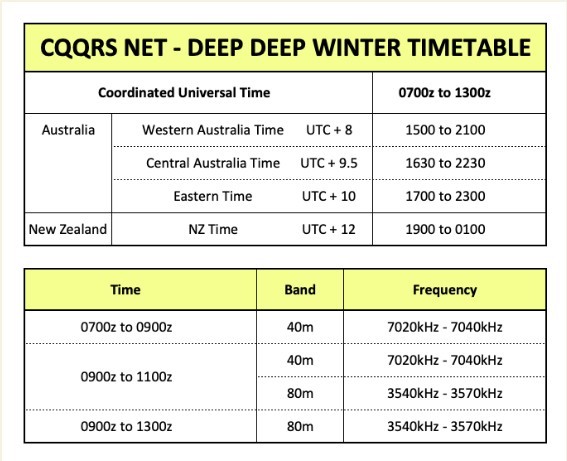
Plus the recent Bourke Street nature of our 40m net, we’ve now expanded the 40m segment of our net; the net will now be held between 7020KHZ and 7040KHZ. Dangerously close to the DX area of 40m I know….
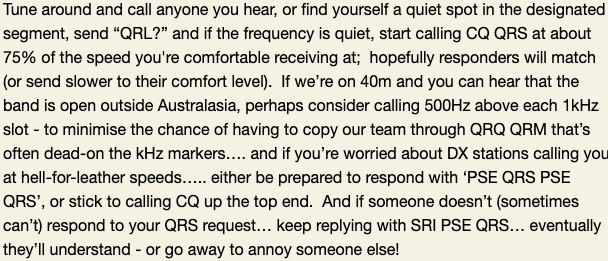
So if you’re not comfortable being called by someone who doesn’t respect our value of replying no faster than the calling station, pethaps call at the top end of our segment… but of course, don’t forget to listen out for those Pixies on 7028KHZ and say g’day.
Ps I’m hoping to see a new Wikipedia entry for International Pixie Day from one of our comedians soon too.
Last Tuesday’s Net
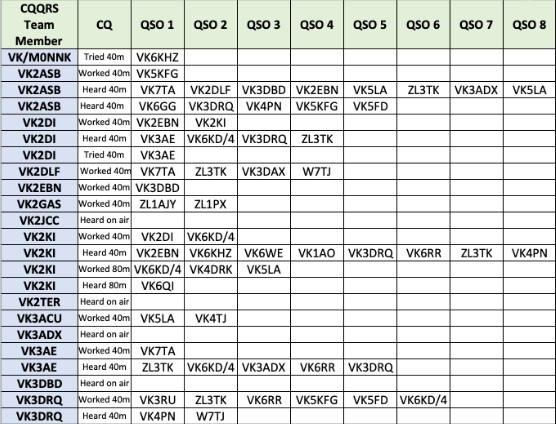
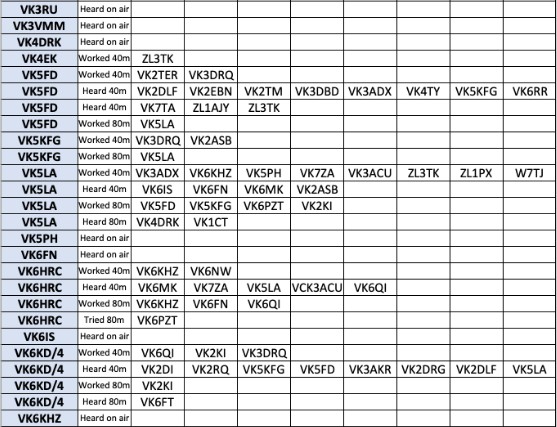
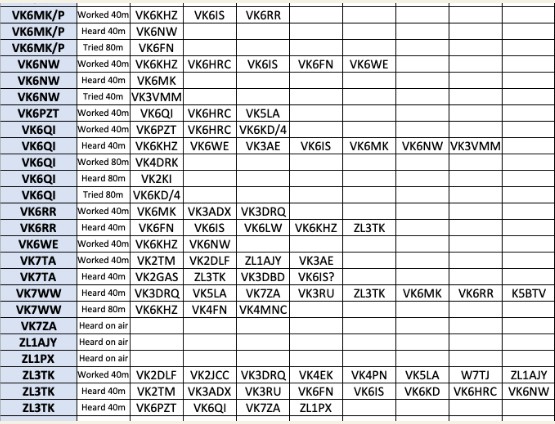
So back to the matter at hand… here’s this week’s list of the 54 stations heard on air (including 39 of our team stations) on Tuesday evening:
New Team Member
And this week, I’m really excited to introduce Sergio LU7YS, our first Argentinian team member! Sergio caught up with Grant ZL2GD during our net on 80m two weeks ago.
Sergio tells me that 40m and 80m are sometimes open between South America and Oceania during our net times at the moment – and he’s keen to have
Some QRS contacts with our team; Sergio’s pair of phased vertical antennas for 40m will help! Welcome Sergio and I look forward to you becoming a regular! See Sergio’s note and superb images in Other News below.
Masthead Image
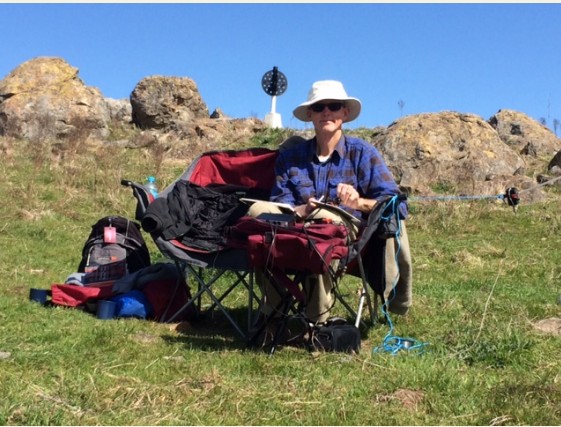
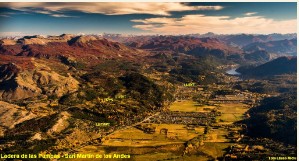
Memo to me… don’t carry kilos and kilos of crap when walking up the seemingly gentle access road to Bobbara Hill (near Boorowa NSW).
I did get to wear my silly hat and got to sign /p though (the significance of this last bit will become clear as you read through this edition of RagChew). Thanks to Ms E for carrying much of the load (and me!) up the hill.
As usual, after next Tuesday’s net, please send me a list of who you worked and / or who you heard using our web form here:

Getting reports from stations and listeners is important to me – even if you listened and didn’t hear anyone or weren’t able to copy anything – the fact that you had a go needs to get recorded so we know that the net is working and attracting new and old team members to have a go.
Reports & Comments
The spreadsheets above show the known stations on last Tuesday’s net. Comments from the reports I’ve received are below:
Comments:
From Ross VK/MONNK at Exeter UK via Perth WA
[40m] « VK6SR remote access radio in Perth not connected to the internet. * VK6CRO remote access radio in Carnarvon WA has sidetone and all the controls function but no transmit. * So, I’ve been unable to get on the air. ¢
[40m] + Some QSB at the start but sigs came good.
[40m] «| wonder if OPS read about the Pixie fx? I guess not, from the strong signals operating on the fx…pity I was really looking forward to stretching my hearing ©.
[80m] + Most activity on 3.555, not much else anywhere.
[40m] + Had an unexpected ‘clip the ticket and run’ QSO with Randy W7TD in ‘Spokane Washington. + Unexpected because I thought he’d been calling ‘CQ WASH just prior.
+ Also had a chatty QSO with the OM Sava VK4PN whom I’ve only ever encountered on the 80 m NZ Net. + Was unable to listen long enough to identify from which of the 18 countries with callsigns beginning with 4 that VK6KD/4 was operating. + Does anybody know?
+ There were no ‘Today in History’ messages nor RG-style 5-letter groups sent, too-short notice, unsuitable punters and others in too much of a hurry to sign off.
+ Nonetheless, a highly successful two-way exchange of QTCs with the OM Manny VK3DR@ took place on sked at ~ 0940Z, one QTC even included a three-word Gaelic place name.
+ Hope these traffic events are providing a useful insight for listeners into what was being achieved hundreds of times every day by historic maritime radio operators on land and sea, equipped initially with only ‘sparks’ and a coherer.
+ We have it so jolly cushy these days!.
[80m] + Not a dicky-bird seen or heard on 80m. + From lan VK7TA at Latrobe
[40m] +I started early at 1700 and didn’t hear much so called CQ. + Got a reply and had a very nice chat with Trev VK2TM. + He didn’t know about our net. + Later on I thought I could make out VK6IS down in the noise.
[80m] + I tried using a remote tuner and the 40m vertical on 80m. + Theard nothing. + I put out a brief call that maybe someone would have heard if they were driving past!. *
From David McSweeney VK6PYN at Chittering, WA
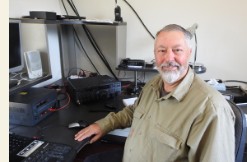
[80m] + Some of the earlier ones were a bit fast but I started to make out some (some letters, e.g. CQ) of the later ones. [Good start David, thanks for your first ranort mate ]
[40m] + My QSO with VK2TER was short-lived owing to his signal being swallowed up in QRM. « Sorry OM, maybe next time.
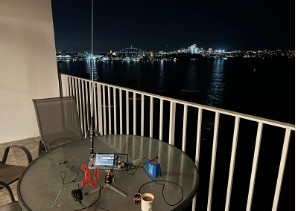
[40m] + Living in an apartment I don’t have a home station with aerials. * Tonight I set up on my balcony and attached a small base loaded whip antenna to my IC705.
• I bought the antenna recently on a trip to Japan and, given its compromised design, it works surprisingly well. * Mine is a northerly facing balcony so no surprises that Brian VK2EBN (in Newcastle) gave me a much better report than Mark VK2KI to the South.
[Might also have something to do with my noise level and 50 year old rig mate!
From Arthur VK2ASB at Wentworth Falls NSW
[40m] * GSRV still down. * WX too wild for anyone to climb a 10m tree to anchor a new halyard. + I listened on my GP (a DSE whip originally designed for CB operation but shortened for the 10m band) thru a LDG tuner.
* To my amazement it worked with 599 each way. + Alas I decided to try it too late in the evening. * Can’t comment on conditions for obvious reasons. interesting – challenge Arthur. Looks like you worked into VK5 OK. How was the noise level?
S/N better or worse than the GSRV? Good luck with getting the doublet back up soon.]
[40m] * Another great night on the QRS net on 40m and also 80m, now I have a decent antenna that actually radiates on that band. * Worked ZL3TK first-up but my pen died and had QRM so wasn’t getting Stan too good.
* Next was Jordan 3ACU on a Pixie with 500MW and he was a genuine 559 much to my surprise! Good QSOs on 40 until dinner time and then came back and worked some 80m with good strong sigs.
* Another look at 40 and worked 6PZT on 5 Watts, and to my amazement was called by Randy, W7TJ from Spokane, Washington, 579 both ways! Finished off the night with Mark, 2KI on 80m with a nice QSO and catchup.
* Great fun and great condx, not a lot of static crashes on 80 which helps with RX. * See you next week!. Voo hoo!]
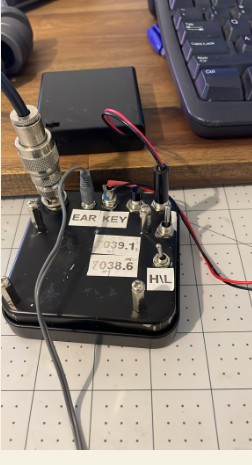
[40m] * Great to get my first ever QSO on my home brew Rockmite 40, a 1WATT crystal CW rig limited to two frequencies on 40m. Only 6-7 years from build to first contact! « Thanks for the help Mark and Richard!.
[80m] * No luck on 80m tonight. [Bunbury to Carnarvon on 1 Watt – c’est rr. F
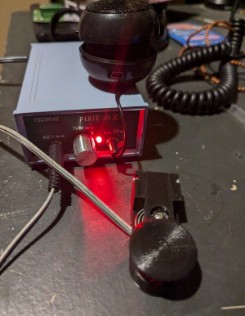
[40m] + 23RD (Pixie day) I dug out one of the Pixie kits I had put together, I was putting out 500MW – QRO compared to some of the CW contacts I’ve had in recent times. + I had a contact with VK5LA and VK4TJ.
* The receive on this particular pixie is silly wide and BC interference with 774ABC Melbourne smashing in on top of the CW signals this just makes for a fun challenge.
• I was intending to get out the 49’er kit after dinner unfortunately I lost th battle with my headache and ended up having an early night. * Hope to make a few more contacts next week.
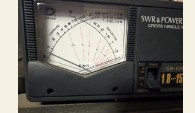
Stew r videos [Thanks for joining in on the inaugural International Pixie Day Jordan. And you made it to the Reverse Beacon Network receiver in Christchurch as well! Next year, Pixie- to-Pixie perhaps?]
[40m] «| found it nice to chat and conditions from my QTH were not bad. * Occasionally, would have QRM from foreigners (DX) managed to S/R 2 QTCs with OM Stan.
* From the six QSOs the hardest one, was OM David, VK6KD/4 in Muttaburra; it took me 24 minutes just to copy his name and QTH. * He was only RSN 265!/QSB.
[40m] + Great night of activity on 40m from Mutaburra QLD using a 5′ whip on 50W.
[80m] + lwas distracted on 40m as there was so much activity. + 80m was opening up at 11:30pm QLD time but was getting a bit cold in my car, hihi. + Hope to concentrate more on 80m next week.
[Great to work you from VK6 on that little whip David – next time 80m perhaps? With a suitable coupler and a few decent ground radials, you might have had some luck loading-up the two sculptures mate!]
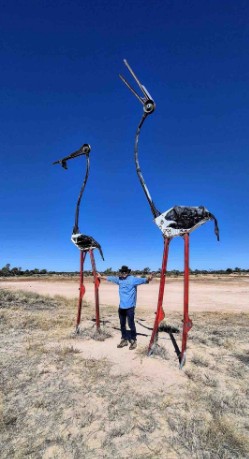
[40m] + Remembered to listen out on 7.023 for the Pixies and was lucky enough to catch the end of a QSO between Jordan VK3ACU and another station.
+ Signals not that strong into Perth so listened on Ironstone Range SDR – unfortunately missed the callsign of the other station. + Later on spotted a WhatsApp alert from Mark VK6QI and once again used the SDR to follow the VK2KI and VK2DI contact.
[80m] + Was great to hear Richard VK6PZT on his one-Watt special – we started off fine but got wiped-out by a strong SSB signal! + From me VK2K( at Beautiful South Bowning
[40m] + I was late to the party on Tuesday after attending a meeting; I think I was a bit pumped-up from the meeting and found myself sending at my normal character speed (guessing around 15 words per minute) but failing to leave nice Farnsworth gaps to slow the effective speed – sorry to anyone struggling with the Code – my motor response was apparently winning the battle with my logical brain half.
+ First up with the help of the Tecsun KiwiSDR at Araluen NSW, I heard Brian VK2EBN up at Newcastle chatting to Mark VK2DI just East of Sydney.
+ I also heard Ron VK6KHZ at Yangebup working Daniel VK6WE at Cottesloe, and Alan VK1AO with a big signal from Narabundah. +l went on to hook up with Mark – and fell off my standing desk when I saw on our WhatsApp group what he was using for an antenna…
1m base- loaded whip sitting on the outdoor setting on his verandah – what a view! Mark wasn’t strong into my barn-side wide TS-120S, but gets the scenic operating location award for the night for sure!.
+ Next up I was called by David VK6KD/4 up at Muttaburra, in the ded centre of Queensland about 100KM North East of Longreach on the Lake Dunn Sculpture Trail – perhaps attending this week’s Muttaburra Sculpture Competition & Festival?
David had a much nicer signal this time compard to last week when he was just out of Longreach. + After David I heard Manny VK3DRQ at Blackburn with a huge signal chatting to Roy VK6RR at Geraldton who had apparently worked out that our net was on Tuesdays, not Mondays.
+ also listened to two old mates Stan ZL3TK at Waitarére Beach and Sava VK4PN at Mount Ommaney catching up; Stan assured me the next day on Richard’s Post Morseum call-in, that I’d heard VK4PN, not VK3PN as I decoded.
+I then tuned in to Andy VKSLA at Winkie chatting to Merv VK3ADX at Ballarat before Stan caught up with Bob VK4EK at Ipswich. +I got busy on the Remotes in WA for a while then slid down for a bit of 80m fun.
[80m] + On 80m I chatted again to David VK6KD/4, then Derek VK4DRK called in after returning home to Toowoomba from a cold game of tennis.
+ Then to round out the night nicely I caught up again with Andy VKSLA at Winkie in the Riverlands area near the SA/VIC/NSW border; Andy reported that he was having lots of fun back on the Tuesday night net.
+ By then it was about time for this old bloke to head off to bed after a really enjoyable evening of relaxed and relaxing CW. * Also from me VK6QI via the VK6QS KiwiSDR near Brookton, VK6CRO Remote at Carnarvon and the VK6SR Remote at Bedfordale
[40m] + On the VK6QS KiwiSDR near Brookton I heard Ron VK6KHZ at Yangebup chatting to Daniel VK6WE at Cottesloe, and also heard a big signal coming into WA from Dylan VK3AE at Ballarat.
+ also heard Peter VK6IS at Wundowie working Stuart VK6MK/P, but I didn’t pick up how far South Stuart had progressed since last week; then I picked up Wayne VK6NW from Bridgetown chatting to Michael VK3VMM at Ballarat.
+ also noticed the post from Richard VK6PZT at Dalyellup with advice that, his Strepsils-tin transmitter couldn’t get to the newly-declared International Pixie Day (23/07, 07/23 or 7023 if you’re dyslexic) frequency of 7023, but was calling on 7029.1.
+ Richard was barely visible / audible on the Brookton SDR, and the Southern Electronics Group’s Bedfordale VK6SR Remote was still off air after the storms in the hills, so we gave the VK6CRO Remote at Camarvon a go.
+ Someone had left the Space Museum display lights on so there was an SQ noise level on the Remote – but despite everything I was just able to copy Richard’s 1 Watt signal on the QSB peaks.
+ Actually “copy” might be stretching the imagination a bit – it was more like I could sense his signal, and could just feel his RST report; intuition at work perhaps?
After that I listened to t’other Richard VK6HRC at Padbury having a go with 1000MW Richard, before he and I had a chat; boy Padbury Richard had a really nice signal into Carnarvon – well above the $9+ noise…..
Until one of our Northern neighbours decided to come up of frequency singing to himself with SSB… helpfull +l had sent Rob VK6LD an SMS asking for the VK6SR remote to be re- connected after the day’s storms, and he was able to fix things.
+ I brought the Remote up and managed to hook up with David VK6KD/4 again just after hearing him say he was QSYing to 80m. + We managed a quick exchange of RSTs before a new SEG member logged- in to the Remote, and not noticing that I was on air….
Proceeded to change frequencies, modes and bands mid-QSO (| figured he didn’t recognise David’s dulcet tones as a form of amateur communication – Hl); c’est la vie!
+ Surprise surprise – I’d done the same thing to Ross MONNK and Mike DLSYZ twice in previous weeks… so a bit of my own medicine back! Tricks for shared Remote operators.
+ The next day at my request, Rob VK6LD who operates the Remote turned on the dreaded May / Tune the Remote? pop-up again – the better of the two evils for CW operators on the Remote.
+ Anyway, through the luxury of our WhatsApp group and the magic of the cellular network, I was able to let David in the dead-centre of Queensland’s outback know why I disappeared suddenly.
[80m] + After working David VK6KD/4 from my home in NSW, I thought I’d give him a try from WA. +I could read David on QSB peaks only, but signals just weren’t strong enough to complete an exchange.
+ Similarly after I’d worked Derek VK4DRK from home we tried from WA; signals were marginal but with repeated repeats, RSTs were exchanged.
+ Later when I was chatting to Andy VKBLA at Wilkie from home, I was able to listen in to both our signals nicely in WA… but it was time for bed, so we didn’t go for that one last exchangel. +
[80m] + Another great evening. here you go – Roy is one of our many old-time commercial CW operators – and he’s immed up our net just so well! Thank you mate!]
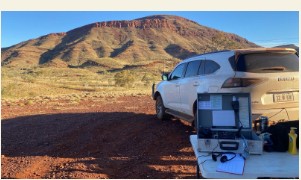
[80m] * Heard Max on 80m but nothing back. * Cheers, Stuart.
From Stan ZL3TK Wednesday’s Post Morsum came into its own under the expert management of Richard VK6HRC when it was revealed that last night Richard VK6PZT was running a mere 1 Won 40m. The comment struck a chord.
Interrogated my log and sure enough there he was, then it all came back. I had heard him rather well but missed including him in my online report so immediately added him to the list of stations heard.
Although not possible to quote his strength, got to thinking about why his signal was so clear and put it down to the magic digital signal processing intrinsic to the IC- 7300.
One can achieve a similar degree of noise elimination and bring signals to the fore as if using an external in-line phase-inversion noise canceller by simply reducing the RF gain, regardless of whether either of the RF pre-amplifiers is switched on.
It may be necessary to increase the preset waterfall level a little to view the noise threshold and see signals, otherwise there’s no drama.
The great circle distance between Dalyellup Beach and Waitarere Beach is 5.230 Mm, an excellent km/W achievement by the OM Richard.
73 de Stan ZL3TK Post Morseum Report by Richard VK6HRC Hello Mark; a short and sweet net this morning which ended well before we got into overtime territory!
On today : * VK6KHZ Ron * VK6FN Max + ZL3TK Stan * VK6QI Mark + VK6GAL Gary * VK6LD Rob * VK6KRC Bob + VK6KD/4 David (late shift!) @ + VK6HRC C’est mois!
Ron enjoyed the net in spite of the noisy conditions and let us know that Ross MQNNK was off on holiday again, so won’t be on the net for a week or two; enjoy the break Ross.
Max managed to get a decent amount of calls in the log apart from the key having a mind of its own! Stan got a good haul on 40MX but nothing on 80MX from AU.
Mark missed the early part of the net with another commitment but got busy working stations, sending WhatsApp alerts and making use of multiple SDR receivers and generally trying to keep us in order!
@ David called in after the net and fortunately Mark was still around to get the latest from the happy wanderer in outback Muttaburra central Queenstand.
Also enjoyed the net, listened on the Ironstone Range SDR when not much was happening locally, as usual thanks to all. 73 Richard VKeHRC [Thank you for running the Post Morseum call-in and your excellent report again Richard.
For those who’d like to say g’day, we’re on each Wednesday morning at 6am WA time (2200Z Tuesday) on the WA AllStar network on 2m & 70CM FM Repeaters and hotspots across the West, plus a few outlets in other places like New Zealand, the UK and even Beautiful South Bowning (if anyone in Canberra wants to give it a try, let me know and I’ll increase the power).
We’d love to hear from you. If you don’t have an AllStar node or phone App, you can use Echolink on your phone or computer to connect to the *VK6-HUB* or VK6RIMH-L Echolink nodes that automatically come out on the WA network.]
Other News
Reciprocal Callsigns – or NOT – as the Circumstances Dictate (Reply to ZL3TK‘s 29/2024 article) by Ross MONNK You may be disappointed to hear that I’m not going to disagree with anything Stan says – he’s the Antipodean Expert as far as I’m concerned.
So my comments are just from a visitor’s perspective. My callsign (MONNK) is constructed somewhat differently from the Australian and New Zealand ones. + The “M” is a regional code and indicates that I operate in England.
If I operated in Wales, I would use MWONNK; in Scotland, MMONNK; etc. + The zero indicates that I am the holder of a Full license. + “NNK’ is my individual identifier.
The UK regulations say, “Any suffix, following the ‘slash’ (‘/’) symbol may be added to the transmitted call sign, so long as the station remains identifiable.” So, /M, /MM, /P, /QRP are all acceptable in the UK.
Having said that, I’ve stopped using suffixes as I think they make my callsign difficult to copy and, as Stan says, this information is best conveyed in the QSO itself.
If Stan says that suffixes are not permitted in Australia and New Zealand then I will go with what he says. My former professional life taught me always to look at the original regulations, and this is what I did before transmitting in Australia…
The UK regulations also say, “If operating overseas under CEPT Recommendation T/R 61-01, you are required to use the appropriate country prefix before your call sign”. I’m definitely operating overseas even though I’m not overseas myself.
Neither Australia nor New Zealand are members of CEPT (the European Conference of Postal and Telecommunications Administrations), but they have both adopted
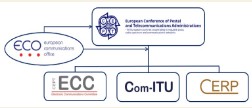
CEPT Recommendation T/R 61-01, and thus participate in the CEPT radio amateur licensing systems regulations. As such, they are required to “provide the call sign prefix to be used by visiting radio amateurs …
And details of any special conditions relating to the implementation of this Recommendation in the country concerned”. In Australia’s case, the ACMA has allocated the prefix “VK” and has specified that, “the class licence allows holders of a CEPT amateur radio licence to operate in Australia for up to 365 days on all allocated amateur bands without the requirement to obtain any additional approvals from, or register with, the regulator”.
As for the semantics of where I am myself versus where I’m transmitting from, I think this is covered by CEPT Recommendation T/R 61-01 paragraph 2.3: “When transmitting in the visited country the licence holder must use his national call sign preceded by the call sign prefix of the visited country as indicated in Annex 2 and Annex 4.
The call sign prefix and the national call sign must be separated by the character “/” (telegraphy) or the word “stroke” (telephony)”.
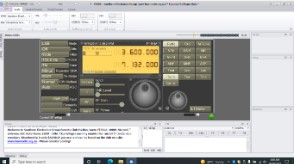
However, the regulations don’t really take account of remote access radios – when using the VK6SR radio, I’m transmitting in Australia but I’m not actually visiting the country.
Paragraph 2.2 says: “The licence holder shall observe the provisions of the ITU Radio Regulations, this Recommendation and the regulations in force in the country visited.” So I’m bound by both the UK and the Australian regulations.
Phew – that’s a lot of words about stuff that doesn’t concern most of the team. But it might help to explain why I use the VK/ prefix, and why I don’t use any suffix.
[Thanks for your excellent analysis Ross; I’m sure future visitors will find your research useful. Well I was surprised that Stan’s contentious article on reciprocal licensing and the use of /p, /m etc didn’t elicit a flood of replies and comments from other oldies like me.
Back in around 1971 when was old enough to attempt the amateur license tests, the Regulations specifically stating that /m, /mm, /am and /t were to be used; of course, my original Regulations manual went to the tip, along with a collection of treasures when I joined the Air Force and left home…
So I can’t confirm my recollection. The earliest version I have (1978 edition) talks about /n to designate the State of operation, but strangely doesn’t mention the use of the other suffixes; I wonder if a new ITU resolution caused the previous direction to be canned?
Of course the reason why VKFF PARKS and SOTA operators like me use /p is because our signals are often weak and rather than a receiving station thinking to themselves… “too weak so they’re unlikely to hear my reply…
So I won’t bother” or “him again – nothing new here, so I won’t bother’… if the operator knew the calling station was out in a gale running milliWatts to a bit of wire slung up a tree and fingers frozen to the key…
Hoping to catch somebody, anybody…, they might make to effort to say g’day. So there we have it. Will I continue to use /p when operating portable? Will you?]
From David VK6KD – Portable at Muttaburra QLD
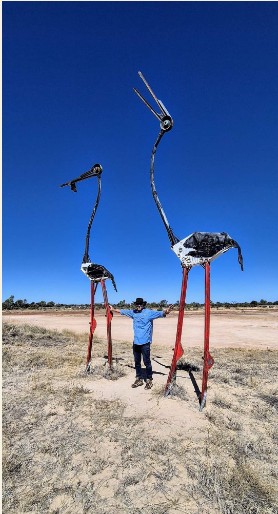
G’day Mark & CW mates. Great catch up on both 40m and 80m last night on CW and this morning via Echolink from my portable location at Muttaburra QLD.
Wife and I are travelling Oz and spent a couple of days checking out the sculpture trail from Aramac – 200KM loop road. Here is just one of the many sculptures. Just working out wave length between statues, hihi. Regards, David VK6KD/4
Today in History’s New Sibling – Starting NOW
By Stan ZL3TK The splendid CW activity known as ‘RandomGram’ (RG) has become extremely popular throughout the United States since OM Drew AF2Z launched it eighteen events ago. Not so in Oceania.
The lack of uptake is only partly due to RG events often held at unsociable hours for we down-under operators. There are also the twin handicaps of geographic isolation and not-ideal propagation.
Nonetheless, the two regular South Pacific participants and our cohort OM Hiro JJ1FXF, find every RG event a challenging and thoroughly rewarding experience. An introduction to the RG experience is now available to the CQ QRS Group.
While ‘Today in History’ (TDIH) fulfils a contextual niche in the CW education experience, it’s not needed by the those longer in the CW-tooth who are perfectly capable of handling straight-forward contextual QSOs.
RG is at a different level, though in no way should this be taken as an exclusion of new-comers; au contraire, anyone who wants to test and grow their skills in a less-conventional manner is most welcome to have a go.
So on Tuesday 23 July, an alternative to TDIH was offered in the form of ten §-letter groups, similar to a multi-contact RG, without the waiting. Don’t balk – 50 letters is somewhat shorter than the average TDIH.
The opening gambit will invite you to make a choice, simply follow this instruction: NW A MESSAGE FER U TO RX AND RETURN. INDICATE IF PREFER ONE TODAY IN HISTORY OR TEN RANDOM GROUPS. PSE REPLY WITH ONE OR TEN, OK?
Listen out for me on Tuesday’s CQQRS net and if you like, I’ll be happy to give you a taste of this new challenge. Stan ZL3TK
International Pixie Day
Tuesday is the 23RD of July was International Pixie Day – 7/23 in freedom dates (remarkably similar to 7023). It’s the day of the year where we all get out and dust off our Chinese QRP crystal locked to 7023KHZ transmitters / transceivers and try to make a QSO.
George and I did a video last year where we put 3 pixies up against each other. https://youtu.be/ybLSKLKypA0? si=FDYysYatXqrQ3FOY
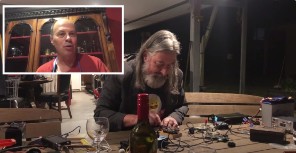
• One that George made that just refused to receive, but smashed out a Watt and a half. ¢ One that I built which managed to punch out almost a Watt but smoked up whilst testing antennas, and ¢ The third one, built by my son when he was 9 years old, which we managed 2 QSOs on.
Hopefully this Tuesday people brought out their home brew monstrosities, novelties and other neglected projects and broken dreams, and got them on the air. 73 DE VK2NAP dit dit [Hopefully a few of our team saw this in my email on Tuesday mate. Next year?]
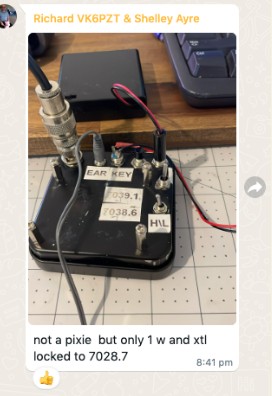
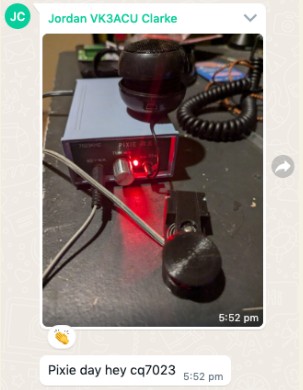
[Well looks like at least two of the team saw the note about International Pixie Day on 7/23 – 7023 in my reminder email.]
Feedback on the Feedback
True to the stated paradigm of the CQ QRS Group, my observations in RagChew edition 25/2024 were not intended to cast judgement whatsoever upon those beginners who are exhibiting ‘sheer guts and determination’ to get on the air with their nacent CW.
Quote from RagChew editor: “Our net has always attracted new operators who were taking their first steps, knowing they won’t be judged.” And thai is indubitably still the case!
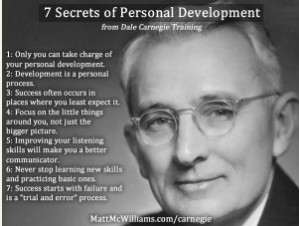
Contrary to fuelling fear of having judgement passed, I have never been anything but encouraging, and in the famous words of Dale Carnegie, “… am hearty in my approbation and lavish in my praise” for the endeavours of others, learners or otherwise.
Constructive criticism should always be welcomed.
As an example, I am forever grateful to the fellow who taught me that word spaces need to be a minimum of seven dot periods, nine even better.
Yet some still chose to misinterpret my reflections, so allow me to point out again who is responsible for such observations on the matter of sending quality being possible at all.
There are those who are already experienced but have become lax, and those who have come up through the CQ QRS Group ranks and now believe, quite erroneously, that they are capable of increased speed.
Folk in those categories, and there are only two or three at the moment, have become over-confident and unconcerned about respecting learners, and are thus heard setting bad examples.
These over-confident guys are the ones who will happily quote that old chestnut, ‘practice makes perfect’, failing to understand that by repeating their huge collection of errors – as they do – simply concretes those errors into their psyche, and unfortunately makes their CW unnecessarily difficult to copy, or even un-copyable.
Vincent Lombardi, the famous American football coach had it right when he said, “Winners never quit, and quitters never win”, but more importantly he adroitly observed, ‘Practice does not make perfect, only perfect practice makes perfect’.
That is why all who participate in the Tuesday CQ QRS Group free-for-all should be setting the best possible examples for the majority to follow, ie the learners, by sending Morse only with as-near-perfect-as-possible mark:space ratio, and not demonstrate incompetence by operating outside one’s limited capability.
My suggestion is that everyone make regular recordings of themselves, listen and self-judge before expressing righteous indignation at someone else’s verifiable observations, then decide based on fact whether slowing down and taking care is indeed the proper thing to do.
Perhaps reading the paragraph written by the RagChew editor under the emboldened heading ‘Speed’, might re-focus attention on the Group’s paradigm. Stan ZL3TK
From Craig VK5QA / VK3CLD Couldn’t be on the net on Tuesday…. was busy dealing with this mess.
Finally get this tyre off – had to resort to breaker bars and extra help. With the spare fitted I decided to check the other rear tyre; also FUBAR! A long and slow trip (limping) back to Port Hedland only to find they have no tyres in stock.
A new set should arrive from Perth on Friday and be fitted, then we’ll be off again. The morale of this is that I was booked in to have new caravan tyres fitted in Broome!
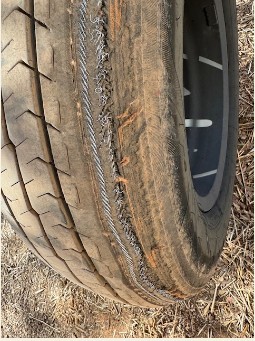
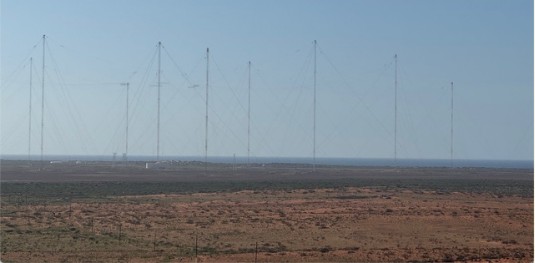
This could help on the net a bit, at 1-2 MW to boot! [Bad luck with the tyres mate – so why would the rears scrub out on the outside on the tandem van with a solid axle, rather than all-over? Are they rubbing up on the fender when each side moves up perhaps?
North West Cape antenna doesn’t look much from that distance – but the centre tower (‘Tower Zero’) is 387.4 metres tall (1,271 feet for aviators).
I recall visiting the station (and the nearby solar observatory) in a previous life forty years ago, but amazingly, I don’t remember much about the technical side of the station.
There was a 2m amateur repeater up the top of Tower Zero at one stage, as Will VK6UU explains below.]
Tower Zero 2m Repeater
CDSE CASUAL [nk PhS LN by Will VK6UU. The repeater was turned on Monday the 19TH of March 1984 at 13:02 and was at the site until around 1989. When decommissioned, the 6db antenna was removed and was taken apart and showed internal corrosion.
Being so high it is surprising that it did not suffer some form of lightning damage – a direct hit would have shattered the fibreglass antenna as happened at Cataby, but lightning corona can cause less obvious damage – eg the Tic Hill antenna was of the same design and had a small burn hole that allowed water in.
I wrote an article about the Exmouth installation for AR magazine – and I’ll be happy to share it with the team – send me an email if you’d like to read it: will2@linet.net.au Regards will
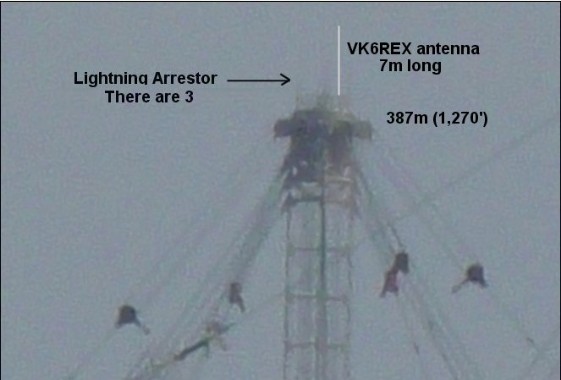
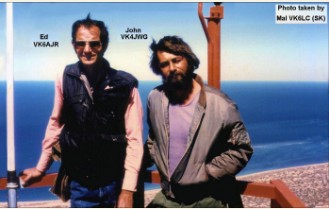
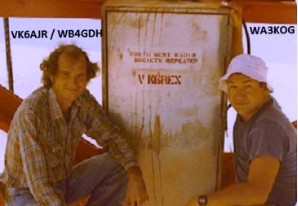
Above: Top of tower Zero Exmouth. VK6REX antenna (white) far left – 6dB collinear – higher than the lightning arrestors (one is behind John – painted with Red Lead).
Above: Metal cabinet housing VK6REX, 12V power supply, duplexer & 12V battery.
CQ QRS Group Traffic Report 23JUL24 from Stan ZL3TK To widen everyones’ CW experience, formal traffic is being exchanged at <= 10 wpm during the CQ QRS Group free-for-all on Tuesdays, intentionally a comfortable speed for learners.
Because the Group’s free-for-all is not a net, the messages must have an addressee, else they would be deemed a broadcast. So although the QTC appears limited, they are in fact open for anyone.
Feel free to compose your own QTC in reply and give a call on 7.0277 MHz at the appointed hour to send it. Anyone is welcome to participate and time is not an impediment, any number of word repeats may be requested using the concise protocol published previously.
Here is the simple structure to use for composing your own Wireless Telegram, you don’t need a form. It demonstrates how
It’s quite old-fashioned really, yet extremely efficient.
CQ QRS Group Traffic Report 23 Jul 24
TEMPLATE
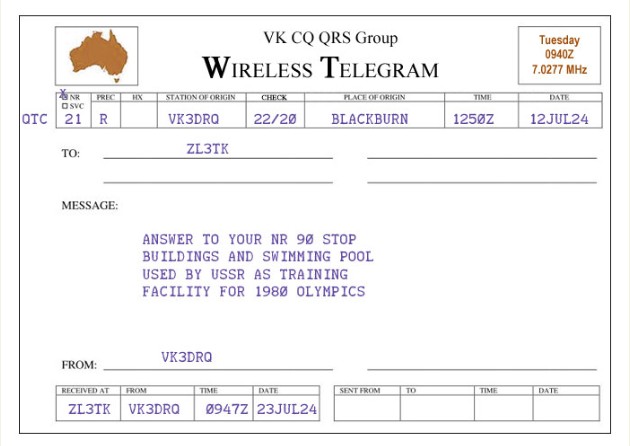
Here is the formal version of the above template, printed for the records. It is OM Manny’s reply to the QTC/QNC sent Tuesday 15 July at QRS Group speed ~ 10 wpm.
Data in any of the eight back-office management fields at the bottom of the form is not part of the message but filled in manually after the event.
And now to this week’s QTC/QNC for those who didn’t copy it in real time – it’s another invitation to dip your toe into traffic handling while in the safe environment of the CQ QRS Group.
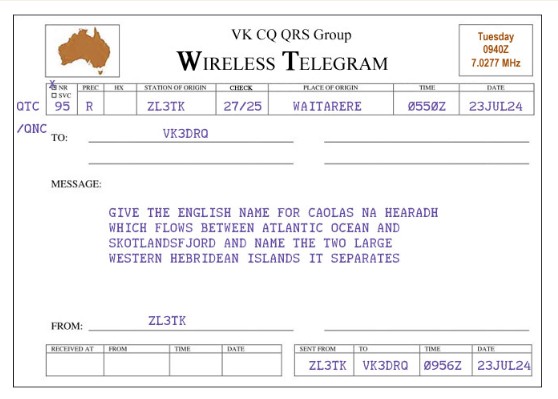
Thanks to search engines which are consulted before composing a QTC, answers are usually easy to find. Then compose your own QTC based on the template above.
Everyone has to start somewhere, this kind of exchange can be a real boost in your journey to becoming a competent and confident CW operator which regular QSOs cannot provide.
Anyone wanting to practice off-air may email for an echolink sked: zl3tk@qsl.net Too easy: all that’s needed is a key and an audio oscillator with speaker. 73 de Stan
An Intangible Cultural Heritage
From Roy VK6RR Morse Code Telegraphy in the Netherlands and Germany is officially declared as an Intangible Cultural Heritage.
The assessment of this state is based on the principles laid down in the Convention for the Safeguarding of Intangible Cultural Heritage by UNESCO.
But Morse Code Telegraphy is not yet declared by UNESCO being an Intangible Cultural Heritage on an international level. Nevertheless, the bearers of an intangible cultural form recognized at a national level are expected to look after their cultural heritage.
In practice, such care of their cultural assets for Morse telegraphy almost only takes place in amateur radio. We are a small group of four former radio officers of the German merchant marine.
Although we are all radio amateurs (DJ7ZY; DL9CM; DL8HCI and DL7AAQ) we are dedicated to keeping Morse telegraphy generally known.
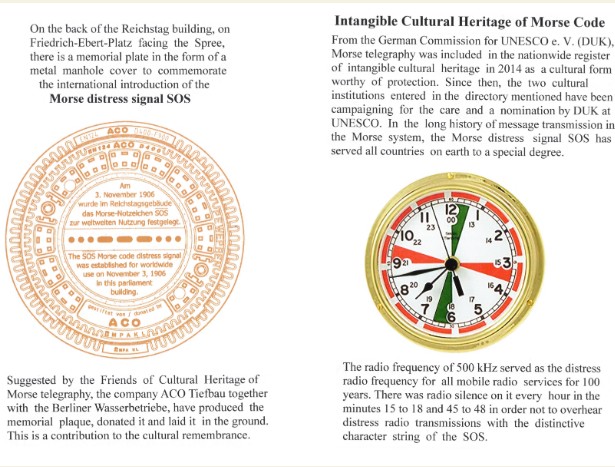
We have also created a commemorative floor plaque, in which we have paid particular attention to the Morse distress signal SOS.
The original version of the flyer is in German, as we have distributed it to many places in Germany that have had to do with Morse telegraphy in the past.
What is still missing now is recognition of CW as a cultural heritage by UNESCO at an international level, because there is probably no other intangible cultural form as widespread in all countries of the world as Morse telegraphy was.
73, Norbert Gabriel OUR FACEBOOK PAGE: hitps://Awww.facebook.com/groups/707451009311335/ [Thanks for passing this on Roy.]
Introducing Sergio LU7YS from San Martin de los andes, Argentina
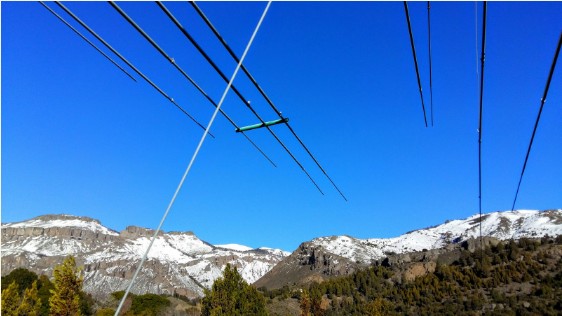
Hi Mark, It’s great that you found a way to attract your colleagues to the CW. It is wonderful! Congratulations. Send my regards to Grant ZL2GD!!! I would love to join the group.
I have been practicing the CW since I was 16 (I’m now 60!) Did you know that we have excellent propagation conditions between New Zealand, Australia and Patagonia every day between 10:00 and 12:00 UTC on 80 and 40 meters?
I think it would be a great opportunity for those new to the CW to make a contact at 80 meters QRS, I can see it on RBN.
Hi Mark,
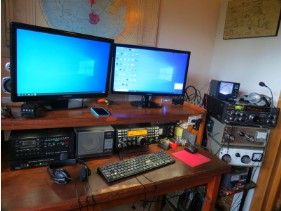
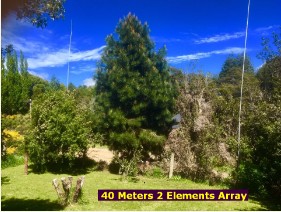
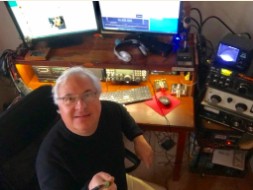
| usually call on 3505 most mornings local time, so I’m available for Sked. Greetings to all. 73 is DX by Sergio, LU7YS
[Thanks for joining in Sergio – I’m looking forward to hearing your success in joining in on our QRS fun.]
For Sale – Hi-Mound HK-707 Telegraph Key
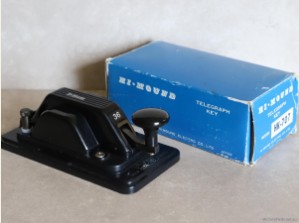
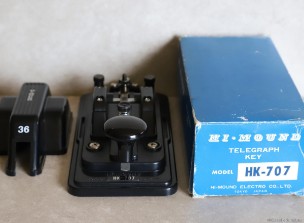
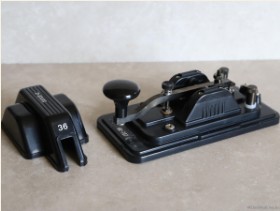
Hi-Mound HK-707 Telegraph Key for sale – never used. New in the original box. $150. kees.vanderspek@netspeed.com.au
For Sale – Hi-Mound HK-705 Telegraph Key
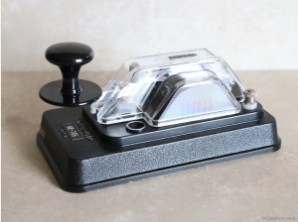
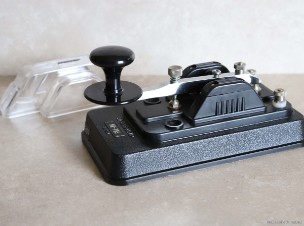
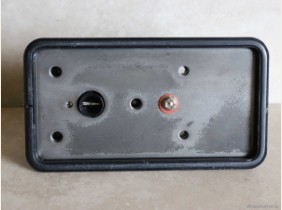
Hi-Mound HK-705 Telegraph Key on high-profile base. Comes with transparent cover which not standard for this key but helps to keep things dust-free. Also fitted with non- standard elevated so-called navy knob with skirt. $150. kees.vanderspek@netspeed.com.au
Morse Training Net
Nic VK7WW runs a Slow Morse training net every Wednesday at 7pm EDST on 3580 for 30 mins. He uses the callsign of the Northern Tasmania Amateur Radio Club VK7TAZ on that net.
Many of our team learned Morse code with the support of Nic, and the weekly training session comes highly recommended for anyone who wants to learn the Code, or simply brush up. Everyone’s welcome – 3580KHZ at 7pm Eastern time every Wednesday.
The NTARC also feeds the CW live via the Discord phone / computer audio stream, and previous weeks’ recordings are available. Contact Nic VK7WW for more info nicholaschantler@hotmail.com – or just join in on Wednesdays.
Northern Corridor Radio Group Raffle
A number of our team are members of the Northern Corridor Radio Group in Perth; the Group’s Hamfest raffle is available to purchasers in NSW, QLD, SA, TAS, VIC & WA; sorry, not available to our NZ friends 🙁
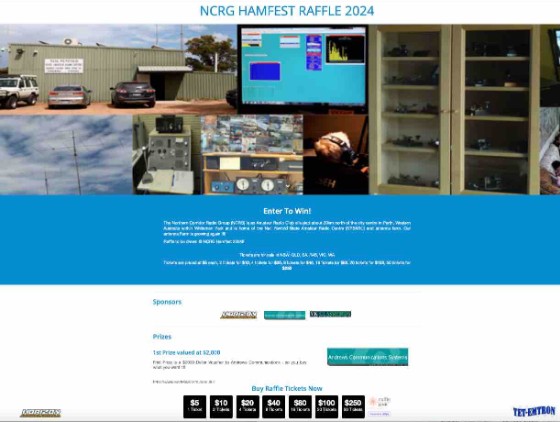
Bus First Prize: An Andrews Communications Voucher worth $2000. Use it to get whatever you desire from Andrews Communications. Second Prize: A Yaesu FTM300 transceiver valued at $699.
This transceiver offers stable 50W RF power output, real dual-band operation, a high-resolution display, and built-in Bluetooth. Third Prize: A Yaesu FT7ODR handheld transceiver priced at $299. Fourth Prize: A Horizon Antennas $100 Voucher.
Ticket Information: Cost: $5 per ticket. Packages: – 2 tickets for $10 – 4 tickets for $20 – 8 tickets for $40 – 16 tickets for $80 – 20 tickets for $100 – 60 tickets for $250
Mae Matto. Start: June 25, 2024 End: August 25, 2024 Draw: August 25, 2024, at 12 PM during the Hamfest 2024 event. Raffle results will be displayed on: NCRG website: ncrg.info/WP/raffle](http://ncrg.info/WP/raffle) RaffleLink: rafflelink.com.au/hamfest-2024](http://rafflelink.com.au/hamfest-2024) Ticket packages adhere to WA DRGLS rules and are available in lots of $5 each.
The raffle is hosted via http://rafflelink.com.au for The Northern Corridor Radio Group INC.
This Week’s Topic of Interest
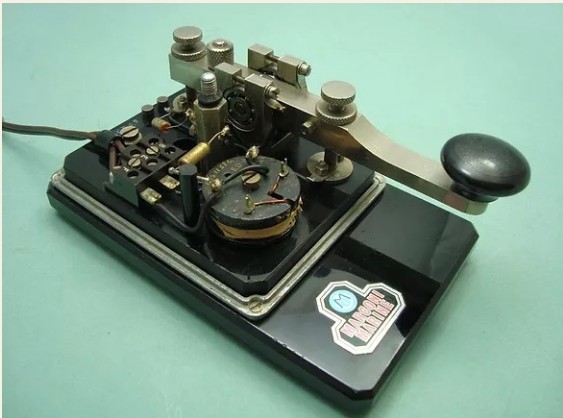
I’ve been an admirer of the 365 series for some time (see CQQRS RagChew 28/2024… bottom line – “I want one!”). I think it’s those HUGE ball bearing races..
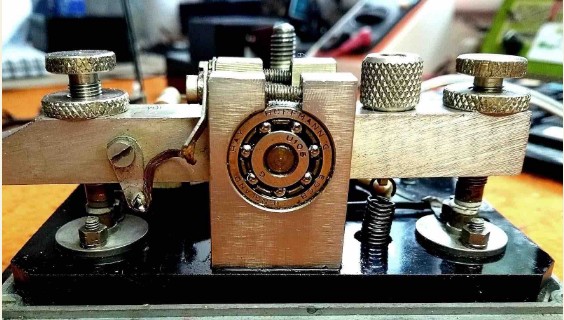
They’re far bigger than any possible need; more an unusual aesthetic flourish than a strictly functional feature. I can’t be their only admirer because the prices they go for are eye-watering. And so Iresigned myself to waiting for a win on the lottery…
Then, as regular readers of RagChew will be aware, I recently paid a visit to the radio museum at Poldhu… where my appetite was suitably wet! Well, I finally got my hands on one… a 365A in rather sad condition. Oh dear – they really are that good.
So when I returned home from Poldhu Museum, I found myself looking at the eBay listings for one of those mythical bargains…and found one! Now, “a bargain” in 365 terms does not mean cheap, merely less eye-wateringly expensive. But, hey, you only live once…
And at 67 years of age, I’m getting worryingly close to my ‘three score years and ten’… so, CLICK… done. My key new was dirty but, apart from missing one of the two spare contacts and the pigtail jack lead, it was complete.
Remarkably, the electrical anti-key-click circuitry was all intact and working.
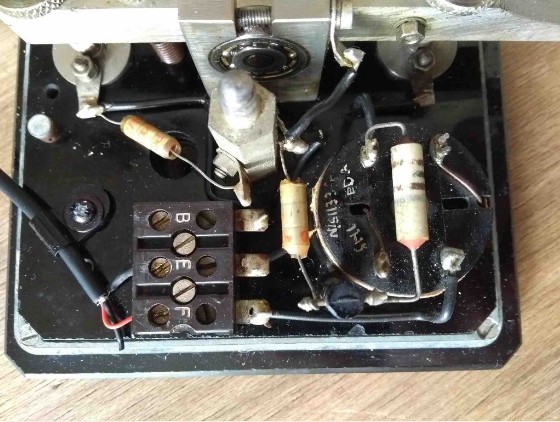
It even has its original cast aluminium cover with the manufacturer’s serial number, but it would be a crime to hide this beauty under a plain black box.
After a good clean and lubrication (I chickened out and didn’t dismantle it fully), I added a new pigtail lead with a 3.5 mm jack and a P-clip for strain relief.
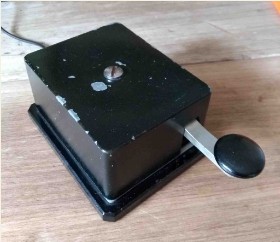
This is one of the later models and would probably have been manufactured in the early 1970S, starting its working life in the radio room of a British merchant ship. Where it’s been over the past 50 years, I have no idea.
It shows some modest signs of abuse, but then it was (at least to start with) a workaday tool. ‘Buyer’s remorse’ is a common side effect of an expensive impulse purchase… but not in this case – I absolutely love this key!
I’ve now also cleaned and lubricated my humble WT 8 Amp key (see previous RagChew) and it’s much better than it was… but it’s never going to come close to the classy performance of this marvellous Marconi Maritime 365. You beauty! [You beauty indeed!
Thanks Ross – I hope we hear it on air via the VK6SR Remote soon.]
If you’d like to share projects, ideas or thoughts with our team of about 190 readers, in a future RagChew, email to cqqrsnet@gmail.com

Brain Teaser
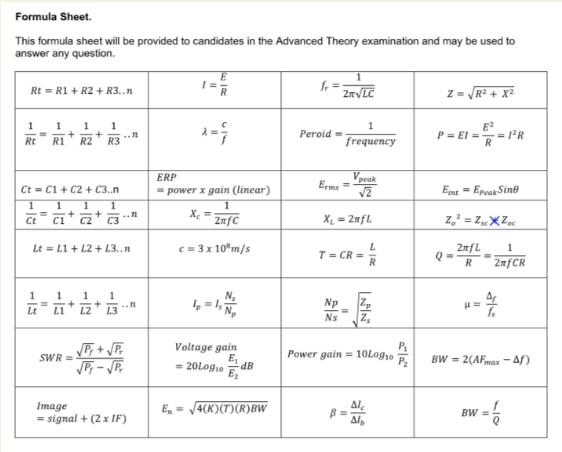
Here’s this week’s quiz questions from Jules’ Workshop example test questions:
Exam Questions:
What is the final stage of a transmitter? The purpose of the capacitor in this filter circuit is to:
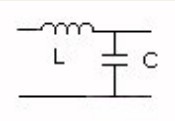
• pass the low frequency ¢ bypass the high frequencies ¢ attenuate the low frequencies ¢ amplify the high frequencies
In an SSB transmitter the balanced modulator suppresses ¢ both sidebands e the carrier and one sideband * one side band e the carrier How did you go? Answers next week.

Answers from last week’s Quiz
Three aspects of a receiver are sensitivity, selectivity and stability. What does each term mean? Answer: Sensitivity is the ability to receive a weak signal. Selectivity is the ability to select a station from other stations near the same frequency.
Stability is the ability to remain on frequency. Four 10 ohm resistors are connected in series. The total resistance is * 2.5 Ohms * 40HMS * 10 Ohms + 40 Ohms Answer: 40 Ohms Tropospheric ducting may * cause high frequency signals to fade suddenly * allow long distance VHF communications * occur as a result of meteor showers or auroral activity * occur more frequently at HF than at VHF Answer: allow long distance VHF communications How did you go?
Di-dah-di-dah-dit
So back to the Slow CW QSO practice net.
Next Tuesday’s Net
Our CQ QRS Net will be on as always on Tuesday from around 0700Z until about 1300Z; note we’ve extended the 40m segment by 5KHZ to help make a bit of elbow room – see below for details.
Doesn’t matter whether you’re brand new and want to try just exchanging callsigns and RST reports, or you’re ready for a good old rag chew. We’ll have fun.
Our CQ QRS Net will be on as always on Tuesday from around 0700Z until about 1300Z; note we’ve extended the 40m segment by 5KHZ to help make a bit of elbow room – see below for details.
Doesn’t matter whether you’re brand new and want to try just exchanging callsigns and RST reports, or you’re ready for a good old rag chew. We’ll have fun. Reports Please let me know via our Reports form bit.ly/CQQRSNET who you work or hear on Tuesday’s net.
Reports
Most Morsum
Richard VK6HRC will run our Post Morsum on the South West AllStar net (via repeaters and hotspots all over WA) from 0600 WA time. If you’re in WA, all you need is an FM 2m or 70CM transceiver and an AllStar node nearby.
If you’re elsewhere in the world, you may be able to connect your local AllStar-enabled repeater to the net, or you can connect via Echolink. Let me know (cqqrsnet@gmail.com) if I can help with that.
Teamwork
Thank you so much to our team of 32 RagChew contributors this week: LU7YS, VK/MONNK, VK1KVS, VK2AOE, VK2ASB, VK2DI, VK2DLF, VK2EBN, VK2GAS, VK2NAP, VK3ACU, VK3AE, VK3DRQ, VK3JFP, VK4EK, VK5FD, VKSKFG, VK5LA, VK5QA/VK3CLD, VK6BAP, VK6HRC, VK6KD/4, VK6MK/P, VKENW, VK6PYN, VK6PZT, VK6QI, VK6RR, VK6UU, VK6WE, VK7TA, VK7WW and ZL3TK.
Thank you team; lots of people have said they really enjoy reading our newsletter – and without doubt it’s the variety of contributions that make it such a good read. GU CW next Tuesday – see below for the new details.
Mb Mark Bosma VK2KI / VK6QI Beautiful South Bowning NSW mark.bosma@icloud.com non impediti ratione cogitationis

An Ode to CW – thanks to David VK3RU: In days of old, when ops were bold, And sideband was not invented, Words were passed by pounding brass, And all were quite contented. – Unknown author
About the CQ QRS Net

Speed

PSE QRS


Landing Zone
CW Tips