Below is a reconstruction of the 2024 26 CQ QRS RagChew newsletter designed to support full text searching. This reconstruction was built using OCR, and will contain errors.
To view the Mailchimp original, click here. To search the entire newsletter archive, click here.
Contents
- CQ QRS RagChew
- Last Tuesday’s Net
- New Team Members
- Reports
- Masthead Image
- Reports & Comments
- Comments:
- Automatic Mode I, DDMemm AAMAIAILZ
- This Week’s Topic of Interest
- CW Operation in Europe
- Brain Teaser
- Exam Questions:
- Answers from last week’s Quiz:
- Di-dah-di-dah-dit
- Next Tuesday’s Net
- Landing Frequencies
- Post Mortem
- Teamwork
- PSE QRS
CQ QRS RagChew
Last Tuesday’s Net
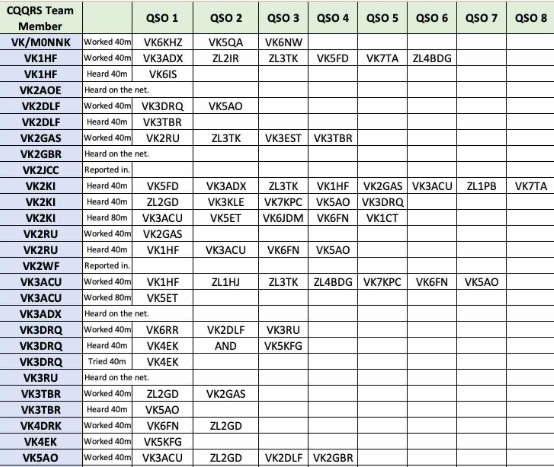
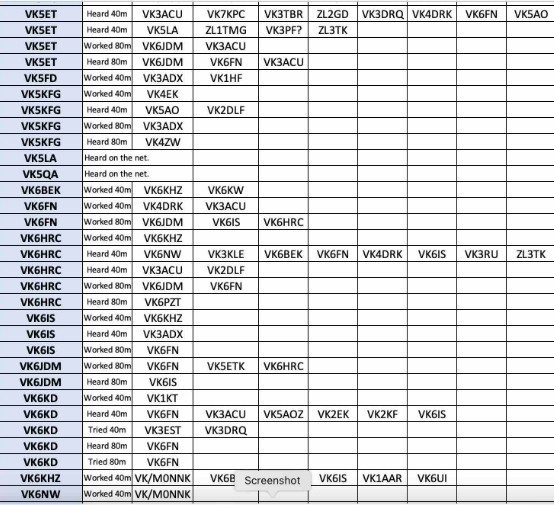
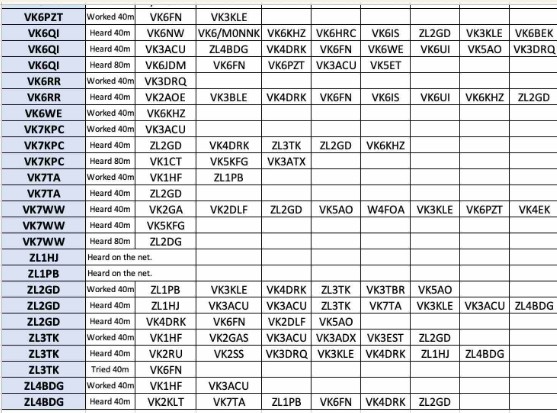
Here’s this week’s list of the 44 of our stations plus 20 visitors heard on Tuesday’s — ft
New Team Members
Welcome this week to Colin VK2JCC also known as Professor Portable (which hopefully we’ll find out more about in due course) from Pennant Hills, David VK6PYN. from Chittering and Bob VK6KI from Geraldton.
Colin is teaching himself Morse Code; I’m sure our net will help that process. He was out portable on Tuesday and just caught the sound of Jordan VK3ACU signing off.
David is also new to the Code and is looking forward to listening-in (so I’m looking forward to reading your reports mate), and before long, having his first CW contacts.
Hopefully David will join our growing list of first QSO certificate recipients who’ve had their first CW QSOs on our net.
And like the people before them, will go on to become a regular, initially enjoying basic callsign & RST exchanges, and before long, longer rag chews.
Scoot down to the end of this newsletter for recommendations for early QSOs and the link to tips for new operators. Bob was heard by David VK6KD on 80m on the net about a month ago – welcome Bob. I reckon there’ll be some confusion with my VK2 call….
Not the least of which will come from me when operating the VK6SR Remote! Terrific to have another 80m operator from Geraldton amongst our team and I look forward to hearing you on Bob.
Reports
After next Tuesday’s net, please send me a list of who you worked and / or who you heard using our new web form here: bit.ly/CQQRSNET
Getting reports from stations and listeners is important to me – even if you listened and didn’t hear anyone or weren’t able to copy anything – the fact that you had a go needs to get recorded so we know that the net is working and attracting new and old team members to have a go.

Thanks again to Nigel G4RWI for building the Google Form, the Python software back-end that does the processing, the new link and the QR code.
This week Elizabeth pointed out that I could just use one product of Nigel’s processing to generate the list of reported stations – rather than importing, reformatting, colouring etc – so the new format shown in the tables above are her doing – and saved me hours of work.
Masthead Image
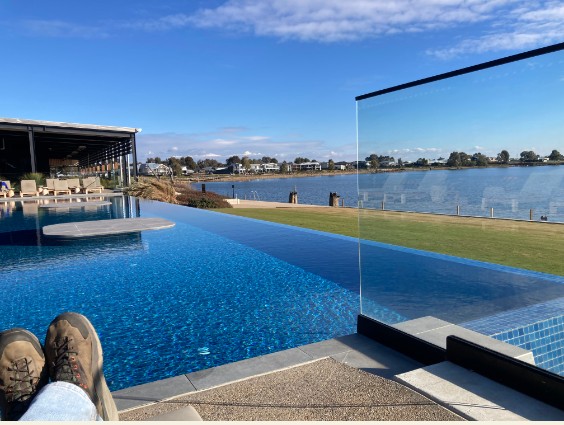
This week, Elizabeth and I continued our public transport only holiday, and moved on from Yarrawonga in Northern Victoria to Lorne on the Great Ocean Road, South West of Melbourne.
And again, I was RX only using my phone to access KiwiSDRs for the net – but I had fun. It wasn’t Elizabeth’s Birthday this time, so I didn’t need to sneak my phone into the restaurant to listen as I did last week.
Sometimes it’s nice just to listen-in to the fun. I’m typing this on the train between Melbourne and Albury on our way home to Beautiful South Bowning NSW. I expect the newsletter to be several days late – but we’ll get there.
In the mean time I’m enjoying using Elizabeth’s MacBook computer – connecting to the MailChimp server when we’re within cellular phone range. 6U CW Tuesday!
Cheers, mb Mark Bosma VK2KI/ VK6QI Beautiful South Bowning NSW mark,bosma@icloud.com ‘on impact rations cogiationis
Reports & Comments
The spreadsheets above show the known stations on last Tuesday’s net. Comments distilled from the reports I’ve received are below:
Comments:
[40m] «| only had an hour to spare so I spent most of it calling CQ «| was using the VK6SR remote access FT-991A in Perth WA + I initially had the VK6DV KiwiSDR providing a waterfall but that timed out after only 15 minutes, after which I was blind + I had three excellent contacts in the hour of operating so I’m very pleased
Map – it’s a lot easier to jump on the Remote using RemoteHams that packing up and going portable eh mate? It almost seems too easy in comparison.
Rob has the Southern Electronics Group’s KiwiSDR on test at his home as well for monitoring – albeit it gets pretty excited when you’re transmitting.
I also use the VK6QS KiwiSDR out near Brookton – which has a big horizontal loop antenna which works really well,] +
[40m] + Was great to catch up with Grant again and first contact with Armin VK2GAS which was a buzz + Heavy rain at my qth made it difficult to hear [We were really lucky that your rain didn’t make it a bit further North or South Tim.] +
From Grant ZL2GD at Oxford, North Canterbury
[40m] + Signals all over the place tonight, band conditions very unstable + Local ZL signals almost unreadable
[80m] + Called CQ but nothing heard [Bad luck mate – you were being heard in VK – and there’s a push toward 80m again, with ZLs working right across to WA later in the wee-hours – if you’re still awake.]
[40m] + Nice to be back and have a good go at QRS night again + Stan sent me a message to send back tonight, It’s been a while since I’ve had a good crack at QRS night I was feeling quite rusty at the start, Stan’s message really helped me get my hand back in!
I put on some headphones as it was a very tricky copy but I managed to copy most of his message + By the time I got to Maitland my 7th contact and just over 2 hours non stop on the air I needed a rest – starting to make mistakes!
Thank you everyone for coming up and catch you all again next week if not before [Great work mate. I always use headphones for CW – for my brain, the close coupling seems to help enormously with copy; I recommend everyone give headphones a try when the going gets tough.] «
From Nic VK7WW at 15 kms N of Launceston (near Legana)
PTViily * Greg VK4KFG said it was raining cats and dogs in Adelaide ¢ From lan VK1HF at Canberra
[40m] * Great night – I WAS TX from Home QTH but RX from WebSDR – thanks to all for baring with me * Really enjoyed working this way
[80m] * called out heaps on 80 but no bites 3ad luck with 80m mate – keep trying. How’s your noise level on 80m from home ow? Ready to give a VK5TM kit phasing noise canceller (or the cheap AliExpress opy) a try?]
[80m] * Worked 80 metres for an hour and a bit after which the CW part of the brain went soft * I answered Max VK6FN calling CQ and we discussed his slow progress in putting up a taller tower * Then five minutes later he answered my CQ – turns out he thought we had QSO on 40 metres and we should now have one on 80 metres * I suspect that short tower syndrome may involve short memory.
We will have to see if his memory improves when he finally gets his taller towers up.
• Managed a brief QSO with VKSETK despite Max VK6FN coming in over the top of his signal (probably another manifestation of the short tower syndrome) + Richard VK6HRC was initially good signal but QSB then struck
[Donald is a (Sort-of) retired GP – and it’s really interesting to read his diagnosis from what he hears on air – luckily as an expert in rural health he’s not constrained to six- minute consultations… which at my speed, would be about half an over.
And for our international readers, welcome to the great VK/ZL tradition of taking the piss out of your best mates….. and given half an opportunity, the effect is magnified across the Tasman Sea.]
[40m] + At some stages could heard Europeans, which made me think the conditions are not in our favour and after 2100 I tune all along the band and nothing copyable was heard
[80m] Did not tune into 80m Bad luck Manny. Thank you for your report – I still owe you that info about phasing Ica rancalloare which will rartainivy HALPL7
[40m] + LOT of noise, QSB & low signals from other stations
[80m] + LESS noise, QSB here than 40 mts [Now there’s a turn up for the books John! A couple of years ago before that digital speaker, you couldn’t hear a thing on 80m through the noise – now it’s better than An.
[80m] «| slipped down to 80m a bit earlier this week, and listened to Jordan VK3ACU at Meredith chatting to John VK5ET at Hope Valley I also listened to the interesting- sounding home-brewed transmission from Donald VK6JDM at Dalyup near Esperance, who was comparing antenna sizes with Max VK6FN at Manjimup
• Also from Me VK6QI at Lorne VIC via the VK6SR and VK6QS KiwiSDRs
[40m] + I tried to connect to the VK6QS KiwiSDR at Jelcobine near Brookton but all four channels were full, so instead I used the Southern Electronics Group KiwiSDR on test at Bedfordale + Ross VK6/MONNK was on the VK6SR Remote from near Exeter in the UK and was having a nice chat with Wayne VK6NW at Bridgetown + When Ross wasn’t transmitting I could also hear Richard VK6HRC at Padbury chatting to Ron VK6KHZ at Yangebup + lalso heard Peter VK6IS at Wundowie calling + Once the VK6QS KiwiSDR let me in, I listened to Grant ZL2GD and Paul VK3KLE coming through strongly into WA (without any sign of the auroral warble noted on the Tecsun KiwiSDR at Araluen NSW) + I then listened to Wayne chatting to Shaun VK6BEK at Quinns Rocks + Jordan VKSACU at Meredith and Ben ZL4BDG at Upper Hutt were coming through strongly, as was Derek VK4DRK near Toowoomba when he worked Max VK6FN at Manjimup + Ialso heard Derek working Grant ZL2GD in Oxford – both signals coming through nicely to WA + Awhile later I heard Ron VK6KHZ calling CQ and Daniel VK6WE at Cottesloe responding; however, Ron wasn’t able to copy Daniel * Then another station that I think was VK6UI called Ron; his name was Dan as well, but it sounded like he was having some keying trouble, so hopefully we’ll find out in future weeks (VK6UI doesn’t have and email address published, so if anyone knows him, please ask him to get in touch so we can let him know about our net) + I listened to Grant chatting to Maity VK5AO at Banksia Park and also the strong signal from Manny VK3DRQ at Blackburn, with no sign of the auroral warble noted in VK2 before moving down to 80m
[80m] + I was pleased to hear a few on 80m on Tuesday; Donald VK6JDM at Dalyup was chatting to Max VK6EN at Manjimup while Richard VK6PZT was calling CQ; no sign of that new two-letter call from the sound of things + Ialso heard the QSO of Jordan VK3ACU at Meredith and John VKSET at Hope Valley coming through stronger to VK6 and I’d heard them in VK2 + Great to hear a bit more activity on 80m again.
From David VK6KD at James Price Point – Broome WA
[40m] + Not much QRM 50 km Nth of Broome
[80m] * More activity on 40m Tue night +
[40m] + The band seemed ok, for a while, then we had QSB + WA was corning in strong, and so was NZ + It was 2 new contacts back to back for Tues nights for me + Thanks everyone
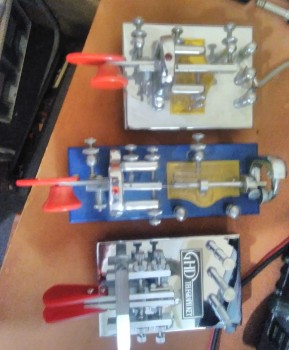
[40m] * most folks didn’t listen to my other key on the Icom at 50w ! + – keep listening out for it –
[80m] + still not much activity on 80m was heard.
[40m] * lots of noise on 40m – quiet on 80 ¢
[40m] * Nice QSO with VK3ACU – Thanks! I need to operate later as 8pm NZ time AU signals are very weak in NZ + After 9pm they are much stronger, but still quite a bit of fading at the moment
URS LEAS te pOLOLO ERAS UULI SOM Cin) LLLESS CELI U2 hi LeU CELUI Stan managed to complete another ‘This day in History’ but no other takers! Max had a good session on 40 mx and 80 mx with a big signal from a chilly Manjimup.
Mark checked in from Lorne in VK8 land and after the CW reports informed us on the latest information about a recent Victorian public transport incentive – unbelievably reasonable fares to encourage the use of a great public transport system – how things have changed in Victoria.
There was also some discussion about band conditions being quite variable but everyone reported having a good evening. Thank you 73 Richard [Thanks for running the net and keeping those cats herded once again Richard.
To advance the ‘Today in History’ project, prior to each message a request to return the message to the sender during the current QSO will be introduced. This policy carries a number of benefits for all participants: 1.
The recipient will have to write the message rather than head read as if it were formal traffic. 2. In order to return the message verbatim, the recipient may need to request a repeat of any missed words. 3.
To perform that repeat-request function efficiently, one needs to be familiar with the simple, commonly used repeat-request protocol. 4.
Since both letters and numbers make up the messages, the parties get good practice in accurately sending and receiving whole sentences. 5. Intrinsic subconscious training will eventually enable all parties to become confident and agile CW operators.
At the end of each message the sending station will send ‘QSL?’. This signals the time send
If the message iscomplete then send QSL and proceed to return the message. If not, this is the time to request a’fill’ using the following commonly-used protocol, note that the protocol is used without any of the usual flannel:
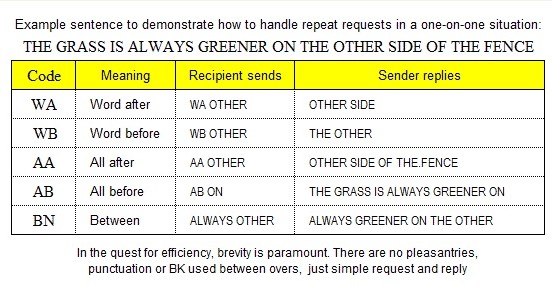
Callsigns are still needed if any 10 minute (VK) or 15 minute (ZL) period is exceeded, then pleasantries may be resumed when bothoperators are happy with the result.
Any questions to Stan zl3tk@qsl.net [Thanks Stan – I repeated this article at the request of one our our readers (or should that be our reader?) – and because… as you so succinctly pointed out (woo hoo… two readers!), I left the table out of the first one!]
Georg VK2DLF tells me that from now on your our RagChew newsletter will appear on the Slow Morse Facebook Page. Thanks Georg – well done!
In last week’s RagChew, Stan ZL3TK raised the question about whether or not our team members should comment about poor keying heard when chatting to someone on the net.
Stan’s comment was that this was the only way an operator might be made aware that all’s not well with their transmission. Sometimes operators may have forgotten to critically listen to their own CW – and to actively try to achieve perfect timing.
I’ve received feedback after Stan’s article to the effect that our net was all about encouraging people to have a go, to learn and to have some fun, knowing that no one was going to make judgements about their level of sending and receiving ability.
Most on the net were having fun and that we should not risk driving people away… it’s hard enough to get up the guts to go on air as it is! Apparently, flies are easier to catch with honey than vinegar.
An interesting conundrum eh? I sit on the fence and feel that both sets of views are valid. I have on occasions contacted operators to offer support and hopefully useful feedback; but should I have to fall one way or the other – I’d fall on the side of the latter comments received.
Our net has always attracted new operators who were taking their first steps, knowing they won’t be judged. Similarly, old timers who haven’t been on the brass for years must also feel confident to have a go and in time, work back up to where they’ve been in the past.
I feel that’s why our net has been so successful – and why we continue to have so many on having a go on Tuesdays. Tango on!
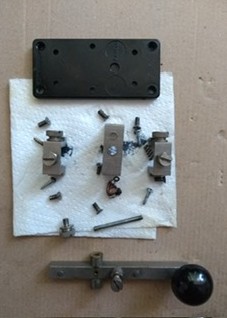
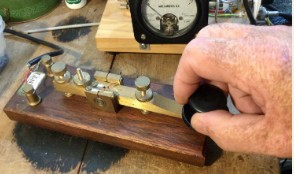
Below are some before- and after- shots of my WT 8AMP No2 key. I’m well aware that some readers would be horrified to see all that patina destroyed but as you can see, it was in pretty shabby form before I polished it up.
I used 600 then 1200 grit sandpaper to remove the dullness and bring back the shine. There were still some deep scratches in some of the surfaces that were a combination of manufacture and wear and tear.
I whipped over the thumbscrews where the leads connect with the sandpaper as well. They look better in the photo than they probably are.
Ideally, one would use steel wool or something like that but I hate working with steel wool and dealing with the splinters and the mess. As cleans and polishes go, it was a relatively quick and superficial job. I did a final polish with Autosol metal polish.
It’s not a perfect mirror finish and there are still plenty of imperfections on the surface but I’m happy with the way it looks now.
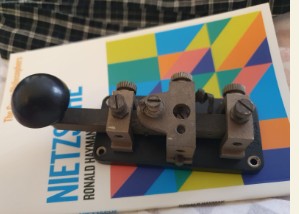
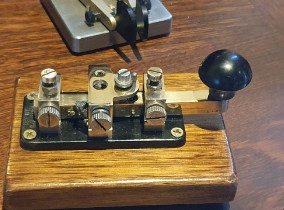
I’m happy with the results so that’s all that matters to me. It’s mounted on a scrap piece of hardwood flooring with some stain and oil to give it a bit of colour. Inoticed Ross MONNK has pulled his WT 8AMP apart for a service too.
It’s great to see so many of these old keys getting regular use after all these years. I really love the feel of mine. It’s not a large key but it feels heavy and solid when sending.
I normally prefer a very tight action on my straight keys but with my 8AMP I like to open it up to better hear and feel it.
I have rubber feet on the wooden base to stop movement but they’re a little squishy and I plan to replace them with something with less give so it’s more stable. I’m also interested to know if anyone in the group is using a Clipsal straight key.
I’d be even more interested if they had one to sell because it would be a great companion to this key. Cheers, Brendan. VK3BAP [Great job Brendan – thank you for sharing.]
Automatic Mode I, DDMemm AAMAIAILZ
Currently I’m learning how to use a straight key, and thoroughly enjoying it. But I started my CW life with a paddle. I have a tidy mind and so, before learning to senc I evaluated the various paddle modes available.
The modes were: ¢ lambic A ¢ lambic B ¢ Ultimatic
By the way, an ‘lamb’ is a unit of rhythm in poetry, consisting of one short syllable that is not stressed followed by one long one that is stressed, for example in the word ‘describe’; think ‘di-dah’..
Lambic B is by far the most popular, but I found both the lambic modes really difficult to understand and therefore difficult to learn. On the other hand, Ultimatic mode made complete sense to me. Like the lambic modes, Ultimatic is a ‘squeeze mode’.
But, not being an lambic mode, it handles some of the characters in a different way. This video has a very good explanation of how Ultimatic mode works, as well as its pros and cons… and compares it to lambic A and B.
Https://www.youtube.com/watch?v=Hn4j2nfdKNE I’ve got used to ploughing a lonely furrow in life so I went with Ultimatic. I’m now reasonably accurate at sending at 25 wpm but I doubt I’ll ever be a QRQ guy (and nor do I really want to be either).
Speed was never my reason for going with Ultimatic. My reason was its comprehensible logic – it appealed to my sense of order and tidiness. My question to readers of RagChew is: are there any other users of Ultimatic mode out there?.
[Thanks Ross – the thinks you learn from RagChew! So any other Ultimatic users out there? cqarsnet@gmail.com ]
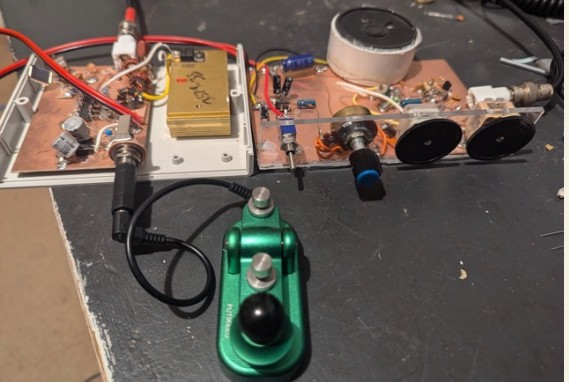
The vfo is not shared at the moment but I plan on combining the two or perhaps building a stand-alone transceiver. The TX uses a 74HC240 dual octal inverting buffer/line driver and a crystal for 3.579 give or take alittle, with a 20PF trimmer.
The final is a IRF520 power MOSFET. can get about 20 watts out depending on the input voltage to the TX. I know above 55V the magic smoke comes out ©) The direct conversion RX works best and seems most sensitive at 9V.
I’m also working on a little break-in circuit that has a relay with a delay to switch RX- TX. Next week I’ll tell you about an even simpler way of getting on air! Jordan VK3ACU. [Brilliant – the true spirit of CW Jordan.)
The propagation forecast showed a strong but narrow window on 40m between Western Australia and the USA during the ARRL Field Day on 23 June.
With some support and encouragement from Mike DL3YZ, I thought I’d give it a try from the remote access FT-991A VK6SR in Perth.
Mistake! The result was a frustrating hour of listening to faint US callsigns sent at high speed. On the few occasions when I managed to pick out the callsign from the noise and QSB and respond to their CQ, my 100 watts across Australia and the Pacific was clearly not heard at the other end.
Probably, there were a lot of powertul stations in the US responding and blotting out my weak signal. The VK6DV webSDR kicked me off after 20 minutes so I was knob-twiddling blind. And the FT-991A narrow filter seemed to me to be excessively narrow.
Nothing ventured, nothing gained. And I was able to eavesdrop on the Field Day. But that’s an hour of my life I’ll never get back. Hey, ho. [Heh heh – good tale Ross.
The VK6SR Remote has in the past worked well into the USO – so I suspect the antenna woes are behind part of the trouble…..
But also having operated in the US for a couple of years, the QR level from other State-Side stations and from the South is unbelievable; during the ARRL Field Day… good luck mate!
The VK6SR KiwiSDR is on test from the same site as the Remote, and doesn’t time out. The VK6QS KiwiSDR near Brookton is connected to a large horizontal loop which works really well… but it also has a one hour time out.
By the way, on the RemoteHams system, you can select a wide or narrow filter on CW (left hand menu), and within each you can vary the bandwidth with one of the slide controls.
On Narrow – with the bandwidth reduced, the receiver is harsh and rings noticeably…. opening it up to 500HZ sounds better…. and makes tuning around a bit easier… wide and set to 2400HZ is the best way of tuning around of course.]
Nic VK7WW runs a Slow Morse training net every Wednesday at 7pm EDST on 3580 for 30 mins. He uses the callsign of the Northern Tasmania Amateur Radio Club VK7TAZ on that net.
Many of our team learned Morse code with the support of Nic, and the weekly training session comes highly recommended for anyone who wants to learn the Code, or simply brush up. Everyone’s welcome – 3580KHZ at 7pm Eastern time every Wednesday.
The NTARC also feeds the CW live via the Discord phone / computer audio stream, and previous weeks’ recordings are available. Contact Nic VK7WW for more info nicholaschantler@hotmail.com – or just join in on Wednesdays.
This Week’s Topic of Interest
CW Operation in Europe
IT pI Ly pad by Ross Waddams MONNK can’t speak from a great deal of experience but, whilst listening to you all on Tuesday, it struck me that there’s a couple of noticeable differences between the bands in Europe and those in Australia.
Firstly, you guys have the bands to yourselves. I tuned in the webSDRs (one in Perth and another in Sydney) early but there was no activity apart from a couple of guys chatting on SSB. The CW activity got going dead-on 0700 UTC and there you all were.
In Europe, you are always sharing the band with a handful of other operators, most of whom are sending at 25 wpm. At the weekends, contests are popular and then you can see twenty or more traces on the waterfall display, all QRQ – time to leave and come back when it’s quieter.
There are no contests on 30m, but it does attract the hardcore CW operators. Secondly, I was impressed by how steady your signals are. Here in Europe we seem to suffer terribly from QSB – almost all contacts suffer from fading to some extent.
It can be frustrating to miss half of the other guy’s transmission and so have to ask for a repeat. And it’s not uncommon for a QSO to end because the other guy just slowly disappears into the noise. It was a pleasure to listen-in to your CW efforts.
If I saw a trace on the waterfall, knew it would be slow morse and it was all of good quality. You have a great weekly meet-up. The problem must be finding contacts at other times.
Repetition is the key to improving one’s Morse and once a week just isn’t enough. In Europe, you have to listen in to many conversations to find an operator that’s sending at QRS speeds (‘d guess the ratio as 15:1).
The solution is to call CQ and hope that someone finds you (thank goodness for waterfall displays!). I don’t want to sound as if CW in Europe is terrible. Far from it.
I don’t do much radio but, on the few occasions when I get out portable (midweek mornings in the summer), I can always pick up one or two contacts at 15 wpm within an hour.
Here are snapshots of the 20m and 40m bands now at 0745 local UK time to show you the sort of activity that’s normal.
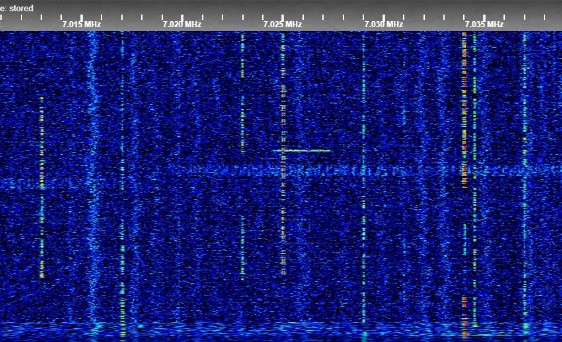
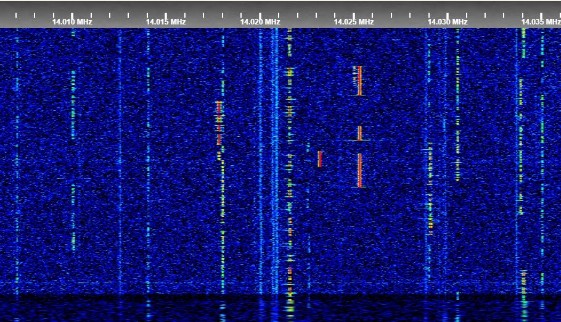
The thing you have to accept is that there’s a lot of operators out there for whom English is not their first language so “name/QTH/RST” is all they can manage, especially if they are QRS and learning. So, keep up the good work. You’re doing a great job, guys!
Ross MONNK Thanks for another interesting article Ross – very much appreciated. Articles by team members aare always very welcome; please let me know if you have some ideas. Email to cqgrsnet@gmail.com

Brain Teaser
Jules Perrin JP VK3JFP has created a terrific resource to help guide learning for all levels of amateur radio licenses: https:/Awww.julesworkshop.net/Amateur%20Radio.html With thanks to Baz VK6MU for he idea, and Jules for the good learning website, here’s this week’s quiz questions from Jules’ Workshop example test questions:
Exam Questions:
What does “frequency deviation” mean in regard to an FM signal? What type of modulation system changes the amplitude of an RF wave for the purpose of conveying information?
* frequency modulation * phase modulation + amplitude-rectification modulation + amplitude modulation The three electrodes of the Silicon Controlled Rectifier (SCR) are: * source, emitter and base * anode, cathode and grid * anode, cathode and gate * source, drain and gate VK3NNN wishes to make a test with a new transmitter on 28.45 MHz.
Which procedure is correct? (a) Say the word “Test” three times and then leave the carrier running 10 minutes (b) Monitor the frequency, send the word “TEST” in Morse code, and send a series o “CQ” (©) Monitor the frequency, and announce the callsign every 10 minutes and state tha the transmission is a test (d) Announce “VK3NNN testing” three times and then let the transmitter run for 15 minutes Answers next week.

Answers from last week’s Quiz:
When modulating a cartier signal with voice, what is the frequency range of the modulating signal? Answer: Approx 20HZ to 20KHZ.
Bleeder resistors are included in power supplies to: * discharge filter capacitors after the supply voltage is switched off * prevent damage to filter during overload * reduce ripple in the output voltage * reduce the size of the filter choke Answer: discharge filter capacitors after the supply voltage is switched off Critical frequency is defined as: * the highest frequency on which it is possible to communicate with another ‘station * the highest frequency at which waves sent vertically are returned to earth * the frequency of the greatest skip distance * the highest frequency with which a station may be contacted by ground wave Answer: the highest frequency at which waves sent vertically are returned to earth ‘An Advanced station using CW (Morse code) is restricted to a power output of: (a) 10 watts pY (b) 30 watts px (c) 120 watts pY (d) 400 watts px Answer: (c) 120 watts pY How did you go?
Di-dah-di-dah-dit
So back to the Slow CW QSO practice net.
Next Tuesday’s Net
Our CQ QRS Net will be on as always on Tuesday from around 0700Z until about 1300Z; see below for details. Doesn’t matter whether you’re brand new and want to try just exchanging callsigns and RST reports, or you’re ready for a good old rag chew.
Landing Frequencies
During the net, if you’ve been tuning around for a while and want to take a break, leave your receiver on 7032KHZ or 3555KHZ. Why not send your callsign as well; you never know who might be listening in…
May be one of our new operators, who likes the sound of your CW, and might be spurred to give you a call!
Please let me know via our Reports form bit.ly/CQQRSNET who you work Tuesday’s net.
Post Mortem
Richard VK6HRC will run our Post Morsum on the South West AllStar net (via repeaters and hotspots all over WA) from 0600 WA time. If you’re in WA, all you need is an FM 2m or 70CM transceiver and an AllStar node nearby.
If you’re elsewhere in the world, you may be able to connect your local AllStar-enabled repeater to the net, or you can connect via Echolink. Let me know (cqqrsnet@gmail.com) if I can help with that.
Teamwork
Thank you so much to our team of 33 contributors this week: VK/MONNK, VK1HF, VK2DLF, VK2GAS, VK2RU, VK3ACU, VK3BAP, VK3DRQ, VK3JFP, VK3TBR, VK4DRK, VK4EK, VK5AO, VKSET, VK5FD, VKSKFG, VK6BEK, VK6FN, VK6HRC, VKEIS, VK6JDM, VK6KD, VK6KHZ, VK6NW, VK6PZT, VK6RR, VK6WE, VK7KPC, VK7TA, VK7WW, ZL2GD, ZL3TK, ZL4BDG; thank you team.
And a special thanks again to those who have written articles for our reading pleasure. GU CW on Tuesday, mb Mark Bosma VK2KI / VK6QI Beautiful South Bowning NSW mark.bosma@icloud.com non impediti ratione cogitationis

An Ode to CW – thanks to David VK3RU: In days of old, when ops were bold, And sideband was not invented, Words were passed by pounding brass, And all were quite contented. – Unknown author
PSE QRS


The opinions expressed in the RagChew newsletter are those of the individual contributors. The opinions do nat necessarily reflect that of the editor or of the C@ QAS Group members.