Below is a reconstruction of the 2024 21 CQ QRS RagChew newsletter designed to support full text searching. This reconstruction was built using OCR, and will contain errors.
To view the Mailchimp original, click here. To search the entire newsletter archive, click here.
Contents
- CQ QRS RagChew
- Last Tuesday’s Net
- Broken Record Department
- New Team Member
- Masthead Image
- Reports & Comments
- Comments:
- From Ben ZL4BDG at Upper Hutt:
- This Week’s Topic of Interest
- Call Sign Soup – Upsides and Downsides:
- Brain Teaser
- Answers from last week’s Quiz:
- Di-dah-di-dah-dit
- Next Tuesday’s Net
- Reports
- Post Mortem
- Teamwork
- PSE QRS
- Landing Zone
CQ QRS RagChew
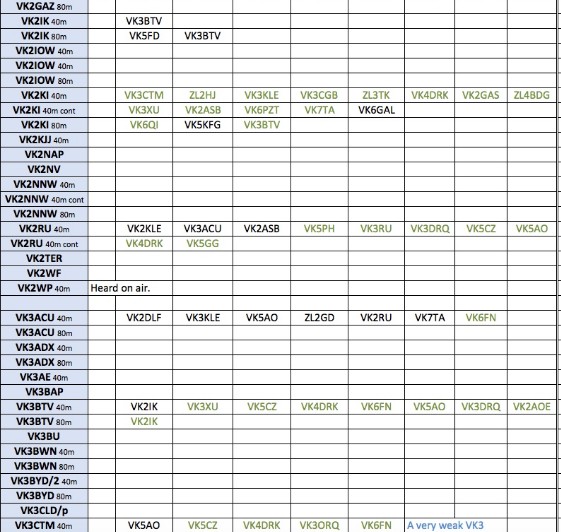
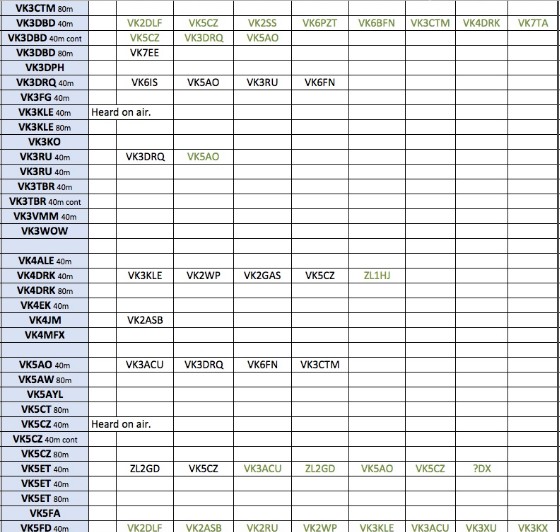
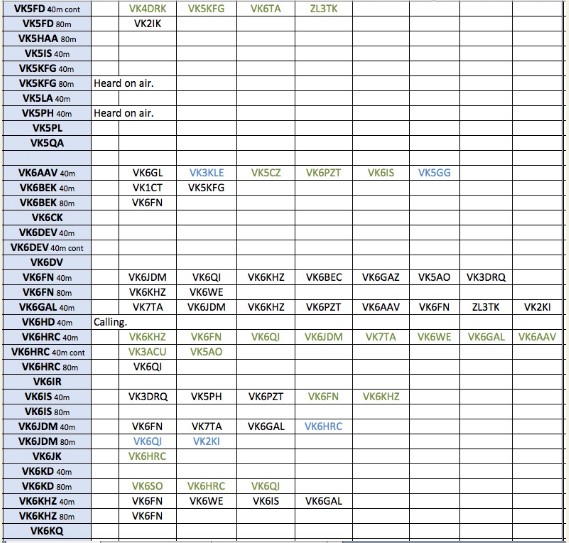
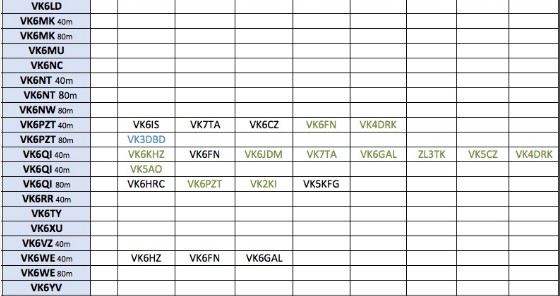
Well Tuesday’s CQQRS Slow CW practice QSO net wasn’t a world-beater compared to our record of 52 known stations on… but it was still pretty good.
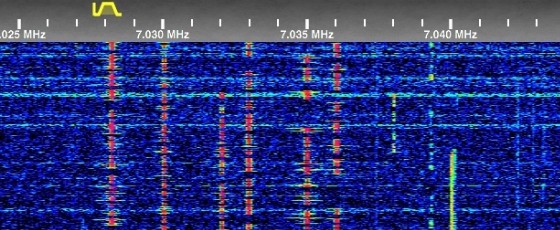
Things are looking positive when people are discovering that our 15KHZ slot on 40m and 30KHZ slot on 80m can actually get crowded on a Tuesday; well, perhaps that’s stretching the imagination a bit for 80m, but for those not using narrow CW filters (and that includes me at the moment), i’s interesting to hear five QRS QSOs at once within a 3KHZ passband!
Imagine what it’s like for those with older gear with even wider filters? All good fun. And people regularly thank me for organising the net… which I really do appreciate every time…
But it’s you that goes out, braves the cold and risks family harmony by making time to join in or to just to listen, then send in your results. That’s what really makes it all happen. So thank you to every one of you.
And do you think that you don’t need to send me your results because someone else will have it covered? Nope – nearly every report identifies a new station that I didn’t know about, and of course adds to our bragging rights….
How many nets run every week anywhere in the world with up to 52 participants? Not many…. and how many of those are CW only? I wouldn’t think there’s any. This week was even more of an international affair as well….
Not only Aussies, Taswegiens, Crow-Eaters, Sandgropers and Kiwis, but a Floridian member and a British member also joined the choir this time. Fantastic!
We even had representatives of all four nations on Wednesday morning’s Post Morsum on the WA AllStar network.
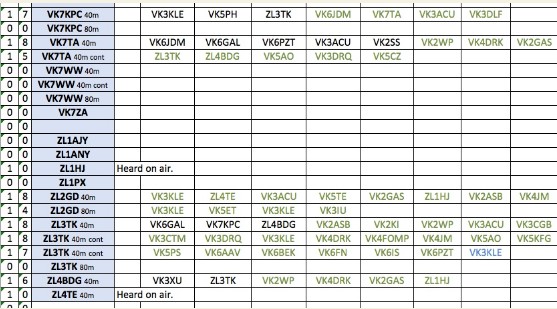
Last Tuesday’s Net
Broken Record Department
After next Tuesday’s net, please send me a list of who you worked and / or who you heard using our new web form here:

Getting reports from stations and listeners is important to me – even if you listened and didn’t hear anyone or weren’t able to copy anything – the fact that you had a go needs to get recorded so we know that the net is working and attracting new and old team members to have a go.
Thanks again to Nigel G4RWI for building the Google Form, the Python software back-end that (will eventually – snigger) do the processing, the new link and the QR code.
New Team Member
We’te joined this week by Mark VK2DI from Sydney who was heard during the previous week’s net by David VK6KD. Mark is a retired Radio Officer who had worked at an OTC Coastal Radio Station, but now spends much of his time as a volunteer guide at the National Maritime Museum at Darling Harbour, and also enjoys operating the radio room on the HMAS Vampire (VK2VMP) on Monday afternoons.
Mark is also a VKFF Parks and VBand operator – who’s always happy to help newcomers with their CW learning. Welcome Mark. Although we have over 180 CQQRS members, we need to keep bringing in new and old operators every week to keep it interesting.
So for those operators who are now able to have the occasional rag chew, if you happen to be working someone QRS who’s not on the spreadsheet list, why not ask whether they’re in the Tuesday CQQRS group?
We’ve had lots of new members through that question being asked. Not all 180+ members are listed in the spreadsheet… just the ones who’ve come up on air in the recent past.
If they’re interested, please pass my email address to them: cqarsnet(at}gmail.com or ask for their address so I can get in touch and let them know what we’re all about.
We’re joined this week by Mark VK2DI from Sydney who was heard during the previous week’s net by David VK6KD. Mark is a retired Radio Officer who had worked at an OTC Coastal Radio Station, but now spends much of his time as a volunteer guide at the National Maritime Museum at Darling Harbour, and also enjoys operating the radio room on the HMAS Vampire (VK2VMP) on Monday afternoons.
Mark is also a VKFF Parks and VBand operator – who’s always happy to help newcomers with their CW learning. Welcome Mark. Although we have over 180 CQQRS members, we need to keep bringing in new and old operators every week to keep it interesting.
So for those operators who are now able to have the occasional rag chew, if you happen to be working someone QRS who’s not on the spreadsheet list, why not ask whether they’re in the Tuesday CQQRS group?
We’ve had lots of new members through that question being asked.
Masthead Image
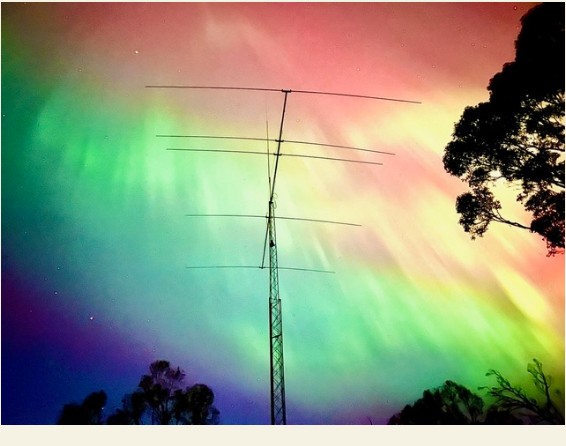
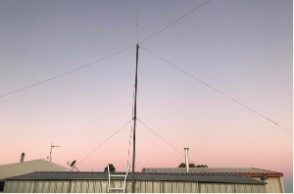
Isn’t that a beauty! And thanks this week to Damien VK7SD for that amazing shot. Cheers, mb Mark Bosma VK2KI / VK6QI Beautiful South Bowning NSW mark.bosma@icloud.com non impsditi ratione cogitationis
Reports & Comments
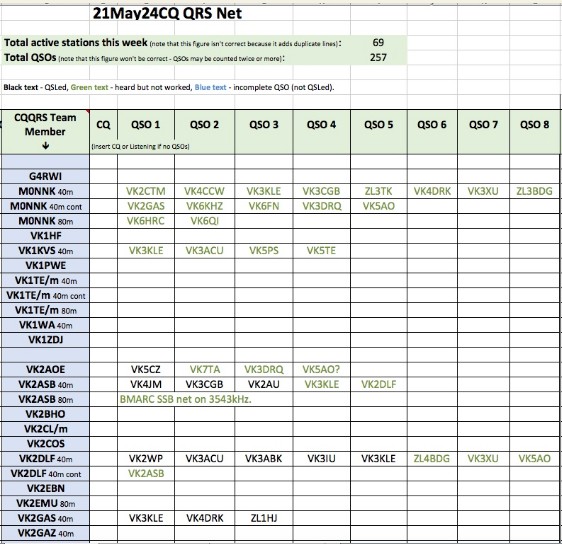
The spreadsheets above show the known stations on last Tuesday’s net. Comment: distilled from the reports I’ve received are below:
Comments:
[40m]. © Started 7:30 pm NZ Time and 40m was a bit quiet © Got more active towards 8:30 pm NZ time © Heard some nice old school rigs early on couldn’t quite catch the call signs though.
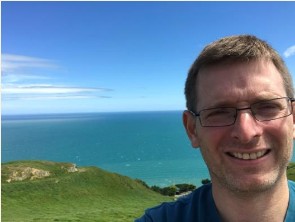
From Ben ZL4BDG at Upper Hutt:
From Grant ZL2GD at Oxford North Canterbury:
[40m] © Good sigs across the pond tonight, pity I had to get up early Wednesday! ¢
[40m] o My first contact with VK2ASB this evening © I was using a remote Flex running 30W and conditions were good
[40m] © Great night made a few contacts thanks all © I was calling CQ and VK6FN came back but the QSO taken over hehe all good © Catch you all again next week.
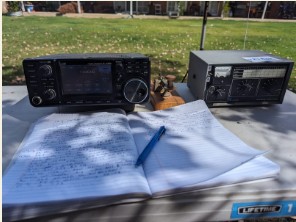
From Ross MONNK in the UK, but using the Tecsun and VK6DV KiwiSDRs:
[40m] © This was my first listen-in to the QRS net (via the KiwiSDRs in NSW and wa) © I don’t have much experience of radio Morse – I spend most of my time on Vband – so this was good practice for me for the rare occasions when © Igo out portable © Head copying was hard work and after an hour I was tired (I’ll probably come back later when I’ve had a rest) © I don’t have much experience on the air so this was a good workout for me © My ability to head copy was dependent on clarity of sending rather than speed – some of the quite slow morse was very clear and easy to listen to © Some guys send their own callsign fast and sloppily (because they know it so well?) but that makes it hard to copy © VKSKLE’s old radio had a very distinctive Chirp until it stuck in constant transmit, drifting in frequency slightly; I wonder what happened there?
• I was listening to two stations on 80m (via the VK6DV KiwiSDR) at 1230 UTC when I heard my callsign mentioned! VK6HRC Richard and VK6QI Mark were talking about me! Now that was creepy given that I’m on the other side of the world!
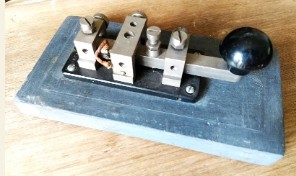
[Great report thank you Ross. Heh heh, can’t get away with anything on air – HI! Great to hear you on the WA AllStar network as well mate; I’m happy to chat to you on the WA AllStar network about how that network works too if you, Ron VK6KHZ or Mike DL3YZ would like.]
From John VK5ET at Hope Valley: ° G’day Mark, bit quiet tonight, maybe everyone is feeling the cold? I hada heater on so I was fairly comfy.
° Heard lan, VK5CZ with one station who I couldn’t get a call sign, bit later lan & this station were hiking along , too fast for me to copy. © I did make QSO with lan who told me he was on to a Vanuatu station &a Japan station before this one.
Mentioned that Dx was getting good. © PS: good to hear & make contact / QSO with the ZLs © 73’s till next time.
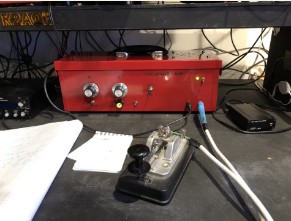
• I got my new, mish-mash home brew monstrosity called the AOE monster on the air (40m). ¢ Tried a few stations but zero beating and understanding if I’m in the correct place always confuses me on direct conversion rigs!
As I was about to give up lan VK5CZ gave me a 459 report!
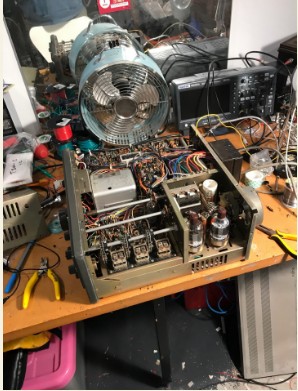
Elation….| replied but no response. It was at this moment I noticed the power needle was dead. The PA transistor had died!!! Luckily AliExpress sent me 150 of these for 20 bucks (NEC D882’s). I might need them all??
Tried my Kenwood – it also lost smoke and is now in hospital 🙁 Parts on their way from the USA. All part of the fun!
• Long live CW! Thanks Mark for the QRS net… makes Tuesdays special. +
[40m] © Conditions not the greatest, a noticeable lack of beacons and DX stations © Worked only three stations and each worthwhile © Heard another 19 stations, an unusually high number, mostly quite weak © Ran off to check QRZ for VK4FOMP to make sure my ears weren’t playing tricks, then had a particularly informative QSO with Gary VK6GAL who was operating remotely from his home…
In Melbourne Florida. © Alltold, a splendid night © Am waiting to be confronted by a “Today in History’ QTC from some adventurous OM, be nice to ‘balance the books’ next week; any takers chaps? +
[80m] © VK6FN was buried in the noise © That is despite the low noise conditions at my QTH and the use of my superior Mark 4 Wotam Hills receiver © VK6FN has previously said he has an antenna null in my direction © VK6KRC (who I have no doubt was also buried in the noise as he did promise he would be on the net) says however that VK6FN‘s antenna has 360 degree null © Hopefully the erection of two 65 foot towers at FN’s QTH will negate the null +
From Keiran (Bad Tempered Victorian) VK3BTV at Ringwood:
[40m] © Iwas recovering from 2 days of hayfever/cold so I was mostly listening © However, I eventually replied to Paul, VK2IK and had a great qso – 559 each way © Paul’s speed to me was perfect on his 3D printed keyer, and he seemed to copy my old 1973 Brown Bros UTL keyer very well © Iwas leaving biggish gaps between letters and Paul mimicked that.
[80m] © Heard nothing on 80 until I saw a blip on the IC7300 scope, and worked VK2IK Paul agn © This time he was 599 originally, but then severe QSB © He had me 588 initially © Aquick QSO!
[40m] © Conditions not the greatest, a noticeable lack of beacons and DX stations © Worked only three stations and each worthwhile © Heard another 19 stations, an unusually high number, mostly quite weak © Ran off to check QRZ for VK4FOMP to make sure my ears weren’t playing tricks, then had a particularly informative QSO with Gary VK6GAL who was operating remotely from his home…
In Melbourne Florida. ° All told, a splendid night e Am waiting to be confronted by a ‘Today in History’ QTC from some adventurous OM, be nice to ‘balance the books’ next week; any takers chaps?
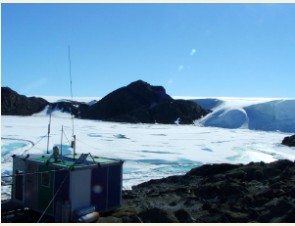
From Paul VK2IK at Southern Highlands NSW:
[80m] © 80M QSB this evening. © Key was 3D print home brew straight key with roller bearings.
From Peter VK7KPC at Evandale, Central TAS:
[40m] © Interesting history snippet from Stan ZL3TK about Manchester Canal opening by Queen Victoria in 1894. © Went upstairs for a break only to have power failure, not back til midnight © Note to self: Investigate off grid operation for shack and tv (for significant other) + From lan VK7TA at Latrobe:
[40m] © [usually hear better on my OCFD than my vertical, but last night I heard VK6 better on the vertical. ‘© When I called CQ (slowly) I got an answer from VK2SS.
© Chuck did not know of the net, but he said that this was his first CW QSO in a long time, so it was good to get another station on the air using CW. [Woo hoo – well done lan – that’s what its all about! :] +
[40m] © Good to hear so many stations, very busy net at times ©
[80m] © Good to catch up with Mark, lucky for him I stopped torturing his ear drums after ten minutes or so ! Thanks Mark [Sounded good to me mate!
[40m] © Conditions were not bad tonight © Not quantity but quality © Time enjoyed
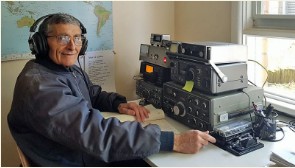
[40m] © I managed to have three QSOs © All went reasonably well but for some reason all QSOs had fading and interference towards the end © This appears to happen every time and I don’t know why © Ataround 9:30pm everything went quiet and that was it for the night +
[40m] © I called three stations, the most I have managed in a sitting © It did take a while but there is incremental progress is my CW ability and less fear and trepidation © I’m starting to copy signals better when the sending has the right rhythm toit © Without that even very slow Morse is more difficult to interpret, I’m glad that the net is helping Daniel – very soon, there will be zero trepidation.
Being able to relax and totally enjoy a rag chew is just the ducks guts! You’re not alone; like QRM, QRN, QSB, etc… incorrect or changing rhythm is very distracting to everyone – but it’s par for the course, especially with people like me that only use a straight key.
Every week I have to pull my socks up and concentrate when I hear that my sending is getting sloppy; for me, some weeks are worse than others it seems].
From Arthur VK2ASB at Wentworth Falls in the Blue Mountains NSW:
[40m] © It was very noisy on air which prompted me to write an article which will be presented later in a future RagChew newsletter.
© I suspect if more people know about how easy it is to overcome the worst of white noise, the more people we will have on the air when the conditions are noisy ©
[80m] © I went into 80 metres a couple of times but didn’t hear any signals at all. © Idid notice that the BMARC. SSB net was still running on 3.543MHz. = lused to run that net before I went over to CW exclusively so it has been going a long time.
© 80 metres is a good band but it is hard to convince people of this, because it is inherently noisy and people haven’t read my article yet (HI)!
Thanks Arthur – and in particular, thank you for the great article; your work will ippear as an Other Topic of Interest – most likely in edition 23/2024 – very much ppreciated mate.
-erhaps a quiet chat with the BMARC when you next go to a meeting about -onsidering moving the net out of our netspace? Don’t want to cause ripples or put }oses out of joint of course; the frequency used is a shared CW / SSB allocation, we jo have plenty of room and can play nicely together – but many of our team use QRP ‘home-brewed / re-built surplus gear that’s crystal locked and can’t move.]
[80m] © I started late as usual around 8:30pm WST but found after listening to a number of QSOs the band went quiet. © lended up practising my manual Rx decoding on 3.70053 MHz.
I think this frequency regularly transmits at different send speeds just for people to practice receiving. [Thanks David; what a pity no one was around; perhaps try sending an alert via our CQQRS WhatsApp group if it happens again – you never know who may be around in Australia or New Zealand (or on a Remote from anywhere) to say g’day.
The VK2WI beacon at Dural (I think) runs continuously on 3699KHZ with 30 Watts to a dipole. Of course in WA you’ll only hear it at night when the band is open (fe the D- layer has disappeared and the F-layer is strong enough to support one or two hop propagation.
Where I am (about 300KM away from the beacon), it’s present a lot of the time – and has a very strong signal. l agree – it’s a very useful practice beacon as well – it sends plain text including numbers at various pre-specified Farnsworth speeds for a few minutes, before changing speed.
I think I’ve heard around 5WPM up to about 25. There’s also another CW beacon up toward the top end of 80m that’s owned by the Hills Amateur Radio Group in WA; I think it only runs at night, but I don’t know the schedule].
To Greg VKSKFG from home here in VK2, I could hear us both in WA, so tried him from the VK6SR Remote and we were able to have a QSO; my signal from VK6 to Greg wasn’t as good as from VK2, but considering the receiver I was using in NSW, Greg was much nicer copy on the Remote.
From me VK2K at Beautiful South Bowning: © Elsewhere in the newsletter you’ll find my tale of woe about my transceivers at home; so for Tuesday’s net, I was using my 50 year old Kenwood TS-1208, for the first time in about 30 years.
© What a joy to have a VFO that moves so fast – tricky to net though… but I did appreciate the ability to key down without transmitting to allow zero- beating the mixed sidetone.
= My normal Kenwood TS-50 transceiver won’t do that easily because by default, it operates in break-in mode. = Looks like I’ll have to see if I can find a way to use one of the programmable buttons on the microphone to disable break-in on CW, allowing the sidetone to help net onto others’ frequencies…
= Another job on the list of to-dos. © Lots of fun using the old transceiver – without a CW filter – boy when the band gets busy with our net, listening on a kHz wide receiver becomes quite a challenge; five conversations at once – what fun!
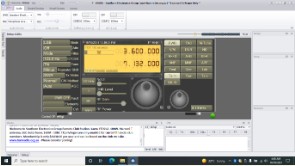
© Made me appreciate the fun our team members have with vintage gear or with equipment without narrow filters. © So using the Tecsun KiwiSDR at Araluen and my TS-120S from home I heard Tony VK3CTM at Junortoun and Mick ZL1HJ at Te Kuiti calling CQ from the get-go.
I also heard Paul VK3KLE at Stawell, Chris VK3CGB at Stanley, Stan ZL8TK at Waitrere Beach, Derek VK4DRK near ‘Toowoomba and Armin VK2GAS at Norwest.
© Ben ZL4BDG at Upper Hutt was chatting to Drew VKSXU in the Yarra Valley; one day, I hope one of our team will find an email address for Drew – who would make another fine member of our little team!
© By around 0800Z, the band was starting to open to WA, and I was able to listen to Max VK6FN and myself (as VK6QI via the Remote).
I also heard Donald VK6JDM near Esperance on his home brew gear working lan VK7TA at Latrobe, who went on to work Richard VK6PZT at Dalyellup.
© I took a break untuk masa makan and returned to hear our new team member Arthur VK2ASB at Wentworth Falls thundering in – welcome Arthur, terrific to hear you on and having some fun.
© I then heard Gary VK6GAL who had got up very early in the morning to fire up the VK6SR Remote and have some fun; terrific to work you from V2 again Gary.
© So because I wanted an early night, as things started to slow down just slightly on 40m, I dropped down to 80m. ©
[80m] © On 80m could hear my signals from VK6QI, and my CQs were answered again this week by Greg VKSKFG at Willunga, South of McLaren Vale. © Nice to have an easy chat with Greg, before he turned the Yagi around and chatted to me from VK6.
© In parallel, I also heard Keiran VK3BTV giving some late night calls – but didn’t hear any response to our mate from North Ringwood; bad luck mate – the band was open, but no-one was hone.
CALE LS © Good to hear Arthur VK2ASB on for the first time since joining, VK6JDM on 40m for the first time for me I think, and our early riser, V6GAL on from Melbourne Florida.
© The next day, MONNK at Budleigh Salterton (let’s just call it Exeter for CW purposes) stayed up until midnight to call in to our AllStar Post Morsum. Ross told us that he’d had some fun listening in to our net on some of the Australian KiwiSDRs.
= Great stuff to have people in different parts of the world having a go and having some fun via our little get-together each Tuesday. = The KiwiSDRs are a little tricky to use with a mouse at first, but with experience, they’re unbelievably good.
= Deep narrow adjustable filtering. * Glorious waterfall display which is unbeatable for watching the whole band. = And they’re free to use! = Wonder where the technology will take us next?
• PIOll TONY WIOTTIS VINO IV al DEMuigu.
[40m] © One great advantage of CW over SSB is that when sending you will not be disturbing others. e Another advantage is that CW provides a reasonable level of privacy. ¢
From Kees VK1KVS at Wanniassa: © Listening only on 7032/7033 before having to go out. ¢
From David VK3RU at Burwood VIC: © Still testing positive to COVID for the third week, so a short time in the shack this Tuesday.
Other News Other things I’ve received from our 180-odd readers. International Post Morsum
From Richard VK6HRC Hi Mark, As you know gremlins were having fun with the WA AllStar network on Wednesday morning for our Post Morsum. So the net was no-go on transmit for me. In spite of that a decent turn up for those that managed to get on…
A real international event eventuated. On this the Post Morsum: + ZL8TK Stan * VK6FN Max * VK6QI Mark + VK6GAL Gary * VK6KRC Bob * MONNK Ross and, * our shortwave listeners.
Some items of interest from today’s net: + Stan had some success with his introduction of the “this day in history” exercise. * Max being kept busy with one of his many day jobs but still managed to enjoy the net.
* Mark and Gary discussed operating the VK6SEG remote. Apparently Mark had been using the VFO all wrong; Gary agreed to teach Mark how to use it more easily. * Ross discussed making use of the online Kiwi Software Defined Receivers.
I’m looking forward to next week’s net… thank you, have a great day Cheers. Richard VK6HRG [Thanks Richard. We really missed your leadership and control on Wednesday; our rudderless ship flailed around without your usual guidance and direction.
I hope you get the problem with your FM transmitter sorted for next week.]
From Stan ZL3TK Is a Ponderosa something to ponder? If yes, then here’s a Ponderosa. When folks ask “what’s a Post Morsum?”, there’s no easy way to explain it. It fulfils quite a number of roles.
Could it perhaps be called a ‘Coroner’s Court’, or is that too bland? Maybe it’s more of a ‘Pathologists’ Playtime’, because all the participants are experts in their own way.
Both monikers are equally moribund whereas the Post Morsum is more of a care- taking event, as held in the days of yore. So could ‘Wireless Wake’ be the most apt descriptor? [Heh, heh… thanks for the Ponderosa Stan. Perhaps we might hear an opinion from
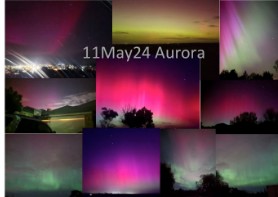
Eagle Eyed Peter VK7KPC: Well, who noticed my pop quiz question about the auroras in last week’s RagChew? The first and best-dressed entry was from Peter VK7KPC at Evandale.
Peter correctly identified that the image that was not of an Aurora Australia, was the right hand top one; an Aurora Borealis which was provided by Nigel G4RWWI.
I trust we’ll get a picture of Peter eating his virtual almond croissant in time for the next RagChew edition.
The Trouble with Transmitters and Receivers. It’s really great to have an opportunity to use radio transmitting and receiving gear – especially when you can build, modify and/or fix your own gear. But sometimes, just sometimes, it can be a bit of a pain!
First-world problems! For some years, my lovely little Kenwood TS-60 has had occasions where the power output wasn’t constant on key-down. A few years ago, I pulled it all apart and chased what I thought was an ALC problem.
Finally, I found via YouTube (rolleyes) that the TS-0 was prone to this problem if there was a bit of gunk (ie some resistance) in any of the 13.8 Volt supply components.
The LCD display is, illuminated by LEDs from a regulated supply, so any moderate drop in supply voltage isn’t noticeable. Bit of squirt, and it was away. However, on occasions the symptoms started to return.
There’s two in-line blade fuses in the power supply line in case of reversal of the supply connection – two additional places where the problem could occur – so I removed one… still the same – occasional power waiver. Oh well… QSB!
However, during last weekend’s St George Amateur Radio Society Don Edwards Memorial Slow CW Contest, the problem became worse – and I was struggling to complete a QSO without bits of characters disappearing…
And it had got bad enough that sometimes on key down, the transceiver would shut down completely and re-start. Hmmm, time for drastic action. The 40m segment of the contest wasn’t until the next day…. lots of time to sort it out!
So I have three Kenwood transceivers with the same power cable. Swap, no change; swap again, no change… squirt contact cleaner here and there… hmmmm. Ok, I also have three 13.8 Volt high current power supplies – swap, swap, swa| hmmmm. Right-oh…..
Desperate times call for desperate measures. What if the power connector on the back of the TS-50 has some corrosion on the contacts? Ok, how to get the pins out of the socket?
Not all that easy – open the box, remov the filter board, remove the connector (inwards), then have lots of fun removin the connector’s four pins without the correct pin-removal tool… dental instruments and pliers.
Amazingly, no electronic or electrical items were harmed in the making of this drama. Pins out (one at a time matie!) re- etraighten the locking tahse (for the firet
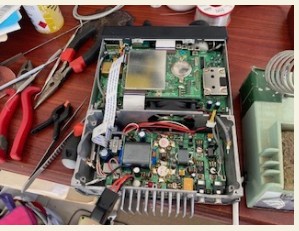
RA LN NT SY A J AN Ed I LDL A time in living history…. none broke), Down to the second layer to remove the DC connector. buff buff, squirt squirt, push back in – click… phew! Re-assemble it all, power up, key up…. instant shut-down of the TS-50.
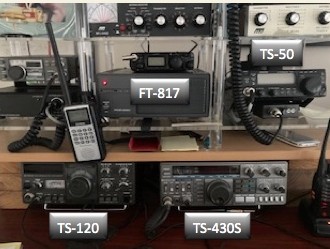
Ok, how to get on air on 40m for the second part of the contest? Ah ha… trusty FT-817 from my portable backpack. And what’s more, I’d managed to buy a used CW filter for the unit (memo to me, if I ever buy another new transceiver that has optional CW filters…
Buy the filter – hen’s teeth when the gear goes out of production… then
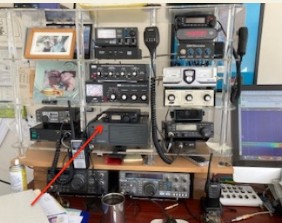
Again, these days it’s all done with software…. buy the biggest memory, hard disk etc instead). This marvellous CW filter knocks out most of the normally S9+ switch mode power supply hash – amazing!
So I didn’t need to build an interface cable for my phasing noise canceller – woo hoo. So that solved the weekend problem… what about Tuesday’s CQ QRS Slow CW QSO practice net? Surely 5 Watts from my FT-817 just isn’t going to cut the mustard? Hmmm…
Ok, well I’m staring at other transceivers (hence the two spare 13.8V DC cables with Kenwood plugs)… I wonder? So first up, I fired up the Kenwood TS-430S that a friend had loaned to me; it had been his father’s and hadn’t been used for many many years.
Well it seemed to work ok on receive… and tx – yup ALC… but wait, no Collector current… and no power output on key-down. Sad face. Ok, well what about my old friend, my Kenwood TS-120?
I bought it 50 years ago, and gave it to my father (VK6SB at the time) when I bought the TS-50 about 30 years ago. Powered up – yup. Keyed up – and I couldn’t believe….. 50 Watts output! Woo hoo! Not 100, but what’s 3B between friends?
This transceiver had always had an occasional intermittent fault where the ALC indication jumped and the power dropped, and it didn’t disappoint… but it was still usable… with an occasional bit of as.
Unlike my TS-50 and FT-817, this old girl didn’t have a CW filter, so it was noisy as anything on receive on 40m and 80m; so I made up an interface plug and socket to bring the TX relay out to my phasing noise canceller.
Boy oh boy, the noise canceller is so much easier to adjust with the real S-meter on the TS- 120, rather than an LCD bar-graph ee ee
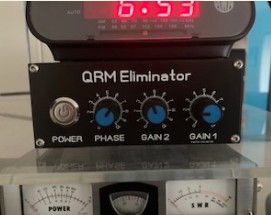
So for the net on Tuesday, that’s what I used – my 50 year old TS-120S – what fun…. I could move from one end of our 40m segment with just over half a turn of the VFO knob.
And unlike my TS-50, with the break-in turned off, I could use the CW side- tone from the speaker to zero-beat and net onto stations. And, another undocumented feature… the 3KKHZ bandwidth meant that I could listen to several QSOs at once during our busy net!
What fun. So what was I saying about the joy of being able to fix your own gear? Ra enon nee
In the Sticks In last week’s RagChew I commented to Stuart VK6MK “Interesting that both you and John VK2RR/7 in the lower latitudes reported really poor conditions”.
My brain must have gone to lunch – of course I meant ‘…and John VK2RU/4 in the lower latitudes…’! I mentioned the mistake to John witi the comment “Boy you are out in the sticks aren’t you!”
Thanks for the email Mark. No need for an apology for a minor error in an excellent newsletter. We enjoy it out this way. The redder the dirt is the better. If there’s no one within a 100KMS of us we think it’s rather good.
But it’s not really as remote as it once was. I’ve got a 4G connection here, probably coming from a nearby aboriginal community. We’ve gone about 700KMS west of Boulia and there’s only been about 300KMS of good dirt road. Alll the rest is bitumen.
Slowly but surely the outback is becoming accessible to everyone, and that will bring its own set of problems with people being under prepared for what is a very hard environment. We’ve been fortunate to date. We have been on the road full time for 11 years.
We camp in the bush say 90% of the time and have never had a problem. But we’re cautious about what we do, and don’t advertise exactly where we are… parked behind a hill or sand dune and no one knows we’re there.
I’m getting nothing in on HF at the moment. I can’t get 12m on the Codan 9350 with the whip I’ve got on. And if I’m reading this chart correctly that’s what might work across to the east coast. I’ll keep listening on 15m and se¢ what comes up on the scope.
Just hearing VK1AM ??? Very low down. I meant to add to last weeks comments that while 40m was not the best, the K beacon was booming in on 7.039.300.
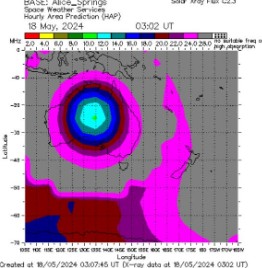
Reflection from vertical incidence signals – and if so, I don’t know how to translate that to predicted propagation between two places; more learning needed – Hi!
I use the GRAFEX point-to-point predictions which provide info on which layers are involved, OWE ALF take-off angles etc.] Regarding the HAP charts, I don’t know a lot about this.
I’m just going off the documentation on this site – https://www.sws.bom.gov.au/HE Systems/1/1 …maybe I’m reading it wrong: + Hourly Area Prediction (HAP) charts are designed for communications between a specified base and mobile within a nominated area.
+ Each chart shows colours which represent the recommended HF frequencies for contacting the base or mobile within the area bounded by the chart for a particular hour.
+ The HAP chart is a guide to frequency selection for HF communications between mobiles and a specified base station. The recommended frequency for communications with the base at a given hour is read off from the point in the map corresponding to the mobile’s location.
The predictions are made from real time data which are updated each hour. [Wow – thank you John. I thought that chart only showed the reflection frequency for vertical incidence; apparently I was completely wrong. That’s very useful – I’l have a look].
From David VK3DBD ‘Twas You Mark, I assume, who lifted my photo from QRZ.com or a QSL card and quoted my QTH Yackandandah as a notable location, few would easily spell. There is/or was a popular tee shirt sold here emblazoned with: Spell Yackandandah?
I can’t even say it! I think Australia has more of it’s fair share of place names which are memorable, that is, if you can say and spell and indeed remember!
You are quite right regarding sending it on the key, at my usual speeds of 20-25 wpm I do it now by muscular memory but I still have a prominent printed YACKANDANDAH just above the radios, so if I need to send it slowly without missing letter, I can look at it and get it right…
A letter at a time, it is too easy to wonder if the letter A is being sent for the first, second or third time…… Inote you too failed to copy it letter perfect Mark – the C is missing!
On a more serious note; one of the recent QRS QSOs I had, with Paul VKSKLE was notable probably for being the longest of all the ones I have had on the QRS net.
He replied at length with the usual details and according to my log was QRV with me for about 20 mins. Well done Paul! I find all too often when a contacted station replies to me, I send the usual details if appropriate and even when a question has been asked, often the other station will end the contact briefly with “thx QSO 73”.
Now this may be due to the fact that they have not copied or understood what I sent or were ending the QSO for other reasons. Never be afraid to send “PSE QRS” or ask for a repeat; I am aware that my speed can easily creep up higher than intended.
Most new ops tend to send a little faster than they can copy. This is fine except that sometimes the Morse is not quite up to scratch. Listening to good Morse, is the best way to learn exactly what it should sound like.
You will then copy that just as we learned to say words when very young by listening… long before we could read or write. Good sending at any speed is much easier to copy than poor code.
Most common faults are with the timing, either broken letters or the opposite, run together letters and insufficient gaps between words. The latter with experience, I can usually read, but broken letters are confusing to say the least….
Especially at QRS speeds. The whole letter should always be sent “as one” at a decent speed and I would strongly suggest for starters, that needs to be 18 or 20 wpm. A few pre-written out phrases for almost every QSO -is a good learning tool.
Every new op ought to make these; on small cards which are handy to look at whilst sending… no need to think what to say; itis so easy to copy your own clear writing with no more than a sentence on it – for instance: “My QTH is located in a rural area, and I have nearly an acre of garden for my antennas”.
A few similar to this can make a QSO so much more interesting. And most importantly, copying a print-out like that makes for ‘smooth and better timed sending on your key, without a doubt. Don’t forget the gaps either… they need sending too! 73 David VK3DBD.
Yack-and-and-ah! [Thanks for your thoughts David – much appreciated. The cards idea is good too – especially for people who have had their first few RST & Names QSOs, and are starting to relax and enjoy the journey. On the question question…
Yes I’m trying to learn to head-copy… and enjoy relaxing and letting the received characters flow, then piecing together the conversation by what actually sinks in. Great, until the other operator asks a question…
More often than not I’ll reply with QUES AGN? or AGN?, then really concentrate. Great fun. The other thing is that this is purposefully an uncontrolled training net…the idea Is that we make mistakes and gain experience.
No-one’s allowed to get wound up if the other station doesn’t do it exactly right… we’re all here to learn. I’d much rather have people on air and making mistakes, than being shy of the key because they fear being shown up as an inexperienced or rusty operator.
That’s what it all about. Thanks again David.]
FIOM REGS VATAVO Many thanks to Ross MONNK for his article about the Key W.T. 8AMP. I have quite a few of them, in most of the configurations Ross describes. Tony Smith G4FAI (recently SK) Morsum Magnificat Worldwide Survey is indeed a great resource.
The one for mobile use with the leg straps, the ‘Key and Plug Assembly’, also mentioned by Ross, has its own write-up which can be downloaded from hitps://royalsignals.org.uk/key-plug/index.html (navigate to the download button below the picture of the (printed) book cover, at the right of the web page.
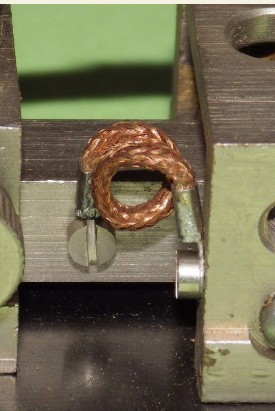
Iattach a picture of the flexible copper braided wire that assists with the connectivity between the lever and the middle bracket of the key, which is not correctly fitted in Ross’ picture. Not a connectivity issue, but rather aesthetic.
If Ross detaches the two small screws and uses a thin rod (| use the end of hobby craft paint brush) to twirl the braided wire around, it will achieve the ‘pigtail’ curl visible in the image, then re-attach.
I meant to send the picture to him directly, but could not see an email address in his QRZ page. 73 Kees
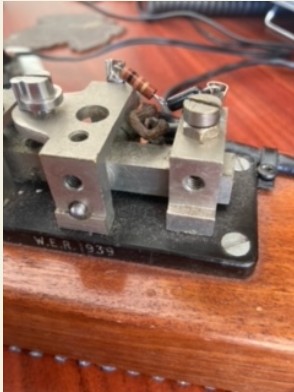
[Thanks Kees. It sure is a popular little key – several members sent me images of theirs. My main one came from a public junk sale back in the early 80s, and got mounted on a bit of Jarrah firewood when I moved to WA. Uh-oh…
Mine failed the curly braid test too! Cheers and thanks for the insight.]
People put all sorts of components on keys to eliminate scratchy dots, but it should not be necessary if the contacts are properly cleaned. Happy to bring it back to life for you if you want to send it to me, no charge.
Lam also always mortified by people using the wrong size screwdrivers, causing gouging the soft brass of the terminal screw slots beneath the nickel plating. Horror again!
I got myself a set of gunsmith screwdrivers, with different interchangeable bits which allows for making correct choices, see https://lawgear.com.au/wheeler-26-piece- space-saver-gunsmithing-screwdriver-set,html Aworthwhile investment if hams want to look after their keys.
73 Kees VKIKVS, [Thanks Kees; yes, this old key has seen lots of use over the years – it has lots of character… aka – gouges on the soft knurled screws. And yes, I added the low pass filter to reduce the harsh keying of my solid state transmitters.
Appreciate your offer of some key care and attention matel]
From Ross MONNK. After our get-together earlier on the VK6RMH-R access to the WA AllStar network, Ron, Mike and I were chatting on Vband (using morse). Ron said that it’s possible to have a 2-way direct (private) contact on Echolink.
He then asked us if it’s possible to have a 3-way direct contact. Mike and I agreed to try and see if that worked (it didn’t).
‘Normally’ one might expect to arrange a CW sked using voice but this was one of those rare occasions when CW was used to arrange a voice sked. We found that amusing. © I thought you might too.
I’m not sure why Ron and Mike can use the *VK6-HUB* normally and can hear me but I can’t hear them or see them listed on the right-hand panel. I’m not experienced with Echolink. Do you have any ideas about what I might be doing wrong? Ross IHi Ross.
I asked our team member is Rob VK6LD (who has built much of the WA AllStar network, and many of it’s AllStar nodes) about the access problem that you and Stan reported with the *VK6-HUB* Echolink node; Rob is the guru behind the Southern Electronics Group’s technical systems.
Rob tested the *VK6-HUB” Echolink node using the Parrot – it worked ok for him. I was also able to connect from my phone and could hear myself through the network and vice versa.
Rob’s comment in his usual character manner was: “Echolink is the explanation – sits next to the recycle bin icon on my computer. I’d just move EchoLink in there @. RepeaterPhone is a much better app for iPhone on Allstar]
Nic VK7WW runs a Slow Morse training net every Wednesday at 7pm EDST on 358 for 30 mins. He uses the callsign of the Northern Tasmania Amateur Radio Club VK7TAZ on that net.
Many of our team learned Morse code with the support of Nic, and the weekly training session comes highly recommended for anyone who wants to learn the Code, or simply brush up. Everyone’s welcome – 3580KHZ at 7pm Eastern time every Wednesday.
The NTARC also feeds the CW live via the Discord phone / computer audio stream, and previous weeks’ recordings are available. Contact Nic VK7WW for more info nicholaschantler@hotmail.com – or just join in o1 Wednesdays.
This Week’s Topic of Interest
Call Sign Soup – Upsides and Downsides:
Vall oIGh SOUP – UPsides ana VOWNSIGeS By Stan ZL3TK It was a bright and sunny day when the annual amateur radio license fee in New Zealand was abolished.
But celebrations were quickly dampened on a dark day when the powers-that-be decreed amateur call signs need no longer be district- identifiable.
The tradition had been: ¢ ZL1 was allocated to stations north of Taupo, ¢ ZL2 south of Taupo plus the Nelson-Marlborough region in the South Island, ¢ ZL3 north of the Waitaki River and ¢ ZL4 south to Stewart Island.
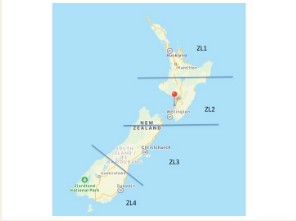
Suddenly call signs became mixed up in a free-for-all number soup. Why? The original reason seems to have been to reduce administration costs. Since license fees were abolished there was no outside funding from call sign holders themselves.
Then evolution came into play and responsibility for registering call signs and any changes shifted from ‘the Authorities’ entirely to authorised agents, some being very reasonable with their fees, while others demonstrated greed.
It makes sense to avoid any such fees by simply keeping one’s call sign when moving between districts. The loss of identity from being mandated to change one’s call sign is offset by the ability to continue as an identifiable ‘personality’ regardless of location.
The loss of district-identifiable callsigns is a tiny cost in the quest for administrative efficiency in a country the size of New Zealand, but the same policy implemented across continental-Australia is an entirely different matter.
For example, when discussing non-teciprocal propagation as occurred on a recent Post Morsum, instead of using the typical ‘between VK6 and ZL’, State names will need to be be used, as in ‘WA to NZ’.
And in case you’re wondering, NZ used to be considered a state of Oz and only became a separate colony after 1 July 1841. We muddle on… see you in the soup.
Stan Vause ZL3TK [Thank you Stan; I’m sure I wasn’t the only one confused about the callsign prefix allocation in ZL.

If you have a topic that might be of interest to readers, please please let me know so we can share more thoughts and ideas; email to cqqrsnet@gmail.com

Brain Teaser
Jules Perrin JP VK3JFP has created a terrific resource to help guide learning for a levels of amateur radio licenses: https://www,julesworkshop.net/Amateur%20Radio.htm| With thanks to Baz VK6MU for he idea, and Jules for the good learning website, here’s this week’s quiz questions from Jules’ Workshop example test questions: Describe the wavelength of a signal.
The main reason for earthing mains powered equipment is to * reduce RF interference * reduce eddy currents * reduce shock hazards * reduce stray coupling Api-coupling network used at the output of the final power amplifier stage in a transmitter + doubles the output frequency and improves neutralisation * suppresses parasitic oscillations and enhances spurious sidebands + matches the PA output impedance to the antenna load and suppresses harmonics * enables a half-wave dipole antenna to be voltage fed Which of these is NOT allowed to be sent as an amateur television image?
(a) An image of your house (b) An image of equipment you have for sale with prices (0) An image of a group of unlicensed persons around your barbecue (d) An image of your antenna system How did you go?

Answers from last week’s Quiz:
Why do we have dedicated amateur bands? Answer: So the radio spectrum can be shared with other users. An interfering signal from a Standard transmitter appears on 56.6MHz.
This could be due to the: * crystal oscillator operating on its fundamental frequency * second harmonic of a 10 metre transmission * third harmonic of a 15 metre transmission * seventh harmonic of an 80 metre transmission Answer: second harmonic of a 10 metre transmission.
The maximum frequency deviation in an FM transmitter is 3000HZ. The modulation index, when the highest modulating audio frequency is 1000HZ is: * 0.3 ed *3 * 30 Answer:3.
A log book must be kept: (a) For use at the licensed address, but it is not necessary for mobile operation (b) To be shown to a police sergeant on request (c) To record any distress messages (d) By club stations Answer: (d) By club stations
Di-dah-di-dah-dit
So back to the Slow CW QSO practice net.
Next Tuesday’s Net
Our CQ QRS Net will be on as always on Tuesday from around 0700Z until about 1300Z; see below for details. Doesn’t matter whether you’re brand new and want to try just exchanging callsigns and RST reports, or you’re ready for a good old rag chew.
Reports
Please let me know via our Reports form bit.ly/CQQRSNET who you work or hear o Tuesday’s net.
Post Mortem
Richard VK6HRC will run our Post Morsum on the South West AllStar net (via repeaters and hotspots all over WA) from 0600 WA time. If you’re in WA, all you need is an FM 2m or 70CM transceiver and an AllStar node nearby.
If you’re elsewhere in the world, you may be able to connect your local AllStar-enabled repeater to the net, or you can connect via Echolink. Let me know (cqqrsnet@gmail.com) if I can help with that.
Teamwork
Thank you so much to our team of 37 contributors this week: VK7SD, ZL4BDG, ZL2GD, VK4JM, VK3ACU, VK6PZT, VKSET, MONNK, VK2AQE, VK2GAS, VK6JDM, VK3BTV, VK2IK, VK2DLF, VK7KPC, VK7TA, VK6HRC, VK3DRQ, VK2RU, VK6BEK, VK6WE, VK2ASB, VK6KHZ, VK6KD, VK6IS, VK5FD, VKADRK, VK5AO, VK6EN, VK3CTM, VK1KVS, VK6AAV, VK3RU, VK3DBD and VK3JFP; and a special thank yo to Stan ZL8TK for his Callsign Soup article and Nigel G4RWI for taking the early morning panic notifications about the reporting software, and his on-going development of the reporting system.
Thank you team. UY CW on Tuesday, mb. Mark Bosra VK2KI/ VK6QI Beautiful South Bowning NSW mark,bosma@icloud.com non impediti ratione cogitationis

An Ode to CW – thanks to David VK3RU: In days of old, when ops were bold, And sideband was not invented, Words were passed by pounding brass, And all were quite contented. – Unknown author
PSE QRS

Landing Zone