Below is a reconstruction of the 2026 13 CQ QRS RagChew newsletter designed to support full text searching. This reconstruction was built using OCR, and will contain errors.
To view the Mailchimp original, click here. To search the entire newsletter archive, click here.
Contents
- CQ QRS RagChew
- Dah-di-dah-di-dah
- Website
- Post Morsum 25th March 2026
- Reporting
- Code Cheerio
- On My Workbench
- VI Curve Tracer Ernam Rance AANNIAIK
- QRZ? Who’s on the other end?
- CW Practice
- Other News
- Calling CW Testers
- Watam Hill
- Drake Twins
- Morse Training Net
- There’s No Such Thing…
- Question:
- Circuit-Drawing Answer from Jack:
- Answer:
- Prosign/Character/Signal of the Month
- Di-dah-di-dah-dit
- Next Tuesday’s Net
- Our CQ QRS Group will be on as always on Tuesday from around 0600Z, until about
- Reports & Photos
- Post Morsum
- Articles
- Material
- Teamwork
- About the CQ QRS Net
CQ QRS RagChew
Dah-di-dah-di-dah
Well well well – who’d have believed after the geomagnetic storm early in the week, that things would have settled down by Tuesday evening.
I thought there was less CQQRS stations on 40m than usual when I listened, but the reports below show that as usual, I was wrong! 64 different stations reported by 4 of our family members.
‘Some found 40m to be particularly quiet (noise-wise), and for others there was a preponderance of DX stations, all falling over each-other as is their want sometimes!
20m performed ok for our mates down-under in Europe, and a growing number of us up top in Oceania have been listening-in and hearing things. Great stuff!
And speaking of 20m, to make life a bit easier from Patrick VK2IOW who edits the text reports from your report submissions on our webform, you can report on 15m. and 20m in the 80m segment of our webform, by doing something like this:
[80m] Your text And of course, when entering any 15m or 20m callsigns in the Worked, Heard or Tiied fields of the 80m form, please append @15 or @20 to each callsign (eg VK6QI@15 VK2KI@20) to make life easier for John VK2RU who edits the spreadsheet each week.
And speaking of 80m, this week was quieter than normal, but it’s good to see that more and more people are giving 80m a try. Yes it can be noisy, and yes antennas are a challenge, but after dark, 80m can do really well across Oceania, with some nice signals.
To make things a little less frustrating when the band’s quiet, I recommend our CQQRS WhatsApp Alerts group – a quick “VK2KI calling CQ on 3555KH2” will often bring a response or two. And…
When we finally ditch Daylight Saving time and the sun sets on the ionosphere earlier and earlier, the band will open earlier than now – hooray! Speaking of Tuesday’s net, please have a read of the nicely-crafted report by Peter VK3WOW.
Our bands are for everyone to use – QRS, QRQ, QRP, and probably a bunch of other QRs – everyone has the same right to be there, irrespective of whether or not we happen to choose to use a segment for our beloved QRS Net.
So hopefully there was just a mis-understanding; it’s really hard to convey true meaning, voice tone, facial expression etc in CW! Peter has taken the initiative of apologising on behalf of our QRS family to the operator concerned; thanks mate.
We’ve worked really hard to create a friendly place for new operators to have a go at CW safely, and for CW fans to get together for a bit of fun and practice among friends – but the resource is ours to share; I’d like all operators who come across our mob to remember it in a positive light, perhaps join in themselves in future, and certainly recommend the net to newcomers.
So back to this week’s newsletter. Once again, we have excellent articles contributed by our team members – thank you all, and we have even more There’s No Such Thing questions that I’m keen to hear your thoughts about.
And I hope you enjoy the end piece – I’m hoping more people will scan all the way to the end each week to see what awaits.
Website
If you’d like to find out a bit about our net, or would like to pass information to others about our Tuesday get-togethers, here’s the link to our website. bit.ly/CQQRSWebsite So here we go – on behalf of the CQQRS Editorial team, please enjoy the newsletter.
WVlarK bosma VK2KI / VK6QI Patrick John Beautiful South Bowning VK2IOW VK2RU NSW Milthorpe NSW on a track somewhere cqqrsnet@gmail.com non impsditi ratione cogitationis Nigel Richard Lance G4RWI VK6HRC VK7TO our other grey nomad Padbury WA Margate TAS
Nith thanks to Nigel G4RWI’s clever software, and John VK2RU’s clever spreadsheet work, here’s the 64 stations heard by 45 members of our team on Tuesday:
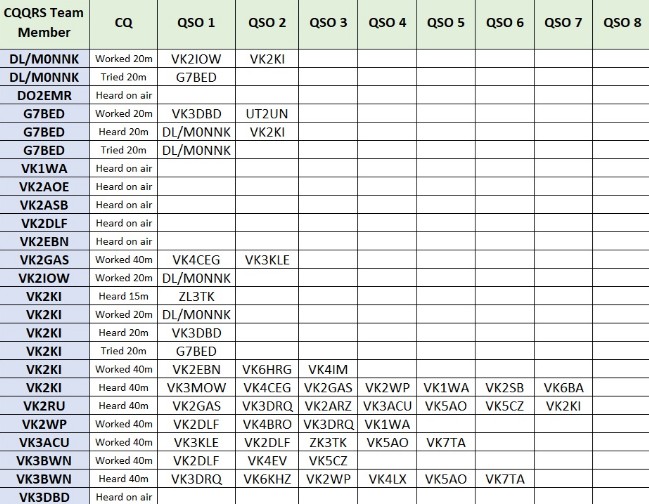
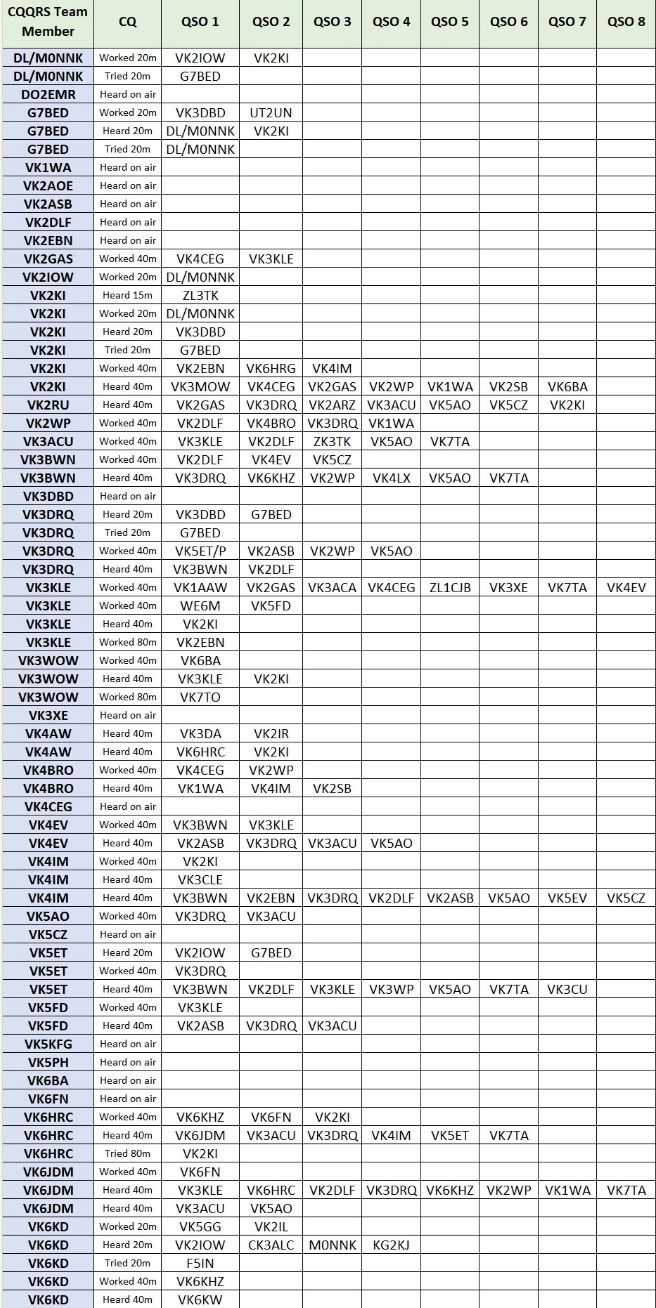
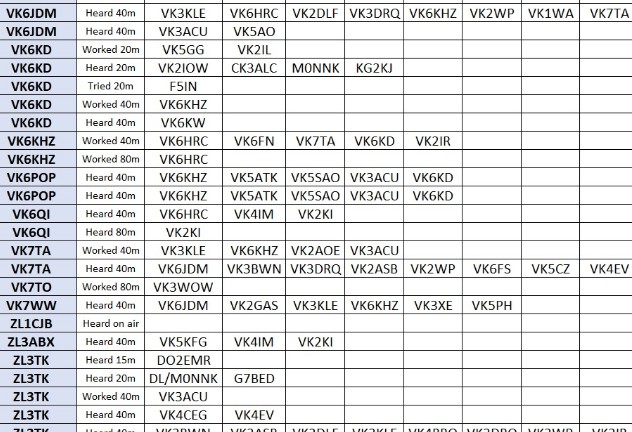
John’s spreadsheet above shows the known stations heard or worked on last Tuesday’s CQQRS Net (reported via our webform bit.ly/CQQRSNET ); the comments in the team members’ reports follow.
The comments were compiled for us by the clever software built by Nigel G4RWI and the layout was perfected by Patrick VK2IOW. Thanks again to Nigel, Patrick and John for the work, and to every team member who submitted a report –
SASSI AIA AIA IN ANI IN Nf TIA AI NSA MI IN TIN Sd AIO NAPE I AI I I LEI VK2IOW. Thanks again to Nigel, Patrick and John for the work, and to every team member who submitted a report –
[40m] A lot of “Flash!” QRN around tonight! Thunderstorms earlier!
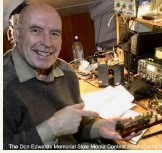
Considering the radio black-out that we had yesterday due to the solar storm, I didn’t think anything would work this morning. But how wrong was that assumption.
My CQ CQ CQ OC got a call from UT2UN, and as I like working Ukraine, we engaged and had a short rubber stamp QSO. Then David, VK3DBD called hich held iin nicely far 15 mine oren Fallnwing that
With a wonderful RST 579 which held up nicely for 15 mins or so. Following that QSO, I copied a very weak signal, which may have been Mark, VK2KI – if it was Mark, my apologies, it was so weak here in the UK.
The Ironstone WebSDR had a queue, which I was still in when I went on air, but I found another ‘localish’ SDR that did the trick. I then heard Ross DL/MONNK call me (via the Australian WebSDR) but we didn’t manage to hook up.
All in all, a good session considering, so my thanks to you all for trying and I hope to get you in the log soon. Best Regards, Chris G7BED
[40m] Work has got in the road the last couple of weeks – but not tonight! Great to be back on air for a couple of QSOs and to listen to a few more to practice. Thanks!
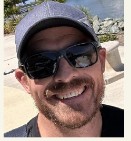
[20m] The QSO with Mark VK2KI was classic “groping in the dark” radio – right on the edge of readability, but definitely a contact. Then I got a signal so loud I practically had to tear my headphones off to avinid haing deafened! I knaw it
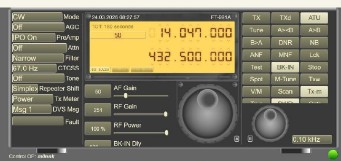
[40m] Very quick RX around but very high QRM tonight.

[80m] I was tied up with visitors for the evening but made the effort to pop in for one contact before bed. 40 m wasn’t in great shape so dropped down to 80 m. There was no discernible activity, but the WIA morse beacon was booming in so put out a CQ call.
I was answered by Peter, VK3WOW who had a lovely 599+10 into Hobart. It’s not often that I enjoy signals like that, so enjoyed a true arm-chair copy QSO.
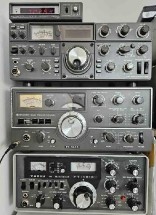
[20m] We don’t have a comments area for 20m but “WOW” 20m was open and active. I stayed within our QRS frequencies so QSOs were with stations within or very close.
Somehow, I don’t think some stations were working on QRS speeds but it gave me a pickup in my step to match their speeds and keep me working hard.
At one stage I used the recording function on I could play back their call sign numerous times before I was sure feo SE ER eo] PR oR fam BR FERRER ER in BOR Oe ee OO opr oe
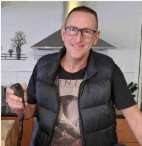
Me working hard. At one stage I used the recording tunction on my ICOM /610 so I could play back their call sign numerous times before I was sure I got it right, hihi. Great fun and hope 80m is a bit more lively into my end of town next week. 73s to all. VK6KD
[40m] Activity on 40m appeared a bit dead compared to previous weeks. At my QTH in Ballajura WA most activity was being heard up on 20m.
I did achieve one QSO on 40m but signal levels dropped drastically in a very short time making an extended Kr»ahy ehallannainn
| waited for too long for Chris G7BED, he was RSN 221. I call several times without luck. Cdx were not good and he was for tco long on another QSO. Nothing, rien, was heard from OM Edi on 15m.
[40m] Apart from the higher than “normal” Noise level,
Little else to report. After finishing the last QSO, a phone call came through and lasted more than an hour. That “made” my day.
From Stan ZL3TK at Waitarere [15m & 20m] When I say ‘heard’, I mean the stations were detectable but QNP, identifiable only because of the frequencies listed by ops on OM Mike’s activity page. [A0m]
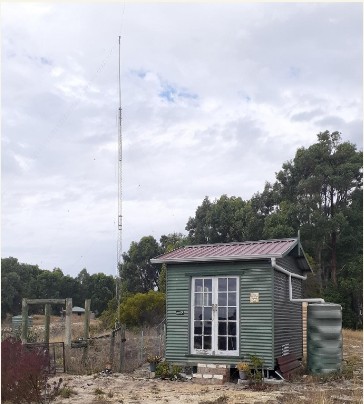
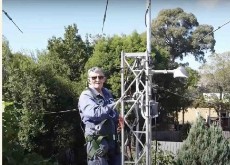
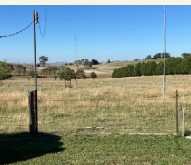
[SLU] Had a QSO with Max VK6FN who reported reception as 579. This is a remarkable change and suggests the felling of a number of trees may have removed some of his 360 degree antenna null. He was 599 on my clear view antenna which stands atop Wotam Hill.
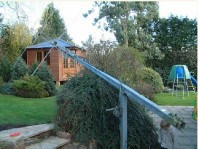
Listened to plenty of stations from 0800 UTC for two hours – great morse practice. Plenty of stations on 40 heard thanks to the Bosma effect which appears (0 be building in strength. The photo shows the tower on
[80m] was ina ZOOM meeting at the time so wasn’t in a position to ake the plunge.

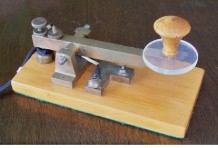
[40m] Many stations worked on the Ten Tec Omni, paseter keyer. The band was like glass later in evening, great propagation and zero static crashes, 80m also surprisingly quiet for summer months.
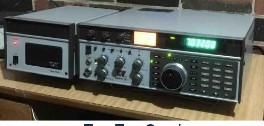
[40m] I thought I was running 100W, but only at the end of the evening did I realise that I turned the power down to 10 or 20W! Still, George VK2AOE was only running 4W from his 1 valve rig but the copy was good here.
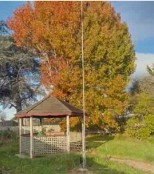
[40m] Unable to even listen to the QRS Net as we have severe storms atm.
[20m] Lots of noise tonight, whether it was the new SOTA, 4- band, linked dipole I was trying out or condx. Did hear other stations apart from G7BED and VK2IOW on 20m, but too much noise to QSL callsigns etc.
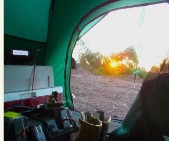
Condx not very good, sounded like there was lots of ‘doubling’?? Generally signals were very weak compared to last time here. Enjoyed good QSO with Manny, gave me strong report, RST 597+40, my RST to Manny 559. Pity other stations were not as good.
Due to noisy condx / weak signals and worn out by hot weather while locating a suitable area for the antenna, I retired early, enjoying the sunset through the trees as it was starting to cool down a bit. 73 John.
From your editor Mark VK2KI at Beautiful South Bov
[15m] No luck hearing Edi DOZEMR this week, but we knew from Mike DL3YZ‘s reporting page that Edi was on and calling. I did hear Stan ZL3TK calling him 1KHZ lower as coordinated via Mike’s webpage..
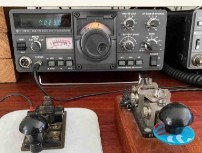
Ross DL/MONNK was up and down in the slow QSB – sometimes Q5 other times below the noise floor. He was struggling to hear my 50 Watts. Chris G7BED was about the same strength, but slightly poorer readability (and it wasn’t just my poor CW skills this time).
I received his RST 229 report but he wasn’t able to @SL my RSN 311 – neatly, but no banana this week.
[40m] At the start of the net I listened in to Graham VK4CEG North of Brisbane chatting to Armin VK2GAS North of Sydney – both good signals here. I then hooked up with Brian VK2EBN up at Newcastle whose Flex radio and dipole lineup was thundering i here at S9.
After returning from 20m, I listened in to a number of QSOs before heading off masa makan. When I returned, the band was full of DX, but not much in the way of Oceania stations; however my calls paid off with a QSO with Richard VK6HRC in Padbury.
Signals were around S 3, but workable in and out of the QSB. Ithen hooked up with Adam VK4IM; I’d worked Adam two weeks ago which had been his first CW QSO for many years.
Well his code was coming along nicely – an¢ I found myself slowly notching up the speed until we were humming along at around 40WPM, which he reported was comfortably adequate in terms of copying enough to get the gist.
We even exchanged SKCC numbers – just to celebrate the use of straight keys at both ends
[80m] Called for a fair while on 80m tonight – no luck was the stern reply. There was some DX activity going on around 3535KHZ that seemed to be causing a ruckus, but it was all too fast for my slow brain.
• r pep inte Se tia ata? SS a nc a and in ma at iy agate a i EE! yn eat 2 ei Ben a loddys Well ni near Northam WA.
[40m] Interesting to look at signals on the Hoddys Well KiwiSDR. When I was working Richard VK6HRC, he was fairly weak into the SDR over a distance of 60KM – probably beyond ground wave, possibly a bit of high angle refraction – or maybe back-scatter possibly?
However my Tae aad hac f qancmorm ane HR ON Re OUTTA WW INR RIB Ae) TRO
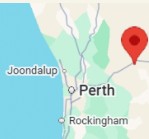
Signal was around S6. Later when I was working Adam VK4IM North of Brisban Adam’s signal was consistently about an S-point stronger than mine (RSN 561 v 551). Adam has a full-size quarter wave vertical which should have a lower ang!
Radiation than my 80m Double-Extended Zepp at about 7 m, and probably 3dB n power as well; so this all gels nicely. Amazing tools these KiwiSDRs.
[80m] Nothing but myself heard, apart from the DX kerfuffle further down the band.
[20m] Only on briefly this evening. Had a QSO with Ross, MONNK, who was using Mike’s rig in Stuttgart. Conditions were good both ways. After our QSO an Italian ham called me and we moved up 2 kHz.
He told me his antenna was an indoor vertical, which I thought was pretty good for a VK contact.

ATOUNG VIvoe I Near 4 Staion Call LANL f (tWICe) ON (20 KIL2, = es and then proceed to call CQ (without, at this point, the “DX” suffix I heard this station use when calling later in the evening).
I did not know it at the time, but have since verified (via RBN) that this station was calling at 17 wpm. I did not recognise the calling station as a Tuesday night “regular”.
I immediately responded, sending my ‘own call sign twice at a speed similar to the calling station’s. Before the station calling CQ got a chance to respond, a third station jumped in informing the calling station that this was the “QRS net”.
The calling station apologised with “sri”, and ceased calling CQ At this point a FOURTH station attempted to contact the station that had been calling CQ with a series of rapid dots and dashes that appeared to be symptomatic of a pretty severe keying problem of some sort.
I continued to listen for some time as this fourth station struggled to send the callsign of the station that originally called CQ then “de (own callsign)”.
Whatever the keying problem may have been, it took a long time to resolve, but the station that originally called CQ was a model of patience, making several attempts to decode what at this stage was quite a messy call back.
I hope I misunderstood whatever the third operator thought he was doing in alerting the calling station that a QRS net was taking place — an intervention that prompted an apologetic response from that operator which the third operator did not attempt to explain was actually unnecessary.
I imagine it must be clear to most of us that we do not have some kind of “exclusive entitlement” to any particular portion of the 40 metre band on Tuesday nights.
As it happens, this fact would have been very clear for anyone who happened to hear several VK stations participating in a decidedly quick- fire pile-up just above 7024 kHz not long after the incident I have described occurred.
Post Morsum 25th March 2026
Bare SUERTE PESTS E Sew OEE BUSSE WEE We
From Richard VK6HRC. Five on the VK6RLM rptr and AllStar/Echolink hub this morning.
PEW Ne NEE CE ENe FEE CEE Oh VK6KD David VK6FN Max VK6QI = Mark VK6HRC VK6MRB Mulligan swl.
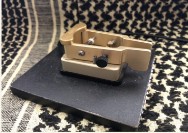
David started out folowing the action on 20m, heard Ross MONNK and a French station F5IN after that worked Ron VK6KHZ and heard VK6KW on 40m. Monitored 80m for a while but no contacts there.
Max worked the locals on 40m and was impressed a strong stable signal from the homebrew Para set of VK6JDM Donald in Esperance. He also heard Ross MONNK on 20m via a local Kiwi sdr.
Mark listened out for Edi DO2EMR ON 15M, nothing heard and on 20m worked Ross MONNK tried Chris G7BED but not succesful there. On 40m heard seven and worked three. I worked three on 40m and one on 80m.
The highlight was catching up with Mark VK2KI in beautiful South Bowning for a quick chat. After the Post Morsum a very interesting discussion about CW protocol and other topics took place, more in the Ragchew at a later date.
As usual thank you to all on last night and this morning.
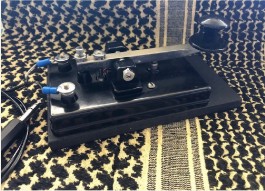
Reporting

Even if you didn’t hear anyone, we’d still like to know that you had a go. And to make your report more interesting, please consider sending a photo: cqgrsnet@gmail.com So, please help attract new and old team members to have a go by submitting your report each week.
Submissions close 1300 (Eastern Australian Summer time)_on Thursdays.
Code Cheerio
Given the current prosign of the month (
Given the current prosign of the month (
How do you finish a CW QSO? I always thought the standard procedure was to pronounce your key going silent with
Is there mor to e e e — e — than meets the ear?
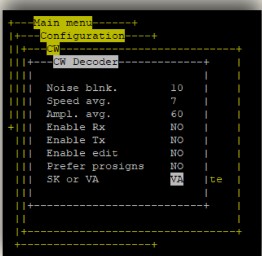
QMX’s terminal, showing CW Decoder options The last entry offers the curious choice of SK or VA
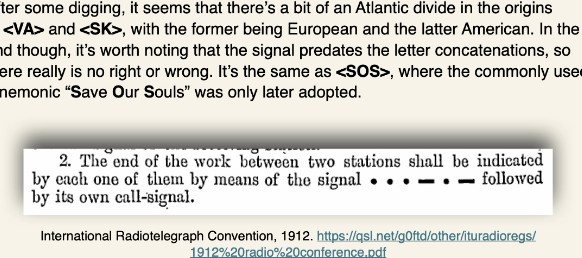
After some digging, it seems that there’s a bit of an Atlantic divide in the origins of
In the end though, it’s worth noting that the signal predates the letter concatenations, so there really is no right or wrong. It’s the same as
The end of the work between two stations shall be indicated by each one of them by means of the signal « « « —= « — followed by its own call-signal, International Radiotelegraph Convention, 1912.
Https://qs!.net/gOftd/other/ituradioregs/ 1912%20radio%20conference.pdf
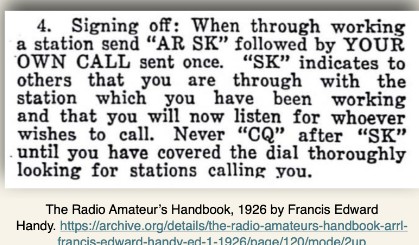
So when did they start being used? The earliest use of
Oo wnen aid ney start being used’ The earliest use of
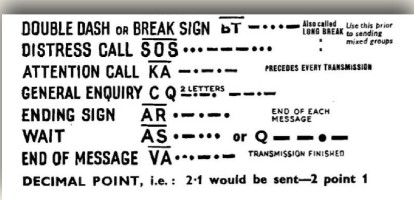
The new morse code manual, 1941 by A.W. Eley, A i details/the-new-morse-code-manual-1943/page/34/mode/2up (5th edition) The earliest identified use of
Interestingly though, in the 1955 edition of the ARRL’s “Learning The Radiotelegraph Code”, they didn’t refer to pronouns at all, rather referring to the signal simply as “didididahdidah*.
• dition) The earliest identified use of
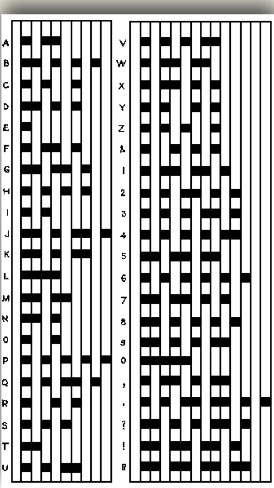
What about <30> then, as it doesn’t even sound the same? To explain this one we need to travel back to 1859, when the world was still black and white, and the Western Union Telegraph Company standardised their Morse code system with the publication of their “92 Code”.
By examining the American Morse chart, we can see that upon joining 3 and 0 it looks remarkably familiar: e e e —e Here’s an anecdote from from Dave, VE7AHT:
To add to the folkiore regarding VA/SK meanings, when I started my career in 1960 with what was then Canadian Pacific Telegraphs, News Bulletins were still being relayed across the system by teams of Telegraphers.
I was hired as a T&R technician and Railway Morse was the common mode of communication among technical staff maintaining the open wire line and associated carrier equipment.
Part of our duties occasionally included off hour hanaling of commercial telegraph traffic including news bulletins (BNs) These bulletins were always ended with the prosign<30>. Railway Morse code for the number 3 is …-. and the number 0 is a LONG dash.
Sent as a prosign, it is …-« Which Is indistinguishable from the prosign
I have often mused that like so many expressions inherited from earlier times, when railway Telegraphers transferred to jobs requiring international code, <30> was easily commuted to
WAN I LSA oe EL UE = SILOS fo Just my personal observations and unsupported conclusions (at my age, I am entitled to such conclusions!
Hi Hi) ps For those who might care, newspaper Type Setters parsed news bulletins into boiler plates scattered around the daily news paper, with -30- at the end of the article to let the reader and publisher know that was the end of the message (text).
That’s what I’ve found. Do you have any additional historical perspective or insights? 73 Lance VK7TO
If you have an article or two that you think might be of interest to our readers, please let me know so we can share more thoughts and ideas; for guidance on writing for RagChew, see Articles below. Please email material to Mark VK2KI: cqqrsnet@gmail.com
On My Workbench
VI Curve Tracer Ernam Rance AANNIAIK
Oh dear, I do hope I’m not going to get into trouble with this one. I don’t want to offend anyone – I’m just expressing a personal opinion about a device that has interested me.
The last edition of RagChew featured, in the “On My Workbench’ section, an article by Jack Child on what he called “An In-Circuit Component Tester” and which I know by the name of a ‘VI Curve Tracer’. The V standing for Voltage; the I standing for Current.
Here’s how it works (using the circuit diagram of my own homebrew Curve Tracer): A mains supply is used because it has an Alternating Current. A step-down transformer converts this mains AC power supply to a safe voltage.
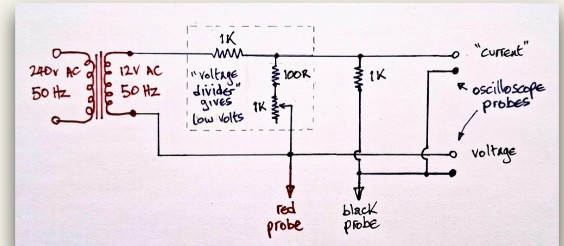
—_——_———_—_—_—_ This alternating supply is used to ‘swee” a voltage across the component, from a positive voltage to a negative voltage, at 50 Hz.
The variable resistor in my unit allows this sweep voltage to be adjusted to keep the voltage within a non-damaging range. While sweeping the voltage, the Curve Tracer outputs that voltage to the horizontal X channel of the oscilloscope.
The resultant current through the component is converted to a proportional voltage (because oscilloscopes measure voltage not current) by the 1k Ohm resistor across the “current” (vertical or Y) oscilloscope output.
You need to use a 2-channel oscilloscope to measure these two outputs separately and then use the oscilloscope’s ‘X-Y plotting’ function to display the result as a graph of Voltage versus Current (hence the name “VI Curve Tracer’).
The shape of the line tells you what component you have. If the line is not what you expect for a known component, then the component is faulty.
If you find that explanation confusing, have a look at the first two minutes of this video – he does a great job of explaining it, using a simplified circuit diagram.
Ayear or so back I built one of these because a) the old-school electronics guys rated them highly, and b) it looked a simple build. Having read Jack’s article (thank you, Jack), I dug mine out to refresh my memory.
Here you can see it hooked up to a +12v/-12v AC power supply and with both leads of my USB oscilloscope attached. What you may not be able to see is the small diode held by the black and pink crocodile clips.
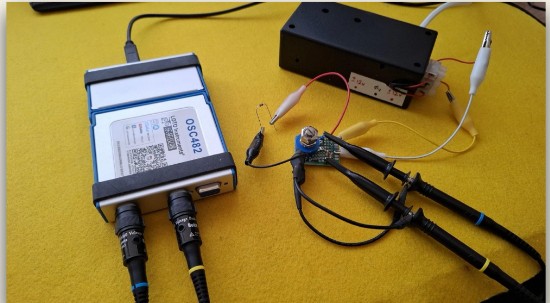
You can see now why, with those eight legs, they’re nicknamed an “Octopus” by some technical types.
Somewhat amazingly, my cheap Chinese USB oscilloscope does have an X-Y plotting function and here is the result for the diode:
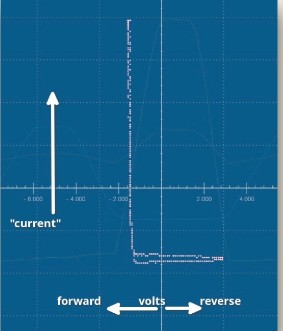
I can see from the L-shape that my diode is functioning as it should. As I understand it, the short horizontal line going from zero to the left represents “Forward Voltage” increasing (but no vertical current flows) until it reaches the 0.7 Volts Vf threshold, at which point the diode opens and the current shoots up.
The voltage line going from zero to the right does not end in any current in the opposite direction because this is a diode. Feel free to correct me if I’m wrong.
Armed with this information, it’s a simple thought experiment to work out why a resistor shows as a diagonal line, going through zero volts and zero current.
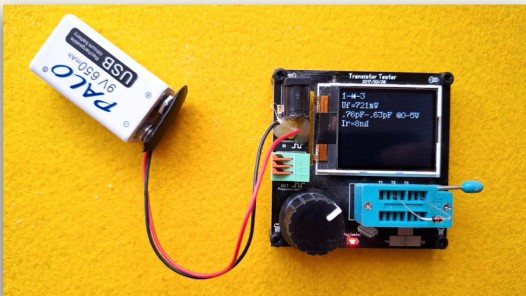
That was all quite a palaver and (arguably) tells me very little about the component under test so, for comparison, I dug out the cheap Chinese Transistor Tester’ that I normally use. It just requires a PP9 battery to power it.
Below it’s shown with the same diode clamped in place. I’m not sure if you can see the display but there’s a diagram identifying the component as a diode and its orientation, and three lines of data about this particular component.
EBay is awash with these dirt cheap devices which seemingly work with just about any through-hole component, and have pads for testing loose SMDs too. For a few more dollars, you can get them with a colour display.
I think you’ll already have guessed where I’m going here – VI Curve Tracers are really interesting devices and I strongly recommend you build one yourself if you have an oscilloscope with an X-Y plotting function.
But, as a useful device for the modern shack, do yourself a favour and spend a few dollars on something that doesn’t “trace” (geddit?) its history back to the beginning of the electronic era.
At this point, I should mention that Jack was advocating the use of the VI Curve Tracer as an in-circuit component testing device, whereas my Chinese Transistor Tester’ only works with unmounted components (although it would be a trivial matter to insert a couple of wires into the clamp and use those as component probes).
So maybe it’s a case of “horses for courses”. Should I also mention that some of the latest up-market Multimeters have similar functionality? But, crikey, you pay a steep price for it.
Don’t worry about offending me – I don’t know that much about electronics (just enough to get me through the exam for a Full radio license) – so, shoot me down, Jack OM (or any of the many members of the QRS Net who are more knowledgeable about electronics than me).
But I hope that all you nerds out there will agree with me (and Jack) when I say that these are fascinating devices and definitely worth a closer look. [Thanks Ross.
When I saw Jack’s article last week, I thought most older cathode- tube type oscilloscopes did not have an ‘X-Y Plotting’ function – and that was the domain of more up-market machines and the newer solid state oscilloscopes.
When I mentioned that to Ross, he scurried away and found several YouTube videos that demonstrated that many older CROs do in fact have the function.
Well I’ve learned several new things – so Ross’ and Jack’s articles have already been a success: + My old cathode ray oscilloscope that I’d inherited from my father and which had been sitting on its end on the floor for some years, does still work (Revelation 0).
+ Not only that, it also does have an X-Y mode that I didn’t know about! I had to download and read the instruction manual, but there it was, hidden in plain sight (Revelation 2).
+ So let’s assume that many still-working oscilloscopes may possibly be so- equipped as well. The explanation in the video Ross refers-to (https://www. youtube. com/watch?
Wo3pEH7hUE) is very clear – and I have to admit, the way the diagrams are normally drawn was confusing to me, and I couldn’t get my mind around what was going on – his explanation is perfect!
And well done Ross for explaining to me what the variable resistor in the diagram is for as welll]
What’s going on on your workbench? If you have an article or two that you think might be of interest to our readers, please let Mark VK2KI know; email to cqqrsnet@gmail.com For guidance on writing for RagChew, see Articles below.
QRZ? Who’s on the other end?
CW Practice
This year we’re using Aesop’s Fables. These are short moral stories, often using talking animals, that illustrate simple truths about human behaviour and character.
‘Aesop’s Fables originated in ancient Greece, traditionally attributed to the storyteller ‘Aesop who is thought to have lived around the 6th century BCE.
The fables are generally smaller files of two to three hundred words that have been recorded at 15 wpm and run for about 15 minutes.
If 15 wpm is a bit quick for you, load it onto your phone and set the playback speed at 0.75 X or even 0.5 X- whatever works for you. 0.75 X will play the MP8 at a bit under 12 wpm. Itis suggested that you read the text file before listening to the audio file.
That will make it easier to follow the audio file and prepare you for any unusual words. Any punctuation that is not usually used with CW has been removed. This week’s fable is ‘The Crow and the Pitcher’, and the MP3 and TXT files are attached here:


If you prefer a different speed or tone you can create your own MP3 files by converting the text file with the Ebook2CW app — https://fkurz.net/ham/ebook2cw.html.
You can either play the MP3 files in any media player, or load the text file into the Ditto CW: Morse Player app — https://dittocw.andro.io/.
Both options work well, however Ditto CW gives you complete control over all Morse settings, while a normal media player only allows changes to playback speed, and does that in steps (e.g. +1.25x, 1.5x, 1.75x).
Other News
Calling CW Testers
From Chris G7BED A friend of mine (HB9HKN, Matej Sustic) has written a ‘CW Complete Trainer App’ and is looking for friendly testers. I think this may be of real interest to the QRS Net Community.
The App is called CW Complete Trainer and will be released shortly on Google Play store (IOS coming a little later). CW Complete Trainer is designed to teach Morse code the right way from the beginning: by building instant character recognition.
Instead of memorising dots and dashes visually or counting elements, it teaches you to recognise each character as a unique sound pattern—just like you recognise spoken words.
Learn to Hear, not to decode, using the right way from the start – character speed vs Farnsworth speed with gradual speed progression. It is intended to train your
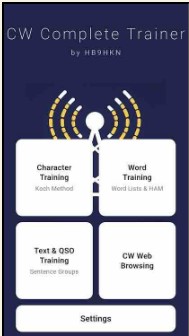
Brain, not your eyes and the app focuses entirely on auditory learning. To participate in the testing programme, all you need to do is send your email address to hb9hkn@sustic.com so you can be registered in the Google Play Store backend (HB9HKN – Matej, will then send you a download link when the App is.
Released). Please make sure the email you register with is the email you use with Google Play Store. More details of the App can be found here: https://www.hb9hkn.ch/CwCompleteTrainer/user-guide.htm!
I met Matej through the CWOps Community and he’s a very creative guy looking for constructive feedback on the App, issues, likes, dislikes, or any ideas on how it could be improved. Best Regards Chris G7BED
Watam Hill
From Donald VK6JDM near Esperance From this week’s reports, you may have noticed the photo of the tower on top of Wotam Hill with Lady Chatterly’s Garden Shed in the foreground.
As I said, he top section of the tower can be wound up a further 10 feet to make it taller than Max’s towers, you cannot let Max win. Size does matter when dealing with Max!
The sign to the right declares it is Lady Chatterley’s shed, the black and white one says Gardener Vacancy – it would appear thus that the good (or not so good) lady has tired of Mallard the Gardener. The name Wotam Hill is after my Uncle Fred Wotam.
The name Wotam appears in Norse mythology as a god of war. Now we have a neighbour who was making unwelcome visits, so I decided if you have a neighbour from hell the answer was to invite (or invent) a relative from hell to stay.
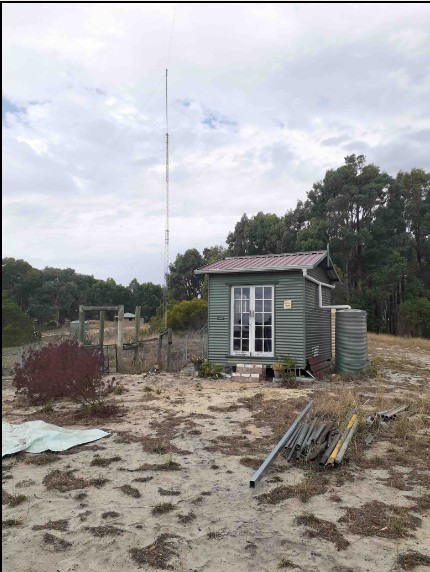
The small mud brick hut in the distance in the photo is Fred’s hut. Now Fred’s hut is a safe distance from the house for Fred was described by his old comrades at arms as “a crack shot, when sober”.
There are unkind souls in this part of the world who swear Fred Wotam does not exist and that Wotam stands for Waste of Time and Money. People can be so cruel. A good friend felt the tales of Fred and his potential for violence would get me in trouble.
She rang the West Australian and asked to place an add in the obituary pages. The person at the West Australian told her they only took ads from registered funeral directors because some people put fictitious ads in!
My friend explained that she was on the medical ward where Fred had just died and that she doubted the Wotams would use a funeral director.
The paper apparently thought about this and rang the hospital, were put through to the ward and Claire answered the phone, confirmed the sad death of Fred and arranged to pay for the ad on behalf of the grieving relatives.
The first I knew of this was Claire turning up at the surgery and telling me to inspect page 46 of the paper under her arm.
Now when ever I see Claire chatting to someone in town (and she does a lot of chatting), I casually come up and point out to the person she is talking to, to be careful, for this woman murdered my uncle.
Fortunately I do not think the neighbour reads the obits in the Western Australian. Cheers, Donald VK6JDM.
Drake Twins
From Paul VK3KLE Re Tuesday’s practice QRS CW, I hope you had fun last night as I did. By the way your CW carrier tone has a slight warble to it. I think the VCO in the old Kenwood might be a bit close to the cliff edge, maybe needing alignment and parts.
No sooking now, I’m being helpful not critical. I take forever to do some things too haha. VK7TA had magnificent CW keying and tone, I’d love to know what set he had on Tuesday night. Jordan also excellent, think he was using home brew and 20 Watts.
It sounded amazing on my Omni. Last night I had the omni on 1.8k bandwidth and used the CW audio filter – it was a joy. You need to work split on that set as it has no RIT control.
With the U310 fets I’ve installed you can use RF gain (IF gain control actually) to roll off the band noise and the IF AGC gives superb crisp CW audio above a near silent band noise. Ithas amazing QSK as well.
I would recommend that model Omni 5 set to our readers if they want a vintage transistor CW transceiver. The later Omni VI onwards are DSP, better for voice perhaps?
However I’m told all later Tentecs have better frequency stability, important if working a fussy new rig these days. Saying that, my TS-590SG has a CW Auto tune to give exact centring of the RX CW tone.
You just use the RIT and keep the TX fixed in hope the receiving station does the same. Otherwise it’s cat and mouse VFO chase hihi. On Tuesday, the band was in fine shape on 40m, no static crashes and very low background noise.
I worked USA on my 100 Watts from the Tentec Omni ater in the evening. Only got a 229 report, but an intercontinental CW contact on 40m just the same. Probably on a QRO boat anchor set might have done a 339 etc.
Re Drake Twins: I’m now the owner of a Drake T4XC…. actually, premature in my claim. Yes it’s still in the post, but I have tracking and a photo. The set has been shed parked, not my favourite storage method.
But has a good face and all knobs and dials and meter look very FB. Cosmetics and originality are quite important for a restoration project.
So in a week or two and after some new parts and tubes & a bath in contact cleaner with dry cleaning fluid and compressed air I should have a clean working Drake twins set. My RX Drake already has clean tail feathers.
She is CW ready and waiting to be partnered with her new husband the T- 4XC.
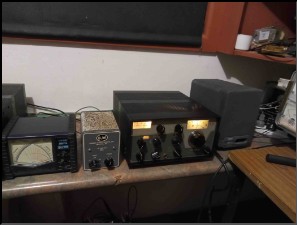
They apparently have good keying and fair stability and good power. The RX drake R-4C I have had for years and is very reliable and sorted.
It has new can caps from Hayseed hamfest in USA – they are exact drop-in can caps – perfect in appearance and function as supply filters. Please have a kind thought to a new marriage of seperated and re partnered Drakes…
Soon to remarry at my QTH of all places haha. Hope there are no nests or eggs inside, quack quack. Soon to be on our QRS practice nite too I hope.
Already have a Drake power supply from my TRS that should be plug and play, cutting down my restoration-to-on-air time considerably. Regards Paul VK3KLE 73 [Thanks Paul; no sooking over my TS-1208 – yup, it’s on my pile of things to be fixed herel]
Morse Training Net
Our team member Nic VK7WW runs an on-air Slow Morse training net every Wednesday at 7pm EDST on 3580 for 30 mins. He uses the callsign of the Northern Tasmania Amateur Radio Club VK7TAZ on that net.
Many of our team learned Morse code with the support of Nic, and the weekly training session comes highly recommended for anyone who wants to learn the Code, or simply brush up.
Everyone’s welcome – 3580KHZ at 7pm Eastern time every Wednesday; you’ll hear lots of the CQQRS team on that net. Jordan VK3ACU has ralso ecorded the complete set of lessons which you can now find here:
Https://www. youtube.com/playlist?list=PLHsQmZz6fBXO7swAfbT mutrbbEL17fUQL Contact Nic VK7WW for more info nicholaschantler@hotmail.com including how to join the NTARC DISCORD group to follow the action, or just come along and join in on Wednesdays.
Are you up for expanding your CW sending and receiving accuracy? You’d be doing it in an environment where speed has no part to

(CDS) ESL Sale ET UY ETO ST Ue US hE 2| LSE ote) UCU SG RandomGram (RG), is a monthly international CW activity which focuses on exchanging random five-character code groups, one group each way per QSO. Last Saturday (UTC), RG event # 41 ran for 24 hours.
Fresh code groups are computer generated, registered and scored for each RG event. They are allocated upon request by email.
Station logs to be sent to RG HQ are simplicity itself, consisting merely of an emailed list of only those code groups you’ve received, no call signs, names or signal reports required, a clever computer does all the collation and math based on it knowing which code groups have been issued to whom.
Most participants operate individually, however teams based around common interests, such as those who use straight keys or sideswipers, or members of specialist clubs such as CWops, also play an important role in building camaraderie.
Each team’s total points is the aggregate of its affiliated member’s points. RG is very popular in the US, the high amateur radio population and large land mass favours RG, so it’s no surprise to find in the results for the latest event, 77 % are Americans.
The others consist of two VEs, two Js, two VKs and one ZL. Which raises an interesting question. Is continental Australia, by AR population, producing a proportional number of RGers relative to the US?
We’ve done the math and found both our Oceania counties are punching above their weight by population ratio, even when fielding such a ridiculously low number of participants.
But that no reason to bluff ourselves into complacency by ceasing to promote the activity. On the contrary, a new epoch has been launched to boost our numbers and make the US take notice.
Since we’re out on a limb here in the south-west Pacific, an RG team appropriately named ‘Oceania’ has been created to challenge the existing teams based in the US. Team Oceania is unashamedly seeking new members.
We want our existence to be felt and to inject a feeling of esprit de corps, just like American AROs have been doing since Hiram Percy Maxim founded the ARRL in 1914.
We don’t need political oversight to develop esprit de corps, we can do it very nicely ourselves from within our new geographic RG team. This activity is suitable for all levels of CW competence, that includes you!
Please register your interest in RG with Drew RG+owner@groups.io or af2z@artlcom You will then receive an emailed invitation to the next and subsequent RG events.
When requesting your code groups for an event, be sure to register your affiliation with team ‘Oceania’ each time, team affiliations do not carry over.
Although not strictly part of Oceania, Japanese AROs have been invited to join team ‘Oceania’ since there is no RG team in Asia, the cunning plan is obviously to boost points earned in the western Pacific theatre at no cost to anyone.
A full wardrobe of information is available at https://groups.io/g/RandomGram and this month’s RG results can be seen at https://groups.io/g/RandomGram/message/656 73 de Stan ZL3TK
If you’ve read something that you think might be of interest to our readers, please email to Mark VK2KI: cqgrsnet@gmail.com
There’s No Such Thing…
Pho WEEN 2 YMC UlIViios I think the first lesson in Teachering 101 is to always tell students “There’s no such…” (I’m sure you know the rest) and “…the only dumb questions are the ones not asked”.
John VK2RU reckons that there’s lots of questions out there among bot our new and our experienced operators – about CW, amateur radio operating and about theory. So here we go…
Question:
MMUC SLUT In last week’s RagChew newsletter, Jack Child had a nice article about in-circuit component testing. The circuit diagram was very nicely drawn – what program or website did he use?
Circuit-Drawing Answer from Jack:
MIPCURS MT AWINY ALSWEr IPUI! VaR, Thank you. I used “SmartDraw”. Free trial, then $US7.95/month. There’s another – “draw.io” which is free.
I haven’t had much of a look but the symbol library looks extensive [What other circuit drawing programs or website are our members using? cqgrsnet@gmail.com ]
I’m writing my report after Tuesday’s net, having heard many stations in our net segment that were sending very fast. What is the CQQRS Net’s definition of QRS? Below 10WPM? Below 12, 15, 18, 20 wom?
| know the idea is that we try to answer at less than or about the same speed as the other operator. This is gentlemanly (gentlepersonly?) always, and makes perfect sense on our QRS net. But what if the caller is rattling away above the speed limit?
Should I ask them to PSE QRS PSE QRS just because they happen to be on our net frequencies?
Answer:
Which piece of string would you like us to measure David? Yes, horses for courses seems to be the right approach. I think you’re right – reply at about the same speed or less – as long as you both can comfortably copy each-other, you may be providing some head-copy material for some of our listeners…
Or you may be frightening others away – hard to know! For me personally it’s simple: * On the net, I aim to provide an opportunity for new operators to listen to real QSOs at practical learning speeds.
* lactually struggle much above 12-15wpm – (Ross MONNK’s Guessing Game applies most of the time with me). So there usually isn’t a problem to QRS.
* So unless I forget myself, I’ll usually send at about say 12 – 15WPM character speed, but with around 1 second gaps between letters to take the speed down to anice stroll.
I use my Break-In (VOX) control set to about a second to help set the rhythm and gap for each letter. + If] know or suspect I’m working a new operator, I’ll go longer between letters; ditto if they reply PSE QRS PSE QRS or their replies don’t indicate understanding of what I’ve just sent.
Note that most often, new operators will send at a speed that is much faster than they could copy – so knowing what speed to respond at can be a challenge.
* Occasionally I’ll go faster if I’m confident the other operator is copying ok (or if I forget myself – there can be real pleasure in rattling along enjoying the wind in your hai)… but [ll try to slow down for sending my own callsign.
* We’ve also suggested 7020KHZ (the bottom of our 40m segment) for those who would like to provide head-copy opportunities for listeners with QRQ QSOs. * And the ones who seem to like to show-off by calling CQ at 30+wpm during our net?
Personally, I ignore them and go and find someone more interesting to listen to. So did I answer David’s question? Nope! Good question, well asked though!

An IC 7610 for my 60TH Birthday at the end of our year-long around-Australia caravan trip (where I stayed in touch with the net almost every Tuesday).
I also use a phasing noise canceller (the so-called QRM Eliminator sold cheaply on the Internet) to cut through the 40m and 80m noise at my home QTH.
When the noise canceller is in use, signals drop down in strength by one or more s-points but the noise drops down substantially more – so my signal-to-noise ratio is better.
Similarly, when I use the narrow filter settings on the 7610, I’ve noticed that the signal strength of the received signal also drops, but again, the signal-to-noise ration improves. My question is, what signal report should I send?
The original signal strength, or the signal strength with either the noise canceller or the filters in play?
Another great question, also well-asked David! My noise canceller also drops the signal strength by one or two S-points, but usually drops the noise by 4 to 8 S-points, depending on how well the noise pick-up antenna is receiving noise compared to signals (the lower the signal pick-up, the better the improvement in signal-to-noise ratio).
Personally, I report on the situation that I’m using to receive – ie the lower signal strength with the canceller in circuit.
Sometimes, if appropriate (and known to be understood at the other end) I might also advise of the strength without the noise canceller; but for most QSOs, I report as I’m using the gear.
I think of it as if I had a separate swept-up bit of gear that I could use that might give a better report, but that I’m not using – I’m not going to report using a configuration I’m not using.
(Actually, if S-meters were calibrated properly (S9 = 50 uV and each S-point is 6dB apart) – then is shouldn’t matter what receiver is being used… the S- meter should read the same… but that’s another story).
The drop in signal strength when you select narrow “filter” settings is an interesting one. My three ancient bits of gear (TS-120S, TS-50 and FT-817) all use ceramic CW filters; I’m pretty sure that on all three, switching to CW from the wide USB filter makes no/very-little difference to signal strength – but a huge difference to noise (and of course, adjacent signals).
Actually, the IF alignment on my my 50 year old Trio TS- 1208 is so far off that the signal strength does drop on CW, but adjusting the IF-Shift brings the two bits back into alignment.
So if the filter frequency aligns with the IF and the input and output impedance of the filter matches the circuit, there doesn’t seem to be a noticeable loss of signal with the three narrow filters I have.
However, on the IC-7610 and other contemporary bits of kit, they use software- defined receivers and/or clever laplace transform software to do the filtering.
I would have hoped that those modern receivers should have more effective filtering that the ceramic (or mechanical or quartz) filters in the older gear, but I haven’t had enough experience with today’s toys to comment.
So over to our readers for their experiences with filters and noise cancellers and their effects on signal strength; is David alone with this problem, should he donate his 7610 to CGQRS HG for more experimentation and the betterment of partciants me personally?
[Do you have a question or two or a discussion starter worth sharing? cqqrsnet@gmail.com if so.]
Prosign/Character/Signal of the Month
Frosign: <9AK> go Meaning: End of Contact
[Put it on a sticky note near your key as a reminder for Tuesday… and tell us how you went!]
Di-dah-di-dah-dit
Next Tuesday’s Net
Our CQQRS Group will be on as always on Tuesday from around 0600Z until about 12002; see https://bit.ly/CQQRSWebsite and navigate to the Net Details page for details.
Our CQ QRS Group will be on as always on Tuesday from around 0600Z, until about
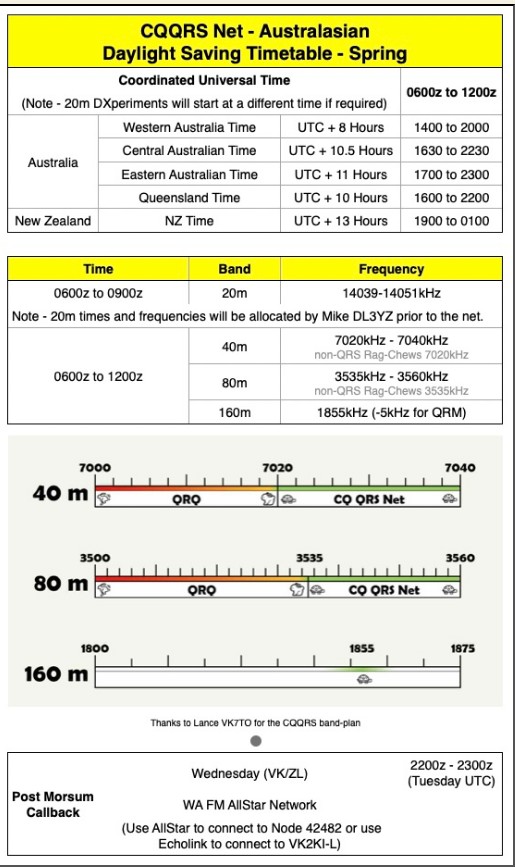
Doesn’t matter whether you’re brand new and want to try just exchanging callsigns and RST reports, or you’re ready for a good old rag chew. We’ll have fun.
There’s usually people around until after 1200Z – so keep calling in the segment of the band designated in the table below until you catch someone.
Reports & Photos
Please let us know via our Reports form bit.ly/CQQRSNET who you work or hear on Tuesday’s Group. The report form closes at 1pm (Eastern Australian time) on Thursday. And how about helping to make the reports even more interesting by sending a photo?
If you have a photo that you’d be happy to include, please email it to: cqqrsnet@gmail.com And of course, we’re always on the lookout for more photos for the newsletter, so if you have something that might be of interest aside from the reports, please send it through as well.
Email to cqgrsnet@gmail.com please. Oh and by the way, I recommend that you don’t keep the Reports Form website open between submission of reports from one week to the next.
If you’re unlucky, there’s an undocumented feature in the software that could cause your current week’s report to be combined with your previous report – it’s happened to your editor several times – much to the chagrin of our Reports editor 🙂
Post Morsum
Richard VK6HRC will run our phone Post Morsum on the South West AllStar net (via repeaters and hotspots all over WA) from 0600 WA time, then from 0700 WA time on 80m (8605 LSB).
See https://bit.ly/CQQRSWebsite and navigate to the Net Details page for details of how you can connect via Echolink from anywhere in the world.
Articles
Could you write a short article or articles for RagChew? You bet! Writing not your strong point? Don’t worry, I’m very happy to help as much or as little as needed.
Oh, and one more thing (actually two) – copyright material: * please use your own images – don’t use images copied from the internet unless you have the producer’s permission, or they’re marked ‘Creative Commons’ or similar; ¢ if you include other peoples’ written material, unless you have permission, you may only include small snippets (unless it’s marked ‘Creative Commons’ or similar), and you’ll need to site the source and author.
For more guidance on writing for the RagChew newsletter (including how you might even try using one of the new Artificial Intelligence tools), head to our website bit.ly/CQQRSWebsite then click the menu on the top right and then click RagChew Newsletter.
Material
A reminder; if you send me any information by email, our report form or WhatsApp – unless you specifically state that material is not to be published, I’ll assume that you’re happy to see your thoughts in the RagChew newsletter.
Teamwork
Thank you so much to our team of 31 contributors: G7BED, MONNK, SWL-Jack, VK2GAS, VK2IOW, VK2RU, VK2WP, VKSAAP, VK3ACU, VK3BWN, VK3DRQ, VK3KLE, VK3WOW, VK4AW, VK4AW, VK4BRO, VK4EV, VK4IM, VK5AO, VK5ET, VK5FD, VK6HRC, VK6JDM, VK6KD, VK6KHZ, VK6POP, VK7TA, VK7TO, VK7WW, ZL3ABX and ZL38TK.
And a special thank you to our editorial team, Nigel G4RWI (head of software development), Patrick VK2IOW (reports coordinator), John VK2RU (spreadsheet pilot), Richard VK6HRC (Post Morsition) and Lance VK7TO (archiving bit wrangler). Great work all!
GU CW on Tuesday, mb Mark Bosma VK2KI / VK6QI Beautiful South Bowning NSW cqqrsnet@gmail.com non impediti ratione cogitationis
About the CQ QRS Net
For the current schedule and more information about the CQQRS net, please go the the Net Details page on our website:

The opinions expressed in the RagChew newsletter are those of the individual contributors. The opinions do not necessarily reflect that of the editors or of the CQQRS Group members.
Any material and images received from members by the editor or published on the CQQRS WhatsApp groups may be published in this newsletter unless specifically requested otherwise.
The RagChew newsletter is considered to be exempt from the Australian Government’s ban on social media for under 16 year olds because it is a service that has the primary purpose of enabling users to share information about products or services, engage in professional networking or professional development services or of supporting the education of users per the Australian Government eSafety Commissioner FAQ webpage “Which platforms have been excluded from the age restrictions” dated 10DEC25.
The values, doctrine and guidelines for the Group and for the newsletter are published on the Principles page of the group’s website https://bit.ly/CQQRSWebsite